Article

Sensitivity of Pyrenophora tritici-repentis Isolates from Kazakhstan to QoI and DMI Fungicides

by
Madina Kumarbayeva
1,*,
Alma Kokhmetova
1,*,
Makpal Nurzhuma
1,2,
Yuliya Zeleneva
3,
Zhenis Keishilov
1,4,
Ardak Bolatbekova
1,4,
Nadezhda Kovalenko
3,
Aidana Kharipzhanova
1,
Bakyt Ainebekova
5 and
Kanat Bakhytuly
1
1
Department of Genetics and Breeding, Institute of Plant Biology and Biotechnology, Almaty 050040, Kazakhstan
2
Faculty of Biology and Biotechnology, Al-Farabi Kazakh National University, Almaty 050040, Kazakhstan
3
All-Russian Research Institute of Plant Protection, St. Petersburg 196608, Russia
4
Faculty of Agrobiology, Kazakh National Agrarian Research University, Almaty 050010, Kazakhstan
5
Kazakh Research Institute of Agriculture and Plant Growing, Almalybak 040909, Kazakhstan
*
Authors to whom correspondence should be addressed.
Agronomy 2026, 16(12), 1137; https://doi.org/10.3390/agronomy16121137 (registering DOI)
Submission received: 8 May 2026 / Revised: 29 May 2026 / Accepted: 6 June 2026 / Published: 10 June 2026

Abstract

Tan spot of wheat, caused by the fungus Pyrenophora tritici-repentis (Ptr), is one of the most destructive foliar diseases of wheat worldwide and in Kazakhstan. Expansion of wheat plantings, the adoption of no-till methods, and the use of ineffective fungicides contribute to the accumulation of inoculum and the spread of the pathogen. Despite the important role of fungicides in plant protection, data on the susceptibility of Ptr populations in Kazakhstan are lacking. This study, for the first time, assessed the susceptibility of Ptr isolates from various regions of Kazakhstan to QoI and DMI fungicides. A predominance of genotypes associated with ToxA (82.9%) was found, with a limited distribution of ToxB (7.9%). Propiconazole demonstrated the highest efficacy, inhibiting mycelial growth by an average of 70.85%, followed by pyraclostrobin (69.04%), while azoxystrobin demonstrated lower efficacy (41.47%). Molecular analysis revealed the widespread prevalence of the G143A mutation in the cytochrome b gene, associated with resistance to the QoI fungicide. These results indicate the emergence of strobilurin resistance in Ptr populations in Kazakhstan and highlight the need for regular monitoring of fungicide susceptibility and the development of effective resistance management strategies.

1. Introduction

Wheat (Triticum aestivum L.) is one of the most widely cultivated cereal crops worldwide and serves as a staple food source for nearly 40% of the global population, providing approximately 20% of dietary protein and caloric intake [1]. According to the Food and Agriculture Organization, global wheat production reached 800.1 million tons in 2025 [2]. Further increases in wheat production are required to meet the growing global demand. However, climate change and the increasing occurrence of wheat disease epidemics substantially reduce grain yield and quality. It is estimated that approximately 15–40% of the global wheat harvest is lost annually due to diseases. In this context, the development and implementation of effective and sustainable disease management strategies are essential for maintaining stable wheat production [3].
In Kazakhstan, the phytopathogenic complex of cereal crops is predominantly represented by rust diseases and wheat root rots [4,5,6,7,8,9,10]. However, recent studies from Kazakhstan and neighboring regions of Central Asia have confirmed the increasing distribution and epidemiological importance of tan spot and other wheat leaf blotch diseases under local agroecological conditions [11,12,13,14,15,16]. Tan spot of wheat, caused by the ascomycete Pyrenophora tritici-repentis (Ptr), is considered one of the most aggressive foliar diseases of wheat both worldwide and in Kazakhstan [17,18,19,20]. Surveys of wheat-growing areas in Central Asia and Kazakhstan have demonstrated that tan spot is widely distributed in wheat crops and, under epiphytotic conditions in major wheat-producing regions, can result in substantial yield losses (up to 50–65% or more), accompanied by deterioration in grain quality [21].
Due to the increasing importance of tan spot, considerable attention has been devoted worldwide to studies investigating its pathogenicity and impact on wheat production [22,23]. The inheritance pattern of Pyrenophora tritici-repentis follows an inverse gene-for-gene interaction with its host, wheat, genetically mediated by dominant virulence in the pathogen and dominant susceptibility in the host [24]. P. tritici-repentis produces several host-selective toxins, three of which have been identified as Ptr ToxA, Ptr ToxB, and Ptr ToxC. Ptr ToxA is the only toxin causing necrosis and is encoded by the ToxA gene. Ptr ToxB and Ptr ToxC induce chlorosis, with ToxB representing a proteinaceous toxin encoded by the multicopy ToxB gene [25,26]. Based on the ability of the pathogen to produce different combinations of these three toxins, eight distinct races have been identified worldwide [27]. Studies on the population structure of P. tritici-repentis in Kazakhstan have attracted attention since the early 2000s and continue to the present day [28,29]. As previously reported, the distribution and prevalence of races in Kazakhstan vary depending on geographic and climatic zones and differ between years. Races 1, 3, 4, 6, and 8 were identified during 2013–2015 [30,31], whereas races 1, 2, 3, 7, and 8 were detected in 2018 [19], and seven races were reported in 2020 [32]. Overall, races 1, 2, and 8 predominated in the P. tritici-repentis population of Kazakhstan during the period from 2003 to 2020.
Management of tan spot is primarily achieved through available control strategies, particularly breeding approaches aimed at developing resistant cultivars [33]. In addition to host resistance, effective fungicide application and modifications of agronomic practices to minimize inoculum accumulation can substantially reduce yield losses [34]. Chemical control remains one of the most commonly employed strategies for managing Pyrenophora tritici-repentis. Although fungicide application provides effective disease suppression, it also increases production costs. Among the most effective fungicide groups against Ptr are azoles, strobilurins, and carboxamides [35,36,37,38]. QoI fungicides inhibit mitochondrial respiration by blocking electron transfer in the cytochrome bc1 complex. Nevertheless, assays based on spore germination are frequently used for sensitivity testing because spore germination represents one of the most sensitive developmental stages affected by this fungicide group [39]. However, QoI fungicides are classified as high-risk compounds with regard to the development of pathogen resistance [40,41]. Consequently, several cases of resistance to QoI fungicides in wheat and other crops were reported worldwide only a few years after their commercial introduction [42,43]. Strobilurins are frequently formulated as premixes with fungicides possessing post-penetration activity, particularly demethylation inhibitors (DMI) [44]. Therefore, QoI + DMI mixtures have become the most widely used fungicide combinations for wheat disease management globally, and both the frequency and intensity of their application have increased considerably over time [45]. Fungicide efficacy is influenced by the timing of application and the activity of the active ingredients [46,47]. When fungicides are applied at the appropriate growth stage with adequate spray coverage, the sensitivity of the pathogen population to the active ingredients becomes a key factor determining disease control efficiency. Control of P. tritici-repentis mainly relies on fungicides belonging to the DMI (azoles) and QoI (strobilurins) groups [46,48]. Despite the extensive use of QoI fungicides against tan spot of wheat in Kazakhstan [21], their effectiveness has not been sufficiently investigated, largely due to the limited attention given to the fungicide sensitivity of P. tritici-repentis populations.
Only a limited number of studies have investigated the fungicide sensitivity of Pyrenophora tritici-repentis. It is known that P. tritici-repentis has developed target-site mutations associated with increased resistance to QoI fungicides, whereas information regarding resistance to DMI fungicides remains scarce. Three target-site mutations associated with QoI resistance have been reported in P. tritici-repentis: F129L, G143A, and G137R [43,48,49]. Earlier studies indicated a higher prevalence of the F129L mutation compared with G143A in Ptr populations [43,49]. However, more recent investigations suggest that the G143A mutation is becoming increasingly widespread, while F129L is no longer detected in many contemporary populations [50]. Compared with studies conducted on Zymoseptoria tritici, the causal agent of Septoria tritici blotch [51], monitoring of QoI resistance development in Ptr populations has remained extremely limited. More comprehensive investigations are required to evaluate the effectiveness of different fungicide groups in relation to changes in pathogen population structure and the genotype composition of cultivated wheat varieties. Furthermore, the decreasing availability of effective fungicides increases the risk of resistance development in pathogen populations [52].
To date, no studies have been conducted in Kazakhstan to investigate the fungicide sensitivity of Pyrenophora tritici-repentis isolates. Therefore, the characterization of resistance to QoI strobilurin fungicides in Kazakhstani Ptr populations represents an important and timely research objective. The aim of the present study was to evaluate the sensitivity of P. tritici-repentis isolates collected from different regions of Kazakhstan to three active ingredients (pyraclostrobin, azoxystrobin, and propiconazole) using in vitro assays, as well as to identify mutations in the cytochrome b (cytb) gene associated with resistance to QoI fungicides.

2. Materials and Methods

2.1. Collection of Infected Plant Material and Isolation of Pyrenophora tritici-repentis

During 2022–2024, wheat leaves exhibiting symptoms of tan spot were collected from four major wheat-growing regions of Kazakhstan, including fields located in the Almaty, Kostanay, Akmola, and Turkistan regions (Table 1). Wheat leaf samples were randomly collected from fields in both northern and southern parts of the country where, according to surveys of farmers and breeders as well as visual assessment of the phytosanitary status of crops, reduced effectiveness of strobilurin and azole fungicides against leaf blotch diseases had been observed. Pyrenophora tritici-repentis isolates were obtained from samples of bread wheat (Triticum aestivum L.) and durum wheat (Triticum durum Desf.) collected in the principal wheat-producing areas of Kazakhstan. The host cultivars included the local bread wheat varieties Steklovidnaya 24, Bogarnaya 56, Lamis, Aina, Karasay, Alatau, Kazakhstanskaya 10, Zhetysu, Naz, Taimas, Shol, and Krasnovodopadskaya 210, as well as the durum wheat cultivars Asangali 20 and Damsinskaya 2017.
Leaves showing symptoms of tan spot caused by Pyrenophora tritici-repentis were carefully excised and placed in paper envelopes, which were air-dried at room temperature. Fungal isolation and inoculum production were performed according to the method described by Lamari and Bernier [53]. Each fragment of infected material consisted of green tissue surrounding necrotic lesions with chlorotic halos. Leaf segments (0.5–1 cm) were cut and surface-sterilized in 30% ethanol for 20 s, followed by immersion in 1% sodium hypochlorite solution for 2 min, and subsequently rinsed three times with sterile distilled water for 1 min each. A 30% ethanol solution was used to minimize damage to fungal structures and preserve the viability of Pyrenophora tritici-repentis during isolation from infected leaf tissue. The sterilized tissue pieces were placed in Petri dishes containing two layers of sterile filter paper moistened with sterile distilled water to maintain high humidity. Plates were incubated in darkness at 15 °C for 24 h to induce conidial formation on conidiophores [53,54,55]. Following incubation, leaf tissues were examined under a binocular microscope at 40× magnification, and individual conidia identified as P. tritici-repentis were transferred onto V8-PDA medium consisting of 150 mL V8 juice, 10 g potato dextrose agar, 3 g CaCO3, 10 g agar, and 850 mL distilled water. Petri dishes were incubated for 5 days at 21 ± 1 °C under alternating light conditions until colonies reached approximately 4 cm in diameter, as previously described [32]. Ptr isolates were maintained on V8 agar at 21 °C under a 12 h light/12 h dark photoperiod and preserved using two methods: (a) storage in cryovials containing sterile water at 4 °C and (b) storage in 20% glycerol solution at −40 °C. A total of 76 monosporic isolates of P. tritici-repentis were included in the study.

2.2. Morphological Identification of Pyrenophora tritici-repentis Isolates

Isolates were preliminarily identified based on colony and conidial morphology following cultivation on V8 and PDA media. All recovered isolates were subsequently analyzed to confirm their taxonomic identity. Conidia were produced by culturing isolates on V8A medium for 5–7 days at 21 ± 1 °C under a 12 h light/12 h dark photoperiod. For each isolate, the length and width of 50 conidia were measured, and the number of septa was recorded. Morphological measurements were performed under a light microscope at 40× magnification using a digital camera system (UNISON-8PE Digital mounted on a BE580 Series microscope, AmScope (United Scope, LLC), Irvine, CA, USA).

2.3. Induction of Sporulation and Collection of Conidia

Conidia were produced according to the methods described by Lamari and Bernier [53] and Tonin [56], with minor modifications. Mycelial plugs (5 mm diameter) were excised from actively growing colonies on V8 medium using a cork borer and transferred onto fresh V8 agar plates. The plates were incubated in a growth chamber (Percival Scientific Inc., Perry, IA, USA) under continuous darkness at 21 ± 1 °C for 7 days. The incubation period was adjusted to prevent the mycelium from reaching the edge of the Petri dish, maintaining approximately 1 cm of agar free of mycelial growth between the colony margin and the plate edge. The colony surface was then gently scraped under sterile distilled water using a sterile glass spatula and the base of a glass rod sterilized with 96% ethanol and flame-treated. Excess water was decanted, and the plates were further incubated for 24 h at 21 ± 1 °C under continuous light, followed by an additional 24 h at 15 ± 0.1 °C in darkness. After a total incubation period of 9 days from the initial transfer of mycelial plugs, conidia were harvested by adding 7 mL of sterile distilled water to each Petri dish and gently dislodging conidia from conidiophores using a camel-hair brush (#20). The resulting conidial suspension was adjusted to a concentration of 103 spores/mL in 14 mL Falcon tubes, maintained on ice, and subsequently used in further experiments.

2.4. In Vitro Sensitivity Assessment of P. tritici-repentis Isolates to Fungicides

The effects of three fungicide active ingredients on mycelial growth inhibition were evaluated following the methodology described by Sautua et al. [57]. In vitro fungicide sensitivity assays were performed using 76 Pyrenophora tritici-repentis isolates. For EC50 estimation, 20 isolates were randomly selected from the total population of 76 isolates. The selected subset included representatives from all sampled geographic regions and encompassed the range of fungicide sensitivity phenotypes identified during the preliminary screening assays. Mycelial plugs (5 mm diameter) obtained from actively growing two-week-old colonies of P. tritici-repentis were used as inoculum and transferred onto Petri dishes containing potato dextrose agar (PDA; Scharlau, Sentmenat, Spain) amended with one of the three tested fungicides. Although spore germination assays are frequently used for evaluating sensitivity to QoI fungicides, mycelial growth inhibition assays on fungicide-amended PDA medium were selected in the present study because they provide a standardized and reproducible approach for comparative evaluation of a large number of isolates under uniform experimental conditions. The evaluated active ingredients are registered for the control of wheat leaf blotch diseases in Kazakhstan and are widely used by farmers and breeding programs: Optimo 20% (200 g/L pyraclostrobin, BASF SE, Ludwigshafen, Germany), Intrada (200 g/L azoxystrobin, August JSC, Moscow, Russia), and Tilt 250 (250 g/L propiconazole, Syngenta Crop Protection AG, Basel, Switzerland). Isolate sensitivity was assessed by culturing the fungus on media containing fungicides at concentrations of 0 (control), 0.01, 0.1, 1, 10, and 100 mg/L. Plates were incubated in darkness at 21 ± 1 °C for 7 days. Three replicates were prepared for each isolate × concentration combination. After incubation, colony diameter was measured twice in millimeters using a digital caliper, and the average value was calculated [58].
Sensitivity of the isolates was expressed as the percentage inhibition (%) of fungal linear growth (I), calculated according to Abbott’s formula:
I = ( C T ) C   ×   100 %
where
I—the percentage inhibition of fungal linear growth (%);
C—the mean colony diameter in the control treatment;
T—the colony diameter in fungicide-amended treatments.
To determine the range of half-maximal effective concentration (EC50) values of fungicide active ingredients in the Pyrenophora tritici-repentis population, 20 isolates representing different regions of Kazakhstan were randomly selected. The selected isolates were cultured under the same conditions described above at different fungicide concentrations (0.01, 0.1, 1, 10, and 100 mg/L), including an untreated control, with three replicates per treatment. EC50 values were estimated using R software version 4.3.2 and the EC50 estimator package in GraphPad Prism version 8.0 (GraphPad Software, San Diego, CA, USA). The distribution of EC50 values was assessed for normality using QQ plots, the Shapiro–Wilk test, and Pearson’s correlation coefficient in the R environment [59]. Differences among fungicide concentrations were analyzed using analysis of variance (ANOVA), and pairwise comparisons were performed using Tukey’s HSD post hoc test at p < 0.05. Homogeneity of variances was evaluated using Levene’s test. Each Petri dish containing a single P. tritici-repentis isolate grown at a given fungicide concentration was considered an experimental unit.

2.5. Genomic DNA Extraction from Pyrenophora tritici-repentis Isolates

Pyrenophora tritici-repentis isolates were cultured for 3 weeks in Fries liquid medium supplemented with 1.5% yeast extract [60]. Mycelial mats were harvested and used for genomic DNA extraction. Briefly, 40 mg of lyophilized mycelium from each isolate was processed using the DNeasy Plant Mini Kit (Qiagen, Hilden, Germany) according to the manufacturer’s protocol for plant material. The extracted DNA was subsequently purified by two phenol–chloroform extractions (1:1, v/v), followed by a single chloroform extraction. DNA concentration was determined using an EzDrop 1000C spectrophotometer (BLUE-RAY BIOTECH CORP., New Taipei City, Taiwan), and DNA samples were diluted to a final concentration of 10–20 ng/µL for PCR analysis [61].

2.6. Molecular Identification of P. tritici-repentis Isolates: Amplification and Sequencing of ITS, CHS-1, ToxA, ToxB, PTM, and Cytb

Using the primers listed in Table 2, fragments of the internal transcribed spacer (ITS) region, the chitin synthase gene (CHS-1), and the ToxA, ToxB, and PTM genes were amplified from genomic DNA. PCR reactions were performed in a total volume of 25 µL containing 2.5 µL genomic DNA (20 ng), 1 µL of each primer (1 pM/µL) (Sigma-Aldrich Company Ltd., Gillingham, Great Britain), 2.5 µL dNTP mix (2.5 mM aqueous solution of dCTP, dGTP, dTTP, and dATP) (SibEnzyme Ltd., Novosibirsk, Russia), 2.5 µL MgCl2 (25 mM), 0.2 µL Taq DNA polymerase (5 U/µL) (SibEnzyme Ltd., Novosibirsk, Russia), 2.5 µL of 10× PCR buffer, and 12.8 µL deionized water (ddH2O). Negative controls contained sterile water instead of template DNA. Aliquots of 7–10 µL of each PCR product mixed with 3 µL loading dye were separated by electrophoresis using a MultiSUB Choice Trio system (Cleaver Scientific, England, UK) at 10 V/cm for 50 min in 1% agarose gels alongside a 1 Kb Plus DNA Ladder (Vivantis, Kuala Lumpur, Malaysia). Gels were stained with ethidium bromide and visualized using a Gel Documentation System (MEGA-BIOPRINT 1100-20M Xpress LED’s Bar Epi-Illumination, Paris, France). The presence of an amplicon of the expected size for each primer pair was considered indicative of the corresponding target gene [62].
Potential mutations in the QoI target site of the cytochrome b (cytb) gene were investigated in all 76 Pyrenophora tritici-repentis isolates included in this study. Two regions of the cytb gene were amplified using the primer pairs Cytb_F129_F/Cytb_F129_R and Cytb_G137_G143_F/Cytb_G137_G143_R according to the protocol described by Sautua and Carmona [49]. PCR amplification was verified by electrophoretic separation of PCR products in 1.2% agarose gels. Purified PCR products (1 µL) were directly sequenced using the BigDye® Terminator v3.1 Cycle Sequencing Kit (Thermo Fisher Scientific, Vilnius, Lithuania) with the same primers used for amplification. Sequencing reactions were analyzed on an ABI 3730xl Genetic Analyzer (Applied Biosystems, Foster City, CA, USA).
The obtained sequences were compared with reference sequences available in GenBank using the Megablast algorithm implemented in the NCBI BLASTn platform (https://blast.ncbi.nlm.nih.gov/Blast.cgi?PROGRAM=blastn; accessed on 20 May 2024). The presence of target-site mutations was determined by sequence alignment against previously published P. tritici-repentis cytb gene sequences available in the NCBI GenBank database [37,43].

3. Results

3.1. Collection of Pyrenophora tritici-repentis Isolates

A total of 76 monosporic isolates identified as Pyrenophora tritici-repentis were included in the study. Isolate identification was based on colony morphology and conidial characteristics. Colonies grown on V8 medium produced dense gray mycelium with whitish margins, which is typical for this species. The isolates formed characteristic solitary conidia that were straight or slightly curved, cylindrical in shape, and rounded at the apex, with a distinctly conical or snake-head-shaped basal cell. Conidia were generally hyaline to pale straw-colored, smooth, and thin-walled, corresponding to the typical morphology of P. tritici-repentis. The mean conidial length was 175.3 µm (range 105.0–210.0 µm), the mean conidial width was 26.7 µm (range 21.0–34.0 µm), and the average number of septa was 4.6 (range 3–7) (Supplementary Figure S1).

3.2. Molecular Identification of P. tritici-repentis Isolates

Molecular characterization of 76 Pyrenophora tritici-repentis isolates confirmed their taxonomic identity and enabled assessment of virulence-associated gene distribution within the population. The chitin synthase gene (CHS-1) was successfully amplified in all isolates, confirming both the quality and amplifiability of the extracted DNA. Amplification of the ITS region was obtained for all analyzed isolates (100%), further supporting their identification as Pyrenophora tritici-repentis. In contrast, amplification with the PTM-specific marker pair (PTM-F/PTM-R) was not detected in any isolate (0%), excluding the presence of Pyrenophora teres f. maculata in the analyzed collection. The ToxA gene was detected in 63 Ptr isolates (82.9%), indicating the predominance of ToxA-producing races in the studied population. The high prevalence of this effector gene suggests its important contribution to the pathogenicity of wheat tan spot in the surveyed regions. In comparison, the ToxB gene was identified only in 6 isolates (7.9%), reflecting the low frequency of ToxB-associated races. Among the analyzed isolates, 6 (7.9%) carried both ToxA and ToxB, corresponding to race 2. A total of 57 isolates (75%) possessed only ToxA in the absence of ToxB, indicating race 7, whereas 13 isolates lacked both toxin genes, suggesting their possible classification as race 4 (Supplementary Table S1).

3.3. In Vitro Mycelial Growth Inhibition Assays of P. tritici-repentis Isolates to Fungicides

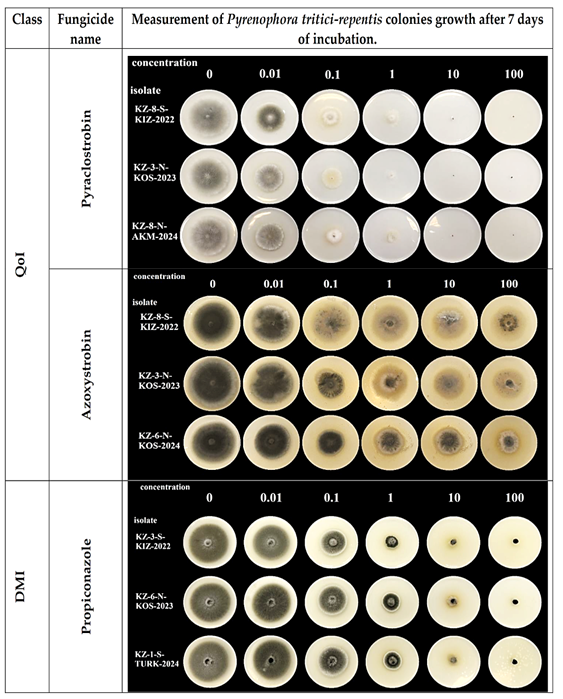
Mycelial growth of Pyrenophora tritici-repentis was significantly inhibited by all tested fungicides, confirming their biological activity against this pathogen. In all experimental treatments, a clear dose-dependent response was observed, whereby increasing concentrations of fungicide active ingredients resulted in a progressive reduction in the radial growth rate of fungal colonies. These results indicate a direct relationship between the degree of growth inhibition and fungicide exposure level. At the same time, substantial differences in the efficacy of the tested active ingredients were detected, as reflected by variations in the level of mycelial growth suppression at equivalent concentrations. These differences may be associated with the distinct modes of action of the fungicides as well as differential sensitivity among P. tritici-repentis isolates, suggesting variability in resistance levels within the pathogen population. The growth dynamics and colony morphology of Pyrenophora tritici-repentis isolates on PDA medium amended with pyraclostrobin, azoxystrobin, and propiconazole at different concentrations are presented in Figure 1. For each fungicide and incubation period, fungicide concentrations on the Petri dishes increased progressively from left to right.
ANOVA revealed significant differences among fungicide concentrations for pyraclostrobin, azoxystrobin, and propiconazole (p < 0.001). Subsequent Tukey’s HSD post hoc analysis showed that mycelial growth inhibition decreased significantly with decreasing fungicide concentration. However, no significant differences were detected between the 100 and 10 µg/mL concentrations for any of the tested fungicides (Table 3, Supplementary Tables S2–S4).
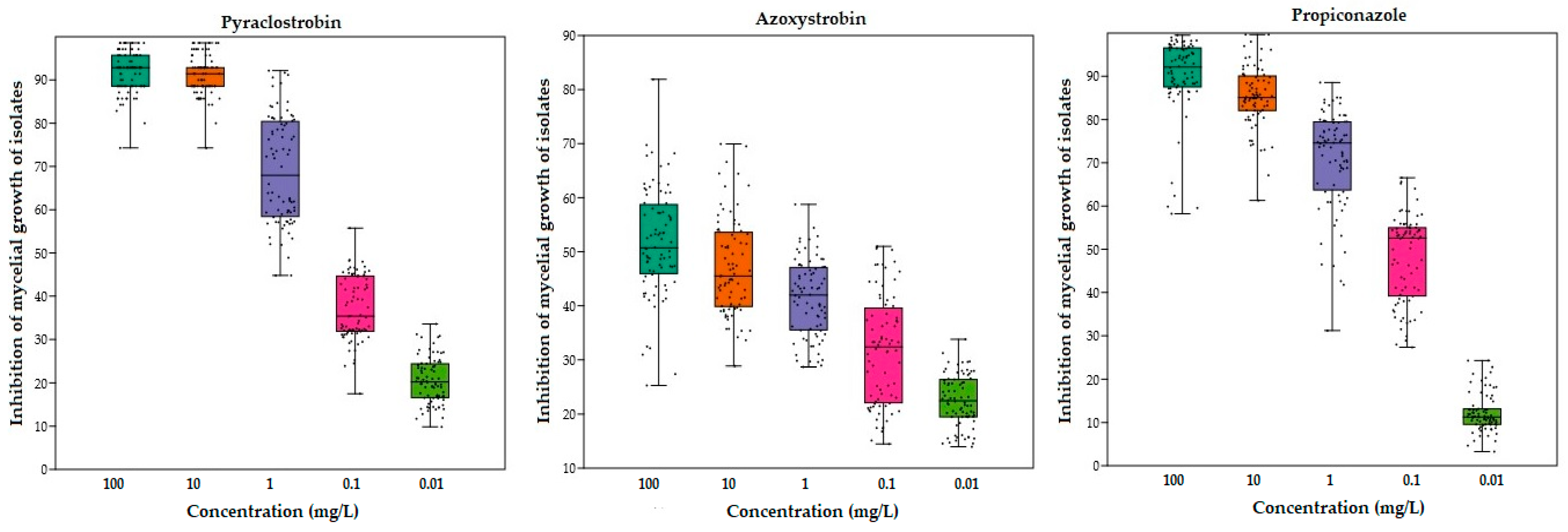
Pyraclostrobin exhibited the highest fungicidal activity across the entire range of tested concentrations. At 100 and 10 mg/L, mycelial growth inhibition reached 91.66% and 91.00%, respectively, indicating nearly complete suppression of fungal development. A high level of inhibition was still maintained at 1 mg/L (69.04%). As the concentration decreased further, the inhibitory effect declined accordingly, reaching 37.27% at 0.1 mg/L and 20.66% at 0.01 mg/L. The consistently high inhibition values observed at concentrations ≥10 mg/L indicate a high level of sensitivity of P. tritici-repentis isolates to pyraclostrobin.
Propiconazole also demonstrated high biological activity against P. tritici-repentis. At a concentration of 100 mg/L, inhibition of mycelial growth reached 90.22%, while 85.95% inhibition was observed at 10 mg/L. At 1 mg/L, the level of growth suppression remained relatively high (70.85%). However, a substantial decline in fungicidal activity was observed at lower concentrations, with inhibition decreasing to 48.08% at 0.1 mg/L and to 12.35% at 0.01 mg/L. These results indicate that propiconazole maintains strong antifungal activity at moderate concentrations but exhibits a marked reduction in efficacy at sublethal doses.
Azoxystrobin exhibited substantially lower fungicidal activity compared with the other two tested active ingredients. The highest level of inhibition recorded at 100 mg/L was 51.76%. Inhibitory activity gradually decreased with decreasing concentrations, reaching 47.38% at 10 mg/L, 41.47% at 1 mg/L, 31.97% at 0.1 mg/L, and 22.58% at 0.01 mg/L. Even at the maximum tested concentration, suppression of Ptr mycelial growth did not exceed 52%, indicating markedly reduced sensitivity of the analyzed isolates to azoxystrobin.
The distribution of mycelial growth inhibition among individual Pyrenophora tritici-repentis isolates at different fungicide concentrations is presented in Figure 2. Boxplots represent the median, interquartile range, and data dispersion, while dots indicate individual isolate responses. Considerable variability in fungicide sensitivity was observed among isolates, particularly at lower fungicide concentrations (Figure 2).
Descriptive statistical analysis revealed substantial differences in central tendency and variability among the evaluated fungicide treatments (Table 4). The highest mean inhibition value was observed for pyraclostrobin (62.06), followed closely by propiconazole (61.49), whereas azoxystrobin showed a considerably lower mean value (39.03). The observed ranges were 24.46–51.26 for azoxystrobin, 47.07–71.26 for propiconazole, and 55.18–66.61 for pyraclostrobin, indicating a comparatively narrower distribution for pyraclostrobin.
Variability parameters demonstrated that pyraclostrobin had the lowest standard deviation (4.01) and coefficient of variation (CV = 6.46%), indicating more consistent performance across experimental units. In contrast, azoxystrobin exhibited the highest relative variability (CV = 16.42%), while propiconazole showed the greatest absolute dispersion (SD = 7.71). Skewness values were close to zero (0.03–0.51), and kurtosis values were slightly negative, suggesting approximately normal and moderately platykurtic distributions. The close agreement between arithmetic and geometric means further supports the absence of pronounced distributional asymmetry.
Significant correlations (p < 0.05) were detected among the inhibition responses of P. tritici-repentis isolates to all three tested active ingredients. The strongest positive correlation was observed between azoxystrobin and propiconazole (r = 0.711), followed by the correlation between pyraclostrobin and propiconazole (r = 0.624). A moderate positive correlation was identified between azoxystrobin and pyraclostrobin (r = 0.488).
EC50 values varied considerably among isolates and fungicide active ingredients, indicating heterogeneous sensitivity within the Pyrenophora tritici-repentis population (Table 5). The calculated EC50 estimates were accompanied by standard errors (SE), 95% confidence intervals (95% CI), and coefficients of determination (R2), which indicated an adequate fit of the dose–response models and satisfactory precision of the estimates.
For azoxystrobin, EC50 values ranged widely from 1.019 to 10.634 mg/L, reflecting substantial variability in isolate sensitivity. The highest levels of reduced sensitivity to azoxystrobin were observed in isolates KZ-22-KIZ-2024 (10.634 ± 0.52 mg/L), KZ-8-ZHAM-2024 (7.272 ± 0.862 mg/L), and KZ-55-IF-KIZ-2024 (7.169 ± 0.856 mg/L). The EC50 range for azoxystrobin exceeded a tenfold difference between minimum and maximum values, suggesting the possible emergence of populations with reduced sensitivity.
In contrast, EC50 values for pyraclostrobin were considerably lower, ranging from 1.006 to 2.808 mg/L. The highest EC50 values were recorded for isolates KZ-1-ZHAM-2024 (2.808 ± 0.448 mg/L) and KZ-2-ENB-2024 (2.673 ± 0.427 mg/L). Compared with azoxystrobin, the variability range for pyraclostrobin was substantially narrower, indicating a more uniform sensitivity profile within the analyzed population.
The lowest EC50 values were recorded for propiconazole, ranging from 0.159 to 1.858 mg/L. Overall, propiconazole exhibited the lowest EC50 values among the tested fungicides, indicating high efficacy of this azole compound against the analyzed isolates.
To assess the conformity of EC50 values to a normal distribution, log-transformed EC50 data were evaluated using visual inspection of Q–Q plots and the Shapiro–Wilk test. Visual examination of the Q–Q plots demonstrated that, for all three fungicides, the data points were predominantly aligned along the diagonal reference line, indicating that the log-transformed EC50 values approximated a normal distribution (Supplementary Figure S2).

3.4. Cytb Amplification Results

Analysis of mutation frequency in the cytochrome b gene revealed a high prevalence of substitutions associated with fungicide resistance. The G143A mutation was detected in 74 isolates, representing 97.37% of the analyzed population, indicating its dominant occurrence. In contrast, the F129L and G137R mutations were not detected in any of the analyzed Pyrenophora tritici-repentis isolates. The high frequency of the G143A substitution suggests strong selective pressure, likely associated with the long-term use of QoI fungicides, and indicates the widespread distribution of resistance linked to this mutation. The absence of alternative mutations (F129L and G137R) further suggests that G143A currently represents the principal molecular mechanism underlying QoI resistance in the studied population, whereas other target-site substitutions do not appear to contribute substantially to resistance development at present.

4. Discussion

The present study represents the first comprehensive investigation of the in vitro sensitivity of Kazakhstani Pyrenophora tritici-repentis (Ptr) isolates to several widely used fungicides. Since its emergence in the early 2000s, tan spot has become one of the predominant wheat diseases in Kazakhstan [21]. Similar to other major wheat-producing regions worldwide, disease management in Kazakhstan largely relies on fungicide applications for the control of wheat pathogens. The effectiveness of pathogen control and the reduction in their negative impact on grain yield and quality are strongly dependent on the timely application of fungicide treatments. Compared with Pyrenophora tritici-repentis, considerably more information is available regarding fungicide efficacy and target-site mutations affecting fungicide sensitivity in pathogens such as Zymoseptoria tritici and Puccinia striiformis [46,67]. Only a limited number of studies conducted in Europe, Canada, and Argentina have evaluated the effects of different fungicide active ingredients on Ptr mycelial growth [43,49,68]. In Kazakhstan, however, investigations concerning the sensitivity of Ptr populations to fungicides have not previously been conducted.
QoI fungicides, including azoxystrobin and pyraclostrobin, are widely used in many countries for the management of wheat tan spot. In Kazakhstan, fungicides belonging to the DMI and QoI classes represent the most commonly applied chemical agents against Ptr. The present study demonstrated variability in fungicide sensitivity within the Kazakhstani population of P. tritici-repentis. Fungicide performance was largely determined by the specific active ingredient, as reflected in differences in isolate sensitivity even among compounds sharing the same mode of action. It should be noted that the present study evaluated fungicide sensitivity using mycelial growth inhibition assays rather than spore germination assays. Therefore, the obtained results should be interpreted primarily as indicators of relative sensitivity patterns among isolates. Since QoI fungicides often exhibit their greatest biological effects during the spore germination stage, mycelial growth assays may not fully reflect all aspects of QoI sensitivity under field conditions. Strobilurin fungicides such as azoxystrobin and pyraclostrobin have become among the most extensively used fungicides worldwide due to their relatively low toxicity and high antifungal efficacy [69]. Sensitivity to strobilurins has previously been documented in several fungal pathogens in Europe. Sensitivity to strobilurins has previously been documented in several fungal pathogens in Europe [70]. Ptr isolates collected in North Dakota exhibited EC50 values ranging from 0.0013 to 0.0027 µg/mL, with a mean value of 0.0017 µg/mL for pyraclostrobin [70]. In the present study, higher EC50 values for pyraclostrobin were observed, ranging from 1.006 to 2.808 mg/L, although the fungicide still demonstrated relatively high efficacy against the analyzed Kazakhstani isolates.
Baseline sensitivity data for European Ptr isolates reported EC50 values for azoxystrobin ranging from 0.007 to 0.7 µg/mL [43]. In contrast, isolates from the Kazakhstani population exhibited a substantially broader EC50 range, from 1.019 to 10.634 mg/L, indicating pronounced variability in sensitivity.
Among the tested active ingredients, propiconazole exhibited the lowest EC50 values, ranging from 0.159 to 1.858 mg/L. These findings are generally consistent with previous data, in which isolates from the Australian population demonstrated a mean EC50 value of 0.39 µg/mL for propiconazole [71]. A similar trend in sensitivity variability was also reported for Ptr isolates collected in Oklahoma and Texas [72], which showed a mean EC50 value of 0.04 µg/mL for propiconazole, substantially lower than the values observed in the present study.
ITS sequences obtained using the BMB-CR/ITS-4b primer pair [73] enabled reliable differentiation of Pyrenophora tritici-repentis isolates. The ToxA gene was detected in 82.9% of the analyzed isolates, whereas ToxB was identified in only 7.9% of the collection. The low frequency of ToxB is consistent with our previous studies, in which this gene was detected only in a limited number of Ptr isolates from Kazakhstan [32]. The obtained results indicate a heterogeneous population structure of Ptr with respect to necrotrophic effector gene composition. The predominance of isolates carrying only ToxA (75%) suggests the dominance of race 7, which may reflect adaptation of the pathogen to wheat genotypes harboring the susceptibility gene Tsn1. The occurrence of isolates possessing both ToxA and ToxB (7.9%) indicates the presence of race 2, which is known to exhibit a broader virulence spectrum [74]. In contrast, isolates lacking both toxin genes (race 4) may reflect the existence of alternative pathogenicity mechanisms or reduced aggressiveness [75]. Overall, these findings confirm the racial diversity of the P. tritici-repentis population and highlight the importance of considering pathogen race composition in breeding programs for disease-resistant wheat cultivars.
QoI fungicides target the cytochrome b (cytb) site within mitochondrial complex III and, consequently, may promote the development of fungicide resistance. Resistance to QoI fungicides is primarily associated with point mutations in the cytb gene [76]. Argentine researchers demonstrated that QoI resistance in Ptr isolates is linked to three cytb mutations resulting in amino acid substitutions associated with reduced fungicide sensitivity [47]. Although QoI fungicides are active across multiple developmental stages of the pathogen, the spore germination stage is considered the most sensitive to these compounds. Resistance to QoI fungicides in Pyrenophora teres and P. tritici-repentis was first reported in 2003 in France, Sweden, Germany, and Denmark [69,77].
Initially, European isolates with reduced sensitivity predominantly carried the F129L mutation, which is known to confer a lower level of resistance compared with the G143A substitution [48]. Subsequently, both F129L and G143A mutations were identified in European populations of Pyrenophora tritici-repentis [43,70]. More recent studies indicate that the G143A substitution has become the dominant resistance-associated mutation in European Ptr populations [41]. Similarly, Argentine isolates of Ptr were reported to harbor the G143A mutation in the cytb gene, whereas the F129L and G137R substitutions were absent [49]. Comparable findings were obtained in Latvia, where the G143A mutation was detected in cytb sequences, while no evidence of F129L or G137R mutations was observed [64]. In the present study, the G143A mutation in the cytochrome b gene was identified in 74 Kazakhstani P. tritici-repentis isolates, indicating the establishment of QoI resistance within the analyzed population. In contrast, the F129L and G137R mutations were not detected in any of the studied isolates.
The significant positive correlations found between the inhibition responses to azoxystrobin and propiconazole (r = 0.711) and between pyraclostrobin and azoxystrobin (r = 0.624) indicate similar sensitivity patterns of Pyrenophora tritici-repentis isolates to fungicides belonging to the QoI and DMI classes. These relationships may reflect common physiological responses or shared resistance-related trends within the studied population. The positive correlation observed between sensitivity to azoxystrobin and pyraclostrobin is likely associated with their shared mode of action, since both fungicides belong to the QoI class. This relationship may also indicate potential cross-sensitivity or cross-resistance associated with mutations in the cytochrome b gene affecting fungicide binding to the target site [48]. The obtained results confirm the presence of the G143A mutation in the cytochrome b gene within the Kazakhstani population of Pyrenophora tritici-repentis, indicating the development of resistance to QoI fungicides and a reduction in their efficacy. These findings are consistent with recent monitoring reports from the Fungicide Resistance Action Committee, which document the increasing prevalence of QoI resistance among phytopathogenic fungal populations [50].
To prevent the further development of fungicide insensitivity, systematic monitoring of phytopathogen populations is essential. Such monitoring is particularly important for newly introduced fungicide classes, as it enables the establishment of baseline sensitivity levels that can serve as reference points for future assessments of population shifts. This approach facilitates the early detection of changes in pathogen sensitivity and supports the development of effective resistance management strategies.

5. Conclusions

This study provides the first assessment of the sensitivity of Pyrenophora tritici-repentis populations in Kazakhstan to QoI and DMI fungicides. The obtained results indicate the widespread occurrence of resistance to QoI fungicides, supported by the high proportion of isolates with reduced sensitivity and the frequent detection of the G143A mutation in the cytochrome b gene. These findings suggest an increasing risk of reduced efficacy of strobilurin-based fungicides under current disease management practices, whereas the F129L and G137R mutations were not detected. The identified resistance patterns emphasize the importance of integrated resistance management strategies, including fungicide rotation, the use of active ingredients with different modes of action, deployment of resistant wheat cultivars, and optimization of agronomic practices. Continuous monitoring of fungicide sensitivity will be essential for improving wheat disease management programs and limiting the spread of resistant P. tritici-repentis populations.

Supplementary Materials

The following supporting information can be downloaded at: https://www.mdpi.com/article/10.3390/agronomy16121137/s1. Table S1. Molecular characterization and geographic origin of Pyrenophora tritici-repentis isolates collected in Kazakhstan. Table S2. Statistical analyses (ANOVA and Levene’s test) of pyraclostrobin effects on mycelial growth inhibition of Pyrenophora tritici-repentis. Table S3. Statistical analyses (ANOVA and Levene’s test) of azoxystrobin effects on mycelial growth inhibition of Pyrenophora tritici-repentis. Table S4. Statistical analyses (ANOVA and Levene’s test) of propiconazole effects on mycelial growth inhibition of Pyrenophora tritici-repentis. Statistical analyses (ANOVA and Levene’s test) of pyraclostrobin, azoxystrobin and propiconazole effects on mycelial growth inhibition of Pyrenophora tritici-repentis. Figure S1. Visualization of P. tritici-repentis conidia (40× magnification). Figure S2. Q–Q plots of log10-transformed EC50 values of Pyrenophora tritici-repentis isolates for azoxystrobin, pyraclostrobin, and propiconazole.

Author Contributions

Conceptualization, A.K. (Alma Kokhmetova) and M.K.; methodology, A.K. (Alma Kokhmetova) and M.K.; software, M.K.; validation, Y.Z. and N.K.; formal analysis, M.N.; investigation, M.K., Y.Z., M.N., Z.K., A.B., N.K., A.K. (Aidana Kharipzhanova), B.A., K.B.; resources, M.K. and Y.Z.; data curation, M.K. and A.K. (Alma Kokhmetova); writing—original draft preparation, M.K. and A.K. (Alma Kokhmetova); writing—review and editing, A.K. (Alma Kokhmetova) and Y.Z.; visualization, M.K.; supervision, A.K. (Alma Kokhmetova) and M.K.; project administration, M.K.; funding acquisition, M.K. All authors have read and agreed to the published version of the manuscript.

Funding

This research was funded by the Science Committee of the Ministry of Science and Higher Education of the Republic of Kazakhstan (Grant No. AP22787867 Molecular screening and identification of isolates insensitive to strobulirin fungicides with quinone outside inhibitor QoI in wheat Pyrenophora tritici-repentis population).

Data Availability Statement

The original contributions presented in this study are included in the article/Supplementary Material. Further inquiries can be directed to the corresponding author(s).

Conflicts of Interest

The authors declare no conflicts of interest.

References

  1. Shewry, P.R.; Hey, S. The contribution of wheat to human diet and health. Food Energy Secur. 2015, 4, 178–202. [Google Scholar] [CrossRef] [PubMed]
  2. FAO. Food Outlook—Biannual Report on Global Food Markets. November 2025; Food and Agriculture Organization of the United Nations: Rome, Italy, 2025. [Google Scholar] [CrossRef]
  3. Food and Agriculture Organization of the United Nations (FAO). FAOSTAT Database. Available online: http://www.fao.org/faostat/en/#data/CC (accessed on 24 March 2023).
  4. Kokhmetova, A.; Rathan, N.D.; Sehgal, D.; Malysheva, A.; Kumarbayeva, M.; Nurzhuma, M.; Bolatbekova, A.; Krishnappa, G.; Gultyaeva, E.; Kokhmetova, A.; et al. QTL Mapping for Seedling and Adult Plant Resistance to Stripe and Leaf Rust in Two Winter Wheat Populations. Front. Genet. 2023, 14, 1265859. [Google Scholar] [CrossRef] [PubMed]
  5. Kokhmetova, A.; Bolatbekova, A.; Zeleneva, Y.; Malysheva, A.; Bastaubayeva, S.; Bakhytuly, K.; Dutbayev, Y.; Tsygankov, V. Identification of wheat Zymoseptoria tritici resistance genes in wheat germplasm using molecular markers. Plants 2024, 13, 1113. [Google Scholar] [CrossRef] [PubMed]
  6. Kumarbayeva, M.; Kokhmetova, A.; Keishilov, Z.; Bolatbekova, A.; Mukhametzhanov, K.; Bakhytuly, K. Characterization of wheat leaf rust resistance genes in promising genotypes from Kazakhstan: Molecular screening and field evaluation. Asian J. Agric. Biol. 2025, 2024, 142. [Google Scholar] [CrossRef]
  7. Bolatbekova, A.; Kokhmetova, A.; Dutbayev, Y.; Özer, G.; Kumarbayeva, M.; Bastaubayeva, S.; Kharipzhanova, A.; Nurzhuma, M.; Keishilov, Z.; Kokhmetova, A.; et al. Molecular Marker-Based Identification of Resistance to Bipolaris sorokiniana in Kazakh and Global Wheat Germplasm. Biology 2026, 15, 244. [Google Scholar] [CrossRef]
  8. Kenzhebayeva, S.; Mazkirat, S.; Shoinbekova, S.; Atabayeva, S.; Abekova, A.; Omirbekova, N.; Doktyrbay, G.; Asrandina, S.; Zharassova, D.; Amirova, A.; et al. Phenotyping and exploitation of Kompetitive Allele-Specific PCR assays for genes underpinning leaf rust resistance in new spring wheat mutant lines. Curr. Issues Mol. Biol. 2024, 46, 689–709. [Google Scholar] [CrossRef]
  9. Kenzhebayeva, S.; Shoinbekova, S.; Saifulla, D.; Sadykbek, T.; Serfling, A. Determination of resistance to yellow rust in new breeding mutant lines of spring wheat at adult plant and seedling stages. BIO Web Conf. 2024, 100, 02021. [Google Scholar] [CrossRef]
  10. Kokhmetova, A.; Kumarbayeva, M.; Atishova, M.; Nehe, A.; Riley, I.T.; Morgounov, A. Identification of high-yielding wheat genotypes resistant to Pyrenophora tritici-repentis (tan spot). Euphytica 2021, 217, 97. [Google Scholar] [CrossRef]
  11. Maulenbay, A.; Zakarya, K.; Moldazhanova, R.; Rsaliyev, A. Characterization of Tan Spot Races in Kazakhstan. Agriculture 2022, 12, 1564. [Google Scholar] [CrossRef]
  12. Malakhov, D. The Septoria Leaf Blotch of Wheat in Central Kazakhstan: Prognosis, Evaluation and Monitoring with Remotely Sensed Data. J. Agric. Sci. Technol. Transdiscip. Tech. 2022, 3, 64–73. [Google Scholar] [CrossRef]
  13. Keishilov, Z.; Kokhmetova, A.; Kumarbayeva, M.; Malysheva, A.; Bakhytuly, K. Monitoring of Septoriosis (Septoria tritici) of Wheat in Almaty Region in 2022. Izdenister Natigeler 2023, 2, 225–235. [Google Scholar] [CrossRef]
  14. Mironenko, N.V.; Orina, A.S.; Kovalenko, N.M.; Zubko, N.G. Racial Composition and Variability of the ToxA Gene in Geographically Distant Populations of Pyrenophora tritici-repentis. Biol. Bull. Rev. 2024, 14, S60–S66. [Google Scholar] [CrossRef]
  15. Kokhmetova, A.; Rathan, N.D.; Sehgal, D.; Ali, S.; Zeleneva, Y.; Kumarbayeva, M.; Bolatbekova, A.; Krishnappa, G.; Keishilov, Z.; Kokhmetova, A.; et al. Genetic Dissection of Septoria Tritici Blotch and Septoria Nodorum Blotch Resistance in Wheat Using GWAS. Front. Plant Sci. 2025, 16, 1524912. [Google Scholar] [CrossRef]
  16. Keishilov, Z.; Kokhmetova, A.; Kumarbayeva, M.; Nurzhuma, M.; Bakhytuly, K. Monitoring of Wheat Disease Tan Spot (Pyrenophora tritici-repentis) in the Northern and Southern Regions of Kazakhstan. Izdenister Natigeler 2025, 2, 121–131. [Google Scholar] [CrossRef]
  17. Kokhmetova, A.; Atishova, M.; Madenova, A.; Kumarbayeva, M. Genotyping of wheat germplasm for resistance to toxins of tan spot (Pyrenophora tritici-repentis). J. Biotechnol. 2019, 305, 53. [Google Scholar] [CrossRef]
  18. Kokhmetova, A.M.; Atishova, M.N.; Kumarbayeva, M.T.; Leonova, I.N. Phytopathological screening and molecular marker analysis of wheat germplasm from Kazakhstan and CIMMYT for resistance to tan spot. Vavilov J. Genet. Breed. 2019, 23, 879–886. [Google Scholar] [CrossRef]
  19. Kokhmetova, A.M.; Kovalenko, N.M.; Kumarbayeva, M.T. Pyrenophora tritici-repentis population structure in the Republic of Kazakhstan and identification of wheat germplasm resistant to tan spot. Vavilov J. Genet. Breed. 2020, 24, 722. [Google Scholar] [CrossRef] [PubMed]
  20. Kumarbayeva, M.K.; Kokhmetova, A.M.; Kovalenko, N.M.; Kremneva, O.Y.; Atishova, M.N.; Keishilov, Z.S.; Malysheva, A.A.; Zhanuzak, D.K.; Bolatbekova, A.A.; Kokhmetova, A.M. Identification of Wheat Samples for Resistance to Toxins of Pyrenophora tritici-repentis (Ptr). Int. J. Biol. Chem. 2022, 15, 64–72. [Google Scholar] [CrossRef]
  21. Koishybayev, M.K. Diseases of Wheat; FAO: Ankara, Türkiye, 2018; p. 394. [Google Scholar]
  22. Lamari, L.; McCallum, B.D.; Depauw, R.M. Foren-sic pathology of Canadian bread wheat: The case of tan spot. Phytopathology 2005, 95, 144–152. [Google Scholar] [CrossRef]
  23. Cotuna, O.; Paraschivu, M.; Paraschivu, A.; Sarateanu, V. The influence of tillage, crop rotation and residue management on tan spot Drechslera tritici repentis. Died. Shoemaker in winter wheat. Res. J. Agric. Sci. 2015, 47, 13–21. [Google Scholar]
  24. Lamari, L.; Strelkov, S.E. The wheat/Pyrenophora tritici-repentis interaction: Progress towards an understanding of tan spot disease. Can. J. Plant Pathol. 2010, 32, 4–10. [Google Scholar] [CrossRef]
  25. Balance, G.M.; Lamari, L.; Bernier, C.C. Purifcation and characterization of a host selective necrosis toxin from Pyrenophora tritici-repentis. Physiol. Mol. Plant Pathol. 1989, 35, 203–213. [Google Scholar] [CrossRef]
  26. Ciuffetti, L.M.; Tuori, R.P.; Gaventa, J.M. A single gene encodes a selective toxin causal to the development of tan spot of wheat. Plant Cell 1997, 9, 135–144. [Google Scholar] [CrossRef]
  27. Martinez, J.P.; Ottum, S.A.; Ali, S.; Francl, L.J.; Ciuffetti, L.M. Characterization of the ToxBgene from Pyrenophora triticirepentis. Mol. Plant-Microbe Interact. 2001, 14, 675–677. [Google Scholar] [CrossRef] [PubMed]
  28. Zhanarbekova, A.B.; Koishibayev, M.; Maraite, H.; Duveiller, E.; Mercado, D.M. The distribution of tan spot on wheat and race structure of Drechslera tritici-repentis in Kazakhstan and neighboring CIS countries. In Proceedings of the International Scientific Conference “Modern Problems of Plant Protection and Quarantine”, Almaty, Kazakhstan, 7–9 November 2004; pp. 371–376. [Google Scholar]
  29. Maraite, H.; Mercado-Vergnes, D.; Renard, M.E.; Zhanarbekova, A.; Duveiller, E. Relevance of pathogen diversity in management of leaf spot and leaf blight diseases on wheat in Central Asia. Agromeridian 2006, 2, 105–114. [Google Scholar]
  30. Kokhmetova, A.M.; Kremneva, O.Y.; Keyshilov, Z.S.; Sultanova, N.Z. Race range and virulence of Pyrenophora tritici-repentis isolates in the Republic of Kazakhstan and the North Caucasus region of Russia. Eurasian J. Appl. Biotechnol. 2016, 3, 57–66. (In Russian) [Google Scholar]
  31. Kokhmetova, A.; Kremneva, O.; Volkova, G.; Atishova, M.; Sapakhova, Z. Evaluation of wheat cultivars growing in Kazakhstan and Russia for resistance to tan spot. J. Plant Pathol. 2017, 99, 161–167. [Google Scholar] [CrossRef]
  32. Kumarbayeva, M.; Kokhmetova, A.; Kovalenko, N.; Atishova, M.; Keishilov, Z.; Aitymbetova, K. Characterization of Pyrenophora tritici-repentis (tan spot of wheat) races in Kazakhstan. Phytopathol. Mediterr. 2022, 61, 243–257. [Google Scholar] [CrossRef]
  33. Colson, E.S.; Platz, G.J.; Usher, T.R. Fungicidal control of Pyrenophora tritici-repentis in wheat. Australas. Plant Pathol. 2003, 32, 241–246. [Google Scholar] [CrossRef]
  34. Loughman, R.; Wilson, R.E.; Roake, J.E.; Platz, G.J.; Rees, R.G.; Ellison, E.W. Crop management and breeding for control of Pyrenophora tritici-repentis causing yellow spot of wheat in Australia. In Proceedings of the International Workshop on Helminthosporium Diseases of Wheat: Spot Blotch and Tan Spot, 9–14 February 1997; Duveiller, E., Dubin, H.J., Reeves, J., Mc Nab, A., Eds.; CIMMYT: Texcoco, Mexico, 1998; pp. 10–17. [Google Scholar]
  35. Jorgensen, L.N.; Olsen, L.V. Control of tan spot (Drechslera tritici-repentis) using cultivar resistance, tillage methods and fungicides. Crop Prot. 2007, 26, 1606–1616. [Google Scholar] [CrossRef]
  36. Fleitas, M.C.; Schierenbeck, M.; Gerard, G.S.; Dietz, J.I.; Golik, S.I.; Campos, P.E.; Simón, M.R. How leaf rust disease and its control with fungicides affect dough properties, gluten quality and loaf volume under different n rates in wheat. J. Cereal Sci. 2018, 80, 119–127. [Google Scholar] [CrossRef]
  37. MacLean, D.E.; Lobo, J.M.; Coles, K.; Harding, M.W.; May, W.E.; Peng, G.; Turkington, T.K.; Kutcher, H.R. Fungicide application at anthesis of wheat provides effective control of leaf spotting diseases in Western Canada. Crop Prot. 2018, 112, 343–349. [Google Scholar] [CrossRef]
  38. Vincelli, P.; Dixon, E. Resistance to QoI (strobilurin-like) fungicides in isolates of Pyricularia grisea from perennial ryegrass. Plant Dis. 2002, 86, 235–240. [Google Scholar] [CrossRef]
  39. Shabbir, Z. Fungicide Sensitivity in P. tritici-Repentis Diverse Population and Phenotyping of Spelt Wheat for Multiple Diseases. Electron. Theses Diss. 2023, 592, 1–188. Available online: https://openprairie.sdstate.edu/etd2/592 (accessed on 5 May 2023).
  40. Carmona, M.A.; Reis, E.M.; Sautua, F.J. Fungi resistance to fungicides in field crops: A growing problem worldwide. In Fungicides: Perspectives, Resistance Management and Risk Assessment; Rodríguez, P.P., Soto-Gómez, D., Calle, I., Eds.; Nova Science Publishers: New York, NY, USA, 2018; pp. 149–193. [Google Scholar]
  41. FRAC. Quinone Outside Inhibitor (QoI) Working Group. Protocol of the Discussions and Use Recommendations of the QoI Working Group of the Fungicide Resistance Action Committee (FRAC); FRAC: Brussels, Belgium, 2021. [Google Scholar]
  42. Fernández-Ortuño, D.; Torés, J.A.; De Vicente, A.; Pérez-García, A. The QoI fungicides, the rise and fall of a successful class of agricultural fungicides. In Fungicides; Odile, C., Ed.; InTech: Vienna, Austria, 2010; Available online: http://www.intechopen.com/books/fungicides/the-qoi-fungicides-the-rise-and-fall-of-a-successful-class-of-agricultural-fungicides (accessed on 7 May 2026).
  43. Sierotzki, H.; Frey, R.; Wullschleger, J.; Palermo, S.; Karlin, S.; Godwin, J.; Gisi, U. Cytochrome b gene sequence and structure of Pyrenophora teres and P. tritici-repentis and implications for QoI resistance. Pest Manag. Sci. 2007, 63, 225–233. [Google Scholar] [CrossRef]
  44. Reis, E.M.; Carmona, M.A. Classification of fungicides. In Fungicides. Classification, Role in Disease Management and Toxicity Effects; Wheeler, M.N., Johnston, B.R., Eds.; Nova Science Publishers Inc.: New York, NY, USA, 2013; pp. 91–104. [Google Scholar]
  45. Carmona, M.A.; Sautua, F.S. Criterios para el manejo integrado de las enfermedades del cultivo de trigo. In Manual del Cultivo de Trigo; Divito, G.A., García, F.O., Eds.; International Plant Nutrition Institute: Buenos Aires, Argentina, 2017. [Google Scholar]
  46. Jørgensen, L.N.; Oliver, R.P.; Heick, T.M. Occurrence and avoidance of fungicide resistance in cereal diseases. In Integrated Disease Management of Wheat and Barley; Burleigh Dodds Science Publishing: Cambridge, UK, 2018; pp. 255–280. [Google Scholar]
  47. Wolf, E.D.; Effertz, R.; Ali, S.; Francl, L. Vistas of tan spot research. Can. J. Plant Pathol. 1998, 20, 349–370. [Google Scholar] [CrossRef]
  48. Sierotzki, H. Respiration inhibitors: Complex III. In Fungicide Resistance in Plant Pathogens; Ishii, H., Hollomon, D., Eds.; Springer: Tokyo, Japan, 2015; pp. 119–143. [Google Scholar]
  49. Sautua, F.J.; Carmona, M.A. Detection and characterization of QoI resistance in Pyrenophora tritici-repentis populations causing tan spot of wheat in Argentina. Plant Pathol. 2021, 70, 2125–2136. [Google Scholar] [CrossRef]
  50. FRAC. Quinone ‘Outside’ Inhibitor (QoI) Working Group; FRAC: Brussels, Belgium, 2024; pp. 1–55. Available online: https://www.frac.info/media/gjoc0mwk/2024-qoi-wg-meeting-minutes-and-recommendations-17jan2024-and-24mar2024.pdf (accessed on 20 March 2024).
  51. Zeleneva, Y.; Zubko, N.; Kokhmetova, A.; Konkova, E.; Kumarbayeva, M. Characteristics of Zymoseptoria tritici isolates from the Russian Federation and the Republic of Kazakhstan by azoxystrobin sensitivity. International Scientific and Practical Conference “AGRONOMY–2024” (AgriScience2024). BIO Web Conf. 2024, 139, 11. [Google Scholar] [CrossRef]
  52. Jess, S.; Kildea, S.; Moody, A.; Rennick, G.; Murchie, A.K.; Cooke, L.R. European Union policy on pesticides: Implications for agriculture in Ireland. Pest Manag. Sci. 2014, 70, 1646–1654. [Google Scholar] [CrossRef] [PubMed]
  53. Lamari, L.; Bernier, C.C. Evaluation of wheat lines and cultivars to tan spot (Pyrenophora tritici-repentis) based on lesion type. Can. J. Plant Pathol. 1989, 11, 49–56. [Google Scholar] [CrossRef]
  54. Gilchrist-Saavedra, L.; Fuentes-Dávila, G.; Martínez-Cano, C.; López-Atilano, R.M.; Duveiller, E.; García, A.I. Practical Guide to the Identification of Selected Diseases of Wheat and Barley, 2nd ed.; CIMMYT: Mexico City, Mexico, 2006. [Google Scholar]
  55. Moreno, M.V.; Arambarri, A.M.; Perelló, A.E. Diversity of Pyrenophora tritici-repentis isolates from the Argentinian wheat-growing area: Morphocultural and pathogenic analysis. Int. Res. J. Agric. Sci. Soil Sci. 2011, 1, 365–382. [Google Scholar]
  56. Tonin, R.B. Ocorrência de Fungos em Manchas Foliares de Trigo e Sensibilidade de Drechslera Tritici-Repentis e D. Siccans a Fungicidas In Vitro. Doctoral Dissertation, Passo Fundo University, Passo Fundo, Brazil, 2012. [Google Scholar]
  57. Sautua, F.J.; Doyle, V.P.; Price, P.P.; Porfiri, A.; Fernandez, P.; Scandiani, M.M.; Carmona, M.A. Fungicide resistance in Cercospora species causing cercospora leaf blight and purple seed stain of soybean in Argentina. Plant Pathol. 2020, 69, 1678–1694. [Google Scholar] [CrossRef]
  58. Kaņeps, J.; Bankina, B.; Moročko-Bičevska, I.; Apsīte, K.; Roga, A.; Fridmanis, D. Sensitivity Analysis of Pyrenophora tritici-repentis to Quinone-Outside Inhibitor and 14α-Demethylase Inhibitor Fungicides in Latvia. Pathogens 2024, 13, 1060. [Google Scholar] [CrossRef]
  59. R Core Team. R: A Language and Environment for Statistical Computing; R Foundation for Statistical Computing: Vienna, Austria, 2023. [Google Scholar]
  60. Ali, S.; Gurung, S.; Adhikari, T.B. Identification and characterization of novel isolates of Pyrenophora tritici- repentis from Arkansas. Plant Dis. 2010, 94, 229–235. [Google Scholar] [CrossRef]
  61. Aboukhaddour, R.; Turkington, T.K.; Strelkov, S.E. Race structure of Pyrenophora tritici-repentis (tan spot of wheat) in Alberta, Canada. Can. J. Plant Pathol. 2013, 35, 256–268. [Google Scholar] [CrossRef]
  62. Abdullah, S.; Sehgal, S.K.; Ali, S. Race diversity of Pyrenophora tritici-repentis in South Dakota and response of predominant wheat cultivars to tan spot. J. Plant Pathol. Microbiol. 2017, 8, 409. [Google Scholar] [CrossRef]
  63. White, T.J.; Bruns, T.D.; Lee, S.; Taylor, J. Amplification and direct sequencing of fungal ribosomal genes for phylogenetics. In PCR Protocols: A Guide to Methods and Applications; Innis, M.A., Gelfand, D.H., Sninsky, J.J., White, T.J., Eds.; Academic Press Inc.: New York, NY, USA, 1990; pp. 315–322. [Google Scholar]
  64. Andrie, R.M.; Pandelova, I.; Ciuffetti, L.M. A combination of phenotypic and genotypic characterization strengthens Pyrenophora tritici-repentis race identification. Phytopathology 2007, 97, 694–701. [Google Scholar] [CrossRef]
  65. Martinez, J.P.; Oesch, N.W.; Ciuffetti, L.M. Characterization of the multiple-copy host-selective toxin gene, ToxB, in pathogenic and nonpathogenic isolates of Pyrenophora tritici-repentis. Mol. Plant-Microbe Interact. 2004, 17, 467–474. [Google Scholar] [CrossRef]
  66. Williams, K.J.; Smyl, C.; Lichon, A.; Wong, K.Y.; Wallwork, H. Development and use of an assay based on the polymerase chain reaction that differentiates the pathogens causing spot form and net form of net blotch of barley. Australas. Plant Pathol. 2001, 30, 37–44. [Google Scholar] [CrossRef]
  67. Lucas, J.A.; Hawkins, N.J.; Fraaije, B.A. Chapter Two—The Evolution of Fungicide Resistance. Adv. Appl. Microbiol. 2015, 90, 29–92. [Google Scholar] [CrossRef]
  68. MacLean, D.E.; Aboukhaddour, R.; Tran, V.A.; Askarian, H.; Strelkov, S.E.; Turkington, T.K.; Kutcher, H.R. Race characterization of Pyrenophora tritici-repentis and sensitivity to propiconazole and pyraclostrobin fungicides. Can. J. Plant Pathol. 2017, 39, 433–443. [Google Scholar] [CrossRef]
  69. Bartlett, D.W.; Clough, J.M.; Godwin, J.R.; Hall, A.A.; Hamer, M.; Parr-Dobrzanski, B. The strobilurin fungicides. Pest Manag. Sci. 2002, 58, 649–662. [Google Scholar] [CrossRef]
  70. Patel, J.S.; Gudmestad, N.C.; Meinhardt, S.; Adhikari, T.B. Pyraclostrobin sensitivity of baseline and fungicide exposed isolates of Pyrenophora tritici-repentis. Crop Prot. 2012, 34, 37–41. [Google Scholar] [CrossRef]
  71. Beard, C.; Loughman, R.; Smith, A.; Speijers, J. Baseline sensitivity to three triazole fungicides in Pyrenophora tritici-repentis. Australas Plant Pathol. 2009, 38, 168–172. [Google Scholar] [CrossRef]
  72. Hunger, R.M.; Brown, D.A. Colony color, growth, sporulation, fungicide sensitivity, and pathogenicity of Pyrenophora tritici-repentis. Plant Dis. 1987, 71, 907–910. [Google Scholar] [CrossRef]
  73. Hafez, M.; Gourlie, R.; Despins, T.; Turkington, T.K.; Friesen, T.L.; Aboukhaddour, R. Parastagonospora nodorum and related species in Western Canada: Genetic variability and effector genes. Phytopathology 2020, 110, 1946–1958. [Google Scholar] [CrossRef]
  74. Lamari, L.; Strelkov, S.E. The wheat tan spot disease complex. Mol. Plant Pathol. 2010, 11, 593–602. [Google Scholar] [CrossRef]
  75. Faris, J.D.; Friesen, T.L. Plant genes hijacked by necrotrophic fungal pathogens. Curr. Opin. Plant Biol. 2020, 56, 74–80. [Google Scholar] [CrossRef]
  76. Patel, J.S.; Meinhardt, S.W.; Sierotzki, H.; Stammler, G.; Gudmestad, N.C.; Adhikari, T.B. A two-step molecular detection method for Pyrenophora tritici-repentis isolates insensitive to QoI fungicides. Plant Dis. 2011, 95, 1558–1564. [Google Scholar] [CrossRef]
  77. Avila-Adame, C.; Olaya, G.; Köller, W. Characterization of Colletotrichum graminicola isolates resistant to strobilurin-related QoI fungicides. Plant Dis. 2003, 87, 1426–1432. [Google Scholar] [CrossRef]
Figure 1. Inhibition of mycelial growth of P. tritici-repentis isolates under increasing concentrations (µg/mL) of pyraclostrobin, azoxystrobin, and propiconazole.
Agronomy 16 01137 g001
Figure 2. Distribution of mycelial growth inhibition (%) of Pyrenophora tritici-repentis isolates at different concentrations of pyraclostrobin, azoxystrobin, and propiconazole.
Agronomy 16 01137 g002
Table 1. Pyrenophora tritici-repentis isolates collected in different regions of Kazakhstan during 2022, 2023, and 2024.
Collection YearHostLocationGPS CoordinatesAltitude (m)Number of Obtained Isolates
2022Wheat (Triticum aestivum L.)Almaty Region
(Karasay district)
43.231356° N; 76.701419° E7926
2023Wheat (Triticum aestivum L.)Kostanay Region
(Karabalyk district)
53.860354° N;
62.179314° E
2104
2024Wheat (Triticum aestivum L.)Almaty Region (Karasay district)43.23665° N, 76.68822° E77129
Durum wheat (Triticum durum Desf.)Kostanay Region
(Karabalyk district)
53.89528° N, 62.17833° E2028
Wheat (Triticum aestivum L.)Almaty Region
(Zhambyl district)
43.21833° N, 76.55472° E78016
Wheat (Triticum aestivum L.)Almaty Region
(Enbekshikazakh district)
43.41343° N, 77.21420° E7835
Durum wheat (Triticum durum Desf.)Akmola Region
(Shortandy district)
51.670526° N, 71.017454° E3804
Wheat (Triticum aestivum L.)Turkistan Region
(Sarkirama)
41.47358° N, 69.43400° E5334
Total76
Table 2. Sequences of primers used in this study.
LocusPrimer NameSequence (5′-3′)Product Size (bp)Annealing Temp. (°C)Reference
ITSBMB-CR
ITS-4b
GTACACACCGCCCGTCG
TTCCWCCGCTTATTGATATGC
~70055[63]
CHS-1CHS-79F
CHS-354R
TGGGGCAAGGATGCTTGGAAGAAG
TGGAAGAACCATCTGTGAGAGTTG
~30058[64]
toxATA51F
TA52R
GCGTTCTATCCTCGTACTTC
GCATTCTCCAATTTTCACG
~60058[64]
toxBTB71F
TB6R
GCTACTTGCTGTGGCTATC
ACGTCCTCCACTTTGCACACTCTC
~25058[27,64,65]
PTMPTM-F
PTM-R
TGCTGAAGCGTAAGTTTC
ATGATGAAAAGTAATTTGTG
41157[66]
cytb1Cytb_F129_F
Cytb_F129_R
CGACAGACTGGGTCACTGGT
TTCCTAGTCTTTCAGACATTCCAA
37958[49]
cytb2Cytb_G137_G143_F
Cytb_G137_G143_R
CACTCAGGATTCGGTGTGAA
TCTCGTTAACGGATCGGACT
51458
Table 3. Percentage inhibition of mycelial growth of P. tritici-repentis isolates at different concentrations of fungicide active ingredients.
Concentration (µg/mL)Mycelial Growth Inhibition (%)Number of Isolates Tested
Pyraclostrobin (%)Azoxystrobin (%)Propiconazole (%)
10091.66 ± 1.85 a51.77 ± 10.46 a90.22 ± 2.13 a76
1091.00 ± 2.05 a47.38 ± 6.51 ab85.95 ± 7.22 a
169.04 ± 8.61 b41.47 ± 8.50 b70.85 ± 10.84 b
0.137.27 ± 7.43 c31.97 ± 8.80 c48.08 ± 8.65 c
0.0120.66 ± 5.62 d22.58 ± 10.95 d12.35 ± 10.47 d
Note: Values are presented as mean ± SD. Values followed by different letters within a column are significantly different according to Tukey’s HSD test (p < 0.05).
Table 4. Statistics coefficients of fungicide treatments.
Active IngredientMinMaxSumMeanStd. ErrorVarianceStand. DevMedianModeGeom. MeanCoeff. Var
Azoxystrobin24.4651.26780.6639.031.4341.076.4138.0735.6738.5216.42
Propiconazole47.0771.261229.8061.491.7359.517.7163.90NA61.0112.55
Pyraclostrobin55.1866.61620.5562.061.2716.054.0162.38NA61.946.46
Table 5. Effective concentration (EC50) values of Pyrenophora tritici-repentis isolates for fungicide active ingredients.
Ptr IsolatesAzoxystrobinPyraclostrobinPropiconazole
EC50, mg/LSE95% CIR2EC50, mg/LSE95% CIR2EC50, mg/LSE95% CIR2
KZ-1-ZHAM-20242.1210.5011.13–3.110.932.8080.4481.93–3.680.980.3950.0970.21–0.690.94
KZ-3-ZHAM-20242.1050.0432.01–2.190.901.6730.2231.22–2.130.951.1530.0091.12–1.190.98
KZ-3-KOS-20231.1210.0501.02–1.220.822.5580.4081.74–3.380.880.1670.0360.10–0.250.97
KZ-8-KOS-20237.2720.8625.58–8.960.871.0910.6120.96–2.290.960.1590.0950.08–0.350.94
KZ-9-ZHAM-20241.0190.0081.00–1.030.811.2130.0841.03–1.410.911.1610.0651.02–1.300.80
KZ-2-ENB-20243.8850.5892.73–5.040.822.6730.4271.82–3.530.900.4550.0560.35–0.570.93
KZ-5-ENB-20241.2720.1051.07–1.480.851.7280.2381.24–2.310.950.7320.0480.63–0.840.93
KZ-8-KIZ-20221.2290.0891.05–1.400.852.4830.3951.69–3.280.880.6020.0820.44–0.760.91
KZ-3-KIZ-20224.1510.0614.03–4.270.831.5270.1841.15–1.910.940.7410.6010.35–1.020.86
KZ-6-KIZ-20221.1830.0731.05–1.340.891.7130.2341.25–2.170.960.2360.0240.19–0.280.82
KZ-2-TURK-20243.8560.5862.71–4.970.931.0780.2450.89–1.510.851.1850.0721.04–1.330.95
KZ-4-TURK-20244.1140.6142.92–5.350.881.1120.0281.04–1.190.911.1930.0771.01–1.370.89
KZ-22-KIZ-202410.6340.5209.63–11.640.951.2650.0351.18–1.350.881.8580.2691.33–2.390.86
KZ-55-IF-KIZ-20247.1690.8565.49–8.860.861.6410.0891.45–1.840.921.1900.0761.03–1.350.95
KZ-56-IF-KIZ-20243.3690.5282.33–4.370.921.0060.0720.85–1.130.961.5040.1771.15–1.860.97
KZ-57-IF-KIZ-20242.6790.4281.82–3.540.891.0780.1950.79–1.560.931.4210.1531.12–1.710.93
KZ-58-IF-KIZ-20241.1130.0471.02–1.230.851.1160.3260.88–1.750.981.1920.0761.04–1.320.90
KZ-1-AKM-20241.1870.0751.03–1.350.941.3540.0561.21–1.500.951.2520.0981.05–1.440.96
KZ-3- AKM-20241.0890.0371.01–1.210.901.0890.4120.68–1.900.861.2570.0991.06–1.450.92
KZ-8- AKM-20241.0670.0281.01–1.120.821.2830.0061.24–1.310.911.2060.0821.01–1.380.84
Notes: SE—Standard Error; 95% CI—95% confidence interval.
Disclaimer/Publisher’s Note: The statements, opinions and data contained in all publications are solely those of the individual author(s) and contributor(s) and not of MDPI and/or the editor(s). MDPI and/or the editor(s) disclaim responsibility for any injury to people or property resulting from any ideas, methods, instructions or products referred to in the content.