Article

Grain Sorghum as a Climate-Resilient Alternative to Maize: Evapotranspiration, Water-Use Efficiency, and Yield Under Weed Competition and Reproductive-Stage Drought


by
Ariel Tóth
,
Zoltán Tóth
,
Kristóf Kozma-Bognár
and
Brigitta Simon-Gáspár
*
Department of Agronomy, Institute of Agronomy, Hungarian University of Agriculture and Life Sciences, Georgikon Campus, 8360 Keszthely, Hungary
*
Author to whom correspondence should be addressed.
Agronomy 2026, 16(11), 1110; https://doi.org/10.3390/agronomy16111110
Submission received: 29 April 2026 / Revised: 29 May 2026 / Accepted: 1 June 2026 / Published: 4 June 2026

Abstract

Climate change is expected to increase the frequency and severity of drought events in Europe, necessitating the identification of more water-efficient cropping systems. This study compared the evapotranspiration dynamics, water-use efficiency, and yield performance of maize (Zea mays L.) and grain sorghum (Sorghum bicolor L. Moench) under controlled field conditions using a Thornthwaite–Mather-type compensation evapotranspirometer. Three water regimes (100%, 50%, and 30% of optimal water supply) were applied during the reproductive stage, combined with weed-free and weed-infested treatments. Under moderate water deficit (50% water supply), grain sorghum maintained stable grain yield, while maize grain yield decreased by 17.98%. Under severe water deficit (30% water supply), grain yield reductions reached 36.04% in maize and 42.80% in sorghum. Grain sorghum consistently required less water and used 2.87–38.17% less water to produce 1 kg of grain compared to maize across treatments. Weed interference was associated with a lower yield and water-use efficiency in both species, while severe water deficit (70%) caused substantial declines in all measured parameters. Evapotranspiration was primarily driven by solar radiation and temperature, with reduced sensitivity under increasing water limitation. Overall, the results suggest that grain sorghum may represent a viable alternative to maize under moderate drought conditions; however, both crops require supplemental irrigation under severe water scarcity. The study highlights the importance of integrated weed management and provides novel insights into crop water-use dynamics under combined abiotic and biotic stress conditions.

1. Introduction

As a consequence of climate change, drought events are expected to become more frequent all across Europe [1]. Although there is no clear consensus on the extent of warming, the results of several regional climate models (RCMs) indicate that the mean annual temperature in Hungary will increase by 1 to 6 °C by the end of the 21st century [2,3,4]. According to the Clausius–Clapeyron relation, a 1 °C increase in air temperature increases the water-holding capacity of air by about 7%, which ultimately stimulates the evapotranspiration (ET) of crops [5]. Between 1991 and 2020, the amount of precipitation during the growing season (May–September) decreased from 387 mm to 321 mm (standard deviation: 67.87 mm) in Hungary [6]. Depending on different global greenhouse gas emission scenarios, the RCMs of Bartholy et al. [7] predict a further 10 to 33% decrease in summer season precipitation by 2071–2100.
Among the cereal crops in Europe, maize (Zea mays L.) is projected to be the most affected by the negative impacts of climate change [8]. The 4M crop simulation models of Fogarasi et al. [9] indicate that the climate change-associated yield loss of maize will presumably increase within the next three decades. Maize is particularly sensitive to heat and drought stresses, especially during the reproductive stage [10]. Its critical threshold temperature is 29–30°C, which is often exceeded by the daily maximum temperature during the summer season [11,12]. The seasonal crop water requirement of maize is 550–630 mm [11,13]. The seasonal water requirement is equal to the sum of daily ET values [or cumulative evapotranspiration (CET)] of a plant population grown with an adequate water supply [14]. The transpiration coefficient of maize is 300–400 L water kg−1 dry matter [15]. Allakonon and Akponikpè [16] concluded that mild water stress (20% water deficit) during the reproductive stage of maize (BBCH 61–99) can lead to a yield loss of 1.5–46%. If severe water stress occurs during the silking and pollen shed period (BBCH 61–69), the final grain yield may be reduced by up to 8% day−1 [17]. It requires at least 8–9 mm of water every day during the critical flowering period [18]. Since only ~2.87% (119,000 ha) of the Hungarian arable land area (4.15 million hectares) can be irrigated [19,20], it will be increasingly difficult to meet the high water requirements of maize in the future, especially if the worst climate change scenarios materialize.
While the potential production area of maize is shrinking, grain sorghum (Sorghum bicolor L. Moench) is likely to become a popular alternative crop in the affected regions. It maintains its grain yield even up to 32–33 °C and withstands the lack of water better than maize [21,22]. Grain sorghum has a seasonal water requirement of 450–580 mm and a transpiration coefficient of 150–250 L water kg−1 dry matter [23,24]. It is well documented that sorghum has better water-use efficiency (WUE) than maize under water-limiting conditions [25,26]. The water stress tolerance of grain sorghum embraces a wide spectrum of adaptive morpho-physiological and biochemical mechanisms across the genotypes. While water spenders increase their root surface area to absorb more water from deeper soil layers, water savers reduce their stomatal density in order to minimize transpiration and maintain high relative water content (RWC) in the leaf tissue [27,28,29]. Sorghum also synthesizes a thick hydrophobic cuticular wax layer to reduce water loss through transpiration and to avoid the harmful effects of UV radiation [30]. Despite its complex water regulation mechanism, grain sorghum is still sensitive to the water deficit stress of the flowering- and post-flowering stages, which may result in a yield depression up to 50–55% [23,31].
Since both maize and grain sorghum are grown with wide row spacing (75 cm), special attention must be paid to crop–weed competition. As a consequence of climate change and weed migration, the weed seed content of Hungarian soils increased about tenfold by the beginning of the 21st century [32]. Weeds remove considerable amounts of water from the soil through ET, which intensifies the water stress of crops [33].
Despite extensive research on crop water use and drought responses, the combined effects of water deficit and weed competition on evapotranspiration dynamics remain insufficiently understood. Existing studies have predominantly focused on drought stress or weed interference individually, while the interactions between these stress factors and their integrated effects on crop evapotranspiration, water-use efficiency, and yield responses under field-realistic conditions remain largely unclear.
Moreover, while grain sorghum is widely recognized as a drought-tolerant alternative to maize, there is still limited quantitative evidence comparing their evapotranspiration behavior, water-use efficiency, and yield responses under controlled yet field-realistic conditions. In particular, experimental systems that allow for the precise regulation of water supply while preserving natural atmospheric influences are rarely applied in such comparative studies. In this context, the present study provides a novel experimental approach by combining a Thornthwaite–Mather-type compensation evapotranspirometer with controlled water deficit treatments and natural weed infestation. This setup enables the simultaneous investigation of crop water use, evapotranspiration dynamics, and crop–weed interactions under realistic environmental conditions. Although several studies have investigated the drought responses or water-use characteristics of maize and grain sorghum separately, direct comparative experiments conducted under identical environmental and management conditions remain relatively limited. In particular, studies simultaneously evaluating the evapotranspiration dynamics, water-use efficiency, weed competition, and reproductive-stage drought responses of both crops within the same experimental framework are scarce.
This study represents one of the few experimental approaches integrating controlled water deficit, natural weed competition, and high-resolution evapotranspiration measurements within a single experimental framework. The main objectives of this study were to (1) simulate different levels of reproductive-stage water deficit in maize and grain sorghum under field conditions; (2) quantify the effects of weed infestation under optimal and limited water supply; and (3) comparatively assess the evapotranspiration dynamics, water-use efficiency, and yield responses of the two crop species. The results contribute to a deeper understanding of crop adaptation strategies under combined abiotic and biotic stress conditions and provide practical insights for the development of climate-resilient cropping systems.
Based on the contrasting drought adaptation strategies of maize and grain sorghum, we hypothesized that (1) grain sorghum would maintain lower evapotranspiration rates, a higher water-use efficiency, and greater yield stability than maize under a reproductive-stage water deficit; (2) weed competition would intensify the negative effects of drought by increasing competition for water resources and reducing crop performance in both species; and (3) the relationships between evapotranspiration and meteorological variables would weaken with increasing water limitation due to stomatal regulation and reduced plant water uptake.

2. Materials and Methods

2.1. Study Site, Materials, and Experimental Design

The research was carried out during the growing season of 2024 (1 June–11 September 2024) at the Agrometeorological Research Station of Keszthely, Hungary (46°44′ N, 17°14′ E, 124 m above sea level). The climate of Keszthely is temperate continental with a long-term (1871–2014) annual mean air temperature of 10.5 °C and annual mean precipitation of 673.3 ± 137.9 mm [34].
The experiment was situated in a Thornthwaite–Mather-type compensation evapotranspirometer (Figure 1). The (4 m2 surface area, 100 cm deep) culture vessels of the evapotranspirometer contained Ramann-type brown forest soil (clay loam, Haplic Cambisol), with a 10 cm layer of gravel and a filter basket at the bottom. The vessels were connected to an underground measuring cellar and a balance-based water regulation system via a pipeline. Prior to sowing, all evapotranspirometer vessels were filled with water up to field water capacity, which served as the initial condition of the experiment. During the growing period, the control treatments (100% water supply) remained connected to the compensation water supply system and received water continuously from the bottom through the drainage pipe network according to crop demand. Under these conditions, plants were able to absorb the amount of water required for their physiological processes while excess water application was avoided. The daily water consumption of the control treatments was continuously recorded by the evapotranspirometer system and used as the basis for calculating the water supply of deficit-irrigated treatments (50 and 30% water supply). According to the soil quality tests, the soil had a mean bulk density of 1150 kg m2 in the top 1 m of the profile, a water holding capacity of 273 mm m−1, and an average nutrient content of 0.11% N, 114.98 mg kg−1 AL(P2O5), and 172.52 mg kg−1 AL(K2O).
P8834 (FAO 290, Pioneer/Corteva Agriscience) maize (M) and RTG Huggo (mid-early maturing, RAGT Semences, Rodez, France) grain sorghum (S) cultivars were sown (by hand) in 6–6 culture vessels, respectively. For the sake of comparability, cultivars with the same potential grain yield (12 t ha−1) were selected. Since the cultivation technology of maize and grain sorghum is similar, soil preparation (fine granular seedbed structure), fertilization (140 kg N ha−1, 80 kg P2O5 ha−1; 80 kg K2O ha−1) and row spacing (75 cm, 3 rows per vessel) were the same for both species. N (CAN) was applied in split doses (65% as basal, 35% as top dressing at BBCH 16–18), while P (SSP) and K (MOP) fertilizers were spread in the autumn preceding the experiment. Plant density was set according to the site-specific optimum of the species (maize: 30 plants per 4 m2; grain sorghum: 96 plants per 4 m2). The vessels were surrounded on all sides with irrigated maize in order to prevent border-row effect and to ensure uniformity.
The evapotranspirometer was used not only to monitor the daily water use of crops in each vessel but also to simulate crop–weed interactions and reproductive-stage water deficit stress. Weedy treatments were set at the beginning of the growing season. Three maize (MW) and 3 grain sorghum treatments (SW) were exposed to uncontrolled weed infestation, while further 3–3 treatments (M, S) were kept weed-free throughout the entire experimental period. Weeds were only used as stress factors in this experiment. The developed weed flora of the studied crops was similar (Chenopodium album L., Amaranthus retroflexus L., Ambrosia artemisiifolia L., Datura stramonium L., Setaria glauca L., Solidago gigantea Ait., and Portulaca olacera L.).
Weed infestation was not artificially established but originated from the naturally occurring field weed community. Weed density in the experimental area corresponded closely to that observed in the surrounding field. The average weed density ranged from 6.25 to 7.25 plants m−2 in maize treatments and from 7.50 to 8.75 plants m−2 in grain sorghum treatments. Prior to crop emergence, weed management followed the same agronomic practices applied in the surrounding field. Thereafter, weekly mechanical weed removal was performed exclusively in the weed-free treatments, whereas weeds were allowed to develop naturally in the weedy treatments.
During the vegetative phase of growth (BBCH 0–61), each vessel received optimal water supply. The drought treatments were maintained continuously from the beginning of the reproductive stage (BBCH 61) until harvest. At the beginning of the reproductive stage (BBCH 61; 23 July 2024), only the control vessels (one for maize and one for grain sorghum) remained connected to the automatic water regulation system, while water deficit treatments were disconnected and subjected to controlled irrigation regimes. After that, these (water-stressed) treatments received only 50% (M50, MW50, S50, and SW50) or 30% (M30, MW30, S30, and SW30) of their optimal daily water requirement. Water portions were calculated from the previous day’s water consumption of the corresponding control treatments (Mc, MWc, Sc, and SWc), which continued to receive optimal water supply. The previous day’s water consumption of the control treatments was registered every day at 8 a.m. The irrigation of stressed treatments was carried out manually every day between 8 and 9 a.m. After rainy days, the daily water portion (DWP) of stressed treatments were computed using the following formulas:
D W P 50 = 0.5 × ( W C c 0 + P 0 ) P 0
D W P 30 = 0.3 × ( W C c 0 + P 0 ) P 0
where DWP50 [L] and DWP30 [L] are the daily water portions of the treatments with 50% and 70% water supply, WCc0 [L] is the previous day’s water consumption of the appropriate control treatments, and P0 [L] is the previous day’s amount of precipitation.

2.2. Measurement of Meteorological Variables

Meteorological data were collected by a QLC-50 automatic climate station (Vaisala, Helsinki, Finland), located at the Agrometeorological Research Station of Keszthely. Air temperature (Ta) and relative humidity (RH) were monitored by combined sensors, while precipitation (P) was measured by a tipping bucket rain gouge. The climate station was also equipped with a CM-3 pyranometer (Kipp & Zonen Corp., Delft, The Netherlands) in order to measure global solar radiation (Rs). In accordance with the meteorological practice, Ta, daily maximum temperature (Tmax), daily minimum temperature (Tmin), RH, P, and Rs were measured at a height of 2 m, while wind speed (u) was monitored by an anemometer at a height of 10.5 m. The station collects data every 2 s and records 10 min averages. Daily mean values were obtained by averaging the values of 10 min records of 24 h periods. Climate normals were calculated for a 30-year reference period, based on the recommendations of the World Meteorological Organization (WMO).

2.3. Determination of Leaf Area Index (LAI)

Since the maximum leaf area (LA) of crops can be measured around flowering, the LA measurements were performed at the beginning of the reproductive stage (BBCH 61). A LI-3000C portable leaf area meter (LICORbioTM, Lincoln, NE, USA) was applied to determine the average LA of maize, grain sorghum, and the present weed species. For leaf area measurements, five representative individuals were selected from each crop species and from each dominant weed species occurring in the treatments. The number of individuals of different crops and weed species was also counted. The maximum leaf area index (LAImax) values were determined by the following equation:
L A I m a x = L A × L N × P N T
where LAImax [dimensionless] is the maximum leaf area index during the growing season, LA [m2] is the area of a fully developed, average-sized leaf, LN is the average number of leaves per plant, PN is the number of individuals of the same species in the experimental area, and T [m2] is the size of the area [35].
The total LAI values (LAItotal) of weed-infested treatments were calculated as the sum of crop LAI and weed LAI.

2.4. Daily Evapotranspiration Rates and Crop Coefficients

The total seasonal evapotranspiration (∑ET) of the treatments was calculated as the sum of actual daily evapotranspiration (ETc act) values. Daily grass reference evapotranspiration (ET0) values were estimated based on the meteorological datasets of the QLC-50 climate station of Keszthely, using the FAO-56 Penman–Monteith equation [36,37]:
E T 0 = 0.408 × × R n G + γ × 900 T a + 273 × u × ( e s e a ) + γ × ( 1 + 0.34 × u )
where ET0 [mm day−1] is the daily reference evapotranspiration, Ta [°C] is the mean daily air temperature (at a height of 2 m), u [m s−1] is the wind speed (at a height of 10.5 m), G [MJ m−2 day−1] is the soil heat flux density (G was assumed to be 0), es [kPa] is the saturation vapor pressure, ea [kPa] is the actual vapor pressure, es-ea [kPa] is the saturation vapor pressure deficit, Δ [kPa °C−1] is the slope of the temperature–saturation vapor pressure curve, γ [kPa °C−1] is a psychrometric constant, and Rn [MJ m−2 day−1] is the net radiation at the crop surface. Rn was computed from Rs, Ta, ea, and site latitude and elevation, using the method of Allen et al. [38]. During the calculations, the albedo (α) was considered to be a fixed value of 0.23.
Daily ETc act and ET0 values were used to calculate crop coefficients (Kc). The crop-specific Kc values indicate the integrated impacts of changes in growth conditions and management practices on crop water use [39]. Since the original definition of Kc assumes optimal water supply, the designation “Kc act” was used [40]. The Kc act values of the treatments were comparable, since they were uniformly determined using the same equation of Pereira et al. [40]:
K c   a c t = E T c   a c t E T 0
The trends of Kc during the growing season were represented by Kc curves.

2.5. Crop Performance and Water-Use Efficiency (WUE)

The experimental plants were harvested at full maturity (maize: BBCH 87–89; sorghum: BBCH 95–99) on 11 September 2024. The 5–5 representative aboveground and cob or panicle samples were collected per treatment in order to determine mean biological (Yb) and grain yields (Yg). The aboveground samples were oven-dried at 40 °C for at least 72 h (until constant weight) in a Memmert UF450 drying cabinet (Memmert GmbH + Co. KG, Schwabach, Germany), then dry aboveground biomass weights were recorded.
The grain samples were threshed from the cobs and panicles by hand. After recording their fresh weight, their moisture content was tested using a FOSS NIRSTM DS 2500F feed analyzer (FOSS A/S, Hillerod, Denmark). Based on the measured values, grain weights were adjusted to a uniform moisture content of 14%. Yb and Yg were determined as a function of plant density (at harvest). The values of Yb and Yg were equally extrapolated to a dimension of kg ha−1.
The treatments’ water-use efficiency (WUE) [kg m−3] values for Yb (WUEb) and Yg (WUEg) were calculated as the ratio of Yb or Yg and ∑ET:
W U E = Y E T

2.6. Monitoring of Crop Water Status

The relative water content of leaves (RWC) [%] is directly proportional to the hydration status of plants. The RWC of maize and sorghum leaves was monitored weekly during the reproductive stage (BBCH 61–99). RWC was determined using a gravimetric method. The leaf segments (25 cm2 surface area) were cut from the top-most fully expanded leaves. A total of 108 samples were processed per sampling occasion. For each treatment, three representative plant samples were collected and analyzed as subsamples for the determination of RWC. The actual weight (AW) of the leaf segments was recorded at the time of sampling. The samples were hydrated (for 24 h) to full turgidity in deionized water. The water adhering to the leaf surface was soaked up, then turgid weights (TWs) were measured using analytical scales. Dry weights (DWs) were measured after oven-drying the samples at 40 °C for 24 h. The values of RWC were computed by the following equation [41]:
R W C = A W D W T W D W × 100
At the Keszthely experimental site, a total of 24 evapotranspirometers were available, which defined the maximum number of experimental units included in the study. Consequently, each treatment was represented by two evapotranspirometer vessels. For RWC measurements, three plant subsamples were collected from each vessel at each sampling occasion and analyzed to characterize within-treatment variability. Due to the technical and infrastructural constraints associated with evapotranspirometer-based systems [42], the present study should primarily be interpreted as a controlled exploratory investigation conducted under field-realistic conditions.

2.7. Statistical Analysis

Descriptive statistical analyses were primarily used to characterize treatment responses. One-, two-, and three-way ANOVA procedures were applied to explore treatment-related response patterns among experimental groups at p < 0.05. Because the analyzed subsamples originated from the same evapotranspirometer vessels, they were not considered fully independent biological replicates, and the statistical results should therefore be interpreted with appropriate caution.
Tukey’s HSD post hoc tests and Student’s t-tests were used for pairwise comparisons among treatments. Linear regression analysis was used to evaluate the relationships between evapotranspiration (ETc act) and the examined meteorological variables. The strength and significance of the regression models were assessed using the coefficient of determination (R2) and p-values.
Pearson’s correlation analysis was also performed to explore the relationships between meteorological variables and ETc act values of the treatments. Correlation coefficients (R) were interpreted as follows: no correlation: |R| = 0–0.3; weak: |R| = 0.31–0.5; moderate: |R| = 0.51–0.7; and strong: |R| = 0.71–1 [42].
All statistical analyses were conducted using IBM SPSS Statistics version 22 (IBM Corp., Armonk, NY, USA), while Microsoft Excel 2023 (Microsoft Corp., Redmond, WA, USA) was used exclusively for data visualization and figure preparation.

3. Results

3.1. Meteorological Factors

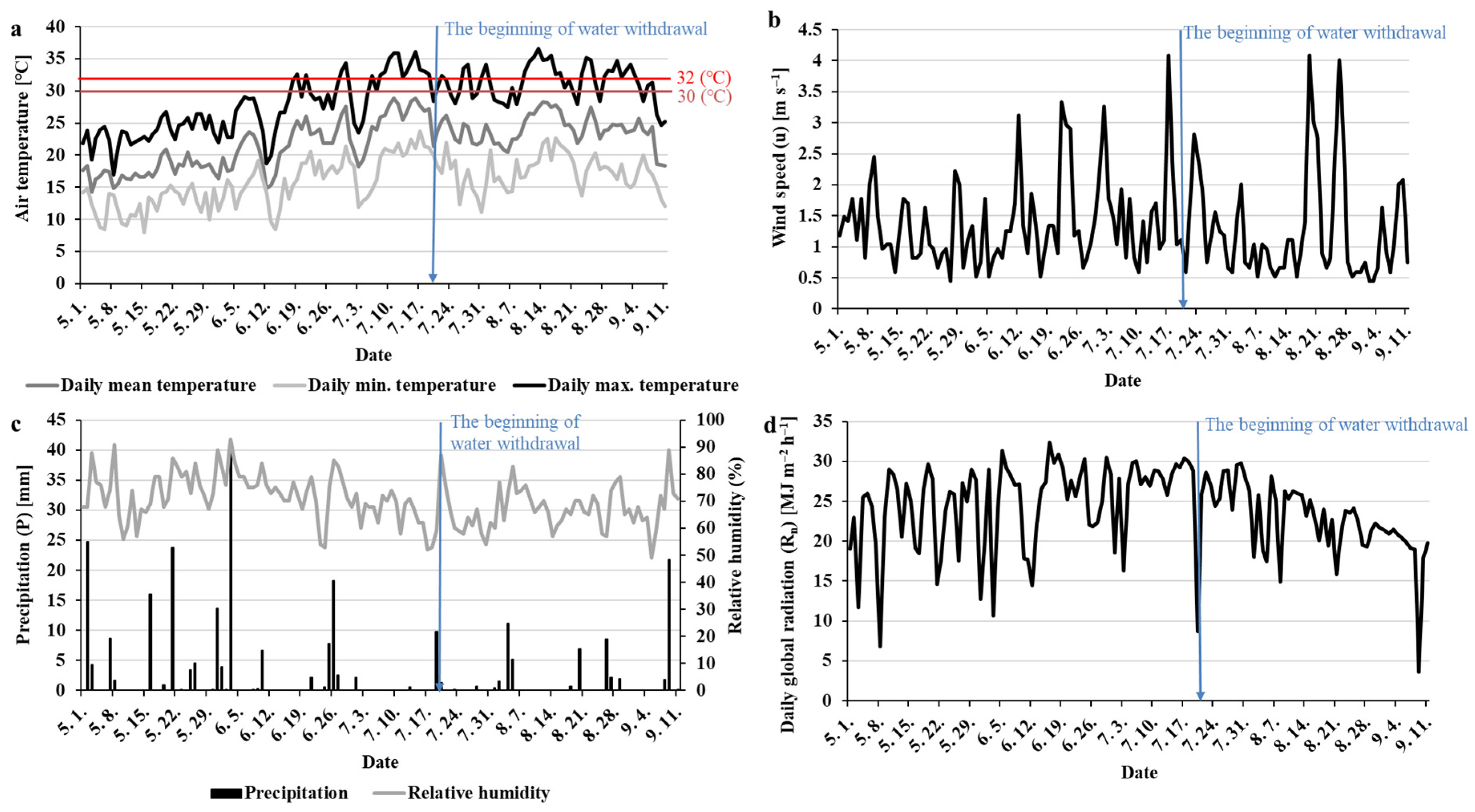
The weather conditions during the growing season were suitable for modeling the expected impacts of climate change. In general, the monthly mean Ta values (June: 21.5 °C, July: 24.5 °C, August: 24.6 °C, and September: 17.4 °C) deviated significantly (p < 0.001 in all cases) from the long-term (1991–2020) averages (June: 19.64 °C, July: 21.22 °C, August: 20.89 °C, and September: 16.03 °C). Except for June (p = 0.039) and September (p = 0.021), the monthly rainfall (June: 82.7 mm, July: 14.5 mm, August: 38.3 mm, and September: 88.5 mm) fell short (July: p < 0.001, August: p < 0.001) of the 30-year normal (June: 69.19 mm, July: 69.5 mm, August: 71.42 mm, and September: 68.14 mm).
The first half of the growing season (1 June 2024–21 July 2024) was typified by gradually increasing Ta (Figure 2a) and high initial water supply (Figure 2c), which provided adequate conditions for germination and vegetative development. The values of u (Figure 2b), RH (Figure 2c), and Rn (Figure 2d) highly fluctuated throughout the entire growing season. The co-occurrence of high Ta, Rn, u, and low RH caused several atmospheric drought events, which enhanced the ET and water stress of plants, especially in the second half of the growing season (21 July 2024–11 September 2024), when water treatments were set. During the reproductive development of the experimental crops (BBCH 61–99), only a sum of 62.7 mm of P fell on 14 rainy days. The low amount of P in July and August allowed the water treatments to be managed without a rainout shelter. During the reproductive stage, the daily Tmax exceeded the upper temperature threshold of maize (30 °C) and grain sorghum (32 °C) on 35 and 23 days, respectively.

3.2. The Effect of Weed Interference on LAI

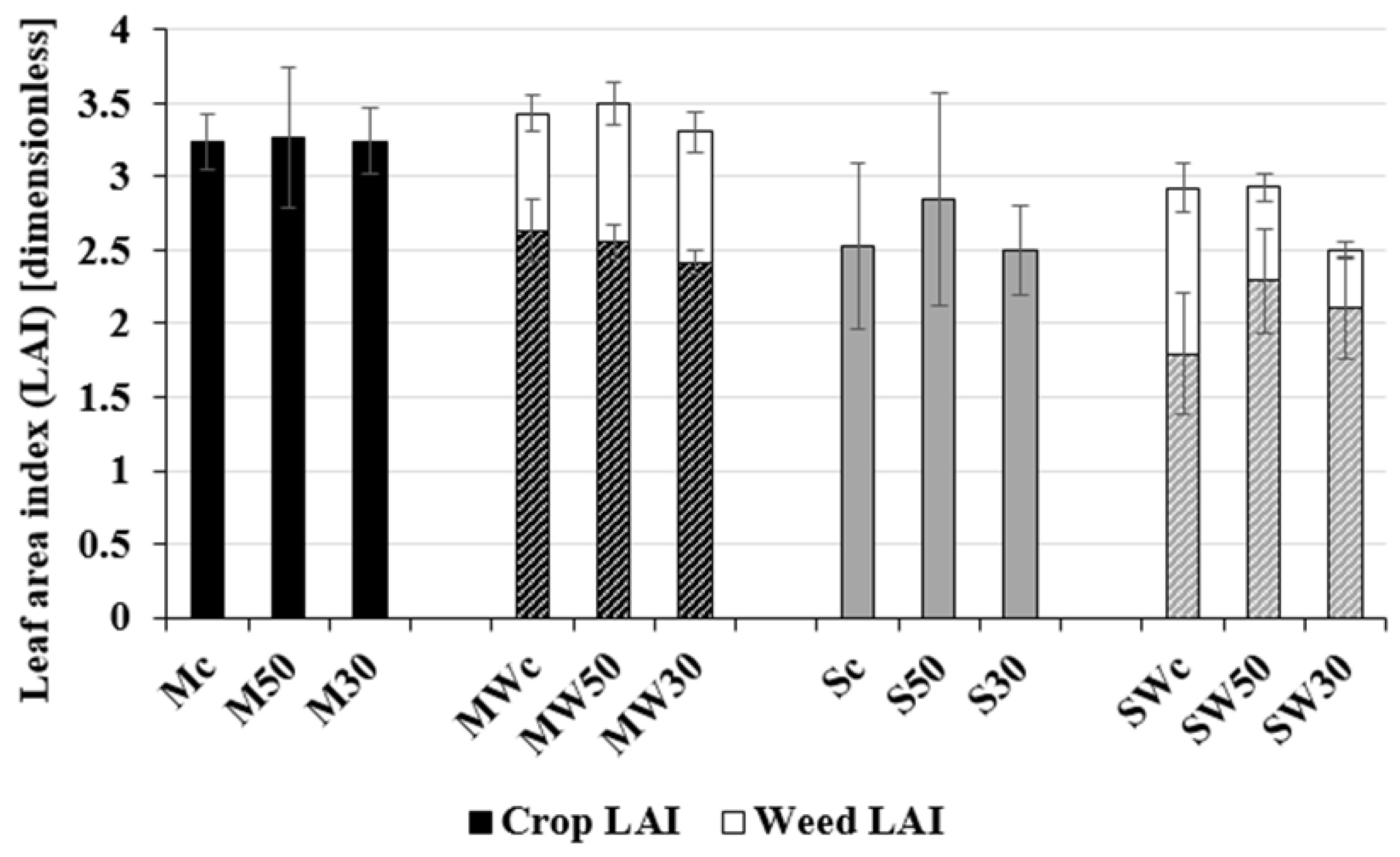
The LAImax of maize (M: 3.25 ± 0.3, MW: 2.53 ± 0.16) was generally higher than that of grain sorghum (p < 0.001; S: 2.62 ± 0.54, SW: 2.06 ± 0.4) (Figure 3). Weed interference was associated with lower LAImax values of maize and sorghum by 22.05 ± 3.42% (p < 0.001) and 21.43 ± 6.77% (p = 0.003), respectively. The LAItotal values of weed-free (M: 3.25 ± 0.3, S: 2.62 ± 0.54) and weed-infested (MW: 3.42 ± 0.15, SW: 2.78 ± 0.39) treatments did not differ significantly from each other (M: p = 0.075, S: p = 0.375).

3.3. Evapotranspiration Dynamics of Maize and Grain Sorghum

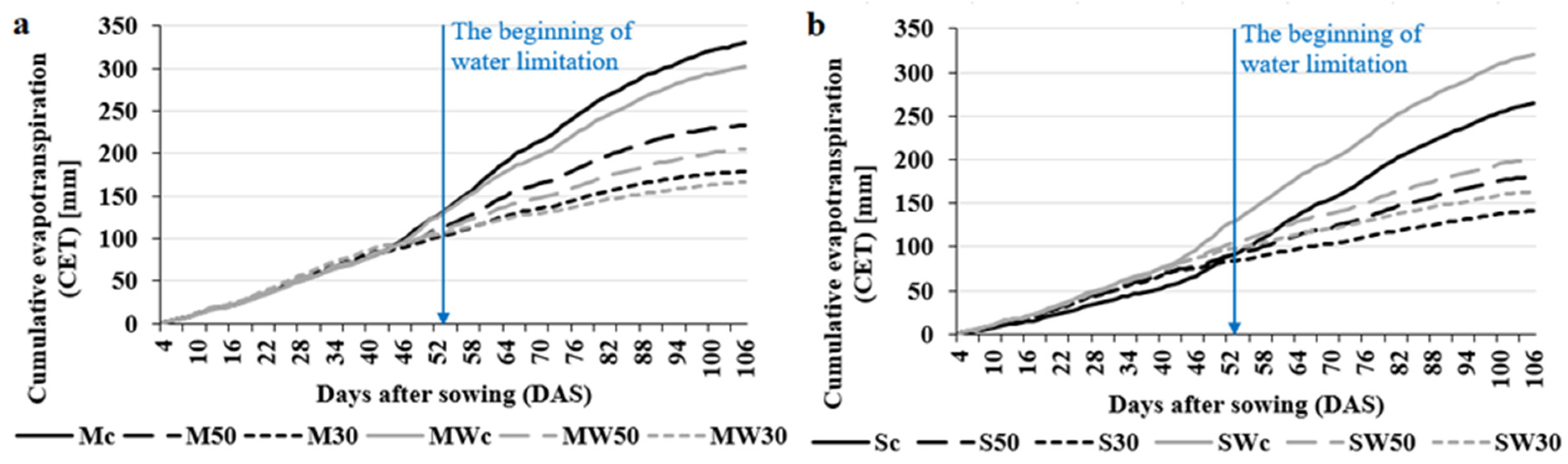
The progressive daily cumulative values of ETc act are shown in Figure 4, separately for maize (Figure 4a) and grain sorghum (Figure 4b) treatments. Since the flowering time of the early-maturing maize hybrid and the mid-early-maturing grain sorghum hybrid coincided, water deficit treatments were initiated simultaneously at the beginning of the reproductive stage (BBCH 61) on 23 July 2024 (54 days after sowing). The total seasonal CET was 330.73 mm for Mc, 302.59 mm for MWc, 264.63 mm for Sc, and 320.94 mm for SWc control treatments. Depending on the level of water limitation, the seasonal CET totals of water-stressed treatments (M50: 233.04 mm, M30: 178.84, MW50: 205.64 mm, MW30: 166.66 mm, S50: 181.28 mm, S30: 141.35 mm, SW50: 201.01 mm, and SW30: 163.57 mm) were 29.53–46.59% below the optimum. In the case of maize, the ET of weed-free treatments was (6.81–11.76%) more intense than that of the weed-infested ones, regardless of the water treatment. In the case of grain sorghum, a reverse trend can be observed. The presence of weeds was associated with higher ET values of sorghum treatments by 9.82–17.54%.

3.4. Relationships Between Evapotranspiration and Meteorological Variables

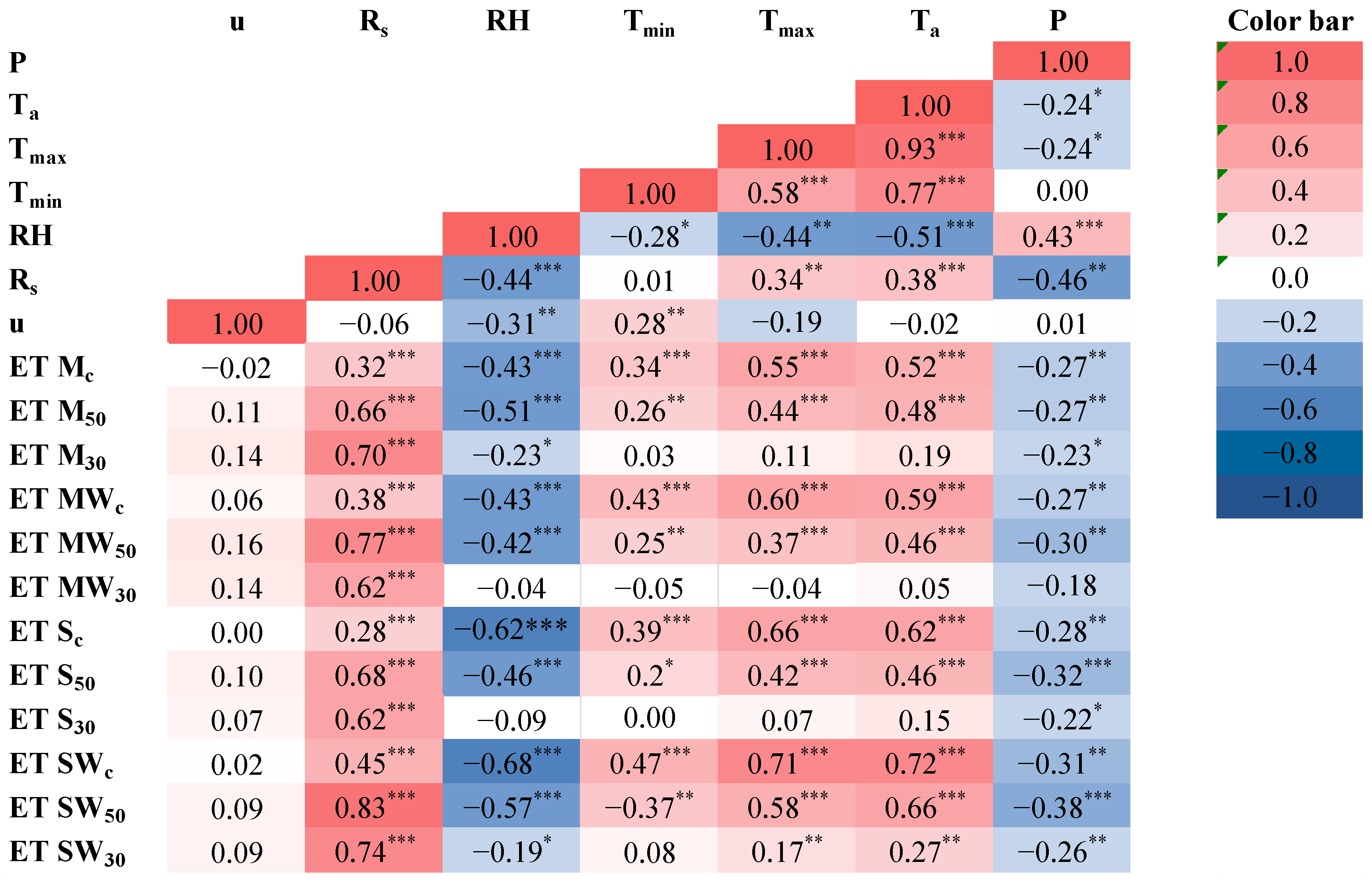
Figure 5 shows a correlation matrix heatmap expressing the strength of the correlations between the daily ETc act of the treatments and the examined meteorological variables. It can be seen by interpreting the matrix that most of the correlation coefficients are higher than −0.7 or lower than 0.7. The strongest correlations with ETc act were observed for Rs (R = 0.28–0.83, p = 0.001–0.004), Tmax (R = −0.04–0.71, p = 0.001–0.659), Ta (R = 0.05–0.72, p = 0.001–0.592), and RH (R = −0.04–0.68, p = 0.001–0.66). Only weak or moderate negative correlations could be observed between Tmin and ET (R = 0–0.47, p = 0.001–0.966). Correlation coefficients between temperature-related variables and ETc act varied among treatments with different water supply levels. Negative correlations between RH and ETc act were more pronounced in treatments with optimal or 50% water supply. Only weak negative correlations were observed between P and ETc act (R = −0.18–0.38, p = 0.001–0.076). No correlation was found between ETc act and u (R = 0–0.16, p = 0.108–0.975).
Abbreviations: P = precipitation, Ta = daily mean air temperature, Tmax = daily maximum temperature, Tmin = daily minimum temperature, RH = relative humidity, Rs = global radiation, u = wind speed, ETc act = daily evapotranspiration, M = maize, S = grain sorghum, W = weed-infested treatment, and 50 and 30 = the ratio of water supply relative to the corresponding control treatments’ (c) water consumption.

3.5. Seasonal Variation in Locally Measured Crop Coefficients

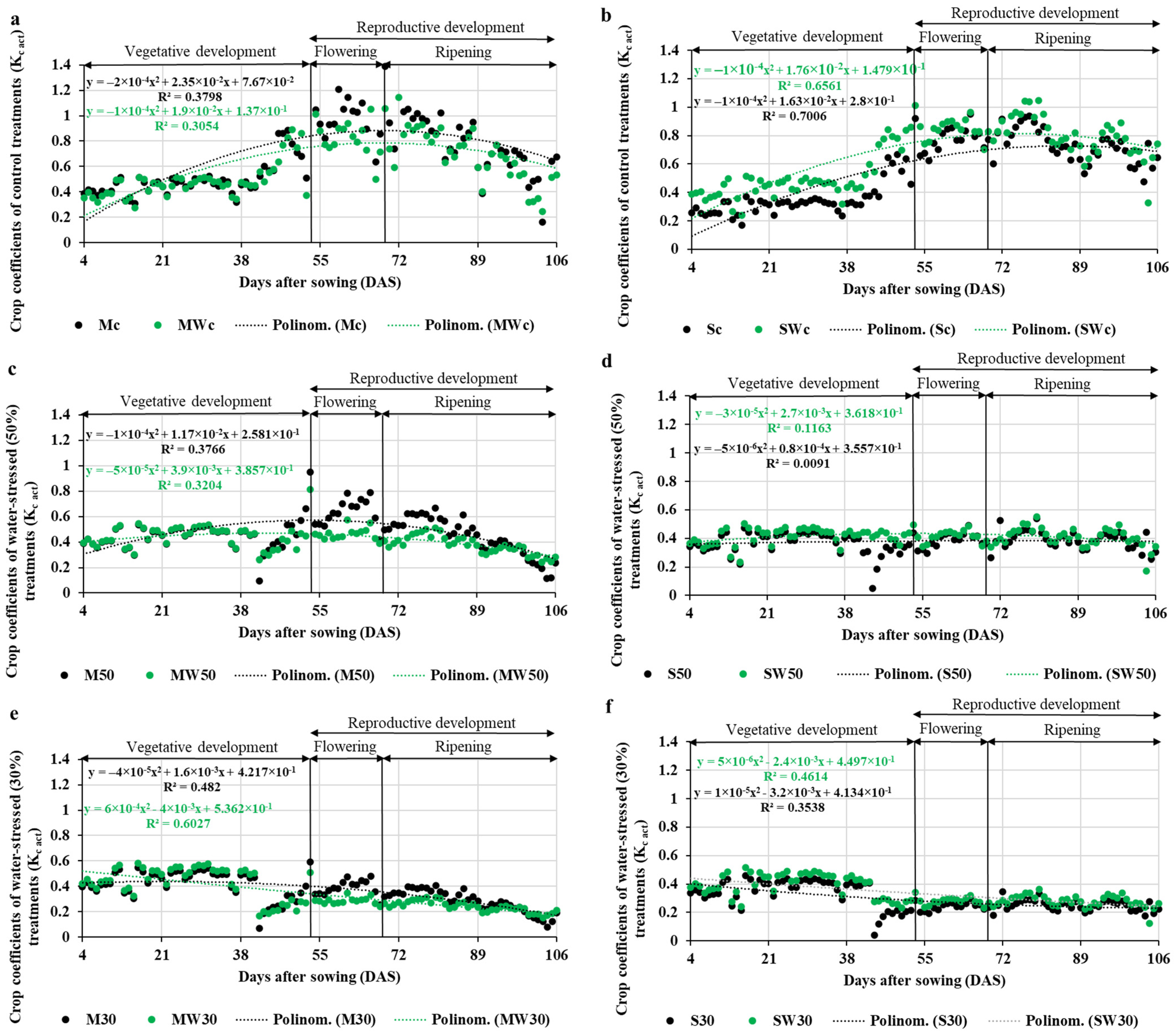
Daily Kc act values varied according to seasonal dynamics and were strongly influenced by treatment effects (Figure 6). The highest Kc act values were observed during flowering and early ripening. The mean ± SD Kc act values of Mc and Sc treatments were 0.53 ± 0.26 and 0.35 ± 0.11 at the initial stage (Kc-ini act), 1.05 ± 0.17 and 0.78 ± 0.09 at the mid-season stage (Kc-mid act), and 0.8 ± 0.27 and 0.72 ± 0.12 at the late-season stage (Kc-end act). The seasonal mean ± SD Kc act values were 0.7 ± 0.32 for Mc, 0.47 ± 0.14 for M50, 0.36 ± 0.12 for M30, 0.64 ± 0.28 for MWc, 0.42 ± 0.09 for MW50, 0.34 ± 0.13 for MW30, 0.55 ± 0.23 for Sc, 0.38 ± 0.07 for S50, 0.29 ± 0.09 for S30, 0.66 ± 0.21 for SWc, 0.41 ± 0.06 for SW50, and 0.33 ± 0.08 for SW30 treatments. Compared to the corresponding controls, lower seasonal average Kc act values were observed in water-stressed treatments 32.33–48.04% (p < 0.001) in the case of maize (Figure 6b,c) and by 31.94–49.47% (p < 0.001) in the case of grain sorghum (Figure 6e,f). The presence of weeds was also associated with changes in seasonal Kc act values (M: p = 0.004, S: p < 0.001) on the evolution of seasonal Kc act values.

3.6. Biological Yield, Grain Yield, and WUE

Depending on the treatment combination, grain sorghum generally exhibited similar or higher Yb (−0.07–50.13%, p < 0.001) and Yg (5.41–24.82%, p < 0.001) values than maize (Table 1).
The presence of weeds was associated with lower Yb values of maize by 37.49–56.87% (p < 0.001), lower Yb values of sorghum by 19.46–37.43% (p < 0.001), lower Yg values of maize by 34.68–47.82% (p < 0.001), and lower Yg values of sorghum by 31.81–39.67% (p < 0.001).
Water treatment was associated with marked differences in the values of Yb (M: p < 0.007; MW: p < 0.001; S: p < 0.001; and SW: p < 0.001) and Yg (M: p = 0.001; MW: p < 0.001; S: p < 0.001; and SW: p < 0.001). In general, lower values were observed with the decreasing water supply. Compared to the corresponding control treatments, Yb decreased by 9.91% in M50, 23.32% in M30, 25.33% in MW50, 47.1% in MW30, 16.57% in S50, 47.55% in S30, −2.41% in SW50, and 32.48% in SW30, while Yg decreased by 17.98% in M50, 36.04% in M30, 19.03% in MW50, 48.91% in MW30, 12.73% in S50, 42.80% in S30, 1.37% in SW50, and 40.08% in SW30 treatments. No clear differences were observed between the Yg of Sc and S50 (p = 0.165) and SWc and SW50 (p = 0.963) treatments.
The WUEb and WUEg values suggest that grain sorghum used water more efficiently than maize (Table 1). Compared to maize, sorghum consumed 20.92–51.26% less water to produce 1 kg of biomass (p < 0.001) and 2.87–38.17% less water to produce 1 kg of grain (p < 0.001).
Weed interference was associated with lower WUEb (M: p < 0.001; S: p < 0.001) and WUEg (M: p < 0.001; S: p < 0.001) values in both species. Lower WUEb and WUEg values were observed in weed-infested treatments in both maize and grain sorghum. Compared to weed-free treatments, WUEb values decreased by 31.67–53.72% in maize and by 30.43–48.41% in grain sorghum, while WUEg values decreased by 26.92–44.01% and 38.48–50.25%, respectively. Except for the weed-free maize block, WUEb and WUEg values peaked at 50% water supply.

3.7. Responses of Leaf RWC to Water Deficit Stress During the Reproductive Stage

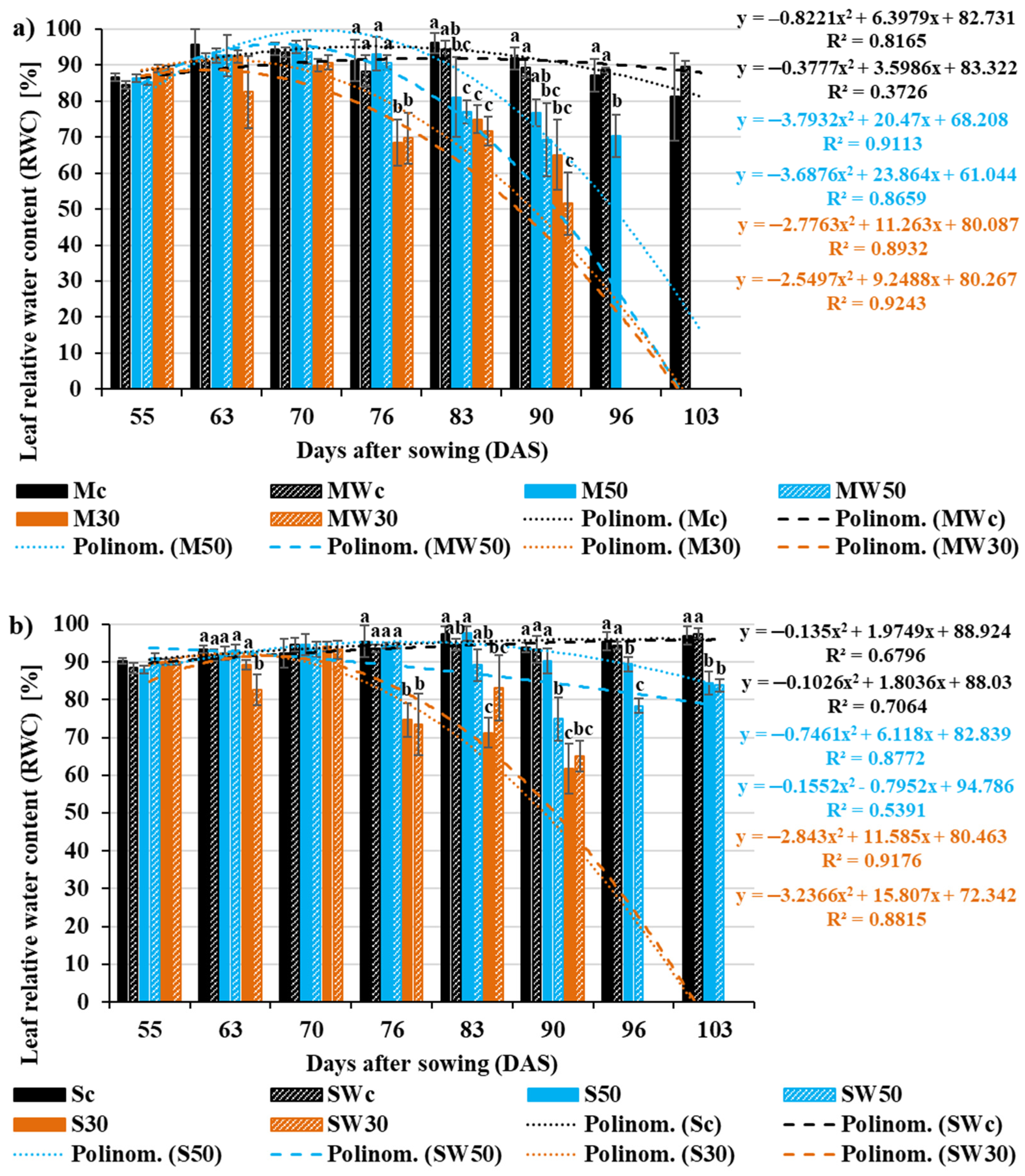
Since all treatments received optimal water supply until the beginning of the flowering stage (BBCH 61, 55 DAS), the water status of the plants was similar when water treatments were set (Figure 7). Differences in RWC (M: p = 0.001–0.188, S: p = 0.001–0.953) among water treatments began to appear in the 4th week of the reproductive stage (76 DAS). MW50 and M50 treatments withered between the 6th and 8th weeks of the water-stressed period (90–103 DAS), while the sorghum equivalent of these treatments (SW50 and S50) remained hydrated until the end of the growing season. A 30% water supply was associated with severe declines for both maize and grain sorghum. M30, MW30, S30, and SW30 treatments withered between the 6th and 7th weeks of the water-stressed period (90–96 DAS). No clear weed-related differences were observed in RWC values (M: p = 0.092–0.810, S: p = 0.167–0.993).

4. Discussion

4.1. Interactions Between Weed Infestation, LAI, and ET

In accordance with the results, the findings of other researchers indicate that early weed competition can significantly reduce the growth rate and canopy development of both maize and grain sorghum [43,44]. Since all treatments received optimal water supply during vegetative development, the observed patterns may partly reflect the LAImax of weed-infested treatments (MW, SW), which decreased primarily due to the competition for limited resources, such as space, nutrients, and sunlight. The weed-induced yield loss of MW and SW treatments was already foreseeable at the beginning of the reproductive stage (BBCH 61) when water treatments were set.
Although no significant difference was observed between the LAItotal values of weed-free and weed-infested maize treatments, weed-free treatments exhibited higher evapotranspiration. This finding suggests differences in water-use dynamics between maize and the associated weed community. This finding is consistent with the assumption of Simić et al. [45], according to which most weed species use water more efficiently than maize. In contrast, the evapotranspiration of grain sorghum treatments was intensified by the presence of weeds. Tadesse [46] also concluded that sorghum has a lower water requirement than most weed species. These observations may partly explain the different Kc act responses observed between weed-free and weed-infested treatments.

4.2. Meteorological Drivers of ET

ET is a function of several factors, such as meteorological conditions (Ta, Rs, RH, and u), hydrological factors (soil moisture content), and biological processes (leaf development, stomatal conductance) [47,48]. Similar to the results of the present study, Gemechu [49] observed that sunshine hours (M: R = 0.423, S: R = 0.526), Tmax (M: R = 0.767, S: R = 0.645), and Tmin (M: R = 0.318, S: R = 0.167) have positive correlations with the ET of both maize and grain sorghum. It is also well documented that the limited availability of water exerts a restraining effect on ET [50]. In contrast to the findings of the present study, other studies reported that wind speed (u) strongly affects crop evapotranspiration [51,52]. The explanation for the differences may be that the north face of Keszthely is sheltered by mountains, which reduce the speed of the prevailing northerly wind [53]. Although no significant correlations were detected between wind speed and ET in the present study, local topographic conditions may have reduced the influence of wind compared with observations reported in other environments.

4.3. Crop Coefficients

In accordance with the general trend described in FAO-56 [54], the Kc act values of control treatments increased gradually during the initial stage, reached a peak during the mid-season stage, and declined toward the end of the growing season. The highest Kc act values occurred during flowering and early grain filling, reflecting the maximum water demand and transpiration activity of the crops.
Water deficit was associated with lower Kc act values in both maize and grain sorghum treatments, particularly during the reproductive stage. The reduction became more pronounced with the increasing water limitation, which may reflect restricted water uptake and stomatal regulation under drought conditions. Similar responses have been reported for several field crops under deficit irrigation [55,56,57,58,59].
Weed presence also altered the temporal dynamics of Kc act values during the critical reproductive period. In maize treatments, weed infestation generally reduced Kc act values compared to weed-free treatments, particularly during flowering and early grain filling. In contrast, weed-infested sorghum treatments exhibited higher Kc act values than weed-free sorghum treatments during the same period. These differences became more apparent under water-limited conditions.
Although the measured Kc act values differed from standard FAO-adjusted coefficients reported in previous studies, these differences can primarily be attributed to variations in climatic conditions, soil characteristics, cultivation practices, and the combined effects of drought and weed competition. Similar variability in locally determined crop coefficients has also been reported in earlier evapotranspiration studies [60,61,62,63].
The contrasting responses of the Kc act values to weed infestation observed in maize and grain sorghum may be associated with differences in crop–weed interactions and water-use patterns. The lower Kc act values recorded in weed-infested maize treatments coincided with lower total evapotranspiration compared to the corresponding weed-free treatments, whereas weed-infested sorghum treatments exhibited higher Kc act values and higher evapotranspiration than their weed-free counterparts. Although crop and weed transpiration were not measured separately, these findings suggest that weed presence may have influenced the overall evapotranspiration dynamics differently in the two crop species, particularly under water-limited conditions.

4.4. Yield Stability and Water-Use Efficiency

In terms of temperature, the most sensitive reproductive period (the second half of July and August) was more favorable for sorghum; therefore, it can be assumed that heat stress fundamentally determined the development of yield differences. In line with this assumption, Staggenborg et al. [64] observed a positive correlation between the Tmax of summer months and the yield difference between grain sorghum and maize. The results of their 13-year duration experiment indicate that the yield difference (grain sorghum minus maize) increases in proportion to the increase in Tmax in July and August. The observed responses suggest greater drought tolerance and water-use efficiency in sorghum, indicated by the phenomenon that it maintained its yield stability, even under 50% water supply, under which maize yields decreased significantly. Although Farré and Faci [65] reported that the advantage for sorghum over maize increases in proportion to the severity of water stress, the yield loss of sorghum and maize was almost the same with a 70% water supply, both in weed-free and weed-infested treatments.
In line with the results of several former comparative field experiments [26,65,66], the values of WUEb and WUEg (Table 1) indicate that sorghum used water more efficiently than maize. Most researchers attribute sorghum’s better WUE and drought tolerance to its deeper and more fibrous root system [67,68], its elevated proline content, and more advanced ability to reduce stomatal density under water-limiting conditions [27]. In general, an increase in WUE under moderate water stress (50% water supply) was observed. Under mild or moderate drought, plants employ a complex network of adaptation mechanisms to reduce water loss through transpiration and maximize carbon fixation and growth. Although these mechanisms were not directly examined in the present study, it can be assumed that physiological and morphological processes such as stomata optimum regulation, root–shoot signaling [69], enhanced root growth [70], and the compensatory effect after water stress [71] also played an important role in the improvement of the WUE of water-stressed treatments. In M50, MW50, S50, and SW50 treatments, the Yb and Yg did not reduce markedly; however, the plants consumed less water. This also contributed to achieving high WUE values. In accordance with these findings, other researchers concluded that a 20–50% water deficit can enhance the WUE of both maize and grain sorghum [72,73,74,75]. On the contrary, severe drought (70% water supply) generally reduced the WUEb and WUEg of both species due to the reduction in dry matter accumulation and yield depression. Since weeds compete for limited resources and transpire water from the soil without contributing to crop production, their presence also lowered the WUE in weed-infested treatments. The increase in WUE under moderate water deficit conditions may be associated with a compensatory physiological response, whereby plants reduce transpirational water loss to a greater extent than the biomass or grain yield declines. Similar responses under moderate drought and deficit irrigation conditions have previously been reported in maize and sorghum studies [65,76].

4.5. Investigation of the Drivers Behind RWC Variation

In water-stressed treatments (especially in treatments with 70% water supply), water limitation induced early senescence, shortened the grain-filling period, and ultimately reduced grain yield. Compared to maize, grain sorghum was able to maintain adequate water levels in its leaves for a longer period of time, even under drought conditions. Similar observations have been made by Frantová et al. [27]. In line with the results, Ali et al. [77] also reported that water-stressed grain sorghum can sustain its shoot water status for longer than maize. The phenomenon was explained by the ability of sorghum to accumulate more proline in its roots during drought than maize. Since the accumulation of proline causes a remarkable decrease in root water potential, it ultimately results in easier water absorption from the soil. Hasan et al. [25] also concluded that the RWC of maize is more severely affected by water stress than that of sorghum. They attributed the differences in the evolution of RWC to the property of sorghum that enables it to maintain a largely constant WUE during the day, while the WUE of maize fluctuates, even in the short term and in response to water stress.
The higher water-use efficiency observed in grain sorghum compared with maize may be associated with several drought-adaptive traits previously reported for sorghum. Earlier studies demonstrated that sorghum genotypes can reduce transpirational water loss through enhanced stomatal regulation and the development of a thick hydrophobic cuticular wax layer, which improves leaf water retention under drought conditions [27,28,29,30]. In addition, sorghum is often characterized by a more conservative water-use strategy than maize, enabling the maintenance of physiological activity and grain production under moderate water limitation while consuming less water overall. Although these physiological mechanisms were not directly evaluated in the present study, they may partly explain the higher WUE values and greater yield stability observed in sorghum under reproductive-stage drought stress.

4.6. Limitations and Practical Implications

Although grain sorghum exhibited superior drought tolerance and water-use efficiency compared to maize under the conditions of the present study, these findings should be interpreted with caution. The experiment was conducted using specific maize and sorghum cultivars, and therefore, the observed responses may partly reflect genotype-specific characteristics rather than universal species-level traits. Considerable variability in drought adaptation and water-use strategies exists within both maize and sorghum germplasm.
Furthermore, the results should not be interpreted as suggesting the general replacement of maize by grain sorghum. Instead, the findings highlight that the two C4 crops may offer different agronomic advantages depending on environmental conditions, water availability, and management practices. In this context, grain sorghum may represent a valuable complementary crop within diversified and climate-resilient agricultural systems, particularly in regions increasingly exposed to water limitation and heat stress.
Another limitation of the present study is that the experiment was conducted during a single growing season under the meteorological conditions of 2024. Although the environmental conditions were suitable for simulating drought stress scenarios associated with climate change, interannual climatic variability may substantially influence crop evapotranspiration dynamics, water-use efficiency, and drought responses. Therefore, long-term fixed-location experiments conducted across multiple growing seasons would be necessary to further validate the stability and general applicability of the observed responses under varying environmental conditions.
Although the evapotranspirometer system allowed for the precise control of the water supply and high-resolution monitoring of crop water use under field conditions, the experimental approach has certain limitations. The evapotranspirometer vessels were embedded within a surrounding maize stand to maintain realistic canopy conditions; however, the degree of experimental independence is inherently lower than in large-scale field plot experiments. In addition, weed infestation originated from the natural field weed community rather than from artificially standardized populations. Although weed densities were comparable among treatments and reflected field conditions, some variability in species composition and density could not be completely eliminated.

5. Conclusions

This study suggests that the applied evapotranspirometer-based approach provides a robust and field-realistic framework for quantifying crop water use under controlled conditions. By integrating controlled water deficit treatments with natural weed infestation, the experimental design enabled a novel assessment of the combined effects of abiotic and biotic stress factors on evapotranspiration dynamics and crop performance.
Grain sorghum generally exhibited higher water-use efficiency and greater yield stability than maize under a moderate water deficit, supporting its potential suitability as a climate-resilient alternative crop in regions facing increasing water scarcity. However, under severe drought conditions, both crops showed substantial declines in physiological performance and yield, indicating that supplemental irrigation remains essential for stable production.
The results also further suggest that weed competition significantly reduces the yield and water-use efficiency in both crops, emphasizing the critical role of effective weed management in water-limited environments.
Overall, this study provides new insights into crop water-use dynamics under combined stress conditions and contributes to the development of more sustainable and climate-adaptive cropping systems. Future research should focus on multi-season validation, genotype-specific responses, and the extension of this approach to different soil types and agro-climatic regions.

Author Contributions

Conceptualization, B.S.-G. and A.T.; methodology, B.S.-G.; software, A.T.; validation, B.S.-G., Z.T. and K.K.-B.; formal analysis, B.S.-G.; investigation, A.T. and K.K.-B.; resources, B.S.-G. and Z.T.; data curation, A.T. and B.S.-G.; writing—original draft preparation, A.T. and B.S.-G.; writing—review and editing, A.T. and B.S.-G.; visualization, A.T.; supervision, Z.T. and B.S.-G. All authors have read and agreed to the published version of the manuscript.

Funding

This work was supported by the Flagship Research Groups Programme of the Hungarian University of Agriculture and Life Sciences.

Data Availability Statement

The raw data supporting the conclusions of this article will be made available by the authors on request.

Acknowledgments

The authors sincerely thank the Institute of Agronomy at the Hungarian University of Agriculture and Life Sciences for their generous provision of facilities, equipment, and laboratory assistance that enabled the successful completion of this experiment. The authors would like to express their sincere gratitude to the Editor and the anonymous reviewers for their thorough evaluation of the manuscript and for their constructive comments and suggestions. Their valuable feedback significantly contributed to improving the scientific quality, clarity, and overall presentation of this work.

Conflicts of Interest

The authors declare no conflicts of interest.

Abbreviations

The following abbreviations are used in this manuscript:
RCMregional climate model
ETevapotranspiration
Mmaize treatments
Ssorghum treatments
Wweed-infested treatments
ccontrol treatments
CETcumulative evapotranspiration
WUEwater use efficiency
RWCrelative water content
CANcalcium ammonium nitrate
SSPsingle superphosphate
MOPmuriate of potash
DWPdaily water portion
Taair temperature
Tmaxmaximum air temperature
Tminminimum air temperature
RHrelative humidity
Pprecipitation
Rssolar radiation
uwind speed
LAleaf area
LAIleaf area index
∑ETtotal seasonal evapotranspiration
ETc actdaily crop evapotranspiration
ET0daily grass reference evapotranspiration
Kc actcrop coefficient (since the original definition of Kc assumes optimal water supply, the designation “Kc act” was used in this study)
Ybbiological yield
Yggrain yield
WUEbwater use efficiency for biological yield
WUEgwater use efficiency for grain yield
DASdays after sowing

References

  1. Lu, J.; Carbone, G.J.; Grego, J.M. Uncertainty and hotspots in 21st century projections of agricultural drought from CMIP5 models. Sci. Rep. 2019, 9, 4922. [Google Scholar] [CrossRef]
  2. Pongrácz, R.; Bartholy, J.; Miklos, E. Analysis of projected climate change for Hungary using ENSEMBLES simulations. Appl. Ecol. Environ. Res. 2011, 9, 387–398. [Google Scholar] [CrossRef]
  3. Probst, E.; Mauer, W. Climate change impacts on water resources in the Danube River basin: A hydrological modelling study using EURO-CORDEX climate scenarios. Water 2023, 15, 8. [Google Scholar] [CrossRef]
  4. Vautard, R.; Gobiet, A.; Sobolowski, S.; Kjellström, E.; Stegehuis, A.; Watkiss, P.; Mendlik, T.; Landgren, O.; Nikulin, G.; Teichmann, C.; et al. The European climate under a 2 °C global warming. Environ. Res. Lett. 2014, 9, 034006. [Google Scholar] [CrossRef]
  5. Baumgartner, A.; Liebscher, H.J. Lehrbuch der Hydrologie I: Allgemeine Hydrologie–Quantitative Hydrologie; Gebrüder Borntraeger: Berlin, Germany; Stuttgart, Germany, 1990. [Google Scholar]
  6. Biró, K.; Kovács, E. Agro-climatic analysis for agricultural adaptation in Hungary. Period. Polytech. Soc. Manag. Sci. 2024, 32, 141–147. [Google Scholar] [CrossRef]
  7. Bartholy, J.; Pongrácz, R.; Gelybó, G. Regional climate change expected in Hungary for 2071–2100. Appl. Ecol. Environ. Res. 2007, 5, 1–17. [Google Scholar] [CrossRef]
  8. Czibolya, L.; Makra, L.; Pinke, Z.; Horváth, J.; Csépe, Z. Dependence of the crop yields of maize, wheat, barley and rye on temperature and precipitation in Hungary. Carpath. J. Earth Environ. Sci. 2020, 15, 359–368. [Google Scholar] [CrossRef]
  9. Fogarasi, J.; Kemény, G.; Molnár, A.; Keményné Horváth, Z.; Zubor-Nemes, A.; Kiss, A. Modelling climate effects on Hungarian winter wheat and maize yields. Stud. Agric. Econ. 2016, 118, 85–90. [Google Scholar] [CrossRef]
  10. Zhao, F.; Zhang, D.; Zhao, Y.; Wang, W.; Yang, H.; Tai, F.; Li, C.; Hu, X. The difference of physiological and proteomic changes in maize leaves adaptation to drought, heat, and combined both stresses. Front. Plant Sci. 2016, 7, 1471. [Google Scholar] [CrossRef]
  11. Hoffmann, A.L.; Kemanian, A.R.; Forest, C.E. The response of maize, sorghum, and soybean yield to growing-phase climate revealed with machine learning. Environ. Res. Lett. 2020, 15, 094013. [Google Scholar] [CrossRef]
  12. Schauberger, B.; Archontoulis, S.; Arneth, A.; Balkovic, J.; Ciais, P.; Deryng, D.; Elliott, J.; Folberth, C.; Khabarov, N.; Müller, C.; et al. Consistent negative response of US crops to high temperatures in observations and crop models. Nat. Commun. 2017, 8, 13931. [Google Scholar] [CrossRef]
  13. Gyuricza, C.; Balla, I.; Tarnawa, Á.; Nyárai, F.H.; Kassai, M.K.; Szentpéteri, Z.; Jolánkai, M. Impact of precipitation on yield quantity and quality of wheat and maize crops. J. Hung. Meteor. Serv. 2012, 116, 211–220. [Google Scholar]
  14. Basso, B.; Ritchie, J.T. Evapotranspiration in high-yielding maize and under increased vapor pressure deficit in the US Midwest. Agric. Environ. Lett. 2018, 3, 170039. [Google Scholar]
  15. Lewandowski, I.; Böhmel, C.; Vetter, A.; Hartmann, H. Landwirtschaftlich produzierte Lignocellulose pflanzen. [Agriculturally produced lignocellulose plants]. In Energie aus Biomasse. Grundlagen, Techniken und Verfahren. [Principles, Techniques and Procedures]; Kaltschmidt, M., Hartmann, H., Hofbauer, H., Eds.; Springer: Berlin/Heidelberg, Germany, 2009; pp. 88–108. (In German) [Google Scholar]
  16. Allakonon, M.G.B.; Akponikpè, P.B.I. Relationship of maize yield to climatic and environmental factors under deficit irrigation: A quantitative review. Int. J. Agron. 2022, 2022, 2408439. [Google Scholar] [CrossRef]
  17. Nielsen, R.L. Drought and Heat Stress Effects on Corn Pollination; Purdue University, Department of Agronomy: West Lafayette, IN, USA, 2002. [Google Scholar]
  18. Comas, L.H.; Trout, T.J.; DeJonge, K.C.; Zhang, H.; Gleason, S.M. Water productivity under strategic growth stage-based deficit irrigation in maize. Agric. Water Manag. 2009, 212, 433–440. [Google Scholar]
  19. 19.1.2.26. Öntözés Vármegye és Régió Szerint. Available online: https://www.ksh.hu/stadat_files/mez/hu/mez0094.html (accessed on 21 March 2025).
  20. 19.1.1.8. Magyarország Mezőgazdasági Területe Művelési Ágak Szerint [Ezer Hektár]. Available online: https://www.ksh.hu/stadat_files/mez/hu/mez0008.html (accessed on 21 March 2025).
  21. Prasad, V.B.R.; Govindaraj, M.; Djanaguiraman, M.; Djalovic, I.; Shailani, A.; Rawat, N.; Singla-Pareek, S.L.; Pareek, A.; Prasad, P.V.V. Drought and high temperature stress in sorghum: Physiological, genetic, and molecular insights and breeding approaches. Int. J. Mol. Sci. 2021, 22, 9826. [Google Scholar] [CrossRef]
  22. Tack, J.; Lingenfelser, J.; Jagadish, S.V.K. Disaggregating sorghum yield reductions under warming scenarios exposes narrow genetic diversity in US breeding programs. Proc. Natl. Acad. Sci. USA 2017, 114, 9296–9301. [Google Scholar] [CrossRef]
  23. Assefa, Y.; Staggenborg, S.A.; Prasad, V.P.V. Grain sorghum water requirement and responses to drought stress: A review. Crop Manag. 2010, 9, 1–11. [Google Scholar] [CrossRef]
  24. Kolozsvári, I.; Kun, Á.; Jancsó, M.; Palágyi, A.; Bozán, C.; Gyuricza, C. Agronomic performance of grain sorghum (Sorghum bicolor (L.) Moench) cultivars under intensive fish farm effluent irrigation. Agronomy 2022, 12, 1185. [Google Scholar] [CrossRef]
  25. Hasan, S.A.; Rabei, S.H.; Nada, R.M.; Abogadallah, G.M. Water use efficiency in the drought-stressed sorghum and maize in relation to expression of aquaporin genes. Biol. Plant. 2017, 61, 127–137. [Google Scholar]
  26. Roby, M.C.; Fernandez, M.G.S.; Heaton, E.A.; Miguez, F.E.; VanLoocke, A. Biomass sorghum and maize have similar water-use-efficiency under non-drought conditions in the rain-fed Midwest U.S. Agric. For. Meteorol. 2017, 247, 434–444. [Google Scholar]
  27. Frantová, N.; Rábek, M.; Porčová, L.; Jovanović, I.; Širůček, P.; Lukas, V.; Hájek, J.; Elzner, P.; Holková, L.; Smutná, P.; et al. Monitoring drought tolerance mechanisms of sorghum and maize under unevenly distributed precipitation. Int. J. Plant Prod. 2024, 18, 49–67. [Google Scholar] [CrossRef]
  28. Ilyas, M.; Nisar, M.; Khan, N.; Hazrat, A.; Khan, A.H.; Hayat, K.; Fahad, S.; Khan, A.; Ullah, A. Drought tolerance strategies in plants: A mechanistic approach. J. Plant Growth Regul. 2021, 40, 926–944. [Google Scholar]
  29. -Prasad, P.V.V.; Djanaguiraman, M.; Jagadish, S.V.K.; Ciampitti, I.A. Drought and high temperature stress and traits associated with tolerance. In Sorghum: A State of the Art and Future Perspectives; Ciampitti, I.A., Prasad, P.V.V., Eds.; ASA: Madison, WI, USA; CSSA: Madison, WI, USA; SSSA: Madison, WI, USA, 2019; pp. 245–265. [Google Scholar]
  30. Ndlovu, E.; van Staden, J.; Maphosa, M. Morpho-physiological effects of moisture, heat and combined stresses on Sorghum bicolor [Moench (L.)] and its acclimation mechanisms. Plant Stress 2021, 2, 100018. [Google Scholar] [CrossRef]
  31. Batista, P.S.C.; Caryalho, A.J.; Portugal, A.F.; Bastos, E.A.; Cardoso, M.J.; Torres, L.G.; Juli, M.P.M.; de Menezes, C.B. Selection of sorghum for drought tolerance in a semiarid environment. Genet. Mol. Res. 2019, 18, gmr18194. [Google Scholar] [CrossRef]
  32. Reisinger, P.; Lehoczky, E.; Komives, T. Relationships between soil characteristics and weeds. Commun. Soil Sci. Plant Anal. 2005, 36, 623–628. [Google Scholar] [CrossRef]
  33. Farooq, M.; Hussain, M.; Ul-Allah, S.; Siddique, K.H. Physiological and agronomic approaches for improving water-use efficiency in crop plants. Agric. Water Manag. 2019, 219, 95–108. [Google Scholar] [CrossRef]
  34. Anda, A.; Soós, G.; da Teixeira, S.J.A. Leaf area index for common reed (Phragmites australis) with different water supplies in the Kis-Balaton wetland, Hungary, during two consecutive seasons (2014 and 2015). Időjárás 2017, 12, 265–284. [Google Scholar]
  35. Richter, P. Measurement and Modeling of the Leaf Area Index; Eötvös Loránd University, Depertment of Meteorology: Budapest, Hungary, 2009. (In Hungarian) [Google Scholar]
  36. Monteith, J.L. Evaporation and environment. In The State and Movement of Water in Living Organisms, Proceedings of the XIX Symposium of the Society for Experimental Biology; Fogg, G.E., Ed.; Cambridge University Press: Cambridge, UK, 1965; pp. 205–234. [Google Scholar]
  37. Penman, H.L. Natural evaporation from open water, bare soil and grass. Proc. R. Soc. Lond. Ser. A Math. Phys. Sci. 1948, 193, 120–145. [Google Scholar] [CrossRef]
  38. Allen, R.G.; Clemmens, A.J.; Burt, C.M.; Solomon, K.; O’Halloran, T. Prediction accuracy for project wide evapotranspiration using crop coefficients and reference evapotranspiration. J. Irrig. Drain. Eng. 2005, 131, 24–36. [Google Scholar] [CrossRef]
  39. Yarami, N.; Kamgar-Haghighi, A.A.; Sepaskhah, A.R.; Zand-Parsa, S. Determination of the potential evapotranspiration and crop coefficient for saffron using a water-balance lysimeter. Arch. Agron. Soil Sci. 2011, 57, 727–740. [Google Scholar] [CrossRef]
  40. Pereira, L.S.; Paredes, P.; Hunsaker, D.J.; López-Urrea, R.; Mohammadi Shad, Z. Standard single and basal crop coefficients for field crops. Updates and advances to the FAO56 crop water requirements method. Agric. Water Manag. 2021, 243, 106466. [Google Scholar] [CrossRef]
  41. Barrs, H.D.; Weatherley, P.E. A re-examination of the relative turgidity technique for estimating water deficit in leaves. Aust. J. Biol. Sci. 1962, 15, 413–428. [Google Scholar] [CrossRef]
  42. López-Urrea, R.; Pardo, J.J.; Simón, L.; Martínez-Romero, Á.; Montoya, F.; Tarjuelo, J.M.; Domínguez, A. Assessing a Removable Mini-Lysimeter for Monitoring Crop Evapotranspiration Using a Well-Established Large Weighing Lysimeter: A Case Study for Barley and Potato. Agronomy 2021, 11, 2067. [Google Scholar]
  43. Cerrudo, D.; Page, E.R.; Tollenaar, M.; Stewart, G. Mechanisms of yield loss in maize caused by weed competition. Weed Sci. 2012, 60, 225–232. [Google Scholar] [CrossRef]
  44. Peerzada, A.M.; Ali, H.H.; Chauhan, B.S. Weed management in sorghum [Sorghum bicolor (L.) Moench] using crop competition: A review. Crop Prot. 2017, 95, 74–80. [Google Scholar] [CrossRef]
  45. Simić, M.; Dragicevic, V.; Brankov, M. Influence of growing measures on weed interference and water status in maize. Pestic. Fitomed. 2017, 32, 113–120. [Google Scholar]
  46. Tadesse, A. Increasing crop production through improved plant protection—Volume I. In Proceedings of the Plant Protection Society of Ethiopia (PPSE), 19–22 December 2006; PPSE: Addis Ababa, Ethiopia; EIAR: Addis Ababa, Ethiopia, 2008. [Google Scholar]
  47. Han, Q.; Liu, Q.; Wang, T.; Wang, L.; Di, C.; Chen, X.; Smettem, K.; Singh, S.K. Diagnosis of environmental controls on daily actual evapotranspiration across a global flux tower network: The roles of water and energy. Environ. Res. Lett. 2020, 15, 124070. [Google Scholar] [CrossRef]
  48. Wang, K.; Bastos, A.; Ciais, P.; Wang, X.; Rödenbeck, C.; Gentine, P.; Chevallier, F.; Humphrey, V.W.; Huntingford, C.; O’Sullivan, M.; et al. Regional and seasonal partitioning of water and temperature controls on global land carbon uptake variability. Nat. Commun. 2022, 13, 3469. [Google Scholar] [CrossRef]
  49. Gemechu, T. Impact of climatological parameters on crop water use of maize and sorghum: A case of Adami-Tulu Jido-Kombolcha Woreda, Central Rift Valley of Ethiopia. J. Earth Sci. Clim. Change 2016, 7, 1000370. [Google Scholar]
  50. Bellvert, J.; Pamies-Sans, M.; Casadesús, J.; Girona, J. Evaluating the impact of drought and water restrictions on agricultural production in irrigated areas through crop water productivity functions and a remote sensing-based evapotranspiration model. Agric. Water Manag. 2025, 309, 109319. [Google Scholar] [CrossRef]
  51. Boamah, P.O.; Onumah, J.; Apam, B.; Salifu, T.; Abunkudugu, A.A.; Alabil, S.A. Climate variability impact on crop evapotranspiration in the upper East region of Ghana. Environ. Chall. 2024, 14, 100828. [Google Scholar]
  52. Taheri, M.; Bigdeli, M.; Imanian, H.; Mohamaddian, A. An overview of evapotranspiration estimation models utilizing artificial intelligence. Water 2025, 17, 1384. [Google Scholar] [CrossRef]
  53. Anda, A.; Simon, B.; Soós, G.; da Silva, J.A.T.; Kucserka, T. Effect of submerged, freshwater aquatic macrophytes and littoral sediments on pan evaporation in the Lake Balaton region, Hungary. J. Hydrol. 2016, 542, 615–626. [Google Scholar] [CrossRef]
  54. Allen, R.G.; Pereira, L.S.; Raes, D.; Smith, M. Crop Evapotranspiration: Guidelines for Computing Crop Water Requirements; FAO Irrigation and Drainage Paper No. 56; FAO: Rome, Italy, 1998. [Google Scholar]
  55. Lima, J.G.A.; Espínola Sobrinho, J.; Medeiros, J.F.; de Viana, P.C.; Maniçoba, R.M. Water requirement and crop coefficients of sorghum in Apodi Plateau. Rev. Bras. Eng. Agríc. Ambient. 2021, 25, 684–688. [Google Scholar] [CrossRef]
  56. Negash, T.W.; Tefera, A.T.; Bayisa, G.D. Maize (Zea mays L., 1753.) evapotranspiration and crop coefficient in semi-arid region of Ethiopia. Ital. J. Agrometeorol. 2024, 2, 55–63. [Google Scholar] [CrossRef]
  57. Piccinni, G.; Ko, J.; Marek, T.; Howell, T. Determination of growth-stage-specific crop coef- ficients (KC) of maize and sorghum. Agric. Water Manag. 2009, 96, 1698–1704. [Google Scholar] [CrossRef]
  58. Gao, Y.; Duan, A.; Sun, J.; Li, F.; Liu, Z.; Liu, H.; Liu, Z. Crop coefficient and water-use efficiency of winter wheat/spring maize strip intercropping. Field Crops Res. 2009, 111, 65–73. [Google Scholar]
  59. Facchi, A.; Gharsallah, O.; Corbari, C.; Masseroni, D.; Mancini, M.; Gandolfi, C. Determination of maize crop coefficients in humid climate regime using the eddy covariance technique. Agric. Water Manag. 2013, 130, 131–141. [Google Scholar] [CrossRef]
  60. Martins, J.D.; Rodrigues, G.C.; Paredes, P.; Carlesso, R.; Oliveira, Z.B.; Knies, A.E.; Petry, M.T.; Pereira, L. Dual crop coefficients for maize in southern Brazil: Model testing for sprinkler and drip irrigation and mulched soil. Biosyst. Eng. 2013, 115, 291–310. [Google Scholar] [CrossRef]
  61. Ding, R.; Kang, S.; Zhang, Y.; Hao, X.; Tong, L.; Du, T. Partitioning evapotranspiration into soil evaporation and transpiration using a modified dual crop coefficient model in irrigated maize field with ground-mulching. Agric. Water Manag. 2013, 127, 85–96. [Google Scholar] [CrossRef]
  62. Li, Y.L.; Cui, J.Y.; Zhang, T.H.; Zhao, H.L. Measurement of evapotranspiration of irrigated spring wheat and maize in a semi-arid region of north China. Agric. Water Manag. 2003, 61, 1–12. [Google Scholar] [CrossRef]
  63. Mirzaei, M.; Sohrabi, T.; Jahanbania, H.; Faghih, M.; Teang, S.L. Evaluation of evapotranspiration coefficient and daily crop reference evapotranspiration in a semi-arid region based on field water balance and FAO method. Aust. J. Basic Appl. Sci. 2011, 5, 1850–1856. [Google Scholar]
  64. Staggenborg, S.A.; Dhuyvetter, K.C.; Gordon, W.B. Grain sorghum and corn comparisons: Yield, economic and environmental responses. Agronomy 2010, 100, 1600–1604. [Google Scholar] [CrossRef]
  65. Farré, I.; Faci, J.M. Comparative response of maize (Zea mays L.) and sorghum (Sorghum bicolor L. Moench) to deficit irrigation in a mediterranean environment. Agric. Water Manag. 2006, 83, 135–143. [Google Scholar] [CrossRef]
  66. Wang, Y.; Zhang, X.; Lu, L.; Gu, N.; Wang, Z.; Liu, M.; Wang, G. Estimation of crop coefficient and evapotranspiration of summer maize by path analysis combined with BP neural network. Trans. Chin. Soc. Agric. Eng. 2020, 36, 109–116. [Google Scholar]
  67. Kukal, M.S.; Irmak, S. Interrelationships between water use efficiency and lightuse efficiency in four row crop canopies. Agrosyst. Geosci. Environ. 2020, 3, e20110. [Google Scholar] [CrossRef]
  68. Negri, L.; Bosi, S.; Fakaros, F.; Ventura, F.; Magagnoli, S.; Masetti, A.; Lami, F.; Oliveti, G.; Poggi, G.M.; Bertinazzi, L.; et al. Millets and sorghum as promising alternatives to maize for enhancing climate change adaptation strategies in the Mediterranean Basin. Field Crops Res. 2024, 318, 109563. [Google Scholar] [CrossRef]
  69. Schittenhelm, S.; Schroetter, S. Comparison of drought tolerance of maize, sweet sorghum and sorghum-sudangrass hybrids. J. Agron. Crop Sci. 2014, 200, 46–53. [Google Scholar] [CrossRef]
  70. Kang, S.Z.; Zhang, J. Controlled alternate partial root-zone irrigation: Its physiological consequences and impact on water use efficiency. J. Exp. Bot. 2004, 55, 2437–2446. [Google Scholar] [CrossRef]
  71. Prince, S.J.; Murphy, M.; Mutava, R.N.; Durnell, L.A.; Valliyodan, B.; Shannon, J.G.; Nguyen, H.T. Root xylem plasticity to improve water use and yield in water-stressed soybean. J. Exp. Bot. 2017, 68, 2027–2036. [Google Scholar] [CrossRef] [PubMed]
  72. Gucci, R.; Caruso, G.; Gennai, C.; Esposto, S.; Urbani, S.; Servili, M. Fruit growth, yield and oil quality changes induced by deficit irrigation at different stages of olive fruit development. Agric. Water Manag. 2019, 219, 88–98. [Google Scholar] [CrossRef]
  73. Garofalo, S.P.; Modugno, A.F.; de Carolis, G.; Campi, P. Energy of sorghum biomass under deficit irrigation strategies in the Mediterranean Area. Water 2025, 17, 578. [Google Scholar] [CrossRef]
  74. Kothari, K.; Ale, S.; Bordovsky, J.; Munster, C.L. Assessing the climate change impacts on grain sorghum yield and irrigation water use under full and deficit irrigation strategies. Trans. ASABE 2020, 63, 81–94. [Google Scholar] [CrossRef]
  75. Liu, H.J.; Wang, X.M.; Zhang, X.; Zhang, L.W.; Li, Y.; Huang, G. Evaluation on the responses of maize (Zea mays L.) growth, yield and water use efficiency to drip irrigation water under mulch condition in the Hetao irrigation District of China. Agric. Water Manag. 2017, 179, 144–157. [Google Scholar] [CrossRef]
  76. Zou, Y.; Saddique, Q.; Ali, A.; Xu, J.; Khan, M.I.; Qing, M.; Azmat, M.; Cai, H.; Siddique, K.H. Deficit irrigation improves maize yield and water use efficiency in a semi-arid environment. Agric. Water Manag. 2021, 243, 106483. [Google Scholar] [CrossRef]
  77. Ali, A.E.E.; Husselmann, L.H.; Tabb, D.L.; Ludidi, N. Comparative proteomics analysis between maize and sorghum uncovers important proteins and metabolic pathways mediating drought tolerance. Life 2023, 13, 170. [Google Scholar] [CrossRef]
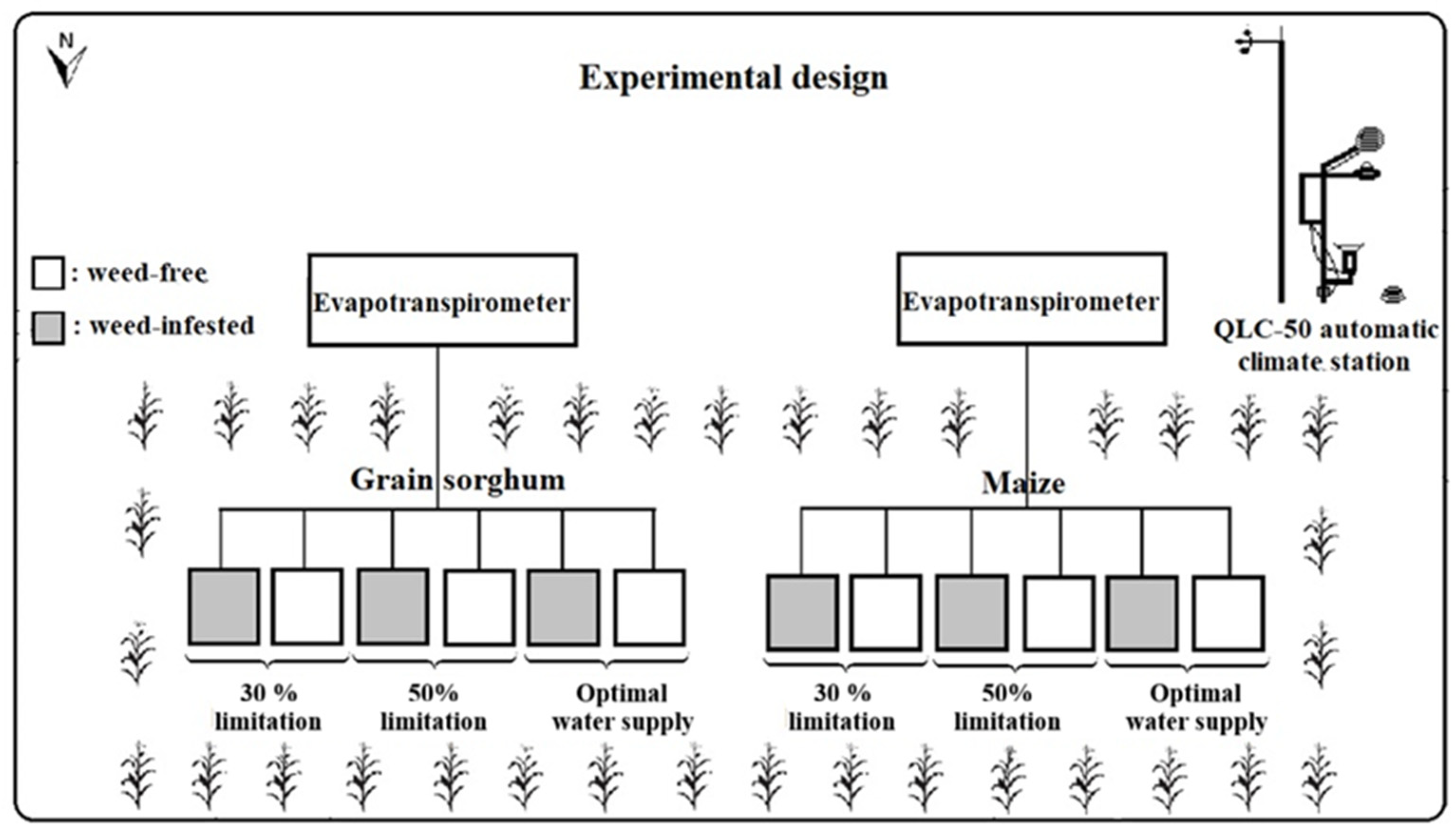
Figure 1. Experimental setup of maize and grain sorghum treatments under different water supply levels and weed competition in the compensation evapotranspirometer system.
Agronomy 16 01110 g001
Figure 2. Agrometeorological parameters during the growing season (1 June–11 September) of 2024 (Keszthely, Hungary): (a) daily mean, minimum and maximum air temperature (°C); (b) daily wind speed (m s−1); (c) daily precipitation (mm); (d) daily global radiation (MJ m−2 h−1).
Agronomy 16 01110 g002
Figure 3. The leaf area index (LAI) (mean ± SD) of maize (M), grain sorghum (S), and the weed flora (W) in optimal water supply (100%) (c), 50% water supply (50), and 30% water supply (30) treatments under weed-free and weed-infested conditions, measured at the beginning of the reproductive stage (BBCH 61). The colored portion of each bar indicates the leaf area of the crop (maize or grain sorghum), whereas the unfilled portion indicates the leaf area of weeds. In weed-infersted treatments, the total bar height represents the combined leaf area of the crop and weeds.
Agronomy 16 01110 g003
Figure 4. Cumulative evapotranspiration of (a) maize and (b) grain sorghum during the study period. Cumulative evapotranspiration (CET) curves for weed-free and weed-infested (W) maize (M) and grain sorghum (S) treatments. The numbers “50” and “30” in subscript represent the ratio of water supply relative to the corresponding controls’ (c) water consumption.
Agronomy 16 01110 g004
Figure 5. Heatmap of Pearson’s correlation coefficient matrix representing the relationships between meteorological variables and the evapotranspiration of maize and grain sorghum treatments. Significance levels are indicated by the numbers of asterisks: p-values <  0.001 (***), <0.01 (**), and <0.05 (*).
Agronomy 16 01110 g005
Figure 6. The evolution of daily crop coefficients (Kc act) in weed-free and weed-infested (W) maize (M) and grain sorghum (S) treatments as affected by different levels of reproductive-stage water deficit stress. The numbers “50” and “30” represent the ratio of water supply relative to the corresponding controls’ (c) water consumption. Comparison of weed-free and weed-infested treatments of maize and grain sorghum under different water supply levels: (a) maize under optimal water supply, including the control (Mc) and weed-infested control (MWc) treatments; (b) grain sorghum under optimal water supply, including the control (Sc) and weedy control (SWc) treatments; (c) maize under 50% water supply, including the weed-free (M50) and weed--infested (MW50) treatments; (d) grain sorghum under 50% water supply, including the weed-free (S50) and weed-infested (SW50) treatments; (e) maize under 30% water supply, including the weed-free (M30) and weed-infested (MW30) treatments; and (f) grain sorghum under 30% water supply, including the weed-free (S30) and weed-infested (SW30) treatments.
Agronomy 16 01110 g006
Figure 7. Relative water content (RWC) of (a) maize and (b) grain sorghum during the reproductive stage (BBCH 61–99) under different water supply and weed competition treatments. In maize, Mc = weed-free plants under optimal (control) water supply, MWc = weed-infested plants under optimal (control) water supply, M50 = weed-free plants under 50% water supply, MW50 = weed-infested plants under 50% water supply, M30 = weed-free plants under 30% water supply, and MW30 = weed-infested plants under 30% water supply. In grain sorghum, Sc = weed-free plants under optimal (control) water supply, SWc = weed-infested plants under optimal (control) water supply, S50 = weed-free plants under 50% water supply, SW50 = weed-infested plants under 50% water supply, S30 = weed-free plants under 30% water supply, and SW30 = weed-infested plants under 30% water supply. Values followed by different superscript letters (a, b, c) within a column differ significantly (p < 0.05), whereas values sharing the same letter are not significantly different.
Agronomy 16 01110 g007
Table 1. Biological yield (Yb), grain yield (Yg), and water-use efficiency (WUEb, WUEg) (mean ± SD) in weed-free and weed-infested (W) maize (M) and grain sorghum (S) treatments. The numbers “50” and “30” in subscript represent the ratio of water supply relative to the corresponding controls’ (c) water consumption. Values followed by different superscript letters (a, b, c) within a column differ significantly (p < 0.05), whereas values sharing the same letter are not significantly different.
Yb [kg ha−1]WUEb [kg Biomass m3 Water]Yg [kg ha−1]WUEg [kg Grain m3 Water]
Maize
Mc16,808.75 ± 1490.69 a5.08 ± 0.45 b9103.62 ± 1024.23 a2.75 ± 0.31
M5015,142.75 ± 1552.97 ab6.5 ± 0.67 a7467.05 ± 1103.71 ab3.2 ± 0.47
M3012,888.75 ± 1735.45 b7.21 ± 0.97 a5822.78 ± 966.72 b3.26 ± 0.48
p-values of water treatment effect0.0070.0020.0010.195
MWc10,507.88 ± 1348.84 a3.47 ± 0.455946.36 ± 818.39 a1.97 ± 0.27 b
MW507846.13 ± 494.28 b3.82 ± 0.244814.93 ± 147.06 b2.34 ± 0.07 a
MW305558.88 ± 476.31 c3.34 ± 0.293038.22 ± 432.42 c1.82 ± 0.26 b
p-values of water treatment effect<0.0010.107<0.0010.008
p-values
Weed infestation<0.001<0.001<0.001<0.001
Weed infestation × water treatment0.6030.0010.7790.106
Grain sorghum
Sc24,556 ± 1904.62 a9.28 ± 0.72 b10,762.31 ± 1374.5 a4.07 ± 0.52 b
S5020,487.6 ± 1123.51 b11.3 ± 0.62 a9391.74 ± 1175.87 a5.18 ± 0.65 a
S3012,880 ± 1203.43 c9.11 ± 0.85 b6155.69 ± 630.21 b4.36 ± 0.45 ab
p-values of water treatment effect<0.0010.001<0.0010.019
SWc15,363.6 ± 382.32 a4.79 ± 0.12 c6493.04 ± 625.2 a2.02 ± 0.19 b
SW5015,733.2 ± 855.56 a7.83 ± 0.43 a6404.2 ± 574.54 a3.19 ± 0.29 a
SW3010,374 ± 823.22 b6.34 ± 0.5 b3890.37 ± 379.8 b2.38 ± 0.23 b
p-values of water treatment effect<0.001<0.001<0.001<0.001
p-values
Weed infestation<0.001<0.001<0.001<0.001
Weed infestation × water treatment<0.0010.0120.050.984
Differences between maize and grain sorghum
p-values
Plant species effect<0.001<0.001<0.001<0.001
Disclaimer/Publisher’s Note: The statements, opinions and data contained in all publications are solely those of the individual author(s) and contributor(s) and not of MDPI and/or the editor(s). MDPI and/or the editor(s) disclaim responsibility for any injury to people or property resulting from any ideas, methods, instructions or products referred to in the content.