Article

Silicon Alters Herbivore-Induced Rice Volatiles to Enhance Attraction to a Predaceous Mirid Bug


1
State Key Laboratory for Biology of Plant Diseases and Insect Pests, Institute of Plant Protection, Chinese Academy of Agricultural Sciences, Beijing 100193, China
2
Plant Protection Center, Department of Agriculture, Ministry of Agriculture and Environment, Vientiane P.O. Box 811, Laos
*
Author to whom correspondence should be addressed.
Agronomy 2026, 16(11), 1109; https://doi.org/10.3390/agronomy16111109
Submission received: 26 April 2026 / Revised: 29 May 2026 / Accepted: 2 June 2026 / Published: 4 June 2026
(This article belongs to the Special Issue The Role of Silicon in Crop Stress Tolerance)

Abstract

Silicon (Si) amendment can enhance plant resistance to biotic stress, yet its role in tri-trophic interactions under multiple herbivore attack remains unclear. This study examined how Si influences herbivore-induced plant volatiles (HIPVs) and the foraging behavior of the predatory mirid Cyrtorhinus lividipennis that preys on eggs of the white-backed planthopper (WBPH; Sogatella furcifera). A 2 × 2 factorial design was employed to test the effects of Si amendment (+Si vs. −Si) and the striped stem borer (SSB; Chilo suppressalis) infestation (+SSB vs. −SSB) on plant volatile emissions and predator behaviors, with WBPH infestation present in all treatments. Cage and Y-tube experiments showed higher predator attraction and increased WBPH egg predation in +Si+SSB treatment relative to −Si+SSB treatment. HS-SPME-GC/MS analysis revealed that, regardless of Si amendment, SSB infestation massively altered the overall volatile profile, while Si amendment reduced emission of many volatiles in SSB infested plants. Single compound bioassays further identified that, regardless of Si amendment, SSB infestation significantly up-regulated four repellents for C. lividipennis. Compared with the −Si+SSB treatment, the +Si+SSB treatment down-regulated one repellent volatile and up-regulated three attractant volatiles. These findings indicate that Si amendment potentially enhances biocontrol of the subsequent herbivore under dual herbivory through altering HIPV emissions induced by the prior herbivory.

1. Introduction

Rice (Oryza sativa L.), a staple food for more than half of the global population, faces persistent threats from insect pests, leading to intensive pesticide use [1]. Although synthetic pesticides remain the primary tool for pest management, their excessive amendment has precipitated many challenges: the evolution of pesticide resistance, environmental contamination, and detrimental impacts on non-target organisms such as natural enemies and pollinators [2,3]. These ecological repercussions underscore an urgent need for sustainable alternatives. In this context, silicon (Si) has gained attention for its dual role in alleviating abiotic stresses and fortifying plant resistance against biotic stresses [4,5]. Si-mediated resistance operates through both direct mechanisms, such as the accumulation of defensive metabolites and the formation of physical barriers, and indirect mechanisms, particularly the modulation of herbivore-induced plant volatiles (HIPVs), which serve as key signals for recruiting natural enemies.
HIPVs are central to tri-trophic interactions, enabling natural enemies to discriminate between infested and healthy plants [6]. These complex blends typically comprise terpenoids, green leaf volatiles (GLVs), and aromatic compounds [7]. Accumulating evidence indicates that Si amendment can qualitatively and quantitatively reshape HIPV profiles, thereby bolstering biological control. For instance, Si amendment can modify HIPV profiles, thereby enhancing the attraction of natural enemies such as predatory beetles, predatory mites, parasitoids, and earwigs in cucumber [8], French bean [9], rice [10], and maize [11]. Collectively, these studies demonstrate that silicon can enhance indirect defense against chewing herbivores. However, evidence for the role of Si in enhancing biological control of piercing–sucking herbivores remains limited and inconsistent. For example, Abbasi et al. [12] found that Si amendment to cotton failed to alter the attraction of Chrysoperla spp. to plants infested with Bemisia tabaci. Similarly, studies on sorghum and wheat reported no significant effects of silicon on parasitoid attraction in aphid-infested systems [13,14]. In contrast, Abdollahi et al. [15] observed, under field conditions, that Si amendment in rapeseed enhanced parasitoid attraction in cabbage aphid colonies.
Most of the above-mentioned studies have been conducted under single-herbivore scenarios. In natural agroecosystems, plants are frequently subjected to simultaneous or sequential attacks by multiple herbivore species, including both chewers and piercing-suckers [16,17]. Such multi-herbivore pressure can trigger intricate crosstalk between phytohormonal signaling pathways, thereby reshaping HIPV biosynthesis. For instance, dual attack by Plutella xylostella and aphids reduced aphid parasitism in Arabidopsis thaliana [18], and Chilo suppressalis infestation induced rice volatiles that repelled natural enemies Anagrus nilaparvatae of Nilaparvata lugens [19]. Conversely, other studies indicate that natural enemies can discriminate volatile cues from plants under concurrent attack and successfully locate their preferred hosts [20]. These studies highlight the contrasting outcomes in the role of HIPVs for natural enemy recruitment between multi-herbivore infestation and single-herbivore system. Rice is severely threatened by pests such as the striped stem borer (SSB; C. suppressalis, Lepidoptera: Crambidae) and the white-backed planthopper (WBPH; S. furcifera, Hemiptera: Delphacidae) [21]. The SSB wreaks destructive damage through larval boring into rice stems from the base and feeding internally, causing withered sheaths, plant death, or panicle failure [22]. Both nymphs and adults of WBPH cause severe direct damage by sucking phloem sap from leaf sheaths [23] and indirect damage through transmission of the southern rice black-streaked dwarf virus [24]. In the subtropics, early-season rice typically experiences SSB infestation first, followed by WBPH infestation during the tillering stage [25], where the mirid bug Cyrtorhinus lividipennis is a dominant predator of WBPH eggs and nymphs [26]. As a key component of integrated pest management, Si amendment has been shown to enhance rice plant resistance to herbivores such as SSB [27] and WBPH [23]. Especially, Si is reported to strengthen attraction of natural enemies and potential in improving biological control [28], but most studies have focused on single herbivore attacks. Although paddy rice in the subtropics is more than often attacked simultaneously or sequentially by multiple herbivores, little is known about the role of Si in tri-trophic interactions under multiple herbivore attack, such as in the subtropical paddy rice ecosystems harboring the chewer SSB, the piercing-sucker WBPH, and the predator C. lividipennis. Based on previous findings, we hypothesized that Si would alter HIPV emission in rice plants sequentially infested by the chewing SSB and piercing–sucking WBPH and affect the attraction of the predator C. lividipennis. To this end, we established a tri-trophic system comprising rice plants, two herbivores—SSB, WBPH, and the predator C. lividipennis, where the plants were amended with Si or not, infested with SSB or not, and oviposited by WBPH. Behavioral responses of C. lividipennis to the plants with WBPH oviposition were observed in both cage tests and olfactometer tests and volatiles were collected and analyzed for chemical profiles to account for the observed behavioral responses.

2. Materials and Methods

2.1. Rice Seedlings and Si Treatment

The rice variety used in the experiment was ‘Zhongzheyou 8’, a major cultivar in Guangxi, China. Seeds were surface-sterilized in 0.5% (w/v) copper sulfate solution for 12 h, rinsed thoroughly with distilled water, and then soaked in distilled water for 24 h (with water renewed 1–2 times). After draining, seeds were covered with moist gauze for 24 h to induce germination. Seeds with uniform radicle emergence were placed in plastic boxes (38 cm × 28 cm × 8 cm) lined with filter paper saturated with Kimura B nutrient solution (pH 5.6–6.0) and cultivated for 7 days. Seed sterilization and germination were performed in a climate chamber (RXZ-270, Ningbo Southeast Instrument Co., Ltd., Ningbo, China) with a temperature of 26 ± 2 °C, photoperiod of 16 L:8 D and 70 ± 10% relative humidity.
Seedlings were transferred to a greenhouse (temperature 28 ± 4 °C, humidity 70 ± 20%, natural light) for hydroponic cultivation. Seedlings were fixed with sponge in perforated foam boards (38 cm × 28 cm, 35 plants per board) and placed in plastic boxes containing 4 L of Kimura B nutrient solution, either amended with silicon [+Si, supplemented with 1.4 mmol·L−1 Na2SiO3·9H2O (99%, analytical grade, Macklin Biochemical Co., Ltd., Shanghai, China)] or not [−Si]. To eliminate potential sodium interference, 2.8 mmol·L−1 NaCl was added to the −Si treatment to equalize Na+ concentrations between treatments. The nutrient solution was replaced weekly. Plants were cultivated for a total of 35 days from seed emergence (7 days in the climate chamber followed by 28 days in the greenhouse) before being used in subsequent experiments.

2.2. Insects Rearing

The SSB, WBPH and C. lividipennis populations were originally collected from the Guilin Experimental Station, Ministry of Agriculture and Rural Affairs, Xing’an County, Guangxi, China (25°36′01.8″ N, 110°42′01.6″ E). The SSB colony was reared on an artificial diet in the insectary for successive generations, following the method described by Han et al. [29]. The WBPH colony was maintained on the susceptible rice variety Taichung Native 1 (TN1). The C. lividipennis population was reared for two generations on TN1 rice plants with WBPH eggs before being used in the experiments. All insects were cultured in chambers under controlled environmental conditions: temperature 26 ± 2 °C, relative humidity 70 ± 10%, and a photoperiod of 16 L:8 D.

2.3. Experimental Design

The experiment employed a 2 × 2 factorial design with two factors: silicon amendment (+Si vs. −Si) and SSB infestation (+SSB vs. −SSB), resulting in four treatment combinations:
  • −Si−SSB (without Si amendment and SSB infestation),
  • −Si+SSB (without Si amendment, infested with one third-instar SSB larva for 72 h),
  • +Si–SSB (with Si amendment, without SSB infestation),
  • +Si+SSB (with Si amendment, infested with one third-instar SSB larva for 72 h).
Following the 72 h SSB infestation, three pairs of WBPH adults (allowed to mate freely for 5–7 days after emergence) were introduced into an arena [30] for oviposition. Briefly, the arena is composed of two 9 cm diameter plastic cups, with one placed outside down on another. A rice stem was passed through the central holes perforated in the lid and bottom of the cup, allowing the roots to be immersed in the Kimura B nutrient solution in the lower cup. The WBPH adults were introduced into the upper cup. After 24 h of oviposition, the planthoppers were removed, and the plants were used for subsequent experiments.

2.4. Settling Preference and Predation of C. lividipennis: Cage Tests

The experiment was conducted under controlled environmental conditions to evaluate the settling preference of C. lividipennis for rice plants across different treatments. The tests were observed between pairs of treatments in cubic cages (60 cm × 60 cm × 60 cm, 80 mesh): −Si−SSB vs. +Si−SSB, −Si−SSB vs. −Si+SSB, +Si−SSB vs. +Si+SSB, −Si+SSB vs. +Si+SSB. The pairs between −Si−SSB and +Si+SSB, and between +Si−SSB and −Si+SSB, involve simultaneous changes in both Si and SSB and were not tested. In each test, one potted rice plant from each of the two compared treatments were placed randomly on the left or right side of the cage, which was determined by a random number table.
To start the tests, ten newly emerged (<24 h) C. lividipennis females, starved for 2 h, were released at the center of the cage. Eight hours after release, the rice stems were dissected under a microscope to check the integrity of WBPH eggs. The eggs that were shriveled or left with eggshells were considered predated. The intact eggs and predated (collapsed) eggs of WBPH in each rice plant were counted to calculate the oviposition amount and predation rate. Ten biological replicates were performed per pairwise comparison, each using independently cultivated plants and a new cohort of 10 C. lividipennis females.

2.5. Orientation Preference of C. lividipennis: Y-Tube Olfactometer Tests

A Y-tube olfactometer [30] was used to further test the orientation preference of C. lividipennis for rice plants from different treatments. The Y-tube olfactometer assays were conducted using purified and humidified air delivered through each arm at a constant airflow rate of 200 mL min−1. All experiments were performed under controlled conditions at 27 ± 2 °C and 70 ± 20% relative humidity in a room shielded from natural light to avoid directional light bias. A 10 W fluorescent light was positioned vertically 30 cm above the Y-tube to guide insect orientation. Rice seedlings (8 plants) from two treatments to be compared were placed in odor source bottles A and B, respectively. A single C. lividipennis female (starved for 2 h) was introduced into the main arm and observed for behavior for up to 10 min. A choice was recorded when the insect entered a side arm, moved ≥5 cm into it, and remained for ≥1 min. Insects that remained in the main arm after 10 min, or that entered a side arm but retreated within 1 min, were recorded as no choice. After every four insects had been tested, the Y-tube was replaced with a clean one of the same type; the used tube was cleaned with 75% ethanol, dried with a hairdryer, and cooled for later use. The direction of the two arms was swapped after every 10 insects tested. For each comparison, 70 female insects were tested. Insects that were recorded as ‘no choice’ and were excluded from statistical analyses.

2.6. Collection and Analysis of Rice Volatiles

After WBPH oviposition, rice stem samples (approximately 10 cm in length) were cut at the base of the plant, immediately flash-frozen in liquid nitrogen and stored at −80 °C until analysis. The samples were ground with liquid nitrogen and mixed by vortexing. Approximately 500 mg of each sample was weighed into a 20 mL headspace vial (22.5 × 75 mm, Agilent, Palo Alto, CA, USA). Then, 2 mL of saturated NaCl solution (to facilitate volatile release) was added. The vials were sealed using crimp-top caps with TFE-silicone headspace septa (Agilent). At the time of SPME analysis, each vial was placed at 60 °C for 5 min, then a SPME Arrow (Agilent) of 120 μm DVB/CWR/PDMS was exposed to the headspace of the sample for 15 min at 60 °C, followed by desorption at 250 °C for 5 min in the GC injection port. Four biological replicates were sampled from each plant treatment, with each replicate consisting of three individual plants. The VOCs were quantified using an Agilent Model 8890 GC and a 7000 D mass spectrometer (MS, Agilent), equipped with a 30 m × 0.25 mm × 0.25 μm DB-5MS (5% phenyl-polymethylsiloxane) capillary column. Helium was used as the carrier gas at a linear velocity of 1.2 mL/min. The injector temperature was kept at 250 °C. The oven temperature was programmed from 40 °C (3.5 min), then increased at 10 °C/min to 100 °C, at 7 °C/min to 180 °C, at 25 °C/min to 280 °C, and held for 5 min. Mass spectra were recorded in electron impact (EI) ionization mode at 70 eV. The quadrupole mass detector, ion source, and transfer line temperatures were set at 150, 230 and 280 °C, respectively. The MS was operated in the selected ion monitoring (SIM) mode for the identification and quantification of analytes. Volatile compounds were quantified relative to peak area normalization after total peak area normalization. Compound identification was performed by comparing the obtained mass spectra with those in the NIST mass spectral library, together with retention time information generated under the same GC–MS conditions. Only compounds with high-quality spectral matching were retained for subsequent analyses. Differential volatile metabolites between the treatments were identified using variable importance in projection (VIP) scores from orthogonal partial least squares discriminant analysis (OPLS-DA), with thresholds of VIP > 1 and |log2(fold change)| ≥ 1.0. OPLS-DA, including score plots and permutation tests (200 permutations), was performed using the MetaboAnalystR package (version 4.2.0) in R. Data were log2-transformed and mean-centered prior to analysis. Volatilomic profiling was entrusted to Metware Biotechnology Co., Ltd. (Wuhan, China).

2.7. Behavioral Response of C. lividipennis to Individual Volatile

Based on volatile metabolomics results (Table A1), 10 compounds showing significant differences among treatments were further tested for their effects on the preference of C. lividipennis. All compounds were purchased from Macklin (Shanghai, China). Stock solutions were serially diluted with n-hexane to four concentrations (1, 10, 50, and 100 μL/mL, v/v). For each bioassay, 20 μL of test solution was applied to a filter paper strip (1 cm × 2 cm) as the odor source; 20 μL of n-hexane served as the control. For each compound and concentration, 40 females were tested using the same Y-tube protocol described in Section 2.5.

2.8. Data Analysis

Pairwise comparison of preference in cage tests were analyzed using one-sample t-tests and that of predation rates and the number of WBPH eggs in cage tests were analyzed using independent samples t-tests. The Chi-square test was used to analyze data of Y-tube olfactometer assays. All analyses were performed using DPS software (Version 19.05).

3. Results

3.1. Settling Preference and Predation of C. Lividipennis: Cage Tests

3.1.1. WBPH Oviposition

When gravid WBPH females were allowed to oviposit ad lib on plants in paired-choice cage tests, the total number of eggs per plant was significantly lower in +Si−SSB compared to the other treatments (t ≤ 2.725; p ≤ 0.014) and showed no significant differences among +Si+SSB, −Si+SSB and –Si–SSB (p > 0.05) (Figure 1).

3.1.2. Settling Preference of C. lividipennis

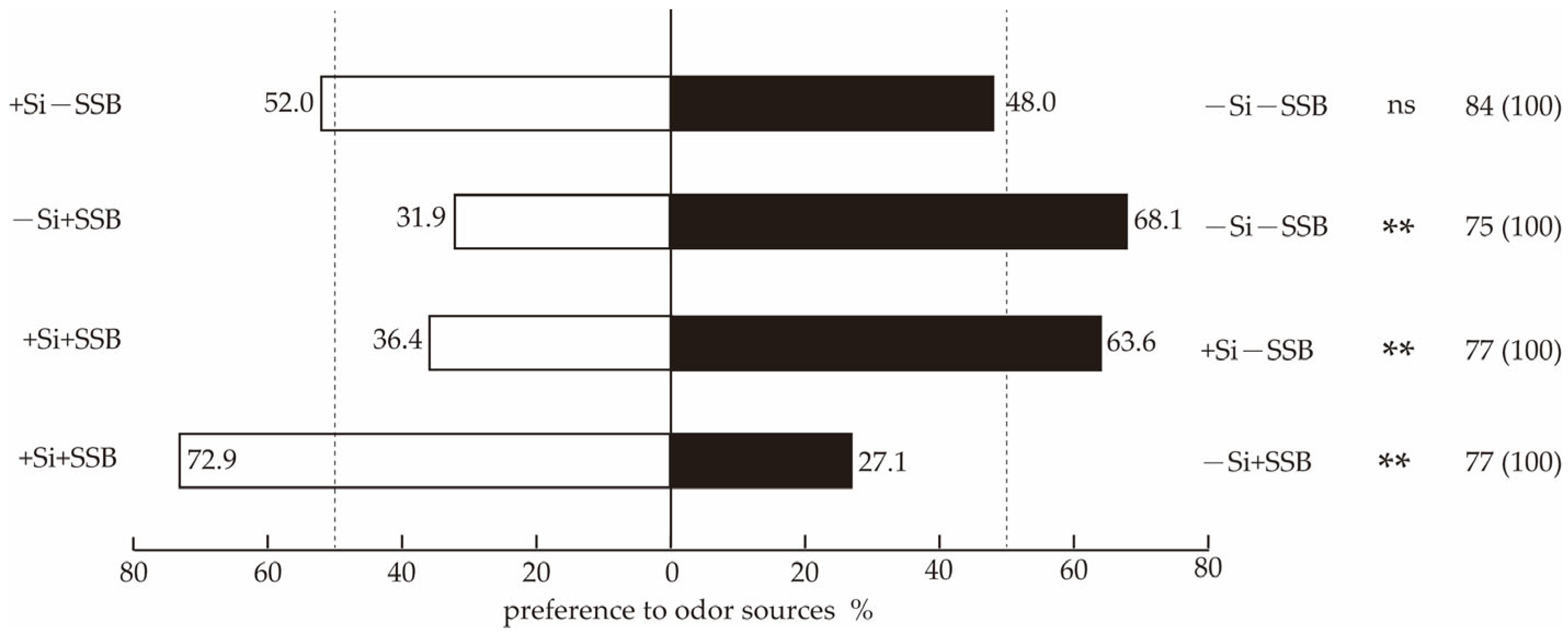
In paired-choice cage tests, without SSB infestation, Si amendment had no significant effect on the preference of C. lividipennis (t = 0.712; p = 0.494). Regardless of Si amendment, a significantly higher percentage of C. lividipennis individuals chose −SSB plants over +SSB plants (t ≥ 3.798; p ≤ 0.004). However, C. lividipennis exhibited a significantly greater preference for +Si+SSB plants compared to −Si+SSB plants (t = 4.321; p = 0.002) (Figure 2).

3.1.3. Predation Rate of WBPH Eggs

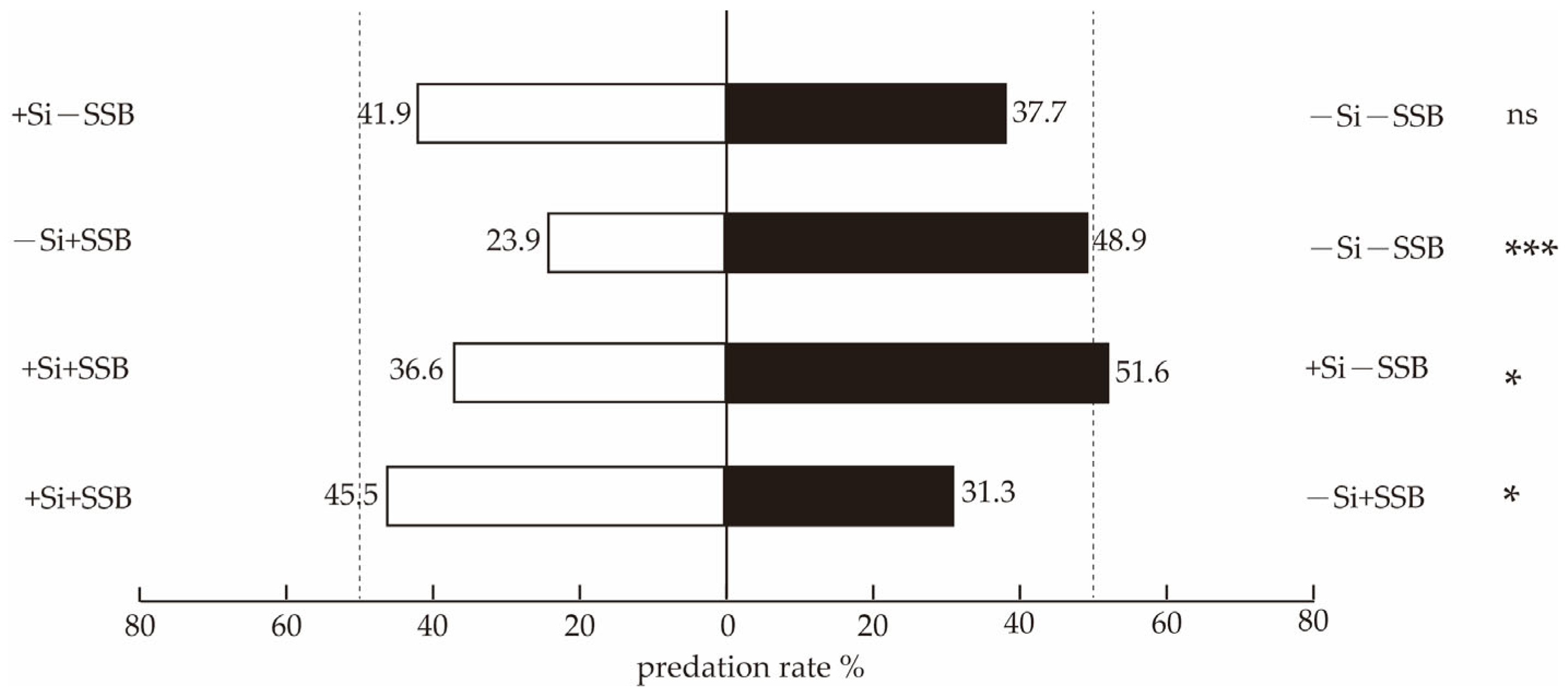
The predation rate of WBPH eggs was consistent with the settling preference of C. lividipennis. When there was no SSB infestation, the Si amendment did not significantly affect the predation rate (t = 0.923; p = 0.368). Regardless of Si amendment, the predation rate was significantly higher on –SSB plants than on +SSB plants (t ≤ 3.552; p ≤ 0.002). However, with SSB infestation, the predation rate was significantly higher on +Si+SSB plants than on −Si+SSB plants (t = 4.200; p = 0.001) (Figure 3).

3.2. Orientation Preference of C. lividipennis: Y-Tube Olfactometer Tests

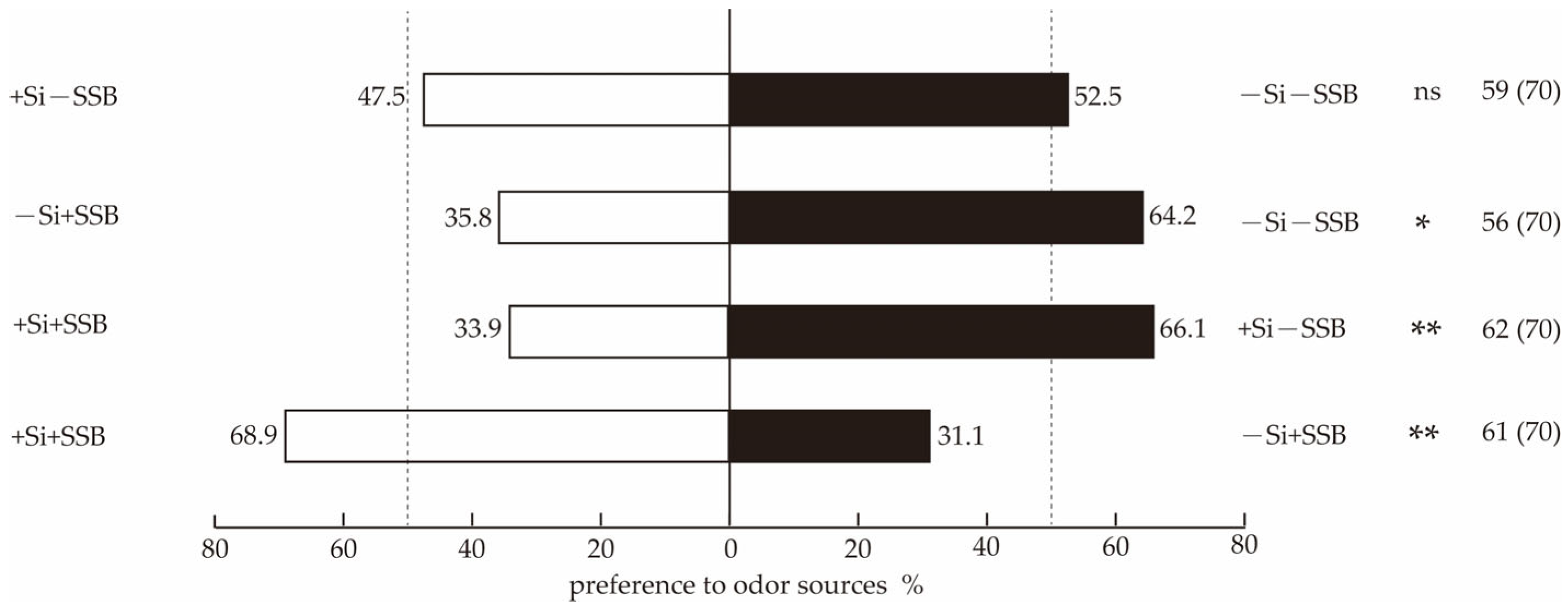
In the Y-tube olfactometer assay, when there was no SSB infestation, Si amendment had no significant effect on the orientation preference of C. lividipennis (χ2 = 0.153; p = 0.696). Regardless of Si amendment, a significantly higher percentage of C. lividipennis individuals chose −SSB plants over +SSB plants (χ2 ≤ 4.571; p ≤ 0.033). However, with SSB infestation, C. lividipennis displayed a significantly greater preference for +Si+SSB plants than for −Si+SSB plants (χ2 = 8.672; p = 0.003) (Figure 4).

3.3. Rice Volatiles

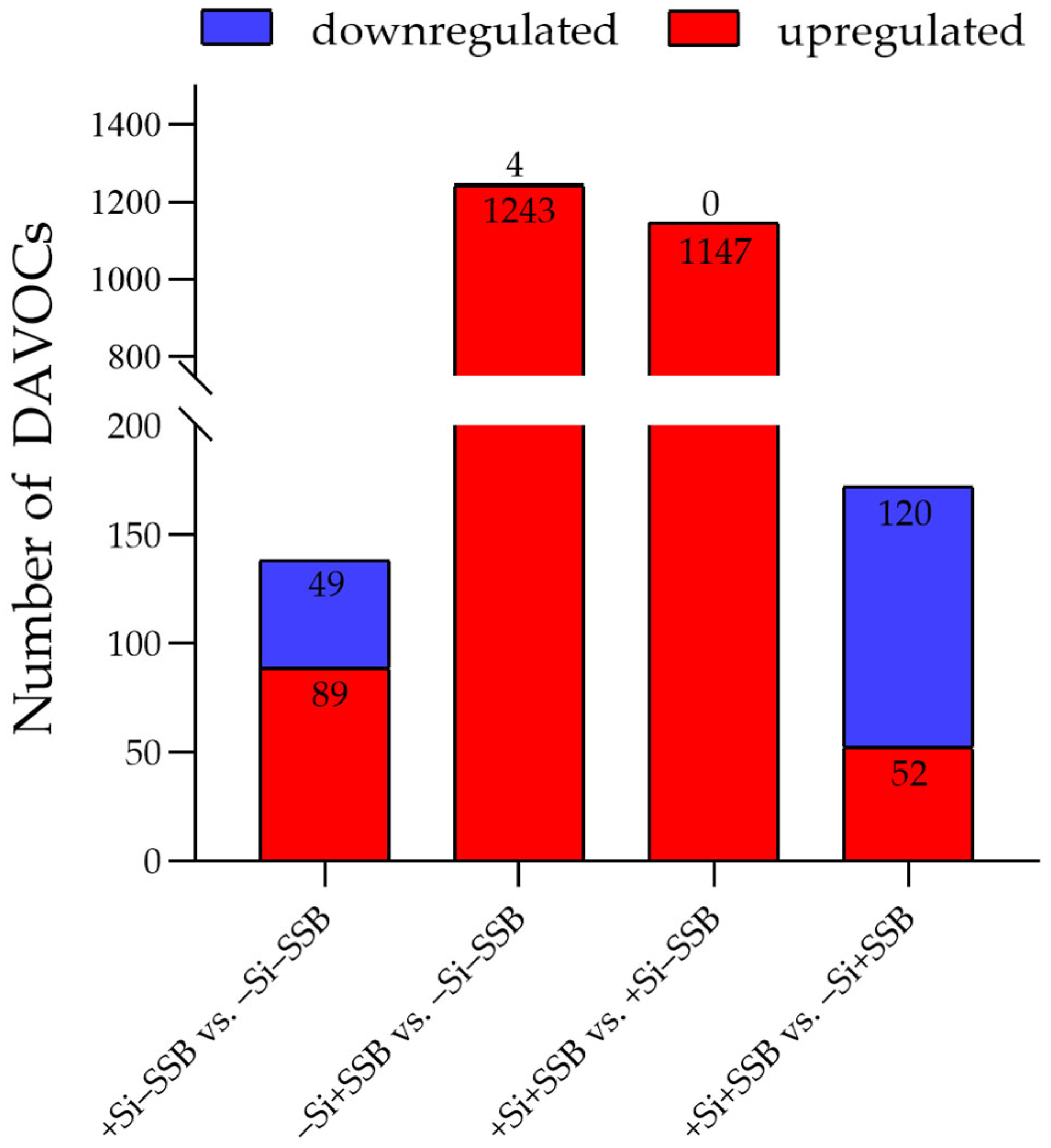
A total of 2704 differentially accumulated volatile organic compounds (DAVOCs) were detected across all pairwise comparisons (Figure 5).
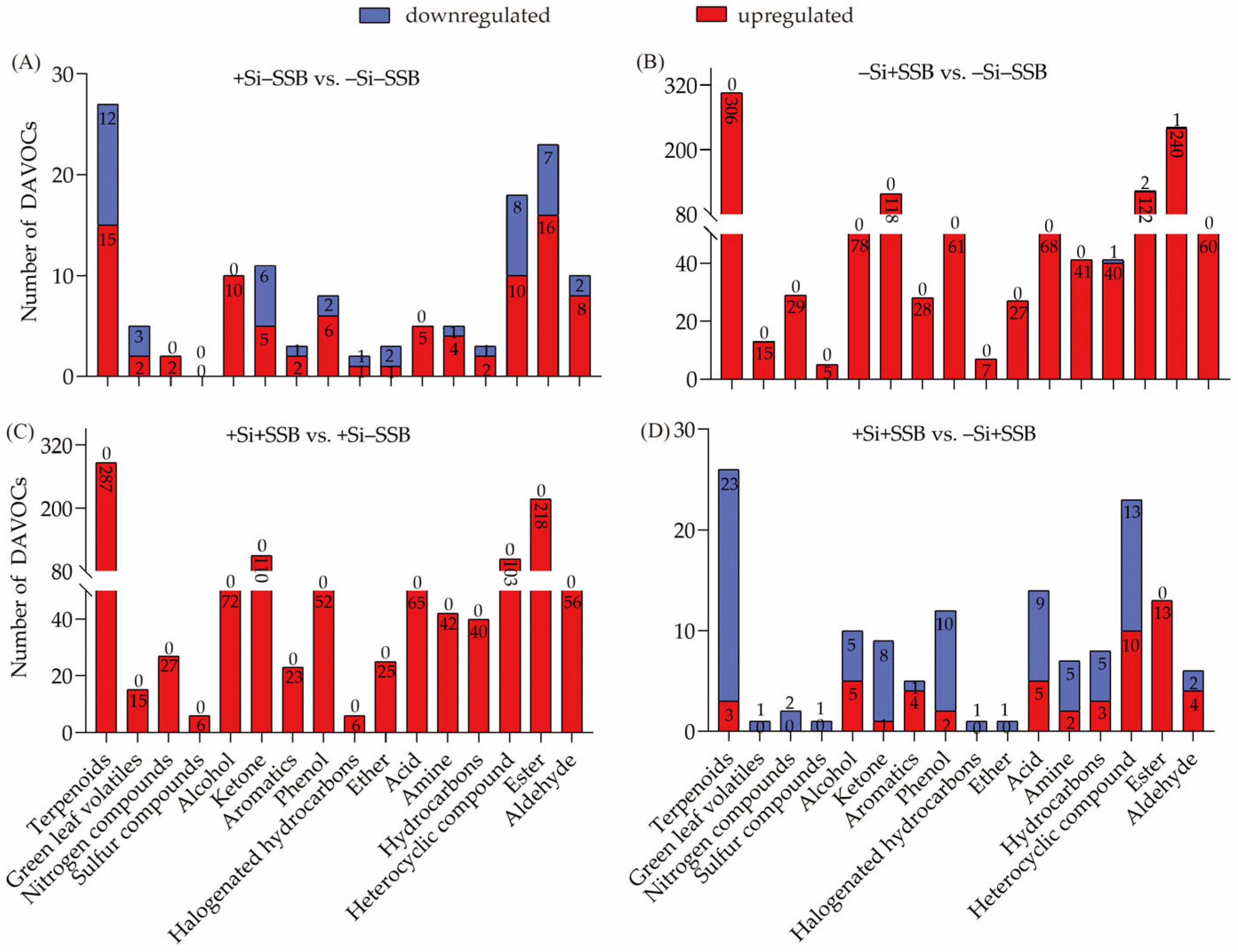
Between +Si−SSB and −Si−SSB, a total of 138 DAVOCs were detected. Compared to −Si−SSB plants, +Si−SSB plants showed relatively higher/lower accumulation of 89/49 volatiles (Figure 5). Among the 138 DAVOCs, only 15 terpenoids, 2 green leaf volatiles (GLVs), and 2 nitrogen-containing compounds exhibited increased concentration, while only 12 terpenoids and 3 GLVs showed decreased concentration (Figure 6A). The variation in volatiles between the treatments did not arouse significant behavioral preference (Figure 2 and Figure 4).
Between −Si+SSB and –Si–SSB, a total of 1247 DAVOCs were detected. In contrast to −Si−SSB plants, −Si+SSB plants harbored relatively higher/lower accumulation of 1243/4 volatiles (Figure 5). Among the 1247 DAVOCs, 306 terpenoids, 15 GLVs, 29 nitrogen-containing compounds, and 5 sulfur-containing compounds exhibited increased concentration (Figure 6B). The variation in volatiles between the treatments aroused significant behavioral preference in C. lividipennis for −Si−SSB plants over −Si+SSB plants (Figure 2 and Figure 4).
Between +Si+SSB and +Si−SSB, a total of 1147 DAVOCs were detected. Relative to +Si−SSB plants, +Si+SSB showed relatively higher accumulation of 1147 volatiles (Figure 5), which includes 287 terpenoids, 15 GLVs, 27 nitrogen-containing compounds, and 6 sulfur-containing compounds (Figure 6C). The variation in volatiles between the treatments resulted in a significant preference in C. lividipennis for +Si−SSB plants compared to +Si+SSB plants (Figure 2 and Figure 4).
Between +Si+SSB and −Si+SSB, a total of 172 DAVOCs were detected. Compared with −Si+SSB plants, +Si+SSB exhibited relatively higher accumulation of 52 volatiles and lower accumulation of 120 volatiles (Figure 5). Among the 172 DAVOCs, only 3 terpenoids increased in concentration (Figure 6D); however, 23 terpenoids, 1 GLV, 2 nitrogen-containing compounds, and 1 sulfur-containing compound decreased. This volatile divergence led to a marked behavioral preference: C. lividipennis significantly preferred +Si+SSB plants over −Si+SSB plants (Figure 2 and Figure 4).

3.4. Behavioral Response of C. lividipennis to Individual Volatile

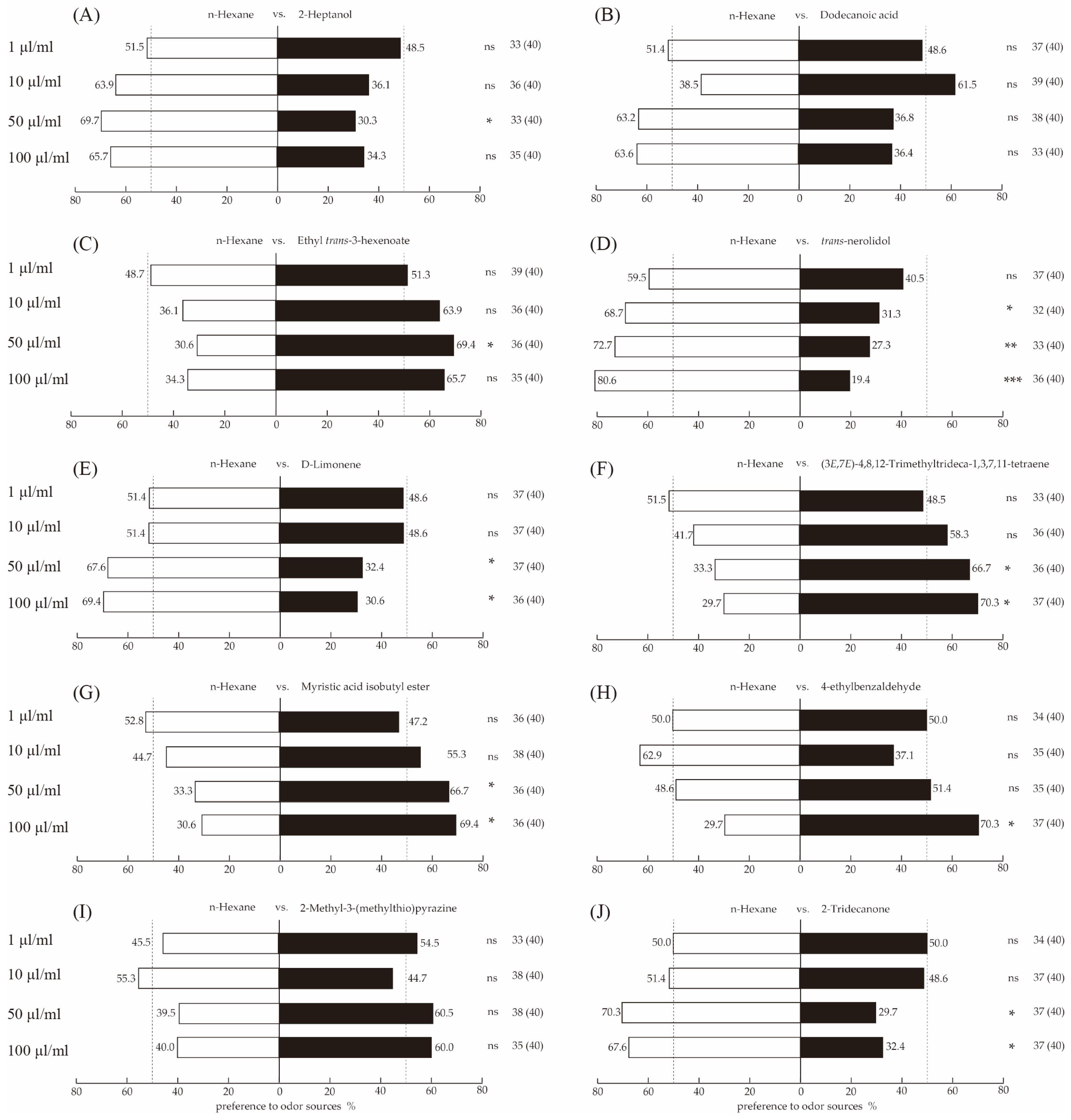
Y-tube olfactometer assays were conducted to evaluate the preference of C. lividipennis females for 10 volatile compounds at various concentrations (Table A1). The results showed that, compared to the n-hexane control, four compounds (2-heptanol, trans-nerolidol, D-limonene, and 2-tridecanone) exhibited significant repellent effects on C. lividipennis females at concentrations of 10, 50, and/or 100 μL/mL (χ2 test, p ≤ 0.034). Lauric acid and 2-methyl-3-(methylthio) pyrazine showed no significant effects on C. lividipennis female preference at any of the four concentrations tested (χ2 test, p ≥ 0.105). In contrast, four compounds—(3E,7E)-4,8,12-trimethyltrideca-1,3,7,11-tetraene (TMTT), ethyl trans-3-hexenoate, myristic acid isobutyl ester, and 4-ethylbenzaldehyde—had no significant effect on females at lower concentrations but demonstrated significant attractant effects at higher concentrations (50 and/or 100 μL/mL) (χ2 test, p ≤ 0.046) (Figure 7; Table 1 and Table 2).
Volatile compounds analysis revealed that, regardless of Si amendment, SSB infestation induced significant up-regulation of four compounds that repel C. lividipennis. In contrast, in the comparison between +Si+SSB and −Si+SSB, one compound that repels C. lividipennis was significantly down-regulated, and three compounds that attract natural enemies were significantly up-regulated (Table A1).

4. Discussion

Silicon is known to enhance the attraction of natural enemies by modulating HIPVs in systems involving chewing herbivores, but studies on piercing–sucking herbivores remain limited [28]. Consistent with previous reports [23], Si amendment significantly reduced WBPH oviposition on rice plants, with the total number of eggs per plant being significantly lower on +Si−SSB than on −Si−SSB plants. However, without SSB infestation, +Si−SSB plants did not exhibit enhanced attraction to C. lividipennis compared to −Si−SSB plants. These results suggest that the role of Si in mediating tri-trophic interactions may differ between chewing and piercing–sucking herbivores. Unlike chewing herbivores, piercing–sucking herbivores require continuous feeding and oviposition sites within plant tissues. Si deposition in plant tissues interferes with both feeding and oviposition of piercing–sucking herbivores, leading to reduced oviposition [23,31,32]. It is well established that natural enemies preferentially orient toward plants with higher prey abundance [33,34,35,36]. Therefore, the reduced oviposition (and thus lower prey density) on Si-treated plants may partially explain why Si-treated plants fail to attract natural enemies of piercing–sucking herbivores. Existing research indicates that under infestation by piercing–sucking herbivores, Si amendment does not promote natural enemy attraction [12,13,14].
A key finding of this study is that SSB infestation significantly disrupted the foraging behavior of C. lividipennis. In Y-tube olfactometer assays, C. lividipennis consistently showed a significant preference for −SSB plants over +SSB plants, regardless of Si amendment. Similarly, predation rates were higher on −SSB plants compared to +SSB plants. Analogous findings have been observed in other plant systems; on Arabidopsis thaliana co-infested by P. xylostella and aphids, aphid parasitism rates were significantly lower than on plants infested by aphids alone [18]. Analysis of the volatile profiles revealed that, regardless of Si amendment, SSB infestation induced varying degrees of increase in the concentrations of more than 1100 DAVOCs. Collectively, these findings suggest that SSB infestation, independent of Si treatment, interferes with the ability of C. lividipennis to locate and prey upon WBPH, likely through modification of the plant’s volatile profile.
Interestingly, C. lividipennis showed a significant preference for +Si+SSB plants over –Si+SSB plants in both behavioral and predation assays. This suggests that Si amendment may partially mitigate the disruptive effects of SSB infestation. HIPVs are highly specific and serve as reliable cues for natural enemies to locate their prey [37,38,39]. This specificity is determined by three key factors: volatile composition, concentration ratios, and background odor [38,40]. When multiple herbivores infest a plant simultaneously, the resulting blend of volatiles becomes more complex, potentially masking prey-specific cues and reducing foraging efficiency [19,41,42]. In this study, SSB infestation induced a broad increase in the emission of numerous volatile compounds, probably creating a “background noise” that likely interfered with prey location by C. lividipennis. However, under SSB infestation, +Si plants exhibited a reduction in more than 100 DAVOCs compared to –Si plants. This reduction in volatile diversity may attenuate the SSB-induced complexity, thereby enabling C. lividipennis to locate WBPH more efficiently. A similar interpretation was proposed by Hu et al. [19], who reported that SSB infestation significantly alters rice volatile profiles and exerts a repellent effect on Anagrus nilaparvatae.
Further single-compound Y-tube olfactometer assays revealed that four compounds—2-heptanol, trans-nerolidol, D-limonene, and 2-tridecanone—exhibited significant repellent effects on C. lividipennis females. Regardless of Si amendment, these compounds were significantly upregulated in SSB infestation treatments compared to no SSB treatments (Table A1). Lauric acid and 2-methyl-3-(methylthio) pyrazine showed no significant effects on C. lividipennis females at any of the four concentrations tested. Among these, lauric acid was significantly upregulated in −Si+SSB compared to −Si−SSB, while 2-methyl-3-(methylthio)pyrazine was significantly downregulated; however, neither compound showed significant changes in +Si+SSB compared to +Si−SSB. Four other compounds—TMTT, ethyl 3-hexenoate, isobutyl myristate, and 4-ethylbenzaldehyde exhibited significant attractant effects on females at higher concentrations (50 or 100 μL/mL, or both). Ethyl 3-hexenoate, isobutyl myristate, and 4-ethylbenzaldehyde were significantly upregulated in the +Si+SSB vs. −Si+SSB treatment (Table A1). Previous studies have also indicated that 2-heptanol, D-limonene, and 2-tridecanone exert repellent effects on A. nilaparvatae [19]. While these assays demonstrate the potential activity of individual volatiles, it is important to note that the concentrations tested may differ from the actual amounts naturally emitted by plants. We therefore consider these results as a mechanistic foundation; future studies using natural-concentration ranges or emission-rate-based dosing would further validate the ecological relevance of these individual compounds. SSB-induced volatiles may include compounds that actively repel C. lividipennis and Si amendment may reduce the emission of some repellents while increasing the emission of some attractants. These differential effects of individual compounds provide a mechanistic explanation for the behavioral preferences of C. lividipennis. The mechanistic conclusions of this study are based on the functionally validated subset of compounds. These results support the hypothesis that Si amendment modulates the volatile profile of SSB-infested plants, enhancing attractiveness to C. lividipennis by reducing repellent compounds and increasing attractant compounds. Furthermore, the predator’s behavior in natural settings is likely shaped by the entire volatile blend, including compounds not tested individually. Future studies should employ synthetic blends mimicking the natural ratios of key attractants and repellents to establish causality more rigorously.
Beyond Si-mediated volatile modifications, plant attractiveness to natural enemies under field conditions is shaped by a complex interplay of additional cues. Many plants provide nutritional rewards such as extrafloral nectar that recruit and maintain resident populations of predators and parasitoids [43]. Visual signals and microclimatic conditions further influence natural enemy behavior and can act synergistically with HIPVs to refine host searching and patch residence decisions [44]. After landing, predators also use gustatory receptors to sense non-volatile herbivory-induced metabolites. Flavonoids can serve as oviposition stimulants, confirming the plant’s suitability as a foraging or reproductive site [45]. In the future, integrating these multifaceted cues will be essential for translating laboratory findings into effective field-based biocontrol strategies. We also acknowledge that our experiments were conducted exclusively under controlled laboratory conditions; semi-field or field validation will be necessary to confirm the ecological relevance of Si-mediated volatile modifications under more variable and realistic environments.

5. Conclusions

In summary, this study reveals that Si-mediated indirect defense differs between chewing and piercing–sucking herbivores. Unlike the well-documented enhancement of natural enemy attraction in chewing herbivore, Si amendment did not increase the attractiveness of rice plants to the predatory mirid C. lividipennis when plants were infested solely with the WBPH. This lack of attraction is likely attributable to Si-induced reduction in WBPH oviposition, which decreases prey density and thereby diminishes prey-derived olfactory cues.
A key finding is that SSB infestation disrupts the foraging efficiency of C. lividipennis, probably by emitting more than 1100 herbivore-induced volatile compounds that may mask prey-specific signals and include repellent compounds. However, Si amendment partially mitigated this disruption: under dual infestation, predators significantly preferred Si-treated plants, as evidenced by the downregulation of one repellent compound and the upregulation of three attractant volatile compounds following Si amendment.
These findings advance our understanding of how plant–herbivore–natural enemy interactions under dual herbivory are modulated by silicon and highlight the importance of herbivore community composition in determining the outcomes of plant-mediated indirect defense. Future research should validate these laboratory findings under field conditions and explore whether Si-induced volatile modifications can be optimized to enhance biological control in rice ecosystems.

Author Contributions

Conceptualization, M.H.; methodology, Y.Z.; software, Y.Z. and D.A.; validation, Y.Z.; formal analysis, M.H.; investigation, Y.Z., L.Z. and S.C.; resources, M.H.; data curation, Y.Z.; writing—original draft preparation, Y.Z. and G.C.; writing—review and editing, B.S. and M.H.; visualization, Y.Z. and D.A.; supervision, M.H.; project administration, M.H.; funding acquisition, M.H. All authors have read and agreed to the published version of the manuscript.

Funding

This work was financially supported by the National Key Research and Development Program of China (2024YFE0214100).

Data Availability Statement

The original contributions presented in this study are included in the article. Further inquiries can be directed to the corresponding author.

Acknowledgments

We would like to thank Han Yi, Yue Sun and Xinyan Tang for their assistance with the experiments.

Conflicts of Interest

The authors declare no conflicts of interest.

Abbreviations

The following abbreviations are used in this manuscript:
DAVOCsDifferentially Accumulated Volatile Organic Compounds
DPSData Processing System
FCFold Change
GLVsGreen Leaf Volatiles
HIPVsHerbivore-Induced Plant Volatiles
OPLS-DAOrthogonal Partial Least Squares Discriminant Analysis
SSBStriped Stem Borer
TN1Taichung Native 1
VIPVariable Importance for the Projection
WBPHWhite-Backed Planthopper

Appendix A

Table A1. Identified differentially emitted volatile compounds in rice plants infested with SSB (+SSB) or not (−SSB) and amended with Si (+Si) or not (−Si).
Compounds+Si−SSB vs.
−Si−SSB
−Si+SSB vs.
−Si−SSB
+Si+SSB vs. +Si−SSB+Si+SSB vs.
−Si+SSB
1,2,4-Benzenetriol-upupdown
Hydrazine, (4-methoxyphenyl)--up-down
Berteroin-up-down
Thiocyanic acid, phenylmethyl ester-upupdown
Azulene, 1,2,3,5,6,7,8,8a-octahydro-1,4-dimethyl-7-(1-methylethenyl)-, [1S-(1.alpha.,7.alpha.,8a.beta.)]--up-down
Phenol, 5-methyl-2-(1-methylethyl)-, acetate-upupdown
Cyclohexen-1-one, 3-methyl-6-(1-methylethylidene)--upupdown
Salvial-4(14)-en-1-one-upupdown
2-Cyclohexen-1-ol, 2-methyl-5-(1-methylethenyl)-, acetatedownupupdown
(3E,7E)-4,8,12-Trimethyltrideca-1,3,7,11-tetraene-upupdown
Cyclohexene, 4-ethenyl-4-methyl-3-(1-methylethenyl)-1-(1-methylethyl)-, (3R-trans)--upupdown
Ledol-upupdown
4aH-Cycloprop[e]azulen-4a-ol, decahydro-1,1,4,7-tetramethyl-, [1aR-(1a.alpha.,4.beta.,4a.beta.,7.alpha.,7a.beta.,7b.alpha.)]--upupdown
4,8-Methanoazulen-9-ol, decahydro-2,2,4,8-tetramethyl-, stereoisomer-upupdown
β-caryophyllene alcohol-upupdown
Caryophyllenyl alcohol-upupdown
(E)-3,7,11-Trimethyl-1,6,10-dodecatrien-3-ol (trans-nerolidol)-upupdown
Lanceol, cis-upupdown
1-Naphthalenol, 5,6,7,8-tetrahydro-2,5-dimethyl-8-(1-methylethyl)--upupdown
2,6,10-Cycloundecatrien-1-one, 2,6,9,9-tetramethyl-, (E,E,E)--upupdown
Longifolenaldehyde-upupdown
1-Penten-3-one, 1-(2,6,6-trimethyl-1-cyclohexen-1-yl)--upupdown
Benzene, 1-methyl-4-(1,2,2-trimethylcyclopentyl)-, (R)--upupdown
10-epi-.gamma.-Eudesmol-upupdown
2-Naphthalenemethanol, 1,2,3,4,4a,5,6,7-octahydro-.alpha.,.alpha.,4a,8-tetramethyl-, (2R-cis)--upupdown
(E)-4,8-Dimethylnona-1,3,7-triene-upupdown
(Z)-2,2-Dimethyl-3-(3-methylpenta-2,4-dien-1-yl)oxiranedownupupdown
Dodecanoic aciddownup-down
1-Dodecanol-upupdown
4-Ethylbenzaldehyde---up
2-Tridecanone-upup-
D-Limonene-upup-
2-Heptanol-upup-
Myristic acid isobutyl ester---up
2-Methyl-3-(methylthio)pyrazine-down-up
Ethyl trans-3-hexenoate--upup
1,3,6,10-Cyclotetradecatetraene, 3,7,11-trimethyl-14-(1-methylethyl)-, [S-(E,Z,E,E)]----up
Noruron---up
Bicyclo [2.2.1]heptane, 2,2-dimethyl-3-methylene-, (1S)----up

References

  1. Xu, H.; Yang, Y.; Lu, Y.; Zheng, X.; Tian, J.; Lai, F.; Fu, Q.; Lu, Z. Sustainable management of rice insect pests by non-chemical-insecticide technologies in China. Rice Sci. 2017, 24, 61–72. [Google Scholar]
  2. Daelemans, R.; Hulsmans, E.; Fockaert, L.; Vranken, L.; De Bruyn, L.; Honnay, O. Agroecosystem multifunctionality of apple orchards in relation to agricultural management and landscape context. Ecol. Indic. 2023, 154, 110496. [Google Scholar] [CrossRef]
  3. Akhter, S.; Naik, V.K.; Naladi, B.J.; Rathore, A.; Yadav, P.; Lal, D. The ecological impact of pesticides on non-target organisms in agricultural ecosystems. Adv. Biores. 2024, 15, 322–334. [Google Scholar]
  4. Islam, W.; Tayyab, M.; Khalil, F.; Zhang, H.; Huang, Z.; Chen, H.Y. Silicon-mediated plant defense against pathogens and insect pests. Pestic. Biochem. Physiol. 2020, 168, 104641. [Google Scholar] [CrossRef] [PubMed]
  5. Bhoi, T.K.; Samal, I.; Mahanta, D.K.; Komal, J.; Jinger, D.; Sahoo, M.R.; Achary, G.C.; Nayak, P.; Sunani, S.K.; Saini, V.; et al. Understanding how silicon fertilization impacts chemical ecology and multitrophic interactions among plants, insects and beneficial arthropods. Silicon 2023, 15, 2529–2549. [Google Scholar] [CrossRef]
  6. Dicke, M.; Baldwin, I.T. The evolutionary context for herbivore-induced plant volatiles: Beyond the ‘cry for help’. Trends Plant Sci. 2010, 15, 167–175. [Google Scholar] [CrossRef] [PubMed]
  7. Niu, D.; Xu, L.; Lin, K. Multitrophic and multilevel interactions mediated by volatile organic compounds. Insects 2024, 15, 572. [Google Scholar] [CrossRef]
  8. Kvedaras, O.L.; An, M.; Choi, Y.S.; Gurr, G.M. Silicon enhances natural enemy attraction and biological control through induced plant defences. Bull. Entomol. Res. 2010, 100, 367–371. [Google Scholar] [CrossRef] [PubMed]
  9. Islam, T.; Moore, B.D.; Johnson, S.N. Silicon suppresses a ubiquitous mite herbivore and promotes natural enemy attraction by altering plant volatile blends. J. Pest Sci. 2022, 95, 423–434. [Google Scholar]
  10. Liu, J.; Zhu, J.; Zhang, P.; Han, L.; Reynolds, O.L.; Zeng, R.; Wu, J.; Shao, Y.; You, M.; Gurr, G.M. Silicon supplementation alters the composition of herbivore induced plant volatiles and enhances attraction of parasitoids to infested rice plants. Front. Plant Sci. 2017, 8, 1265. [Google Scholar] [CrossRef]
  11. Pereira, P.; Morales-Silva, T.; Coelho, R.S.; Pec, M.; Azevedo, K.E.X.; Prado, A.; Bento, J.M.S.; Marucci, R.C.; de Souza, B.H.S.; Peñaflor, M.F.G.V. Silicon fertilization in maize increases attractiveness of nocturnal herbivore-induced plant volatiles to Spodoptera frugiperda natural enemies. Pest Manag. Sci. 2025, 81, 7423–7431. [Google Scholar] [CrossRef]
  12. Abbasi, A.; Sufyan, M.; Arif, M.J.; Sahi, S.T. Effect of silicon on tritrophic interaction of cotton, Gossypium hirsutum (Linnaeus), Bemisia tabaci (Gennadius) (Homoptera: Aleyrodidae) and the predator, Chrysoperla carnea (Stephens) (Neuroptera: Chrysopidae). Arthropod-Plant Interact. 2020, 14, 717–725. [Google Scholar] [CrossRef]
  13. Sampaio, M.V.; Franco, G.M.; Lima, D.T.; Oliveira, A.R.C.; Silva, P.F.; Santos, A.L.Z.; Resende, A.V.M.; Santos, F.A.A.; Girão, L.V.C. Plant silicon amendment does not reduce population growth of Schizaphis graminum or host quality for the parasitoid Lysiphlebus testaceipes. Neotrop. Entomol. 2020, 49, 745–757. [Google Scholar] [CrossRef]
  14. De Oliveira, R.S.; Peñaflor, M.F.G.V.; Gonçalves, F.G.; Sampaio, M.V.; Korndörfer, A.P.; Silva, W.D.; Bento, J.M.S. Silicon-induced changes in plant volatiles reduce attractiveness of wheat to the bird cherry-oat aphid Rhopalosiphum padi and attract the parasitoid Lysiphlebus testaceipes. PLoS ONE 2020, 15, e0231005. [Google Scholar] [CrossRef]
  15. Abdollahi, R.; Yarahmadi, F.; Zandi-Sohani, N. Impact of silicon-based fertilizer and salicylic acid on the population density of Brevicoryne brassicae (Hemiptera: Aphididae) and its parasitism by Diaeretiella rapae (Hymenoptera: Braconidae). J. Crop Prot. 2021, 10, 473–482. [Google Scholar]
  16. Mertens, D.; Fernández de Bobadilla, M.; Rusman, Q.; Bloem, J.; Douma, J.C.; Poelman, E.H. Plant defence to sequential attack is adapted to prevalent herbivores. Nat. Plants 2021, 7, 1347–1353. [Google Scholar] [CrossRef]
  17. De Bobadilla, M.F.; Vitiello, A.; Erb, M.; Poelman, E.H. Plant defense strategies against attack by multiple herbivores. Trends Plant Sci. 2022, 27, 528–535. [Google Scholar] [CrossRef] [PubMed]
  18. Kroes, A.; Weldegergis, B.T.; Cappai, F.; Dicke, M.; van Loon, J.J.A. Terpenoid biosynthesis in Arabidopsis attacked by caterpillars and aphids: Effects of aphid density on the attraction of a caterpillar parasitoid. Oecologia 2017, 185, 699–712. [Google Scholar] [CrossRef] [PubMed]
  19. Hu, X.; Su, S.; Liu, Q.; Jiao, Y.; Peng, Y.; Li, Y.; Turlings, T.C.J. Caterpillar-induced rice volatiles provide enemy-free space for the offspring of the brown planthopper. eLife 2020, 9, e55421. [Google Scholar] [CrossRef]
  20. Zhang, P.-J.; Xu, C.-X.; Zhang, J.-M.; Lu, Y.-B.; Wei, J.-N.; Liu, Y.-Q.; David, A.; Boland, W.; Turlings, T.C.J. Phloem-feeding whiteflies can fool their host plants, but not their parasitoids. Funct. Ecol. 2013, 27, 1304–1312. [Google Scholar] [CrossRef]
  21. Chen, M.; Shelton, A.; Ye, G.Y. Insect-resistant genetically modified rice in China: From research to commercialization. Annu. Rev. Entomol. 2011, 56, 81–101. [Google Scholar] [CrossRef]
  22. Villegas, J.M.; Way, M.O.; Pearson, R.A.; Stout, M.J. Integrating soil silicon amendment into management programs for insect pests of drill-seeded rice. Plants 2017, 6, 33. [Google Scholar] [CrossRef]
  23. Jia, L.; Han, Y.; Hou, M. Silicon amendment to rice plants reduces the transmission of southern rice black-streaked dwarf virus by Sogatella furcifera. Pest Manag. Sci. 2021, 77, 3233–3240. [Google Scholar]
  24. Zhou, G.; Xu, D.; Xu, D.; Zhang, M. Southern rice black-streaked dwarf virus: A white-backed planthopper transmitted Fijivirus threatening rice production in Asia. Front. Microbiol. 2013, 4, 270. [Google Scholar] [CrossRef] [PubMed]
  25. Zhong, Y.; Dai, C.; Cheng, Y.; Hou, M. Prior chewing herbivory compromises silicon-mediated rice plant defense against a piercing-sucking herbivore. Entomol. Gen. 2026, 46, 487–498. [Google Scholar] [CrossRef]
  26. Zhong, Y.; Liao, X.; Hou, M. Predatory Capacity and Reproduction of Cyrtorhinus lividipennis (Hemiptera: Miridae) Adults Exposed to Low-Temperature Storage and Fitness of the F1 Generation. Insects 2023, 14, 226. [Google Scholar] [CrossRef] [PubMed]
  27. Hou, M.; Han, Y. Si-mediated rice plant resistance to the Asiatic rice borer: Effects of silicon amendment and rice varietal resistance. J. Econ. Entomol. 2010, 103, 1412–1419. [Google Scholar] [CrossRef]
  28. Islam, T.; Brown, M.S.; Koppenhöfer, A.M. Harnessing plant silicon defenses for biological control of herbivorous insects. Trends Plant Sci. 2025, 30, 846–856. [Google Scholar] [CrossRef]
  29. Han, L.; Li, S.; Liu, P.; Peng, Y.; Hou, M. New artificial diet for continuous rearing of Chilo suppressalis (Lepidoptera: Crambidae). Ann. Entomol. Soc. Am. 2012, 105, 253–258. [Google Scholar]
  30. Liu, D.; Zhong, Y.; Li, Z.; Hou, M. Rice varietal resistance to the vector Sogatella furcifera hinders transmission of Southern rice black-streaked dwarf virus. Pest Manag. Sci. 2024, 80, 3684–3690. [Google Scholar]
  31. Yang, L.; Han, Y.; Li, P.; Wen, L.; Hou, M. Silicon amendment to rice plants impairs sucking behaviors and population growth in the phloem feeder Nilaparvata lugens (Hemiptera: Delphacidae). Sci. Rep. 2017, 7, 1101. [Google Scholar] [CrossRef]
  32. Reynolds, O.L.; Keeping, M.G.; Meyer, J.H. Silicon-augmented resistance of plants to herbivorous insects: A review. Ann. Appl. Biol. 2009, 155, 171–186. [Google Scholar] [CrossRef]
  33. Comins, H.N.; Hassell, C.P. The dynamics of optimally foraging predators and parasitoids. J. Anim. Ecol. 1979, 48, 335–351. [Google Scholar] [CrossRef]
  34. Stiling, P.; Moon, D.C. Quality or quantity: The direct and indirect effects of host plants on herbivores and their natural enemies. Oecologia 2005, 142, 413–420. [Google Scholar] [CrossRef]
  35. Walker, M.; Hartley, S.E.; Jones, T.H. The relative importance of resources and natural enemies in determining herbivore abundance: Thistles, tephritids and parasitoids. J. Anim. Ecol. 2008, 77, 1063–1071. [Google Scholar] [CrossRef] [PubMed]
  36. Hauri, K.C.; Paranjape, S.M.; Ali, J.G.; Szendrei, Z. Rooted disruptions: Below-ground herbivory drives contrasting natural enemy foraging for hosts and prey. Funct. Ecol. 2025, 39, 3704–3717. [Google Scholar] [CrossRef]
  37. Barata, N.; Mustaparta, H.; Pickett, J.A.; Wadhams, L.J.; Araujo, J. Encoding of host and non-host plant odours by receptor neurones in the eucalyptus woodborer, Phoracantha semipunctata (Coleoptera: Cerambycidae). J. Comp. Physiol. A 2002, 188, 121–133. [Google Scholar] [CrossRef]
  38. McCormick, A.C.; Unsicker, S.B.; Gershenzon, J. The specificity of herbivore-induced plant volatiles in attracting herbivore enemies. Trends Plant Sci. 2012, 17, 303–310. [Google Scholar] [CrossRef] [PubMed]
  39. Turlings, T.C.J.; Erb, M. Tritrophic interactions mediated by herbivore-induced plant volatiles: Mechanisms, ecological relevance, and application potential. Annu. Rev. Entomol. 2018, 63, 433–452. [Google Scholar] [CrossRef]
  40. Hilker, M.; McNeil, J. Chemical and behavioural ecology in insect parasitoids: How to behave optimally in complex odorous environment. In Behavioral Ecology of Insect Parasitoids: From Theoretical Approaches to Field Applications; Wajnberg, E., Bernstein, C., van Alphen, J., Eds.; Blackwell Publishing: Oxford, UK, 2008; pp. 92–128. [Google Scholar]
  41. Desurmont, G.A.; Zemanova, M.A.; Turlings, T.C. The gastropod menace: Slugs on Brassica plants affect caterpillar survival through consumption and interference with parasitoid attraction. J. Chem. Ecol. 2016, 42, 183–192. [Google Scholar] [CrossRef]
  42. Blubaugh, C.K.; Asplund, J.S.; Eigenbrode, S.D.; Morra, M.J.; Philips, C.R.; Popova, I.E.; Reganold, J.P.; Snyder, W.E. Dual-guild herbivory disrupts predator-prey interactions in the field. Ecology 2018, 99, 1089–1098. [Google Scholar] [CrossRef] [PubMed]
  43. Heil, M. Extrafloral nectar at the plant-insect interface: A spotlight on chemical ecology, phenotypic plasticity, and food webs. Annu. Rev. Entomol. 2015, 60, 213–232. [Google Scholar] [CrossRef] [PubMed]
  44. Carvalho, R.M.R.; Gandra, R.L.R.; Saldanha, A.V.; Gontijo, L.M. Long-distance plant-color cues are more quickly exploited by flying natural enemies in the early exploration of aphid-infested brassicas. Arthropod-Plant Interact. 2022, 16, 583–591. [Google Scholar] [CrossRef]
  45. Riddick, E.W.; Wu, Z.; Eller, F.J.; Berhow, M.A. Utilization of quercetin as an oviposition stimulant by lab-cultured Coleomegilla maculata in the presence of conspecifics and a tissue substrate. Insects 2018, 9, 77. [Google Scholar] [CrossRef]
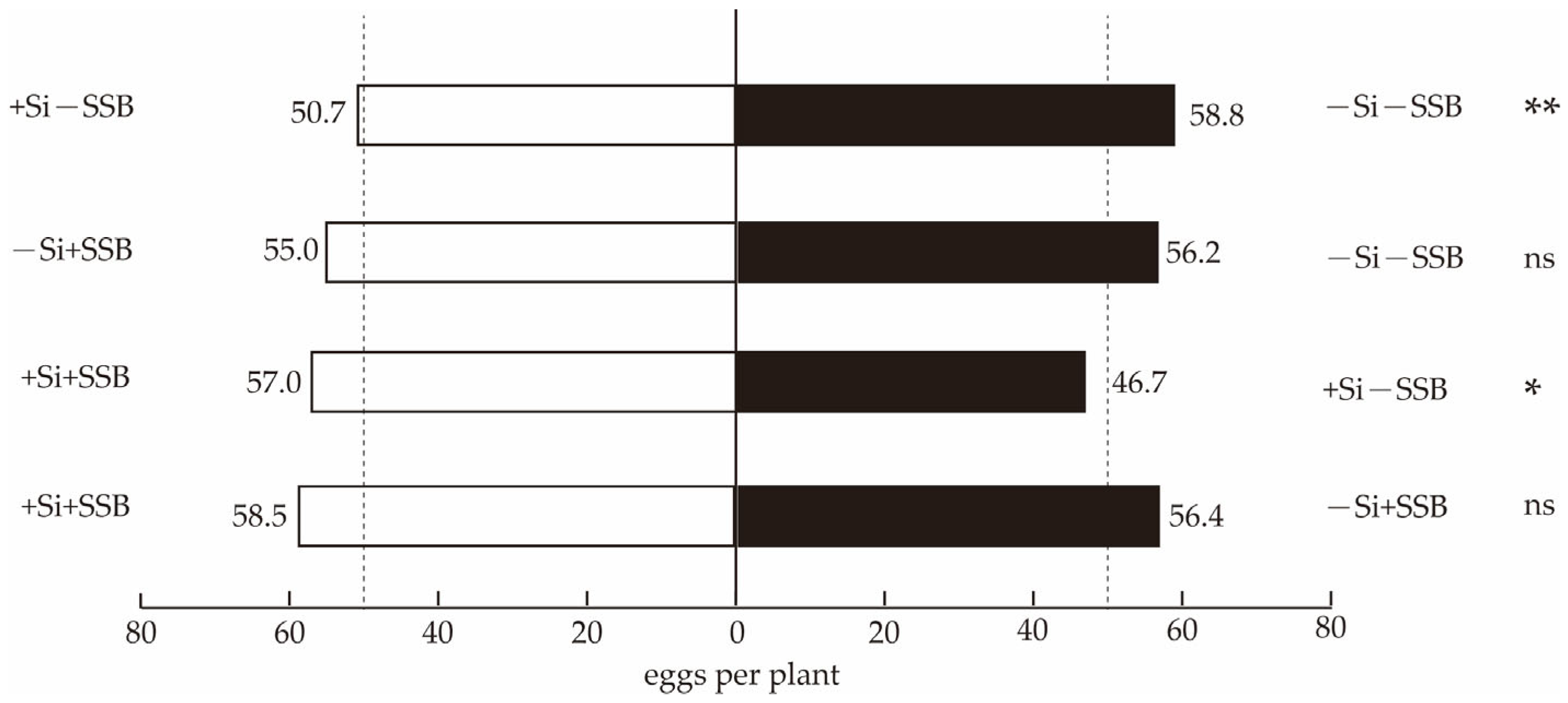
Figure 1. Number of WBPH eggs deposited on plants in paired-choice cage tests (n = 10). * and ** denote significance at p = 0.05 and p = 0.01, respectively, ns denotes no difference.
Agronomy 16 01109 g001
Figure 2. Settling preference of C. lividipennis for plants with WBPH eggs in paired-choice cage tests (n = 10). ** denotes significance at p = 0.01, ns denotes no difference. The figures in parentheses denote the total number of C. lividipennis tested, the figures outside parentheses denote the number of C. lividipennis that made a choice.
Agronomy 16 01109 g002
Figure 3. Predation rate of WBPH eggs by C. lividipennis in paired-choice cage tests (n = 10). * and *** denote significance at p = 0.05 and p = 0.001, respectively, ns denotes no difference.
Agronomy 16 01109 g003
Figure 4. Olfactory responses of C. lividipennis in Y-tube olfactometer assays among treatments (n = 70). * and ** denote significance at p = 0.05 and p = 0.01, respectively, ns denotes no difference. The figures in parentheses denote the total number of C. lividipennis tested, the figures outside parentheses denote the number of C. lividipennis that made a choice.
Agronomy 16 01109 g004
Figure 5. Differentially accumulated volatile organic compounds (DAVOCs) between paired plant treatments (n = 4).
Agronomy 16 01109 g005
Figure 6. Categorical distribution of differentially emitted volatiles in pairwise comparisons (n = 4). (A) +Si−SSB vs. −Si−SSB, (B) −Si+SSB vs. −Si−SSB, (C) +Si+SSB vs. +Si−SSB, and (D) +Si+SSB vs. −Si+SSB.
Agronomy 16 01109 g006
Figure 7. Preference (%) of female C. lividipennis for 10 individual volatile compounds at four concentrations (n = 40). (A) 2-Heptanol, (B) Dodecanoic acid (lauric acid), (C) Ethyl trans-3-hexenoate, (D) (E)-3,7,11-Trimethyl-1,6,10-dodecatrien-3-ol (trans-nerolidol), (E) D-Limonene, (F) (3E,7E)-4,8,12-Trimethyltrideca-1,3,7,11-tetraene (TMTT), (G) Myristic acid isobutyl ester, (H) 4-ethylbenzaldehyde, (I) 2-Methyl-3-(methylthio)pyrazine, (J) 2-Tridecanone. *, ** and *** denote significance at p = 0.05, p = 0.01 and p = 0.001, respectively, ns denotes no difference. The figures in parentheses denote the total number of C. lividipennis tested, and the figures outside parentheses denote the number of C. lividipennis that made a choice.
Agronomy 16 01109 g007
Table 1. Chi-square test for the effects of individual volatile compounds on C. lividipennis preference.
Volatile Compoundsn-Hexane vs. 1 μL/mLn-Hexane vs. 10 μL/mLn-Hexane vs. 50 μL/mLn-Hexane vs. 100 μL/mL
2-Heptanolχ2 = 0.030, p = 0.862χ2= 2.778, p = 0.096χ2 = 5.121, p = 0.024χ2 = 3.457, p = 0.063
Dodecanoic acidχ2= 0.027, p = 0.869χ2 = 2.077, p = 0.150χ2 = 2.632, p = 0.105χ2 = 2.455, p = 0.117
Ethyl trans-3-hexenoateχ2 = 0.026, p = 0.873χ2 = 2.778, p = 0.096χ2 = 5.444, p = 0.020χ2 = 3.457, p = 0.063
trans-nerolidolχ2 = 1.324, p = 0.250χ2 = 4.500, p = 0.034χ2 = 6.818, p = 0.009χ2 = 13.444, p < 0.001
D-Limoneneχ2 = 0.027, p = 0.869χ2 = 0.027, p = 0.869χ2 = 4.568, p = 0.033χ2 = 5.444, p = 0.020
(3E,7E)-4,8,12-Trimethyltrideca-1,3,7,11-tetraene (TMTT)χ2 = 0.030, p = 0.862χ2 = 1.000, p = 0.317χ2 = 4.000, p = 0.046χ2 = 6.081, p = 0.014
Myristic acid isobutyl esterχ2 = 0.111, p = 0. 739χ2 = 0.421, p = 0.516χ2 = 4.000, p = 0.046χ2 = 5.444, p = 0.020
4-ethylbenzaldehydeχ2 = 0.000, p = 1.000χ2 = 2.314, p = 0.128χ2 = 0.029, p = 0.866χ2 = 6.081, p = 0.014
2-Methyl-3-(methylthio)pyrazineχ2 = 0.273, p = 0.602χ2 = 0.421, p = 0.516χ2 = 1.684, p = 0.194χ2 = 1.400, p = 0.237
2-Tridecanoneχ2 = 0.000, p = 1.000χ2 = 0.027, p = 0.869χ2 = 6.081, p = 0.014χ2 = 4.568, p = 0.033
Table 2. Attractant and repellent effects of single volatiles on C. lividipennis.
Volatile CompoundsChemical ClassBehavioral EffectEffective Concentration(s) (μL/mL)
trans-nerolidolTerpenoidRepellent10, 50, 100
D-LimoneneTerpenoidRepellent50, 100
2-TridecanoneKetoneRepellent50, 100
2-HeptanolAlcoholRepellent50
TMTTTerpenoidAttractant50, 100
Ethyl trans-3-hexenoateGreen leaf volatileAttractant50
Myristic acid isobutyl esterEsterAttractant50, 100
4-ethylbenzaldehydeAromatic aldehydeAttractant100
Dodecanoic acidFatty acidNeutralNot effective
2 Methyl-3-(methylthio)pyrazineSulfur-containingNeutralNot effective
Disclaimer/Publisher’s Note: The statements, opinions and data contained in all publications are solely those of the individual author(s) and contributor(s) and not of MDPI and/or the editor(s). MDPI and/or the editor(s) disclaim responsibility for any injury to people or property resulting from any ideas, methods, instructions or products referred to in the content.