


Abstract
Mechanical transplanting often causes root damage to rice seedlings, but its yield impacts in double-cropping systems remain unclear. A two-year field experiment was conducted in early- and late-season rice under three root damage treatments: no damage (CK), mild root damage (T1, seedling roots pruned to 2 cm), and severe root damage (T2, seedling roots pruned to 1 cm). Results showed that T2 reduced early-season rice yield by 8% but had no significant effect on late-season rice, while T1 did not affect yield in either season. In early-season rice, the yield loss was associated with reduced pre-heading biomass (BMPre) and total biomass (both 13% lower than CK), primarily due to decreases of 5–32% in SPAD, leaf area index, specific leaf weight, pre-heading crop growth rate, and leaf area duration, with no post-heading compensation. In contrast, late-season rice sustained yield despite a 9% reduction in BMPre (attributed to similar leaf trait reductions of 4–26%) by enhancing post-heading biomass (16% increase), driven by a 17% increase in post-heading crop growth rate and an 11% decrease in the rate of leaf area decline. Partial least squares path modeling confirmed that biomass dynamics, rather than yield components, constituted the primary pathway linking root damage to yield. These results demonstrate that the impact of root damage is season-dependent, highlighting the need for root protection in early-season rice and the exploitation of compensatory capacity in late-season rice to optimize mechanical transplanting practices.
1. Introduction
Rice (Oryza sativa L.) constitutes the principal staple food for over 60% of the population in China [1]. Ensuring sufficient rice production is therefore fundamental to national food security [2]. However, rapid urbanization over recent decades has led to a substantial migration of the rural labor force to urban areas [3,4]. This demographic shift has been accompanied by an increasingly aging agricultural workforce and a consequent shortage of young and middle-aged laborers in rural regions [5]. Consequently, traditional rice cultivation practices that rely heavily on manual labor are becoming increasingly unsustainable [6]. In response, labor-saving technologies, particularly mechanized transplanting, have been vigorously promoted across major rice-producing areas [7]. Therefore, it is urgent to develop and optimize these labor-saving rice cultivation technologies to safeguard national food security.
Under the guidance of the Chinese government, machine-transplanted rice has witnessed a substantial expansion, covering over 12.75 million hectares and accounting for approximately 87.6% of the nation’s total rice cultivation area [8]. Nevertheless, several challenges remain in machine-transplanted rice production, among which a major one is the root damage inflicted on seedlings during the transplanting process [9]. Such damage typically arises when seedlings are separated from trays and inserted into puddled soil by the transplanter, frequently causing root pruning, tearing, or even complete loss of root tips [10]. This damage is particularly severe for big rice seedlings, reducing effective tiller numbers and ultimately compromising grain yield [11]. A recent study on high-speed transplanting of over-aged rice seedlings reported that combined root and stem injuries severely restrict yield, with severely damaged seedlings exhibiting only 49% of the heart leaf growth rate and 77% of the SPAD value of uninjured seedlings at 12 days after transplanting, and new root emergence delayed until 9 days post-transplanting [12]. An impaired root system may lead to complex effects on plant growth [13]. Previous studies found that pruning roots to approximately 3 cm did not alter leaf development or heading time compared with intact seedlings, whereas pruning all roots to a length of 0–1 cm noticeably suppressed leaf growth and delayed heading [14]. Physiologically, root pruning has been shown to markedly decrease the activities of key nitrogen-assimilating enzymes, glutamine synthetase and glutamate synthase, thereby impairing nitrogen uptake in rice [15]. Taken together, these findings confirm that root damage adversely affects tillering, impairs yield formation, and induces further unfavorable outcomes.
Interestingly, studies on wheat have reported that root damage can, under certain circumstances, increase grain yield and improve water-use efficiency. However, it simultaneously lowers the root-to-shoot ratio, which negatively affects overall plant growth potential [16,17]. This contrasting evidence suggests that the impact of root damage may vary considerably across species and environments, possibly due to differences in root architecture, compensatory growth capacity, or growing conditions. In wheat, root pruning can enhance water-use efficiency and grain yield under water-limited conditions by reducing vegetative growth and reallocating assimilates to grains [17]. Rice, in contrast, is adapted to flooded environments with fundamentally different root architecture and regenerative capacity. When faced with stress, the compensatory ability of rice roots can be rapidly exhausted, whereas wheat exhibits greater tolerance to water deficit and can implement a more effective water-conserving strategy [18]. Thus, the same degree of root damage is unlikely to elicit similar compensatory responses in rice, especially within the tight turnaround of a double-cropping system. While these studies provide valuable insights into species-specific responses, they are largely derived from single-season experiments or controlled conditions that do not capture the complexity of double-cropping rice systems. In such systems, the tight turnaround between early- and late-season rice leaves little room for growth recovery, and the contrasting thermal regimes between seasons may profoundly modulate the consequences of root damage.
Despite these efforts, several important knowledge gaps remain. First, most previous studies have focused on short-term physiological responses. Although early growth differences are often observed, it remains unknown whether they translate into final yield loss over a full growing season, especially given the self-regulation capacity of rice plants [19]. Second, systematic comparisons between early- and late-season rice are lacking. In our study region, early-season rice experiences lower pre-heading temperatures than late-season rice [20], yet how such climatic contrasts affect root damage outcomes remains unknown. Third, the integrated pathways through which mechanical root damage influences yield, including biomass production, distribution characteristics, and yield components, have not been fully elucidated. Based on these knowledge gaps, we formulated the following hypothesis: Severe root damage will cause persistent yield loss in early-season rice because the initial reduction in pre-heading biomass cannot be compensated during post-heading, whereas late-season rice will maintain yield by enhancing post-heading biomass accumulation and delaying leaf senescence, despite similar early-season biomass reductions. Moreover, biomass dynamics, rather than yield components, will constitute the primary pathway through which root damage affects yield, and this pathway will be season-dependent, with late-season rice exhibiting effective post-heading compensation.
To test this hypothesis, we conducted a two-year experiment to investigate yield, yield components, growth duration, biomass production and translocation characteristics, and leaf and canopy traits of early- and late-season rice under no, mild, and severe root damage treatments. The objectives were (1) to quantify the effects of root damage severity on grain yield and its physiological basis, and (2) to compare the responses between early- and late-season rice, and (3) to identify the direct and indirect pathways linking root damage to yield using correlation analysis and partial least squares path modeling, thereby providing insights for optimizing machine-transplanting practices.
2. Materials and Methods
2.1. Site Description
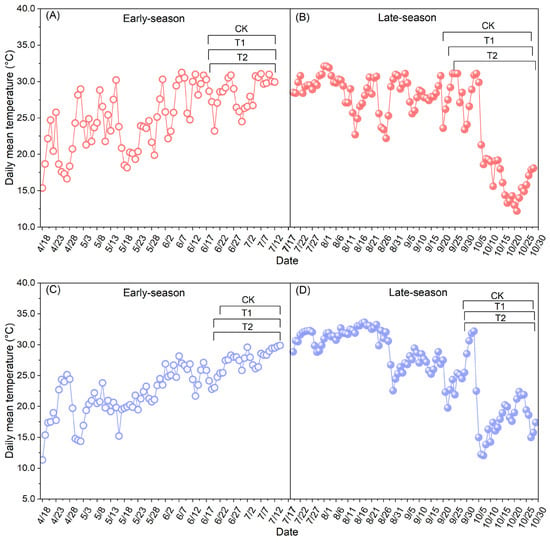
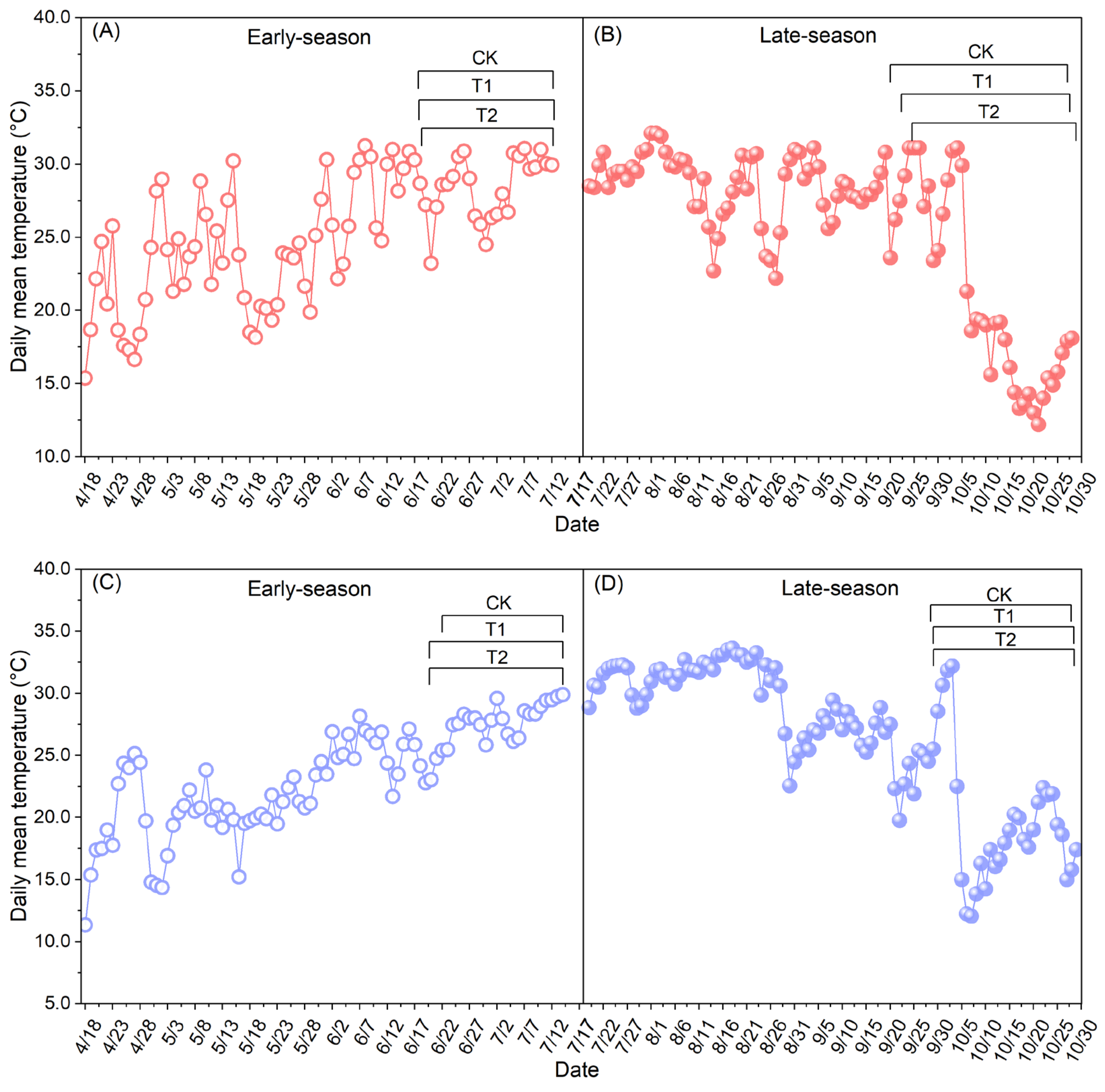
Field experiments were conducted in 2021 and 2022. The early rice-growing season was carried out at Yanxi Town (28°18′ N, 113°49′ E) in Liuyang County, Hunan Province, and the late rice-growing season at Lukou Town (28°41′ N, 113°22′ E) in Changsha County, Hunan Province. Both sites are located in the Yangtze River basin, a typical double-season rice-growing region with a humid subtropical monsoon climate. In 2021, the pre-heading average daily mean temperature across the three treatments was 2.04 °C higher for the early rice season, but 0.60 °C lower for the late rice season, compared with 2022. The post-heading average daily mean temperature was 0.67 °C and 1.46 °C higher in 2021 than in 2022, respectively (Figure 1). Topsoil samples (0–20 cm) were collected before the start of the experiment in 2021. At Yanxi, the soil had an organic matter content of 14.15 mg kg−1, total N of 0.76 g kg−1, available N of 162.44 mg kg−1, available P of 14.33 mg kg−1, available K of 128.33 mg kg−1, and a pH of 5.67. At Lukou, the soil had an organic matter content of 38.34 mg kg−1, total N of 0.91 g kg−1, available N of 237.54 mg kg−1, available P of 16.64 mg kg−1, available K of 94.26 mg kg−1, and a pH of 5.48. The two sites differed in soil organic matter, total N, and available nutrient contents. Because the early- and late-season experiments were conducted at different sites, direct comparison of absolute yield between seasons should consider potential soil effects. However, within each site, the three root damage treatments were fully randomized, so the relative treatment effects are not confounded by soil heterogeneity. The consistent trends observed across two years (2021 and 2022) support the robustness of the season-dependent responses reported.
Figure 1.
Average daily mean temperature during the early- and late-season rice growing periods in 2021 (A,B) and 2022 (C,D). CK, T1 and T2 denote the three root damage treatments: no root damage (intact roots), mild root damage (seedling roots pruned to 2 cm), and severe root damage (seedling roots pruned to 1 cm). Values in parentheses indicate the post-heading temperature for each treatment.
2.2. Experimental Design
The experiment included two indica hybrid rice varieties: Lingliangyou 211 (early-season rice), with female and male parents, Xiangling 628S and Hua 211, released in 2010; and Taiyou 553 (late-season rice), with female and male parents, Taifeng A and R 553, released in 2019. The selection of these two varieties was based on their widespread cultivation by rice farmers in the study region and its vicinity. Lingliangyou 211 and Taiyou 553 were selected because they are the widely grown and high-yielding varieties for early- and late-season rice, respectively, in the Yangtze River basin. Although their release years differ (2010 and 2019), both are modern indica hybrids with similar growth habits. The consistent two-year results suggest that seasonal environment, rather than genetic differences, is the main driver of the contrasting responses to root damage. Genetic effects cannot be completely excluded but are unlikely to override the strong seasonal pattern observed in this study. Each variety was subjected to three root damage treatments: no root damage (CK, intact roots), mild root damage (T1, in which seedling roots were pruned to 2 cm), and severe root damage (T2, in which seedling roots were pruned to 1 cm). The experiment was arranged in a randomized complete-block design with seven replicate plots per treatment and a plot size of 20 m2.
Pre-germinated seeds were sown in seedling trays (length × width × depth = 58.0 cm × 22.5 cm × 2.5 cm) filled with the Xianghui nursery substrate at a rate of 70 g per tray. In both years, early-season rice was sown on 24 March and transplanted on 18 April, whereas late-season rice was sown on 29 June and transplanted on 19 July. One day before transplanting, trays were soaked in water to facilitate separation of the matted root system. On the day of transplanting, seedlings were carefully separated in water, and uniform individuals were selected, treated for root damage, and then transplanted manually. Before pruning, all seedlings were visually inspected to ensure similar root length (approximately 10–12 cm) and root volume. Only seedlings with intact, healthy root systems and comparable shoot size were chosen. For T1 and T2, roots were cut to the specified lengths (2 cm or 1 cm) using a sharp blade, and any damaged or broken roots above the cut were trimmed to achieve uniform root stubs. After treatment, seedlings were immediately transplanted to avoid desiccation. The planting spacing was 25 cm × 12 cm for early-season rice and 25 cm × 14 cm for late-season rice. Total application rates of nitrogen (N), phosphorus (P), and potassium (K) fertilizers were 150 kg N ha−1, 75 kg P2O5 ha−1, and 120 kg K2O ha−1 for both the early and late rice-growing seasons. N fertilizer was split into three doses: 40% as basal dose, 30% at early tillering, and 30% at the panicle initiation stage. P fertilizer was applied in full as basal fertilizer to each plot, while K fertilizer was split into two equal doses: 50% as basal and 50% at the panicle initiation stage. A constant floodwater depth of 5–10 cm was maintained from transplanting until 7 days before physiological maturity. Throughout the growing seasons, pests, diseases, and weeds were strictly controlled using chemical pesticides, insecticides, and herbicides.
2.3. Sampling and Measurements
The growth stages of rice, including sowing, transplanting, tillering stage (TD), panicle initiation (PI), full heading (HD), and maturity (MA), were recorded. Meteorological data were collected using an automatic weather station (Vantage Pro2, Davis Instruments, Fremont, CA, USA).
At TD, PI, HD, and MA, five hills of rice plants were randomly collected from each plot. At TD and PI, samples were separated into leaves and stems; at HD, into leaves, stems, and panicles; and at MA, into stems, leaves, rachis, and unfilled and filled spikelets. SPAD values were determined using a chlorophyll meter (SPAD-502, Konica Minolta, Tokyo, Japan) on green leaves at TD, PI, and HD. Leaf area was measured at TD, PI, HD, and MA with a leaf area meter (LI-3000C, LI-COR, Lincoln, NE, USA). Leaf area index (LAI) was calculated as green leaf area per unit of land area, and specific leaf weight (SLW) as leaf dry weight per unit of land area. Leaf area duration (LAD) was calculated as: LAD (m2 d m−2) = 1/2 × (L1 + L2) × (t2 − t1), where L1 and L2 represent the leaf area measured at two consecutive sampling dates, and t1 and t2 represent the corresponding sampling times [21]. The rate of leaf area decline (DRLA) was calculated as: DRLA (LAI d−1) = (LAI1 − LAI2)/(t2 − t1), where LAI1 and LAI2 represent the leaf area index measured at HD and MA, respectively, and t1 and t2 denote the corresponding sampling times. Plant organs were dried in an oven at 70 °C for three days until constant weight. Pre-heading biomass production (BMPre) was defined as the sum of dry weights of all plant organs at HD, and total biomass production (BMTotal) as the sum of dry weights of all plant organs at MA. Post-heading biomass production (BMPost) was calculated as the difference between BMTotal and BMPre. Pre-heading crop growth rate (CGRPre) was calculated as BMPre divided by the number of days from sowing to HD, and post-heading crop growth rate (CGRPost) as BMPost divided by the number of days from HD to MA. Panicle number per m2 was determined by counting panicles in each sample. Spikelets per panicle were calculated as total spikelet number divided by panicle number. Spikelet filling percentage was calculated as the proportion of filled spikelets relative to total spikelet number. After oven-drying to constant weight, three 30 g subsamples of filled spikelets were taken for grain weight determination. Yield was determined from a 5 m2 area in each plot at MA and adjusted to a standard moisture content of 13.5%.
2.4. Statistical Analysis
The statistical model included replication (experimental plot), year (treated as a fixed effect), treatment, and the interaction between year and treatment. Normality of residuals and homogeneity of variances were verified using Shapiro–Wilk and Levene’s tests, respectively, and assumptions were met. Data variation was assessed using standard ANOVA, and the assumption of homogeneity of variances was confirmed by Levene’s test (see above). Means were compared using the least significant difference (LSD) test at p < 0.05. Pearson’s correlation analysis was used to evaluate the relationships between yield and agronomic traits. All statistical analyses were conducted using Statistix 8.0 (Tallahassee, FL, USA). In addition, a partial least squares (PLS) path model was employed to further elucidate the effects of pre- and post-heading agronomic traits and yield components on yield. The PLS path analysis was performed using SmartPLS 3.0 (https://www.smartpls.com/), with path coefficients estimated to represent direct effects, and the overall predictive power of the model was evaluated using the “goodness-of-fit” statistic.
3. Results
3.1. Growth Duration
In the early rice-growing season, pre-heading growth duration ranged from 86 to 88 d in CK and T1, and from 88 to 88 d in T2 during 2021–2022 (Table 1). The two-year mean pre-heading growth duration in T2 was 2 d longer than that in T1 and CK. No year-to-year variation was observed in post-heading growth duration, which was 24 d, 24 d, and 22 d in CK, T1, and T2, respectively, in both 2021 and 2022. Total growth duration ranged from 110 to 112 d in CK, T1, and T2 during 2021–2022.
Table 1.
Growth duration of early-season rice and late-season rice under different root damage treatments in 2021 and 2022.
In the late rice-growing season, the range of pre-heading growth duration widened to 83–91 d in CK, 85–92 d in T1, and 87–92 d in T2 during 2021–2022. The two-year mean pre-heading growth duration was longest in T2, followed by T1, and the shortest in CK. Post-heading growth duration did not vary with treatment, lasting 34 d in 2021 and 30 d in 2022. Consistent with the patterns observed for pre-heading growth duration, total growth duration ranged from 117–121 d in CK, 119–122 d in T1, and 121–122 d in T2 during 2021–2022, with T2 showing the longest two-year mean and CK the shortest.
3.2. Yield and Yield Components
For early-season rice, averaged across two years, yield was 0.5% lower in T1 and 8% lower in T2 compared with CK, with no significant difference between T1 and CK (Table 2). For spikelets per panicle, T1 and T2 exhibited reductions of 11% and 3%, respectively, relative to CK, whereas no significant difference was observed between T2 and CK. Consistent with yield, panicles m−2 were highest in CK, followed by T1 (6% lower) and then T2 (12% lower), although the difference between CK and T1 was not significant.
Table 2.
Yield and yield components of early-season rice and late-season rice under different root damage treatments in 2021 and 2022.
For late-season rice, no significant differences in yield or yield components were observed among the three treatments.
3.3. BMPre, BMPost, BMTotal, CGRPre, and CGRPost
In the early rice-growing season, averaged across two years, T2 showed reductions of 13%, 13%, 13%, and 6% in BMPre, BMTotal, CGRPre, CGRPost, respectively, compared with CK, whereas no significant differences were detected between T1 and CK (Table 3). In contrast, no significant differences were found in BMPost among the three treatments.
Table 3.
Biomass production (BM) and crop growth rate (CGR) of early-season rice and late-season rice under different root damage treatments in 2021 and 2022.
In the late rice-growing season, averaged across two years, BMPre in T1 and T2 was 7% and 9% lower than that in CK, respectively, and CGRPre in T1 and T2 was 10% and 12% lower than that in CK, respectively. Similarly, averaged across two years, BMpost and CGRPost were 10% and 11% higher in T1, and 16% and 17% higher in T2, compared with CK. In contrast, no significant differences were detected in BMTotal among the three treatments.
3.4. SPAD, LAI, and SLW
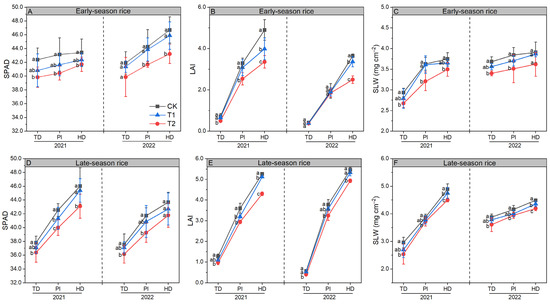
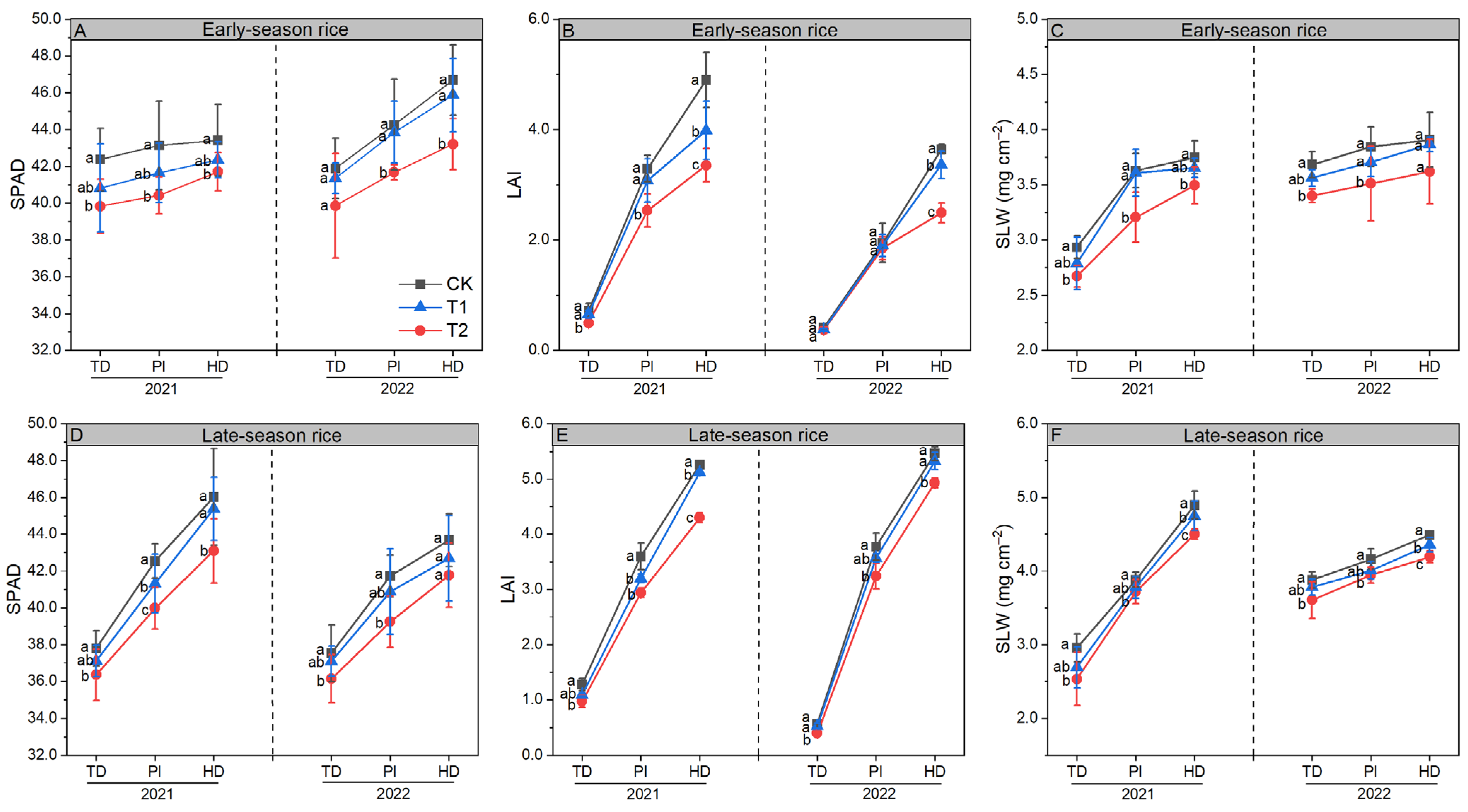
During 2021 and 2022, SPAD, LAI, and SLW generally increased from TD to HD across all treatments in the early rice-growing season (Figure 2A–C). Averaged across two years, SPAD in T2 was 5%, 6%, and 6% lower than that in CK at TD, PI, and HD, respectively. The two-year mean LAI in T2 was reduced by 23%, 16%, and 32% at TD, PI, and HD, respectively, compared with CK, while in T1 it was reduced by 14% at HD. For SLW, the two-year mean in T2 was 8%, 10%, and 7% lower than in CK at TD, PI, and HD, respectively. No significant differences were observed between T1 and CK in SPAD values and SLW across any growth stage nor in LAI at TD or PI.
Figure 2.
The SPAD values (A,D), leaf area index (LAI, (B,E)), and specific leaf weight (SLW, (C,F)) at three growth stages of early- and late-season rice under different root damage treatments in 2021 and 2022. Data represent the means of seven replicates with vertical bars indicating standard errors. Within the same growth stage, different lowercase letters (left of data points) indicate significant differences between treatments at the 0.05 probability level. TD, PI, and HD denote the tillering stage, panicle initiation stage, and full heading stage, respectively. CK, T1 and T2 denote the three root damage treatments: no root damage (intact roots), mild root damage (seedling roots pruned to 2 cm), and severe root damage (seedling roots pruned to 1 cm).
For late-season rice, SPAD, LAI, and SLW showed a consistent increase from TD to HD across all treatments in 2021 and 2022 (Figure 2D–F). Averaged across two years, SPAD in T2 was 4%, 6%, and 5% lower than that in CK at TD, PI, and HD, respectively, while that in T1 was 2% lower at PI. For LAI, the two-year mean was 26%, 16%, and 14% lower in T2 and 12%, 8%, and 3% lower in T1 at TD, PI, and HD, respectively, compared with CK. The two-year mean SLW in T2 was reduced by 10%, 5%, and 7% at TD, PI, and HD, respectively, relative to CK, while in T1 it was reduced by 3% at both PI and HD. In contrast, no significant differences were detected in SPAD values at TD and HD, nor in SLW at TD.
3.5. LAD and DRLA
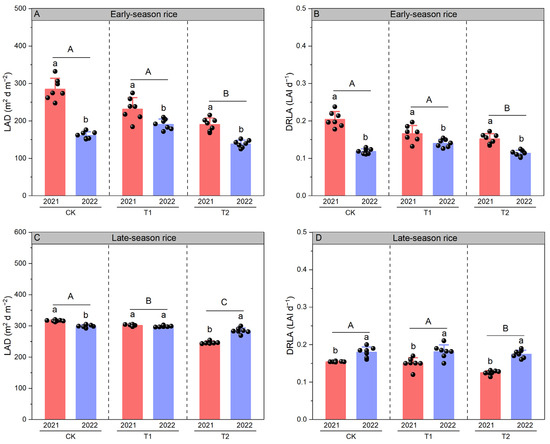
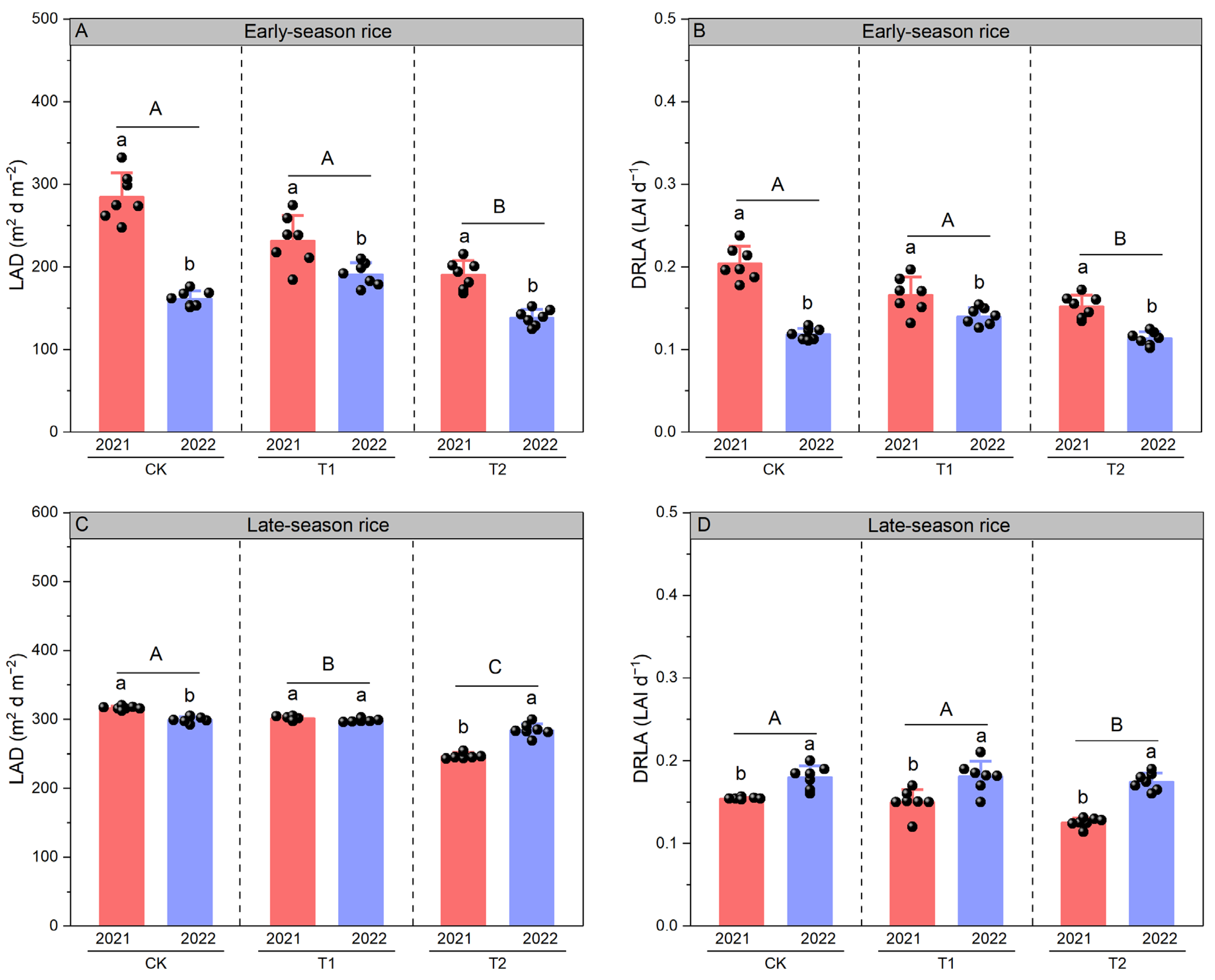
In the early rice-growing season, LAD and DRLA in T2 were reduced by 26% and 18%, respectively, compared with CK, averaged across two years (Figure 3A,B). Although T1 showed 5% lower LAD and DRLA than CK over the two-year average, the differences were not significant between CK and T1.
Figure 3.
Leaf area duration (LAD, (A,C)) and decreasing rate of leaf area (DRLA, (B,D)) of early- and late-season rice under different root damage treatments in 2021 and 2022. Data represent the means of seven replicates, and vertical bars indicate standard errors. Data with differing lowercase letters differ at the 0.05 probability level. Two-year averages with differing uppercase letters differ at the 0.05 probability level. CK, T1 and T2 denote the three root damage treatments: no root damage (intact roots), mild root damage (seedling roots pruned to 2 cm), and severe root damage (seedling roots pruned to 1 cm).
In the late rice-growing season, the two-year mean LAD and DRLA of T2 were lower than those of CK by 14% and 11%, respectively (Figure 3C,D). In T1, averaged across two years, LAD and DRLA were 3% and 1% lower than those in CK, respectively, with the difference in DRLA not being significant.
3.6. Relationships Between Yield and Agronomic Traits and Their Driving Pathways
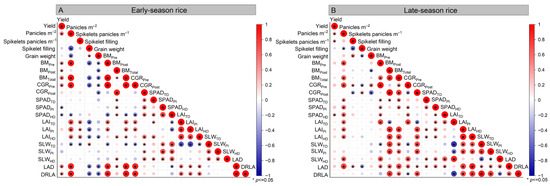
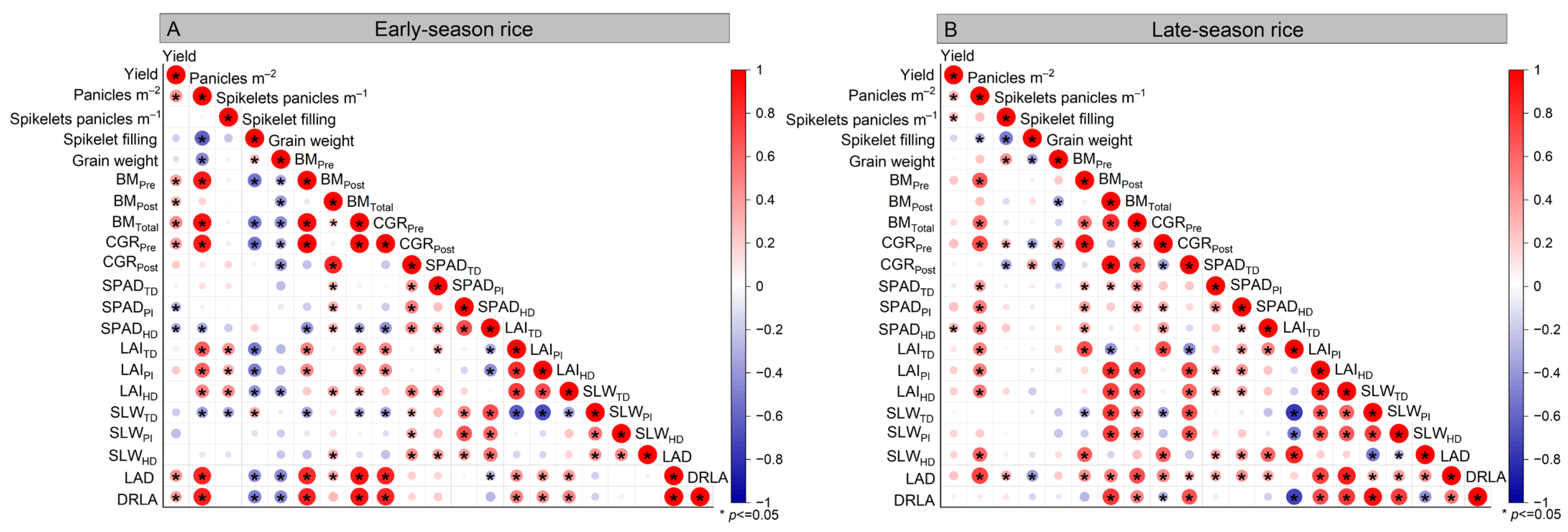
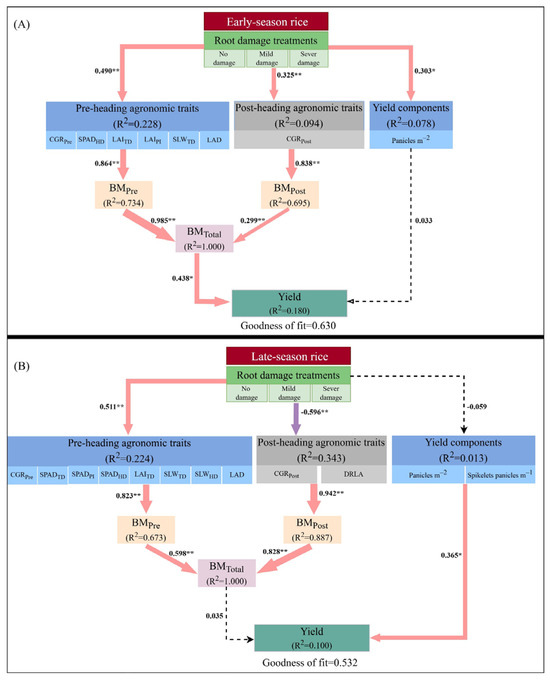
To further elucidate the key factors influencing yield and their underlying pathways, correlation analysis and partial least squares (PLS) path modeling were conducted (Figure 4 and Figure 5).
Figure 4.
Relationships between yield and agronomic traits of early-season rice (A) and late-season rice (B) under different root damage treatments during 2021–2022 (n = 14). Data are from fourteen replications across two years. * denotes significance at the 0.05 probability level. BMPre, pre-heading biomass production; BMPost, post-heading biomass production; BMTotal, total biomass production; CGRPre, pre-heading crop growth rate; CGRPost, post-heading crop growth rate; SPADTD, SPAD at tillering stage; SPADPI, SPAD at panicle initiation stage; SPADHD, SPAD at full heading stage; LAITD, LAI at tillering stage; LAIPI, LAI at panicle initiation stage; LAIHD, LAI at full heading stage; SLWTD, SLW at tillering stage; SLWPI, SLW at panicle initiation stage; SLWHD, SLW at full heading stage; LAD, leaf area duration; DRLA, decreasing rate of leaf area.
Figure 5.
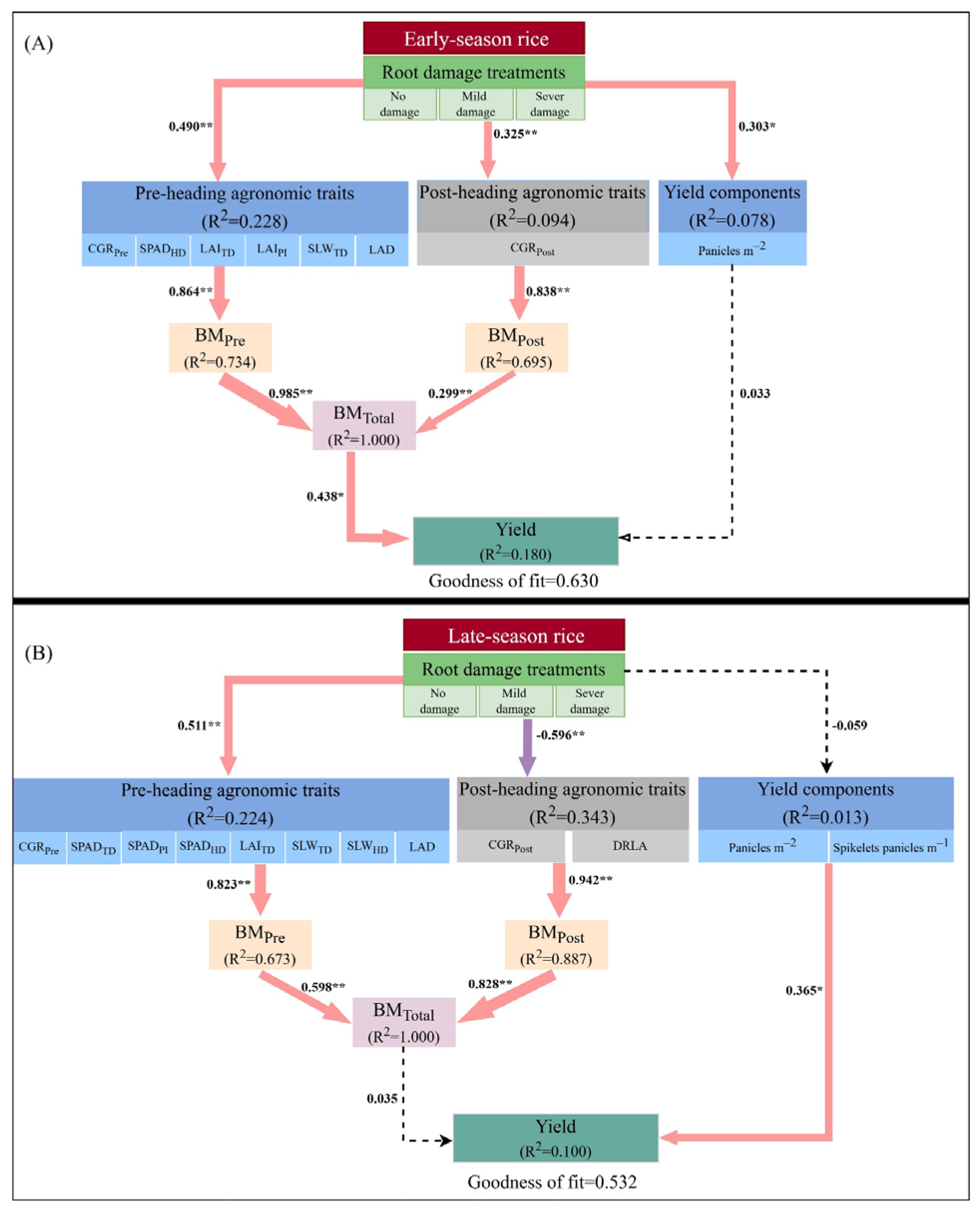
Partial least squares path model estimates of the impact of pre- and post-heading agronomic traits and yield components on grain yield of early-season rice (A) and late-season rice (B) under different root damage treatments during 2021–2022. Positive and negative correlations are represented by red and purple lines, respectively, whereas dotted lines signify lack of significant correlation. The R2 value represents the percentage of explained variance, whereas arrow width and accompanying numeric data indicate path coefficients (** p < 0.01, * p < 0.05). BMPre, pre-heading biomass production; BMPost, post-heading biomass production; BMTotal, total biomass production; CGRPre, pre-heading crop growth rate; CGRPost, post-heading crop growth rate; SPADTD, SPAD at tillering stage; SPADPI, SPAD at panicle initiation stage; SPADHD, SPAD at full heading stage; LAITD, LAI at tillering stage; LAIPI, LAI at panicle initiation stage; SLWTD, SLW at tillering stage; SLWHD, SLW at full heading stage; LAD, leaf area duration; DRLA, decreasing rate of leaf area.
For early-season rice, correlation plot analysis showed that yield was significantly positively correlated with panicles m−2 and BMTotal (Figure 4A). The PLS path model further revealed that root damage directly affected pre- and post-heading agronomic traits (CGRPre, SPAD at HD, LAI at TD and PI, SLW at TD, LAD, and CGRPost), thereby influencing BMPre and BMPost, which in turn affected BMTotal and ultimately led to changes in yield. Notably, although root damage directly affected the yield component panicles m−2, this did not translate into a direct effect on yield (Figure 5A).
For late-season rice, correlation plot analysis showed that yield was significantly positively correlated with panicles m−2 and spikelets per panicle, but not with BMTotal (Figure 4B). The PLS path model further indicated that root damage directly affected pre- and post-heading agronomic traits (CGRPre, SPAD at TD, PI, and HD, LAI at TD, SLW at TD and HD, LAD, CGRPost, and DRLA), thereby influencing BMPre and BMPost, which in turn affected BMTotal. However, this did not translate into a direct effect on yield. In addition, root damage did not indirectly affect yield via yield components, as no significant direct effects were observed on panicles m−2 or spikelets per panicle (Figure 5B).
4. Discussion
Understanding how mechanical root damage affects rice performance is critical for optimizing machine-transplanting practices in double-cropping rice systems. The present study demonstrated that the impact of root damage on grain yield and growth duration was strongly dependent on damage severity and seasonal conditions. It should be noted that the early- and late-season experiments were carried out at different sites with distinct soil properties. Although this prevents a direct comparison of absolute yield between seasons, the within-site randomization of root damage treatments ensures that the relative effects are valid. Moreover, the reproducibility of the seasonal contrast across two independent years suggests that the observed differences are primarily driven by climatic and physiological factors rather than by soil fertility alone. In early-season rice, severe root damage (T2) significantly reduced grain yield by 8% compared with CK, whereas mild damage (T1) had no detectable effect. This yield reduction was accompanied by a 2-day extension of the pre-heading period and a 2-day shortening of the post-heading period. In contrast, for late-season rice, neither severe nor mild root damage affected final grain yield, although T2 prolonged the pre-heading period by up to 3 days without altering the post-heading period. These results indicate that early-season rice is more susceptible to mechanical root injury than late-season rice, and that the compensatory adjustments in growth duration differ between seasons. The ability of late-season rice to maintain yield under severe root damage may be attributed to greater compensatory root growth and more efficient post-heading assimilate partitioning. This is consistent with observations in wheat, where root pruning at the seedling stage increased panicles per unit area and enhanced the contribution of post-heading photosynthesis and carbohydrate remobilization to grain, ultimately boosting grain yield [22]. The contrasting yield responses between the two seasons highlight the importance of considering both damage severity and environmental conditions when evaluating the consequences of mechanical root injury in double-cropping systems.
Grain yield was determined by yield components (panicle number per unit area, spikelets per panicle, spikelet filling rate, and grain weight) [23]. In this study, the lower yield of T2 compared with CK in early-season rice was partly attributable to its reduced panicle number per unit area. In contrast, the lack of yield differences among root damage treatments in late-season rice resulted from the absence of significant differences in their yield components. This disparity in panicle response between seasons may be explained by differences in tillering dynamics, root regeneration capacity, and environmental conditions during the recovery period. In early-season rice, T2 likely suppressed early tiller emergence and reduced tiller survival, leading to fewer productive panicles at maturity. A similar suppression of tillering has been observed in spring wheat [24]. Severe root damage impairs the establishment of a functional root system, which in turn reduces the supply of nutrients from roots to shoots, thereby inhibiting tiller initiation and development [25]. Moreover, in this study, early-season rice was typically grown under cooler pre-heading temperatures, which slowed root regeneration and limited tiller compensation. Late-season rice, however, experienced warmer pre-heading conditions that facilitated rapid root regrowth and tiller formation. Our observation aligns with the study of Lee et al. [15], who showed that root damage during transplanting specifically inhibits tiller development, and this inhibition is exacerbated when temperatures are suboptimal for root recovery. Thus, the ability to maintain panicle number under root damage is not solely a function of damage severity, but is strongly modulated by thermal conditions during the early growth period, which govern the speed and extent of root functional recovery.
Grain yield of rice is also closely related to the biomass production [26]. In this study, the lower yield of T2 compared with CK in early-season rice can also be explained by its lower BMTotal. Analysis of biomass production across different growth periods revealed that the reduction in BMTotal under T2 was primarily attributable to decreased BMPre. The observation implies that severe root damage in early-season rice reduces BMPre, which serves as an important reserve source for grain filling [27], thereby restricting source capacity and ultimately reducing yield. Consistent with this, Huang et al. [28] also demonstrated that BMPre plays a significant role in determining yield in early-season rice. In contrast, late-season rice was able to maintain BMTotal and yield despite reduced BMPre by enhancing BMPost, suggesting that the ability to compensate for early biomass loss is season-dependent and closely linked to post-heading environmental conditions. In our study, late-season rice experienced lower post-heading temperatures, which likely promoted photosynthetic activity and biomass production, enabling effective compensation. Zhong et al. [29] also reported that rice sown earlier under cooler post-heading temperatures can exhibit increased post-heading biomass and yield, further supporting the role of thermal regimes in modulating compensatory growth.
Biomass production is closely associated with crop growth rate [30]. In early-season rice, the reduction in CGRPre accounted for the decline in BMPre. In late-season rice, the decrease in CGRPre led to lower BMPre, whereas the increase in CGRPost contributed to enhanced BMPost. Moreover, biomass production is also closely related to leaf and canopy traits, including SPAD, SLW, LAI, LAD, and DRLA [31]. The reductions in SPAD, LAI, SLW, and LAD under T2 partly explained the lower BMPre in both early- and late-season rice. In contrast, the decrease in DRLA under T2 was associated with increased BMPost in late-season rice. The substantial reduction in LAI under T2 in early-season rice would inevitably reduce canopy light interception and photosynthetic carbon assimilation, contributing to the BMPre decline. In late-season rice, despite a smaller LAI reduction, the slower leaf area decline helped maintain light interception during grain filling. Although SPAD, LAI, and SLW were significantly reduced from TD to HD in late-season rice, and consequently BMPre and CGRPre decreased by 9% and 12%, respectively, the rice did not experience yield loss. This was because the reduction in DRLA under T2 indicated slower leaf senescence during post-heading. The slower senescence allowed a longer duration of photosynthetic activity, which contributed to a 16% increase in BMPost and a 17% increase in CGRPost. As a result, the initial deficit in pre-heading biomass was fully compensated by enhanced post-heading accumulation, leading to stable total biomass and grain yield. This compensation pathway is supported by the PLS path model, which showed that the biomass pathway was not significant for yield loss in late-season rice. These findings suggest that delaying leaf senescence during grain filling is critical for post-heading biomass compensation. Seasonal temperature plays a key role in modulating leaf senescence and determining whether root damage reduces yield [29]. It has been reported that high solar radiation during the post-heading period benefits biomass accumulation [32]. However, solar radiation was not recorded in this study, limiting our ability to assess its contribution. Future research should include both temperature and radiation to clarify their effects. Improving post-heading source activity by delaying leaf senescence, rather than merely protecting sink size, may be a promising strategy to mitigate root damage in double-cropping rice systems.
The partial least squares path model revealed two potential pathways linking root damage to yield, one through biomass production and another through yield components [33]. In early-season rice, root damage directly reduced panicle number per unit area, but this effect did not translate into a significant yield loss via the yield-component pathway. Instead, yield reduction was primarily mediated through the biomass pathway; impaired BMPre limited BMTotal, and this deficit could not be compensated during grain filling. This finding is consistent with a previous study where biomass production mediated yield loss under root damage [34], but differs from others that identified yield components as the primary driver [33]. In late-season rice, neither the yield-component pathway nor the biomass pathway was effective in causing yield reduction. Although root damage also affected some yield components (e.g., spikelets per panicle), the effects were not significant enough to impact final yield. Moreover, any negative impact on BMPre was fully offset by enhanced BMPost. This underscores that, in early-season rice, biomass dynamics rather than yield components, were the primary determinant of whether root damage led to yield loss. In late-season rice, however, strong compensation via post-heading biomass accumulation rendered both the biomass pathway and the yield component pathway irrelevant, meaning that root damage did not cause significant yield loss through either mechanism [35]. Thus, whether root damage translates into yield loss depends not only on damage severity but also on the crop’s ability to activate source compensation during the grain filling stage, a capacity that is strongly modulated by seasonal climate.
A limitation of this study is that we did not directly measure post-transplanting root regeneration, root growth dynamics, or root activity. Therefore, the precise mechanisms by which initial root damage leads to sustained growth suppression in early-season rice remain incompletely understood. Nevertheless, previous studies have shown that root regeneration after transplanting is strongly temperature-dependent. Ren [36] established that the lower and upper temperature limits for root regrowth in transplanted rice are 15 °C and 40 °C, respectively, with the optimum range being 30–31 °C based on a parabolic model fitted to root growth traits. In early-season rice, cooler post-transplanting temperatures (often below the optimum range) would slow down cell division in root primordia, delay the emergence of new lateral roots, and impair reconstitution of a functional root system [37], thereby limiting nutrient and water uptake during the critical pre-heading period. By contrast, warmer post-transplanting conditions typical of late-season rice may facilitate faster root regrowth, enabling plants to re-establish a vigorous root system that supports higher post-heading crop growth rates and delayed leaf senescence. Wang et al. [38] also found that low temperatures strongly impair root growth and nitrogen uptake in rice, further demonstrating that temperature modulates root recovery capacity. This temperature-dependent recovery capacity likely explains why T2 caused persistent yield loss in early-season rice but not in late-season rice. Future studies should directly quantify root regeneration parameters (e.g., new root number, root length density, root activity, bleeding rate) at multiple time points after transplanting to establish a direct causal link between root recovery and final yield.
5. Conclusions
T2 reduced grain yield by 8% in early-season rice but had no significant effect on late-season rice, while T1 did not affect yield in either season. The yield loss in early-season rice was primarily driven by reduced BMPre, which limited BMTotal and could not be compensated during the post-heading period. In contrast, late-season rice sustained yield by enhancing BMPost, including increased CGRPost and delayed leaf senescence. PLS path analysis confirmed that biomass dynamics, rather than yield components, mediated the yield response to root damage. These findings suggest that the impact of root damage is season-dependent, and optimizing transplanting practices should prioritize root protection in early-season rice while leveraging the compensatory capacity of late-season rice.
Author Contributions
X.F.: investigation, methodology and project administration. X.L.: writing—original draft preparation and visualization. Y.Z.: software and data curation. X.M.: investigation and visualization. J.W.: formal analysis and data curation. R.G.: writing—review and editing and conceptualization. Y.W.: project administration and super-vision. G.C.: conceptualization and methodology. All authors have read and agreed to the published version of the manuscript.
Funding
This research was funded by the National Key Research and Development Program of China (2018YFD0301005), the High-level Talent Research Startup Fund of Ganzhou Polytechnic (GZYDRF-2024-10), and the Doctoral Research Fund Project (HRBS07).
Data Availability Statement
The original contributions presented in this study are included in the article. Further inquiries can be directed to the corresponding authors.
Acknowledgments
Special thanks are given to the anonymous reviewers for their valuable comments.
Conflicts of Interest
The authors declare no conflicts of interest.
References
- Yuan, L. Development of hybrid rice to ensure food security. Rice Sci. 2014, 21, 1–2. [Google Scholar] [CrossRef] [Scilit]
- Fu, Y.; Wu, J.; Wu, M.; Ye, S.; Zhai, R.; Ye, J.; Zhu, G.; Yu, F.; Lu, Y.; Zhang, X. Progress on molecular mechanism of heat tolerance in Rice. Rice Sci. 2024, 31, 673–687. [Google Scholar] [CrossRef] [Scilit]
- Huang, H.; Roland-Holst, D.; Wang, C.; Cai, W. China’s income gap and inequality under clean energy transformation: A CGE model assessment. J. Clean. Prod. 2020, 251, 119626. [Google Scholar] [CrossRef] [Scilit]
- Brauw, A.D.; Kramer, B.; Murphy, M. Migration, labor and women’s empowerment: Evidence from an agricultural value chain in Bangladesh. World Dev. 2021, 142, 105445. [Google Scholar] [CrossRef] [Scilit] [PubMed]
- Zheng, X.; Wang, Y.; Zhang, D. Spatial spillovers and nonlinear effects of urban green space on population aging in China. Front. Public Health 2026, 14, 1756430. [Google Scholar] [CrossRef] [Scilit]
- Li, L.; Zheng, Z.; Hua, T.; Ashraf, U.; Hamoud, Y.A.; Alaa, A.A.; Xiangru, T.; Meiyang, D.; Zaiman, W.; Shenggang, P. Nitrogen deep placement combined with straw mulch cultivation enhances physiological traits, grain yield and nitrogen use efficiency in mechanical pot-seedling transplanting rice. Rice Sci. 2022, 29, 89–100. [Google Scholar] [CrossRef] [Scilit]
- Li, L.; Wang, Y.; Nie, L.; Ashraf, U.; Wang, Z.; Zhang, Z.; Wu, T.; Tian, H.; Hamoud, Y.A.; Tang, X.; et al. Deep placement of nitrogen fertilizer increases rice yield and energy production efficiency under different mechanical rice production systems. Field Crops Res. 2022, 276, 108359. [Google Scholar] [CrossRef] [Scilit]
- Bian, J.L.; Ren, G.L.; Qiu, S.; Xu, F.F.; Hu, Z.L.; Zhang, H.C.; Wei, H.Y. Effect of application methods of mixed controlled-release nitrogen fertilizer on yield and nitrogen utilization of good taste quality japonica rice under different mechanical transplanting methods in the Huaibei region. Chin. J. Rice Sci. 2025, 39, 847–862, (In Chinese with English Abstract). [Google Scholar]
- Takahashi, N.; Sunohara, Y.; Fujiwara, M.; Matsumoto, H. Improved tolerance to transplanting injury and chilling stress in rice seedlings treated with orysastrobin. Plant Physiol. Biochem. 2017, 113, 161–167. [Google Scholar] [CrossRef] [Scilit]
- Xi, D.; Que, J.; Shen, R.; Kuang, F.; Xiong, W.; Zhang, S.; Zhu, D. Quantitative assessment and predictive modelling of stem damage during seedling separation in mechanical rice transplanting. Biosyst. Eng. 2026, 263, 104377. [Google Scholar] [CrossRef] [Scilit]
- Xue, K.; Gao, K.; Kuang, F.; Zhang, S.; Liao, J.; Zhu, D. Machinery-plant-paddy soil coupling model based numerical simulation method of mechanical transplanting process of big rice seedling. Comput. Electron. Agric. 2022, 198, 107053. [Google Scholar] [CrossRef] [Scilit]
- Wang, T.; Shi, M.; Xi, D.; Sun, D.; Kuang, F.; Xiong, W.; Zhang, S.; Zhu, D. Injury mechanisms in high-speed transplanting of over aged rice seedlings. Biosyst. Eng. 2024, 248, 142–155. [Google Scholar] [CrossRef] [Scilit]
- Wang, T.; Sun, D.; Xiong, W.; Kuang, F.; Xue, K.; Shi, M.; Xi, D.; Zhu, D. Impact of root-stem coupling damage from mechanical transplanting on the growth of large rice seedlings. Plant Growth Regul. 2024, 104, 1075–1086. [Google Scholar] [CrossRef] [Scilit]
- Yamamoto, Y.; Maeda, K.; Hayashi, K. Studies on transplanting injury in rice plant. Jpn. J. Crop Sci. 1978, 47, 31–38. [Google Scholar] [CrossRef] [Scilit]
- Lee, H.; Hwang, W.; Jeong, J.; Yang, S.; Jeong, N.; Lee, C.; Choi, M. Physiological causes of transplantation shock on rice growth inhibition and delayed heading. Sci. Rep. 2021, 11, 16818. [Google Scholar] [CrossRef] [Scilit]
- Ma, S.; Li, F.; Xu, B.; Huang, Z. Effects of root pruning on the growth and water use efficiency of winter wheat. Plant Growth Regul. 2009, 57, 233–241. [Google Scholar] [CrossRef] [Scilit]
- Hu, C.; Sadras, V.O.; Lu, G.; Zhang, R.; Yang, X.; Zhang, S. Root pruning enhances wheat yield, harvest index and water-use efficiency in semiarid area. Field Crops Res. 2019, 230, 62–71. [Google Scholar] [CrossRef] [Scilit]
- Kano, N.N.; Yin, X.; Bindraban, P.S.; Struik, P.C.; Jagadish, K.S.V. Does morphological and anatomical plasticity during the vegetative stage make wheat more tolerant of water deficit stress than rice? Plant Physiol. 2015, 18, 36–47. [Google Scholar]
- Kawai, T.; Chen, Y.; Takahashi, H.; Inukai, Y.; Siddique, K.H.M. Rice genotypes express compensatory root growth with altered root distributions in response to root cutting. Front. Plant Sci. 2022, 13, 830577. [Google Scholar] [CrossRef] [Scilit]
- Chen, J.N.; Huang, M.; Cao, F.B.; Yin, X.H.; Zou, Y.B. Availability of existing early-season rice cultivars as resources for selecting high-yielding short-duration cultivars of machine-transplanted late-season rice. Exp. Agric. 2020, 56, 218–226. [Google Scholar] [CrossRef] [Scilit]
- Zhu, G.; Ren, Z.; Liu, Y.; Lu, F.; Gu, L.; Shi, Y.; Liu, J.; Zhou, G.; Nimir, N.E.A.; Mohapatra, P.K. Optimization of leaf properties and plant phenotype through yield-based genetic improvement of rice over a period of seventy years in the Yangtze River Basin of China. Food Energy Secur. 2020, 9, e233. [Google Scholar] [CrossRef] [Scilit]
- Shi, Y.; Wei, D.B.; Yu, Z.W.; Yu, S.L. Effects of deep cultivation-root cutting on dry weight of root system after anthesis and yield in dry land wheat of high yield. Acta Agric. Boreali-Sin. 1999, 3, 91–95, (In Chinese with English Abstract). [Google Scholar]
- Hu, L.; Chen, W.; Yang, W.; Li, X.; Zhang, C.; Zhang, X.; Zheng, L.; Zhu, X.; Yin, J.; Qin, P.; et al. OsSPL9 regulates grain number and grain yield in rice. Front. Plant Sci. 2021, 12, 682018. [Google Scholar] [CrossRef] [Scilit]
- Hu, C.; Ding, M.; Qu, C.; Sadras, V.; Yang, X.; Zhanga, S. Yield and water use efficiency of wheat in the Loess Plateau: Responses to root pruning and defoliation. Field Crops Res. 2015, 179, 6–11. [Google Scholar] [CrossRef] [Scilit]
- Li, Y.H.; Wang, H.Y.; Yan, F.J.; Li, N.; Sun, Y.J.; Dai, Z.; Xie, H.Y.; Ma, J. Effects of root-cutting treatment on growth and physiological characteristics of hybrid rice at different seeding-ages. Chin. J. Sci. 2016, 30, 626–636, (In Chinese with English Abstract). [Google Scholar]
- Huang, M.; Xiao, Z.W.; Fang, S.L.; Zhang, H.D.; Liu, L.S.; Cao, F.B.; Chen, J.N. Achieving super high yield in rice by simultaneously increasing panicle number and grain weight via improving pre-heading biomass production. Exp. Agric. 2024, 60, e20. [Google Scholar] [CrossRef] [Scilit]
- Won, P.L.; Kanno, N.; Banayo, N.P.; Bueno, C.S.; Cruz, P.S.; Kato, Y. Source-sink relationships in short-duration and hybrid rice cultivars in tropical Asia. Field Crops Res. 2022, 282, 108485. [Google Scholar] [CrossRef] [Scilit]
- Huang, M.; Yin, X.H.; Jiang, L.G.; Zou, Y.B.; Deng, G.F. Raising potential yield of short-duration rice cultivars is possible by increasing harvest index. Biotechnol. Agron. Société Environ. 2015, 19, 153–159. [Google Scholar]
- Zhong, X.; Li, Q.; Yang, F.; Chen, D.; He, L.; Yang, Z.; Wu, Z.; Lu, H.; Li, Z.; Zeng, Y. Higher solar radiation and lower temperature enhance biomass production and grain yield of rice under high-altitude condition. Arch. Agron. Soil Sci. 2022, 68, 1664–1680. [Google Scholar] [CrossRef] [Scilit]
- Huang, M.; Tao, Z.; Lei, T.; Cao, F.B.; Chen, J.N.; Yin, X.H.; Zou, Y.B.; Liang, T.F. Improving lodging resistance while maintaining high grain yield by promoting pre-heading growth in rice. Field Crops Res. 2021, 270, 108212. [Google Scholar] [CrossRef] [Scilit]
- Ibrahim, M.; Peng, S.B.; Tang, Q.Y.; Huang, M.; Jiang, P.; Zou, Y.B. Comparisons of yield and growth behaviors of hybrid rice under different nitrogen management methods in tropical and subtropical environments. J. Integr. Agric. 2013, 12, 621–629. [Google Scholar] [CrossRef] [Scilit]
- Liu, K.; Yang, R.; Deng, J.; Huang, L.; Wei, Z.; Ma, G.; Tian, X.; Zhang, Y. High radiation use efficiency improves yield in the recently developed elite hybrid rice Y-liangyou 900. Field Crops Res. 2020, 253, 107804. [Google Scholar] [CrossRef] [Scilit]
- Zou, L.I.; Stout, M.J.; Dunand, R.T. The effects of feeding by the rice water weevil, Lissorhoptrus oryzophilus Kuschel, on the growth and yield components of rice, Oryza sativa. Agric. For. Entomol. 2004, 6, 47–54. [Google Scholar] [CrossRef] [Scilit]
- Yang, J.C.; Zhang, H.; Zhang, J.H. Root morphology and physiology in relation to the yield formation of rice. J. Integr. Agric. 2012, 11, 920–926. [Google Scholar] [CrossRef] [Scilit]
- Yin, X.H.; Chen, J.N.; Cao, F.B.; Tao, Z.; Huang, M. Short-term application of biochar improves post-heading crop growth but reduces pre-heading biomass translocation in rice. Plant Prod. Sci. 2020, 23, 522–528. [Google Scholar] [CrossRef] [Scilit]
- Ren, W.J. Study on Mechanism of Seedling Rooting and Root Growth of Rice After Transplanting. Ph.D. Thesis, Sichuan Agricultural University, Ya’an, China, 2005. [Google Scholar]
- Zhu, J.; Zhang, K.X.; Wang, W.S.; Gong, W.; Liu, W.C.; Chen, H.G.; Xu, H.H.; Lu, Y.T. Low Temperature Inhibits Root Growth by Reducing Auxin Accumulation via ARR1/12. Plant Cell Physiol. 2015, 56, 727–736. [Google Scholar] [CrossRef] [Scilit]
- Wang, H.; Zhong, L.; Fu, X.; Huang, S.; Zhao, D.; He, H.; Chen, X. Physiological analysis reveals the mechanism of accelerated growth recovery for rice seedlings by nitrogen application after low temperature stress. Front. Plant Sci. 2023, 14, 1133592. [Google Scholar] [CrossRef] [Scilit] [PubMed]

Disclaimer/Publisher’s Note: The statements, opinions and data contained in all publications are solely those of the individual author(s) and contributor(s) and not of MDPI and/or the editor(s). MDPI and/or the editor(s) disclaim responsibility for any injury to people or property resulting from any ideas, methods, instructions or products referred to in the content. |
© 2026 by the authors. Licensee MDPI, Basel, Switzerland. This article is an open access article distributed under the terms and conditions of the Creative Commons Attribution (CC BY) license.