Review

A Review of Lightweight Object Detection Technologies for Densely Occluded Scenarios in Agricultural Fields

1
School of Agricultural Engineering, Jiangsu University, Zhenjiang 212013, China
2
School of Energy and Power Engineering, Jiangsu University, Zhenjiang 212013, China
*
Authors to whom correspondence should be addressed.
Agronomy 2026, 16(11), 1059; https://doi.org/10.3390/agronomy16111059
Submission received: 28 April 2026 / Revised: 23 May 2026 / Accepted: 25 May 2026 / Published: 27 May 2026

Abstract

Intelligent perception systems are essential for precision agriculture, yet their deployment in agricultural field environments is significantly challenged by dense target occlusion and strict resource constraints on edge devices. To address this issue, this paper reviews lightweight object detection technologies from a problem-driven perspective, focusing on the interaction between occlusion-induced feature degradation and limited model capacity under real-world conditions. Unlike existing surveys that mainly summarize model evolution or application scenarios, this work presents a systematic review based on a unified analytical framework to examine how lightweight models compensate for feature loss caused by complex physical factors. Specifically, we analyze the mechanisms underlying feature degradation arising from morphological similarity, extreme scale variation, and dynamic environmental disturbances such as illumination changes and non-rigid deformation. Based on this analysis, recent advances in lightweight detection architectures are comparatively reviewed, including the YOLO series, real-time Transformers, and State Space Models, with an emphasis on their design trade-offs between computational efficiency and representation capability. In addition, key optimization strategies are discussed, such as multi-scale attention mechanisms and dynamic routing for adaptive computation allocation, as well as distribution-aware loss functions for improving localization robustness in densely occluded scenarios. The role of large vision models is also explored, highlighting their lightweight adaptation through knowledge distillation and parameter-efficient fine-tuning. Overall, by synthesizing empirical findings and comparative evidence from the recent literature, this review provides a structured understanding of collaborative optimization pathways and offers evidence-based strategic insights into achieving an effective balance between detection accuracy and computational efficiency for agricultural edge deployment.

1. Introduction

Machine vision systems have become integral to critical operations in precision agriculture, including automated seeding, precision spraying, and intelligent harvesting [1,2,3,4]. During the transition from controlled laboratory environments to complex and dynamic agricultural field environments, object detection models face severe physical conditions and hardware resource constraints in practical deployment [5,6,7,8].
General computer vision tasks heavily rely on high-performance Graphics Processing Units (GPUs). In contrast, smart agricultural equipment—such as weeding robots, crop protection UAVs, and automated harvesting manipulators—typically operates on embedded edge platforms. These computing platforms possess strictly limited computational power, storage, and energy budgets, as exemplified by the NVIDIA Jetson series, Coral TPUs, or ARM-based microprocessors [9,10,11].
These hardware constraints directly lead to a “computational bottleneck.” High-precision deep Convolutional Neural Networks (CNNs) or Vision Transformer (ViT) models are often accompanied by massive parameter sizes (Params) and high computational complexity (FLOPs), making it difficult to achieve stable real-time inference on edge devices [12,13,14]. For instance, when a crop protection UAV executes a dynamic pesticide spraying task, the vision system must complete object recognition and localization within an extremely short delay; inference latency will directly lead to spatial deviations in spraying, thereby causing pesticide waste or crop damage [11,15]. Therefore, compensating for the deficiency in feature representation capability through lightweight architectures is critical under strict resource constraints. Achieving an effective balance between accuracy and efficiency has thus become a core engineering problem in agricultural artificial intelligence [16,17].
In practical agricultural production scenarios, particularly in high-density row-crop fields (e.g., corn, soybeans, and rice) or in orchards with lush foliage, visual perception systems face complex, unstructured challenges that far exceed those in laboratory or greenhouse environments [18,19]. Among these, the most prominent characteristics are the high-density distribution and severe occlusion of objects. During the middle and late stages of crop growth, phenomena such as leaf folding, plant overlapping, and fruit clustering are ubiquitous. This often leaves objects (e.g., disease spots, tiny pests, fruits, or weeds) only partially exposed in the camera’s field of view, significantly obscuring their critical morphological and boundary information [20,21]. Furthermore, dynamic illumination changes in natural environments (such as alternating overexposure and shadows), wind-induced deformations, and the drastic multi-scale variations (Multi-scale Variation) exhibited by objects at different growth stages further increase the difficulty of feature extraction and discrimination [22].
Under the coupled effects of these factors, traditional object detection models are prone to issues such as missed detections, false detections, and bounding box localization deviations in agricultural scenarios, reflecting their insufficient robustness in complex spatial environments [23]. Especially for lightweight models with limited feature representation capabilities, the absence of features caused by dense occlusion further amplifies performance degradation, making methods that perform well on general datasets difficult to transfer directly to real-world agricultural field environments [24,25,26].
To address the aforementioned problems, the academic community has conducted extensive research, promoting the application of lightweight backbone networks (e.g., MobileNet, ShuffleNet) and detection frameworks (e.g., the You Only Look Once (YOLO) series) in agriculture [27,28,29,30,31,32,33]. However, existing relevant reviews primarily focus on linear reviews of the evolution of specific algorithm systems or remain at the level of categorical summaries of macroscopic applications. They still lack a systematic analysis originating from the core issue of “how to compensate for feature degradation caused by occlusion under limited computational power” [34,35,36]. Meanwhile, with the continuous evolution of the YOLO series models in recent years, the development of real-time detection Transformers (e.g., Real-Time DEtection TRansformer (RT-DETR) and Roboflow DETR (RF-DETR)), the introduction of State Space Models (SSMs, e.g., Mamba), and the continuous improvement of various attention mechanisms and loss functions, it is necessary to systematically integrate and compare these methods from a unified analytical framework [37,38,39,40,41].
To bridge the aforementioned research gaps, this paper takes attention mechanisms as a pivotal entry point without being limited to a single-module analysis. Instead, this manuscript conducts a systematic review to map collaborative optimization pathways for lightweight object detection in densely occluded agricultural scenarios from multiple perspectives. These include backbone network design, multi-scale feature fusion, bounding box regression optimization, large vision model assistance, and the construction of evaluation systems. Based on a comprehensive analysis of recent related research, this review aims to reveal the key mechanisms through which lightweight models achieve a balance between accuracy and efficiency in complex agricultural environments, providing a valuable reference for the future design and application of agricultural visual perception systems.
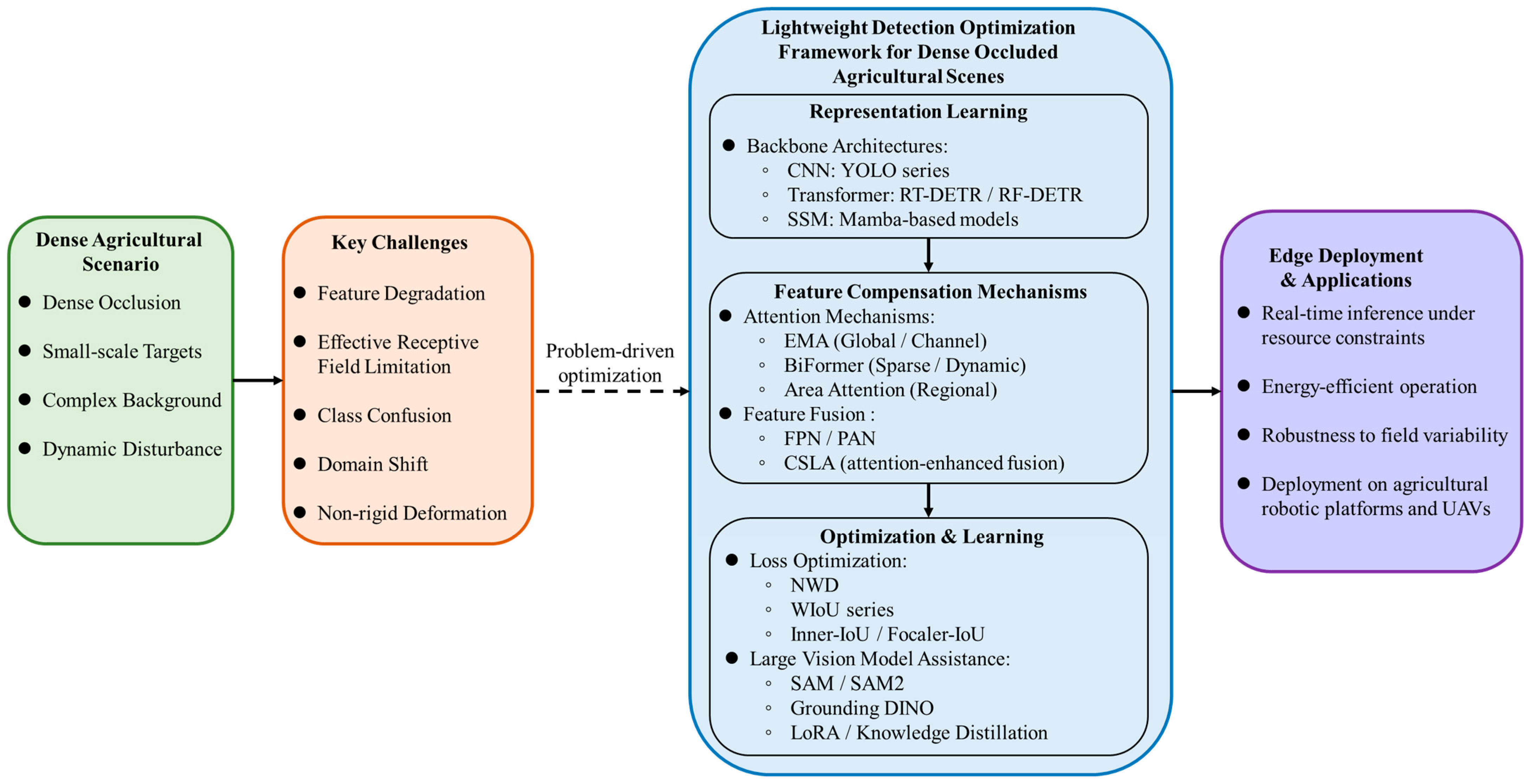
To visually illustrate the narrative structure of this paper, Figure 1 presents a problem-driven optimization framework tailored to dense occluded agricultural scenes. Confronting issues such as constrained effective receptive fields and feature degradation triggered by physical challenges—including severe target overlapping, scale variations, and dynamic disturbances in complex environments represented by high-density row crops like cornfields—this framework systematically outlines the core pathways for model optimization.
This framework aims to reveal how to achieve an effective balance between detection accuracy and inference efficiency on resource-constrained edge devices. To fulfill this objective, it systematically encompasses fundamental lightweight representation learning, feature compensation mechanisms for occlusion (particularly core attention and feature fusion), multi-dimensional loss optimization, and knowledge transfer from large vision models. Ultimately, it provides evidence-backed technical references for the practical edge deployment and applications of agricultural intelligent perception systems.

2. Review Methodology

To ensure a comprehensive and reproducible selection of the relevant literature, this systematic review followed the Preferred Reporting Items for Systematic Reviews and Meta-Analyses (PRISMA) guidelines [42].

2.1. Search Strategy and Databases

The primary systematic literature search was performed across Web of Science (Core Collection), Scopus, and IEEE Xplore. To capture the most recent advancements in lightweight edge-deployment models for agricultural scenes, the search spanned from January 2019 to May 2026. The Boolean search string combined three core domains: (“object detection” OR “deep learning” OR “lightweight model” OR “YOLO” OR “Transformer”) AND (“agriculture” OR “orchard” OR “crop” OR “weed” OR “pest”) AND (“occlusion” OR “dense” OR “overlapping”).

2.2. Inclusion and Exclusion Criteria

To maintain the high quality and relevance of the review, strict inclusion and exclusion criteria were established. Inclusion criteria are as follows: (1) Peer-reviewed journal articles and high-impact conference proceedings; (2) Studies explicitly focusing on lightweight object detection architectures; (3) Research addressing target occlusion, dense distribution, or severe environmental interference in agricultural fields; (4) Articles written in English. Exclusion criteria are as follows: (1) Non-peer-reviewed preprints (unless reporting fundamental breakthrough architectures like YOLOv12 or Mamba); (2) Studies focusing purely on indoor/controlled environments without agricultural field challenges; (3) Traditional machine-learning vision studies without deep-learning architectures; (4) Duplicate publications and inaccessible full texts.

2.3. Screening Procedure

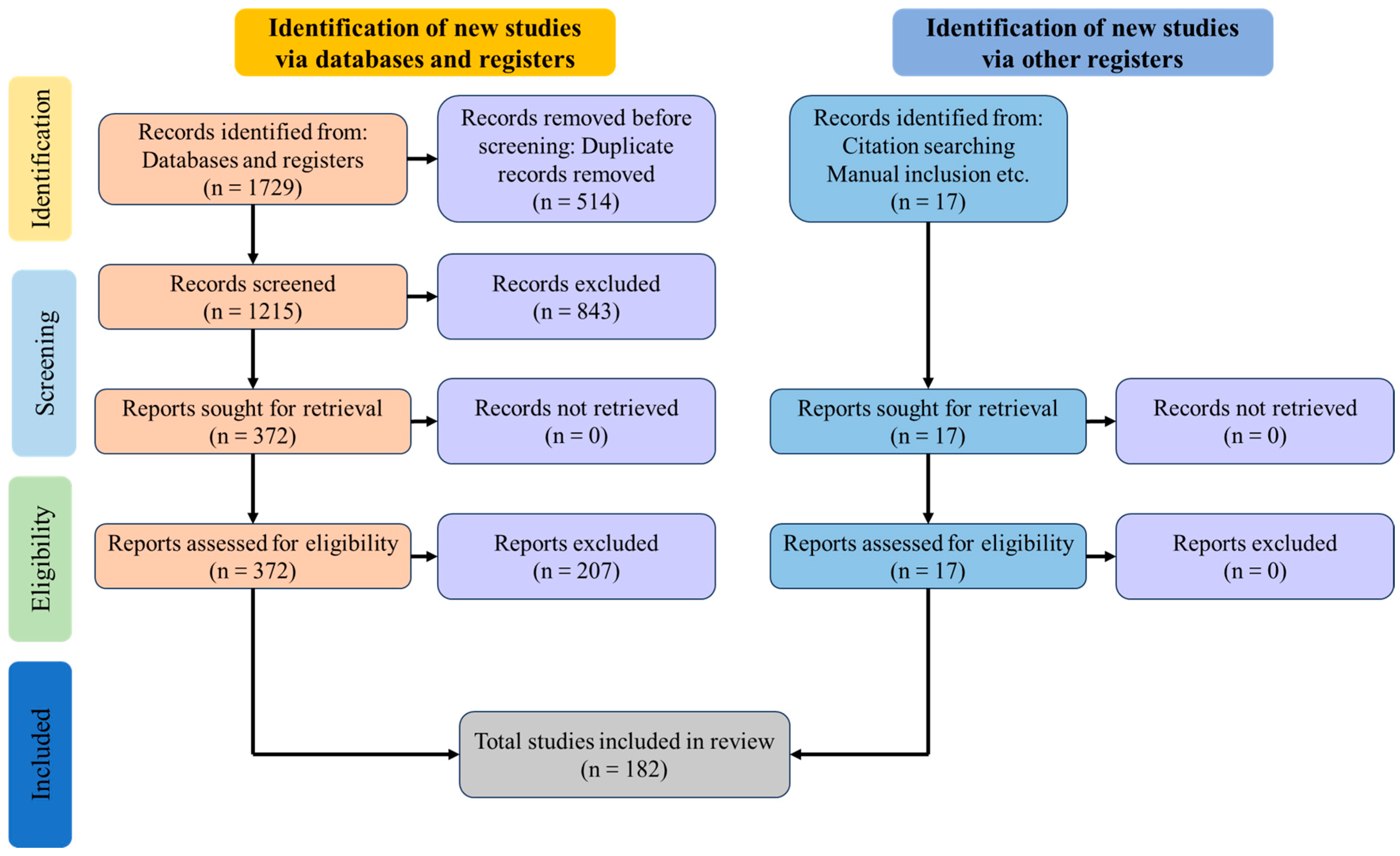
The literature identification followed a bipartite approach. First, the primary database search yielded 1729 candidate records. After duplicate removal and abstract screening, 372 articles underwent full-text eligibility assessment. Applying the strict exclusion criteria removed 207 articles (e.g., lacking occlusion focus or unsuited for edge devices), resulting in 165 highly relevant applied agricultural studies.
Second, to provide the necessary algorithmic context and trace the mathematical origins of the discussed methods, an additional 17 foundational papers were manually incorporated through citation searching. These include seminal pre-2019 works (e.g., classical spatial transformer networks and original attention mechanisms) and pure computer vision theoretical breakthroughs (e.g., fundamental YOLO architectures, original Segment Anything Models, and foundational loss functions) that fall outside agricultural-specific keywords. Ultimately, 182 references were comprehensively synthesized. The complete procedure is illustrated in the PRISMA flowchart (Figure 2).

3. Agricultural Field Occlusion Mechanisms and Feature Loss Analysis

Unlike rigid occlusions in general object detection tasks (e.g., pedestrians occluded by vehicles, or obscured urban road signs), the occlusion problem in agricultural field scenarios is characterized by severe spatial structural ambiguity and high intra-class morphological variance [43,44]. An in-depth analysis of the physical and mathematical mechanisms of feature loss caused by occlusion is a prerequisite for targeted deep-learning model optimization.

3.1. Morphological Similarity and Class Confusion

In agricultural ecosystems, associated weeds and target crops typically share similar growth environments, soil nutrients, and sunlight conditions, resulting in a high degree of homogeneity in spectral reflectance, leaf color distribution, vein textures, and macroscopic morphological structures [45]. For example, in corn or soybean fields, the leaf geometries of common broadleaf weeds at the seedling stage are almost impossible to rapidly distinguish from those of the crops by the naked eye [45,46].
This dual similarity at the morphological and spectral levels, when mapped into the feature space of deep neural networks, directly leads to a sharp reduction in the inter-class distance of high-dimensional feature vectors [45]. From the perspective of manifold learning, the feature manifolds of crops and weeds severely overlap in the feature space. In lightweight networks, with the number of convolutional layers drastically reduced and channel dimensions compressed, it is inherently difficult for the model to extract highly discriminative, fine-grained, high-frequency features. When an object encounters occlusion, with only local regions (such as half a leaf or a partial stem) remaining visible, the structural context features available to the model for classification become even scarcer. At this point, morphological similarity and spatial occlusion mutually amplify each other, making the model highly susceptible to severe class confusion, thereby causing the detector to output a large number of false positive predictions.
Existing research has fully verified the aforementioned phenomena in practical agricultural scenarios. For example, when evaluating lightweight models such as single-stage object detection algorithms (YOLO), Chen et al. found that mutual occlusion or overlap among objects severely deprives the network of the critical context information required for inference, confirming that low-parameter models easily fall into decision-making dilemmas when faced with incomplete visible regions [47]. Furthermore, Deng et al. conducted an in-depth exploration of morphological bottlenecks under complex backgrounds, pointing out that when confronting the comprehensive challenges of variable plant scales, highly homogenized morphologies, and severe leaf overlapping, the ability of lightweight CNNs to extract fine-grained features is further weakened [48]. In empirical validations, this degradation of feature representation manifests directly as a reduction in the inter-class distance within the feature space. This reduction inevitably disrupts the balance between detection speed and accuracy, thereby corroborating the underlying causes for numerous false detections and false positives.

3.2. Multi-Scale Variation and Effective Receptive Field Limitation

Agricultural targets span an extreme distribution of spatial scales, ranging from minute morphologies at the seedling stage to large-scale plants at the mature stage [49]. In scenarios where multi-scale targets coexist, when lightweight networks perform downsampling operations via strided convolutions or max pooling, the pixel-level physical features of small targets (e.g., early-stage disease spots, tiny pests, or seedlings) are irreversibly compressed or even completely lost [50,51]. For instance, in the scenario of UAV-based remote sensing monitoring of rice panicles, the semantic enhancement in deep networks often comes at the severe cost of sacrificing the spatial resolution of tiny panicles [52].
Simultaneously, mutual occlusion caused by dense planting and the crops’ own self-occlusion disrupts the geometric continuity of the targets [53]. In traditional CNNs, the Effective Receptive Field (ERF) typically exhibits a center-aggregated Gaussian distribution, and its actual functional range is much smaller than the theoretical calculation. Due to the fewer network layers in lightweight models, their theoretical receptive fields struggle to cover the global image. When crucial discriminative parts of a target (e.g., crop inflorescences, fruit stems) are obscured, the model must rely on long-range context for inferential compensation (for example, inferring the exact position of an occluded fruit based on the orientation of visible branches and leaves). However, due to the constrained Effective Receptive Field (ERF) inherent in shallow lightweight CNNs, the model often fails to cover the global context necessary for establishing cross-regional feature dependencies, ultimately leading to bounding box localization failures.
The aforementioned theoretical limitations have been conclusively corroborated by recent empirical field studies. For example, Ma et al. demonstrated in their study on extreme spatial scales from a UAV perspective that lightweight models not only severely obliterate the pixel-level features of tiny targets during the multi-layer convolutional downsampling stage, but this drastic loss of spatial resolution also further deprives the model of the physical foundation for constructing global information dependencies [54]. Regarding the failure of contextual inference caused by occlusion, the research by Zhao et al. provides more intuitive evidence. They found that within dense plant canopies, when core discriminative parts like fruits are masked, constrained by the limits of the local effective receptive field, conventional lightweight networks are completely unable to extract and utilize the clearly visible surrounding branch orientations or leaf distributions as logical inference cues. This phenomenon illustrates the spatial context deficiency of lightweight models in complex scenes, proving that the lack of long-range context compensation is the root cause of the broken inference chain and failed object localization [55].

3.3. Dynamic Environmental Interference and Non-Rigid Deformation

The natural agricultural field environment possesses a high degree of uncontrollability, and such dynamic changes introduce non-linear noise perturbations to object detection. Dynamic variations in illumination conditions (e.g., cloudy weather, backlighting, and front-light reflection) create complex shadows, local overexposure, and highlight regions on target surfaces, severely disrupting color constancy [56,57].
Furthermore, meteorological factors, such as wind fields and rainfall, frequently cause crop leaves to undergo non-rigid deformations, such as flipping, curling, and folding, which further alter the two-dimensional projection topologies of the targets [58,59]. The superimposition of these environmental disturbances and dense occlusion effects constitutes a typical detection scenario characterized by high noise and weak features. Lightweight models that rely on static convolutional kernels for feature extraction exhibit extremely poor generalization capabilities in such environments. They are prone to falling into local optima, leading to significant domain shifts across data distributions from different time periods or field plots, which results in drastic fluctuations in detection accuracy [60]. The perturbations of such complex physical environments compel detection algorithms to undergo profound architecture-level innovations in feature alignment, attention mechanisms, and adaptive deformation processing.
Recent cutting-edge research has fully corroborated the necessity and effectiveness of the aforementioned architecture-level innovations. For example, regarding non-rigid topological distortions triggered by factors such as wind fields, Praveen et al. demonstrated the vulnerability of conventional lightweight models in capturing dynamic deformations [61]. To break through this bottleneck, their study explicitly modeled geometric distortions by introducing Thin-Plate Splines (TPS) and successfully achieved adaptive spatial alignment of target features by coupling Spatial Transformer Networks (STNs) with the Convolutional Block Attention Module (CBAM). In addition, the research by Dong et al. corroborated the risk of severe environmental disturbances destroying feature constancy and inducing domain shifts from another dimension [62]. Building upon the use of Histogram Transformers (HT) to suppress environmental degradation, they innovatively proposed Dynamic Slender Convolutions (DSC). By replacing the traditional static perception paradigm, this deformable convolution variant enables the model to perform adaptive sampling based on leaf morphology. These empirical works not only objectively reveal the generalization defects of static convolutional kernels in complex agricultural field scenes but also confirm that introducing dynamic deformation perception and attention compensation is a critical path to bridging the robustness gap of the models.
To explicitly delineate the theoretical boundaries and the distinct technical challenges discussed above, Table 1 presents a comprehensive taxonomy framework. This framework systematically maps each complex physical factor to its corresponding high-dimensional feature degradation pattern, representative field scenarios, widely adopted agriculture-specific benchmark datasets, and the most appropriate evaluation metrics, thereby providing a structured reference for targeted algorithmic optimization.

4. Lightweight Backbone Networks and Feature Fusion Strategies

To bridge the contradiction between edge computational bottlenecks and feature loss, the backbone and multi-scale fusion neck architectures have evolved to address these constraints [77]. In recent years, the rapid iteration of the YOLO series, the lightweight adaptation of Transformer architectures, and the introduction of State Space Models (SSMs, e.g., Mamba) have collectively shaped the current technical landscape of agricultural object detection [6,39,78].

4.1. Lightweight Evolution of the YOLO Series

As the benchmark for one-stage detectors, YOLO is the most widely applied in the agricultural field, and its evolutionary trajectory clearly reflects the ultimate pursuit of a balance between accuracy and inference latency [13,79,80]. This section focuses on reviewing the recent YOLO architectures that have demonstrated outstanding performance in complex agricultural scenarios.
YOLOv8, through its decoupled head and anchor-free design, significantly enhances the model’s generalization and adaptability to multi-scale crops, and has now become a general baseline for agricultural detection tasks [81]. This strong structural plasticity has been fully verified in practical deployments. For example, Lv et al. utilized this architecture as the underlying framework. They performed deep, lightweight modifications to its backbone to meet the real-time navigation requirements of agricultural machinery in non-ridged environments [82]. By introducing lightweight mobile-end modules, the model not only drastically compressed the parameter count and improved the inference frame rate, but also objectively confirmed the excellent modification potential and deployment elasticity of YOLOv8 on edge hardware platforms.
Subsequently, YOLOv9 innovatively introduced Programmable Gradient Information (PGI) and the Generalized Efficient Layer Aggregation Network (GELAN), effectively alleviating the information bottleneck in deep networks and ensuring that shallow spatial details of small and occluded targets can be fully transmitted to the deep semantic network [83,84]. This characteristic is particularly critical for monitoring morphologically diverse agricultural targets. Rout et al. applied it to the autonomous growth monitoring of leafy green vegetables using tracked robots, successfully addressing the complex morphological evolution and non-rigid occlusion during the natural growth stages of vegetables [85]. Thanks to the non-destructive transmission of details provided by the aforementioned architecture, subtle features such as leaf edges were preserved, thereby providing robust visual perception for continuous state monitoring of chassis robots in complex field environments.
YOLOv10 introduced a Consistent Dual Assignment Strategy into its architecture, eliminating the dependence on Non-Maximum Suppression (NMS) post-processing for the first time in the YOLO series [86,87]. This innovation directly addresses the pain point of detecting dense clusters of agricultural targets—where traditional algorithms previously tended to erroneously discard physically independent but spatially overlapping real targets as redundant bounding boxes. Li et al. deployed YOLOv10 directly in greenhouse scenarios; when processing highly overlapping tomato fruit clusters, the model not only completely avoided the missed-detection (false-negative) defects caused by NMS but also significantly reduced end-to-end computational latency, achieving precise recall of dense fruits [88].
Furthermore, YOLOv11 integrated the C3k2 module and the Cross-Stage Partial Spatial Attention (C2PSA) mechanism, greatly strengthening the model’s ability to capture multi-scale contextual information without increasing additional computational overhead [89]. This high-resolution spatial detail analysis capability has allowed it to excel in precision agricultural phenotyping tasks. Jiang et al. utilized an improved YOLOv11 model for the precise quantification of strawberry appearance quality, achieving not only accurate instance-level extraction of multi-scale fruit contours but also completing complex spatial quantitative analysis of geometric distortion and symmetry on this basis [90]. This fully demonstrates the cutting-edge application potential of the new-generation YOLO architecture for tackling highly challenging tasks, such as fine-grained phenotyping and grading of agricultural products.

4.2. Architectural Breakthrough of Area Attention in YOLOv12

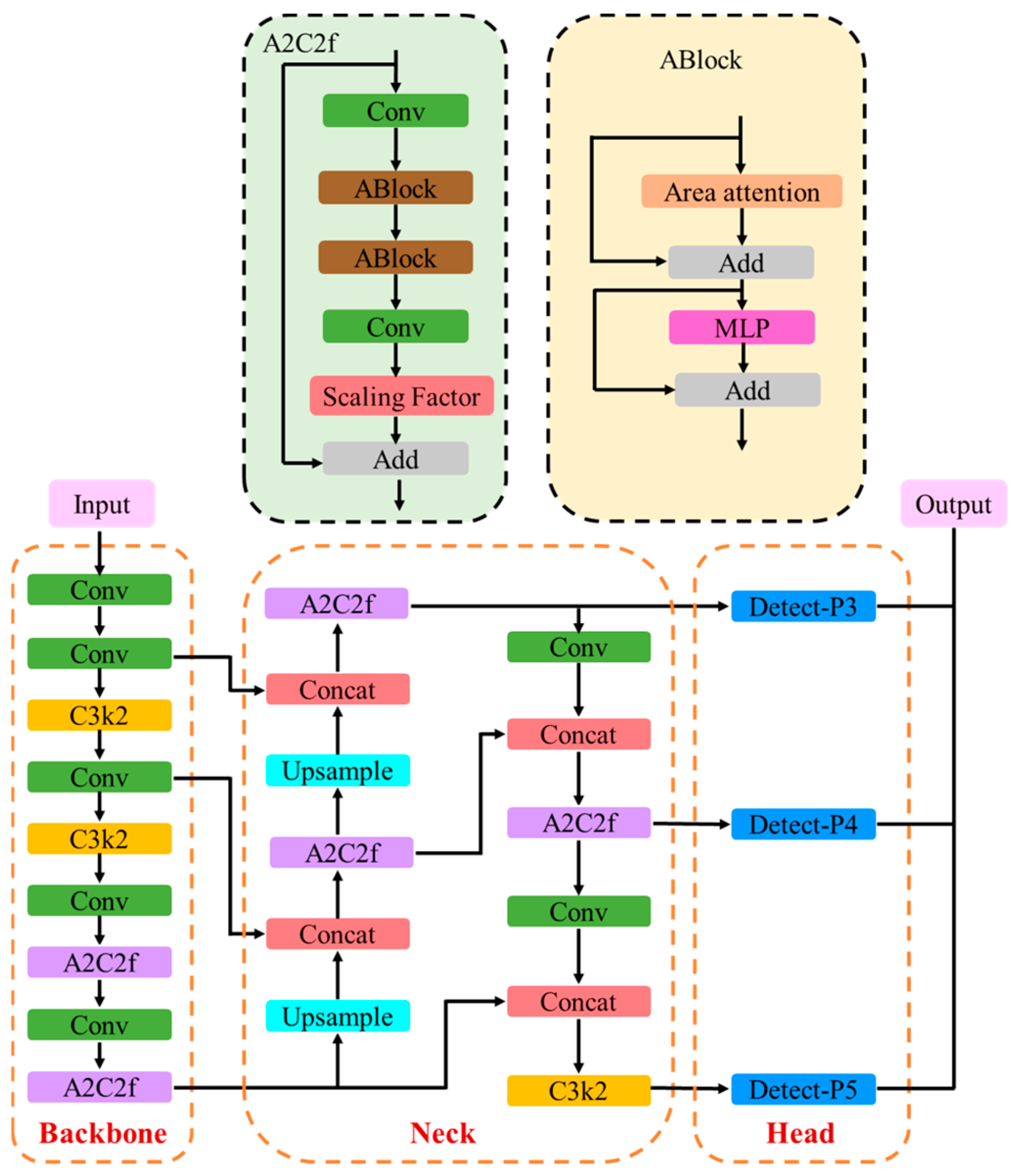
Released in 2025, YOLOv12 set a new milestone in lightweight architecture design [91]. Traditional YOLO models highly depend on convolutional operators and are constrained by local receptive fields; in contrast, YOLOv12 elevates the attention mechanism to the core level of the backbone network, innovatively introducing the Area Attention (A2) module [34].
The original intention of this mechanism is to solve the problem where the computational complexity of standard global Self-Attention increases quadratically with resolution. By dividing the feature map horizontally or vertically into four Localized Regions for independent weight computation, Area Attention significantly reduces memory consumption and floating-point operations while preserving a broad receptive field that surpasses traditional convolutions. For agricultural applications, this means the model can capture long-range structural associations of crop branches under extremely low latency, thereby performing logical compensatory inference for partially obscured diseases or fruits.
To further enhance the execution efficiency on edge hardware, YOLOv12 deeply integrates FlashAttention technology with the Residual Efficient Layer Aggregation Network (R-ELAN). The Area Attention within the ABlock is accelerated at the underlying level based on the FlashAttention mechanism. This integration directly optimizes memory access efficiency from the hardware layer, specifically refining the read-write mechanisms of Static Random-Access Memory (SRAM) and High Bandwidth Memory (HBM).
Meanwhile, R-ELAN effectively alleviates vanishing gradients and optimization instability in deep attention networks during early training by introducing an extremely small scaling factor (0.01) for residual connections. This dual optimization of underlying operators and upper-level architecture enables YOLOv12 to achieve an optimal trade-off between mean Average Precision (mAP) and FLOPs on agricultural benchmark datasets [92].
Figure 3 details the overall topological structure of the improved YOLOv12 and its internal microscopic module logic. In terms of macroscopic layout, the model continues the design paradigm of the Backbone, feature-fusion Neck, and decoupled-detection Head. However, the core feature-extraction operator has been upgraded to the attention-driven A2C2f module. As an attention-adapted version of the R-ELAN architecture, the A2C2f module achieves deep parsing of complex features by embedding a two-layer ABlock in the residual path. As shown in the local enlarged view in Figure 3, the A2 mechanism inside the ABlock, in conjunction with Multilayer Perceptron (MLP) layers, can adaptively focus computational resources on key target regions under dense occlusion in agricultural fields. Furthermore, A2C2f explicitly introduces a learnable scaling factor to dynamically weight the residual branches, guaranteeing lossless transmission of feature information in densely overlapping scenarios while ensuring the lightweight nature of the model.
This attention-centric mechanism shows promising potential for handling complex agricultural scenarios, particularly when long-range contextual information is needed under dense occlusion. For example, in a detection study targeting extremely small weed objects (0–3000 pixels), Yang et al. demonstrated the synergistic advantages of the Area Attention and R-ELAN architectures [17]. Benefiting from its ability to calculate attention weights within localized regions, the model can successfully capture cross-regional crop structural features with low computational and memory overhead. Furthermore, it effectively filters out strong non-linear interferences, such as soil clod backgrounds and natural illumination. Experiments confirmed that in real-world field tests with heavy occlusion and high-noise backgrounds, YOLOv12 showed improved feature extraction and recall, suggesting its potential value for lightweight agricultural detection under occlusion and background noise.
To provide a representative overview of reported performance trends in recent YOLO-series detectors, Table 2 summarizes the performance of core YOLO versions reported in the recent literature. However, it is crucial to note that these quantitative comparisons should be interpreted with caution. Because the evaluation datasets and testing hardware platforms across different original studies are not fully consistent, these metrics serve primarily as theoretical architectural references rather than absolute performance guarantees for specific agricultural field applications. The data indicate that, through continuous optimization of model structures, the detectors have achieved a better balance between computational cost and prediction accuracy. It is worth noting that under the premise of drastically compressing computational complexity (Giga Floating-point Operations (GFLOPs) reduced to 6.4, on par with YOLOv11, which focuses on extreme lightweighting), YOLOv12 achieved a leap forward in Precision, reaching a peak of 0.883, and maintained mAP50 at a high level of 0.802.
Although its inference time (4.6 ms) is slightly higher than that of YOLOv10 and YOLOv11, its real-time performance remains significantly improved compared to early versions relying on cumbersome convolutions. Furthermore, it is crucial to note that sub-millisecond inference latencies (e.g., 0.6–0.8 ms) reported in the standard benchmark literature are typically acquired under ideal laboratory conditions utilizing high-end desktop GPUs (e.g., NVIDIA A100 or RTX 4090) [93]. When deployed on actual agricultural edge devices (e.g., NVIDIA Jetson Orin NX or Coral TPU), the absolute physical latency will inevitably increase, yet the relative architectural speed advantages remain consistent.
This metric distribution suggests that the Area Attention mechanism may provide a favorable accuracy–efficiency trade-off under constrained computational budgets. By reallocating computational resources to more informative regions, the model can improve the extraction of discriminative features in dense and noisy agricultural scenes. However, because the reported values were not obtained from a unified experimental protocol, these results should be interpreted as indicative rather than definitive evidence of architectural superiority.
It should also be emphasized that the numerical results summarized in Table 2 are collected from different reported studies and may involve differences in datasets, image resolutions, training strategies, inference hardware, and software optimization. Therefore, these values should be used to understand general performance tendencies rather than to draw strict conclusions about absolute model superiority.
It should be noted that, as the latest engineering evolution in 2026, Ultralytics introduced YOLO26 in its official documentation, emphasizing end-to-end deployment, the MuSGD optimizer, and edge inference efficiency. However, since this version currently lacks the support of formal research papers, its generalization capability and stability advantages in densely occluded agricultural scenarios remain to be verified by additional independent studies.

4.3. Lightweight Adaptation of End-to-End Transformers

Although the YOLO series dominates in inference speed, Transformer-based detectors offer inherent advantages for handling severe occlusion and complex background interference, thanks to their built-in global dependency modeling capabilities [94,95]. However, the high computational overhead of standard Transformers has consistently hindered their deployment on edge agricultural machinery [39,96].
The RT-DETR proposed by Baidu decouples intra-scale feature interaction and cross-scale feature fusion by designing an Efficient Hybrid Encoder, successfully breaking through the computational bottleneck of traditional Transformers and elevating its inference speed to the real-time level for the first time [93]. This architecture, which balances a global receptive field and a high inference frame rate, provides a novel paradigm for agricultural vision edge computing. For example, targeting the pain points of highly similar features between immature fruits and backgrounds accompanied by high-frequency occlusion in complex orchard environments, Zhang et al. conducted deep customization based on RT-DETR [97]. They further strengthened the model’s discriminative ability for local hidden features by introducing Multi-Scale Convolutional Attention (MSBlock) and a reparameterized feature pyramid network (Efficient RepGFPN). Experimental data confirm that while significantly improving detection accuracy in complex scenes, the improved model maintains an inference speed of up to 30.2 frames per second (FPS), demonstrating the feasibility of deploying lightweight Transformers on agricultural edge devices.
Targeting dense occlusion scenarios, the RF-DETR model released in 2025 demonstrates a more radical architectural evolution [98]. This model completely abandons the heuristic designs of anchor boxes and NMS, integrates the DINOv2 vision Transformer backbone, and greatly enhances feature robustness for locally visible and tiny targets through contrastive denoising training. More crucially, RF-DETR can achieve synergy between high-precision bounding box detection and instance segmentation through a unified Application Programming Interface (API), providing indispensable pixel-level mask information for subsequent precise obstacle avoidance and grasping by agricultural robotic arms in complex occlusions. To verify the upper limit of this architecture in extreme agricultural environments, Sapkota et al. conducted a comparative empirical study of RF-DETR and the latest YOLOv12 specifically targeting heavily occluded green fruit in highly challenging complex orchards [99]. The results indicate that, thanks to its contrastive denoising mechanism and outstanding global contextual understanding, RF-DETR achieves significant localization accuracy gains and extremely fast convergence when handling severe occlusion and complex background interference. However, the study also objectively points out that RF-DETR still faces architectural limitations despite its excellent performance in multi-task synergy. Compared to the extremely lightweight YOLO series, its model parameter size remains relatively large, and its inference time is relatively long. It still requires further compression and optimization for agricultural machinery platforms with limited computational power.

4.4. Application of State Space Models (Mamba) in Agricultural Vision

Entering 2025, inspired by State Space Models (SSMs), particularly the Mamba architecture, these models have surged in prominence within the field of agricultural computer vision [100,101,102]. The core theoretical advantage of the Mamba model lies in its selective scan/memory mechanism and hardware-aware algorithm, which enable global context modeling capabilities comparable to those of Transformers with linear time complexity [103]. For complex agricultural scenarios, this means the model can process high-resolution feature maps as long sequences without the risk of memory explosion. Consequently, it can effectively penetrate dense leaf occlusion networks to dynamically filter and reconstruct complete semantic representations of occluded targets on a global scale.
Recent hybrid architectures have empirically explored this trade-off, balancing global context modeling with computational efficiency through linear sequence mechanisms. For example, targeting the pain points of high overlap and variable scales in greenhouse flower counting and agricultural field crop pest and disease detection, researchers innovatively integrated the efficient detection architecture of YOLOv11 with the long-sequence modeling strengths of Mamba [104]. By utilizing Mamba modules to enhance feature extraction and multi-scale contextual representation, the hybrid model demonstrates superior object recall capabilities when facing heavy occlusion. An even more extreme lightweight case is reflected in mulberry leaf disease detection tasks under natural environments. Addressing the limitations of existing models, such as low recognition rates for subtle lesions (small targets) and difficulty in accurately extracting leaf vein structures, researchers specially customized a Mamba-YOLO variant architecture [105]. Benefiting from the efficient filtering and memory of long-range spatial features provided by the Mamba mechanism, the model achieved high-precision localization of hidden lesions with an extremely small parameter count of only 5.6 M and an exceptionally low computational overhead of 13.4 GFLOPS. These recent explorations suggest that Mamba-based hybrid architectures may be compatible with some agricultural edge-deployment scenarios after further optimization, and they provide a promising technical direction for improving global context modeling in lightweight agricultural perception.
Furthermore, a rigorous methodological boundary must be delineated regarding the empirical validation status of these cutting-edge algorithms. While foundational, fully convolutional YOLO iterations (up to YOLOv11) have been extensively validated across diverse deployed agricultural equipment, the widespread field-side applicability of ultra-recent or alternative non-convolutional architectures remains in its infancy. Although a few pioneering studies have recently explored YOLOv12, real-time Transformers (RT-DETR), and Mamba variants for specific tasks like weed identification or foliage disease detection, their performance is largely optimized on closed benchmark datasets [106]. Attention mechanisms have inherent computational overhead, and resource-constrained embedded chips currently lack hardware-level operator acceleration for SSMs with long sequences. Consequently, their real-time robustness under unstructured field lighting variations requires extensive empirical robotic validation rather than inferred architectural prospects.
In summary, from the perspective of practical edge deployment, a critical trade-off must be orchestrated among accuracy, parameter scale, and inference efficiency. Although emerging architectures like real-time Transformers (RT-DETR) and State Space Models (Mamba) offer robust global contextual reasoning to break through dense foliage occlusions, their higher computational complexity and memory throughput limits currently restrict them to high-end edge GPUs (e.g., NVIDIA Jetson AGX Orin). For ultra-low-power, battery-constrained platforms typical of crop-protection UAVs, NMS-free CNN frameworks such as YOLOv10 and YOLOv11 remain the optimal baseline to ensure the real-time inference frame rate (>80 FPS) required for continuous field operations.
The comparison of characteristics between lightweight backbone networks and feature fusion strategies under severe canopy overlapping conditions is shown in Table 3.

5. Optimization and Application of Lightweight Attention Mechanisms

To resolve the dual dilemma of constrained effective receptive fields and computational constraints identified in the previous analysis, attention mechanisms, as a plug-and-play network enhancement architecture that builds on lightweight backbone reconstruction, have become an industry standard for improving model representation capabilities [107,108]. From a more fundamental physical perspective, under the strict computational budget of edge devices, attention mechanisms are not merely feature filters, but rather a “dynamic adaptive compute allocation mechanism” (Compute Allocation Mechanism). By evaluating the semantic importance of different regions within the feature maps, they compel the network to prioritize allocating limited channel and spatial representation capacities to regional features critical for classification and localization (such as exposed edges or key textures of targets) [109].

5.1. Global Recalibration and Multi-Dimensional Feature Enhancement

Early lightweight detection models widely adopted attention mechanisms based on global feature recalibration (Global Recalibration), with typical representatives including Squeeze-and-Excitation (SE) networks and Convolutional Block Attention Modules (CBAM) [110,111].
The SE module extracts channel-wise statistical information via Global Average Pooling (GAP) and adaptively calculates feature-channel weights using fully connected layers, thereby achieving “channel selection” [112]. Building on this, CBAM introduces a spatial attention branch that concatenates channel attention (determining “what features” to focus on) and spatial attention (determining “where” to focus), achieving multi-dimensional reweighting of feature maps [113]. This dual filtering mechanism demonstrates significant anti-interference advantages in agricultural perception tasks and has been widely proven to effectively suppress complex field background noise (e.g., soil reflections, stray light spots, or water ripples), accurately highlighting the core discriminative regions of occluded weeds or tiny lesions [114,115].
Field-based empirical studies have strongly corroborated the effectiveness of the aforementioned theoretical mechanisms. For instance, addressing the challenge of field weed recognition in extremely complex backgrounds, researchers deeply embedded CBAMs into the YOLO architecture [116]. Benefiting from the module’s strong suppression of redundant environmental interference and its focus on critical weed features, the improved model effectively overcame false detection issues caused by cluttered backgrounds, achieving a detection accuracy (mAP) of 86.89%.
However, as the complexity of agricultural detection scenarios increases, the underlying theoretical limitations of these traditional attention mechanisms are becoming increasingly apparent. Due to their high dependence on static statistics extracted via GAP, this single-dimensional information aggregation method often obliterates high-frequency spatial details in extremely dense and cluttered scenes (e.g., severely intertwined crops and weeds) [117]. Consequently, when dealing with localized multiple occlusion problems, this approach still struggles to finely delineate the complex overlapping boundaries between objects [108].

5.2. Multi-Scale Interaction and Non-Rigid Deformation Adaptation

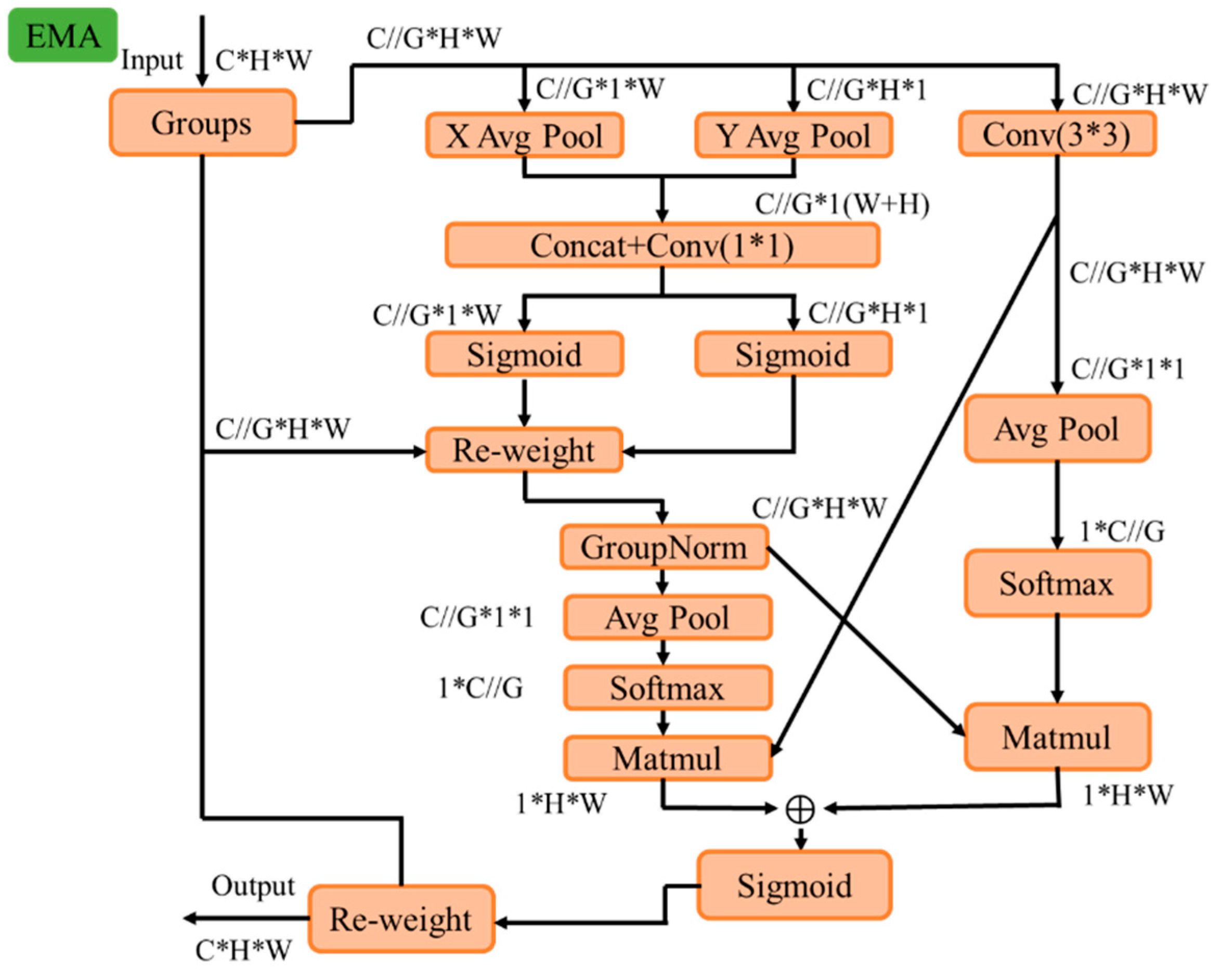
To compensate for the deficiencies of traditional attention in fine-grained spatial modeling, mechanisms such as Efficient Multi-Scale Attention (EMA), Dynamic Head (DyHead), and Cross-Scale Lightweight Attention (CSLA) have been proposed and widely integrated into advanced agricultural perception networks [118,119,120,121]. Figure 4 details the internal topology and interaction logic of the EMA module. Utilizing a parallel branch design, the EMA module extends the coordinate attention concept to the multi-scale representation space, achieving dynamic recalibration of the discriminative target regions through cross-spatial information interaction and 1D vector encoding. In agricultural field operation environments, when crop leaves sway with the wind, producing non-rigid deformations or causing the morphological fragmentation of targets (e.g., lesions, weeds), the EMA architecture can compensate for the loss of spatial continuity by fusing multi-level semantic information, enabling the network to re-establish the contextual association of targets that are physically separated by occlusion.
The core of such mechanisms lies in breaking through the limitations of a single receptive field. For example, CSLA establishes information highways between different feature pyramid levels through low-rank decomposition and feature compression techniques [121]. When crop leaf occlusion causes the morphological fragmentation of targets (such as pests and diseases), multi-scale attention can fuse the clear physical edges retained by shallow networks and the strong semantic abstractions extracted by deep networks, reconstructing a complete feature representation of the target across spatial scales [122].
Furthermore, targeting the ubiquitous non-rigid deformations in agricultural field environments (such as crop leaves swaying with the wind), researchers have proposed innovative frameworks that integrate attention mechanisms with Spatial Transformer Networks (STNs) or Thin-Plate Splines (TPS) [61,123,124]. For instance, the CBAM-STN-TPS-YOLO model utilizes channel and spatial attention mechanisms to guide a learnable TPS deformation field. Prior to deep feature extraction, it actively “stretches” and aligns the distorted, bent, or perspective-deformed leaf or fruit features into a standard spatial structure [61]. This non-rigid spatial registration technique drastically reduces missed detections and false positive errors caused by deformations, significantly improving the model’s robustness to dynamic occlusion.

5.3. Dynamic Routing and Sparse Computation Allocation

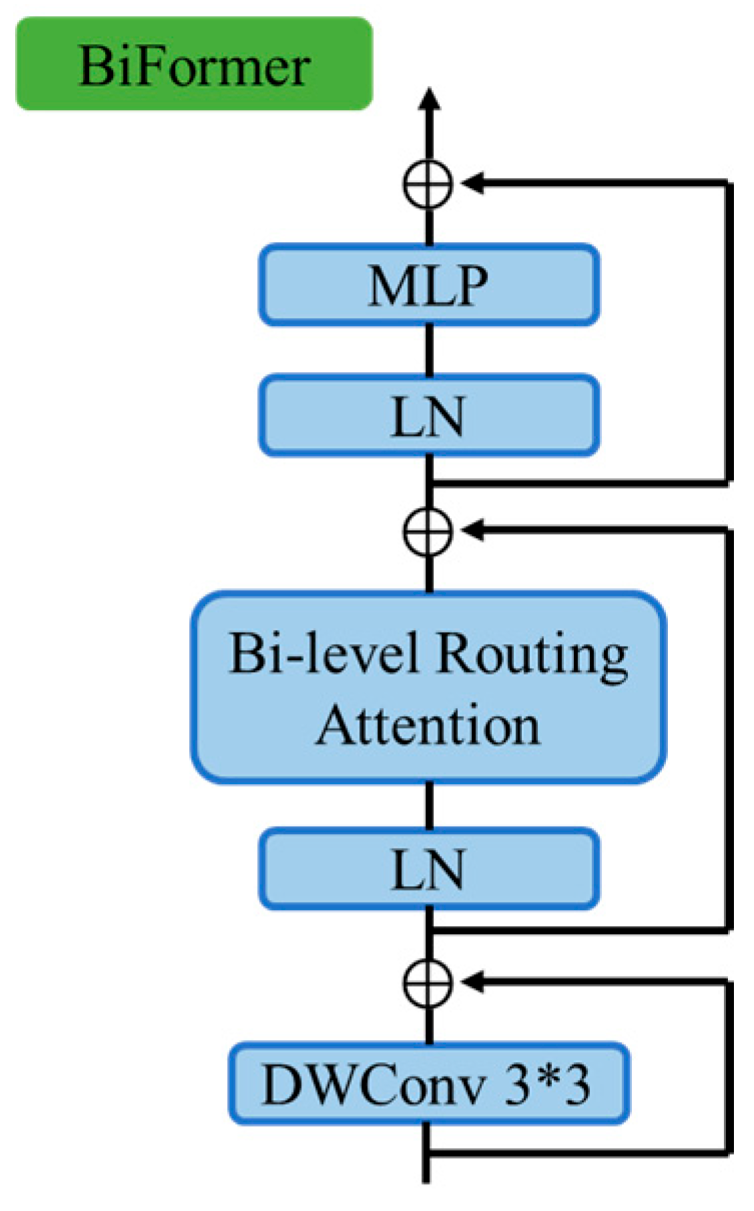
To approximate the global modeling capability of Transformers within the CNN framework while strictly controlling explosive growth in computational cost, sparse attention based on dynamic routing (such as Bi-Level Routing Attention (BRA) in BiFormer, and the variant application of Area Attention in YOLOv12) represents the most cutting-edge concept of computation allocation at present [91,125].
The dynamic routing mechanism abandons the inefficient paradigm of performing the same computation on all pixels across the entire image and adopts a content-aware strategy. It first performs coarse-grained screening among macroscopic regions of the feature map to evaluate the information entropy of each region, and subsequently executes fine-grained token-level attention computation only within the most discriminative and information-dense key regions (top-K regions) [126]. Figure 5 illustrates the core mechanism of BiFormer based on BRA. This architecture abandons the inefficient global-equal-computation paradigm, adopting a content-driven, dynamic, sparse routing strategy. Targeting the large areas of low-value backgrounds (e.g., soil, flat lighting, and shadows) in agricultural field images, BiFormer first evaluates information entropy at the macro-region level and then precisely allocates computational resources to the top-K core-dense regions to execute fine-grained computations. This adaptive reallocation strategy for computational resources, while maintaining an extremely low parameter count, effectively suppresses background noise interference in densely clustered scenarios and significantly reduces localization drift.
In actual orchards or cornfields, the vast majority of pixels in an image belong to highly sparse and redundant backgrounds (such as large areas of clear sky or flat soil) [116,127]. The dynamic routing mechanism can adaptively skip low-value regions and allocate computational power to the interlaced branches and occluded target clusters. This sparse allocation mechanism improves mAP in dense scenarios while maintaining an extremely low model parameter size (e.g., less than 10 M). It effectively prevents background noise from infiltrating the feature aggregation process, thereby suppressing localization drift [91,126].
This outstanding capability to handle highly redundant backgrounds has been fully verified in other domains with similar visual challenges. For example, Qin et al. innovatively introduced BRA into the head of the YOLO network [128]. Although this study was oriented towards road defect detection, its core logic is highly consistent with agricultural scenarios: both use a dynamic routing mechanism to skip redundant regions within a large proportion of valueless background (e.g., large areas of normal road surfaces) and to precisely focus computational resources on information-dense “defect” regions. Furthermore, in remote sensing image detection—where backgrounds are equally complex, small targets are dense, and scale variations are extreme—this mechanism has also demonstrated significant performance improvements. These cross-domain results suggest that, while keeping the network lightweight, introducing dynamic routing attention is an effective approach to addressing the bottlenecks in object recall rate and accuracy in densely occluded scenarios.
Concurrently, integrating advanced attention mechanisms serves as a dynamic compute allocation strategy to balance model capacity and representation learning on constrained hardware. Unlike traditional global recalibration mechanisms (e.g., SE, CBAM) that risk obliterating fine-grained details via uniform spatial aggregation, dynamic routing frameworks (e.g., BiFormer) and region-divided mechanisms (e.g., YOLOv12 Area Attention) may provide a favorable engineering trade-off. By strictly filtering out massive redundant agricultural backgrounds and allocating sparse computational capacity exclusively to nested target clusters, these approaches can improve feature extraction for occluded targets without inflating the static parameter budget.
A comparison of the optimization and application of lightweight attention mechanisms in cluttered field conditions is shown in Table 4.

6. Bounding Box Regression and Multi-Dimensional Loss Function Optimization

In addition to innovations in backbone architectures and attention allocation mechanisms, the Bounding Box Regression (BBR) loss used during the training phase directly and fundamentally determines the localization accuracy and convergence stability of the model in densely overlapping scenarios [130]. Traditional metrics based on Intersection over Union (IoU) have exposed severe theoretical and physical limitations in complex agricultural field scenarios [131].

6.1. Limitations of Traditional IoU Losses

Standard IoU and its early improved variants (e.g., Generalized IoU (GIoU) and Complete IoU (CIoU)) rely heavily on the absolute geometric overlap area when evaluating the coincidence between predicted bounding boxes and Ground Truth (GT) [132,133]. In agricultural vision tasks, this geometric mechanism faces two irreconcilable pain points:
First, scale sensitivity is extremely high when detecting tiny targets (such as early-stage rice lesions or newly germinated weed seedlings). A slight offset of even one or two pixels—though negligible on an absolute scale—can lead to a precipitous and drastic decline in IoU values on a relative scale [118]. This extreme sensitivity to slight pixel shifts triggers severe oscillations in the loss function gradient, making it difficult for the network to achieve stable convergence when training on tiny targets, resulting in an “unhealthy” learning state characterized by repeated fluctuations [134].
Second, in environments with high weed density or fruit clustering (e.g., a bunch of overlapping tomatoes), the bounding boxes of multiple real targets overlap heavily or even become nested within the 2D image plane. When the predicted box falls into the intersection area of multiple targets, the IoU gradient is prone to saturation or even Gradient Vanishing [135]. At this point, the model loses a clear optimization direction and falls into local optima; the output often merges multiple overlapping targets into a single large box, a phenomenon known as “Bounding Box Crowding,” or results in severe missed detections [136]. This is the core mathematical root cause of the performance collapse of traditional models in dense scenarios.

6.2. Distance Metrics and Distribution Modeling

To fundamentally resolve the geometric dependency defects of IoU from a mathematical standpoint, the research community has introduced the Normalized Wasserstein Distance (NWD) and Weighted IoU (WIoU) systems [131,137].
NWD abandons the traditional area-based overlap approach and adopts a probability distribution perspective, modeling the 2D bounding boxes as 2D Gaussian Distributions and subsequently measuring the prediction error by calculating the Wasserstein distance between the distributions. Since this distribution-based metric does not rely on rigid geometric overlap, NWD exhibits exceptional smoothness and robustness against the positional offsets of tiny targets [137]. More crucially, even under extreme conditions where there is no overlap between the predicted box and the GT box (i.e., IoU = 0), the Wasserstein distance can still calculate the spatial gap and provide stable guidance gradients [138], making its advantages significant in tiny feature recognition and counting tasks.
On the other hand, addressing occlusion and noise in complex scenarios, WIoU (especially its evolved version, WIoUv3) innovatively introduces the concept of “Outlier Degree” based on a dynamic non-monotonic focusing mechanism. In real-world field environments, some plants are inevitably severely occluded or extremely blurred (i.e., “low-quality labeled samples”). Traditional loss functions (such as Focal Loss) that force-fit such samples tend to generate harmful gradients and damage model generalizability. In contrast, WIoUv3 can intelligently evaluate the outlier degree of samples and dynamically reduce the gradient backpropagation weights of extreme occlusion samples. This mechanism of “strategically abandoning” abnormal noise and shifting the optimization focus to medium-difficulty core samples greatly alleviates the optimization difficulties caused by dense overlapping and significantly improves the model’s macro regression accuracy [139].
In practical complex agricultural scenarios, extremely tiny target scales and severe background occlusion often occur simultaneously, requiring detection models to possess both optimization capabilities. The research by Song et al. provides an excellent example of this theoretical fusion [140]. Targeting the dual challenges in macro-field pest monitoring, they innovatively combined NWD with Wise-IoU (WIoU mechanism) within an improved YOLO framework. This strategy fully leverages the precision advantage of NWD in tiny bounding box matching while utilizing WIoU to effectively suppress abnormal noise gradients generated by complex background interference. Experimental results indicate that this joint mechanism not only significantly improves detection accuracy under complex agricultural conditions but also successfully maintains the model’s lightweight characteristic with a computational complexity of only 5.6 GFLOPs.

6.3. Hard Examples and Overlapping Region Focusing

Addressing the two core challenges of “numerous hard-to-classify samples” and “ambiguous occlusion boundaries” in dense scenarios, the Focaler-IoU and Inner-IoU mechanisms have been extensively researched in recent years, achieving breakthrough progress in agricultural pest and fruit detection [80,140,141].
Focaler-IoU reconstructs the numerical distribution profile of IoU by introducing a non-linear Linear Interval Mapping mechanism. It can adaptively amplify the gradient contribution proportion of high-difficulty samples (e.g., targets with severe occlusion or those highly blended with background colors) according to the specific requirements of the task [140]. This design allows the loss function to focus more on refining bounding boxes with poor regression quality during the late optimization stage, effectively enhancing the model’s ability to resolve extreme corner cases.
Relatively, Inner-IoU originates from spatial geometric structures and cleverly introduces the concept of an Auxiliary Inner Bounding Box [141]. It utilizes a learnable scale factor to construct an internal scaled box smaller than the actual physical box, using it to guide the regression. In dense greenhouse environments, the external boundaries of fruits are often difficult to define accurately due to occlusion by branches and leaves, but their core internal regions (e.g., the central surface of a tomato) are typically clearly visible and highly discriminative [142]. Inner-IoU compels the model to prioritize aligning the internal core of the target, skillfully circumvents the noise interference caused by external occluded boundaries, significantly accelerates the convergence process, and reduces the overall localization error.
In real-world dense clustering scenarios, targets often simultaneously face the dual challenges of “extremely blurred external boundaries” and “difficulty in distinguishing individuals due to severe stacking,” which a single loss function struggles to balance. Consequently, recent cutting-edge research has further proposed the Inner-Focaler-IoU composite loss function, which deeply integrates the advantages of both. This composite metric inherits the high sensitivity of Inner-IoU for internal core feature alignment. Concurrently, it utilizes the mapping mechanism of Focaler-IoU to enhance the model’s continuous mining capability for blurred boundaries and hard-to-classify overlapping samples. In the highly representative tasks of greenhouse cherry tomato cluster detection and multi-class ripeness recognition, a lightweight detection model enhanced by this composite mechanism achieved an mAP@0.5 as high as 85.6% while maintaining extremely low computational complexity. This fully demonstrates the immense potential of multi-dimensional synergistic optimization of loss functions in overcoming dense occlusion challenges [126].
Crucially, addressing bounding box regression through distribution-aware loss optimizations exhibits a distinct edge-deployment advantage. Advanced formulations such as Normalized Wasserstein Distance (NWD) and Inner-Focaler-IoU focus heavily on fine-grained pixel shifts and internal structural alignment to stabilize gradient propagation. Because the computational branch of the loss function is entirely stripped during the post-training inference phase, these algorithms drastically enhance the localization accuracy for tiny, clustered targets under dynamic field conditions while incurring no additional parameter overhead or computational latency on embedded edge hardware.
A comparison of bounding box regression loss functions oriented toward highly unstructured crop environments is shown in Table 5.

7. Lightweight Application of Large Vision Models (LVMs) in Agricultural Perception

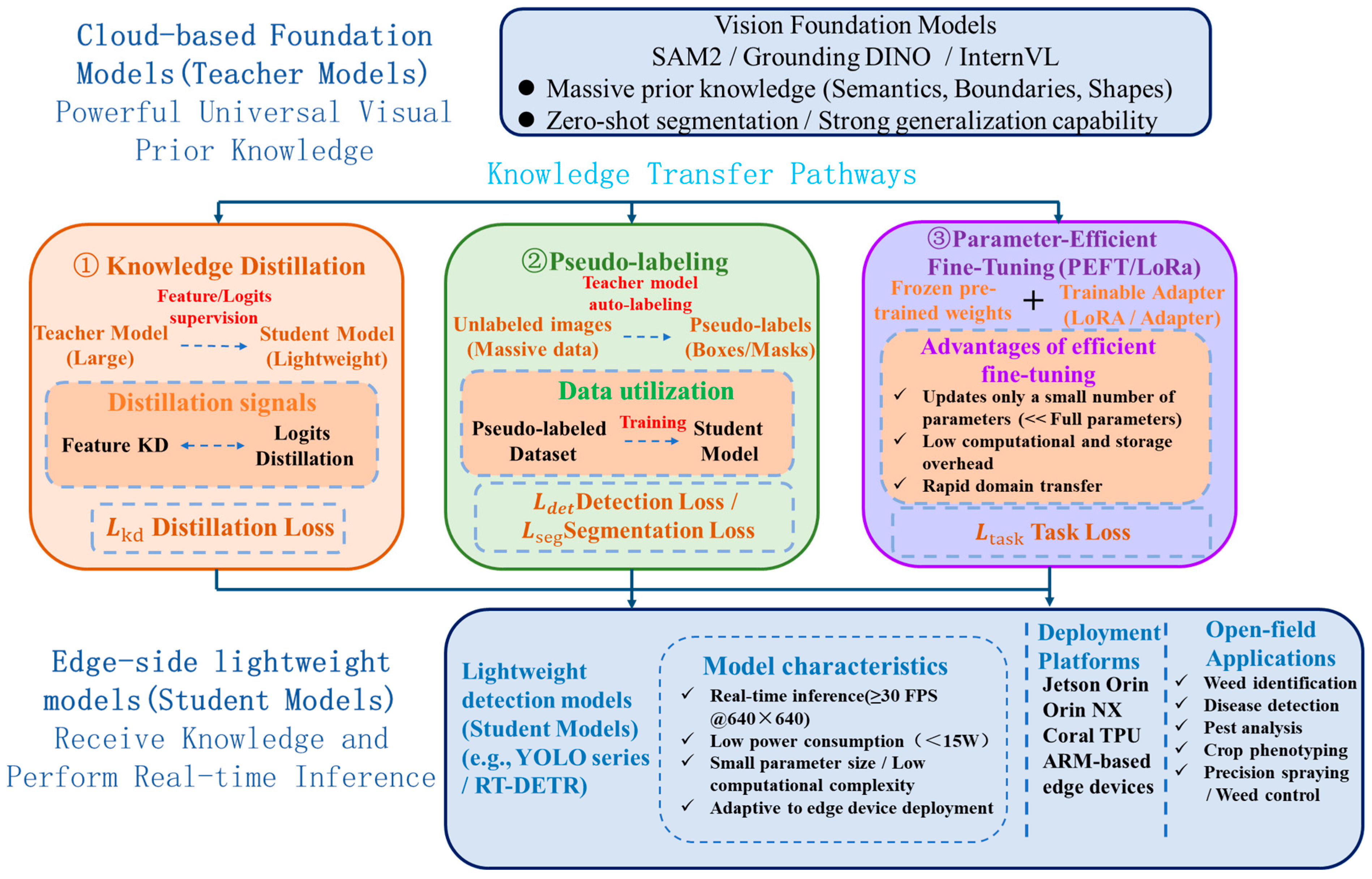
This section shifts focus from the intrinsic architecture of lightweight detectors to vision foundation models. It explores how these foundation models indirectly enhance lightweight detection performance in nested foliage scenarios through various advanced pathways, including annotation augmentation, knowledge distillation, parameter-efficient adaptation, and multi-modal supplementation. Traditional lightweight detection models are often small-domain expert models trained on limited datasets for specific agricultural tasks (e.g., single apple recognition, specific weed classification), and their generalization capabilities across regions, seasons, and varieties are relatively weak [10,17,144]. As computer vision comprehensively enters the era of Foundation Models, how to transfer and deploy Large Vision Models (LVMs)—with their hundreds of millions or even billions of parameters and massive prior knowledge reserves—into computationally constrained agricultural edge scenarios at a low cost has become a core research hotspot in the past two years [145,146].
As shown in Figure 6, vision foundation models (such as SAM2, Grounding DINO, and InternVL) can achieve the transfer of their capabilities to lightweight detection models through three main pathways: knowledge distillation, pseudo-label generation, and Parameter-Efficient Fine-Tuning (PEFT)/Low-Rank Adaptation (LoRA). These three pathways compensate for and enhance the performance of lightweight models from three levels: model knowledge transfer, data expansion, and parameter optimization, respectively. It should be pointed out that the three knowledge transfer pathways shown in Figure 6 are unified abstractions at the methodological level; subsequent subsections will analyze their specific application methods in agricultural scenarios, starting from the capability types of vision foundation models (such as segmentation capabilities, open-vocabulary capabilities, and multi-modal capabilities).
Through the synergistic effect of the above three pathways, lightweight detection models (such as the YOLO series or RT-DETR) can effectively inherit the prior knowledge of large vision models and achieve efficient, real-time agricultural object detection and analysis tasks on edge devices.

7.1. Downscaling Zero-Shot Segmentation Capabilities of Vision Foundation Models

The Segment Anything Model (SAM) and its subsequent iteration, SAM2, introduced by Meta, have shown robust zero-shot segmentation performance across various domains [147,148]. Particularly when dealing with tasks involving dense overlapping foliage in agriculture, SAM’s outstanding pixel-level mask generation capability can extremely accurately strip foreground targets from complex backgrounds [149,150]. Furthermore, by introducing a streaming memory mechanism, SAM2 further strengthens the target consistency tracking capability in continuous video streams and dynamic scenarios.
The research by Wang et al. provides an excellent application example of the potential of this cutting-edge mechanism in the agricultural field [74]. They introduced a fine-tuned SAM2 (SAM2-FT) specifically designed to handle the dynamic overlapping and tracking of agricultural leaves under extremely complex natural wind fields. Experimental results indicate that SAM2-FT can precisely strip dynamic foregrounds from complex backgrounds, achieving an Intersection over Union (IoU) of 98.2% to 98.7% and a segmentation Precision as high as 99.0% to 99.5%. This performance compares favorably with traditional YOLO segmentation algorithms, highlighting SAM2’s utility in handling highly dynamic and occluded boundaries.
However, despite the State-of-the-Art precision demonstrated by the SAM series in mask generation, its massive memory footprint and computational requirements dictate that it cannot directly run on the power-constrained edge motherboards of smart agricultural equipment, such as tractors or weeding robots [151,152]. To break through this deployment bottleneck, the academic community has developed numerous cloud-edge collaborative adaptation tools. For instance, ARAMSAM (an Agricultural Rapid Annotation Module based on SAM) cleverly utilizes the powerful zero-shot perception capability of SAM to assist in generating massive high-quality agricultural “pseudo-labels” in the cloud. This reduces the manual interactive annotation time for complex occluded images from the traditional 9.7 s per instance (for polygon drawing) to just 1.6 s per instance [153]. More crucially, the massive fine-grained annotation data efficiently constructed by the large model can be used—via knowledge distillation technology—to effectively transfer the anti-occlusion boundary stripping knowledge learned by SAM (as verified by Wang) to lightweight YOLO or RT-DETR models. From a fundamental data-driven perspective, this paradigm opens up the technical path for edge-side small models to solve dense occlusion challenges [154,155].

7.2. Lightweight Reconstruction of Open-Vocabulary Detection

Addressing the long-tailed distribution problems ubiquitous in agricultural scenarios (e.g., sudden pest outbreaks or rare weed identification), open-vocabulary detection models based on natural language prompts (Text Prompt), such as Grounding DINO, offer versatile perception solutions for long-tailed distributions in agriculture [156,157]. However, direct deployment of standard Grounding DINO in frontline agriculture reveals significant maladaptation: on the one hand, its high dependence on the massive and computationally expensive BERT text encoder severely restricts edge inference; on the other hand, the model is extremely sensitive to agricultural terminology, easily leading to semantic deviations or localization failures when facing complex agricultural conditions [158].
To break through this dual bottleneck of computational power and semantics, cutting-edge research has first implemented disruptive “truncation” and lightweight modifications to the model architecture. Regarding the problems of terminology sensitivity and massive computational load, some studies have removed the time-consuming BERT text encoder module and innovatively replaced it with randomly initialized, learnable minimalist text embedding vectors (Learnable Text Embeddings) [156]. This strategy reduces the model’s dependence on complex text prompts and may mitigate performance fluctuations caused by prompt sensitivity, while also freeing computational space for subsequent Mixture-of-Experts (MoE) architecture upgrades. Combined with few-shot fine-tuning with pseudo-labeling, this lightweight reconstructed MoE-Grounding DINO architecture not only surpasses traditional YOLO models—fully fine-tuned on massive datasets—in accuracy for dense agricultural tasks like weed detection, but also significantly lowers the memory threshold for edge devices [156,159].
Building upon the architectural “slimming,” Low-Rank Adaptation (LoRA) and Parameter-Efficient Fine-Tuning (PEFT) technologies have been widely introduced as supplements to further achieve rapid model adaptation to complex agricultural field environments [160,161]. These technologies enable massive vision foundation models to quickly “memorize” and adapt to complex environmental features, such as dense crop occlusion or extreme lighting and shadows, while updating only a minimal number of weight parameters. This joint strategy of “architectural truncation + efficient fine-tuning” effectively completes the technical closed-loop for the low-cost transfer of universal large model foundation knowledge to specific agricultural field tasks, a potential strategy for improving generalization in agricultural detection [162].
However, it is crucial to clarify that zero-shot large vision models (LVMs) such as SAM2 and Grounding DINO currently belong to cross-domain adaptations rather than field-validated agricultural perception tools [163]. While their open-vocabulary transferability offers inspiring paradigms for long-tailed pest or weed identification, their massive parameter footprints and deployment latencies strictly prohibit them from immediate, direct edge-side integration [164]. Consequently, their claimed applicability to precision farming should be interpreted as prospective architectural inspirations rather than off-the-shelf deployment solutions, pending further resource-efficient distillation and rigorous field-side validation.

7.3. Multi-Modal Fusion and Vision-Language Large Models

In extreme agricultural field occlusion scenarios, a single optical RGB image often struggles to penetrate dense plant canopies. Consequently, agricultural scene perception must first progress toward multi-modal fusion at the physical level [107,165,166]. By jointly processing RGB, depth (RGB-D), hyperspectral, and infrared thermal imaging data, foundation models can effectively bridge the information gaps caused by optical occlusion [167,168,169]. For instance, studies have experimentally demonstrated that under extreme occlusion, where foliage tightly envelops the targets, single optical features are highly prone to failure; however, by introducing thermal infrared features, the model can help localize heat-emitting mature fruits. This supports the critical role of multi-modal sensors in breaking through physical occlusion bottlenecks and indicates the inevitable trend of developing more robust fusion algorithms in the future [170].
Furthermore, merely “seeing through” occlusion at the physical level can no longer satisfy the requirements of future agricultural robots. Agricultural AI is accelerating its evolution from simple “bounding-box-based perception” toward an integrated “cognition-diagnosis-decision” paradigm coupled with agricultural knowledge graphs [171]. With the release of knowledge reasoning benchmarks for agriculture-specific multi-modal Vision-Language Models (VLMs) such as AgMMU, large VLMs are already capable of autonomously generating management strategies by invoking internal agricultural expert corpora after identifying occluded diseases [172].
The recently proposed MKG-CottonCapT6 framework provides a representative example of this trend. This study constructed a Multi-modal Knowledge Graph (MMKG) that deeply integrates pathogens and control measures. When addressing cotton pest and disease tasks, the model not only accurately identifies damaged or severely occluded lesions in complex backgrounds but also maps their visual features directly to the graph, ultimately outputting expert-level diagnostic reports containing specific pesticide recommendations [173]. This seamless integration of multi-dimensional physical perception and deep domain knowledge provides a useful reference for the fully autonomous operation of future intelligent agricultural equipment in complex agricultural field environments.

8. Agricultural Perception Evaluation Systems and Frontier Datasets

The practical engineering value of any cutting-edge algorithm depends not only on the exquisite design of the mathematical model but, more importantly, on a scientific, rigorous, and practice-oriented performance evaluation system. In the field of agricultural object detection, traditional computer vision evaluation standards are undergoing a profound evolution toward “multi-dimensional hardware constraints and physical scene perception” [107].

8.1. Benchmarking Datasets and Field-Oriented Evaluation Frameworks

Beyond algorithmic architectures, the construction of standardized agricultural vision benchmarks and the selection of multi-dimensional evaluation metrics are critical for guaranteeing the transition from laboratory simulation to actual field edge deployment. Current prominent open-source benchmarks—ranging from crop-weed segregation datasets to multi-class orchard indexing—primarily categorize their targets via dense bounding boxes or pixel-level semantic masks under varying natural variables, including clustered overlapping, dynamic field illumination, and structural canopies [71,174]. However, a significant gap persists regarding how these theoretical metrics reflect the multifaceted demands of physical agricultural machinery [66]. While standard metrics such as mean Average Precision (mAP), Frames Per Second (FPS), and GFLOPs provide essential baselines for model capacity, they are inherently insufficient for field-bound Unmanned Ground Vehicles (UGVs) and crop-protection UAVs operating in stochastic environments. To build a truly field-oriented evaluation system, greater attention should be given to engineering-centric metrics. Specifically, latency stability (jitter) under consecutive video frames is paramount to avoid steering over-corrections in weeding robots; energy consumption per inference (Joule/frame) directly determines the battery life and continuous operational duration of autonomous UAVs; and robustness under extreme weather variations (such as high winds, sudden overcast, or dust interference) dictates the deployment safety red lines. Furthermore, incorporating systematic failure-case analysis—which quantifies false negatives triggered by severe dynamic motion blur or morphological similarities between young weeds and target crops—is highly recommended as a standard diagnostic tool to guide downstream model finetuning and active continuous learning loops in precision farming.

8.2. Shift Toward Multi-Dimensional Engineering Performance Evaluation

In general computer vision (e.g., COCO benchmarks), researchers typically employ Mean Average Precision (mAP) as the sole dominant metric for measuring algorithm superiority. However, for edge detection algorithms deployed on field tractors, mounted on plant-protection Unmanned Aerial Vehicles (UAVs), or integrated into picking robotic arms, the evaluation system should increasingly consider multi-dimensional engineering trade-offs [175,176].
In addition to basic mAP@50 and more stringent mAP@50:95 precision metrics, recent agricultural evaluation studies have increasingly included the introduction of topological complexity indicators (Parameters (Params) and Floating-point Operations (GFLOPs/MFLOPs)) as well as real-time performance indicators (Inference Frame Rate (FPS) and end-to-end Latency) [92,107,176].
More critically, considering that most agricultural inspection equipment and UAVs are battery-powered and restricted by a strict “Power Wall,” energy efficiency has gradually become the latest benchmark for measuring the field feasibility of lightweight models [177]. For example, specialized tests on mainstream agricultural embedded platforms such as NVIDIA Jetson AGX Orin show that the energy consumption difference between different architectures at the same precision is enormous (the energy consumption of some efficient models like YOLOX is only 0.58 Joules/frame) [92]. Provided that the minimum FPS “red line” required for automated closed-loop control is met, the model should maintain low power consumption to avoid thermal throttling and ensure the endurance required for long-term continuous operations in large-scale farmlands [121].

8.3. Fine-Grained Evaluation Gap in Dense Occlusion Scenarios

The existing literature profoundly points out that reporting only the overall mAP on a dataset often masks the vulnerability of models when facing extreme corner cases in agricultural field environments [178]. To more realistically reflect the model’s robustness when handling complex physical interference in the field, evaluation protocols should explicitly incorporate fine-grained quantitative characterizations of “scenario complexity.”
Future agricultural perception studies are encouraged to report subset precision performance based on multi-dimensional spatial distributions [179]. This includes constructing performance decay curves based on occlusion ratio, object density, and small object ratio [180]. For instance, academic reports need to explicitly disclose the recall decline gradient of the model in “heavy geometric occlusion (visible pixel area of target < 30%)” scenarios, or evaluate its bounding box localization variance under extremely dense overlapping conditions during the seedling stage [181]. Introducing these physical scene constraint indicators would help improve the fairness and practical relevance of evaluation protocols for various attention mechanisms and advanced loss functions designed specifically for occlusion optimization.

8.4. Standardization of Agriculture-Specific Benchmark Datasets

The iteration of deep-learning algorithms is inseparable from the nourishment provided by high-quality datasets. Unlike early research teams that conducted unilateral evaluations using fragmented, closed-source, and small-scale datasets, a large number of large-scale, fine-grained, open agriculture-specific benchmark datasets containing extremely complex field environment annotations have emerged in recent years [71,182]. These datasets have significantly advanced the development of agricultural computer vision.
For example, datasets such as DeepWeeds, ImageWeeds, and the multi-class composite CottonWeedDet12, which specifically target field weeds, provide massive real-world complex agricultural images with dense companionship and extreme scale variations, becoming benchmarks for testing model anti-confusion capabilities [67,69,72]. Composite rice/wheat phenotyping benchmarks (e.g., PhenoBench) covering multiple flight altitudes and extreme lighting variations from UAV perspectives fill the gap in multi-scale high-altitude evaluation [66]. Meanwhile, orchard datasets (e.g., PearSurfaceDefects) that specifically and finely annotate subtle lesion defects, specular highlights on apple and pear surfaces, and severe mutual occlusion between fruits provide invaluable data for researching overlapping target separation technologies [63]. By providing standardized training/test set splits and open-source unified evaluation scripts, these benchmarks significantly improve the reproducibility and cross-study comparability of evaluation results between different lightweight architectures, driving the academic community from unordered, paper-oriented research toward a virtuous cycle of truly solving practical agricultural pain points.

9. Conclusions and Outlook

9.1. Research Summary

Following a systematic review methodology, this paper systematically summarizes the evolutionary trajectory and core optimization strategies of dense occluded object detection technology in complex agricultural field scenarios under computationally constrained edge environments. Research indicates that in high-density crop planting environments, the high morphological similarity between targets, extreme scale variations, and dynamic non-linear disturbances—such as wind and rain—are the physical root causes of insufficient global context modeling and semantic feature confusion in traditional vision models. To break through this bottleneck, simply reducing network depth is often insufficient; instead, current research is accelerating toward a stage of deep co-evolution between model architectures and underlying mathematical logic.
In this evolutionary process, lightweight reconstruction centered on attention mechanisms has demonstrated immense engineering potential. Backbone architectures have progressed from YOLOv10, which breaks the Non-Maximum Suppression (NMS) computational bottleneck, to YOLOv12 with deeply integrated area attention, and further toward State Space Models (SSMs, such as Mamba) characterized by linear global modeling capabilities. Particularly in the precise identification of densely planted crops and associated weeds, lightweight attention mechanisms have successfully achieved a paradigm shift from static global feature recalibration (e.g., Squeeze-and-Excitation (SE) and Convolutional Block Attention Module (CBAM)) to multi-scale interaction capable of deformation adaptation and content-aware dynamic sparse routing. This adaptive reallocation of computational resources allows limited edge computing power to be extremely focused on the minute gaps of overlapping leaves or critical morphological edges. Furthermore, complemented by distribution-aware fine-grained bounding box loss functions (such as multi-dimensional combinations of Normalized Wasserstein Distance (NWD) and Inner-Focaler-IoU), the risks of gradient vanishing and localization drift can be alleviated at the optimization level. Overall, the highly integrated framework of “Minimalist Lightweight Architecture + Dynamic Feature Sparse Routing + Distribution-Aware Bounding Box Regression” has emerged as a promising technical pathway for overcoming visual perception barriers in dense agricultural field occlusion.

9.2. Future Development Trends and Outlook

Although lightweight object detection has achieved significant breakthroughs in addressing agricultural occlusion, it still faces severe challenges regarding generalization and stability during large-scale deployment on intelligent agricultural equipment, such as weeding robots and precision spraying Unmanned Aerial Vehicles (UAVs).
Despite the systematic methodology employed, it is crucial to acknowledge the inherent boundaries and limitations of this review. First, potential literature-selection bias exists, as our systematic search was primarily restricted to English-language peer-reviewed articles within specific databases, potentially omitting valuable localized agronomic reports or commercial white papers. Second, a strict quantitative meta-analysis was precluded by the extreme heterogeneity across the surveyed studies regarding physical environmental variables, crop-specific datasets, and customized evaluation metrics. Third, as previously discussed, there is a pronounced scarcity of large-scale, long-term field-deployment evidence; the applicability of ultra-recent architectures (e.g., YOLOv12, Mamba) is largely inferred rather than empirically validated on dynamic robotic platforms. Finally, the exceptionally rapid update cycle of computer vision architectures dictates that some State-of-the-Art models discussed herein may soon be superseded by newer iterations.
Given these limitations, future research in agricultural visual perception should be more clearly prioritized rather than broadly expanded. A particularly important priority is to bridge the “deployment gap”. This entails prioritizing hardware-aware architectural distillation (e.g., optimizing selective scan operators for low-power embedded chips) and establishing standardized, field-oriented benchmarking frameworks that encourage or require the reporting of latency stability, energy consumption, and weather robustness alongside traditional accuracy metrics. To meet the future demands of all-weather unmanned agricultural operations, agricultural field visual perception technology will expand deeply along the following dimensions:
(1)
Contextual occlusion simulation and model adaptive optimization for specific agricultural field scenarios. Current general data augmentation methods struggle to realistically replicate the complex physical occlusion states of farmlands. Future efforts urgently require the development of advanced targeted data augmentation technologies, such as Context-Aware Scale-Adaptive Occlusion Simulation (CA-SAOS). Particularly in tasks like agricultural field weeding characterized by highly unstructured features, explicitly constructing complex topological relationships—such as leaf folding and severe plant intertwining—during the training phase can greatly enhance the robustness of lightweight models. This approach accelerates their practical iteration on real-world agricultural edge devices. To implement this, generative paradigms such as Diffusion Models or Generative Adversarial Networks (GANs) can be utilized to synthetically overlay photorealistic occluded leaves onto target stems. The core barrier lies in the immense computational overhead required to generate high-fidelity, agronomically accurate foliage topologies. Given the rapid maturity of generative vision, this direction may become more practical in the short term (1–2 years), depending on the availability of efficient generative pipelines and agronomically realistic simulation datasets.
(2)
Deep integration of multi-modal physical perception and active vision. In the depths of agricultural fields where the canopy is heavily closed, extracting features solely from optical RGB images faces insurmountable physical limits. Future agricultural robot vision systems are likely to increasingly rely on multi-modal joint perception. By introducing low-power thermal infrared, hyperspectral, and lightweight solid-state Light Detection and Ranging (LiDAR) data, information gaps will be bridged from both three-dimensional geometric and physical spectral dimensions. More importantly, perception systems will achieve “embodied intelligence” linkage with physical actuators like robotic arms, empowering agricultural machinery with “active vision” interaction capabilities—such as physically parting leaves—to obtain complete target semantic information by actively altering the physical occlusion state. Methodologically, this requires constructing cross-attention fusion mechanisms to align asynchronous heterogeneous sensor inputs in a unified coordinate space. The primary implementation challenge stems from the stringent temporal-spatial calibration alignment required under violent vehicle vibration and dust interference. Consequently, this multi-modal active interaction paradigm is expected to achieve wide field viability within the medium term (3–5 years).
(3)
Low-cost edge-side downscaling and distillation of Large Vision Models (LVMs). While Large Vision Models (LVMs) like SAM2 and Grounding DINO have demonstrated remarkable zero-shot boundary stripping and anti-occlusion capabilities in the cloud, their massive parameter scales remain a core obstacle to edge deployment. Future research should focus on knowledge distillation and Low-Rank Adaptation (LoRA) technologies under the cloud-edge collaborative paradigm. Exploring how to transfer part of the structural prior knowledge of LVMs to edge-side small models may improve the adaptability of lightweight networks to long-tailed diseases, sudden pest outbreaks, or previously unseen weeds. Technically, structured channel pruning paired with token-dropping attention mechanisms can be deployed to systematically compress these foundation backbones. The potential barrier involves resolving the significant accuracy collapse of open-vocabulary representations during severe architectural compression. Driven by intensive corporate and academic investment in mobile-side AI, this pathway is likely to achieve mature edge deployment within 2–3 years.
(4)
Construction of a closed-loop ecosystem integrating perception, cognition, and operation. Future agricultural visual perception should not remain merely at the physical localization level of outputting bounding boxes or masks; it must accelerate its evolution toward an integrated “cognition-diagnosis-decision” paradigm that deeply fuses agriculture-specific knowledge graphs (such as AgMMU). Through the coupling of multi-modal Vision-Language Models (VLMs) and Multi-modal Knowledge Graphs (MMKG), when the system identifies severely occluded weeds or lesions, it can autonomously transcend visual representation to directly map and invoke underlying agronomic expert systems, outputting decision instructions containing specific weeding plans or pesticide guidance. Integrating cognitive frameworks with perceptual models will be a key step toward robust autonomous operation in complex agricultural field environments. The realization of this ecosystem depends on deploying Graph Neural Networks (GNNs) to map vision embeddings directly onto dynamic agronomic knowledge entities. The bottleneck lies in the real-time inference latency when executing multi-turn cognitive reasoning on low-power edge microprocessors, alongside the lack of standardized cross-domain failure diagnostic corpora. As a highly integrated socio-technical challenge, it is projected as a long-term goal requiring 5+ years to reach full field autonomy.

Author Contributions

Literature search, Z.S.; Conceptualization, Y.X.; Resources, C.G.; Writing—original draft, M.Y.; Writing—review and editing, C.K. All authors have read and agreed to the published version of the manuscript.

Funding

This research was funded by the National Natural Science Foundation of China (No. 52311540154), Natural Science Foundation of Jiangsu Province, China (No. BK20231325), and China Scholarship Council (No. 202508690021).

Data Availability Statement

The original contributions presented in this study are included in the article material. Further inquiries can be directed to the corresponding authors.

Acknowledgments

The authors thank the College of Agricultural Engineering of Jiangsu University for providing access to its library resources and internal databases.

Conflicts of Interest

The authors declare no conflicts of interest.

References

  1. Mavridou, E.; Vrochidou, E.; Papakostas, G.A.; Pachidis, T.; Kaburlasos, V.G. Machine Vision Systems in Precision Agriculture for Crop Farming. J. Imaging 2019, 5, 89. [Google Scholar] [CrossRef]
  2. Guan, X.P.; Shi, L.Y.; Yang, W.G.; Ge, H.R.; Wei, X.H.; Ding, Y.H. Multi-Feature Fusion Recognition and Localization Method for Unmanned Harvesting of Aquatic Vegetables. Agriculture 2024, 14, 971. [Google Scholar] [CrossRef]
  3. Ge, C.; Zhang, G.J.; Wang, Y.J.; Shao, D.D.; Song, X.J.; Wang, Z.W. Research Status and Development Trends of Artificial Intelligence in Smart Agriculture. Agriculture 2025, 15, 2247. [Google Scholar] [CrossRef]
  4. Liang, Z.W.; Xu, X.Y.; Yang, D.Y.; Liu, Y.B. The Development of a Lightweight DE-YOLO Model for Detecting Impurities and Broken Rice Grains. Agriculture 2025, 15, 848. [Google Scholar] [CrossRef]
  5. Zhou, X.Y.; Chen, W.M.; Wei, X.H. Improved Field Obstacle Detection Algorithm Based on YOLOv8. Agriculture 2024, 14, 2263. [Google Scholar] [CrossRef]
  6. Zhang, T.F.; Zhou, J.H.; Liu, W.; Yue, R.C.; Yao, M.J.; Shi, J.W.; Hu, J.P. Seedling-YOLO: High-Efficiency Target Detection Algorithm for Field Broccoli Seedling Transplanting Quality Based on YOLOv7-Tiny. Agronomy 2024, 14, 931. [Google Scholar] [CrossRef]
  7. Lu, Y.Z.; Liu, P.F.; Tan, C. MA-YOLO: A Pest Target Detection Algorithm with Multi-Scale Fusion and Attention Mechanism. Agronomy 2025, 15, 1549. [Google Scholar] [CrossRef]
  8. Wang, C.D.; Chen, X.Y.; Jiao, Z.Y.; Song, S.; Ma, Z. An Improved YOLOP Lane-Line Detection Utilizing Feature Shift Aggregation for Intelligent Agricultural Machinery. Agriculture 2025, 15, 1361. [Google Scholar] [CrossRef]
  9. Wang, J.Z.; Gao, Z.H.; Zhang, Y.; Zhou, J.; Wu, J.Z.; Li, P.P. Real-Time Detection and Location of Potted Flowers Based on a ZED Camera and a YOLO V4-Tiny Deep Learning Algorithm. Horticulturae 2022, 8, 21. [Google Scholar] [CrossRef]
  10. Ji, W.; Pan, Y.; Xu, B.; Wang, J.C. A Real-Time Apple Targets Detection Method for Picking Robot Based on ShufflenetV2-YOLOX. Agriculture 2022, 12, 856. [Google Scholar] [CrossRef]
  11. Zhu, C.T.; Hao, S.H.; Liu, C.L.; Wang, Y.W.; Jia, X.; Xu, J.T.; Guo, S.B.; Huo, J.X.; Wang, W.M. An Efficient Computer Vision-Based Dual-Face Target Precision Variable Spraying Robotic System for Foliar Fertilisers. Agronomy 2024, 14, 2770. [Google Scholar] [CrossRef]
  12. Zhang, T.F.; Zhou, J.H.; Liu, W.; Yue, R.C.; Shi, J.W.; Zhou, C.J.; Hu, J.P. SN-CNN: A Lightweight and Accurate Line Extraction Algorithm for Seedling Navigation in Ridge-Planted Vegetables. Agriculture 2024, 14, 1446. [Google Scholar] [CrossRef]
  13. Wang, A.C.; Xu, Y.Z.; Hu, D.; Zhang, L.Y.; Li, A.; Zhu, Q.Z.; Liu, J.Z. Tomato Yield Estimation Using an Improved Lightweight YOLO11n Network and an Optimized Region Tracking-Counting Method. Agriculture 2025, 15, 1353. [Google Scholar] [CrossRef]
  14. Sun, J.; He, X.F.; Ge, X.; Wu, X.H.; Shen, J.F.; Song, Y.Y. Detection of Key Organs in Tomato Based on Deep Migration Learning in a Complex Background. Agriculture 2018, 8, 196. [Google Scholar] [CrossRef]
  15. Arthur, L.; Mahnan, S.; He, L.; Hussain, M.; Heinemann, P.; Brunharo, C. YOLOv7-CBAM and DeepSORT with pixel grid analysis for Real-Time weed localization and Intra-Row density estimation in apple orchards. Comput. Electron. Agric. 2025, 239, 111071. [Google Scholar] [CrossRef]
  16. Yang, C.; Zhao, B.; Mansurova, M.; Zhou, T.; Liu, Q.; Bao, J.; Zheng, D. AgriLiteNet: Lightweight Multi-Scale Tomato Pest and Disease Detection for Agricultural Robots. Horticulturae 2025, 11, 671. [Google Scholar] [CrossRef]
  17. Yang, Z.F.; Khan, Z.; Shen, Y.; Liu, H. GTDR-YOLOv12: Optimizing YOLO for Efficient and Accurate Weed Detection in Agriculture. Agronomy 2025, 15, 1824. [Google Scholar] [CrossRef]
  18. Xu, Z.J.; Liu, J.Z.; Wang, J.; Cai, L.J.; Jin, Y.C.; Zhao, S.Y.; Xie, B.B. Realtime Picking Point Decision Algorithm of Trellis Grape for High-Speed Robotic Cut-and-Catch Harvesting. Agronomy 2023, 13, 1618. [Google Scholar] [CrossRef]
  19. Zhou, M.L.; Wei, Z.X.; Wang, Z.L.; Sun, H.; Wang, G.B.; Yin, J.J. Design and Experimental Investigation of a Transplanting Mechanism for Super Rice Pot Seedlings. Agriculture 2023, 13, 1920. [Google Scholar] [CrossRef]
  20. Tao, L.; Qingchun, F.; Quan, Q.; Feng, X.; Chunjiang, Z. Occluded Apple Fruit Detection and Localization with a Frustum-Based Point-Cloud-Processing Approach for Robotic Harvesting. Remote Sens. 2022, 14, 482. [Google Scholar] [CrossRef]
  21. Wang, X.; Huang, Y.; Wei, S.; Xu, W.; Zhu, X.; Mu, J.; Chen, X. ELD-YOLO: A Lightweight Framework for Detecting Occluded Mandarin Fruits in Plant Research. Plants 2025, 14, 1729. [Google Scholar] [CrossRef]
  22. Yang, Q.; Gu, J.; Xiong, T.; Wang, Q.; Huang, J.; Xi, Y.; Shen, Z. RFA-YOLOv8: A Robust Tea Bud Detection Model with Adaptive Illumination Enhancement for Complex Orchard Environments. Agriculture 2025, 15, 1982. [Google Scholar] [CrossRef]
  23. Fu, H.; Guo, Z.; Feng, Q.; Xie, F.; Zuo, Y.; Li, T. MSOAR-YOLOv10: Multi-Scale Occluded Apple Detection for Enhanced Harvest Robotics. Horticulturae 2024, 10, 1246. [Google Scholar] [CrossRef]
  24. Peng, Y.; Wang, A.C.; Liu, J.Z.; Faheem, M. A Comparative Study of Semantic Segmentation Models for Identification of Grape with Different Varieties. Agriculture 2021, 11, 997. [Google Scholar] [CrossRef]
  25. Tao, K.; Wang, A.C.; Shen, Y.D.; Lu, Z.M.; Peng, F.T.; Wei, X.H. Peach Flower Density Detection Based on an Improved CNN Incorporating Attention Mechanism and Multi-Scale Feature Fusion. Horticulturae 2022, 8, 904. [Google Scholar] [CrossRef]
  26. Yang, X.; Zhao, W.; Wang, Y.; Yan, W.Q.; Li, Y. Lightweight and efficient deep learning models for fruit detection in orchards. Sci. Rep. 2024, 14, 26086. [Google Scholar] [CrossRef] [PubMed]
  27. Li, A.; Wang, C.R.; Wang, A.C.; Sun, J.P.; Gu, F.W.; Zhang, T.X. YOLO-MSRF: A Multimodal Segmentation and Refinement Framework for Tomato Fruit Detection and Segmentation with Count and Size Estimation Under Complex Illumination. Agriculture 2026, 16, 277. [Google Scholar] [CrossRef]
  28. Xin, X.; Sun, J.; Shi, L.; Yao, K.S.; Zhang, B. Application of hyperspectral imaging technology combined with ECA-MobileNetV3 in identifying different processing methods of Yunnan coffee beans. J. Food Compos. Anal. 2025, 143, 107625. [Google Scholar] [CrossRef]
  29. Sun, J.; Xin, X.; Xin, Y.; Cong, S.L. Non-destructive identification of processing methods of Yunnan coffee beans via portable near-infrared spectrometer and lightweight MobileNetV4. J. Food Compos. Anal. 2026, 149, 108724. [Google Scholar] [CrossRef]
  30. Zhang, F.; Chen, Z.J.; Ali, S.; Yang, N.; Fu, S.L.; Zhang, Y.K. Multi-class detection of cherry tomatoes using improved YOLOv4-Tiny. Int. J. Agric. Biol. Eng. 2023, 16, 225–231. [Google Scholar] [CrossRef]
  31. Xu, B.; Cui, X.; Ji, W.; Yuan, H.; Wang, J.C. Apple Grading Method Design and Implementation for Automatic Grader Based on Improved YOLOv5. Agriculture 2023, 13, 124. [Google Scholar] [CrossRef]
  32. Zhao, Y.Q.; Zhang, X.D.; Sun, J.J.; Yu, T.T.; Cai, Z.Y.; Zhang, Z.; Mao, H.P. Low-Cost Lettuce Height Measurement Based on Depth Vision and Lightweight Instance Segmentation Model. Agriculture 2024, 14, 1596. [Google Scholar] [CrossRef]
  33. Shi, Q.; Zhang, Y.Z.; Du, X.X.; Chen, T.H.; Wang, Y.F. Light-YOLO-Pepper: A Lightweight Model for Detecting Missing Seedlings. Agriculture 2026, 16, 231. [Google Scholar] [CrossRef]
  34. Ali, M.L.; Zhang, Z. The YOLO Framework: A Comprehensive Review of Evolution, Applications, and Benchmarks in Object Detection. Computers 2024, 13, 336. [Google Scholar] [CrossRef]
  35. Tai, S.; Tang, Z.; Li, B.; Wang, S.G.; Guo, X.H. Intelligent Recognition and Automated Production of Chili Peppers: A Review Addressing Varietal Diversity and Technological Requirements. Agriculture 2025, 15, 1200. [Google Scholar] [CrossRef]
  36. Zhang, R.X.; Zhu, H.T.; Chang, Q.L.; Mao, Q.R. A Comprehensive Review of Digital Twins Technology in Agriculture. Agriculture 2025, 15, 903. [Google Scholar] [CrossRef]
  37. Xia, G.; Li, X. YOLOv12-BDA: A Dynamic Multi-Scale Architecture for Small Weed Detection in Sesame Fields. Sensors 2025, 25, 6927. [Google Scholar] [CrossRef]
  38. Wang, Q.; Qin, W.C.; Liu, M.N.; Zhao, J.J.; Zhu, Q.Z.; Yin, Y.X. Semantic Segmentation Model-Based Boundary Line Recognition Method for Wheat Harvesting. Agriculture 2024, 14, 1846. [Google Scholar] [CrossRef]
  39. Zhu, W.D.; Sun, J.; Wang, S.M.; Shen, J.F.; Yang, K.F.; Zhou, X. Identifying Field Crop Diseases Using Transformer-Embedded Convolutional Neural Network. Agriculture 2022, 12, 1083. [Google Scholar] [CrossRef]
  40. Ji, W.; Zhai, K.L.; Xu, B.; Wu, J.W. Green Apple Detection Method Based on Multidimensional Feature Extraction Network Model and Transformer Module ☆. J. Food Prot. 2025, 88, 100397. [Google Scholar] [CrossRef]
  41. Wang, Z.; Liu, H.; Hu, Z.; Wang, Y. Multi-scale mamba attention and residual learning for robust agricultural image segmentation in precision agriculture. Discov. Appl. Sci. 2026, 8, 310. [Google Scholar] [CrossRef]
  42. Page, M.J.; McKenzie, J.E.; Bossuyt, P.M.; Boutron, I.; Hoffmann, T.C.; Mulrow, C.D.; Shamseer, L.; Tetzlaff, J.M.; Akl, E.A.; Brennan, S.E.; et al. The PRISMA 2020 statement: An updated guideline for reporting systematic reviews. Syst. Rev. 2021, 10, 89. [Google Scholar] [CrossRef]
  43. Pengyu, C.; Zhaojian, L.; Kaixiang, Z.; Dong, C.; Kyle, L.; Renfu, L. O2RNet: Occluder-occludee relational network for robust apple detection in clustered orchard environments. Smart Agric. Technol. 2023, 5, 100284. [Google Scholar] [CrossRef]
  44. Hu, T.T.; Wang, W.B.; Gu, J.A.; Xia, Z.L.; Zhang, J.; Wang, B. Research on Apple Object Detection and Localization Method Based on Improved YOLOX and RGB-D Images. Agronomy 2023, 13, 1816. [Google Scholar] [CrossRef]
  45. Yue, Y.; Zhao, A. Weed Discrimination at the Seedling Stage in Dryland Fields Under Maize–Soybean Rotation. Plants 2026, 15, 1114. [Google Scholar] [CrossRef]
  46. Cui, J.; Zhang, X.; Zhang, J.; Han, Y.; Ai, H.; Dong, C.; Liu, H. Weed identification in soybean seedling stage based on UAV images and Faster R-CNN. Comput. Electron. Agric. 2024, 227, 109533. [Google Scholar] [CrossRef]
  47. Chen, Z.; Wu, L.; Jia, Z.; Wang, J.; Zhou, G.; Zhang, Z. Research on Field Weed Target Detection Algorithm Based on Deep Learning. Sensors 2026, 26, 677. [Google Scholar] [CrossRef] [PubMed]
  48. Deng, L.; Miao, Z.H.; Zhao, X.G.; Yang, S.; Gao, Y.Y.; Zhai, C.Y.; Zhao, C.J. HAD-YOLO: An Accurate and Effective Weed Detection Model Based on Improved YOLOV5 Network. Agronomy 2025, 15, 57. [Google Scholar] [CrossRef]
  49. He, L.; Wu, D.; Zheng, X.; Xu, F.; Lin, S.; Wang, S.; Ni, F.; Zheng, F. RLK-YOLOv8: Multi-stage detection of strawberry fruits throughout the full growth cycle in greenhouses based on large kernel convolutions and improved YOLOv8. Front. Plant Sci. 2025, 16, 1552553. [Google Scholar] [CrossRef] [PubMed]
  50. Qiuchi, X.; Xiaoning, H.; Zhouxu, H.; Xingming, C.; Jintao, C.; Xiaoyu, T. Yolo-Pest: An Insect Pest Object Detection Algorithm via CAC3 Module. Sensors 2023, 23, 3221. [Google Scholar] [CrossRef]
  51. Wei, Z.; He, H.; Youqiang, S.; Xiaowei, W. AgriPest-YOLO: A rapid light-trap agricultural pest detection method based on deep learning. Front. Plant Sci. 2022, 13, 1079384. [Google Scholar] [CrossRef]
  52. Guo, Y.; Zhan, W.; Zhang, Z.; Zhang, Y.; Guo, H. FRPNet: A Lightweight Multi-Altitude Field Rice Panicle Detection and Counting Network Based on Unmanned Aerial Vehicle Images. Agronomy 2025, 15, 1396. [Google Scholar] [CrossRef]
  53. Wang, J.Z.; Zhang, Y.; Gu, R.R. Research Status and Prospects on Plant Canopy Structure Measurement Using Visual Sensors Based on Three-Dimensional Reconstruction. Agriculture 2020, 10, 462. [Google Scholar] [CrossRef]
  54. Ma, Y.; Xi, C.; Ma, T.; Sun, H.; Lu, H.; Xu, X.; Xu, C. I-YOLOv11n: A Lightweight and Efficient Small Target Detection Framework for UAV Aerial Images. Sensors 2025, 25, 4857. [Google Scholar] [CrossRef] [PubMed]
  55. Zhao, Y.; Chen, Y.; Xu, X.; He, Y.; Gan, H.; Wu, N.; Wang, Z.; Sun, X.; Wang, Y.; Skobelev, P.; et al. Ta-YOLO: Overcoming target blocked challenges in greenhouse tomato detection and counting. Front. Plant Sci. 2025, 16, 1618214. [Google Scholar] [CrossRef] [PubMed]
  56. Yuxiang, W.; Zengling, Y.; Gert, K.; Ahmad, K.H. Correction: The impact of variable illumination on vegetation indices and evaluation of illumination correction methods on chlorophyll content estimation using UAV imagery. Plant Methods 2023, 19, 62. [Google Scholar] [CrossRef]
  57. Jia, W.K.; Zheng, Y.J.; Zhao, D.A.; Yin, X.; Liu, X.Y.; Du, R.C. Preprocessing method of night vision image application in apple harvesting robot. Int. J. Agric. Biol. Eng. 2018, 11, 158–163. [Google Scholar] [CrossRef]
  58. Gao, Z.M.; Ma, J.; Hu, W.; Wang, K.Y.; Liu, K.; Chen, J.; Wang, T.; Dong, X.Y.; Qiu, B.J. Wind-Induced Bending Characteristics of Crop Leaves and Their Potential Applications in Air-Assisted Spray Optimization. Horticulturae 2025, 11, 1002. [Google Scholar] [CrossRef]
  59. Hu, W.; Gao, Z.M.; Chen, J.; Dong, X.Y.; Qiu, B.J. Motion behavior of a charged droplet impacting on hydrophilic and hydrophobic leaf surfaces. J. Agric. Eng. 2025, 56, 1736. [Google Scholar] [CrossRef]
  60. Xu, S.; Zheng, S.; Rai, R. Dense object detection based canopy characteristics encoding for precise spraying in peach orchards. Comput. Electron. Agric. 2025, 232, 110097. [Google Scholar] [CrossRef]
  61. Praveen, S.; Jung, Y. CBAM-STN-TPS-YOLO: Enhancing Agricultural Object Detection through Spatially Adaptive Attention Mechanisms. arXiv 2025, arXiv:2506.07357. [Google Scholar]
  62. Dong, X.; Pan, J. DHS-YOLO: Enhanced Detection of Slender Wheat Seedlings Under Dynamic Illumination Conditions. Agriculture 2025, 15, 510. [Google Scholar] [CrossRef]
  63. Chen, J.; Fu, H.; Lin, C.; Liu, X.; Wang, L.; Lin, Y. YOLOPears: A novel benchmark of YOLO object detectors for multi-class pear surface defect detection in quality grading systems. Front. Plant Sci. 2025, 16, 1483824. [Google Scholar] [CrossRef]
  64. Li, S.; Guo, S.; Gao, S.; Sun, L.; Li, F.; Zhang, S. Robust detection for selective harvesting of field flat jujube: Overcoming occlusion and small-target challenges in unstructured environments. Front. Plant Sci. 2026, 17, 1795650. [Google Scholar] [CrossRef] [PubMed]
  65. Zhao, S.Y.; Fang, C.; Hua, T.Z.; Jiang, Y. Detecting the Maturity of Red Strawberries Using Improved YOLOv8s Model. Agriculture 2025, 15, 2263. [Google Scholar] [CrossRef]
  66. Weyler, J.; Magistri, F.; Marks, E.; Chong, Y.L.; Sodano, M.; Roggiolani, G.; Chebrolu, N.; Stachniss, C.; Behley, J. Phenobench: A large dataset and benchmarks for semantic image interpretation in the agricultural domain. IEEE Trans. Pattern Anal. Mach. Intell. 2024, 46, 9583–9594. [Google Scholar] [CrossRef]
  67. Olsen, A.; Konovalov, D.A.; Philippa, B.; Ridd, P.; Wood, J.C.; Johns, J.; Banks, W.; Girgenti, B.; Kenny, O.; Whinney, J. DeepWeeds: A multiclass weed species image dataset for deep learning. Sci. Rep. 2019, 9, 2058. [Google Scholar] [CrossRef]
  68. Duan, Y.L.; Han, W.Y.; Guo, P.; Wei, X.H. YOLOv8-GDCI: Research on the Phytophthora Blight Detection Method of Different Parts of Chili Based on Improved YOLOv8 Model. Agronomy 2024, 14, 2734. [Google Scholar] [CrossRef]
  69. Dang, F.; Chen, D.; Lu, Y.; Li, Z. YOLOWeeds: A novel benchmark of YOLO object detectors for multi-class weed detection in cotton production systems. Comput. Electron. Agric. 2023, 205, 107655. [Google Scholar] [CrossRef]
  70. Wang, W.B.; Xi, Y.D.; Gu, J.N.; Yang, Q.Y.; Pan, Z.Y.; Zhang, X.Z.; Xu, G.Y.; Zhou, M. YOLOv8-TEA: Recognition Method of Tender Shoots of Tea Based on Instance Segmentation Algorithm. Agronomy 2025, 15, 1318. [Google Scholar] [CrossRef]
  71. Chiu, M.T.; Xu, X.; Wei, Y.; Huang, Z.; Schwing, A.G.; Brunner, R.; Khachatrian, H.; Karapetyan, H.; Dozier, I.; Rose, G. Agriculture-vision: A large aerial image database for agricultural pattern analysis. In Proceedings of the IEEE/CVF Conference on Computer Vision and Pattern Recognition, Seattle, WA, USA, 13–19 June 2020; pp. 2828–2838. [Google Scholar]
  72. Rai, N.; Mahecha, M.; Christensen, A.; Quanbeck, J.; Howatt, K.; Ostlie, M.; Zhang, Y.; Sun, X. ImageWeeds: An Image dataset consisting of weeds in multiple formats to advance computer vision algorithms for real-time weed identification and spot spraying application. Mendeley Data 2023, 2. [Google Scholar] [CrossRef]
  73. Zhang, Z.; Lu, Y.Z.; Zhao, Y.Q.; Pan, Q.M.; Jin, K.; Xu, G.; Hu, Y.G. TS-YOLO: An All-Day and Lightweight Tea Canopy Shoots Detection Model. Agronomy 2023, 13, 1411. [Google Scholar] [CrossRef]
  74. Wang, Y.; Jia, W.; Dai, S.; Ou, M.; Dong, X.; Wang, G.; Gao, B.; Tu, D. Analytical Methods for Wind-Driven Dynamic Behavior of Pear Leaves (Pyrus pyrifolia). Agriculture 2025, 15, 886. [Google Scholar] [CrossRef]
  75. Zhang, Q.; Chen, Q.S.; Xu, L.Z.; Xu, X.Q.; Liang, Z.W. Wheat Lodging Direction Detection for Combine Harvesters Based on Improved K-Means and Bag of Visual Words. Agronomy 2023, 13, 2227. [Google Scholar] [CrossRef]
  76. Zhuang, X.B.; Li, Y.M. Segmentation and Angle Calculation of Rice Lodging during Harvesting by a Combine Harvester. Agriculture 2023, 13, 1425. [Google Scholar] [CrossRef]
  77. Tan, M.; Pang, R.; Le, Q.V. EfficientDet: Scalable and efficient object detection. In Proceedings of the IEEE/CVF Conference on Computer Vision and Pattern Recognition, Seattle, WA, USA, 13–19 June 2020; pp. 10778–10787. [Google Scholar] [CrossRef]
  78. Wang, Z.; Li, C.; Xu, H.; Zhu, X.; Li, H. Mamba YOLO: A Simple Baseline for Object Detection with State Space Model. In Proceedings of the AAAI Conference on Artificial Intelligence, Vancouver, BC, Canada, 26–27 February 2024. [Google Scholar]
  79. Tao, T.; Wei, X.H. STBNA-YOLOv5: An Improved YOLOv5 Network for Weed Detection in Rapeseed Field. Agriculture 2025, 15, 22. [Google Scholar] [CrossRef]
  80. Badgujar, C.M.; Poulose, A.; Gan, H. Agricultural object detection with You Only Look Once (YOLO) Algorithm: A bibliometric and systematic literature review. Comput. Electron. Agric. 2024, 223, 109090. [Google Scholar] [CrossRef]
  81. Ma, Z.; Zhang, N.; Wang, S.; Li, Y.M.; Pan, Y.; Zhang, J.Q.; Liu, C.; Gao, H.Y. A lightweight real-time potato damage detection method based on improved YOLOv8. J. Food Meas. Charact. 2025, 19, 5931–5945. [Google Scholar] [CrossRef]
  82. Lv, R.Y.; Hu, J.P.; Zhang, T.F.; Chen, X.X.; Liu, W. Crop-Free-Ridge Navigation Line Recognition Based on the Lightweight Structure Improvement of YOLOv8. Agriculture 2025, 15, 942. [Google Scholar] [CrossRef]
  83. Jegham, N.; Koh, C.Y.; Abdelatti, M.; Hendawi, A. YOLO Evolution: A Comprehensive Benchmark and Architectural Review of YOLOv12, YOLO11, and Their Previous Versions. arXiv 2024, arXiv:2411.00201. [Google Scholar]
  84. Wang, C.Y.; Yeh, J.; Liao, H.Y.M. YOLOv9: Learning What You Want to Learn Using Programmable Gradient Information. In Proceedings of the 18th European Conference on Computer Vision (ECCV), Milan, Italy, 29 September–4 October 2024; pp. 1–21. [Google Scholar]
  85. Rout, A.; Champatiray, C.; Mahanta, G.B.; Sahni, R.S.; Aggarwal, T.; Maji, K.; Bahubalendruni, M.R. Autonomous green vegetable growth monitoring via YOLOv9 and a vine robot with tracked mobility. Expert Syst. Appl. 2026, 321, 132165. [Google Scholar] [CrossRef]
  86. Guan, S.; Lin, Y.; Lin, G.; Su, P.; Huang, S.; Meng, X.; Liu, P.; Yan, J. Real-Time Detection and Counting of Wheat Spikes Based on Improved YOLOv10. Agronomy 2024, 14, 1936. [Google Scholar] [CrossRef]
  87. Wang, A.; Chen, H.; Liu, L.H.; Chen, K.; Lin, Z.J.; Han, J.G.; Ding, G.G. YOLOv10: Real-Time End-to-End Object Detection. In Proceedings of the 2024 38th Conference on Neural Information Processing Systems-NeurIPS, Vancouver, BC, Canada, 10–15 December 2024. [Google Scholar]
  88. Li, A.; Wang, C.R.; Ji, T.T.; Wang, Q.Y.; Zhang, T.X. D3-YOLOv10: Improved YOLOv10-Based Lightweight Tomato Detection Algorithm Under Facility Scenario. Agriculture 2024, 14, 2268. [Google Scholar] [CrossRef]
  89. Sapkota, R.; Karkee, M. Comparing YOLOv11 and YOLOv8 for instance segmentation of occluded and non-occluded immature green fruits in complex orchard environment. arXiv 2024, arXiv:2410.19869. [Google Scholar]
  90. Jiang, L.L.; Wang, Y.F.; Yan, H.H.; Yin, Y.Z.; Wu, C. Strawberry Fruit Deformity Detection and Symmetry Quantification Using Deep Learning and Geometric Feature Analysis. Horticulturae 2025, 11, 652. [Google Scholar] [CrossRef]
  91. Tian, Y.; Ye, Q.; Doermann, D. YOLOv12: Attention-Centric Real-Time Object Detectors. Adv. Neural Inf. Process. Syst. 2026, 38, 78433–78457. [Google Scholar]
  92. Kim, J.; Kim, G.; Yoshitoshi, R.; Tokuda, K. Real-Time Object Detection for Edge Computing-Based Agricultural Automation: A Case Study Comparing the YOLOX and YOLOv12 Architectures and Their Performance in Potato Harvesting Systems. Sensors 2025, 25, 4586. [Google Scholar] [CrossRef]
  93. Lv, W.; Xu, S.; Zhao, Y.; Wang, G.; Wei, J.; Cui, C.; Du, Y.; Dang, Q.; Liu, Y. DETRs Beat YOLOs on Real-time Object Detection. arXiv 2023, arXiv:2304.08069. [Google Scholar]
  94. Shehzadi, T.; Hashmi, K.A.; Liwicki, M.; Stricker, D.; Afzal, M.Z. Object Detection with Transformers: A Review. Sensors 2025, 25, 6025. [Google Scholar] [CrossRef]
  95. Hadi, S.J.; Ahmed, I.; Iqbal, A.; Alzahrani, A.S. CATR: CNN augmented transformer for object detection in remote sensing imagery. Sci. Rep. 2025, 15, 42281. [Google Scholar] [CrossRef]
  96. Mehdipour, S.; Mirroshandel, S.A.; Tabatabaei, S.A. Vision transformers in precision agriculture: A comprehensive survey. Intell. Syst. Appl. 2026, 29, 200617. [Google Scholar] [CrossRef]
  97. Zhang, X.; Mamat, S.; Liu, X.; Liu, J.; Liu, R.; Wu, G.; Zhu, P.; Li, H.; Ma, M.; Liu, X. MSRRT-DETR: A high-precision apple detection method with strong cross-domain generalization capability in complex orchard scenes. PLoS ONE 2026, 21, e0342854. [Google Scholar] [CrossRef]
  98. Robinson, I.; Robicheaux, P.; Popov, M.; Ramanan, D.; Peri, N. RF-DETR: Neural Architecture Search for Real-Time Detection Transformers. arXiv 2025, arXiv:2511.09554. [Google Scholar]
  99. Sapkota, R.; Cheppally, R.H.; Sharda, A.; Karkee, M. RF-DETR Object Detection vs YOLOv12: A Study of Transformer-based and CNN-based Architectures for Single-Class and Multi-Class Greenfruit Detection in Complex Orchard Environments Under Label Ambiguity. arXiv 2025, arXiv:2504.13099. [Google Scholar]
  100. Gu, A.; Dao, T. Mamba: Linear-time sequence modeling with selective state spaces. arXiv 2023, arXiv:2312.00752. [Google Scholar]
  101. Mamun, A.A.; Zhang, M.; Aristizabal, D.A.; Hayder, Z.; Awrangjeb, M. ConMamba: Contrastive vision Mamba for plant disease detection. Pattern Recognit. 2026, 176, 113177. [Google Scholar] [CrossRef]
  102. Xia, X.; Zhang, N.; Guan, Z.; Chai, X.; Ma, S.; Chai, X.; Sun, T. PAB-Mamba-YOLO: VSSM assists in YOLO for aggressive behavior detection among weaned piglets. Artif. Intell. Agric. 2025, 15, 52–66. [Google Scholar] [CrossRef]
  103. Bao, M.; Lyu, S.; Xu, Z.; Zhou, H.; Ren, J.; Xiang, S.; Li, X.; Cheng, G. Vision Mamba in Remote Sensing: A Comprehensive Survey of Techniques, Applications and Outlook. Remote Sens. 2026, 18, 594. [Google Scholar] [CrossRef]
  104. You, S.C.; Li, B.H.; Chen, Y.J.; Ren, Z.Y.; Liu, Y.Y.; Wu, Q.Y.; Tao, J.H.; Zhang, Z.J.; Zhang, C.Y.; Xue, F.; et al. Rose-Mamba-YOLO: An enhanced framework for efficient and accurate greenhouse rose monitoring. Front. Plant Sci. 2025, 16. [Google Scholar] [CrossRef]
  105. Yuan, C.; Li, S.; Wang, K.; Liu, Q.; Li, W.; Zhao, W.; Guo, G.; Wei, L. Mamba-YOLO-ML: A State-Space Model-Based Approach for Mulberry Leaf Disease Detection. Plants 2025, 14, 2084. [Google Scholar] [CrossRef] [PubMed]
  106. Allmendinger, A.; Saltık, A.O.; Peteinatos, G.G.; Stein, A.; Gerhards, R. Assessing the capability of YOLO- and transformer-based object detectors for real-time weed detection. Precis. Agric. 2025, 26, 52. [Google Scholar] [CrossRef]
  107. Khan, Z.; Shen, Y.; Liu, H. ObjectDetection in Agriculture: A Comprehensive Review of Methods, Applications, Challenges, and Future Directions. Agriculture 2025, 15, 1351. [Google Scholar] [CrossRef]
  108. Guo, M.-H.; Xu, T.-X.; Liu, J.-J.; Liu, Z.-N.; Jiang, P.-T.; Mu, T.-J.; Zhang, S.-H.; Martin, R.R.; Cheng, M.-M.; Hu, S.-M. Attention mechanisms in computer vision: A survey. Comput. Vis. Media 2022, 8, 331–368. [Google Scholar] [CrossRef]
  109. Hou, Q.; Zhou, D.; Feng, J. Coordinate attention for efficient mobile network design. In Proceedings of the IEEE/CVF Conference on Computer Vision and Pattern Recognition, Nashville, TN, USA, 19–25 June 2021; pp. 13713–13722. [Google Scholar]
  110. Hu, J.; Shen, L.; Sun, G. Squeeze-and-excitation networks. In Proceedings of the IEEE Conference on Computer Vision and Pattern Recognition, Salt Lake City, UT, USA, 18–22 June 2018; pp. 7132–7141. [Google Scholar]
  111. Woo, S.; Park, J.; Lee, J.-Y.; Kweon, I.S. Cbam: Convolutional block attention module. In Proceedings of the European conference on Computer Vision (ECCV), Munich, Germany, 8–14 September 2018; pp. 3–19. [Google Scholar]
  112. Syed, T.N.; Zhou, J.; Lakhiar, I.A.; Marinello, F.; Gemechu, T.T.; Rottok, L.T.; Jiang, Z.Z. Enhancing Autonomous Orchard Navigation: A Real-Time Convolutional Neural Network-Based Obstacle Classification System for Distinguishing ‘Real’ and ‘Fake’ Obstacles in Agricultural Robotics. Agriculture 2025, 15, 827. [Google Scholar] [CrossRef]
  113. Zhao, S.Y.; Liu, J.Z.; Hua, T.Z.; Jiang, Y. Improved UNet Recognition Model for Multiple Strawberry Pests Based on Small Samples. Agronomy 2025, 15, 2252. [Google Scholar] [CrossRef]
  114. Zhao, S.Y.; Peng, Y.; Liu, J.Z.; Wu, S. Tomato Leaf Disease Diagnosis Based on Improved Convolution Neural Network by Attention Module. Agriculture 2021, 11, 651. [Google Scholar] [CrossRef]
  115. Wang, X.; Hu, C.; Wang, X.; Zha, H.; Chen, X.; Yuan, S.; Zhang, J.; Liao, J.; Ye, Z. Research on multi class pests identification and detection based on fusion attention mechanism with Mask-RCNN-CBAM. Front. Agron. 2025, 7, 1578412. [Google Scholar] [CrossRef]
  116. Pei, H.T.; Sun, Y.Q.; Huang, H.; Zhang, W.; Sheng, J.J.; Zhang, Z.Y. Weed Detection in Maize Fields by UAV Images Based on Crop Row Preprocessing and Improved YOLOv4. Agriculture 2022, 12, 975. [Google Scholar] [CrossRef]
  117. Wu, Y.; Yuan, S.; Tang, Y.; Tang, L. Application of real-time detection transformer based on convolutional block attention module and grouped convolution in maize seedling. Front. Plant Sci. 2025, 16, 1672746. [Google Scholar] [CrossRef]
  118. Li, S.; Chen, Z.; Xie, J.; Zhang, H.; Guo, J. PD-YOLO: A novel weed detection method based on multi-scale feature fusion. Front. Plant Sci. 2025, 16, 1506524. [Google Scholar] [CrossRef]
  119. Ouyang, D.; He, S.; Zhang, G.; Luo, M.; Guo, H.; Zhan, J.; Huang, Z. Efficient multi-scale attention module with cross-spatial learning. In Proceedings of the ICASSP 2023 IEEE International Conference on Acoustics, Speech and Signal Processing (ICASSP), Rhodes, Greece, 4–9 June 2023; pp. 1–5. [Google Scholar]
  120. Dai, X.; Chen, Y.; Xiao, B.; Chen, D.; Liu, M.; Yuan, L.; Zhang, L. Dynamic head: Unifying object detection heads with attentions. In Proceedings of the IEEE/CVF Conference on Computer Vision and Pattern Recognition, Nashville, TN, USA, 19–25 June 2021; pp. 7373–7382. [Google Scholar]
  121. Hong, W.; Ling, S.; Zhu, P.; Wang, Z.; Zhao, R.; Liu, Y.; Dong, M. Lightweight Vision–Transformer Network for Early Insect Pest Identification in Greenhouse Agricultural Environments. Insects 2026, 17, 74. [Google Scholar] [CrossRef]
  122. Zuo, X.; Chu, J.; Shen, J.F.; Sun, J. Multi-Granularity Feature Aggregation with Self-Attention and Spatial Reasoning for Fine-Grained Crop Disease Classification. Agriculture 2022, 12, 1499. [Google Scholar] [CrossRef]
  123. Jaderberg, M.; Simonyan, K.; Zisserman, A. Spatial transformer networks. Adv. Neural Inf. Process. Syst. 2015, 28. [Google Scholar] [CrossRef]
  124. Bookstein, F.L. Principal warps: Thin-plate splines and the decomposition of deformations. IEEE Trans. Pattern Anal. Mach. Intell. 2002, 11, 567–585. [Google Scholar] [CrossRef]
  125. Zhu, L.; Wang, X.; Ke, Z.; Zhang, W.; Lau, R.W. Biformer: Vision transformer with bi-level routing attention. In Proceedings of the IEEE/CVF Conference on Computer Vision and Pattern Recognition, Vancouver, BC, Canada, 18–22 June 2023; pp. 10323–10333. [Google Scholar]
  126. Chen, B.-J.; Bu, J.-Y.; Xia, J.-L.; Li, M.-X.; Su, W.-H. AFBF-YOLO: An Improved YOLO11n Algorithm for Detecting Bunch and Maturity of Cherry Tomatoes in Greenhouse Environments. Plants 2025, 14, 2587. [Google Scholar] [CrossRef]
  127. Tang, S.X.; Xia, Z.L.; Gu, J.N.; Wang, W.B.; Huang, Z.D.; Zhang, W.H. High-precision apple recognition and localization method based on RGB-D and improved SOLOv2 instance segmentation. Front. Sustain. Food Syst. 2024, 8, 1403872. [Google Scholar] [CrossRef]
  128. Qin, J.; Yang, X.; Zhang, T.; Bi, S. BI-TST_YOLOv5: Ground Defect Recognition Algorithm Based on Improved YOLOv5 Model. World Electr. Veh. J. 2024, 15, 102. [Google Scholar] [CrossRef]
  129. Zheng, T.; Chen, Z.; Bai, J.; Xie, H.; Jiang, Y.-G. Tps++: Attention-enhanced thin-plate spline for scene text recognition. arXiv 2023, arXiv:2305.05322. [Google Scholar]
  130. Ma, J.; Zhao, Y.K.; Fan, W.P.; Liu, J.Z. An Improved YOLOv8 Model for Lotus Seedpod Instance Segmentation in the Lotus Pond Environment. Agronomy 2024, 14, 1325. [Google Scholar] [CrossRef]
  131. Tong, Z.; Chen, Y.; Xu, Z.; Yu, R. Wise-IoU: Bounding box regression loss with dynamic focusing mechanism. arXiv 2023, arXiv:2301.10051. [Google Scholar]
  132. Rezatofighi, H.; Tsoi, N.; Gwak, J.; Sadeghian, A.; Reid, I.; Savarese, S. Generalized intersection over union: A metric and a loss for bounding box regression. In Proceedings of the IEEE/CVF Conference on Computer Vision and Pattern Recognition, Long Beach, CA, USA, 16–20 June 2019; pp. 658–666. [Google Scholar]
  133. Zheng, Z.; Wang, P.; Liu, W.; Li, J.; Ye, R.; Ren, D. Distance-IoU loss: Faster and better learning for bounding box regression. In Proceedings of the AAAI Conference on Artificial Intelligence, New York, NY, USA, 7–12 February 2020; pp. 12993–13000. [Google Scholar]
  134. He, J.; Erfani, S.; Ma, X.; Bailey, J.; Chi, Y.; Hua, X.-S. α-IoU: A family of power intersection over union losses for bounding box regression. Adv. Neural Inf. Process. Syst. 2021, 34, 20230–20242. [Google Scholar]
  135. Chu, X.; Zheng, A.; Zhang, X.; Sun, J. Detection in crowded scenes: One proposal, multiple predictions. In Proceedings of the IEEE/CVF Conference on Computer Vision and Pattern Recognition, Seattle, WA, USA, 16–18 June 2020; pp. 12214–12223. [Google Scholar]
  136. Wang, X.; Xiao, T.; Jiang, Y.; Shao, S.; Sun, J.; Shen, C. Repulsion loss: Detecting pedestrians in a crowd. In Proceedings of the IEEE Conference on Computer Vision and Pattern Recognition, Salt Lake City, UT, USA, 18–22 June 2018; pp. 7774–7783. [Google Scholar]
  137. Wang, J.; Xu, C.; Yang, W.; Yu, L. A normalized Gaussian Wasserstein distance for tiny object detection. arXiv 2021, arXiv:2110.13389. [Google Scholar]
  138. Yang, X.; Yan, J.; Ming, Q.; Wang, W.; Zhang, X.; Tian, Q. Rethinking rotated object detection with gaussian wasserstein distance loss. In Proceedings of the International Conference on Machine Learning, Virtual, 18–24 July 2021; pp. 11830–11841. [Google Scholar]
  139. Wang, G.; Chen, Y.; An, P.; Hong, H.; Hu, J.; Huang, T. UAV-YOLOv8: A small-object-detection model based on improved YOLOv8 for UAV aerial photography scenarios. Sensors 2023, 23, 7190. [Google Scholar] [CrossRef]
  140. Zhang, H.; Zhang, S. Focaler-iou: More focused intersection over union loss. arXiv 2024, arXiv:2401.10525. [Google Scholar]
  141. Zhang, H.; Xu, C.; Zhang, S. Inner-IoU: More effective intersection over union loss with auxiliary bounding box. arXiv 2023, arXiv:2311.02877. [Google Scholar]
  142. Zheng, S.; Jia, X.; He, M.; Zheng, Z.; Lin, T.; Weng, W. Tomato recognition method based on the YOLOv8-Tomato model in complex greenhouse environments. Agronomy 2024, 14, 1764. [Google Scholar] [CrossRef]
  143. Song, J.; Cheng, K.; Chen, F.; Hua, X. RDW-YOLO: A deep learning framework for scalable agricultural pest monitoring and control. Insects 2025, 16, 545. [Google Scholar] [CrossRef] [PubMed]
  144. Zhang, W.; Chen, K.; Wang, J.; Shi, Y.; Guo, W. Easy domain adaptation method for filling the species gap in deep learning-based fruit detection. Hortic. Res. 2021, 8. [Google Scholar] [CrossRef] [PubMed]
  145. Yin, S.; Xi, Y.; Zhang, X.; Sun, C.; Mao, Q. Foundation Models in Agriculture: A Comprehensive Review. Agriculture 2025, 15, 847. [Google Scholar] [CrossRef]
  146. Li, J.; Xu, M.; Xiang, L.; Chen, D.; Zhuang, W.; Yin, X.; Li, Z. Foundation models in smart agriculture: Basics, opportunities, and challenges. Comput. Electron. Agric. 2024, 222, 109032. [Google Scholar] [CrossRef]
  147. Kirillov, A.; Mintun, E.; Ravi, N.; Mao, H.; Rolland, C.; Gustafson, L.; Xiao, T.; Whitehead, S.; Berg, A.C.; Lo, W.-Y. Segment anything. In Proceedings of the IEEE/CVF International Conference on Computer Vision, Paris, France, 2–6 October 2023; pp. 4015–4026. [Google Scholar]
  148. Ravi, N.; Gabeur, V.; Hu, Y.-T.; Hu, R.; Ryali, C.; Ma, T.; Khedr, H.; Rädle, R.; Rolland, C.; Gustafson, L. Sam 2: Segment anything in images and videos. arXiv 2024, arXiv:2408.00714. [Google Scholar]
  149. Zhao, S.; Liu, J.; Wu, S. Multiple disease detection method for greenhouse-cultivated strawberry based on multiscale feature fusion Faster R_CNN. Comput. Electron. Agric. 2022, 199, 107176. [Google Scholar] [CrossRef]
  150. Williams, D.; Macfarlane, F.; Britten, A. Leaf only SAM: A segment anything pipeline for zero-shot automated leaf segmentation. Smart Agric. Technol. 2024, 8, 100515. [Google Scholar] [CrossRef]
  151. Zhang, C.; Han, D.; Qiao, Y.; Kim, J.U.; Bae, S.-H.; Lee, S.; Hong, C.S. Faster segment anything: Towards lightweight sam for mobile applications. arXiv 2023, arXiv:2306.14289. [Google Scholar] [CrossRef]
  152. Zhou, C.; Li, X.; Loy, C.C.; Dai, B. Edgesam: Prompt-in-the-loop distillation for on-device deployment of sam. arXiv 2023, arXiv:2312.06660. [Google Scholar]
  153. Oehme, L.H.; Boysen, J.; Wu, Z.; Stein, A.; Müller, J. Orchestrating segment anything models to accelerate segmentation annotation on agricultural image datasets. Front. Artif. Intell. 2026, 8, 1748468. [Google Scholar] [CrossRef] [PubMed]
  154. Sun, X.; Liu, J.; Shen, H.; Zhu, X.; Hu, P. On Efficient Variants of Segment Anything Model: A Survey. Int. J. Comput. Vis. 2025, 133, 7406–7436. [Google Scholar] [CrossRef]
  155. Wang, Y.; Fei, Z.; Li, R.; Ying, Y. Learn from foundation model: Fruit detection model without manual annotation. Pattern Recognit. 2025, 174, 112799. [Google Scholar] [CrossRef]
  156. Singh, R.; Puhl, R.B.; Dhakal, K.; Sornapudi, S. Few-Shot Adaptation of Grounding DINO for Agricultural Domain. In Proceedings of the IEEE/CVF Conference on Computer Vision and Pattern Recognition, Nashville, TN, USA, 11–15 June 2025. [Google Scholar]
  157. Zhang, Y.; Shao, Y.; Tang, C.; Liu, Z.; Li, Z.; Zhai, R.; Peng, H.; Song, P. E-clip: An enhanced clip-based visual language model for fruit detection and recognition. Agriculture 2025, 15, 1173. [Google Scholar] [CrossRef]
  158. Liu, S.; Zeng, Z.; Ren, T.; Li, F.; Zhang, H.; Yang, J.; Jiang, Q.; Li, C.; Yang, J.; Su, H. Grounding dino: Marrying dino with grounded pre-training for open-set object detection. In Proceedings of the European Conference on Computer Vision, Milan, Italy, 29 September–4 October 2024; pp. 38–55. [Google Scholar]
  159. Dong, X.; Zhang, K.; Nong, Q.; Ju, M.; Tu, Y. Empowering Grounding DINO with MoE Empowering Grounding DINO with MoE: An End-to-End Framework for End Framework for Cross-Domain Few Domain Few-Shot Object Detection Shot Object Detection. ZTE Commun. 2025, 23, 77–85. [Google Scholar] [CrossRef]
  160. Hu, E.J.; Shen, Y.; Wallis, P.; Allen-Zhu, Z.; Li, Y.; Wang, S.; Wang, L.; Chen, W. Lora: Low-rank adaptation of large language models. Iclr 2022, 1, 3. [Google Scholar]
  161. Houlsby, N.; Giurgiu, A.; Jastrzebski, S.; Morrone, B.; De Laroussilhe, Q.; Gesmundo, A.; Attariyan, M.; Gelly, S. Parameter-efficient transfer learning for NLP. In Proceedings of the International Conference on Machine Learning, Long Beach, CA, USA, 9–15 July 2019; pp. 2790–2799. [Google Scholar]
  162. Jiang, X.; Liu, Y.; Debbagh, M.; Tian, Y.; Hoyos-Villegas, V.; Adamchuk, V.; Sun, S. Adapting SAM with Dynamic Similarity Graphs for Few-Shot Parameter-Efficient Small Dense Object Detection: A Case Study of Chickpea Pods in Field Conditions. arXiv 2025, arXiv:2509.25805. [Google Scholar]
  163. Bao, Q.-Z.; Yang, Y.-X.; Li, Q.; Yang, H.-C. Zero-shot instance segmentation for plant phenotyping in vertical farming with foundation models and VC-NMS. Front. Plant Sci. 2025, 16, 1536226. [Google Scholar] [CrossRef]
  164. Devanna, R.P.; Reina, G.; Cheein, F.A.; Milella, A. Boosting grape bunch detection in RGB-D images using zero-shot annotation with Segment Anything and GroundingDINO. Comput. Electron. Agric. 2025, 229, 109611. [Google Scholar] [CrossRef]
  165. Yang, Z.-X.; Li, Y.; Wang, R.-F.; Hu, P.; Su, W.-H. Deep learning in multimodal fusion for sustainable plant care: A comprehensive review. Sustainability 2025, 17, 5255. [Google Scholar] [CrossRef]
  166. Zhu, H.; Qin, S.; Su, M.; Lin, C.; Li, A.; Gao, J. Harnessing large vision and language models in agriculture: A review. Front. Plant Sci. 2025, 16, 1579355. [Google Scholar] [CrossRef] [PubMed]
  167. Sun, J.; Jiang, S.Y.; Mao, H.P.; Wu, X.H.; Li, Q.L. Classification of Black Beans Using Visible and Near Infrared Hyperspectral Imaging. Int. J. Food Prop. 2016, 19, 1687–1695. [Google Scholar] [CrossRef]
  168. Ban, C.; Wang, L.; Su, T.; Chi, R.; Fu, G. Fusion of monocular camera and 3D LiDAR data for navigation line extraction under corn canopy. Comput. Electron. Agric. 2025, 232, 110124. [Google Scholar] [CrossRef]
  169. Wei, L.L.; Yang, H.S.; Niu, Y.X.; Zhang, Y.N.; Xu, L.Z.; Chai, X.Y. Wheat biomass, yield, and straw-grain ratio estimation from multi-temporal UAV-based RGB and multispectral images. Biosyst. Eng. 2023, 234, 187–205. [Google Scholar] [CrossRef]
  170. Ruigrok, T.; Henten, E.J.v.; Kootstra, G. Stereo Vision for Plant Detection in Dense Scenes. Sensors 2024, 24, 1942. [Google Scholar] [CrossRef]
  171. Gauba, A.; Pi, I.; Man, Y.; Pang, Z.; Adve, V.S.; Wang, Y.X. AgMMU: A Comprehensive Agricultural Multimodal Understanding Benchmark. Adv. Neural Inf. Process. Syst. 2025, 38. [Google Scholar] [CrossRef]
  172. Wang, Y.; Wang, F.; Chen, W.; Lv, B.; Liu, M.; Kong, X.; Zhao, C.; Pan, Z. A large language model for multimodal identification of crop diseases and pests. Sci. Rep. 2025, 15, 21959. [Google Scholar] [CrossRef]
  173. Chenzi, Z.; Xiaoyan, M.; Yu, L.; Shuaiqi, Y. MKG-CottonCapT6: A Multimodal Knowledge Graph-Enhanced Image Captioning Framework for Expert-Level Cotton Disease and Pest Diagnosis. Appl. Sci. 2026, 16, 3029. [Google Scholar]
  174. Joshi, A.; Guevara, D.; Earles, M. Standardizing and centralizing datasets for efficient training of agricultural deep learning models. Plant Phenomics 2023, 5, 0084. [Google Scholar] [CrossRef]
  175. Singh, S.; Yadav, A.; Jain, J.; Shi, H.; Johnson, J.; Desai, K. Benchmarking object detectors with coco: A new path forward. In Proceedings of the European Conference on Computer Vision, Milan, Italy, 29 September–4 October 2024; pp. 279–295. [Google Scholar]
  176. Islam, M.D.; Liu, W.; Izere, P.; Singh, P.; Yu, C.; Riggan, B.; Zhang, K.; Jhala, A.J.; Knezevic, S.; Ge, Y. Towards real-time weed detection and segmentation with lightweight CNN models on edge devices. Comput. Electron. Agric. 2025, 237, 110600. [Google Scholar] [CrossRef]
  177. El Jarroudi, M.; Kouadio, L.; Delfosse, P.; Bock, C.H.; Mahlein, A.-K.; Fettweis, X.; Mercatoris, B.; Adams, F.; Lenné, J.M.; Hamdioui, S. Leveraging edge artificial intelligence for sustainable agriculture. Nat. Sustain. 2024, 7, 846–854. [Google Scholar] [CrossRef]
  178. Li, K.; Chen, K.; Wang, H.; Hong, L.; Ye, C.; Han, J.; Chen, Y.; Zhang, W.; Xu, C.; Yeung, D.-Y. Coda: A real-world road corner case dataset for object detection in autonomous driving. In Proceedings of the European Conference on Computer Vision, Tel Aviv, Israel, 23–27 October 2022; pp. 406–423. [Google Scholar]
  179. Wang, L.; Yang, J.; Zhang, Y.; Wang, F.; Zheng, F. Depth-aware concealed crop detection in dense agricultural scenes. In Proceedings of the IEEE/CVF Conference on Computer Vision and Pattern Recognition, Seattle, WA, USA, 17–21 June 2024; pp. 17201–17211. [Google Scholar]
  180. Liu, D.; Wang, P.; Zhang, Z.; Lu, Y.; Wang, B.; Hu, Y. Robust detection of dense small tea shoots across cultivars under occlusion and bud–leaf similarity for intelligent selective harvesting. Sci. Hortic. 2025, 353, 114499. [Google Scholar] [CrossRef]
  181. Mohammadzadeh Babr, M.; Faghihabdolahi, M.; Ristić-Durrant, D.; Michels, K. Deep learning-based occlusion handling of overlapped plants for robotic grasping. Appl. Sci. 2022, 12, 3655. [Google Scholar] [CrossRef]
  182. Lu, Y.; Young, S. A survey of public datasets for computer vision tasks in precision agriculture. Comput. Electron. Agric. 2020, 178, 105760. [Google Scholar] [CrossRef]
Figure 1. Lightweight Detection Optimization Framework for Dense Occluded Agricultural Scenes.
Agronomy 16 01059 g001
Figure 2. PRISMA 2020 flow diagram of the literature selection process, detailing the bipartite identification via databases (left) and other methods (right).
Agronomy 16 01059 g002
Figure 3. Architecture diagram of YOLOv12.
Agronomy 16 01059 g003
Figure 4. Architecture diagram of EMA. The asterisk (*) denotes tensor dimension multiplication.
Agronomy 16 01059 g004
Figure 5. Architecture diagram of BiFormer. The asterisk (*) denotes tensor dimension multiplication.
Agronomy 16 01059 g005
Figure 6. Framework of knowledge transfer from vision foundation models to lightweight detection models. Blue regions denote cloud-based teacher foundation models and edge-side student deployment modules; orange, green, and purple regions denote knowledge distillation, pseudo-label generation, and parameter-efficient fine-tuning (PEFT/LoRA), respectively. Solid arrows indicate the main knowledge/data transfer flow, dashed arrows indicate internal supervision or data-flow relationships, and dashed frames group submodules or loss components. Colors and fonts are used only to distinguish functional modules and do not represent quantitative differences.
Agronomy 16 01059 g006
Table 1. Taxonomy of physical challenges and feature degradation mechanisms in agricultural field object detection.
Physical FactorFeature Degradation
Pattern
Representative
Agricultural Scenarios
Typical Benchmark
Datasets
Suitable Evaluation Metrics
Dense Occlusion
Spatial feature fragmentation
Blurred target boundaries
Intersection over Union (IoU) gradient saturation in dense clusters
Overlapping tomato/apple clusters in canopies
Intertwined dense foliage masking fruits/stems
PearSurfaceDefects [63]
Greenhouse Tomato Dataset [55]
Field Flat Jujube Dataset [64]
Strawberry Maturity Dataset [65]
mAP@50
Recall/Missed Detection Rate
Bounding Box Crowding variance
Small-Target Detection
Irreversible pixel compression during downsampling
Severe attenuation of semantic abstractions
High geometric shift sensitivity
Early-stage crop disease spots
Micro-scale pests and weeds
High-altitude UAV-based rice panicle monitoring
PhenoBench [66]
DeepWeeds [67]
Chili Phytophthora Blight Dataset [68]
m A P s m a l l ( m A P s )
Localization error variance
NWD loss matching rate
Morphological Similarity
Manifold overlapping in feature space
Severe reduction in inter-class distance
High risk of false positive activation
Weed-crop differentiation at the seedling stages
Morphologically identical crop-weed companionship
CottonWeedDet12 [69]
DeepWeeds [67]
Tea tender-shoot instance segmentation dataset [70]
Confusion Matrix
False Positive Rate (FPR)
Precision
Background Clutter
Infiltration of low-value soil/stray noise into feature aggregation
Constrained Effective Receptive Field (ERF)
Open-field autonomous tractor navigation
Weed spot spraying amidst complex soil clod backgrounds
Agriculture-Vision [71]
ImageWeeds [72]
mAP@50:95
Sparse routing efficiency (BRA activation ratio)
Illumination Variation
Disruption of object color constancy
Local overexposure and structural shadowing
Non-linear data distribution shift
All-weather outdoor robotic harvesting
Night harvesting using artificial active light sources
RFA-YOLOv8 Tea Dataset [22]
Slender Wheat Seedling Dataset [62]
All-day Tea Canopy Shoots Dataset [73]
Robustness decay curves under lighting shifts
Domain shift mAP fluctuation
Non-Rigid Deformation
Distortion of 2D projection topologies
Destruction of static geometric templates/anchors
Wind-induced crop leaf swaying and folding
Crop leaf curling triggered by pest infestations
Pear Leaf Dynamic Behavior [74]
Crop Leaf Bending Dataset [58]
Wheat Lodging Direction Dataset [75]
Rice Lodging Segmentation Dataset [76]
Thin-Plate Spline (TPS) alignment error
Inference Latency under dynamic alignment
Table 2. Representative reported performance metrics of different YOLO-series versions. The values are summarized from the cited literature and may not be strictly comparable due to differences in datasets, input settings, and hardware platforms [83].
VersionsPrecisionmAP50Inference TimeGFLOPs
YOLOv80.7490.7776.88.1
YOLOv90.7920.812107.7
YOLOv100.7220.7220.88.3
YOLOv110.7680.7570.66.4
YOLOv120.8830.8024.66.4
Table 3. Comparison of characteristics of lightweight backbone networks and feature fusion strategies under severe canopy overlapping conditions.
Model Architecture CategoryRepresentative ModelsCore Structural InnovationsOfficial Repository/CodeAdvantages in Agricultural Field Dense Occlusion Scenarios
Single-stage Convolutional Networks (CNNs)YOLOv10, YOLOv11NMS-free, C3k2, C2PSA, Consistent Dual Assignmenthttps://github.com/THU-MIG/yolov10 (accessed on 24 April 2026), https://github.com/ultralytics/ultralytics (accessed on 24 April 2026)Extremely high computational efficiency; effectively avoids the erroneous deletion of overlapping clustered fruits by NMS; cross-stage attention enhances local feature representation [13,79,80,82,83,84,85,86,87,88,89,90].
Single-stage Attention NetworksYOLOv12Area Attention (A2), R-ELAN, FlashAttentionhttps://github.com/sunsmarterjie/yolov12 (accessed on 24 April 2026)While maintaining CNN-like low latency, it significantly expands the receptive field through regional division mechanisms, facilitating the inferential mining of weak features and occluded targets [17,34,91,92].
Real-time TransformersRT-DETR, RF-DETREfficient Hybrid Encoder, Contrastive Denoising Training, Decoupled Fusionhttps://github.com/roboflow/rf-detr (accessed on 27 April 2026)Completely eliminates reliance on heuristic NMS; built-in global self-attention can effectively overcome information gaps caused by local rigid occlusion [39,93,94,95,96,97,98,99].
State Space Models (SSMs)ROSE-MAMBA-YOLOHardware-aware linear sequence modeling, Visual selective memoryNo official public repository identifiedAchieves global context association with extremely low memory overhead and linear computational complexity, effectively handling extreme scale variations and severe multi-layer geometric overlapping [100,101,102,103,104,105].
Table 4. Comparison of optimization and application of lightweight attention mechanisms in cluttered field conditions.
Attention Mechanism CategoryTypical RepresentativesCore Computational LogicAddressed Agricultural Vision Pain PointsLimitations and Computational Cost
Global RecalibrationSE, CBAMRelies on global pooling to compute channel/spatial weight matricesEffectively suppresses large-area macroscopic background noise such as soil and sky [110,111,112,113,114,115,116].Single aggregation method, making it difficult to finely delineate the mutual occlusion boundaries of dense targets; extremely low computational overhead [108,117].
Multi-scale and Deformation PerceptionEMA, CSLA, TPS-AttentionRelies on global pooling to compute channel/spatial weight matricesFuses shallow edges and deep semantics to reconstruct fractured features; actively adapts to non-rigid leaf deformations caused by wind [61,118,119,120,121,122,123,124].Requires constructing complex parallel branches, resulting in cumbersome structural design; slightly increases inference latency [119,129].
Dynamic Sparse RoutingBiFormer (BRA), Area AttentionCombines content-aware coarse-grained screening with intra-region fine-grained self-attentionEffectively suppresses interference from large-area low-value backgrounds, enabling adaptive focusing of computational power on dense, clustered fruits or tiny lesion regions [91,125,126].High engineering implementation complexity, requiring highly optimized underlying operator support (e.g., FlashAttention) [128].
Table 5. Comparison of bounding box regression loss functions oriented toward highly unstructured crop environments.
Loss Function SeriesCore Mathematical MechanismEngineering Advantages in Agricultural Dense Occlusion Scenarios
NWDModels bounding boxes as 2D Gaussian distributions and calculates the Wasserstein distance between distributions [137].Reduces scale sensitivity; provides smooth gradients under zero overlap or slight offsets, serving as a useful option for tiny crop detection from UAV high-altitude perspectives [138].
WIoUv3Based on a dynamic non-monotonic focusing mechanism, it dynamically evaluates the “outlier degree” of samples [139].Intelligently isolates “low-quality noise samples” with extreme severe occlusion or annotation errors, preventing the model from collapsing due to force-fitting noise, and improving generalizability [143].
Focaler-IoUReconstructs the numerical space of IoU based on linear interval mapping [140].Dynamically amplifies the gradient weights of hard examples (e.g., similar colors, deep occlusion), enhancing the model’s bounding box localization capability under complex illumination and cluttered backgrounds [140].
Inner-IoUIntroduces an auxiliary inner bounding box with a scaling factor to focus on the core of the overlap [141].Circumvents the edge blur defects caused by occlusion, prioritizes aligning the clear internal regions of the target, may improve convergence behavior in dense clustered fruit environments, and possesses multi-dimensional synergistic optimization capabilities [142].
Disclaimer/Publisher’s Note: The statements, opinions and data contained in all publications are solely those of the individual author(s) and contributor(s) and not of MDPI and/or the editor(s). MDPI and/or the editor(s) disclaim responsibility for any injury to people or property resulting from any ideas, methods, instructions or products referred to in the content.