Article

Weed Management and Tobacco Production Are Influenced by Cropping Systems Including Cover Crops and Reduced Tillage


1
Research Centre for Agriculture and Environment, Council for Agricultural Research and Economics (CREA), Via Della Navicella 2, 00184 Rome, Italy
2
Research Centre for Cereal and Industrial Crops, Council for Agricultural Research and Economics (CREA), Via Torrino, 3, 81100 Caserta, Italy
3
Ente Terre Regionali Toscane, Tenuta di Cesa, 52047 Marciano Della Chiana, Italy
*
Author to whom correspondence should be addressed.
Agronomy 2026, 16(10), 989; https://doi.org/10.3390/agronomy16100989 (registering DOI)

Submission received: 30 March 2026 / Revised: 12 May 2026 / Accepted: 14 May 2026 / Published: 17 May 2026
(This article belongs to the Special Issue Sustainable Agriculture: Plant Protection and Crop Production)

Abstract

Tobacco (Nicotiana tabacum L.) is an industrial crop cultivated worldwide with intensive management systems that include continuous cropping, conventional tillage and high use of agrochemicals. The increasing concerns about environmental and economic sustainability call for innovative practices to maintain yield while managing weeds and enhancing soil fertility. Our research investigated the effect of green manure or cover crops coupled with minimum tillage on Kentucky tobacco production and the level of control of weeds. Six integrated management systems were tested in a four-year trial in Tuscany, Italy: (TS1) conventional farming management as defined above; (TS2) reduction in fertilizers and compost application; (TS3) rotation of tobacco–leguminous green manure and reduction in fertilizers; (TS4) rotation of tobacco–leguminous green manure and compost application without fertilizers; (TS5) rotation of tobacco–mixture of cover crops, minimum tillage before tobacco transplant, reduction in fertilizers; (TS6) as in TS5 but with a compost amendment addition. The different farming practices represented an ecological filter for the weed communities. The combination of conventional tillage, compost application and green manure was sufficient to control weed development. On the other hand, cover crop termination via roller crimper and minimum tillage did not reduce weed pressure, thereby negatively affecting tobacco production. Further studies are needed to improve the effectiveness of mulching and minimal tillage on weed levels not detrimental to tobacco development. It would be advisable to alternate different weed management strategies to prevent community specialization, mitigate negative effects on crops and enhance biodiversity at the farm scale.

1. Introduction

Soil health and biodiversity can be improved through the adoption of agroecological practices (e.g., soil organic matter conservation, diversified crop rotations, and intercropping), thereby strengthening the resilience of agroecosystems where soil fertility and biodiversity have been severely depleted [1]. Soil health relies on the management of soil organic matter and biological activity, while biodiversity can be promoted through diversification of species across time and space, thus increasing functional complementarity within the system.
In contrast, tobacco (Nicotiana tabacum L.) is usually cultivated according to continuous cropping based on the use of fertilizers, pesticides and herbicides to increase yield and to protect crops from pests and weeds.
A rethinking of this approach is currently underway, aiming to increase environmental sustainability without compromising economic viability. For instance, long-term Chinese experiments pointed out improvements associated with the adoption of crop rotation and organic amendment [2,3,4]. In Italy, organic amendment may rely on the availability of compost obtained from the organic fraction of municipal solid wastes, treated by a network of plants able to treat 7.1 MT of organic waste and to produce 1.9 MT per year of composts [5]. Composting represents a ‘win–win’ technology, enabling the recycling of organic wastes and by-products into a valuable soil amendment. Composting is a biodegradation process of a mixture of substrates carried out by a diverse microbial community in a self-heating aerobic condition in the solid state. During the composting process, the most readily degradable organic compounds are mineralized, while the concentration of the more recalcitrant ones lead to the formation of humified materials [6,7]. In this experiment, compost was not considered a direct weed control tool, but rather a strategy to improve soil fertility and reduce reliance on mineral fertilizers, with potential indirect effects on crop–weed interactions within the overall system.
The primary objective of weed management is to reduce the negative impact of spontaneous vegetation on crop production. Effectively, the potential crop loss due to spontaneous plants is estimated at up to 34% each year [8], and weeds are often recognized as the most detrimental threat to crop production in systems with reduced or no use of agricultural chemicals. The relative competitive ability of weeds is mainly determined by both the species’ characteristics (i.e., botanical and physiological aspects) and cropping system management. These aspects are particularly relevant for tobacco and vegetable crops, which are commonly weak competitors against weeds. The introduction of cover crops may aid in creating an unfavorable environment for weeds while ensuring a greater level of biodiversity and soil protection [9]. The use of cover crops terminated with a roller crimper in combination with reduced tillage has shown promising results in several cropping systems, including Mediterranean vegetable systems, where mulch-based management contributed to weed suppression and soil protection [9]. However, its effectiveness may be constrained by environmental conditions, particularly in relation to cover crop termination timing and the potential selection of perennial weed species under reduced soil disturbance. One strategy is to minimize soil disturbance with conservation tillage by planting the cash crop directly into biomass residues of an overwintered cover crop using specialized planting equipment [10]. In the Southeastern United States, some research has been carried out on tobacco cropping systems to assess the feasibility of combining reduced tillage with cover crops [11,12,13]. Despite the encouraging results, a better understanding of how to introduce and manage these techniques in standard farm management is needed.
In our research, we hypothesized a shift towards agroecological management focusing on (a) the effects of different organic fertilization strategies aimed at fostering soil recovery, enhancing soil fertility, and sustaining crop productivity; and (b) the introduction of cover crops that keep the soil covered in winter, contribute biomass to the soil, and can reduce soil tillage while controlling weeds when flattened on the soil surface.
To test this hypothesis, we evaluated different integrated management systems that included conventional tillage associated with compost amendment and/or leguminous green manure on one hand, and reduced tillage associated with a cereal–leguminous mixture cover crop on the other hand, with respect to (1) the growth rate of Kentucky tobacco, (2) yields of tobacco, and (3) management of weeds in terms of biomass and species richness and distribution.

2. Materials and Methods

2.1. Location, Treatment and Experimental Design

The research was carried out at the Cesa farm of the public agency Terre Regionali Toscane, located in Marciano della Chiana (43°3′ N, 11°8’ E) in the Tuscany region of Italy, on an experimental area of more than 5000 m2. The soil was classified as an Inceptisol, Acquic xerochrepts (USDA Taxonomy), with a loamy texture (22.8% clay, 42.4% silt and 34.8% sand) and a negligible coarse fraction. Other soil physico-chemical parameters were: organic matter (0.95% corresponding to 5.5 g kg−1 organic C), pH (7.4), cation exchange capacity (16.3 meq 100 g−1), available soil P and K (74 mg kg−1 and 110 mg kg−1, respectively), and electrical conductivity (0.124 dS m−1, measured at a 5:1 ratio). Soil bulk density averaged 1.65 kg dm−3.
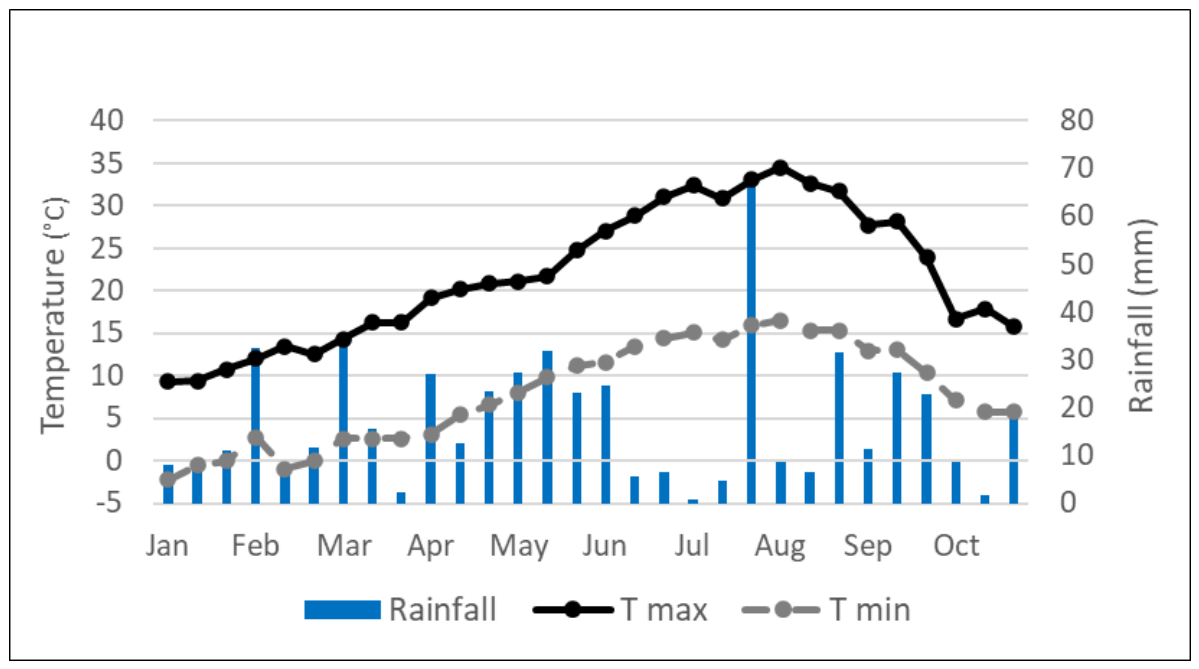
Weather conditions during the whole trial are shown in Figure 1 as averages of the four-year period and shown as ten-day means of rainfall, maximum and minimum temperatures.
The experiment compared six tobacco management systems characterized as follows: (TS1) Tobacco monoculture with standard tillage in spring and autumn, bare soil in autumn–winter, mineral fertilization, and mechanical weed control; (TS2) soil tillage and weed control as in TS1, with biowaste compost amendment integrated with a reduced dose of N-K fertilizers; (TS3) tobacco–green manure rotation with mechanical weed control, standard tillage in spring and autumn, standard mineral fertilization in the first year, followed by green manure integrated with a reduced dose of N–K fertilizers from the second year onward; (TS4) tobacco–green manure rotation with mechanical weed control, standard tillage in spring and autumn, biowaste compost amendment and reduced doses of N-K fertilizers in the first two years, followed by no mineral fertilization in the last years; (TS5) tobacco–cover crop rotation, with standard tillage in autumn, cover crop termination by roller crimper in spring, and minimum tillage to prepare the soil for tobacco transplant, with a reduced dose of N-K fertilizers; (TS6) tobacco–cover crop rotation with soil management as in TS5, combined with a biowaste compost amendment.
The homogeneity of the experimental area was assessed at the beginning of the trial by collecting 16 soil samples according to the design shown in Figure S1. The ANOVA results showed no significant variability among the four transects oriented along the main field axis for the six measured soil parameters (Table S1). On this basis, the six cropping systems were not randomized. This approach allowed for the implementation of the management systems under realistic field conditions while ensuring comparable initial soil characteristics across treatments. Each of the six TSs was assigned an area of approximately 800 m2. Within each area, six 90 m2 plots were established as replicates for sampling tobacco and cover crop biomass.

2.2. Crop Management Systems

This study focused on three consecutive growing seasons of Kentucky tobacco, cv Foiano, starting in 2018. Tobacco was transplanted on 11 June 2018, 12 June 2019, and 10 May 2020, in rows spaced at 1 m × 1 m, and was harvested in September. Plant protection and topping were managed according to the standard practices of the area, while irrigation was carried out by drip lines (spaced 1 m along the rows). Irrigation volumes were based on crop evapotranspiration and distributed in a ratio of 40% in the initial phase and 60% in the maximum development phase. In TS1 the standard mineral fertilization was applied according to the Tuscany regulation for integrated agriculture of Kentucky tobacco. The full fertilization formula was 160-152-172 kg ha−1 N-P-K. One third of total N was distributed before transplanting (as ammonium sulphate, N 21%), along with the whole amount of P2O5 (as triple superphosphate, P 46%) and 80 kg ha−1 K2O (as potassium sulphate, K 50%). The remaining N and K fertilizers (104 kg ha−1 as calcium nitrate, N 15.5%, and 92 kg ha−1 as potassium nitrate, N 13%, K 46%) were distributed by three fertigation after 20, 40 and 60 days from transplanting. In TS2, the amendment with biowaste compost integrated mineral fertilization that was supplied only post-transplant as described in TS1. In TS3, an average amount of 9.4 Mg ha−1 dry weight (d.w.) of hairy vetch (Vicia villosa Roth.) in 2018, and 8.3 and 12 Mg ha−1 d.w. of field bean (Vicia faba L.) in 2019 and 2020, respectively, was integrated with reduced mineral fertilization. In TS4, green manure was combined with biowaste compost and reduced mineral fertilization. In TS5 and TS6, the cover crop mixture was flattened by roller crimper and N-K mineral fertilizers were applied as described in TS1. TS6 was also amended by compost. Soil amendment with biowaste compost was applied annually at the rate of 15 Mg ha−1 as fresh weight (f.w.) from 2017 to 2019, and buried in soil before tobacco transplant in TS1–TS2–TS3–TS4 in spring, while TS5 and TS6 received compost in autumn after the tobacco harvest. This difference in timing reflects the contrasting soil management practices among systems, particularly the reduced soil disturbance and mulch presence in TS5 and TS6. These practices were implemented as part of integrated management systems designed to enhance sustainability, rather than as isolated factors. Table 1 summarized the cover crop sowing rates and dates of sowing and termination in the three years.
In October 2018, field bean substituted hairy vetch. In the last season of the trial, barley was substituted by triticale (×Triticosecale Wittm.) mixed with field bean in a 4:1 ratio. The change in the composition of the mixture was intended to increase the amount of biomass that is more recalcitrant to decomposition on soil after flattening to prolong the mulching action. The flattening of cover crops together with minimum tillage was carried out using in-line tillage and a roller crimper. This machine consists of a sharp vertical disc and a coulter installed in line at the rear of the roller, and its use allows the cover crops to be flattened and, at the same time, a transplanting furrow 0.1–0.2 m deep and a few centimeters wide to be created without disturbing the mulch layer, thus providing the expected agronomic and ecological services (i.e., weed control, soil protection). In 2018 and 2019, an unsatisfying growth of tobacco plantlets was recorded in the transplanting furrows described above. Therefore, in 2020, after the flattening by roller crimper, strip tillage was adopted in a narrow zone of soil, about 0.25–0.30 m wide, which was tilled to control weeds, loosen the soil and prepare the transplanting bed. This adjustment was introduced to improve transplanting conditions while maintaining the overall reduced tillage approach. It partially addressed the observed constraints and represents operational refinement within the same management system, which remained consistent in its overall structure.
The main tillage and the other practices that characterize each integrated management system are shown in Table 2.

2.3. Crop and Weed Sampling

During the tobacco crop cycle, with the aim of describing the growth of the plants in different systems, samplings were effectuated at 25, 57 and 74 days from transplantation in 2018; at 29 and 76 days from transplantation in 2019; and at 30, 46, 66 and 74 days after transplantation in 2020. At each time of sampling, 2 plants of tobacco out of 90 per replicate were chosen in fixed positions before the final harvest of the marketable leaves. The stems and leaves were separated, weighted as fresh matter, and then dried in an oven at 60 °C. The evaluation of the marketable leaves after topping the plants was carried out at the harvest following the same procedure described above.
Regarding the development and control of weed populations, samplings were effectuated at different times each year to assess the influence exerted by conventional tillage management and innovative management based on the coupling of cover crop biomass termination with a roller crimper and minimum tillage along the row of tobacco transplantation. Every sampling campaign was carried out with the same methodology in the three-year period. Three out of six replicates per tobacco system were sampled. In each plot, 4 areas of 0.25 m2 (0.5 × 0.5 m) were selected in fixed positions, 2 along the rows of plot and 2 along the inter-row spaces. This sampling intensity was chosen to balance field-scale feasibility with the need to capture spatial variability within each system through multiple quadrats distributed between row and inter-row positions. Spontaneous plantlets in each sampling area were cut above ground, separated per species, counted and weighted as fresh matter. Subsequently, after drying in oven at 60 °C, dry weight was measured (g 0.25 m−2). Soil cover per species was evaluated visually and richness was calculated as the sum of species found in each quadrat. The times of sampling in 2018 were at 25 and 92 days after transplantation (46 and 113 days from cover crop termination). In 2019, only one round of sampling was conducted, at 29 days after tobacco transplantation (60 days after cover crop termination); successive sampling was not possible due to the heavy damage suffered by the plants from a thunderstorm at the end of July that destroyed tobacco in the cover crop mulch-based systems. The sampling times in 2020 were at 35 and 44 days after transplantation (44 and 60 days after cover crop termination).

2.4. Statistical Analysis

Tobacco plant dry biomass produced in 2018–2020 was analyzed annually by one-way ANOVA, and means were separated by Tukey’s HSD post-hoc test (p = 0.05). Non-metric multidimensional scaling (NMDS, k = 2) was conducted on spontaneous plant species data using Euclidean distance (vegan package), as different samples contained no recorded species (all-zero rows), which leads to undefined values when using Bray–Curtis dissimilarity.
Prior to ordination, the dataset was tested for overdispersion with the dispersion test function. Permutational multivariate analysis of variance (PERMANOVA) was then applied to assess the interaction effects of treatment, including year as a stratum. For the 2020 dataset, the same procedure was applied while omitting the stratum “year”. To examine biomass responses, zero-inflated Tweedie models were fitted. Specifically, we tested the effects of treatment, year, and position, as well as their interactions, on biomass in 2018 and 2019, and the effects of treatment, position, and their interaction in 2020. Species richness data were analyzed using generalized linear models with a Poisson error distribution. Model fit was evaluated with the Kolmogorov–Smirnov, dispersion, and outlier tests (DHARMa package). Post hoc pairwise comparisons of treatment means were performed using Tukey’s test (α = 0.05) with the emmeans package. All statistical analyses were performed in R (version 4.4.1, 2024).

3. Results

3.1. Effects of Farming Practices on Spontaneous Vegetation at the Species Level

The PERMANOVA analysis revealed that the effect of treatments on spontaneous vegetation communities in 2018 and 2019 was highly significant (p < 0.001), followed by the interaction across treatment and position (p < 0.01) and by the position (p < 0.05). However, it accounted for only approximately 6% of the total variance (Table 3). The PERMANOVA of the spontaneous plant dataset compiled in 2020 revealed a very strong effect of treatment and a not significant interaction between treatment and position on species distribution (Table 4), with treatment explaining almost 60% of the total variability.
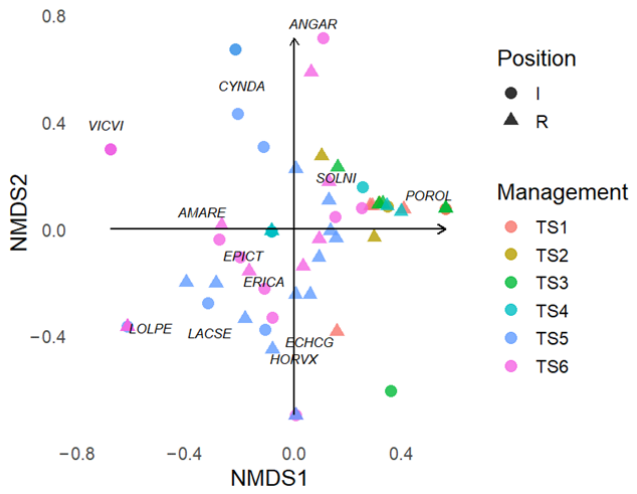
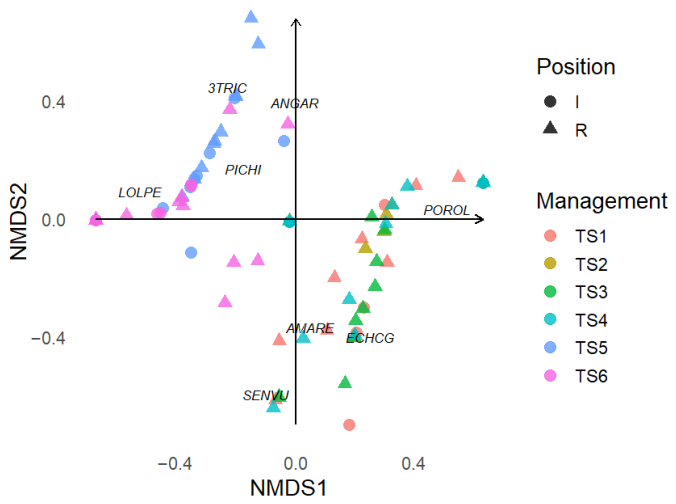
Figure 2 presents the NMDS ordination of species composition under different management systems in 2018 and 2019. A differentiation was observed for the roller-crimper treatments (TS5 and TS6), which clustered separately from the other systems. In both years, these treatments were closely associated with the emergence of new shoots from the previously terminated cover crop (Hordeum vulgare L.; HORVX; V. villosa; VICVI)), as well as with perennial species such as Lolium perenne L. (LOLPE) and Cynodon dactylon L. (CYNDA) and annual species (Lactuca serriola L., LACSE). By contrast, the other management systems supported very low biomass and were primarily characterized by annual species and in particular by Portulaca oleracea L. (POROL). Similar results were observed in 2020 (Figure 3). In particular, a strong effect of the roller-crimper treatments (TS5 and TS6) on species distribution was evident when compared with tillage-based systems (TS1, TS2, TS3 and TS4). Overall, TS5 and TS6 were primarily associated with the presence of L. perenne and the regrowth of the terminated triticale cover crop.

3.2. Effects of Farming Practices on the Biomass and Richness of the Spontaneous Vegetation

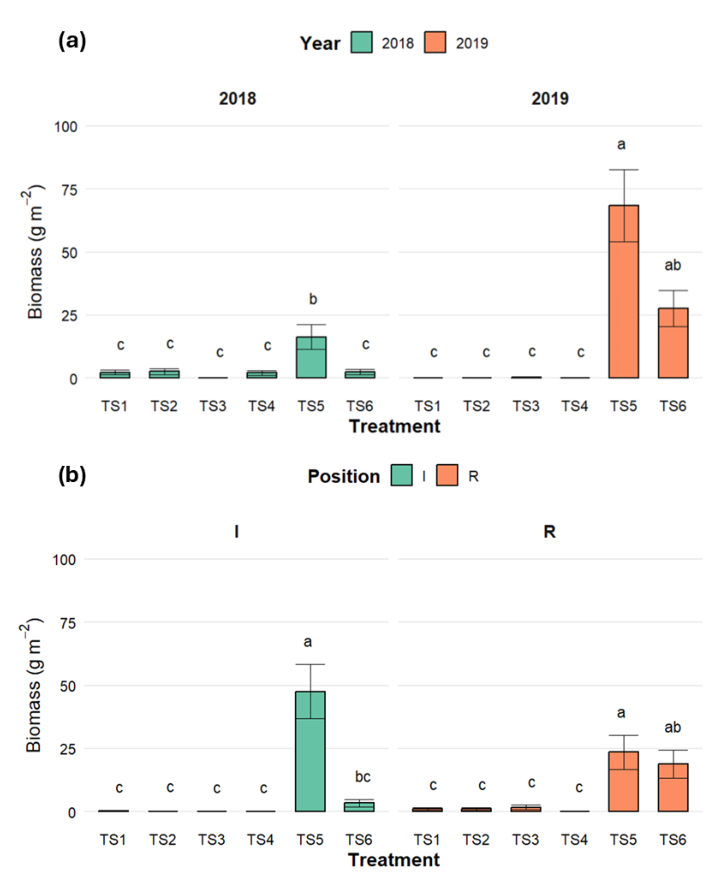
The biomass of spontaneous plants following cover crop termination was significantly affected by the interactions between (i) treatment × year (p ≤ 0.001) and (ii) treatment × position (p ≤ 0.01) (Table 5).
The highest biomass (68.4 g m−2) was recorded under TS5 in 2019, which was almost 2.5 times larger than TS6, although they did not differ significantly (Figure 4a). In contrast, all other treatments in 2019 produced negligible biomass (<0.35 g m−2), with no significant differences among them. Similarly, in 2018, TS5 supported the highest weed biomass, indicating that weed control was not achieved under this management system, while the remaining treatments showed minimal biomass production and did not differ significantly from each other.
The biomass of spontaneous plants also differed between row and inter-row positions across treatments (Figure 4b). In the inter-row, TS5 recorded the highest biomass production, reaching nearly 50 g m−2, although no significant differences were detected between row and inter-row within this treatment. TS6 and TS5 exhibited a biomass 3.5 times higher than TS1, TS2, TS3 and TS4 in the row. In the row position, a different pattern emerged: TS6 and TS5 displayed comparable biomass levels (23.5 and 19.0 g m−2, respectively), with no significant differences between the two systems. All treatments that included tillage, however, produced consistently low biomass, with no significant differences among them.
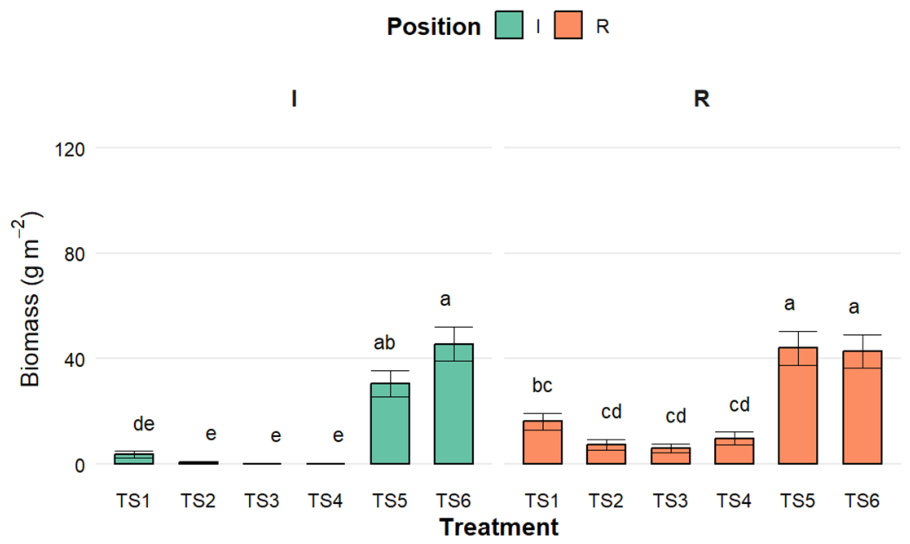
A strong effect (p ≤ 0.001) of all factors included in the analysis—treatment, position, and their interaction—was observed in 2020 with regard to the biomass development of weed (Table 6). Once again, the roller-crimper treatments exhibited the highest biomass in both row and inter-row positions (Figure 5). Among the other systems, TS1 produced slightly higher biomass in both positions, although it did not differ significantly from the other tillage-based treatments.
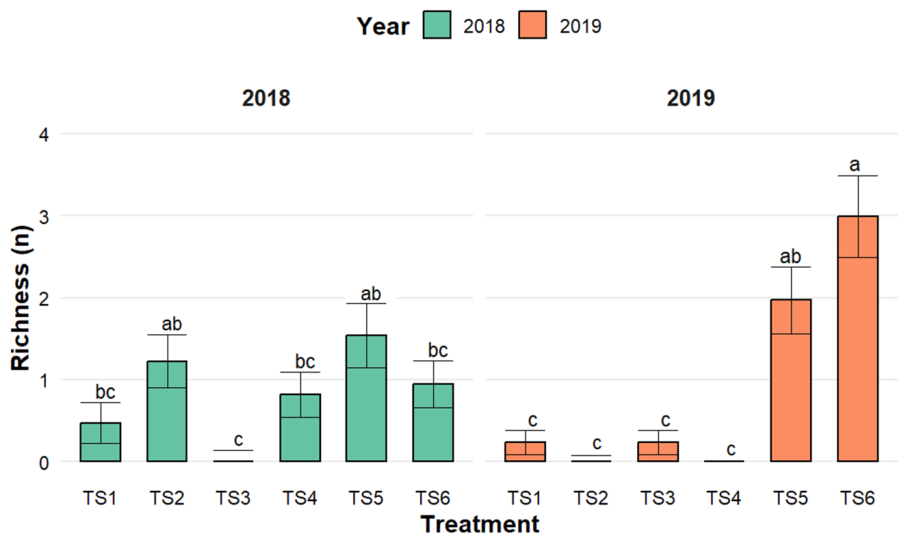
Richness was significantly influenced by POS, YEAR and the interaction across treatment and year in 2018 and 2019 (Table 7).
Overall, a higher number of species was recorded in 2019, particularly in the systems where the roller crimper was used to terminate cover crops (Figure 6). On average, these treatments showed 2.5–3 times higher species richness than the remaining treatments, which produced negligible biomass and did not differ significantly from one another. In contrast, a different pattern was observed in 2018: TS5 (R = 3) and TS2 (R = 2) recorded the highest biomass production, although they did not differ significantly from TS4, TS6, and TS1. TS3 exhibited almost no biomass and was significantly different only from TS2 and TS5.
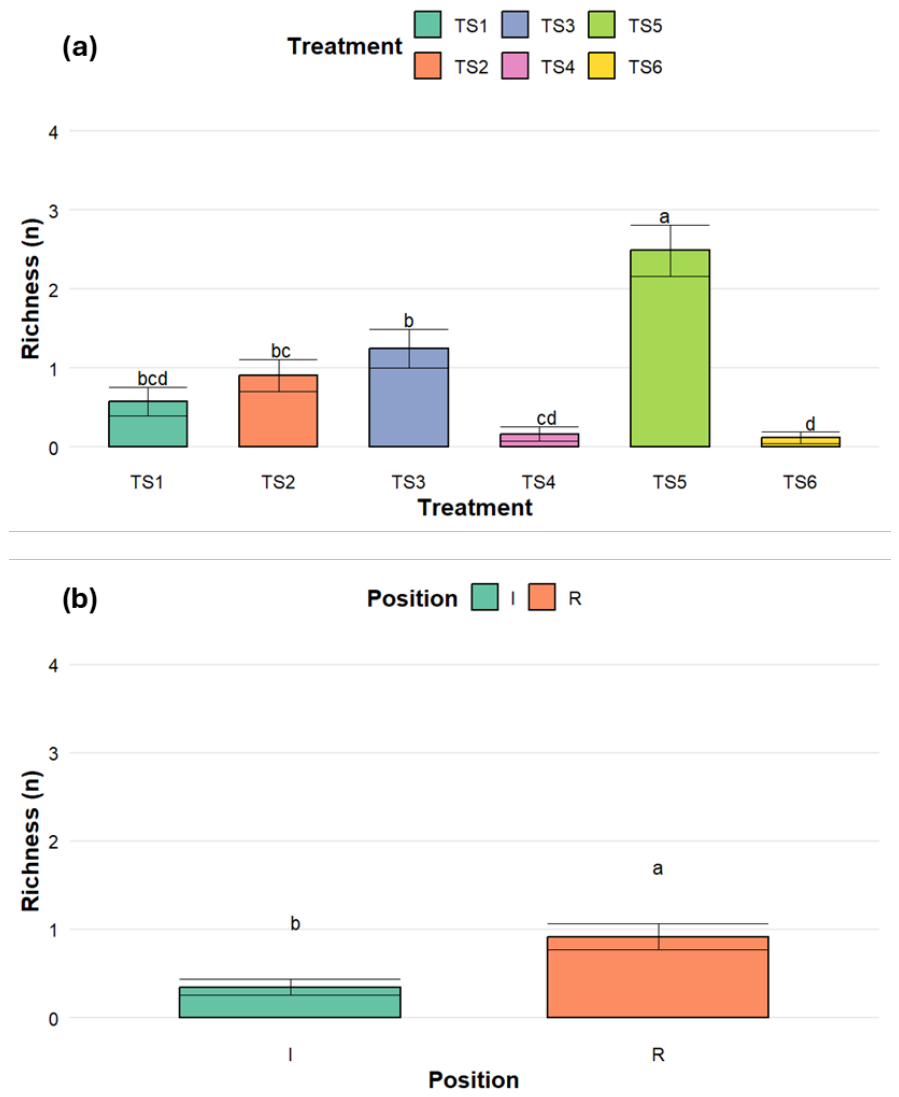
In 2020, species richness was significantly affected by treatment (p ≤ 0.001) and sampling position (p ≤ 0.01), but not by their interaction (Table 8). TS5 exhibited the highest richness (R = 2.5), whereas TS4 and TS6 showed the lowest diversity (Figure 7a). The number of spontaneous species was significantly higher in the rows compared to the inter-rows (Figure 7b).

3.3. Tobacco Growth and Yield

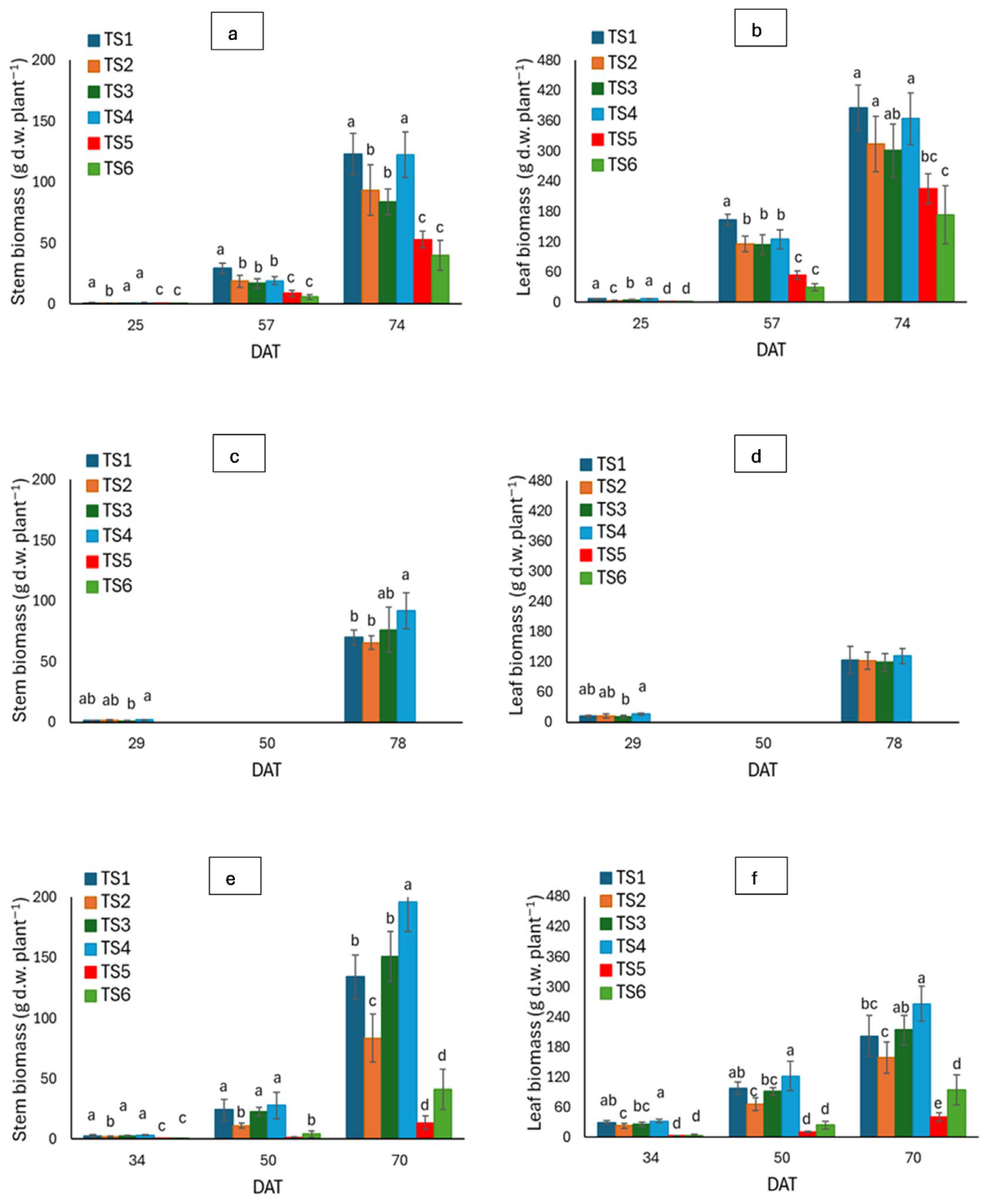
For each growing season, stem and leaf biomass was always significantly reduced in TS5 and TS6 in the whole period of measurements taken during the plant growth cycle (Figure 8). The effect of all the TSs on dry aboveground biomass in the stems, and in the leaves during cropping cycles is shown in Figure 8a,b for 2018, Figure 8c,d for 2019, and Figure 8e,f for 2020. In 2018, during the stem elongation phase, 57 days after transplanting, TS1, showed the highest biomass production for both stems (29.1 g. d.w. plant−1) and leaves (163.3 g. d.w. plant−1) (Figure 8a,b); however, subsequently, once the phenological stage ready for topping was reached, the biomass values of stems (123.1 g. d.w. plant−1) and leaves (386.3 g. d.w. plant−1) in the TS1 system were comparable to those obtained in TS4 (122.4 and 363.9 g. d.w. plant−1 for stem and leaves, respectively) and, with regard to the leaves, also to those of the TS2, TS3, and TS4 systems.
In 2019, the tobacco plants were damaged by a heavy storm in late July (see the mean rainfall in Figure 1): tobacco plants that in TS5 and TS6 had reached a lower stage of development were overrun by the subsequent weed spread, which completely hindered their growth and production, while in plots TS1, TS2, TS3, and TS4, the plants partially recovered from the damage. Consequently, statistical analysis referred only to the treatments that concluded their cycle at harvest. The cross-year comparison of different management systems was not affected by the lack of productive data in TS5 and TS6 in 2019. As a matter of fact, this result pointed out a limitation in the resilience of tobacco plants growing in conservative systems. It is interesting to note, however, that the TS4 system, once it was in the rosette phenological stage (29 DAT), showed stem and leaf biomass comparable to that of TS1 and TS2, and higher than TS3 (Figure 8c,d). At 78 DAT in TS4, the recovery of the plant structure in terms of stems was better than in the other treatments it survived.
In 2020, the cumulative effects of leguminous green manure and compost amendment in TS4 resulted in stem biomass similar to TS1 and TS3 at 34 and 50 DAT. Moreover, TS4 showed a larger leaf biomass than the other systems, especially in the phenological stages of rosette formation and stem elongation. At topping (70 DAT), different from the preceding years, the plants in the TS4 system achieved the highest biomass values for both stems (196 g. d.w. plant−1) and leaves (265 g. d.w. plant−1) compared to TS1 (standard management), TS2 (integration of compost and reduced mineral fertilization) and TS3 (integration of green manure and reduced mineral fertilization) (Figure 8e,f). Despite the adoption of strip tillage instead of in-line tillage to improve the transplanting conditions, plants in TS5 and TS6 continued to show a significant reduction in stem growth (−90% and −70% vs. the average of all other treatments, respectively) and leaf growth (−81% and −55% vs. the average of all other treatments, respectively).
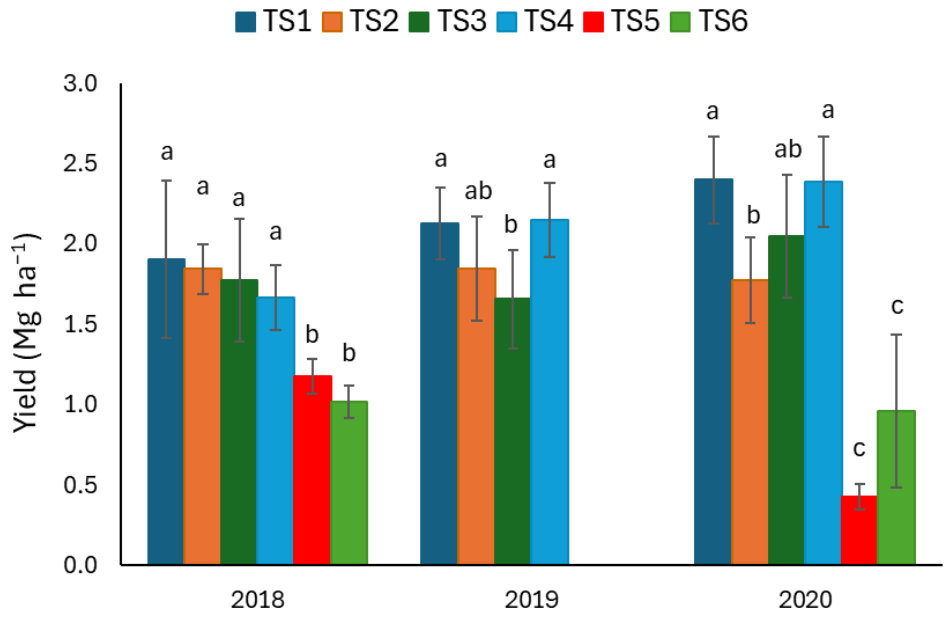
Tobacco yield in terms of marketable leaves (after topping at the leaf-maturity stage) was significantly reduced in the TS5 and TS6 systems for each growing season. In 2018, under TS1, tobacco yield was comparable to those obtained under the TS2, TS3, and TS4 systems. In both 2019 and 2020, the yield under TS4 was comparable to that of the standard TS1 management system (Figure 9).

4. Discussion

Tobacco is cultivated within highly intensive production systems that can maximize yield but also increase negative environmental externalities. Consequently, evaluating innovative and diversified systems capable of balancing crop production with the provision of multiple ecosystem services is of critical importance. In this study, we compared different combinations of sustainable practices and assessed their effects on spontaneous vegetation and tobacco production.

4.1. Effects of Farming Practices on Spontaneous Vegetation

Our results allow us to directly assess the initial hypothesis that cover crops combined with reduced tillage can contribute to weed control. In contrast to this expectation, the systems based on roller crimper and reduced tillage (TS5 and TS6) did not reduce weed pressure and instead promoted a shift toward perennial species.
Our analysis confirmed that different farming practices exerted a significant effect on spontaneous vegetation communities, as also observed by [14]. However, in 2018 and 2019 (when a thunderstorm occurred), the treatment explained only a small portion of the total variance (Table 3). This suggests that spontaneous plant communities were shaped not only by management but also by ecological, edaphic and climatic factors, as well as seed bank conditions [15], with interannual variability often representing a dominant driver of community dynamics, as observed in other agroecological systems [16]. In contrast, a much clearer differentiation among management systems was obtained in 2020, when treatment explained approximately 60% of the variance (Table 4).
Overall, we observed a marked shift in species composition associated with the adoption of roller crimpers and cover cropping (Figure 2 and Figure 3), with different effects in 2018 compared to 2019 and 2020. This pattern confirms the role of management practices as ecological filters shaping weed communities and their functional composition, as widely reported in diversified agroecosystems.
In 2018, the roller crimper appeared to be ineffective in terminating the cover crop, as more than 90% of the biomass under TS5 consisted of V. villosa. Similar constraints, despite partial adjustments in species composition and soil management, were observed in subsequent years, confirming the sensitivity of this technique to local conditions. We observed a weed substitution effect rather than suppression, with regrowth of the cover crops acting as potential competitors with the main crop [16]. This result highlights the technical limitations associated with the roller crimper and the need for specific management skills, including knowledge of the spontaneous plant communities, cover crop traits and operational parameters (e.g., working speed, roller weight) [17]. In particular, both the timing of the intervention and the choice of cover crops were reported to be critical factors determining roller crimper effectiveness [18]. More broadly, the introduction of cover crops and their termination through a roller crimper can act as a strong selective pressure on weed communities, influencing both species composition and functional traits through mulch-mediated effects and reduced soil disturbance [19]. A different scenario was observed in 2019 and 2020. Under conventional tillage, weed communities were dominated by annual species. In contrast, reduced tillage combined with cover crop flattening promoted the prevalence of perennial grasses, mainly L. perenne and C. dactylon (Figure 4a and Figure 5). This pattern suggests a filtering effect of farm management, with tillage favoring ruderal annual plants and conservation practices promoting perennial species [20]. In this context, the combination of reduced tillage and cover crop mulching may contribute to the selection of perennial grasses, which can represent problematic species for crop management due to their persistence and competitive ability. Overall, this result further supports the rejection of the initial hypothesis under the conditions tested.
Several mechanisms may explain these shifts. First, reduced tillage has often limited suppressive effects on perennial grasses, as stolons and rhizomes can remain intact and be not buried deeply enough to prevent regrowth [21]. Second, roller crimper effectiveness depends strongly on the phenological stage of the cover crop, with optimal termination typically occurring between anthesis and flowering [22]. Third, the mulch derived from cover crop residues alters light availability and soil microclimatic conditions, thereby influencing weed germination dynamics. Mulching is generally more effective at suppressing small-seeded annual weeds [23], whereas perennial grasses are better adapted to tolerate reduced light levels and increased soil moisture.
Management systems without cover crops and relying on mechanical termination supported low weed biomass and were dominated by annual species, particularly P. oleracea, which is well adapted to disturbed environments. Tillage, especially inversion tillage, is generally expected to reduce the germination of P. oleracea through seed burial [24], while surface mulching suppresses emergence by limiting light availability. In our case, the relatively shallow non-inversion tillage (20 cm disc harrowing) may not have been sufficient to effectively bury seeds below their maximum emergence depth, thereby maintaining a large proportion of the seed bank under conditions favorable for germination. In contrast, the roller-crimper treatment likely exerted a stronger suppression through a dense mulch layer. This reduced light penetration and created a physical barrier that inhibited the germination of small-seeded, light-sensitive species such as P. oleracea [25].
Although species richness remained relatively low across all systems, higher values were observed in treatments that included the roller crimper (Figure 6 and Figure 7a,b). These results suggested that conservation practices combining a roller crimper and cover cropping may enhance the biodiversity value of intensive tobacco production systems. Moreover, such practices may improve the provision of multiple ecosystem services, including soil erosion control, nutrient cycling, and water retention [11,26].
In summary, disturbance tends to select for fast-colonizing annual species, whereas reduced disturbance intensity favors perennial species [27]. Over time, both trajectories may lead to the specialization of spontaneous plant communities and their functional traits, with distinct agronomic and environmental consequences. Within this context, managing spontaneous vegetation emerges as a complex challenge that requires agroecological knowledge to assess community status and to select appropriate management practices that balance biodiversity conservation with crop production. Despite being technically demanding, alternating different weed management strategies may help to prevent community specialization, mitigate negative effects on crops and enhance biodiversity at the farm scale [28,29], while avoiding the long-term selection of competitive, service-disrupting weed communities [20].
Finally, no significant effects of compost application on spontaneous plant communities were detected. Compost may therefore appear to be a valuable strategy for recycling organic matter and improving soil health without increasing weed pressure, thereby contributing to the overall sustainability of tobacco production systems [30].

4.2. Tobacco Growth and Yield

Plants in TS5 and TS6 achieved the lowest yield of tobacco with respect to the other tobacco systems, pointing out that the agronomic conditions implemented by cover crop mulching combined with minimum tillage were detrimental for crop growth. Ellis et al. [12] obtained a good stand of Burley and dark fire-cured tobacco that developed on wheat cover crop residues treated by herbicides in a non-till system, but the yields were reduced with respect to conventional tillage. Machanoff et al. [11], in flue-cured tobacco farms of North Carolina (USA), assessed minimum tillage in soil mulched by overwintered cereal rye (Secale cereale L.) cover crop terminated via roller crimper. Cover crop residue reduced weed density and biomass compared with conventional tillage treatments, and tobacco yields were higher but vulnerable to extreme rain events due to the exclusion of in-season cultivation. In particular, we suppose that the combination of four reasons could have contributed to these difficulties: (a) the suboptimal soil temperatures under 10 °C persisting up to June in the cultivation site (Kentucky requires at least 12–14 °C after transplanting) (Figure 1); (b) the concomitant, reduced soil heating caused by mulching cover crop residues, which could have delayed the heating of the soil; (c) the need for transplanted tobacco seedlings to have good root-to-soil contact for vigorous early-season growth, which is important for achieving a uniform crop—in this regard, in-line tillage with a roller crimper or strip tillage left the soil with a coarse structure unsuitable for good rooting of tobacco seedlings; and (d) as a consequence of the preceding reasons, the slow growth of tobacco plants in the first 7–8 weeks of the cycle makes the strong competition from weeds more harmful in conservative treatments.
In TS4, compost amendment and burial of legume–green manure repeated for three years determined tobacco development and led to a yield similar to or higher than what was measured in TS1, particularly in the last two years (2019 and 2020), when N-K fertilizers were no longer applied after reduced N rates were supplied in the first two tobacco crop cycles (2017 and 2018). Recent papers largely support our results. Liang et al. [31] suggested that green manuring (smooth vetch or ryegrass or radish) in rotation with tobacco promoted an optimized soil environment characterized by efficient nutrient cycling and diminished pathogenicity. Green manuring increased the soil microbial biomass at different stages compared with fallow. The positive effect of green manure on the soil microbiome was probably due to enhanced C and N inputs from green manure growth and decomposition. Changes in soil microbial composition were reflected in the production of enzymes that target different nutrient resources. Huang et al. [32] found that the optimal combinations of 67 kg N ha−1 as fertilizer to tobacco and hairy vetch green manures contributed to high tobacco yield and better quality. The leguminous green manure showed a stronger ability to improve residue N transfer, N uptake and growth of tobacco compared to cruciferous (radish) and gramineous (barley and ryegrass) crops. These results supplied an important guide for tobacco green development in Southwest China by optimizing green manure–tobacco rotations and N rates. In our case, however, in TS3, legume green manure alone integrated with reduced doses of N and K never produced effects higher than in TS1 or TS4. It is plausible that in a soil very depleted of organic C, the activity of microbial communities is more prolonged and efficient thanks to the combination of mature compost, which brings relatively stabilized C to the soil, and green manure, which contributes to bringing easily degradable C and activating the nutrient cycling driven by the microbial community [33].

5. Conclusions

The hypothesis that cover crops combined with reduced tillage can effectively control weeds while maintaining tobacco growth and yield was not supported under the conditions of this study. The interaction among these practices appeared to create constraints for crop development, likely due to increased competition for resources and altered soil conditions. At the same time, these systems exerted a selective or “filtering” effect on weed communities, shaping their composition and structure.
These findings contribute to a deeper understanding of weed dynamics in tobacco production systems, highlighting how management practices can actively influence the trajectory of spontaneous vegetation. In particular, they demonstrate that weed communities are not merely a passive outcome of environmental conditions, but can be directed through agronomic choices toward specific objectives, such as maximizing crop productivity, improving soil health and/or enhancing on-farm biodiversity.
In the TS5 and TS6 systems, a higher diversity of spontaneous plant species was observed compared to conventional mechanical tillage. However, this increase in biodiversity was accompanied by a marked predominance of perennial species, which may pose challenges for crop management due to their persistence and competitive ability. This suggests that while conservation-oriented practices can promote ecological complexity, they may also require additional strategies to prevent the establishment of difficult-to-control weed communities. For this reason, it would be advisable to adopt a more flexible and integrated approach to weed management, alternating different control strategies over time. Such diversification could help prevent the specialization of weed communities, reduce the risk of dominance by problematic species, and mitigate negative impacts on crop performance, while still supporting biodiversity at the farm scale.
Finally, further research is needed to optimize the use of mulching and minimal tillage techniques in tobacco systems. In particular, future studies should focus on improving their effectiveness in suppressing spontaneous vegetation to levels that do not compromise crop growth, while maintaining the ecological benefits associated with reduced soil disturbance.

Supplementary Materials

The following supporting information can be downloaded at: https://www.mdpi.com/article/10.3390/agronomy16100989/s1, Figure S1: Experimental design and distribution of chemical–physical soil parameters (in brackets, standard deviation n = 2) of the field trial carried out at Cesa (AR) from 2017 to 2020. Numbers 1 to 6 indicate the replicated plots; Table S1: Means and related standard deviation (n = 16), Anova or Deviance table according to normal or gamma logarithmic distribution of data sets of six soil parameters measured in 16 sampling points of the field trial.

Author Contributions

Conceptualization, L.M.; methodology, L.M., E.C., M.Q. and T.E.; software, D.W.R. and L.d.P.; validation, D.W.R., L.d.P., L.M. and C.C.; formal analysis, D.W.R. and L.d.P.; investigation, E.C., M.Q., T.E. and L.M.; data curation, L.M., L.d.P. and D.W.R.; writing—original draft preparation, L.M., D.W.R., C.C. and L.d.P.; writing—review and editing, L.M., D.W.R., C.C. and L.d.P.; supervision, L.M.; funding acquisition, L.M. All authors have read and agreed to the published version of the manuscript.

Funding

The research received funding for the years 2017–2018 from the Italian Ministry for Agriculture under Grant Agreement No. 0096733, 28 December 2016. The continuance of the research in 2019–2020 was funded under an agreement with the private stakeholder Manifatture Sigaro Toscano SpA signed on 7 January 2019.

Data Availability Statement

The datasets analyzed during the current study are available from the corresponding author on reasonable request.

Acknowledgments

We thankfully acknowledge the experimental farm ‘Terre regionali Toscane’ in Marciano della Chiana (AR), Luigi Fabbrini, for the friendly welcome and providing the field, the workers and laboratory facilities for conducting the field trial.

Conflicts of Interest

The authors declare no conflicts of interest.

References

  1. HLPE. Agroecological and Other Innovative Approaches for Sustainable Agriculture and Food CS That Enhance Food Security and Nutrition. A Report by the High Level Panel of Experts on Food Security and Nutrition of the Committee on World Food Security, Rome. 2019. Available online: http://www.fao.org/3/ca5602en/ca5602en.pdf (accessed on 24 November 2024).
  2. Wang, C.; Ning, P.; Li, Y.; Wei, X.; Ge, T.; Cui, X.; Deng, X.; Jiang, Y.; Shen, W. Responses of soil microbial community composition and enzyme activities to long-term organic amendments in a continuous tobacco cropping system. Appl. Soil Ecol. 2022, 169, 104210. [Google Scholar] [CrossRef]
  3. Zhang, X.; Song, Y.; Yang, X.; Hu, C.; Wang, K. Regulation of soil enzyme activity and bacterial communities by food waste compost application during field tobacco cultivation cycle. Appl. Soil Ecol. 2023, 192, 105016. [Google Scholar] [CrossRef]
  4. Jin, X.; Yang, X.; Peng, S.; Ma, E.; Zhang, H.; Lin, X.; Wang, Y.; Li, Y. Cropping rotation improved the bacterial diversity and N-cycling genes in tobacco fields through a 19-year long-term experiment. Appl. Soil Ecol. 2024, 193, 105165. [Google Scholar] [CrossRef]
  5. ISPRA. Rapporto rifiuti urbani. Edizione 2025. In Rapporti 419/2025; ISPRA: Rome, Italy, 2025; pp. 78–115. [Google Scholar]
  6. Morra, L. Role of compost in the organic amendment of vegetable crops. Italus Hort. 2019, 26, 27–39. [Google Scholar] [CrossRef]
  7. Amlinger, F.; Peyr, S.; Geszti, J.; Dreher, P.; Nortcliff, S. Beneficial effects of compost application on fertility and productivity of soils. In Literature Study; Federal Ministry for Agriculture and Forestry, Environment and Water Management of Austria: Vienna, Austria, 2007; pp. 32–42. [Google Scholar]
  8. Oerke, E.C. Crop losses to pests. J. Agric. Sci. 2006, 144, 31–43. [Google Scholar] [CrossRef]
  9. Ciaccia, C.; Lakkenborg Kristensen, H.; Campanelli, G.; Xie, Y.; Testani, E.; Leteo, F.; Canali, S. Living mulch for weed management in organic vegetable cropping systems under Mediterranean and North European Conditions. Renew. Agric. Food Syst. 2016, 32, 248–262. [Google Scholar] [CrossRef]
  10. Dang, Y.P.; Dalal, R.C.; Menzies, N.W. No-Till Farming Systems for Sustainable Agriculture. Challenges and Opportunities; Springer Nature: Cham, Switzerland, 2020. [Google Scholar] [CrossRef]
  11. Machanoff, C.H.; Venn, M.C.; Woodley, A.L.; Suchoff, D. Evaluation of conservation tillage practices in the production of organic flue-cured tobacco. Agrosyst. Geosci. Environ. 2022, 5, e20317. [Google Scholar] [CrossRef]
  12. Ellis, R.L.; Morgan, G.D.; Rhodes, G.N., Jr.; Mueller, T.C. Cover crop management in no-till tobacco. Tob. Sci. 2001, 45, 44–48. [Google Scholar] [CrossRef]
  13. Haramoto, E.R.; Lowry, C.J.; Pearce, R. Cover crops are not affected by tobacco soil residual herbicides but also do not provide consistent weed management benefits. Weed Technol. 2019, 34, 383–393. [Google Scholar] [CrossRef]
  14. Bàrberi, P.; Carlesi, S.; Leoni, F. Weed management in organic Conservation Agriculture systems. In Weed Management in Conservation Agriculture Systems; Basch, G., González-Sánchez, E., Geraghty, J., Eslami, S.V., Duiker, S.W., Mkomwa, S., Bartz, M., Eds.; Burleigh Dodds Series in Agricultural Science; Burleigh Dodds Science Publishing: Cambridge, UK, 2025; Volume 160, pp. 237–267. [Google Scholar] [CrossRef]
  15. Fried, G.; Norton, L.R.; Reboud, X. Environmental and management factors determining weed species composition and diversity in France. Agric. Ecosyst. Environ. 2008, 128, 68–76. [Google Scholar] [CrossRef]
  16. Smith, R.G.; Lounsbury, N.P.; Palmer, S.A. Mechanisms of weed suppression by cover crops, intercrops, and mulches. In Ecologically-Based Weed Management: Concepts, Challenges, and Limitations; Korres, N.E., Travlos, I.S., Gitsopoulos, T.K., Eds.; John Wiley & Sons, Inc.: Hoboken, NJ, USA, 2023; pp. 172–195. [Google Scholar] [CrossRef]
  17. Kumar, V.; Singh, V.; Flessner, M.L.; Haymaker, J.; Reiter, M.S.; Mirsky, S.B. Cover crop termination options and application of remote sensing for evaluating termination efficiency. PLoS ONE 2023, 18, e0284529. [Google Scholar] [CrossRef]
  18. Mirsky, S.B.; Curran, W.S.; Mortenseny, D.M.; Ryany, M.R.; Shumway, D.L. Timing of Cover-Crop Management Effects on Weed Suppression in No-Till Planted Soybean using a Roller-Crimper. Weed Sci. 2011, 59, 380–389. [Google Scholar] [CrossRef]
  19. Ciaccia, C.; Armengot Martinez, L.; Testani, E.; Leteo, F.; Campanelli, G.; Trinchera, A. Weed functional diversity as affected by agroecological service crops and no-till in a mediterranean Organic vegetable system. Plants 2020, 9, 689. [Google Scholar] [CrossRef] [PubMed]
  20. Gaba, S.; Perronne, R.; Fried, G.; Gardarin, A.; Bretagnolle, F.; Biju-Duval, L.; Colbach, N.; Cordeau, S.; Fernández-Aparicio, M.; Gauvrit, C.; et al. Response and effect traits of arable weeds in agro-ecosystems: A review of current knowledge. Weed Res. 2017, 57, 123–147. [Google Scholar] [CrossRef]
  21. Armengot, L.; Berner, A.; Blanco-Moreno, J.M.; Mäder, P.; Sans, F.X. Long-term feasibility of reduced tillage in organic farming. Agron. Sustain. Dev. 2015, 35, 339–346. [Google Scholar] [CrossRef]
  22. Miville, D.; Leroux, G.D. Rolled Winter Rye–Hairy Vetch Cover Crops for Weed Control in No-till Pumpkin. Weed Technol. 2018, 32, 251–259. [Google Scholar] [CrossRef]
  23. Vincent-Caboud, L.; Casagrande, M.; David, C.; Ryan, M.R.; Silva, E.M.; Peigne, J. Using mulch from cover crops to facilitate organic no-till soybean and maize production. A review. Agron. Sustain. Dev. 2019, 39, 45. [Google Scholar] [CrossRef]
  24. Carrascosa, A.; Pascual, J.A.; Ros, M.; Petropoulos, S.A.; Alguacil, M.d.M. Agronomical Practices and Management for Commercial Cultivation of Portulaca oleracea as a Crop: A Review. Plants 2023, 12, 1246. [Google Scholar] [CrossRef]
  25. Chauhan, B.S.; Johnson, D.E. Seed germination ecology of Portulaca oleracea L.: An important weed of rice and upland crops. Ann. Appl. Biol. 2009, 155, 61–69. [Google Scholar] [CrossRef]
  26. Zou, C.; Pearce, R.C.; Grove, J.H.; Coyne, M.S. Conservation Practices in Tobacco Production Increase Large Aggregates and Associated Carbon and Nitrogen. Soil Sci. Soc. Am. J. 2015, 79, 1760–1770. [Google Scholar] [CrossRef]
  27. Armengot, L.; Blanco-Moreno, J.M.; Barberi, P.; Bocci, G.; Carlesi, S.; Aendekerk, R.; Berner, A.; Celette, F.; Grosse, M.; Huiting, H.; et al. Tillage as a driver of change in weed communities: A functional perspective. Agri. Ecosyst. Environ. 2016, 222, 276–285. [Google Scholar] [CrossRef]
  28. Warren Raffa, D.; Virili, A.; Carlesi, S.; Antichi, D.; Barberi, P. Soil management shapes the functional diversity of the inter-row vegetation in Mediterranean vineyards. Agron. Sustain. Dev. 2025, 45, 46. [Google Scholar] [CrossRef]
  29. Birthisel, S.K.; Clements, R.S.; Gallandt, E.R. Review: Ow will climate change impact the ‘many little hammers’ of ecological weed management? Weed Res. 2021, 61, 327–341. [Google Scholar] [CrossRef]
  30. Sifola, M.I.; Cozzolino, E.; Todisco, D.; Palladino, M.; Sicignano, M.; del Piano, L. Organic Fraction Municipal Solid Waste Compost and Horse Bean Green Manure Improve Sustainability of a Top-Quality Tobacco Cropping System: The Beneficial Effects on Soil and Plants. Sustainability 2024, 16, 6466. [Google Scholar] [CrossRef]
  31. Liang, H.; Li, S.; Zhou, G.; Fu, L.; Hu, F.; Gao, S.; Cao, W. Targeted regulation of the microbiome by green manuring to promote tobacco growth. Biol. Fertil. Soils 2024, 60, 69–85. [Google Scholar] [CrossRef]
  32. Huang, W.; Xu, Z.; Zheng, Y.; Lang, P.; Zou, Y.; Shen, S.; Olesen, J.E.; Rees, R.M.; Topp, C.F.E.; Harrison, M.T.; et al. Leguminous green manure reduced N inputs and increased yield, quality and N use efficiency of the subsequent tobacco. Ind. Crops Prod. 2025, 237, 122256. [Google Scholar] [CrossRef]
  33. White, K.E.; Brennan, E.B.; Cavigelli, M.A.; Smith, R.F. Winter cover crops increase readily decomposable soil carbon, but compost drives total soil carbon during eight years of intensive, organic vegetable production in California. PLoS ONE 2020, 15, e0228677, Correction in PLoS ONE 2020, 19, e0307250. https://doi.org/10.1371/journal.pone.0307250. [Google Scholar] [CrossRef]
Figure 1. Mean ten days of rainfall, maximum and minimum temperatures recorded in 2017–2020 and shown as averages of the whole period.
Agronomy 16 00989 g001
Figure 2. NMDS of spontaneous plant species found in the rows and inter-rows in 2018 and 2019 across management and position. I = inter-row; R = row. Plant abbreviations: VICIVI: Vicia villosa Roth.; CYNDA: Cynodon dactylon L.; AMARE: Amaranthus retroflexus L.; ANGAR: Anagallis arvensis L.; SOLNI: Solanum nigrum L.; POROL: Portulaca oleracea L.; EPICT: Epilobium ciliatum L.; ERICA: Erigeron canadensis L.; LOLPE: Lolium perenne L.; LACSE: Lactuca serriola L.; HORVX: Hordeum vulgare L.; ECHCG: Echinocloa crus-galli (L.) P.Beauv.
Agronomy 16 00989 g002
Figure 3. NMDS of spontaneous plant species found in the rows and inter-rows in 2020 across management and position. I = inter-row; R = row. Plant abbreviations: AMARE: Amaranthus retroflexus L.; ANGAR: Anagallis arvensis L.; SENVU: Senecio vulgaris L.; POROL: Portulaca oleracea L.; PICHI: Picris hieracioides L.; 3TRIC: × Triticosecale Wittm.; LOLPE: Lolium perenne L.; ECHCG: Echinocloa crus-galli (L.) P.Beauv.
Agronomy 16 00989 g003
Figure 4. Biomass (g m−2) across the six systems in 2018 and 2019 (a) and in rows and inter-rows (b). Treatments indicated by different letters are significantly different at p < 0.05 (Tukey test). Bars denote standard errors of the mean.
Agronomy 16 00989 g004
Figure 5. Biomass (g m−2) across the six systems in 2020 in rows and inter-rows. Treatments indicated by different letters are significantly different at p < 0.05 (Tukey test). Bars denote standard errors of the mean.
Agronomy 16 00989 g005
Figure 6. Richness (n) of spontaneous plants across the six systems in 2018 and 2019. Treatments indicated by different letters are significantly different at p < 0.05 (Tukey test). Bars denote standard errors of the mean.
Agronomy 16 00989 g006
Figure 7. Richness (n) of spontaneous plant in 2020 across (a) the six treatments in 2020 (b) in rows and inter-rows. Treatments indicated by different letters are significantly different at p < 0.05 (Tukey test). Bars denote standard errors of the mean.
Agronomy 16 00989 g007
Figure 8. The effect of tobacco management system (TS) on stems (on the left), and leaves (on the right), dry aboveground biomass during cropping cycles in 2018 (a,b), 2019 (c,d) and 2020 (e,f). In each year, per each DAT, different letters indicate means significantly different to the Tukey’s HSD test (p = 0.05); in 2019, at 50 DAT missing data (TS5 and TS6) are due to the tobacco plants destruction following a summer thunderstorm. DAT (days after transplanting), d.w. (dry weight).
Agronomy 16 00989 g008
Figure 9. The effect of the tobacco management system (TS) on yield (Mg ha−1) in the 2018, 2019 and 2020 growing season. (For each year, different letters indicate means significantly different to the Tukey’s HSD Test (p = 0.05); missing data in TS5 and TS6 in 2019 are due to the tobacco plant’s destruction following a summer thunderstorm at 50 DAT).
Agronomy 16 00989 g009
Table 1. Cover crop species sowed, rate of sowing and dates of termination.
YearsCover CropsRate of Sowing
(kg ha−1)
Sowing Date of Burying/Flattening
2017–2018V. villosa I
V. villosa-Hordeum disticum L. II
100
65–100
30 October 20176 June 2018
May–June in 2 passages
2018–2019V. faba III
V. faba—H. disticum
320
160–100
26 October 20188 May 2019
8–17 May in 3 passages
2019–2020V. faba
V. faba—Triticale IV
270
55–220
17 October 20198 April 2020
27 April–4 May 2020
I cv Villana; II cv Quench; III cv Scuro di Torre Lama; IV cv Oxygen.
Table 2. Mechanical operations carried out annually in the different cropping systems (x sign indicates when and where an operation was executed). Fallow was practiced for TS1 and 2, green manure was practiced for TS3 and 4, and cover crop mulching was practiced for TS5 and 6.
Main Field OperationsAimsMonthKind of Management
FallowGreen ManureCover Crop-Based Mulch
Shredding of tobacco crop residuesClose the cycle of tobacco Octxxx
Shredding of cover crop mulch and weed residuesClose the cycle of tobacco Oct x
Compost distributionSoil amendmentOct x
Chisel plowing to 40 cm depth and successive disc harrowing to 20 cm depthReduce soil compaction, break up clods and bury plant residueOctxxx
Seeding of cover cropsRotation with
tobacco
Oct-Nov xx
Shredding of green manure biomassBiomass dryingApr-May x
Roller crimper termination of cereal–legume cover cropsBiomass flattening to form a dead mulchMay x
Compost distributionSoil amendmentMayxx
Disc harrowing and rotary vertical tine harrowingCompost and plant residue burial, soil preparationMayxx
Minimum tillage (inline tillage or strip tillage)Reduced soil tillageMay x
Tobacco transplantStart the cycle of tobaccoJunxxx
Weed control during
tobacco cycle
Hand hoe and rototillingJun to Sepxx
MowingJun to Sep x
Table 3. Results of the PERMANOVA applied to the spontaneous weed species dataset for 2018 and 2019.
DfSum of SquaresR2FPr(>F)
TREAT5834.60.060031.81230.001 ***
POS1158.70.014481.72300.030 *
TREAT × POS5675.00.048821.46570.01 **
Residual13212,158.00.87934
Total14313,826.31.000
*** Significant at p ≤ 0.001. ** Significant at p ≤ 0.01. * Significant at p ≤ 0.05. TREAT: tobacco system management; POS: position along the row and inter-row.
Table 4. Results of the PERMANOVA applied to the spontaneous species dataset for 2020.
DfSum of SquaresR2FPr(>F)
TREAT52668.10.552734.92560.001 ***
POS152.60.01093.44440.048 *
TREAT × POS589.90.018621.17690.335 ns
Residual1322106.80.41778
Total1434827.51.000
*** Significant at p ≤ 0.001; * significant at p ≤ 0.05; ns: not significant. TREAT: tobacco system management; POS: position along the row and inter-row.
Table 5. Analysis of variance (type = 3) for biomass in 2018 and 2019.
FactorsLR ChisqDfPr(>Chisq)Sign
TREAT34.13350.632ns
YEAR16.76810.195ns
POS0.000910.975ns
TREAT:YEAR312.9055<0.001***
TREAT:POS163.9795<0.005**
YEAR:POS16.12810.204ns
TREAT:YEAR:POS71.28650.211ns
** Significant at p ≤ 0.01; *** significant at p ≤ 0.001; ns: not significant. TREAT: tobacco system management; POS: position along the row and inter-row.
Table 6. Analysis of variance (type = 3) for biomass in 2020.
ChisqDfPr(>Chisq)Sign
(Intercept)46.8181<0.001***
TREAT94.4275<0.001***
POS14.3491<0.001***
TREAT:POS36.0225<0.001***
*** Significant at p ≤ 0.001; TREAT: tobacco system management; POS: position along the row and inter-row.
Table 7. Analysis of variance (type = 3) for species richness in 2018 and 2019.
LR ChisqDfPr(>Chisq)Sign
TREAT57.96350.326ns
POS61.9771<0.01**
YEAR38.5491<0.05*
TREAT:POS78.27150.166ns
TREAT:YEAR247.7785<0.001***
POS:YEAR0.715410.397ns
TREAT:POS:YEAR53.27150.377ns
* Significant at p ≤ 0.05; ** significant at p ≤ 0.01;. *** significant at p ≤ 0.001; ns: not significant. TREAT: tobacco system management; POS: position along the row and inter-row.
Table 8. Analysis of variance (type = 3) for richness in 2020.
LR ChisqDfPr(>Chisq)Sign
TREAT50.7365<0.001***
POS9.7651<0.001***
TREAT:POS7.87650.163ns
*** significant at p ≤ 0.001; ns: not significant. TREAT: tobacco system management; POS: position along the row and inter-row.
Disclaimer/Publisher’s Note: The statements, opinions and data contained in all publications are solely those of the individual author(s) and contributor(s) and not of MDPI and/or the editor(s). MDPI and/or the editor(s) disclaim responsibility for any injury to people or property resulting from any ideas, methods, instructions or products referred to in the content.