1. Introduction
Maize (
Zea mays L.) is one of the most important food, feed, and industrial raw materials globally and in China, playing an irreplaceable key role in ensuring national food security and agricultural macro-control [
1]. However, under the dual impacts of global climate change and land degradation, soil salinization has become the primary abiotic stress factor restricting agricultural production in arid and semi-arid regions [
2,
3]. In saline–alkali environments, high concentrations of soluble salts not only induce osmotic stress and limit root water uptake but also disrupt crop nutrient balance through ionic toxicity, leading to reduced photosynthetic efficiency, inhibited biomass accumulation, and ultimately yield loss in maize [
4]. Scientific fertilizer management is a critical strategy for improving the physicochemical properties of saline–alkali soils, alleviating salinization pressure, and sustaining crop growth. Previous studies have confirmed that rational fertilizer formulations can significantly enhance maize saline–alkali tolerance by regulating soil pH and improving nutrient availability [
5]. Different types of fertilizers (e.g., controlled-release fertilizers, special compound fertilizers) exhibit substantial differences in nutrient release rates and soil salinity-alkalinity regulation [
6]. Therefore, accurately assessing the dynamic effects of various fertilizer formulations on maize growth in saline–alkali soils represents an important direction for achieving sustainable agricultural development and improving fertilizer use efficiency.
Traditional monitoring of crop growth and fertilizer efficacy relies mainly on field destructive sampling and physicochemical analysis. Although this method yields accurate single-point data, it is time-consuming, labor-intensive, and costly. Moreover, it is difficult to capture the spatiotemporal dynamics of crops over large areas and cannot support cross-growth-stage comparative evaluation of fertilizer efficacy [
7,
8]. With the rapid development of remote sensing technology, unmanned aerial vehicle (UAV) platforms have become a research hotspot in precision agriculture due to their advantages of high spatiotemporal resolution, low cost, and non-destructive monitoring [
9]. Researchers have constructed a series of vegetation indices (VIs) by extracting canopy spectral reflectance, among which the Normalized Difference Vegetation Index (NDVI) and Soil-Adjusted Vegetation Index (SAVI) have been widely used for the quantitative assessment of crop leaf area index (LAI), plant height, and yield, achieving satisfactory inversion performance [
10,
11,
12]. Nevertheless, single spectral features are prone to spectral saturation during the vigorous crop growth period, resulting in a significant decrease in inversion accuracy at high biomass stages, a problem that is more pronounced under high-stress saline–alkali conditions. To overcome this bottleneck, spatial structural information such as texture features has been gradually incorporated into models. For example, Chen et al. (2024) fused spectral and texture features from UAV multispectral data and constructed a soil moisture inversion model, achieving a higher R
2 value than a model based solely on spectral features [
13]. Li et al. (2020) also confirmed that fused features can more effectively capture canopy spatial heterogeneity and significantly improve model stability and generalization ability in complex environments [
14].
Despite considerable progress in UAV remote sensing-based crop monitoring, existing literature still presents significant limitations in applications to saline–alkali soil scenarios. First, most existing growth inversion models have been developed under farmland conditions where salinity stress is not the primary limiting factor, and their parameters may not fully capture crop responses under saline–alkali stress [
15,
16]. Under saline–alkali stress, maize leaves exhibit unique physiological and biochemical responses, including imbalanced chlorophyll a/b ratio, increased cell membrane permeability, and curled canopy structure, leading to distinct differences in spectral reflectance in the visible–near-infrared bands compared with normal crops. This challenges the applicability of generic models in saline–alkali soils. Second, while existing research primarily concentrates on local optimization of model accuracy, such as feature selection and algorithm enhancement, it lacks closed-loop studies on fertilizer optimization that directly integrate monitoring, assessment, and decision-making with machine learning algorithms. For example, Wang et al. (2026) accurately monitored crop growth in saline–alkali soils but did not further link their findings to fertilizer efficacy evaluation [
17]. Therefore, how to leverage multi-source remote sensing features to precisely quantify the driving effects of different fertilizers on maize growth throughout the entire growing season under complex saline–alkali conditions, and how to establish a complete technical framework spanning from monitoring to decision-making, remains an urgent challenge in the field of precision fertilization.
To address the above research gaps, this study selected typical saline–alkali farmlands in Wuyuan County, Bayannur City, Inner Mongolia, as the experimental site and aimed to develop a UAV multispectral remote sensing-based framework for evaluating fertilizer-induced crop responses and optimizing fertilization strategies in maize under saline–alkali conditions. Unlike previous studies that primarily focus on improving prediction accuracy using single-source spectral features or single growth stages, this study emphasizes the detection of subtle crop responses to fertilizer treatments under saline–alkali stress conditions, where spectral differences are often weak and difficult to capture. To achieve this, a multi-source feature representation was constructed by integrating 20 VIs and 40 texture parameters derived from UAV imagery, enabling the joint characterization of canopy physiological status and structural variability at the plot scale. On this basis, an ensemble learning framework incorporating Random Forest (RF), Gradient Boosting Regression (GBR), AdaBoost, and Decision Tree Regression (DTR) was developed to enhance model robustness and generalization across multiple growth stages. In addition, partial least squares regression (PLSR) was introduced as a linear baseline model for comparison. Given its suitability for handling high-dimensional and highly collinear remote sensing variables, PLSR provides a reliable benchmark for assessing whether the proposed ensemble framework offers additional advantages in capturing fertilizer-induced crop responses.
The general objective of this study was to develop a UAV multispectral remote sensing-based framework for evaluating fertilizer-induced maize growth and yield responses under saline–alkali conditions and for identifying an optimal fertilization strategy. To support this objective, multi-source UAV features and ensemble learning were used to estimate maize plant height, LAI, and yield across growth stages, and the model outputs were further integrated with yield increase rate indicators to compare the dynamic effects of seven fertilizer treatments. The main contribution of this study lies not in proposing a new algorithm, but in the problem-oriented integration of UAV-derived multi-source feature representation, cross-growth-stage growth inversion, and fertilizer response evaluation. Compared with previous UAV-based studies that mainly focused on crop growth monitoring or prediction accuracy, the proposed framework further translates model outputs into quantitative evidence for fertilizer optimization, providing an interpretable and application-oriented tool for precision nutrient management in saline–alkali farmlands.
2. Materials and Methods
2.1. Study Area and Experimental Design
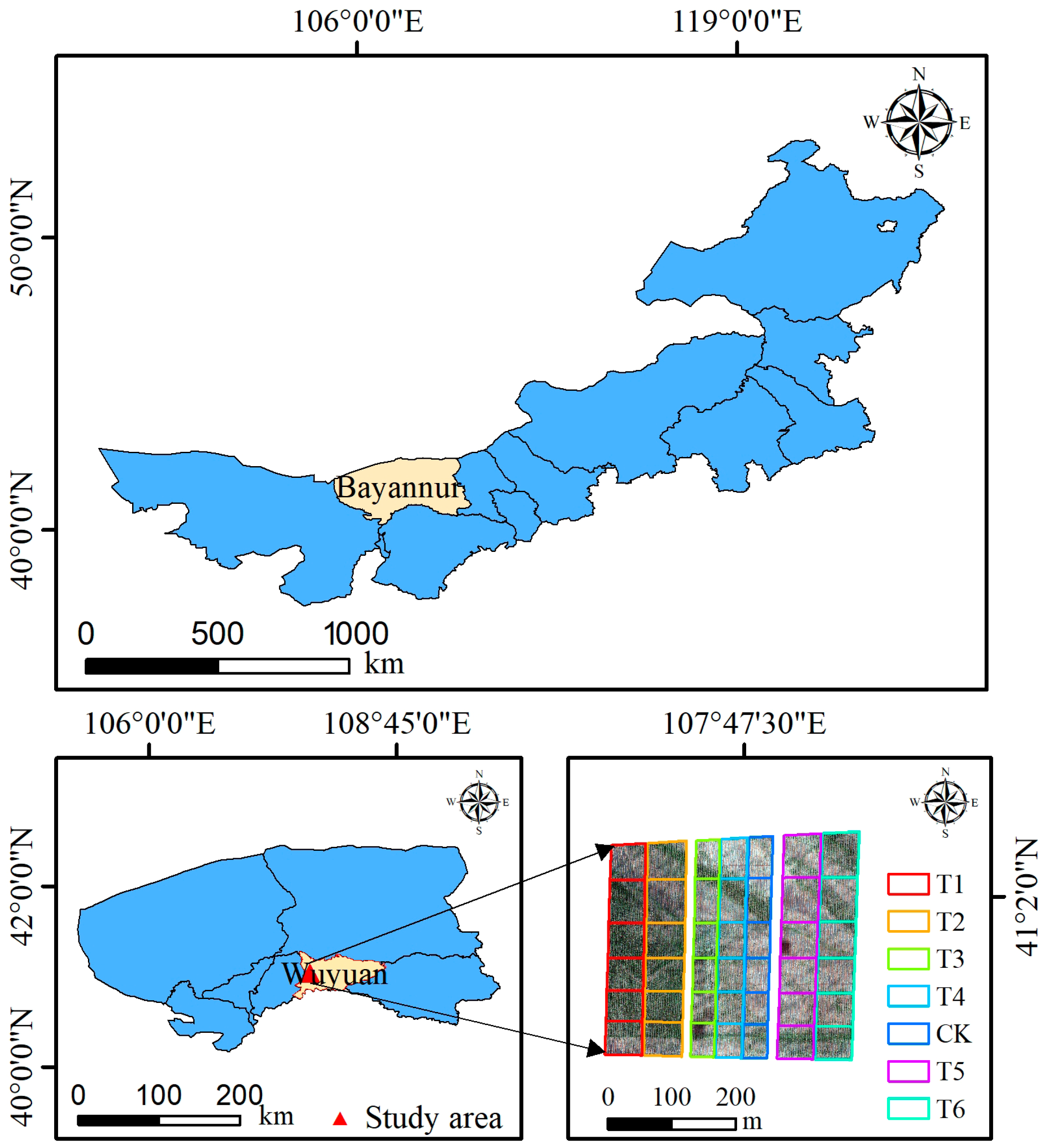
The experimental site was located at the Shanhe Agricultural Cooperative in Wuyuan County, Bayannur City, Inner Mongolia Autonomous Region (41°01′57.48″ N, 107°47′28.66″ E). The region has a temperate continental monsoon climate, characterized by abundant sunshine, with an annual sunshine duration of approximately 3200 h, high evaporation, with an annual evaporation of 2000–2500 mm, frequent strong winds and sandstorms, a short frost-free period of about 150 days, marked diurnal temperature variations, and four distinct seasons. The annual average precipitation is 188 mm, ranging from 150 to 200 mm in parts of the Hetao Irrigation District, with more than 60% of the rainfall concentrated in July and August. The preceding crop was maize.
Seven fertilizer treatments were established in the experiment, including six specialized maize fertilizers and the conventional compound fertilizer commonly used by local farmers (CK). Specifically, T1 was Xinlianxi controlled-release fertilizer with a nutrient ratio of N–P2O5–K2O = 27–10–13, T2 was Nongda Kui (18–18–18), T3 was Sinochem Yu (25–10–10), T4 was Kaimenzi (17–17–17), T5 was Stanley (25–10–16), T6 was Nongda Yu (26–11–11), and CK was the local conventional compound fertilizer (24–10–10). All fertilizers were applied at a rate of 900 kg ha−1 as a single basal application prior to sowing.
The study area and experimental plot layout are illustrated in
Figure 1. The experimental field covered approximately 9.4 ha. A total of 42 independent experimental plots were established, including seven fertilizer treatments (T1–T6 and CK) with six replicated plots per treatment. Each replicated plot had an area of 5 m × 5 m (25 m
2) and was used as the basic unit for UAV feature extraction and field agronomic measurements. A 1 m wide buffer zone was set between adjacent plots to minimize cross-contamination among treatments. The planting pattern was wide–narrow row mulched drip irrigation, with a plant spacing of 0.22 m, wide row spacing of 0.55 m, narrow row spacing of 0.45 m, and a planting density of 8.1 × 10
4 plants ha
−1. Maize was sown on 9 May 2024, and harvested on 27 September 2024. Field management practices, including irrigation, weeding, and pest and disease control, were consistent with local conventional practices.
2.2. Measured Variables and Methods
2.2.1. Agronomic Trait Measurement
Agronomic traits were measured synchronously at the jointing, tasseling, grain-filling and maturity stages of maize. For plant height, three representative plants were randomly selected in each plot, and the vertical distance from the soil surface to the top of the plant was measured using a steel tape. The average value of the three plants was used as the plant height for the corresponding plot.
LAI was determined using the Montgomery method, with the following formula:
where
is the total leaf area per plant (cm
2),
is the length of the
ith leaf (cm), and
is the maximum width of the
ith leaf (cm). Three plants were randomly selected in each plot to measure the length and maximum width of all fully expanded leaves. After calculating the leaf area per plant, plot-level LAI was converted according to the plant number per unit area, and the average of the three plants was taken as the final LAI of the plot.
Yield was measured at the maize maturity stage. Ten consecutive maize plants were randomly selected from each plot, naturally air-dried to constant weight, and then threshed to determine the fresh grain weight. A portion of grains was fixed at 105 °C in an oven for 30 min and then dried at 80 °C to constant weight for grain moisture content measurement, based on which grain yield was converted to the standard moisture content of 13%. Meanwhile, three replicates of 100-grain samples were randomly selected and weighed, and the average value was recorded as the 100-grain weight of the plot.
2.2.2. SPAD Measurement
SPAD values of maize were measured using a SPAD-502 portable chlorophyll meter (Konica Minolta, Inc., Tokyo, Japan). Measurements were taken synchronously with agronomic trait determination, covering all key growth stages of maize. In each plot, five representative plants were selected, and three measurement points were chosen in the middle part of the third upper leaf of each plant, avoiding the main vein. A total of 15 readings were obtained per plot, and the average value was used as the SPAD value for that plot. The data were used to assist in verifying the effectiveness of VIs extracted from UAV remote sensing.
2.2.3. Soil Characteristics
The soil in the experimental field was classified as a typical moderately saline–alkali fluvio-aquic soil in Wuyuan County, Inner Mongolia, China. The soil had a silty loam texture, with sand, silt, and clay contents of 35.9%, 53.6%, and 10.5%, respectively. The average groundwater table depth during the maize growing season was 1.9–2.3 m. Prior to sowing, initial soil samples were collected from the 0–20 cm plow layer for each fertilizer treatment (CK and T1–T6) using the five-point sampling method. For each treatment, five subsamples were collected and thoroughly mixed to form one composite soil sample. Soil pH, electrical conductivity (EC), total salt content, and major soluble ions were determined. Soil pH ranged from 8.28 to 9.12, and EC ranged from 2.20 to 2.99 mS cm
−1, with coefficients of variation of 3.4% and 10.1%, respectively. These relatively low CV values, together with the adjacent location of the experimental plots and the use of similar irrigation and field management practices, suggest that the initial saline–alkali background conditions were broadly comparable among treatments. Although high-density spatial mapping of soil salinity was not conducted, the initial soil survey indicated relatively low variability in pH and EC among treatments. Therefore, soil salinity was considered a comparable background condition in the subsequent fertilizer response analysis, rather than being used as a direct explanatory variable. Detailed initial soil properties are presented in
Table 1.
It should be noted that soil salinity variables were not used as direct input predictors in the machine learning models. Instead, UAV-derived spectral and texture features were used to capture crop canopy responses to fertilizer treatments under the relatively comparable saline–alkali background conditions.
2.3. UAV Data Acquisition
In this study, the DJI Phantom 4 Multispectral UAV (SZ DJI Technology Co., Ltd., Shenzhen, China) was used as the data acquisition platform. The platform is equipped with six sensors, including one RGB sensor and five monochrome multispectral sensors covering blue, green, red, red-edge and near-infrared bands. Each sensor has an effective pixel count of 2.08 million pixels, with high stability and radiometric consistency. Detailed sensor parameters are shown in
Table 2.
Multispectral UAV imaging was conducted at four key growth stages of maize, specifically the jointing stage (28 June), tasseling stage (27 July), grain-filling stage (30 August), and maturity stage (27 September). To ensure the accuracy and reliability of the multispectral data, UAV data acquisition was scheduled between 10:00 a.m. and 2:00 p.m., when the solar elevation angle was ≥45°, illumination was sufficient and stable, there was no cloud cover, and wind conditions were calm. This timing helped avoid the effects of shadows and atmospheric scattering on image quality.
Before each flight, flight routes were planned using DJI GS Pro software (version 2.0.17), with a cross-track overlap of 80%, an along-track overlap of 75%, a flight altitude of 50 m, and a ground sample distance (GSD) of 2.5 cm/px. Each flight mission lasted approximately 45 min. Prior to each flight, radiometric calibration was performed using a standard reflectance calibration panel to establish the relationship between sensor response values and actual reflectance, which supported subsequent radiometric correction of the images.
2.4. Feature Parameter Extraction and Selection
VIs are constructed through linear or nonlinear combinations of spectral bands to enhance vegetation signals and capture crop physiological status [
18]. In the present study area, the initial soil survey indicated that the saline–alkali background conditions were broadly comparable among treatments due to the adjacent plot arrangement and similar field management. Therefore, variations in remote sensing signals were assumed to mainly reflect crop responses to fertilizer treatments rather than large differences in initial soil background conditions. However, in saline–alkali environments, crop growth differences induced by fertilizer application are often subtle and primarily manifested in physiological traits and canopy structural characteristics. Therefore, relying solely on spectral indices may not be sufficient to fully capture the effects of fertilizer treatments.
To better support fertilizer efficacy evaluation, this study integrates spectral and spatial information by combining VIs with texture features derived from UAV multispectral imagery. Texture features can effectively characterize canopy structure, spatial heterogeneity, and growth uniformity at the plot scale, which are closely related to crop responses to fertilizer treatments under saline–alkali stress conditions [
19]. Specifically, eight gray-level co-occurrence matrix (GLCM) based texture metrics (mean, variance, homogeneity, contrast, dissimilarity, entropy, angular second moment, and correlation) were extracted from each of the five spectral bands, resulting in 40 texture features. Meanwhile, 20 commonly used VIs were selected to represent canopy spectral characteristics (
Table 3). All features were aggregated at the experimental plot level, and the mean values within each plot were used as input variables for subsequent modeling. This plot-level feature extraction strategy ensures consistency with the experimental design and improves the reliability of fertilizer treatment evaluation. This feature construction approach is designed not only to improve model performance but also to enhance the sensitivity of remote sensing variables to fertilizer-induced differences in crop growth under the specific conditions of the study area.
2.5. Model Development
This study developed a weighted ensemble learning model that integrated four base learners: RF, GBR, AdaBoost Regression, and DTR. The detailed parameter settings of these models are provided in
Table A1 (
Appendix A). The final ensemble prediction was obtained via the weighted average of the outputs from each base model. Model weights were calculated and normalized based on the root mean square error (RMSE) of each base model on the validation set, such that models with higher prediction accuracy (i.e., lower RMSE) contributed greater weight to the ensemble decision. This weighting strategy allows the ensemble to emphasize more reliable learners while reducing the influence of less accurate ones. The formula is as follows:
where
is the weight of the
ith model,
is the RMSE of the
ith model on the validation set, and
n is the total number of base models.
To construct high-precision regression models for maize canopy growth indicators (LAI, yield, and plant height), this study performed systematic feature selection on the texture features and VIs derived from remote sensing. Considering the high dimensionality and potential redundancy among these features, the importance score of each feature for predicting maize growth indicators was computed based on the RF model, which is capable of capturing nonlinear relationships and ranking the contributions of variables effectively. The top three features were first selected as the initial input variables. Following the feature importance ranking, features were incrementally introduced into the regression models in descending order. At each step, model performance was evaluated using the coefficient of determination (R2) and RMSE. The feature subset yielding the best predictive performance was selected as the final input combination. This iterative selection strategy aims to balance information completeness and model simplicity, while ensuring that the selected features are most relevant to fertilizer-induced variations in maize growth under saline–alkali conditions. In addition, to provide a baseline comparison with linear modeling approaches, PLSR was employed in this study. Given its suitability for handling high-dimensional and highly collinear remote sensing variables, PLSR serves as a benchmark model to evaluate whether the proposed ensemble framework offers additional advantages in capturing crop responses to fertilizer treatments.
2.6. Accuracy Assessment
To evaluate model performance, R
2 and RMSE were used as the main metrics. To verify model robustness, 5-fold cross-validation was adopted: the dataset was randomly divided into 5 subsets, and each subset was alternately used as the validation set while the remaining subsets served as the training set. The formulas for R
2 and RMSE are as follows:
where
n is the number of samples,
is the average of the measured values,
,
are the observed value and predicted value of the
ith sample, respectively.
2.7. Statistical Analysis
To evaluate direct agronomic differences among fertilizer treatments, statistical analysis was conducted using measured yield at maturity and LAI at the tasseling stage. Yield at maturity represents the final productivity of maize, while LAI at the tasseling stage reflects peak canopy development and is closely related to biomass accumulation and yield formation. Before ANOVA, the assumptions of normality and homogeneity of variance were examined using the Shapiro–Wilk test and Levene’s test, respectively. The residuals of both measured yield and LAI satisfied the normality assumption, and Levene’s test indicated homogeneous variances among treatments. Therefore, one-way ANOVA followed by Tukey’s HSD test was used to compare differences among fertilizer treatments at the 0.05 significance level.
3. Results
3.1. Maize Canopy Extraction Accuracy and Feature Optimization
3.1.1. Classification and Extraction Results of Maize Canopy
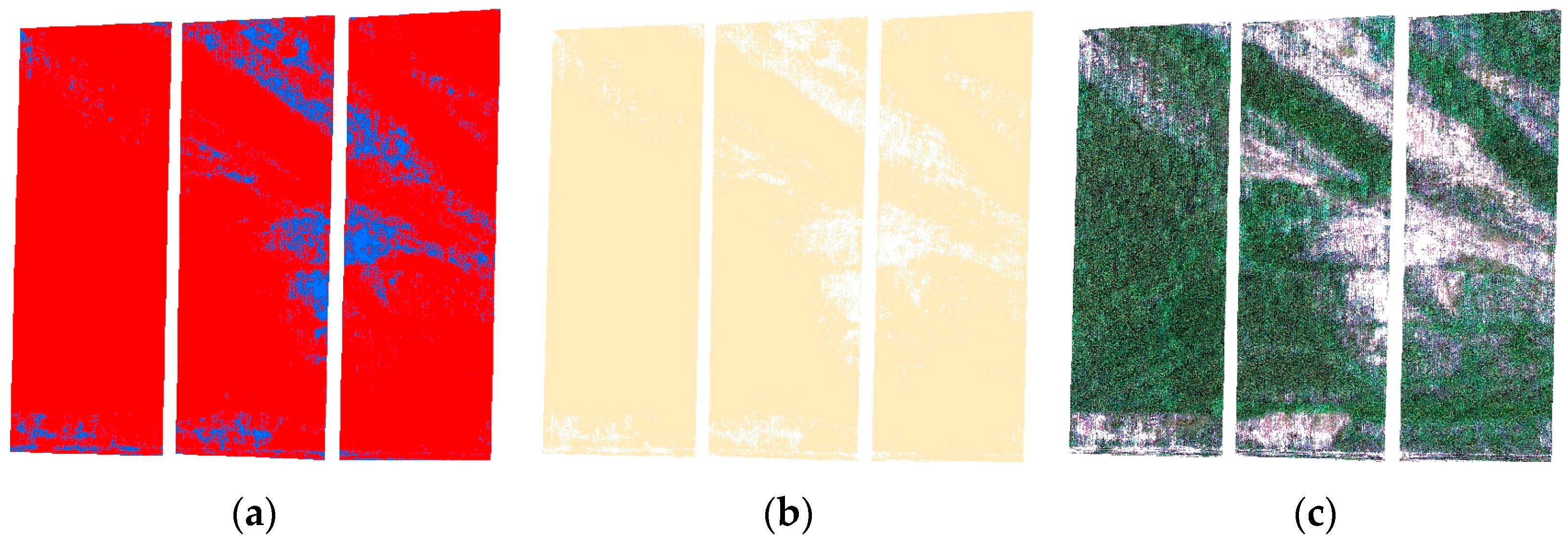
Based on the RF classification algorithm, the accurate separation of maize canopy from bare soil and weeds in saline–alkali soils was achieved. The statistical results of classification accuracy are presented in
Table 4 and
Figure 2. The classification accuracy of each growth stage ranged from 85.1% to 98.2%, and the Kappa coefficient ranged from 0.77 to 0.97, indicating an overall good classification performance that meets the sample purity requirement for subsequent growth status and yield prediction. Specifically, the grain-filling stage achieved the highest classification accuracy of 98.2% with a Kappa coefficient of 0.97, followed by the maturity stage with 95.2% accuracy and a Kappa coefficient of 0.92. The tasseling stage showed a classification accuracy of 90.8%, while the jointing stage had relatively lower accuracy at 85.1%.
This accurate canopy extraction effectively reduces the interference of soil background and non-crop pixels, thereby ensuring the reliability of subsequent VI calculation and model inversion. As a result, it provides a critical data foundation for accurately evaluating fertilizer-induced differences in maize growth under saline–alkali conditions.
3.1.2. Feature Importance Analysis and Optimal Feature Selection
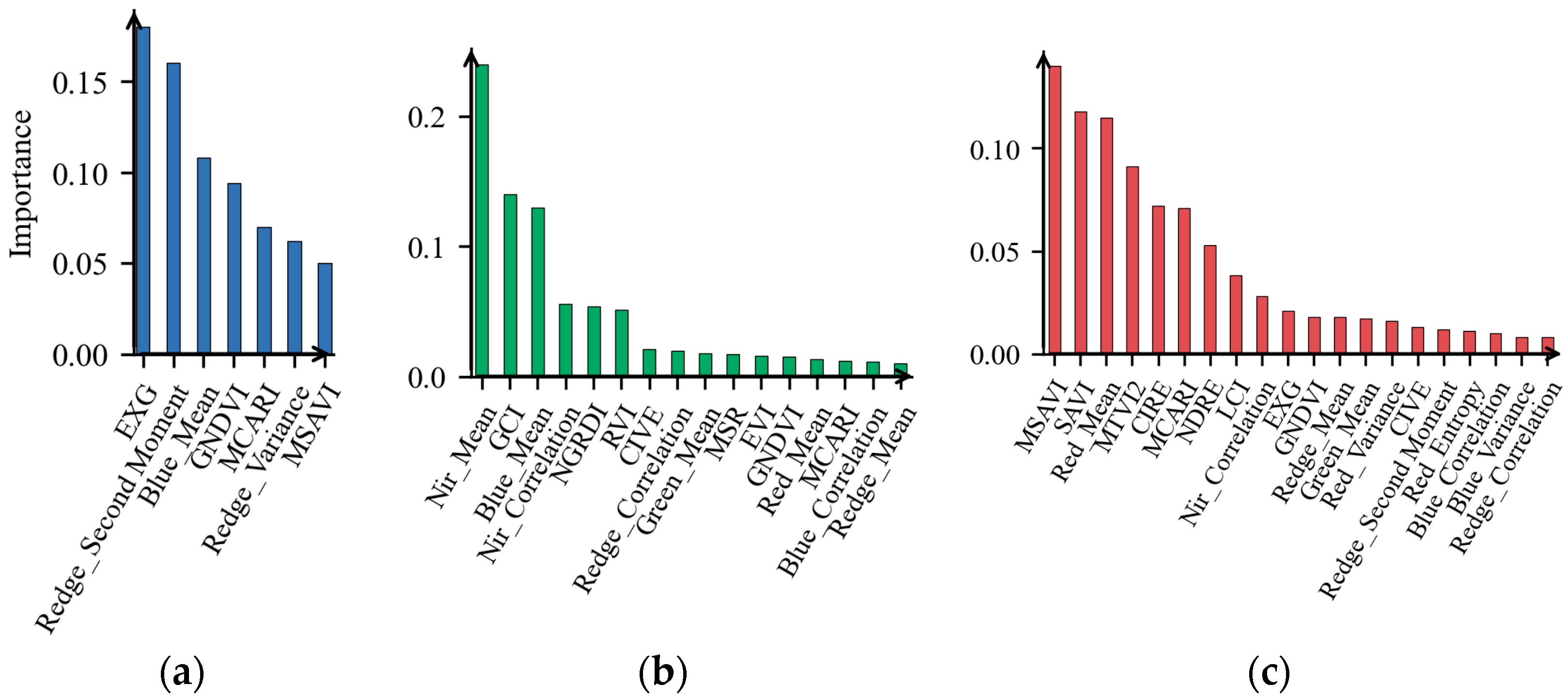
The results of feature importance analysis showed clear differences in sensitive features among different prediction indicators (plant height, LAI, and yield) (
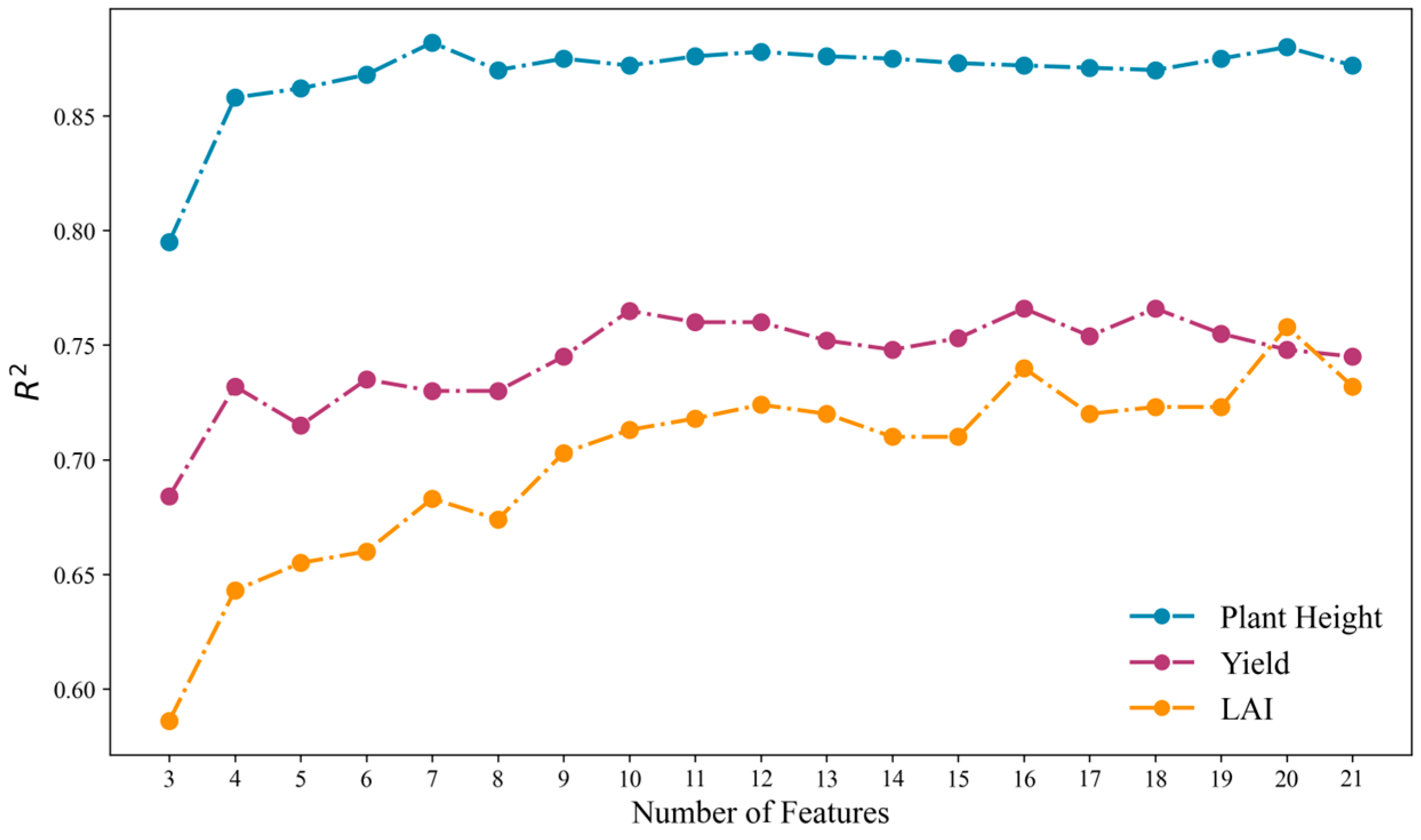
Figure 3), reflecting the influence of the physical meaning and representation logic of each indicator on feature requirements. Among them, the optimal feature combination for plant height prediction consisted of the top 7 important features (
Figure 4), namely EXG, Redge_Second Moment, Blue_Mean, GNDVI, MCARI, Redge_Variance, and MSAVI. For LAI prediction, all 20 candidate features were required to capture the complex details of canopy structure. For yield prediction, 16 key features were screened out, including Nir_Mean, EXR, GCI, Red_Mean, etc.
The LAI and yield prediction models exhibited similar variation patterns. When the number of features was small (no more than 5), the model accuracy increased rapidly with the addition of features, indicating the dominant role of core features in the prediction results. After the number of features reached the optimal threshold (20 for LAI and 16 for yield), continuously adding features led to a slight decrease in accuracy due to the introduction of redundant information. These results verified the necessity of feature selection, which not only ensured model accuracy by retaining key features but also reduced computational complexity and improved model operational efficiency by eliminating redundant features. In contrast, the accuracy of the plant height prediction model tended to be stable after the number of features reached 7, further indicating that plant height was more sensitive to core features and could be predicted with high accuracy without excessive features.
Importantly, these selected key features are closely related to crop physiological status and canopy structural characteristics, which are directly influenced by fertilizer application under saline–alkali conditions. Therefore, the feature optimization process enhances the model’s ability to capture fertilizer-induced differences in maize growth, providing a reliable basis for subsequent fertilizer effect evaluation.
3.2. Prediction Performance of the Ensemble Learning Model
The prediction performance of the ensemble learning regression model constructed based on the optimal feature combination for maize plant height, LAI and yield is presented in
Table 5. The results showed that the prediction accuracy of the model across the whole growth period was higher than that at single growth stages. The plant height prediction model achieved the best performance, with an R
2 of 0.88 and an RMSE of 27.56 cm, indicating that the model could accurately capture the spatiotemporal variations in maize plant height. The R
2 values of the LAI and yield prediction models were 0.76 and 0.76, with RMSE values of 0.81 and 382.18 kg ha
−1, respectively. Such reliable prediction performance lays a solid foundation for subsequent fertilization effect analysis.
Compared with the linear baseline model PLSR, the ensemble learning model generally achieved higher prediction accuracy for plant height, LAI, and yield, especially when data from all growth stages were integrated. For the all-growth-stage dataset, the R2 values of the ensemble model for plant height, yield, and LAI were 0.88, 0.76, and 0.76, respectively, which were higher than those of PLSR (0.83, 0.69, and 0.60). This indicates that the ensemble framework provided additional predictive value by capturing nonlinear relationships between UAV-derived features and maize growth responses under saline–alkali conditions. However, at some individual growth stages, certain base models showed comparable or slightly better performance, suggesting that the advantage of the ensemble framework is mainly reflected in overall robustness across growth stages rather than absolute superiority at every single stage.
By comparing the contributions of different feature types, the fusion of texture features and VIs helped alleviate the spectral saturation problem of single spectral features at the tasseling and grain-filling stages. For instance, texture features such as nir_Mean and redge_Mean included in the yield prediction model could capture the spatial heterogeneity of the canopy, compensating for the deficiency of VIs in characterizing crop growth during the high-biomass stage. In the plant height prediction model, the EXG and red-edge second moment (redge_Second Moment) served as core sensitive features, which was attributed to the high sensitivity of EXG to vegetation coverage and the strong indicative ability of the red-edge band for crop growth stages.
Collectively, the above findings highlight the potential of the established model for fine monitoring of maize growth under saline–alkali stress, which facilitates the differentiation of fertilization effects and guides field fertilizer regulation.
3.3. Spatiotemporal Distribution of Maize Growth and Yield at Different Growth Stages
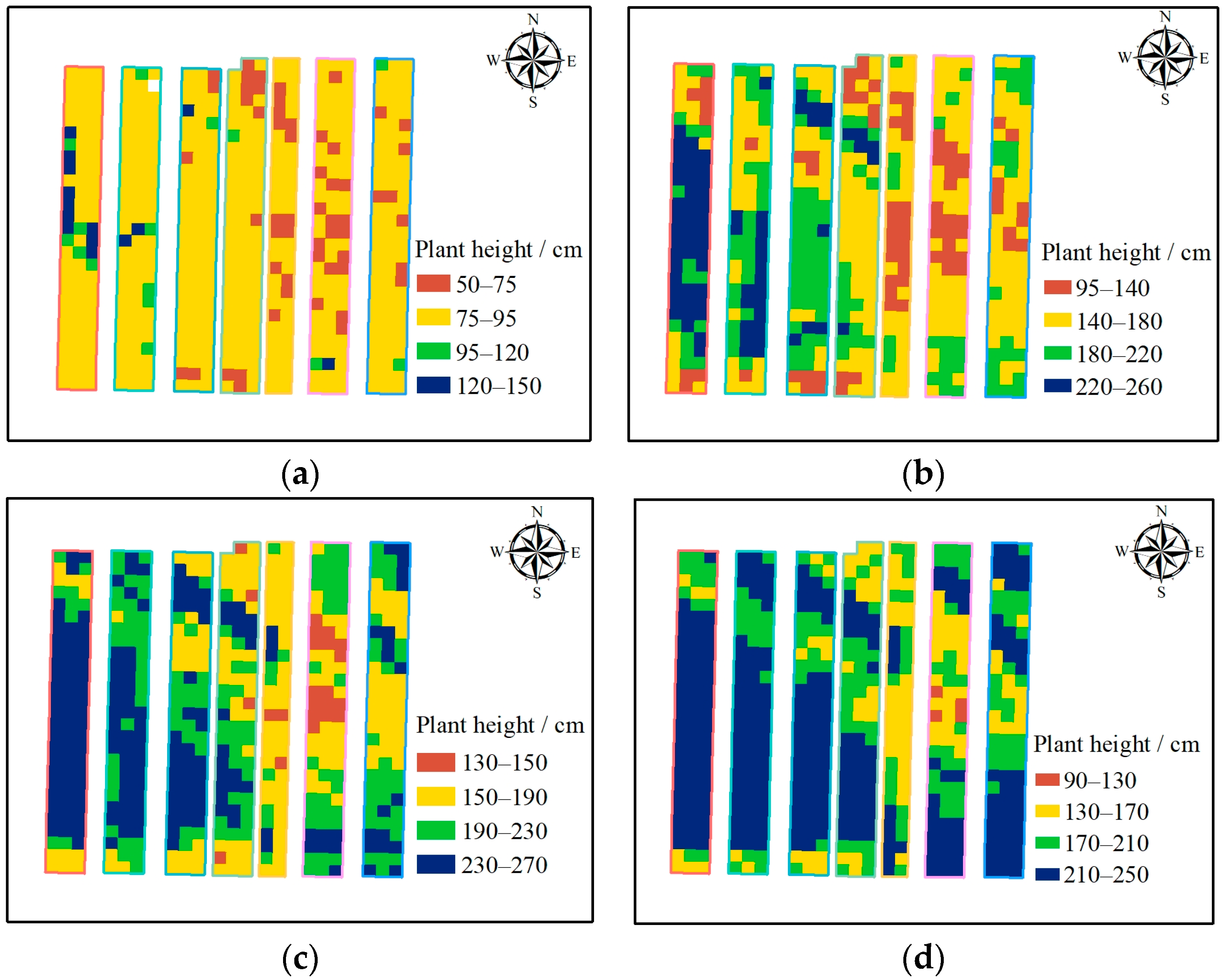
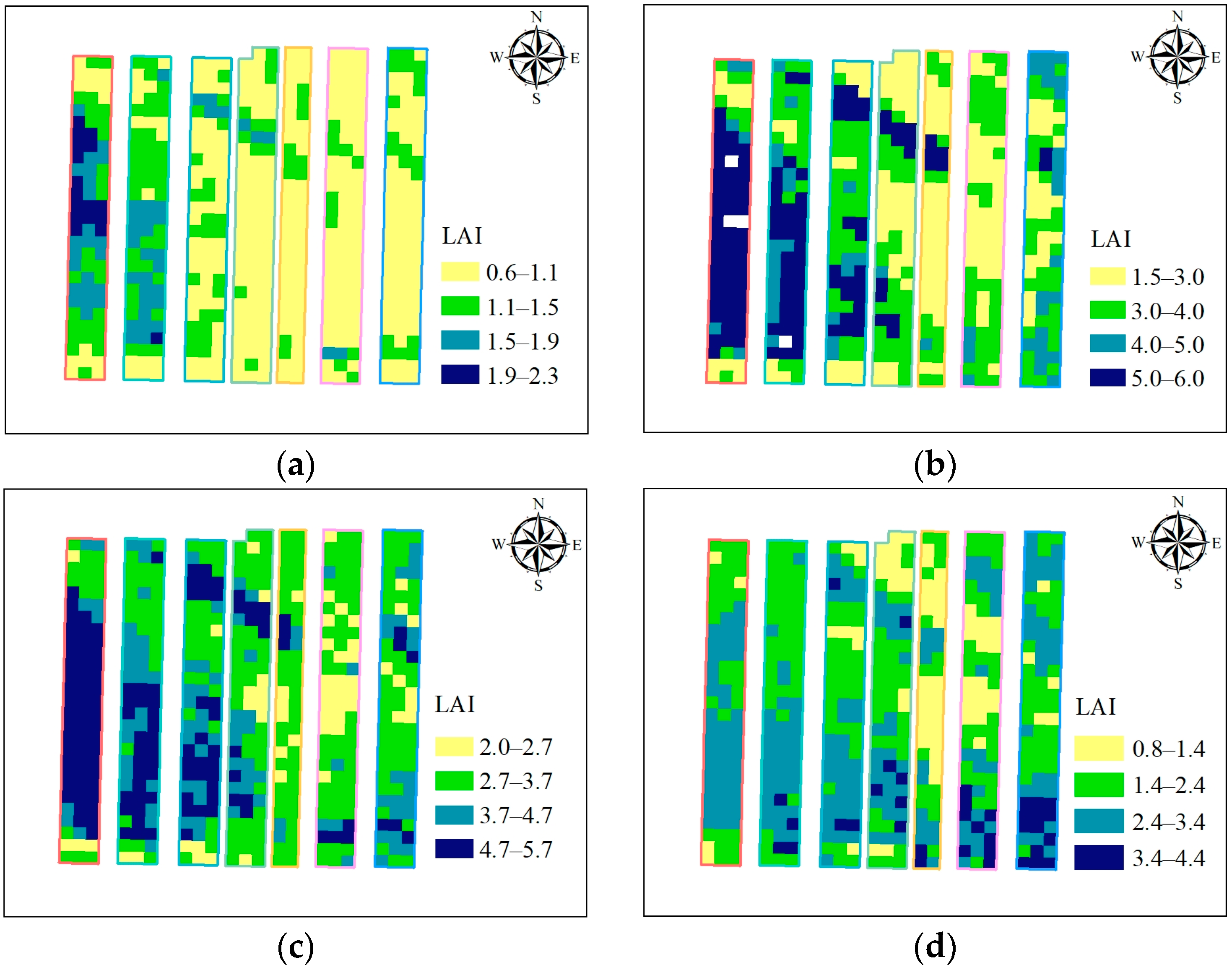
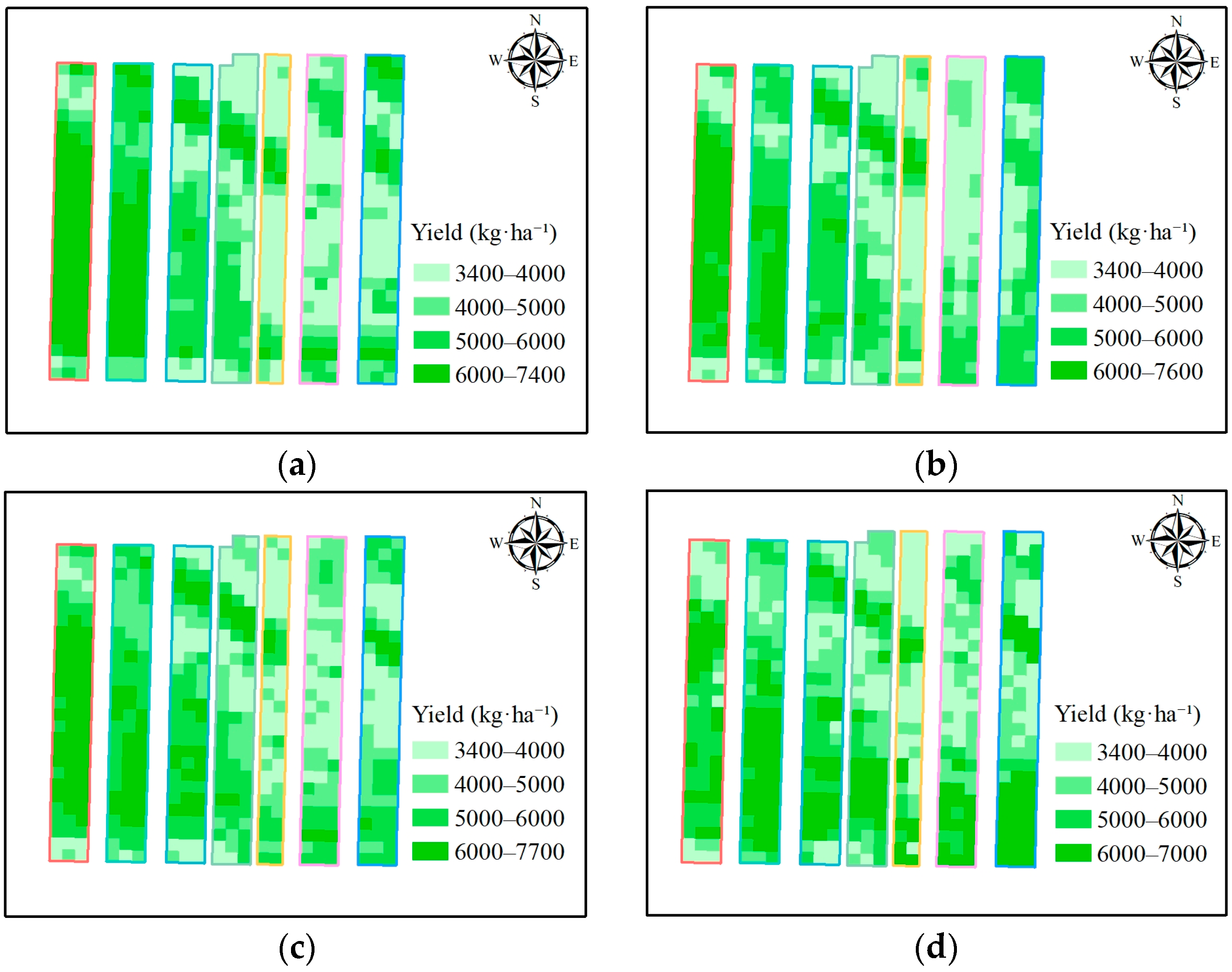
Dynamic predictions of plant height, LAI and yield across the entire growth period of maize were conducted using the optimized ensemble learning model, and their spatiotemporal distribution characteristics are presented in
Figure 5,
Figure 6 and
Figure 7. From the perspective of spatial distribution, the predicted plant height, LAI and yield all exhibited obvious spatial heterogeneity, and corresponded well with different fertilizer treatments, directly reflecting the differential effects of various fertilizers on maize growth.
The predicted plant height and LAI exhibited clear differences across growth stages. Plant height increased continuously from the jointing stage, where it ranged from 67.08 to 85.38 cm, to the grain-filling stage, where it reached 176.56 to 235.16 cm. At the maturity stage, plant height decreased slightly due to plant lodging or top drying, a trend consistent with the physiological rhythm of vertical maize growth. LAI peaked at the tasseling stage, with values between 2.97 and 4.86, and remained high during the grain-filling stage, ranging from 3.14 to 4.55. At the maturity stage, LAI decreased markedly to 1.87–2.62 due to leaf senescence and abscission, which aligns well with the physiological characteristics of maize development. The stage-specific predicted final yield ranged from 4243.2 to 6201.15 kg ha−1 across growth stages.
The stage-specific predicted final yields of T1 and T2 were generally higher than those of the other treatments across growth stages. However, given the relatively low prediction accuracy of the maturity-stage yield model, maturity-stage predicted yield should be interpreted with caution and combined with measured yield and LAI for fertilizer evaluation.
These results demonstrate that the proposed framework can effectively capture fertilizer-induced differences in maize growth and yield at both spatial and temporal scales, thereby providing a reliable basis for identifying optimal fertilizer strategies under saline–alkali conditions.
3.4. Integrated Effects of Fertilizer Treatments on Maize Growth and Yield
3.4.1. Effects of Different Fertilizer Treatments on Maize Growth and Yield
Dynamic changes in maize plant height across different fertilizer treatments are shown in
Table 6. Plant height was relatively low at the jointing stage, and clear differences in predicted plant height were observed among treatments. T1 and T2 exhibited predicted plant heights of 85.38 cm and 83.40 cm, respectively, both higher than those of the other treatments, with T1 being slightly higher than T2. CK had the lowest predicted plant height of 67.08 cm. At the tasseling and grain-filling stages, T1 maintained the highest predicted plant height, with mean values of 208.64 cm and 235.16 cm, corresponding to 43.9% and 33.2% higher values than CK, respectively. At the maturity stage, T2 had a predicted plant height of 222.19 cm, which was slightly higher than that of T1 (221.63 cm), and both treatments showed higher predicted plant height values than the other treatments.
Dynamic changes in maize LAI displayed stage-dependent characteristics similar to those of plant height. At the jointing stage, the predicted LAI of T1 was 1.50, which was 56.3% higher than that of CK. At the tasseling stage, T1’s predicted LAI reached a peak of 4.86, which was higher than that of the other treatments, whereas CK had the lowest predicted LAI of 2.97. At the grain-filling stage, T1 still had the highest predicted LAI, while T5 exhibited the lowest predicted LAI of 3.14. LAI generally decreased at the maturity stage, with T6 having the highest predicted LAI of 2.62, followed by T1 with 2.41, both of which were higher than CK.
Throughout the entire growth period, T1 achieved the highest predicted yield at the jointing, tasseling, and grain-filling stages, with values of 5947.95 kg ha
−1, 6201.15 kg ha
−1, and 5910.75 kg ha
−1, corresponding to yield increases of 40.18%, 36.64%, and 24.18% relative to CK, respectively (
Table 6). These predicted yields were higher than those of the other treatments. At the maturity stage, T2 had the highest predicted yield of 5463.6 kg ha
−1, with a yield increase rate of 15.42%, followed by T1 at 5214.3 kg ha
−1 and a yield increase rate of 10.15%.
In terms of the mean stage-specific predicted final yield increase rate across growth stages (
Table 7), T1 had an average yield increase rate of 27.74%, which was higher than those of T2 (26.45%), T3 (14.14%), T4 (6.37%), T5 (0.23%), and T6 (7.84%). The limited yield-increasing effects of T3 to T6 were associated with the compatibility of the fertilizer ratio with the saline–alkali soil environment, as well as the degree of matching between the nutrient release rate and the nutrient demand of maize during different growth stages.
3.4.2. Statistical Comparison of Yield and LAI Among Treatments
To further validate the differences among fertilizer treatments, one-way ANOVA followed by Tukey’s HSD test was conducted using measured yield at maturity and LAI at the tasseling stage, and the results are presented in
Table 8.
The results showed that both measured yield and LAI differed significantly among fertilizer treatments (p < 0.05). For measured yield at maturity, T1 showed the highest mean value and was significantly higher than T5 and CK, whereas no significant differences were observed between T1 and T2, T3, T4, or T6. For LAI at the tasseling stage, T1 also showed the highest mean value and was significantly higher than T4 and T5, while the differences between T1 and T2, T3, T6, and CK were not significant.
It should be noted that the optimal fertilizer treatment in this study was not determined solely based on pairwise statistical significance at a single growth stage. Instead, it was identified through an integrated evaluation of measured yield, LAI, yield increase rate, and UAV-derived dynamic growth indicators across different growth stages. From this perspective, T1 showed the highest mean measured yield and LAI, maintained consistently superior growth and yield performance from the jointing stage to the grain-filling stage, and achieved the highest average yield increase rate. Therefore, T1 was identified as the optimal fertilization strategy for maize in the saline–alkali soils of the study area.
4. Discussion
4.1. Effectiveness of Multi-Source Feature Fusion and Ensemble Learning Model
Previous remote sensing inversion studies on crop growth and yield mostly relied on single VIs or single algorithm models. Although basic monitoring could be realized, such studies often suffered from insufficient inversion accuracy and poor robustness under the conditions of spectral variation and complex canopy structure caused by saline–alkali stress [
34]. Most of these studies ignored the problem that spectral features are prone to saturation at high biomass stages, and failed to fully exploit the indicative effect of canopy spatial structure information on crop growth status, resulting in limited applicability of models in dynamic monitoring during the whole growth period. Moreover, most existing studies focus mainly on improving prediction accuracy, while neglecting the integration of canopy structural information and the applicability of models across multiple growth stages.
In contrast, this study proposes a unified framework that integrates multi-source feature representation (combining VIs and texture features) with ensemble learning to simultaneously address these limitations. Leveraging an ensemble learning framework, we achieved accurate predictions of maize plant height, LAI, and grain yield in saline–alkali soils, with R
2 values of 0.88, 0.76, and 0.76, respectively. By incorporating both spectral and spatial information, the proposed approach enhances the sensitivity to canopy heterogeneity and mitigates the saturation problem associated with single spectral features. Compared with previous studies that rely on single-source features or individual models, the proposed framework demonstrates improved robustness and generalization across growth stages, particularly under saline–alkali stress conditions. This finding aligns with the research by Li et al. (2026), which employed an integrated feature-selection strategy for spring maize in arid regions, achieving a high inversion accuracy (R
2 = 0.85) for aboveground biomass by fusing red-edge VIs with texture parameters [
35]. Furthermore, Fu et al. (2025) confirmed that integrating spatial and spectral information from UAV platforms can significantly improve the estimation of maize biomass and yield under varying nitrogen inputs [
36].
However, unlike these studies, which primarily focus on prediction performance, the present study further extends this approach by explicitly linking UAV-based feature extraction with fertilizer treatment evaluation through statistical analysis (ANOVA and Tukey’s HSD), thereby improving the agronomic interpretability of the results. Feature selection results further showed clear differences in sensitive features among different prediction indicators, which originated from the differences in physical meanings and characterization logics of plant height, LAI and yield. As a direct reflection of vertical crop growth, plant height was more sensitive to VIs reflecting vegetation coverage and red-edge band texture features depicting local canopy structure. LAI was closely related to canopy coverage and leaf spatial distribution, and the integration of multi-dimensional features such as spectrum and texture was required to fully capture its dynamic changes. As the final result of growth accumulation over the whole growth period, yield needed the synergistic effect of near-infrared band texture features and multiple VIs to effectively integrate spectral and structural information and avoid the limitations of single features [
37].
In addition, the ensemble learning framework effectively integrates the strengths of different algorithms, leading to more stable predictions under complex environmental conditions. Previous UAV-based crop monitoring studies have demonstrated the effectiveness of spectral indices, texture features, and machine learning models for estimating crop growth indicators such as plant height, LAI, biomass, and yield [
10,
11,
12,
13]. However, most of these studies primarily focused on crop status estimation, prediction accuracy, or the identification of sensitive remote sensing features, while the agronomic interpretation and decision-making use of model outputs were relatively limited. In comparison, the added value of the proposed framework lies not in standalone algorithmic innovation, but in an integrative analytical workflow that links UAV-derived growth and yield indicators with fertilizer treatment responses. In this framework, feature fusion and ensemble learning serve as technical components for improving the reliability of crop growth estimation, whereas the key contribution lies in the subsequent use of model outputs, yield increase rates, and statistical comparisons of measured agronomic traits to evaluate fertilizer-induced crop responses and identify an optimal fertilization strategy. This extends the application of UAV-based monitoring from crop growth estimation to precision nutrient management in saline–alkali farmlands.
4.2. Screening Mechanism of Optimal Fertilizer for Maize in Saline–Alkali Soils
The core challenge of fertilizer selection for maize in saline–alkali soils is that the high-salt and high-alkali soil environment inhibits root activity and nutrient absorption efficiency of crops, and the nutrient requirements of maize vary significantly among different growth stages. Single fertilizer ratio or static evaluation mode is difficult to adapt to the growth needs of the whole growth period. Previous studies have shown that nutrient imbalance and salt stress can significantly limit crop productivity in saline–alkali soils, especially when fertilization strategies fail to match crop demand across growth stages [
38,
39,
40]. However, most related studies have focused mainly on final yield responses, with limited attention to continuous growth dynamics and the matching relationship between nutrient release and crop demand. As a result, the selected fertilizer schemes were difficult to balance salt tolerance and yield-increasing effect in practical application.
Dynamic monitoring throughout the growth period in this study showed that T1 treatment showed the best overall performance in growth and yield from the jointing stage to the grain-filling stage, with the highest average yield increase rate of 27.74%. This indicates that dynamic monitoring combined with statistical evaluation can provide a more reliable basis for fertilizer screening compared with traditional yield-based approaches. The core mechanism was that the N–P
2O
5–K
2O ratio of this fertilizer was highly compatible with the nutrient requirements of maize in saline–alkali soils. The high nitrogen content of 27% could precisely meet the nitrogen demand of maize during the vegetative growth stage, effectively promoting plant height growth and canopy expansion, and laying a foundation for photosynthate accumulation. Meanwhile, the controlled-release characteristic enabled a more stable and sustained nutrient supply, avoiding nutrient loss caused by leaching and fixation in saline–alkali soils and thereby improving fertilizer utilization efficiency [
41]. In addition, T1 fertilizer may have contributed to alleviating the inhibitory effects of salt–alkali stress on maize growth by improving nutrient supply and potentially regulating soil physicochemical conditions, which is consistent with previous findings that appropriate fertilizer ratios can enhance crop salt–alkali tolerance [
42].
Compared with conventional fertilizer evaluation studies that rely mainly on final yield measurements, the present study highlights the importance of considering growth-stage-specific responses when selecting fertilizer strategies for maize in saline–alkali soils [
43,
44]. Previous studies have shown that slow-release or controlled-release fertilizers can improve crop productivity and nutrient use efficiency in saline–alkali environments by regulating nutrient availability and alleviating stress effects [
45,
46]. However, fertilizer effectiveness in saline–alkali soils is not only determined by final yield improvement, but also by whether nutrient release can match crop demand during critical growth stages. The UAV-derived dynamic monitoring results showed that T1 consistently promoted plant height, LAI, and predicted yield from the jointing stage to the grain-filling stage, whereas T2 showed a slight advantage in predicted yield at maturity. This stage-dependent response indicates that fertilizer optimization in saline–alkali soils should be evaluated from a whole-growth-period perspective rather than relying solely on a single final yield measurement.
T2 showed a slight advantage in maturity-stage predicted yield, which may be related to its balanced N–P
2O
5–K
2O ratio and the increased demand for phosphorus and potassium during late reproductive growth. A balanced nutrient supply may be beneficial for grain filling and dry matter accumulation at the reproductive stage. This stage-dependent response is generally consistent with previous studies indicating that maize nutrient demand gradually shifts from nitrogen-dominated vegetative growth to a greater requirement for phosphorus and potassium during reproductive development [
47,
48]. However, considering the relatively low prediction accuracy of the maturity-stage yield model, this result should be interpreted cautiously and should not be used as the sole basis for fertilizer selection. Considering the whole-growth-period performance, measured yield, tasseling-stage LAI, and average yield increase rate, T1 treatment showed more stable overall advantages, especially in promoting maize growth during the key vegetative growth stages, which laid a solid foundation for later yield formation. This further highlights that optimal fertilizer selection should be evaluated from a whole-growth-period perspective rather than relying solely on a single growth stage or final yield. Therefore, T1 was identified as the optimal fertilizer scheme for maize in the saline–alkali soils of the study area. In contrast, the limited yield-increasing effects of T3, T4, T5, and T6 treatments may be associated with the relatively poor matching between fertilizer ratios and crop nutrient requirements under saline–alkali conditions, as well as the mismatch between nutrient release rates and maize nutrient demand at different growth stages. This mismatch between nutrient supply and crop demand under stress conditions is a key factor limiting fertilizer efficiency in saline–alkali environments. For example, T5 treatment had a high potassium content but relatively insufficient nitrogen content, which may not have fully met the nitrogen demand of maize during vegetative growth, resulting in limited improvement in growth and yield.
4.3. Limitations and Future Perspectives
This study established a technical framework for optimal fertilizer selection of maize in saline–alkali soils through multi-source feature fusion and ensemble learning, providing an effective approach for precision nutrient management. However, several limitations remain, which may affect the applicability, interpretability, and generalization of the proposed framework in practical scenarios.
Firstly, this study only conducted experiments with a single maize variety. The saline–alkali tolerance and nutrient demand characteristics of different maize varieties differ significantly, which may limit the applicability of the optimal fertilizer scheme to other varieties and reduce the robustness of the proposed framework when applied to different genetic backgrounds. Secondly, UAV data were acquired only at four key growth stages. This limited the temporal continuity of crop monitoring and may have failed to capture short-term environmental fluctuations during the growing season, thereby affecting the temporal stability of model predictions. Finally, the proposed model primarily captures crop phenotypic responses, such as canopy spectral characteristics and spatial structural variations, rather than directly modeling soil salinity as an explicit stress factor. Therefore, the high prediction accuracy obtained in this study should be interpreted as evidence of the model’s ability to monitor maize growth and yield responses under saline–alkali background conditions, rather than as a direct quantification of soil salinity effects. Although initial soil pH and EC showed relatively low variability among plots, dynamic spatiotemporal changes in soil salinity, soil moisture, and groundwater conditions were not incorporated into the model. This may reduce model interpretability and prediction accuracy in areas with stronger salt heterogeneity.
Future research should therefore focus on the following aspects. First, experiments should be expanded to include more maize varieties and saline–alkali soil types, covering varieties with different salt tolerance and plots with different salinization degrees, to verify the general applicability of the optimal fertilizer scheme. Second, UAV monitoring frequency should be increased to achieve more continuous dynamic monitoring throughout the maize growth period and to clarify the response of crop growth to short-term environmental changes. Third, environmental variables such as dynamic soil salinity, soil moisture, and groundwater information should be incorporated as explicit predictors to construct an environment–crop–fertilizer coupled model and better reveal the mechanisms linking soil stress, crop growth, and fertilizer response. Finally, a UAV remote sensing-based field fertilization decision-support system should be developed by integrating model predictions with field management requirements, thereby improving the practical applicability of precision fertilization in saline–alkali farmlands.