1. Introduction
The North Kazakhstan Region is one of the leading grain-producing regions of the Republic of Kazakhstan, and the structure of its agricultural land use is largely determined by moisture availability, continental climatic conditions, and the organization of crop rotations [
1,
2]. Official statistical compilations confirm the dominant role of arable farming in the country’s agricultural sector and the persistent importance of grain production in northern Kazakhstan [
1]. In agrarian studies, northern Kazakhstan has long been regarded as a major rainfed grain belt with a strong dependence on climatic variability and agronomic management [
2]. More recent assessments show that agricultural productivity in the northern regions of Kazakhstan is increasingly influenced by changes in hydrothermal conditions, rising temperatures, limited moisture availability, and growing climatic pressure on grain production [
3,
4,
5].
Under the dry-steppe and forest-steppe conditions of North Kazakhstan, fallow remains agronomically important as an element of arable land management. Its role is associated with soil moisture accumulation, weed control, and the regulation of crop rotations in rainfed farming systems [
2,
6]. Studies conducted in North Kazakhstan show that summer fallow and crop rotation structure substantially affect soil organic matter dynamics, the carbon balance, and the overall functioning of grain agroecosystems developed on Chernozem soils [
7,
8,
9,
10]. In addition, recent studies on wheat production in North Kazakhstan demonstrate that productivity and grain quality depend not only on weather conditions but also on tillage practices and the adaptation of agronomic technologies to resource constraints [
11,
12]. Therefore, fallow should be considered not as a static land category, but as a dynamic functional element of the agricultural landscape.
At the same time, the importance of sustainable land management is increasing in the northern regions of Kazakhstan, taking into account the soil, geological, and water-retention properties of the territory [
13]. The spatial transformation of land use in different districts of Kazakhstan has already been examined in studies showing the need to analyze not only land categories themselves but also their territorial configuration and temporal changes [
14]. Therefore, an assessment of fallow land should consider not only total area, but also the spatial differentiation of its distribution across districts.
Conventional statistical accounting alone is insufficient for analyzing the spatial organization of fallow land. Official statistics provide aggregated information on sown areas and land-use categories at the level of administrative units, but they do not reveal the intra-district distribution of fallow fields, their configuration within agricultural land masses, or their annual redistribution across the territory [
1]. This limitation is especially significant for the North Kazakhstan Region because its districts differ in their climatic background, agricultural specialization, tillage intensity, and the structural organization of arable land. Consequently, identical or similar district totals may conceal fundamentally different territorial patterns of fallow use. For this reason, the analysis of fallow land requires spatially explicit methods capable of capturing not only the area, but also the location.
Such an opportunity is provided by remote sensing, which has become a standard methodological basis for analyzing agricultural land use. Satellite data are widely used for crop classification, land-cover mapping, the assessment of agricultural intensity, and the detection of underutilized or abandoned land [
15,
16,
17]. For Kazakhstan, remote sensing studies have already demonstrated large-scale transformations of agricultural land use, the role of climatic and institutional factors in land-cover change, and the possibility of satellite-based identification of abandoned and weakly used agricultural lands [
18,
19]. At the regional scale, recent studies have also demonstrated the applicability of Sentinel-2 data and adapted spectral approaches for agricultural monitoring, the spatial differentiation of agricultural lands, and the assessment of land-use sustainability in Kazakhstan [
13,
14,
20,
21,
22].
However, the present study does not address abandoned land as a separate target class. Instead, it focuses specifically on managed fallow fields within active agricultural land under the agronomic conditions of North Kazakhstan. In this sense, the novelty of the study lies not in the general use of Sentinel-2 for agricultural mapping, but in the application of a field-level, multi-temporal, rule-based approach for annual fallow-field identification, where the adapted PLI is used as the principal indicator of mechanically processed soil surfaces and NDVI is used as a supporting filter. Thus, the study is concerned with the interannual dynamics of managed fallow fields, whereas abandoned lands were included only within the general agricultural field mask and were not identified as an independent class.
The use of Sentinel-2 is particularly justified for the recent period because this sensor combines the appropriate spatial resolution, multispectral information, and high revisit frequency required for field-scale analysis in agriculture [
15,
20,
21]. In Kazakhstan, Sentinel-2-based methods have already been successfully applied to crop identification, pasture-condition assessment, the delineation of cultivated areas, and the analysis of agricultural land-use sustainability [
20,
21,
22,
23,
24]. This is especially important for fallow detection because fallow fields are characterized not only by the absence or weak development of vegetation, but also by the presence of exposed or recently tilled soil surfaces, which cannot be adequately accounted for using vegetation indices alone [
20,
21,
23]. Therefore, the monitoring of fallow land in the North Kazakhstan Region requires an approach that considers both the spectral expression of soil exposure and the supporting role of vegetation-based filtering.
The need for repeated observations rather than one-time mapping is determined by the pronounced interannual variability of agroclimatic conditions in North Kazakhstan. Recent studies document substantial fluctuations in heat and moisture supply, the occurrence of droughts during the growing season, and climate-related changes in crop yields in Kazakhstan, especially in its northern grain-producing regions [
3,
4,
5,
11,
12,
24]. Under these conditions, a one-year assessment of fallow land does not allow for determining whether the identified area reflects a stable crop rotation scheme, a temporary response to unfavorable moisture conditions, or a broader restructuring of agricultural land use. Therefore, the main analytical task is to investigate interannual dynamics rather than isolated annual states.
Within the framework of this study, interannual dynamics are understood not only as changes in the total area of fallow land from year to year, but also as their spatial redistribution among districts, as well as the stability or instability of spatial patterns of fallow fields under contemporary land-use conditions. This problem has direct practical significance because the district-level differentiation of fallow land may reflect different combinations of agroclimatic constraints, crop rotation decisions, and land management strategies [
6,
13,
14]. In addition, the spatial assessment of fallow dynamics makes it possible to understand the contemporary structure of agricultural land use in the North Kazakhstan Region more accurately than can be achieved using aggregated statistical data alone [
1,
18,
25].
Based on the above, this study analyzes the interannual dynamics of fallow land extent in the North Kazakhstan Region during 2021–2025 using Sentinel-2 data. The research is focused on identifying the spatial differentiation of fallow fields at the district level during the recent period and on interpreting annual changes under the contemporary structure of land use. Methodologically, the study applies a field-level rule-based approach in which the adapted Plowed Land Index (PLI) is used as the principal indicator of mechanically processed soil surfaces, NDVI is used as a supporting indicator for excluding crop-like vegetation trajectories, and the hydrothermal coefficient (HTC) is used for the agroclimatic interpretation of interannual differences. The objective of the study is to refine the spatial assessment of the fallow land structure of the North Kazakhstan Region and to establish a remote sensing basis for analyzing its interannual variability in relation to agroclimatic conditions and district-level agricultural practices.
2. Study Area
The North Kazakhstan Region is located in the northern part of Kazakhstan within the country’s main grain-producing belt. It borders the Russian Federation to the north and the Kostanay, Akmola, and Pavlodar regions within Kazakhstan; the administrative center is Petropavl [
26]. In physical-geographical terms, the region occupies the southern margin of the West Siberian Plain and partly the Kazakh Uplands, which explains the predominance of plain relief combined with local geomorphological differentiation. The territory is characterized by extensive lowlands and weakly undulating plains, numerous lake depressions, and locally elevated sectors in the south and southeast.
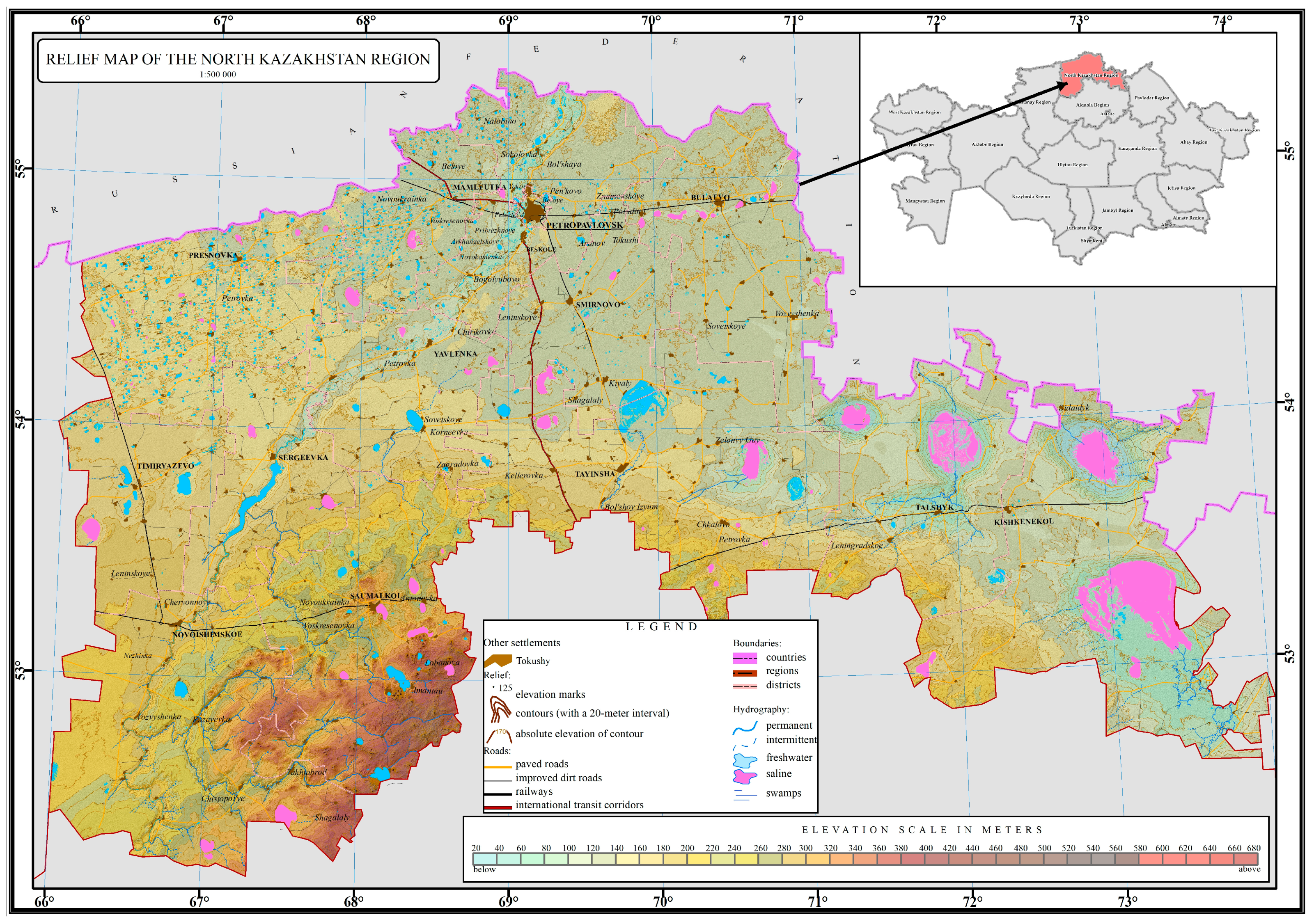
The region belongs to the forest-steppe and dry-steppe zones and is characterized by a sharply continental climate. Agriculture is predominantly rainfed; therefore, crop production and land-use structure strongly depend on interannual variability in precipitation, heat supply, and hydrothermal conditions. Northern Kazakhstan is spatially heterogeneous in terms of moisture availability, heat resources, and growing-season aridity, which is important for interpreting the territorial differentiation of fallow land dynamics (
Figure 1).
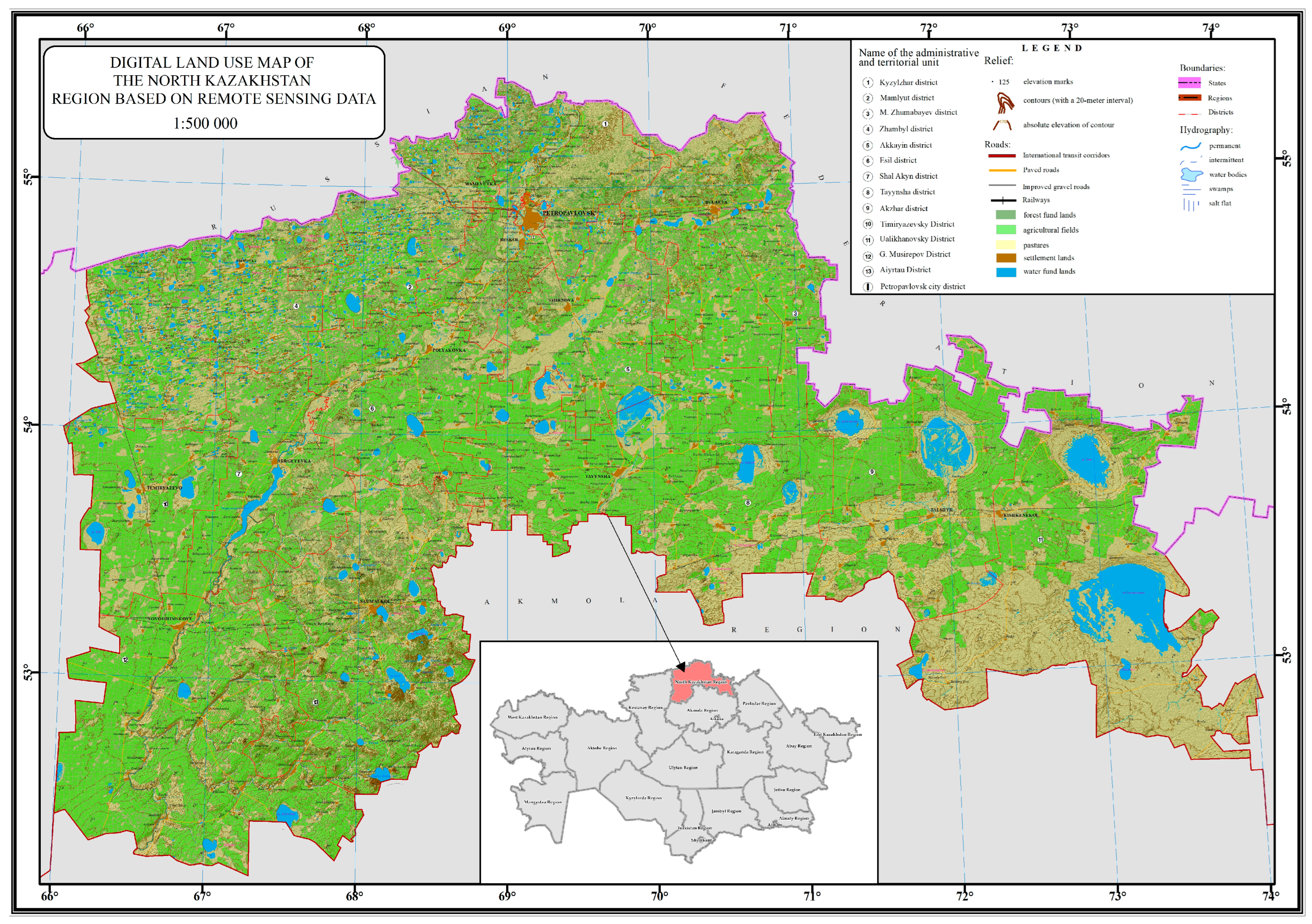
Agricultural lands dominate the region and form extensive cultivated massifs, especially in the central, northern, and western districts. In contrast, the southern and southeastern parts are more heterogeneous because of the combination of locally elevated terrain, pasture areas, and lake depression landscapes. Under these conditions, interannual changes in fallow land extent should be interpreted as a territorially differentiated process shaped by the combined influence of agroclimatic variability, relief organization, and the existing land-use structure. The dominant role of crop production in regional land use also supports district-level analysis as the most appropriate spatial scale for this study [
1] (
Figure 2).
3. Data and Methods
3.1. Remote Sensing and Ground Data
Sentinel-2 Level-2A imagery was used as the main remote sensing source for mapping fallow lands in the North Kazakhstan Region [
27]. The analysis covered the period from 2021 to 2025. Sentinel-2 data were collected within the broader annual period from May to August for all study years, whereas the effective observation window used for fallow identification was concentrated in the May–July period in order to capture both early-season and late-season mechanical treatment of agricultural fields. This period corresponds to the active vegetation season and allows for the simultaneous assessment of exposed soil surfaces, actively cultivated fields, and areas characterized by weak or discontinuous vegetation cover, which is essential for distinguishing fallow lands from cropped fields.
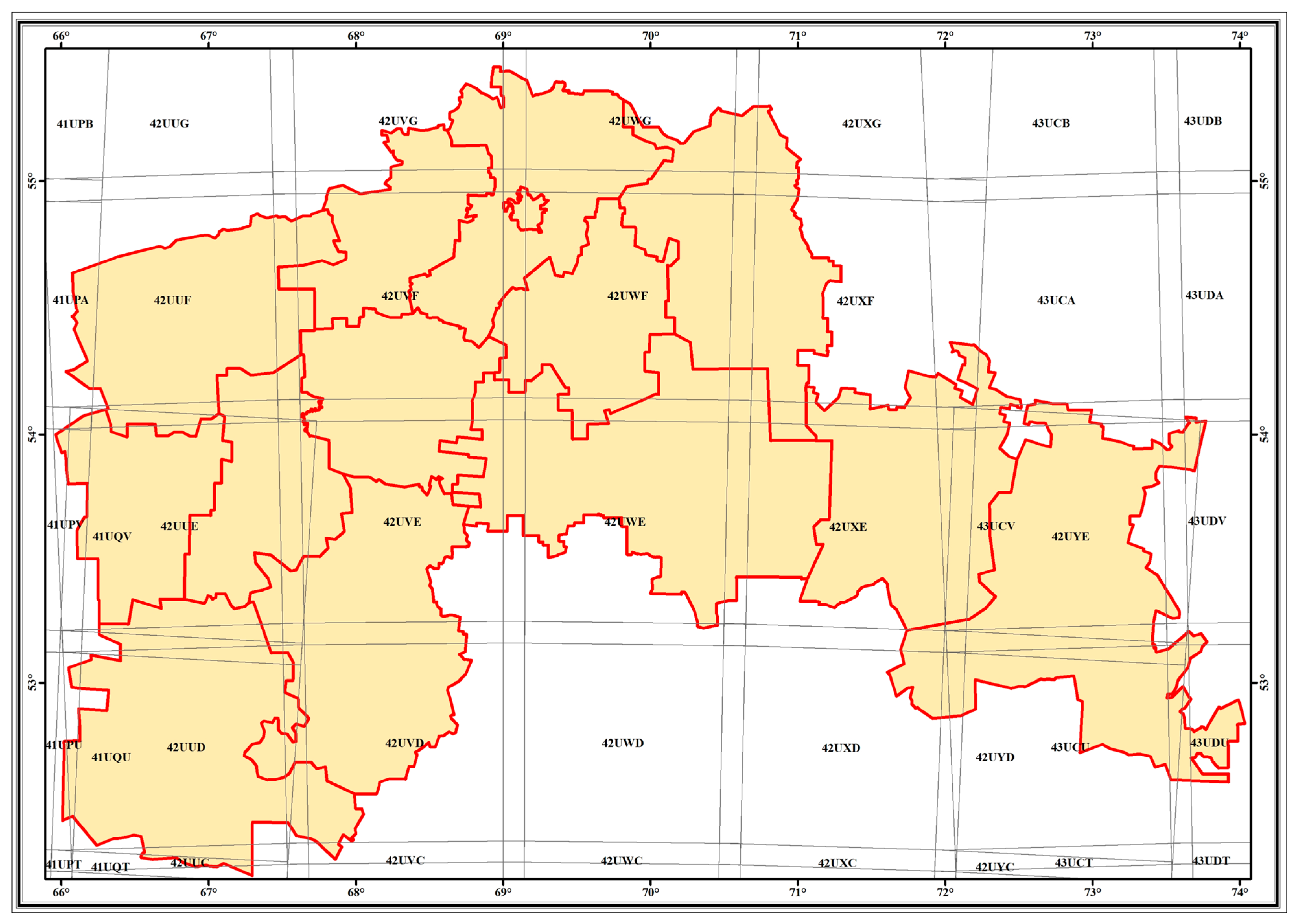
The spatial coverage of the study area was provided by a set of Sentinel-2 tiles covering the North Kazakhstan Region. The main regional coverage was formed by tiles 42UUF, 42UVF, 42UXF, 42UUE, 42UVE, 42UWE, 42UXE, and 42UYE, while several marginal tiles were additionally used where necessary to ensure complete spatial continuity along the southern and eastern boundaries of the region [
28,
29]. The Sentinel-2 L2A product was selected because it provides bottom-of-atmosphere reflectance and is therefore suitable for consistent multi-year spectral analysis (
Figure 3).
The preprocessing workflow included the masking of clouds and cloud shadows using the scene classification information available in the L2A product. All spectral bands used in the analysis were brought to a common spatial resolution. Bands B2, B3, B4, and B8 were used at 10 m resolution, whereas shortwave infrared bands B11 and B12, originally available at a 20 m resolution, were resampled to 10 m to ensure compatibility in subsequent index calculations. When more than one cloud-free scene was available within the same observation window, the images were combined into seasonal mosaics in order to reduce data gaps and improve spatial completeness. This unified preprocessing scheme ensured the comparability of the spectral data between years and provided a consistent basis for the calculation of the PLI and NDVI (
Table 1).
Because the availability of valid cloud-free scenes differed between years, the number and exact timing of observations were not fully identical from year to year. To reduce the influence of this limitation on temporal comparability, multiple acquisition dates were used whenever possible, and seasonal mosaics were generated where needed to improve spatial completeness and maintain the consistency of the annual interpretation.
All image preprocessing, satellite image compositing, and index calculations were performed in Google Earth Engine and ArcGIS Pro 3.0, whereas vector processing, field-based aggregation, and area calculations were carried out in ArcGIS Pro 3.0.
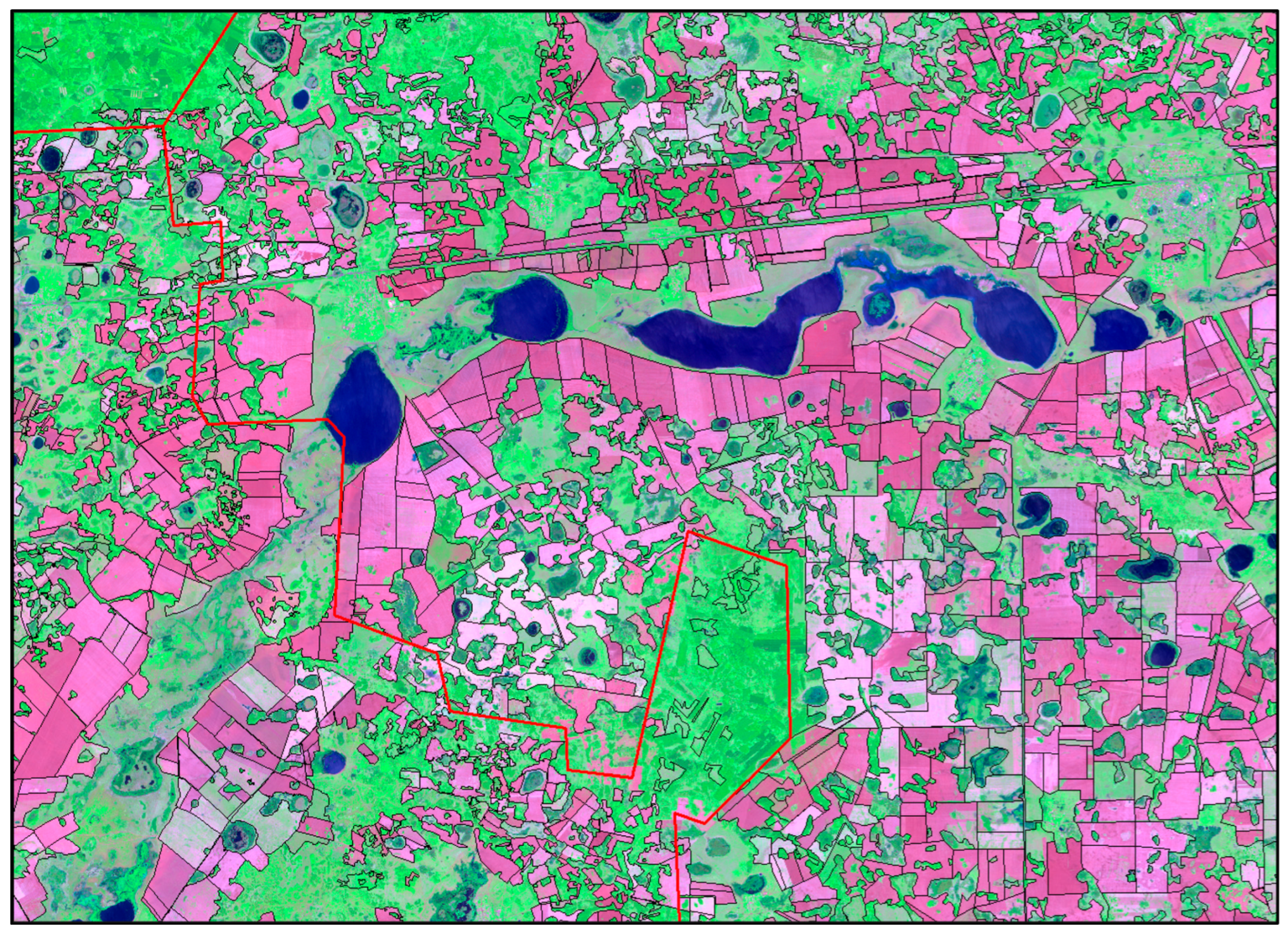
Agricultural field boundaries used for field-level extraction and area calculations were digitized within the project from Sentinel-2 imagery rather than obtained from an external cadastral dataset. For each analyzed year, the field mask was delineated and updated separately using Sentinel-2 images from the corresponding year and multiple seasonal dates in order to improve the recognition of actual field boundaries. Therefore, the field-boundary structure was updated annually and was not assumed to be identical throughout the 2021–2025 period. The digitization was performed at an approximate working scale of 1:50,000 (
Figure 4).
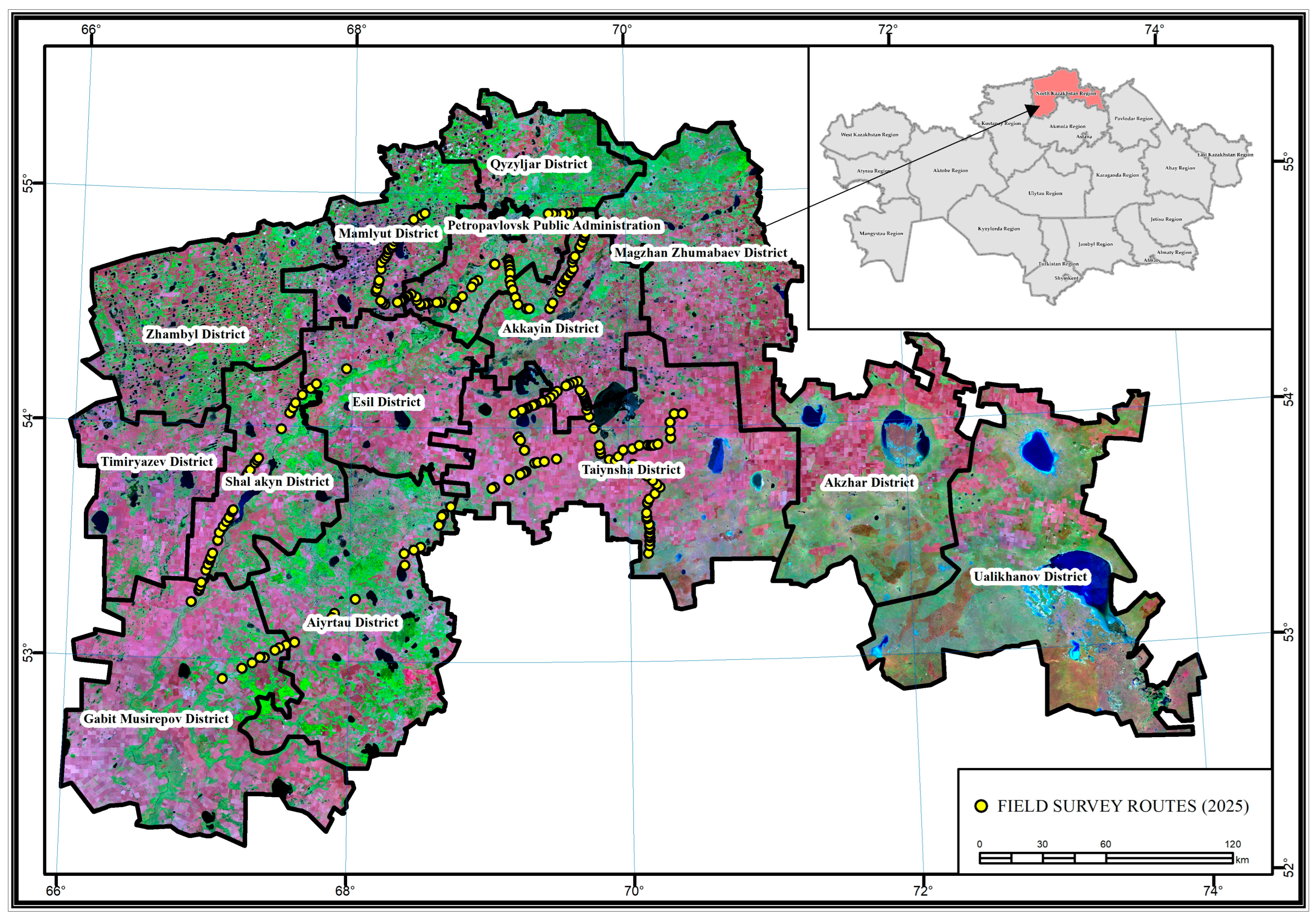
Field survey data collected in 2025 were additionally used to support the interpretation of the fallow land identification results derived from Sentinel-2 imagery. The field campaign covered several districts of the North Kazakhstan Region and included route-based observations with georeferenced points distributed along the main survey paths. In total, about 320 ground observation points were collected, including more than 30 points corresponding to fallow fields. Such a dataset is sufficient for supporting the interpretation of the principal target class under regional conditions, although it was not intended for a full statistical accuracy assessment. Accordingly, a formal multi-year confusion matrix for all mapped years was not available, because comparable field survey data were collected only in 2025. However, to strengthen the validation of the annual mapping procedure, the 2025 field dataset was additionally used for a binary accuracy assessment distinguishing between fallow and non-fallow classes. Based on the 320 ground observation points, a confusion matrix was compiled and the overall accuracy, producer’s accuracy, user’s accuracy, and F1-score were calculated for the 2025 map (
Table 2).
Thus, the ground survey did not replace the remote sensing procedure itself, which was based on the adapted Plowed Land Index (PLI) and the NDVI, but provided an additional level of verification for the resulting maps. In this study, field verification was used primarily to confirm the consistency of the interpretation rather than to derive a full confusion matrix or a formal classification accuracy assessment. This approach is methodologically justified because the main objective of the study was the interannual analysis of fallow land dynamics, whereas the field data served as independent support for identifying the principal land-use states in 2025.
Field survey data collected in 2025 were additionally used to support the interpretation of the fallow land identification results derived from Sentinel-2 imagery. The field campaign covered several districts of the North Kazakhstan Region and included route-based observations with georeferenced points distributed along the main survey paths. In total, about 320 ground observation points were collected, including more than 30 points corresponding to fallow fields. Such a dataset is sufficient for supporting the interpretation of the principal target class under regional conditions, although it was not intended for a full statistical accuracy assessment (
Figure 5).
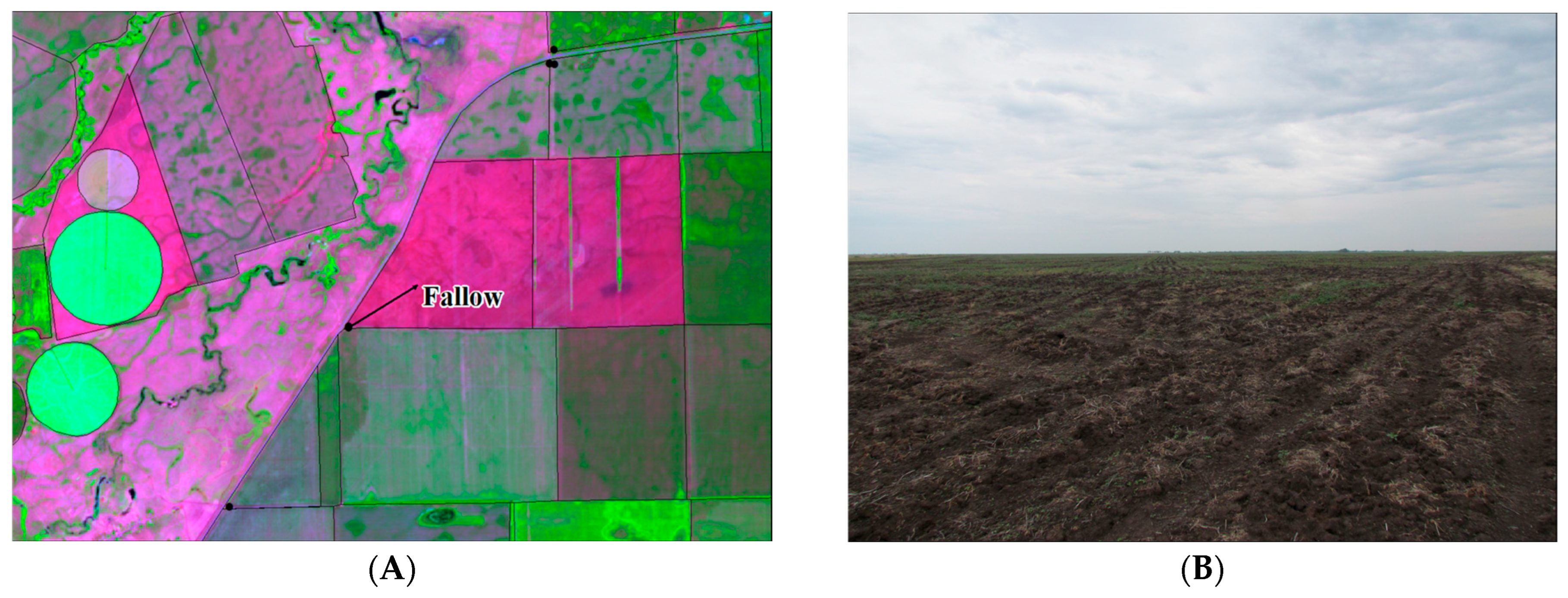
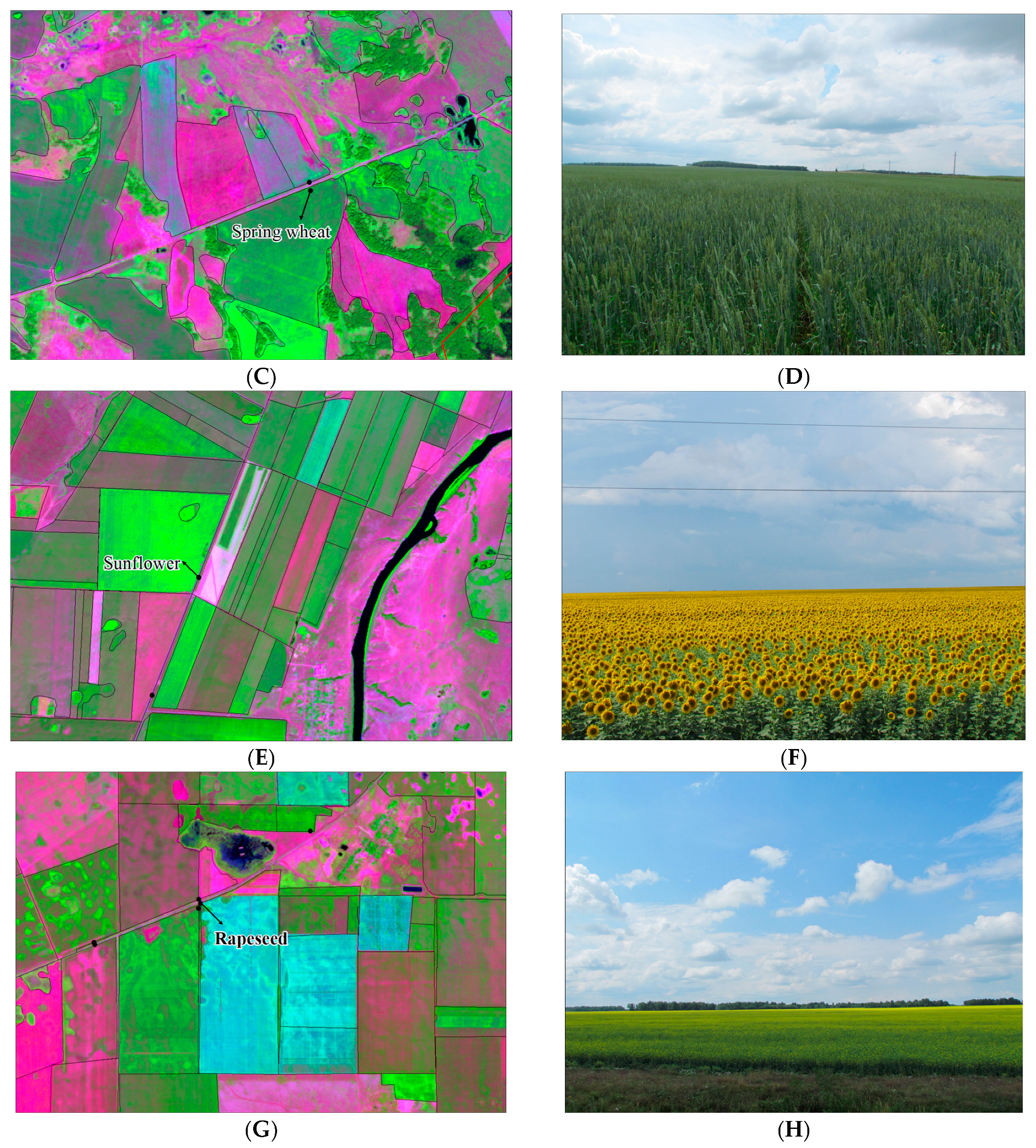
The field data were used to compare the mapped fallow areas with the actual condition of agricultural fields observed in situ. Special attention was paid to the distinction between fallow fields, cultivated cropland, and fields with weak or sparse vegetation cover. The route map with survey points was used to demonstrate the territorial distribution of field observations, while field photographs of different land-use types, including fallow fields and cultivated crops, were used as visual support for the interpretation (
Figure 6).
3.2. Adapted Plowed Land Index (PLI)
The identification of fallow fields in this study was based on the adapted Plowed Land Index (PLI), previously developed for Sentinel-2 data as a spectral indicator of plowed land. The index was derived from the Brightness component of the Tasseled Cap transformation and constructed as an original linear combination of six Sentinel-2 spectral bands: B2, B3, B4, B8, B11, and B12 [
30,
31,
32,
33,
34]. In the published methodology, the PLI was designed to enhance the spectral expression of plowed soil and to separate it from vegetated surfaces and other land-cover types [
20,
21,
22].
The Brightness Index for Sentinel-2 data was defined as:
where b2, b3, b4, b8, b11, and b12 correspond to the blue, green, red, near-infrared, and shortwave infrared bands of Sentinel-2. Based on this spectral logic, the adapted Plowed Land Index was formulated as follows:
The methodological rationale for using the PLI in the present study is that fallow lands in North Kazakhstan are commonly characterized by exposed or recently tilled soil surfaces combined with weak or discontinuous vegetation cover during the selected observation period. Under such conditions, the spectral response of fallow fields is closer to that of plowed surfaces than to actively growing crops. For this reason, an index specifically oriented toward soil exposure is more suitable for fallow identification than conventional vegetation indices alone. This logic is consistent with the original purpose of the PLI, which was created to detect plowed land on Sentinel-2 imagery through the weighted combination of visible, near-infrared, and shortwave infrared bands.
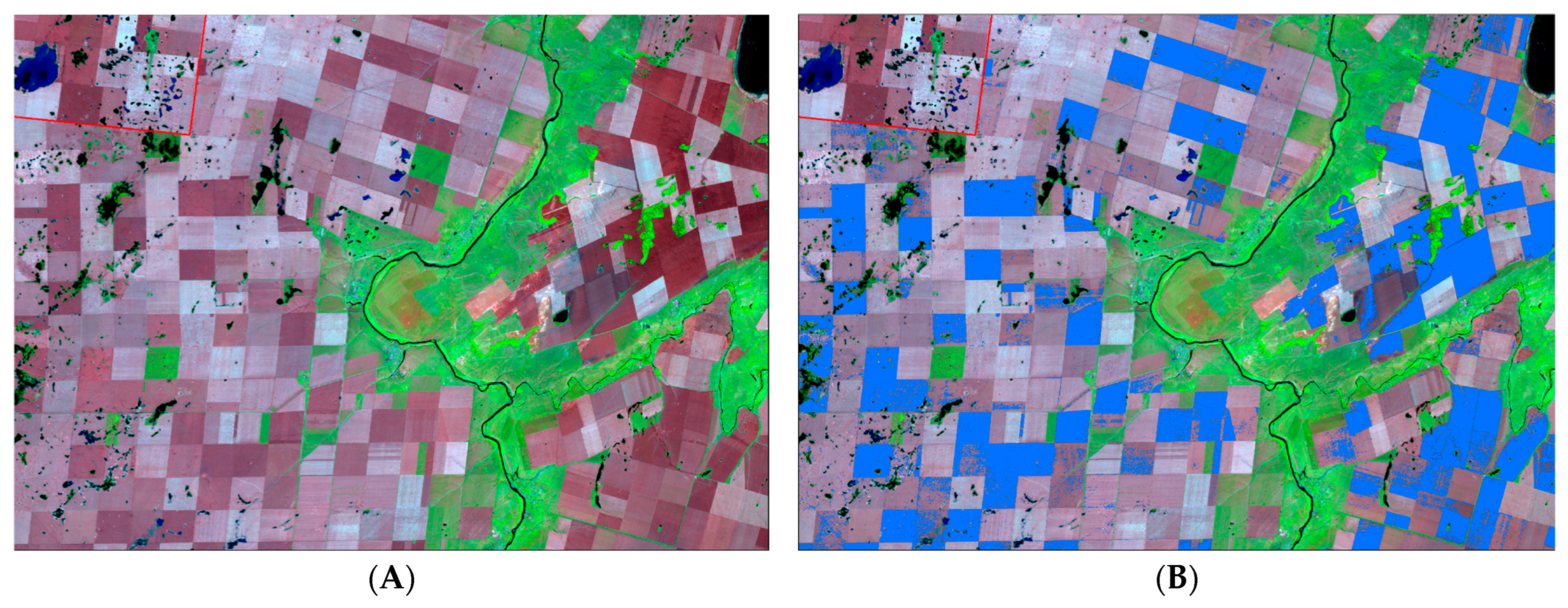
In the original PLI analysis, plowed soils were associated with small positive values, while dense vegetation corresponded to negative values, sparse vegetation occupied intermediate negative ranges, and fires were characterized by distinctly higher positive values. Specifically, plowed soils were reported at approximately 0.004–0.030, bare soil at approximately −0.020 to −0.006, dense vegetation at approximately −0.180 to −0.130, sparse vegetation at approximately −0.080 to −0.040, and fires at approximately 0.050 to 0.260. These relationships indicate that the PLI is sensitive not only to the vegetation absence but also to the spectral contrast between exposed soil and other surface types (
Figure 7).
Compared with the NDVI, the adapted PLI has an important methodological advantage for the present task. The NDVI is effective for distinguishing actively vegetated surfaces from non-vegetated ones, but it does not directly emphasize the spectral properties of plowed soil. PLI, by contrast, was specifically constructed for the recognition of plowed land and therefore provides a more suitable basis for identifying fallow fields associated with mechanically processed soil surfaces. In this study, the PLI was used as the principal index for delineating fallow lands, whereas the NDVI was applied only as a supporting indicator to exclude actively vegetated fields and to control for vegetation overgrowth. Such a combination made it possible to separate fallow lands from cropped areas more reliably under the heterogeneous agricultural conditions of North Kazakhstan.
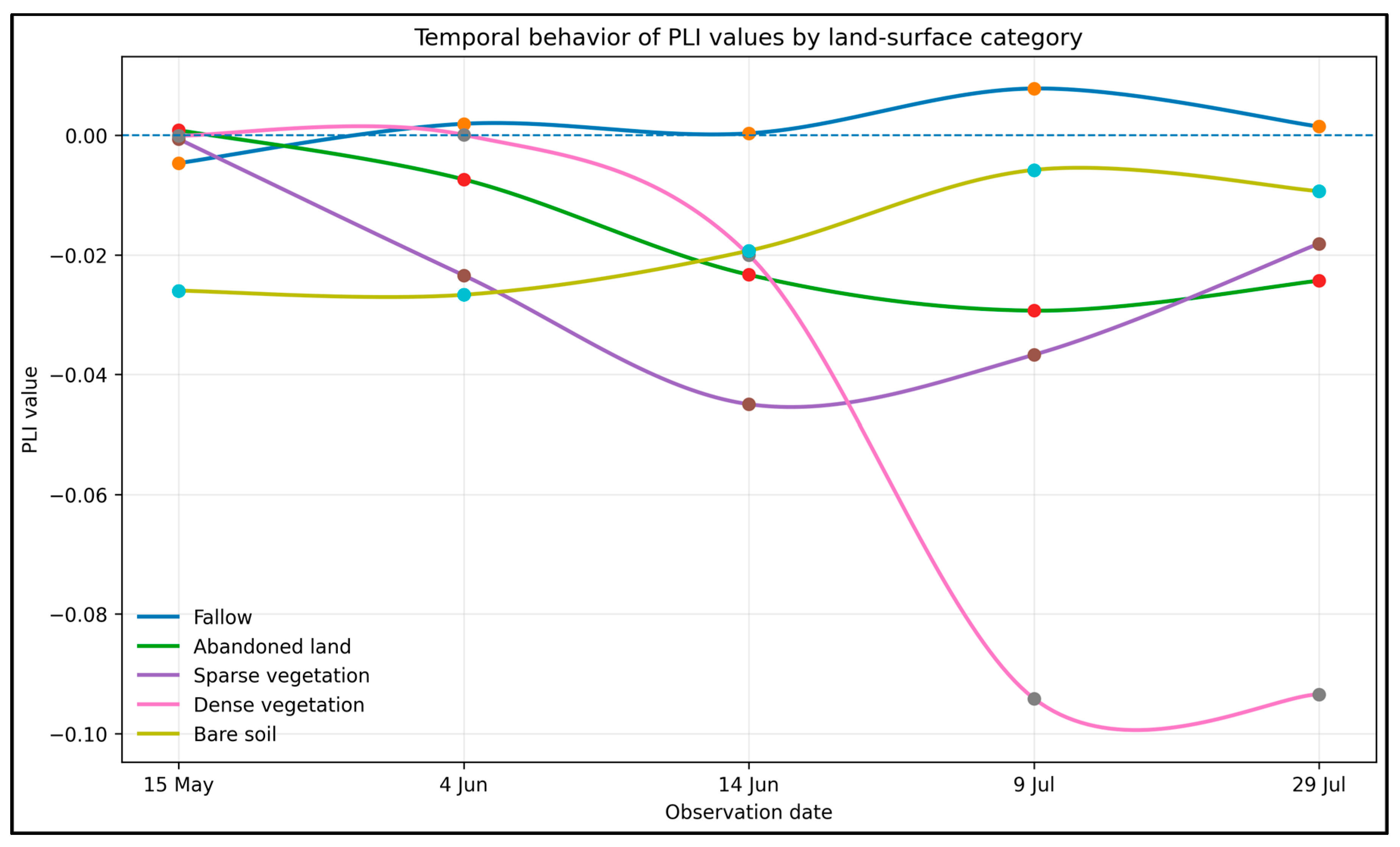
To further demonstrate the separability of the adapted PLI, the temporal mean values of the index were analyzed for representative land-surface categories, including fallow land, bare soil, abandoned land, sparse vegetation, and dense vegetation, from June to August. The comparison showed that fallow land was characterized by values close to zero or slightly positive, whereas vegetated surfaces generally exhibited lower values (
Figure 8). Dense vegetation demonstrated the most negative PLI values during the period of active biomass development, while bare soil and abandoned land occupied intermediate ranges. Such temporal differentiation confirms that the adapted PLI responds not only to the absence of vegetation but also to the spectral properties of exposed and recently tilled soil surfaces, which supports its applicability for fallow land identification in the North Kazakhstan Region.
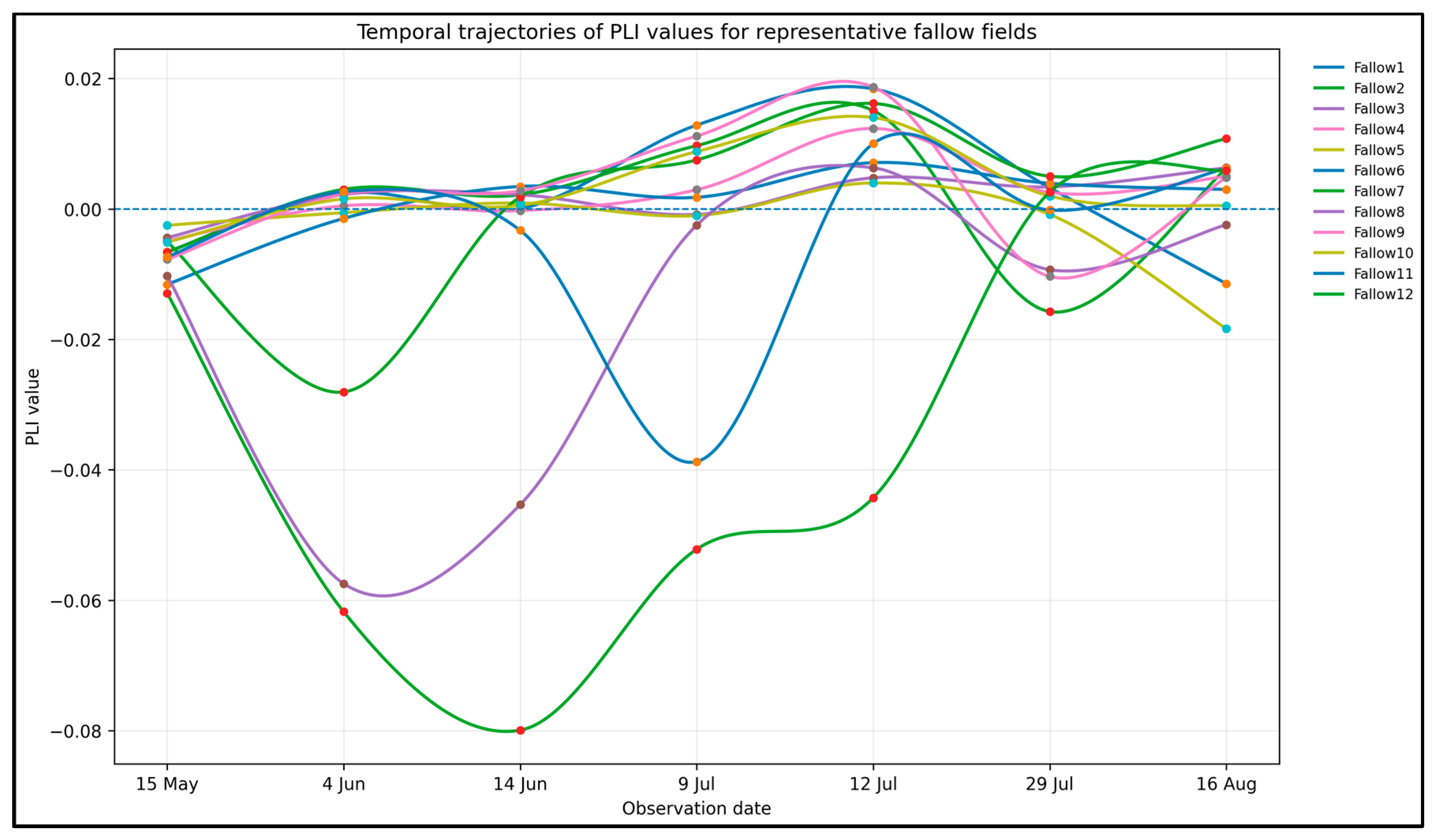
At the same time, the temporal behavior of the PLI indicates that fallow fields are not expressed identically on all observation dates. Positive or near-zero values may appear at different moments of the season depending on the timing of mechanical field treatment. Therefore, the interpretation of fallow land should rely on a multi-date approach rather than on a single scene. As shown in
Figure 7, such temporal differentiation increases the reliability of fallow identification under the heterogeneous agricultural conditions of the North Kazakhstan Region.
3.3. NDVI as a Supporting Index
The NDVI was used in this study as a supporting spectral indicator for differentiating fallow lands from actively vegetated agricultural fields. The index was calculated using the standard normalized difference formulation based on the near-infrared and red bands of Sentinel-2:
For the Sentinel-2 data used in this study, band B8 represented the near-infrared reflectance and band B4 represented the red reflectance [
35,
36,
37,
38].
The methodological role of the NDVI consisted of excluding fields occupied by actively developing crops and of controlling the degree of vegetation development on agricultural land. This was necessary because some fields with weak vegetation may partially show a spectral response in the PLI analysis that is close to bare soil. Under such conditions, the NDVI provided an additional criterion for separating non-vegetated or weakly vegetated surfaces from dense crop canopies.
To support this interpretation, seasonal NDVI trajectories were analyzed for representative crop and fallow fields in the Akkayin district of the North Kazakhstan Region. The comparison showed that cultivated crops were characterized by a pronounced increase in the NDVI from late May to July, followed by a decline toward August, whereas fallow lands maintained substantially lower and relatively stable values during the same period. This contrast confirms that the NDVI is effective for distinguishing actively vegetated fields from fallow surfaces. Therefore, in the present study NDVI was used as a complementary index, whereas the adapted PLI served as the principal indicator for fallow land mapping (
Figure 9).
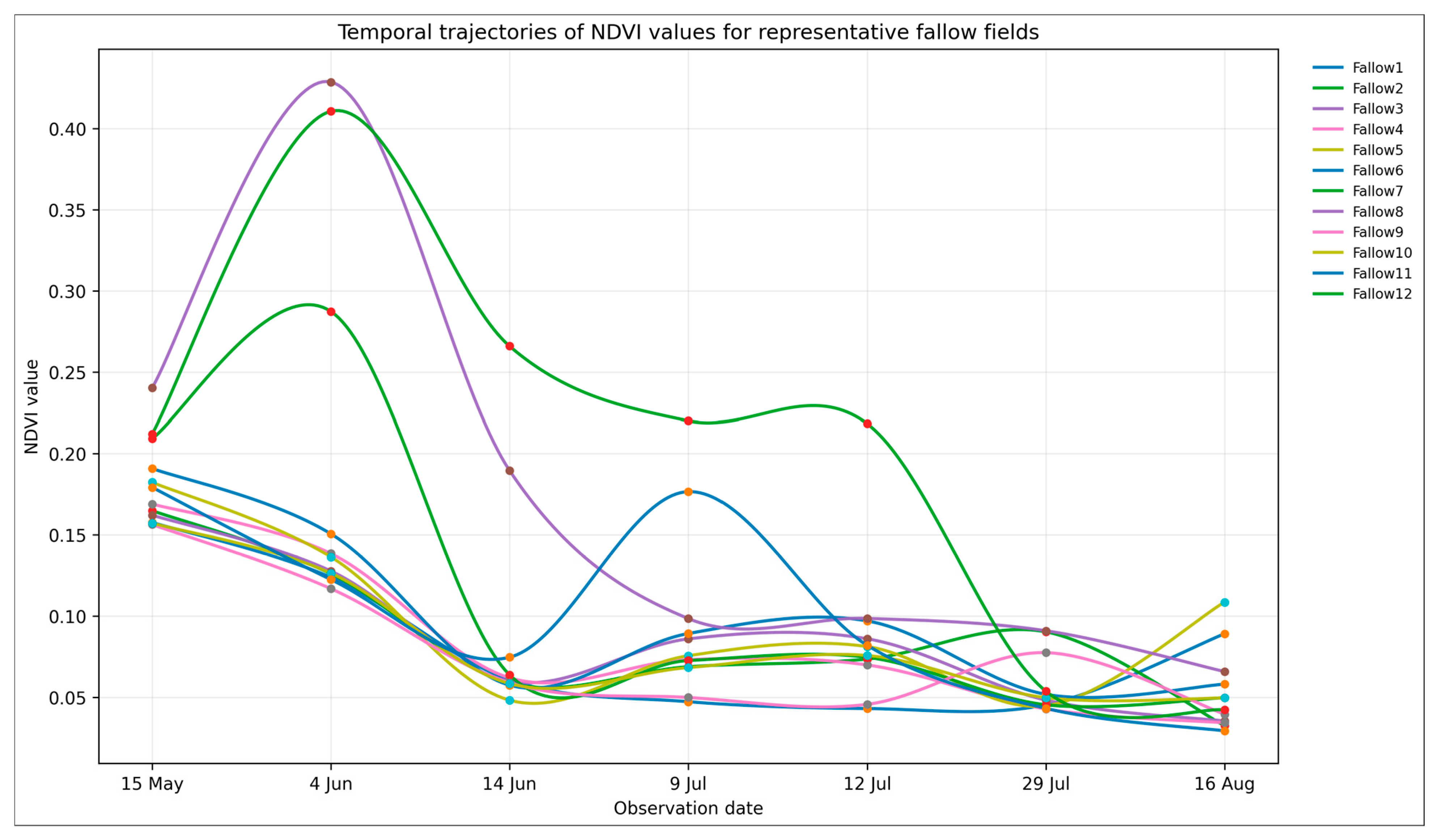
To further examine the behavior of the NDVI within the fallow class, temporal trajectories were also analyzed for representative fallow fields. The comparison showed that most fallow fields were characterized by relatively low NDVI values throughout the observation period, confirming the absence of dense and stable crop development. At the same time, the trajectories were not identical for all fields, which indicates that fallow lands differed in the degree of residual vegetation cover, overgrowth, or the timing of mechanical treatment.
This within-class variability is methodologically important because it shows that fallow fields should not be interpreted as a spectrally uniform category. Some fields maintained consistently low NDVI values, whereas others showed temporary increases on individual dates. As shown in
Figure 10, such differences do not contradict the fallow interpretation, but rather reflect the heterogeneous seasonal state of mechanically managed fields. Therefore, the NDVI was used in this study not as a direct identifier of fallow land, but as a supporting indicator for excluding actively vegetated crop fields and for controlling the degree of vegetation development within the fallow class.
3.4. Annual Mapping of Fallow Fields
Annual mapping of fallow fields was performed using a rule-based, field-level procedure that integrated the adapted Plowed Land Index (PLI) as the principal indicator of mechanically processed soil surfaces and the NDVI as a supporting indicator of vegetation development. The methodological logic of the procedure was based on the fact that fallow fields in North Kazakhstan Region may differ not only in the degree of vegetation cover, but also in the timing of tillage within the growing season. As a result, some fallow fields can be identified as early as June, whereas others become spectrally expressed only in the early, mid-, or late July period. For this reason, the annual mapping procedure was designed to account for different tillage timing and seasonal vegetation behavior within agricultural fields.
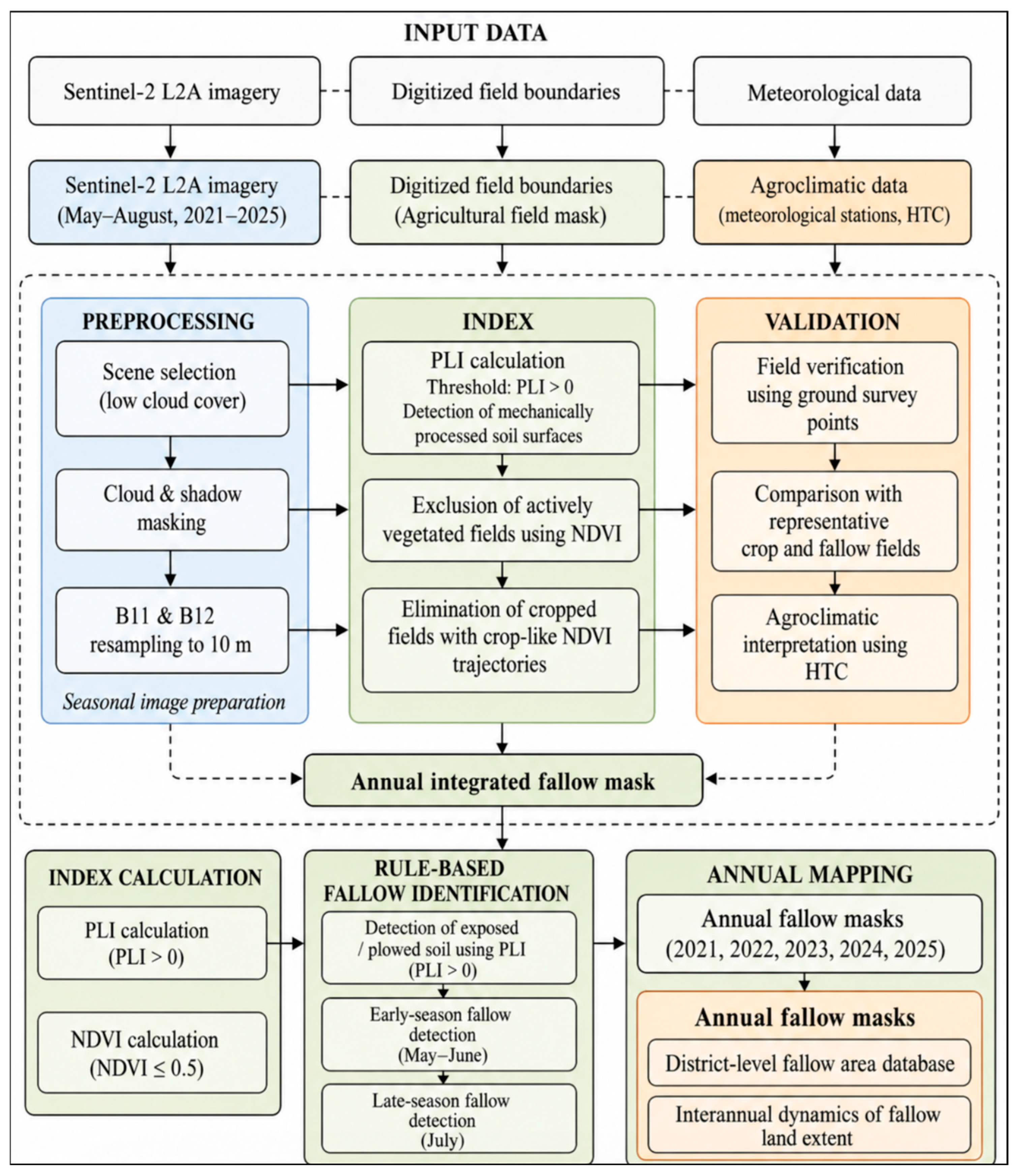
At the initial stage, all available Sentinel-2 scenes within the annual observation window from May to the end of July were processed, and field-level values of the PLI and NDVI were extracted for each agricultural field. The use of field boundaries made it possible to shift the analysis from the pixel level to the level of agricultural parcels, which reduced local spectral noise and ensured a more consistent interpretation of seasonal field conditions. The annual workflow combined remote sensing data, field verification, and agroclimatic interpretation and is summarized in the methodological flowchart (
Figure 11).
The first part of the procedure was focused on the identification of mechanically processed soil surfaces using the adapted PLI. In the present study, the PLI was treated as an index of the spectral response associated with plowing and mechanical soil processing. This distinction is important because the target class was not simply any exposed soil surface, but agricultural fields that had undergone mechanical soil treatment and remained outside the trajectory of normal crop development. Since the adapted PLI was formulated so that positive values correspond to processed soil surfaces, the annual identification of fallow candidates was based on the occurrence of positive PLI values within the seasonal observation window.
Thus, for each field
f, year
t, and observation date
d, the PLI and NDVI values were denoted as
and
respectively. A field was considered to contain a mechanically processed soil surface if at least one valid date within the seasonal observation set
satisfied the following condition:
where
denotes the set of valid observation dates for year
t.
Because fallow fields may be tilled at different times, two temporal conditions were introduced to distinguish early-season and late-season tillage signals. The early-season tillage condition was defined as
and the late-season tillage condition was defined as
Here, corresponds to the early part of the seasonal window (May–June), while corresponds to the later part of the observation period (July, depending on the availability of valid cloud-free scenes). Accordingly, describes fields that were mechanically processed earlier in the season, whereas captures fields tilled later.
At the second stage, the NDVI was used to exclude fields occupied by crops with active or increasing vegetation development. This step was necessary because some fields with sparse or transitional vegetation cover may still demonstrate PLI responses associated with processed soil surfaces, especially on certain dates. Therefore, the PLI alone was not sufficient for final fallow identification and had to be complemented by a vegetation-based filter. In contrast to the PLI, the NDVI was not used as a direct indicator of fallow land, but as an auxiliary criterion for eliminating fields with crop-like seasonal development.
For this purpose, the maximum seasonal NDVI and the seasonal NDVI amplitude were evaluated for each field:
A field was considered non-crop-like if it did not show a seasonal trajectory typical of actively developing cultivated crops, that is, if it remained below the threshold of intensive vegetation development or exhibited only a limited seasonal increase in the NDVI:
where
and
are empirically selected thresholds established from representative field samples and supported by field verification.
The final annual fallow mask was then defined according to the following rule:
In an expanded logical form, the annual fallow condition can be written as
This formulation allowed for the identification of fallow fields with different management timing, including fields tilled in May–June and fields mechanically processed later in July, while excluding fields with NDVI trajectories characteristic of cultivated crops.
From an algorithmic perspective, the annual fallow mapping procedure included the following steps:
- (1)
Calculation of the PLI and NDVI for all valid observation dates within the annual time window;
- (2)
Identification of fields with positive PLI values as indicators of mechanically processed soil surfaces;
- (3)
Separation of early-season and late-season tillage signals;
- (4)
Exclusion of fields with crop-like NDVI trajectories using the seasonal maximum and amplitude of the NDVI;
- (5)
Generation of the final annual fallow mask.
The procedure was applied consistently for each year from 2021 to 2025, which resulted in a set of annual fallow masks. These masks formed the basis for the subsequent calculation of fallow land extent, district-level aggregation, and the analysis of interannual dynamics. The corresponding workflow also included field verification based on ground survey points and the interpretation of spatial and temporal differences using agroclimatic indicators, primarily the hydrothermal coefficient (HTC), as shown in
Figure 9.
3.5. Agroclimatic Data and Hydrothermal Coefficient (HTC)
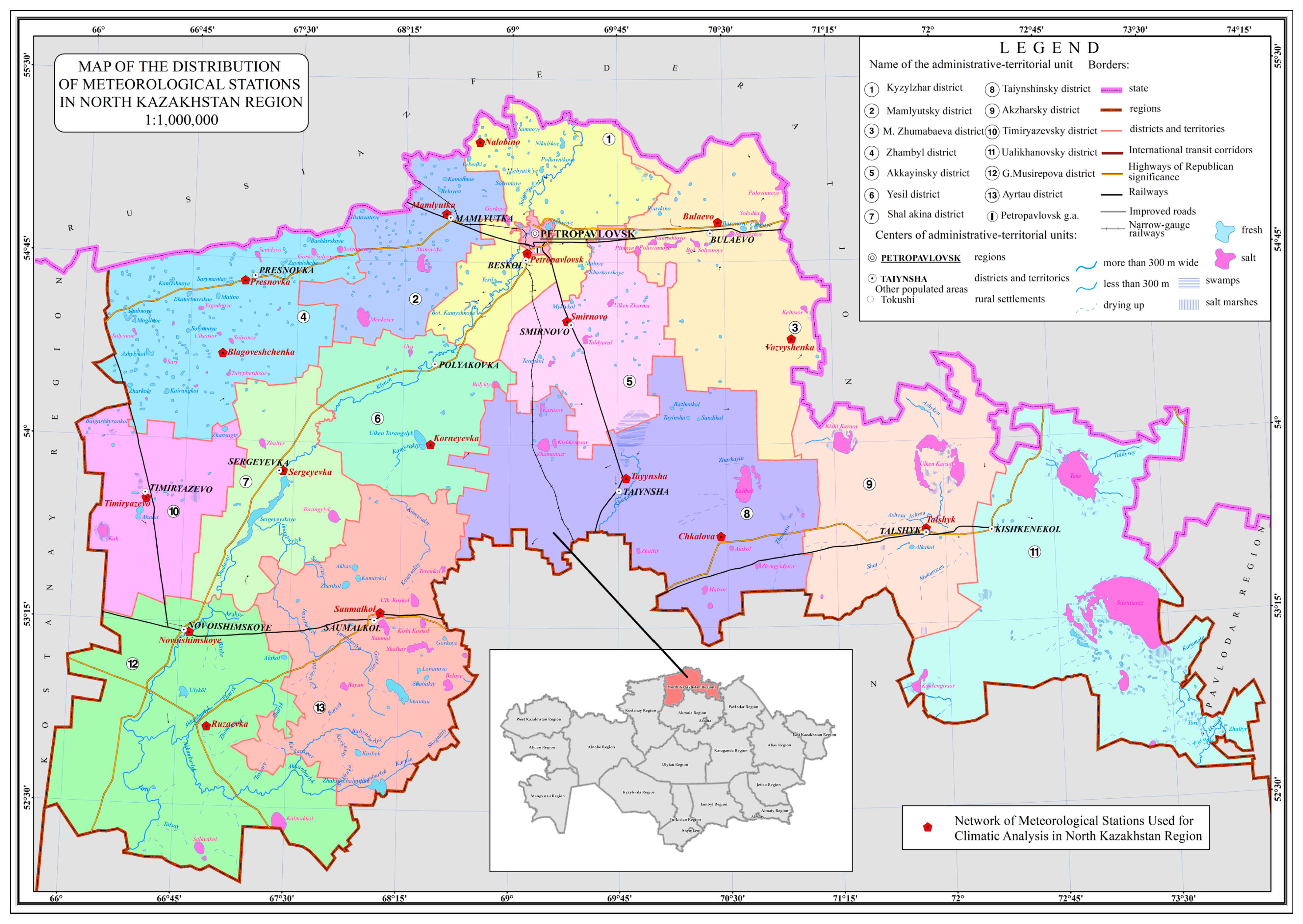
Agroclimatic conditions in the North Kazakhstan Region were analyzed using meteorological data from stations distributed across the study area and spatially linked to the district framework used in the fallow land analysis. The meteorological station network covered the principal agricultural districts of the region and served as the basis for comparing territorial differences in moisture availability within the same growing season of the analyzed years (
Figure 12).
The analysis covered the period 2021–2025, fully corresponding to the years for which annual fallow masks were generated from Sentinel-2 data. Such temporal consistency made it possible to analyze changes in fallow land extent in relation to the prevailing agrometeorological conditions. Methodologically, the hydrothermal coefficient (HTC) was used as an integrated indicator of the ratio between precipitation and heat supply during the growing season and, consequently, as a generalized measure of moisture availability under rainfed farming conditions.
The hydrothermal coefficient was calculated according to the standard formula:
where ∑R—is the total precipitation for the selected period and
—is the sum of air temperatures above 10 °C [
39,
40]. Lower HTC values correspond to drier conditions and reduced moisture availability, whereas higher values indicate more favorable hydrothermal conditions relative to heat supply. In the context of North Kazakhstan, where agriculture is predominantly rainfed, this coefficient provides a suitable basis for explaining spatial and interannual differences in the functioning of crop rotations and fallow systems.
In the present study, the HTC was not used for the direct identification or classification of fallow fields. The calculated HTC values were used to analyze moisture conditions or increasing aridity by district and to substantiate the increase or decrease in fallow field area over the years. Remote sensing identification of fallow lands was performed using the PLI and NDVI, whereas the HTC was applied for result interpretation and for comparing changes in fallow extent with moisture conditions during the growing season.
The district-based map of meteorological stations made it possible to interpret HTC values in direct relation to the territorial units used in the subsequent analysis of fallow land extent. This approach ensured consistency between the agroclimatic dataset and the spatial aggregation of annual fallow masks.
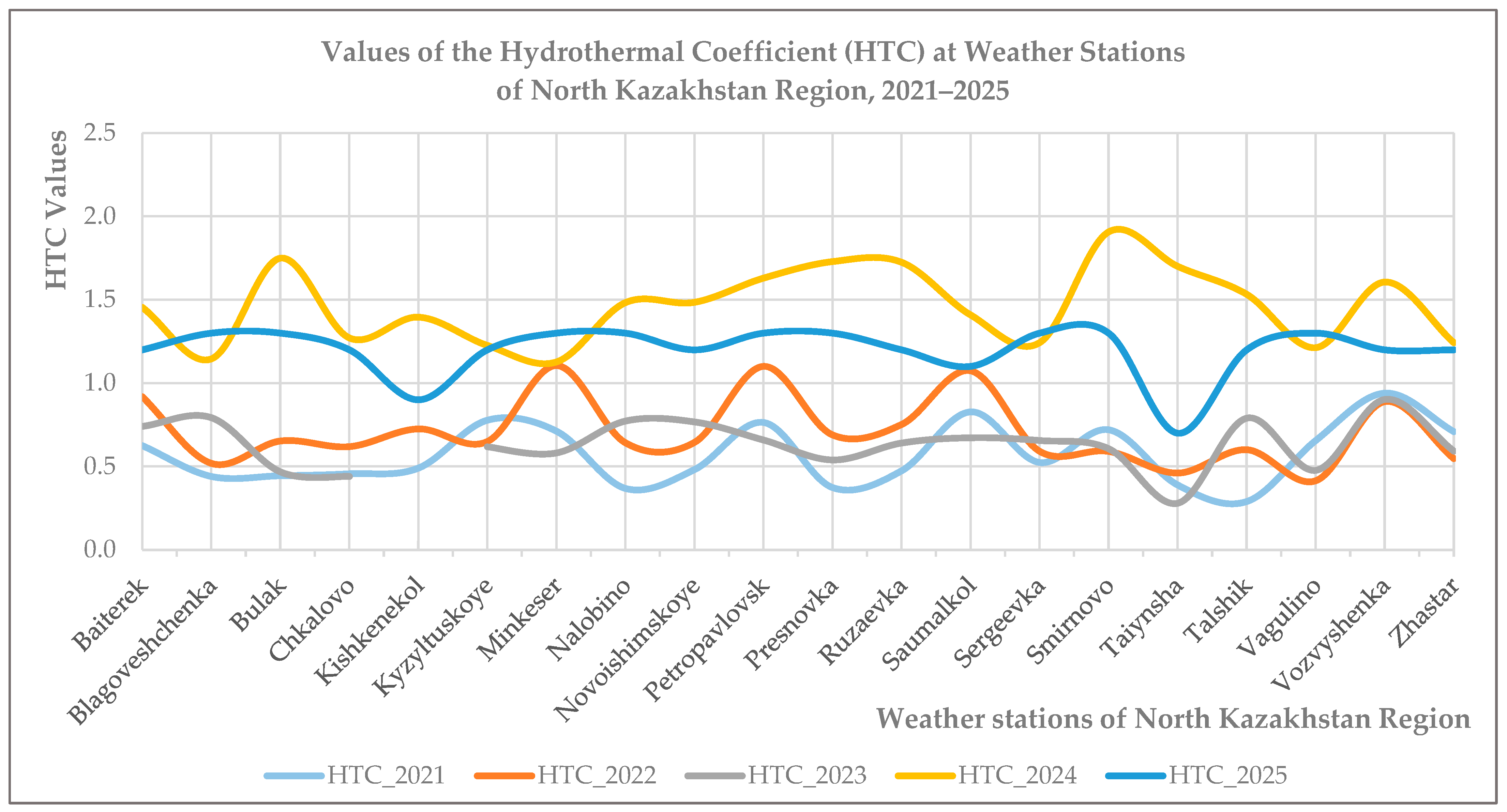
The annual HTC series for 2021–2025 showed both interannual variability and pronounced spatial differentiation. Some districts were characterized by relatively favorable hydrothermal conditions, while others showed lower or more variable moisture availability. Under such conditions, the role of fallow as a moisture-regulating element of crop rotation is expected to differ territorially. Consequently, the agroclimatic interpretation based on the HTC provided an additional basis for understanding why the spatial distribution and annual extent of fallow lands were not uniform across the North Kazakhstan Region (
Figure 13).
Thus, in this study HTC served as an auxiliary but important analytical component linking remotely mapped fallow land dynamics with the broader agroclimatic background of the region. Its use strengthened the interpretation of annual and district-level differences in fallow land extent and provided a climatic context for the subsequent analysis of interannual dynamics.
3.6. Calculation of Fallow Land Extent and Interannual Dynamics
The annual extent of fallow land was calculated on the basis of the fallow masks obtained from the rule-based classification procedure described above. Since fallow identification was performed at the field level, the calculation of the fallow area was also conducted using the polygonal field mask. This approach ensured that the final estimates corresponded to agricultural field units rather than to isolated raster pixels and therefore provided a more agronomically meaningful representation of the fallow land structure.
For each year from 2021 to 2025, all agricultural fields classified as fallow were selected from the annual mask, and their polygon areas were summed within each administrative district of the North Kazakhstan Region. Thus, the district-level fallow area for district
i in year
t was defined as
where
is the total fallow area in district
i in year
t,
is the area of the
k-th field classified as fallow in that district and year, and
ni is the number of fallow fields within the district. Because the fallow masks were derived from polygon-based field units, the calculation of the area was directly linked to the actual geometry of agricultural parcels.
The resulting values were organized into a district-by-year matrix covering the full study period. This matrix served as the basis for subsequent interannual comparisons and graphical analysis. In addition to the district-level fallow area, the processed agricultural area was also considered as the sum of cropland and fallow land within each district. This made it possible to calculate not only the absolute fallow area, but also its share within the processed agricultural area:
where
is the percentage share of fallow land in the processed agricultural area of district
i in year
t, and
is the cropland area derived from remote sensing data for the same district and year.
To quantify interannual dynamics, annual changes in fallow extent were evaluated both in absolute and relative forms. The absolute interannual change for district
i between two consecutive years was calculated as
where
expresses the increase or decrease in fallow area relative to the previous year. In addition, the relative change rate was calculated as
where
is the percentage change in fallow area relative to year
t − 1.
The calculated values were then used to identify the direction of change in each district, including the increase, decrease, or relative stability of fallow extent over time. District-by-year tables and derived change indicators were further used for the graphical analysis of interannual dynamics and for the comparison of spatially differentiated trajectories among districts. In this way, the methodological basis of the term interannual dynamics in the present study consisted not only in the comparison of annual fallow maps, but also in the explicit calculation of district-level area values, annual differences, and relative change rates throughout the 2021–2025 period.
Although the maps themselves are presented in the Results section, the calculation procedure described here provided the numerical basis for all subsequent interpretations of temporal change. Thus, annual fallow masks were transformed into a structured statistical dataset that allowed both regional and district-level assessments of fallow land dynamics in the North Kazakhstan Region.
4. Results
4.1. Spatial Distribution of Fallow Lands
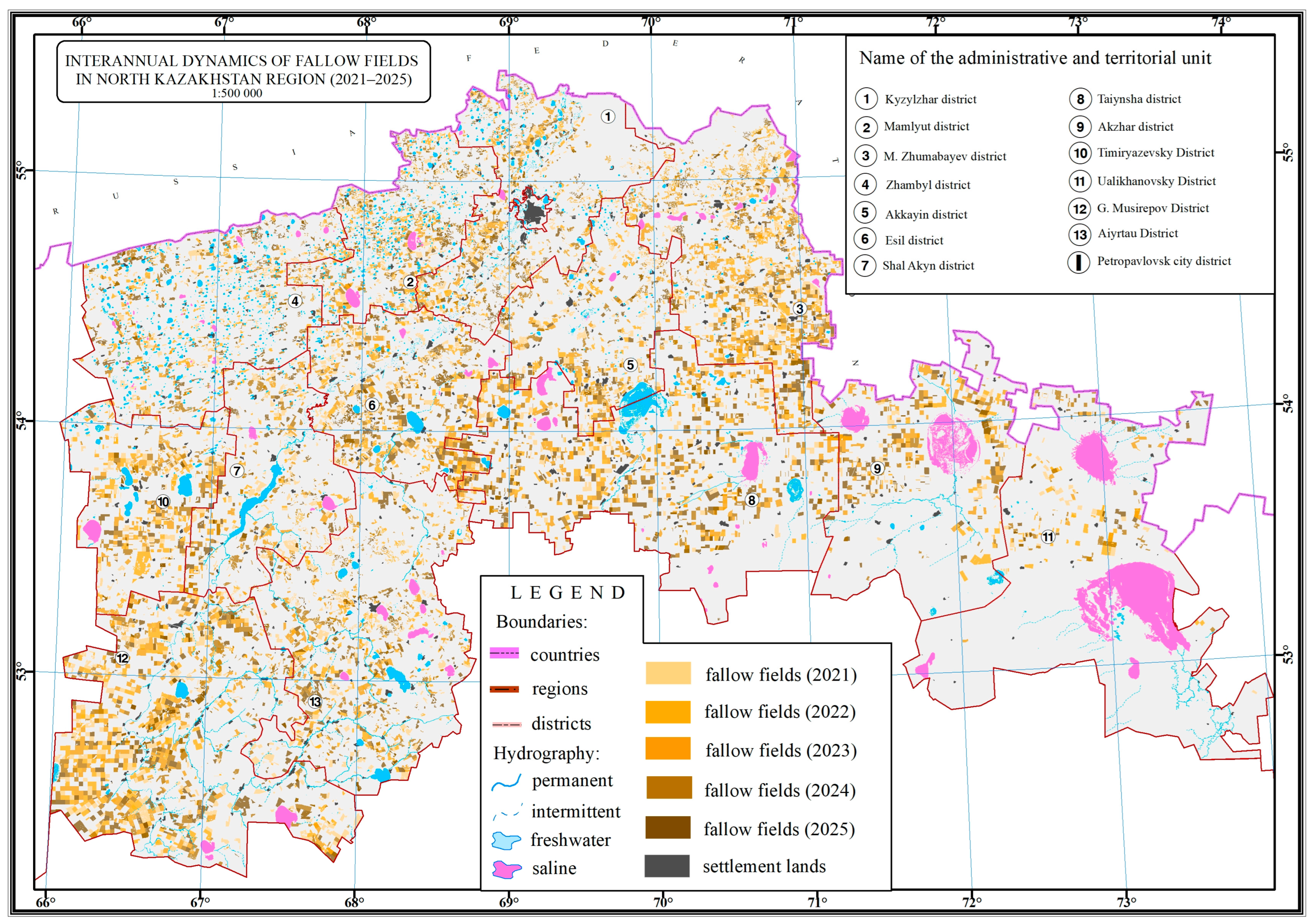
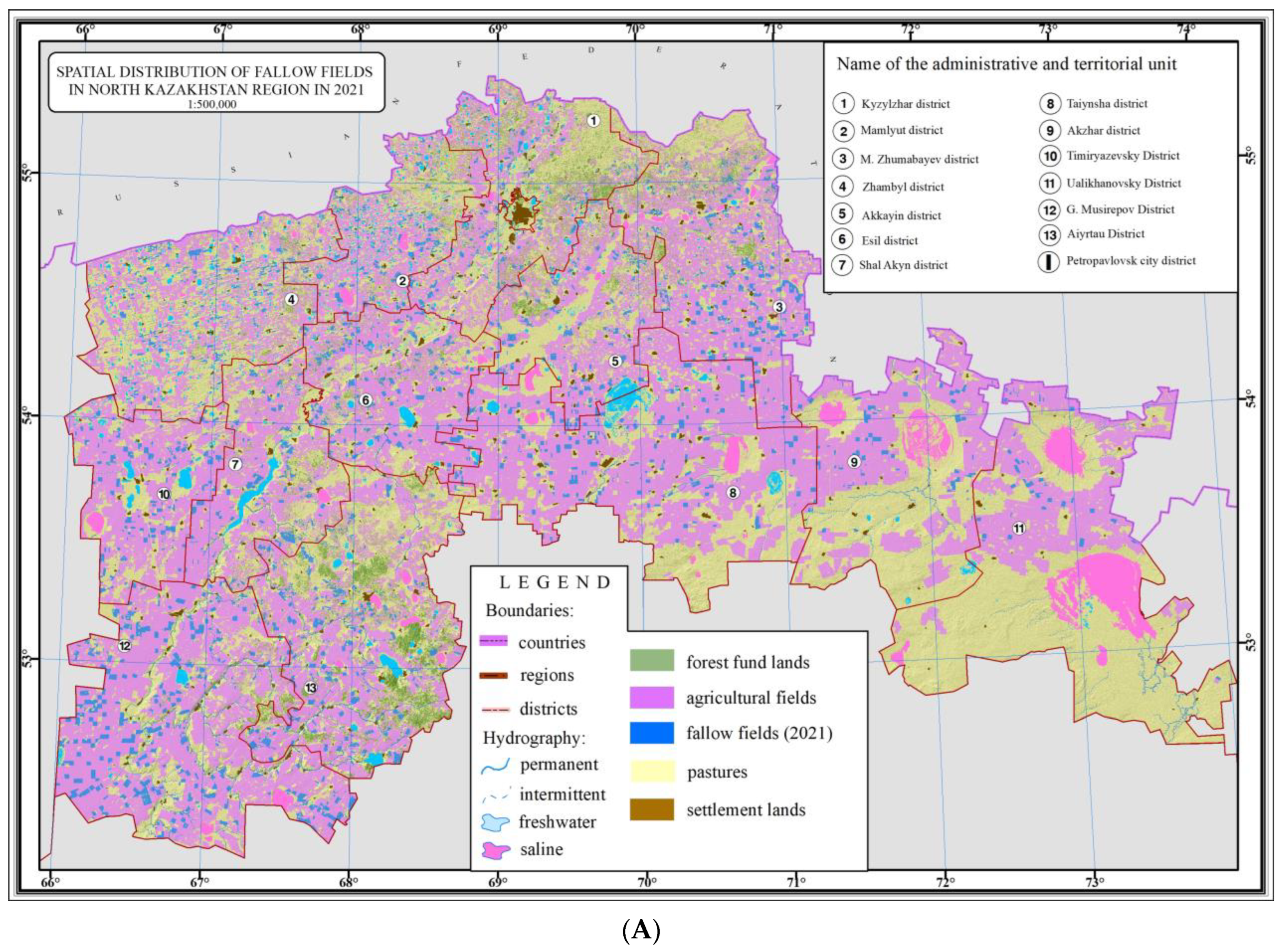
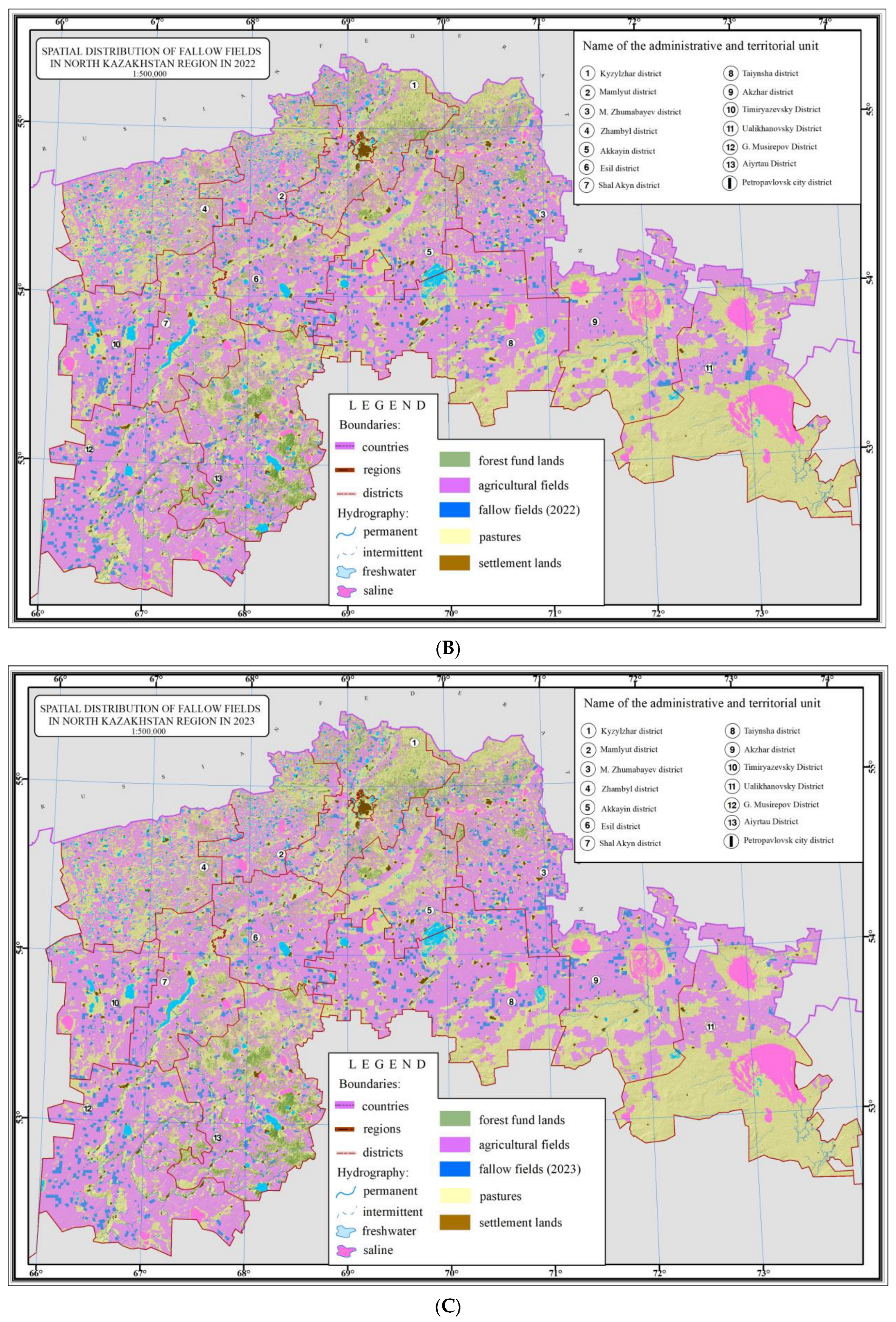
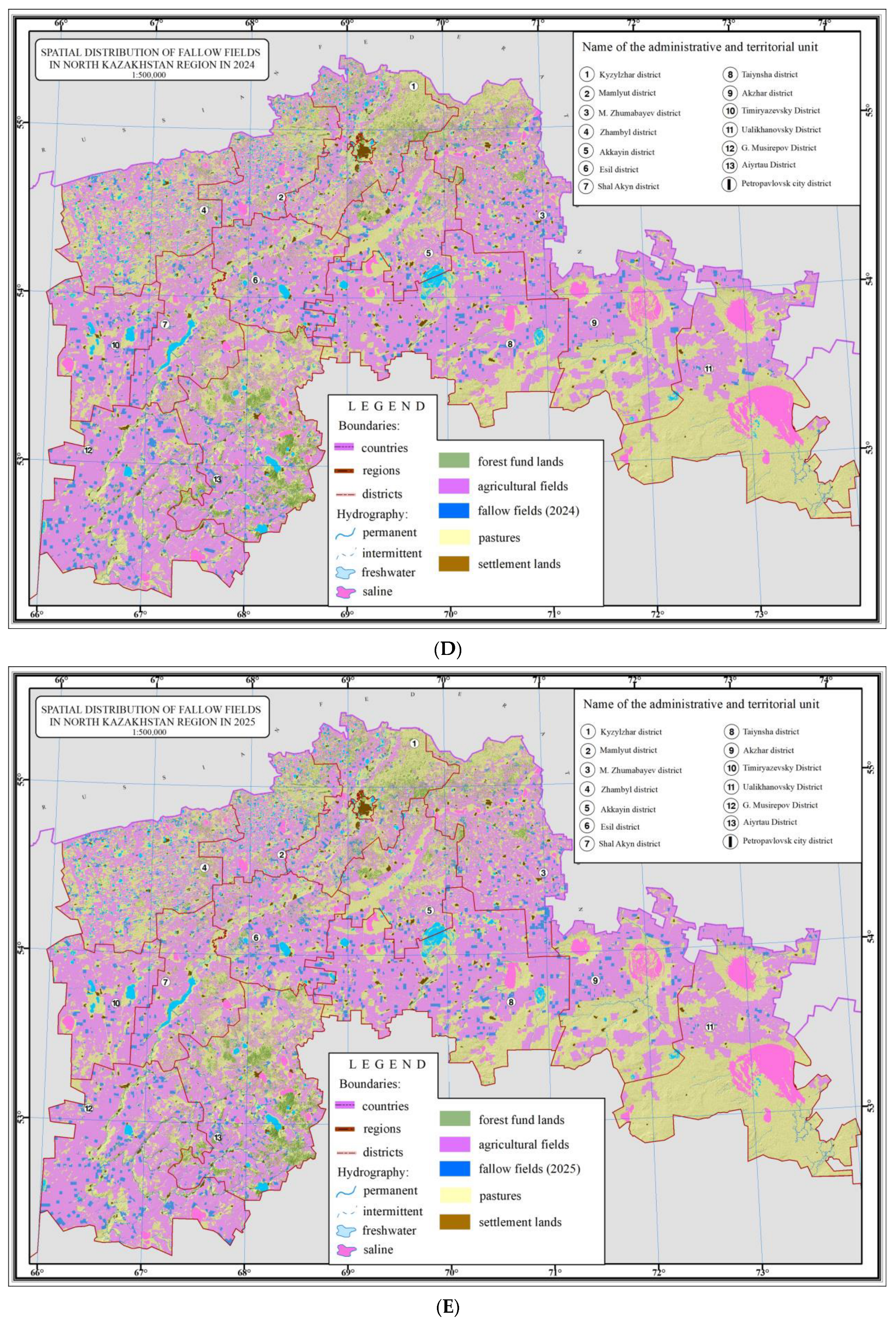
The annual maps of fallow fields show that their spatial distribution in the North Kazakhstan Region was markedly heterogeneous and remained strongly controlled by the general structure of agricultural land use. In all analyzed years, fallow fields were concentrated mainly within the intensively cultivated belt occupying the central, northern, western, and southwestern districts, whereas the eastern and southeastern parts of the region displayed a lower density of fallow patches. This pattern corresponds to the contrast between districts dominated by large arable massifs and those characterized by a greater proportion of pasture lands, lake depression landscapes, and less continuous cultivated areas.
The maps for 2021–2025 indicate that fallow fields were not randomly distributed, but formed a relatively stable territorial framework. The highest spatial concentration of fallow lands was observed in the districts with extensive cropland and large processed agricultural areas, particularly in the G. Musirepov, M. Zhumabayev, Taiynsha, and Ayirtau districts. In contrast, the Ualikhanov District consistently showed the lowest representation of fallow land, both in absolute area and in proportional terms, which is in agreement with its more fragmented and less arable-oriented land-use pattern. A relatively low concentration of fallow fields was also observed in some eastern and northeastern districts, where the agricultural mosaic was less continuous than in the central and western parts of the region (
Figure 14A–E).
A comparison of the annual maps shows that the broad spatial pattern of fallow distribution remained recognizable throughout the study period, but the density and continuity of fallow patches varied by year. In 2021, the maps showed the most extensive distribution of fallow fields, which was especially visible in the central-western and southwestern districts. In 2024, by contrast, the mapped area of fallow lands was noticeably reduced, and the fallow pattern became less continuous in many districts. In 2025, the spatial extent of fallow fields increased again relative to 2024, although it did not return to the 2021 level. Thus, the maps indicate that interannual change was expressed primarily through changes in the density and area of fallow patches within a relatively persistent agricultural framework.
Territorial differences among districts were also reflected in the statistical indicators of the fallow area. The largest absolute areas of fallow land were repeatedly recorded in the G. Musirepov district, where the mapped fallow area ranged from 68.8 to 102.7 thousand ha, and in the Taiynsha district, where it ranged from 47.4 to 69.2 thousand ha. The M. Zhumabayev District also showed persistently high values, varying from 42.8 to 63.3 thousand ha. By contrast, the smallest absolute values were observed in the Ualikhanov district, where the fallow area ranged from 7.5 to 16.6 thousand ha, and in the Akzhar District in some years. These differences confirm that the distribution of fallow land in the North Kazakhstan Region was territorially differentiated and closely linked to the regional structure of cultivated land.
The cumulative map of fallow fields for 2021–2025 further confirms that the repeated occurrence of fallow was concentrated mainly within the core cropland districts of the region. This indicates that interannual variability did not eliminate the basic territorial differentiation, but rather modified the intensity of fallow use within a spatial structure that remained generally stable over time (
Figure 15).
4.2. Interannual Dynamics of Fallow Land Extent (2021–2025)
The district-by-year statistics reveal pronounced interannual variability in fallow land extent across the North Kazakhstan Region during 2021–2025. The total mapped fallow area was 486.3 thousand ha in 2021, then declined sharply to 431.7 thousand ha in 2022, remained nearly stable at 433.6 thousand ha in 2023, decreased further to 398.4 thousand ha in 2024, and rose again to 410.0 thousand ha in 2025. Thus, the overall trajectory was characterized by a high initial level in 2021, a marked contraction in 2022, relative stabilization in 2023, a minimum in 2024, and a partial recovery in 2025 (
Table 3).
This pattern is also reflected in the relative share of fallow land within the processed agricultural area. In 2021, several districts showed high percentages of fallow land, including the Mamlyut district (13.5%), the G. Musirepov district (12.6%), the Ayirtau district (12.4%), the Esil district (11.9%), and the Akkayin district (11.9%). In 2022, the highest share was recorded in the Timiryazev district (12.1%), while in 2023 the minimum value of the entire study period was observed in the Ualikhanov district (3.0%). In 2024 and 2025, the percentage values remained moderate in most districts, but the Ualikhanov district again retained the lowest fallow share, with 6.5% in 2024 and 3.9% in 2025. These figures indicate that the interannual dynamics were expressed not only in absolute area, but also in the changing proportion of fallow land within the district-level structure of processed agricultural land.
The spatial distribution of fallow fields across the territory was heterogeneous. Some districts retained persistently high fallow areas throughout the study period, although with changing magnitudes. The G. Musirepov district had the largest fallow extent in every year, decreasing from 102.7 thousand ha in 2021 to 68.8 thousand ha in 2025. The Taiynsha district also remained among the leading districts, with a maximum of 69.2 thousand ha in 2023 and 64.7 thousand ha in 2025. Thee M. Zhumabayev district showed a comparable pattern, with values ranging between 42.8 and 63.3 thousand ha. These districts therefore formed the principal regional core of fallow use over the entire study period.
At the same time, the direction and magnitude of annual change differed among districts. Between 2021 and 2022, many districts showed a decrease in fallow area, which contributed to the regional decline from 486.3 to 431.7 thousand ha. However, some districts, such as Akzhar and Timiryazev, increased their fallow area during the same interval. Between 2022 and 2023, the regional total remained almost unchanged, but district-level shifts were more contrasting: the M. Zhumabayev, Taiynsha, and Akzhar districts increased their fallow area, whereas the Ayirtau, Esil, Zhambyl, and Mamlyut districts showed declines. Between 2023 and 2024, the overall fallow extent decreased again, mainly because of reductions in districts such as M. Zhumabayev, Taiynsha, and Timiryazev. In 2025, the regional total increased relative to 2024, but the rise was selective rather than universal: the Ayirtau, Akzhar, Esil, Zhambyl, and Taiynsha showed increases, whereas the G. Musirepov, M. Zhumabayev, Akkayin, Timiryazev, and Ualikhanov districts displayed further declines or only a slight recovery.
The comparison with HTC values should therefore be interpreted as a descriptive agroclimatic context rather than as direct quantitative proof of a uniform inverse relationship between moisture availability and fallow extent. Although the regional pattern is broadly consistent with lower moisture availability being associated with larger fallow areas, this relationship was not homogeneous across districts and years, which indicates that district-level land-use structure and management decisions also played an important role. Given the short 2021–2025 period, the HTC in this study is considered an explanatory background factor for interpreting interannual variability rather than a statistically validated predictor. Under drier hydrothermal conditions, the share and area of fallow land tend to increase, whereas under relatively more favorable moisture supply the need for maintaining large fallow areas may decrease.
Nevertheless, the relationship between the HTC and fallow extent was not strictly uniform in every district and year. The district-level data indicate that fallow dynamics were shaped by the combined influence of agroclimatic variability and land management decisions. Therefore, the interannual dynamics of fallow land in the North Kazakhstan Region should be interpreted as a territorially differentiated process in which regional climatic conditions provide an important background, but the final pattern emerges through district-specific agricultural responses.
This district-level heterogeneity was additionally examined by Spearman rank correlation analysis between the HTC values and fallow area for each study year. The results showed that the relationship was not stable across years and did not reach statistical significance in any year: ρ = 0.021 in 2021 (
n = 12,
p = 0.948), ρ = 0.168 in 2022 (
n = 12,
p = 0.602), ρ = 0.355 in 2023 (
n = 11,
p = 0.285), ρ = 0.490 in 2024 (
n = 12,
p = 0.106), and ρ = −0.263 in 2025 (
n = 12,
p = 0.408). These results indicate that the district-level fallow extent cannot be explained by the HTC alone and should be interpreted together with land-use structure and management conditions (
Table 4).
Overall, the analysis confirms that the term interannual dynamics is fully justified for the 2021–2025 period. The mapped fallow area did not remain static, but showed a clearly expressed sequence of contraction, stabilization, renewed decrease, and partial recovery, with substantial district-level contrasts in both absolute extent and the direction of change.
5. Discussion
The results showed that fallow land dynamics in the North Kazakhstan Region during 2021–2025 were controlled by a combination of agroclimatic, agronomic, and spatial factors rather than by a single cause. The regional trajectory, with the largest fallow extent in 2021, a decline in 2022, near-stable conditions in 2023, a minimum in 2024, and a partial increase in 2025, indicates that fallow is a flexible component of rainfed crop rotations. Under such conditions, the annual extent of fallow land reflects both the need for moisture regulation and the management decisions made within individual districts.
The comparison with the HTC supports the interpretation that agroclimatic variability was one of the main background factors of these dynamics. Years characterized by lower hydrothermal conditions corresponded to larger fallow areas, whereas years with relatively higher HTC values were associated with a smaller fallow extent. This relationship is consistent with the functional role of fallow in dryland farming, where mechanically processed fields are used as an element of moisture conservation. At the same time, the district-level differences show that the HTC cannot be treated as the only explanatory variable, because the response of fallow extent also depends on crop rotation structure, farm specialization, and local land management practices.
A further important result is the pronounced territorial heterogeneity of fallow land dynamics. Districts with extensive and continuous cropland, especially the G. Musirepov, Taiynsha, and M. Zhumabayev districts, repeatedly formed the main regional core of fallow use. By contrast, districts with smaller or more fragmented arable areas showed a lower and less stable fallow extent. This means that regional averages alone are insufficient for interpretation, and that district-level analysis is methodologically necessary for understanding how interannual dynamics are expressed spatially.
The use of the adapted PLI was a major methodological advantage of the study. Unlike vegetation indices, which primarily respond to biomass development, the PLI is sensitive to mechanically processed soil surfaces and therefore corresponds more directly to the land-state characteristic that defines fallow management. This was especially important because fallow fields in North Kazakhstan may be tilled at different times within the growing season. The combination of the PLI as the principal indicator and the NDVI as a supporting filter made it possible to identify both early-season and late-season fallow fields while excluding areas with crop-like vegetation trajectories.
At the same time, several methodological limitations should be taken into account. The detection of fallow fields depends on the availability of cloud-free Sentinel-2 scenes within the critical seasonal window, and the spectral expression of mechanically processed soil may vary depending on the exact timing of field treatment. In addition, some transitional agricultural surfaces may complicate interpretation, especially where sparse vegetation, disturbed soil, or mixed spectral responses occur. A probable source of false positive interpretation is represented by fields with recently disturbed or exposed soil surfaces that are not managed as true fallow land, including temporarily bare agricultural fields, post-harvest disturbed plots, or abandoned land with weak seasonal vegetation. Under such conditions, positive PLI values may be detected even though the field does not belong to the fallow class in the agronomic sense. Conversely, false negative cases may occur where actual fallow fields retain residual vegetation cover, partial overgrowth, or crop-like NDVI behavior during part of the season, which may reduce the PLI response or lead to their exclusion by the NDVI-based filtering. These uncertainties are most likely in transitional field states and in years or districts where the timing of mechanical treatment does not coincide well with the available Sentinel-2 acquisition dates. For this reason, the use of the NDVI and field verification was essential for strengthening the reliability of the final annual masks.
Overall, the present results confirm that fallow land dynamics in the North Kazakhstan Region should be interpreted as a territorially differentiated and multi-factor process. Agroclimatic conditions provide the environmental background, district-specific land-use structure constrains the spatial pattern, and agricultural management determines the operational response. Within this framework, the adapted PLI proved to be an effective basis for annual fallow mapping and interannual comparison under the conditions of rainfed agriculture.
An additional limitation of the study is that field verification was available only for 2025; therefore, the reliability of annual fallow mapping for 2021–2024 was assessed indirectly through the consistency of the rule-based procedure, multi-date spectral behavior, and district-level comparison of annual spatial patterns rather than through a formal year-specific confusion matrix.
The reliability of the annual mapping results also depends on the empirical threshold criteria used for PLI and NDVI filtering, as well as on year-specific observation conditions, including the timing of mechanical field treatment and the availability of suitable cloud-free Sentinel-2 scenes. These factors may introduce additional uncertainty and potential year-specific bias in the spectral expression and interpretation of fallow fields.
6. Conclusions
This study analyzed the interannual dynamics of fallow land extent in the North Kazakhstan Region during 2021–2025 using Sentinel-2 data. The results showed that fallow land did not remain stable over time, but changed substantially both in total area and in district-level distribution. The maximum regional fallow extent was recorded in 2021, followed by a decrease in 2022, near-stable conditions in 2023, a minimum in 2024, and a partial increase in 2025. Thus, the identified dynamics confirmed that fallow land in North Kazakhstan should be interpreted as a flexible component of rainfed agricultural land use rather than as a fixed land category.
An important methodological result of the study is the confirmation of the applicability of the adapted Plowed Land Index (PLI) for annual fallow mapping under the conditions of Northern Kazakhstan. Unlike vegetation indices, the PLI is directly related to mechanically processed soil surfaces and therefore provides a more suitable basis for identifying fallow fields. The combination of the PLI as the principal indicator and the NDVI as a supporting filter made it possible to account for differences in tillage timing and to exclude fields with crop-like vegetation development. In this way, the study demonstrated that annual fallow masks can be generated using a rule-based multi-temporal procedure based on Sentinel-2 data.
The results also showed that fallow land dynamics were territorially differentiated. Districts with extensive and continuous cropland formed the principal core of fallow distribution, whereas districts with a more fragmented agricultural structure consistently showed a lower fallow extent. The comparison with the HTC suggests that agroclimatic variability formed an important background for interannual change; however, the district-level Spearman analysis showed that this relationship was not statistically significant and was not stable across years. Therefore, the HTC should be interpreted as a contextual agroclimatic factor rather than as a uniform predictor of fallow extent.
From a practical point of view, the proposed approach can be used for the regional monitoring of agricultural land use, especially in dryland farming systems where fallow plays a moisture-regulating role. The annual mapping of fallow fields based on Sentinel-2 data provides a spatially explicit basis for district-level land-use assessment, the comparison of annual agricultural patterns, and support for decision-making related to crop rotation and land management.
Further research should focus on improving the temporal detail of the method, expanding field verification, and testing the transferability of the approach to other grain-producing regions of Kazakhstan. Additional work may also include the integration of Sentinel-1 radar data, the analysis of longer time series, and a more detailed assessment of the relationship between fallow extent, hydrothermal conditions, and agricultural management strategies.
Author Contributions
Conceptualization, A.A. and R.A.; methodology, A.A., R.A., N.K. and J.S.; software, J.S.; validation, R.A., N.K. and D.S.; formal analysis, A.A. and E.B.; investigation, A.A., E.B., D.S. and A.P.; data curation, E.B., A.P. and S.Y.; visualization, A.A., S.Y. and E.T.; supervision, R.A., N.K. and A.M.; project administration, R.A. and A.M.; funding acquisition, A.A.; writing—original draft, A.A.; writing—review and editing, R.A., N.K., J.S., E.B., A.A., D.S., A.P., A.M., S.Y. and E.T. All authors have read and agreed to the published version of the manuscript.
Funding
This research was funded by the Science Committee of the Ministry of Science and Higher Education of Kazakhstan (grant no. BR24993222 Construction of a decision support system for the natural and economic development of the territory of the North Kazakhstan region in the context of sustainable development).
Data Availability Statement
The original contributions presented in this study are included in the article. Further inquiries can be directed to the corresponding author.
Conflicts of Interest
The authors declare no conflicts of interest.
References
- Bureau of National Statistics of the Agency for Strategic Planning and Reforms of the Republic of Kazakhstan. Agriculture, Forestry and Fisheries in the Republic of Kazakhstan; Official Statistical Compilation: Astana, Kazakhstan, 2024.
- Meng, E.; Longmire, J.; Moldashev, A. Kazakhstan’s Wheat System: Priorities, Constraints, and Future Prospects. Food Policy 2000, 25, 701–717. [Google Scholar] [CrossRef]
- Baisholanov, S.; Akshalov, K.; Mukanov, Y.; Zhumabek, B.; Karakulov, E. Agro-Climatic Zoning of the Territory of Northern Kazakhstan for Zoning of Agricultural Crops Under Conditions of Climate Change. Climate 2025, 13, 3. [Google Scholar] [CrossRef]
- Teleubay, Z.; Wang, D.; Li, Y.; Sabit, B.; Kasymbek, E.; Mukanov, Y. Comparison of Climate Change Effects on Wheat Productivity in Akmola, Kostanay, and North Kazakhstan Regions. Sustainability 2024, 16, 293. [Google Scholar] [CrossRef]
- Wang, D.; Li, Y.; Sabit, B.; Mukanov, Y.; Teleubay, Z.; Kasymbek, E. Limiting Factors and Environmental Adaptability for Staple Grain Crop Production in Kazakhstan. Sustainability 2022, 14, 9980. [Google Scholar] [CrossRef]
- Karbozova-Saljnikov, E.; Funakawa, S.; Akhmetov, K.; Kosaki, T. Soil Organic Matter Status of Chernozem Soil in North Kazakhstan: Effects of Summer Fallow. Soil Biol. Biochem. 2004, 36, 1373–1381. [Google Scholar] [CrossRef]
- Funakawa, S.; Nakamura, I.; Akshalov, K.; Kosaki, T. Soil Organic Matter Dynamics under Grain Farming in Northern Kazakhstan. Soil Sci. Plant Nutr. 2004, 50, 1211–1218. [Google Scholar] [CrossRef]
- Takata, Y.; Funakawa, S.; Akshalov, K.; Ishida, N.; Kosaki, T. Influence of Land Use on the Dynamics of Soil Organic Carbon in Northern Kazakhstan. Soil Sci. Plant Nutr. 2007, 53, 162–172. [Google Scholar] [CrossRef]
- Takata, Y.; Funakawa, S.; Yanai, J.; Mishima, A.; Akshalov, K.; Ishida, N.; Kosaki, T. Influence of Crop Rotation System on the Spatial and Temporal Variation of the Soil Organic Carbon Budget in Northern Kazakhstan. Soil Sci. Plant Nutr. 2008, 54, 159–171. [Google Scholar] [CrossRef]
- Yanai, J.; Mishima, A.; Funakawa, S.; Akshalov, K.; Kosaki, T. Spatial Variability of Organic Matter Dynamics in the Semi-Arid Croplands of Northern Kazakhstan. Soil Sci. Plant Nutr. 2005, 51, 261–269. [Google Scholar] [CrossRef]
- Savin, T.; Turuspekov, Y.; Amalova, A.; Anuarbek, S.; Babkenov, A.; Chudinov, V.; Fedorenko, E.; Kairzhanov, Y.; Maulenbay, A.; Sereda, G.; et al. Spring Wheat Breeding in Northern Kazakhstan: Drivers of Yield and Adaptation. Crops 2025, 5, 63. [Google Scholar] [CrossRef]
- Savin, T.; Morgounov, A.; Chilimova, I.; Guzmán, C. Spring Bread Wheat (Triticum aestivum L.) Grain Quality in Northern Kazakhstan under Resource-Saving Tillage. Agriculture 2026, 16, 724. [Google Scholar] [CrossRef]
- Sarsekova, D.; Sagin, J.; Perzadayeva, A.; Arystanova, R.; Arystanov, A.; Kezheneva, A.; Jumassultanova, S.; Satybaldiyeva, G.; Ospangaliyev, A. Farmers’ Land Sustainability Improvement with Soil, Geology, and Water Retention Assessment in North Kazakhstan. Sustainability 2026, 18, 1316. [Google Scholar] [CrossRef]
- Alipbeki, O.; Alipbekova, C.; Mussaif, G.; Grossul, P.; Zhenshan, D.; Muzyka, O.; Turekeldiyeva, R.; Yelubayev, D.; Rakhimov, D.; Kupidura, P.; et al. Analysis and Prediction of Land Use/Land Cover Changes in Korgalzhyn District, Kazakhstan. Agronomy 2024, 14, 268. [Google Scholar] [CrossRef]
- Goga, T.; Feranec, J.; Bucha, T.; Rusnák, M.; Sačkov, I.; Barka, I.; Kopecká, M.; Papčo, J.; Oťaheľ, J.; Szatmári, D.; et al. A Review of the Application of Remote Sensing Data for Abandoned Agricultural Land Identification with Focus on Central and Eastern Europe. Remote Sens. 2019, 11, 2759. [Google Scholar] [CrossRef]
- Liu, X.; Wang, S.; Zhang, X.; Zhen, L.; Ma, C.; Naing, S.Y.; Liu, K.; Li, H. Monitoring Spatiotemporal Dynamics of Farmland Abandonment and Recultivation Using Phenological Metrics. Land 2025, 14, 1745. [Google Scholar] [CrossRef]
- Hamidov, A.; Helming, K.; Balla, D. Impact of Agricultural Land Use in Central Asia: A Review. Agron. Sustain. Dev. 2016, 36, 6. [Google Scholar] [CrossRef]
- de Beurs, K.M.; Henebry, G.M. Land Surface Phenology, Climatic Variation, and Institutional Change: Analyzing Agricultural Land Cover Change in Kazakhstan. Remote Sens. Environ. 2004, 89, 497–509. [Google Scholar] [CrossRef]
- Löw, F.; Fliemann, E.; Abdullaev, I.; Conrad, C.; Lamers, J.P.A. Mapping Abandoned Agricultural Land in Kyzyl-Orda, Kazakhstan Using Satellite Remote Sensing. Appl. Geogr. 2015, 62, 377–390. [Google Scholar] [CrossRef]
- Arystanov, A.; Karabkina, N.; Sagin, J.; Nurguzhin, M.; King, R.; Bekseitova, R. Use of Indices Applied to Remote Sensing for Establishing Winter–Spring Cropping Areas in the Republic of Kazakhstan. Sustainability 2024, 16, 7548. [Google Scholar] [CrossRef]
- Arystanov, A.; Sagin, J.; Karabkina, N.; Arystanova, R.; Yermekov, F.; Kabzhanova, G.; Bekseitova, R.; Aktymbayeva, A.; Kutymova, N. Automatic Classification of Agricultural Crops Using Sentinel-2 Data in the Rainfed Zone of Southern Kazakhstan. Agronomy 2025, 15, 2040. [Google Scholar] [CrossRef]
- Arystanov, A. Winter Cereal Re-Sowing and Land-Use Sustainability in the Foothill Zones of Southern Kazakhstan Based on Sentinel-2 Data. Sustainability 2026, 18, 1053. [Google Scholar] [CrossRef]
- Kabzhanova, G.; Arystanova, R.; Bissembayev, A.; Arystanov, A.; Sagin, J.; Nasiyev, B.; Kurmasheva, A. Remote Sensing Applications for Pasture Assessment in Kazakhstan. Agronomy 2025, 15, 526. [Google Scholar] [CrossRef]
- Karatayev, M.; Clarke, M.; Salnikov, V.; Bekseitova, R.; Nizamova, M. Monitoring Climate Change, Drought Conditions and Wheat Production in Eurasia: The Case Study of Kazakhstan. Heliyon 2022, 8, e08660. [Google Scholar] [CrossRef]
- Perez-Quezada, J.F.; Saliendra, N.Z.; Akshalov, K.; Johnson, D.A.; Laca, E.A. Land Use Influences Carbon Fluxes in Northern Kazakhstan. Rangel. Ecol. Manag. 2010, 63, 82–93. [Google Scholar] [CrossRef]
- Invest in North Kazakhstan Region. Doing Business Here; Official Regional Information Portal. Available online: https://nkr.invest.gov.kz/doing-business-here/ (accessed on 5 April 2026).
- European Space Agency. SENTINEL-2 User Handbook; ESA Standard Document; Issue 1, Rev. 2; European Space Agency: Paris, France, 2015. [Google Scholar]
- Hagolle, O.; Sylvander, S.; Huc, M.; Claverie, M.; Clesse, D.; Dechoz, C.; Lonjou, V.; Poulain, V. SPOT-4 (Take 5): Simulation of Sentinel-2 Time Series on 45 Large Sites. Remote Sens. 2015, 7, 12242–12264. [Google Scholar] [CrossRef]
- Bauer-Marschallinger, B.; Falkner, K. Wasting Petabytes: A Survey of the Sentinel-2 UTM Tiling Grid and Its Spatial Overhead. ISPRS J. Photogramm. Remote Sens. 2023, 202, 682–690. [Google Scholar] [CrossRef]
- Kauth, R.J.; Thomas, G.S. The tasseled cap—A graphic description of the spectral-temporal development of agricultural crops as seen by Landsat. In Proceedings of the Symposium on Machine Processing of Remotely Sensed Data; Purdue University: West Lafayette, IN, USA, 1976; pp. 4B41–4B51. [Google Scholar]
- Baig, M.H.A.; Zhang, L.; Shuai, T.; Tong, Q. Derivation of a Tasselled Cap Transformation Based on Landsat 8 At-Satellite Reflectance. Remote Sens. Lett. 2014, 5, 423–431. [Google Scholar] [CrossRef]
- Zhang, X.; Schaaf, C.B.; Friedl, M.A.; Strahler, A.H.; Gao, F.; Hodges, J.C. MODIS Tasseled Cap Transformation and Its Utility. In IEEE International Geoscience and Remote Sensing Symposium; IEEE: Piscataway, NJ, USA, 2002. [Google Scholar]
- Qiu, B.; Liu, Z.; Tang, Z.; Chen, C. Developing Indices of Temporal Dispersion and Continuity to Map Natural Vegetation. Ecol. Indic. 2016, 64, 335–342. [Google Scholar] [CrossRef]
- Crist, E.P.; Cicone, R.C. A Physically Based Transformation of Thematic Mapper Data-The TM Tasseled Cap. IEEE Trans. Geosci. Remote Sens. 1984, 3, 256–263. [Google Scholar] [CrossRef]
- Rouse, J.W., Jr.; Haas, R.H.; Schell, J.A.; Deering, D.W. Monitoring Vegetation Systems in the Great Plains with ERTS. In Third Earth Resources Technology Satellite-1 Symposium, Volume I: Technical Presentations, Section A; NASA SP-351; NASA Goddard Space Flight Center: Washington, DC, USA, 1974; pp. 309–317. [Google Scholar]
- Tucker, C.J. Red and Photographic Infrared Linear Combinations for Monitoring Vegetation. Remote Sens. Environ. 1979, 8, 127–150. [Google Scholar] [CrossRef]
- Pettorelli, N.; Vik, J.O.; Mysterud, A.; Gaillard, J.-M.; Tucker, C.J.; Stenseth, N.C. Using the Satellite-Derived NDVI to Assess Ecological Responses to Environmental Change. Trends Ecol. Evol. 2005, 20, 503–510. [Google Scholar] [CrossRef] [PubMed]
- Huete, A.; Didan, K.; Miura, T.; Rodriguez, E.P.; Gao, X.; Ferreira, L.G. Overview of the Radiometric and Biophysical Performance of the MODIS Vegetation Indices. Remote Sens. Environ. 2002, 83, 195–213. [Google Scholar] [CrossRef]
- Selyaninov, G.T. Methods of agricultural climatological characterization of moisture conditions. Proc. All Union Res. Inst. Agric. Meteorol. 1937, 20, 165–177. (In Russian) [Google Scholar]
- Chirkov, Y.I. Agrometeorology; Gidrometeoizdat: Leningrad, Russia, 1968; p. 320. (In Russian) [Google Scholar]
Figure 1.
Relief and hydrographic features of North Kazakhstan Region.
Figure 1.
Relief and hydrographic features of North Kazakhstan Region.
Figure 2.
Digital land-use map of North Kazakhstan Region based on remote sensing data.
Figure 2.
Digital land-use map of North Kazakhstan Region based on remote sensing data.
Figure 3.
Sentinel-2 tile coverage of North Kazakhstan Region.
Figure 3.
Sentinel-2 tile coverage of North Kazakhstan Region.
Figure 4.
Example of annual digitization of agricultural field boundaries from Sentinel-2 imagery in G. Musirepov District, North Kazakhstan Region.
Figure 4.
Example of annual digitization of agricultural field boundaries from Sentinel-2 imagery in G. Musirepov District, North Kazakhstan Region.
Figure 5.
Route of field surveys and georeferenced observation points collected in 2025 in North Kazakhstan Region.
Figure 5.
Route of field surveys and georeferenced observation points collected in 2025 in North Kazakhstan Region.
Figure 6.
Examples of the interpretation of fallow and cultivated fields based on Sentinel-2 imagery and field photographs: (A) fallow field on a Sentinel-2 image; (B) field photograph of a fallow site; (C) spring wheat field on a Sentinel-2 image; (D) field photograph of spring wheat; (E) sunflower field on a Sentinel-2 image; (F) field photograph of sunflower; (G) rapeseed field on a Sentinel-2 image; (H) field photograph of rapeseed. The background image is a Sentinel-2 composite in the SWIR2–NIR–Red band combination.
Figure 6.
Examples of the interpretation of fallow and cultivated fields based on Sentinel-2 imagery and field photographs: (A) fallow field on a Sentinel-2 image; (B) field photograph of a fallow site; (C) spring wheat field on a Sentinel-2 image; (D) field photograph of spring wheat; (E) sunflower field on a Sentinel-2 image; (F) field photograph of sunflower; (G) rapeseed field on a Sentinel-2 image; (H) field photograph of rapeseed. The background image is a Sentinel-2 composite in the SWIR2–NIR–Red band combination.
Figure 7.
Identification of plowed lands using the Plowed Land Index (PLI): (A) Sentinel-2 composite image from 15 May 2023, where plowed fields are visually expressed in purple tones; (B) PLI-based result, in which the contours of plowed lands are highlighted.
Figure 7.
Identification of plowed lands using the Plowed Land Index (PLI): (A) Sentinel-2 composite image from 15 May 2023, where plowed fields are visually expressed in purple tones; (B) PLI-based result, in which the contours of plowed lands are highlighted.
Figure 8.
Temporal behavior of mean PLI values for representative surface categories from mid-May to late July in Gabit Musirepov District.
Figure 8.
Temporal behavior of mean PLI values for representative surface categories from mid-May to late July in Gabit Musirepov District.
Figure 9.
Temporal behavior of mean PLI values for representative land-surface categories from mid-May to late July.
Figure 9.
Temporal behavior of mean PLI values for representative land-surface categories from mid-May to late July.
Figure 10.
Temporal trajectories of NDVI values for representative fallow fields in G. Musirepov District, North Kazakhstan Region. Markers indicate the original observation dates.
Figure 10.
Temporal trajectories of NDVI values for representative fallow fields in G. Musirepov District, North Kazakhstan Region. Markers indicate the original observation dates.
Figure 11.
General workflow for annual fallow land mapping in North Kazakhstan Region based on Sentinel-2 data, PLI, NDVI, field verification, and agroclimatic interpretation.
Figure 11.
General workflow for annual fallow land mapping in North Kazakhstan Region based on Sentinel-2 data, PLI, NDVI, field verification, and agroclimatic interpretation.
Figure 12.
Spatial distribution of meteorological stations in North Kazakhstan Region.
Figure 12.
Spatial distribution of meteorological stations in North Kazakhstan Region.
Figure 13.
Spatial variation in the hydrothermal coefficient (HTC) across meteorological stations of North Kazakhstan Region in 2021–2025.
Figure 13.
Spatial variation in the hydrothermal coefficient (HTC) across meteorological stations of North Kazakhstan Region in 2021–2025.
Figure 14.
Spatial distribution of fallow fields in North Kazakhstan Region in 2021–2025: (A) 2021, (B) 2022, (C) 2023, (D) 2024, and (E) 2025.
Figure 14.
Spatial distribution of fallow fields in North Kazakhstan Region in 2021–2025: (A) 2021, (B) 2022, (C) 2023, (D) 2024, and (E) 2025.
Figure 15.
Cumulative spatial distribution of fallow fields in North Kazakhstan Region during 2021–2025.
Figure 15.
Cumulative spatial distribution of fallow fields in North Kazakhstan Region during 2021–2025.
Table 1.
Sentinel-2 imagery used in the study (North Kazakhstan Region).
Table 1.
Sentinel-2 imagery used in the study (North Kazakhstan Region).
| Parameter | Description |
|---|
| Observation period | May–August of each study year (2021–2025); effective fallow-identification window: May–July |
| Agricultural season | Late spring-summer (crop development and fallow observation) |
| Temporal coverage | Multiple acquisitions per month, depending on cloud conditions |
| Sentinel-2 tiles | 42UUF, 42UVF, 42UXF, 42UUE, 42UVE, 42WVE, 42UXE, 42UYE; marginal tiles were additionally used where necessary to ensure complete regional coverage |
| Processing level | Sentinel-2 L2A |
| Spatial resolution | 10 m (B2, B3, B4, B8); 20 m bands (B11, B12) resampled to 10 m |
| Purpose | Mapping of fallow lands and calculation of PLI and NDVI |
Table 2.
Confusion matrix and accuracy metrics for the 2025 binary validation of the annual fallow map.
Table 2.
Confusion matrix and accuracy metrics for the 2025 binary validation of the annual fallow map.
| Reference/Predicted | Fallow | Non-Fallow | Total |
|---|
| Fallow | 32 | 1 | 33 |
| Non-fallow | 0 | 287 | 287 |
| Total | 32 | 288 | 320 |
| Overall Accuracy (OA), % | | | 99.69 |
| Producer’s Accuracy (Fallow), % | | | 96.97 |
| User’s Accuracy (Fallow), % | | | 100.00 |
| F1-score (Fallow), % | | | 98.46 |
Table 3.
Fallow land area and its share in the processed agricultural area by district of North Kazakhstan Region in 2021–2025.
Table 3.
Fallow land area and its share in the processed agricultural area by district of North Kazakhstan Region in 2021–2025.
| District | 2021, ha | 2021, % | 2022, ha | 2022, % | 2023, ha | 2023, % | 2024, ha | 2024, % | 2025, ha | 2025, % |
|---|
| Ayirtau | 52,867.6 | 12.4 | 37,971.8 | 9.2 | 31,713.4 | 7.6 | 33,468.9 | 8.0 | 37,336.6 | 9.1 |
| Akkayin | 28,726.1 | 11.9 | 19,982.7 | 8.2 | 21,471.9 | 8.9 | 21,356.5 | 9.7 | 18,328.8 | 7.7 |
| Akzhar | 17,768.0 | 6.0 | 22,215.3 | 7.1 | 32,549.1 | 10.2 | 22,297.5 | 8.2 | 25,322.0 | 8.4 |
| Esil | 37,079.0 | 11.9 | 35,270.1 | 11.0 | 29,573.5 | 9.4 | 30,396.0 | 9.3 | 37,614.1 | 11.6 |
| G. Musrepov | 102,687.1 | 12.6 | 78,291.9 | 10.0 | 74,649.9 | 9.5 | 76,164.8 | 10.6 | 68,810.3 | 8.9 |
| Kyzylzhar | 22,851.9 | 10.2 | 24,378.5 | 10.7 | 25,019.1 | 11.1 | 19,718.4 | 8.7 | 24,847.7 | 11.1 |
| M. Zhumabayev | 53,356.2 | 11.3 | 54,097.4 | 11.2 | 63,346.9 | 12.2 | 42,827.5 | 9.9 | 44,589.7 | 9.6 |
| Mamlyut | 27,070.0 | 13.5 | 20,991.4 | 10.5 | 16,354.2 | 8.3 | 18,004.1 | 9.0 | 20,653.3 | 10.2 |
| Shal Akyn | 25,679.1 | 9.2 | 14,616.6 | 5.3 | 19,412.6 | 6.9 | 20,555.0 | 6.8 | 15,735.4 | 5.8 |
| Taiynsha | 47,423.3 | 6.7 | 48,496.2 | 7.0 | 69,242.0 | 9.3 | 53,624.3 | 8.7 | 64,668.6 | 9.6 |
| Timiryazev | 30,060.6 | 10.5 | 35,733.8 | 12.1 | 25,379.9 | 8.5 | 24,828.7 | 7.9 | 14,185.9 | 5.2 |
| Ualikhanov | 11,201.7 | 5.2 | 16,598.9 | 6.6 | 7458.0 | 3.0 | 11,838.1 | 6.5 | 8433.0 | 3.9 |
| Zhambyl | 29,509.2 | 8.8 | 23,085.3 | 6.8 | 17,371.9 | 5.2 | 23,321.7 | 6.9 | 29,443.7 | 8.6 |
Table 4.
Spearman rank correlation between district-level HTC values and fallow area in North Kazakhstan Region by year.
Table 4.
Spearman rank correlation between district-level HTC values and fallow area in North Kazakhstan Region by year.
| Year | n Districts | Spearman’s ρ | p-Value |
|---|
| 2021 | 12 | 0.021 | 0.948 |
| 2022 | 12 | 0.168 | 0.602 |
| 2023 | 11 | 0.355 | 0.285 |
| 2024 | 12 | 0.490 | 0.106 |
| 2025 | 12 | -0.263 | 0.408 |
| Disclaimer/Publisher’s Note: The statements, opinions and data contained in all publications are solely those of the individual author(s) and contributor(s) and not of MDPI and/or the editor(s). MDPI and/or the editor(s) disclaim responsibility for any injury to people or property resulting from any ideas, methods, instructions or products referred to in the content. |





 ,
,