Article

Machine Learning-Driven Prediction of Plant Water Potential in Kiwifruit Under Mediterranean Conditions


by
Panagiotis Patseas
1,
Anastasios Katsileros
2,
Efthymios Kokkotos
3,
Angelos Patakas
3 and
Anastasios Zotos
1,*
1
Department of Sustainable Agriculture, University of Patras, 30131 Agrinio, Greece
2
Laboratory of Plant Breeding & Biometry, Department of Crop Science, Agricultural University of Athens, Iera Odos 75, 11855 Athens, Greece
3
Laboratory of Plant Production, Department of Food Science and Technology, University of Patras, 30100 Agrinio, Greece
*
Author to whom correspondence should be addressed.
Agronomy 2026, 16(10), 1005; https://doi.org/10.3390/agronomy16101005
Submission received: 23 April 2026 / Revised: 10 May 2026 / Accepted: 18 May 2026 / Published: 20 May 2026
(This article belongs to the Special Issue Crop Production in the Era of Climate Change)

Abstract

Kiwifruit (Actinidia deliciosa cv. Hayward) is a high-demand crop due to its nutritional value. Climate change increasingly challenges its cultivation, particularly under Mediterranean conditions, due to limited water resources. Therefore, the early detection of water stress onset is crucial for optimizing irrigation water use and enhancing kiwi productivity. In this context, advanced sensors capable of continuously monitoring critical hydrodynamic parameters, combined with machine learning approaches, offer a promising solution for reliable prediction of plant water status, supporting irrigation decision-making systems. This study develops and evaluates machine learning (ML) models to predict trunk water potential (Ψtrunk), integrating soil moisture, climatic variables, and plant-based measurements, including sap flow. Various machine learning models were evaluated including Ridge Regression, Lasso Regression, Random Forest, Support Vector Machine (SVM), Extreme Gradient Boosting (XGBoost), and Light Gradient Boosting Machine (LightGBM), using soil moisture, trunk water potential (Ψtrunk), sap flow, and microclimatic variables (relative humidity, wind speed, temperature, solar radiation, vapor pressure deficit, and reference evapotranspiration). Among the tested models, XGBoost demonstrated the best performance, achieving an accuracy of approximately 0.80, followed by Ridge, Lasso and SVM, which showed similar accuracy.

1. Introduction

Kiwifruit (Actinidia deliciosa) is a high-value crop with increasing global demand due to its nutritional benefits, requiring intensive irrigation management due to its susceptibility to hydraulic dysfunction and cavitation, particularly in semi-arid regions such as the Mediterranean Basin [1]. In these environments, the prolonged summer droughts characterized by high air temperatures, intense solar radiation, and elevated vapor pressure deficit (VPD) make the implementation of sustainable irrigation practices an essential agronomic strategy [2].
Greece is among the leading kiwifruit-producing countries, ranking fourth in global kiwifruit exports. The continuous expansion of kiwifruit cultivation areas in recent years is expected to improve the export capacity of Greece, with export volumes expected to increase from 317,080 tons in 2023 to approximately 363,000 tons by 2027 [3]. However, this expansion is anticipated to increase irrigation water demand. Given that Actinidia deliciosa ‘Hayward’ is the most important green-fleshed kiwifruit cultivar [4], requiring substantial irrigation inputs, typically ranging from 10,000 to 12,000 m3 ha−1 [5], the implementation of measures to ensure the sustainable management of available water resources is of critical importance [6].
From a physiological perspective, kiwifruit vines are characterized by relatively sparse and wide xylem vessels, resulting in high hydraulic conductivity. These anatomical traits, combined with their extensive leaf area, promote elevated transpiration rates, making vines vulnerable to hydraulic dysfunction and cavitation under water-limited conditions [7]. Kiwifruit is particularly sensitive to water deficits, especially during critical phenological stages such as fruit set and rapid fruit growth. During these periods, which typically occur during spring and summer and are characterized by high evaporative demand, water deficit can significantly impair physiological processes and reduce yield, with reported losses reaching approximately 25% under severe stress [8].
Climate change is expected to further exacerbate the irrigation challenges by altering precipitation patterns, increasing evapotranspiration rates, and intensifying both the frequency and severity of drought events [9]. In the Mediterranean region, these changes are expected to reduce water availability, increasing the competition among agricultural, industrial, environmental and urban water use. Within this context, conventional irrigation practices based solely on soil moisture measurements and estimations of crop evapotranspiration do not always accurately reflect plant water status, mainly due to temporal hysteresis between soil water availability and plant water potential. As a result, irrigation decisions based solely on soil moisture and climatic data are likely to prove insufficient, reinforcing the necessity for adoption of integrated, data-driven irrigation management strategies that also incorporate data from plant-based sensors.
Plant-based indicators provide a more reliable assessment of crop water status, optimizing irrigation scheduling and preventing the adverse effects of water stress in kiwifruit [10]. Among available indicators, midday stem water potential (Ψstem), measured using a pressure chamber, is considered a reliable method for assessing plant water status [11]. However, this method presents certain limitations, as it is destructive [12], discontinuous and labor-intensive method [13], thereby limiting its applicability for continuous monitoring. The growing demand for automated and non-destructive monitoring approaches has led to the development of continuous plant-based sensors capable of providing real-time information on tree water status and facilitating their integration into automated irrigation management systems [14].
Trunk-embedded microtensiometers (e.g., Flora Pulse) have already been used in various crops, including stone fruits and kiwifruit, to monitor trunk water potential (Ψtrunk), providing real-time data and demonstrating a strong positive correlation with measurements obtained using pressure chamber [15,16,17]. Despite these advances, the high installation and maintenance costs, along with the fact that these sensors provide information only at the individual tree level, limit their large-scale applicability. Moreover, sap flow measurements and environmental variables provide complementary information on plant-atmosphere water exchange processes, constituting valuable inputs for integrated irrigation management systems [18].
In recent years, machine learning (ML) approaches have been increasingly applied in agriculture as powerful low-cost tools for integrating datasets derived from plant sensing technologies to support irrigation decision-making [19,20]. ML has emerged as a particularly promising methodology for addressing the challenges associated with multi-source agricultural field data, enabling the synthesis of large volumes of heterogeneous information, and the provision of real-time, data-driven recommendations. By integrating complex datasets, ML techniques enhance decision-support systems while reducing reliance on manual interventions, thereby contributing to the adoption of sustainable irrigation management practices.
Numerous studies have explored various ML algorithms for irrigation management [21,22], including applications in citrus [23], pecan [24], maize, and soybean [25,26,27]. However, most of these approaches focus on predicting irrigation requirements primarily using soil water balance data and climatic variables, without integrating plant-based sensor data, such as plant water potential and sap flow, that directly reflect the crop’s hydrodynamic status and more accurately indicate the appropriate timing for irrigation.
Therefore, the present study aims to develop a framework for accurately predicting plant water stress using relatively affordable, easily measurable inputs. This framework will rely on the development of machine learning models capable of predicting the presence or absence of kiwifruit tree water stress as a binary output (stressed/non-stressed). The purpose of this model is to operate as a decision-support system for precision irrigation management, eliminating the need for more sophisticated sensors such as microtensiometers.

2. Materials and Methods

2.1. Experimental Orchard

The experiment was conducted in 2025 in a commercial kiwifruit orchard located in Western Greece (38°37′ N, 21°13′ E), covering the period from day of year (DOY) 196 to DOY 263. The orchard consisted of 7-year-old kiwifruit vines (Actinidia deliciosa cv. Hayward), planted at a spacing of 5 m between rows and 4 m between vines and trained on a pergola trellis system, with an approximate canopy height of 3.5 m. All measurements were conducted exclusively on female vines, as these constitute the productive component of the orchard. The region is characterized by a Mediterranean climate, with typically hot and arid summer conditions. The soil at the experimental site was classified as sandy clay loam (50.2% sand, 26.7% silt, 23.1% clay), with a pH value of 6.92 and an organic matter content of 1.91% w/w. Irrigation was applied using micro-sprinklers, positioned 20–30 cm from the vine trunk. During the experimental period two irrigation treatments were applied: a control treatment (CTR), in which irrigation fully satisfied crop evapotranspiration and a deficit irrigation (DI80) treatment, in which 80% of ETc was applied from the end of the rapid fruit growth stage until harvest. The DI80 treatment was selected on the basis that kiwifruit yield is highly dependent on the volume of water supplied through irrigation [5], whereas more significant water deficits have been demonstrated to negatively affect kiwi tree physiological performance [28]. Consequently, this reduction in water application relative to the control constitutes a conservative deficit irrigation strategy compatible with commercial production objectives. All other agronomic management practices, including fertilization, pruning, and plant protection, were applied uniformly across both treatments throughout the experimental period.

2.2. Environmental and Soil Moisture Content Measurements

Microclimatic parameters were continuously recorded at hourly intervals using an automated weather station installed at the experimental site. The monitored variables included solar radiation (Wh/m2), wind speed at 2 m height (m/sec), precipitation (mm), relative humidity (%), and air temperature (°C). These data were used to calculate the reference evapotranspiration (ETo) according to the Penman–Monteith equation [29], while crop evapotranspiration (ETc) was calculated by multiplying reference evapotranspiration (ETo) by the kiwifruit crop coefficient (Kc) [30]. Vapor pressure deficit (VPD) at hourly intervals was calculated as the difference between saturation vapor pressure (es) and actual vapor pressure (ea) [29]. The cumulative daily vapor pressure deficit (VPDintegral) was calculated by integrating VPD over a 24 h period.
Soil volumetric water content was continuously measured using a capacitance probe system (EnviroSCAN, Sentek Sensor Technologies, Stepney, Australia), which was calibrated following the manufacturer’s instructions. The sensors were installed at depths from 10 cm to 50 cm below the soil surface, at 10 cm intervals, to monitor soil moisture variations within the active root zone of the crop [31].

2.3. Sap Flow and Plant Water Potential Measurements

Sap flow velocity was measured at hourly intervals on the trunk of two representative kiwifruit vines per treatment, using the heat ratio method (HRM) by ICT International in Armidale, NSW, Australia [32]. Prior to sensor installation, the extent of active xylem within the sapwood area was determined by extracting a core sample from the trunk using a tree-coring instrument. The extracted sample was then treated with methyl orange dye applied using a micropipette, facilitating the differentiation of sapwood and heartwood tissues. The depth of the actively conducting xylem was measured using digital calipers [33]. The cumulative daily sap flow (SFintegral) was expressed as the sum of the 24-hourly values.
Trunk water potential (Ψtrunk) was continuously monitored at hourly intervals in two representative trees per irrigation treatment, using microtensiometers connected to a solar-powered data logger (FloraPulse, Davis, CA, USA). The microtensiometers were installed in the trunks of the selected vines, at a depth of approximately 1.5–2 cm to ensure direct contact with the xylem vessels [34] and were positioned to avoid direct solar radiation. Two sensors were installed per tree during the experimental period to minimize potential measurement inconsistencies [35]. The first sensor was installed approximately 130 cm above ground level, while the second sensor was positioned 7–15 cm above the first, in a diagonal orientation, following the manufacturer’s instructions. Installation was performed at predawn under minimum transpiration rates and low vapor pressure deficit (VPD), ensuring that trunk tissues remained hydrated during the installation process [36,37]. After installation, the sensors were carefully covered with reflective aluminum foil to minimize direct solar exposure and to facilitate rapid thermal equilibration with the surrounding xylem tissues [38].
Midday stem water potential (Ψstem) was measured at 12:00 pm using a Scholander pressure chamber (SKPM 1400/80, Skye Instruments, Powys, UK) on three fully expanded, mature leaves per treatment. Prior to measurement, leaves were enclosed in a plastic bag covered with aluminum foil for at least 50 min [39,40].

2.4. Statistical Analysis

Machine learning algorithms were used to construct predictive models for the detection of plant water stress, using trunk water potential (Ψtrunk) as the key physiological indicator of plant water status. The critical Ψtrunk values used for stress classification were derived from the relationship between trunk water potential (Ψtrunk) and stem water potential (Ψstem). Stem water potential measurements were considered the reference indicator of plant water status. Ψstem is a well-established indicator of plant water status and was therefore used as the reference variable for the derivation of the Ψtrunk threshold. In this way, a commonly used Ψstem threshold was translated into a corresponding Ψtrunk threshold. A regression analysis was performed between Ψstem and Ψtrunk values to identify the corresponding Ψtrunk threshold that aligns with the commonly used Ψstem stress threshold. Based on this relationship, the derived Ψtrunk value was employed to convert the continuous Ψtrunk measurements into a binary response variable indicative of plant water status. Plants with Ψtrunk values below this established threshold were classified as stressed, whereas those with values above this threshold were classified as non-stressed. A classification approach was selected because irrigation management decisions are commonly based on threshold values indicating stress or non-stress conditions, allowing the development of practical decision-support tools for farmers.
Predictor variables included soil moisture (SM), rainfall (R), irrigation (IR), relative humidity (RHmin, RHmax, RHmean), wind speed (WSmin, WSmax, WSmean), air temperature (Tmin, Tmax, Tmean), solar radiation (SRmax, SRmean), cumulative daily sap flow (SFintegral), reference evapotranspiration (ETo), crop evapotranspiration (ETc), and the cumulative daily vapor pressure deficit (VPDintegral). Prior to model development, preprocessing procedures were applied to the dataset, including data cleaning and scaling of predictor variables. Observations with missing values were removed prior to analysis. The final dataset consisted of n = 136 observations.
The models subjected to the evaluation included Ridge Regression, Lasso Regression, Random Forest, Support Vector Machine (SVM), Extreme Gradient Boosting (XGBoost), and Light Gradient Boosting Machine (LightGBM). Training was performed on 80% of the observations, with the remaining 20% used for validation purposes. In addition, 5-fold cross-validation was applied during model training to assess model robustness and reduce overfitting. Hyperparameter tuning was performed for Ridge and Lasso regression models using the cv.glmnet function, whereas predefined hyperparameter values based on commonly reported values in the literature were used for the remaining models.
The performance of each model was evaluated using metrics such as accuracy, precision, recall, F-measure, and the Area Under the Receiver Operating Characteristic Curve (AUC). Accuracy was calculated to determine the most suitable model for this study and is defined as follows [41]:
Accuracy = (TP + TN)/(TP + TN + FP + FN)
where TP = true positives, TN = true negatives, FP = false positives, and FN = false negatives.
Precision measures the accuracy of positive predictions made by a model and is defined as:
Precision = TP/(TP + FP)
Recall is a metric that measures the ability of a model to capture all the relevant instances of a particular class and is defined as:
Recall = TP/(TP + FN)
The F-measure is a metric that combines both precision and recall and is defined as:
F-measure = 2 × ((Precision × Recall)/(Precision + Recall))
The Area Under the Receiver Operating Characteristic Curve (AUC) was used to evaluate the ability of the models to distinguish between stressed and non-stressed plants. The ROC curve represents the relationship between the true positive rate (sensitivity) and the false positive rate across different classification thresholds, while AUC values provide an overall measure of model discriminative ability. Additionally, 95% confidence intervals were calculated for the AUC values to assess model reliability and robustness.
Ridge Regression is a regularized linear model that applies an L2 penalty to the regression coefficients to reduce overfitting and improve model generalization. Lasso Regression applies an L1 penalty that can shrink some coefficients to zero, allowing variable selection and improving model interpretability [42].
Random Forest (RF) is a supervised machine learning classifier that uses multiple decision trees to make predictions [43]. Each tree is trained on bootstrap samples of the dataset and uses random subsets of predictors during splitting, improving predictive accuracy and reducing overfitting.
Support Vector Machine (SVM) constructs an optimal separating hyperplane in a multidimensional feature space to classify observations [44]. By using kernel functions, SVM can model nonlinear relationships between predictor variables and the response variable.
Extreme Gradient Boosting (XGBoost) is an ensemble learning algorithm based on gradient boosting that sequentially builds decision trees by minimizing a specified loss function and correcting errors made by previously constructed trees [45].
Light Gradient Boosting Machine (LightGBM) is a gradient boosting framework that builds decision trees using a leaf-wise growth strategy, enabling faster training and improved performance for datasets with multiple predictors [46].
Models were constructed and evaluated using R software (Version 4.3.0) [47] and relevant libraries (xgboost, ranger, e1071, glmnet, lightgbm and pROC) [46,48,49,50,51,52] for data preprocessing, machine learning model development, performance evaluation, and visualization.
Figures were created using R software (Version 4.3.0) [46] with the ggplot2 (Version 3.5.2) [53] package. Violin-box plots were used to visualize the distribution of hourly soil moisture values between irrigation treatments, and the statistical significance of differences between treatments was assessed using the Wilcoxon rank-sum test.

3. Results

3.1. Soil Moisture Variation

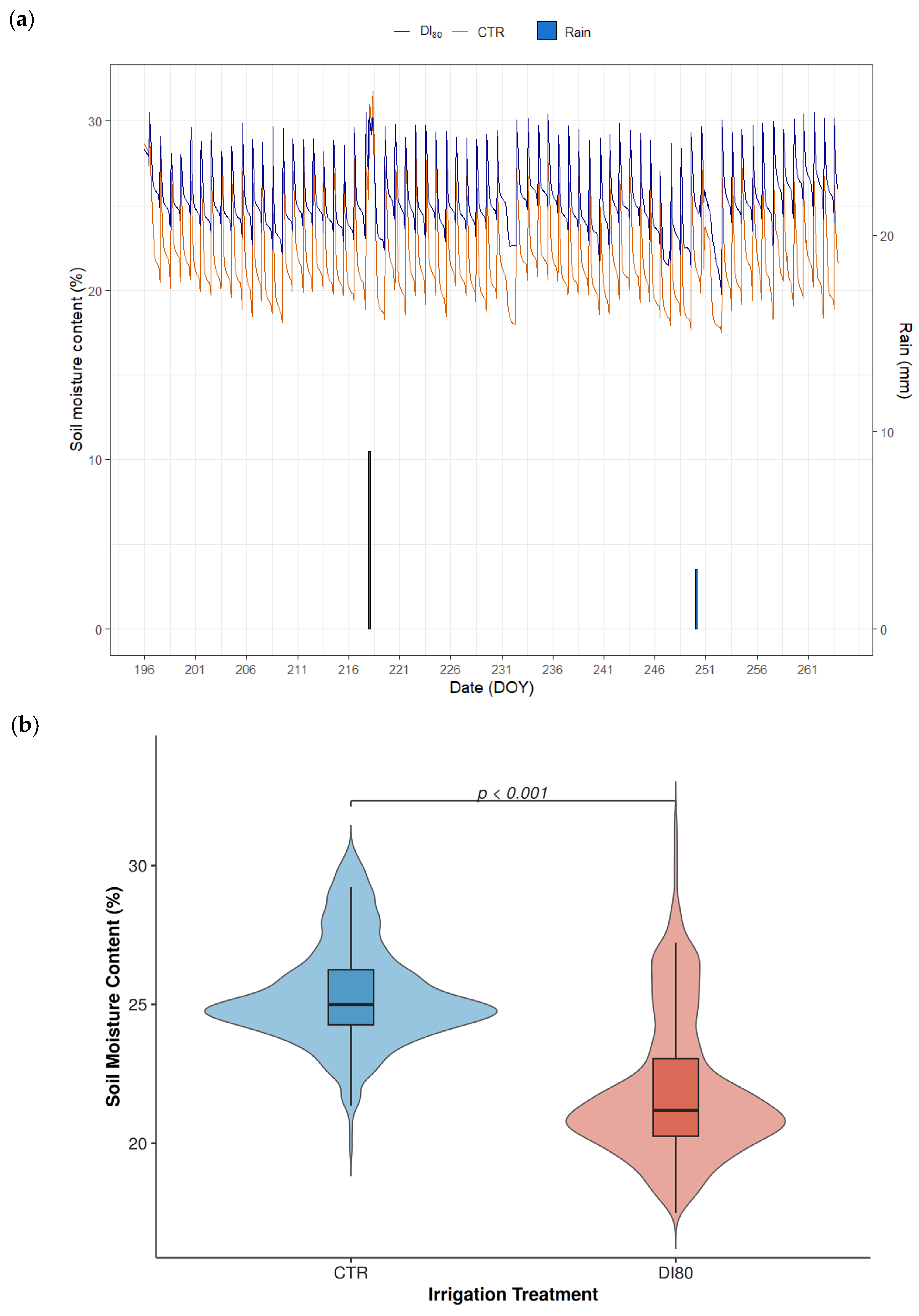
For the well-water vines (CTR), the irrigation schedule was designed to replenish the water lost by the plants through daily crop evapotranspiration. As expected, lower soil moisture values were recorded in the DI80 treatment compared to CTR, mainly due to the reduced irrigation volume applied per irrigation event (Figure 1). In the CTR treatment, the minimum daily soil moisture ranged between 22 and 23% prior to irrigation, whereas in the DI80 treatment, the corresponding values were lower, ranging between 19 and 20%.
A pronounced decline in soil moisture was observed on DOY 231 in both the DI80 and CTR treatments, reaching low levels of 17.99% and 22.60%, respectively, due to a malfunction in the irrigation system that interrupted irrigation on that day. Moreover, a rainfall recorded on DOY 218 (9 mm) resulted in a marked increase in soil moisture in both treatments, leading to comparable soil moisture levels between treatments. In contrast, a second rainfall event during the experimental period (DOY 250) had no significant effect on soil moisture in either treatment due to the limited precipitation amount (3 mm).

3.2. Sap Flow and Environmental Conditions

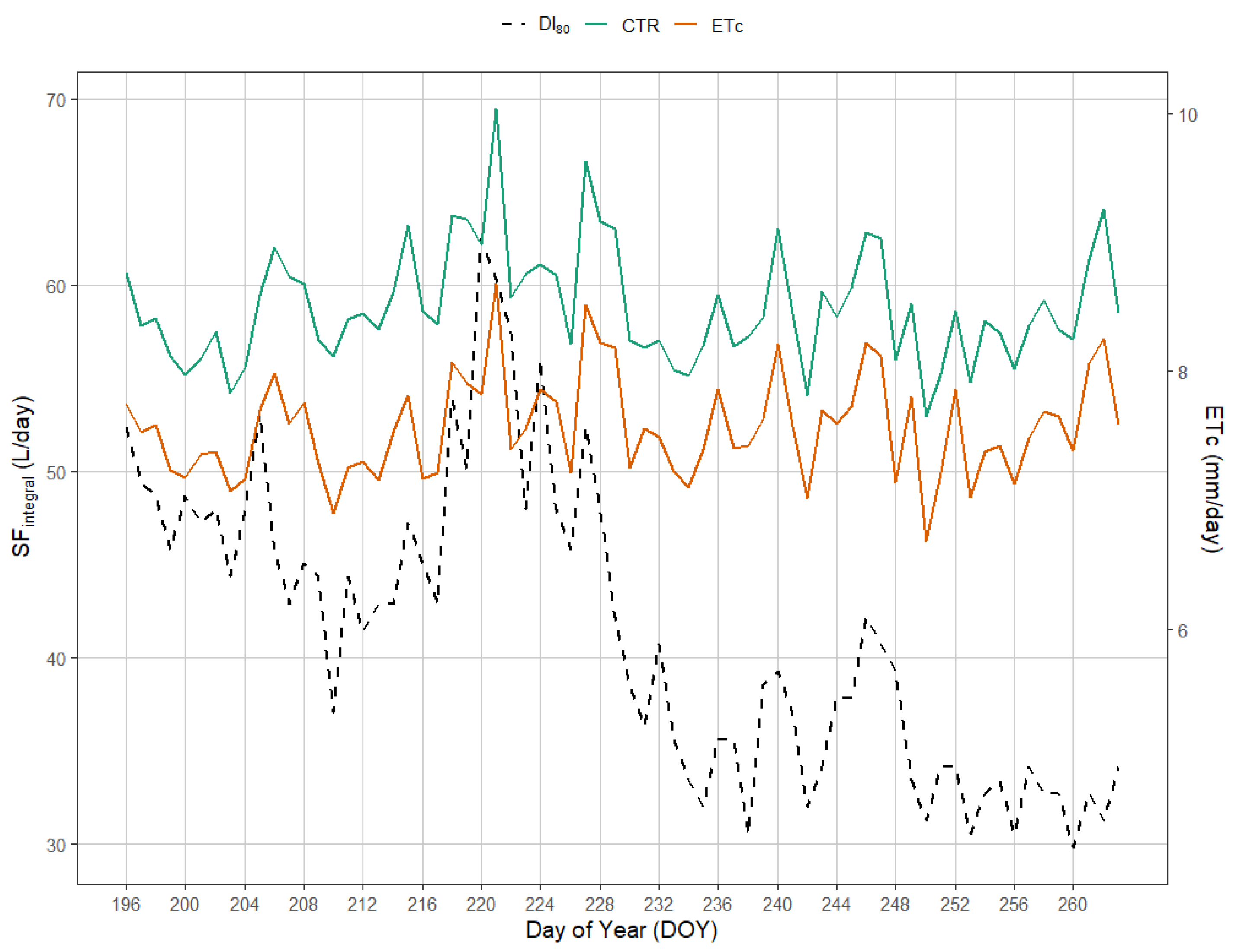
Daily sap flow dynamics for the two irrigation treatments (DI80 and CTR) during the experimental period followed a similar temporal pattern, consistent with the corresponding ETc values (Figure 2). Overall, sap flow values in the fully irrigated treatment (CTR) ranged between 55 and 65 kg/d, compared with the deficit irrigation treatment (DI80), where values ranged between 48 and 56 kg/d. This pattern suggests a systematic reduction in sap flow under deficit irrigation conditions relative to full irrigation, which can be attributed to the lower irrigation amount received by plants cultivated under limited water supply.
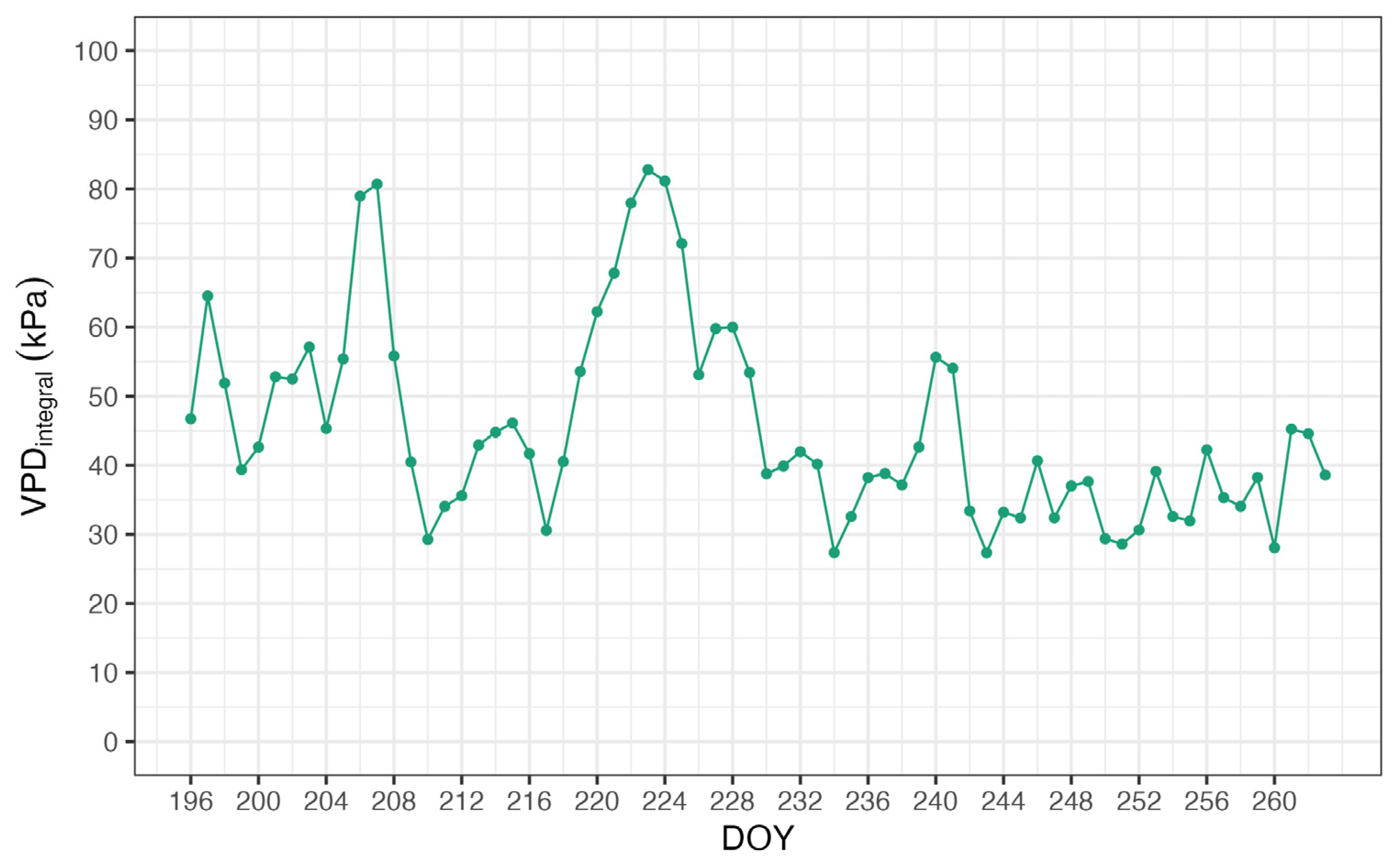
A pronounced increase in sap flow was observed on DOY 221 for both treatments, reaching peak values of approximately 70 kg/d for CTR and 60 kg/d for DI80. This rise in sap flow values coincided with elevated VPDintegral (67.80 kPa) and ETc (8.72 mm) values (Figure 2 and Figure 3), as well as sufficient irrigation supply in both treatments during this period, indicating that atmospheric demand and water availability were the primary factors influencing sap flow dynamics [28,54].
A gradual decrease in sap flow was observed after approximately DOY 230, corresponding with a decline in both VPDintegral and ETc values. During the latter part of the experimental period (DOY 240–263), sap flow remained relatively stable but remained lower in the deficit irrigation (DI80) treatment compared to the fully irrigated treatment (CTR). Overall, sap flow responded to changes in environmental demand, as indicated by VPDintegral and ETc, while the amount of irrigation influenced transpiration rates, with the fully irrigated treatment consistently showing higher sap flow rates than the DI80 treatment.

3.3. Plant Water Status and Stress Threshold

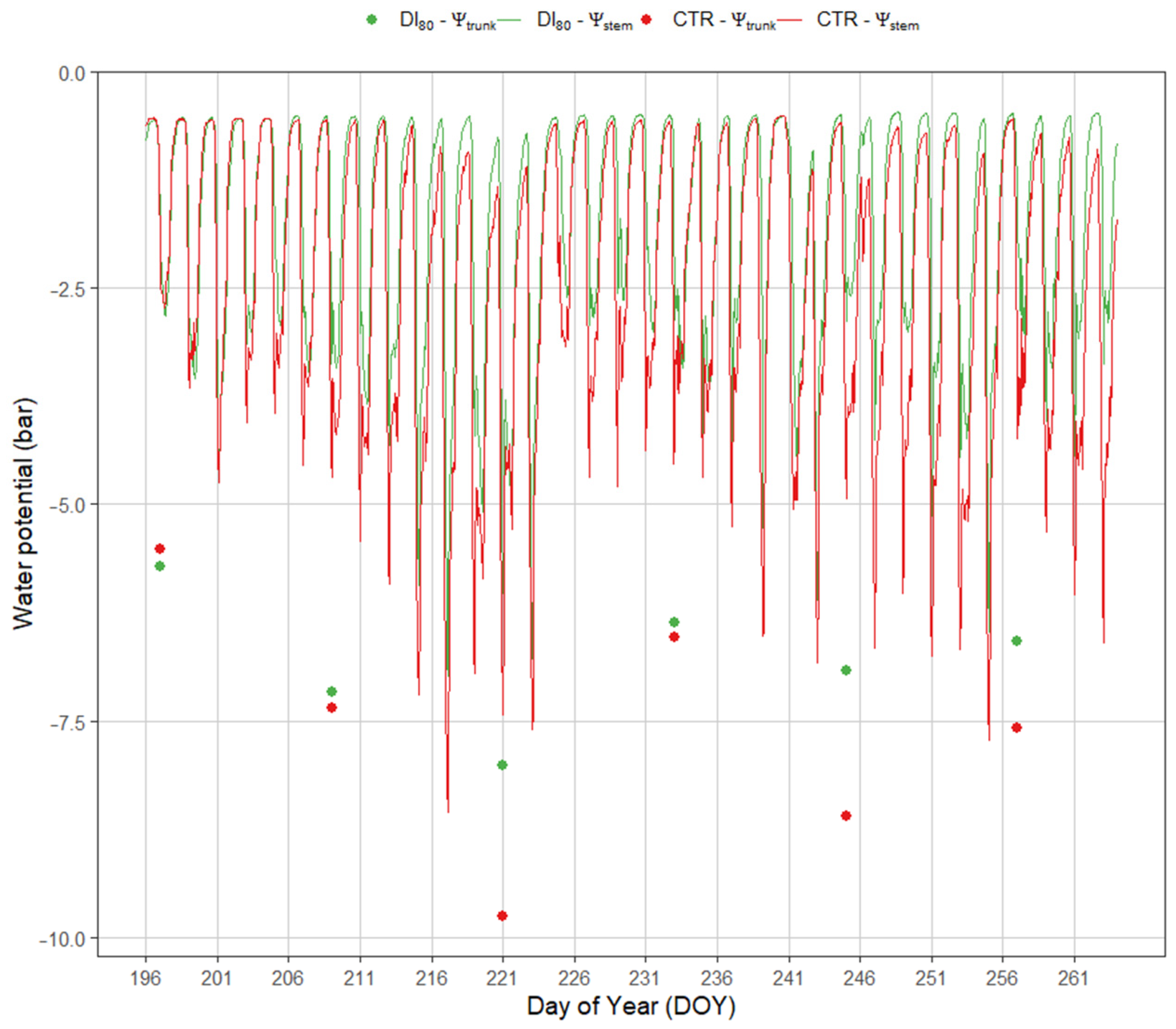
Differences in soil moisture content among treatments influenced plant water status over the experimental period, as indicated by trunk water potential (Ψtrunk) and stem water potential (Ψstem) measurements (Figure 4). Kiwifruit vines receiving full irrigation (CTR) consistently maintained higher (less negative) Ψtrunk values compared with those subjected to deficit irrigation (DI80). Daily variations in Ψtrunk were observed in both treatments, reflecting typical diurnal changes in plant water status associated with diurnal transpiration dynamics. However, vines under deficit irrigation (DI80) exhibited more pronounced declines in Ψtrunk during midday, coinciding with periods of peak atmospheric demand and maximum transpiration rates.
Similar trends were also observed with stem water potential (Ψstem) measured using a Scholander pressure chamber. Kiwifruit subjected to the DI80 treatment consistently exhibited more negative Ψstem values than those receiving full irrigation (CTR), further confirming the trunk water potential (Ψtrunk) results and highlighting the impact of deficit irrigation on plant water status.
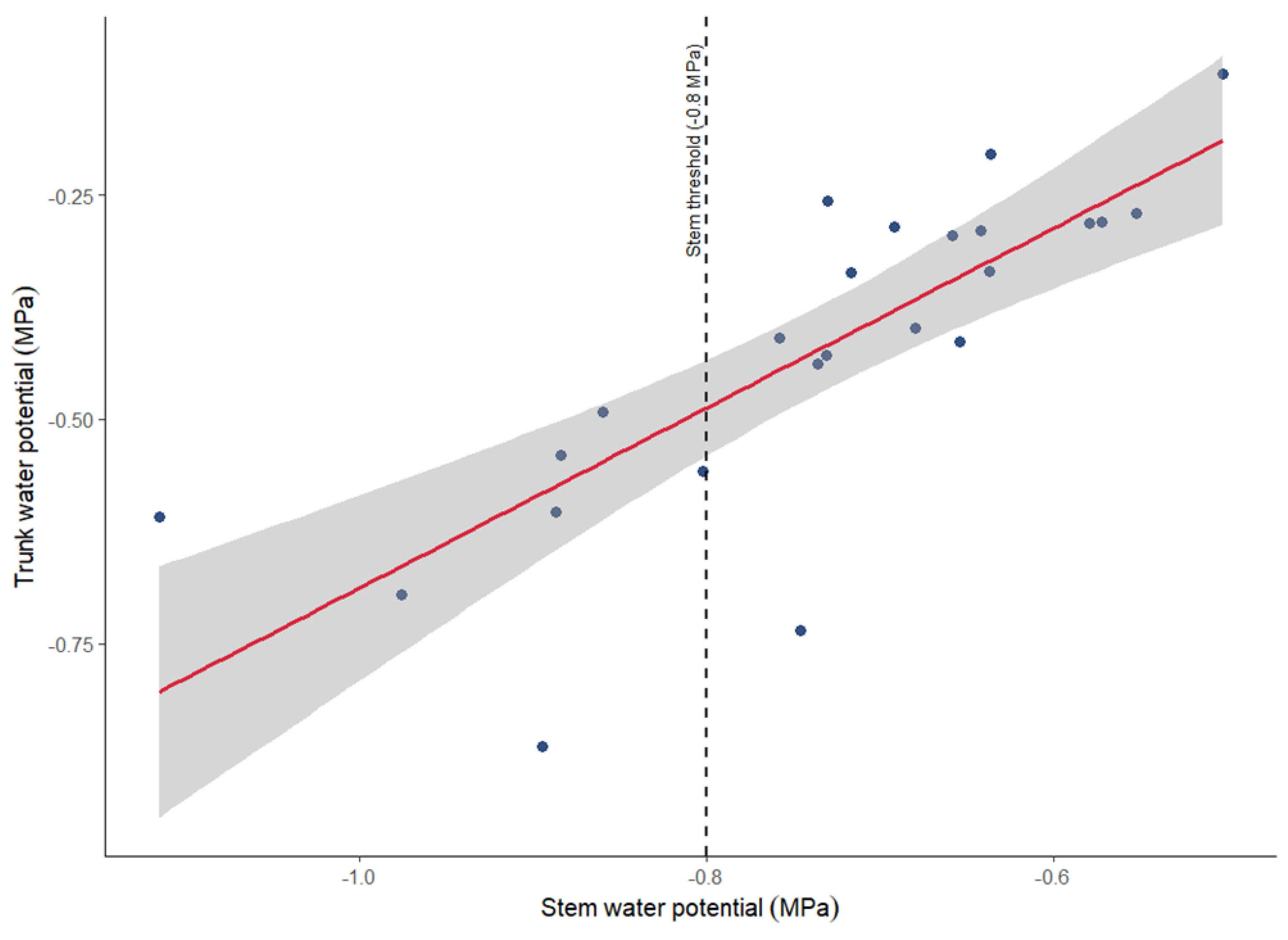
The subsequent phase of the study focused on identifying the critical threshold of trunk water potential (Ψtrunk) below which plants begin to experience water stress because of stomatal closure. Determination of this threshold is essential for enhancing the reliability and practical applicability of the predictive models, as declines in Ψtrunk beyond this threshold value serve as an indicator of the onset of water stress and signal the need for irrigation implementation. Previous studies on kiwifruit cultivation have reported a lower stem water potential threshold of −0.8 MPa as a critical value marking the onset of water stress [55,56]. Trunk water potential (Ψtrunk) is typically higher (less negative) than stem water potential (Ψstem), primarily due to the water storage capacity of the trunk and the water potential gradient between the canopy and the trunk [57].
Based on the above considerations, a correlation analysis was conducted between the water potential values obtained from the FloraPulse microtensiometers (FloraPulse, Davis, CA, USA) and those measured using the Scholander pressure chamber (SKPM 1400/80, Skye Instruments, Powys, UK). The objective was to determine the Ψtrunk corresponding to the onset of water stress, as defined by a threshold Ψstem value of −0.8 MPa. The results indicated that the corresponding Ψtrunk value measured by the FloraPulse microtensiometers (Ψtrunk) is approximately −0.5 MPa (Figure 5).

3.4. Descriptive Statistics

The comparative evaluation of the machine learning models revealed notable differences in their predictive performance. Among the examined machine learning models, XGBoost achieved the highest accuracy (0.808) and the highest F1-score (0.762), indicating a better balance between precision and recall, compared to the other models (Table 1). Ridge, Lasso, and SVM demonstrated similar performance, each reaching an accuracy of 0.769 and a recall of 0.889, suggesting strong capability in correctly identifying positive cases. However, their relatively lower precision (0.615) indicates a higher rate of false positives. Random Forest showed moderate performance, with an accuracy of 0.731 and an F1-score of 0.632, while LightGBM exhibited the lowest performance across the models, particularly in terms of accuracy (0.692) and F1-score (0.600). In terms of discrimination ability, Ridge regression achieved the highest AUC value (0.850), followed by XGBoost (0.824), indicating strong capability in distinguishing between classes. Overall, the results suggest that XGBoost provides the most balanced predictive performance among the tested models, while Ridge regression demonstrates strong discriminative capacity.

3.5. Correlation Analysis

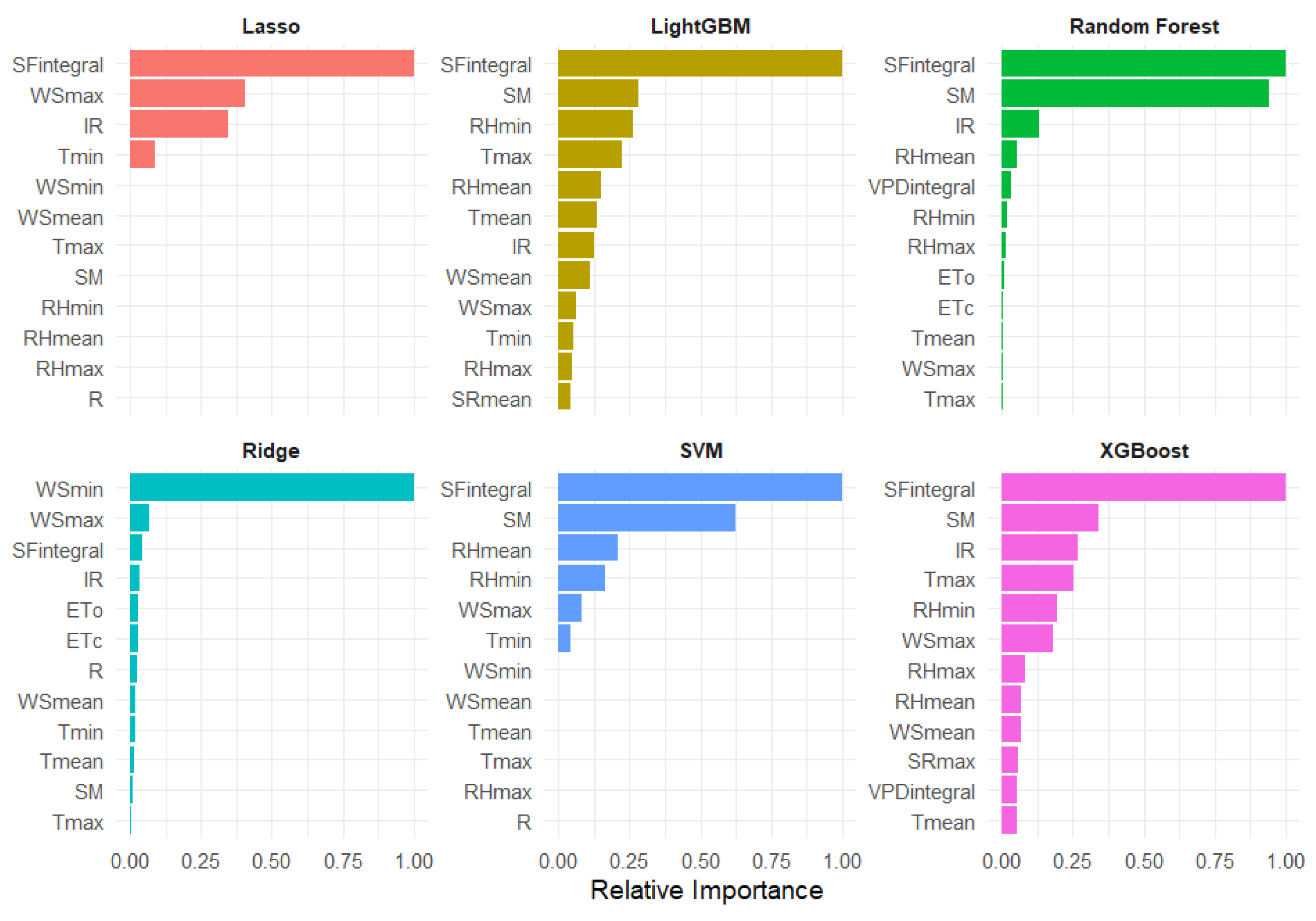
Importance plots presented in Figure 6 suggest that cumulative daily sap flow (SFintegral) and max wind speed (WSmax) are the most crucial explanatory variables among the six machine learning models. The XGBoost model distributes importance across multiple variables, while in Ridge model minimum wind speed (WSmin) is considered the most important predictive variable.

3.6. Confusion Matrices

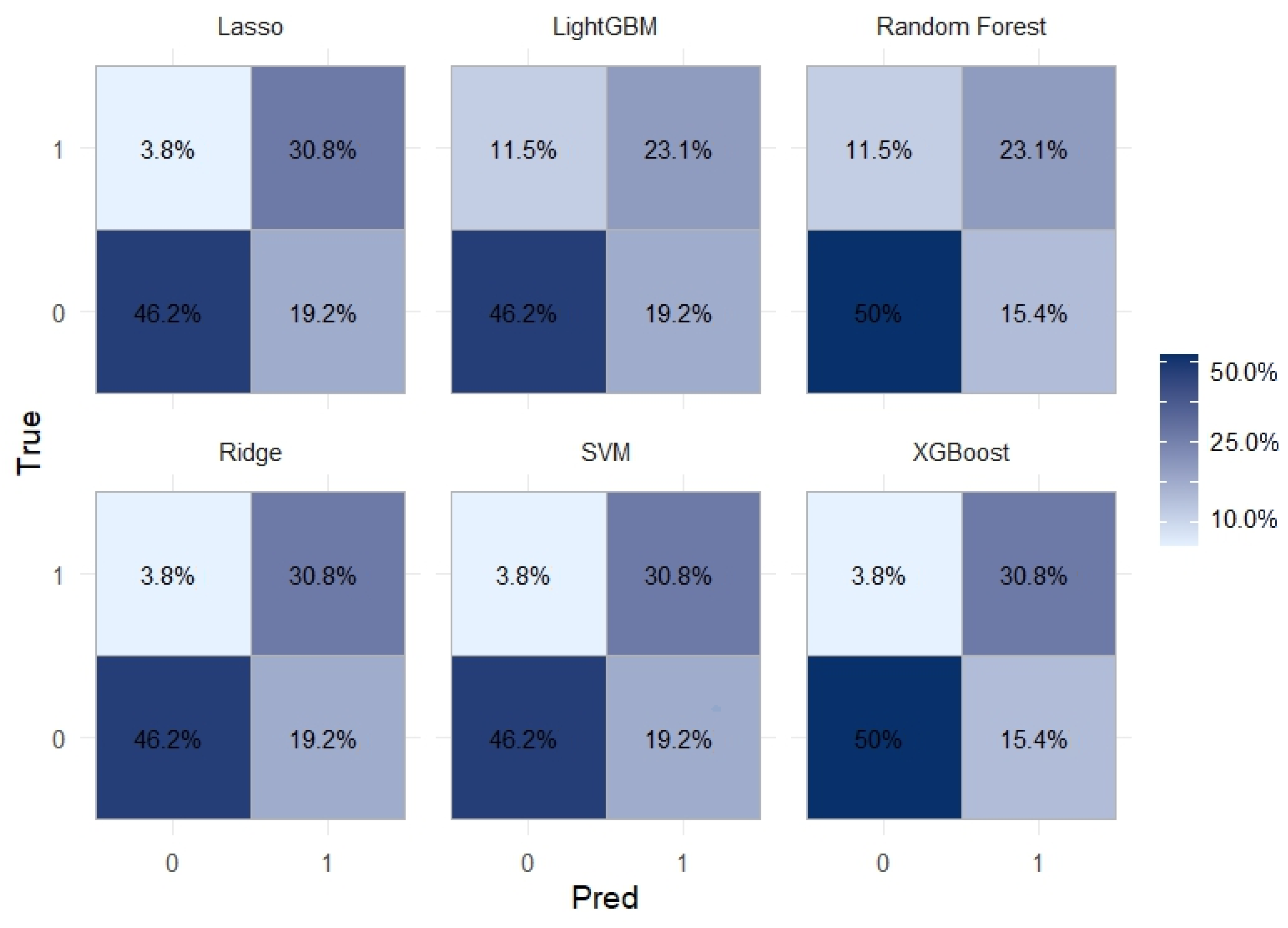
To evaluate the predictive performance of the machine learning models, confusion matrices were created (Figure 7). The proportion of correctly classified true negatives ranged from 46.2% to 50% across the evaluated models, while the percentage of correctly identified true positives varied between 23.1% and 30.8%. Among the models, XGBoost demonstrated the highest percentages for both true negative and true positive classifications, indicating superior classification performance. Ridge and Random Forest models also showed relatively high percentages in these categories.

3.7. ROC Curves

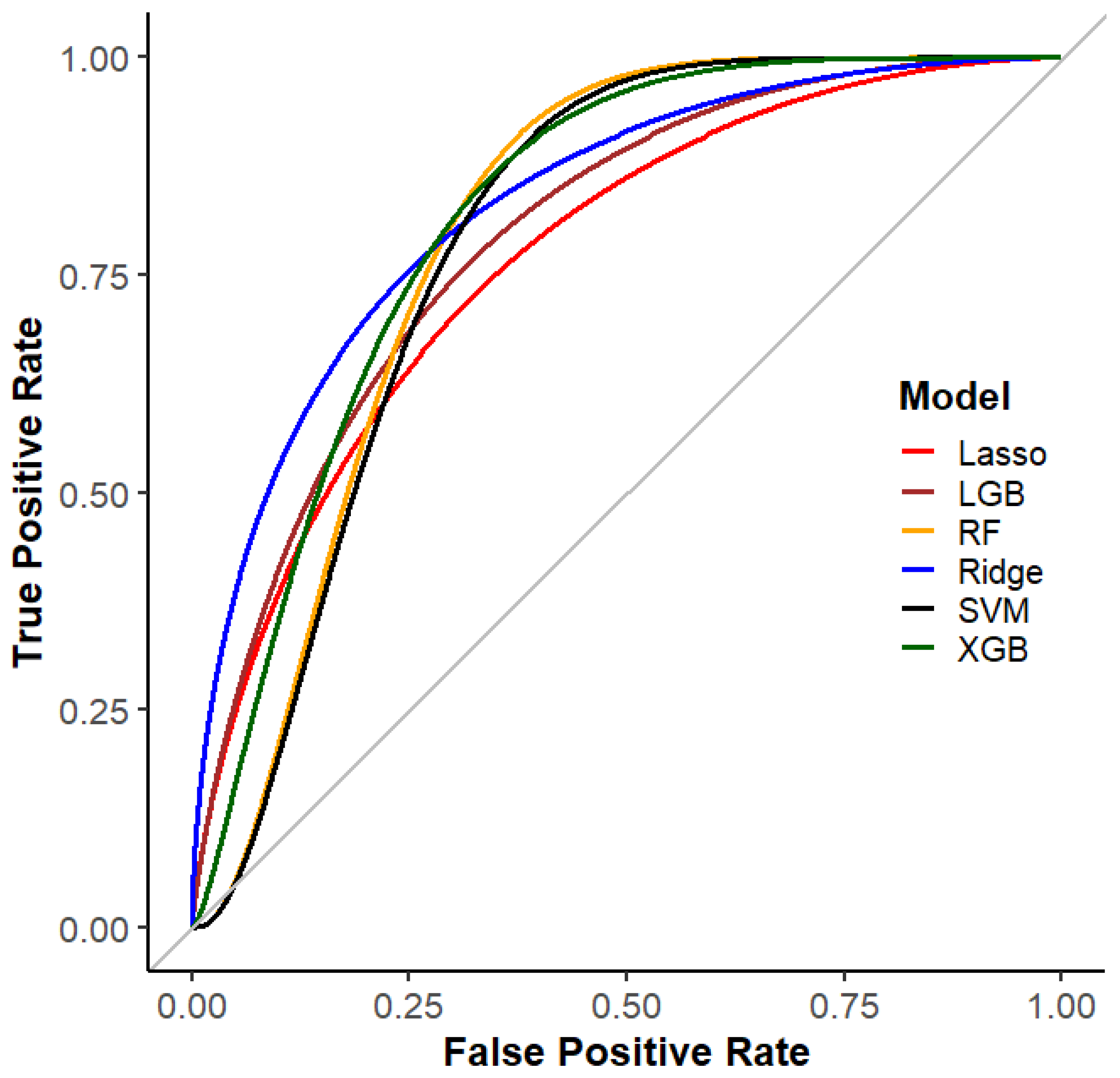
The Receiving Operating Characteristic (ROC) curves presented in Figure 8 illustrate the classification performance of the evaluated machine learning models across different decision thresholds. Models which have the ROC curve closer to the upper-left corner exhibit higher classification performance. This occurs because a curve that approaches this region corresponds to a larger Area Under the Curve (AUC), with the ideal ROC curve approaching an AUC value of 1.0. ROC curve of a random classification is presented with the dotted line, so below this line the performance of the models is worse than random. All models performed substantially better than random classification, as their curves lie well above the dot line. Among the examined approaches, the Ridge model demonstrated the highest discriminative ability, achieving the largest area under the curve (AUC), followed by XGBoost and LightGBM. Random Forest also showed strong performance, in contrast to Lasso and SVM, which exhibited slightly lower performance. Overall, the results suggest that the tested models which possess the best classification capacity are Ridge and XGBoost. Although the obtained AUC values were moderate, they still indicate a satisfactory ability of the models to distinguish between stressed and non-stressed plants. In the context of irrigation management, such performance may still be considered practically useful, particularly for the early detection of the onset of plant water stress and the support of irrigation scheduling decisions under field conditions.

3.8. Correlation Matrix

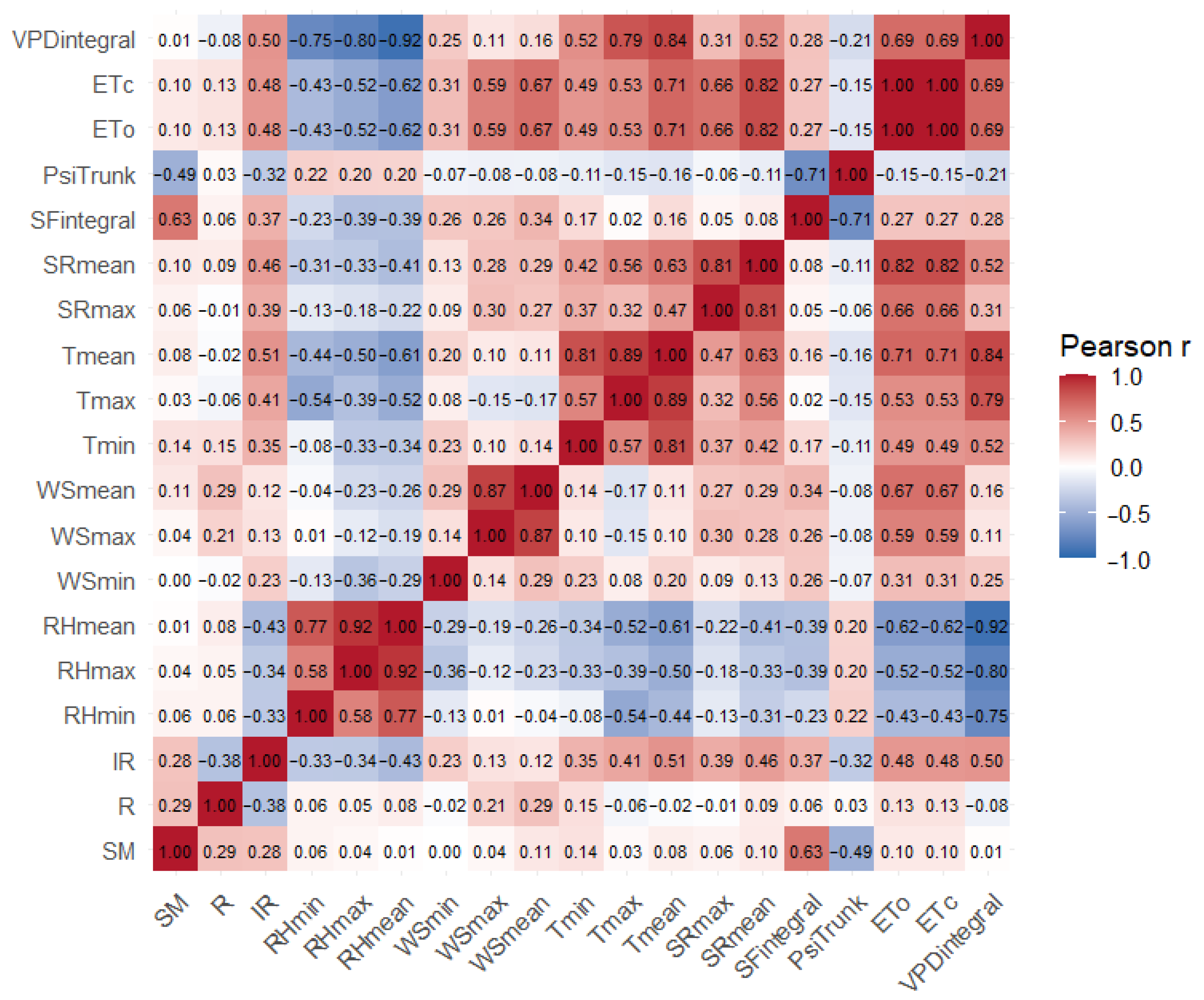
Figure 9 presents the Pearson correlation matrix illustrating the relationships among the variables included in the analysis. Notably, a strong positive correlation was identified between ETc and ETo (r = 1.00, p-value < 0.001), reflecting the close relationship between these evapotranspiration indicators (ETc = Kc × ETo). Similarly, temperature-related variables exhibited strong statistically significant correlations, with Tmean showing high positive correlation with Tmax (r = 0.89, p-value < 0.001) and Tmin (r = 0.81, p-value < 0.001). Radiation variables also displayed statistically significant correlation, particularly between RadMean and RadMax (r = 0.81, p-value < 0.001), while relative humidity variables were strongly associated, with RHmax and RHmean exhibiting a high positive correlation (r = 0.92, p-value < 0.001).
Moderate correlations were also observed between VPDintegral and several microclimatic variables, including ETc, ETo and temperature-related variables. A corresponding correlation was also observed between SFintegral and Soil Moisture (r = 0.63, p-value < 0.001). Although several variables showed moderate to strong associations, most correlations remained below the commonly used multicollinearity threshold (greater than 0.90). This suggests that severe multicollinearity among predictors is limited, which is important for maintaining the interpretability of the machine learning models, which applied in this study, such as Random Forest (Figure 9).

4. Discussion

Plant water status throughout the experimental period was clearly influenced by the differences in soil moisture between the fully irrigated (CTR) and deficit irrigation (DI80) treatments. The reduced water supply in the DI80 treatment, applied from the end of rapid fruit growth until harvest, resulted in more negative trunk and stem water potential values, indicating increased water stress in kiwifruit vines subjected to deficit irrigation. Similar results have been reported in kiwifruit and other horticultural crops, where deficit irrigation induces stomatal closure, thereby limiting transpiration and photosynthetic rates [58,59,60]. These effects are expected to be intensified under Mediterranean conditions, due to high temperatures and elevated vapor deficit (VPD), which increase plant water demand.
Daily sap flow dynamics for the two irrigation treatments (DI80 and CTR) during the experimental period followed the seasonal trend of crop evapotranspiration (ETc), highlighting the strong influence of environmental variables on soil–plant–atmosphere continuum (SPAC). Higher sap flow values were observed in the CTR treatment compared with DI80, due to greater soil water availability, which enabled well-watered plants to maintain higher transpiration rates. This finding aligns with previous studies in kiwifruit and other fruit crops, which demonstrated that sap flow responds primarily to vapor pressure deficit (VPD) and solar radiation (SR) when soil water is not a limiting factor [31,54,61]. The reduction in sap flow under the deficit irrigation treatment indicates that kiwifruit regulate transpiration through stomatal closure in response to water stress in order to avoid hydraulic failure [62,63].
The validation of trunk water potential (Ψtrunk) as a robust indicator of plant water status in kiwifruit, along with the establishment of a reliable Ψtrunk threshold, is of particularly important, as it enables continuous monitoring of plant stress without the need for labor-intensive pressure chamber measurements. The strong relationship observed between Ψtrunk measured by microtensiometers and Ψstem measured using a pressure chamber confirms that trunk-embedded sensors can provide continuous and accurate information on plant water status. The identification of a stress threshold of approximately −0.5 MPa for Ψtrunk, corresponding to a Ψstem value of −0.8 MPa, is consistent with previous research in grapevines [38], nectarine trees [17] and kiwifruit [57] indicating that trunk water potential is typically less negative than stem water potential due to hydraulic capacitance in woody tissues [57].
Based on the results of the present study, trunk water potential (Ψtrunk) in kiwifruit can be accurately predicted by integrating critical environmental variables, soil water content and sap flow measurements using machine learning models. The integration of plant-based measurements with environmental and soil moisture data significantly improved the predictive capacity of the machine learning models. Conventional irrigation scheduling methods rely mainly on soil moisture or reference evapotranspiration (ETo) data, which do not always reflect the actual water status of the plant [64,65,66]. In contrast, the approach adopted in this study incorporates critical physiological indicators such as sap flow and trunk water potential, which directly reflect the plant response to the combined effects of soil moisture availability, environmental evaporative demand, hydraulic resistances and root uptake capacity [55]. Similar studies have demonstrated that combining plant-based and climatic variables improves the accuracy of irrigation decision-support systems, particularly under variable environmental conditions [67,68].
Among the evaluated models, XGBoost achieved the highest accuracy and F1-score, indicating the most balanced performance, suggesting that non-linear relationships play an important role in describing plant water dynamics. Although Ridge regression showed slightly higher AUC values, XGBoost demonstrated a better balance between precision and recall, indicating that the most suitable model may depend on the specific operational priorities of the application. Similar results have been reported also in other studies applying machine learning techniques to irrigation management, where ensemble models such as gradient boosting and random forests often outperform traditional regression approaches [69,70]. However, Ridge regression exhibited a slightly higher rate of false positives, which may limit its practical applicability in irrigation decision-making. In contrast, XGBoost achieved a better balance between precision and recall, making it more suitable for identifying actual stress conditions.
Sap flow integral (SFintegral) and wind speed (WS) were among the most significant variables for achieving accurate predictions of plant water stress. Sap flow represents an integrated response of plant physiological status to soil water availability and atmospheric demand, which explains its strong contribution to model performance in predicting plant water stress [31,71]. On the other hand, wind speed enhances transpiration rates by increasing the vapor pressure gradient between the leaf surface and the atmosphere, thereby increasing water losses and the risk of water stress. This highlights the importance of including atmospheric variables in irrigation models, particularly in regions characterized by high evaporative demand. Comparable results have been reported in other research employing machine learning methodologies to forecast water stress in trees. Specifically, González-Teruel et al. (2022) utilized Random Forest and Support Vector Machine (SVM) techniques for binary classification of water stress in sweet cherry trees [72], employing soil and meteorological data series without the inclusion of plant-based measurements. Owing to the imbalanced nature of their dataset, the F2-score was selected as the primary evaluation metric, attaining values of up to 0.735, while F1-scores reached as high as 0.690. The present study achieved recall values of 0.889 and F1-scores of up to 0.762 with XGBoost, indicating that the utilization of sap flow integral as a physiological predictor significantly enhances classification performance. From a practical perspective, the results of the present study provide valuable information for optimizing irrigation scheduling in commercial kiwifruit orchards, particularly in Mediterranean regions where water scarcity is expected to increase due to climate change. By developing a reliable decision-support tool based on real-time data, the proposed approach can improve water-use efficiency while maintaining crop productivity. However, some limitations should be considered. The experiment was conducted during a single growing season and included a limited number of kiwifruit vines, which may restrict the generalization of the results. Furthermore, the predictive models were developed under specific climatic and soil conditions, and their performance may vary under different environmental conditions or in other kiwifruit-growing regions. In addition, although the general modeling framework is transferable, hydraulic characteristics such as trunk water potential dynamics and sap flow may vary with vine age, canopy architecture, and cultivar. Hence, recalibration or retraining of the models using data from the target age group or variety would likely be necessary before deployment in orchards with different characteristics. Further research focusing on multi-year validation and a broader range of climatic conditions will contribute to the development of advanced decision-support tools for sustainable agriculture.

5. Conclusions

This study demonstrates that machine learning models can reliably predict plant water status in kiwifruit under Mediterranean field conditions by integrating soil, climatic, and plant-based measurements. Among the evaluated models, XGBoost exhibited the most balanced performance, highlighting the importance of capturing non-linear interactions in plant water dynamics. The proposed approach provides a valuable practical tool for optimizing irrigation and enhancing water-use efficiency in kiwifruit orchards. From a practical point of view, agronomists and growers can use the model for decision-making assistance in regard to the irrigation practice. This requires the continuous accumulation and use of microclimatic, soil moisture, and sap flow data collected from the standard low-cost sensor network. Future research should focus on validating this methodology across diverse environmental conditions and throughout multiple growing seasons.

Author Contributions

Conceptualization, P.P., A.Z., E.K. and A.K.; methodology, P.P., A.Z., E.K. and A.K.; software, P.P., A.Z. and A.K.; validation, P.P., A.Z. and A.K.; formal analysis, P.P., A.Z. and A.K.; investigation, P.P., A.Z. and A.K.; resources, P.P., A.Z. and A.K.; data curation, P.P., A.K., E.K., A.P. and A.Z.; writing—original draft preparation, P.P., A.Z. and A.K.; writing—review and editing, P.P., A.Z., A.K., E.K. and A.P.; visualization, P.P., A.Z. and A.K.; supervision, A.Z.; project administration, A.Z. and A.P. All authors have read and agreed to the published version of the manuscript.

Funding

This research received no external funding.

Data Availability Statement

The original contributions presented in this study are included in the article. Further inquiries can be directed to the corresponding author.

Conflicts of Interest

The authors declare no conflicts of interest.

References

  1. Dichio, B.; Montanaro, G.; Sofo, A.; Xiloyannis, C. Stem and Whole-Plant Hydraulics in Olive (Olea europaea) and Kiwifruit (Actinidia deliciosa). Trees 2013, 27, 183–191. [Google Scholar] [CrossRef]
  2. Trifilò, P.; Lo Gullo, M.A.; Nardini, A.; Pernice, F.; Salleo, S. Rootstock Effects on Xylem Conduit Dimensions and Vulnerability to Cavitation of Olea europaea L. Trees 2007, 21, 549–556. [Google Scholar] [CrossRef]
  3. Karakaya, E.; Uzundumlu, A.S. Kiwi Production Forecasts for the Leading Countries in the Period 1983–2027. Appl. Fruit Sci. 2025, 67, 66. [Google Scholar] [CrossRef]
  4. Jaeger, S.R.; Rossiter, K.L.; Wismer, W.V.; Harker, F.R. Consumer-Driven Product Development in the Kiwifruit Industry. Food Qual. Prefer. 2003, 14, 187–198. [Google Scholar] [CrossRef]
  5. Holzapfel, E.A.; Merino, R.; Mariño, M.A.; Matta, R. Water Production Functions in Kiwi. Irrig. Sci. 2000, 19, 73–79. [Google Scholar] [CrossRef]
  6. Arnell, N.W.; van Vuuren, D.P.; Isaac, M. The Implications of Climate Policy for the Impacts of Climate Change on Global Water Resources. Glob. Environ. Change 2011, 21, 592–603. [Google Scholar] [CrossRef]
  7. Condon, J.M. Aspects of kiwifruit stem structure in relation to transport. Acta Hortic. 1992, 297, 419–426. [Google Scholar] [CrossRef]
  8. Calderón-Orellana, A.; Calderón-Orellana, M.; Atenas, C.; Contreras, C.; Aburto, F.; Alvear, T.; Antileo-Mellado, S. Late Water Deficits Improve Intrinsic Water Use Efficiency, Fruit Maturity, and Acceptability in Yellow-Fleshed Kiwifruit Cv. Soreli. Plants 2025, 14, 2843. [Google Scholar] [CrossRef]
  9. Tsanis, I.K.; Koutroulis, A.G.; Daliakopoulos, I.N.; Jacob, D. Severe Climate-Induced Water Shortage and Extremes in Crete. Clim. Change 2011, 106, 667–677. [Google Scholar] [CrossRef]
  10. Moriana, A.; Pérez-López, D.; Prieto, M.H.; Ramírez-Santa-Pau, M.; Pérez-Rodriguez, J.M. Midday Stem Water Potential as a Useful Tool for Estimating Irrigation Requirements in Olive Trees. Agric. Water Manag. 2012, 112, 43–54. [Google Scholar] [CrossRef]
  11. Choné, X.; van Leeuwen, C.; Dubourdieu, D.; Gaudillère, J.P. Stem Water Potential Is a Sensitive Indicator of Grapevine Water Status. Ann. Bot. 2001, 87, 477–483. [Google Scholar] [CrossRef]
  12. Fernández, J.-E. Understanding Olive Adaptation to Abiotic Stresses as a Tool to Increase Crop Performance. Environ. Exp. Bot. 2014, 103, 158–179. [Google Scholar] [CrossRef]
  13. Fernández Luque, J.E.; Díaz-Espejo, A.; Romero Vicente, R.; Hernández Santana, V.; García Martos, J.M.; Padilla Díaz, C.M.; Cuevas Sánchez, M.V. Precision Irrigation in Olive (Olea europaea L.) Tree Orchards; Academic Press: Cambridge, MA, USA, 2018; ISBN 978-0-12-813164-0. [Google Scholar]
  14. Steppe, K.; De Pauw, D.J.W.; Lemeur, R. A Step towards New Irrigation Scheduling Strategies Using Plant-Based Measurements and Mathematical Modelling. Irrig. Sci. 2008, 26, 505–517. [Google Scholar] [CrossRef]
  15. Mastroleo, M.; Ceccarelli, A.; Sofo, A.; Dichio, B.; Mininni, A.N.; Green, S.; Scotti, C.; Bergamaschi, V.; Donati, I. An Innovative and Multidisciplinary Approach to Face Kiwifruit Vine Decline Syndrome (KVDS). Acta Hortic. 2025, 1431, 487–496. [Google Scholar] [CrossRef]
  16. Lakso, A.N.; Santiago, M.; Stroock, A.D. Monitoring Stem Water Potential with an Embedded Microtensiometer to Inform Irrigation Scheduling in Fruit Crops. Horticulturae 2022, 8, 1207. [Google Scholar] [CrossRef]
  17. Conesa, M.R.; Conejero, W.; Vera, J.; Ruiz-Sánchez, M.C. Assessment of Trunk Microtensiometer as a Novel Biosensor to Continuously Monitor Plant Water Status in Nectarine Trees. Front. Plant Sci. 2023, 14, 1123045. [Google Scholar] [CrossRef] [PubMed]
  18. Vandegehuchte, M.W.; Steppe, K. Corrigendum to: Sap-Flux Density Measurement Methods: Working Principles and Applicability. Funct. Plant Biol. 2013, 40, 1088. [Google Scholar] [CrossRef]
  19. Javaid, M.; Haleem, A.; Khan, I.H.; Suman, R. Understanding the Potential Applications of Artificial Intelligence in Agriculture Sector. Adv. Agrochem. 2023, 2, 15–30. [Google Scholar] [CrossRef]
  20. Waleed, M.; Um, T.-W.; Kamal, T.; Khan, A.; Iqbal, A. Determining the Precise Work Area of Agriculture Machinery Using Internet of Things and Artificial Intelligence. Appl. Sci. 2020, 10, 3365. [Google Scholar] [CrossRef]
  21. Agrawal, Y.; Kumar, M.; Ananthakrishnan, S.; Kumarapuram, G. Evapotranspiration Modeling Using Different Tree Based Ensembled Machine Learning Algorithm. Water Resour. Manag. 2022, 36, 1025–1042. [Google Scholar] [CrossRef]
  22. Fan, J.; Yue, W.; Wu, L.; Zhang, F.; Cai, H.; Wang, X.; Lu, X.; Xiang, Y. Evaluation of SVM, ELM and Four Tree-Based Ensemble Models for Predicting Daily Reference Evapotranspiration Using Limited Meteorological Data in Different Climates of China. Agric. For. Meteorol. 2018, 263, 225–241. [Google Scholar] [CrossRef]
  23. Pagano, A.; Amato, F.; Ippolito, M.; De Caro, D.; Croce, D.; Motisi, A.; Provenzano, G.; Tinnirello, I. Machine Learning Models to Predict Daily Actual Evapotranspiration of Citrus Orchards under Regulated Deficit Irrigation. Ecol. Inform. 2023, 76, 102133. [Google Scholar] [CrossRef]
  24. Stoffer, R.; Hartogensis, O.; Rodríguez, J.C.; van Heerwaarden, C. Machine-Learned Actual Evapotranspiration for an Irrigated Pecan Orchard in Northwest Mexico. Agric. For. Meteorol. 2024, 345, 109825. [Google Scholar] [CrossRef]
  25. Amori, P.N.; Heeren, D.M.; Shi, Y.; Wilkening, E.; Goncalves, I.Z.; Balboa, G.R.; Rudnick, D.; Katimbo, A.; Ritzema, R.S. Scalable Machine Learning Framework for Adaptive Irrigation Management of Maize and Soybean in the U.S. Midwest. Comput. Electron. Agric. 2025, 237, 110710. [Google Scholar] [CrossRef]
  26. Wilkening, E.; Heeren, D.; Shi, Y.; Puntel, L.; Balboa, G.; Katimbo, A.; Zhang, K.; Amori, P.; Lena, B. Development of a Machine Learning Framework for an Irrigation Decision Support System. Dep. Agric. Biol. Syst. Eng. Fac. Publ. 2025, 3, 121–131. [Google Scholar] [CrossRef]
  27. Mokhtar, A.; Al-Ansari, N.; El-Ssawy, W.; Graf, R.; Aghelpour, P.; He, H.; Hafez, S.M.; Abuarab, M. Prediction of Irrigation Water Requirements for Green Beans-Based Machine Learning Algorithm Models in Arid Region. Water Resour. Manag. 2023, 37, 1557–1580. [Google Scholar] [CrossRef]
  28. Zhao, X.; Fan, J. Response of Tree Sap Flow Rate to Soil Water and Atmospheric Environment, and Adaptability to Drought in the Loess Plateau Region of China. For. Ecol. Manag. 2024, 565, 122007. [Google Scholar] [CrossRef]
  29. Allen, R.; Pereira, L.; Raes, D.; Smith, M. Crop Evapotranspiration Guidelines for Computing Crop Requirements. FAO Irrig. Drain. Report Modeling and Application. J. Hydrol. 1998, 285, 19–40. [Google Scholar]
  30. Mehta, R.; Pandey, V. Reference Evapotranspiration (ETo) and Crop Water Requirement (ETc) of Wheat and Maize in Gujarat. J. Agrometeorol. 2015, 17, 107–113. [Google Scholar] [CrossRef]
  31. Kokkotos, E.; Zotos, A.; Tsesmelis, D.E.; Petrakis, E.A.; Patakas, A. Estimating Grapevine Transpirational Losses Using Models Under Different Conditions of Soil Moisture. Horticulturae 2025, 11, 665. [Google Scholar] [CrossRef]
  32. Burgess, S.S.; Adams, M.A.; Turner, N.C.; Beverly, C.R.; Ong, C.K.; Khan, A.A.; Bleby, T.M. An Improved Heat Pulse Method to Measure Low and Reverse Rates of Sap Flow in Woody Plants. Tree Physiol. 2001, 21, 589–598. [Google Scholar] [CrossRef]
  33. Sun, X.; Li, J.; Cameron, D.; Moore, G. Sap Flow Monitoring of Two Australian Native Tree Species in a Suburban Setting: Implications for Tree Selection and Management. Plant Sci. 2022, 317, 111194. [Google Scholar] [CrossRef] [PubMed]
  34. Lakso, A.N.; Zhu, S.; Santiago, M.; Shackel, K.; Volkov, V.; Stroock, A.D. A Microtensiometer Sensor to Continuously Monitor Stem Water Potentials in Woody Plants—Design and Field Testing. Acta Hortic. 2022, 1335, 317–324. [Google Scholar] [CrossRef]
  35. Cruz, M.F.G.; Ye, Y.; Gallud, M.F.O.; Lázaro, R.J.S.; Izquierdo, M.A.Z.; Tortosa, P.N.; Gómez, A.S. Creation of a Digital Twin Based on Microtensiometer Indices (Florapulse), Climatic Variables and Crop Data for Sustainable Production in Stone Fruit Crops. In Proceedings of the 2024 4th International Conference on Embedded & Distributed Systems (EDiS), Bechar, Algeria, 3–5 November 2024; pp. 243–248. [Google Scholar]
  36. Phillips, N.; Oren, R.; Zimmermann, R.; Wright, S.J. Temporal Patterns of Water Flux in Trees and Lianas in a Panamanian Moist Forest. Trees 1999, 14, 116–123. [Google Scholar] [CrossRef]
  37. Améglio, T.; Archer, P.; Cohen, M.; Valancogne, C.; Daudet, F.; Dayau, S.; Cruiziat, P. Significance and Limits in the Use of Predawn Leaf Water Potential for Tree Irrigation. Plant Soil. 1999, 207, 155–167. [Google Scholar] [CrossRef]
  38. Pagay, V. Evaluating a Novel Microtensiometer for Continuous Trunk Water Potential Measurements in Field-Grown Irrigated Grapevines. Irrig. Sci. 2022, 40, 45–54. [Google Scholar] [CrossRef]
  39. McCutchan, H.; Shackel, K.A. Stem Water Potential as a Sensitive Indicator of Water Stress in Prune Trees (Prunus domestica L. Cv. French.). J. Am. Soc. Hortic. Sci. 1992, 117, 607–611. Available online: https://www.scirp.org/reference/referencespapers?referenceid=1221613 (accessed on 11 March 2026). [CrossRef]
  40. Carrasco-Benavides, M.; Ortega-Farías, S.; Ahumada-Orellana, L.E.; Olguín-Cáceres, J.M.; de la Fuente-Sáiz, D.; Zuñiga, M. Assessing Olive Tree Water Status Using Canopy Spectral Reflectance Indices. Irrig. Sci. 2025, 43, 921–935. [Google Scholar] [CrossRef]
  41. Davis, J.; Goadrich, M. The Relationship between Precision-Recall and ROC Curves. In Proceedings of the 23rd International Conference on Machine Learning; Association for Computing Machinery: New York, NY, USA, 2006; pp. 233–240. [Google Scholar]
  42. Gillariose, J.; Joseph, J.; Chesneau, C. Lasso and Ridge Regression: A Comprehensive Review of Applications and Developments in Machine Learning. Int. J. Data Sci. Anal. 2025, 21, 7. [Google Scholar] [CrossRef]
  43. Breiman, L. Random Forests. Mach. Learn. 2001, 45, 5–32. [Google Scholar] [CrossRef]
  44. Cortes, C.; Vapnik, V. Support-Vector Networks. Mach. Learn. 1995, 20, 273–297. [Google Scholar] [CrossRef]
  45. Chen, T.; Guestrin, C. XGBoost: A Scalable Tree Boosting System. In Proceedings of the 22nd ACM SIGKDD International Conference on Knowledge Discovery and Data Mining; Association for Computing Machinery: New York, NY, USA, 2016; pp. 785–794. [Google Scholar]
  46. Ke, G.; Meng, Q.; Finley, T.; Wang, T.; Chen, W.; Ma, W.; Ye, Q.; Liu, T.-Y. LightGBM: A Highly Efficient Gradient Boosting Decision Tree. In Proceedings of the Advances in Neural Information Processing Systems; Curran Associates, Inc.: Red Hook, NY, USA, 2017; Volume 30. [Google Scholar]
  47. R Core Team. R: A Language and Environment for Statistical Computing; R Core Team: Vienna, Austria, 2024. [Google Scholar]
  48. Wright, M.N.; Ziegler, A. Ranger: A Fast Implementation of Random Forests for High Dimensional Data in C++ and R. J. Stat. Softw. 2017, 77, 1–17. [Google Scholar] [CrossRef]
  49. Meyer, D.; Dimitriadou, E.; Hornik, K.; Weingessel, A.; Leisch, F.; Chang, C.C.; Lin, C.C. E1071: Misc Functions of the Department of Statistics, Probability Theory Group (Formerly: E1071); TU Wien: Vienna, Austria, 2025. [Google Scholar]
  50. Friedman, J.H.; Hastie, T.; Tibshirani, R. Regularization Paths for Generalized Linear Models via Coordinate Descent. J. Stat. Softw. 2010, 33, 1–22. [Google Scholar] [CrossRef] [PubMed]
  51. Robin, X.; Turck, N.; Hainard, A.; Tiberti, N.; Lisacek, F.; Sanchez, J.-C.; Müller, M. pROC: An Open-Source Package for R and S+ to Analyze and Compare ROC Curves. BMC Bioinform. 2011, 12, 77. [Google Scholar] [CrossRef] [PubMed]
  52. Chen, T.; He, T.; Benesty, M.; Khotilovich, V.; Tang, Y.; Cho, H.; Chen, K.; Mitchell, R.; Cano, I.; Zhou, T.; et al. Xgboost: Extreme Gradient Boosting. R Package, Version 3.2.1.1. 2026. Available online: https://github.com/dmlc/xgboost (accessed on 20 April 2026).
  53. Wickham, H. Ggplot2; Use R! Springer International Publishing: Cham, Switzerland, 2016; ISBN 978-3-319-24275-0. [Google Scholar]
  54. Fernandes, R.D.M.; Venturi, M.; Giovannini, A.; Morandi, B. Kiwifruit Ecophysiological Adaptations under Moderate and Severe Deficit Irrigation. Sci. Hortic. 2025, 347, 114193. [Google Scholar] [CrossRef]
  55. Calabritto, M.; Mininni, A.N.; Di Biase, R.; Pietrafesa, A.; Dichio, B. Spatio-Temporal Dynamics of Root Water Uptake and Identification of Soil Moisture Thresholds for Precision Irrigation in a Mediterranean Yellow-Fleshed Kiwifruit Orchard. Front. Plant Sci. 2024, 15, 1472093. [Google Scholar] [CrossRef]
  56. Rego, R.; Pinto, R. Influence of Irrigation and Nitrogen Fertilization on Kiwifruit Production. In Proceedings of the European Conference on Agricultural Engineering AgEng2021, Évora, Portugal, 4–8 July 2022. [Google Scholar]
  57. Di Biase, R.; Calabritto, M.; Mininni, A.N.; Montanaro, G.; Dichio, B. Microtensiometer-Based Trunk Water Potential as a Plant Water Status Indicator in Kiwifruit under Different Soil Water Availability. Irrig. Sci. 2025, 43, 937–954. [Google Scholar] [CrossRef]
  58. Naor, A. Irrigation Scheduling of Peach—Deficit Irrigation at Different Phenological Stages and Water Stress Assessment. Acta Hortic. 2006, 713, 339–350. Available online: https://www.scirp.org/reference/referencespapers?referenceid=749631 (accessed on 5 April 2026). [CrossRef]
  59. Fereres, E.; Soriano, M.A. Deficit Irrigation for Reducing Agricultural Water Use. J. Exp. Bot. 2007, 58, 147–159. [Google Scholar] [CrossRef]
  60. Girona, J.; Mata, M.; del Campo, J.; Arbonés, A.; Bartra, E.; Marsal, J. The Use of Midday Leaf Water Potential for Scheduling Deficit Irrigation in Vineyards. Irrig. Sci. 2006, 24, 115–127. [Google Scholar] [CrossRef]
  61. Fernandes-Silva, A.A.; López-Bernal, Á.; Ferreira, T.C.; Villalobos, F.J. Leaf Water Relations and Gas Exchange Response to Water Deficit of Olive (Cv. Cobrançosa) in Field Grown Conditions in Portugal. Plant Soil. 2016, 402, 191–209. [Google Scholar] [CrossRef]
  62. Boini, A.; Cavallina, L.; Perulli, G.; Bresilla, K.; Bortolotti, G.; Morandi, B.; Corelli Grappadelli, L.; Manfrini, L. Actinidia Chinensis: Physiological and Productive Performance under Water Stress Condition. Acta Hortic. 2022, 1346, 43–50. [Google Scholar] [CrossRef]
  63. Montanaro, G.; Dichio, B.; Xiloyannis, C. Response of Photosynthetic Machinery of Field-Grown Kiwifruit under Mediterranean Conditions during Drought and Re-Watering. Photosynthetica 2007, 45, 533–540. [Google Scholar] [CrossRef]
  64. Hamouda, F.; Puig-Sirera, À.; Bonzi, L.; Remorini, D.; Massai, R.; Rallo, G. Design and Validation of a Soil Moisture-Based Wireless Sensors Network for the Smart Irrigation of a Pear Orchard. Agric. Water Manag. 2024, 305, 109138. [Google Scholar] [CrossRef]
  65. Millán, S.; Casadesús, J.; Campillo, C.; Moñino, M.J.; Prieto, M.H. Using Soil Moisture Sensors for Automated Irrigation Scheduling in a Plum Crop. Water 2019, 11, 2061. [Google Scholar] [CrossRef]
  66. Vera, J.; Conejero, W.; Conesa, M.R.; Ruiz-Sánchez, M.C. Irrigation Factor Approach Based on Soil Water Content: A Nectarine Orchard Case Study. Water 2019, 11, 589. [Google Scholar] [CrossRef]
  67. Fernández, J.E. Plant-Based Methods for Irrigation Scheduling of Woody Crops. Horticulturae 2017, 3, 35. [Google Scholar] [CrossRef]
  68. Jones, M.R.; Singels, A.; Ruane, A.C. Simulated Impacts of Climate Change on Water Use and Yield of Irrigated Sugarcane in South Africa. Agric. Syst. 2015, 139, 260–270. [Google Scholar] [CrossRef]
  69. Mortazavizadeh, F.; Bolonio, D.; Mirzaei, M.; Ng, J.L.; Mortazavizadeh, S.V.; Dehghani, A.; Mortezavi, S.; Ghadirzadeh, H. Advances in Machine Learning for Agricultural Water Management: A Review of Techniques and Applications. J. Hydroinformatics 2025, 27, 474–492. [Google Scholar] [CrossRef]
  70. Liakos, K.G.; Busato, P.; Moshou, D.; Pearson, S.; Bochtis, D. Machine Learning in Agriculture: A Review. Sensors 2018, 18, 2674. [Google Scholar] [CrossRef]
  71. Steppe, K.; De Pauw, D.J.W.; Doody, T.M.; Teskey, R.O. A Comparison of Sap Flux Density Using Thermal Dissipation, Heat Pulse Velocity and Heat Field Deformation Methods. Agric. For. Meteorol. 2010, 150, 1046–1056. [Google Scholar] [CrossRef]
  72. González-Teruel, J.D.; Ruiz-Abellon, M.C.; Blanco, V.; Blaya-Ros, P.J.; Domingo, R.; Torres-Sánchez, R. Prediction of Water Stress Episodes in Fruit Trees Based on Soil and Weather Time Series Data. Agronomy 2022, 12, 1422. [Google Scholar] [CrossRef]
Figure 1. Rainfall and hourly soil moisture content (%) variation (a) and violin boxplot with statistical comparison (b) for CTR and DI80 treatments during the experimental period (DOY 196 to DOY 263).
Agronomy 16 01005 g001
Figure 2. Cumulative daily sap flow (SFintegral) under the two irrigation treatments (DI80 and CTR) and crop evapotranspiration (ETc) throughout the experimental period (DOY 196–263).
Agronomy 16 01005 g002
Figure 3. Cumulative daily Vapor Pressure Deficit (VPDintegral) throughout the experimental period (DOY 196–263).
Agronomy 16 01005 g003
Figure 4. Daily Ψtrunk variation for treatments DI80 and CTR, along with stem water potential measurements (Ψstem) over the experimental period (DOY 196–263).
Agronomy 16 01005 g004
Figure 5. Relation between Stem (Ψstem) and Trunk Water Potential values (Ψtrunk), measured by Scholander and FloraPulse sensors, respectively.
Agronomy 16 01005 g005
Figure 6. Relative importance of predictor variables in the evaluated machine learning models for plant water stress classification.
Agronomy 16 01005 g006
Figure 7. Confusion matrices of the evaluated machine learning models for plant water stress classification based on trunk water potential (Ψtrunk).
Agronomy 16 01005 g007
Figure 8. ROC curves of the machine learning model for the classification of plant water stress based on trunk water potential (Ψtrunk). The grey diagonal line represents the performance of a random classifier (AUC = 0.5).
Agronomy 16 01005 g008
Figure 9. Pearson correlation matrix (n = 136, α = 0.05) of environmental and hydrodynamics variables used in the analysis.
Agronomy 16 01005 g009
Table 1. Performance metrics of machine learning models for the classification of plant water stress based on trunk water potential (Ψtrunk).
ModelAccuracyRecallPrecisionF1AUCAUC (95% CI)
Ridge0.7690.8890.6150.7270.8500.692–0.998
XGBoost0.8080.8890.6670.7620.8240.670–0.989
LightGBM0.6920.6670.5450.6000.8100.641–0.979
Random Forest0.7310.6670.6000.6320.8040.631–0.978
Lasso0.7690.8890.6150.7270.7970.597–0.996
SVM0.7690.8890.6150.7270.7970.620–0.974
Disclaimer/Publisher’s Note: The statements, opinions and data contained in all publications are solely those of the individual author(s) and contributor(s) and not of MDPI and/or the editor(s). MDPI and/or the editor(s) disclaim responsibility for any injury to people or property resulting from any ideas, methods, instructions or products referred to in the content.