Article

Influence of Vegetative Growth and Head Traits on the Hollow Stem Formation in Broccoli Affected by Cultivation Factors


1
Faculty of Agricultural Sciences and Landscape Architecture, Osnabrück University of Applied Sciences, 49090 Osnabrück, Germany
2
Mählmann Gemüsebau GmbH & Co. KG, 49692 Cappeln, Germany
*
Author to whom correspondence should be addressed.
Agronomy 2026, 16(1), 42; https://doi.org/10.3390/agronomy16010042
Submission received: 12 November 2025 / Revised: 14 December 2025 / Accepted: 19 December 2025 / Published: 23 December 2025

Abstract

Stem hollowness is a common disorder in broccoli, often reducing marketable yield. This study analyzed factors influencing its development and identified agronomic strategies for mitigation. Three field trials with the varieties ‘Parthenon’ and ‘Naxos’ investigated the effects of plant density, soil mineral nitrogen supply, and foliar boron application on plant growth, head characteristics, and hollow stem development. The proportion and severity of hollow stems were significantly affected by variety, plant density, and nitrogen supply. Increasing plant density markedly reduced the disorder, with symptoms nearly absent at close spacing. ‘Parthenon’ showed high susceptibility at wide spacing, showing 30–70% incidence depending on nitrogen supply, whereas ‘Naxos’ exhibit only 1–28%. Foliar boron application had no effect. The cavity formation correlated closely with head traits and varied with cultivation and weather conditions. Hardly any hollow stems occurred at stem diameters below 3.3–4.4 cm and head weights below 330–447 g. Above these values, the severity of damage increased linearly with increasing stem diameter (R2 = 0.78–0.93) and head weight (R2 = 0.74–0.84). Vegetative growth had only a minor influence. Overall, stem hollowness is mainly linked to head traits, with variety and plant density being the most effective factors for its reduction.

1. Introduction

Broccoli (Brassica oleracea var. italica) is a globally important vegetable crop. Together with cauliflower, approximately 26 million metric tons are produced annually on 1.4 million hectares. Asia accounts for 81% of global production, followed by the Americas (9%) and Europe (8%). Major growing regions include China, India, the United States, Mexico, and Spain [1]. The widespread cultivation of broccoli is facilitated by its relatively low site-specific requirements. Key factors include well-drained soils and a temperate climate with moderate temperatures and sufficient rainfall. As a cool-season crop, broccoli prefers average daily temperatures between 16 °C and 18 °C [2]. Temperatures of 5–15 °C during head formation promote compact and firm curds, whereas higher temperatures increase the risk of loose heads and may also contribute to hollow stem development [3,4]. In addition, an adequate water supply is essential for optimal yield and head development [5].
Broccoli is valued for its health-promoting properties. In addition to being low in calories and rich in fiber, it contains essential minerals and vitamins, as well as secondary metabolites like glucosinolates and polyphenols [6,7,8,9,10,11]. Due to its nutritional profile and growing consumer awareness of healthy diets, broccoli has gained increasing popularity in many countries [1,12]. Over the past two decades, global production of broccoli and cauliflower has increased by 52% [1]. At the same time, hollow stem formation remains a major quality issue in broccoli cultivation. In some regions, a considerable portion of the harvest, sometimes more than three-quarters, is affected [13,14,15,16]. The abiotic disorder begins with small cracks in the pith tissue of the stem, which can expand into larger cavities. These cavities are visible on the cut surface after harvest and may appear brown or corky. A hollow stem is not only an aesthetic flaw but also carries the risk of rot and is therefore undesirable from a hygienic point of view. Research on hollow stem formation has primarily been conducted in temperate regions of North America (Canada, USA) and Europe (Germany, Poland), highlighting its regional significance [17,18,19,20]. Nevertheless, the disorder has also been reported in Mediterranean and subtropical climates, including Australia, California, Spain, and Bangladesh [16,21,22,23]. In contrast, there are hardly any reports of this quality impairment from major producing countries such as China, India, and Mexico [1]. Whether this reflects a lower prevalence of hollow stem in these regions or the disorder being given less consideration in the food trade and among consumers remains unclear. Differences in marketing channels may also contribute to this pattern. In several major production regions, a substantial share of broccoli is grown for the frozen food industry, in which typically only florets are processed and the stem is removed before freezing [24]. For example, in Mexico the majority of broccoli—around three quarters of total production—is exported as frozen florets. Consequently, internal stem defects are largely irrelevant for product quality, which may partly explain the limited number of published studies from this country [25].
The causes of hollow stem formation are multifactorial and related to plant development as well as environmental conditions and cultivation practices. Early observations by Zink [21] suggested seasonal variation in hollow stem incidence depending on shoot weight and width, though without empirical confirmation. A later study showed that fast-growing broccoli plants tend to develop hollow stems more frequently than slow-growing ones, although this effect was not consistently confirmed over several years [16]. Rather than the absolute growth rate of shoot biomass, head traits appear to drive this physiological disorder. In particular, increasing head weight and stem diameter are strongly correlated with hollow stem incidence [17,23]. Stem thickening likely induces mechanical stress in the pith tissue, especially between the nodes. This initially results in elliptical cracks running transversely to the shoot axis. With the onset of flowering, leaf formation ceases while the inflorescence continues to elongate. This increases the internode spacing and causes additional longitudinal tissue strain. These tensions result in the characteristic stem cavities [26,27,28]. Recent molecular studies suggest that this tissue degradation is triggered by ethylene-mediated signaling and the accumulation of reactive oxygen species, leading to programmed cell death, senescence, and autophagy in the pith parenchyma [29].
Growing conditions such as weather, nutrient supply, and plant density influence both plant development and hollow stem formation. Heavy rainfall is considered a contributing factor, explaining the higher incidence in temperate regions [17,18,19,20]. Under certain conditions, hollow stem formation can also occur more frequently in Mediterranean regions. San Bautista et al. [22] reported higher incidences during the rainy spring and autumn months in Spain. Intensive irrigation may have similar effects [5,22]. Among plant nutrients, boron (B) and nitrogen (N) are particularly important. Boron fulfills an essential structural function in plant cell walls by forming diester bridges between two rhamnogalacturonan II (RG-II) molecules, thereby contributing to the cross-linking of the pectin matrix, which strengthens the mechanical stability of the cell wall [30]. Boron deficiency weakens the tissue integrity and leads to increased formation of hollow stems in broccoli [31,32]. Targeted B fertilization can mitigate symptoms under these conditions [23,33]. Nitrogen is essential for the synthesis of compounds such as proteins, nucleic acids, and chlorophyll, thereby playing a crucial role in various aspects of plant growth [34]. Broccoli has a relatively high N demand, with recommended fertilization rates of up to 310 kg ha−1 in intensive systems, depending on the location and expected yield [35]. However, several studies indicate that elevated N supply may promote hollow stem incidence [17,33,36]. This is likely due to the development of larger heads and thicker stems, which are associated with an increased susceptibility to stem hollowness [17,18,23,37].
Wider plant spacing allows individual plants greater access to water, nutrients, and light, thereby promoting vegetative plant growth. Accordingly, several studies have shown that lower plant densities are associated with an increased risk of hollow stems [5,18,21,38]. While closer spacing can reduce the incidence of this disorder, it also has disadvantages: it may increase the proportion of small heads, promote head decay and misshapen produce, and thus compromise marketability [5]. The susceptibility of broccoli to hollow stem varies by genotype. Although differences in growth habit and head weight have been associated with hollow stem incidence [15,37], the underlying physiological mechanisms that are specific to individual varieties remain unclear.
These relationships highlight that hollow stem formation in broccoli results from a complex interplay of plant morphological characteristics, genetic predisposition, and growth factors. Despite existing knowledge, it is still poorly understood to what extent plant development can be purposefully influenced by agronomic practices to effectively mitigate stem hollowness. In particular, systematic studies are lacking that assess the combined impact of multiple cultivation factors on hollow stem formation under field conditions.
Therefore, the objective of this study was to investigate effects and interactions of fertilization measures (N, B), plant density, and variety selection on the development of hollow stems in broccoli. Additionally, the study examined how these factors affect plant growth and other quality attributes of the harvested produce. It was also assessed whether the risk of hollow stem formation could be predicted during cultivation based on vegetative growth parameters. Furthermore, the study aimed to identify thresholds for onset of hollow stem with respect to head traits such as head weight and stem diameter.
We hypothesized that hollow stem formation in broccoli can be reduced by lowering the soil mineral N supply, applying foliar B fertilization, increasing plant density, and selecting less susceptible varieties. We further assumed that these cultivation factors influence both vegetative growth and head traits, with genotype-specific responses. Moreover, we anticipated that head traits have a stronger impact on hollow stem formation than vegetative growth parameters. Nonetheless, we expected that growth rates in plant height, plant width and number of leaves could serve as predictive indicators for the later occurrence of hollow stems.

2. Materials and Methods

2.1. Plant Material and Growing Conditions

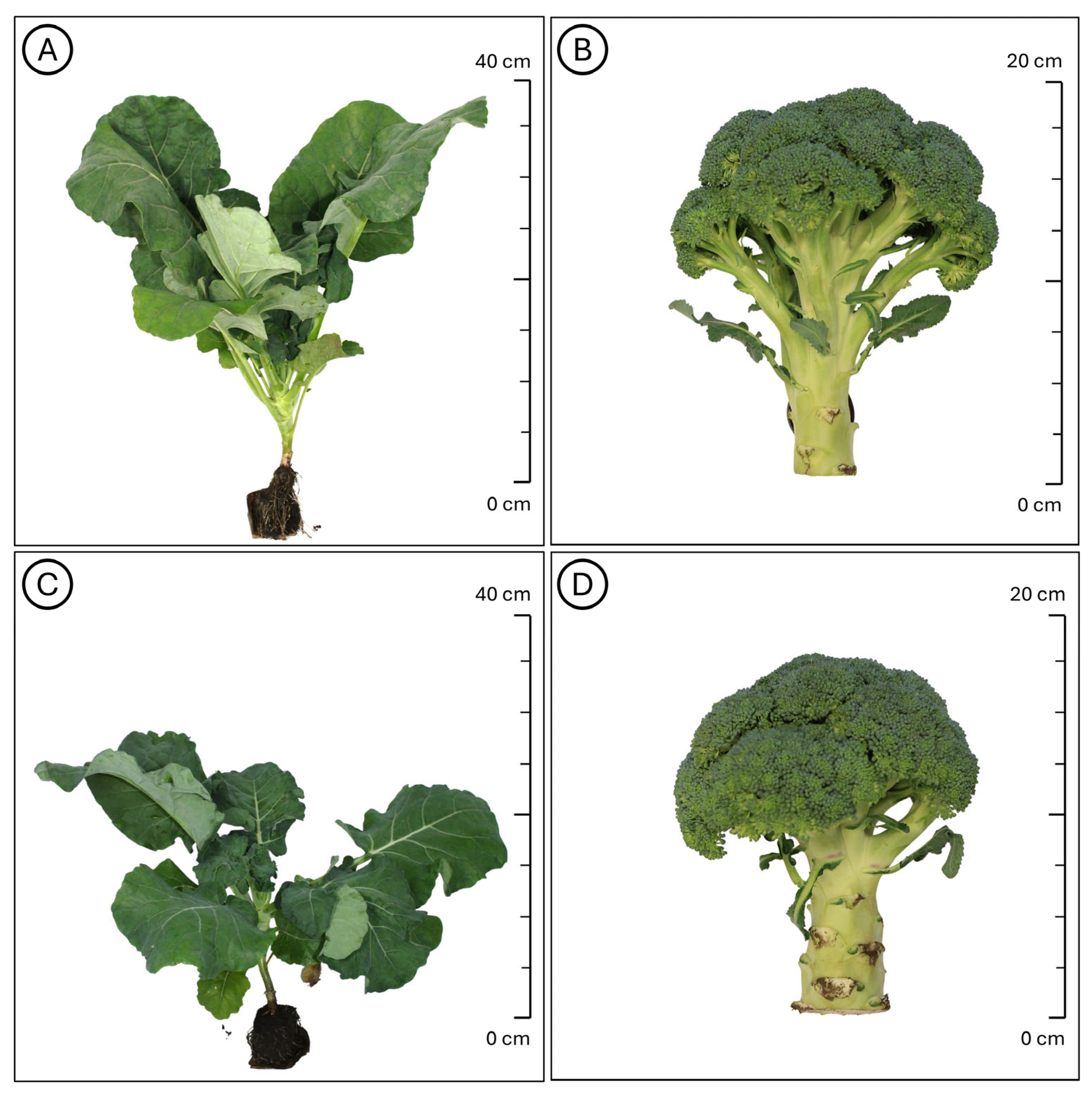
The study included two broccoli cultivars (Brassica oleracea var. italica) with differing susceptibility to hollow stem formation based on prior cultivation experience. The variety ‘Parthenon’ has been regarded as relatively susceptible, whereas ‘Naxos’ is considered less prone to the disorder. ‘Naxos’ is characterized by an upright, cup-shaped growth habit (Figure 1A), while ‘Parthenon’ has a broad, spreading form (Figure 1C). The heads of ‘Naxos’ are loosely structured with long floret stalks (Figure 1B), in contrast to the compact, firm heads with thicker stems produced by ‘Parthenon’ (Figure 1D). The field experiments were conducted in 2017, 2021, and 2023, thereby capturing natural variation in temperature and precipitation, which are known to influence hollow stem formation. Transplanting occurred in mid-July, and harvests took place from late September to early October. The trials were conducted in Falkenberg (N 52°54′39.9″ E 7°59′02.3″), Warnstedt (N 52°45′57.0″ E 8°01′00.9″), and Elsten (N 52°47′12.4″ E 8°04′09.2″), in northwestern Germany, with a maximum distance of 13 km between the sites. This region represents a main regional production area for broccoli. All sites had soils of similar texture (sand or loamy sand) and organic matter content (1.9 to 3.0%). The organic matter content was measured by combustion at 550 °C and subsequent carbon dioxide analysis. In 2017 and 2021, soil pH, measured in 0.01 mol L–1 calcium chloride (CaCl2), was adjusted to 5.5 using quicklime with 90% calcium oxide (CaO). At Elsten, no liming was required as the soil pH was already 6.3. Plant available phosphorus (P), potassium (K), and magnesium (Mg) levels were usually in the optimal to slightly elevated range, with the exception of site Falkenberg, which exhibited an extremely high P content as a result of long-term intensive slurry application. The boron content of the soils ranged between 0.23 and 0.47 mg kg−1, indicating an adequate availability of this micronutrient (Table 1). Prior to planting, Korn-KALI® (K+S Aktiengesellschaft, Kassel, Germany) fertilizer containing 31.5% K, 3.6% Mg, and 4.8% sulfur (S) was applied at rates of 100 kg ha−1 (2023), 300 kg ha−1 (2021), and 400 kg ha−1 (2017). Crop protection followed standard practices using Benevia® (cyantraniliprole, Cheminova Deutschland GmbH & Co. KG, Stade, Germany), Bulldock® (beta-cyfluthrin, Nufarm Deutschland GmbH, Köln, Germany), Calypso® (thiacloprid, Bayer CropScience AG, Mohnheim am Rhein, Germany), Forum® (dimethomorph, BASF SE, Ludwigshafen, Germany), Karate® Zeon (lambda-cyhalothrin, Syngenta Agro GmbH, Frankfurt am Main, Germany), Luna® Experience (fluopyram and tebuconazole, Bayer CropScience AG, Mohnheim am Rhein, Germany), Signum® (boscalid and pyraclostrobin, BASF SE, Ludwigshafen, Germany), and Trebon® 30 EC (etofenprox, Certis Belchim B.V., Hannover, Germany).
The weather data were obtained from nearby weather stations of the German Weather Service [41] or from in-field weather stations (model METOS® Basic 6, Pessl Instruments GmbH, Weiz, Austria). In 2017, the weather conditions during the 88-day growing period from transplanting to harvest were divided into two distinct phases. In the first half, the average daily temperature was 16.9 °C (max. 20.7 °C/min. 12.3 °C), accompanied by 130 mm of precipitation. In the second half, the average daily temperature dropped to 13.1 °C (max. 17.6 °C/min. 9.7 °C), with slightly higher precipitation of 141 mm. In 2021, the average daily temperature remained relatively stable throughout the entire crop cycle at 16.8 °C (max. 21.8 °C/min. 11.2 °C). Overall, precipitation of 170 mm and the cultivation period of 72 days were lower than in the first field trial. In 2023, the average temperature was highest at 17.3 °C (max. 22.5 °C/min. 12.9 °C). The 78 growing days were characterized by regular precipitation, totaling 214 mm. The field experiments conducted in 2017 and 2023 received supplemental irrigation of 15 mm at planting with well water. Nitrate concentration in the irrigation water was below the detection limit (<0.167 mg L−1); thus irrigation did not contribute to plant N supply.

2.2. Trial Set-Up

In 2017, the field trial was conducted using a randomized strip-split-plot design because three factors (variety, mineral N supply, and plant density) were tested simultaneously. This required large main plots to implement the different N levels and to allow the use of a transplanting machine that operated in continuous strips. In 2021 and 2023, planting was carried out manually in smaller plots and N was applied uniformly; therefore, a randomized complete block design was adopted, which enabled a more compact layout while maintaining full replication of the main treatment factors. Each experiment comprised four replicates. Seedlings were raised in peat press pots (3.8 cm × 3.8 cm × 3.8 cm) and transplanted at the three-leaf stage. In the first trial, the common planting distance was 60 cm between rows and 40 cm within rows. In subsequent years, this was reduced to 60 cm × 36 cm. Additionally, narrower spacings of 30 cm × 20 cm, 36 cm × 30 cm, and 60 cm × 28 cm were tested in 2017, 2021 and 2023, respectively. In the first trial, soil mineral nitrogen (Nmin) supply, i.e., the sum of nitrate nitrogen (NO3–N) and ammonium nitrogen (NH4+–N), was varied at three levels: 100, 200 and 300 kg ha−1. In the second and third trials, it was set at 250 and 300 kg ha−1, respectively. The initial mineral N content in the soil was 41, 62 and 35 kg ha−1. The N fertilization was split into two applications. The base dressing was carried out immediately after planting. In 2017, 10 kg ha–1 was applied at the lowest N level and 54 kg ha–1 at the higher N levels. In 2021 and 2023, the N application rate was uniformly 54 kg ha–1. The top dressing took place 56 (2017), 23 (2021) and 38 (2023) days after transplanting (DAT), respectively. In 2017, the plants received fertilization rates of 49, 105 and 205 kg N ha−1 to reach the respective mineral N supply levels. In 2021 and 2023, fertilizer amounts applied for top dressing were 134 and 211 kg N ha−1, respectively (Supplementary Table S1). In the first two field trials, granulated calcium ammonium nitrate with a N content of 27.0% N (w/w) was broadcast. In the third field trial, a mixture of urea ammonium nitrate solution and ammonium sulfate solution in a ratio of 2:1 (v/v) with a N content of 25.6% (w/v) was injected into strips 5 cm deep and approximately 10 cm from the plant rows. Additionally, three B levels (0, 1.5, and 3.0 kg ha−1) were applied as foliar sprays using a solution of disodium tetraborate decahydrate (≥99%, ThermoFischer Scientific, Kandel, Germany) and the surfactant BREAK-THRU® S 301 (0.02% (v/v), Alzchem Group AG, Trostberg, Germany) (Table 2). Boron was applied onto the plants 43 DAT in the morning hours using a pressure sprayer (Hobby exclusiv Typ 262, GLORIA® Haus-und Gartengeräte GmbH, Witten, Germany) with a water amount of 500 L ha–1. Boron treatments were tested exclusively on ‘Parthenon’, which was chosen due to its higher susceptibility to hollow stem and thus its suitability for detecting potential B effects. As B soil availability at the trial sites was within a sufficient range, no B-deficient control was established.

2.3. Measurement of Vegetative Plant Growth Parameters

In the first two field experiments, vegetative growth was assessed by recording the number of leaves and measuring plant height and width. Ten plants per plot were included in the data collection. All fully expanded leaves were counted, with cotyledons excluded. Plant height was measured from the soil surface to the highest point. Plant width was determined as the mean of two perpendicular measurements across the plant canopy using a ruler. The average daily increase in plant height, plant width, and number of leaves was calculated by dividing the respective values by the number of cultivation days. The number of leaves was recorded on five dates: 20, 27, 35, 42 and 63 DAT in 2017, and 10, 17, 24, 31 and 45 DAT in 2021. During later cultivation, older leaves turned yellow and fell off, which could have biased subsequent counts. Plant height and width were measured on six dates up to 70 and 52 DAT, respectively. Subsequently, no further growth was observed.

2.4. Harvest and Evaluation of Head Traits

The broccoli heads were harvested in two rounds. In 2017, the first harvest took place on 11 October (83 DAT) and the second on 16 October (88 DAT). In the following two years, the harvests took place on 23 September (66 DAT) and 29 (72 DAT), 2021, and 26 September (70 DAT) and 4 October (78 DAT), 2023. In 2017, all marketable heads from each 60-plant plot were harvested. Their evaluation was based on the quality characteristics defined in the FFV-48 standard of the United Nations Economic Commission for Europe (UNECE) [4]. Heads were considered marketable if they were healthy, free of damage and pests, had a minimum width of 6 cm, and a head-to-stem diameter ratio of at least 2:1. Heads with bacterial soft rot, premature flowering, or insufficient maturity were excluded [4]. Harvest rate was calculated as the proportion of harvested heads relative to the total number of plants per plot. In addition, the marketable head yield, expressed in tons fresh matter per hectare (t FM ha–1), was calculated according to the above criteria. In the trials conducted in 2021 and 2023, the entire core plot of 10 and 20 plants, respectively, was harvested. Here, the marketability of broccoli heads was not assessed due to the limited number of plants.
Broccoli heads were harvested with a stem length of 8 cm, measured from the cut surface to the first flower branch. Afterward the harvested crop was evaluated based on different head characteristics. These included head width, length, and weight, as well as stem diameter. The head width was the mean of two crosswise measurements, starting at the largest diameter. To determine the head length and stem diameter, the heads were first cut in half lengthwise. The measurements were then taken on the inside of the stem. The head length was measured from the harvest cut to the highest point of the head. The stem diameter was taken 3 cm above the cut surface.
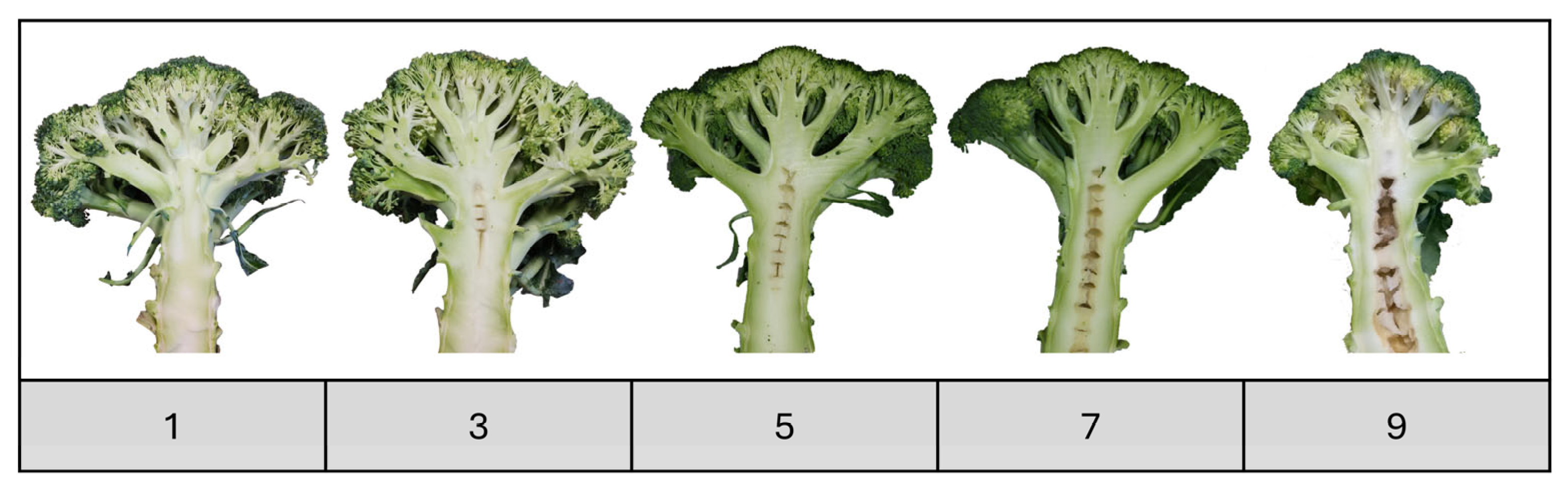
Incidence and severity of the cavities were examined on the inner surface of the halved heads. All harvested broccoli heads were included in the assessment. The rating scale ranged from 1 (no hollow stem) to 9 (very severe) (Figure 2). A broccoli head was considered hollow-stemmed if it received a score of ≥2. When the cavity was visible at the cut surface and had begun to brown (possible from a score of 4), the damage was classified as unmarketable. At scores ≥ 6, extensive browning and partial corking were to be expected, and the hollow stem usually extended to the cut surface of the harvested produce.

2.5. Plant and Soil Analyses

To determine N and B contents, broccoli heads were categorized as hollow or non-hollow. Plant material was dried for one week at 60 °C in a forced-air oven and subsequently ground with an ultracentrifugal mill (model ZM 200, RETSCH GmbH, Haan, Germany) at 14,000 rpm to a particle size of ≤80 µm. The quantitative determination of total N was performed via Dumas’ method using an elemental analyzer (model FP-628, LECO Instrumente GmbH, Mönchengladbach, Germany) following ISO 16634-1 [42]. For B analysis, the dried powder was ashed overnight at 450 °C in a muffle furnace. Afterward, the material was boiled in 67–69% nitric acid to completely break down the remaining organic matter in the samples. For analysis, the mineral residues were dissolved in 2 M HCl. Boron content in the digestion solution was measured by inductively coupled plasma optical emission spectroscopy (ICP-OES; model iCAPTM 7000, ThermoFisher Scientific GmbH, Bremen, Germany) within a calibration range of 0.2 mg B L−1 to 2.0 mg B L−1. Since broccoli is rich in easily excitable alkali and alkaline earth metals that cool the argon plasma of the ICP-OES, the standard solutions were matrix-adjusted accordingly with 1600 mg L−1 potassium (K), 40 mg L−1 sodium (Na) 80 mg L−1, calcium (Ca), and 80 mg L−1 magnesium (Mg).
On the day of transplanting, soil samples were taken from a depth of 0–30 cm with ten punctures per location using a Pürckhauer drill stick for basic soil characterization, and from depths of 0–30 cm and 30–60 cm to determine the initial Nmin content. All soil samples were processed and analyzed according to the guidelines of the Association of German Agricultural and Research Institutes [40]. Mineral N and Mg were extracted with 0.0125 mol L–1 calcium chloride (CaCl2 method), P and K with 0.05 mol L–1 calcium lactate, 0.05 mol L–1 calcium acetate, and 0.3 mol L–1 acetic acid (CAL method), and B with 0.01 mol L–1 CaCl2 and 0.002 mol L–1 diethylenetriaminepentaacetic acid (CaCl2/DTPA method). The subsequent analysis was performed spectrophotometrically (NO3 and NH4+) or via ICP-OES (P, K, Mg, and B). The soil pH (CaCl2) was measured potentiometrically with a glass electrode. In 2017, the initial Nmin content was not determined on the day of transplanting but 14 DAT. In addition, soil samples were taken from depths of 0–30 cm and 30–60 cm at the end of the cultivation period for mineral N and B analysis. These consisted of ten punctures per N supply level and replicate and included all treatments for plant density and variety. In this case, NO3 content was measured by ion chromatography (model 882 Compact IC plus, Metrohm AG, Herisau, Switzerland) and NH4+ content by steam distillation with potentiometric titration using a VapoDest® (model 50 s, C. Gerhardt GmbH & Co. KG, Königswinter, Germany).

2.6. Statistical Analyses

In the first field experiment, the results of vegetative plant growth and head trait were evaluated using a three-way ANOVA, and in the two subsequent trials, using a two-way ANOVA. The mineral N content in the soil was analyzed by a one-way ANOVA. All data met assumptions of ANOVA. Post hoc comparisons were adjusted using the Bonferroni correction Analyses were conducted at a significance level of α = 0.05. Statistical analyses for the Falkenberg site were performed using IBM SPSS® Statistics, Version 26 (IBM Deutschland GmbH, Böblingen, Germany). Data from other sites were analyzed using R, Version 4.4.2 (The R Foundation for Statistical Computing, Vienna, Austria).
A linear response plateau (LRP) model was applied to describe the relationship between head traits and hollow stem incidence. The model was adapted to the observed pattern, comprising an initial plateau phase without hollow stem occurrence followed by a linear increase beyond a threshold value. Calculations were performed using an Excel spreadsheet (Microsoft Corporation, Redmond, WA, USA), as described by Kuzyakov et al. [43].

3. Results

3.1. Growing Period and Vegetative Development of Broccoli

The cultivation period from transplanting to the end of harvest varied between 72 and 88 days across the three trial years due to weather conditions. The longest duration occurred in 2017, which was attributed to cooler temperatures averaging 13.1 °C in the second half of the growing season. Under these conditions, the maximum leaf number was reached at 63 DAT, and senescence of the oldest leaves began at 70 DAT. Plants produced up to 17 leaves, and high plant density reduced leaf number by an average of four (Table 3). Plant height increased steadily to 70 DAT. During the first 42 DAT, the average growth rate was 1.1 cm per day, decreasing to 0.9 cm per day thereafter, coinciding with visible inflorescence development. Under high N supply, the plants reached an average height of 68 cm (low plant density) and 62 cm (high plant density). A low N supply reduced plant height by 10–25%.
Plant width followed a similar pattern to height growth but plateaued a week earlier. Due to canopy closure, the plants could not expand further. Until the onset of the generative phase, the width increased by 1.1 cm per day, then slowed to 0.8 cm per day. At common spacing with 4.2 plants m−2, plants reached an average width of 62 cm, which decreased to 37 cm under very dense plantings with 16.7 plants m−2. No variety differences were observed in plant width, but ‘Naxos’ grew 5 cm taller on average, while ‘Parthenon’ produced three more leaves. In 2021, plants reached similar height and width as in 2017 under common spacing (Supplementary Table S2) but developed about two weeks faster due to average temperatures that were 4 °C higher. Until the transition to inflorescence formation, after 31 DAT, the growth rate was 0.4 cm per day higher than in the previous field trial. This advantage in height growth remained until the end of cultivation. The width growth occurred mainly in the first half of the cultivation period. An increase in plant density to 9.3 plants m−2 did not affect height but reduced the width from 60 cm to 51 cm. ‘Parthenon’ was on average 5 cm broader than ‘Naxos’, but no genotypic differences in plant height were observed in this trial.

3.2. Head Yield of Broccoli

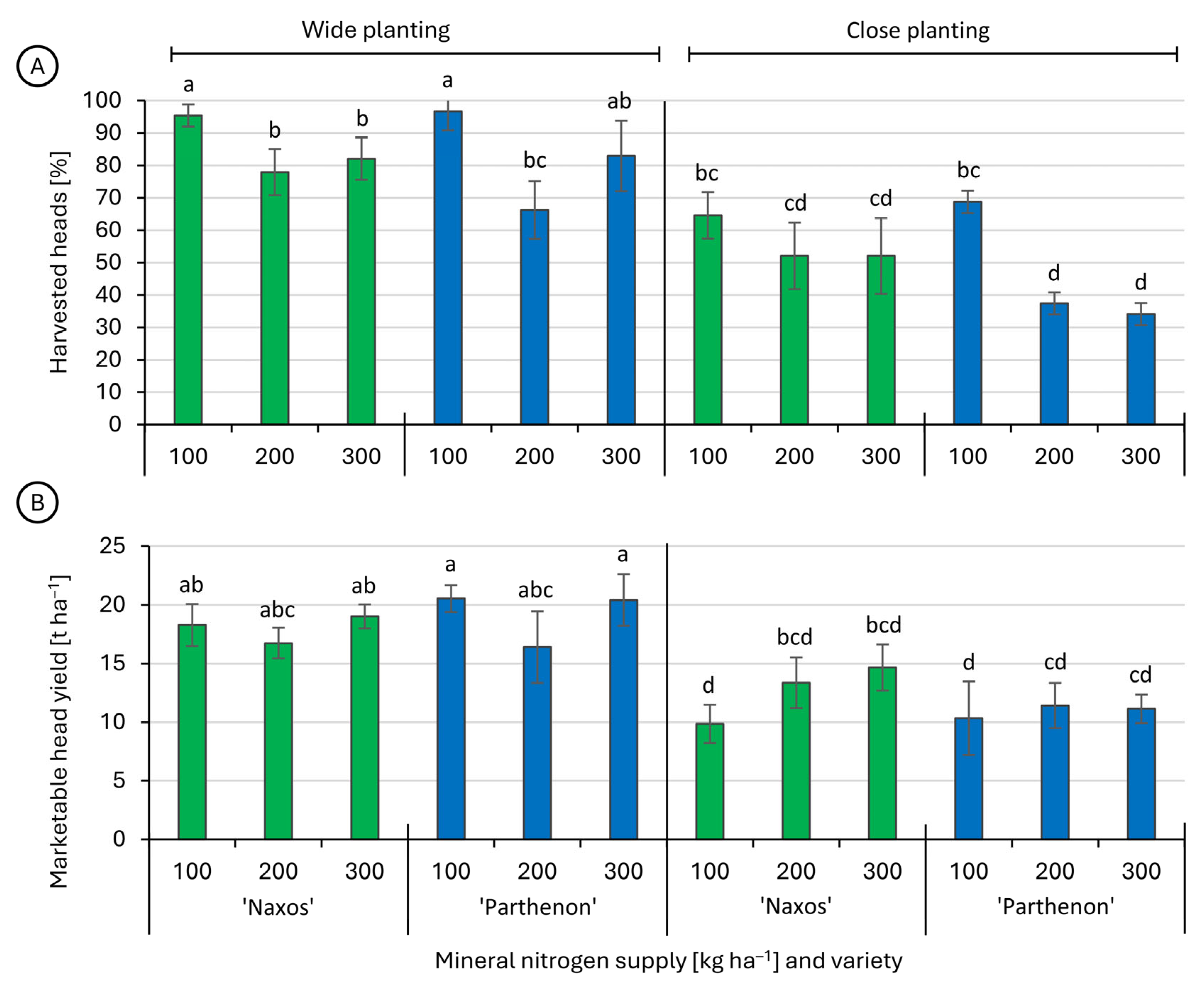
At the end of the cultivation period, broccoli heads were harvested in two rounds. In 2017, the harvest rate—defined as the proportion of harvested heads relative to total plants per plot—varied considerably, ranging from 34% to 97% (Figure 3A). The highest harvest rates were observed at common plant density. Very dense planting reduced the number of harvested heads by 37% and marketable head yield by 35% (Figure 3B), as numerous plants did not reach the necessary harvest maturity. This was indicated by pale green coloration, small head width, and insufficient bud development. In addition, cool and wet conditions toward the end of the season promoted bacterial soft rot caused by Pseudomonas pathogens. These infections significantly reduced the harvest rate, especially under dense planting, which facilitated pathogen spread. Plants grown under low N supply showed greater resistance to infection, resulting in 15% (wide spacing) and 55% (close spacing) higher harvest rates compared to high N treatments. No significant differences in harvest rate or marketable head yield were found between ‘Naxos’ and ‘Parthenon’.

3.3. Evaluation of the Harvested Broccoli Heads

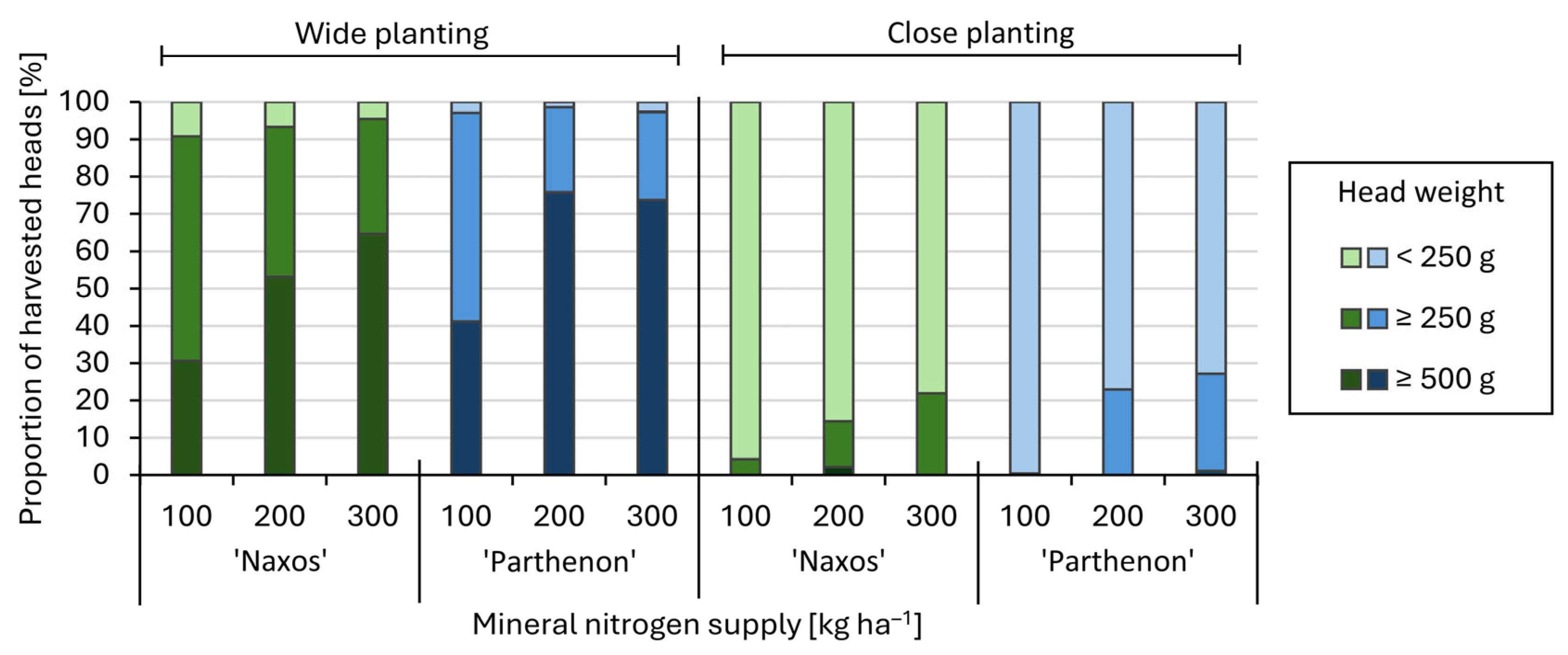
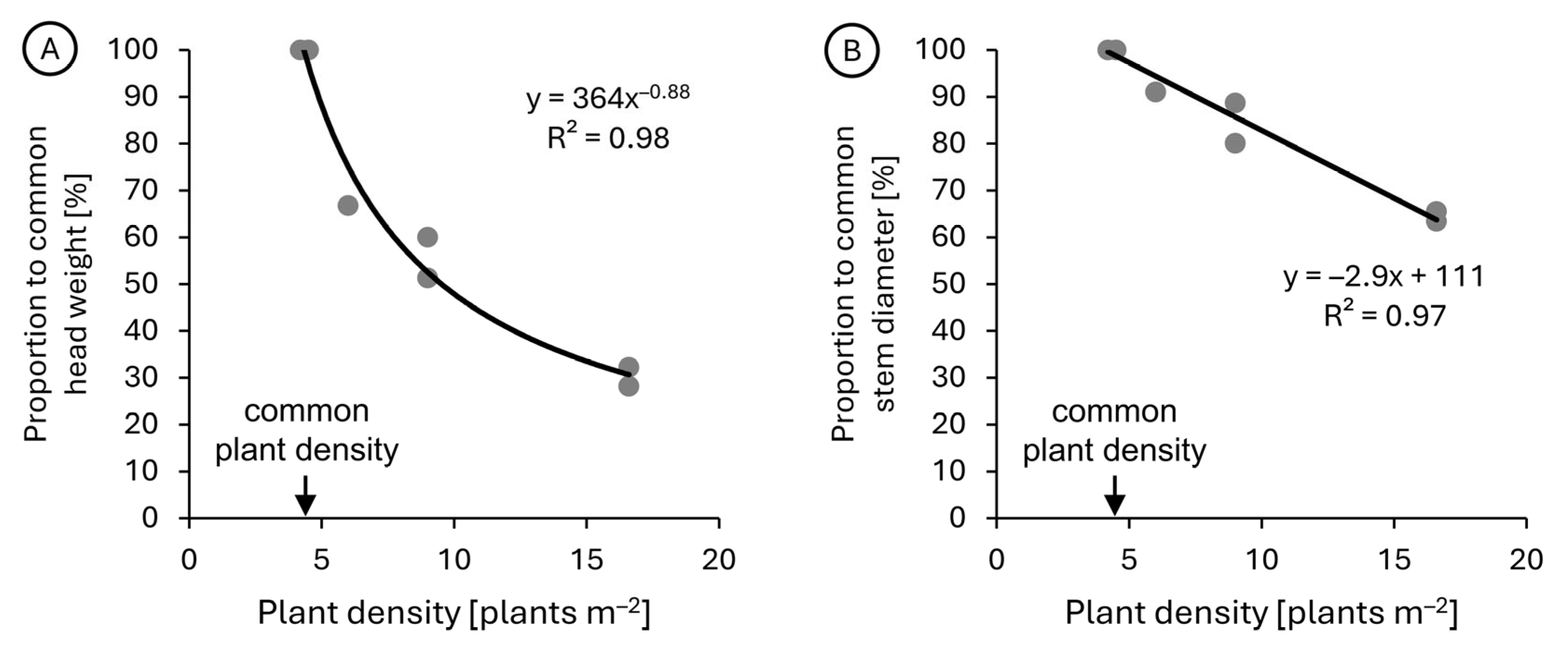
The head traits were strongly influenced by plant density. A fourfold increase in plant density from 4.2 to 16.7 plants m−2 reduced head width and stem diameter by 43% and 36%, respectively (Table 4), and head length by an average of 4 cm. Despite smaller heads under close planting, all broccoli heads met UNECE FFV-48 standards [4], which require a minimum head width of 6 cm and a head-to-stem diameter ratio of ≥2:1. Head weight, on the other hand, was significantly affected by density: under wide spacing, weights ranged from 460 g at low N supply to 585 g at high N supply, while under dense spacing, weights dropped to 93 g and 196 g, respectively. At low plant density, most heads exceeded 500 g, whereas under high plant density, the majority were below 250 g (Figure 4). Even with high N supply, only about one-quarter of heads exceeded this threshold under dense planting. Head weight decreased steadily with increasing density. Compared to the common plant density of 4.2 plants m–2, it reached 67% at 6.0 plants m–2, 56% at 9.3 plants m–2, and only 30% of the reference value at 16.7 plants m–2 (Figure 5A). The stem diameter also declined with increasing plant density (Figure 5B). Low N supply resulted in the smallest heads and thinnest stems. Additional reductions in head length (13%) and head width (33%) occurred only under simultaneous close planting (Table 4).
Figure 3. Proportion of harvested heads (A) and marketable head yield (B) of the broccoli varieties ‘Naxos’ and ‘Parthenon’ from the 2017 field experiment as affected by plant spacing and mineral nitrogen supply (mean ± standard deviation, n = 4); means with different letters in the same graph are significantly different according to Bonferroni corrected multiple comparisons (α = 0.05).
Agronomy 16 00042 g003
Table 4. Head weight, width, and length as well as stem diameter of the broccoli varieties ‘Naxos’ and ‘Parthenon’ from the 2017 field experiment as affected by plant spacing and mineral nitrogen supply (mean ± standard deviation, n = 4); means with different letters in one line are significantly different according to Bonferroni corrected multiple comparisons (α = 0.05).
VarietyNaxosParthenon
Mineral N Supply
[kg ha–1]
100200300100200300
Wide planting
Head weight [g]460±47 b516±16 ab557±29 ab490±64 ab593±58 a585±77 a
Stem diameter [cm]3.4±0.1 c3.6±0.1 b3.8±0.1 b3.9±0.2 ab4.1±0.1 a4.2±0.1 a
Head width [cm]19.1 ±1.3 ab19.6±0.1 ab20.8±0.9 a18.0±0.8 b19.5±1.1 ab19.4±1.6 ab
Head length [cm]20.1±0.6 a19.6±0.1 a19.9±0.2 a18.1±0.5 b18.0±0.4 b18.1±0.6 b
Close planting
Head weight [g]93 ±20 d157±25 c173±18 c90±7.6 d191±34 c196±10 c
Stem diameter [cm]2.1 ±0.1 g2.3±0.1 f2.4±0.1 f2.3±0.1 f2.7±0.1 d2.8±0.0 d
Head width [cm]8.5±1.0 d12.0±0.7 c12.6±1.1 c8.3±1.3 d12.8±1.3 c12.7±1.3 c
Head length [cm]14.3 ±0.9 e16.3±0.5 c16.7±0.9 c13.8±0.4 e15.8±0.7 d15.8±0.2 d
Figure 4. Proportion of different head weights of the broccoli varieties ‘Naxos’ and ‘Parthenon’ from the 2017 field experiment as affected by plant spacing and mineral nitrogen supply (mean, n = 4).
Agronomy 16 00042 g004
Figure 5. Relative broccoli head weight (A) and stem diameter (B) under high mineral nitrogen supply across all experimental years as affected by plant density compared to values observed at common plant spacing of the varieties ‘Naxos’ (mean, n = 4) and ‘Parthenon’ (mean, n = 6).
Agronomy 16 00042 g005
In the first trial, ‘Parthenon’ produced heavier heads and stems that were thicker by an average of 0.5 cm, while ‘Naxos’ had heads 1.2 cm longer (Table 4). In addition, ‘Parthenon’ had the highest proportion of heads over 500 g under medium N supply. At common spacing, about three-quarters of heads reached this weight class, compared to 53% to 65% for ‘Naxos’ (Figure 4). Similar trends were observed in the second field trial depending on variety and plant spacing, though overall head weights were lower (Supplementary Table S3). Due to the weather conditions, the plants matured rapidly in 2021 with a cultivation period of 72 days. This threatened premature flowering, meaning that the broccoli heads were harvested with lower weights. In 2023, foliar B application evaluated in ‘Parthenon’ had no effect on head weight or stem diameter, while plant density effects were again pronounced (Supplementary Table S4).

3.4. Incidence and Severity of Hollow Stem in Broccoli

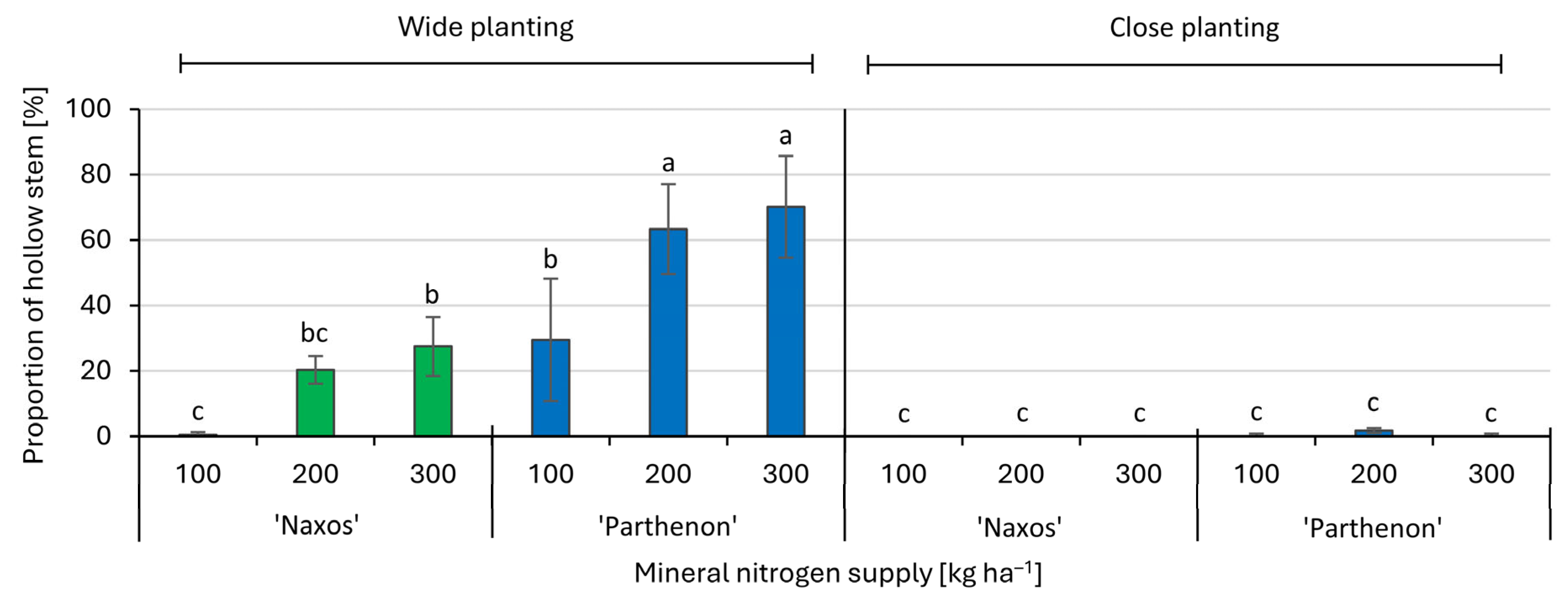
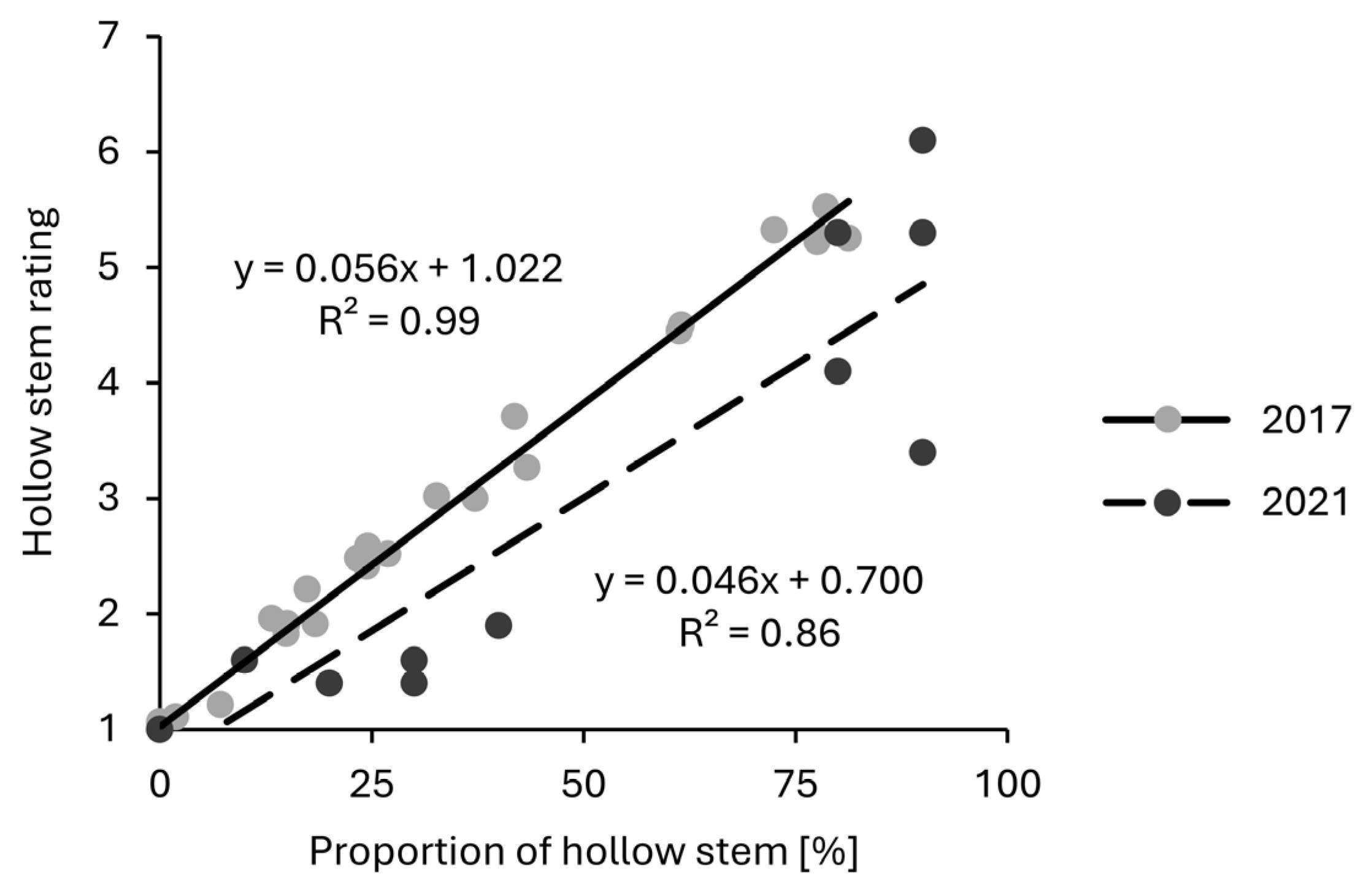
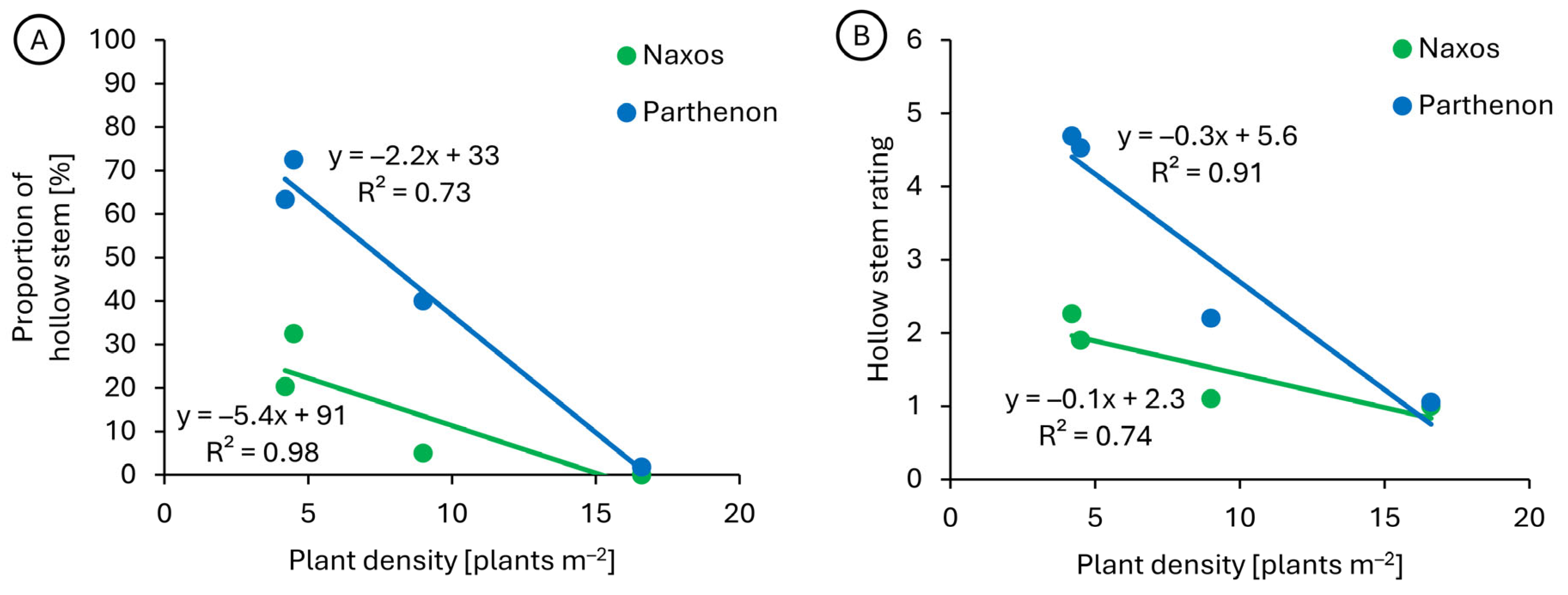
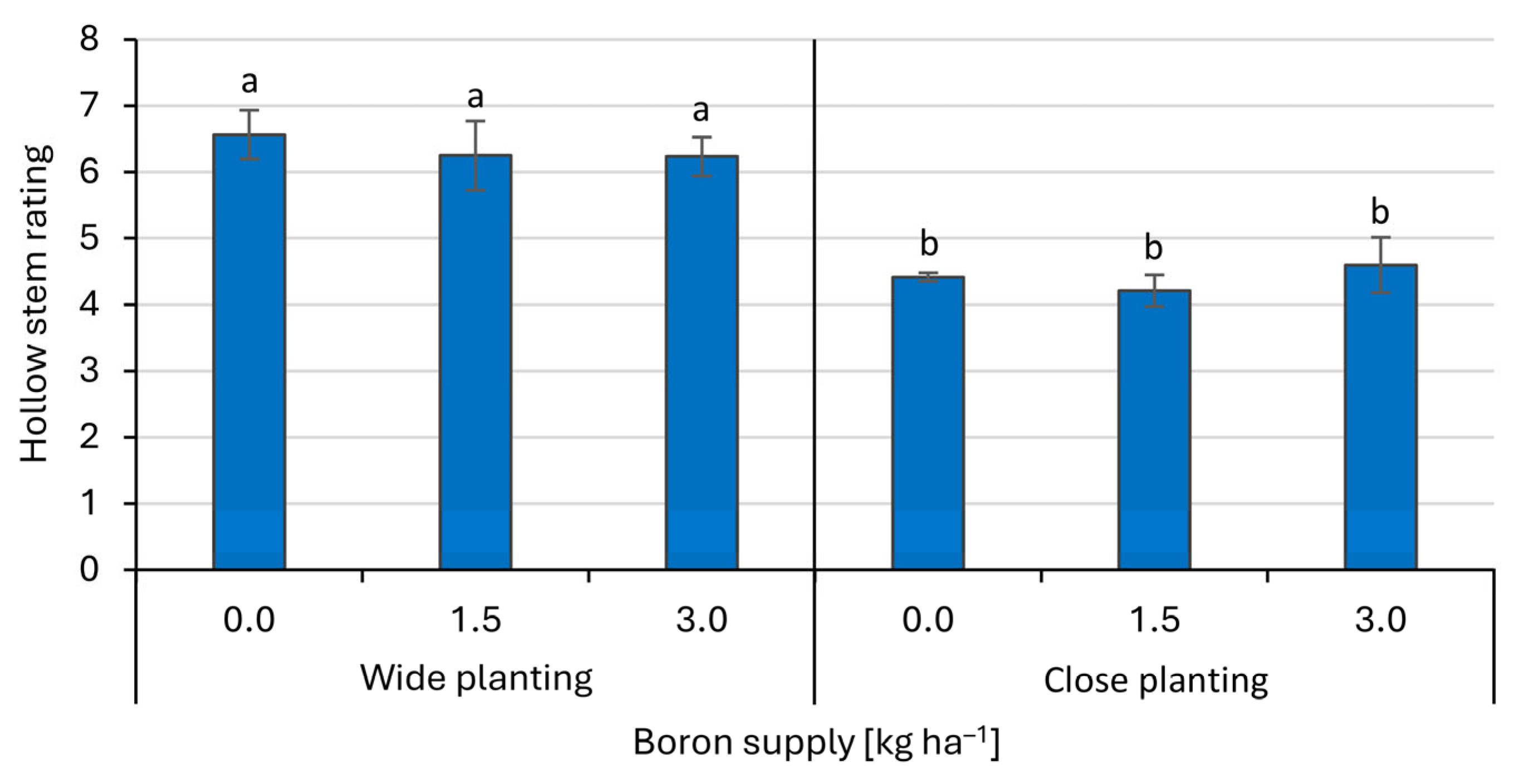
Hollow stem incidence was significantly affected by plant density, N supply, and variety. Under very close planting, hollow stems were nearly absent (Figure 6). At common spacing, ‘Parthenon’ showed incidences ranging from 30% at low N supply to 70% at high N supply. ‘Naxos’ exhibited a significantly lower incidence of cavities, ranging from 1% to 28% under the respective conditions. With an increasing proportion of hollow stems, the severity of cavity formation also increased. Both variables correlated strongly in 2017 and 2021 (Figure 7). In 2023, this relationship was less clear due to a uniformly high incidence of ≥85%. Both varieties showed increased severity with decreasing plant density. ‘Parthenon’ was more sensitive to stem hollowness than ‘Naxos’ (Figure 8). Foliar B application at rates of 1.5 to 3.0 kg ha−1 had no effect on the disorder regardless of plant density (Figure 9).

3.5. Development of Hollow Stem as Affected by Plant Parameters

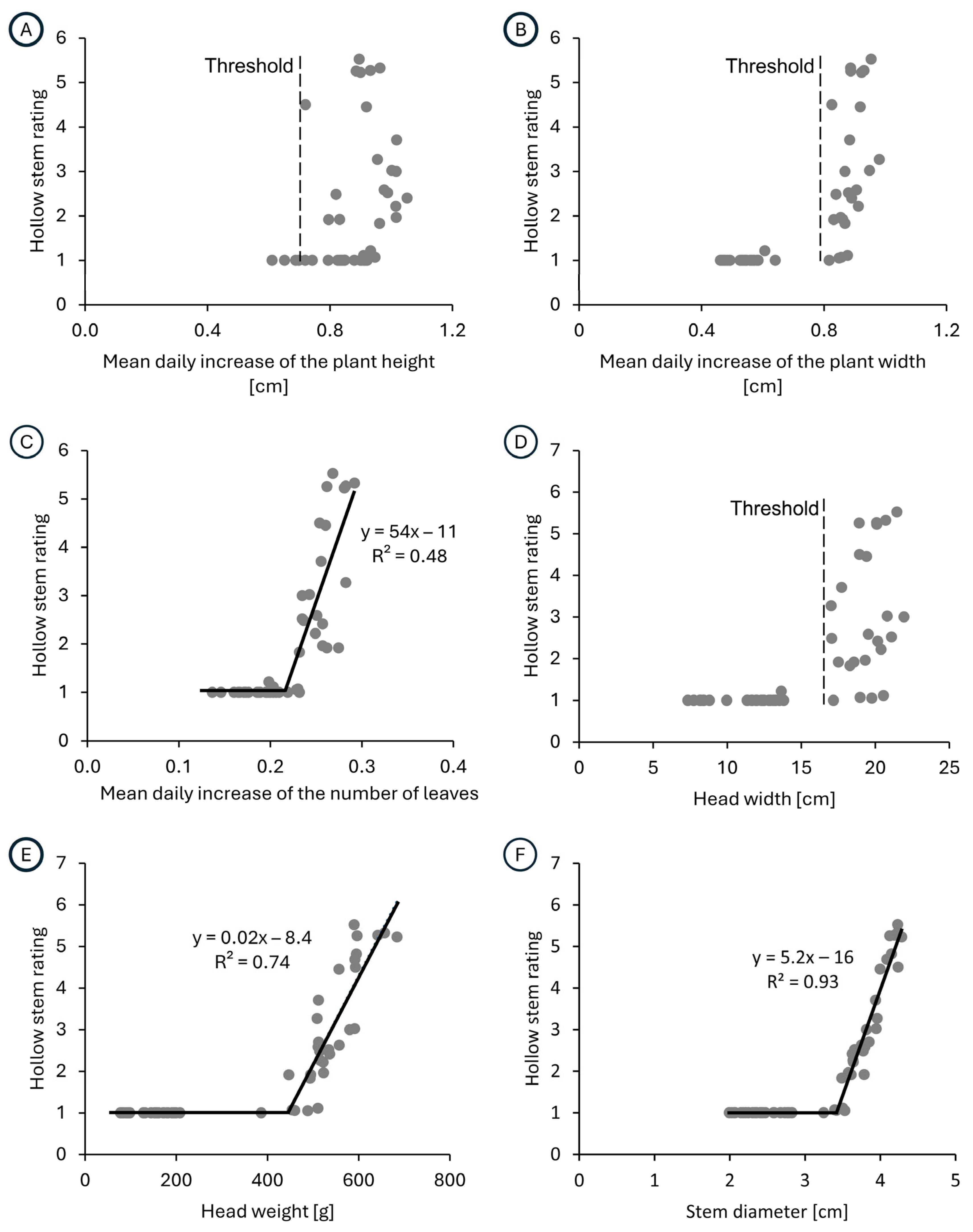
Vegetative plant growth affected hollow stem development. Symptoms began to appear at daily growth rates of 0.7–1.2 cm in plant height and 0.8–1.1 cm in plant width. However, severity varied widely beyond these thresholds, as shown in Figure 10A,B for the 2017 experiment. Thus, the influence of vegetative growth parameters on the damage pattern was rather low. The number of leaves showed the strongest correlation with the disorder. Above an increase of 0.2 leaves per day, hollow stem severity increased linearly, even though the relationship was only moderate (R2 = 0.48) (Figure 10C). In 2021, this threshold was slightly higher at 0.3 leaves per day (Supplementary Figure S1). Only at the final measurement dates (45–70 DAT) did vegetative parameters correlate with hollow stem occurrence, whereas earlier stages did not allow reliable prediction.
Thresholds could also be identified for head width, which ranged from 13 to 17 cm depending on the cultivation year. Beyond these values, the cavities developed in a highly variable manner, similar to the vegetative growth parameters (Figure 10D). In contrast, head weight and stem diameter showed strong to very strong correlations with hollow stem formation. In 2017, hollow stems appeared at head weights above 447 g (Figure 10E) and stem diameter above 3.5 cm (Figure 10F), respectively. Severity increased linearly with increasing head weight and stem diameter. In 2021 and 2023, first cavities were already observed at head weights of 330 g and 412 g, respectively (Table 5). In both years, the correlation between head weight and the disorder was particularly pronounced (Supplementary Figures S1 and S2). However, the influence of stem diameter was weaker than in the first trial. In 2023, the first hollow stems appeared only at stem diameters of ≥4.4 cm. This critical value also corresponded to the smallest diameter measured in that year, which was characterized by uniformly warm and humid conditions, thus favoring plant growth.

3.6. Nitrogen and Boron Content in the Dry Matter of Broccoli Heads

Total N content in head dry matter was influenced by N supply and variety. With a mineral N supply of 200 and 300 kg ha–1 the N content in the dry matter was around 5.4%, while it dropped to 4.4% at the lowest N level of 100 kg ha–1 (Table 6). ‘Parthenon’ contained, on average, 0.5 percentage points less N in the plant material than ‘Naxos’. In 2017, B content in the head dry matter ranged from 23 mg kg−1 to 30 mg kg−1, independent of treatment. No differences in B content were found between hollow and non-hollow broccoli heads (Supplementary Table S5). In 2023, the native B content in the dry matter was higher, ranging from 38 mg kg–1 at wide spacing to 45 mg kg–1 at close spacing. This corresponded to a B concentration in the soil at this trial that was approximately twice as high as that in the previous field experiment when extracted with CaCl2/DTPA (Table 1). Boron foliar fertilization increased the B content in the broccoli heads by 17% following an application of 1.5 kg ha–1 and by 21% following an application of 3.0 kg ha–1. However, no influence of the B content on the formation of hollow stems was detectable in this experiment either.

3.7. Residual Mineral Nitrogen in the Soil at Harvest

The residual Nmin concentration in the soil increased with increasing N supply, ranging from 41 kg ha–1 at low N supply to 109 kg ha–1 at high N supply (Table 7). Higher N levels also led to increased leaching into deeper soil layers. With a N supply of 300 kg ha–1, more than half of residual Nmin was found in the 30–60 cm layer. In 2021 and 2023, residual Nmin in the 0–90 cm layer at a N supply of 250 kg ha–1 and 300 kg ha–1 ranged between 34 kg ha–1 and 70 kg ha−1, respectively.

4. Discussion

4.1. Hollow Stem in Broccoli and Its Association with Plant Traits

The formation of hollow stems is a widespread quality issue in broccoli cultivation under temperate climate conditions. This was confirmed in the present study, which covered three summer growing periods at closely situated sites in northwestern Germany. Under common cultivation conditions—with plant densities of 4.2 to 4.5 plants m−2 and a mineral N supply of 250 to 300 kg ha−1—the proportion of hollow-stemmed broccoli ranged between 28% and 100% (Supplementary Table S6). Comparable damage levels have been reported under similar site conditions by Gruda and Heine [13], Bakker et al. [14], and Schellenberg et al. [15]. As the incidence of hollow stem increased, the severity of the disorder rose (Figure 7). When the incidence was below 35%, only mild symptoms with a rating value of ≤3 were typically observed. In contrast, an incidence above 65% was usually associated with more severe damage. At such a level—especially when the hollow stem is visible at the cut surface and shows brown discoloration—the product is no longer marketable in retail and remains unharvested in the field, resulting in considerable food losses.
The annual variation in hollow stem incidence under common cultivation conditions is likely due to differences in weather, as the plants were grown on similar sites with sandy to loamy-sandy soils. The highest proportion of hollow-stemmed plants was observed in the cultivar ‘Parthenon’ during the 2023 trial year, which experienced by consistently warm and wet conditions. Similar year-dependent variations in the occurrence of this physiological disorder have been reported in other studies and linked to weather factors. In particular, high water availability due to regular precipitation or irrigation, combined with elevated air temperatures, has been shown to promote hollow stem formation [5,18,22].
The development of hollow stems was closely associated with head characteristics, particularly head weight and stem diameter. If these parameters remained below certain thresholds, broccoli heads were free of hollow stems. Once the respective thresholds were exceeded, the severity of hollow stem increased linearly with the expression of these traits. Depending on the year, the critical values ranged between 330 and 447 g for head weight and between 3.3 and 4.4 cm for stem diameter (Table 5). A threshold between 13 and 17 cm was also observed for head width. However, the severity of hollow stem varied more widely above this range. These findings are consistent with previous studies, which identified stem diameter and head weight as key traits in the development of hollow stem, while head width appeared to be less relevant [15,21,23]. It has been proposed that an increase in stem diameter and head weight beyond a certain limit induce excessive mechanical stress in the pith tissue of the stem axis, leading to tissue ruptures and subsequent cavity formation [18,26,27,28]. Such tissue degeneration may be triggered by ethylene-mediated signaling and the accumulation of reactive oxygen species. Both of these stimuli can activate downstream programmed cell death pathways. Once activated, these processes can weaken or degrade parenchyma cells within the stem axis, facilitating the formation and enlargement of internal cavities [29]. Although our field experiments did not include molecular analyses, the correspondence between large head traits and cavity development supports the notion that intrinsic stress-response mechanisms may contribute to hollow stem formation under favorable growth conditions.
Vegetative growth parameters such as the number of leaves, plant height, and plant width had only a minor influence on the severity of hollow stem compared to head development. Although thresholds were also identified for these traits, exceeding them resulted in highly variable damage patterns (Figure 10A–C). The strongest correlation was found for the number of leaves, particularly when the average daily increase exceeded 0.2 to 0.3 leaves per day at the final measurement date (45–63 DAT). These results are consistent with earlier reports, which observed that rapidly growing broccoli plants tend to develop hollow stems more frequently [16,21,44]. The phase of peak biomass accumulation in the inflorescence appears to be particularly critical. In earlier developmental stages, no clear relationships were observed between vegetative growth parameters and the later occurrence of hollow stem. Neither the number of leaves nor the plant height or width proved to be reliable indicators for the early prediction of hollow stem formation in broccoli.
Overall, the results clearly show that the risk of hollow stem formation in broccoli depends less on the growth rate of the plant and more on the final expression of its head-related traits. Similar patterns were reported by Griffith and Carling [18] in summer broccoli trials conducted under continental to subarctic climate conditions in Canada. However, the year-to-year variation in threshold values for head weight and stem diameter (Table 5) suggests that weather-related factors such as water availability and temperature also influence the tissue stability of the stem axis and thereby contribute to hollow stem formation.

4.2. Cultivation Factors Influencing Plant Development and Hollow Stem

Variety selection, plant spacing, and fertilization offer agronomic approaches for influencing plant development and thereby reducing hollow stem formation. In the field experiments, the variety ‘Parthenon’ proved to be particularly susceptible to hollow stem. Compared to ‘Naxos’, the incidence was at least twice as high, and the severity of symptoms was also significantly greater. This may be due to differences in head trait expression of between the two cultivars. In ‘Naxos’, a large proportion of harvested heads did not reach the critical values for head weight and stem diameter associated with hollow stem formation. In contrast, ‘Parthenon’, with its stocky growth habit and thick stems (Figure 1D), more frequently exceeded these thresholds. Under common cultivation conditions, the heads of ‘Parthenon’ were on average 18% heavier and the stems 15% thicker than those of ‘Naxos’. However, these differences did not significantly affect the proportion of marketable heads or the head yield (Figure 3). In terms of vegetative development, only minor differences were observed between the cultivars. While ‘Naxos’ reached a greater final height, ‘Parthenon’ developed more leaves (Table 3). Genotypic variability in hollow stem susceptibility has already been described in several previous studies. These often show that cultivars with higher head weights are more susceptible to the disorder [15,18,37,38]. The formation of hollow stems due to tissue rupture in the pith may be promoted by a higher leaf number, as increased node formation can lead to greater mechanical stress in the stems [26,27,28]. However, this effect was likely of minor importance, since—as previously discussed—the number of leaves generally showed only a weak to moderate correlation with hollow stem severity.
Among the agronomic measures examined, plant density proved to be the most effective approach for reducing hollow stem formation. Increasing plant density restricted plant growth, as the reduced space availability limited both lateral plant spread and leaf development (Table 3). Head width, head weight, and stem diameter also decreased (Figure 5). Other studies have shown that head growth declines at densities above 3.3 plants m−2, while reductions in vegetative growth are observed only above 5.6 plants m−2 [5,45,46]. Although individual head weight decreased with increasing plant density, higher plant numbers can still result in greater head yields [5,15,45,46,47,48]. However, results from the 2017 experiment showed that under very close spacings at 16.7 plants m−2, a significant proportion of broccoli failed to reach harvest maturity or was affected by soft rot. Due to these losses, marketable yield dropped to an average of 12 t ha−1, which was 36% below the level of variants with common spacing (4.2 to 4.5 plants m−2) and 14% below the average yield reported for broccoli cultivation in Germany [49]. In German retail, a minimum pack weight of 500 g is required for broccoli. While most plants under wide spacing produced heads reaching this weight class, the majority grown under very close spacing remained below 250 g. Even when bundling two heads, the required minimum pack weight would often not be achieved. The head weights of ‘Parthenon’ were just below the 500 g threshold at a plant density of 6.0 plants m–2. Therefore, it can be assumed that broccoli cultivated at a plant density between 4.5 and 6.0 plants m–2 can achieve head weights that meet the German food retailer standard.
With increasing plant density and the resulting reduction in head weight, both the incidence and severity of hollow stem decreased (Figure 8). While up to 70% of the harvest was affected by hollow stem at common spacing, very close planting almost completely prevented the disorder. For the variety ‘Naxos’, a density of 9.3 plants m−2 was sufficient to reduce the incidence to 5%. For ‘Parthenon’, the proportion was significantly higher at 40%, but severity remained below the critical value for marketability. Under these conditions, the rating for hollow stem severity ranged from 2 to 3 on a scale from 1 (no hollow stem) to 9 (very severe) (Figure 2). In contrast, significantly higher damage levels with ratings between 4 and 5 were observed at common spacing. These results are consistent with earlier reports identifying plant density as an effective control measure to reduce hollow stem formation [5,21] and emphasizing variety-specific differences in response to this measure [38].
The mineral N supply in the soil also affected hollow stem formation in broccoli. However, a clear reduction in incidence was only observed when N supply was lowered to 100 kg ha−1 (Figure 6), equivalent to approximately one-third of the estimated N requirement for a head yield level of 15 t ha−1 [35]. Under common N supply of 300 kg ha−1, the proportion of hollow-stemmed heads in the variety ‘Parthenon’ was 70%. When N fertilization was substantially reduced, this proportion dropped to 30%. In the variety ‘Naxos’, the disorder was almost absent under the same conditions. When N supply was moderately reduced to 200 kg ha−1, a trend toward lower incidence was observed in both varieties, but the differences compared to the highest N level were not statistically significant. Similar relationships between N supply and hollow stem incidence have been reported by Bakker et al. [14] and Hussain et al. [23]. These effects are likely to be due to changes in relevant head traits. At the lowest N level, head weight decreased by an average of 16% under wide spacing and by 50% under close spacing compared to the highest N level. Head width and stem diameter also decreased, although to a lesser extent (Table 4). According to Hussain et al. [23], significant reductions in these traits occur only when N supply is further limited to 60 kg ha−1. In contrast, Kahn et al. [50] found no effect of N supply on stem diameter. However, in their study, stems remained relatively thin even at high N rates, and head weights were also consistently low.
Reducing N supply to 100 kg ha−1 did not negatively affect marketable head yield (Figure 3). This was mainly due to a higher harvest rate, resulting from a lower proportion of severely hollow-stemmed broccoli and a reduced incidence of head rot. Other studies have also reported a decrease in bacterial soft rot incidence in broccoli when N fertilization is reduced [14,51,52]. Slower plant growth under low N supply promotes the development of firmer, more lignified cell walls and thicker cuticles, which may provide structural protection of the heads against pathogens. At the same time, tissue water content and the concentration of soluble amino acids in the apoplast decrease, making conditions less favorable for colonization by Pseudomonas spp. and other biotrophic pathogens. Additionally, the synthesis of secondary metabolites such as glucosinolates and phenolic compounds increases, which act as antimicrobial defense substances [53,54,55,56,57]. Although less than half of the harvested broccoli heads reached a weight of at least 500 g under the lowest N supply level, more than 90% still exceeded 250 g when common spacing was applied (Figure 4). Low N rates also led to a significant reduction in residual soil Nmin content. At the end of the cultivation period, only 36 kg ha−1 remained, compared to 103 kg ha−1 under high N supply (Table 7). Thus, reducing N input also lowered the risk of nitrate leaching into groundwater [58,59,60]. At the same time, N content in the plant material decreased (Table 6), meaning that less N remained in the field with crop residues at the end of the season. This easily decomposable organic material can significantly contribute to N losses through nitrate leaching, especially in crops grown at the end of the vegetation period [61,62,63].
Although a reduction in N supply to 100 kg N ha−1 markedly decreased hollow stem incidence, this approach is not feasible under commercial production conditions because approximately two thirds of the harvested heads did not meet the 500 g minimum weight threshold for the German food retail market and would therefore have to be sold in bundles. Thus, 100 plants yield a maximum of 68 consumer packs, compared with 84 packs at 300 kg N ha−1. However, when the higher share of culls caused by head rot at elevated N supply is taken into account, the number of marketable units under reduced N supply was only about 7% lower. With a N supply of 200 kg ha−1, adverse effects on head size distribution were no longer observed, while residual soil mineral N was almost halved compared with the standard N rate of 300 kg N ha−1 (Table 7). Even though this moderate reduction in N supply did not lead to a significant decrease in hollow stem incidence, it nonetheless represents a meaningful measure from an environmental perspective.
A foliar B application of up to 3 kg ha−1 increased B content in broccoli heads but failed to reduce stem hollowness (Figure 9). Consistently, no effect of this measure was observed on head traits relevant to hollow stem formation (Supplementary Table S4). However, these findings need to be interpreted in the context of the soil B status, which at 0.47 mg kg–1 was well above the CaCl2/DTPA-extractable B threshold of 0.25 mg kg−1, below which B deficiency would be expected under these site conditions [64]. These results are consistent with findings by Gupta and Cutcliffe [65], who also observed no effect of soil-applied B at rates of up to 4.5 kg ha−1 on hollow stem incidence or head yield in broccoli. In hydroponic broccoli cultivation, hollow stem formation could be induced when plants were grown in nutrient solution lacking B, and B content in the dry matter of florets dropped below 14 mg kg−1 [30]. In the present study, B content in the dry matter of broccoli heads was generally two to three times higher. The CaCl2/DTPA-extractable B content in the soil also indicated sufficient B availability at all three trial sites (Table 1). However, under conditions of limited B availability in the soil, B fertilization can reduce hollow stem formation in broccoli, as shown by Hussain et al. [23] and Moniruzzaman et al. [31]. Boron deficiency can be caused by factors such as high soil pH, coarse soil texture, low organic matter content, and drought [66,67]. To better assess the effect of foliar B sprays on hollow stem formation across sites and varieties, further studies under B-deficient conditions are required.

5. Conclusions

Hollow stem formation in broccoli is primarily determined by head traits, occurring only when head weight and stem diameter exceed specific thresholds. Heads weighing less than 330 g or with a stem diameter below 3.3 cm were almost entirely free of a hollow stem. However, these critical values varied depending on weather conditions. Under growth conditions that extended the cultivation period, even heavier heads with thicker stems remained free of a hollow stem. Once the respective thresholds were exceeded, the formation of cavities increased linearly with the expression of these head traits. The incidence and severity of hollow stem were closely correlated. When incidence exceeded 65%, the damage was usually so severe that retail marketability was compromised. Based on vegetative plant parameters, hollow stem formation cannot be predicted at an early stage. Neither plant height and width nor leaf number showed a close relationship with the later occurrence of the disorder.
Variety choice and plant density proved to be effective strategies to reduce hollow stem formation. Varieties producing lighter heads with thinner stems are advantageous. In combination with moderately closer plant spacing, hollow stem formation can be significantly reduced. However, excessively dense planting promotes pathogen infestation and increases the risk of heads failing to reach the minimum weight required for retail marketing. Further research is needed to determine the optimal plant density, taking into account these various aspects. Reducing mineral N supply is not a suitable measure to prevent hollow stem formation, as significant effects are only expected under severe N deficiency (100 kg ha–1), which is associated with a high proportion of small heads. A moderate reduction of N supply (200 kg ha–1) did not substantially affect hollow stem formation and therefore cannot be recommended as a mitigation strategy. However, compared with the standard N supply (300 kg ha–1), it resulted in lower residual soil mineral N. The influence of different N fertilization forms and timings on hollow stem development should be explored further. Boron fertilization to reduce hollow stem formation is recommended only when soil availability of the micronutrient is limited.
Overall, this work delivers multi-year, field-based evidence on hollow stem in broccoli, linking it to quantifiable head traits and identifying variety selection and moderately increased plant density as realistic strategies to mitigate this disorder under commercial production conditions.

Supplementary Materials

The following supporting information can be downloaded at: https://www.mdpi.com/article/10.3390/agronomy16010042/s1, Table S1. Overview of amount and splitting of the N fertilization; Table S2: Vegetative growth parameters of the broccoli varieties ‘Naxos’ and ‘Parthenon’ in the 2021 field experiment, recorded at 45 DAT (number of leaves) and 52 DAT (plant height and plant width) as affected by plant spacing (mean ± standard deviation, n = 4); means with different letters in one line are significantly different according to Bonferroni corrected multiple comparisons (α = 0.05); Table S3: Head weight, diameter, and length as well as stem diameter of the broccoli varieties ‘Naxos’ and ‘Parthenon’ from the 2021 field experiment as affected by plant spacing (mean ± standard deviation, n = 4); means with different letters in one line are significantly different according to Bonferroni corrected multiple comparisons (α = 0.05); Table S4: Head weight and stem diameter of the broccoli variety ‘Parthenon’ from the 2023 field experiment as affected by plant spacing and boron application (mean ± standard deviation, n = 4); means with different letters in one line are significantly different according to Bonferroni corrected multiple comparisons (α = 0.05); Figure S1: Correlation between hollow stem severity (1 = no hollow stem, 9 = very severe) of broccoli heads and the mean daily increase in the plant height (A), plant width (B), and number of leaves (C) determined on the last measurement date (45 and 52 DAT, respectively) as well as the head width (D), head weight (E), and stem diameter (F); the datasets comprise all treatments from the 2021 field experiment, covering different varieties and plant densities (n = 16); Figure S2: Correlation between hollow stem severity (1 = no hollow stem, 9 = very severe) of broccoli heads and the head weight (A) and stem diameter (B) of the variety ‘Parthenon’; the datasets comprise all treatments from the 2023 field experiment, covering different foliar boron sprays and plant densities (n = 24); Table S5: Boron content in the dry matter of broccoli heads of the varieties ‘Naxos’ and ‘Parthenon’ from the 2017 field experiment as affected by plant spacing and mineral nitrogen supply (mean ± standard deviation, n = 4); Table S6: Hollow stem incidence and severity (1 = no hollow stem, 9 = very high degree) in heads of the broccoli varieties ‘Naxos’ and ‘Parthenon’ from all field experiments under common production practice (mean ± standard deviation, n = 4).

Author Contributions

Conceptualization, A.F.; methodology, A.F.; validation, A.F.; formal analysis, A.F. and H.-G.S.; investigation, A.F.; resources, C.V. and D.D.; data curation, A.F.; writing—original draft preparation, A.F.; writing—review and editing, C.V., D.D. and H.-G.S.; visualization, A.F.; supervision, C.V. and D.D.; project administration, A.F. and D.D.; funding acquisition, D.D. All authors have read and agreed to the published version of the manuscript.

Funding

This research was funded by the German Federal Ministry of Research, Technology, and Space (BMFTR) within the project “Broccoli—Free of Hollow Stem, Consumer-Appropriate, and Rich in Health-Promoting Compounds (BroHoKo+)” under the funding line “New Products for the Bioeconomy” (grant no. 031B1247A). The project was conducted in cooperation with Technical University of Berlin—Faculty III: Process Sciences, Institute of Food Technology and Food Chemistry, Division of Food Analytics (grant no. 031B1247B).

Data Availability Statement

The original contributions presented in this study are included in the article/Supplementary Material. Further inquiries can be directed to the corresponding author(s).

Conflicts of Interest

Carsten Vorsatz was employed by Mählmann Gemüsebau GmbH & Co. KG, Cappeln, Germany, during the experimental work and the preparation of the manuscript. The company supported the project by providing field sites and performing general cultivation practices but had no influence on the study design, data collection, analysis, or interpretation. The authors declare that this affiliation did not affect the objectivity or conclusions of the research.

References

  1. FAOSTAT. Crops and Livestock Products—Metadata. Cauliflowers and Broccoli. Visualize Data. Available online: https://www.fao.org/faostat/en/#data/QCL/visualize (accessed on 12 August 2025).
  2. Smith, R.; Barman, A.; Cahn, M.; Dara, S.K.; Fennimore, S.; Grettenberger, I.; Montazar, A.; Putman, A.; Takele, E.; Wang, Z. Broccoli production in California. In Vegetable Production Series; University of California: Oakland, CA, USA, 2024; pp. 1–10. [Google Scholar] [CrossRef]
  3. Kałużewicz, A.; Krzesiński, W.; Knaflewski, M. Effect of temperature on the yield and quality of broccoli heads. Veg. Crops. Bull. 2009, 71, 51–58. [Google Scholar] [CrossRef]
  4. UNECE Standard FFV–48; Concerning the Marketing and Commercial Quality Control of Broccoli; UNECE: Geneva, Switzerland, 2021; Available online: https://unece.org/sites/default/files/2023-12/FFV-48_Broccoli_2023_e.pdf (accessed on 12 August 2025).
  5. Sanderson, K.R.; Fillmore, S.A.E. Response of broccoli (Brassica oleracea var. italica) yield and hollow stem to plant density, trickle irrigation and transplanting date. Can. J. Plant Sci. 2010, 90, 729–735. [Google Scholar] [CrossRef]
  6. USDA. Broccoli, Raw. Available online: https://fdc.nal.usda.gov/food-details/747447/nutrients (accessed on 8 August 2025).
  7. Li, H.; Xia, Y.; Liu, H.-Y.; Guo, H.; He, X.-Q.; Liu, Y.; Wu, D.-T.; Mai, Y.-H.; Li, H.-B.; Zou, L.; et al. Nutritional values, beneficial effects, and food applications of broccoli (Brassica oleracea var. italica Plenck). Trends Food Sci. Technol. 2022, 119, 288–308. [Google Scholar] [CrossRef]
  8. Fahey, J.W.; Zalcmann, A.T.; Talalay, P. The chemical diversity and distribution of glucosinolates and isothiocyanates among plants. Phytochemistry 2001, 56, 5–51. [Google Scholar] [CrossRef]
  9. Hwang, J.-H.; Lim, S.-B. Anitoxidant and anti-inflammatory activities of broccoli florets in LPS-stimulated RAW 264.7 cells. Prev. Nutr. Food Sci. 2014, 19, 89–97. [Google Scholar] [CrossRef]
  10. Mahn, A.; Rubio, M.P. Evolution of total polyphenols content and antioxidant activity in broccoli florets during storage at different temperatures. J. Food Qual. 2017, 2017, 1–9. [Google Scholar] [CrossRef]
  11. Cheng, L.; Wan, K.; Liang, H.; Yuan, Q. Sulforaphane and sulforaphene: Two potential anticancer compounds from glucosinolates. In Glucosinolates: Properties, Recovery, and Applications; Galanakis, C.M., Ed.; Academic Press: London, UK, 2020; pp. 281–312. [Google Scholar] [CrossRef]
  12. Nagraj, G.S.; Chouksey, A.; Jaiswal, S.; Jaiswal, A.K. Broccoli. In Nutritional Composition and Antioxidant Properties of Fruits and Vegetables; Academic Press: Cambridge, MA, USA, 2020; pp. 5–17. ISBN 978-0-12-812780-3. [Google Scholar] [CrossRef]
  13. Gruda, N.; Heine, H. Hohle Strünke bei Brokkoli—Auch eine Sortenfrage? Gemüse 2002, 38, 13–14. [Google Scholar]
  14. Bakker, C.J.; Swanton, C.J.; McKeown, A.W. Broccoli growth in response to increasing rates of pre-plant nitrogen. I. Yield and quality. Can. J. Plant Sci. 2009, 89, 527–537. [Google Scholar] [CrossRef]
  15. Schellenberg, D.L.; Bratsch, A.D.; Shen, Z. Large single-head broccoli yield as affected by plant density, nitrogen, and cultivar in a plasticulture system. HortTechnology 2009, 19, 792–795. [Google Scholar] [CrossRef]
  16. Boersma, M.; Gracie, A.J.; Brown, P.H. Relationship between growth rate and the development of hollow stem in broccoli. Crop Pasture Sci. 2009, 60, 995–1001. [Google Scholar] [CrossRef]
  17. Tremblay, N. Effect of nitrogen sources and rates on yield and hollow stem development in broccoli. Can. J. Plant Sci. 1989, 69, 1049–1053. [Google Scholar] [CrossRef]
  18. Griffith, M.; Carling, D.E. Effects of plant spacing on broccoli yield and hollow stem in Alaska. Can. J. Plant Sci. 1991, 71, 579–585. [Google Scholar] [CrossRef]
  19. Babik, I.; Elkner, K. The effect of nitrogen fertilization and irrigation on yield and quality of broccoli. Acta Hort. 2002, 571, 33–43. [Google Scholar] [CrossRef]
  20. Grabowska, A.; Kunicki, E.; Libik, A. Effects of age and cold storage of transplants on the growth and quality of broccoli heads. Veg. Crops Res. Bull. 2007, 66, 31–38. [Google Scholar] [CrossRef]
  21. Zink, F.W. Hollow stem in broccoli. Calif. Agric. 1968, 22, 8–9. [Google Scholar]
  22. San Bautista, A.; Rueda, R.; Pascual, B.; Maroto, J.V.; López-Galarza, S. Influence of different substrates and nutrient solutions on the yields and the incidence of abiotic disorders of broccoli. Acta Hortic. 2005, 697, 275–280. [Google Scholar] [CrossRef]
  23. Hussain, M.J.; Sirajul Karim, A.J.M.; Solaiman, A.R.M.; Haque, M.M. Effects of nitrogen and boron on the yield and hollow stem disorder of broccoli (Brassica oleracea var. italica). Agriculturists 2012, 10, 36–45. [Google Scholar] [CrossRef]
  24. Jadwisieńczak, K.; Kaliniewicz, Z.; Konopka, S.; Choszcz, D.; Majkowska-Gadomska, J. A Proposal for a Processing Line for Cauliflower and Broccoli Floretting. Appl. Scienc. 2023, 13, 2509. [Google Scholar] [CrossRef]
  25. Ríos-Fuentes, B.; Rivas-García, P.; Estrada-Baltazar, A.; Rico-Martinez, R.; Miranda-Lopez, R.; Botello-Álvarez, J.E. Life cycle assessment of frozen broccoli processing: Environmental mitigation scenarios. Sustainable Prod. Consumption 2022, 32, 27–34. [Google Scholar] [CrossRef]
  26. Hejnowicz, Z. Graviresponses in herbs and trees: A major role for the redistribution of tissue and growth stresses. Planta 1997, 203, 136–146. [Google Scholar] [CrossRef]
  27. Tan, D.K.Y.; Wearing, A.H.; Rickert, K.G.; Birch, C.J. Detection of floral initiation in broccoli (Brassica oleracea L. var. italica Plenck) based on electron micrograph standards of shoot apices. Austr. J. Exp. Agric. 1998, 38, 313–318. [Google Scholar] [CrossRef]
  28. Boersma, M.; Gracie, A.J.; Brown, P.H. Evidence of mechanical tissue strain in the development of hollow stem in broccoli. Sci. Hortic. 2013, 164, 353–358. [Google Scholar] [CrossRef]
  29. Yan, M.; Fan, W.; Yang, W.; Zhao, J.; Meng, Y.; Zhou, W.; Zhuang, H.; Xu, Z.; Wang, Y.; Huang, Q.; et al. The hollow truth: Ethylene-triggered ROS, PCD, senescence, and autophagy drive hollow stem formation. BioRxiv. 2025, preprint. Available online: https://www.biorxiv.org/content/10.1101/2025.03.06.641815v1 (accessed on 12 August 2025).
  30. Lilay, G.H.; Thiébaut, N.; du Mee, D.; Assunção, A.G.L.; Schjoerring, J.K.; Husted, S.; Persson, D.P. Linking the key physiological functions of essential micronutrients to their deficiency symptoms in plants. New Phytol. 2024, 242, 881–902. [Google Scholar] [CrossRef] [PubMed]
  31. Shelp, B.J. Boron mobility and nutrition in broccoli (Brassica oleracea var. italica). Ann. Bot. 1988, 61, 83–91. [Google Scholar] [CrossRef]
  32. Shelp, B.J.; Penner, R.; Zhu, Z. Broccoli (Brassica oleracea var. italica) cultivar response to boron deficiency. Can. J. Plant Sci. 1992, 72, 883–888. [Google Scholar] [CrossRef]
  33. Moniruzzaman, M.; Rahman, S.M.L.; Kibria, M.G.; Rahman, M.A.; Hossain, M.M. Effect of boron and nitrogen on yield and hollow stem of broccoli. J. Soil Nat. 2007, 1, 24–29. [Google Scholar]
  34. de Bang, T.C.; Husted, S.; Laursen, K.H.; Persson, D.P.; Schjoerring, J.K. The molecular-physiological functions of mineral macronutrients and their consequences for deficiency symptoms in plants. New Phytol. 2021, 229, 2446–2469. [Google Scholar] [CrossRef]
  35. DüV. Verordnung Über die Anwendung von Düngemitteln, Bodenhilfsstoffen, Kultursubstraten und Pflanzenhilfsmitteln nach den Grundsätzen der Guten Fachlichen Praxis Beim Düngen vom 26. Mai 2017, Zuletzt Geändert am 11.12. 2024. Available online: https://www.gesetze-im-internet.de/d_v_2017/D%C3%BCV.pdf (accessed on 12 August 2025).
  36. Bélec, C.; Villeneuve, S.; Coulombe, J.; Tremblay, N. Influence of nitrogen fertilization on yield, hollow stem incidence and sap nitrate concentration in broccoli. Can. J. Plant Sci. 2001, 81, 765–772. [Google Scholar] [CrossRef]
  37. Shattuck, V.I.; Shelp, B.J. Effect of boron nutrition on hollow stem in broccoli (Brassica oleracea var. italica). Can. J. Plant Sci. 1987, 67, 1221–1225. [Google Scholar] [CrossRef]
  38. Cutcliffe, J.A. Effects of plant spacing and nitrogen on incidence of hollow stem in broccoli. Can. J. Plant Sci. 1972, 52, 833–834. [Google Scholar] [CrossRef]
  39. Hartmann, K.J.; Bauriegel, A.; Dehner, U.; Eberhardt, E.; Hesse, S.; Kühn, D.; Martin, W.; Waldmann, F.; Boden, A.G.; Hannover, B.G.R. Bodenkundliche Kartieranleitung KA6 in 2 Bänden, 6th ed.; Schweizerbart Science Publishers: Stuttgart, Germany, 2024. [Google Scholar]
  40. VDLUFA. Untersuchung von Böden. In VDLUFA-Methodenbuch, Band I, 4th ed.; VDLUFA-Verlag: Darmstadt, Germany, 2016. [Google Scholar]
  41. DWD Climate Data Center (CDC). Historische Stündliche Stationsmessungen der Lufttemperatur und Luftfeuchtigkeit Für Deutschland, 6th ed.; DWD Climate Data Center (CDC): Offenbach am Main, Germany, 2018. [Google Scholar]
  42. ISO 16634-1; Food Products—Determination of the Total Nitrogen Content by Combustion According to the Dumas Principle and Calculation of the Crude Protein Content—Part 1: Oilseeds and Animal Feeding Stuffs. International Organization for Standardization: Geneva, Switzerland, 2008.
  43. Kuzyakov, Y.; Rühlmann, J.; Geyer, B. Linear response and plateau-Modell und Softwarelösung. Gartenbauwissenschaften 1997, 62, 237–239. [Google Scholar]
  44. Hipp, B. Influence of nitrogen and maturity rate on hollow stem in broccoli. HortScience 1974, 9, 68–69. [Google Scholar] [CrossRef]
  45. Agarwal, A.; Gupta, A.; Ahmed, Z. Nitrogen nutrition and plant density influencing marketable head yield of broccoli in cold arid desert of Ladakh. Acta Hort. 2007, 756, 299–307. [Google Scholar] [CrossRef]
  46. Hossain, M.F.; Ara, N.; Uddin, M.R.; Dey, S.; Islam, M.R. Effect of time of sowing and plant spacing on broccoli production. Trop. Agri. Res. Ext. 2011, 14, 90–92. [Google Scholar] [CrossRef]
  47. Westcott, M.P.; Callan, N.W. Modeling plant population and rectangularity effects on broccoli head weights and yield. J. Amer. Soc. Hort. Sci. 1990, 115, 893–897. [Google Scholar] [CrossRef]
  48. Jett, L.W.; Morse, R.D.; O’Dell, C.R. Plant density effects on single-head broccoli production. HortScience 1995, 30, 50–52. [Google Scholar] [CrossRef]
  49. Destatis. Betriebe, Anbauflächen, Erträge und Erntemengen von Gemüse und Erdbeeren. 2024. Available online: https://www.destatis.de/DE/Themen/Branchen-Unternehmen/Landwirtschaft-Forstwirtschaft-Fischerei/Obst-Gemuese-Gartenbau/Tabellen/betriebe-anbau-erntemenge-gemuese.html (accessed on 12 August 2025).
  50. Kahn, B.A.; Shilling, P.G.; Brusewitz, G.H.; McNew, R.W. Forse to shear the stalk, stalk diameter, and yield of broccoli in response to nitrogen fertilization and within-row spacing. J. Amer. Soc. Hort. Sci. 1991, 116, 222–227. [Google Scholar] [CrossRef]
  51. Canaday, C.H.; Wyatt, J.E. Effects of nitrogen fertilisation on bacterial soft rot in two broccoli cultivars, one resistant and one susceptible to the disease. Plant Dis. 1992, 76, 989–991. [Google Scholar] [CrossRef]
  52. Everaarts, A.P. Nitrogen fertilization and head rot in broccoli. Neth. J. Agric. Sci. 1994, 42, 195–201. [Google Scholar] [CrossRef]
  53. Charron, C.S.; Sams, C.E.; Canaday, C.H. Impact of glucosinolate content in broccoli (Brassica oleracea (Italica group)) on growth of Pseudomonas marginalis, a causal agent of bacterial soft rot. Plant Dis. 2002, 86, 629–632. [Google Scholar] [CrossRef]
  54. Schonhof, I.; Blankenburg, D.; Müller, S.; Krumbein, A. Sulfur and nitrogen supply influence growth, product appearance, and glucosinolate concentration of broccoli. J. Plant Nutr. Soil Sci. 2007, 170, 65–72. [Google Scholar] [CrossRef]
  55. Jones, R.B.; Imsic, M.; Franz, P.; Hale, G.; Tomkins, R.B. High nitrogen during growth reduced glucoraphanin and flavonol content in broccoli (Brassica oleracea var. italica) heads. Aust. J. Exp. Agric. 2007, 47, 1498–1505. [Google Scholar] [CrossRef]
  56. Dordas, C. Role of nutrients in controlling plant diseases in sustainable agriculture. A review. Agron. Sustain. Dev. 2008, 28, 33–46. [Google Scholar] [CrossRef]
  57. Sun, Y.; Wang, M.; Mur, L.A.J.; Shen, Q.; Guo, S. Unravelling the roles of nitrogen nutrition in plant disease defences. Int. J. Mol. Sci. 2020, 21, 1–20. [Google Scholar] [CrossRef]
  58. Agostini, F.; Tei, F.; Silgram, M.; Farneselli, M.; Benincasa, P.; Aller, M.F. Decreasing nitrate leaching in vegetable crops with better N management. In Genetic Engineering, Biofertilisation, Soil Quality and Organic Farming; Lichtfouse, E., Ed.; Springer: Dodrecht, The Netherlands, 2010; pp. 147–200. ISBN 978-90-481-8741-6. [Google Scholar] [CrossRef]
  59. Wang, Y.; Ying, H.; Yin, Y.; Zheng, H.; Cui, Z. Estimating soil nitrate leaching of nitrogen fertilizer from global meta-analysis. Sci. Total Environ. 2019, 657, 96–102. [Google Scholar] [CrossRef]
  60. Frerichs, C.; Key, G.; Broll, G.; Daum, D. Nitrogen fertilization strategies to reduce the risk of nitrate leaching in open field cultivation of spinach (Spinacia oleracea L.). J. Plant Nutr. Soil Sci. 2022, 185, 264–281. [Google Scholar] [CrossRef]
  61. Wyland, L.J.; Jackson, L.E.; Chaney, W.E.; Klonsky, K.; Koike, S.T.; Kimple, B. Winter cover crops in a vegetable cropping system: Impacts on nitrate leaching, soil water, crop yield, pests and management costs. Agric. Ecosyst. Environ. 1996, 59, 1–17. [Google Scholar] [CrossRef]
  62. de Ruijter, F.J.; ten Berge, H.F.M.; Smit, A.L. The fate of nitrogen from crop residues of broccoli, leek and sugar beet. Acta Hort. 2010, 852, 157–162. [Google Scholar] [CrossRef]
  63. Frerichs, C.; Glied-Olsen, S.; De Neve, S.; Broll, G.; Daum, D. Crop residue management strategies to reduce nitrogen losses during the winter leaching period after autumn spinach harvest. Agronomy 2022, 12, 653. [Google Scholar] [CrossRef]
  64. LWK Niedersachsen. Richtwerte Für Die Düngung in Niedersachsen—Auszug aus den Düngungsrichtlinien, Stand März 2008—Mikronährstoffe Bor, Mangan, Kupfer und Zink. Available online: https://www.lwk-niedersachsen.de/lwk/news/11622_Merkblatt_zur_Duengung_mit_Grund-_und_Spurennaehrstoffen (accessed on 7 December 2025).
  65. Gupta, U.C.; Cutcliffe, J.A. Boron nutrition of broccoli, brussels sprouts, and cauliflower grown on Prince Edward Island soils. Can. J. Soil Sci. 1973, 53, 275–279. [Google Scholar] [CrossRef]
  66. Ahmad, W.; Zia, M.H.; Malhi, S.S.; Niaz, A.; Ullah, S. Boron Deficiency in soils and crops: A review. In Crop Plant; Goyal, A., Ed.; InTech: Rijeka, Croatia, 2012; pp. 65–97. ISBN 978-953-51-0527-5. [Google Scholar]
  67. Rerkasem, B.; Jamjod, S.; Pusadee, T. Productivity limiting impacts of boron deficiency, a review. Plant Soil 2020, 455, 23–40. [Google Scholar] [CrossRef]
Figure 1. Examples of broccoli plants 35 DAT and heads at the final harvest of the varieties ‘Naxos’ (A,B) and ‘Parthenon’ (C,D).
Agronomy 16 00042 g001
Figure 2. Rating scale for the hollow stem incidence of broccoli from 1 (no hollow stem) to 9 (very severe).
Agronomy 16 00042 g002
Figure 6. Hollow stem incidence in heads of the broccoli varieties ‘Naxos’ and ‘Parthenon’ from the 2017 field experiment as affected by plant spacing and mineral nitrogen supply (mean ± standard deviation, n = 4); means with different letters are significantly different according to Bonferroni corrected multiple comparisons (α = 0.05).
Agronomy 16 00042 g006
Figure 7. Correlation between the incidence and severity of hollow stem (1 = no hollow stem, 9 = very severe) in broccoli heads from field experiments in 2017 (n = 48; 26 broccoli had no hollow stem) and 2021 (n = 16; 4 broccoli had no hollow stem), considering all treatment combinations.
Agronomy 16 00042 g007
Figure 8. Correlation between the plant density and the incidence (A) and severity (1 = no hollow stem, 9 = very severe) (B) of hollow stem in broccoli heads of the varieties ‘Naxos’ and ‘Parthenon’ from the 2017 and 2021 field experiments under high mineral nitrogen supply (n = 4).
Agronomy 16 00042 g008
Figure 9. Hollow stem incidence in broccoli heads of the variety ‘Parthenon’ as affected by plant spacing and foliar boron fertilization from the 2023 field experiment (mean ± standard deviation, n = 4); means with different letters are significantly different according to Bonferroni corrected multiple comparisons (α = 0.05).
Agronomy 16 00042 g009
Figure 10. Correlation between hollow stem severity (1 = no hollow stem, 9 = very severe) of harvested broccoli heads and the mean daily increase in the plant height (A), plant width (B), and number of leaves (C) determined on the last measurement date (63 and 70 DAT, respectively) as well as the head width (D), head weight (E), and stem diameter (F); the datasets comprise all treatments from the 2017 field experiment, covering different varieties, plant densities, and mineral nitrogen supply levels (n = 48).
Agronomy 16 00042 g010
Table 1. Soil type and selected properties (0–30 cm) at the experimental sites determined prior to planting.
Experimental SiteFalkenbergWarnstedtElsten
Experimental Year201720212023
Soil Type 1PodsolPseudogley-BraunerdePseudogley-Podsol
Soil TextureSandSandLoamy Sand
Soil Parameter
Phosphorus (CAL) [mg kg–1]500(E) 2153(D)106(D)
Potassium (CAL) [mg kg–1]60(C)92(C)72(C)
Magnesium (CaCl2) [mg kg–1]70(D)41(C)55(D)
Boron (CaCl2/DTPA) [mg kg–1] 0.23(C)0.30(C)0.47(C)
pH (CaCl2)5.5(D)5.5(C)6.3(E)
Organic matter content [%]2.6 3.0 1.9
1 According to the German Soil Survey Guidelines [39]. 2 Capital letters indicate nutrient supply class (C, optimal; D, high; E, very high) according to the Association of German Agricultural Analytic and Research Institutes [40].
Table 2. Overview of the experimental setups including broccoli variety, mineral nitrogen supply, foliar boron application, and plant density.
LocationYearVarietyMineral N Supply
[kg ha–1]
B Application
[kg ha–1]
Plant Density
[Plants m–2]
Falkenberg2017Naxos
Parthenon
100
200
300
4.2
16.7
Warnstedt2021Naxos
Parthenon
2504.5
9.3
Elsten2023Parthenon3000
1.5
3.0
4.5
6.0
Table 3. Vegetative growth parameters of the broccoli varieties ‘Naxos’ and ‘Parthenon’ in the 2017 field experiment, recorded at 63 DAT (number of leaves) and 70 DAT (plant height and plant width) as affected by plant spacing and mineral nitrogen supply (mean ± standard deviation, n = 4); means with different letters in one line are significantly different according to Bonferroni corrected multiple comparisons (α = 0.05).
VarietyNaxosParthenon
Mineral N Supply
[kg ha–1]
100200300100200300
Wide planting
Number of leaves14.1±0.7 bc15.6 ±0.6 ab15.3 ±0.6 b16.2 ±0.9 ab17.2 ±1.0 ab17.2 ±0.5 a
Plant height [cm]63.4±2.5 b70.1 ±2.4 ab70.4 ±0.8 a55.4 ±3.0 c67.1 ±2.7 ab63.6 ±1.9 b
Plant width [cm]59.5±1.5 b62.6 ±1.2 ab62.2 ±2.5 ab58.8 ±1.0 b63.3 ±1.4 ab65.5 ±2.4 a
Close planting
Number of leaves9.8±0.9 d11.3 ±0.5 cd11.2 ±0.7 cd11.5 ±1.1 cd12.6 ±0.2 c12.9 ±0.6 c
Plant height [cm]53.9±2.9 c62.6 ±2.4 b61.5 ±2.3 b46.3 ±2.4 d62.1 ±2.6 b62.1 ±2.1 b
Plant width [cm]35.1±2.3 d37.8 ±2.0 cd39.2 ±1.6 cd34.2 ±1.6 d37.7 ±3.4 cd39.8 ±3.7 c
Table 5. Threshold for the beginning of hollow stem formation and correlation between hollow stem severity (1 = no hollow stem, 9 = very severe) in broccoli heads and the head weight as well as stem diameter, depending on the respective experimental year.
YearnHead Weight [g]yR2Stem Diameter [cm]yR2
2017484470.02x − 8.410.743.55.2x − 16.70.93
2021163300.01x − 1.470.793.32.4x − 5.500.58
2023404120.01x + 0.810.844.44.5x − 13.20.80
Table 6. Total nitrogen content in the dry matter of broccoli heads of the varieties ‘Naxos’ and ‘Parthenon’ from the 2017 field experiment as affected by plant spacing and mineral nitrogen supply (mean ± standard deviation, n = 4); means with different letters are significantly different according to Bonferroni corrected multiple comparisons (α = 0.05).
VarietyNaxosParthenon
Mineral N Supply
[kg ha–1]
100200300100200300
Plant SpacingTotal Nitrogen Content of Head Dry Matter [%]
Wide planting4.6±0.1 c5.5±0.3 a5.7±0.2 a4.3±0.2 cd5.2±0.4 b5.2±0.1 b
Close planting4.7±0.2 c5.6±0.3 ab5.8±0.2 a4.2±0.2 d5.2±0.1 b5.1±0.1 b
Table 7. Residual mineral nitrogen in the soil at harvest as affected by mineral nitrogen supply in the 2017 field experiment (mean ± standard deviation, n = 4); means with different letters in one line are significantly different according to Bonferroni corrected multiple comparisons (α = 0.05).
Mineral N Supply
[kg ha–1]
100200300
Soil LayerResidual Soil Mineral Nitrogen Content [kg ha–1]
0–30 cm25±1 b31±7 ab49±14 a
30–60 cm11±1 b23±8 ab54±20 a
0–60 cm36±2 b54±16 b103±32 a
Disclaimer/Publisher’s Note: The statements, opinions and data contained in all publications are solely those of the individual author(s) and contributor(s) and not of MDPI and/or the editor(s). MDPI and/or the editor(s) disclaim responsibility for any injury to people or property resulting from any ideas, methods, instructions or products referred to in the content.