Article

Dynamics of Avirulence Genes and Races in the Population of Magnaporthe oryzae in Jilin Province, China


1
Agricultural College, Yanbian University, Yanji 133002, China
2
Institute of Plant Protection, Jilin Academy of Agricultural Sciences, Gongzhuling 136100, China
3
Key Laboratory of Integrated Pest Management on Crops in Northeast China, Ministry of Agriculture and Rural Affairs, Gongzhuling 136100, China
*
Authors to whom correspondence should be addressed.
These authors contributed equally to this work.
Agronomy 2026, 16(1), 41; https://doi.org/10.3390/agronomy16010041

Submission received: 22 October 2025 / Revised: 9 December 2025 / Accepted: 19 December 2025 / Published: 23 December 2025
(This article belongs to the Special Issue Managing Fungal Pathogens of Stable Crops in Sustainable Agriculture)

Abstract

Rice blast, caused by Magnaporthe oryzae, is a devastating global disease. Its control through the deployment of host resistance genes relies on a detailed knowledge of the pathogen’s race structure and the corresponding avirulence (Avr) genes. To guide effective rice breeding for blast resistance, this study investigated the population dynamics of M. oryzae in Jilin Province from 2022 to 2024. The distribution frequencies of seven Avr genes were detected using PCR and avirulence gene-specific primers, and the physiological race structure of 193 isolates was characterized using a set of Chinese differential cultivars, which contains seven cultivars. The results revealed a high prevalence and stability of specific Avr genes, with Avr-Pi9, Avr-Pias, Avr-Piz-t, and Avr-Pib all exhibiting detection frequencies exceeding 80%. In particular, Avr-Pib showed a high frequency (80.83%) and a very low disease incidence (0.64%) on the differential variety Sifeng 43 (which carries Pib), confirming its low mutation rate and the ongoing effectiveness of the corresponding resistance gene. Conversely, the significant decline in Avr-co39 suggests that its corresponding resistance gene should be avoided. Race diversity increased over the three-year period, characterized by a shift toward a more complex structure dominated by ZG1, ZA17, ZA43, and ZB31. Based on the gene-for-gene interactions and pathogen population structure, we recommend a breeding strategy that prioritizes the incorporation of the highly effective Pib, Pi54, and Pik genes, utilizing resistant donors like Sifeng 43. These results can help inform the design of sustainable management strategies adapted to the changing pathogen population.

1. Introduction

Magnaporthe oryzae is a filamentous ascomycete fungus and a major plant pathogen. It can cause rice blast disease. In addition, it also can infect more than 50 species of grass species, such as wheat, millet, barley, and oats [1,2]. M. oryzae has a semibiotrophic lifestyle in which the fungus suppresses the plant immune system during an initial biotrophic phase and then switches to the necrotrophic stage to promote plant cell death [3,4]. Moreover, it can infect many growth stages of rice and cause up to 100% rice yield losses in infected areas [5]. Consequently, rice blast is recognized as the most damaging rice disease in the world [6].
Rice–M. oryzae interactions have become a model system for crop–fungus interactions, and the pattern of interactions is consistent with the gene-for-gene hypothesis [7,8]. To date, 26 avirulence (Avr) genes of M. oryzae have been genetically mapped in the rice blast fungus genome, of which, 14 Avr genes (PWL1, PWL2, Avr-Pita, ACE1, Avr-Pia, Avr-Pii, Avr-Piz-t, Avr-co39, Avr-Pib, Avr-Pi9, and Avr-Pi54, Avr-Pias, Avr-Mgk1, and AVR-Pik) have been cloned [9]. Previous studies have shown that M. oryzae has a high level of genetic instability and diversity, and evolves rapidly in nature [10,11]. With the evolution of Avr genes in M. oryzae, the resistance conferred by their cognate resistance (R) genes in rice is lost [12]. Concomitantly, the physiological race structure will also change. Therefore, monitoring the dynamics of race structures and avirulence genes can help in devising a sustainable strategy to control plant disease through the deployment of appropriate resistance genes [13].
Jilin Province is a key producer of high-quality rice in Northeast China, and its output plays a pivotal role in ensuring national and regional food security [14]. In 2024, the province’s rice planting area reached 823,100 hectares, accounting for approximately 14.1% of its total grain area. With an annual output of 6.76 million tonnes, it holds an irreplaceable position in rice production both within the northeast region and across the country [15]. Rice blast caused by the heterothallic ascomycete M. oryzae represents one of the most serious biotic constraints on the yield of rice in Jilin Province. This study characterized the distribution frequencies of seven Avr genes and the race structure of a collection of 193 M. oryzae isolates obtained from Jilin Province from 2022 to 2024. The profiling of resistance genes in a set of Chinese differential cultivars (CDCs) comprising seven representative varieties was conducted alongside the resistance evaluation of the CDCs to M. oryzae isolates, offering direct guidance to breeders. It underscores the practical importance of incorporating these specific resistance genes and our understanding of their gene-for-gene interactions with Avr genes into breeding strategies.

2. Materials and Methods

2.1. Monoconidial Isolation and Preservation of M. oryzae

During the 2022–2024 period, M. oryzae-infected rice panicles were collected from seven major rice-growing regions in Jilin Province, China, namely Jilin, Helong, Meihekou, Liuhe, Dongfeng, Songyuan, and Gongzhuling. To obtain mono-conidial isolates of M. oryzae, the collected samples were first incubated on moist filter paper in Petri dishes for 24 h following the protocol of Wang et al. [16]. Subsequently, spores from the incubated samples were transferred to water–agar medium and incubated at 25 °C for 24–36 h. After this period, individual germinating spores with long hyphae were identified under an optical microscope. Each germinated spore was carefully picked up using a micro-hook and cultivated on a potato dextrose agar (PDA) slant at 25 °C for 5–7 days. A resulting single colony was then transferred to a rice straw agar medium plate overlaid with a 9 cm diameter filter paper and incubated at 25 °C for 10 days. Finally, the cultures of all isolates, which contained mycelia and conidia, were dried and stored in sterile glass vials at −20 °C. A total of 193 monoconidial isolates of M. oryzae were obtained from the samples. Specifically, 60 monoconidial isolates were obtained in 2022, 67 in 2023, and 66 in 2024 (Table S1).

2.2. DNA Preparation and Extraction

Genomic DNA of each rice blast isolate was extracted following the method of Sirisathaworn et al. [17]. Each isolate was cultured in a 250 mL glass Erlenmeyer flask containing 100 mL of potato dextrose broth and incubated at 28 °C with shaking at 200 rpm for 7 days. Fungal mycelia were then harvested by filtration through Whatman No. 1 filter paper. Total genomic DNA was extracted using liquid nitrogen grinding and the cetyltrimethylammonium bromide (CTAB) method with the following buffer: 10 mM Tris–HCl (pH 8.0), 1 mM ethylenediaminetetraacetic acid (EDTA), 100 mM NaCl, and 2% sodium dodecyl sulfate (SDS). The mixture was incubated at 65 °C for 60 min. DNA was subsequently purified using chloroform–isoamyl alcohol (24:1, v/v) and precipitated by adding an equal volume of cold isopropanol, followed by overnight incubation at 4 °C. After precipitation, the DNA was pelleted by centrifugation at 12,000 rpm and 4 °C for 30 min, and the pellet was washed with 95% and 70% ethanol.

2.3. The Avirulence Gene Detection

The molecular characterization of M. oryzae isolates was performed using PCR and primers for the seven Avr genes (Avr-Pizt, Avr-Pik, Avr-Pi54, Avr-co39, Avr-Pi9, Avr-Pias, and Avr-Pib), which correspond to the known resistance genes Pizt [18], Pik [19], Pi54 [20], Pi-CO39 [21], Pi9 [22], Pias [23], and Pib [24], respectively, as detailed in Table 1. The primer sequences were designed following the descriptions in Xu et al. [25]. All primers were synthesized by Shanghai Shenggong Biological Engineering Co. (Shanghai, China). The PCR reaction was as follows (25 µL total volume per reaction): 10 µL of 2 × Taq PCR Master Mix (Servicebio, Wuhan, China; Cat# G3304), 0.5 µL of 10 µm primer, 1 µL of 50 µg/mL template DNA, and 8 µL of ddH2O. Each reaction was repeated three times. A total of 4 µL of each of the PCR products was run on a 1% agarose gel (Coolaber, Beijing, China; Cat# PH104-100 mL) and stained with Goldview (Servicebio, Wuhan, China; Cat# G3304). The results were recorded using a gel imaging system (Bio-Rad, Hercules, CA, USA).

2.4. Pathogenicity Analysis

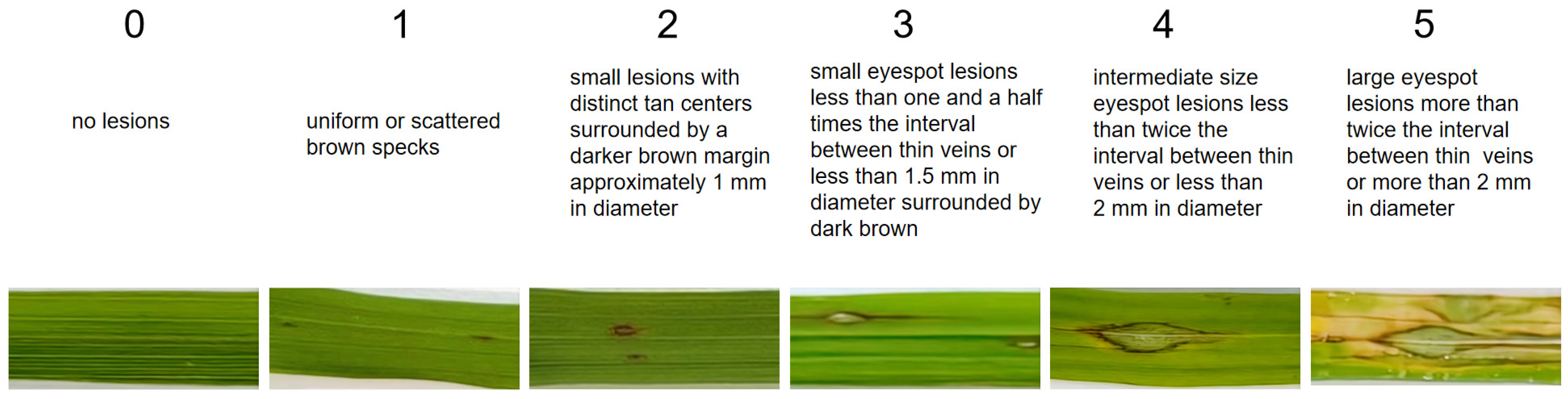
The CDC set, which comprised three indica-type entries (cultivars Tetep, Zhenong 13, and Sifeng 43) along with four japonica-type entries (cultivars Dongnong 363, Kando 51, Hejiang 18, and LTH), was challenged with each of the 193 M. oryzae isolates. Following the method of Zhang et al. [26] with a slight modification, the inoculation test was conducted as follows. Each differential cultivar was represented by 10 seedlings grown in a plastic tray (58 × 38 × 8 cm). The trays were uniformly sprayed with 50 mL of a spore suspension using an electric atomizer with a 0.3 mm nozzle at a pressure of 0.1 MPa. Disease reactions were scored on a 0–5 scale, where scores of 0–2 and 3–5 were classified as resistant and susceptible (Figure 1), respectively. Each isolate was tested in at least two independent inoculation trials. In cases of inconsistent results between replicates, the highest disease score was adopted for the final assessment.

2.5. Race Coding

Each of the seven CDC entries was assigned a race code (All China Corporation of Research on Physiological Races of Pyricularia oryzae 1980), which combines both an alphabetical component and a numerical component: Tetep, race code A64; Zhenlong 13, race code B32; Sifeng 43, C16; Dongnong 363, D8; Kando 51, E4; Hejiang 18, F2; and LTH, G1. Race groups (A to G) were first determined based on the initial compatible reaction observed on the CDC entries. Subsequently, the race number (a numerical value) was assigned, representing the sum of the codes corresponding to the remaining entries to which an incompatible reaction was observed, followed by adding 1 to the numerical value to avoid coding races as A0 and B0 [27,28].

2.6. Statistics and Analysis of Data

Race structure was dissected into three aspects with eight parameters (Table S2) following Zhang et al. [28]: the total race frequency ftr [(tr/N) × 100%]; the population common race frequency fpcr [(pcr/tr) × 100%]; the population common race isolate frequency fpcri [(pcri/N) × 100%]; the total population common race isolate frequency ftpcri [(tpcri/N) × 100%] for common race structure; the population specific race frequency fpsr [(psr/tr) × 100%]; the top three race isolate frequency ft3ri [(t3ri/N) × 100%]; and the total top three race isolate frequency ftt3ri [(tt3ri/N) × 100%] for dominant race structure. In these expressions, N represents the number of the isolates within a population, tr represents the number of races identified within a given population, pcr represents the number of population-common races across all three populations, pcri represents the number of population-common race isolates within a population, tpcri represents the total number of population-common race isolates within a population, psr represents the number of population-specific races within a population, psri represents the number of population-specific race isolates within a population, and t3ri represents the number of top three race isolates within a population.
The dynamic behavior of the host resistance gene content was quantified using the cultivar resistance frequency [28] fCR [(CRI/N) × 100%] and the total cultivar resistance frequency fTCR [(TCRI/TN) × 100%], where CRI represents the number of isolates that were avirulent on a given CDC entry, TCRI represents the total number of isolates that were avirulent across all three populations, and TN represents the total number of isolates of all three populations. Each cultivar was given an overall resistance rating (high: >85%; intermediate: 60–84%; low: <60%).

3. Results

3.1. Avr Gene Analysis

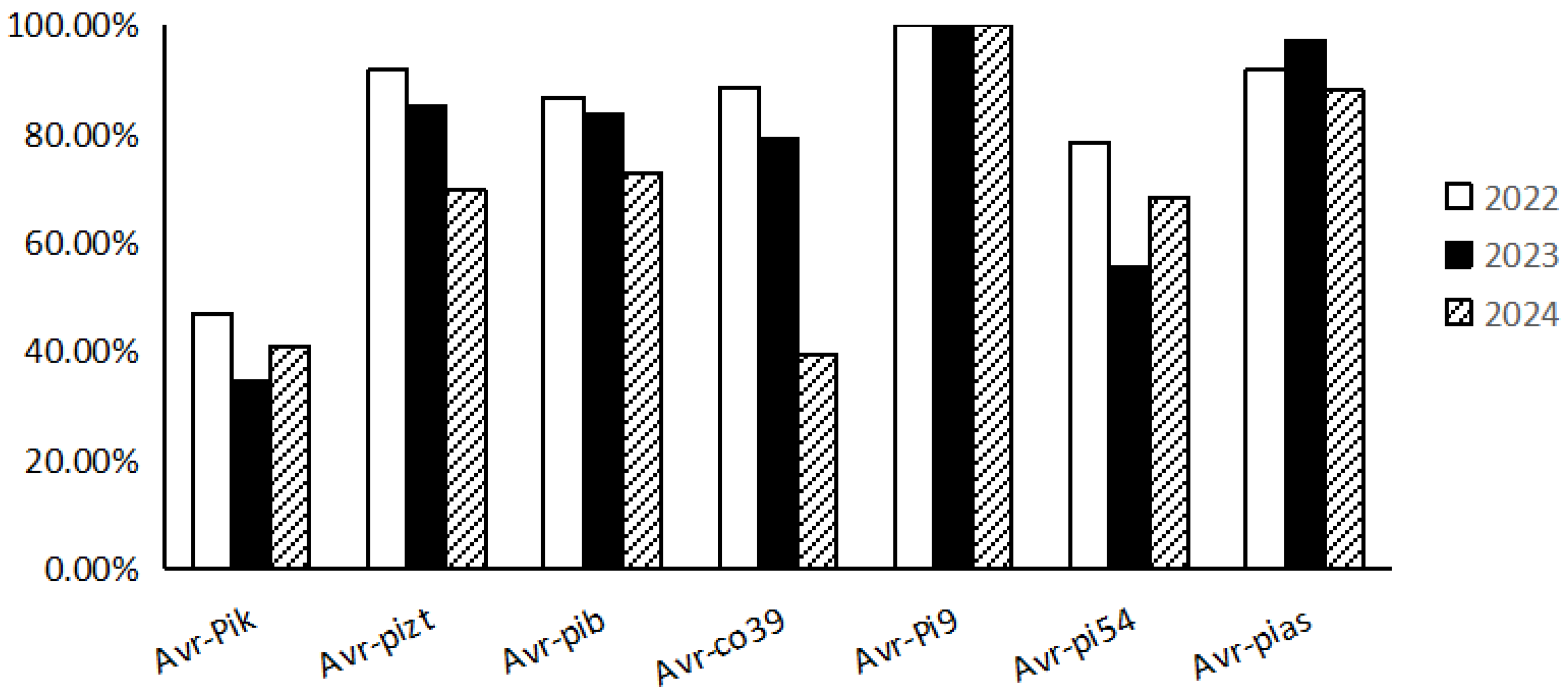
The primers for the seven avirulence (Avr) genes (Avr-co39, Avr-Pib, Avr-Pi9, Avr-Pizt, Avr-Pik, Avr-Pias, and Avr-Pi54) were used to survey the test isolates of M. oryzae. The seven Avr genes were assessed through PCR amplification in the tested isolates (Figure S1; Table S3). There were four Avr genes with a total distribution frequency of more than 80% (Table 2), of which, Avr-Pi9 had the highest distribution frequency at 100%. The distribution frequency of Avr-Pik had the lowest frequency at 40.41%.
The distribution frequency of Avr-Pik and Avr-Pi54 decreased in 2023 and then increased in 2024 (Figure 2). The distribution frequency of Avr-Pib, Avr-co39, and Avr-Pizt decreased from 2022 to 2024, while the distribution frequency of Avr-Pi9 remained nearly constant over the three-year period.

3.2. Race Structure

Race diversity. According to the analysis conducted on the CDC set, the M. oryzae population in 2024 was shown to be the most diverse of the three years. In the 23 races from 2024, all seven race groups were represented, with an ftr of 34.85% (Table 3). In both the 13 races from 2022 and the 20 races from 2023, six of the seven groups were represented, with ftr values of 21.67% and 28.35%, respectively. Therefore, there was an increase in race frequency and diversity from the 2022 to 2024.
Common race structure. A total of nine races (ZA17, ZA33, ZA57, ZA49, ZB31, ZD1, ZF1, and ZG1) were identified across the three groups, with fpcr values of 61.54% in 2022, 42.11% in 2023, and 34.78% in 2024 (Table 4). The fpcri distribution among common races spanned from 41.67% in 2022 (ZG1) to 1.49% in 2023 (ZA57). The estimated ftpcri values reached 85.00% in 2022, 74.63% in 2023, and 62.12% in 2024. Common race proportions declined from 2022 to 2023, a decline of 10.37%, followed by a decrease of 12.51% from 2023 to 2024. This indicates a progressive decrease in common races over the three-year period.
Specific race structure. The number of population-specific races in 2022, 2023, and 2024 were 1, 3, and 7, respectively. This corresponded to estimated fpsr values of 7.69%, 15.79%, and 31.82%, respectively (Table 5). The numbers of isolates were two in 2022, three in 2023, and eight in 2024, giving rise to fpsri values of 3.33%, 4.48%, and 15.15%, respectively. Thus, the population-specific races increased steadily from 2022 to 2023, but population-specific race isolates increased abruptly from 2023 to 2024.
Dominant Race Structure. Two group A races (ZA17, ZA43), one group B race (ZB31), and one group G race (ZG1) emerged as the dominant races across the three years (Table 6). ZG1 emerged as the most dominant race, representing 41.67% of the population in 2022, 23.88% in 2023, and 37.88% in 2024. ZA17 was the second most common race, representing 8.33% of the population in 2022, 16.42% in 2023, and 6.06% in 2024; ZA31 was the third most common race, representing 15.00% of the population in 2022 and 10.45% in 2023. The ft3ri values ranged from 41.67 to 6.06%, and the ftt3ri values were dynamic (65.00% in 2022, 50.75% in 2023, and 53.03% in 2024). Overall, the dominant races remained relatively stable over the three-year period in Jilin Province.

3.3. Resistance and Pathogenicity Profiles

The resistance gene composition of the CDC entries was based on the conclusions drawn by Zhang et al. [26]. The seven identified Chinese varieties were analyzed for disease resistance (Table 7). The total resistance frequency of all the varieties other than LTH ranged from 55.96% to 82.90%. Tetep, Zhenlong 13, Sifeng 43, and Dongnong 363 were found to be moderately resistant cultivars, while Kando 51 and Hejiang 18 were found to be low-resistance cultivars. In comparison, Sifeng 43 expressed a greater level of resistance than the other entries from 2022 to 2024. LTH was susceptible to every isolate. Zhenlong 13 showed a higher resistance to M. oryzae than Dongnong 363, possibly because the presence of the resistance gene ε.
Based on the pathogenicity assessment, strains carrying the most avirulence genes, particularly Avr-Pias, Avr-Pi9, and Avr-co39, consistently showed a high total disease incidence ranging from 30.97% to 34.36% (Table 8). In contrast, strains carrying Avr-Pik or Avr-Pi54 showed a markedly lower incidence at only 3.85% and 15.37%, respectively.

4. Discussion

Rice blast is one of the most devastating rice diseases [29]. The diversity of dominant physiological races of M. oryzae and the variability of its avirulence genes have eroded the resistance of high-quality rice cultivars in many regions [24,30]. According to the gene-for-gene theory, the spectrum of avirulence genes in a local M. oryzae population is closely linked to the resistance profile of the prevailing rice cultivars. This concept is supported by previous studies, which have reported significant regional differences in the composition and distribution of these avirulence genes [31]. This study showed that among seven avirulence genes, Avr-Pi9 had the highest total detection frequency at 100.00%; Avr-Pik had the lowest detection frequency (40.46%). Meanwhile, the average amplification frequency of Avr-Pi9, Avr-Pias, Avr-Pizt and Avr-Pib exceeded 80.00% for three consecutive years, indicating that these four Avr genes are stably present in Jilin Province. The high distribution frequency of Avr-Pi9 may be due to the absence of dominant rice varieties carrying the resistance gene Pi9 that have been deployed in Jilin Province in recent years. Consequently, there has been no selection pressure against isolates carrying Avr-Pi9 in most rice-growing areas in Jilin Province. Previous surveys (2008–2010) confirmed the efficacy of the broad-spectrum resistance gene Pi9 in Jilin Province, where the avirulence frequency of Avr-Pi9 was over 94.2% in the local M. oryzae population [32]. In terms of pathogenicity, isolates carrying the Avr-Pi9 gene ranked second highest, while those with Avr-Pik had the lowest pathogenicity. Consistent with the gene-for-gene relationship, the disease incidence caused by isolates carrying Avr-Pib on Sifeng 43 (harboring Pib) and by those carrying Avr-Pi54 on Tetep (harboring Pi54) was only 0.64% and 0.78%, respectively, indicating low mutation rates for both avirulence genes. Furthermore, the high frequency of Avr-Pib (80.83%) confirms its stability and underscores the ongoing effectiveness of the corresponding Pib resistance gene, supporting its strategic deployment in Jilin’s breeding programs.
The M. oryzae population in Jilin underwent a restructuring from 2022 to 2024, which was marked by increasing race diversity, a rise in population-specific races, and a corresponding reduction in common and dominant races, which collectively point to an increasingly complex pathogen race structure [33]. According to previous studies, the dominant racial groups were ZF1 and ZG1 during the period of 1978–1981 [34]. After the decline of ZF1, ZE1 and ZG1 became the dominant racial groups from 1982 to 2012 [35,36]. This was followed by a period of succession where ZE1 was predominant in 2016, which was subsequently replaced in 2017 by ZG1, followed by ZF1 and ZE1 [33]. From 1978 to 2017, the population structure of M. oryzae in Jilin was remarkably stable, dominated by the japonica-type races ZG1, ZE1, and ZF1. This pattern held until the more frequent occurrence of the ZA group precipitated a change, and by 2021, the dominant populations had shifted from ZG1 and ZE1 to a combination of ZG1, ZA1, and ZA17. In our study, the dominant populations were ZG1 and ZA17 from 2022 to 2024, which aligns with the findings of Li [33]. This stability, which lasted from 2021 to 2024, was accompanied by a shift in the dominant physiological races of M. oryzae, which transitioned from the japonica type to a mixture of japonica and indica types. The dynamic shifts in the race structure of M. oryzae are linked to the prevailing rice cultivars and their planting area, which impose selection pressure on the pathogen population. It should be acknowledged that this study was confined to the seven Avr genes corresponding to the resistance genes Co39, Pib, Pi9, Pizt, Pik, Pias, and Pi54 in regional populations of M. oryzae. This focus was necessitated by the fact that, although the rice M. oryzae pathosystem involves a broader spectrum of gene-for-gene interactions, including well-characterized resistance genes such as Pia, Pish, Pit, Piz-5, Piz, Pii, Pi3(t), Pi5(t), Pik-h, Pik-D, Pik-m, Pita, Pita-2, Pi19(t), and Pi20(t), which are used in differential varieties to analyze the pathogenicity of M. oryzae [37], the majority of Avr genes corresponding to these resistance genes remain uncloned. Consequently, our analysis centered on the distribution of these seven Avr genes. As further avirulence genes are cloned and incorporated into detection frameworks, a more comprehensive assessment of pathogen evolutionary potential can be conducted to provide a solid foundation for breeding rice varieties with broad spectrum blast resistance.

5. Conclusions

This study clarifies the population dynamics of M. oryzae in Jilin Province, revealing critical shifts in its genetic structure that directly inform blast resistance management. Our results identify Avr-Pib as a highly stable and prevalent (80.83%) avirulence gene in the population. This provides a compelling basis for prioritizing the use of its corresponding broad-spectrum resistance gene, Pib, in breeding programs. Furthermore, the low mutation rates of Avr-Pi54 and Avr-Pik validate the continued breeding value of their corresponding resistance genes, Pi54 and Pik, in local programs. In contrast, the marked decline in Avr-co39 suggests its diminished efficacy and advises against its future use. Concurrently, the physiological race structure has shifted toward greater complexity, which is now dominated by ZG1 and ZA17, reflecting increased cultivar diversity in this region. The identification of highly resistant donors such as Sifeng 43 provides valuable genetic resources. We therefore recommend a breeding strategy that prioritizes the incorporation of Pi54 and Pik, alongside the utilization of resistant donors such as Sifeng 43, which harbors Pib. This integrated approach, supported by ongoing pathogen monitoring, is essential for developing durable blast-resistant rice varieties in Jilin.

Supplementary Materials

The following supporting information can be downloaded at: https://www.mdpi.com/article/10.3390/agronomy16010041/s1, Figure S1: Gel electrophoresis image of PCR products for avirulence gene detection; Table S1: Race designation of Magnaporthe oryzae isolates from Jilin Province (2022–2024) using the set of Chinese differential cultivars; Table S2: Parameters used for characterization of race structures in the present study; Table S3: Details of rice blast isolates presence/absence of the seven avirulence genes.

Author Contributions

Conceptualization, L.L. and Z.J.; methodology, S.Z. and Z.J.; software, S.W.; validation, Z.J., X.L., and L.L.; formal analysis, S.Z.; investigation, L.S. and H.S.; resources, X.L.; data curation, S.Z.; writing—original draft preparation, S.Z.; writing—review and editing, Z.J.; visualization, L.L. and Z.J.; supervision, S.W.; project administration, L.L.; funding acquisition, L.L. All authors have read and agreed to the published version of the manuscript.

Funding

This study was supported by the Agricultural Science and Technology Innovation Program of Jilin Province (Grant No. CXGC2024ZD004) and the Jilin Agriculture Research System (Grant No. JLARS-2025-020301).

Data Availability Statement

The original contributions presented in this study are included in the article and Supplementary Materials. Further inquiries can be directed to the corresponding authors.

Conflicts of Interest

The authors declare no conflicts of interest.

References

  1. Cruz, C.D.; Valent, B. Wheat blast disease: Danger on the move, Trop. Plant Pathol. 2017, 42, 210–222. [Google Scholar] [CrossRef]
  2. Baudin, M.; Le Naour-Vernet, M.; Gladieux, P.; Tharreau, D.; Lebrun, M.H.; Lambou, K.; Leys, M.; Fournier, E.; Césari, S.; Kroj, T. Pyricularia oryzae: Lab star and field scourge. Mol. Plant Pathol. 2024, 25, e13449. [Google Scholar] [CrossRef]
  3. Fernandez, J.; Orth, K. Rise of a Cereal Killer: The Biology of Magnaporthe oryzae Biotrophic Growth. Trends Microbiol. 2018, 26, 582–597. [Google Scholar] [CrossRef]
  4. Eseola, A.B.; Ryder, L.S.; Osés-Ruiz, M.; Findlay, K.; Yan, X.; Cruz-Mireles, N.; Molinari, C.; Garduño-Rosales, M.; Talbot, N.J. Investigating the cell and developmental biology of plant infection by the rice blast fungus Magnaporthe oryzae. Fungal Genet. Biol. 2021, 154, 103562. [Google Scholar] [CrossRef]
  5. Sahu, P.K.; Sao, R.; Choudhary, D.K.; Thada, A.; Kumar, V.; Mondal, S.; Das, B.K.; Jankuloski, L.; Sharma, D. Advancement in the Breeding, Biotechnological and Genomic Tools towards Development of Durable Genetic Resistance against the Rice Blast Disease. Plants 2022, 11, 2386. [Google Scholar] [CrossRef] [PubMed]
  6. Wang, X.; Jia, Y.; Wamishe, Y.; Jia, M.; Valent, B. Dynamic changes in the rice blast population in the USA over six decades. Mol. Plant-Microbe Interact. 2017, 30, 803–812. [Google Scholar] [CrossRef]
  7. Flor, H.H. Current status of the gene-for-gene concept. Annu. Rev. Phytopathol. 1971, 9, 275–296. [Google Scholar] [CrossRef]
  8. Devanna, B.N.; Jain, P.; Solanke, A.U.; Das, A.; Thakur, S.; Singh, P.K.; Kumari, M.; Dubey, H.; Jaswal, R.; Pawar, D. Understanding the Dynamics of Blast Resistance in Rice-Magnaporthe oryzae Interactions. J. Fungi 2022, 8, 584. [Google Scholar] [CrossRef] [PubMed]
  9. Younas, M.U.; Qasim, M.; Ahmad, I.; Feng, Z.; Iqbal, R.; Jiang, X.; Zuo, S. Exploring the molecular mechanisms of rice blast resistance and advances in breeding for disease tolerance. Mol. Biol. Rep. 2024, 51, 1093. [Google Scholar] [CrossRef] [PubMed]
  10. Wang, Q.; Li, J.; Lu, L.; He, C.; Li, C. Novel Variation and Evolution of AvrPiz-t of Magnaporthe oryzae in Field Isolates. Front. Genet. 2020, 11, 746. [Google Scholar] [CrossRef]
  11. Wu, W.; Wang, L.; Cheng, G.; Zhu, Y.; Pan, Q. Molecular genetic studies on the rice blast fungus population: Comparison of genetic and pathotypic structures of two rice blast fungus populations derived from Guangdong and Yunnan provinces of China. Sci. Agri. Sin. 2004, 675–680. (In Chinese) [Google Scholar]
  12. Tian, D.; Deng, Y.; Yang, X.; Li, G.; Li, Q.; Zhou, H.; Chen, Z.; Guo, X.; Su, Y.; Luo, Y.; et al. Association analysis of rice resistance genes and blast fungal avirulence genes for effective breeding resistance cultivars. Front. Microbiol. 2022, 13, 1007492. [Google Scholar] [CrossRef] [PubMed]
  13. Huang, Z.; Wang, J.; Zhang, Y.; Yao, Y.; Huang, L.; Yang, X.; Wang, L.; Pan, Q. Dynamics of Race Structures of Pyricularia oryzae Populations Across 18 Seasons in Guangdong Province, China. Plant Dis. 2021, 105, 144–148. [Google Scholar] [CrossRef]
  14. Hao, B.; Li, C.; Meng, Z.W.; Yang, L.; Geng, Y.Q.; Wang, S.; Li, K.Z.; Dang, S.; Yang, G.Y.; Chen, D.Y. Development Status and Prospect of High-quality Rice industry in Jilin Province. North. Rice 2020, 50, 1–5+11. (In Chinese) [Google Scholar] [CrossRef]
  15. Hao, B.; Li, C.; Yao, L.; Wu, X.Y.; Chen, D.Y.; Yan, G.B.; Liu, Z.J. Analysis of Current Status and Development Strategies of Rice Seed Industry in Jilin Province. China Seed Ind. 2023, 12, 47–51+56. (In Chinese) [Google Scholar] [CrossRef]
  16. Wang, D.; Zhu, F.; Wang, J.; Ju, H.; Yan, Y.; Qi, S.; Ou, Y.; Tian, C. Pathogenicity Analyses of Rice Blast Fungus (Pyricularia oryzae) from Japonica Rice Area of Northeast China. Pathogens 2024, 13, 211. [Google Scholar] [CrossRef]
  17. Sirisathaworn, T.; Srirat, T.; Longya, A.; Jantasuriyarat, C. Evaluation of mating type distribution and genetic diversity of three Magnaporthe oryzae avirulence genes, PWL-2, AVR-Pii and Avr-Piz-t, in Thailand rice blast isolates. Agric. Nat. Resour. 2017, 51, 7–14. [Google Scholar] [CrossRef]
  18. Li, W.; Wang, B.; Wu, J.; Lu, G.; Hu, Y.; Zhang, X.; Zhang, Z.; Zhao, Q.; Feng, Q.; Zhang, H.; et al. The Magnaporthe oryzae avirulence gene AvrPiz-t encodes a predicted secreted protein that triggers the immunity in rice mediated by the blast resistance gene Piz-t. Mol. Plant-Microbe Interact. 2009, 22, 411–420. [Google Scholar] [CrossRef]
  19. Yoshida, K.; Saitoh, H.; Fujisawa, S.; Kanzaki, H.; Matsumura, H.; Yoshida, K.; Tosa, Y.; Chuma, I.; Takano, Y.; Win, J.; et al. Association genetics reveals three novel avirulence genes from the rice blast fungal pathogen Magnaporthe oryzae. Plant Cell 2009, 21, 1573–1591. [Google Scholar] [CrossRef]
  20. Ray, S.; Singh, P.K.; Gupta, D.K.; Mahato, A.K.; Sarkar, C.; Rathour, R.; Singh, N.K.; Sharma, T.R. Analysis of Magnaporthe oryzae Genome Reveals a Fungal Effector, Which Is Able to Induce Resistance Response in Transgenic Rice Line Containing Resistance Gene, Pi54. Front. Plant Sci. 2016, 7, 1140. [Google Scholar] [CrossRef]
  21. Farman, M.; Eto, Y.; Nakao, T.; Tosa, Y.; Nakayashiki, H.; Mayama, S.; Leong, S. Analysis of the structure of the AVR1-CO39 avirulence locus in virulent rice-infecting isolates of Magnaporthe grisea. Mol. Plant-Microbe Interact. 2002, 15, 6–16. [Google Scholar] [CrossRef] [PubMed]
  22. Wu, J.; Kou, Y.; Bao, J.; Li, Y.; Tang, M.; Zhu, X.; Ponaya, A.; Xiao, G.; Li, J.; Li, C.; et al. Comparative genomics identifies the Magnaporthe oryzae avirulence effector AvrPi9 that triggers Pi9-mediated blast resistance in rice. New Phytol. 2015, 206, 1463–1475. [Google Scholar] [CrossRef]
  23. Shimizu, M.; Hirabuchi, A.; Sugihara, Y.; Abe, A.; Takeda, T.; Kobayashi, M.; Hiraka, Y.; Kanzaki, E.; Oikawa, K.; Saitoh, H.; et al. A genetically linked pair of NLR immune receptors shows contrasting patterns of evolution. Proc. Natl. Acad. Sci. USA 2022, 119, e2116896119. [Google Scholar] [CrossRef]
  24. Zhang, S.; Wang, L.; Wu, W.; He, L.; Yang, X.; Pan, Q. Function and evolution of Magnaporthe oryzae avirulence gene AvrPib responding to the rice blast resistance gene Pib. Sci. Rep. 2015, 5, 11642. [Google Scholar] [CrossRef]
  25. Xu, Z.W. Distribution Characteristics and Pathogenicity Analysis of Avirulence Genes of Rice Blast Fungus in Jiangsu Rice Region. Ph.D. Thesis, The Yangzhou University, Yangzhou, China, 2023. (In Chinese). [Google Scholar] [CrossRef]
  26. Zhang, Y.; Zhu, Q.; Yao, Y.; Zhao, Z.; Correll, J.C.; Wang, L.; Pan, Q. The Race Structure of the Rice Blast Pathogen Across Southern and Northeastern China. Rice 2017, 10, 46. [Google Scholar] [CrossRef]
  27. All China Corporation of Research on Physiological Races of Pyricularia oryzae. Research on physiological races of rice blast fungus in China. Acta Phytopathol. Sin. 1980, 10, 71–82.
  28. Zhang, Y.; Wang, J.; Yao, Y.; Jin, X.; Correll, J.; Wang, L.; Pan, Q. Dynamics of Race Structures of the Rice Blast Pathogen Population in Heilongjiang Province, China From 2006 Through 2015. Plant Dis. 2019, 103, 2759–2763. [Google Scholar] [CrossRef]
  29. Oliveira-Garcia, E.; Yan, X.; Oses-Ruiz, M.; de Paula, S.; Talbot, N.J. Effector-triggered susceptibility by the rice blast fungus Magnaporthe oryzae. New Phytol. 2024, 241, 1007–1020. [Google Scholar] [CrossRef]
  30. Li, R.; Qiu, J.; Shi, H.; Jiang, N.; Lan, B.; Kou, Y. Variation of Avirulence Genes in the Blast Fungus from Jiangxi Province, China. Plant Dis. 2025, 109, 1211–1217. [Google Scholar] [CrossRef] [PubMed]
  31. Singh, P.K.; Ray, S.; Thakur, S.; Rathour, R.; Sharma, V.; Sharma, T.R. Co-evolutionary interactions between host resistance and pathogen avirulence genes in rice-Magnaporthe oryzae pathosystem. Fungal Genet. Biol. 2018, 115, 9–19. [Google Scholar] [CrossRef] [PubMed]
  32. Wang, J.C.; Zhang, J.H.; Ren, J.P.; Wen, J.W.; Li, L. Identification of rice blast resistance genes using international monogenic differentials. Crop Prot. 2013, 45, 109–116. [Google Scholar] [CrossRef]
  33. Li, L.; Sun, L.; Zhang, J.H.; Zou, X.W.; Sun, H.; Ren, J.P.; Liu, X.M.; Jiang, Z.Y. Evaluation of Resistance and Analysis of Utilization Value of the Major Japonica Rice Varieties in Jilin Province Based on the Physiological Race Variation of Magnaporthe oryzae. Chin. Agric. Sci. 2023, 56, 4441–4452. (In Chinese) [Google Scholar]
  34. Cao, G.M.; Li, C.D.; Jin, F.; Liu, H.T.; Han, R.T. A preliminary study on the physiological races of rice blast fungus in Jilin Province. Acta Phytopathol. Sin. 1983, 13, 13–19. (In Chinese) [Google Scholar]
  35. Liu, H.T.; Lu, Z.Z.; Han, R.T. A review of studies on physiological races of blast fungus in Jilin Province. J. Jilin Agric. Univ. 2002, 24, 34–38. (In Chinese) [Google Scholar]
  36. Liu, X.M.; Li, L.; Jiang, Z.Y.; Sun, H.; Ren, J.P. Variation of physiological race of rice blast in Jilin Province from 2002 to 2012. J. Jilin Agric. Sci. 2014, 39, 68–70+77. (In Chinese) [Google Scholar]
  37. Tsunematsu, H.; Yanoria, M.J.T.; Ebron, L.A.; Hayashi, N.; Ando, I.; Kato, H.; Imbe, T.; Khush, G.S. Development of Monogenic Lines of Rice for Blast Resistance. Breed. Sci. 2000, 50, 229–234. [Google Scholar] [CrossRef]
Figure 1. Scoring scale for susceptible or resistance reaction of rice varieties.
Agronomy 16 00041 g001
Figure 2. Frequency of avirulence genes in M. oryzae from the Jilin Region during 2022–2024. X-axis: avirulence genes; Y-axis: percentage (%).
Agronomy 16 00041 g002
Table 1. Primers used in this study.
Primer NamePrimer Sequence (5′-3′)Expected Size (bp)
Avr-co39 FAATTGCATAATCGCTGCGAT918
Avr-co39 RCTCAAGCTCACAGAACTTTGTT
Avr-Pib FGCCGACAATGCGAGGTATAC248
Avr-Pib RCGACAGGGAATAACACAGCG
Avr-Pi9 FGTGCCGTGAGTTTTCCATGT210
Avr-Pi9 RCCTTGGAATAGACGGCAGCAC
Avr-Pizt FAAACCAGGGCAGCCAAAGA153
Avr-Pizt RATTCCCAATCGAGCCAACG
Avr-Pik FACTTTGGGAACTGTCGCTGTC184
Avr-Pik RAGCTGTAACAGGTTCCAGCATC
Avr-Pias FATGCGTTTTTCATCTATTCC270
Avr-Pias RTTATTCAGGATAACCAAAAAC
Avr-Pi54 FATGCAGTTCACCGCCACC462
Avr-Pi54 RCTAGCAGCCATAGGTGAGGA
Table 2. Frequency of avirulence genes of M. oryzae in Jilin Province from 2022 to 2023.
Gene2022 (60) a2023 (67)2024 (66)Total Frequency of Detection/%
No.Frequency/%No.Frequency/%No.Frequency/%
Avr-Pi960100.0067100.0066100.00100.00
Avr-Pik2846.672334.332740.9140.41
Avr-Pizt5591.675785.074669.7081.87
Avr-Pib5286.675683.584872.7380.83
Avr-co395388.335379.102639.3968.39
Avr-Pias5591.676597.015887.8892.22
Avr-Pi544778.333755.224568.1866.83
a Numbers shown in parentheses represent the numbers of isolates tested.
Table 3. Race diversity and dynamics of M. oryzae populations in Jilin Province (2022–2024).
Parameter2022 (60) a2023 (67)2024 (66)
No. of race group667
No. of races131923
Race frequency (ftr)21.6728.3534.85
a Numbers shown in parentheses represent the numbers of isolates tested.
Table 4. Prevalent races of M. oryzae in Jilin from 2022 to 2024.
Race/Parameter2022 (60) a2023 (67)2024 (66)
No.fpcriNo.fpcriNo.fpcri
ZA1758.331116.4246.06
ZA3335.0022.9923.03
ZA5711.6711.4911.52
ZA4911.6757.4611.52
ZB31915.00710.4534.55
ZD146.6757.4634.55
ZF135.0034.4823.03
ZG12541.671623.882537.88
fpcr 61.54 42.11 34.78
∑/ftpcri5185.005074.634162.12
a Figures shown in parentheses represent the number of isolates tested.
Table 5. Specific races of M. oryzae across a three-year period (2022–2024) in Jilin.
PopulationSpecific Races (No. of Isolates) aRacesIsolates
No.fpsrNo.fpsr
2022 (60)ZB1 (2)17.6923.33
2023 (67)ZA59 (1), ZA63 (1), ZC13 (1)315.7934.48
2024 (66)ZA3 (1), ZA41 (1), ZA53 (1), ZB9 (1), ZB15 (1), ZB23 (2), ZC3 (1), ZD3 (3)834.781015.15
a Races are ordered according to their alphanumeric code.
Table 6. Predominant races of M. oryzae in Jilin, 2022–2024.
Top 3 Races and Their Frequencies
PopulationFirst (Isolates)ft3ri-1Second (Isolates)ft3ri-2Third (Isolates)ft3ri-3Top 3 ftt3ri
2022 (60)ZG1 (25)41.67ZB31 (9)15.00ZA17 (5)8.3365.00
2023 (67)ZG1 (16)23.88ZA17 (11)16.42ZB31 (7)10.4550.75
2024 (66)ZG1 (25)37.88ZA43 (6)9.09ZA17 (4)6.0653.03
Table 7. Resistance genes and frequencies of the set of Chinese differential cultivars (CDCs) to M. oryzae in Jilin (2022–2024).
Differential CultivarRace CodeResistance GeneResistance Frequencies (fCR)Total Resistance
Frequency (fTCR)
202220232024
TetepA64Pi1, Pi4, and Pi5481.6756.7169.7068.91
Zhenlong 13B32Pik, Pia, β, and ε71.6758.2174,2468.39
Sifeng 43C16Pib, Pia, and α88.3385.0775.7682.90
Dongnong 363D8Pik, Pia, and β68.3353.7371.2164.25
Kando 51E4Pik and γ65.0049.2554.5555.96
Hejiang 18F2Pii, Pia, and δ60.0043.2871.2158.03
LijiangxintuanheiguG1Pik-l0.000.000.000.00
Table 8. Pathogenicity testing of strains carrying the avr gene on six cultivars of the set of CDCs.
GeneNo.Disease Incidence (%)Total Disease Incidence (%)
TetepZhenlong 13Sifeng 43Dongnong 363Kando 51Hejiang 18
Avr-Pi919332.6432.1216.5835.7544.0441.9733.85
Avr-Pik782.5602.562.562.5612.823.85
Avr-Pizt15824.6835.4410.1336.0836.7141.1430.97
Avr-Pib15621.7930.130.6432.6933.3337.8226.07
Avr-co3913229.5534.8512.8835.6141.6746.2133.46
Avr-Pias17832.0233.7116.8535.9644.9442.7034.36
Avr-Pi541290.7822.667.7519.3818.622.4815.37
Disclaimer/Publisher’s Note: The statements, opinions and data contained in all publications are solely those of the individual author(s) and contributor(s) and not of MDPI and/or the editor(s). MDPI and/or the editor(s) disclaim responsibility for any injury to people or property resulting from any ideas, methods, instructions or products referred to in the content.