Article

Genome-Wide Identification and Characterization of the bZIP Gene Family in Elephant Grass (Cenchrus purpureus) and Its Response to Cold Stress

College of Grassland Science and Technology, Sichuan Agricultural University, No. 211 Huimin Road, Wenjiang District, Chengdu 611130, China
*
Authors to whom correspondence should be addressed.
Agronomy 2026, 16(1), 43; https://doi.org/10.3390/agronomy16010043
Submission received: 18 November 2025 / Revised: 9 December 2025 / Accepted: 14 December 2025 / Published: 23 December 2025

Abstract

Elephant grass (Cenchrus purpureus) is a globally important C4 perennial forage crop valued for its high biomass yield and tolerance to heat and drought. However, its poor cold tolerance severely limits its cultivation in temperate regions. The bZIP (basic region-leucine zipper) transcription factors are known to regulate abiotic stress responses; however, their role in elephant grass’s cold response is unclear. This study aimed to identify and characterize the CpbZIP gene family on a genome-wide scale and analyze its expression patterns under low-temperature stress. Through phylogenetic analysis, we classified 158 putative CpbZIP genes into 13 subgroups, a classification supported by conserved gene structures and motifs. The family expanded primarily through segmental duplication and has been shaped by strong purifying selection. Promoter analysis revealed numerous cis-acting elements associated with hormone signaling and abiotic stress, including low temperature, suggesting the family’s potential role in stress adaptation. Subsequent expression analysis and RT-qPCR validation identified six cold-induced genes. Of these, CpbZIP38 and CpbZIP86 exhibited high basal expression in roots and were significantly upregulated under cold stress. These findings identify promising candidate genes for the cold tolerance regulatory network in elephant grass and lay the groundwork for breeding cold-tolerant varieties.

1. Introduction

Elephant grass (Cenchrus purpureus), also known as Napier grass, is a classic C4 perennial forage grass. It is a globally preferred forage due to its rapid growth, high biomass, adaptability to soil conditions [1], efficient energy conversion, water use efficiency, and strong resistance to heat and drought [2]. Studies have shown that elephant grass has an extremely high yield potential of 20 to 30 tons of dry matter per hectare per year and can adapt to various soil conditions, including poorly drained clay and over-drained sandy soils with a pH range of 4.5 to 8.2 [3]. However, its sensitivity to cold stress severely affects its growth and development, leading to a significant decrease in yield, which limits its widespread cultivation and distribution [4]. Low-temperature stress profoundly impacts the physiological and molecular processes of tropical grasses. Cold stress disrupts cell membrane fluidity, inhibits enzymatic activities involved in photosynthesis, and induces the accumulation of reactive oxygen species (ROS), leading to oxidative damage [5]. In warm-season forage grasses like elephant grass, temperatures below 10 °C can cause chilling injury, manifesting as leaf chlorosis, reduced biomass accumulation, and stunted root development, which critically threatens overwintering survival and spring regrowth [6]. While studies have examined elephant grass’s energy [7,8] and feed utilization, breeding [9], and environmental and ecological functions [10], the molecular mechanisms and key genes involved in its response to low-temperature stress remain largely unknown.
Transcription factors (TFs) are core molecules that regulate gene expression by activating or repressing it through binding to specific DNA sequences in the promoter or enhancer regions of target genes [11,12]. The bZIP (basic region-leucine zipper) family is one of the most extensively studied transcription factor families in eukaryotes due to its large and diverse membership. The hallmark of this family is its highly conserved bZIP domain, consisting of two parts: a basic region that is responsible for nuclear localization and DNA binding and a leucine zipper region that mediates homodimerization or heterodimerization via leucine repeats [13].
The bZIP transcription factors play essential roles in many biological processes in plants, including organ differentiation, embryogenesis, seed maturation, and flowering [14]. They are particularly recognized as crucial regulators of abiotic stress responses [15]. Regarding cold stress, studies have found that transcription factors such as ABF1, ABF3, and ABF4 (a subgroup of ABRE-binding bZIP proteins) can increase tolerance to cold and freezing in Arabidopsis thaliana [16]. In contrast, CsbZIP6 in tea plants (Camellia sinensis) acts as a negative regulator, reducing freezing tolerance [17]. Furthermore, TabZIP96 in wheat (Triticum aestivum) [18], LchibZIP4 and LchibZIP7 in Liriodendron chinense [19], bZIP73 in rice (Oryza sativa) [20], and PbbZIP11 in pear (Pyrus bretschneideri) [21] enhance tolerance to cold stress. Therefore, we hypothesized that bZIP genes that regulate cold tolerance also exist in elephant grass.
Comprehensive analyses of the bZIP gene family have also been conducted in other grasses, including rice [18], wheat [16], maize (Zea mays) [22], and barley (Hordeum vulgare) [23]. These studies showed that most bZIP members play an essential role underlying various abiotic stresses. To our knowledge, no comprehensive analysis of the bZIP family has been reported in forage grass, especially regarding their responses to cold stress. To address this knowledge gap and identify potential genetic resources for breeding, this study aims to identify and characterize members of the bZIP TF family in the elephant grass genome on a genome-wide scale. We used bioinformatics methods to analyze the physicochemical properties, chromosomal distribution, gene structure, and conserved sequences of these genes. Then, we constructed a phylogenetic tree to reveal their evolutionary relationships. By analyzing the expression patterns of bZIP genes under cold stress, this study provides the first systematic insight into the CpbZIP family and identifies candidate genes involved in elephant grass’s cold tolerance regulatory network.

2. Materials and Methods

2.1. Plant Materials and Cold Stress Treatment

We collected elephant grass (C. purpureus ‘CN002’) germplasm from Chongzhou, Sichuan Province, China. Mature stems were harvested and propagated hydroponically in a growth chamber at 26 °C (12 h light)/23 °C (12 h dark) for 10 days to induce rooting and fresh growth. The plants were then divided into two groups: a control group (CK) maintained at 26 °C/23 °C, and a cold stress group (CS) transferred to a 4 °C incubator with a 12 h light/12 h dark cycle. Root tissues were collected from both CK and CS treatments at 0, 3, 6, 12, 24, 72 h, and 7 days post-treatment. Three biological replicates were collected at each time point for each treatment. Samples were immediately frozen in liquid nitrogen and stored at −80 °C for RNA extraction.

2.2. Identification of bZIP Factors in Cenchrus purpureus

The elephant grass genome, protein sequence, and genome annotation files were obtained from the MilletDB website. The Blast Compare Two Seqs function in TBtools software (version 2.376) was used to identify and screen full-length protein sequences from elephant grass showing high similarity to Arabidopsis bZIP protein sequences obtained from the TAIR website, with a threshold set at 1 × 10⁻⁵. The Up Set Plot tool in TBtools was then used to compare the results and remove redundant sequences, preliminarily determining the candidate gene members. The candidate genes were validated for domain presence using the NCBI (https://www.ncbi.nlm.nih.gov/, accessed on 7 March 2025) and SMART 9.0 (http://smart.embl-heidelberg.de/, accessed on 7 March 2025) online databases. Protein sequences containing the bZIP domain were retained and confirmed as members of the elephant grass bZIP gene family. We analyzed the physicochemical properties of the bZIP gene family members, including amino acid count, isoelectric point, relative molecular mass, average hydrophobicity, instability coefficient, and aliphatic index, using the ExPASy tool within TBtools software. Subcellular localization prediction analysis was performed for each bZIP gene family member using the WOLFPSORT online tool (https://wolfpsort.hgc.jp/, accessed on 7 March 2025).

2.3. Chromosomal Localization, Collinearity Analysis, and Phylogenetic Analysis of CpbZIPs

Based on the elephant grass genome annotation, we used the TBtools software to visualize the chromosomal distribution of the bZIP gene family members in elephant grass. To determine collinearity among CpbZIP genes, we analyzed their duplication events using TBtools and MCScanX [24]. Next, to investigate the evolutionary relationships among bZIP family members in Cenchrus purpureus, Arabidopsis, and Oryza sativa, we imported the bZIP protein sequences from all three species into MEGA 12 software. We conducted a phylogenetic analysis using the Maximum Likelihood (ML) method based on the JTT matrix-based model with 1000 bootstrap replications. The phylogenetic tree was visualized using the iTOL online platform (https://itol.embl.de/, accessed on 13 March 2025).

2.4. CpbZIP Analysis of Conserved Domains, Genetic Structure, Conserved Motifs, and Cis-Regulatory Elements

Conserved domains within CpbZIP protein sequences were identified by searching the Pfam database (http://pfam.xfam.org/, accessed on 14 March 2025) with the default parameters. TBtools software was then used to visualize the domain architecture, gene structure, and conserved motifs of bZIP family members. Promoter sequences (2000 bp) upstream of each elephant grass bZIP family member were extracted and analyzed for cis-acting elements using the PlantCARE database. The functional roles of the elephant grass bZIP gene family in growth, development, and stress responses were inferred based on annotation information.

2.5. Analysis of CpbZIPs Expression Patterns in Different Tissues

Partial expression data for CpbZIP genes across tissues (stem, flower, root, leaf, and shoot tip) was obtained from the MilletDB website. The expression levels of these genes in each tissue were compiled and visualized as heatmaps.

2.6. Analysis of Cold Stress Transcriptome Expression Data

To investigate the transcriptional response to cold, we analyzed the root transcriptome dataset (Table S6). Raw RNA-seq reads were quality-controlled and mapped to the Cenchrus purpureus reference genome using STAR software (version 2.7.11b). Gene expression levels were quantified as Transcripts Per Million (TPM) using FeatureCounts, and differential expression analysis was performed using the DESeq2 R package (version 1.42.0). This dataset captures expression changes at 3, 6, 12, and 24 h post-cold treatment relative to the control group (0 h). For the purpose of heatmap visualization, missing data points were assigned a Log2FC value of 0 to represent no relative change, ensuring continuity in the graphical representation, although these data were treated as missing during statistical filtering. We generated a circular heatmap using the “circlize” package in R to display expression changes for all CpbZIP members, which are grouped according to their distinct subgroups.

2.7. Analysis of CpbZIP Expression Patterns Under Low-Temperature Stress

Preliminary analysis of existing cold-stressed switchgrass transcriptome data revealed that genes within the subgroup S exhibited highly concentrated response characteristics [25]. Therefore, we performed RT-qPCR validation on subgroup S members to accurately analyze their expression patterns under cold stress. To analyze CpbZIP gene expression under cold stress, total RNA was extracted from the root samples using the HiPure Plant RNA Mini Kit (Magen, Guangzhou, China). Then, cDNA was synthesized using the HiScript III First-Strand cDNA Synthesis Kit (+gDNA wiper) (Vazyme, Nanjing, China), following the manufacturer’s instructions. Gene expression levels were analyzed via RT-qPCR using a CFX96 RT-qPCR system (Bio-Rad, Hercules, CA, USA) and 2X M5 HiPer SYBR Premix EsTaq (with Tli RNaseH) (Mei5 Biotechnology, Beijing, China). Experiments were conducted with three biological and three technical replicates, using elongator factor-1-alpha (EF1α) as the reference gene. CpbZIP gene expression levels were ultimately calculated using the 2−∆∆CT method. All RT-qPCR primers were designed using Primer Premier 6.0 software, and sequence details are provided in Table S8. The relative expression data were presented as the mean ± standard deviation (SD) of three biological replicates (n = 3). Statistical significance was determined using one-way ANOVA followed by Tukey’s post hoc test (p < 0.05) to compare expression levels at different time points against the control (0 h).

3. Results

3.1. The CpbZIP Family Comprises 158 Members with Diverse Physicochemical Characteristics

A total of 158 putative CpbZIP genes were identified in the elephant grass genome. Detailed physicochemical analyses were conducted on these proteins, including size, molecular weight (MW), theoretical isoelectric point (pI), and subcellular localization (Table S1). The results indicate that CpbZIP protein sizes range from 100 amino acids (CpbZIP157) to 696 amino acids (CpbZIP87). Their molecular weights range from 11.09 kilodaltons (kDa) (CpbZIP83) to 75.56 kDa (CpbZIP87). The predicted pI ranged from 4.30 (CpbZIP2) to 11.93 (CpbZIP130). Among these proteins, 40.5% were acidic (pI < 7.0). The mean values for amino acid count, molecular weight, and pI were 324, 35.23 kDA, and 7.85, respectively, with medians of 315, 33.83 kDA, and 7.86. Most CpbZIP proteins are predicted to be nuclear, according to subcellular localization predictions. However, there are a few exceptions: CpbZIP105 is primarily localized to chloroplasts, CpbZIP62 to mitochondria, and CpbZIP93 to the endoplasmic reticulum. Overall, these results indicate that the CpbZIP family in elephant grass is likely large and diverse in its physicochemical characteristics, with most members predicted to be nuclear proteins.

3.2. CpbZIPs Show Uneven Chromosomal Distribution and Expansion Primarily via Segmental Duplication

To understand the genomic distribution and evolutionary history of the CpbZIP gene family in elephant grass, we analyzed their chromosomal locations, duplication events, and selective pressures. Analysis of the elephant grass genome and mapping of CpbZIP gene chromosomal localization revealed uneven distribution patterns. Of the 158 identified genes, 154 were successfully anchored to 14 chromosomes, while four lacked corresponding chromosomal positions. Specifically, chromosome 8 had the highest concentration of CpbZIP genes (19 genes), and chromosome 14 had the lowest (2 genes). Our study also revealed an association between the number of CpbZIP genes and chromosome length. For example, longer chromosomes, such as chromosomes 4 and 8, contained a higher number of CpbZIP genes.
We analyzed the gene duplication patterns of elephant grass and elucidated the expansion mechanism of the bZIP gene family. Collinearity analysis revealed extensive segmental duplication events within the elephant grass genome (Figure 1). No tandem duplications were detected within the CpbZIP gene family, indicating that segmental duplication is the primary mechanism responsible for its expansion. To investigate selective pressures on duplicated genes during evolution, we calculated the non-synonymous (Ka) and synonymous (Ks) substitution rates for duplicate gene pairs across all collinear regions, then analyzed their ratio (Ka/Ks). Of the 38,996 total duplicate gene pairs, Ka/Ks values could not be reliably calculated for 399 pairs due to saturation or other factors. Of the remaining pairs, 38,110 had Ka/Ks ratios significantly less than 1, indicating strong purifying selection. One gene pair (CpA0701890.1 vs. CpB0204110.1) exhibited a Ka/Ks ratio of approximately 1 (Ka = Ks = 0.0335), suggesting that this specific pair may be undergoing neutral evolution. Conversely, we identified 486 pairs with Ka/Ks ratios greater than 1. These results provide strong evidence that approximately 98.7% of duplicated genes have undergone intense purifying selection, which is crucial for maintaining their original functions. Conversely, a small fraction of genes (approximately 1.3%) may have been a result of positive selection, which is potentially related to the emergence of new functions or the adaptive evolution of species in response to their environments (Table S2). In sum, these analyses demonstrate that the CpbZIP gene family is unevenly distributed across the genome, its expansion was potentially caused primarily by segmental duplication, and its members have likely been shaped predominantly by strong purifying selection.

3.3. Phylogenetic Analysis Reveals 13 CpbZIP Subgroups and Conserved Evolutionary Relationships

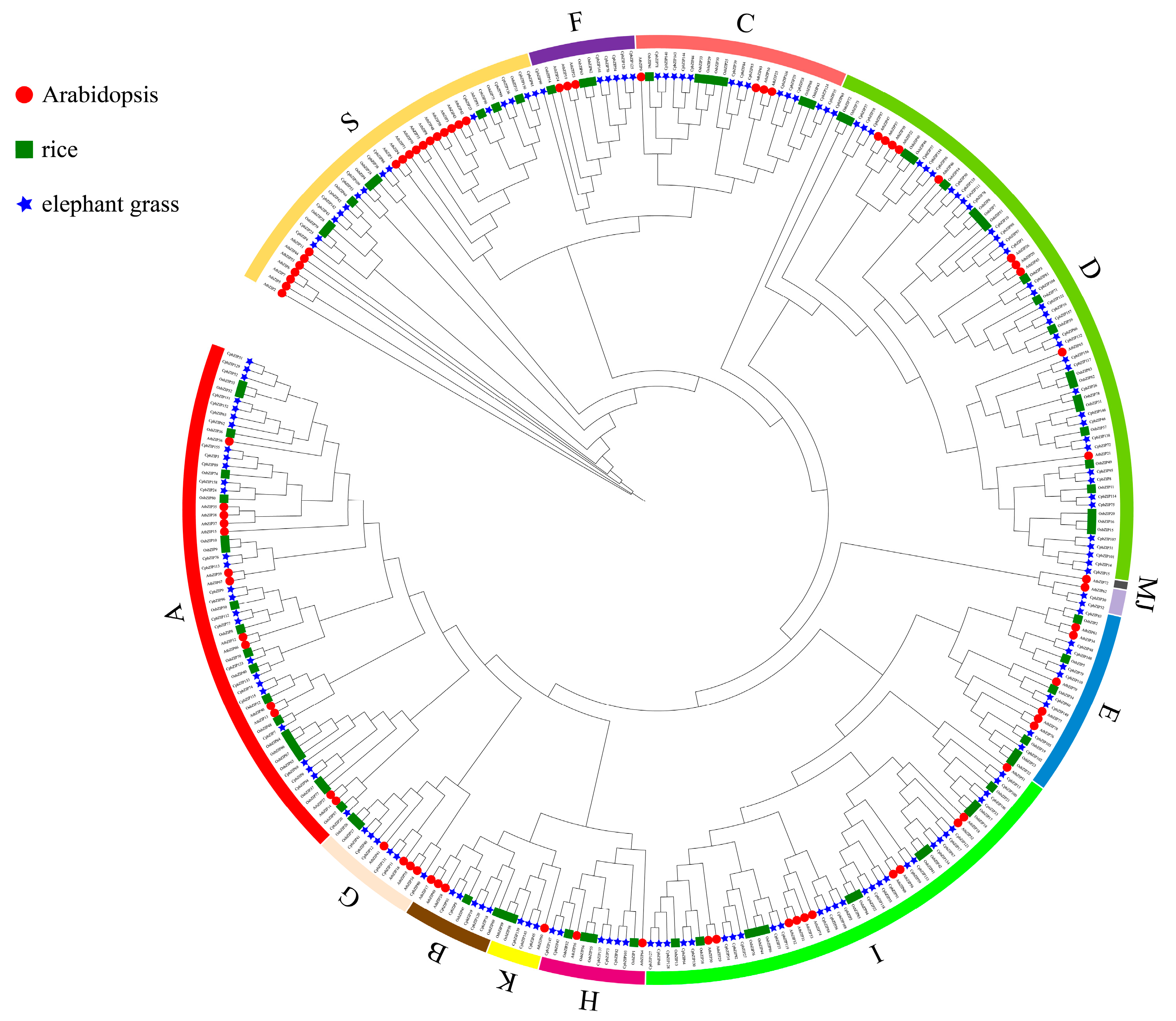
To study the classification and evolutionary relationships of bZIP proteins in elephant grass, we created a phylogenetic tree using 323 bZIP protein sequences. The tree included 158 CpbZIP proteins from elephant grass, 87 OsbZIP proteins from rice, and 78 AtbZIP proteins from Arabidopsis (Figure 2). Based on the clustering results from the phylogenetic tree, we identified 13 distinct CpbZIP protein subgroups, named A through M, according to established classification systems. The number of members varies significantly across subgroups. Subgroup D comprises 38 members, making it the largest subgroup. Subgroup M contains no elephant grass bZIP genes. The specific member counts are as follows: Group A (7), Group B (5), Group C (13), Group D (38), Group E (9), Group F (6), Group G (6), Group H (6), Group I (28), Group J (2), Group K (3), and Group S (15). Genes that cluster together on a phylogenetic tree typically share similar phylogenetic relationships, suggesting that they may have originated from a common ancestor and potentially exhibit functional similarities. This comprehensive classification, which places CpbZIPs into distinct clades with their Arabidopsis and rice homologs, shows conserved evolutionary pathways and potentially serves as a basis for the subsequent analyses of gene structure and conserved motifs.

3.4. Conserved Motifs, Domains and Gene Structures Support the CpbZIP Phylogenetic Classification

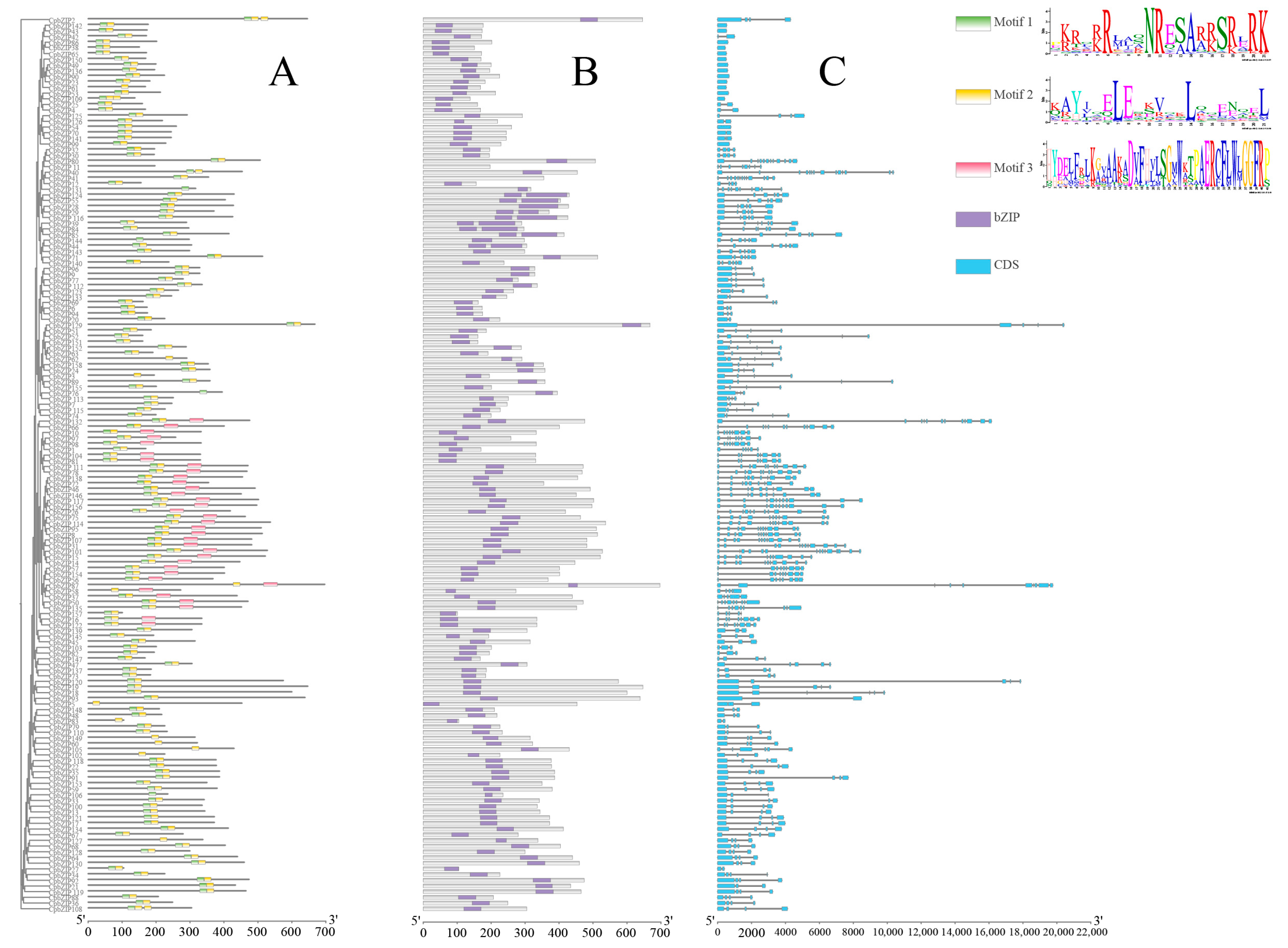
To gain deeper insights into the CpbZIP gene family, a comprehensive analysis was conducted (Figure 3), wherein the CpbZIP genes were vertically aligned based on their phylogenetic relationships. Each gene displays three analyses from left to right: conserved motifs, domain architecture, and gene structure. We identified three conserved motifs (Motifs 1–3) in the conserved motif analysis (Figure 3A). The consensus sequences for these motifs were identified as Motif 1 (PKRXRRLAQNRESARRSRLRK), Motif 2 (KAYIQELEXKVXKLQQENQEL), and Motif 3 (HYDELFRLKAVAAKADVFHVLSGMWKTPAERCFLWLGGFRP). Motifs 1 and 2 are present in nearly all CpbZIP members, and all 35 family members containing Motif 3 belong to the D subgroup. The domain architecture analysis (Figure 3B) confirmed that most CpbZIP members contain the core bZIP domain, validating their classification. The gene structure analysis (Figure 3C) revealed significant diversity in the number of exons within the CpbZIP gene family, ranging from one to 15; however, most members contain two to five exons. Genes within the same phylogenetic subgroup typically exhibit similar patterns in their motif composition, domain architecture, and gene structure (e.g., subgroups S and I). This multi-level conservation supports the reliability of our phylogenetic classification and suggests potential functional conservation and differentiation within the CpbZIP family during evolution.

3.5. Identification and Functional Classification of Cis-Acting Elements in CpbZIP Promoters

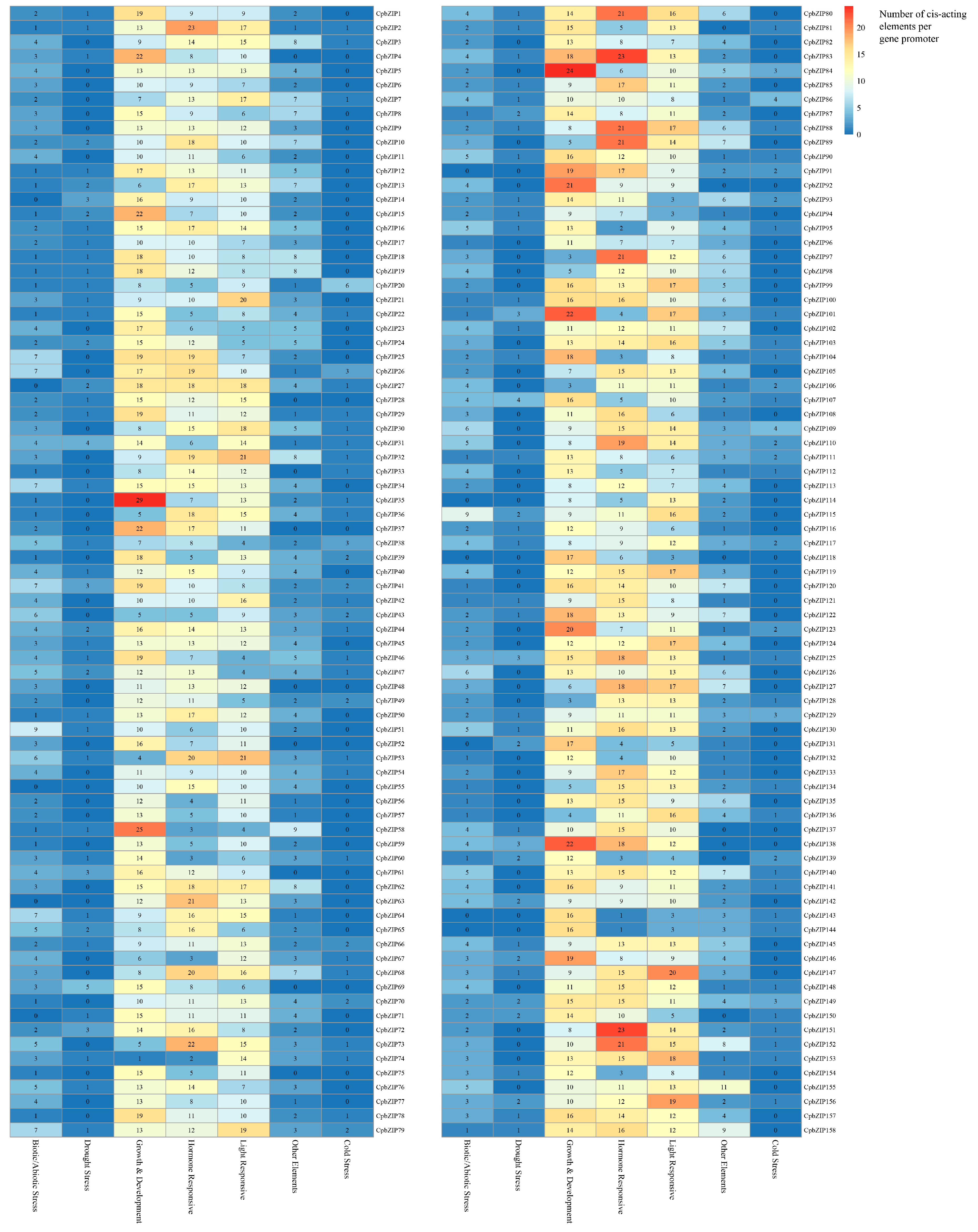
To explore the potential transcriptional regulation and functional roles of CpbZIP genes, we analyzed the promoter sequences of all CpbZIP genes, extending 2000 bp upstream. Our analysis revealed that the promoter regions of CpbZIP genes contain a variety of regulatory elements (Table S3). To illustrate the distribution and functional tendencies of these elements visually, we categorized them into three groups based on their known biological functions: plant growth and development, plant hormone response, and biotic/abiotic stress response (Figure 4; Table S4). Within the plant growth and development category, light-responsive elements (e.g., G-box, Box 4, and GT1 motifs) were the most abundant, present in all 158 CpbZIP promoters (100%). Regarding plant hormone responses, abscisic acid response elements (ABREs) were highly concentrated and present in 89% of CpbZIP gene promoters (141 out of 158). Since the abscisic acid (ABA) signaling pathway is a core regulatory network for plant responses to abiotic stresses such as cold and drought, the high abundance of ABREs indicates that the CpbZIP gene family plays a pivotal role in elephant grass’s response to stress. Additionally, approximately 85% of genes contain methyl jasmonate (MeJA) response elements, indicating their broad involvement in defense responses. Approximately 34% (53 out of 158) of genes involved in abiotic stress response contained low-temperature response elements. The presence of these elements provides a direct molecular basis for the involvement of CpbZIP family members in cold stress regulation. Additionally, approximately 60% of the genes contained drought-related MBS elements, while about 70% contained anaerobic-related ARE elements.
In summary, a comprehensive analysis of the cis-acting elements in the promoter regions of CpbZIP genes indicates that this gene family acts as a multifunctional regulatory hub. Through the synergistic action of low-temperature response elements and ABREs, the CpbZIP family plays a key role in cold stress responses, potentially providing a robust molecular basis for the subsequent identification of key cold stress regulators.

3.6. Identification of Key CpbZIP Genes Responsive to Cold Stress in Roots

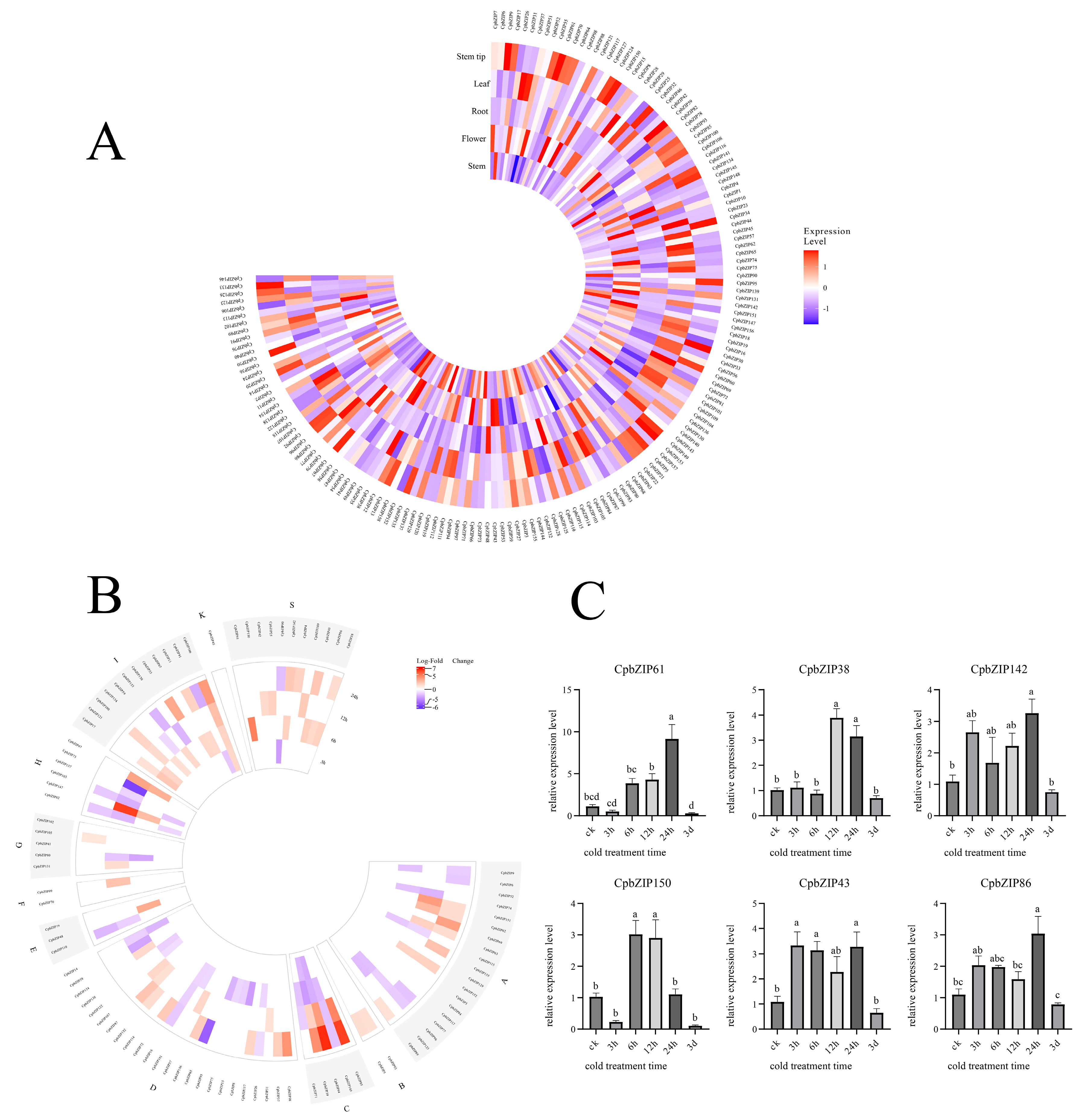
To understand the potential functional roles of the CpbZIP gene family, we analyzed their expression patterns across different plant tissues and, more specifically, in roots under cold stress. We analyzed the expression patterns of the 158 CpbZIP genes in our model plant (Table S5). The data revealed that these genes are widely expressed across multiple tissues, including roots, stems, and leaves (Figure 5A). Considering the central role of roots in forage crop stress resistance, we compared the expression levels of each member between roots and leaves using data from MilletDB. Accounting for over half of the family, 81 genes showed higher expression in roots than in leaves, suggesting their potential roles in root-specific functions. For instance, CpbZIP17 (CpA0200170.1) exhibited a root expression level (TPM 6.319) that was over six times higher than its expression level in leaves (TPM 0.999). This demonstrates a strong preference for root-specific expression.
Based on a multi-organism transcriptomic analysis, we evaluated the cold stress expression data for all subgroups from a large pool of candidate genes (Table S6). It is important to note that the transcriptome sequencing focused on the early signaling response phase (up to 24 h) to identify initial regulators. In contrast, our physiological observations and subsequent RT-qPCR validation were extended to 72 h and 7 days to assess sustained cold tolerance. The results from the transcriptome data indicated that subgroup S exhibits the most highly concentrated response characteristics; this subgroup comprises 11 genes, nine of which (81.82%) were upregulated at least once during cold stress, the highest proportion among all major subgroups (≥5 genes). Although the average response levels of subgroups I and C were slightly higher, their proportion of responsive genes was lower, indicating poorer response concentration. Due to its highly concentrated and extensive response, subgroup S was identified as a key target for subsequent quantitative RT-qPCR analysis.
To identify key cold-responsive genes, we visualized the transcriptional profiles (Figure 5B), which confirmed the response patterns identified in Table S6, showing S-subgroup members were predominantly upregulated. To validate these findings, we performed RT-qPCR analysis on S-subgroup members (Figure 5C), revealing six CpbZIP genes that were induced at multiple time points under low-temperature stress (Table S7). Integrating these expression profiles and heatmap data identified two key candidate genes, CpbZIP38 and CpbZIP86. These genes exhibit high basal expression levels in roots and show significant upregulation upon exposure to cold stress, making them the most promising targets for elucidating the molecular mechanisms of cold tolerance in elephant grass roots.
In summary, this comprehensive expression analysis not only revealed the tissue-specific preferences of the CpbZIP family but also successfully identified CpbZIP38 and CpbZIP86 as likely primary candidates for regulating the cold stress response in elephant grass roots.

4. Discussion

Elephant grass is a high-biomass, high-photosynthetic-efficiency C4 forage grass. However, it faces a critical bottleneck in its global expansion due to its sensitivity to low temperatures. Transcription factors play a central role in plant responses to abiotic stresses, and the bZIP family is particularly notable for its diversity. This study is the first to systematically identify and analyze the bZIP gene family in elephant grass at the genome-wide level. This work lays the foundation for a deeper understanding of the grass’s cold tolerance mechanisms.
We identified a total of 158 CpbZIP genes, which is a significantly higher number than in model plants, such as Arabidopsis (78) [26] and rice (87) [27]. This expansion of the gene family is common across various crops and is generally considered to be the result of adaptive evolution in plant [28]. Our collinearity analysis indicates that the expansion of the elephant grass bZIP gene family was primarily driven by segmental duplication events, which is consistent with observations in other grasses [22,29]. Subgroup S members in Arabidopsis and rice are known to form heterodimers with C-group bZIPs to regulate stress responses efficiently [26,27]. Our finding that elephant grass Subgroup S genes are highly responsive to cold stress parallels findings in Liriodendron chinense [17] and wheat [16], reinforcing the conserved role of this subgroup in thermal adaptation. Ka/Ks ratio analysis revealed that the vast majority of duplicate gene pairs underwent purifying selection, suggesting that their functions have been strictly conserved during evolution. However, a small number of gene pairs with Ka/Ks ratios exceeding 1 suggests that these genes may be under positive selection and have evolved new functions or undergone subfunctionalization to adapt to specific environmental pressures [30]. Future research may involve the functional validation of these specific genes to investigate their roles in elephant grass traits, such as high biomass production and specific environmental adaptability [31].
Through phylogenetic analysis, we classified the elephant grass CpbZIP family into 13 subgroups and discovered that the number of members varied significantly across subgroups. This classification largely aligns with bZIP classifications in species such as Arabidopsis and rice. These results suggest that the bZIP family exhibits highly conserved evolutionary relationships across different plant species. Typically, genes within different subgroups exhibit distinct functions, providing crucial clues for functional studies organized by subgroup classification. For instance, Arabidopsis subgroup A bZIP genes primarily participate in the abscisic acid (ABA) signaling pathway and stress responses [32]. Meanwhile, HY5 from subgroup G and HYH from subgroup H act as pivotal positive regulators in plant photomorphogenesis and light signaling pathways [33]. Future research can leverage this classification to conduct in-depth functional analyses of subgroup members in elephant grass.
Our analysis of cis-acting elements provides compelling evidence for the potential functions of the CpbZIP gene. We found that its promoter region contains multiple elements associated with stress and hormone responses, especially abscisic acid response elements (ABREs) and low-temperature response elements. This discovery paves the way for our investigation into the cold tolerance mechanisms of elephant grass, as the ABRE-mediated signaling pathway is a core regulatory network for plant responses to cold and drought stress [34]. Additionally, we identified elements associated with light response and hypoxia induction, suggesting that the bZIP family acts as a multifunctional regulatory hub in elephant grass. Future studies could use promoter-reporter assays to validate whether these cis-elements are activated under cold stress through transgenic technology [35].
One of the core contributions of this study is the analysis of gene expression under cold stress. We identified multiple CpbZIP genes that exhibited significant changes in expression during low-temperature treatment. Notably, CpbZIP38 and CpbZIP86 have high basal expression levels in roots and are significantly upregulated under cold stress. Roots play a crucial role in plant overwintering [36]. Therefore, these two genes may be strong candidates for cold stress responses in elephant grass roots.
Future research should focus on conducting functional genomics studies in elephant grass. These studies should utilize CRISPR-Cas9 or RNA interference (RNAi) technologies to knock out or downregulate the expression of these two genes. This will allow researchers to assess the specific roles these genes play in elephant grass’s cold tolerance. Additionally, yeast two-hybrid or co-immunoprecipitation methods could be employed to investigate whether CpbZIP38 and CpbZIP86 interact with other transcription factors or proteins to regulate downstream target genes. Identifying these target genes will help construct a comprehensive regulatory network for the cold stress response in elephant grass [37]. Furthermore, recent pioneering work on the related species pearl millet has utilized single-cell transcriptomics to reveal complex spatiotemporal responses to abiotic stress [38]. Future research on elephant grass could also adopt such high-resolution approaches to uncover the precise cellular localization and dynamic regulatory roles of CpbZIP genes during cold acclimation.

5. Conclusions

This study identified 158 putative CpbZIP genes in elephant grass, representing a significant expansion primarily caused by segmental duplication and shaped by purifying selection. Phylogenetic analysis grouped the CpbZIP proteins into 13 subgroups, a classification supported by conserved gene structures and motifs. Promoter analysis indicated CpbZIP genes play key roles in regulating responses to hormones (ABA) and abiotic stresses like low temperature. Gene expression pattern analysis further identified six candidate genes responsive to low-temperature stress. Notably, CpbZIP38 and CpbZIP86 exhibited high basal expression in roots and were significantly upregulated under cold stress. Although functional verification (e.g., via overexpression or CRISPR-Cas9 knockout) is required to confirm their biological activities, our data suggest these genes are strong candidates for investigating cold tolerance mechanisms. In summary, this study establishes a solid foundation for future functional genomics and provides valuable genetic resources for breeding cold-tolerant elephant grass.

Supplementary Materials

The following supporting information can be downloaded at: https://www.mdpi.com/article/10.3390/agronomy16010043/s1. Table S1: The physicochemical properties and localization information of 158 identified CpbZIP family members; Table S2: The Ka and Ks value of CpbZIP proteins; Table S3: Cis-acting elements in CpbZIPs; Table S4: Functional Classification of Identified Cis-Acting Elements; Table S5: The expression of CpbZIPs in different tissues; Table S6: Transcriptome data of elephant grass under cold stress; Table S7: The expression of CpbZIPs under cold stress; Table S8: Primers used for RT-qPCR.

Author Contributions

Conceptualization, H.Y., C.M. and R.Y.; Methodology, H.Y.; Software, R.Y.; Formal analysis, R.Y.; Investigation, R.Y., D.Y., H.F., K.L., Y.L., S.P. and J.H.; Resources, Y.J., Y.Z., H.Y., L.H. and C.M.; Data curation, R.Y., H.F. and Z.Z.; Writing—original draft preparation, R.Y.; Writing—review & editing, H.Y. and R.Y.; Visualization, R.Y.; Supervision, H.Y.; Project administration, H.Y.; Funding acquisition, H.Y. and L.H. All authors have read and agreed to the published version of the manuscript.

Funding

This work was supported by the National Key R&D Program of China (2024YFF1001300), the Sichuan Provincial International Cooperation Project (2025YFHZ0180) and the National Undergraduate Training Program on Innovation and Entrepreneurship (No. 202510626003).

Data Availability Statement

All data generated or analyzed during this study are included in this published article and its Supplementary Material files.

Acknowledgments

We thank the anonymous reviewers for their constructive comments, which significantly improved the quality of this manuscript. During the preparation of this manuscript, the authors used Gemini (Google) for the purposes of English language editing, proofreading, and refining the response to reviewers. The authors have reviewed and edited the output and take full responsibility for the content of this publication.

Conflicts of Interest

The authors declare no conflicts of interest.

Abbreviations

The following abbreviations are used in this manuscript:
bZIPBasic region-leucine zipper
RT-qPCRReverse Transcription–Quantitative Polymerase Chain Reaction
CKControl
CSCold Stress
KaNon-synonymous substitution rate
KsSynonymous substitution rate
MWMolecular Weight
pITheoretical Isoelectric Point
kDaKilodalton
MLMaximum Likelihood
CDSCoding Sequence
ABAAbscisic Acid
ABREAbscisic Acid Response Element
MeJAMethyl Jasmonate
MBSMYB Binding Site
AREAnaerobic-Related Element
Log2FCLog2-Fold Change
TPMTranscripts Per Million
EF1αElongator Factor-1-Alpha
RNAiRNA Interference
SDStandard Deviation
ANOVAAnalysis of Variance

References

  1. Liang, X.; Erickson, J.E.; Sollenberger, L.E.; Rowland, D.L.; Silveira, M.L.; Vermerris, W. Growth and transpiration responses of elephantgrass and energycane to soil drying. Crop Sci. 2018, 58, 354–363. [Google Scholar] [CrossRef]
  2. Anderson, W.F.; Dien, B.S.; Brandon, S.K.; Peterson, J.D. Assessment of Bermudagrass and Bunch Grasses as Feedstock for Conversion to Ethanol. In Proceedings of the Biotechnology for Fuels and Chemicals, Denver, CO, USA, 29 April–2 May 2007; Humana Press: Totowa, NJ, USA, 2008; pp. 13–21. [Google Scholar]
  3. Kebede, G.; Feyissa, F.; Assefa, G.; Alemayehu, M.; Mengistu, A.; Kehaliew, A.; Melese, K.; Mengistu, S.; Tadesse, E.; Wolde, S.; et al. Agronomic performance, dry matter yield stability and herbage quality of Napier grass (Pennisetum purpureum (L.) Schumach) accessions in different agro-ecological zones of Ethiopia. J. Agric. Crop Res. 2017, 5, 49–65. [Google Scholar]
  4. Muktar, M.S.; Teshome, A.; Hanson, J.; Negawo, A.T.; Habte, E.; Domelevo Entfellner, J.-B.; Lee, K.-W.; Jones, C.S. Genotyping by sequencing provides new insights into the diversity of Napier grass (Cenchrus purpureus) and reveals variation in genome-wide LD patterns between collections. Sci. Rep. 2019, 9, 6936. [Google Scholar] [CrossRef]
  5. Adhikari, L.; Baral, R.; Paudel, D.; Min, D.; Makaju, S.O.; Poudel, H.P.; Acharya, J.P.; Missaoui, A.M. Cold stress in plants: Strategies to improve cold tolerance in forage species. Plant Stress 2022, 4, 100081. [Google Scholar] [CrossRef]
  6. Al-Shoaibi, A. Growth response of elephant grass (Pennisetum purpureum) and Zea mays to chilling temperature. Biosci. Biotechnol. Res. Asia 2007, 4, 389–394. [Google Scholar]
  7. Kour, S.; Kapil, P.; Sood, Y. Harnessing the Potential of Napier Grass (Pennisetum purpureum) for Sustainable Biofuel Production. J. Sci. Res. Rep. 2025, 31, 734–745. [Google Scholar] [CrossRef]
  8. Nimmanterdwong, P.; Chalermsinsuwan, B.; Østergård, H.; Piumsomboon, P. Environmental performance assessment of Napier grass for bioenergy production. J. Clean. Prod. 2017, 165, 645–655. [Google Scholar] [CrossRef]
  9. Rahul Kapoor, R.K. Genetic variability and association studies in Napier grass (Pennisetum purpureum Schumach.) for green fodder yield and quality traits. Electron. J. Plant Breed. 2017, 8, 885–891. [Google Scholar] [CrossRef]
  10. Osman, N.; Roslan, A.; Ibrahim, M.; Hassan, M. Potential use of Pennisetum purpureum for phytoremediation and bioenergy production: A mini review. Asia Pac. J. Mol. Biol. Biotechnol. 2020, 28, 14–26. [Google Scholar] [CrossRef]
  11. Kong, S.; Park, S.Y.; Lee, Y.H. Systematic characterization of the bZIP transcription factor gene family in the rice blast fungus, Magnaporthe oryzae. Environ. Microbiol. 2015, 17, 1425–1443. [Google Scholar] [CrossRef]
  12. Ptashne, M.; Gann, A. Transcriptional activation by recruitment. Nature 1997, 386, 569–577. [Google Scholar] [CrossRef] [PubMed]
  13. Hurst, H.C. Transcription factors 1: bZIP proteins. Protein Profile 1995, 2, 101–168. [Google Scholar] [PubMed]
  14. Jakoby, M.; Weisshaar, B.; Dröge-Laser, W.; Vicente-Carbajosa, J.; Tiedemann, J.; Kroj, T.; Parcy, F. bZIP transcription factors in Arabidopsis. Trends Plant Sci. 2002, 7, 106–111. [Google Scholar] [CrossRef]
  15. Banerjee, A.; Roychoudhury, A. Abscisic-acid-dependent basic leucine zipper (bZIP) transcription factors in plant abiotic stress. Protoplasma 2017, 254, 3–16. [Google Scholar] [CrossRef] [PubMed]
  16. Kim, S.; Kang, J.y.; Cho, D.I.; Park, J.H.; Kim, S.Y. ABF2, an ABRE-binding bZIP factor, is an essential component of glucose signaling and its overexpression affects multiple stress tolerance. Plant J. 2004, 40, 75–87. [Google Scholar] [CrossRef]
  17. Wang, L.; Cao, H.; Qian, W.; Yao, L.; Hao, X.; Li, N.; Yang, Y.; Wang, X. Identification of a novel bZIP transcription factor in Camellia sinensis as a negative regulator of freezing tolerance in transgenic arabidopsis. Ann. Bot. 2017, 119, 1195–1209. [Google Scholar] [CrossRef]
  18. Liang, Y.; Xia, J.; Jiang, Y.; Bao, Y.; Chen, H.; Wang, D.; Zhang, D.; Yu, J.; Cang, J. Genome-Wide Identification and Analysis of bZIP Gene Family and Resistance of TaABI5 (TabZIP96) under Freezing Stress in Wheat (Triticum aestivum). Int. J. Mol. Sci. 2022, 23, 2351. [Google Scholar] [CrossRef]
  19. Li, M.; Hwarari, D.; Li, Y.; Ahmad, B.; Min, T.; Zhang, W.; Wang, J.; Yang, L. The bZIP transcription factors in Liriodendron chinense: Genome-wide recognition, characteristics and cold stress response. Front. Plant Sci. 2022, 13, 1035627. [Google Scholar] [CrossRef]
  20. Liu, C.; Schläppi, M.R.; Mao, B.; Wang, W.; Wang, A.; Chu, C. The bZIP 73 transcription factor controls rice cold tolerance at the reproductive stage. Plant Biotechnol. J. 2019, 17, 1834–1849. [Google Scholar] [CrossRef]
  21. Zhang, Y.; Wu, L.; Liu, L.; Jia, B.; Ye, Z.; Tang, X.; Heng, W.; Liu, L. Functional analysis of PbbZIP11 transcription factor in response to cold stress in Arabidopsis and pear. Plants 2024, 13, 24. [Google Scholar] [CrossRef]
  22. Wei, K.; Chen, J.; Wang, Y.; Chen, Y.; Chen, S.; Lin, Y.; Pan, S.; Zhong, X.; Xie, D. Genome-wide analysis of bZIP-encoding genes in maize. DNA Res. 2012, 19, 463–476. [Google Scholar] [CrossRef] [PubMed]
  23. Zhong, X.; Feng, X.; Li, Y.; Guzmán, C.; Lin, N.; Xu, Q.; Zhang, Y.; Tang, H.; Qi, P.; Deng, M.; et al. Genome-wide identification of bZIP transcription factor genes related to starch synthesis in barley (Hordeum vulgare L.). Genome 2021, 64, 1067–1080. [Google Scholar] [CrossRef] [PubMed]
  24. Wang, Y.; Tang, H.; DeBarry, J.D.; Tan, X.; Li, J.; Wang, X.; Lee, T.; Jin, H.; Marler, B.; Guo, H.; et al. MCScanX: A toolkit for detection and evolutionary analysis of gene synteny and collinearity. Nucleic Acids Res. 2012, 40, e49. [Google Scholar] [CrossRef] [PubMed]
  25. Hu, Y.; Sun, M.; Luo, D.; Yang, D.; Zhang, Y.; Jia, J.; Ding, Q.; Najeeb, A.; Wang, X.; Ji, Y.; et al. Transcriptome profiling the response of elephant grass (Cenchrus purpureus) root to cold stress. Grass Res. 2025, 5, e014. [Google Scholar] [CrossRef]
  26. Dröge-Laser, W.; Snoek, B.L.; Snel, B.; Weiste, C. The Arabidopsis bZIP transcription factor family—An update. Curr. Opin. Plant Biol. 2018, 45, 36–49. [Google Scholar] [CrossRef]
  27. Nijhawan, A.; Jain, M.; Tyagi, A.K.; Khurana, J.P. Genomic survey and gene expression analysis of the basic leucine zipper transcription factor family in rice. Plant Physiol. 2008, 146, 333. [Google Scholar] [CrossRef]
  28. Panchy, N.; Lehti-Shiu, M.; Shiu, S.-H. Evolution of gene duplication in plants. Plant Physiol. 2016, 171, 2294–2316. [Google Scholar] [CrossRef]
  29. Wang, J.; Zhou, J.; Zhang, B.; Vanitha, J.; Ramachandran, S.; Jiang, S.Y. Genome-wide expansion and expression divergence of the basic leucine zipper transcription factors in higher plants with an emphasis on sorghum. J. Integr. Plant Biol. 2011, 53, 212–231. [Google Scholar] [CrossRef]
  30. Wang, Y.; Wang, X.; Paterson, A.H. Genome and gene duplications and gene expression divergence: A view from plants. Ann. N. Y. Acad. Sci. 2012, 1256, 1–14. [Google Scholar] [CrossRef]
  31. Uga, Y.; Sugimoto, K.; Ogawa, S.; Rane, J.; Ishitani, M.; Hara, N.; Kitomi, Y.; Inukai, Y.; Ono, K.; Kanno, N.; et al. Control of root system architecture by DEEPER ROOTING 1 increases rice yield under drought conditions. Nat. Genet. 2013, 45, 1097–1102. [Google Scholar] [CrossRef]
  32. Fujita, Y.; Fujita, M.; Shinozaki, K.; Yamaguchi-Shinozaki, K. ABA-mediated transcriptional regulation in response to osmotic stress in plants. J. Plant Res. 2011, 124, 509–525. [Google Scholar] [CrossRef] [PubMed]
  33. Xiao, Y.; Chu, L.; Zhang, Y.; Bian, Y.; Xiao, J.; Xu, D. HY5: A pivotal regulator of light-dependent development in higher plants. Front. Plant Sci. 2022, 12, 800989. [Google Scholar] [CrossRef]
  34. Nakashima, K.; Yamaguchi-Shinozaki, K.; Shinozaki, K. The transcriptional regulatory network in the drought response and its crosstalk in abiotic stress responses including drought, cold, and heat. Front. Plant Sci. 2014, 5, 170. [Google Scholar] [CrossRef]
  35. Yamaguchi-Shinozaki, K.; Shinozaki, K. A novel cis-acting element in an Arabidopsis gene is involved in responsiveness to drought, low-temperature, or high-salt stress. Plant Cell 1994, 6, 251. [Google Scholar]
  36. Khan, M.; Gemenet, D.C.; Villordon, A. Root system architecture and abiotic stress tolerance: Current knowledge in root and tuber crops. Front. Plant Sci. 2016, 7, 1584. [Google Scholar] [CrossRef]
  37. Meng, X.; Li, L.; De Clercq, I.; Narsai, R.; Xu, Y.; Hartmann, A.; Claros, D.L.; Custovic, E.; Lewsey, M.G.; Whelan, J.; et al. ANAC017 coordinates organellar functions and stress responses by reprogramming retrograde signaling. Plant Physiol. 2019, 180, 634–653. [Google Scholar] [CrossRef]
  38. Jin, Y.; Yan, H.; Zhu, X.; Yang, Y.; Jia, J.; Sun, M.; Najeeb, A.; Luo, J.; Wang, X.; He, M.; et al. Single-cell transcriptomes reveal spatiotemporal heat stress response in pearl millet leaves. New Phytol. 2025, 247, 637–650. [Google Scholar] [CrossRef]
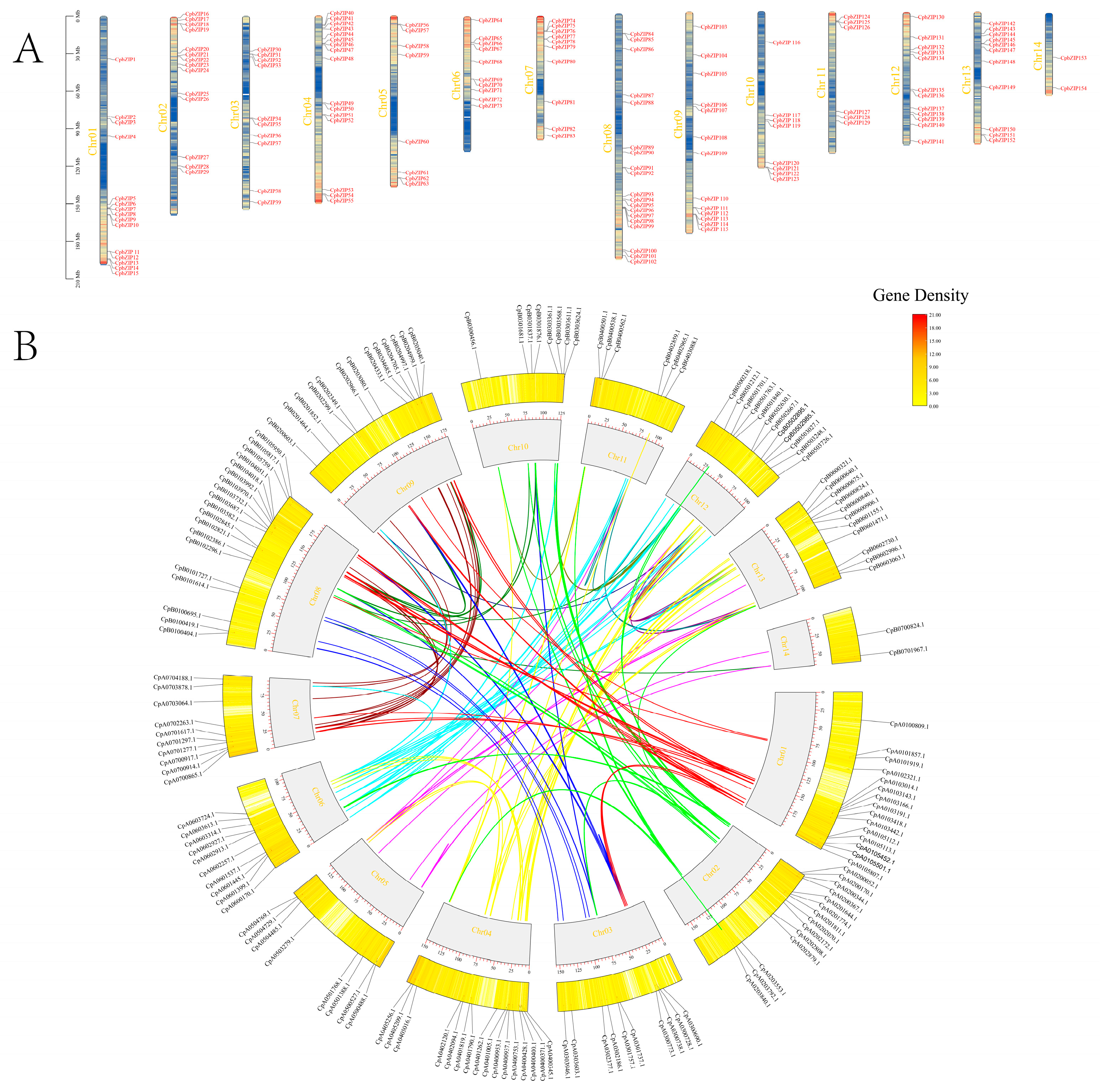
Figure 1. Chromosomal distribution and collinearity analysis of the CpbZIP gene family in elephant grass. (A) The distribution of 158 CpbZIP genes on 14 elephant grass chromosomes (Chr01–Chr14). The chromosome numbers are indicated at the top. The scale on the left indicates the chromosome length (Mb). The heatmap background on the chromosomes represents the gene density across the genome, with warmer colors (e.g., red) indicating higher gene density regions and cooler colors (e.g., blue) indicating lower gene density regions. (B) Circle plot showing segmental duplication events of CpbZIP genes. The 14 chromosomes are arranged in a circle. The colored connecting lines in the center represent duplicated gene pairs belonging to the CpbZIP gene family, indicating segmental duplication events between different chromosomes.
Agronomy 16 00043 g001
Figure 2. Phylogenetic tree of bZIP members from elephant grass (blue pentagons), rice (green squares), and Arabidopsis (red circles). The 13 subgroups (A–M, excluding L) are indicated by colored ranges, where “S” represents the S subgroup.
Agronomy 16 00043 g002
Figure 3. Phylogenetic relationship, conserved motifs, domain architecture, and gene structure of CpbZIP family members. The vertical order of CpbZIP genes is based on their phylogenetic relationships (tree shown at far left). Three distinct analyses are shown for each gene from left to right: (A) Conserved motifs (Motif 1–3) identified by MEME. (B) Conserved bZIP domain architecture. (C) Gene structure, where exons (CDS) are represented by light blue boxes and introns by gray lines. The legend in the top right displays the sequence logos for Motif 1 (olive green), Motif 2 (yellow), and Motif 3 (pink). In these logos, the colored capital letters represent the standard one-letter codes for amino acids, and the height of each stack indicates the sequence conservation at that position. The legend also indicates the color codes: bZIP domain (purple) and CDS (light blue). Scale bars are provided at the bottom for each panel.
Agronomy 16 00043 g003
Figure 4. Functional classification and quantitative analysis of cis-acting elements in the CpbZIP gene promoter.
Agronomy 16 00043 g004
Figure 5. Expression analysis of CpbZIP genes in different tissues and in response to cold stress. (A). Expression levels of the CpbZIP gene family in different tissues. (B). Circular heatmap of transcriptome expression changes for CpbZIP subgroups under cold stress. The uppercase letters represent different subgroups of the CpbZIP gene family. The rings from inside to outside represent 3 h, 6 h, 12 h, and 24 h of cold treatment. (C). Expression levels of the S subgroup of CpbZIP genes in the roots of elephant grass CN002 at various time points under cold stress, normalized to the control group (CK). Data represent the mean ± SD of three biological replicates (n = 3). Different lowercase letters indicate statistically significant differences (p < 0.05) determined by one-way ANOVA.
Agronomy 16 00043 g005
Disclaimer/Publisher’s Note: The statements, opinions and data contained in all publications are solely those of the individual author(s) and contributor(s) and not of MDPI and/or the editor(s). MDPI and/or the editor(s) disclaim responsibility for any injury to people or property resulting from any ideas, methods, instructions or products referred to in the content.