Article

Response of Soil Organic Carbon Components in Pinus yunnanensis Stand to Altitude Variation

College of Resources and Environment, Yunnan Agricultural University, Kunming 650500, China
*
Authors to whom correspondence should be addressed.
Agronomy 2026, 16(1), 4; https://doi.org/10.3390/agronomy16010004
Submission received: 10 November 2025 / Revised: 10 December 2025 / Accepted: 17 December 2025 / Published: 19 December 2025
(This article belongs to the Section Soil and Plant Nutrition)

Abstract

Under global climate change, the response of mountain forest soil carbon pools to elevation is central to carbon cycle research, and Pinus yunnanensis stands, which span a wide elevation range, serve as a typical subject for studying how soil properties in mountain ecosystems respond to elevation gradients. To reveal the variation patterns and underlying regulatory mechanisms of soil nutrients and organic carbon components in Pinus yunnanensis stands across different altitudinal gradients, this study took Pinus yunnanensis stands at three altitude gradients (1604 m, 2377 m, 3206 m) within Yunnan Province as research objects, collected stratified soil samples, and determined soil chemical properties, organic carbon components, enzyme activity, and microbial biomass. The results showed that changes in elevation significantly influence soil nutrient content: soil pH gradually decreases with increasing elevation; soil organic carbon, total nitrogen, alkali-hydrolyzable nitrogen, available phosphorus, and readily available potassium first increase then decrease with elevation, reaching their highest levels at Jin’an Town (JA); total phosphorus and total potassium gradually increase with elevation, peaking at Xiaozhongdian Town (XZD); particulate organic carbon, mineral-bound organic carbon, and microbial biomass carbon follow similar patterns to organic carbon, all showing enrichment in the surface layer; JA exhibits the highest carbon cycle enzyme activity and bacterial biomass, while XZD shows dominant fungal biomass. Partial Least Squares Path Modeling (PLS-PM) analysis indicates that elevation strongly positively drives microbial biomass, indirectly regulating enzyme activity and chemical properties, ultimately jointly influencing organic carbon components. In conclusion, soil properties varied markedly, and under stable precipitation, the thermal gradient emerged as the primary driver; the mid-elevation site (2377 m) showed optimal soil functioning, with peak nutrient and carbon stocks linked to heightened microbial and enzymatic activity, and path modeling confirmed that temperature, via microbial mediation, is the key regulator of soil organic carbon dynamics in these pine forests.

1. Introduction

Forests, as the primary terrestrial ecosystems, cover approximately 9.4% of the Earth’s total surface area and play a central role in maintaining biodiversity and regulating global biogeochemical cycles [1]. Especially in the context of global climate change, mountain forests, characterized by pronounced vertical differentiation with altitude, have become key regions for studying ecosystem responses to environmental gradients. Simultaneously, mountain forest ecosystems serve as vital terrestrial carbon sinks, and how their soil carbon pool dynamics respond to changes in altitude gradients has emerged as one of the core issues in contemporary global carbon cycle research [2,3].
Soil, as the cornerstone of forest ecosystems, plays an irreplaceable and vital role in maintaining forest ecological balance, safeguarding regional environmental quality, and numerous other aspects [4]. Therefore, conducting in-depth investigations into soil nutrient status is not only a fundamental prerequisite for understanding processes such as forest carbon cycling and biodiversity maintenance, but also holds significant guiding importance for rationally optimizing the utilization of forest land resources and protecting the ecological environment [5,6]. In soil ecosystems, soil microorganisms and extracellular enzymes serve as crucial components, acting as primary regulators of soil organic matter decomposition and nutrient mineralization. They directly drive the orderly progression of biogeochemical cycles within terrestrial ecosystems [7]. These processes interact and synergistically interact, collectively supporting the formation of forest ecosystem biodiversity and the maintenance of ecosystem stability.
Soil organic carbon (SOC) is not only a core component of soil nutrients but also a key element of the soil carbon pool. It connects three vital processes: soil function, ecological balance maintenance, and the global carbon cycle. Its accumulation process and dynamic equilibrium state directly determine the level of soil fertility [8,9]. From a compositional perspective, SOC exhibits an “active-stable” gradient differentiation: Particulate Organic Carbon (POC) represents the active fraction, originating from incompletely decomposed plant residues and reflecting litter input and decomposition rates; Mineral-Associated Organic Carbon (MAOC) constitutes the stable fraction, bound to clay minerals and iron oxides to form the core of long-term carbon storage; Microbial biomass carbon (MBC) serves as the pivotal link between these two, participating in organic carbon transformation cycles [10,11]. Research indicates that elevation gradients within forest ecosystems can significantly alter soil nutrient cycling processes by regulating regional water and thermal conditions and influencing microbial activity intensity, thereby promoting the accumulation and stabilization of organic carbon [12,13]. However, systematic research on the partitioning and interactive mechanisms of various soil organic carbon components (e.g., POC, MAOC, MBC) in Pinus yunnanensis stand across different altitude gradients remains relatively scarce. While global reviews confirm the general trend of altitude effects on forest SOC pools, significant controversies and knowledge gaps persist regarding the underlying drivers at the component level.
Pinus yunnanensis stand is a dominant tree species in the subtropical forests of Southwest China, with its natural distribution spanning a wide altitudinal range from approximately 800 to 3200 m above sea level. The stands investigated in this study are naturally regenerated or semi-natural forests, which are not monocultures. They typically exhibit a multi-layered structure: the canopy is dominated by Pinus yunnanensis stand, while the understory includes a variety of shrub and herbaceous species. This structural complexity influences litter inputs and the soil microenvironment, making Pinus yunnanensis stand an ideal system for studying how soil properties respond to elevation gradients. Studying soil nutrient status not only measures forest soil quality but also indirectly reflects the health and stability of forest ecosystems through characteristics such as nutrient supply capacity and cycling efficiency. Based on the regulatory role of elevation in soil processes, this study proposes the hypothesis that elevation gradients drive directional succession of soil microbial communities and functions, thereby regulating the dynamic changes in soil organic carbon components. Therefore, this study investigates Pinus yunnanensis stand soils at three distinct elevations, analyzing variations in soil nutrients, organic carbon composition, enzyme activity, and microbial characteristics. The aim is to reveal the patterns and underlying mechanisms governing these soil properties along the elevation gradient, providing a scientific basis for sustainable forest ecosystem management and soil quality assessment.

2. Materials and Methods

2.1. Geographic Settings

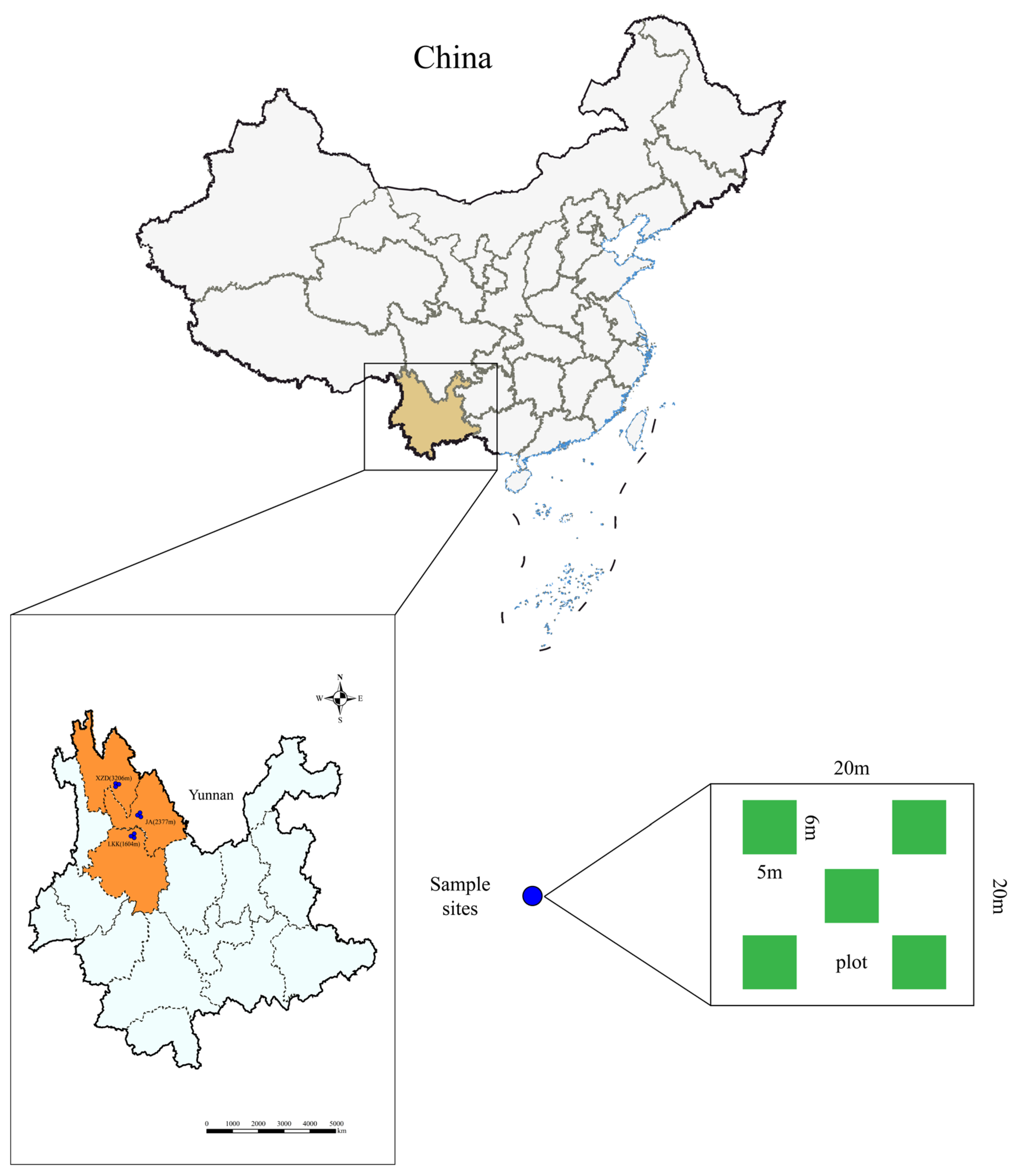
This study was conducted in Yunnan Province, China (97°31′–106°11′ E, 21°8′–29°15′ N), characterized by a subtropical plateau monsoon climate. The terrain is mountainous, with vegetation dominated by natural Pinus yunnanensis stand, where trees are 20–30 years old. The study area encompassed three zones at different elevations (Figure 1): Longkoukui Town (LKK), Dali City, at 1604 m elevation, south-facing slope, with annual precipitation of 850 mm, long-term average temperature of 18.5 °C, and soil temperature ranging from 5 to 8 °C; Jinan Town (JA), Lijiang City, elevation 2377 m, southeast-facing slope, annual precipitation 850 mm, long-term average temperature 13 °C, soil temperature 3.6–5.6 °C; Xiaozhongdian Town (XZD), Shangri-La, elevation 3206 m, southeast-facing slope, annual average precipitation 849.8 mm, long-term average temperature 5.8 °C, soil temperature 3–5 °C. The parent material of the soils in all three study areas is limestone. According to the USDA Soil Taxonomy (12th edition) and the World Reference Base for Soil Resources (WRB, 2022), the soils are classified as Hapludults (USDA, Great Group level, Order: Ultisols) and Rhodic Calcaric Lixisols (WRB system).
Notably, the long-term annual precipitation across the three study sites is remarkably similar (~850 mm), based on local meteorological station records. This pattern deviates from the typical expectation of increasing precipitation with altitude and may be attributed to the unique regional topography and atmospheric circulation patterns of the Hengduan Mountains, where complex terrain can create localized climate zones. This unusual consistency in precipitation across a large elevational gradient (≈1600 m) provides a valuable natural experimental setting. It allows us to isolate and primarily attribute the observed variations in soil properties to the pronounced temperature gradient (from 18.5 °C to 5.8 °C) and other altitude-associated factors (e.g., vegetation composition, soil development stage), while minimizing the confounding effect of precipitation variability.

2.2. Plot Establishment and Soil Sampling

Soil sampling was conducted in June 2025. Three plots with similar topography and consistent vegetation growth were selected, each measuring 20 m × 20 m (as three independent replicates). Within each plot, five 5 m × 6 m sample squares were randomly established (Figure 1). Within each small plot, five sampling points were selected using the five-point sampling method. Soil samples were collected in layers at 0–20 cm, 20–40 cm, and 40–60 cm using a soil auger, yielding a total of 675 soil samples. Fresh soil samples were collected and subsequently transferred to the laboratory. Soil samples from the same layer of the same plot were uniformly mixed into a single composite sample, which was then divided into two portions: one portion was air-dried for physical and chemical soil analysis, while the other portion was stored at −20 °C for determining soil microbial biomass, enzyme activity, and microbial content. Microbial content was measured through phospholipid fatty acid (PLFA) analysis.

2.3. Sample Analysis and Methods

2.3.1. Determination of Soil Chemical Properties

Soil pH, SOC, POC, MAOC, Total Nitrogen (TN), Alkali-hydrolysable Nitrogen (AN), Total Phosphorus (TP), Available Phosphorus (AP), Total Potassium (TK), and Available Potassium (AK) were determined by Chengdu Baihui Organisms Technology Co., Ltd. (Chengdu, China), following standardized protocols with specified parameters and references to ensure result reproducibility. Specifically, soil pH was measured via potentiometry at a 1:2.5 soil-to-water ratio [14]; SOC, POC, and MAOC were quantified using a modified Walkley–Black potassium dichromate external heating method, with POC isolated via 53 μm sieve fractionation and MAOC as the mineral-bound residual fraction [15,16]; TN was analyzed via semi-micro Kjeldahl digestion and titration [17]; AN was determined via alkaline hydrolysis-diffusion [18]; TP was measured via HClO4-H2SO4 digestion and molybdenum-antimony colorimetry, while AP was extracted via the Olsen method before colorimetric determination [18]; TK was determined via NaOH fusion and ICP-AES [19], and AK was extracted with NH4OAc and detected via flame atomic absorption spectrometry [18]. All instruments were calibrated with standard reference materials prior to sample analysis to ensure accuracy. Specific methods are detailed in Table 1.

2.3.2. Determination of Soil Biological Properties

Soil β-glucosidase (BG), N-acetyl-β-glucosidase (NAG), β-1,4-xylosidase (BX), and cellobiohydrolase (CBH) activities, microbial biomass carbon (MBC), and phospholipid fatty acids (PLFA) were determined by Chengdu Baihui Organisms Technology Co., Ltd., following standardized protocols with detailed operational procedures and reference methods to ensure data credibility, as described below:
BG and BX: Determined via p-nitrophenyl (pNP) glycoside substrate method; 1 g fresh soil incubated with p-nitrophenyl-β-D-glucopyranoside (for BG) or p-nitrophenyl-β-D-xylopyranoside (for BX) at 37 °C for 1 h, terminated with 0.5 mol/L CaCl2 and 0.1 mol/L Tris (pH 12), absorbance measured at 400 nm. CBH: Assayed using 4-methylumbelliferyl-β-D-cellobioside as substrate, incubated at 37 °C for 2 h, fluorescence measured at excitation 365 nm/emission 450 nm. NAG: Determined with p-nitrophenyl-N-acetyl-β-D-glucosaminide as substrate, incubated at 37 °C for 1 h, terminated and detected at 400 nm. MBC: Measured via chloroform fumigation-extraction method; fumigated and non-fumigated soils extracted with 0.5 mol/L K2SO4, organic carbon in extracts determined via TOC analyzer, conversion factor of 0.45 used [20]. PLFA: Extracted via Bligh–Dyer method, separated via solid-phase extraction, and identified and quantified via gas chromatography–mass spectrometry (GC-MS) [21].

2.4. Statistical Analysis

All data were organized using Microsoft Excel 365. Prior to parametric analysis, the normality of distributions and homogeneity of variances for all variables were assessed using the Shapiro–Wilk test and Levene’s test, respectively.
To evaluate the effects of Altitude, Soil Depth, and their interaction on all measured soil properties, a two-way analysis of variance (Two-way ANOVA) was performed using SPSS (version 26.0, IBM Corp., Armonk, NK, USA). For variables where the main or interactive effects were significant (p ≤ 0.05), post hoc pairwise comparisons among altitude levels within the same soil layer (or among soil layers within the same altitude) were conducted using Fisher’s Least Significant Difference (LSD) test.
To elucidate the complex causal relationships and quantify the direct and indirect pathways through which environmental and biological factors influence soil organic carbon (SOC) components, a Partial Least Squares Path Model (PLS-PM) was constructed. The analysis was performed using R (version 4.4.2) within RStudio. The conceptual model included five latent variables: Elevation, Microbial Biomass, Enzyme Activity, Soil Chemical Properties, and SOC Components. The path weighting scheme was used for inner model estimation. The overall model fit was assessed by the Goodness-of-Fit (GoF) index. The significance of all path coefficients was tested using a non-parametric bootstrap procedure with 1000 resamples to generate 95% bias-corrected confidence intervals; paths were considered significant if their confidence intervals did not span zero.
All graphs were created using Origin 2021 (Origin Lab Corp., Northampton, MA, USA). Data in the text and figures are presented as the mean ± standard deviation (SD) based on three independent experimental plots (biological replicates).
Two-way ANOVA was performed to quantify the main effects of Altitude (A), Soil Depth (D), and their interaction (A × D) on soil chemical properties, organic carbon components, enzyme activities, and microbial biomass. Fisher’s LSD test was used for pairwise comparisons of significant variables. All statistical analyses were based on the actual sample data (n = 3 per soil layer per altitude), with results of F-values, p-values, and LSD pairwise comparison significance presented in Tables S1–S4.

3. Results

3.1. Soil Chemical Properties

3.1.1. Soil pH and Total Nutrients

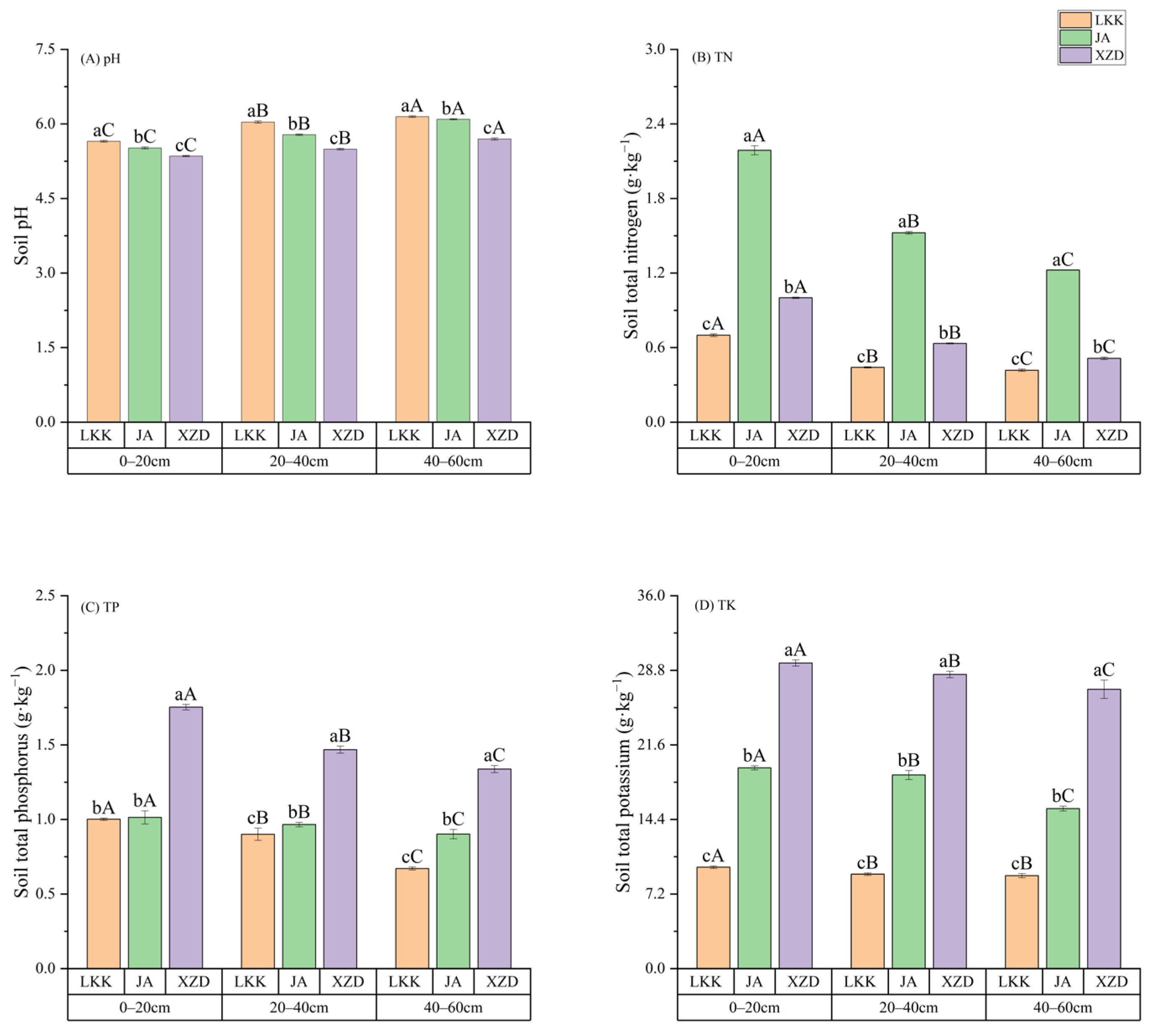
Soil pH, TN, TP, and TK content were significantly influenced by elevation (Two-way ANOVA, Table S1; all p < 0.0001). Within the same soil profile, soil pH decreased with increasing elevation (p < 0.001), while at the same elevation, it increased with greater soil depth (p < 0.001, Figure 2A). Soil TN content first increased and then decreased with increasing elevation, reaching its maximum at JA, which was significantly higher than at LKK and XZD (p < 0.001, Table S1, Figure 2B). TP and TK contents gradually increased with elevation, with XZD exhibiting significantly higher TP and TK contents than LKK and JA (p < 0.001, Table S1, Figure 2C,D). Both TP and TK contents decreased significantly with increasing soil depth (p < 0.001).

3.1.2. Soil Available Nutrients

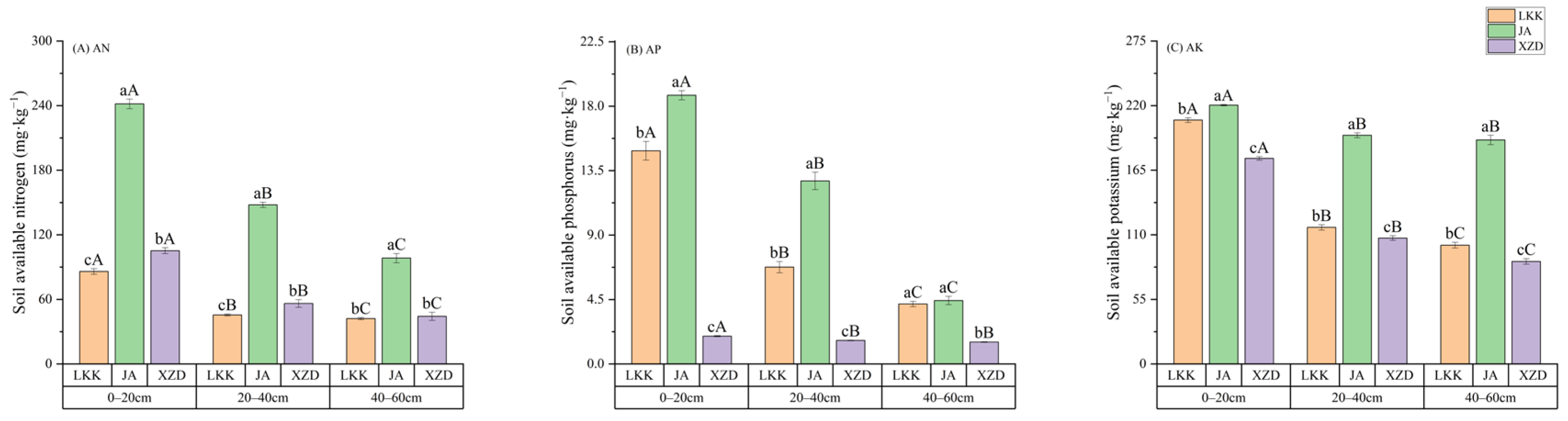
Soil AN, AP, and AK contents all showed an initial increase followed by a decrease with increasing elevation (Two-way ANOVA, p < 0.0001, Table S1). JA was significantly higher than LKK and XZD in all soil layers at the JA elevation, and all three showed a significant decreasing trend with increasing soil depth (p < 0.001, Table S1, Figure 3A–C). Notably, the interaction of altitude and soil depth (A × D) had a significant effect on AN (A × D, p = 0.0264) and AK (A × D, p = 0.0395), with the most pronounced difference between JA and XZD in the 20–40 cm layer for AK (p = 0.001, Table S1).

3.2. Soil Organic Carbon Components

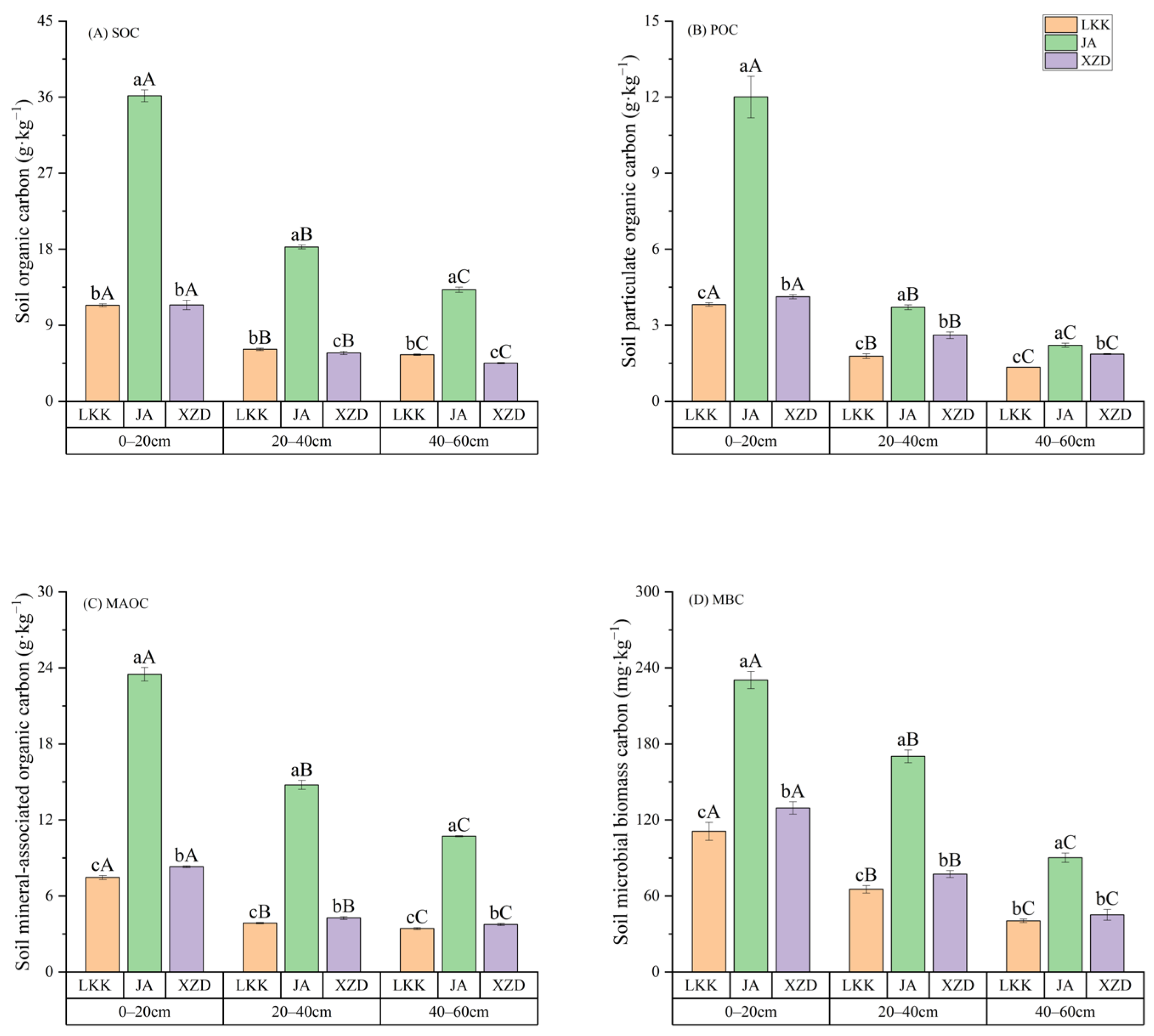
SOC content showed an initial increase followed by a decrease with increasing elevation (Two-way ANOVA, p < 0.0001, Table S2), reaching its maximum at JA, which was significantly higher than at LKK and XZD. It decreased significantly with increasing soil depth (p < 0.001, Table S2, Figure 4A). The trends in POC, MAOC, and MBC content were consistent with SOC (Two-way ANOVA, p < 0.0001, Table S2), all significantly influenced by elevation. With increasing elevation, POC, MAOC, and MBC content first increased and then decreased, reaching their highest values at JA and being significantly higher than at LKK and XZD. At the same elevation, the content of all three significantly decreased with increasing soil depth, exhibiting a distinct surface enrichment pattern (p < 0.001, Table S2, Figure 4B–D). The interaction of altitude and soil depth had a significant effect on SOC (A × D, p = 0.0218) and MBC (A × D, p = 0.0156), with the most significant difference between JA and XZD in the 0–20 cm layer for MBC (p < 0.001, Table S2).

3.3. Soil Biological Properties

3.3.1. Soil Enzyme Activity

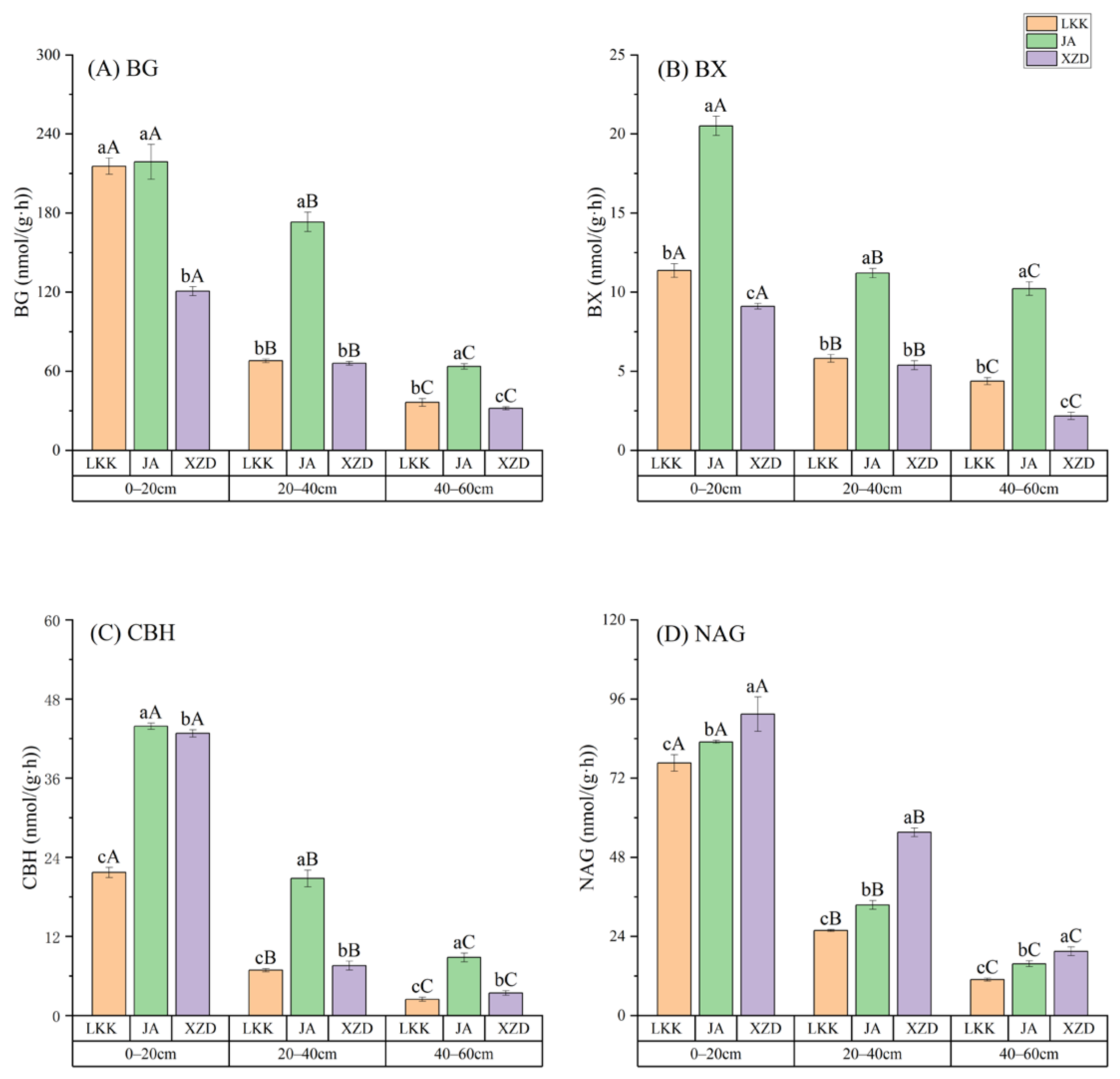
The activities of four soil enzymes (BG, BX, CBH, NAG) exhibited significant differences across different elevations (Two-way ANOVA, p < 0.0001, Table S3). Significant differences in BG enzyme activity were observed between different elevations. In the 0–20 cm soil layer, LKK and JA showed no significant difference (p > 0.05) but were both significantly higher than XZD (p < 0.001). In the 20–60 cm layer, JA was significantly higher than LKK and XZD, and BG enzyme activity decreased significantly with increasing soil depth (p < 0.001, Table S3, Figure 5A). JA’s BX enzyme activity was significantly higher than LKK and XZD and decreased significantly with increasing soil depth (p < 0.001, Table S3, Figure 5B). For CBH enzyme activity, no significant difference existed between JA and XZD in the 0–20 cm soil layer (p > 0.05), though both were significantly higher than LKK (p < 0.001). In both the 20–40 cm and 40–60 cm soil layers, JA was significantly higher than XZD and LKK. Enzyme activity decreased significantly with increasing soil depth at all elevations (p < 0.001, Table S3, Figure 5C). However, NAG enzyme activity in XZD was significantly higher than in JA and LKK, and decreased significantly with increasing soil depth (p < 0.001, Table S3, Figure 5D). Overall, elevation significantly influenced the activity of all four soil enzymes (Two-way ANOVA, F > 89, p < 0.0001, Table S3). JA exhibited higher enzyme activity at higher elevations in most cases, while enzyme activity generally decreased with increasing soil depth.

3.3.2. Soil Microbial Biomass

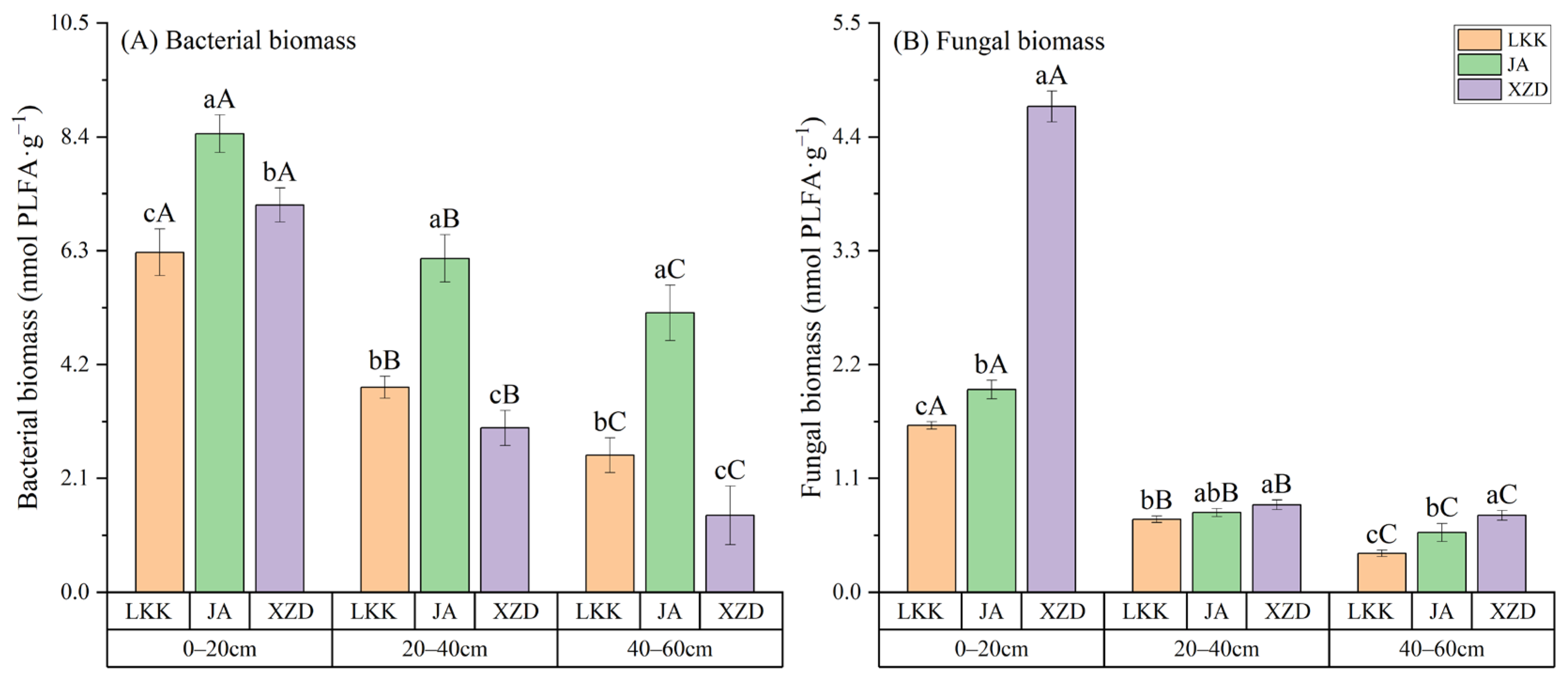
Significant differences in bacterial and fungal biomass were observed across different elevations (Two-way ANOVA, p < 0.0001, Table S4). Bacterial biomass peaked at the highest elevation (JA) and was significantly higher than at LKK and XZD across all soil layers (p < 0.001, Table S4, Figure 6A). Fungal biomass peaked at the highest elevation (XZD) and was generally significantly higher than at other elevations (p < 0.001, Table S4, Figure 6B). Both biomass types showed a significant decreasing trend with increasing soil depth (p < 0.001), with bacterial biomass at JA and fungal biomass at XZD being highest in the topsoil layer. The interaction of altitude and soil depth had a significant effect on bacterial biomass (A × D, p = 0.0189), with the most significant difference between JA and LKK in the 0–20 cm layer (p < 0.001, Table S4).

3.4. The Influence Mechanism Based on PLS-PM

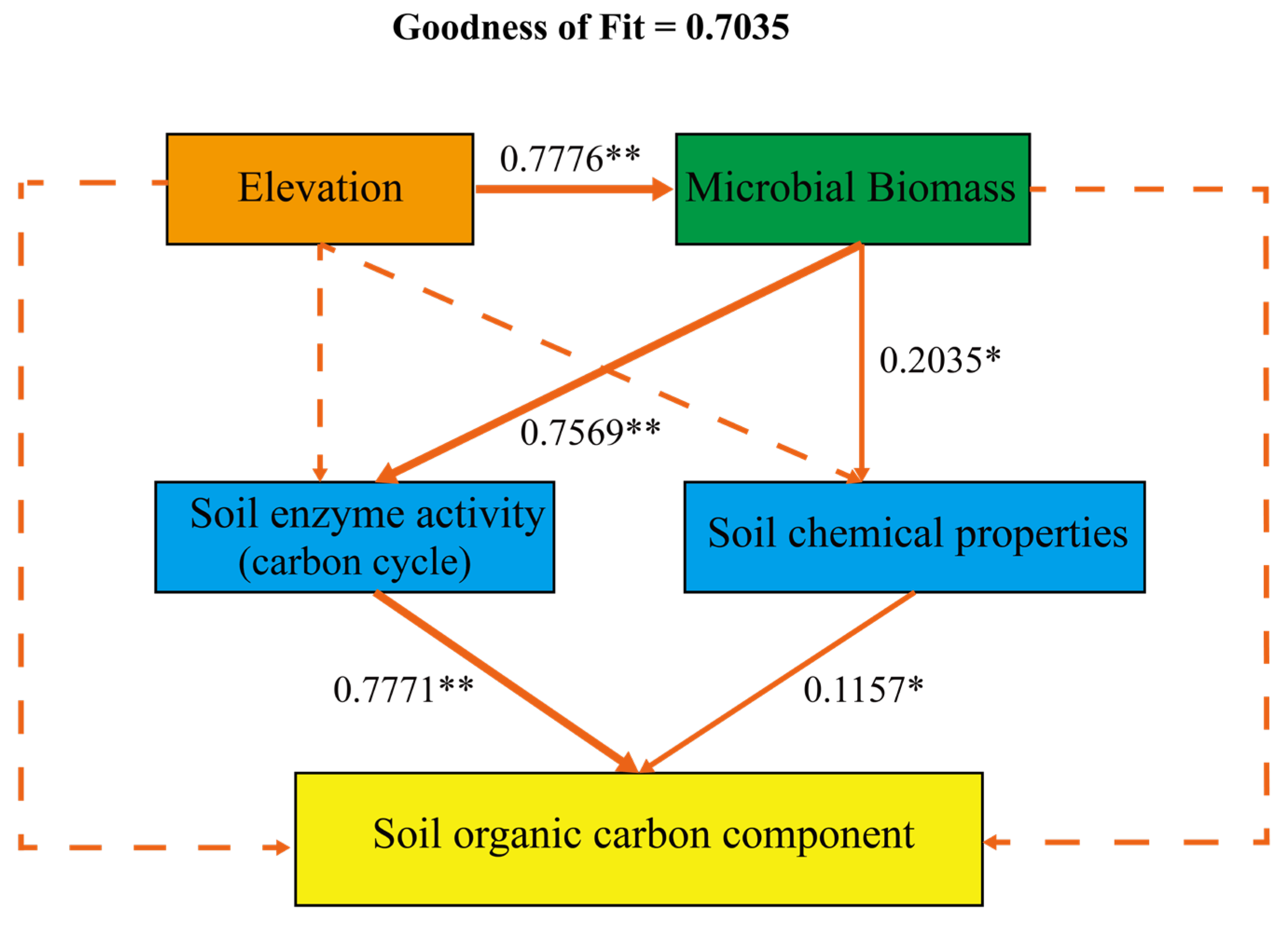
In this study, the goodness-of-fit value for PLS-PM was 0.7035, indicating that the model adequately explained the influencing pathways of soil organic carbon components (Figure 7). Path analysis revealed that elevation exerted a highly significant positive driving effect on microbial biomass (β = 0.7776, p < 0.01); this finding was supported by Two-way ANOVA results that altitude was the primary driver of microbial biomass variation (bacterial biomass: F = 116.89, p < 0.0001; fungal biomass: F = 103.56, p < 0.0001, Table S4). Microbial biomass exerted a statistically significant positive effect on soil chemical properties (β = 0.2035, p < 0.05) and a highly significant positive influence on soil enzyme activity involved in carbon cycling (β = 0.7569, p < 0.01). Soil enzyme activity involved in carbon cycling exerted a highly significant positive regulation on soil organic carbon components (β = 0.7771, p < 0.01), while soil chemical properties also exerted a statistically significant but weakly positive effect on soil organic carbon components (β = 0.1157, p < 0.05), the weak effect of soil chemical properties was consistent with the relatively small F-values for the effect of soil chemical properties on SOC components compared to enzyme activity (Tables S1 and S2). Additionally, elevation indirectly influences soil organic carbon components by affecting microbial biomass and soil enzyme activity.
Notably, the path coefficients for the effects of microbial biomass on soil chemical properties and of soil chemical properties on soil organic carbon components are relatively low, indicating that these pathways have limited explanatory power compared to the dominant pathways (e.g., elevation → microbial biomass → enzyme activity → organic carbon components). Therefore, elevation regulates soil organic carbon composition primarily through microbial biomass and carbon cycle enzyme activity, with soil chemical properties playing a secondary and supplementary role in this regulatory network.

4. Discussion

In this study, the altitudinal gradient is characterized by a sharp decrease in temperature but an unusually consistent precipitation regime. This setting allows us to focus on the thermal and associated biological controls on soil processes.

4.1. Effects of Altitude Gradient on Soil Chemical Properties

This study found that the chemical properties of Yunnan pine forest soils exhibit significant differentiation along an elevation gradient (Two-way ANOVA, all p < 0.0001, Table S1), a result consistent with the general patterns observed in global forest soil ecology research. In this study, soil pH decreased with increasing elevation (p < 0.001, Table S1), a finding consistent with conclusions from numerous mountain forest ecosystem studies [22,23]. The primary reason may lie in the following: On the one hand, high-altitude regions typically experience higher precipitation and lower temperatures, which intensify soil leaching and result in the loss of base cations. This process causes the soil to become increasingly acidic [24]. On the other hand, lower temperatures inhibit microbial decomposition activity, promoting the accumulation of organic acids and further lowering soil pH [25]. This acidification trend has significantly impacted the availability of soil nutrients and the survival environment of microorganisms.
SOC and TN content peaked in the JA treatment (p < 0.001, Tables S1 and S2); Two-way ANOVA confirmed that altitude was the dominant driver of this variation (TN: F = 108.45, p < 0.0001; SOC: F = 129.67, p < 0.0001, Tables S1 and S2), which supports the research hypothesis that mid-elevation zones may form nutrient and carbon accumulation hotspots. While this pattern aligns with the common “mid-elevation peak” hypothesis observed in some mountain ecosystems, it is crucial to note that our study includes only one site at this elevation. Therefore, we cannot definitively conclude that 2377 m represents an optimal elevation for SOC accumulation across the region. The observed peak at JA in our specific transect likely stems from a combination of factors that may represent an optimal hydrothermal balance for organic matter dynamic at this location. Compared to LKK, its lower temperature effectively suppressed rapid SOC decomposition; whereas relative to XZD, its suitable temperature maintained sufficiently high primary productivity (e.g., litter input) and microbial activity, thereby enabling organic matter accumulation [26,27]. This finding aligns with studies conducted on the Qinghai–Tibet Plateau [28] and in subtropical forests [29], indicating that mid-elevation zones are crucial regions certain mid-elevation zones can be crucial regions for soil organic carbon accumulation. The unique combination of factors at JA has created a particularly favorable nutrient and carbon hotspot, as validated by the significant differences in SOC and TN between JA and other sites (p < 0.001, Tables S1 and S2). Future studies incorporating replicate sites at similar elevations are needed to distinguish between a general elevational pattern and site-specific effects. TP and TK content increases continuously with altitude (Two-way ANOVA, F > 89, p < 0.0001; Fisher’s LSD, p < 0.001, Table S1), this is likely due to the shallower soil development and lower weathering of primary minerals in high-altitude areas, leading to greater retention of phosphorus and potassium in the soil [30].
Additionally, nutrients such as AN, AP, and AK reached their highest concentrations at the JA elevation (p < 0.001, Table S1), with Two-way ANOVA confirming altitude’s significant control (F > 95, p < 0.0001). This supports the hypothesis that mid-elevation zones are active hubs for nutrient cycling, as JA’s favorable hydrothermal conditions (supported by its moderate temperature and high enzyme activity via Fisher’s LSD, p < 0.001, Table S3) stimulate microbially driven nutrient mineralization, converting inert nutrients to available forms [31].

4.2. Response of Soil Organic Carbon Components to Elevation Changes

Soil organic carbon components (POC, MAOC, MBC), serving as core indicators reflecting carbon pool stability and transformation efficiency, exhibit a “first increase, then decrease” trend along the elevation gradient (Two-way ANOVA, F > 105, p < 0.0001; Fisher’s LSD, p < 0.001, Table S2), which supports the research hypothesis that elevation regulates the entire organic carbon cycle process through environmental and biological factors. This pattern results from the combined effects of environmental and biological factors at different elevations.
In this study, the total organic carbon was further decomposed into three functional components: POC, MAOC and MBC, and the influence of altitude on the stability of carbon pool was revealed in detail. The results indicate that the trends in POC, MAOC, and MBC generally align with those of SOC, all reaching their maximum values at JA (p < 0.001, Table S2), suggesting that altitude systematically influences the entire organic carbon cycle process by regulating environmental factors. POC mainly comes from incomplete decomposed plant residues, and its content reflects the balance between recent litter input and physical crushing. The favorable hydrothermal conditions at Site JA (2377 m) promote vegetation growth and litter input, while the moderate microbial activity (supported by high bacterial biomass via Fisher’s LSD, p < 0.001, Table S4) fails to fully decompose it, leading to significant accumulation of POC [32,33]. MBC, serving as an indicator and conversion hub for the activated carbon pool, exhibits its highest concentration at JA (2377 m). This correlates with the region’s highest bacterial biomass and carbon cycle enzyme activity (Two-way ANOVA, F > 98, p < 0.0001, Tables S3 and S4), indicating strong microbial assimilation and rapid carbon turnover rates at this elevation, which verifies the hypothesis that microbial biomass mediates carbon transformation. More importantly, as the main body of long-term stable carbon pool, MAOC has the highest content in JA (p < 0.001, Table S2). The traditional view is that MAOC is mainly controlled by the physical protection of clay mineral content and changes slowly [34]. However, the results of this study indicate that its formation along the elevation gradient may depend more on the input of microbial-derived carbon, consistent with previous research findings [16]. The reason may be that, on the one hand, active microbial activities in JA produce a large number of small molecular organic substances through decomposition, and on the other hand, their own residues (such as MBC) also provide precursors for the formation of MAOC, and promote the formation of organic–inorganic complexes by secreting viscous substances [35,36]. Therefore, the JA region in our study simultaneously exhibits high carbon inputs and strong carbon stabilization capacity, reflecting its pivotal role in soil carbon sequestration functions suggesting its potential role as a significant carbon sink within this landscape, as validated by the significant difference in MAOC between JA and other sites (p < 0.001, Table S2). This makes it a critical area for conservation and a valuable case study for understanding the mechanisms that can lead to high soil carbon storage at mid-elevations.
Notably, the soil temperature ranges (JA: 3.6–5.6 °C; XZD: 3–5 °C) and annual precipitation (JA: 850 mm; XZD: 849.8 mm) between JA and XZD are highly similar, yet SOC, microbial biomass, and enzyme activity differ drastically between the two sites. Temperature and precipitation alone cannot fully explain these variations, as the observed differences are also linked to altitude-associated edaphic and biological factors (e.g., soil development stage, microbial community composition) that covary with elevation. Future research should quantify soil texture, litter decomposition rates, and microclimatic parameters to disentangle the relative contributions of these factors to soil property differentiation.

4.3. Altitudinal Gradient of Soil Enzyme Activity and Microbial Communities

Soil enzymes directly reflect microbial metabolic activity and serve as biological catalysts for nutrient cycling. In this study, the activities of enzymes involved in carbon cycling (BG, BX, CBH) generally showed an initial increase followed by a decrease with increasing elevation, reaching their highest values at JA (Two-way ANOVA, F > 92, p < 0.0001; Fisher’s LSD, p < 0.001, Table S3), which supports the hypothesis that hydrothermal conditions mediate enzyme-driven carbon cycling. This may be attributed to the favorable hydrotemperate conditions in the JA (2377 m) region, where abundant vegetation litter (such as pine needles) and high organic matter accumulation (p < 0.001, Table S2) provide ample substrates for enzymes. Combined with moderate microbial activity, this environment supports high enzyme synthesis efficiency. However, at high altitudes (>3000 m), low temperatures inhibit microbial metabolism, reducing enzyme synthesis (evidenced by significantly lower enzyme activity at XZD via Fisher’s LSD, p < 0.001, Table S3). Although litter decomposition slows (resulting in more substrate retention), insufficient microbial activity leads to decreased enzyme activity [37]. The change of carbon cycle enzyme activity coincides with the change in SOC and MBC content (Two-way ANOVA, F > 105, p < 0.0001, Tables S2 and S3), forming a positive feedback cycle: rich substrates (such as SOC) stimulate microbial enzyme activity, while high enzyme activity accelerates the decomposition of organic matter, releasing energy and small molecular substances for microbial utilization, thus maintaining high microbial biomass and high carbon cycle efficiency [38,39].
NAG primarily participates in the degradation of chitin (the main component of fungal cell walls). In this study, its activity peaked at XZD (Two-way ANOVA, F = 89.64, p < 0.0001; Fisher’s LSD, p < 0.001, Table S3), a pattern slightly different from other carbon cycle enzymes. We hypothesize that this may be related to the unique microbial community structure found in high-altitude regions (>3000 m). The low-temperature, high-humidity environment commonly associated with high elevations is more conducive to fungal community development [40], a finding also confirmed by the fungal community structure results in this study (Fisher’s LSD, p < 0.001 for fungal biomass at XZD, Table S4). The fungal cell wall is rich in chitin, and the increase in its biomass further expands the substrate pool available for enzymatic action, thereby indirectly promoting and sustaining high NAG activity [41].
Microbial community structure exhibits significant bacterial and fungal differentiation along the elevation gradient (Two-way ANOVA, F > 103, p < 0.0001, Table S4), which validates the core hypothesis that elevation drives directional succession of soil microbial communities and functions. Bacterial biomass peaked at JA, consistent with this area’s higher soil pH, available nutrient content, and enzyme activity levels (Fisher’s LSD, p < 0.001 for all indices, Tables S1, S3 and S4), indicating bacteria’s greater adaptation to favorable, resource-rich environments. In contrast, fungal biomass increased markedly at XZD, reflecting its stronger resilience to adverse conditions. At lower elevations, higher temperatures accelerate organic matter decomposition, limiting bacterial carbon acquisition; At mid-elevations, favorable hydrotemperate conditions enable moderate decomposition rates of Yunnan pine litter, sufficient organic matter accumulation, and good soil aeration, promoting the growth and reproduction of aerobic bacteria (supported by high bacterial biomass at JA via Fisher’s LSD, p < 0.001, Table S4). However, above 3000 m, the cold environment significantly suppresses bacterial metabolic activity and enzyme synthesis. Although organic matter decomposes slowly and available carbon sources are relatively abundant, bacterial biomass still shows a slight decline [42,43]. Fungi, however, maintain metabolic activity under high-altitude, low-temperature conditions due to the enhanced cold tolerance provided by their chitinous cell walls, further enhancing their reproductive and competitive capabilities [44,45]. This succession of community structure along an elevation gradient, shifting from bacterial dominance to fungal dominance, represents not only a microbial response to environmental factor changes but also serves as a crucial microbiological indicator of ecosystem functional evolution along the elevation gradient, as confirmed by the significant differences in microbial biomass between sites (Fisher’s LSD, p < 0.001, Table S4).

5. Conclusions

Soil properties in Pinus yunnanensis stands differed significantly among the three studied locations along a 1600 m elevation gradient. Altitude variation significantly influences soil properties in Pinus yunnanensis stands. The mid-elevation JA site (2377 m) exhibited nutrient enrichment, strong organic carbon accumulation capacity, and active biological processes, resulting in superior soil quality compared to the lower and higher sites. These differences are primarily associated with the pronounced altitudinal and particularly thermal gradients, given the minimal variation in precipitation across sites. However, it is important to note that soil temperature ranges are highly similar between JA and XZD, indicating that elevation-induced thermal differences alone cannot fully explain the drastic differences in SOC, microbial biomass, and enzyme activity. Other unmeasured environmental factors—such as soil parent material, vegetation structure and litter quality, solar radiation, and soil moisture dynamics—may play critical mediating roles and require further investigation.
PLS-PM analysis further elucidates a mechanism: altitude (largely via its strong covariation with temperature) primarily influences organic carbon components indirectly by regulating microbial biomass and enzyme activity, confirming that microbial mediation is a key pathway through which altitude gradients regulate soil carbon cycling in these mountain forests. However, the unique attributes of the JA site highlight that local factors (e.g., microclimate, stand structure, soil parent material) may interact with the elevational gradient to shape specific soil outcomes. Future studies should incorporate measurements of soil texture, litter quality, and detailed microclimatic parameters to better disentangle the relative contributions of elevation and local environmental factors to soil carbon dynamics in mountain pine forests.

Supplementary Materials

The following supporting information can be downloaded at: https://www.mdpi.com/article/10.3390/agronomy16010004/s1, Table S1: Two-way ANOVA and LSD post-hoc test results for soil chemical properties; Table S2: Two-way ANOVA and LSD post-hoc test results for soil organic carbon components; Table S3: Two-way ANOVA and LSD post-hoc test results for soil enzyme activities; Table S4: Two-way ANOVA and LSD post-hoc test results for soil microbial biomass.

Author Contributions

Conceptualization, B.W., H.L., X.L. (Xiaoyi Li), X.L. (Xinran Liang), L.W., F.Z. and Y.H.; Methodology, H.L., X.L. (Xiaoyi Li), X.L. (Xinran Liang), L.W., F.Z. and Y.H.; Software, X.L. (Xiaoyi Li); Investigation, H.L., X.L. (Xiaoyi Li), X.L. (Xinran Liang) and L.W.; Resources, Z.S. and S.H.; Data curation, B.W.; Writing—original draft, B.W.; Writing—review & editing, B.W. and S.H.; Supervision, F.Z., Y.H., Z.S. and S.H.; Project administration, Z.S. and S.H.; Funding acquisition, Z.S. and S.H. All authors have read and agreed to the published version of the manuscript.

Funding

This study was supported by the Youth Project of Yunnan Provincial Basic Research Program (No. 202401AU070080), Yunnan Fundamental Research Projects (Grant No. 202301AU070113) and the Major Science and Technology Project of Yunnan Province (Grant No. 202202AE090034).

Data Availability Statement

All data and materials generated or analyzed during this study have been included in this article.

Acknowledgments

The authors would like to thank all the reviewers who participated in the review.

Conflicts of Interest

There is no conflict of interest in this article.

References

  1. Keenan, R.J.; Reams, G.A.; Achard, F.; de Freitas, J.V.; Grainger, A.; Lindquist, E. Dynamics of global forest area: Results from the FAO Global Forest Resources Assessment 2015. For. Ecol. Manag. 2015, 352, 9–20. [Google Scholar] [CrossRef]
  2. Cook-Patton, S.C.; Leavitt, S.M.; Gibbs, D.; Harris, N.L.; Lister, K.; Anderson-Teixeira, K.J.; Briggs, R.D.; Chazdon, R.L.; Crowther, T.W.; Ellis, P.W.; et al. Mapping carbon accumulation potential from global natural forest regrowth. Nature 2020, 585, 545–550. [Google Scholar] [CrossRef] [PubMed]
  3. Nesha, K.; Herold, M.; De Sy, V.; Duchelle, A.E.; Martius, C.; Branthomme, A.; Garzuglia, M.; Jonsson, O.; Pekkarinen, A. An assessment of data sources, data quality and changes in national forest monitoring capacities in the Global Forest Resources Assessment 2005–2020. Environ. Res. Lett. 2021, 16, 054029. [Google Scholar] [CrossRef]
  4. Menyailo, O.V. Forest Soil Carbon and Climate Changes. Forests 2022, 13, 398. [Google Scholar] [CrossRef]
  5. Xu, Z.; Yu, G.; Zhang, X.; He, N.; Wang, Q.; Wang, S.; Wang, R.; Zhao, N.; Jia, Y.; Wang, C. Soil enzyme activity and stoichiometry in forest ecosystems along the North-South Transect in eastern China (NSTEC). Soil Biol. Biochem. 2017, 104, 152–163. [Google Scholar] [CrossRef]
  6. Qiu, L.; Zhang, Q.; Zhu, H.; Reich, P.B.; Wei, X. Erosion reduces soil microbial diversity, network complexity and multifunctionality. ISME J. 2021, 15, 2474–2489. [Google Scholar] [CrossRef]
  7. Chen, D.; Pan, Q.; Bai, Y.; Hu, S.; Huang, J.; Wang, Q.; Naeem, S.; Elser, J.J.; Wu, J.; Han, X.J. Effects of plant functional group loss on soil biota and net ecosystem exchange: A plant removal experiment in the Mongolian grassland. J. Ecol. 2016, 104, 734–743. [Google Scholar] [CrossRef]
  8. O’Rourke, S.M.; Angers, D.A.; Holden, N.M.; McBratney, A.B. Soil organic carbon across scales. Glob. Change Biol. 2015, 21, 3561–3574. [Google Scholar] [CrossRef]
  9. Hoffland, E.; Kuyper, T.W.; Comans, R.N.J.; Creamer, R.E. Eco-functionality of organic matter in soils. Plant Soil 2020, 455, 1–22. [Google Scholar] [CrossRef]
  10. Rudrappa, L.; Purakayastha, T.J.; Singh, D.; Bhadraray, S. Long-term manuring and fertilization effects on soil organic carbon pools in a Typic Haplustept of semi-arid sub-tropical India. Soil Tillage Res. 2006, 88, 180–192. [Google Scholar] [CrossRef]
  11. Zeng, M.D.H. Changes in Soil Particulate Organic Matter, Microbial Biomass, and Activity Following Afforestation of Marginal Agricultural Lands in a Semi-Arid Area of Northeast China. Environ. Manag. 2010, 46, 110–116. [Google Scholar] [CrossRef] [PubMed]
  12. Hu, J.; Chen, H.; Yue, L.; Liu, S.; Wu, L.; Wang, B.; Chen, D. Elevational gradient regulates the effects of short-term nutrient deposition on soil microorganisms and SOM decomposition in subtropical forests. Plant Soil 2023, 489, 225–238. [Google Scholar] [CrossRef]
  13. Wu, M.; Chen, L.; Ma, J.; Zhang, Y.; Li, X.; Pang, D. Aggregate-associated carbon contributes to soil organic carbon accumulation along the elevation gradient of Helan Mountains. Soil Biol. Biochem. 2023, 178, 108926. [Google Scholar] [CrossRef]
  14. Thomas, G.W. Soil pH and soil acidity. In Methods of Soil Analysis; John Wiley & Sons, Ltd.: Hoboken, NJ, USA, 2018. [Google Scholar]
  15. Walkley, A.J.; Black, I.A. An Examination of the Degtjareff Method for Determining Soil Organic Matter, and a Proposed Modification of the Chromic Acid Titration Method. Soil Sci. 1934, 37, 29–38. [Google Scholar] [CrossRef]
  16. Cotrufo, M.F.; Ranalli, M.G.; Haddix, M.L.; Six, J.; Lugato, E. Soil carbon storage informed by particulate and mineral-associated organic matter. Nat. Geosci. 2019, 12, 989–994. [Google Scholar] [CrossRef]
  17. Sparks, D.L.; Page, A.L.; Helmke, P.A.; Loeppert, R.H.; Bremner, J.M. Nitrogen-Total. In Methods of Soil Analysis; John Wiley & Sons, Ltd.: Hoboken, NJ, USA, 1996. [Google Scholar]
  18. Bao, S. Analysis on Soil and Agricultural Chemistry; China Agricultural Press: Beijing, China, 2000. [Google Scholar]
  19. Reed, S.; Martens, D. Methods of Soil Analysis Part 3—Chemical Methods; Soil Science Society of America: Madison, WI, USA, 1996. [Google Scholar]
  20. Brookes, P.C.; Landman, A.; Pruden, G.; Jenkinson, D.S. Chloroform fumigation and the release of soil nitrogen: A rapid direct extraction method to measure microbial biomass nitrogen in soil. Soil Biol. Biochem. 1985, 17, 837–842. [Google Scholar] [CrossRef]
  21. Frostegård, A.; Bååth, E. The use of phospholipid fatty acid analysis to estimate bacterial and fungal biomass in soil. Biol. Fertil. Soils 1996, 22, 59–65. [Google Scholar] [CrossRef]
  22. Bojko, O.; Kabala, C. Transformation of physicochemical soil properties along a mountain slope due to land management and climate changes—A case study from the Karkonosze Mountains, SW Poland. CATENA 2016, 140, 43–54. [Google Scholar] [CrossRef]
  23. Looby, C.I.; Maltz, M.R.; Treseder, K.K. Belowground responses to elevation in a changing cloud forest. Ecol. Evol. 2016, 6, 1996–2009. [Google Scholar] [CrossRef]
  24. Slessarev, E.W.; Lin, Y.; Bingham, N.L.; Johnson, J.E.; Dai, Y.; Schimel, J.P.; Chadwick, O.A. Water balance creates a threshold in soil pH at the global scale. Nature 2016, 540, 567–569. [Google Scholar] [CrossRef]
  25. Laurent, T.; Lee, B.D.; McDaniel, P.A.; Graham, R.C. Spodosol-Inceptisol Transition Along an Elevation Gradient in the Klamath Mountains, Northern California. Soil Sci. 2018, 183, 43–50. [Google Scholar] [CrossRef]
  26. Davidson, E.A.; Janssens, I.A. Temperature sensitivity of soil carbon decomposition and feedbacks to climate change. Nature 2006, 440, 165–173. [Google Scholar] [CrossRef] [PubMed]
  27. Li, Q.; Cheng, X.; Luo, Y.; Xu, Z.; Xu, L.; Ruan, H.; Xu, X. Consistent temperature sensitivity of labile soil organic carbon mineralization along an elevation gradient in the Wuyi Mountains, China. Appl. Soil Ecol. 2017, 117–118, 32–37. [Google Scholar] [CrossRef]
  28. Nie, X.; Wang, D.; Ren, L.; Du, Y.; Zhou, G. Storage and controlling factors of soil organic carbon in alpine wetlands and meadow across the Tibetan Plateau. Eur. J. Soil Sci. 2023, 74, e13383. [Google Scholar] [CrossRef]
  29. Yu, F.; Zhang, Z.; Chen, L.; Wang, J.; Shen, Z. Spatial distribution characteristics of soil organic carbon in subtropical forests of mountain Lushan, China. Environ. Monit. Assess. 2018, 190, 545. [Google Scholar] [CrossRef]
  30. Nimalka Sanjeewani, H.K.; Samarasinghe, D.P.; De Costa, W.A.J.M. Influence of elevation and the associated variation of climate and vegetation on selected soil properties of tropical rainforests across a wide elevational gradient. CATENA 2024, 237, 107823. [Google Scholar] [CrossRef]
  31. Wang, L.; Li, Z.; Gao, C.; Li, J.; Cui, K. The altitude shapes the heterogeneity of tree growth by modulating the soil characteristics and microorganisms in the Calocedrus macrolepis plantation. For. Ecol. Manag. 2025, 578, 122459. [Google Scholar] [CrossRef]
  32. Lugato, E.; Lavallee, J.M.; Haddix, M.L.; Panagos, P.; Cotrufo, M.F. Different climate sensitivity of particulate and mineral-associated soil organic matter. Nat. Geosci. 2021, 14, 295–300. [Google Scholar] [CrossRef]
  33. Cotrufo, M.F.; Wallenstein, M.D.; Boot, C.M.; Denef, K.; Paul, E. The Microbial Efficiency-Matrix Stabilization (MEMS) framework integrates plant litter decomposition with soil organic matter stabilization: Do labile plant inputs form stable soil organic matter? Glob. Change Biol. 2013, 19, 988–995. [Google Scholar] [CrossRef]
  34. Sollins, P.; Homann, P.; Caldwell, B.A. Stabilization and destabilization of soil organic matter: Mechanisms and controls. Geoderma 1996, 74, 65–105. [Google Scholar] [CrossRef]
  35. Liang, C.; Schimel, J.P.; Jastrow, J.D. The importance of anabolism in microbial control over soil carbon storage. Nat. Microbiol. 2017, 2, 17105. [Google Scholar] [CrossRef] [PubMed]
  36. Kallenbach, C.M.; Frey, S.D.; Grandy, A.S. Direct evidence for microbial-derived soil organic matter formation and its ecophysiological controls. Nat. Commun. 2016, 7, 13630. [Google Scholar] [CrossRef] [PubMed]
  37. Sinsabaugh, R.L.; Lauber, C.L.; Weintraub, M.N.; Ahmed, B.; Allison, S.D.; Crenshaw, C.; Contosta, A.R.; Cusack, D.; Frey, S.; Gallo, M.E.; et al. Stoichiometry of soil enzyme activity at global scale. Ecol. Lett. 2008, 11, 1252–1264. [Google Scholar] [CrossRef] [PubMed]
  38. Schimel, J.P.; Schaeffer, S.M. Microbial control over carbon cycling in soil. Front. Microbiol. 2012, 3, 348. [Google Scholar] [CrossRef]
  39. Wieder, W.R.; Grandy, A.S.; Kallenbach, C.M.; Bonan, G.B. Integrating microbial physiology and physio-chemical principles in soils with the MIcrobial-MIneral Carbon Stabilization (MIMICS) model. Biogeosciences 2014, 11, 3899–3917. [Google Scholar] [CrossRef]
  40. Hussain, S.; Liu, H.; Liu, S.; Yin, Y.; Yuan, Z.; Zhao, Y.; Cao, H. Distribution and assembly processes of soil fungal communities along an altitudinal gradient in Tibetan Plateau. J. Fungi 2021, 7, 1082. [Google Scholar] [CrossRef]
  41. Min, K.; Suseela, V. Plant invasion alters the Michaelis–Menten kinetics of microbial extracellular enzymes and soil organic matter chemistry along soil depth. Biogeochemistry 2020, 150, 181–196. [Google Scholar] [CrossRef]
  42. Tian, Q.; Jiang, Q.; Huang, L.; Li, D.; Lin, Q.; Tang, Z.; Liu, F. Vertical distribution of soil bacterial communities in different forest types along an elevation gradient. Microb. Ecol. 2023, 85, 628–641. [Google Scholar] [CrossRef]
  43. Chen, Z.; Xu, Y.; Wang, X.; Ma, T.; Liu, Y.; Qin, X.; Zhang, W.; Chen, T.; Liu, G.; Zhang, B. Altitudinal patterns of bacterial communities across soil layers in the alpine meadows of the Qinghai-Tibet Plateau. Ecol. Indic. 2025, 171, 113185. [Google Scholar] [CrossRef]
  44. Yao, B.; Mou, X.; Li, Y.; Lian, J.; Niu, Y.; Liu, J.; Lu, J.; Li, Y.; Li, Y.; Wang, X. Distinct Assembly Patterns of Soil Bacterial and Fungal Communities along Altitudinal Gradients in the Loess Plateau’s Highest Mountain. Microb. Ecol. 2025, 88, 29. [Google Scholar] [CrossRef]
  45. Fenice, M. The Psychrotolerant Antarctic Fungus Lecanicillium muscarium CCFEE 5003: A Powerful Producer of Cold-Tolerant Chitinolytic Enzymes. Molecules 2016, 21, 447. [Google Scholar] [CrossRef]
Figure 1. Location and sampling points of study area.
Agronomy 16 00004 g001
Figure 2. Effects of altitude on soil pH (A), TN (B), TP (C), TK (D). Different lowercase letters indicate that there are significant differences between different altitudes in the same soil layer. Different capital letters indicate that there are significant differences between different soil layers at the same altitude, p ≤ 0.05.
Agronomy 16 00004 g002
Figure 3. Effects of altitude on soil AN (A), AP (B), AK (C). Different lowercase letters indicate that there are significant differences between different altitudes in the same soil layer. Different capital letters indicate that there are significant differences between different soil layers at the same altitude, p ≤ 0.05.
Agronomy 16 00004 g003
Figure 4. Effects of altitude on SOC (A), POC (B), MAOC (C), MBC (D). Different lowercase letters indicate that there are significant differences between different altitudes in the same soil layer. Different capital letters indicate that there are significant differences between different soil layers at the same altitude, p ≤ 0.05.
Agronomy 16 00004 g004
Figure 5. Effects of altitude on soil enzyme activities, (A) BG; (B) BX; (C) CBH; (D) NAG. Different lowercase letters indicate that there are significant differences between different altitudes in the same soil layer. Different capital letters indicate that there are significant differences between different soil layers at the same altitude, p ≤ 0.05.
Agronomy 16 00004 g005
Figure 6. Effects of altitude on soil bacterial biomass (A) and fungal biomass (B). Different lowercase letters indicate that there are significant differences between different altitudes in the same soil layer. Different capital letters indicate that there are significant differences between different soil layers at the same altitude, p ≤ 0.05.
Agronomy 16 00004 g006
Figure 7. Path map of soil organic carbon accumulation mechanism based on PLS-PM. (*, p < 0.05; **, p < 0.01).
Agronomy 16 00004 g007
Table 1. Determination methods of soil chemical properties.
IndexSpecific Protocol
pHPotentiometric method with soil-to-water ratio of 1:2.5 (w/v); calibrated with standard buffer solutions (pH 4.01, 6.86, 9.18) before measurement.
SOC, POC, MAOCModified Walkley–Black potassium dichromate external heating method (heating at 170–180 °C for 5 min, with H2SO4 as catalyst and FeSO4 as titrant); POC was isolated via physical fractionation (53 μm sieve) prior to determination, MAOC was the residual fraction after POC extraction. Heating Method
TNSemi-micro Kjeldahl method: soil samples were digested with concentrated H2SO4 + CuSO4-K2SO4 catalyst mixture (sealing at 380 °C for 2 h), followed by distillation and titration with 0.01 mol/L HCl.
ANAlkaline hydrolysis-diffusion method: soil samples were incubated with 1.8 mol/L NaOH solution at 40 °C for 24 h, with boric acid as absorbent and HCl as titrant.
TPHClO4-H2SO4 wet digestion method: digested with mixed acid (HClO4:H2SO4 = 1:3, v/v) at 360 °C until clear, then determined via molybdenum-antimony colorimetry at 700 nm, referring to Bao.
APOlsen method (for neutral/alkaline soil): extracted with 0.5 mol/L NaHCO3 (pH 8.5) at 25 °C for 30 min (shaking speed 150 r/min), followed by molybdenum-antimony colorimetry at 700 nm.
TKNaOH fusion method: fused with solid NaOH at 720 °C for 15 min, dissolved in HCl, then determined via inductively coupled plasma atomic emission spectrometry (ICP-AES, detection wavelength 766.5 nm).
AKFlame atomic absorption spectroscopy: Extract with 1 mol/L NH4OAc (pH 7.0) for 30 min at 25 °C (soil-to-solution ratio 1:10, weight/volume), then determine using a flame spectrophotometer.
Disclaimer/Publisher’s Note: The statements, opinions and data contained in all publications are solely those of the individual author(s) and contributor(s) and not of MDPI and/or the editor(s). MDPI and/or the editor(s) disclaim responsibility for any injury to people or property resulting from any ideas, methods, instructions or products referred to in the content.