


Abstract
This study aimed to establish an integrated variety–technology cultivation pathway for the new forage mulberry variety ‘Fengyuan No. 1’, linking salt tolerance mechanisms with practical application. A systematic investigation was conducted via a pot experiment with a 0–5‰ NaCl gradient and a field trial comparing three cultivation modes: Ridge Planting (RP), Furrow Planting (FP), and Flat-Bed Planting (FBP). Key findings are as follows. (1) The salt tolerance threshold was clearly defined: a 100% survival rate at salinity ≤ 4‰ (with no injury symptoms at ≤3‰), and 5‰ identified as the lethal threshold (33.33% survival). Salt stress triggered a resource reallocation strategy, increasing the leaf-to-stem fresh weight ratio from 1.53 (0‰) to 2.78 (5‰) to prioritize leaf photosynthetic function. Stable leaf circularity (0.83–0.87) indicated morphological stress resistance. (2) Optimized cultivation pathways were identified: FBP was the core pathway for maximizing biomass accumulation (root, stem, and leaf fresh weights were 5.0, 2.3, and 1.5 times those of RP, respectively) and resulted in the lowest leaf Na+ accumulation (124 mg/kg), making it suitable for lightly to moderately saline–alkali land (≤4‰). FP served as an effective pathway for salt avoidance and height promotion (plant height: 113.18 cm). RP constituted a specialized pathway for high-quality forage, yielding the highest crude protein content (23.3 g/100 g). (3) Cultivation modes significantly affected functional components; FBP activated alkaloid DNJ synthesis (215.16 mg/kg), whereas RP and FP increased osmolyte GABA accumulation (~586 mg/kg). In conclusion, this study integrates a complete technical pathway from salt tolerance mechanism analysis to diversified cultivation options, providing a systematic variety–technology solution for the industrial development of forage mulberry on coastal saline–alkali land.
1. Introduction
Soil salinization is one of the major abiotic stresses constraining global agricultural sustainability and ecological restoration [1]. It is estimated that over 830 million hectares of land worldwide are affected by salinization, with coastal saline–alkali land in China accounting for a significant proportion [2]. Salinization not only leads to crop yield reduction but also exacerbates ecosystem degradation, posing a serious threat to food security and agricultural income [3,4]. In this context, screening and breeding crop varieties that have strong salt tolerance and high biomass and are rich in nutrition are crucial for the utilization of marginal land and the sustainable development of animal husbandry.
Mulberry (Morus spp.) is a deep-rooted deciduous tree widely cultivated in Asian countries as an important economic and ecological species [5]. Its leaves are known as “arboreal food” due to their high crude protein content, abundance in amino acids, and bioactive substances [6,7]. Furthermore, mulberry exhibits strong regrowth ability, rapid growth characteristics, and high biomass yield, showing great potential as forage and in medicine and ecological restoration [5,8]. In recent years, with the increasing scarcity of arable land, mulberry cultivation has gradually expanded into untraditional areas such as saline–alkali and arid land, placing higher demands on its stress tolerance [9].
Research indicates that there are significant genotypic differences in salt tolerance among mulberry varieties [10]. For instance, some varieties can maintain growth under certain types of salt stress, while some hybrid combinations show significant growth inhibition at above 0.2% NaCl [11,12]. Salt stress affects morphological development, photosynthetic characteristics, ion balance, and the antioxidant system in mulberry seedlings, with plant height, leaf area, and biomass being important parameters for evaluating salt tolerance [13,14]. Traditionally, breeding for salt tolerance often relies on combining ability analysis, including general combining ability (GCA) and specific combining ability (SCA), to select superior parents and hybrid combinations [15,16].
‘Fengyuan No. 1’ is a new forage mulberry variety independently bred in China characterized by rapid growth, strong regrowth ability, and high protein content [17]. However, its promotion in coastal saline–alkali areas is hindered by two key bottlenecks: firstly, its precise salt tolerance threshold remains unclear owing to a lack of systematic analysis of physiological responses to salt stress; secondly, optimized cultivation models for areas with high water tables and prone to salt accumulation are lacking, preventing the full realization of the variety’s potential. Previous studies often focused on unilateral exploration, such as evaluating genotypic differences or physiological damage mechanisms under controlled conditions [11,14], failing to effectively integrate the variety’s salt tolerance mechanisms with field cultivation techniques into a decision-making pipeline. Therefore, in this study, we aimed—through a complete technical pathway ranging from pot-based gradient salt stress experiments analyzing salt tolerance thresholds and physiological response mechanisms to field comparison trials establishing optimized cultivation models—to systematically elucidate the salt adaptation capacity of ‘Fengyuan No. 1’ and construct an integrated variety–technology solution for different saline–alkali sites. This work is intended to provide systematic theoretical and practical support for the large-scale promotion of this variety and the efficient utilization of saline–alkali land resources.
2. Materials and Methods
2.1. Plant Materials and Experimental Sites
Plant Materials: In the experiment, we utilized one-year-old sprout seedlings of the forage mulberry variety ‘Fengyuan No. 1’ provided by the Shandong Institute of Sericulture. All seedlings underwent uniform pre-experiment acclimatization, and healthy seedlings with consistent growth (Plant height, 30 ± 5 cm; Base diameter, 4 ± 1 mm) were selected.
Pot Experiment Site and Substrate: The pot experiment was conducted inside a controlled-environment rain shelter at the Shandong Institute of Sericulture to avoid interference from natural rainfall. The substrate was commercial peat soil with the following basic physicochemical properties: pH, 7.2; electrical conductivity (EC), 0.8 mS/cm; and organic matter content, ≥85%. Polyethylene pots with a top diameter of 25 cm, a bottom diameter of 18 cm, and a height of 20 cm were used, each filled with 5.0 kg of substrate.
Field Experiment Site and Soil: The field trial was conducted at the Dongying Experimental Base of the Shandong Academy of Agricultural Sciences, a typical coastal saline–alkali environment. Before the experiment commenced, topsoil (0–20 cm) samples were collected using a five-point sampling method for baseline analysis. The soil properties were as follows: initial total salt content, 2.8‰; pH, 8.1; and texture, sandy loam.
2.2. Experimental Design
2.2.1. Pot-Based Salt Stress Experiment
Salt Stress Treatments: We established five NaCl concentration gradients: 0‰ (Control, CK), 2‰, 3‰, 4‰, and 5‰ (w/w, equivalent to the percentage of soil dry weight). There were 12 pots in each treatment (i.e., 12 biological replicates), arranged in a completely randomized block design.
Salt Treatment Application: NaCl (analytical grade) was added according to the soil mass for each target concentration and dissolved in 1 L of Hoagland full-strength nutrient solution (pH 6.5). This solution was applied once per pot thoroughly to ensure uniform salt distribution in the soil. The control (CK) group received an equal volume of NaCl-free Hoagland solution.
Plant Management and Data Recording: All the plants underwent a one-week acclimatization period before salt treatment initiation. After acclimatization, all the plants were uniformly pruned to a height of 5 cm above the surface of the soil to eliminate initial growth differences. Thereafter, each pot received 1 L of deionized water weekly (without additional nutrients) to maintain soil moisture and prevent salt concentration changes due to evaporation.
Growth Monitoring and Harvest: The number of sprouted buds and the height of the longest branch per plant were recorded weekly. After 12 weeks of salt treatment, all surviving plants were harvested, and the fresh weights of roots, stems, and leaves were measured separately using an electronic balance with 0.01 g precision. The plant survival rate was calculated at the end of the experiment using the formula: (Number of surviving plants / Total number of plants per treatment) × 100%. A plant was considered dead if it showed no green tissue and exhibited no signs of regrowth.
2.2.2. Field Cultivation Experiment
Cultivation Mode Design: The trial adopted a single-factor completely randomized block design, with the factor being the cultivation mode, comprising three types (specifications detailed in Table 1):
Table 1.
Field cultivation mode design for ‘Fengyuan No. 1’.
Ridge Planting (RP)—ridge height, 30 cm; ridge top width, ~50 cm; ridge spacing (center-to-center), 80 cm.
Furrow Planting (FP)—ridge height, 30 cm; furrow bottom width, 30 cm.
Flat-Bed Planting (FBP)—bed width, 1.0 m, with 20 cm wide walkways between beds.
Planting and Management: The plant spacing was 30 cm for all modes. Each mode was replicated in 3 plots, with 100 plants per plot, totaling 300 plants per mode. Field irrigation was managed uniformly and applied twice per week, with the amount sufficient to moisten the topsoil layer, ensuring consistent water supply across different modes. No additional fertilizer was applied during the growing season.
Sampling Method: At the end of the growing season, 10 representative plants were randomly selected from each replicate plot for destructive sampling and measurements. The average value of the measurements from these 10 plants represented the data for that replicate and was used in subsequent statistical analysis.
2.3. Measurements and Methods
2.3.1. Growth and Morphological Parameters
Plant Height and Base Diameter: The natural height of the plants was measured using measuring tape (1 mm precision). The base diameter at 2 cm above the surface of the soil was measured using a digital vernier caliper (0.01 mm precision).
Leaf Morphology: The 3rd to 5th fully expanded, healthy mature leaves from each plant were selected. These leaves were scanned using an LA-S Leaf Area Meter (Wseen, Hangzhou, China), and the accompanying software was used to extract leaf area, leaf perimeter, serration number, and a total of 26 morphological traits. Circularity was automatically calculated by the software based on area and perimeter (Circularity = 4π × Area/Perimeter2).
2.3.2. Physiological and Biochemical Components
All component analyses were performed using fresh or freeze-dried leaf powder. The specific methods used are listed in Table 2.
Table 2.
Analytical methods used for determining physiological and biochemical components.
2.4. Data Analysis
All data were initially collated in Microsoft Excel. Statistical analysis was performed using SPSS Statistics 26.0 software. One-Way Analysis of Variance (ANOVA) was conducted for each parameter across different salt stress levels or cultivation modes. When ANOVA indicated significant differences (p < 0.05), Tukey’s Honest Significant Difference (HSD) test was used for multiple comparisons, with significance denoted by lowercase letters. Pearson correlation analysis was employed to explore relationships between key indicators. All figures were generated using OriginLab 2023 software.
3. Results and Analysis
3.1. Analysis of Salt Tolerance Threshold and Physiological Growth Responses of ‘Fengyuan No. 1’
3.1.1. Survival Rate and Salt Injury Symptoms Define Tolerance Limits
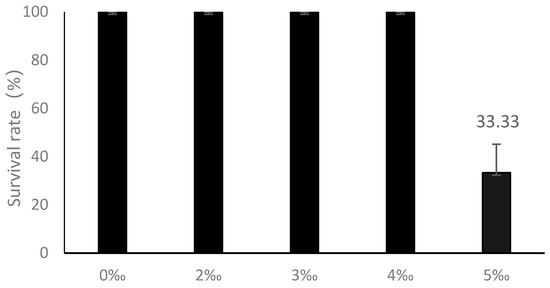
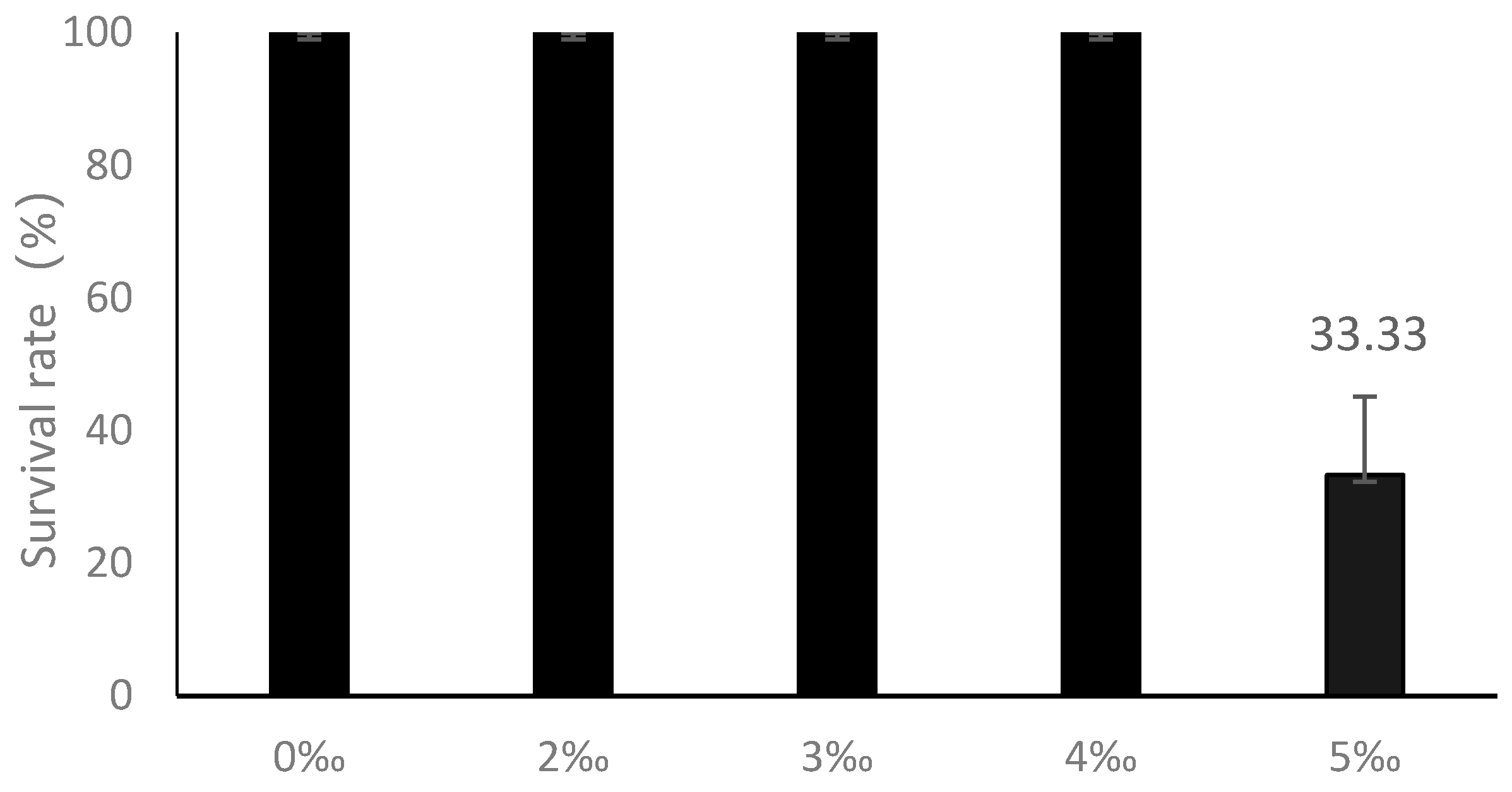
The pot experiment clearly delineated the salt tolerance threshold of ‘Fengyuan No. 1’ (Figure 1). At NaCl concentrations ≤ 3‰, the plant survival rate remained at 100% with no observable salt injury symptoms, indicating this range is its safe growth zone. When salinity was increased to 4‰, leaf scorching appeared in some plants, though the survival rate remained 100%, suggesting the initiation of stress response mechanisms. The concentration of 5‰ constituted the lethal threshold, with the survival rate plummeting to 33.33%, and the surviving plants exhibited severe leaf scorching and growth arrest. These results provide a clear quantitative benchmark for the application boundaries for this variety.
Figure 1.
Survival rate of ‘Fengyuan No. 1’ under gradient NaCl stress. Note: Leaf scorching appeared at 4‰, while 5‰ was the lethal threshold (survival rate: 33.33%) and was accompanied by severe salt damage.
3.1.2. Biomass Allocation Strategy Reveals Resource Optimization Pathway
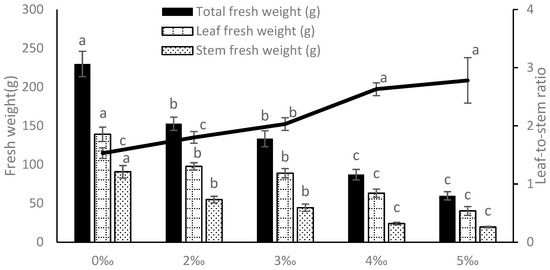
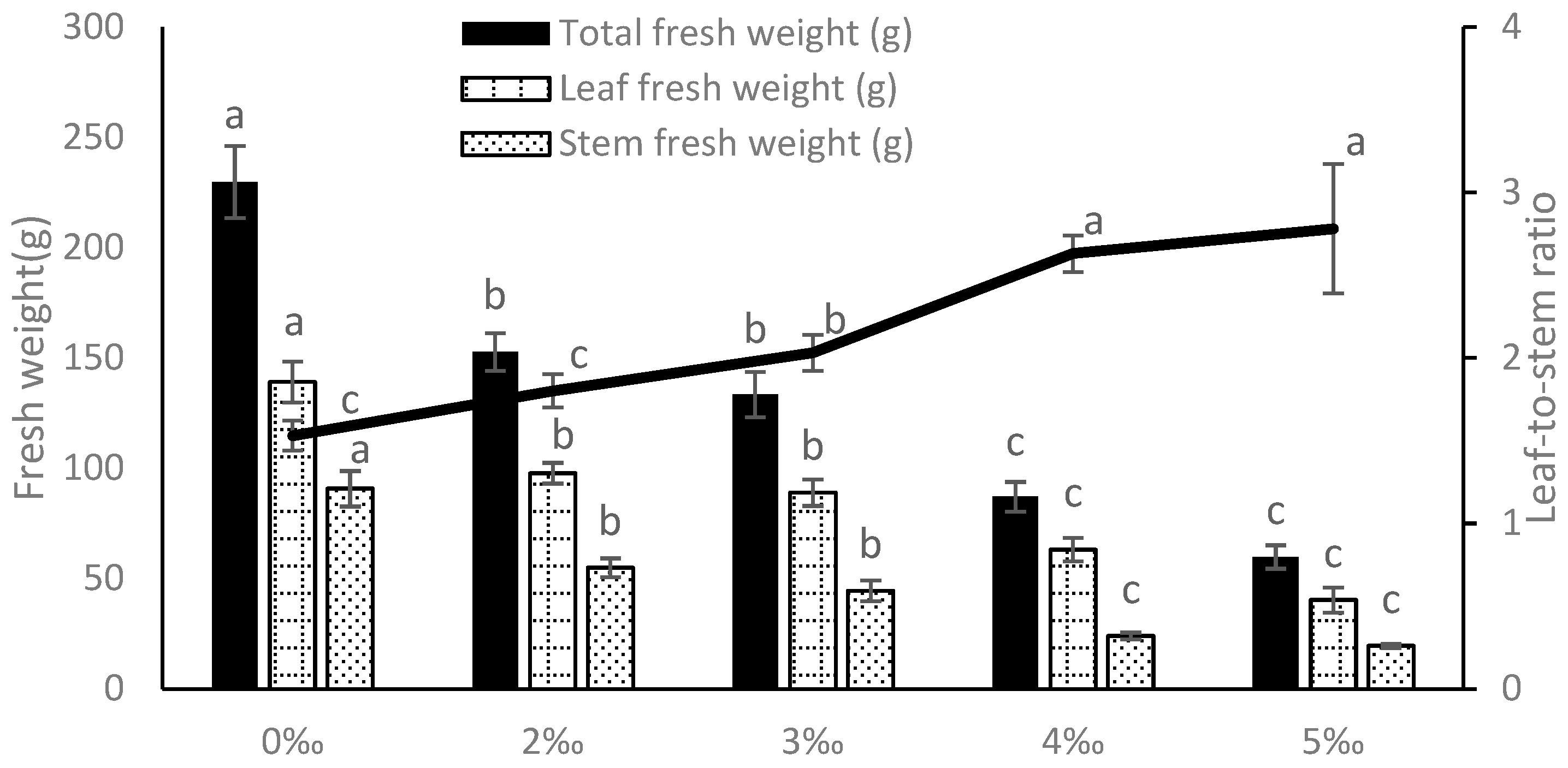
Salt stress significantly inhibited biomass accumulation in ‘Fengyuan No. 1’ in a dose-dependent manner (Figure 2). The total fresh weight significantly (p < 0.05) decreased from 229.75 g for the control (0‰) to 59.80 g at 5‰, a reduction of 74%. Notably, at concentrations ≥ 4‰, the total fresh weight reached a low plateau (only 37.9% and 26.0% of that for the control, respectively), with no significant difference between 4‰ and 5‰ (p > 0.05), a result consistent with severe physiological damage under high salinity.
Figure 2.
Changes in total fresh weight (TFW), leaf fresh weight (LFW), stem fresh weight (SFW), and leaf-to-stem ratio (LSR) of ‘Fengyuan No. 1’ under gradient NaCl stress. Note: Different lowercase letters indicate statistically significant differences among treatments for the same parameter (p < 0.05, Tukey’s HSD test). Letters are not comparable across different parameters. Bars with distinct patterns (e.g., solid, hatched, dotted) correspond to different measured indices as defined in the legend.
In-depth analysis at the organ level revealed that stem and leaf fresh weights decreased by 78.5% and 71.0%, respectively, indicating that stem growth was more sensitive to salt stress (p < 0.05). This differential sensitivity resulted in a continuous and significant increase in the leaf-to-stem fresh weight ratio (LSR), rising from 1.53 for the control to 2.78 at 5‰. This dynamic change reveals a possible resource regulation pathway: under mild stress (≤3‰), the gradual increase in the LSR indicates that photosynthetic organs (leaves) might have received preferential resource allocation; under severe stress (≥4‰), the surge in the LSR may reflect a survival-priority regulation mode, concentrating limited resources to maintain the core physiological functions of leaves, which constitutes an important feature of its response to salt stress. It should be noted that the observed pattern of increased LSR could also stem from the differential sensitivity of stem and leaf tissues to salt-induced growth inhibition.
3.1.3. Leaf Morphological Adaptation Demonstrates Structural Stress Resilience
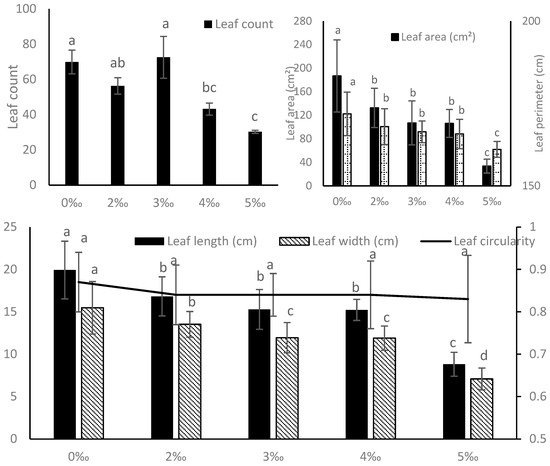
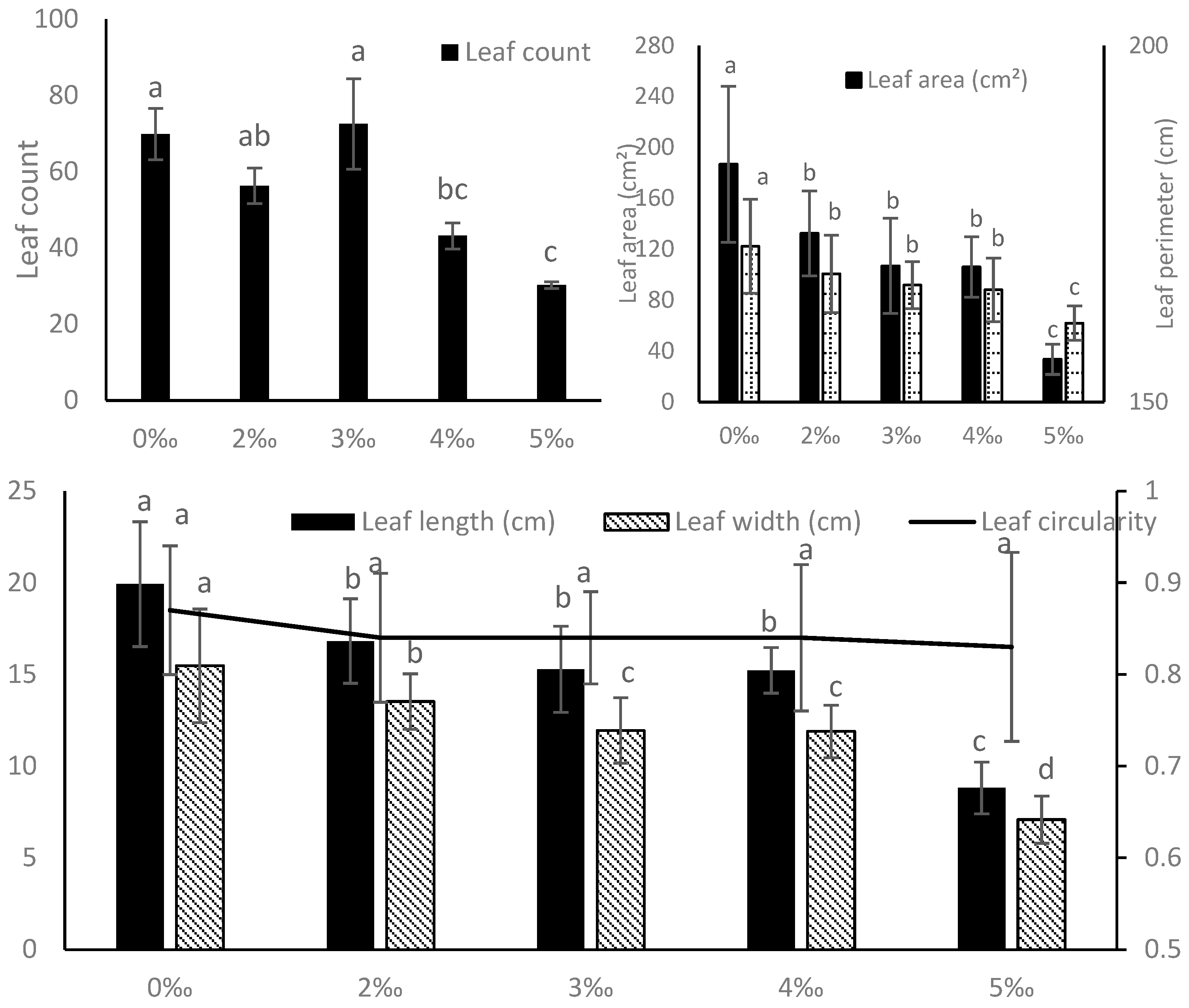
Salt stress significantly inhibited leaf morphogenesis but revealed structural resilience (Figure 3). Leaf area decreased significantly in a dose-dependent manner (p < 0.05), plummeting from 186.81 cm2 (0‰) to 33.51 cm2 (5‰), an 82.1% reduction. Leaf length and width also decreased significantly and synchronously.
Figure 3.
Changes in leaf count, leaf area, perimeter, leaf length, leaf width and leaf circularity of ‘Fengyuan No. 1’ under gradient NaCl stress. Note: Different lowercase letters indicate statistically significant differences among treatments for the same parameter (p < 0.05, Tukey’s HSD test). Letters are not comparable across different parameters. Bars with distinct patterns (e.g., solid, hatched, dotted) correspond to different measured indices as defined in the legend.
An interesting phenomenon was the anomalous peak in leaf number at 3‰ stress (72.50): this peak was significantly higher than that at 2‰ (56.25) and 4‰ (p < 0.05), potentially indicating a compensatory growth response under mild stress in an attempt to offset the photosynthetic loss caused by the sharp decrease in individual leaf area (3‰: 106.89 cm2). However, the net photosynthetic capacity was still inhibited overall due to the small individual leaf area.
Leaf circularity remained stable across treatments (0.83–0.87, p > 0.05) and was unaffected by salinity. This result indicates that ‘Fengyuan No. 1’ reduces transpiration by decreasing leaf size (area and perimeter) while maintaining a stable near-circular configuration, which is a key manifestation of its morphological stress resilience. Critical threshold analysis confirmed that at ≥4‰ salinity, all leaf morphological parameters deteriorated sharply, a finding consistent with the severe salt injury symptoms observed.
3.2. Impact of Optimized Cultivation Pathways on Plant Growth
ANOVA indicated that the cultivation mode significantly affected the field growth performance of ‘Fengyuan No. 1’ (p < 0.05, Table 3), outlining distinct growth optimization pathways.
Table 3.
Effects of different cultivation modes on the growth parameters of ‘Fengyuan No. 1’. Note: Values followed by different lowercase letters are significantly different (p < 0.05).
Regarding biomass accumulation, Flat-Bed Planting (FBP) demonstrated absolute superiority. The root, stem, and leaf fresh weights under FBP were significantly higher than those under Ridge Planting (RP) (5.0, 2.3, and 1.5 times those of RP, respectively). The biomass indicators under Furrow Planting (FP) generally fell between FBP and RP. This finding suggests that FBP is most conducive to overall plant substance accumulation.
Regarding plant height development, Furrow Planting (FP) showed a specific advantage. The plant height under FP (113.18 cm) was significantly greater than that under RP (75.83 cm), with FBP (100.83 cm) being intermediate. Consistent with this, the base diameter under RP (13.07 mm) was significantly smaller than that under FP (19.74 mm) and FBP (19.85 mm).
These results clearly indicate that FBP is the core pathway for maximizing biomass; FP is an effective pathway for achieving rapid height increase (potentially beneficial for early shading or harvesting); and the RP mode is inferior, disadvantaged across all growth indicators. These differences stem from the modification of the root zone microenvironment (e.g., water–salt distribution and aeration) by different cultivation modes, in turn regulating the plant’s resource allocation strategy.
3.3. Regulation of Leaf Components by Optimized Cultivation Pathways
The three cultivation modes not only affected growth but also directionally regulated the nutritional and functional component profiles of mulberry leaves (p < 0.05, Table 4), providing component-level pathway choices for different production objectives.
Table 4.
Leaf nutritional and functional components of ‘Fengyuan No. 1’ under different cultivation modes.
Crude Protein: The crude protein content under RP (23.3 g/100 g) and FP (24.7 g/100 g) was significantly higher than that under FBP (21.2 g/100 g), establishing RP/FP as the quality–priority pathways.
Fiber Components: FP resulted in the highest levels of neutral detergent fiber (NDF: 40.56 g/100 g) and acid detergent fiber (ADF: 25.60 g/100 g), suggesting that fluctuating root zone conditions might have induced stronger lignification.
Functional Components: Metabolite accumulation showed significant mode-specificity. FBP specifically activated the synthesis of the alkaloid DNJ (215.16 mg/kg), with a content significantly higher than that under RP and FP. Conversely, RP and FP significantly enhanced the content of the osmolyte GABA (approx. 586 mg/kg), reflecting different physiological stress states.
Ion Homeostasis: FBP performed best in maintaining ion homeostasis, exhibiting the lowest leaf Na+ content (124 mg/kg) and the highest K+ content (25,000 mg/kg), thereby achieving the most favorable K+/Na+ ratio. This finding indicates that FBP is the optimal means of mitigating sodium toxicity and maintaining leaf metabolic health.
4. Discussion
4.1. Salt Tolerance and Physiological Response Mechanism of ‘Fengyuan No. 1’—The Starting Point of the Integrated Pathway
This study first systematically defined the salt tolerance of ‘Fengyuan No. 1’, with 100% survival at NaCl concentrations ≤ 4‰ and no salt injury symptoms at ≤3‰, which is slightly higher than the usual concentration for the common mulberry [11,22]. This finding provides the critical threshold basis for subsequent cultivation mode selection, serving as the starting point of the integrated pathway. When the salt concentration was ≥4‰, the plants exhibited a notable change in biomass allocation, with the leaf-to-stem fresh weight ratio increasing from 1.53 to 2.78. This shift may favor the prioritization of leaf photosynthetic function under stress, a trend similar to the survival strategies observed in many salt-tolerant woody plants under stress [23]. Similarly, Chen et al. [14] also found that highly salt-tolerant hybrid combinations of mulberry could maintain relatively high biomass and leaf area growth rates under salt stress. We note that the increase in the leaf-to-stem ratio can be interpreted as an allocation shift favoring leaf maintenance, or it could result from differential sensitivity of stem versus leaf organs to salt-induced growth inhibition. Similar shifts towards greater allocation to leaves under abiotic stress (e.g., drought) have often been discussed as part of plant adaptation strategies [24]. Under salt stress, the leaf area of ‘Fengyuan No. 1’ decreased significantly, but leaf circularity remained stable, indicating morphological stress resilience induced by reducing the transpirational surface area to alleviate water imbalance [25].
It is important to emphasize that the pot experiment in this study focused on defining its agronomic salt tolerance thresholds (survival, growth, and biomass allocation) and morphological adaptations, which are the core phenotypic indicators directly guiding cultivation applications. Therefore, this study did not measure in-depth physiological indicators of oxidative and photosynthetic stress, such as antioxidant enzyme activities (SOD, POD, CAT), malondialdehyde (MDA) content, or chlorophyll fluorescence parameters. These indicators are crucial for revealing salt tolerance mechanisms at the cellular level and have been widely used in many classic physiological studies on salt tolerance [26,27]. Existing literature indicates that mulberry activates its antioxidant defense system and undergoes membrane lipid peroxidation under salt stress [11,27], while the stability of the photosynthetic apparatus is also closely related to salt tolerance [10]. We acknowledge that incorporating these physiological indicators would help provide a more comprehensive analysis of the salt tolerance physiological mechanisms in ‘Fengyuan No. 1’. Future research could delve into the patterns of antioxidant metabolism and photosynthetic performance responses within the framework of the tolerance threshold (≤4‰) and lethal threshold (5‰) established in this study, thereby enhancing the understanding of this variety’s salt tolerance at the mechanistic level.
In summary, the survival threshold, possible resource regulation, and morphological stability elucidated in this study collectively form the core capacity of this variety to cope with salt stress and lay a physiological and ecological foundation for designing compatible cultivation techniques. From an application-oriented perspective, this clear set of phenotypic response mechanisms provides a reliable basis for subsequent field cultivation decisions.
4.2. Effects of Cultivation Mode on Growth and Composition—Diversified Options Within the Integrated Pathway
The field trial demonstrated that the three cultivation modes are not simple alternatives but rather constitute diversified options within the integrated pathway for different objectives. Flat-bed planting (FBP) significantly promoted biomass accumulation in ‘Fengyuan No. 1’ and resulted in the lowest leaf Na+ content, a finding closely related to its structure, favoring root expansion, uniform water infiltration, and surface salt leaching [28], making it the core method for achieving high yields on lightly to moderately saline–alkali land. Crucially, the superior ion homeostasis (i.e., the lowest Na+ accumulation and the highest K+/Na+ ratio) observed under FBP underscores its effectiveness in mitigating sodium toxicity and maintaining cytosolic K+/Na+ balance, a fundamental mechanism for salt tolerance that protects enzymatic activities and metabolic processes [3,29]. Furrow planting (FP), by elevating the root zone to avoid high-salinity groundwater, promoted plant height development, but its significantly higher fiber content might be related to salinity-heterogeneity-induced enhanced lignification [30]. Thus, it can serve as an effective supplementary pathway for salt avoidance in areas with high groundwater tables. The RP treatment yielded the highest crude protein content but lower biomass, confirming the trade-off between biomass and quality traits [14], making it a specialized pathway for scenarios with specific demands for protein quality. These diversified cultivation options enable the precise matching of technical applications to specific site conditions and production goals.
4.3. Functional Component Response and Metabolic Regulation—The Quality Dimension of Pathway Selection
Cultivation modes significantly affected the accumulation of leaf functional components, adding a quality regulation dimension to the integrated pathway. The fact that the highest DNJ content was observed under FBP suggests that the relatively stable root zone environment fostered by this method activated the alkaloid synthesis pathway [31], whereas the higher GABA accumulation under RP and FP treatments reflects potentially stronger osmotic stress in their root zones, thereby activating osmotic adjustment mechanisms [32]. Specifically, GABA (γ-aminobutyric acid) is a key compatible solute and signaling molecule involved in osmotic regulation under abiotic stress. Its elevated accumulation under RP and FP likely indicates an active physiological response to maintain cell turgor and stabilize cellular structures under fluctuating or more stressful root-zone conditions [33,34]. These differential responses of metabolites indicate that the choice of cultivation pathway not only affects yield but also directly determines the functional component profile of the harvested material, which is significant for developing specialized feeds with specific health-promoting functions.
4.4. Application Prospects and Sustainability Outlook—Towards a Complete Industrial Pathway
The integrated pathway from salt tolerance analysis to cultivation optimization proposed in this study provides operable variety–technology packages for different saline–alkali environments. Its novelty lies in the sequential and decision-focused integration: establishing a variety-specific physiological threshold and then using it to design and interpret field-scale agronomic options, resulting in clear, objective-based cultivation pathways. This bridges the gap between controlled-environment physiology and practical field management. ‘Fengyuan No. 1’ exhibits enormous annual biomass potential under salinity ≤ 4‰, and its crude protein content is significantly higher than that of traditional legume forages [35]. These advantages, along with its multiple benefits in terms of improving livestock health [7,36], reveal mulberry leaf forage’s broad prospects for industrial forage development on coastal saline–alkali land. Future research should focus on the long-term monitoring and optimization of this pathway, deeply analyzing the interaction mechanism between soil water–salt dynamics and plant responses under different cultivation modes and incorporating water and fertilizer management into this framework to ultimately form a complete and sustainable industrial technology pathway integrating variety, cultivation, and management [37].
5. Conclusions
This study, through systematic research on aspects ranging from salt tolerance threshold analysis to optimized cultivation practices, has established a complete integrated variety–technology pathway for the application of the forage mulberry ‘Fengyuan No. 1’ on saline–alkali land.
Pathway Foundation: The salt tolerance threshold and physiological basis were clarified. ‘Fengyuan No. 1’ can survive at NaCl concentrations ≤ 4‰ (with no salt injury symptoms at ≤3‰), with 5‰ being the lethal threshold. Under salt stress, the plants maintained stress resistance through mechanisms such as resource reallocation (with the leaf-to-stem fresh weight ratio increasing from 1.53 to 2.78) and stable leaf circularity (0.83–0.87), laying a solid physiological and ecological foundation for the application of this variety.
Pathway Core: Diversified cultivation mode options were established. This study established three cultivation pathways guiding different production objectives: Flat-Bed Planting (FBP), serving as the core pathway for maximizing biomass and maintaining superior ion homeostasis; Furrow Planting (FP), serving as an effective pathway for salt avoidance and promoting plant height growth; and Ridge Planting (RP), functioning as a quality–priority pathway for obtaining high crude protein content. These three modes collectively form the organic components within the integrated technical pathway.
Pathway Value: Integration from theory to application was achieved. Synthesizing the above research, we propose a complete application pathway: “Using the salt tolerance threshold as the theoretical basis, adopting Flat-Bed Planting (FBP) as the core model, and flexibly selecting Furrow Planting (FP) or Ridge Planting (RP) as supplements based on site conditions and production objectives.” This pathway ensures that ‘Fengyuan No. 1’ achieves an annual biomass potential of 20–30 tons/hectare on coastal saline–alkali land with salinity ≤ 4‰, providing a systematic solution for the utilization of saline–alkali land resources and animal feed supply, spanning from variety potential exploitation to technological model implementation.
Author Contributions
Experiment design, data curation, formal analysis, writing—original. B.G.; Data curation, formal analysis, Y.R. and Y.D.; Funding acquisition, validation and methodology, G.G.; Investigation, validation and methodology, Z.W.; Experiment design, data curation, formal analysis, writing—review and editing, D.Z. All authors have read and agreed to the published version of the manuscript.
Funding
This study was funded by Key R&D Program of Shandong Province, China (2023LZGC012), the Yantai Science and Technology Innovation Development Plan Project (2023JCYJ105), the Yantai Comprehensive Test Station of the National Silkworm Industry Technology System (CARS-18-SYZ08), the Shandong Province Sericulture Industry Technology System Innovation Team Processing and Comprehensive Utilization Position Project (SDAIT-18-01), and the Shandong Province Sericulture Industry Technology System Innovation Team Breeding Position Project (SDAIT-18-02).
Data Availability Statement
The data presented in this study are available upon request from the corresponding author.
Conflicts of Interest
The authors declare no conflicts of interest.
References
- FAO. Salt-Affected Soils and Their Management; FAO: Rome, Italy, 2021. [Google Scholar]
- Li, X.; Sun, M.; Zhang, H.; Xu, N.; Sun, G. Use of mulberry-soybean intercropping in salt-alkali soil impacts the diversity of the soil bacterial community. Microb. Biotechnol. 2016, 9, 293–304. [Google Scholar] [CrossRef] [Scilit]
- Munns, R. Comparative physiology of salt and water stress. Plant Cell Environ. 2002, 25, 239–250. [Google Scholar] [CrossRef] [Scilit]
- Parida, A.K.; Das, A.B. Salt tolerance and salinity effects on plants: A review. Ecotoxicol. Environ. Saf. 2005, 60, 324–349. [Google Scholar] [CrossRef] [Scilit]
- Vijayan, K.; Doss, S.G.; Chakraborti, S.P.; Ghosh, P.D. Breeding for salinity resistance in mulberry (Morus spp.). Euphytica 2009, 169, 403–411. [Google Scholar] [CrossRef] [Scilit]
- Hassan, F.U.; Arshad, M.A.; Li, M.; Rehman, M.S.; Loor, J.J.; Huang, J. Potential of Mulberry Leaf Biomass and Its Flavonoids to Improve Production and Health in Ruminants: Mechanistic Insights and Prospects. Animals 2020, 10, 2076. [Google Scholar] [CrossRef] [Scilit] [PubMed]
- Geng, B.; Gao, J.; Cheng, H.; Guo, G.; Wang, Z. Effects of dietary mulberry leaves on growth, production performance, gut microbiota, and immunological parameters in poultry and livestock: A systematic review and meta-analysis. Anim. Biosci. 2024, 37, 1065–1076. [Google Scholar] [CrossRef] [Scilit]
- Zhang, H.; Li, X.; Zhang, S.; Yin, Z.; Zhu, W.; Li, J.; Meng, L.; Zhong, H.; Xu, N.; Wu, Y.; et al. Rootstock Alleviates Salt Stress in Grafted Mulberry Seedlings: Physiological and PSII Function Responses. Front. Plant Sci. 2018, 9, 1806. [Google Scholar] [CrossRef] [Scilit]
- Ashraf, M.; Wu, L. Breeding for salinity tolerance in plants. Crit. Rev. Plant Sci. 1994, 13, 17–42. [Google Scholar] [CrossRef]
- Kumar, S.G.; Lakshmi, A.; Madhusudhan, K.; Ramanjulu, S.; Sudhakar, C. Photosynthesis Parameters in Two Cultivars of Mulberry Differing in Salt Tolerance. Photosynthetica 2000, 36, 611–616. [Google Scholar] [CrossRef] [Scilit]
- Kumar, S.G.; Reddy, A.M.; Sudhakar, C. NaCl effects on proline metabolism in two high yielding genotypes of mulberry (Morus alba L.) with contrasting salt tolerance. Plant Sci. 2003, 165, 1245–1251. [Google Scholar] [CrossRef] [Scilit]
- Lu, N.; Luo, Z.; Ke, Y.; Dai, L.; Duan, H.; Hou, R.; Cui, B.; Dou, S.; Zhang, Y.; Sun, Y.; et al. Growth, Physiological, Biochemical, and Ionic Responses of Morus alba L. Seedlings to Various Salinity Levels. Forests 2017, 8, 488. [Google Scholar] [CrossRef] [Scilit]
- Ashraf, M.; Ali, Q. Relative membrane permeability and activities of some antioxidant enzymes as the key determinants of salt tolerance in canola (Brassica napus L.). Environ. Exp. Bot. 2008, 63, 266–273. [Google Scholar] [CrossRef] [Scilit]
- Chen, X.; Gao, Y.; Zhang, D.; Gao, Y.; Song, Y.; Wang, H.; Ma, B.; Li, J. Evaluation of salinity resistance and combining ability analysis in the seedlings of mulberry hybrids (Morus alba L.). Physiol. Mol. Biol. Plants 2023, 29, 543–557. [Google Scholar] [CrossRef] [Scilit]
- Vijayan, K.; Chakraborti, S.P.; Doss, S.G.; Ghosh, P.D.; Ercisli, S. Combining ability for morphological and biochemical characters in mulberry (Morus spp.) under salinity stress. Int. J. Ind. Entomol. 2008, 16, 67–74. [Google Scholar]
- Sudharani, M.; Reddy, P.R.; Badu, V.R.; Reddy, G.H.; Raju, C.S. Combining ability studies in rice (Oryza sativa L.) under coastal saline soil conditions. Madras Agric. J. 2013, 100, 797–802. [Google Scholar] [CrossRef] [Scilit]
- Ren, Y.; Guo, G.; Wang, Z.; Zhu, L.; Geng, B. Response of Yield and Protein Content of Forage Mulberry to Irrigation in North China Plain. Agronomy 2025, 15, 1016. [Google Scholar] [CrossRef] [Scilit]
- Y/T 2890-2016; Determination of γ-aminobutyric acid in rice-High performance liquid chromatography. Ministry of Agriculture of the People‘s Republic of China: Beijing, China, 2016.
- Shi, X.Q.; Cui, W.Z.; Xi, L.Q.; Duan, Z.A.; Wu, X.F. Determination of 1-deoxynojirimycin by reversed-phase high performance liquid chromatography with ultraviolet detection. Sci. Seric. 2006, 1, 146–149. (In Chinese) [Google Scholar] [CrossRef]
- GB 5009.5-2016; National food safety standard-Determination of protein in foods. National Health Commission of the People’s Republic of China: Beijing, China, 2016.
- GB 5009.268-2016; National food safety standard-Determination of multi-elements in foods. National Health Commission of the People’s Republic of China: Beijing, China, 2016.
- Liu, X.Q.; Ding, T.L.; Wei, C.J.; Long, D.; Guo, Q.; Zhu, F.; He, N.; Yu, M.; Xiang, Z. An evaluation on salt and drought tolerance of F1 generations from 13 mulberry hybrid combinations. Acta Sericologica Sin. 2014, 40, 764–773. (In Chinese) [Google Scholar] [CrossRef]
- Guha, A.; Sengupta, D.; Reddy, A.R. Physiological optimality, allocation trade-offs and antioxidant protection linked to better leaf yield performance in drought exposed mulberry. J. Sci. Food Agric. 2010, 90, 2649–2659. [Google Scholar] [CrossRef] [Scilit]
- Rao, L.; Li, S.; Cui, X. Leaf morphology and chlorophyll fluorescence characteristics of mulberry seedlings under waterlogging stress. Sci. Rep. 2021, 11, 13379. [Google Scholar] [CrossRef] [Scilit]
- Sun, Z.; Yin, Y.; Zhu, W.; Zhou, Y. Morphological, Physiological, and Biochemical Composition of Mulberry (Morus spp.) under Drought Stress. Forests 2023, 14, 949. [Google Scholar] [CrossRef] [Scilit]
- Gill, S.S.; Tuteja, N. Reactive oxygen species and antioxidant machinery in abiotic stress tolerance in crop plants. Plant Physiol. Biochem. 2010, 48, 909–930. [Google Scholar] [CrossRef] [Scilit] [PubMed]
- Ahmad, P.; Jaleel, C.A.; Sharma, S. Antioxidant defense system, lipid peroxidation, proline-metabolizing enzymes, and biochemical activities in two Morus alba genotypes subjected to NaCl stress. Russ. J. Plant Physiol. 2010, 57, 509–517. [Google Scholar] [CrossRef] [Scilit]
- Tang, Z.; Lu, J.; Xiang, Y.; Shi, H.; Sun, T.; Zhang, W.; Wang, H.; Zhang, X.; Li, Z.; Zhang, F. Farmland mulching and optimized irrigation increase water productivity and seed yield by regulating functional parameters of soybean (Glycine max L.) leaves. Agric. Water Manag. 2024, 298, 108875. [Google Scholar] [CrossRef] [Scilit]
- Zhu, J.-K. Plant Salt Tolerance. Trends Plant Sci. 2001, 6, 66–71. [Google Scholar] [CrossRef] [Scilit]
- Zahra, N.; Hafeez, M.B.; Kausar, A.; Al Zeidi, M.; Asekova, S.; Siddique, K.H.M.; Farooq, M. Plant photosynthetic responses under drought stress: Effects and management. J. Agron. Crop Sci. 2023, 209, 651–672. [Google Scholar] [CrossRef] [Scilit]
- Fatima, M.; Dar, M.A.; Dhanavade, M.J.; Abbas, S.Z.; Bukhari, M.N.; Arsalan, A.; Liao, Y.; Wan, J.; Shah Syed Bukhari, J.; Ouyang, Z. Biosynthesis and Pharmacological Activities of the Bioactive Compounds of White Mulberry (Morus alba): Current Paradigms and Future Challenges. Biology 2024, 13, 506. [Google Scholar] [CrossRef] [Scilit]
- Demiral, T.; Turkan, I. Comparative lipid peroxidation, antioxidant defense systems and proline content in roots of two rice cultivars differing in salt tolerance. Environ. Exp. Bot. 2005, 53, 247–257. [Google Scholar] [CrossRef] [Scilit]
- Shelp, B.J.; Bown, A.W.; McLean, M.D. Metabolism and functions of gamma-aminobutyric acid. Trends Plant Sci. 1999, 4, 446–452. [Google Scholar] [CrossRef] [Scilit]
- Ramesh, S.A.; Tyerman, S.D.; Gilliham, M.; Xu, B. γ-Aminobutyric acid (GABA) signalling in plants. Cell. Mol. Life Sci. 2017, 74, 1577–1603. [Google Scholar] [CrossRef] [Scilit] [PubMed]
- Ackah, M.; Shi, Y.; Wu, M.; Wang, L.; Guo, P.; Guo, L.; Jin, X.; Li, S.; Zhang, Q.; Qiu, C.; et al. Metabolomics Response to Drought Stress in Morus alba L. Variety Yu-711. Plants 2021, 10, 1636. [Google Scholar] [CrossRef] [Scilit] [PubMed]
- Liu, Y.; Li, Y.; Xiao, Y.; Peng, Y.; He, J.; Chen, C.; Xiao, D.; Yin, Y.; Li, F. Mulberry leaf powder regulates antioxidative capacity and lipid metabolism in finishing pigs. Anim. Nutr. 2021, 7, 421–429. [Google Scholar] [CrossRef] [Scilit] [PubMed]
- Zappa, L.; Dari, J.; Modanesi, S.; Quast, R.; Brocca, L.; De Lannoy, G.; Massari, C.; Quintana-Seguí, P.; Barella-Ortiz, A.; Dorig, W. Benefits and pitfalls of irrigation timing and water amounts derived from satellite soil moisture. Agric. Water Manag. 2024, 295, 108773. [Google Scholar] [CrossRef] [Scilit]

Disclaimer/Publisher’s Note: The statements, opinions and data contained in all publications are solely those of the individual author(s) and contributor(s) and not of MDPI and/or the editor(s). MDPI and/or the editor(s) disclaim responsibility for any injury to people or property resulting from any ideas, methods, instructions or products referred to in the content. |
© 2025 by the authors. Licensee MDPI, Basel, Switzerland. This article is an open access article distributed under the terms and conditions of the Creative Commons Attribution (CC BY) license.