Next Article in Journal
Alternative to Groundwater Drip Irrigation for Tomatoes in Cold and Arid Regions of North China by Rainwater Harvesting from Greenhouse Film
Next Article in Special Issue
Preliminary Study on Optimizing Rice Production in Cold Regions: Yield and Nutritional Trade-Offs Between Transplanting and Mechanical Hill-Drop Seeding
Previous Article in Journal
Construction of a CFD Simulation and Prediction Model for Pesticide Droplet Drift in Agricultural UAV Spraying
Previous Article in Special Issue
Dynamic Degradation of Seed Ropes: Influence of Material Type and Adhesion to Different Soils
error_outline You can access the new MDPI.com website here. Explore and share your feedback with us.
 
 
Article

Nitrogen Uptake and Use Efficiency Affected by Spatial Configuration in Maize/Peanut Intercropping in Rain-Fed Semi-Arid Region
1
Tillage and Cultivation Research Institute, Liaoning Academy of Agricultural Sciences, Shenyang 110161, China
2
National Agricultural Experimental Station for Agricultural Environment, Fuxin 123102, China
3
Key Laboratory of Water-Saving Agriculture of Northeast, Ministry of Agriculture and Rural Affairs, Shenyang 110161, China
4
College of Agronomy, Northwest A&F University, Yangling 712100, China
5
College of Resources and Environmental Sciences, China Agricultural University, Beijing 100193, China
*
Authors to whom correspondence should be addressed.
These authors contributed equally to this work.
Agronomy 2026, 16(1), 131; https://doi.org/10.3390/agronomy16010131
Submission received: 19 November 2025 / Revised: 30 December 2025 / Accepted: 2 January 2026 / Published: 5 January 2026

Abstract

Efficient nitrogen (N) management is critical for improving productivity and sustainability in intercropping systems, especially in semi-arid regions. Maize and peanut, the two dominant local crops, were selected to represent a typical cereal/legume intercropping system with contrasting nitrogen acquisition strategies. To investigate how spatial configuration regulates nitrogen uptake and nitrogen use efficiency in maize/peanut intercropping systems, a 3-year field (2022–2024) experiment was conducted on sandy soils in semi-arid northwest Liaoning, China. Six cropping systems were evaluated, including sole maize, sole peanut, and four intercropping configurations differing in strip width and crop proportion, including M2P2 (two rows of maize intercrop with two rows of peanut, M indicates maize and P indicates peanut), M2P4, M4P4, and M8P8. The total land equivalent ratio (LER) varied from 0.65 to 1.09, indicating that yield advantages were highly dependent on spatial configuration. Maize consistently exhibited stronger competitiveness than peanut, resulting in suppressed peanut growth in narrow-strip systems. Increasing strip width and peanut proportion alleviated interspecific competition and improved fertilizer nitrogen equivalent ratio (FNER) and nitrogen equivalent ratio (NER) in intercrops. Although intercropping did not consistently enhance total nitrogen uptake, nitrogen use efficiency was significantly improved. Narrow-strip systems (M2P2 and M2P4) increased nitrogen use efficiency, whereas wide-strip systems (M4P4 and M8P8) achieved yield benefits mainly through enhanced nitrogen uptake. Overall, the results highlight that spatial configuration plays a key role in regulating nitrogen uptake and interspecific competition in maize/peanut intercropping under semi-arid sandy conditions. Optimizing strip width and crop proportion is therefore critical for stabilizing yield and improving resource use efficiency in maize/peanut intercropping systems in dryland agriculture.

1. Introduction

Achieving high and stable crop productivity while improving nutrient use efficiency remains a key challenge for sustainable agriculture [1]. Particularly in the semi-arid region with sandy soil, rainfall is irregular and sparse, and the soil consists primarily of coarse sand, which has limited water and nutrient retention capacity. These conditions result in low and unstable nitrogen use efficiency under monoculture practices. Thus, resource-efficient cropping systems are essential for sustaining agricultural productivity and ecological stability [2]. Cereal/legume intercropping, particularly maize/peanut intercropping, have been increasingly adopted as an important dryland cropping strategy to improve land productivity and nitrogen use efficiency, and minimize fertilizer losses by exploiting spatial and temporal complementarity [3] due to typical different root characters and nitrogen acquisition strategies.
Numerous studies indicate that well-managed maize/peanut intercropping led to substantial gains in yield and nitrogen use efficiency, contributing to more sustainable and low-input agricultural production [4]. However, the magnitude and consistency of these benefits can vary considerably across regions, influenced by factors such as climate, soil fertility, and management practices. In thermally insufficient areas, such as Northeast China, the air temperature during the growing season only allows growing one harvest per year. In such areas, maize/peanut intercropping typically shares the same planting window and harvest period. As a result, temporal niche differentiation contributes minimally to the advantages of intercropping in this region. Instead, spatial configuration (row ratio) and nutrient management (such as nitrogen fertilizer application rates) play a more pivotal role in determining system performance [5]. Previous studies showed that row configuration is a key factor that influence interspecific competition and complementarity [6]. Altering spatial arrangements affects canopy light interception and root distribution, which, in turn, influences crop access to water and nutrients, thereby improving nutrient use efficiency [7]. Additionally, as a nitrogen-fixing legume, peanuts contribute to nitrogen fixation and influence rhizosphere interactions that impact the nitrogen cycle at the system level. However, these contributions are highly dependent on environmental conditions and the competitive dynamics between the two crops.
While considerable research has been conducted in regions with fine-textured, well-irrigated soils, there is a lack of systematic evidence from semi-arid sandy environments [8]. Most studies on yield and nitrogen use advantages of maize/peanut intercropping have focused on fertile soils, while results in dryland sandy conditions being more variable [9]. Recent observations suggest that the expected benefits in yield or nitrogen use may be diminished by excessive competition from maize or the inhibition of nitrogen fixation in peanuts [10]. The rapid nitrogen turnover in these soils, coupled with mismatches in the temporal and spatial availability of resources, can undermine the nitrogen complementarity typically driven by legumes, leading to unstable system performance [11]. As a result, it remains uncertain whether maize/peanut intercropping can provide consistent advantages in nitrogen uptake and use in semi-arid sandy areas, or how spatial configuration can regulate interspecific competition and nitrogen efficiency [12]. Addressing these gaps is essential for developing effective nitrogen fertilizer management and spatial optimization strategies tailored to dryland agricultural systems.
To address these knowledge gaps, a three-year (2022–2024) field experiment was conducted in Northwest Liaoning, China, a typical semi-arid region. Six planting patterns were tested, including sole maize, sole peanut, and four maize/peanut intercropping configurations (M2P2, M2P4, M4P4, and M8P8). The main objective was to quantify how various spatial configurations of maize/peanut intercropping in semi-arid sandy soils influence crop yields, land equivalent ratio (LER), nitrogen equivalent ratio (NER), fertilizer nitrogen equivalent ratio (FNER), nitrogen uptake advantage (ΔNU), and nitrogen use efficiency advantage (ΔNUE). The findings of this study will provide valuable insights for designing intercropping systems with enhanced nitrogen efficiency and stable yields in semi-arid sandy regions.

2. Materials and Methods

2.1. Field Experimental Design

The field experiment was conducted in Fuxin (121°44′ E, 42°7′ N), Northwestern Liaoning, China. The soil of this region is classified as Alfisols according to the ST (Soil Taxonomy) [13]. The soil had a sandy-loam texture, with approximately 57.5% sand, 29.6% silt, and 12.9% clay. The average annual rainfall from 1980–2010 was 470 mm, with more than 87% of the rainfall occurring during the growing season (May–September). The mean annual air temperature is approximately 8.5 °C, with monthly mean temperatures ranging from −15.8 °C in the coldest month to 27.2 °C in the warmest month. Composite soil samples (0–20 cm) were collected from each experimental plot before sowing and fertilization to characterize the initial soil physicochemical properties [14]. Soil pH was 5.81, measured in a soil–water suspension (1:2.5, w/v) using a glass electrode pH meter (PHS-3E, Shanghai INESA Scientific Instrument Co., Ltd., Shanghai, China). Total nitrogen (TN) was determined using an elemental analyzer (EA3000, EuroVector, San Severo, Italy). Total phosphorus (TP) was 0.03% and total potassium (TK) was 1.31%, both measured after acid digestion, with phosphorus quantified by the molybdenum blue colorimetric method (UV-9000S, Shanghai Metash Instruments Co., Ltd., Shanghai, China) and potassium determined using a flame photometer (Z-2000, Hitach, Tokyo, Japan). Available phosphorus (AP) was 54.2 mg kg−1, extracted using the Olsen method and quantified colorimetrically (UV-9000S, Shanghai Yuanxi, Shanghai, China). Available potassium (AK) was 80.1 mg kg−1, determined using a flame photometer (Z-2000, Hitach, Tokyo, Japan). Soil organic matter content was 12.2 g kg−1, determined by the potassium dichromate oxidation method [14].
To investigate the characteristics of nitrogen uptake and utilization in maize/peanut intercropping, different planting patterns were conducted, including sole maize (Sole M), sole peanut (Sole P), maize/peanut intercropping with 2 rows of maize and 2 rows of peanut (M2P2), 2 rows of maize and 4 rows of peanut (M2P4), 4 rows of maize and 4 rows of peanut (M4P4), and 8 rows of maize and 8 rows of peanut (M8P8). Each treatment was replicated three times in a randomized block design, with an individual plot area of 120 m2.
The maize cultivar used in this study was Jingke 968, and the peanut cultivar was Qinghua 6, both of which are locally adopted varieties by farmers. The plant distance within a row was 33 cm in maize and 13.3 cm in peanut. In sole cropping systems, the planting densities for maize and peanut were 60,000 plants ha−1 and 300,000 plants ha−1 respectively. In intercropping systems, the planting densities for maize were 30,000, 20,000, 30,000, and 30,000 plants ha−1 in M2P2, M2P4, M4P4, and M8P8, respectively. The planting densities for peanut were 150,000, 200,000, 150,000 and 150,000 plants ha−1 in M2P2, M2P4, M4P4, and M8P8, respectively. The row spacing for both crops in all the treatments were 50 cm, and ridges were oriented in a north–south direction. All treatments in the present experiment received a uniform application of N, P, and K fertilizers according to farmer practices (compound fertilizer (N-P2O5-K2O: 14-16-15), 750 kg ha−1). Peanut seeds were not artificially inoculated with rhizobial strains.

2.2. Measurements and Methods

To comprehensively evaluate the growth, yield, and nitrogen utilization characteristics of maize/peanut intercropping systems, multiple indices were determined as follows.
(1)
Dry Weight of Plant Organs
Aboveground samples were collected at maturity stages, then inactivated at 105 °C for 30 min, and oven-dried at 75 °C to a constant weight before weighing.
(2)
Crop Yield
At harvest, yield samples were collected from border rows of each treatment, consisting of 10 maize plants and 1 m2 of peanut plants. Samples were air-dried in a ventilated shed until the grain moisture content reached 14% for maize and 15.5% for peanut, after which the grains were threshed, weighed, and analyzed for yield.
(3)
Plant Nitrogen Content
For the determination of plant total nitrogen concentration, 3 maize plants and 3 peanut plants samples were collected during harvest from each plot. Aboveground plant tissues were air-dried, followed by drying at 75 °C to constant weight, and then finely ground to pass through a 0.15 mm sieve. Total nitrogen concentration in plant samples was determined using an elemental analyzer (EA3000, EuroVector, San Severo, Italy) based on dry combustion, and nitrogen uptake was calculated as the product of dry biomass and nitrogen concentration.
(4)
Land Equivalent Ratio (LER)
The LER was used to assess land-use efficiency and productivity advantages of intercropping systems [15]:
L E R = p L E R m + p L E R p = Y i m Y s m + Y i p Y s p
where Y i m and Y i p are the yields of maize and peanut in intercropping, and Y s m and Y s p are the maize and peanut yields in sole cropping. p L E R m and p L E R p represent the partial LERs of maize and peanut. LER > 1 indicates that intercropping achieves higher land-use efficiency and a yield advantage over sole cropping.
(5)
Nitrogen Equivalent Ratio (NER)
The nitrogen equivalent ratio was calculated to evaluate the N uptake advantage of the intercropping system [16]:
N E R = p N E R m + p N E R p = N U i m N U s m + N U i p N U s p
where N U i m and N U i p are N uptake amounts of intercropped maize and peanut, and N U s m and N U s p are N uptake of maize and peanut in sole cropping. p N E R m and p N E R p represent the partial NERs of maize and peanut, respectively. NER > 1 denotes an N uptake advantage under intercropping compared to the sole cropping.
(6)
Fertilizer-Nitrogen Equivalent Ratio (FNER)
The fertilizer-N equivalent ratio (FNER) quantifies the advantage of fertilizer-N utilization in intercropping [17]:
F N E R = p L E R m × F U m + p L E R p × F U p F U i c
where F U m , F U p , and F U i c are fertilizer-N inputs for sole maize, sole peanut, and the maize/peanut intercropping, respectively. FNER > 1 indicates that intercropping improves fertilizer-N use efficiency compared with sole cropping.
(7)
Nitrogen Uptake Advantage (ΔNU)
The nitrogen uptake advantage (ΔNU) reflects the relative increase or decrease in total N uptake of the intercropping system compared with sole cropping [18].
Δ N U = N U i c F m × N U s m + F p × N U s p 1 × 100
where N U i c is the total N uptake in intercropping, N U s m and N U s p are N uptake amounts in sole maize and peanut, and F m and F p are the proportional land areas occupied by maize and peanut in intercropping. ΔNU > 0 indicates increased N uptake under intercropping compared to the sole cropping, whereas ΔNU < 0 indicates a reduction.
(8)
Nitrogen Use Efficiency Advantage (ΔNUE)
The nitrogen use efficiency advantage (ΔNUE) indicates the change in nitrogen utilization efficiency under intercropping compared to the sole cropping [16]:
Δ N U E = Y i c N U i c F m × Y s m N U s m + F p × Y s p N U s p 1 × 100
where Y i c is the total grain or biomass yield of the intercropping system; Y s m and Y s p are the yields of sole maize and peanut; N U i c , N U s m , and N U s p are their respective N uptake amounts; and F m and F p are the land proportions of maize and peanut in intercropping. ΔNUE > 0 indicates an improvement in N use efficiency in intercropping compared to the sole cropping.
(9)
Contribution of Nitrogen Uptake and Utilization Efficiency to Yield Advantage
Taking LER as an indicator of yield advantage, it can be expressed as [19]:
L E R = Y i m Y s m + Y i p Y s p = A i m A s m × E i m E s m + A i p A s p × E i p E s p
where A and E represent nitrogen uptake and nitrogen use efficiency, respectively, for maize (subscript m) and peanut (subscript p) under intercropping (i) and sole cropping (s). Defining a m = ( A i m / A s m ) 1 , a p = ( A i p / A s p ) 1 , e m = ( E i m / E s m ) 1 , and e p = ( E i p / E s p ) 1 , we obtain:
L E R = 1 + a m + a p + e m + e p + a m e m + a p e p
Here, ( a m + a p ) denotes the contribution of N uptake differences, ( e m + e p ) represents the contribution of N utilization efficiency differences, and ( a m e m + a p e p ) indicates the interaction between uptake and utilization efficiencies to the yield advantage [16].
(10)
Aggressivity (Amp) and Nutrient Competition Ratio (CRmp)
Amp quantifies the aggressiveness of one crop relative to the other [20]:
A m p = Y i m Y s m × F m Y i p Y s p × F p
A positive A m p indicates that maize is more competitive than peanut, whereas a negative value indicates stronger competitiveness of peanut.
The nutrient competition ratio (CRmp) evaluates the relative competitiveness of the two species for nitrogen [21]:
C R m p = N U i m N U s m × F m N U i p N U s p × F p
A C R m p > 1 implies that maize has a stronger N-uptake competitiveness than peanut, while C R m p < 1 indicates the opposite.

2.3. Statistical Analysis

Statistical analyses were conducted using SPSS software (IBM SPSS Statistics Version 20) to evaluate significant differences among treatments. Mean comparisons were performed based on the least significant difference (LSD) test at the 0.05 probability level.

3. Results

3.1. Responses of Dry Matter Accumulation and Yield to Different Planting Patterns

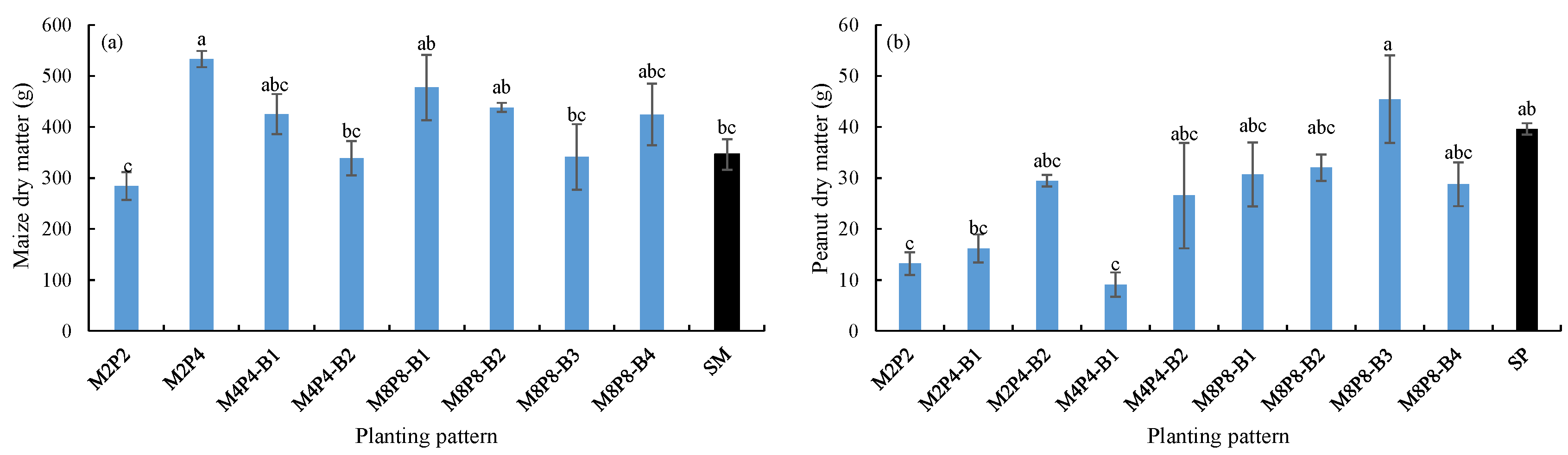
Dry matter accumulation in maize and peanut was measured under different planting patterns and analyzed for each cropping configuration. Overall, maize in intercropping systems exhibited higher dry matter accumulation than sole maize (346 g plant−1). Specifically, the M2P4, M4P4, and M8P8 patterns increased maize dry matter by 53.9%, 10.3%, and 21.4%, respectively, compared to the sole maize. Within intercropping strips, maize in border rows showed higher dry matter than in inner rows, with differences ranging from 8.9% to 39.9%. This advantage gradually diminished as the number of boundary rows increased (Figure 1).
In contrast, the dry matter accumulation of peanut followed an opposing trend. Compared to sole peanut (39.6 g plant−1), intercropping treatments generally reduced peanut dry matter. The reductions were 66.6%, 42.4%, 54.9%, and 13.5% for M2P2, M2P4, M4P4, and M8P8, respectively. Additionally, the dry matter content of peanut in edge rows was lower than in inner rows, with differences ranging from 3.99% to 65.8%. The dry matter of peanut increased as the distance from maize rows grew (Figure 1).
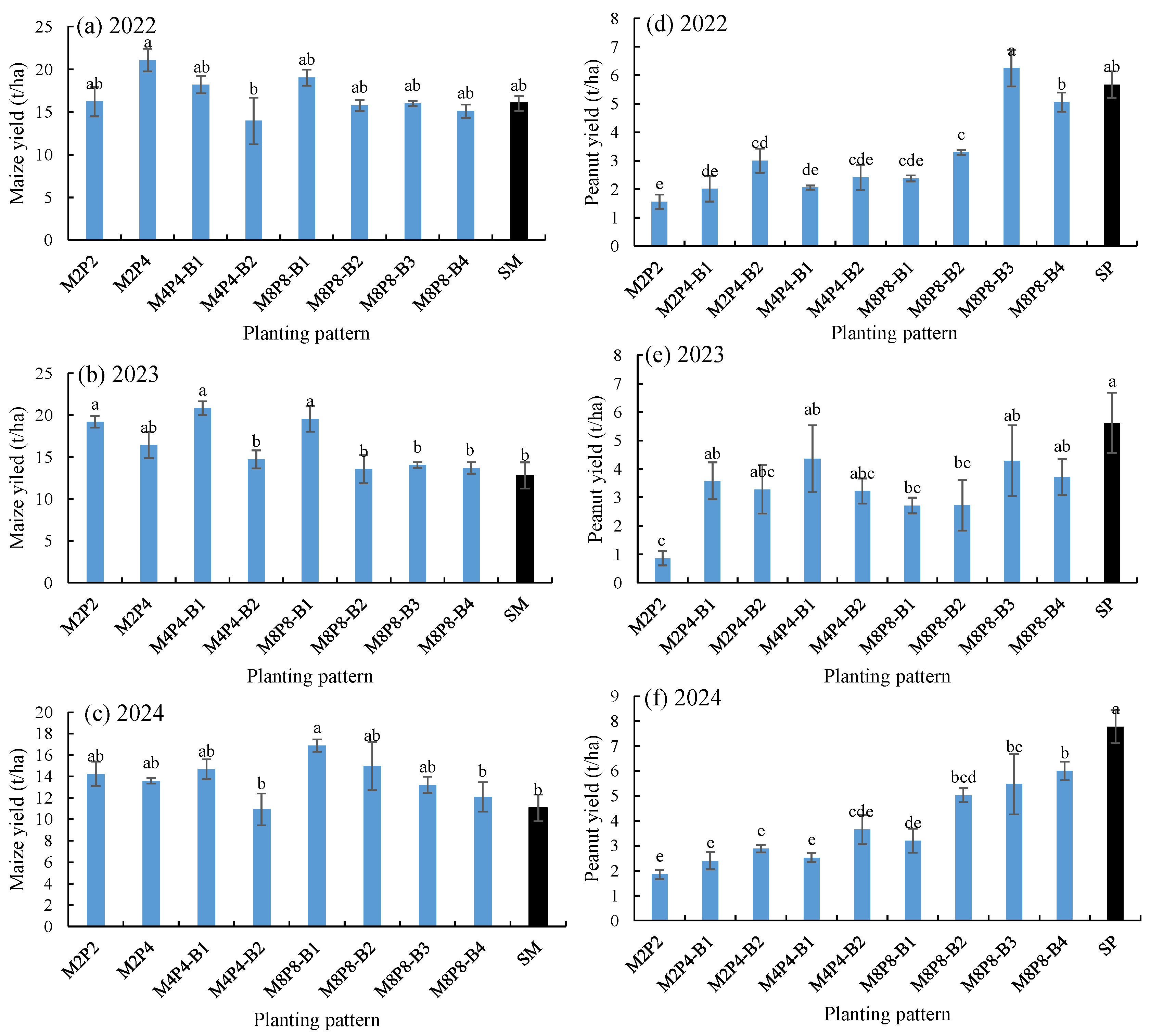
In terms of strip yield, intercropped maize generally outperformed sole maize, with the yield advantage being most pronounced in 2023 and 2024. The yield of maize in boundary rows was consistently higher than that in inner rows, with M2P2 and M2P4 exhibiting the greatest yield advantages. Peanut yield trends mirrored those of dry matter accumulation, showing lower yields in intercropping systems compared to sole cropping. However, this negative impact diminished as intercropping width increased, with yield following the trend: M8P8 > M4P4 > M2P4 > M2P2 (Figure 2).

3.2. Effects of Planting Patterns on Land Equivalent Ratio (LER)

The Land Equivalent Ratio (LER) is an important metric for assessing the advantages of intercropping, while the partial LERs (pLERm and pLERp) quantify the relative contributions of the component crops. As shown in Table 1, for all treatments, the partial LER of maize (pLERm) exceeded 0.5 under equal proportion configurations, with averages ranging from 0.431 to 0.648. This indicates a clear yield advantage for maize in the intercropping systems. In contrast, the partial LER of peanut (pLERp) was below 0.5 (average: 0.11 to 0.34), suggesting significant interspecific competition, with peanut at a competitive disadvantage.
The total LER for the intercropping systems ranged from 0.65 to 1.09. The M4P4 and M8P8 configurations demonstrated stronger overall productivity advantages compared to M2P2 and M2P4. Generally, increasing the proportion or width of peanut rows helped alleviate its competitive disadvantage. The total LER was influenced by both the increase in maize productivity and the relief of peanut stress, highlighting the importance of optimizing row configurations (Table 1).

3.3. Responses of Nitrogen Uptake and Fertilizer Nitrogen Use Efficiency to Different Planting Patterns

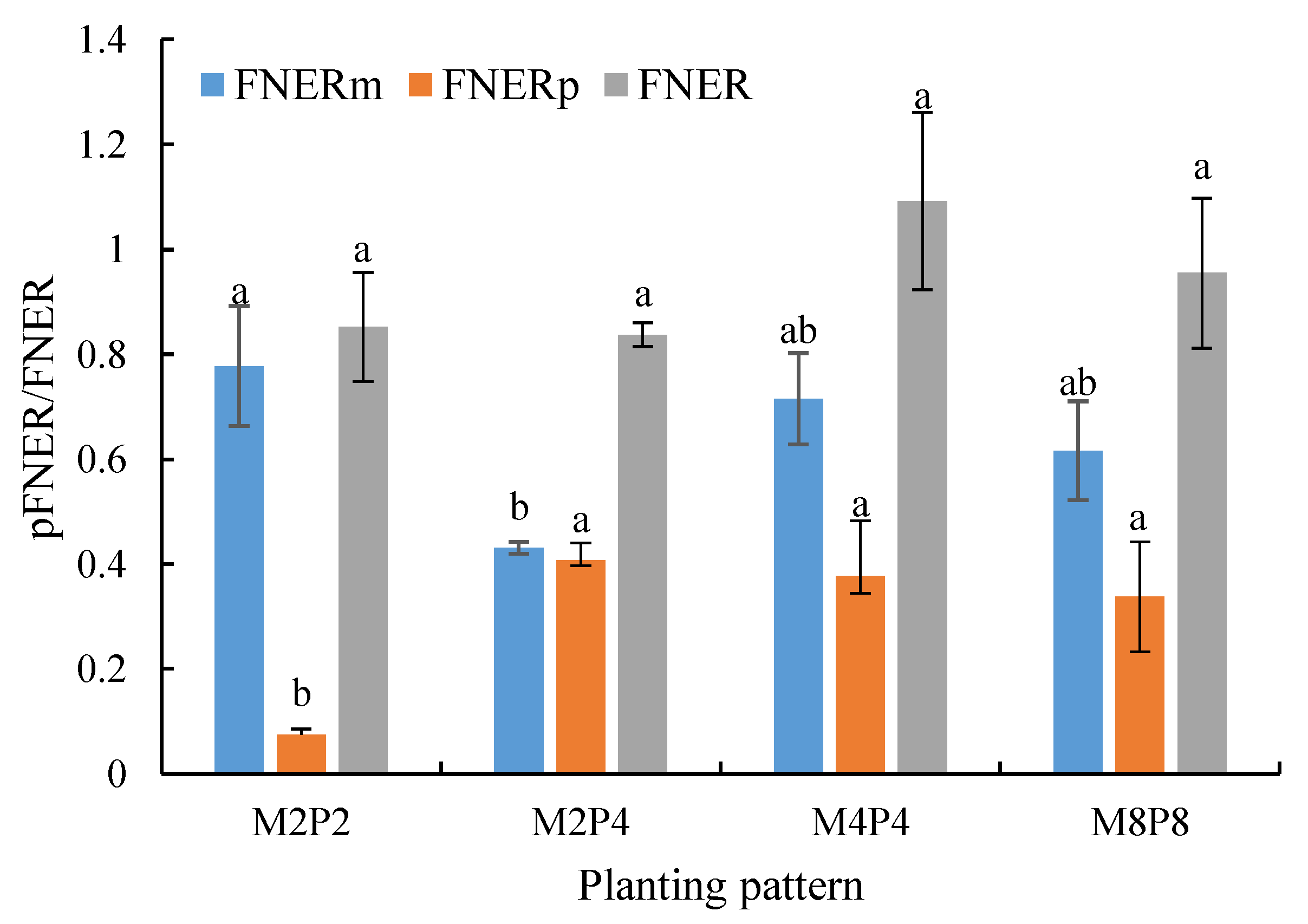
The Fertilizer Nitrogen Equivalent Ratio (FNER) for maize/peanut intercropping in 2023 ranged from 0.84 to 1.09. Maize exhibited higher FNERm values under M2P2 and M4P4, while M2P4 had a lower FNERm due to its land proportion effects. Despite the high FNERm in M2P2, the intense competition from maize led to the lowest FNERp (0.07). The total FNER for the different systems followed the trend: M4P4 > M8P8 > M2P2 > M2P4 (Figure 3).
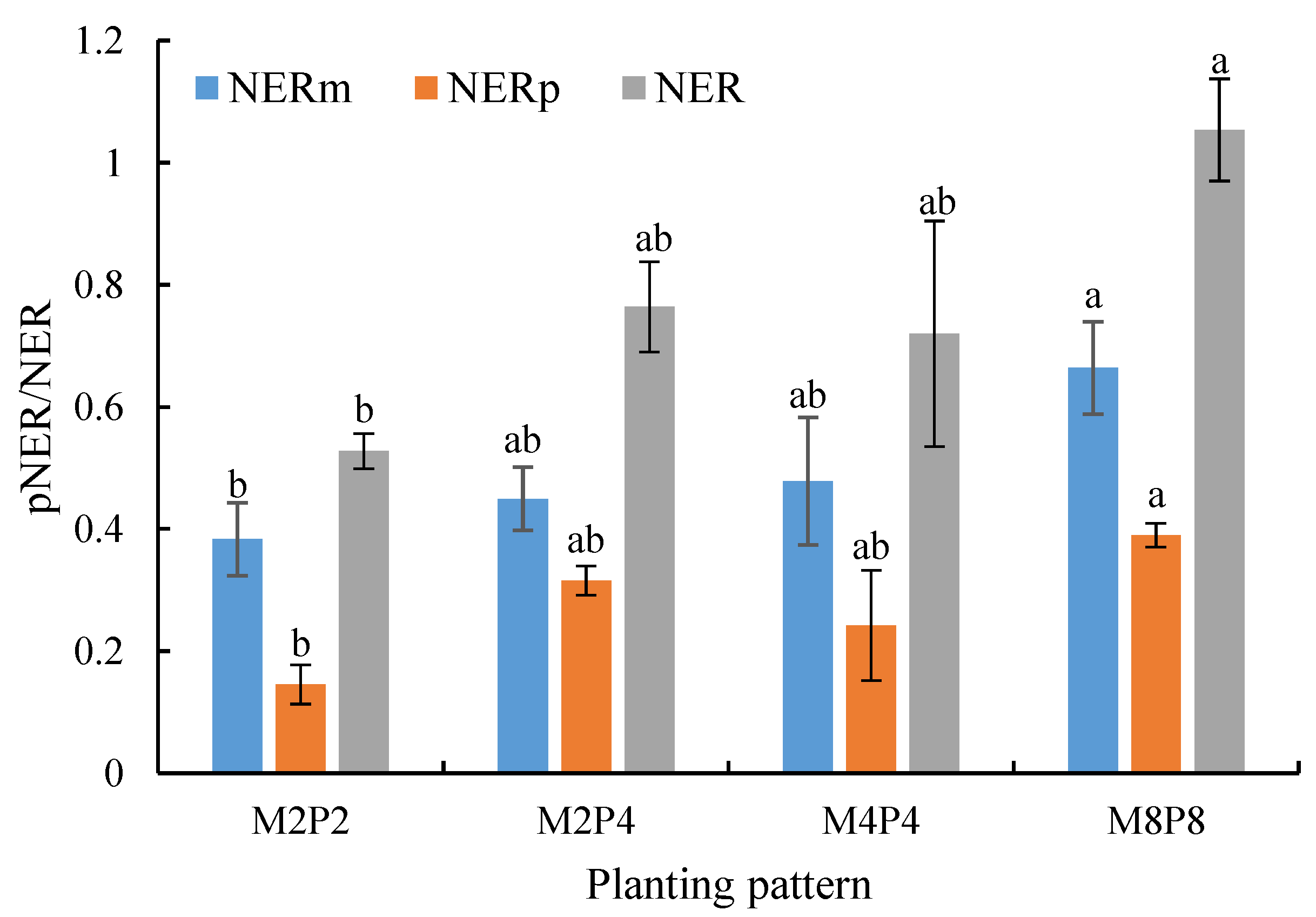
The overall trend for the Nitrogen Equivalent Ratio (NER) was: M8P8 > M2P4 ≥ M4P4 > M2P2. As row width and peanut proportion increased, the partial net nitrogen uptake rates (NERm and NERp) for both maize and peanut also increased. This suggests that wider inter-row spacing and higher peanut proportions reduce maize competition for light and water, benefiting peanut growth, while also allowing maize to benefit from nitrogen inputs provided by the peanuts. The changes in NER were influenced by both biomass accumulation and nitrogen uptake (Figure 4).
Although no clear nitrogen uptake advantage was observed, nitrogen use efficiency (NUE) showed significant benefits. In particular, under the M2P2 configuration, the ΔNUE based on yield reached 48%. For M2P4 and M4P4, the ΔNUE based on biomass reached 53%. Further analysis of the contributions of nitrogen uptake and utilization efficiency to yield advantage (Table 2) revealed that the yield advantage of M8P8 was primarily attributed to increased nitrogen uptake compared to monoculture, while in M2P2, M2P4, and M4P4, the advantage was mainly due to improvements in nitrogen use efficiency. The interaction between nitrogen uptake and utilization efficiency was positively correlated under M2P4 and M8P8 but negatively correlated under M2P2 and M4P4.

3.4. Inter-Species Competitiveness

The relative competitiveness between maize and peanut was assessed using two key metrics: interspecific aggressivity (Amp) and the nutrient competition ratio (CRmp) (Table 3). Amp values ranged from 0.27 to 0.89, all being positive, which indicates that maize was consistently more competitive than peanut. The highest competitiveness of maize (Amp = 0.89) occurred under the M2P4 configuration, while its competitiveness decreased as the width of maize strips increased, reaching its lowest level under M8P8 (Amp = 0.27). The nitrogen nutrient competition ratio (CRmp) varied between 0.70 and 3.17, with a trend of M2P2 > M4P4 > M8P8 > M2P4. In general, CRmp values greater than 1 suggested that maize had a stronger nitrogen absorption competitiveness than peanut. As the proportion of maize decreased, its relative competitiveness also diminished. Additionally, under equal width conditions, increasing maize strip width further weakened its competitive advantage.

4. Discussion

4.1. Regional Adaptation and Resource-Use Characteristics of Maize/Peanut Intercropping in Semi-Arid Sandy Areas

Our study suggests that in the semi-arid sandy region, the overall land use advantage of maize/peanut intercropping was less pronounced compared to that reported for more humid or fertile regions. This outcome highlights that under conditions of low soil fertility and uneven rainfall distribution, the potential resource complementarity between maize and peanut is substantially constrained. The sandy soil in this region has low organic matter content and poor water and nutrient retention capacity. Moreover, the rapid transformation and leaching of nitrogen result in an unstable nitrogen supply within the rhizosphere, while biological nitrogen fixation in peanuts is limited [22]. Water scarcity also exacerbates competition for soil moisture among crops, thus undermining the nitrogen complementarity potential and weakening the mutual benefits at the system level [23]. Our findings are consistent with recent studies conducted in semi-arid regions [24], which described maize/peanut intercropping as a “zero-sum game,” where yield gains of maize are frequently offset by yield reductions in peanut. Our results confirm that simultaneous intercropping under semi-arid sandy conditions does not necessarily result in net yield or nitrogen uptake advantages, but rather leads to a redistribution of limited resources between component crops. While spatial configuration did have a significant impact on the land equivalent ratio (LER) (p = 0.031), the overall advantage remained modest, indicating that intercropping and spatial mixing alone cannot guarantee stable improvements in nitrogen use efficiency or yield under semi-arid sandy conditions [17]. Precipitation influence crop growth and resource use in intercropping system, especially in rainfed semi-arid region, and this might be due to the fact that the increased precipitation will limit the intercropping species complementary effects and thereby reduce the intercropping advantage. The rainfall was 780.3 mm, 348.1 mm, and 527.1 mm, respectively, during the experimental years (Supplementary Materials, Table S1), and the LER was 0.75, 0.93, and 0.80, respectively (Table 1). The relatively high rainfall in the study years can also lead to a relatively lower LER in maize/peanut intercropping.
Our study extends previous zero-sum interpretations by demonstrating that limited yield advantage does not imply the absence of functional regulation within the intercropping system. Even when total productivity gains are small, maize/peanut intercropping can substantially modify nitrogen utilization pathways, which is rarely addressed in yield-centered evaluations. Long-term field experiments incorporating varying nitrogen input levels are necessary to clarify how spatial arrangements and nitrogen applications interact to regulate nitrogen uptake, transformation, and utilization efficiency in these fragile agricultural ecosystems [25].

4.2. Spatial Configuration Regulation on Nitrogen Absorption and Utilization Efficiency

The response patterns of nitrogen absorption and nitrogen use efficiency across different intercropping configurations highlight two complementary pathways driving system advantages. In wide-strip systems (M4P4, M8P8), the yield advantage is primarily driven by increased nitrogen absorption, while in relative narrow-strip systems (M2P2, M2P4), the improvement in nitrogen use efficiency plays a more dominant role in maintaining productivity [26]. For example, the M2P2 configuration resulted in a 48% increase in ΔNUE based on yield, indicating that, under resource-limited conditions, crops can stabilize yield by improving the yield per unit of absorbed nitrogen [27]. Similar patterns have been reported in cereal/legume intercropping systems across different semi-arid and temperate regions. Studies on maize/soybean and maize/pea intercropping in Europe and Central Asia have shown that wider strip configurations tend to enhance nitrogen uptake by alleviating interspecific competition, whereas narrow strips often favor nitrogen use efficiency through intensified plant–plant interactions [7,11,26].
As strip width increases, maize competitiveness declines, and peanut root growth and nitrogen content might partially recover. In contrast, narrow strips enhance maize’s competitive advantage and suppress peanut growth; this might lead to limited nitrogen accumulation at the system level but higher nitrogen fertilizer use efficiency [28]. This trade-off between nitrogen uptake and utilization efficiency is consistent with observations from dryland intercropping systems in Africa and the Mediterranean region, where nitrogen use efficiency plays a compensatory role under constrained nitrogen and water availability [2,4].
Overall, these results suggest that changes in nitrogen absorption and utilization efficiency reflect the internal self-regulation and compensation mechanisms of intercropping systems under varying competitive intensities [29]. Therefore, spatial configuration plays a key role in balancing the advantages of maize and the compensatory benefits of peanut, optimizing nitrogen dynamics and overall productivity.

4.3. Trade-Off Between Nitrogen Absorption and Utilization Efficiency and the Role of Interspecific Competition

The interspecific relationship between maize and peanut reflects a trade-off between competition and complementarity [30]. Under low competition intensity, system benefits are mainly driven by increased nitrogen absorption. However, as competition intensifies, productivity is maintained by enhancing net nitrogen utilization efficiency. The contrasting trends of ΔNU and ΔNUE capture this “absorption-utilization” trade-off [31]. In our study, the wide-strip M8P8 configuration exhibited higher nitrogen absorption rates but lower nitrogen use efficiency, while the narrow-strip M2P2 demonstrated the opposite pattern. This suggests that different spatial configurations induce different functional pathways within the system [32]. Comparable trade-offs have been widely reported in cereal–legume intercropping systems worldwide. For instance, studies on wheat–legume and maize–legume strip intercropping in Europe and East Asia demonstrated that asymmetric competition from the cereal component often suppresses legume nitrogen acquisition, resulting in limited system-level nitrogen uptake but enhanced nitrogen use efficiency under moderate competition [6,11].
The competition index further corroborates these findings: maize was consistently more competitive than peanut (Amp > 0, CRmp > 1), but its dominance weakened as strip width increased. This asymmetric competition pattern is consistent with reports from maize/soybean and maize/pea intercropping systems [4,33]. Moderate competition may stimulate resource utilization efficiency, whereas excessive competition disrupts the interspecific balance and diminishes overall system performance. Therefore, nitrogen absorption and utilization efficiency are not independent processes but jointly maintain productivity across different ecological and spatial conditions [34].

4.4. Management Implications and Future Research Directions

Our findings indicate that nitrogen-related benefits in maize/peanut intercropping in semi-arid sandy regions are jointly regulated by spatial structure and interspecific competition [35]. Narrow-strip systems (M2P2, M2P4) maintain yield by enhancing nitrogen use efficiency, while wide-strip systems (M4P4, M8P8) rely more on increased nitrogen uptake. However, in sandy soils, rapid nitrogen migration and poor water retention render spatial adjustments alone insufficient to produce stable advantages [36]. Therefore, spatial optimization should be combined with stratified or slow-release nitrogen fertilizers. Future research should integrate long-term field experiments with process-based crop models (e.g., APSIM) to elucidate the coupling mechanisms linking spatial structure, nitrogen cycling, and interspecific interactions [37]. This integrated approach will be helpful for designing efficient, stable-yielding, and environmentally friendly maize/peanut intercropping systems in semi-arid regions.

5. Conclusions

This study demonstrates that nitrogen uptake and utilization in maize/peanut intercropping systems in semi-arid sandy regions are affected by spatial configuration and interspecific competition. Narrow-strip configurations mainly increased nitrogen use efficiency, whereas wide-strip configurations relied more on enhanced nitrogen uptake to achieve intercropping advantages. Maize consistently exhibited stronger competitive ability than peanut, but increasing strip width effectively alleviated competitive pressure on peanut and improved overall system performance. Overall, appropriate spatial configuration is essential for balancing interspecific competition, improving nitrogen use efficiency, and stabilizing yields, providing a practical basis for optimizing cereal/legume intercropping systems in dryland agriculture.

Supplementary Materials

The following supporting information can be downloaded at: https://www.mdpi.com/article/10.3390/agronomy16010131/s1, Table S1: Total rainfall, mean air temperature and total solar radiation during the growing season (May–September) in 2022, 2023 and 2024 in Fuxin, Liaoning, China.

Author Contributions

Conceptualization, Z.S. and C.F.; methodology, W.X. and Y.Z.; software, W.X., Y.Z. and C.F.; validation, L.F., L.Z. and W.B.; formal analysis, W.X., Y.Z. and C.F.; investigation, W.X., Y.Z., and W.S.; resources, W.X. and Y.Z.; data curation, W.X., Y.Z. and C.F.; writing—original draft preparation, W.X. and Y.Z.; writing—review and editing, Z.S. and C.F.; visualization, W.X., Y.Z. and C.F.; supervision, Z.S. and C.F.; project administration, Z.S. and C.F.; funding acquisition, Z.S. and C.F. All authors have read and agreed to the published version of the manuscript.

Funding

The research was supported by the National Natural Science Foundation of China (U21A20217, 42305204), National Key R & D Program of China (2023YFD1501200), China Postdoctoral Science Foundation (No. 2023M731482), the Presidential Foundation of the Liaoning Academy of Agricultural Sciences (NO2025MS1712), Northwest A&F University Doctoral Research Foundation (No. 2452024071).

Data Availability Statement

The original contributions presented in this study are included in this article. Further inquiries can be directed to the corresponding author.

Conflicts of Interest

The authors declare no conflicts of interest.

References

  1. Chai, Q.; Nemecek, T.; Liang, C.; Gan, Y. Integrated farming with intercropping increases food production while reducing environmental footprint. Proc. Natl. Acad. Sci. USA 2021, 118, e2106382118. [Google Scholar] [CrossRef] [PubMed]
  2. Stomph, T.J.; Dordas, C.; Baranger, A.; de Rijk, J.; Dong, B.; Evers, J.; Gu, C.; Li, L.; Simon, J.; Jensen, E.S.; et al. Designing intercrops for high yield, yield stability and efficient use of resources: Are there principles? In Advances in Agronomy; Sparks, D.L., Ed.; Academic Press: Cambridge, MA, USA, 2020; Volume 160, pp. 1–50. [Google Scholar] [CrossRef]
  3. Si, T.; Yang, L.; Lu, J.; Lin, Y.; Yu, X.; Zhang, X.; Zou, X. Application of root exudates derived from peanut/maize intercropping system promotes peanut growth and yield via modulating nitrogen turnover processes. BMC Plant Biol. 2025, 25, 977. [Google Scholar] [CrossRef] [PubMed]
  4. Jensen, E.S.; Carlsson, G.; Hauggaard-Nielsen, H. Intercropping of grain legumes and cereals improves the use of soil N resources and reduces the requirement for synthetic fertilizer N: A global-scale analysis. Agron. Sustain. Dev. 2020, 40, 5. [Google Scholar] [CrossRef]
  5. Fan, Y.; Wang, Z.; Liao, D.; Raza, M.A.; Wang, B.; Zhang, J.; Chen, J.; Feng, L.; Wu, X.; Liu, C.; et al. Uptake and utilization of nitrogen, phosphorus and potassium as related to yield advantage in maize-soybean intercropping under different row configurations. Sci. Rep. 2020, 10, 9504. [Google Scholar] [CrossRef]
  6. Ma, Q.; Wu, Y.; Liu, Y.; Shen, Y.; Wang, Z. Interspecific interaction and productivity in a dryland wheat/alfalfa strip intercropping. Field Crops Res. 2024, 309, 109335. [Google Scholar] [CrossRef]
  7. Ren, Y.; Wang, X.; Zhang, S.; Palta, J.A.; Chen, Y. Influence of spatial arrangement in maize-soybean intercropping on root growth and water use efficiency. Plant Soil 2017, 415, 131–144. [Google Scholar] [CrossRef]
  8. Cong, Z.; Gu, J.; Li, C.; Li, F.; Li, F. Enhancing Soil Conditions and Maize Yield Efficiency through Rational Conservation Tillage in Aeolian Semi-Arid Regions: A TOPSIS Analysis. Water 2024, 16, 2228. [Google Scholar] [CrossRef]
  9. Han, F.; Guo, S.; Naseer, M.A.; Guo, S.; Guo, R.; Cai, T.; Zhang, P.; Jia, Z.; Yang, D.; Chen, X.; et al. Potential use of maize–peanut intercropping to adapt to drought and nitrogen–shortage impacts. Plant Soil 2024, 499, 255–274. [Google Scholar] [CrossRef]
  10. Huang, W.; Yang, Y.; Zheng, H.; Olesen, J.E.; Rees, R.M.; Zou, J.; Zhang, L.; Hu, S.; Qiao, B.; Wang, X.; et al. Excessive N applications reduces yield and biological N fixation of summer-peanut in the North China Plain. Field Crops Res. 2023, 302, 109021. [Google Scholar] [CrossRef]
  11. Dong, B.; Wang, Z.; Stomph, T.J.; Evers, J.B.; van der Putten, P.E.L.; van der Werf, W. Temporal complementarity drives nitrogen uptake in strip intercropping with or without legumes. Agron. Sustain. Dev. 2025, 45, 59. [Google Scholar] [CrossRef]
  12. Wang, Y.; Zhang, Y.; Yang, Z.; Fei, J.; Zhou, X.; Rong, X.; Peng, J.; Luo, G. Intercropping improves maize yield and nitrogen uptake by regulating nitrogen transformation and functional microbial abundance in rhizosphere soil. J. Environ. Manag. 2024, 358, 120886. [Google Scholar] [CrossRef]
  13. Soil Survey Staff. Keys to Soil Taxonomy, 12th ed.; USDA-Natural Resources Conservation Service: Washington, DC, USA, 2014; pp. 43–85, E-ISBN 9789400774209.
  14. Lu, R. Soil Agro-Chemical Analysis Methods; China Agricultural Science and Technology Press: Beijing, China, 2000; ISBN 7-80119-925-1. [Google Scholar]
  15. Mead, R.; Willey, R.W. The concept of a ‘land equivalent ratio’ and advantages in yields from intercropping. Exp. Agric. 1980, 16, 217–228. [Google Scholar] [CrossRef]
  16. Li, L. The Ecological Principles and Applications of Biological N2 Fixation in Legumes-Based Intercropping Systems; China Agricultural University Press: Beijing, China, 2013. [Google Scholar]
  17. Xu, Z.; Li, C.; Zhang, C.; Yu, Y.; van der Werf, W.; Zhang, F. Intercropping maize and soybean increases efficiency of land and fertilizer nitrogen use: A meta-analysis. Field Crops Res. 2020, 246, 107661. [Google Scholar] [CrossRef]
  18. Li, L.; Sun, J.; Zhang, F.; Li, X.; Yang, S.; Rengel, Z. Wheat/maize or wheat/soybean strip intercropping: I. Yield advantage and interspecific interactions on nutrients. Field Crops Res. 2001, 71, 123–137. [Google Scholar] [CrossRef]
  19. Deb, D.; Dutta, S. The robustness of land equivalent ratio as a measure of yield advantage of multi-crop systems over monocultures. Exp. Results 2022, 3, e2. [Google Scholar] [CrossRef]
  20. McGilchrist, C.A. Analysis of Competition Experiments. Biometrics 1965, 21, 975–985. [Google Scholar] [CrossRef]
  21. Morris, R.A.; Garrity, D.P. Resource capture and utilization in intercropping; non-nitrogen nutrients. Field Crops Res. 1993, 34, 319–334. [Google Scholar] [CrossRef]
  22. Gao, H.; Meng, W.; Zhang, C.; van der Werf, W.; Zhang, Z.; Wan, S.; Zhang, F. Yield and nitrogen uptake of sole and intercropped maize and peanut in response to N fertilizer input. Food Energy Secur. 2020, 9, e187. [Google Scholar] [CrossRef]
  23. Liu, H.; Gao, X.; Li, C.; Cai, Y.; Song, X.; Zhao, X. Intercropping increases plant water availability and water use efficiency: A synthesis. Agric. Ecosyst. Environ. 2025, 379, 109360. [Google Scholar] [CrossRef]
  24. Zhang, Y.; Sun, Z.; Feng, C.; Du, G.; Feng, L.; Bai, W.; Zhang, Z.; Zhang, D.; Yang, J.; Li Chao Yang, S.; et al. Intercropping maize and peanut under semi-arid conditions is a zero-sum game. Field Crops Res. 2025, 326, 109833. [Google Scholar] [CrossRef]
  25. Li, C.; Hoffland, E.; Kuyper, T.W.; Yu, Y.; Zhang, C.C.; Li, H.G.; Zhang, F.S.; van der Werf, W. Syndromes of production in intercropping impact yield gains. Nat. Plants 2020, 6, 653–660. [Google Scholar] [CrossRef] [PubMed]
  26. Hu, F.; Tan, Y.; Yu, A.; Zhao, C.; Fan, Z.; Yin, W.; Chai, Q.; Cao, W. Strip width ratio expansion with lowered N fertilizer rate enhances N complementary use between intercropped pea and maize. Sci. Rep. 2020, 10, 19969. [Google Scholar] [CrossRef] [PubMed]
  27. Zhang, X.; Chen, P.; Du, Q.; Zhou, Y.; Ren, J.; Jin, F.; Yang, W.; Yong, T. Effects of maize/soybean and maize/peanut intercropping systems on crops nitrogen uptake and nodulation nitrogen fixation. Chin. J. Eco-Agric. 2019, 27, 1183–1194. [Google Scholar] [CrossRef]
  28. Zhang, J.; Yao, W.; Wen, Y.; Qian, X.; Peixoto, L.; Yang, S.; Meng, S.; Yang, Y.; Zeng, Z.; Zang, H. Temporal and spatial patterns of N2O emissions in maize/legume strip intercropping: Effects of straw incorporation and crop interactions. Field Crops Res. 2025, 326, 109850. [Google Scholar] [CrossRef]
  29. Xu, K.; Chai, Q.; Hu, F.; Yin, W.; Fan, Z. Postponed nitrogen fertilizer topdressing enhances nitrogen use efficiency in pea/maize intercropping. Plant Soil 2023, 487, 587–603. [Google Scholar] [CrossRef]
  30. Dong, Q.; Zhao, X.; Zhou, D.; Liu, Z.; Shi, X.; Yuan, Y.; Jia, P.; Liu, Y.; Song, P.; Wang, X.; et al. Maize and peanut intercropping improves the nitrogen accumulation and yield per plant of maize by promoting the secretion of flavonoids and abundance of Bradyrhizobium in rhizosphere. Front. Plant Sci. 2022, 13, 957336. [Google Scholar] [CrossRef]
  31. Weih, M.; Asplund, L.; Bergkvist, G. Assessment of nutrient use in annual and perennial crops: A functional concept for analyzing nitrogen use efficiency. Plant Soil 2011, 339, 513–520. [Google Scholar] [CrossRef]
  32. Qiu, Y.; Wang, Z.; Sun, D.; Lei, Y.; Li, Z.; Zheng, Y. Advances in Water and Nitrogen Management for Intercropping Systems: Crop Growth and Soil Environment. Agronomy 2025, 15, 2000. [Google Scholar] [CrossRef]
  33. Brooker, R.W.; Bennett, A.E.; Cong, W.F.; Daniell, T.J.; George, T.S.; Hallett, P.D.; Hawes, C.; Iannetta, P.P.; Jones, H.G.; Karley, A.J.; et al. Improving intercropping: A synthesis of research in agronomy, plant physiology and ecology. New Phytol. 2015, 206, 107–117. [Google Scholar] [CrossRef]
  34. Vallicrosa, H.; Fleischer, K.; Delgado-Baquerizo, M.; Fernández-Martínez, M.; Cerný, J.; Tian, D.; Kourmouli, A.; Mayoral, C.; Grados, D.; Lu, M.; et al. Nitrogen deposition and climate drive plant nitrogen uptake while soil factors drive nitrogen use efficiency in terrestrial ecosystems. Earth Syst. Dyn. 2025, 16, 1183–1196. [Google Scholar] [CrossRef]
  35. Jiao, N.; Wang, J.; Ma, C.; Zhang, C.; Guo, D.; Zhang, F.; Jensen, E.S. The importance of aboveground and belowground interspecific interactions in determining crop growth and advantages of peanut/maize intercropping. Crop J. 2021, 9, 1460–1469. [Google Scholar] [CrossRef]
  36. Bukomba, J.; Lusk, M.G.; Maltais-Landry, G. Inorganic nitrogen dynamics under cover crops in Florida’s sandy soils. Nutr. Cycl. Agroecosystems 2025, 131, 543–555. [Google Scholar] [CrossRef]
  37. Xiao, L.; Wang, G.; Wang, E.; Liu, S.; Chang, J.; Zhang, P.; Zhou, H.; Wei, Y.; Zhang, H.; Zhu, Y.; et al. Spatiotemporal co-optimization of agricultural management practices towards climate-smart crop production. Nat. Food 2024, 5, 59–71. [Google Scholar] [CrossRef]
Figure 1. Dry matter of maize (a) and peanut (b) under different planting patterns. B1, B2, B3 and B4 indicate the first, the second, the third and the fourth border row, respectively. Same small letters indicate no significant difference between planting pattern at the 0.05 level.
Agronomy 16 00131 g001
Figure 2. Maize (ac) and peanut (df) yields under different planting patterns from 2022–2024. B1, B2, B3 and B4 indicate the first, the second, the third and the fourth border row, respectively. Same small letters indicate no significant difference between planting pattern at the 0.05 level.
Agronomy 16 00131 g002
Figure 3. Partial and total fertilizer-N equivalent ratios (FNERm, FNERp, and FNER) under different planting patterns. Same small letters indicate no significant difference between planting pattern at the 0.05 level.
Agronomy 16 00131 g003
Figure 4. Partial and total nitrogen equivalent ratios (NERm, NERp, and NER) under different planting patterns. Same small letters indicate no significant difference between planting pattern at the 0.05 level.
Agronomy 16 00131 g004
Table 1. Partial LERs (LERm, LERp) and total LER under different planting patterns.
YearPlanting PatternLERmLERpLER
2022M2P20.50 ± 0.03 a0.14 ± 0.04 c0.65 ± 0.06 b
M2P40.44 ± 0.01 a0.30 ± 0.01 ab0.73 ± 0.02 ab
M4P40.51 ± 0.08 a0.20 ± 0.01 bc0.71 ± 0.09 ab
M8P80.52 ± 0.02 a0.38 ± 0.05 a0.90 ± 0.03 a
2023M2P20.78 ± 0.11 a0.07 ± 0.01 b0.85 ± 0.10 a
M2P40.43 ± 0.01 b0.41 ± 0.03 a0.84 ± 0.02 a
M4P40.72 ± 0.09 ab0.38 ± 0.10 a1.09 ± 0.16 a
M8P80.62 ± 0.09 ab0.34 ± 0.10 a0.95 ± 0.14 a
2024M2P20.66 ± 0.10 a0.12 ± 0.01 c0.78 ± 0.09 ab
M2P40.42 ± 0.05 b0.23 ± 0.02 b0.65 ± 0.07 b
M4P40.58 ± 0.01 ab0.20 ± 0.04 b0.79 ± 0.04 ab
M8P80.66 ± 0.05 a0.32 ± 0.01 a0.98 ± 0.06 a
AverageM2P20.65 ± 0.039 a0.11 ± 0.029 b0.76 ± 0.05 b
M2P40.43 ± 0.039 b0.31 ± 0.029 a0.74 ± 0.05 b
M4P40.60 ± 0.039 a0.26 ± 0.029 a0.86 ± 0.05 ab
M8P80.60 ± 0.039 a0.34 ± 0.029 a0.94 ± 0.05 a
p valueTreatment0.0030.0000.031
Year0.0210.0870.017
Treat × Year0.3910.1290.391
Note: Same small letters indicate no significant difference between planting pattern at the 0.05 level.
Table 2. Advantages of nitrogen absorption and utilization, and their contribution to intercropping yield advantage.
Treatment∆NU
%
∆NUE
Biomass %
∆NUE Yield %LER-1P
(1 + am + ap)
P
(em + ep)
P
(amem + apep)
M2P2−52.7433.4748.01−0.35143.10−87.4870.46
M2P4−31.4553.1321.59−0.2791.07−7.08−0.30
M4P4−33.2853.0226.94−0.2982.14−65.2356.05
M8P8−0.37−1.74−16.85−0.10−163.96194.19−13.50
Table 3. Interspecific competitiveness indices (Amp and CRmp) under different intercropping treatments.
TreatmentAmpCRmp
M2P20.723.17
M2P40.890.70
M4P40.632.39
M8P80.271.71
Disclaimer/Publisher’s Note: The statements, opinions and data contained in all publications are solely those of the individual author(s) and contributor(s) and not of MDPI and/or the editor(s). MDPI and/or the editor(s) disclaim responsibility for any injury to people or property resulting from any ideas, methods, instructions or products referred to in the content.