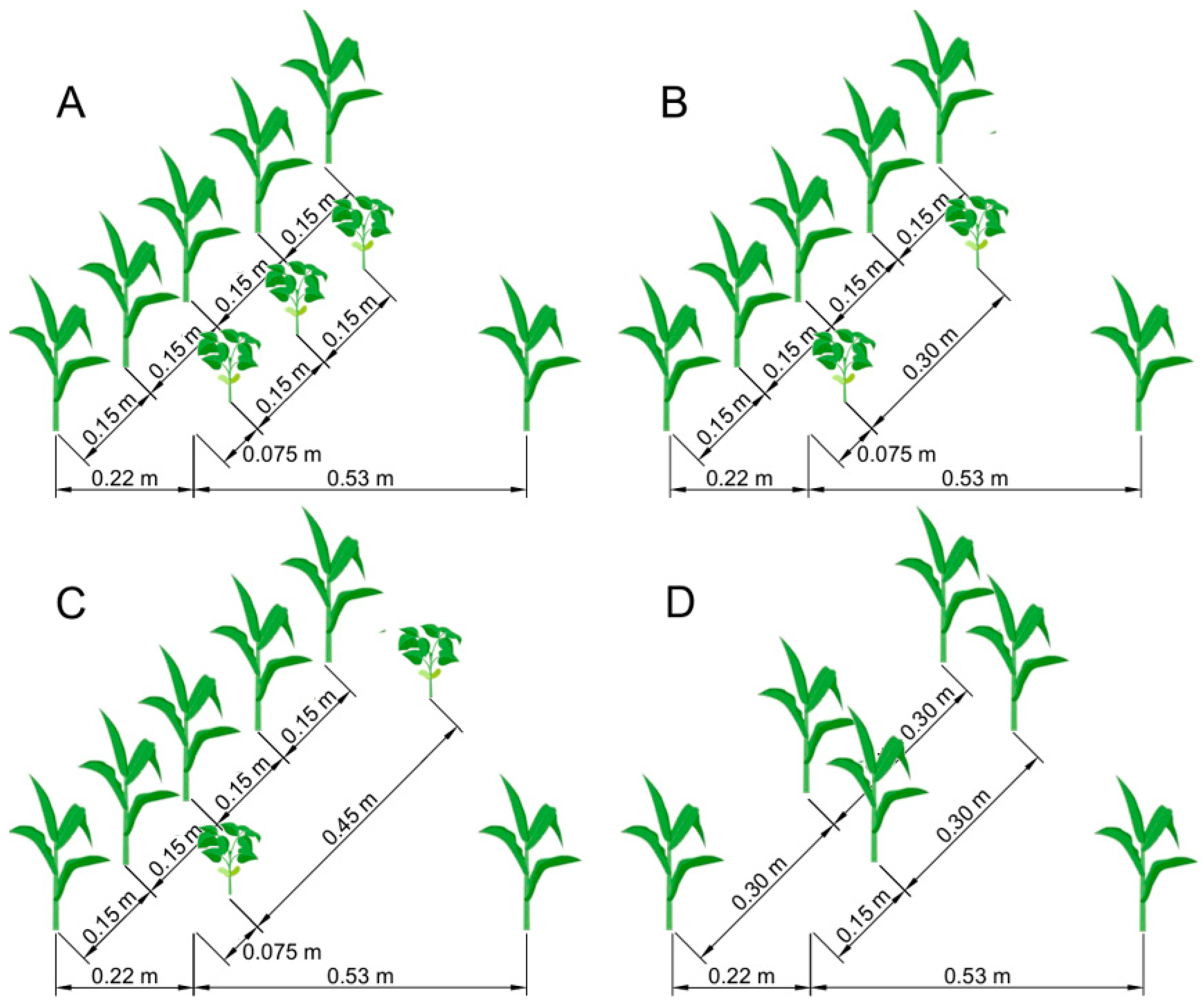
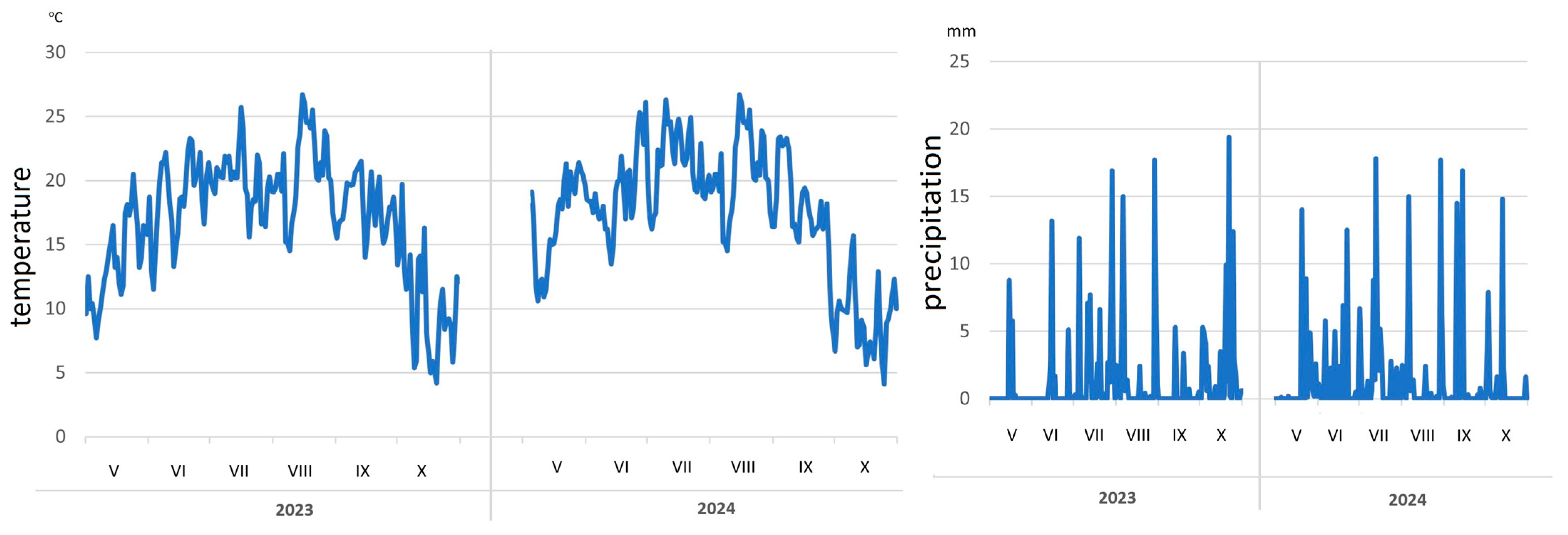
Enhancing Maize–Climbing Bean Intercropping with Biostimulants: Implications for Yield and Silage Quality


Abstract
1. Introduction
2. Materials and Methods
2.1. Field Research
2.2. Data Collection
2.3. Statistical Analysis
3. Results
4. Discussion
4.1. Intercropping
4.2. Biostimulants
5. Conclusions
Supplementary Materials
Author Contributions
Funding
Data Availability Statement
Conflicts of Interest
Abbreviations
| CFU | Colony Forming Units |
References
- Raza, A.; Asghar, M.A.; Ahmad, B.; Bin, C.; Iftikhar Hussain, M.; Li, W.; Iqbal, T.; Yaseen, M.; Shafiq, I.; Yi, Z.; et al. Agro-techniques for lodging stress management in maize-soybean intercropping system—A Review. Plants 2020, 9, 1592. [Google Scholar] [CrossRef]
- Norris, K. Agriculture and biodiversity conservation: Opportunity knocks. Conserv. Lett. 2008, 1, 2–11. [Google Scholar] [CrossRef]
- Vogel, E.; Meyer, R. Climate change, climate extremes, and global food production—Adaptation in the agricultural sector. In Resilience; Elsevier: Amsterdam, The Netherlands, 2018; pp. 31–49. [Google Scholar] [CrossRef]
- Pierre, J.F.; Latournerie-Moreno, L.; Garruña, R.; Jacobsen, K.L.; Laboski, C.A.M.; Us-Santamaría, R.; Ruiz-Sánchez, E. Effect of maize–legume intercropping on maize physio-agronomic parameters and beneficial insect abundance. Sustainability 2022, 14, 12385. [Google Scholar] [CrossRef]
- Secretariat of the Convention on Biological Diversity. Biodiversity and Agriculture: Safeguarding Biodiversity and Securing Food for the World; Secretariat of the Convention on Biological Diversity: Montreal, QC, Canada, 2008; ISBN 978-92-9225-111-6. [Google Scholar]
- Księżak, J.; Staniak, M.; Stalenga, J. Restoring the importance of cereal-grain legume mixtures in low-input farming systems. Agriculture 2023, 13, 341. [Google Scholar] [CrossRef]
- Annicchiarico, P.; Collins, R.P.; De Ron, A.M.; Firmat, C.; Litrico, I.; Hauggaard-Nielsen, H. Do we need specific breeding for legume-based mixtures? Adv. Agron. 2018, 157, 141–215. [Google Scholar] [CrossRef]
- Marchesini, G.; Serva, L.; Chinello, M.; Gazziero, M.; Tenti, S.; Mirisola, M.; Garbin, E.; Contiero, B.; Grandis, D.; Andrighetto, I. Effect of maturity stage at harvest on the ensilability of maize hybrids in the early and late FAO classes, grown in areas differing in yield potential. Grass Forage Sci. 2019, 74, 415–426. [Google Scholar] [CrossRef]
- Ahmed, S.; Raza, M.A.; Zhou, T.; Hussain, S.; Khalid, M.H.B.; Feng, L.; Wasaya, A.; Iqbal, N.; Ahmed, A.; Liu, W. Responses of soybean dry matter production, phosphorus accumulation, and seed yield to sowing time under relay intercropping with maize. Agronomy 2018, 8, 282. [Google Scholar] [CrossRef]
- Yang, F.; Liao, D.; Wu, X.; Gao, R.; Fan, Y.; Raza, M.A.; Wang, X.; Yong, T.; Liu, W.; Liu, J. Effect of aboveground and belowground interactions on the intercrop yields in maize-soybean relay intercropping systems. Field Crops Res. 2017, 203, 16–23. [Google Scholar] [CrossRef]
- Raza, M.A.; Feng, L.Y.; van Der Werf, W.; Iqbal, N.; Khalid, M.H.B.; Chen, Y.K.; Wasaya, A.; Ahmed, S.; Din, A.M.U.; Khan, A. Maize leaf-removal: A new agronomic approach to increase dry matter, flower number and seed-yield of soybean in maize soybean relay intercropping system. Sci. Rep. 2019, 9, 13453. [Google Scholar] [CrossRef] [PubMed]
- Nurk, L.; Graß, R.; Pekrun, C.; Wachendorf, M. Effect of sowing method and weed control on the performance of maize (Zea mays L.) intercropped with climbing beans (Phaseolus vulgaris L.). Agriculture 2017, 7, 51. [Google Scholar] [CrossRef]
- Lithourgidis, A.S.; Dordas, C.A.; Damalas, C.A.; Vlachostergios, D. Annual intercrops: An alternative pathway for sustainable agriculture. Aust. J. Crop Sci. 2011, 5, 396. [Google Scholar]
- Li, J.; Van Gerrewey, T.; Geelen, D. A Meta-analysis of biostimulant yield effectiveness in field trials. Front. Plant Sci. 2022, 13, 836702. [Google Scholar] [CrossRef] [PubMed]
- European Biostimulants Industry Council (EBIC). Plant Biostimulants Contribute to Climate-Smart Agriculture. Available online: https://biostimulants.eu/issue/plant-biostimulants-contribute-to-climate-smart-agriculture (accessed on 15 September 2025).
- Silva, M.S.R.D.A.d.; Santos, B.D.M.S.D.; Silva, C.S.R.D.A.D.; Antunes, L.F.D.S.; dos Santos, R.M.; Santos, C.H.B.; Rigobelo, E.C. Humic substances in combination with plant growth-promoting bacteria as an alternative for sustainable agriculture. Front. Microbiol. 2021, 12, 719653. [Google Scholar] [CrossRef] [PubMed]
- Mackiewicz-Walec, E.; Olszewska, M. Biostimulants in the production of forage grasses and turfgrasses. Agriculture 2023, 13, 1796. [Google Scholar] [CrossRef]
- Sobiech, Ł.; Grzanka, M.; Idziak, R.; Blecharczyk, A. The effect of post-emergence application of biostimulants and soil amendments in maize cultivation on the growth and yield of plants. Plants 2025, 14, 1274. [Google Scholar] [CrossRef]
- Boscaro, R.; Panozzo, A.; Piotto, S.; Moore, S.S.; Barion, G.; Wang, Y.; Vamerali, T. Effects of foliar-applied mixed mineral fertilizers and organic biostimulants on the growth and hybrid seed production of a male-sterile inbred maize line. Plants 2023, 12, 2837. [Google Scholar] [CrossRef]
- Ciepiela, G.A. The Effect of biostimulants derived from various materials on the yield and selected organic components of italian rye grass (Lolium multiflorum Lam.) against the background of nitrogen regime. Appl. Ecol. Env. Res. 2019, 17, 12407–12418. [Google Scholar] [CrossRef]
- Alharbi, K.; Hafez, E.M.; Omara, A.E.-D.; Nehela, Y. Composted bagasse and/or cyanobacteria-based bio-stimulants maintain barley growth and productivity under salinity stress. Plants 2023, 12, 1827. [Google Scholar] [CrossRef]
- Petropoulos, S.A.; Fernandes, Â.; Plexida, S.; Chrysargyris, A.; Tzortzakis, N.; Barreira, J.C.M.; Barros, L.; Ferreira, I.C.F.R. Biostimulants application alleviates water stress effects on yield and chemical composition of greenhouse green bean (Phaseolus vulgaris L.). Agronomy 2020, 10, 181. [Google Scholar] [CrossRef]
- Mazurenko, B.; Sani, M.N.H.; Litvinov, D.; Kalenska, S.; Kovalenko, V.; Shpakovych, I.; Pikovska, O.; Gordienko, L.; Yong, J.W.H.; Ghaley, B.B.; et al. Biostimulants-induced improvements in pea-barley intercropping systems: A study of biomass and yield optimization under Ukrainian climatic conditions. J. Agric. Food Res. 2025, 22, 102074. [Google Scholar] [CrossRef]
- Bulgari, R.; Cocetta, G.; Trivellini, A.; Vernieri, P.; Ferrante, A. Biostimulants and crop responses: A review. Biol. Agric. Hortic. 2014, 31, 1–17. [Google Scholar] [CrossRef]
- Mosalman, S.; Rezaei-Chiyaneh, E.; Mahdavikia, H.; Dolatabadian, A.; Siddique, K.H. Enhancing rainfed safflower yield, oil content, and fatty acid composition through intercropping with chickpea and stress-modifier biostimulants. Front. Agron. 2024, 6, 1389045. [Google Scholar] [CrossRef]
- Gao, C.; El-Sawah, A.M.; Ali, D.F.I.; Alhaj Hamoud, Y.; Shaghaleh, H.; Sheteiwy, M.S. The integration of bio and organic fertilizers improve plant growth, grain yield, quality and metabolism of hybrid maize (Zea mays L.). Agronomy 2020, 10, 319. [Google Scholar] [CrossRef]
- Kintl, A.; Huňady, I.; Vítěz, T.; Brtnický, M.; Sobotková, J.; Hammerschmiedt, T.; Vítězová, M.; Holátko, J.; Smutný, V.; Elbl, J. Effect of legumes intercropped with maize on biomass yield and subsequent biogas production. Agronomy 2023, 13, 2775. [Google Scholar] [CrossRef]
- Zhang, W.; Gao, S.; Li, Z.; Xu, H.; Yang, H.; Yang, X.; Fan, H.; Su, Y.; Fornara, D.; Li, L. Shifts from complementarity to selection effects maintain high productivity in maize/legume intercropping systems. J. Appl. Ecol. 2021, 58, 2603–2613. [Google Scholar] [CrossRef]
- Corre-Hellou, G.; Dibet, A.; Hauggaard-Nielsen, H.; Crozat, Y.; Gooding, M.; Ambus, P.; Dahlmann, C.; von Fragstein, P.; Pristeri, A.; Monti, M.; et al. The competitive ability of pea–barley intercrops against weeds and the interactions with crop productivity and soil N availability. Field Crops Res. 2011, 122, 264–272. [Google Scholar] [CrossRef]
- Fu, Z.; Chen, P.; Zhang, X.; Du, Q.; Zheng, B.; Yang, H.; Luo, K.; Lin, P.; Li, Y.; Pu, T.; et al. Maize-legume intercropping achieves yield advantages by improving leaf functions and dry matter partition. BMC Plant Biol. 2023, 23, 438. [Google Scholar] [CrossRef]
- Zhang, H.; Shi, W.; Ali, S.; Chang, S.; Jia, Q.; Hou, F. Legume/maize intercropping and N application for improved yield, quality, water and N utilization for forage production. Agronomy 2022, 12, 1777. [Google Scholar] [CrossRef]
- Javanmard, A.; Machiani, M.A.; Lithourgidis, A.; Morshedloo, M.R.; Ostadi, A. Intercropping of maize with legumes: A cleaner strategy for improving the quantity and quality of forage. Clean. Eng. Technol. 2020, 1, 100003. [Google Scholar] [CrossRef]
- Villwock, D.; Kurz, S.; Hartung, J.; Müller-Lindenlauf, M. Effects of stand density and N fertilization on the performance of maize (Zea mays L.) intercropped with climbing beans (Phaseolus vulgaris L.). Agriculture 2022, 12, 967. [Google Scholar] [CrossRef]
- Suárez, J.C.; Anzola, J.A.; Contreras, A.T.; Salas, D.L.; Vanegas, J.I.; Urban, M.O.; Beebe, S.E.; Rao, I.M. Influence of simultaneous intercropping of maize-bean with input of inorganic or organic fertilizer on growth, development, and dry matter partitioning to yield components of two lines of common bean. Agronomy 2022, 12, 1216. [Google Scholar] [CrossRef]
- Wysokinski, A.; Kożuchowska, M. Increasing silage maize yield and nitrogen use efficiency as a result of combined rabbit manure and mineral nitrogen fertilization. Sci. Rep. 2024, 14, 5856. [Google Scholar] [CrossRef]
- Wu, Y.; Gong, W.; Yang, W. Shade inhibits leaf size by controlling cell proliferation and enlargement in soybean. Sci. Rep. 2017, 7, 9259. [Google Scholar] [CrossRef]
- Khalid, M.; Raza, M.; Yu, H.; Sun, F.; Zhang, Y.; Lu, F.; Si, L.; Iqbal, N.; Khan, I.; Fu, F. Effect of shade treatments on morphology, photosynthetic and chlorophyll fluorescence characteristics of soybeans (Glycine max L. Merr.). Appl. Ecol. Environ. Res. 2019, 17, 2551–2569. [Google Scholar] [CrossRef]
- Feng, L.; Raza, M.A.; Li, Z.; Chen, Y.; Khalid, M.H.B.; Du, J.; Liu, W.; Wu, X.; Song, C.; Yu, L. the influence of light intensity and leaf movement on photosynthesis characteristics and carbon balance of soybean. Front. Plant Sci. 2018, 9, 1952. [Google Scholar] [CrossRef]
- Baez-Gonzalez, A.D.; Fajardo-Diaz, R.; Padilla-Ramirez, J.S.; Osuna-Ceja, E.S.; Kiniry, J.R.; Meki, M.N.; Acosta-Díaz, E. Yield performance and response to high plant densities of dry bean (Phaseolus vulgaris L.) cultivars under semi-arid conditions. Agronomy 2020, 10, 1684. [Google Scholar] [CrossRef]
- Musana, R.F.; Rucamumihigo, F.X.; Nirere, D.; Mbaraka, S.R. Growth and yield performance of common bean (Phaseolus vulgaris L.) as influenced by plant density at Nyagatare, East Rwanda. AJFAND 2020, 20, 16249–16261. [Google Scholar] [CrossRef]
- Soe Htet, M.N.; Wang, H.; Yadav, V.; Sompouviseth, T.; Feng, B. Legume integration augments the forage productivity and quality in maize-based system in the Loess Plateau Region. Sustainability 2022, 14, 6022. [Google Scholar] [CrossRef]
- Iqbal, M.A.; Hamid, A.; Ahmad, T.; Siddiqui, M.H.; Hussain, I.; Ali, S.; Ali, A.; Ahmad, Z. Forage sorghum-legumes intercropping: Effect on growth, yields, nutritional quality and economics returns. Bragantia 2018, 78, 82–95. [Google Scholar] [CrossRef]
- Liu, R.; Lal, R. Synthetic apatite nanoparticles as a phosphorus fertilizer for soybean (Glycine max). Sci. Rep. 2014, 4, 5686. [Google Scholar] [CrossRef] [PubMed]
- Kocira, A.; Świeca, M.; Kocira, S.; Złotek, U.; Jakubczyk, A. Enhancement of yield, nutritional and nutraceutical properties of two common bean cultivars following the application of seaweed extract (Ecklonia maxima). Saudi J. Biol. Sci. 2018, 25, 563–571. [Google Scholar] [CrossRef]
- Guardiola-Márquez, C.E.; Santos-Ramírez, M.T.; Segura-Jiménez, M.E.; Figueroa-Montes, M.L.; Jacobo-Velázquez, D.A. Fighting obesity-related micronutrient deficiencies through biofortification of agri-food crops with sustainable fertilization practices. Plants 2022, 11, 3477. [Google Scholar] [CrossRef] [PubMed]
- Ratajczak, K.; Sulewska, H.; Panasiewicz, K.; Faligowska, A.; Szymańska, G. Phytostimulator Application after cold stress for better maize (Zea mays L.) plant recovery. Agriculture 2023, 13, 569. [Google Scholar] [CrossRef]
- Dong, Y.J.; He, M.R.; Wang, Z.L.; Chen, W.F.; Hou, J.; Qiu, X.K.; Zhang, J.W. Effects of new coated release fertilizer on the growth of maize. J. Soil Sci. Plant Nutr. 2016, 16, 637–649. [Google Scholar] [CrossRef][Green Version]
- Gupta, S.D.; Agarwal, A.; Pradhan, S. Phytostimulatory effect of silver nanoparticles (AgNPs) on rice seedling growth: An insight from antioxidative enzyme activities and gene expression patterns. Ecotoxicol. Environ. Saf. 2018, 161, 624–633. [Google Scholar] [CrossRef] [PubMed]
- Sharma, H.S.; Fleming, C.; Selby, C.; Rao, J.R.; Martin, T. Plant biostimulants: A review on the processing of macroalgae and use of extracts for crop management to reduce abiotic and biotic stresses. J. Appl. Phycol. 2014, 26, 465–490. [Google Scholar] [CrossRef]
- Siwik-Ziomek, A.; Szczepanek, M. Soil extracellular enzyme activities and uptake of N by oilseed rape depending on fertilization and seaweed biostimulant application. Agronomy 2019, 9, 480. [Google Scholar] [CrossRef]
- Pienaar, B.C.; Majeke, B.M.; Wittenberg, M.F.; Adetunji, A.E.; Nephali, L.; Tugizimana, F.; Rafudeen, M.S. Mitigating salt stress in maize using Ecklonia maxima seaweed extracts. Plant Stress 2025, 16, 100828. [Google Scholar] [CrossRef]
- Tandathu, T.; Kotzé, E.; Van Der Watt, E.; Khetsha, Z.P. Effect of Biostimulants and Glyphosate on morphophysiological parameters of Zea mays (L.) seedlings under controlled conditions. Agronomy 2024, 14, 2396. [Google Scholar] [CrossRef]
- Matysiak, K.; Adamczewski, K. Wpływ bioregulatora Kelpak na plonowanie roślin uprawnych. Prog. Plant Prot. 2006, 46, 102–108. (In Polish) [Google Scholar]
- Glińska, S.; Bartczak, M.; Oleksiak, S.; Wolska, A.; Gabara, B.; Posmyk, M.M. Effects of anthocyanin-rich extract from red cabbage leaves on meristematic cells of Allium cepa L. roots treated with heavy metals. Ecotox. Environ. Safe 2007, 68, 343–350. [Google Scholar] [CrossRef] [PubMed]
- El-Katony, T.M.; Ward, F.M.; Deyab, M.A.; El-Adl, M.F. Algal amendment improved yield and grain quality of rice with alleviation of the impacts of salt stress and water stress. Heliyon 2021, 7, e07911. [Google Scholar] [CrossRef]
- El-Akhdar, I.; Elsakhawy, T.; Abo-Koura, H.A. Alleviation of salt stress on wheat (Triticum aestivum L.) by plant growth promoting bacteria strains Bacillus halotolerans MSR-H4 and Lelliottia amnigena MSR-M49. J. Adv. Microbiol. 2020, 20, 44–58. [Google Scholar] [CrossRef]
- Çam, S.; Küçük, Ç.; Almaca, A. Bacillus strains exhibit various plant growth promoting traits and their biofilm-forming capability correlates to their salt stress alleviation effect on maize seedlings. J. Biotechnol. 2023, 369, 35–42. [Google Scholar] [CrossRef]
- Lata, D.L.; Abdie, O.; Rezene, Y. IAA-Producing bacteria from the rhizosphere of chickpea (Cicer arietinum L.): Isolation, characterization, and their effects on plant growth performance. Heliyon 2024, 10, e39702. [Google Scholar] [CrossRef]
- Khan, A.; Doshi, H.V.; Thakur, M.C. Bacillus spp.: A Prolific siderophore producer. In Bacilli and Agrobiotechnology; Islam, M.T., Rahman, M., Pandey, P., Jha, C.K., Aeron, A., Eds.; Springer International Publishing: Cham, Switzerland, 2016; pp. 309–323. ISBN 978-3-319-44409-3. [Google Scholar]
- Misra, S.; Chauhan, P.S. ACC deaminase-producing rhizosphere competent Bacillus spp. mitigate salt stress and promote Zea mays growth by modulating ethylene metabolism. 3 Biotech 2020, 10, 119. [Google Scholar] [CrossRef]
- Jain, S.; Varma, A.; Choudhary, D.K. Perspectives on nitrogen-fixing bacillus species. In Soil Nitrogen Ecology; Cruz, C., Vishwakarma, K., Choudhary, D.K., Varma, A., Eds.; Springer International Publishing: Cham, Switzerland, 2021; pp. 359–369. ISBN 978-3-030-71206-8. [Google Scholar]
- Rafanomezantsoa, P.; El-Hasan, A.; Voegele, R.T. Potential of Bacillus halotolerans in mitigating biotic and abiotic stresses: A comprehensive review. Stresses 2025, 5, 24. [Google Scholar] [CrossRef]
- Feitoza de Jesus Santos, A.; Da Cas Bundt, A. A inoculação foliar com Methylobacterium symbioticum SB23 melhora a fixação de nitrogênio e a produtividade do milho em diferentes condições edafoclimáticas. Agrária—Rev. Bras. De Ciências Agrárias 2025, 20, e4182. [Google Scholar] [CrossRef]
- Valente, F.; Panozzo, A.; Bozzolin, F.; Barion, G.; Bolla, P.K.; Bertin, V.; Potestio, S.; Visioli, G.; Wang, Y.; Vamerali, T. Growth, photosynthesis and yield responses of common wheat to foliar application of Methylobacterium symbioticum under decreasing chemical nitrogen fertilization. Agriculture 2024, 14, 1670. [Google Scholar] [CrossRef]
- Vera, R.T.; García, A.J.B.; Álvarez, F.J.C.; Ruiz, J.M.; Martín, F.F. Application and effectiveness of Methylobacterium symbioticum as a biological inoculant in maize and strawberry crops. Folia Microbiol. 2024, 69, 121–131. [Google Scholar] [CrossRef]
- Rodrigues, M.Â.; Correia, C.M.; Arrobas, M. The application of a foliar spray containing Methylobacterium symbioticum had a limited effect on crop yield and nitrogen recovery in field and pot-grown maize. Plants 2024, 13, 2909. [Google Scholar] [CrossRef]
- Arrobas, M.; Correia, C.M.; Rodrigues, M.Â. Methylobacterium symbioticum applied as a foliar inoculant was little effective in enhancing nitrogen fixation and lettuce dry matter yield. Sustainability 2024, 16, 4512. [Google Scholar] [CrossRef]
- Gyogluu Wardjomto, C.; Mohammed, M.; Ngmenzuma, T.Y.; Mohale, K.C. Effect of rhizobia inoculation and seaweed extract (Ecklonia maxima) application on the growth, symbiotic performance and nutritional content of cowpea (Vigna unguiculata (L.) Walp.). Front. Agron. 2023, 5, 1138263. [Google Scholar] [CrossRef]
- Serafin-Andrzejewska, M.; Falkiewicz, A.; Wojciechowski, W.; Kozak, M. Yield and seed quality of faba bean (Vicia faba L. var. minor) as a result of symbiosis with nitrogen-fixing bacteria. Agriculture 2025, 15, 960. [Google Scholar] [CrossRef]
- Vasantharaja, R.; Abraham, L.S.; Inbakandan, D.; Thirugnanasambandam, R.; Senthilvelan, T.; Jabeen, S.A.; Prakash, P. Influence of seaweed extracts on growth, phytochemical contents and antioxidant capacity of cowpea (Vigna unguiculata L. Walp). Biocatal. Agric. Biotechnol. 2019, 17, 589–594. [Google Scholar] [CrossRef]
- Al-Temimi, A.H.M.; Al-Hilfy, I.H.H. Role of plant growth promoting in improving productivity and quality of maize. Iraqi. J. Agric. Sci. 2022, 53, 1437–1446. [Google Scholar] [CrossRef]
- Kalman, C.D.; Kálmán, L.; Szél, S.; Salamon, K.M.; Xoltan, N.; Kiss, E.; Posta, K. Assessment of the influence of soil inoculation on changes in the adaptability of maize hybrids. Cereal Res. Commun. 2023, 51, 1055–1071. [Google Scholar] [CrossRef]
- Ocwa, A.; Mohammed, S.; Mousavi, S.M.N.; Illés, Á.; Bojtor, C.; Ragán, P.; Rátonyi, T.; Harsányi, E. Maize grain yield and quality improvement through biostimulant application: A systematic review. J. Soil Sci. Plant Nutr. 2024, 24, 1609–1649. [Google Scholar] [CrossRef]



| Parameter | Value |
|---|---|
| pH | 6.1 |
| Organic carbon, % | 1.02 |
| P, mg 100 g−1 soil | 12.83 |
| K, mg 100 g−1 soil | 9.84 |
| Mg, mg 100 g−1 soil | 5.31 |
| Nmin 0–30 cm, mg kg−1 soil | 2.95 |
| Nmin 30–60 cm, mg kg−1 soil | 5.60 |
| Biostimulants | Intercropping | ||||||
|---|---|---|---|---|---|---|---|
| I1 | I2 | I3 | Sole Maize | ||||
| Maize | Climbing Beans | Maize | Climbing Beans | Maize | Climbing Beans | ||
| control | 88,628 | 63,630 | 87,264 | 47,821 | 87,264 | 21,450 | 89,082 |
| B1 1 | 83,628 | 69,084 | 89,991 | 44,070 | 83,628 | 22,165 | 86,355 |
| B2 | 85,446 | 67,266 | 89,991 | 45,008 | 83,628 | 22,165 | 80,901 |
| B3 | 87,264 | 70,902 | 88,900 | 43,133 | 85,446 | 24,310 | 79,992 |
| B4 | 88,173 | 76,356 | 86,173 | 45,477 | 82,719 | 22,165 | 80,901 |
| Dry Matter Maize Cobs, g Plants−1 | |||||
|---|---|---|---|---|---|
| Biostimulants | Intercropping | Means | |||
| I1 | I2 | I3 | sole maize | ||
| control | 140.30 | 145.90 | 161.82 | 167.20 | 153.80 A 2 |
| B1 1 | 169.89 | 167.42 | 183.33 | 187.82 | 177.11 C |
| B2 | 152.40 | 154.20 | 174.14 | 182.66 | 165.85 B |
| B3 | 162.49 | 158.46 | 173.47 | 175.71 | 167.53 BC |
| B4 | 147.92 | 156.21 | 165.63 | 168.09 | 159.46 AB |
| Means | 154.60 A | 156.44 A | 171.68 B | 176.30 B | |
| Dry Matter Maize Leaves, g Plants−1 | |||||
| Biostimulants | Intercropping | Means | |||
| I1 | I2 | I3 | sole maize | ||
| control | 25.07 | 22.10 | 30.59 | 32.48 | 27.56 A |
| B1 | 29.51 | 27.36 | 34.23 | 35.71 | 31.70 B |
| B2 | 32.88 | 33.02 | 34.37 | 39.89 | 35.04 BC |
| B3 | 34.64 | 35.58 | 36.52 | 37.87 | 36.15 C |
| B4 | 28.98 | 29.38 | 33.02 | 37.20 | 32.14 B |
| Means | 30.22 A | 29.49 A | 33.75 B | 36.63 B | |
| Dry Matter Maize Stems, g Plants−1 | |||||
| Biostimulants | Intercropping | Means | |||
| I1 | I2 | I3 | sole maize | ||
| control | 34.77 | 33.05 | 47.68 | 50.57 | 41.52 A |
| B1 | 39.55 | 40.10 | 49.67 | 52.29 | 45.40 AB |
| B2 | 45.06 | 45.24 | 52.02 | 51.57 | 48.47 B |
| B3 | 41.00 | 39.92 | 51.75 | 53.64 | 46.58 AB |
| B4 | 35.94 | 34.77 | 50.75 | 51.29 | 43.19 AB |
| Means | 39.27 A | 38.62 A | 50.37 B | 51.87 B | |
| Dry Matter Climbing Beans Pods, g Plants−1 | ||||
|---|---|---|---|---|
| Biostimulants | Intercropping | Means | ||
| I1 | I2 | I3 | ||
| control | 2.95 | 7.84 | 5.18 | 5.32 C |
| B1 1 | 2.37 | 7.04 | 4.56 | 4.65 AB |
| B2 | 2.37 | 7.29 | 4.89 | 4.85 B |
| B3 | 2.37 | 6.71 | 4.92 | 4.67 AB |
| B4 | 2.08 | 6.23 | 4.38 | 4.23 A |
| Means | 2.43 A | 7.02 C | 4.78 B | |
| Dry Matter Climbing Beans Leaves, g Plants−1 | ||||
| Biostimulants | Intercropping | Means | ||
| I1 | I2 | I3 | ||
| control | 13.50 | 25.40 | 20.93 | 19.94 B |
| B1 | 10.63 | 22.70 | 19.58 | 17.63 AB |
| B2 | 10.72 | 23.03 | 19.74 | 17.83 AB |
| B3 | 12.15 | 24.64 | 20.33 | 19.04 AB |
| B4 | 9.96 | 21.52 | 18.82 | 16.76 A |
| Means | 11.39 A | 23.46 B | 19.88 B | |
| Dry Matter Climbing Beans Stems, g Plants−1 | ||||
| Biostimulants | Intercropping | Means | ||
| I1 | I2 | I3 | ||
| control | 25.49 | 48.48 | 32.18 | 35.38 B 2 |
| B1 | 23.19 | 44.08 | 25.79 | 31.02 AB |
| B2 | 22.39 | 40.08 | 26.19 | 29.55 A |
| B3 | 22.39 | 42.58 | 26.09 | 30.35 AB |
| B4 | 20.69 | 39.88 | 26.49 | 29.02 A |
| Means | 22.83 A | 43.02 B | 27.35 A | |
| Biostimulants | Intercropping | Means | |||
|---|---|---|---|---|---|
| I1 | I2 | I3 | Sole Maize | ||
| control | 185.05 a 2 | 193.69 b | 233.71 c | 241.73 c | 213.55 A |
| B1 1 | 209.72 a | 214.45 a | 251.44 b | 254.30 b | 232.48 BC |
| B2 | 212.19 a | 222.03 b | 252.40 c | 257.23 c | 235.96 C |
| B3 | 212.94 a | 218.18 b | 253.95 c | 256.98 c | 235.51 C |
| B4 | 203.16 a | 210.31 b | 247.09 c | 251.08 c | 227.91 B |
| Means | 204.61 A | 211.73 B | 247.72 C | 252.26 C | |
| Biostimulants | Intercropping | Means | ||
|---|---|---|---|---|
| I1 | I2 | I3 | ||
| control | 38.49 | 87.51 | 62.63 | 62.88 C 2 |
| B1 1 | 33.43 | 80.41 | 57.34 | 57.06 AB |
| B2 | 32.85 | 78.45 | 56.71 | 56.00 AB |
| B3 | 34.31 | 81.65 | 58.01 | 57.99 B |
| B4 | 31.47 | 77.54 | 56.08 | 55.03 A |
| Means | 34.11 A | 81.11 C | 58.15 B | |
| Biostimulants | Intercropping | Means | |||
|---|---|---|---|---|---|
| I1 | I2 | I3 | Sole Maize | ||
| control | 16.84 a 2 | 17.06 a | 20.38 b | 19.93 b | 18.55 A |
| B1 1 | 17.48 a | 19.33 b | 21.03 b | 22.25 c | 20.02 B |
| B2 | 18.12 a | 19.98 b | 21.12 c | 20.84 bc | 20.02 B |
| B3 | 18.55 a | 19.59 b | 21.71 c | 20.57 b | 20.10 B |
| B4 | 17.91 a | 18.14 a | 20.44 b | 20.33 b | 19.20 A |
| Means | 17.78 A | 18.82 B | 20.94 C | 20.78 C | |
| Biostimulants | Intercropping | Means | ||
|---|---|---|---|---|
| I1 | I2 | I3 | ||
| control | 2.46 | 5.19 | 1.34 | 3.00 B 2 |
| B1 1 | 2.30 | 4.54 | 1.26 | 2.70 A |
| B2 | 2.21 | 4.53 | 1.25 | 2.66 A |
| B3 | 2.44 | 4.52 | 1.41 | 2.79 A |
| B4 | 2.41 | 4.52 | 1.25 | 2.72 A |
| Means | 2.36 B | 4.66 C | 1.30 A | |
| Biostimulants | Intercropping | Means | |||
|---|---|---|---|---|---|
| I1 | I2 | I3 | Sole Maize | ||
| control | 19.29 | 23.13 | 21.72 | 19.93 | 21.02 A 2 |
| B1 1 | 19.77 | 24.31 | 22.29 | 22.25 | 22.15 B |
| B2 | 20.33 | 25.63 | 22.37 | 20.84 | 22.29 B |
| B3 | 20.99 | 24.17 | 23.12 | 20.57 | 22.21 B |
| B4 | 20.31 | 22.91 | 21.69 | 20.33 | 21.31 A |
| Means | 20.14 A | 24.03 C | 22.24 B | 20.78 AB | |
| Biostimulants | Intercropping | Means | |||
|---|---|---|---|---|---|
| I1 | I2 | I3 | Sole Maize | ||
| control | 91.6 c 2 | 106.3 d | 84.5 b | 75.6 a | 89.5 A |
| B1 1 | 96.5 c | 111.3 d | 93.0 b | 77.5 a | 94.6 B |
| B2 | 98.3 c | 110.3 d | 92.0 b | 78.2 a | 94.7 B |
| B3 | 99.5 b | 115.4 c | 96.7 b | 80.2 a | 97.9 C |
| B4 | 95.4 b | 109.2 c | 91.8 b | 79.4 a | 93.9 BC |
| Means | 96.2 C | 110.5 D | 91.6 B | 78.1 A | |
Disclaimer/Publisher’s Note: The statements, opinions and data contained in all publications are solely those of the individual author(s) and contributor(s) and not of MDPI and/or the editor(s). MDPI and/or the editor(s) disclaim responsibility for any injury to people or property resulting from any ideas, methods, instructions or products referred to in the content. |
© 2025 by the authors. Licensee MDPI, Basel, Switzerland. This article is an open access article distributed under the terms and conditions of the Creative Commons Attribution (CC BY) license (https://creativecommons.org/licenses/by/4.0/).
Share and Cite
Górski, R.; Sikorska, A.; Czaplicki, R.; Mystkowska, I. Enhancing Maize–Climbing Bean Intercropping with Biostimulants: Implications for Yield and Silage Quality. Agronomy 2025, 15, 2894. https://doi.org/10.3390/agronomy15122894
Górski R, Sikorska A, Czaplicki R, Mystkowska I. Enhancing Maize–Climbing Bean Intercropping with Biostimulants: Implications for Yield and Silage Quality. Agronomy. 2025; 15(12):2894. https://doi.org/10.3390/agronomy15122894
Chicago/Turabian StyleGórski, Rafał, Anna Sikorska, Robert Czaplicki, and Iwona Mystkowska. 2025. "Enhancing Maize–Climbing Bean Intercropping with Biostimulants: Implications for Yield and Silage Quality" Agronomy 15, no. 12: 2894. https://doi.org/10.3390/agronomy15122894
APA StyleGórski, R., Sikorska, A., Czaplicki, R., & Mystkowska, I. (2025). Enhancing Maize–Climbing Bean Intercropping with Biostimulants: Implications for Yield and Silage Quality. Agronomy, 15(12), 2894. https://doi.org/10.3390/agronomy15122894