
Integrating Infiltration Holes into Ridge–Furrow Systems Enhances Drought Resilience and Yield of Maize in Semi-Arid China


Abstract
1. Introduction
2. Materials and Methods
2.1. Study Site
2.2. Experimental Design and Field Management
2.3. Sampling and Measurements
2.3.1. Soil Water Storage
2.3.2. Soil Bulk Density
2.3.3. Dry Matter and Plant Height
2.3.4. Root Sampling and Root Weight Density
2.3.5. Maize Yield
2.3.6. Total Evapotranspiration, Water Use Efficiency, and Precipitation Use Efficiency
2.4. Statistical Analysis
3. Results
3.1. Spatiotemporal Dynamics of Soil Water Storage
3.2. Plant Height
3.3. Dry Matter
3.4. Root Weight Density
3.5. Maize Yield, Water Use Efficiency, and Precipitation Use Efficiency
4. Discussion
4.1. Adding Infiltration Holes to the DRFM Optimized the Spatiotemporal Distribution of Soil Water Storage
4.2. Adding Infiltration Holes to the DRFM Promoted Root–Shoot Synergistic Growth and ADM
4.3. Synergistic Enhancement of Maize Yield and WUE
5. Conclusions
Supplementary Materials
Author Contributions
Funding
Data Availability Statement
Conflicts of Interest
References
- Lobell, D.B.; Gourdji, S.M. The influence of climate change on global crop productivity. Plant Physiol. 2012, 160, 1686–1697. [Google Scholar] [CrossRef]
- Tester, M.; Langridge, P. Breeding technologies to increase crop production in a changing world. Science 2010, 327, 818–822. [Google Scholar] [CrossRef] [PubMed]
- Zhang, X.D.; Kamran, M.; Xue, X.K.; Zhao, J.; Cai, T.; Jia, Z.K.; Zhang, P.; Han, Q.F. Ridge-furrow mulching system drives the efficient utilization of key production resources and the improvement of maize productivity in the Loess Plateau of China. Soil Tillage Res. 2019, 190, 10–12. [Google Scholar] [CrossRef]
- Fan, T.L.; Wang, S.Y.; Li, Y.P.; Yang, X.M.; Li, S.Z.; Ma, M.S. Film mulched furrow-ridge water harvesting planting improves agronomic productivity and water use efficiency in Rainfed Areas. Agric. Water Manag. 2019, 217, 1–10. [Google Scholar] [CrossRef]
- Li, Q.; Li, H.B.; Zhang, L.; Zhang, S.Q.; Chen, Y.L. Mulching improves yield and water-use efficiency of potato cropping in China: A meta-analysis. Field Crops Res. 2018, 221, 50–60. [Google Scholar] [CrossRef]
- Liu, P.; Wang, H.L.; Li, L.C.; Liu, X.L.; Qian, R.; Wang, J.J.; Yan, X.Q.; Cai, T.; Zhang, P.; Jia, Z.K.; et al. Ridge-furrow mulching system regulates hydrothermal conditions to promote maize yield and efficient water use in rainfed farming area. Agric. Water Manag. 2020, 232, 106041. [Google Scholar] [CrossRef]
- Wang, J.Y.; Wang, H.; Sui, Q.Q.; Dong, B.X.; Liao, Z.Q.; Yang, C.L.; Deng, X.W.; Li, Z.J.; Fan, J.L. Effects of mulching cultivation patterns on maize yield, resources use efficiency and greenhouse gas emissions of rainfed summer maize on the Loess Plateau of China. Agric. Water Manag. 2025, 315, 109574. [Google Scholar] [CrossRef]
- Wang, Q.; Song, X.Y.; Li, F.C.; Hu, G.R.; Liu, Q.L.; Zhang, E.H.; Wang, H.L.; Davies, R. Optimum ridge-furrow ratio and suitable ridge-mulching material for Alfalfa production in rainwater harvesting in semi-arid regions of China. Field Crops Res. 2015, 180, 186–196. [Google Scholar] [CrossRef]
- Herrero, M.; Thornton, P.K.; Power, B.; Bogard, J.R.; Remans, R.; Fritz, S.; Gerber, J.S.; Nelson, G.; See, L.; Waha, K.; et al. Farming and the geography of nutrient production for human use: A transdisciplinary analysis. Lancet Planet. Health 2017, 1, e33–e42. [Google Scholar] [CrossRef]
- Mashnik, D.; Jacobus, H.; Barghouth, A.; Wang, E.J.; Blanchard, J.; Shelby, R. Increasing productivity through irrigation: Problems and solutions implemented in Africa and Asia. Sustain. Energy Technol. Assess. 2017, 22, 220–227. [Google Scholar] [CrossRef]
- Ren, X.L.; Zhang, P.; Liu, X.L.; Ali, S.; Chen, X.L.; Jia, Z.K. Impacts of different mulching patterns in rainfall-harvesting planting on soil water and spring corn growth development in semihumid regions of China. Soil Res. 2017, 55, 285–295. [Google Scholar] [CrossRef]
- Ren, X.L.; Zhang, P.; Chen, X.L.; Guo, J.J.; Jia, Z.K. Effect of different mulches under rainfall concentration system on corn production in the semi-arid areas of the Loess Plateau. Sci. Rep. 2016, 6, 19019. [Google Scholar] [CrossRef]
- Liu, Y.; Yang, S.J.; Li, S.Q.; Chen, X.P.; Chen, F. Growth and development of maize (Zea mays L.) in response to different field water management practices: Resource capture and use efficiency. Agric. For. Meteorol. 2010, 150, 606–613. [Google Scholar] [CrossRef]
- Hou, F.Y.; Zhang, L.M.; Xie, B.T.; Dong, S.X.; Zhang, H.Y.; Li, A.X.; Wang, Q.M. Effect of plastic mulching on the photosynthetic capacity, endogenous hormones and root yield of summer-sown sweet potato (Ipomoea batatas (L). Lam.) in Northern China. Acta Physiol. Plant. 2015, 37, 1–10. [Google Scholar] [CrossRef]
- Jia, Q.M.; Chen, K.Y.; Chen, Y.Y.; Ali, S.; Manzoor Sohail, A.; Fahad, S. Mulch covered ridges affect maize yield of maize through regulating root growth and root-bleeding sap under simulated rainfall conditions. Soil Tillage Res. 2018, 175, 101–111. [Google Scholar] [CrossRef]
- Mo, F.; Wang, J.Y.; Zhou, H.; Luo, C.L.; Zhang, X.F.; Li, X.Y.; Li, F.M.; Xiong, L.B.; Kavagi, L.; Nguluu, S.N.; et al. Ridge-furrow plastic-mulching with balanced fertilization in rainfed maize (Zea mays L.): An adaptive management in east African Plateau. Agric. For. Meteorol. 2017, 236, 100–112. [Google Scholar] [CrossRef]
- Zhang, F.; Zhang, W.J.; Li, M.; Zhang, Y.; Li, F.M.; Li, C.B. Is crop biomass and soil carbon storage sustainable with long-term application of full plastic film mulching under future climate change? Agric. Syst. 2017, 150, 67–77. [Google Scholar] [CrossRef]
- Li, C.; Luo, X.Q.; Li, Y.; Wang, N.J.; Zhang, T.B.; Dong, Q.G.; Feng, H.; Zhang, W.X.; Siddique, K.H.M. Ridge planting with transparent plastic mulching improves maize productivity by regulating the distribution and utilization of soil water, heat, and canopy radiation in arid irrigation area. Agric. Water Manag. 2023, 280, 108230. [Google Scholar] [CrossRef]
- Wang, X.K.; Fan, J.L.; Xing, Y.Y.; Xu, G.C.; Wang, H.D.; Deng, J.; Wang, Y.F.; Zhang, F.C.; Li, P.; Li, Z.B. The effects of mulch and nitrogen fertilizer on the soil environment of crop plants. Adv. Agron. 2019, 153, 121–173. [Google Scholar] [CrossRef]
- Fan, T.L.; Li, S.Z.; Zhao, G.; Wang, S.Y.; Zhang, J.J.; Wang, L.; Dang, Y.; Cheng, W.L. Response of dryland crops to climate change and drought-resistant and water-suitable planting technology: A case of spring maize. J. Integr. Agric. 2023, 22, 2067–2079. [Google Scholar] [CrossRef]
- Zhang, X.Y.; Wang, K.; Li, G.L.; Zheng, J.Y. Infiltration holes enhance the deep soil water replenishment from a level ditch on the Loess Plateau of China. Land Degrad. Dev. 2022, 34, 1549–1557. [Google Scholar] [CrossRef]
- Zhu, W.; Li, H.J.; Qu, H.C.; Wang, Y.L.; Misselbrook, T.; Li, X.; Jiang, R. Water stress in maize production in the drylands of the Loess Plateau. Vadose Zone J. 2018, 17, 180117. [Google Scholar] [CrossRef]
- Alaoui, A.; Lipiec, J.; Gerke, H.H. A review of the changes in the soil pore system due to soil deformation: A hydrodynamic perspective. Soil Tillage Res. 2011, 115, 1–15. [Google Scholar] [CrossRef]
- Strudley, M.W.; Green, T.R.; Ascough, J.C. Tillage effects on soil hydraulic properties in space and time: State of the science. Soil Tillage Res. 2008, 99, 4–48. [Google Scholar] [CrossRef]
- Anantha, K.H.; Garg, K.K.; Akuraju, V.; Sawargaonkar, G.; Purushothaman, N.K.; Das, B.S.; Singh, R.; Jat, M.L. Sustainable intensification opportunities for Alfisols and Vertisols landscape of the semi-arid tropics. Agric. Water Manag. 2023, 284, 108332. [Google Scholar] [CrossRef]
- Wang, K.; Zhang, X.Y.; Ma, J.B.; Ma, Z.H.; Li, G.L.; Zheng, J.Y. Combining infiltration holes and level ditches to enhance the soil water and nutrient pools for semi-arid slope shrubland revegetation. Sci. Total Environ. 2020, 729, 138796. [Google Scholar] [CrossRef] [PubMed]
- Wang, K.; Zhang, X.Y.; Li, G.L.; Ma, J.B.; Zhang, S.Q.; Zheng, J.Y. Effect of using an infiltration hole and mulching in fish-scale pits on soil water, nitrogen, and organic matter contents: Evidence from a 4-year field experiment. Land Degrad. Dev. 2021, 32, 4203–4211. [Google Scholar] [CrossRef]
- Allaire, S.E.; Roulier, S.; Cessna, A.J. Quantifying preferential flow in soil: A review of different techniques. J. Hydrol. 2009, 378, 179–204. [Google Scholar] [CrossRef]
- Simunek, J.; Jarvis, N.J.; van Genuchten, M.T.; Gardenas, A. Review and comparison of models for describing non-equilibrium and preferential flow and transport in the vadose zone. J. Hydrol. 2003, 272, 14–35. [Google Scholar] [CrossRef]
- Kang, J.; Ding, R.S.; Chen, J.L.; Wu, S.Y.; Gao, W.C.; Wen, Z.L.; Tong, L.; Du, T.S. Crop root system phenotyping with high water-use efficiency and its targeted precision regulation: Present and prospect. Agric. Water Manag. 2025, 309, 109327. [Google Scholar] [CrossRef]
- Zhang, X.Y.; Wang, K.; Duan, C.H.; Li, G.L.; Zhen, Q.; Zheng, J.Y. Evaporation effect of infiltration hole and its comparison with mulching. Agric. Water Manag. 2023, 275, 108049. [Google Scholar] [CrossRef]
- Fang, Y.J.; Tan, W.J.; Hou, H.Z.; Wang, H.L.; Yin, J.D.; Zhang, G.P.; Lei, K.N.; Dong, B.; Qin, A.Z. Effects of deep vertical rotary tillage on soil water use and yield formation of forage maize on semiarid land. Agriculture 2024, 14, 955. [Google Scholar] [CrossRef]
- Lin, W.; Liu, W.Z.; Xue, Q.W. Spring maize yield, soil water use and water use efficiency under plastic film and straw mulches in the Loess Plateau. Sci. Rep. 2016, 7, 42455. [Google Scholar] [CrossRef] [PubMed]
- Qiao, J.B.; Zhu, Y.J.; Jia, X.X.; Huang, L.M.; Shao, M.A. Spatial variation and simulation of the bulk density in a deep profile (0–204 m) on the Loess Plateau, China. Catena 2018, 164, 88–95. [Google Scholar] [CrossRef]
- Gou, Q.; Zhu, Q. Response of deep soil moisture to different vegetation types in the Loess Plateau of northern Shannxi, China. Sci. Rep. 2021, 11, 15098. [Google Scholar] [CrossRef]
- Mei, X.; Ma, L.; Zhu, Q.; Li, B.; Zhang, D.; Liu, H.; Zhang, Q.; Gou, Q.; Shen, M. The variability in soil water storage on the loess hillslopes in China and its estimation. Catena 2019, 172, 807–818. [Google Scholar] [CrossRef]
- Tan, H.B.; Liu, Z.H.; Rao, W.B.; Jin, B.; Zhang, Y.D. Understanding recharge in soil-groundwater systems in high loess hills on the Loess Plateau using isotopic data. Catena 2017, 156, 18–29. [Google Scholar] [CrossRef]
- Jarvis, N.J. A review of non-equilibrium water flow and solute transport in soil macropores: Principles, controlling factors and consequences for water quality. Eur. J. Soil Sci. 2007, 58, 523–546. [Google Scholar] [CrossRef]
- Lin, H. Linking principles of soil formation and flow regimes. J. Hydrol. 2010, 393, 3–19. [Google Scholar] [CrossRef]
- Pla, C.; Cuezva, S.; Martinez-Martinez, J.; Fernandez-Cortes, A.; Garcia-Anton, E.; Fusi, N.; Crosta, G.B.; Cuevas-Gonzalez, J.; Canaveras, J.C.; Sanchez-Moral, S. Role of soil pore structure in water infiltration and CO2 exchange between the atmosphere and underground air in the vadose zone: A combined laboratory and field approach. Catena 2017, 149, 402–416. [Google Scholar] [CrossRef]
- Song, X.L.; Wu, P.T.; Ga, X.D.; Yao, J.; Zou, Y.F.; Zhao, X.N.; Siddiqu, K.H.M.; Hu, W. Rainwater collection and infiltration (RWCI) systems promote deep soil water and organic carbon restoration in water-limited sloping orchards. Agric. Water Manag. 2020, 242, 106400. [Google Scholar] [CrossRef]
- Zheng, J.Y.; Wang, K.; Ma, J.B.; He, H.H.; Liu, Y. Fish-scale pits with infiltration holes enhance water conservation in semi-arid loess soil: Experiments with soil columns, mulching, and simulated rainfall. J. Soil Sci. Plant Nutr. 2019, 19, 501–511. [Google Scholar] [CrossRef]
- AbdAllah, A.M.; Mashaheet, A.M.; Burkey, K.O. Super absorbent polymers mitigate drought stress in corn (Zea mays L.) grown under rainfed conditions. Agric. Water Manag. 2021, 254, 106946. [Google Scholar] [CrossRef]
- Yin, D.C.; Gou, X.H.; Liu, J.; Zhang, D.Y.; Wang, K.; Yang, H.J. Increasing deep soil water uptake during drought does not indicate higher drought resistance. J. Hydrol. 2024, 630, 130694. [Google Scholar] [CrossRef]
- Luo, Y.; Hou, X.Y.; Zhang, J.M.; Wang, Y.J.; Hu, M.J.; Jiang, G.S.; Tang, C.S. Exploring the effects of weather-driven dynamics of desiccation cracks on hydrological process of expansive clay slope: Insights from physical model test. J. Hydrol. 2025, 656, 133011. [Google Scholar] [CrossRef]
- Diop, M.; Chirinda, N.; Beniaich, A.; El Gharous, M.; El Mejahed, K. Soil and water conservation in Africa: State of play and potential role in tackling soil degradation and building soil health in agricultural lands. Sustainability 2022, 14, 13425. [Google Scholar] [CrossRef]
- Zhang, Y.Z.; Bao, Z.L.; Smoljan, A.; Liu, Y.F.; Wang, H.H.; Friml, J. Foraging for water by MIZ1-mediated antagonism between root gravitropism and hydrotropism. Proc. Natl. Acad. Sci. USA 2025, 122, e2427315122. [Google Scholar] [CrossRef]
- Lynch, J.P. Rightsizing root phenotypes for drought resistance. J. Exp. Bot. 2018, 69, 3279–3292. [Google Scholar] [CrossRef]
- Lynch, J.P. Harnessing root architecture to address global challenges. Plant J. 2022, 109, 415–431. [Google Scholar] [CrossRef] [PubMed]
- York, L.M.; Lynch, J.P. Intensive field phenotyping of maize (Zea mays L.) root crowns identifies phenes and phene integration associated with plant growth and nitrogen acquisition. J. Exp. Bot. 2015, 66, 5493–5505. [Google Scholar] [CrossRef]
- Madamombe, S.M.; Nyamadzawo, G.; Oborn, I.; Smucker, A.; Chirinda, N.; Kihara, J.; Nkurunziza, L. Seasonal rainfall patterns affect rainfed maize production more than management of soil moisture and different plant densities on sandy soils of semi-arid regions. Field Crops Res. 2025, 331, 110007. [Google Scholar] [CrossRef]
- Zhou, M.W.; Wang, Y.C.; Gu, J.; Ma, N.N.; Hou, W.J.; Sun, J.Q.; Fan, X.B.; Yin, G.H. Effects of increasing maize planting density on yield, water productivity and irrigation water productivity in China: A comprehensive meta-analysis incorporating soil and climatic factors. Agric. Water Manag. 2025, 317, 109671. [Google Scholar] [CrossRef]
- Bodner, G.; Nakhforoosh, A.; Kaul, H.P. Management of crop water under drought: A review. Agron. Sustain. Dev. 2015, 35, 401–442. [Google Scholar] [CrossRef]
- Gan, Y.; Siddique, K.H.M.; Turner, N.C.; Li, X.G.; Niu, J.Y.; Yang, C.; Liu, L.; Chai, Q. Ridge-furrow mulching systems: An innovative technique for boosting crop productivity in semiarid rain-fed environments. Adv. Agron. 2013, 118, 429–476. [Google Scholar] [CrossRef]
- Sadras, V.O.; Richards, R.A. Improvement of crop yield in dry environments: Benchmarks, levels of organisation and the role of nitrogen. J. Exp. Bot. 2014, 65, 1981–1995. [Google Scholar] [CrossRef]
- Kang, S.Z.; Hao, X.M.; Du, T.S.; Tong, L.; Su, X.L.; Lu, H.N.; Li, X.L.; Huo, Z.L.; Li, S.E.; Ding, R.S. Improving agricultural water productivity to ensure food security in China under changing environment: From research to practice. Agric. Water Manag. 2017, 179, 5–17. [Google Scholar] [CrossRef]
- Zhang, X.D.; Yang, L.C.; Xue, X.K.; Kamran, M.; Ahmad, I.; Dong, Z.Y.; Liu, T.N.; Jia, Z.K.; Zhang, P.; Han, Q.F. Plastic film mulching stimulates soil wet-dry alternation and stomatal behavior to improve maize yield and resource use efficiency in a semi-arid region. Field Crops Res. 2019, 233, 101–113. [Google Scholar] [CrossRef]
- Hatfield, J.L.; Dold, C. Water-use efficiency: Advances and challenges in a changing climate. Front. Plant Sci. 2019, 10, 103. [Google Scholar] [CrossRef] [PubMed]

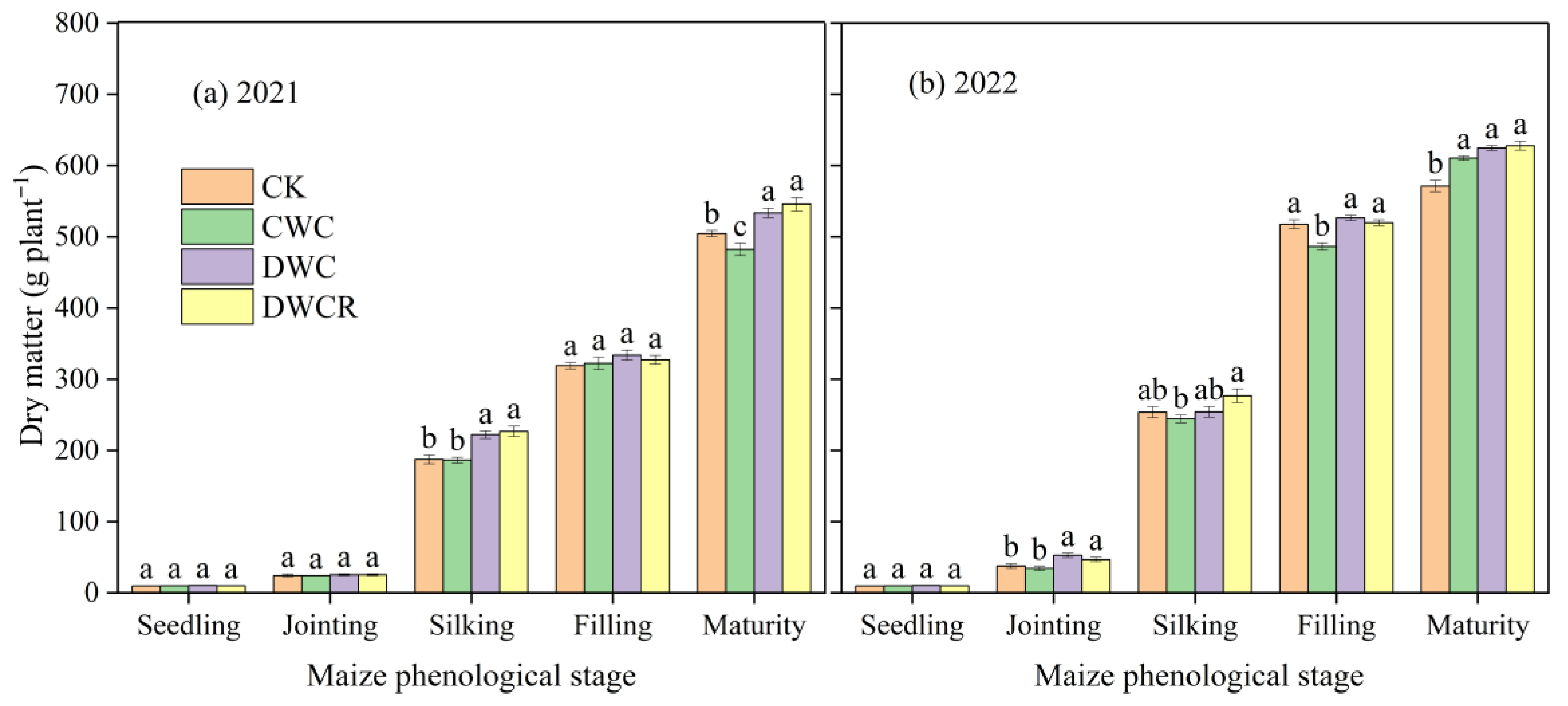
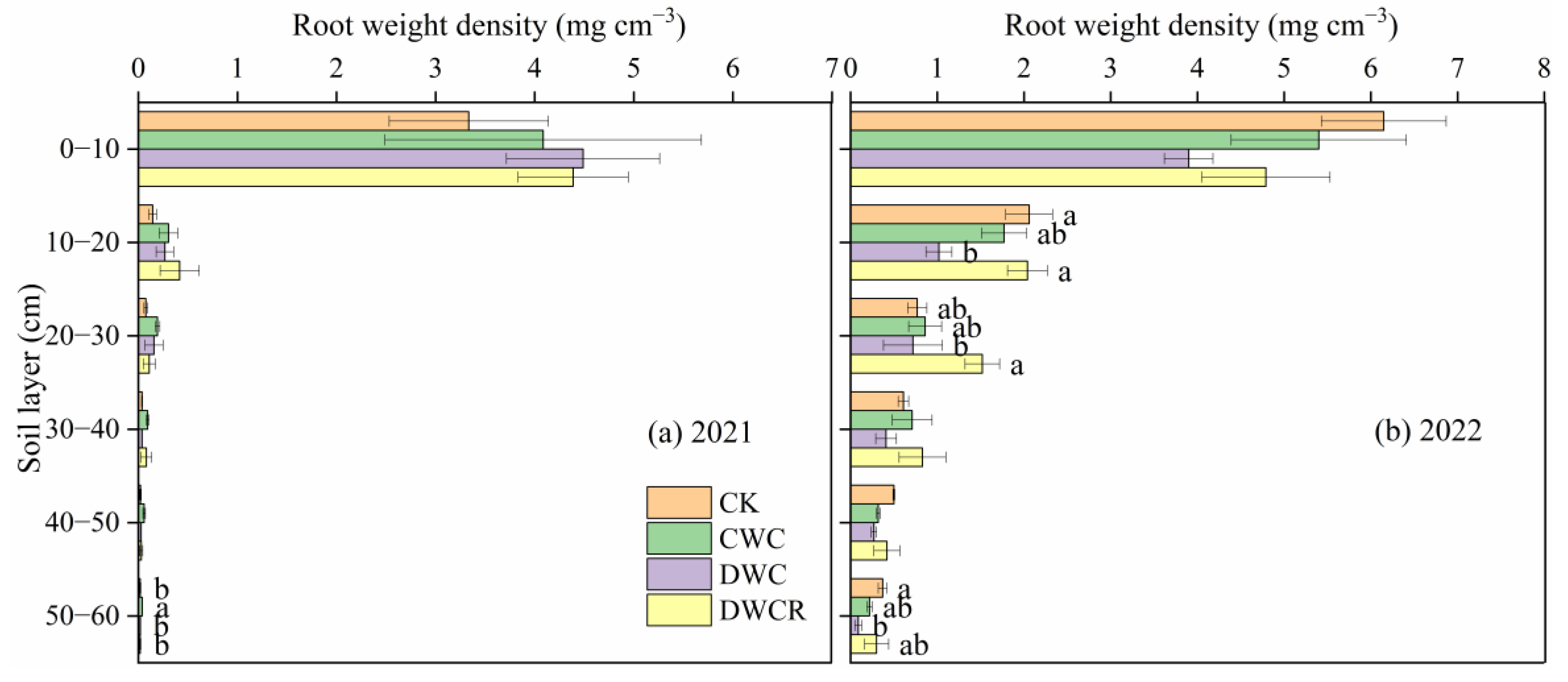
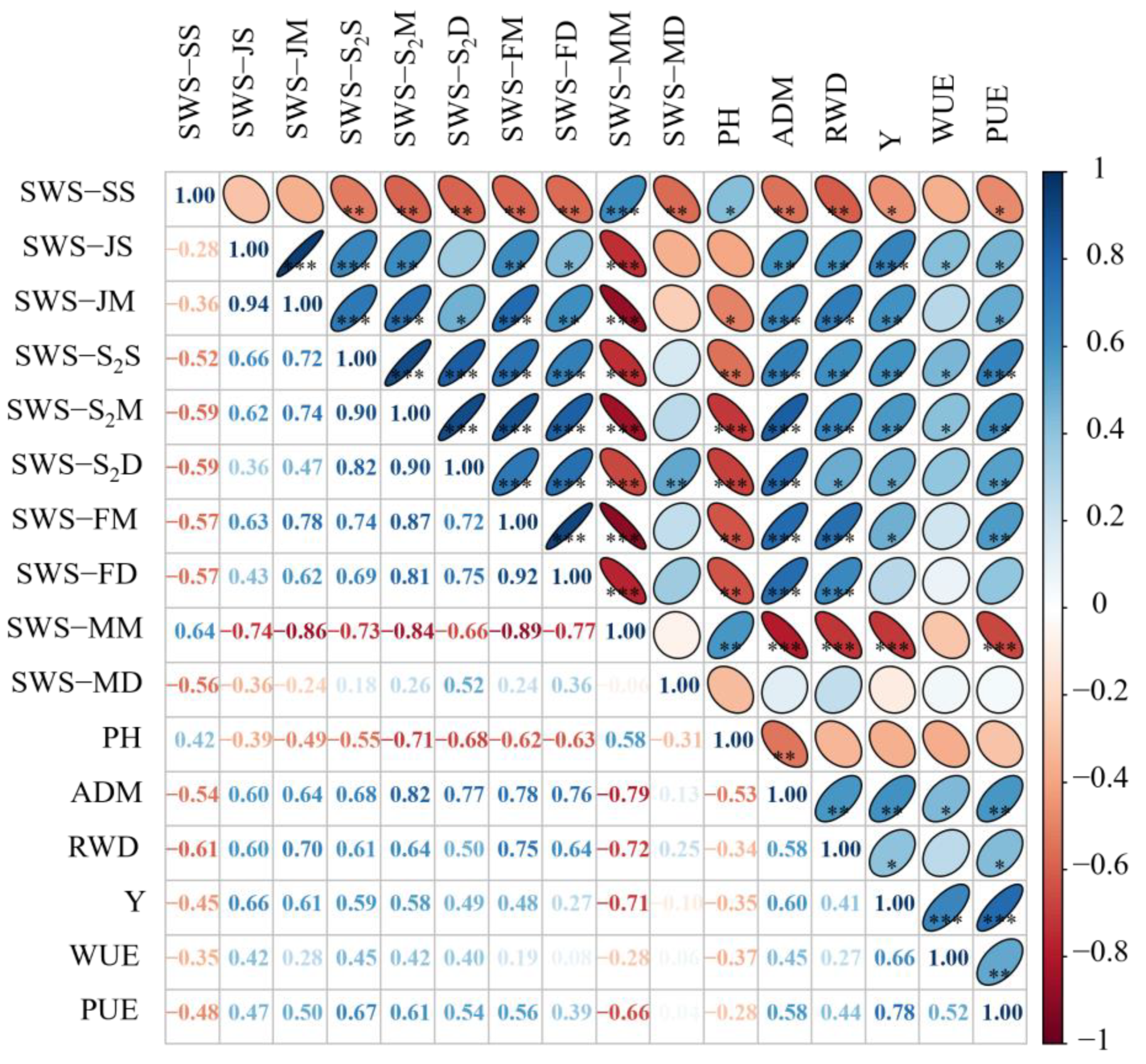

| Acronym | Treatment Name | Description | Key Structural Features |
|---|---|---|---|
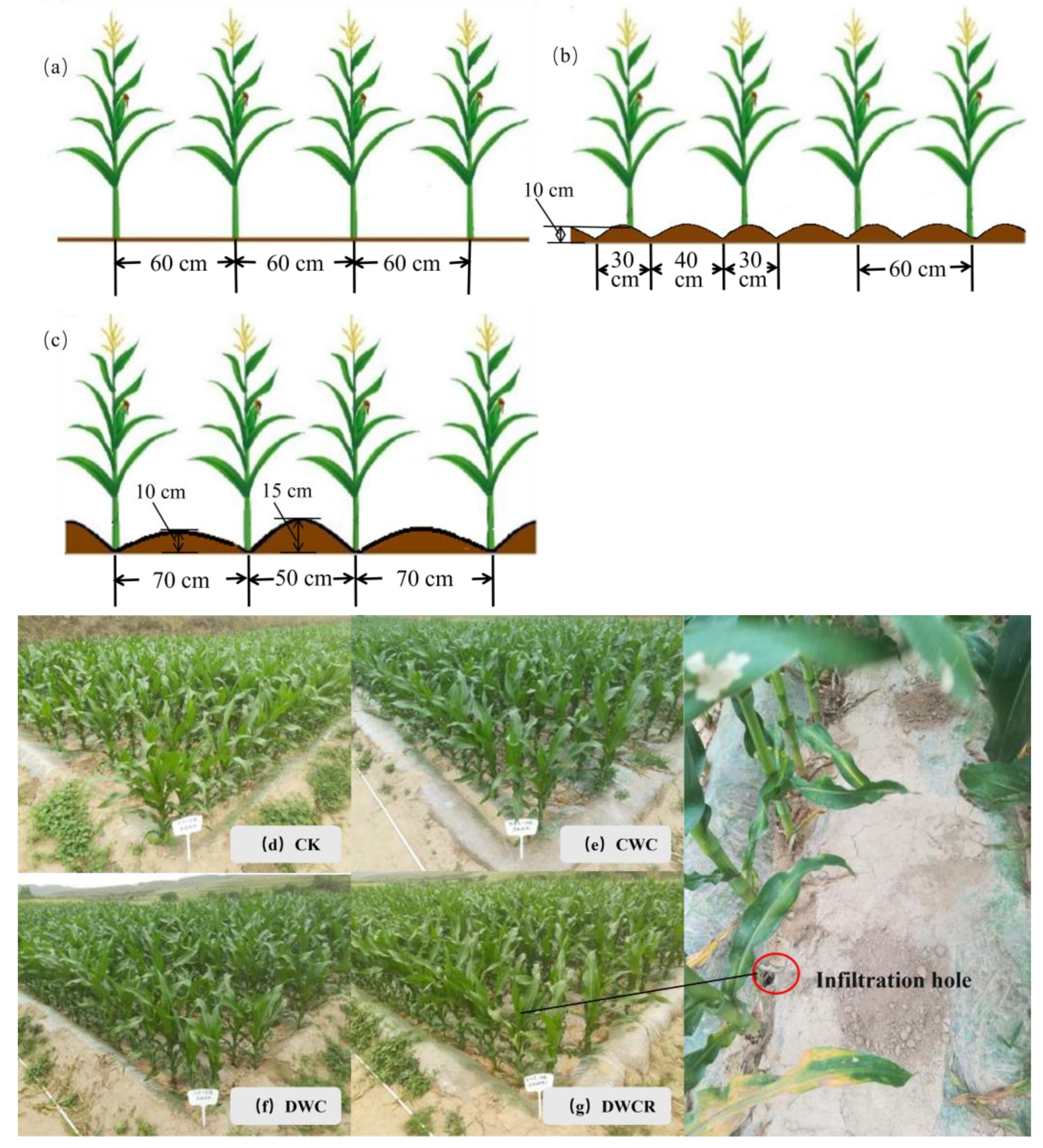
| CK | Conventional Flat Planting (Control) | Flat planting with complete plastic film mulching. | No ridges; full coverage with 0.01 mm transparent PE film. |
| CWC | Traditional Ridge-Furrow | Ridge-furrow system following local practice. | Ridge height: 10 cm; Alternating ridge width: 30–40–30 cm. Fully mulched. |
| DWC | Double Ridge-Furrow | Double ridge-furrow system with alternating high and low ridges. | High ridge: 15 cm H × 50 cm W; Low ridge: 10 cm H × 70 cm W. Fully mulched. |
| DWCR | Double Ridge-Furrow with Infiltration Holes | DWC system augmented with artificial infiltration holes in the furrow. | Same as DWC, plus holes (10 cm dia. × 50 cm deep, 1 m apart) in planting furrow. |
| Indicator | Year (Y) | Treatment (T) | Y × T | |||
|---|---|---|---|---|---|---|
| Phenological Stages | Soil Layer (cm) | df | ||||
| Soil water storage | Seedling | 0–50 | (1, 3, 3) | ** | * | * |
| 50–200 | (1, 3, 3) | * | ns | ns | ||
| 200–300 | (1, 3, 3) | ** | ns | ns | ||
| Jointing | 0–50 | (1, 3, 3) | *** | *** | * | |
| 50–200 | (1, 3, 3) | *** | *** | *** | ||
| 200–300 | (1, 3, 3) | *** | ns | ns | ||
| Silking | 0–50 | (1, 3, 3) | *** | ns | ** | |
| 50–200 | (1, 3, 3) | *** | * | *** | ||
| 200–300 | (1, 3, 3) | *** | * | *** | ||
| Filling | 0–50 | (1, 3, 3) | *** | ns | ns | |
| 50–200 | (1, 3, 3) | *** | *** | ** | ||
| 200–300 | (1, 3, 3) | *** | *** | * | ||
| Maturity | 0–50 | (1, 3, 3) | *** | ns | ns | |
| 50–200 | (1, 3, 3) | *** | * | ** | ||
| 200–300 | (1, 3, 3) | ns | *** | ** | ||
| Plant height | (1, 3, 3) | ** | ns | ns | ||
| Dry matter | (1, 3, 3) | *** | ns | ns | ||
| Root weight density | (1, 3, 3) | *** | ns | ns | ||
| Yield | (1, 3, 3) | *** | *** | ** | ||
| Water use efficiency | (1, 3, 3) | * | * | ns | ||
| Precipitation use efficiency | (1, 3, 3) | ** | ns | ns | ||
| Year | Treatment | Maize Yield | WUE | PUE |
|---|---|---|---|---|
| (kg ha−1) | (kg ha−1 mm−1) | (kg ha−1 mm−1) | ||
| 2021 | CK | 11,473.9 ± 314.6 c | 27.7 ± 1.8 ab | 28.0 ± 0.8 b |
| CWC | 11,940.5 ± 289.2 bc | 25.5 ± 1.1 b | 29.1 ± 0.7 ab | |
| DWC | 13,028.6 ± 187.9 a | 31.3 ± 1.5 a | 31.0 ± 1.0 a | |
| DWCR | 12,352.3 ± 150.1 ab | 32.2 ± 1.0 a | 30.1 ± 0.4 a | |
| 2022 | CK | 12,263.2 ± 142.0 c | 27.5 ± 0.6 b | 45.7 ± 0.5 b |
| CWC | 13,716.1 ± 172.0 b | 30.5 ± 1.3 ab | 52.0 ± 2.4 a | |
| DWC | 14,685.2 ± 128.7 a | 32.7 ± 0.9 a | 54.4 ± 1.8 a | |
| DWCR | 14,721.1 ± 107.5 a | 33.6 ± 1.7 a | 54.5 ± 1.3 a |
Disclaimer/Publisher’s Note: The statements, opinions and data contained in all publications are solely those of the individual author(s) and contributor(s) and not of MDPI and/or the editor(s). MDPI and/or the editor(s) disclaim responsibility for any injury to people or property resulting from any ideas, methods, instructions or products referred to in the content. |
© 2025 by the authors. Licensee MDPI, Basel, Switzerland. This article is an open access article distributed under the terms and conditions of the Creative Commons Attribution (CC BY) license (https://creativecommons.org/licenses/by/4.0/).
Share and Cite
Gao, J.; Wang, K.; Zhang, X.; Li, G.; Wang, G.; Zhang, Z.; Zheng, J. Integrating Infiltration Holes into Ridge–Furrow Systems Enhances Drought Resilience and Yield of Maize in Semi-Arid China. Agronomy 2025, 15, 2871. https://doi.org/10.3390/agronomy15122871
Gao J, Wang K, Zhang X, Li G, Wang G, Zhang Z, Zheng J. Integrating Infiltration Holes into Ridge–Furrow Systems Enhances Drought Resilience and Yield of Maize in Semi-Arid China. Agronomy. 2025; 15(12):2871. https://doi.org/10.3390/agronomy15122871
Chicago/Turabian StyleGao, Jiwei, Ke Wang, Xiaoyuan Zhang, Gaoliang Li, Guogang Wang, Zitong Zhang, and Jiyong Zheng. 2025. "Integrating Infiltration Holes into Ridge–Furrow Systems Enhances Drought Resilience and Yield of Maize in Semi-Arid China" Agronomy 15, no. 12: 2871. https://doi.org/10.3390/agronomy15122871
APA StyleGao, J., Wang, K., Zhang, X., Li, G., Wang, G., Zhang, Z., & Zheng, J. (2025). Integrating Infiltration Holes into Ridge–Furrow Systems Enhances Drought Resilience and Yield of Maize in Semi-Arid China. Agronomy, 15(12), 2871. https://doi.org/10.3390/agronomy15122871