Role of Endogenous Hormone Dynamics in Regulating the Development of Suaeda salsa L. Under Salt Stress

 ,
,
Abstract
1. Introduction
2. Materials and Methods
2.1. Experimental Design
2.2. Test Materials
2.3. Sampling and Measurement
2.4. Statistical Analysis
3. Results and Analysis
3.1. Changes in Soil Physicochemical Properties Under Salt Stress
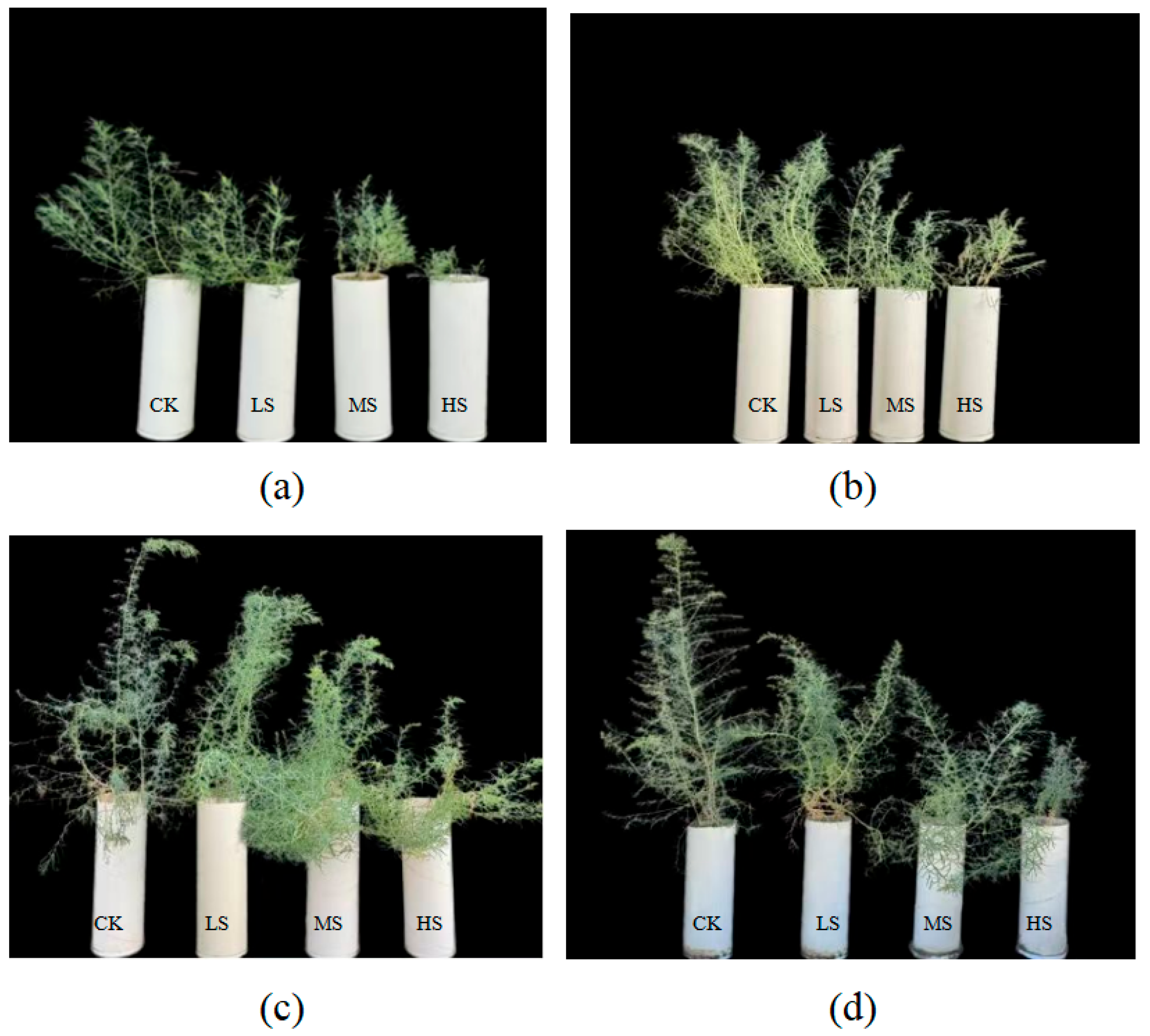
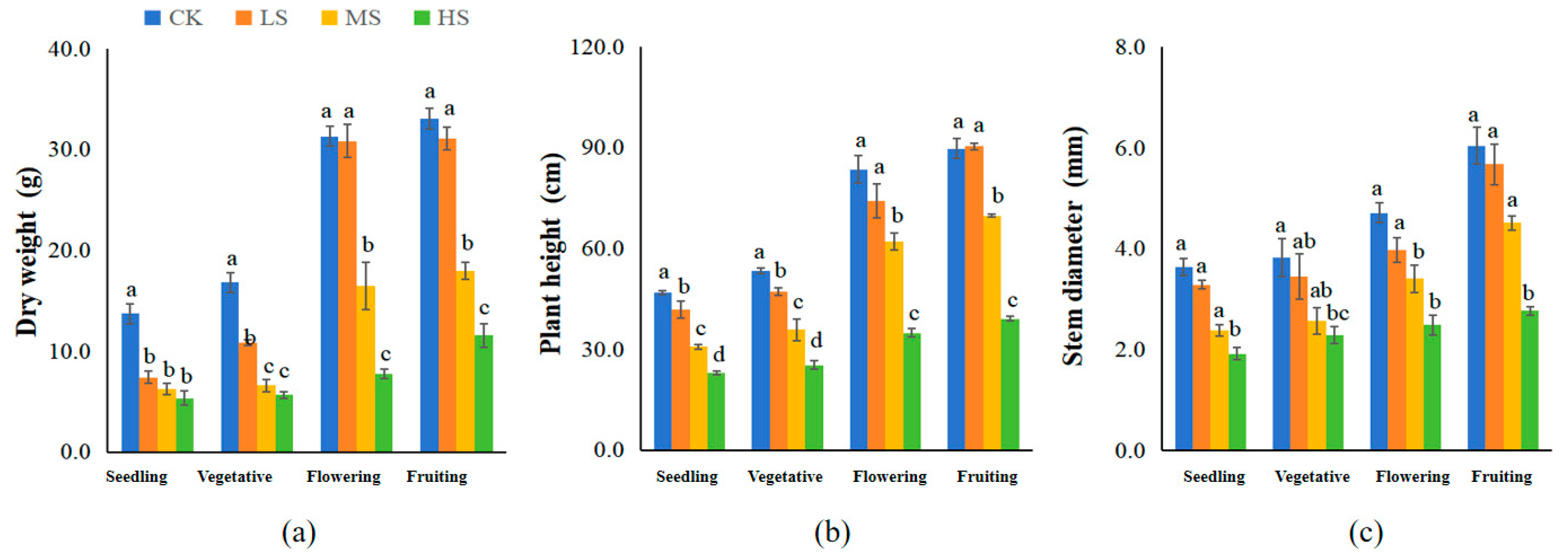
3.2. Effects of Salt Stress on the Growth Traits of Suaeda Salsa in Saline–Alkali Soil
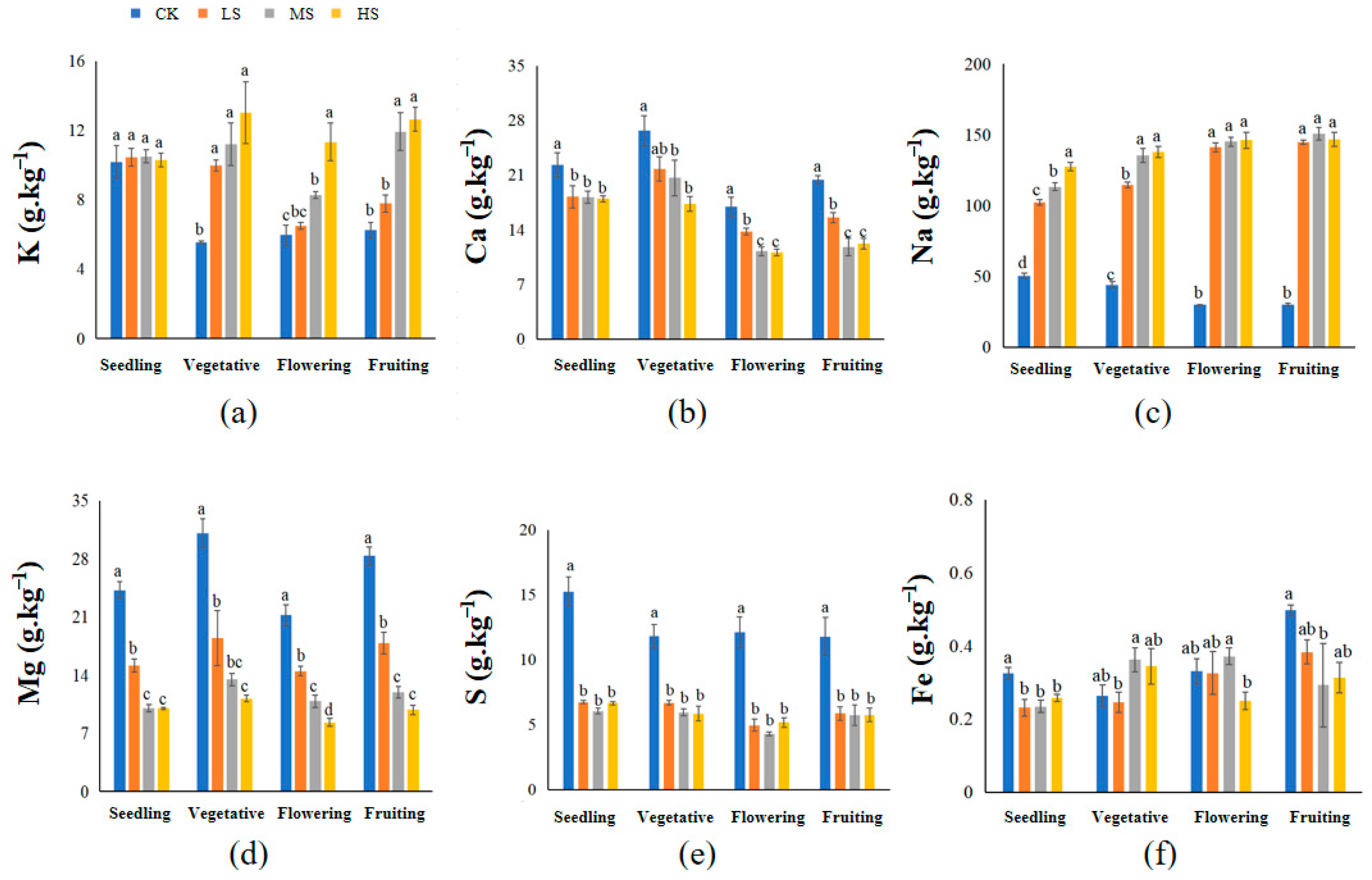
3.3. Effects of Salt Stress on Nutrient Absorption in Saline–Alkali Soil
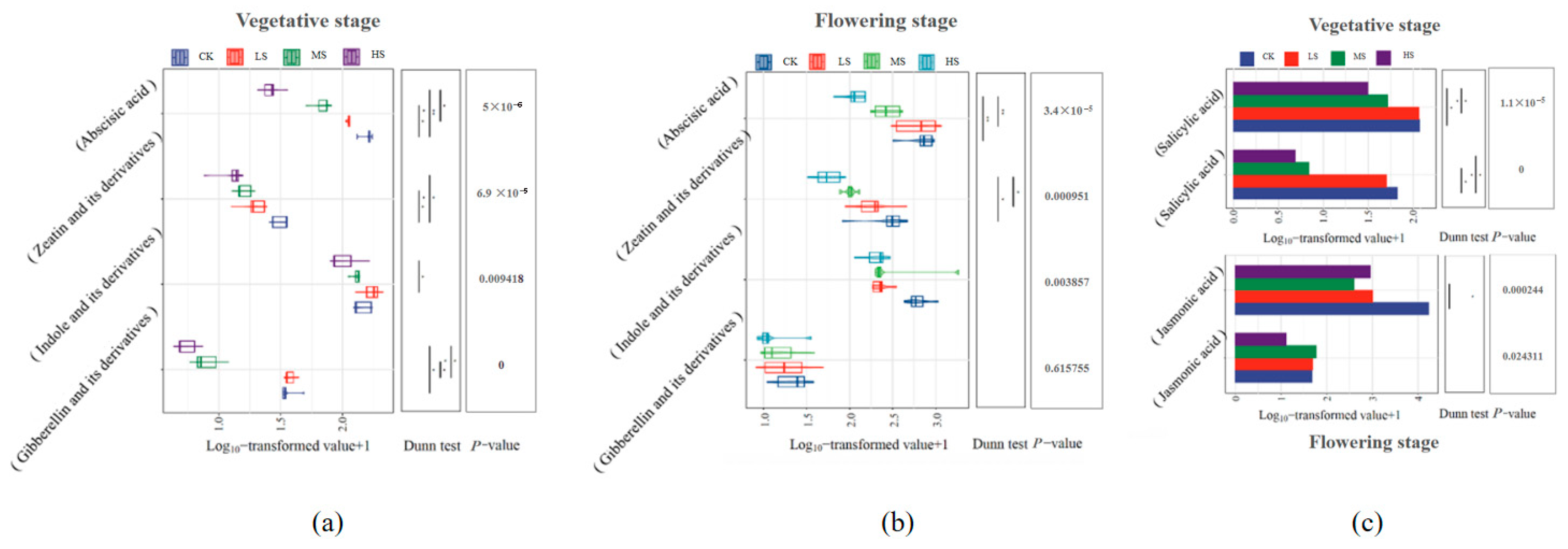
3.4. Effects of Salt Stress on Endogenous Hormones in Saline–Alkali Soil
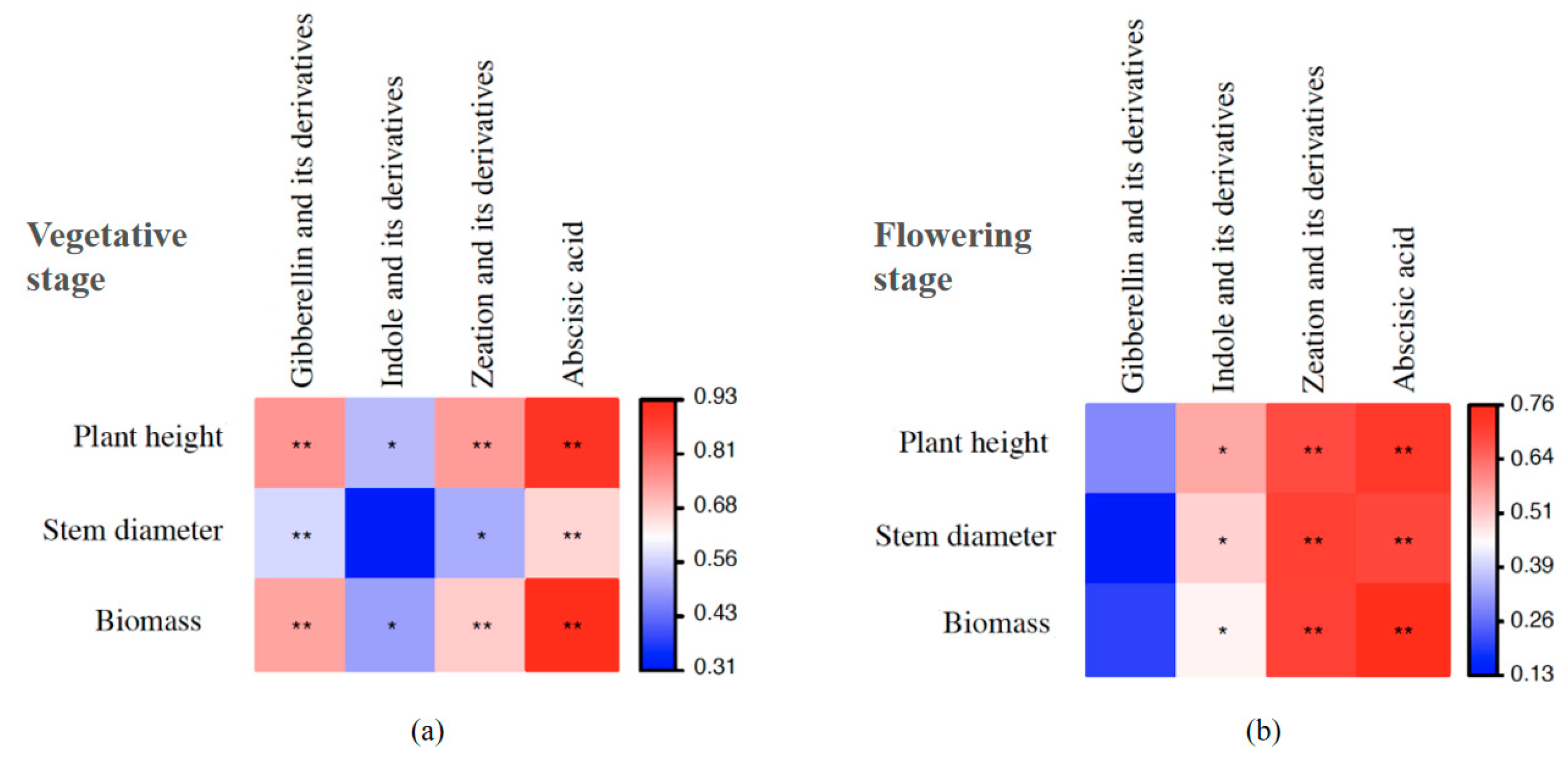
3.5. Relationship Between Changes in Endogenous Hormones and Growth Traits of Suaeda salsa in Saline–Alkali Soil
4. Discussion
Novelty and Practical Implications
5. Conclusions
- 1.
- Salt stress significantly alters the growth environment and metabolic balance of Suaeda salsa in saline–alkali land. As the salt gradient increases, soil electrical conductivity and soluble salts continue to rise, and Na accumulates in the plant and inhibits the absorption of Ca, Mg, and other ions, thereby affecting overall nutrient homeostasis.
- 2.
- Suaeda salsa showed a typical low-salt environment promotes growth and high salt inhibits growth response to salt stress. LS had growth-promoting effects, but MS and HS significantly inhibited growth traits such as plant height and biomass. The seedling and flowering stage were more sensitive to salt stress.
- 3.
- Salt tolerance of Suaeda salsa is closely related to the dynamics of endogenous hormones. Salt stress promotes a significant increase in the content of IAA, ABA, JA, and SA, forming a defensive signaling core. At the same time, IAA maintains a high level in the medium-salt stage to maintain growth activity, while the decrease in GA content is consistent with the growth inhibition process.
- 4.
- The salt tolerance mechanism of Suaeda salsa is characterized by a comprehensive regulatory model of “moderate salt stimulation hormone rebalancing homeostasis maintenance”. Hormone levels are significantly correlated with growth traits. The dynamic regulation of endogenous hormones is not only a key physiological strategy for salt adaptation, but also provides a theoretical basis for understanding the community-building advantages of halophytes in saline–alkali ecosystems and their potential application in saline–alkali land restoration.
Author Contributions
Funding
Data Availability Statement
Conflicts of Interest
References
- Guo, G.; Zhang, H.; Araya, K.; Jia, H.; Ohomiya, K.; Matsuda, J. Improvement of Salt-affected Soils, Part 3: Specific Heat of Salt-affected Soils. Biosyst. Eng. 2007, 96, 413–418. [Google Scholar] [CrossRef]
- Wong, V.N.L.; Dalal, R.C.; Greene, R.S.B. Carbon dynamics of sodic and saline soils following gypsum and organic material additions: A laboratory incubation. Appl. Soil Ecol. 2009, 41, 29–40. [Google Scholar] [CrossRef]
- Azeem, A.; Mai, W.; Gul, B.; Rasheed, A. Eco-physiological and Growth Responses of Two Halophytes to Saline Irrigation and Soil Amendments in Arid Conditions. BMC Plant Biol. 2025, 25, 1451. [Google Scholar]
- Yu, R.; Chen, D. Saline soil resources in my country and their development and utilization. Soil Bull. 1999, 34, 15–16. [Google Scholar]
- Yang, Z.; Wang, B. Current status of saline soil resources in China and countermeasures for improvement and utilization. Shandong Agric. Sci. 2015, 47, 125–130. [Google Scholar]
- Abdul Aziz, M.; Masmoudi, K. Insights into the Transcriptomics of Crop Wild Relatives to Unravel the Salinity Stress Adaptive Mechanisms. Int. J. Mol. Sci. 2023, 24, 9813. [Google Scholar] [CrossRef] [PubMed] [PubMed Central]
- Meena, M.D.; Yadav, R.K.; Narjary, B.; Yadav, G.; Jat, H.S.; Sheoran, P.; Meena, M.K.; Antil, R.S.; Meena, B.L.; Singh, H.V.; et al. Municipal solid waste (MSW): Strategies to improve salt affected soil sustainability: A review. Waste Manag. 2019, 84, 38–53. [Google Scholar] [CrossRef]
- Wang, W.; Vinocur, B.; Altman, A. Plant responses to drought, salinity and extreme temperatures: Towards genetic engineering for stress tolerance. Planta 2003, 218, 1–14. [Google Scholar] [CrossRef]
- Arif, Y.; Singh, P.; Siddiqui, H.; Bajguz, A.; Hayat, S. Salinity induced physiological and biochemical changes in plants: An omic approach towards salt stress tolerance. Plant Physiol. Biochem. 2020, 156, 64–77. [Google Scholar] [CrossRef]
- Ma, Y. Effects of Potassium and Calcium Regulation on Cotton Plant Growth, Physiology, and Yield Under Salt and Drought Stress. Ph.D. Thesis, Northwest A&F University, Xianyang, China, 2022. [Google Scholar]
- Basu, S.; Kumar, A.; Benazir, I.; Kumar, G. Reassessing the role of ion homeostasis for improving salinity tolerance in crop plants. Physiol. Plant. 2020, 171, 502–519. [Google Scholar] [CrossRef]
- Zhao, K.; Fan, H. Comparative study on osmotic regulatory substances and their contributions of true halophytes and halogen-secreting plants under salt stress. J. Appl. Environ. Biol. 2000, 6, 99–105. [Google Scholar] [CrossRef]
- Zhou, J.; Wei, Y.; Yuan, N.; Wang, L. Research status and prospects of Suaeda salsa in my country. Agric. Prod. Process. 2017, 67, 61–64. [Google Scholar] [CrossRef]
- Wang, Y.; Guo, T.; Tian, C.; Zhang, K.; Li, Z.; Zhao, Z.; Hu, M.; Mai, W. The curvilinear responses of biomass accumulation and root morphology to a soil salt-nitrogen environment reflect the phytodesalination capability of the euhalophyte Suaeda salsa L. Front. Plant Sci. 2024, 15, 1424766. [Google Scholar] [CrossRef]
- Wang, Y.; Guo, T.; Tian, C.; Zhang, K.; Zhao, Z.; Hu, M.; Mai, W. Suaeda salsa adapts to high-salt environments through expanding vessel diameter, activating antioxidant enzymes and strengthening osmotic regulation. Plant Physiol. Biochem. 2025, 228, 110249. [Google Scholar] [CrossRef] [PubMed]
- Wang, Y.; Peng, B.; Zhao, S.; Zhou, J.; Hanipa, H.; Tian, C. Salinity stress reveals keystone metabolites linking rhizosphere metabolomes and microbiomes in Halophyte Suaeda salsa. Plant Soil 2025, 514, 1219–1239. [Google Scholar] [CrossRef]
- Zhang, F.; Dong, W.; Yue, Z.; Dong, B. Research progress on the regulatory mechanism of endogenous hormones on efficient water use in crops. China Agric. Bull. 2011, 27, 6–10. [Google Scholar]
- Bari, R.; Jones, J.D.J. Role of plant hormones in plant defense responses. Plant Mol. Biol. 2008, 69, 473–488. [Google Scholar] [CrossRef]
- Takahashi, F.; Suzuki, T.; Osakabe, Y.; Betsuyaku, S.; Kondo, Y.; Dohmae, N.; Fukuda, H.; Yamaguchi-Shinozaki, K.; Shinozaki, K. A small peptide modulates stomatal control via abscisic acid in long-distance signaling. Nature 2018, 556, 235–238. [Google Scholar] [CrossRef]
- Munns, R.; Sharp, R.E. Involvement of abscisic acid in controlling plant growth in soils of low water potential. Aust. J. Plant Physiol. 1993, 20, 425–437. [Google Scholar] [CrossRef]
- Xiao, F.; Zhou, H. Plant salt response: Perception, signaling, and tolerance. Front. Plant Sci. 2023, 13, 1053699. [Google Scholar] [CrossRef] [PubMed]
- Hyoung, S.; Cho, S.H.; Chung, J.H.; So, W.M.; Cui, M.H.; Shin, J.S. Cytokinin oxidase PpCKX1 plays regulatory roles in development and enhances dehydration and salt tolerance in Physcomitrella patens. Plant Cell Rep. 2019, 39, 419–430. [Google Scholar] [CrossRef]
- Sakakibara, H. Cytokinin biosynthesis and transport for systemic nitrogen signaling. Plant J. 2020, 105, 421–430. [Google Scholar] [CrossRef] [PubMed]
- Li, C.; Yang, Y.; Xi, H.; Chen, Z.; Dong, Y.; Liu, M.; Liu, J.; Wang, W. Optimized Irrigation Strategies for Saline Soil Remediation in Agricultural Lands Under Water-Limited Conditions. Sustainability 2024, 16, 10256. [Google Scholar] [CrossRef]
- Azeem, A.; Mai, W.; Gul, B.; Rasheed, A. Influence of Soil Amendment Application on Growth and Yield of Hedysarum scoparium Fisch. et Mey and Avena sativa L. Under Saline Conditions in Dry-Land Regions. Plants 2025, 14, 855. [Google Scholar] [CrossRef]
- Liu, C.; Jiang, X.; Yuan, Z. Plant Responses and Adaptations to Salt Stress: A Review. Horticulturae 2024, 10, 1221. [Google Scholar] [CrossRef]
- Qi, Q.; Ma, S.; Xu, W. Research progress on the effects of salt stress on plant growth and the physiological mechanisms of salt tolerance. Mol. Plant Breed. 2020, 18, 2741–2746. [Google Scholar]
- Targino, V.A.; Dias, T.J.; Sousa, V.F.; Silva, M.D.; da Silva, A.J.; Ribeiro, J.E.; da Silva, R.F.; Batista, D.S.; Henschel, J.M.; Rêgo, M.M. Growth, Gas Exchange, and Phytochemical Quality of Nasturtium (Tropaeolum majus L.) Subjected to Proline Concentrations and Salinity. Plants 2025, 14, 301. [Google Scholar] [CrossRef] [PubMed]
- Zhou, Y.; Feng, C.; Wang, Y.; Yun, C.; Zou, X.; Cheng, N.; Zhang, W.; Jing, Y.; Li, H. Understanding of Plant Salt Tolerance Mechanisms and Application to Molecular Breeding. Int. J. Mol. Sci. 2024, 25, 10940. [Google Scholar] [CrossRef]
- Abbas, A.; Mansha, S.; Waheed, H.; Siddiq, Z.; Hayyat, M.U.; Zhang, Y.-J.; Alwutayd, K. NaCl stress, tissue specific Na+ and K+ up-take and their effect on growth and physiology of Helianthus annuus L. and Solanum lycopersicum L. Sci. Hortic. 2024, 326, 112454. [Google Scholar] [CrossRef]
- Ma, Y.; Xu, J.; Qi, J.; Zhao, D.; Jin, M.; Wang, T.; Yang, Y.; Shi, H.; Guo, L.; Zhang, H. Crosstalk among plant hormone regulates the root development. Plant Signal. Behav. 2024, 19, 2404807. [Google Scholar] [CrossRef] [PubMed]
- Singh, A.; Roychoudhury, A. Abscisic acid in plants under abiotic stress: Crosstalk with major phytohormones. Plant Cell Rep. 2023, 42, 961–974. [Google Scholar] [CrossRef]
- Samanta, S.; Seth, C.S.; Roychoudhury, A. The molecular paradigm of reactive oxygen species (ROS) and reactive nitrogen species (RNS) with different phytohormone signaling pathways during drought stress in plants. Plant Physiol. Biochem. 2024, 206, 108259. [Google Scholar] [CrossRef]
- Thiruvengadam, R.; Venkidasamy, B.; Easwaran, M.; Chi, H.Y.; Thiruvengadam, M.; Kim, S.H. Dynamic interplay of reactive oxygen and nitrogen species (ROS and RNS) in plant resilience: Unveiling the signaling pathways and metabolic responses to biotic and abiotic stresses. Plant Cell Rep. 2024, 43, 198. [Google Scholar] [CrossRef]
- Hualpa-Ramirez, E.; Carrasco-Lozano, E.C.; Madrid-Espinoza, J.; Tejos, R.; Ruiz-Lara, S.; Stange, C.; Norambuena, L. Stress salinity in plants: New strategies to cope with in the foreseeable scenario. Plant Physiol. Biochem. 2024, 208, 108507. [Google Scholar] [CrossRef]
- Aizaz, M.; Lubna Jan, R.; Asaf, S.; Bilal, S.; Kim, K.M.; Al-Harrasi, A. Regulatory Dynamics of Plant Hormones and Transcription Factors under Salt Stress. Biology 2024, 13, 673. [Google Scholar] [CrossRef]
- Chen, G.; Zheng, D.; Feng, N.; Zhou, H.; Mu, D.; Zhao, L.; Shen, X.; Rao, G.; Meng, F.; Huang, A. Physiological mechanisms of ABA-induced salinity tolerance in leaves and roots of rice. Sci. Rep. 2022, 12, 8228. [Google Scholar] [CrossRef]
- Wu, S.; Jia, X.; Tian, B.; Zhang, F.; Zhao, J.; Xie, X.; Shan, C.; Wang, H.; Guo, X.; Han, J. Physiological and Cellular Ultrastructural Responses of Isatis indigotica Fort. under Salt Stress. Plants 2024, 13, 1593. [Google Scholar] [CrossRef] [PubMed]
- Al-Janabia, A.M.I.; Al-Dulaimy, A.F.Z.; Sekhi, Y.S.; Almohammedi, O.H.M.; Al–Taey, D.K.A. Effect of Salt Stress on Growth and Yield of Plants: A Review. IOP Conf. Ser. Earth Environ. Sci. 2024, 1371, 042028. [Google Scholar] [CrossRef]
- Peleg, Z.; Blumwald, E. Hormone balance and abiotic stress tolerance in crop plants. Curr. Opin. Plant Biol. 2011, 14, 290–295. [Google Scholar] [CrossRef] [PubMed]
- Chang, Y.-N.; Zhu, C.; Jiang, J.; Zhang, H.; Zhu, J.-K.; Duan, C.-G. Epigenetic regulation in plant abiotic stress responses. J. Integr. Plant Biol. 2020, 62, 563–580. [Google Scholar] [CrossRef] [PubMed]
- Wang, B. Salt-Enhanced Reproductive Development of Suaeda salsa L. Coincided With Ion Transporter Gene Upregulation in Flowers andIncreased Pollen K+ Content. Front. Plant Sci. 2019, 10, 333. [Google Scholar]
- Jiang, Z.; Zhou, X.; Tao, M.; Yuan, F.; Liu, L.; Wu, F.; Wu, X.; Xiang, Y.; Niu, Y.; Liu, F.; et al. Plant cell-surface GIPC sphingolipids sense salt to trigger Ca2+ influx. Nature 2019, 572, 341–346. [Google Scholar] [CrossRef]
- Ku, Y.-S.; Sintaha, M.; Cheung, M.-Y.; Lam, H.-M. Plant Hormone Signaling Crosstalks between Biotic and Abiotic Stress Responses. Int. J. Mol. Sci. 2018, 19, 3206. [Google Scholar] [CrossRef] [PubMed]
- Wang, Q.Z.; Liu, Q.; Gao, Y.N.; Liu, X. Research progress on the response mechanism of plants to salt and alkali stress. Acta Ecol. Sin. 2017, 37, 5565–5577. [Google Scholar]
- Dong, N.-Q.; Sun, Y.; Guo, T.; Shi, C.-L.; Zhang, Y.-M.; Kan, Y.; Xiang, Y.-H.; Zhang, H.; Yang, Y.-B.; Li, Y.-C.; et al. UDP-glucosyltransferase regulates grain size and abiotic stress tolerance associated with metabolic flux redirection in rice. Nat. Commun. 2020, 11, 2629. [Google Scholar] [CrossRef]
- Yun, D.-Y.; Kang, Y.-G.; Kim, M.; Kim, D.; Kim, E.-H.; Hong, Y.-S. Metabolomic understanding of pod removal effect in soybean plants and potential association with their health benefit. Food Res. Int. 2020, 138, 109797. [Google Scholar] [CrossRef]
- Zhu, Y.; Li, M.; Wang, T.; Wang, J.; Zhou, H.; Lin, Y.; Yin, C. Recent review on integrated salt-tolerance mechanisms: Research advances of salt exclusion, salt sequestration, salt secretion, and salt signaling regulation in plants. Plant Stress 2025, 17, 100952. [Google Scholar] [CrossRef]
- Wang, Y.; Xu, L.; Shen, H.; Wang, J.; Liu, W.; Zhu, X.; Wang, R.; Sun, X.; Liu, L. Metabolomic analysis with GC-MS to reveal potential metabolites and biological pathways involved in Pb & Cd stress response of radish roots. Sci. Rep. 2015, 5, 18296. [Google Scholar] [CrossRef] [PubMed]
- Li, X.; Li, C.; Shi, L.; Lv, G.; Li, X.; Liu, Y.; Jia, X.; Liu, J.; Chen, Y.; Zhu, L.; et al. Jasmonate signaling pathway confers salt tolerance through a NUCLEAR FACTOR-Y trimeric transcription factor complex in Arabidopsis. Cell Rep. 2024, 43, 113825. [Google Scholar] [CrossRef]
- Wang, Y.; Guo, Y.; Li, C.; Su, X.; Yang, M.; Li, W.; Xu, H.; Li, H. Rhizosphere microorganisms mediate ion homeostasis in cucumber seedlings: A new strategy to improve plant salt tolerance. BMC Plant Biol. 2025, 25, 670. [Google Scholar] [CrossRef] [PubMed]
- Sheteiwy, M.S.; Ulhassan, Z.; Qi, W.; Lu, H.; AbdElgawad, H.; Minkina, T.; Sushkova, S.; Rajput, V.D.; El-Keblawy, A.; Jośko, I.; et al. Association of jasmonic acid priming with multiple defense mechanisms in wheat plants under high salt stress. Front. Plant Sci. 2022, 13, 886862. [Google Scholar] [CrossRef] [PubMed]
- Liu, A.; Wang, M.; Dong, J.; Yan, Z.; Wang, X.; Li, J.; Song, H. Foliar application of exogenous salicylic acid mitigates the detrimental effects caused by salt stress in sunflower seedlings. Ind. Crops Prod. 2024, 222, 119854. [Google Scholar] [CrossRef]
- Wasternack, C.; Song, S. Jasmonates: Biosynthesis, metabolism, and signaling by proteins activating and repressing transcription. J. Exp. Bot. 2017, 68, 1303–1321. [Google Scholar] [CrossRef]
- Ahmadzai, A.S.; Hu, C.; Zhang, C.; Li, Y. Mechanisms of anthocyanin-mediated salt stress alleviation and cellular homeostasis in plants. Plant Growth Regul. 2025, 105, 655–673. [Google Scholar] [CrossRef]
- Zhang, Y.; Berman, A.; Shani, E. Plant Hormone Transport and Localization: Signaling Molecules on the Move. Annu. Rev. Plant Biol. 2023, 74, 453–479. [Google Scholar] [CrossRef] [PubMed]
- Luo, X.; Wang, B.; Gao, S.; Zhang, F.; Terzaghi, W.; Dai, M. Genome-wide association study dissects the genetic bases of salt tolerance in maize seedlings. J. Integr. Plant Biol. 2019, 61, 658–674. [Google Scholar] [CrossRef]
- Azeem, A.; Mai, W. Mathematical Modeling for Predicting Growth and Yield of Halophyte Hedysarum scoparium in Arid Regions under Variable Irrigation and Soil Amendment Conditions. Resources 2024, 13, 110. [Google Scholar] [CrossRef]
- Zhang, H.; Fu, R.; Li, M.; Li, J.; Chen, C.; Gu, Y.; Liang, X.; Li, D.; Nie, W.; Wang, X.; et al. The key pathways in halophyte tree revealed via transcriptome analysis in response to salt stress. Plant Growth Regul. 2025, 105, 1695–1709. [Google Scholar] [CrossRef]
- Yu, B.; Chao, D.; Zhao, Y. How plants sense and respond to osmotic stress. J. Integr. Plant Biol. 2024, 66, 394–423. [Google Scholar] [CrossRef]
- Azeem, A.; Mai, W.; Ali, R.; Abbas, A.; Hussain, N.; Kazmi, A.H.; Butt, U.A. Evaluating salt tolerance in fodder crops: A field experiment in the dry land. Open Agric. 2024, 9, 20220307. [Google Scholar] [CrossRef]



| Soil | pH | EC | TDS | Density | WHC | Organic Matter | Quick-Acting Nitrogen | Quick-Acting Phosphorus | Quick-Acting Potassium |
|---|---|---|---|---|---|---|---|---|---|
| (cm) | (mS cm−1) | (g kg−1) | (g cm−3) | (%) | (g kg−1) | (mg kg−1) | (mg kg−1) | (mg kg−1) | |
| 0–20 | 7.8 | 0.4 | 1.7 | 1.4 | 25.0 | 10.1 | 59.0 | 34.1 | 664.1 |
| Sampling Period | Treatments | pH | EC | TDS | Quick-Acting Nitrogen | Quick-Acting Phosphorus | Quick-Acting Potassium |
|---|---|---|---|---|---|---|---|
| (mS cm−1) | (g kg−1) | (mg kg−1) | (mg kg−1) | (mg kg−1) | |||
| Seedling stage | CK | 8.3 ± 0.02 a | 0.7 ± 0.07 d | 2.8 ± 0.26 d | 114.8 ± 5.18 c | 31.8 ± 1.53 a | 446.8 ± 3.71 a |
| LS | 8.2 ± 0.03 ab | 2.4 ± 0.11 c | 7.2 ± 0.33 c | 120.4 ± 4.24 c | 33.7 ± 0.44 a | 463.9 ± 6.33 a | |
| MS | 8.2 ± 0.42 ab | 3.7 ± 0.29 b | 11.7 ± 0.42 b | 158.6 ± 0.77 b | 30.2 ± 2.18 a | 460.5 ± 10.63 a | |
| HS | 8.2 ± 0.24 b | 5.5 ± 0.29 a | 16.5 ± 0.94 a | 171.4 ± 4.61 a | 31.3 ± 2.21 a | 451.2 ± 8.31 a | |
| Vegetative stage | CK | 8.6 ± 0.06 a | 0.3 ± 0.03 d | 1.2 ± 0.08 d | 114.2 ± 5.64 c | 30.2 ± 1.45 a | 440.8 ± 10.81 b |
| LS | 8.3 ± 0.04 b | 2.2 ± 0.45 c | 6.3 ± 1.28 c | 142.0 ± 10.18 b | 31.0 ± 2.38 a | 465.3 ± 18.09 ab | |
| MS | 8.2 ± 0.01 b | 4.0 ± 0.19 b | 11.2 ± 0.47 b | 164.5 ± 1.06 a | 35.8 ± 1.69 a | 489.6 ± 3.02 a | |
| HS | 8.3 ± 0.03 b | 5.3 ± 0.10 a | 14.9 ± 0.29 a | 178.1 ± 5.28 a | 35.5 ± 2.75 a | 481.7 ± 18.27 ab | |
| Flowering stage | CK | 8.7 ± 0.05 a | 0.2 ± 0.17 d | 0.7 ± 0.04 d | 114.7 ± 2.97 c | 39.1 ± 9.34 a | 484.8 ± 11.44 a |
| LS | 8.8 ± 0.22 a | 1.7 ± 0.23 c | 5.0 ± 0.43 c | 127.5 ± 14.33 bc | 22.9 ± 2.97 b | 466.7 ± 22.38 a | |
| MS | 8.4 ± 0.06 ab | 3.4 ± 0.42 b | 10.5 ± 0.52 b | 163.3 ± 1.83 ab | 28.7 ± 3.69 ab | 476.8 ± 11.23 a | |
| HS | 8.3 ± 0.02 b | 5.1 ± 0.10 a | 14.1 ± 0.33 a | 180.7 ± 21.54 a | 34.9 ± 1.60 ab | 494.0 ± 5.73 a | |
| Fruiting stage | CK | 8.6 ± 0.07 a | 0.5 ± 0.05 d | 1.5 ± 0.16 d | 94.1 ± 10.12 c | 22.1 ± 2.27 ab | 447.6 ± 11.89 b |
| LS | 8.4 ± 0.05 b | 2.1 ± 0.16 c | 5.7 ± 0.45 c | 151.4 ± 9.44 b | 18.9 ± 1.92 b | 447.4 ± 4.57 b | |
| MS | 8.3 ± 0.06 b | 3.6 ± 0.15 b | 9.9 ± 0.49 b | 172.0 ± 1.86 ab | 20.2 ± 1.81 b | 471.9 ± 5.52 ab | |
| HS | 8.3 ± 0.02 b | 5.0 ± 0.41 a | 13.7 ± 1.15 a | 187.6 ± 19.41 a | 27.0 ± 2.20 a | 491.7 ± 11.79 a |
Disclaimer/Publisher’s Note: The statements, opinions and data contained in all publications are solely those of the individual author(s) and contributor(s) and not of MDPI and/or the editor(s). MDPI and/or the editor(s) disclaim responsibility for any injury to people or property resulting from any ideas, methods, instructions or products referred to in the content. |
© 2025 by the authors. Licensee MDPI, Basel, Switzerland. This article is an open access article distributed under the terms and conditions of the Creative Commons Attribution (CC BY) license (https://creativecommons.org/licenses/by/4.0/).
Share and Cite
Hao, J.; Wang, Y.; Feng, X.; Mai, W.; Zhang, D.; Zhang, K.; Zhang, W.; Azeem, A. Role of Endogenous Hormone Dynamics in Regulating the Development of Suaeda salsa L. Under Salt Stress. Agronomy 2025, 15, 2859. https://doi.org/10.3390/agronomy15122859
Hao J, Wang Y, Feng X, Mai W, Zhang D, Zhang K, Zhang W, Azeem A. Role of Endogenous Hormone Dynamics in Regulating the Development of Suaeda salsa L. Under Salt Stress. Agronomy. 2025; 15(12):2859. https://doi.org/10.3390/agronomy15122859
Chicago/Turabian StyleHao, Jinxiu, Yanyan Wang, Xinzhi Feng, Wenxuan Mai, Dong Zhang, Ke Zhang, Wentai Zhang, and Ahmad Azeem. 2025. "Role of Endogenous Hormone Dynamics in Regulating the Development of Suaeda salsa L. Under Salt Stress" Agronomy 15, no. 12: 2859. https://doi.org/10.3390/agronomy15122859
APA StyleHao, J., Wang, Y., Feng, X., Mai, W., Zhang, D., Zhang, K., Zhang, W., & Azeem, A. (2025). Role of Endogenous Hormone Dynamics in Regulating the Development of Suaeda salsa L. Under Salt Stress. Agronomy, 15(12), 2859. https://doi.org/10.3390/agronomy15122859