Hierarchical Deep Learning Framework for Mapping Honey-Producing Tree Species in Dense Forest Ecosystems Using Sentinel-2 Imagery
 , , , , ,
  ,
,  , and
, and 
Abstract
1. Introduction
2. Materials and Methods
2.1. Study Area
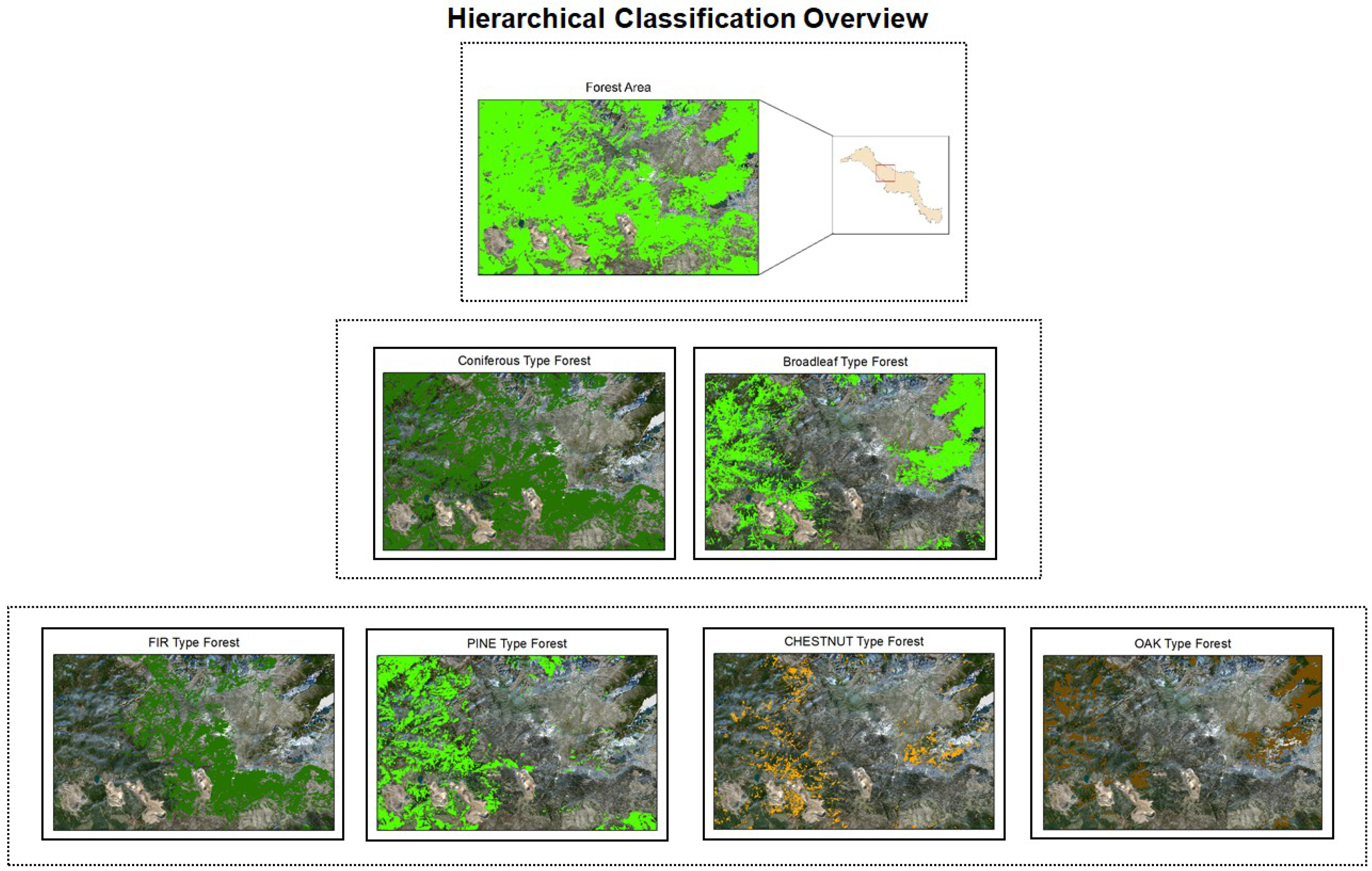
2.2. Hierarchical Classification Methodology
2.2.1. Forest Area Delineation
2.2.2. Broadleaf-Coniferous Forest-Type Stratification
2.2.3. Species-Level Semantic Segmentation
2.3. Composite Species Map Generation
2.4. Data Acquisition and Training Dataset Development
2.4.1. Satellite and Ancillary Data
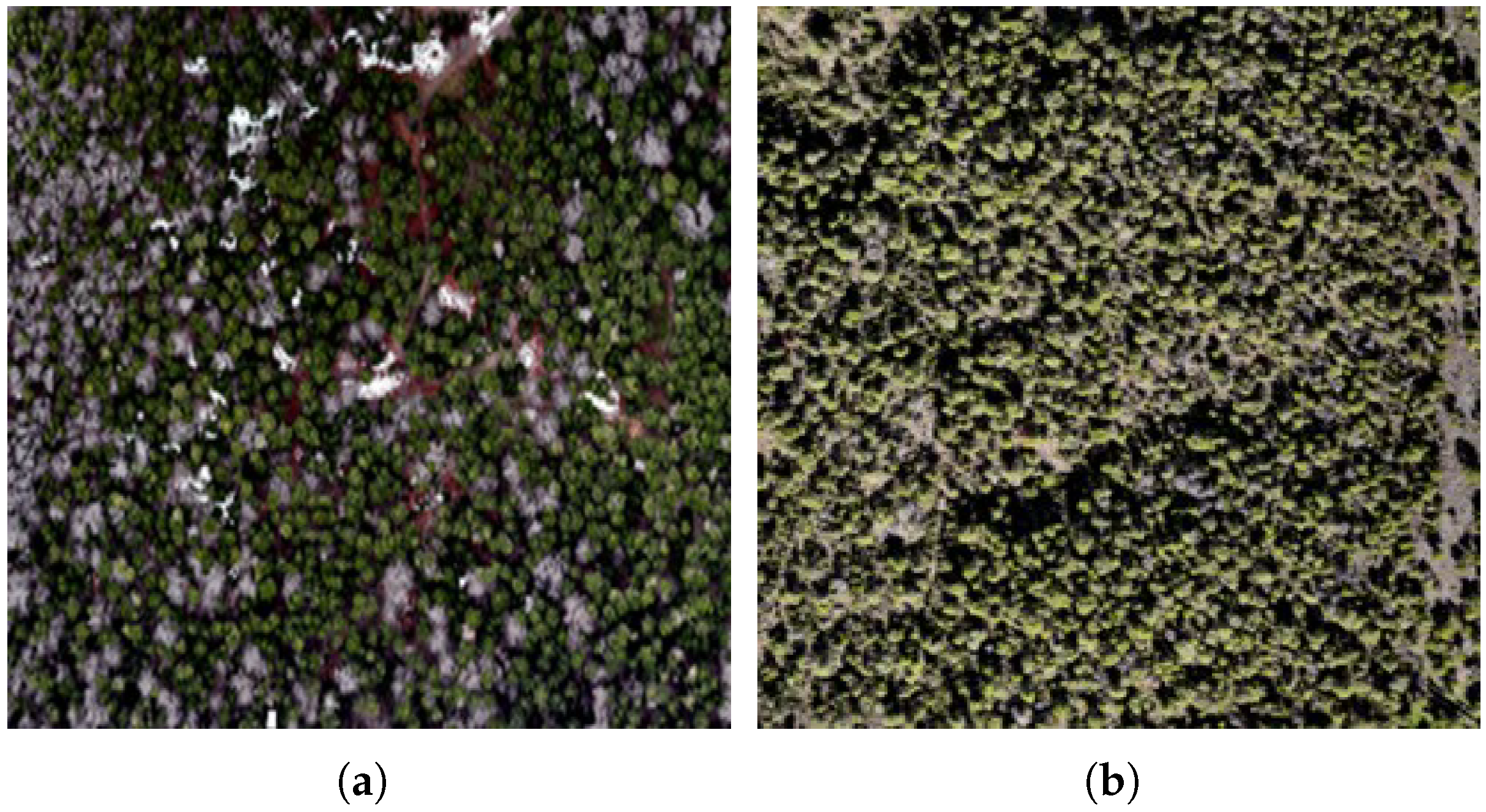
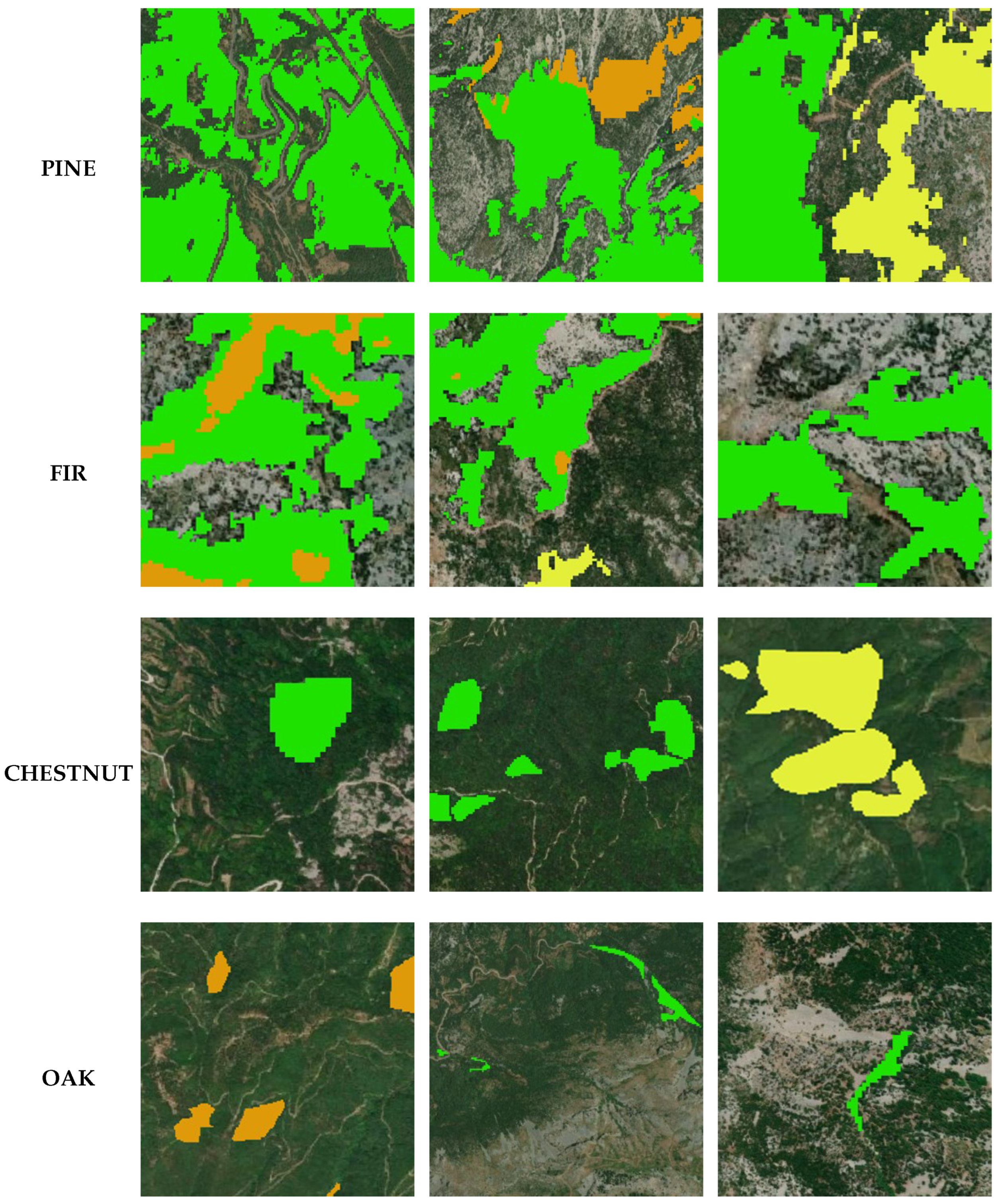
2.4.2. Ground Truth and Training Data Generation
2.5. Feature Engineering and Data Preprocessing
2.5.1. Spectral Index Selection
2.5.2. Input Data Preparation
2.6. Annual Map Updating and Temporal Refinement
2.7. Implementation Details
3. Results
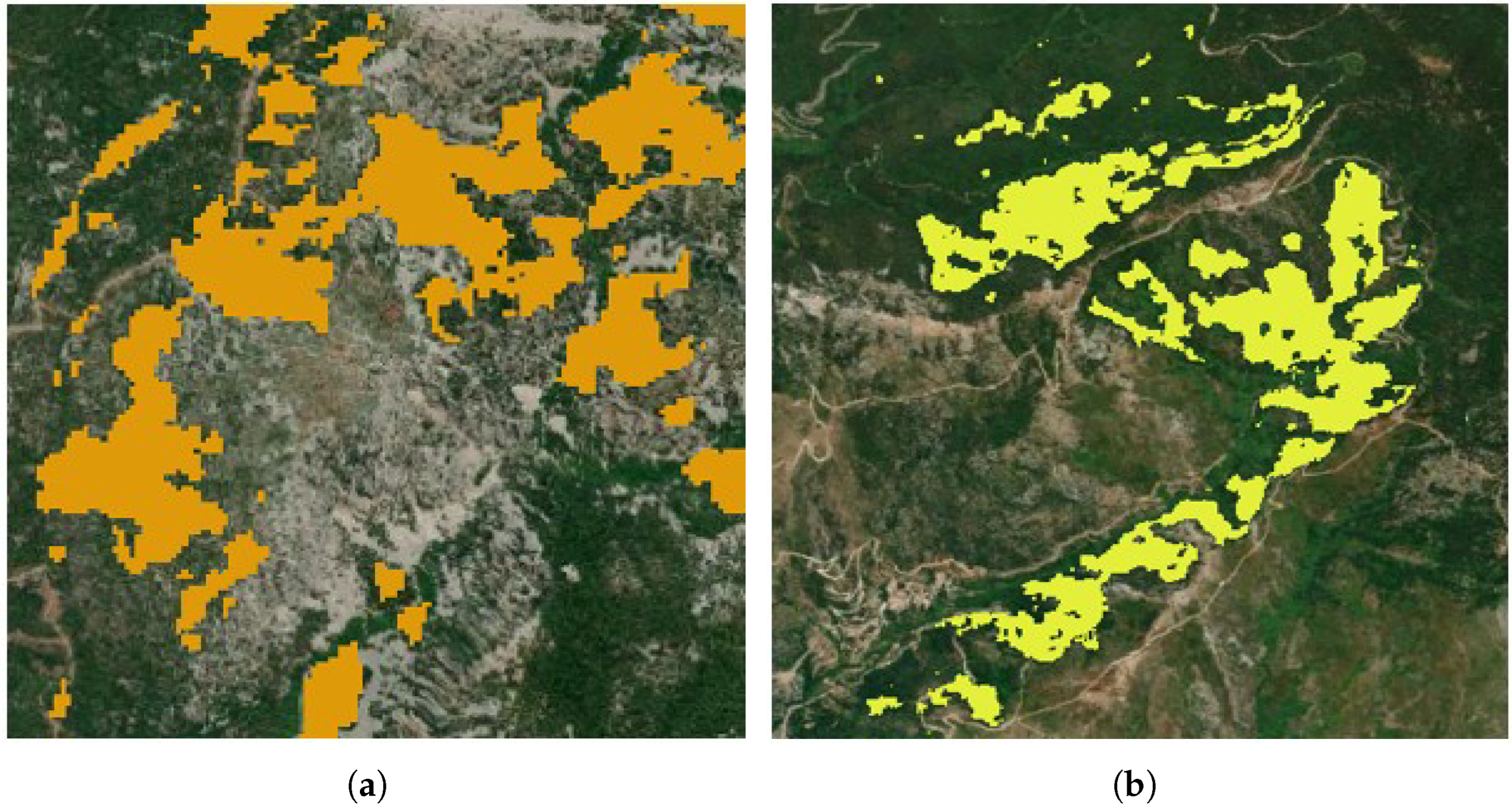
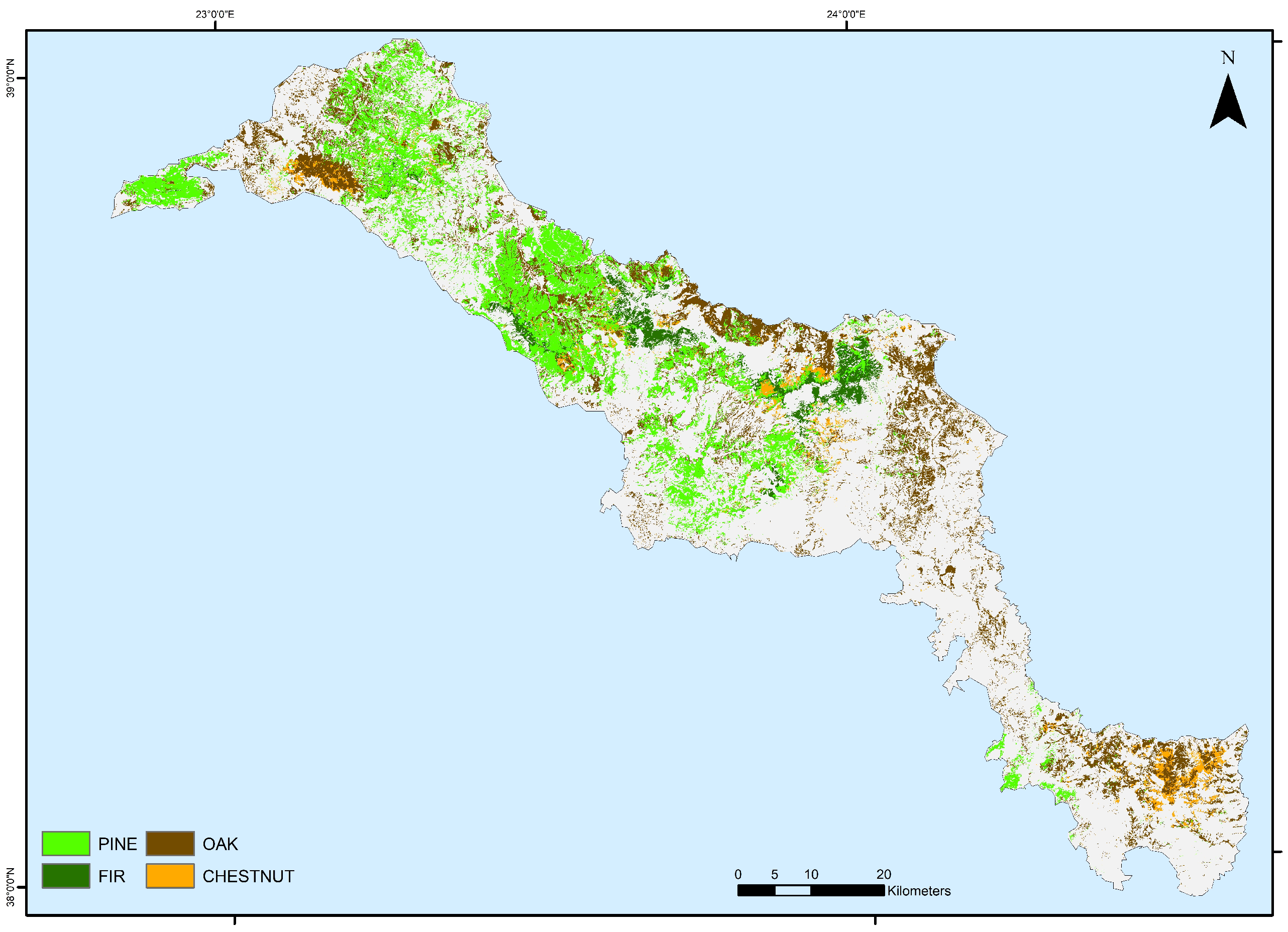
3.1. Honey-Producing Trees Habitats in 2020
3.2. Ablation Study
3.2.1. Feature Selection for the Hierarchical Framework (HF)
3.2.2. Random Forest and SVM Classifiers
3.2.3. U-Net and Features Performance
3.2.4. Multiclass Semantic Segmentation
- Multi-class semantic segmentation using U-Net architecture (MCSS).
- Multi-class semantic segmentation with background class (MCSS-B).
- Multi-class semantic segmentation confined only to forest areas (MCSS-F).
4. Discussion
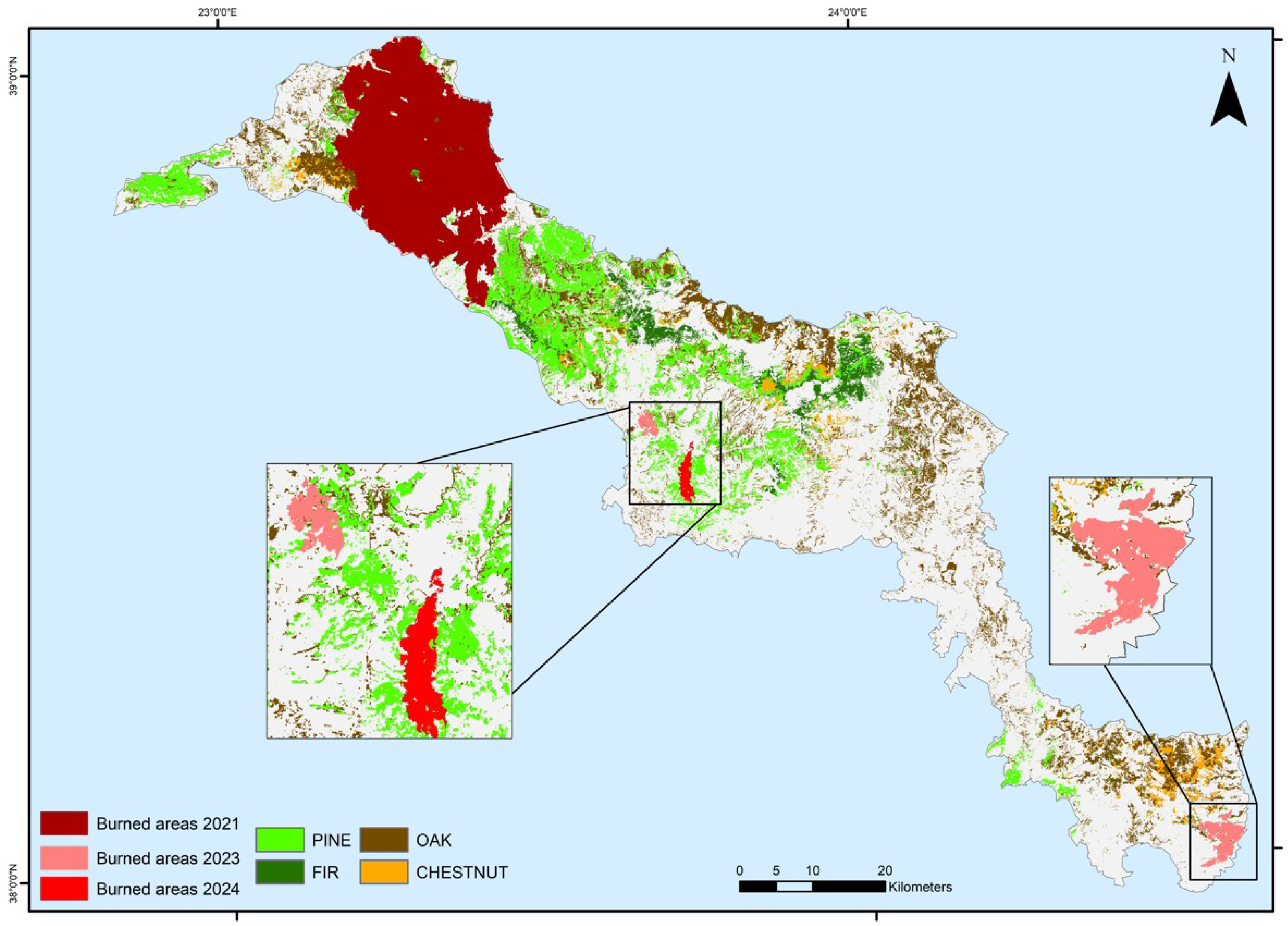
4.1. Impact of Forest Fires on Beekeeping and Ecosystem Damage
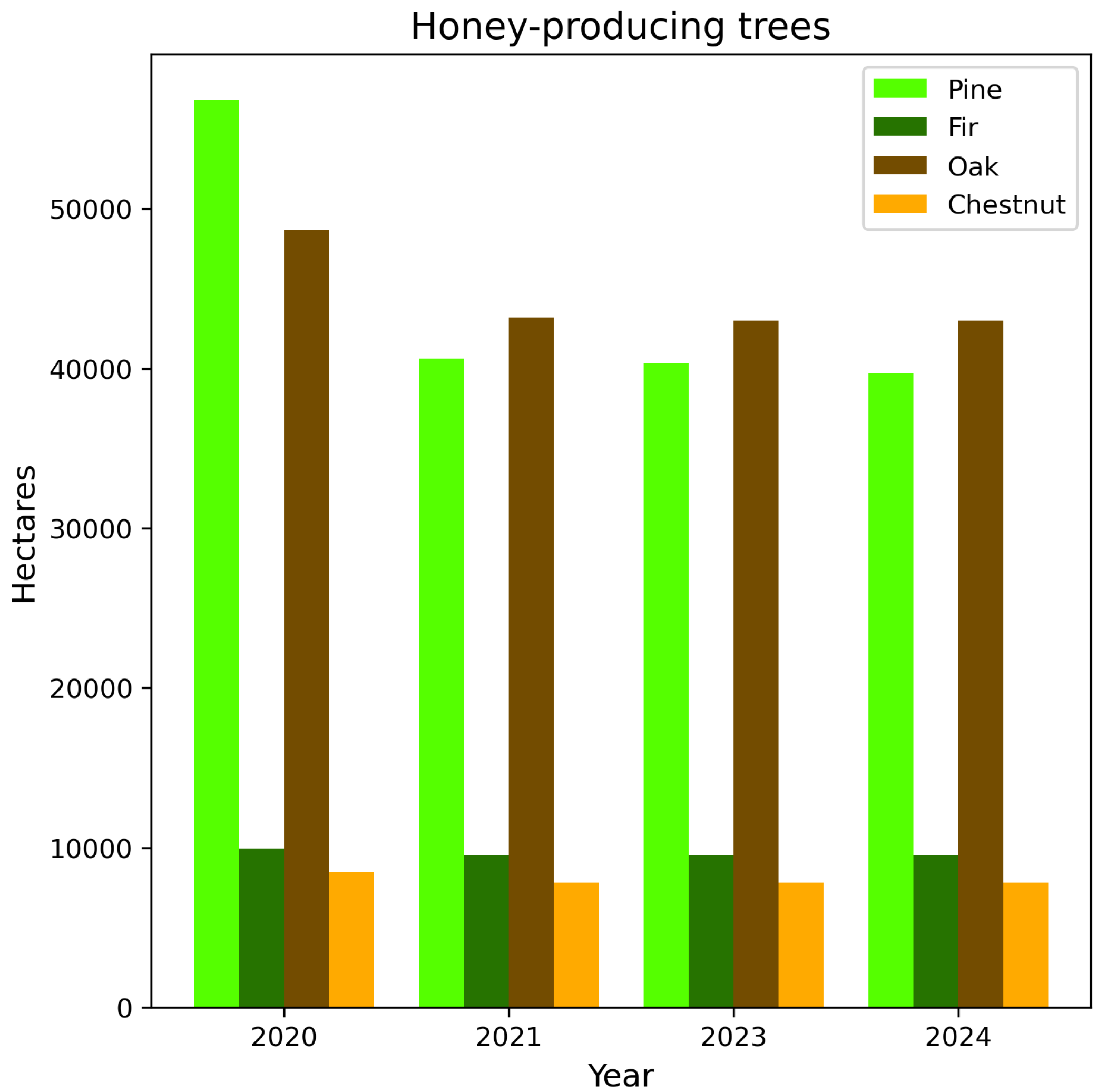
4.2. Forest Recovery, Honeydew Dynamics, and Management Implications
4.3. Future Research Needs
5. Conclusions
Author Contributions
Funding
Data Availability Statement
Acknowledgments
Conflicts of Interest
References
- Schwartz, K.R.; Minor, H.; Magro, C.; McConnell, J.; Capani, J.; Griffin, J.; Doebel, H. The neonicotinoid imidacloprid alone alters the cognitive behavior in Apis mellifera L. and the combined exposure of imidacloprid and Varroa destructor mites synergistically contributes to trial attrition. J. Apic. Res. 2020, 60, 431–438. [Google Scholar] [CrossRef]
- Urban, J.M.; Broome, R. Beyond pollination: Honey bees (Apis mellifera) as zootherapy keystone species. Front. Ecol. Evol. 2018, 6, 161. [Google Scholar] [CrossRef]
- Worthy, S.H.; Acorn, J.H.; Frost, C.M. Honey bees (Apis mellifera) modify plant-pollinator network structure, but do not alter wild species’ interactions. PLoS ONE 2023, 18, e0287332. [Google Scholar] [CrossRef] [PubMed]
- Dáttilo, W.; Cruz, C.P.; Luna, P.; Ratoni, B.; Hinojosa-Díaz, I.A.; Neves, F.S.; Leponce, M.; Villalobos, F.; Guevara, R. The impact of the honeybee Apis mellifera on the organization of pollination networks is positively related with its interactive role throughout its geographic range. Diversity 2022, 14, 917. [Google Scholar] [CrossRef]
- Cunningham-Minnick, M.J.; Milam, J.; Fassler, A.; King, D.I. Best management practices for bee conservation in forest openings. Conserv. Sci. Pract. 2024, 6, e13231. [Google Scholar] [CrossRef]
- Brunet, J.; Fragoso, F.P. What are the main reasons for the worldwide decline in pollinator populations? CAB Rev. 2024, 19, 0016. [Google Scholar] [CrossRef]
- Massah, D.O.; Adamou, M.; Nukenine, N.E.; Kosini, D.; Yatahaï, C.M.; Tchoubou, S.A.; Mohammadou, M.; Youssoupha, O. Effects of Botanical Extracts on Foraging and Pollination Activity of Apis Mellifera (Hymenoptera: Apidae) on Glycine Max (Fabaceae) Flowers at Bini (Ngaoundere, Cameroon). Am. J. Agric. Sci. Eng. Technol. 2023, 7, 37–46. [Google Scholar] [CrossRef]
- Cavigliasso, P.; Bello, F.; Rivadeneira, M.F.; Monzon, N.O.; Gennari, G.P.; Basualdo, M. Pollination efficiency of managed bee species (Apis mellifera and Bombus pauloensis) in highbush blueberry (Vaccinium corymbosum) productivity. J. Hort. Res. 2020, 28, 25–34. [Google Scholar] [CrossRef]
- Zhang, K.; Li, Y.; Sun, K.; Bao, J.; He, C.; Hou, X. Supplementary honey bee (Apis mellifera L.) pollination enhances fruit growth rate and fruit yield in Paeonia ostii (family: Paeoniaceae). PLoS ONE 2022, 17, e0272921. [Google Scholar] [CrossRef]
- Tsingalia, H.M.; Mandela, H.K. Effects of precipitation and temperature on the species composition and pollinator efficiency of Ocimum kilimandscharicum flower visitors in Kakamega forest ecosystem. Open J. Environ. Biol. 2023, 8, 39–47. [Google Scholar] [CrossRef]
- IPBES. The Assessment Report of the Intergovernmental Science-Policy Platform on Biodiversity and Ecosystem Services on Pollinators, Pollination and Food Production; Potts, S.G., Imperatriz-Fonseca, V.L., Ngo, H.T., Eds.; Secretariat of the Intergovernmental Science-Policy Platform on Biodiversity and Ecosystem Services; IPBES: Bonn, Germany, 2016; 552p. [Google Scholar] [CrossRef]
- Gounari, S.; Zotos, C.E.; Dafnis, S.D.; Moschidis, G.; Papadopoulos, G.K. On the impact of critical factors to honeydew honey production: The case of Marchalina hellenica and pine honey. J. Apic. Res. 2021, 62, 383–393. [Google Scholar] [CrossRef]
- Dafnis, S.D.; Gounari, S.; Zotos, C.E.; Papadopoulos, G.K. The effect of cold periods on the biological cycle of Marchalina hellenica. Insects 2022, 13, 375. [Google Scholar] [CrossRef]
- Oğuzoğlu, Ş.; Avcı, M.; İpekdal, K. Predators of the giant pine scale, Marchalina hellenica (Gennadius 1883; Hemiptera: Marchalinidae), out of its natural range in Turkey. Open Life Sci. 2021, 16, 682–694. [Google Scholar] [CrossRef] [PubMed]
- Evelpidou, N.; Tzouxanioti, M.; Gavalas, T.; Spyrou, E.; Saitis, G.; Petropoulos, A.; Karkani, A. Assessment of fire effects on surface runoff erosion susceptibility: The case of the summer 2021 forest fires in Greece. Land 2022, 11, 21. [Google Scholar] [CrossRef]
- Oxford Analytica. August wildfires will force Greek rethink on climate. Expert Brief. 2021. [Google Scholar] [CrossRef]
- Alexiou, S.; Deligiannakis, G.; Pallikarakis, A.; Papanikolaou, I.; Psomiadis, E.; Reicherter, K. Comparing high accuracy t-LiDAR and UAV-SfM derived point clouds for geomorphological change detection. ISPRS Int. J. Geo-Inf. 2021, 10, 367. [Google Scholar] [CrossRef]
- Valkanou, K.; Karymbalis, E.; Bathrellos, G.; Skilodimou, H.; Tsanakas, K.; Papanastassiou, D.; Gaki-Papanastassiou, K. Soil loss potential assessment for natural and post-fire conditions in Evia Island, Greece. Geosciences 2022, 12, 367. [Google Scholar] [CrossRef]
- Tarbill, G.L.; White, A.M.; Sollmann, R. Response of pollinator taxa to fire is consistent with historic fire regimes in the Sierra Nevada and mediated through floral richness. Ecol. Evol. 2023, 13, e10761. [Google Scholar] [CrossRef]
- Tarbill, G.L.; White, A.M.; Sollmann, R. Floral richness drives pollinator diversity after fire in upland forests and meadows of the Sierra Nevada, California. Insect Conserv. Divers. 2024, 77, 187. [Google Scholar] [CrossRef]
- Grushecky, S.T.; Knopka, S.C.; Owen, S.F.; Edwards, J.W. Enhancing pollinator habitats: The role of reclaimed natural gas pipeline rights-of-way in the Appalachian region. J. Environ. Manag. 2024, 300, 123–134. [Google Scholar] [CrossRef]
- Escobedo-Kenefic, N.; Cardona, E.; Arizmendi, M.d.C.; Domínguez, C.A. Do forest reserves help maintain pollinator diversity and pollination services in tropical agricultural highlands? A case study using Brassica rapa as a model. Front. Bee Sci. 2024, 2, 1393431. [Google Scholar] [CrossRef]
- Shokati, H.; Mashal, M.; Noroozi, A.; Abkar, A.A.; Mirzaei, S.; Mohammadi-Doqozloo, Z.; Taghizadeh-Mehrjardi, R.; Khosravani, P.; Nabiollahi, K.; Scholten, T. Random Forest-Based Soil Moisture Estimation Using Sentinel-2, Landsat-8/9, and UAV-Based Hyperspectral Data. Remote Sens. 2024, 16, 1962. [Google Scholar] [CrossRef]
- Brauchler, M.; Stoffels, J.; Nink, S. Extension of an Open GEOBIA Framework for Spatially Explicit Forest Stratification with Sentinel-2. Remote Sens. 2022, 14, 727. [Google Scholar] [CrossRef]
- Antoniadis, K.; Georgopoulos, N.; Katagis, T.; Stavrakoudis, D.; Gitas, I.Z. Classification of seasonal Sentinel-2 imagery for mapping vegetation in Mediterranean ecosystems. In Proceedings of the Ninth International Conference on Remote Sensing and Geoinformation of the Environment (RSCy2023), Ayia Napa, Cyprus, 3–5 April 2023; p. 1278609. [Google Scholar] [CrossRef]
- Malinowski, R.; Lewiński, S.; Rybicki, M.; Gromny, E.; Jenerowicz, M.; Krupiński, M.; Nowakowski, A.; Wojtkowski, C.; Krupiński, M.; Krätzschmar, E.; et al. Automated Production of a Land Cover/Use Map of Europe Based on Sentinel-2 Imagery. Remote Sens. 2020, 12, 3523. [Google Scholar] [CrossRef]
- Vasilakos, C.; Kavroudakis, D.; Georganta, A. Machine Learning Classification Ensemble of Multitemporal Sentinel-2 Images: The Case of a Mixed Mediterranean Ecosystem. Remote Sens. 2020, 12, 2005. [Google Scholar] [CrossRef]
- Guisao-Betancur, A.; Gómez Déniz, L.; Marulanda-Tobón, A. Forest/Nonforest Segmentation Using Sentinel-1 and -2 Data Fusion in the Bajo Cauca Subregion in Colombia. Remote Sens. 2024, 16, 5. [Google Scholar] [CrossRef]
- Host, T.K.; Russell, M.B.; Windmuller-Campione, M.A.; Slesak, R.A.; Knight, J.F. Ash Presence and Abundance Derived from Composite Landsat and Sentinel-2 Time Series and Lidar Surface Models in Minnesota, USA. Remote Sens. 2020, 12, 1341. [Google Scholar] [CrossRef]
- Ronneberger, O.; Fischer, P.; Brox, T. U-Net: Convolutional Networks for Biomedical Image Segmentation. In Medical Image Computing and Computer-Assisted Intervention—MICCAI 2015; Navab, N., Hornegger, J., Wells, W.M., Frangi, A.F., Eds.; Springer International Publishing: Cham, Switzerland, 2015; pp. 234–241. [Google Scholar]
- Siregar, O.R.; Sasongko, P.S.; Endah, S.N. Optic disc segmentation on eye retinal image with U-Net convolutional neural network architecture. In Proceedings of the 2021 5th International Conference on Informatics and Computational Sciences (ICICoS), Semarang, Indonesia, 24–25 November 2021; IEEE: New York, NY, USA, 2021; pp. 69–74. [Google Scholar] [CrossRef]
- Komosar, A.; Stefanović, D.; Sladojević, S. An overview of image processing in biomedicine using U-Net convolutional neural network architecture. J. Comput. Forensic Sci. 2024, 3, 5–20. [Google Scholar] [CrossRef]
- D’Alessandro, V.I.; Palermo, L.; Attivissimo, F.; Di Nisio, A.; Lanzolla, A.M.L. U-Net convolutional neural network for multisource heterogeneous iris segmentation. In Proceedings of the 2023 IEEE International Symposium on Medical Measurements and Applications (MeMeA), Jeju, Republic of Korea, 14–16 June 2023; IEEE: New York, NY, USA, 2023; pp. 1–5. [Google Scholar] [CrossRef]
- Motyl, M.; Madej, Ł. Supervised pearlitic–ferritic steel microstructure segmentation by U-Net convolutional neural network. Arch. Civ. Mech. Eng. 2022, 22, 206. [Google Scholar] [CrossRef]
- Erwin, A.S.; Desiani, A.; Suprihatin, B.; Fathoni. The augmentation data of retina image for blood vessel segmentation using U-Net convolutional neural network method. Int. J. Comput. Intell. Appl. 2022, 21, 2250004. [Google Scholar] [CrossRef]
- Nguyen, H.M.; Demir, B.; Dalponte, M. A Weighted SVM-Based Approach to Tree Species Classification at Individual Tree Crown Level Using LiDAR Data. Remote Sens. 2019, 11, 2948. [Google Scholar] [CrossRef]
- Immitzer, M.; Atzberger, C.; Koukal, T. Tree Species Classification with Random Forest Using Very High Spatial Resolution 8-Band WorldView-2 Satellite Data. Remote Sens. 2012, 4, 2661–2693. [Google Scholar] [CrossRef]
- Zhong, L.; Dai, Z.; Fang, P.; Cao, Y.; Wang, L. A Review: Tree Species Classification Based on Remote Sensing Data and Classic Deep Learning-Based Methods. Forests 2024, 15, 852. [Google Scholar] [CrossRef]
- Harmon, I.; Weinstein, B.; Bohlman, S.; White, E.; Wang, D.Z. A Neuro-Symbolic Framework for Tree Crown Delineation and Tree Species Classification. Remote Sens. 2024, 16, 4365. [Google Scholar] [CrossRef]
- Wang, X.; Yang, N.; Liu, E.; Gu, W.; Zhang, J.; Zhao, S.; Sun, G.; Wang, J. Tree Species Classification Based on Self-Supervised Learning with Multisource Remote Sensing Images. Appl. Sci. 2023, 13, 1928. [Google Scholar] [CrossRef]
- Ni-Meister, W.; Albanese, A.; Lingo, F. Assessing Data Preparation and Machine Learning for Tree Species Classification Using Hyperspectral Imagery. Remote Sens. 2024, 16, 3313. [Google Scholar] [CrossRef]
- Kamga, G.A.F.; Bouroubi, Y.; Germain, M.; Mbom, A.M.; Chagnon, M. Expert knowledge-based modelling approach for mapping beekeeping suitability area. Ecol. Inform. 2024, 80, 102530. [Google Scholar] [CrossRef]
- Marnasidis, S.; Kantartzis, A.; Malesios, C.; Hatjina, F.; Arabatzis, G.; Verikouki, E. Mapping priority areas for apiculture development with the use of geographical information systems. Agriculture 2021, 11, 182. [Google Scholar] [CrossRef]
- Gerula, D.; Gąbka, J. The Effect of Land Cover on the Nectar Collection by Honeybee Colonies in Urban and Rural Areas. Appl. Sci. 2025, 15, 4497. [Google Scholar] [CrossRef]
- Amiri, F.; Shariff, A.R.B.M. Application of geographic information systems in land-use suitability evaluation for beekeeping: A case study of Vahregan watershed (Iran). Afr. J. Agric. Res. 2012, 7, 89–97. [Google Scholar] [CrossRef]
- Abou-Shaara, H.F. Wintering map for honey bee colonies in El-Behera governorate, Egypt by using Geographical Information System (GIS). J. Appl. Sci. Environ. Manag. 2013, 17, 403–408. [Google Scholar] [CrossRef]
- Abou-Shaara, H.F. GIS analysis to locate more suitable wintering areas for honey bee colonies in agricultural and desert lands. Afr. Entomol. 2021, 29, 405–413. [Google Scholar] [CrossRef]
- Abou-Shaara, H.F.; Al-Ghamdi, A.A.; Mohamed, A.A. A suitability map for keeping honey bees under harsh environmental conditions using geographical information system. World Appl. Sci. J. 2013, 22, 1099–1105. [Google Scholar]
- Abou-Shaara, H.F.; Eid, K.S. Increasing the profitability of propolis production in honey bee colonies by utilizing remote sensing techniques to spot locations of trees as potential sources of resin. Remote Sens. Lett. 2019, 10, 922–927. [Google Scholar] [CrossRef]
- Antonopoulos, A.; Gounari, O.; Falagas, A.; Tsagkarakis, A.; Karantzalos, K. Mapping bee-keeping forest plants from medium spatial resolution multispectral satellite data. Int. Arch. Photogramm. Remote Sens. Spatial Inf. Sci. 2023, 48, 1839–1845. [Google Scholar] [CrossRef]
- Papachristoforou, A.; Prodromou, M.; Hadjimitsis, D.; Christoforou, M. Detecting and distinguishing between apicultural plants using UAV multispectral imaging. PeerJ 2023, 11, e15065. [Google Scholar] [CrossRef]
- Adgaba, N.; Alghamdi, A.; Sammoud, R.; Shenkute, A.; Tadesse, Y.; Ansari, M.J.; Hepburn, C. Determining spatio-temporal distribution of bee forage species of Al-Baha region based on ground inventorying supported with GIS applications and Remote Sensed Satellite Image analysis. Saudi J. Biol. Sci. 2017, 24, 1038–1044. [Google Scholar] [CrossRef]
- European Environment Agency (EEA). Natura 2000 Standard Data Form–Site Code: GR2420002. Natura 2000 Database, Release 55. Available online: https://natura2000.eea.europa.eu/Natura2000/sdf/#/sdf?site=GR2420002&release=55&nav=7 (accessed on 11 August 2025).
- Karakizi, C. Land Cover and Crop Type Mapping at National Scale from Multitemporal High Resolution Satellite Data; National Technical University of Athens (NTUA), School of Rural, Surveying & Geomatics Engineering, Remote Sensing Laboratory: Athens, Greece, 2022. [Google Scholar]
- Tananaki, C.; Rodopoulou, M.-A.; Dimou, M.; Kanelis, D.; Liolios, V. The Total Phenolic Content and Antioxidant Activity of Nine Monofloral Honey Types. Appl. Sci. 2024, 14, 4329. [Google Scholar] [CrossRef]
- European Environment Agency. Dominant Leaf Type 2018–Present (Raster 10 m), Europe, Yearly, Nov. 2024; Copernicus Land Monitoring Service (CLMS), Ed. 01.00, Citation Identifier: copernicus_r_3035_10_m_dlt_p_2018-now_v01_r00. 2024. Available online: https://sdi.eea.europa.eu/catalogue/srv/api/records/82f93572-9888-47ef-97a1-5cac5985a26a?language=all (accessed on 10 August 2025).
- Miranda, E.; Mutiara, A.B.; Ernastuti; Wibowo, W.C. Forest Classification Method Based on Convolutional Neural Networks and Sentinel-2 Satellite Imagery. Int. J. Fuzzy Inf. Syst. 2019, 19, 272–282. [Google Scholar] [CrossRef]
- Zhang, T.; Su, J.; Xu, Z.; Luo, Y.; Li, J. Sentinel-2 Satellite Imagery for Urban Land Cover Classification by Optimized Random Forest Classifier. Appl. Sci. 2021, 11, 543. [Google Scholar] [CrossRef]
- Liu, P.; Ren, C.; Wang, Z.; Jia, M.; Yu, W.; Ren, H.; Xia, C. Evaluating the Potential of Sentinel-2 Time Series Imagery and Machine Learning for Tree Species Classification in a Mountainous Forest. Remote Sens. 2024, 16, 293. [Google Scholar] [CrossRef]
- Chowdhury, M.; Saifullah, S.M.; Rahman, M.S. Leveraging Machine Learning Algorithms and Sentinel-2 Satellite Imagery for Land Use Land Cover Classification of Bangladesh Using Google Earth Engine. In Proceedings of the 2024 27th International Conference on Computer and Information Technology (ICCIT), Cox’s Bazar, Bangladesh, 20–22 December 2024; pp. 3384–3389. [Google Scholar] [CrossRef]
- Ma, J.; Shen, H.; Cai, Y.; Zhang, T.; Su, J.; Chen, W.-H.; Li, J. UCTNet with Dual-Flow Architecture: Snow Coverage Mapping with Sentinel-2 Satellite Imagery. Remote Sens. 2023, 15, 4213. [Google Scholar] [CrossRef]
- Huete, A.R.; Didan, K.; Miura, T.; Rodriguez, E.P.; Gao, X.; Ferreira, L.G. Overview of the radiometric and biophysical performance of the MODIS vegetation indices. Remote Sens. Environ. 2002, 83, 195–213. [Google Scholar] [CrossRef]
- Mulkal, R.; Aflah, N.; Muchlis. Exploring the role of spectral indices on improving land cover classification accuracy based on Sentinel-2 satellite imagery in Banda Aceh City, Indonesia. Indones. J. Environ. Sustain. 2024, 2, 96–107. [Google Scholar] [CrossRef]
- Mao, A.; Mohri, M.; Zhong, Y. Cross-Entropy Loss Functions: Theoretical Analysis and Applications. In Proceedings of the 40th International Conference on Machine Learning (ICML 2023), Honolulu, HI, USA, 23–29 July 2023; pp. 21892–21930. [Google Scholar]
- Bacandritsos, N.; Saitanis, C.J.; Papanastasiou, I. Morphology and life cycle of Marchalina hellenica (Gennadius) (Hemiptera: Margarodidae) on pine (Parnis Mt.) and fir (Helmos Mt.) forests of Greece. Ann. Societe Entomol. Fr. 2004, 40, 169–176. [Google Scholar] [CrossRef]
- Gajardo-Rojas, M.; Muñoz, A.A.; Barichivich, J.; Klock-Barría, K.; Gayo, E.M.; Fontúrbel, F.E.; Olea, M.; Lucas, C.M.; Veas, C. Declining Honey Production and Beekeeper Adaptation to Climate Change in Chile. Prog. Phys. Geogr. Earth Environ. 2022, 46, 737–756. [Google Scholar] [CrossRef]
- Enríquez de Salamanca, Á. Effects of Climate Change on Forest Regeneration in Central Spain. Atmosphere 2022, 13, 1143. [Google Scholar] [CrossRef]
- Bucur, D.; Păduraru, C.; Dinca, A. Determination of Forest Fire Risk with Respect to Marchalina hellenica Potential Distribution to Protect Pine Honey Production Sites in Turkey. Environ. Sci. Pollut. Res. 2024, 31, 57692–57703. [Google Scholar] [CrossRef]
- Vergarechea, M.; Calama, R.; Fortin, M.; del Río, M. Climate-Mediated Regeneration Occurrence in Mediterranean Pine Forests: A Modeling Approach. For. Ecol. Manag. 2019, 446, 10–19. [Google Scholar] [CrossRef]
- Erdozain, M.; Bonet, J.A.; Martínez de Aragón, J.; de Miguel, S. Forest Thinning and Climate Interactions Driving Early-Stage Regeneration Dynamics of Maritime Pine in Mediterranean Areas. For. Ecol. Manag. 2023, 539, 121036. [Google Scholar] [CrossRef]
- Flores, J.M.; Gil-Lebrero, S.; Gámiz, V.; Rodríguez, M.I.; Ortiz, M.A.; Quiles, F.J. Effect of Climate Change on Honey Bee Colonies in a Temperate Mediterranean Zone Assessed through a Remote Hive Weight Monitoring System in Conjunction with Exhaustive Colony Assessments. Sci. Total Environ. 2019, 653, 1111–1119. [Google Scholar] [CrossRef]
- Knoll, S.; Fadda, V.; Ahmed, F.; Cappai, M.G. The Nutritional Year-Cycle of Italian Honey Bees (Apis mellifera ligustica) in a Southern Temperate Climate. Agriculture 2024, 14, 730. [Google Scholar] [CrossRef]
- Alfieri, D.; Tognetti, R.; Santopuoli, G. Exploring Climate-Smart Forestry in Mediterranean Forests through an Innovative Composite Climate-Smart Index. J. Environ. Manag. 2024, 368, 122002. [Google Scholar] [CrossRef]
- Njimi, H.; Chehata, N.; Revers, F. Fusion of Dense Airborne LiDAR and Multispectral Sentinel-2 and Pleiades Satellite Imagery for Mapping Riparian Forest Species Biodiversity at Tree Level. Sensors 2024, 24, 1753. [Google Scholar] [CrossRef]





| Stage | Operation | Input → Output Channels | Spatial Size |
|---|---|---|---|
| Input | – | ||
| Encoder level 0 (inc) | Conv + BN + ReLU | ||
| Conv + BN + ReLU | |||
| Conv + BN + ReLU | |||
| Down block 1 | MaxPool | ||
| (Encoder lvl 1) | Conv + BN + ReLU | ||
| Conv + BN + ReLU | |||
| Down block 2 | MaxPool | ||
| (Encoder lvl 2) | Conv + BN + ReLU | ||
| Conv + BN + ReLU | |||
| Down block 3 | MaxPool | ||
| (Encoder lvl 3) | Conv + BN + ReLU | ||
| Conv + BN + ReLU | |||
| Up block 1 | Upsample (bilinear) | ||
| (Decoder lvl 3) | Concatenate (skip) | ||
| Conv + BN + ReLU | |||
| Conv + BN + ReLU | |||
| Up block 2 | Upsample (bilinear) | ||
| (Decoder lvl 2) | Concatenate (skip) | ||
| Conv + BN + ReLU | |||
| Conv + BN + ReLU | |||
| Up block 3 | Upsample (bilinear) | ||
| (Decoder lvl 1) | Concatenate (skip) | ||
| Conv + BN + ReLU | |||
| Conv + BN + ReLU | |||
| Output layer | Conv |
| Index | Name | Formula |
|---|---|---|
| NDVI | Normalized Difference Vegetation Index | |
| EVI | Enhanced Vegetation Index | |
| MCARI | Modified Chlorophyll Absorption Ratio Index | |
| SAVI | Soil-Adjusted Vegetation Index | |
| NDMI | Normalized Difference Moisture Index |
| Model Input | Accuracy | F1-Score | ||
|---|---|---|---|---|
| Coniferous | Broadleaf | Coniferous | Broadleaf | |
| NDVI | 90.4 | 93.5 | 76.4 | 89.9 |
| NDVI + SAVI | 79.0 | 80.2 | 71.3 | 74.4 |
| NDVI + MCARI | 79.8 | 80.3 | 73.5 | 75.3 |
| NDVI + NDMI | 88.6 | 91.1 | 79.1 | 89.8 |
| EVI | 87.0 | 84.8 | 84.1 | 78.6 |
| EVI + SAVI | 78.6 | 74.6 | 76.2 | 77.3 |
| EVI + MCARI | 85.9 | 89.2 | 84.4 | 87.3 |
| EVI + NDMI | 90.9 | 89.4 | 74.7 | 88.7 |
| Classifier | Overall Accuracy (%) | F1-Score (%) | Execution Time (s) |
|---|---|---|---|
| RF | 74.6 | 70.9 | 1548 |
| SVM | 76.9 | 69.3 | 2495 |
| HF | 92.1 | 83.6 | 1929 |
| Classifier | Overall Accuracy (%) | F1-Score (%) | Execution Time (s) |
|---|---|---|---|
| MCSS | 77.8 | 76.4 | 1623 |
| MCSS-B | 86.3 | 83.1 | 1565 |
| MCSS-F | 89.5 | 87.8 | 1263 |
| HF | 92.1 | 83.6 | 1929 |
Disclaimer/Publisher’s Note: The statements, opinions and data contained in all publications are solely those of the individual author(s) and contributor(s) and not of MDPI and/or the editor(s). MDPI and/or the editor(s) disclaim responsibility for any injury to people or property resulting from any ideas, methods, instructions or products referred to in the content. |
© 2025 by the authors. Licensee MDPI, Basel, Switzerland. This article is an open access article distributed under the terms and conditions of the Creative Commons Attribution (CC BY) license (https://creativecommons.org/licenses/by/4.0/).
Share and Cite
Antonopoulos, A.; Moumouris, T.; Tsironis, V.; Psalta, A.; Arapostathi, E.; Tsagkarakis, A.; Trigas, P.; Harizanis, P.; Karantzalos, K. Hierarchical Deep Learning Framework for Mapping Honey-Producing Tree Species in Dense Forest Ecosystems Using Sentinel-2 Imagery. Agronomy 2025, 15, 2858. https://doi.org/10.3390/agronomy15122858
Antonopoulos A, Moumouris T, Tsironis V, Psalta A, Arapostathi E, Tsagkarakis A, Trigas P, Harizanis P, Karantzalos K. Hierarchical Deep Learning Framework for Mapping Honey-Producing Tree Species in Dense Forest Ecosystems Using Sentinel-2 Imagery. Agronomy. 2025; 15(12):2858. https://doi.org/10.3390/agronomy15122858
Chicago/Turabian StyleAntonopoulos, Athanasios, Tilemachos Moumouris, Vasileios Tsironis, Athena Psalta, Evangelia Arapostathi, Antonios Tsagkarakis, Panayiotis Trigas, Paschalis Harizanis, and Konstantinos Karantzalos. 2025. "Hierarchical Deep Learning Framework for Mapping Honey-Producing Tree Species in Dense Forest Ecosystems Using Sentinel-2 Imagery" Agronomy 15, no. 12: 2858. https://doi.org/10.3390/agronomy15122858
APA StyleAntonopoulos, A., Moumouris, T., Tsironis, V., Psalta, A., Arapostathi, E., Tsagkarakis, A., Trigas, P., Harizanis, P., & Karantzalos, K. (2025). Hierarchical Deep Learning Framework for Mapping Honey-Producing Tree Species in Dense Forest Ecosystems Using Sentinel-2 Imagery. Agronomy, 15(12), 2858. https://doi.org/10.3390/agronomy15122858