Article

Research on Simplified Nursery and Labor-Saving Mechanized Transplanting Technologies to Improve Rice Production Efficiency in Southern China

1
Jiangsu Key Laboratory of Crop Cultivation and Physiology, Agricultural College, Yangzhou University, Yangzhou 225009, China
2
Jiangsu Co-Innovation Center for Modern Production Technology of Grain Crops, Yangzhou University, Yangzhou 225009, China
3
Research Institute of Rice Industrial Engineering Technology, Yangzhou University, Yangzhou 225009, China
*
Author to whom correspondence should be addressed.
Agronomy 2025, 15(12), 2808; https://doi.org/10.3390/agronomy15122808
Submission received: 10 November 2025 / Revised: 1 December 2025 / Accepted: 5 December 2025 / Published: 6 December 2025
(This article belongs to the Section Farming Sustainability)

Abstract

Mounting labor shortages and rising operational costs are threatening the sustainability of mechanized rice production in Southern China, underscoring the urgent need for innovations that reduce labor inputs during nursery preparation and transplanting. To address these challenges, this study developed an innovative double-blanket seedling tray measuring 120 cm in length—twice that of a conventional tray. Based on this design, experiments were conducted to identify suitable lightweight substrates capable of producing cohesive and structurally stable double-blanket rice seedling mats. Two lightweight substrates—crop straw boards and matrix cotton—were evaluated in comparison to traditional nursery soil. Results demonstrated that, when combined with the nutrient solution “Miao Zhuang Feng”, both lightweight substrates significantly improved seedling quality, transplanting performance, and final yield. Notably, the fresh weight of double-blanket seedlings grown on lightweight substrates was comparable to single-blanket seedlings cultivated in soil while being 47.46% lighter than double-blanket seedlings raised with soil. To optimize double-blanket seedling mat formation and transplanting quality, five seeding densities (300, 360, 420, 480, and 540 g/tray) and four seedling ages (10, 15, 20, and 25 d) were tested using crop straw board as the substrate. The results revealed that optimal combinations varied by condition: 480 and 540 g/tray were suitable for 15-day-old seedlings, 420 g/tray for 20-day-old seedlings, 360 g/tray for 20~25-day-old seedlings, and 300 g/tray for 25-day-old seedlings. Compared with single-blanket seedlings, the double-blanket approach reduced the number of trays required per hectare and the total seedling cultivation and transportation cost by 57.97% and 16.67%. Furthermore, increasing the seeding density from 300 to 360, 420, 480, and 540 g/tray led to additional reductions of 16.31%, 26.24%, 34.75%, and 41.13%, respectively—substantially lowering labor requirements for tray handling and seedling feeding during transplanting.

1. Introduction

Rice (Oryza sativa) is one of the most important staple crops globally, and the development of simplified and efficient mechanized production methods is essential for ensuring food security and maintaining social stability [1,2]. Currently, simplified mechanized rice production encompasses two approaches: mechanical direct seeding and mechanical transplanting [3,4]. Compared to direct seeding, mechanical transplanting—which involves raising seedlings in advance—enables better utilization of light and temperature during the nursery period and offers greater yield potential. However, this method necessitates additional operations for seedling raising and transplanting, resulting in increased labor requirements and production costs, thereby limiting its widespread adoption [5]. For instance, in Southeast Asia, the rapid decline in the agricultural labor force has accelerated the adoption of mechanized transplanting systems [6], while similar labor constraints are evident in India, where high seasonal wages pose challenges to conventional nursery management [7]. Collectively, these shared trends demonstrate that the labor bottlenecks observed in Southern China reflect a common global challenge faced by labor-intensive rice production models. The challenges associated with mechanical transplanting stem mainly from two factors: the collection and preparation of nursery soil, which involves multiple labor-intensive steps (e.g., soil digging, crushing, sieving, acid regulation, sterilization, and fertilization) [4,8] and the transportation and handling of seedling trays during transplanting. The trays, filled with nursery soil, are relatively heavy, thereby increasing the workload during tray handling and seedling feeding operations. Furthermore, large-scale soil excavation for nursery soil preparation can degrade the plow layer structure and lead to soil deterioration [9].
The standard mat-type seedling trays employed for mechanical transplanting in rice cultivation typically measure 60 cm × 25 cm × 3 cm, with a mat length of approximately 58~60 cm. Generally, 375~525 trays are required per hectare, necessitating the preparation, transportation, and feeding of an equivalent number of trays into the transplanter during operation [10,11]. This process not only demands substantial quantities of nursery soil but also significantly increases labor input in both seedling production and transplanting. To address these challenges, this study developed a double-blanket seedling tray measuring 120 cm × 25 cm × 3 cm, which is twice the length of conventional trays. This innovation effectively reduces the frequency of tray handling and seedling feeding (tray reloading) during mechanical transplanting, thereby streamlining production operations [10]. However, the increased tray length results in a doubling of the seedling mat weight when nursery soil is used, complicating handling and transplanting procedures. Consequently, it is imperative to identify lightweight seedling substrates to replace nursery soil in double-blanket trays, aiming to reduce tray weight while maintaining seedling quality. Additionally, the extended tray length may affect the mat formation capacity of seedlings. Previous studies have demonstrated that seeding density and seedling age are critical factors affecting seedling quality and mat formation [12]. A short seedling age often leads to underdeveloped roots with low root entanglement strength, resulting in loose mats that are unsuitable for mechanical transplanting [13,14]. Conversely, excessive seedling age can cause over-maturity, thereby diminishing transplanting quality [12]. Therefore, selecting an appropriate seedling age in relation to varying seeding densities is essential for producing robust, cohesive mats suitable for mechanical transplanting [15]. At high seeding densities, the optimal seedling age tends to be shorter to prevent excessive density and competition among seedlings [16,17,18], whereas at lower seeding densities, a slightly extended seedling age can enhance root interweaving and improve mat stability [12].
Most existing research focused on conventional single-blanket trays, with limited investigations into the optimal combinations of seeding density and seedling age for double-blanket trays utilizing lightweight seedling substrates. Accordingly, this study employed a double-blanket tray system in which lightweight substrates replaced traditional nursery soil. Five seeding densities (300, 360, 420, 480, and 540 g/tray) and four seedling ages (10, 15, 20, and 25 d) were evaluated to assess their effects on seedling quality and transplanting performance within the double-blanket system. The primary objective was to identify the optimal seeding density and seedling age combinations for producing high-quality, cohesive double-blanket seedlings under lightweight substrate cultivation. Based on the foregoing, we hypothesized that (1) increasing the seeding density in nursery trays would produce seedlings with morphological traits suitable for mechanized transplanting, and (2) this approach would not negatively affect the yield components and final grain yield. This research aims to provide a theoretical and technical foundation to facilitate simplified and labor-efficient mechanized rice production in Southern China.

2. Materials and Methods

2.1. Experimental Site Description

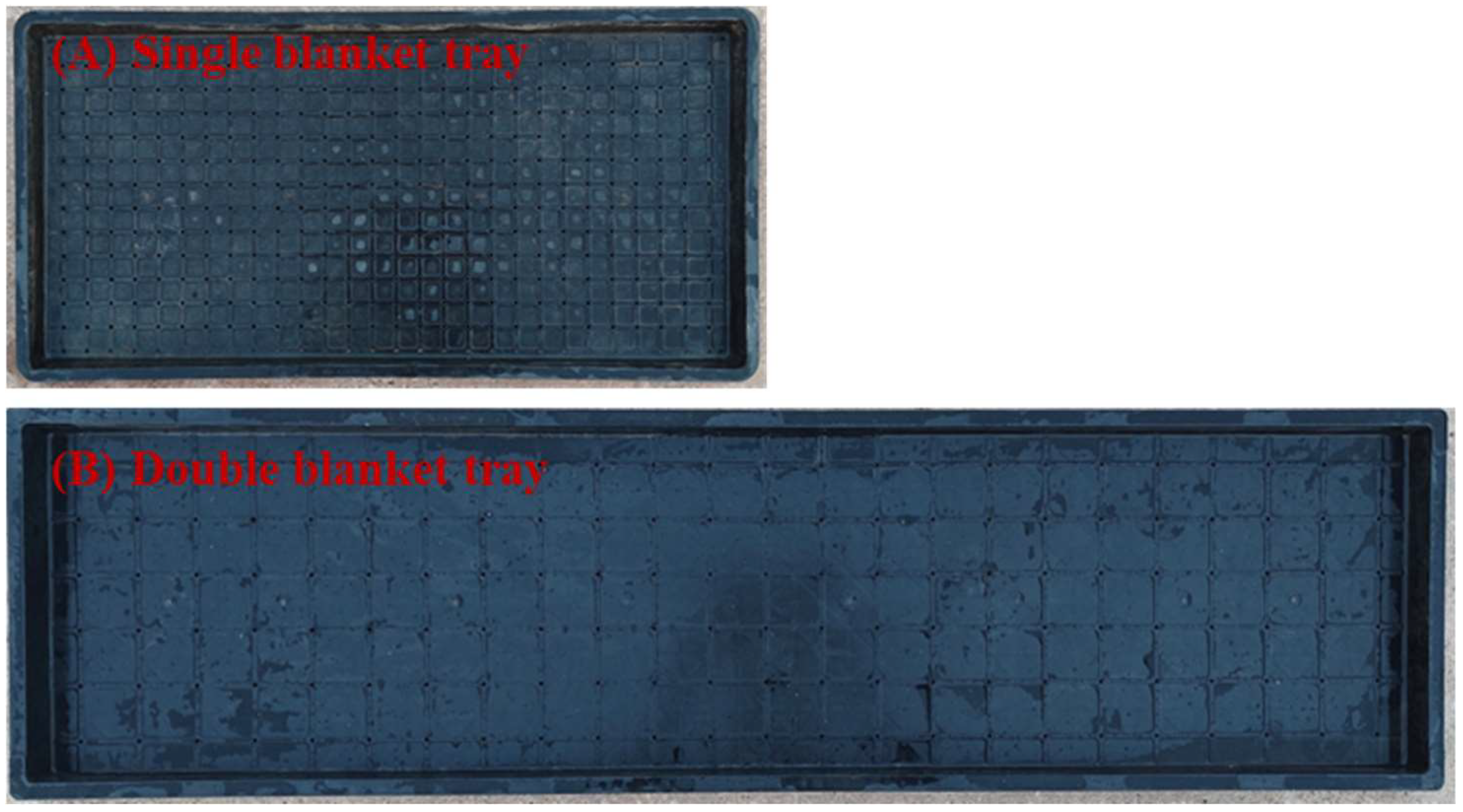
Field experiments were conducted during the rice-growing seasons of 2022 and 2023 at the off-campus experimental station of Yangzhou University, situated in Liyang City, Jiangsu Province, China (31°45′ N, 119°28′ E). The region is characterized by a subtropical monsoon climate, with an average annual sunshine duration of 1932 h, different dry and wet seasons, and precipitation predominantly occurring in the summer months. The mean annual rainfall is 1160 mm, and the mean annual temperature is 15.5 °C. The high-quality japonica rice cultivar Nanjing 46 was utilized as the experimental material. Seedlings were cultivated using three substrates: nutrient soil; crop straw boards, which are produced from rice, wheat, and other crop straws through processes including bio-fermentation, nutrient conditioning, vacuum molding, and high-temperature drying [19]; and matrix cotton, a seedling substrate material manufactured by high-temperature firing of raw materials such as high-purity clay clinker, alumina powder, silica powder, and chromite sand [20]. All substrates were provided by the Jiangsu Academy of Agricultural Sciences. The physicochemical properties of the three substrates are detailed in Table 1. Two types of seedling trays were employed: a single-blanket tray and a double-blanket tray. The number of drainage holes at the bottom of the trays was 392 and 144, respectively, with tray weights of 0.572 kg and 1.545 kg. Images of the single-blanket and double-blanket trays are illustrated in Figure 1.
This study comprised two experiments. The first was a screening trial to evaluate lightweight seedling substrates suitable for cultivating rice seedlings in double-blanket trays. For double-blanket seedling trays, three substrate treatments were established: nutrient soil, crop straw boards, and matrix cotton, with a seeding density of 360 g/tray and a transplanting seedling age of 24 d. The second was an experiment designed to assess the effects of varying seeding densities and seedling ages on rice seedling quality and machine transplanting performance. Five seeding densities (300 g, 360 g, 420 g, 480 g, and 540 g) and four transplanting seedling ages (10, 15, 20, and 25 d) were arranged, resulting in a total of 20 treatments. In both years, sowing was conducted on 7 May.
For all treatments, seedlings were sprayed after darkening with “Miao Zhuang Feng”. The solution is a commercial nutrient product with a total nutrient content (N-P2O5-K2O) ≥ 210 g/L (140-45-21 g/L); it contains organic matter (≥10 g/L), free amino acids (≥17.5 g/L), and biochemical fulvic acid (≥13.5 g/L) while exhibiting a pH of ≤6. A total of 16 g of the solution was applied per double-blanket tray. Transplantation was conducted using a Kubota 2ZGQ-6G2 (SPV-6CM) rice transplanter (Kubota Corporation, Osaka, Japan). The field planting density was established with a spacing of 30 cm by 11.8 cm, accommodating 4~6 seedlings per hill, resulting in a seedling density of 1.425 × 10⁶ hills per hectare.

2.2. Measurement Items and Methods

2.2.1. Substrate Physicochemical Properties

Air-dried samples from each substrate ratio were collected randomly. The chemical properties were subsequently analyzed as follows: substrate pH was measured using a pH meter; organic matter content was determined using the potassium dichromate oxidation method. Available nitrogen (AN), available phosphorus (AP), and available potassium (AK) were quantified using 0.5 mol·L−1 K2SO4 extraction, 0.5 mol·L−1 NaHCO3 extraction followed by molybdenum-antimony colorimetry, and NH4OAc extraction coupled with flame photometry, respectively [21].

2.2.2. Seedling Emergence Rate

For each treatment, seedlings within randomly selected 10 cm × 10 cm quadrats were counted, encompassing both emerged seedlings and ungerminated seeds. The seedling emergence rate was subsequently calculated as follows:
Seedling   rate = Number   of   emerged   seedlings Number   of   emerged   seedlings   +   Number   of   un - germinated   seeds

2.2.3. Seedling Tray Weight

Following the darkening process, the total weight of the seedling tray, water-saturated substrate, and seeds was recorded. Prior to mechanical transplanting, the weight of the seedling mat was measured.

2.2.4. Seedling Quality

Ten representative seedlings were selected from each replicate within every treatment to measure plant height, root length, root number, leaf age, basal stem diameter, and the dry weights of both shoots and roots (expressed per 100 plants). Rooting capacity was evaluated by selecting 20 uniformly growing seedlings per treatment prior to transplantation; their roots were excised, and the seedlings were subsequently incubated hydroponically. After 7 d, the number of newly formed roots measuring at least 5 mm was recorded. The root twisting force was measured one day before rice transplanting. For each treatment, an intact rice seedling mat was used. After adjusting the moisture content of the seedling mat to approximately 40%, wooden boards of equal width were fixed to both ends of the mat. A spring scale was then used to apply horizontal pulling force until the seedling mat fractured. The instantaneous force recorded by the spring scale at the point of fracture represented the root twisting force. Three replicates were measured for each treatment.

2.2.5. Nitrogen Content and Accumulation

Samples were inactivated at 105 °C for 30 min, oven-dried to a constant weight at 75 °C, and subsequently ground to pass through a 60-mesh sieve. Total nitrogen content was determined using a Kjeldahl nitrogen analyzer (FOSS-8400, Foss, Eden Prairie, MN, USA). Nitrogen accumulation in 100 plants (mg) was calculated as follows:
Nitrogen   accumulation mg = N   content × abroveground   dry   weight   of   plants

2.2.6. Mechanized Transplanting Quality

1~2 d following transplantation, three representative locations were selected within each plot. At each location, 40 planting holes were examined. Count the number of empty holes, total seedlings surveyed, floating seedlings, and upturned seedlings in the 40 planting holes. The subsequent indices were calculated [22] as follows:
Missing   hill   rate % = Number   of   empty   holes Total   holes   surveyed × 100 %
Floating   seedling   rate % = Number   of   floating   seedlings Total   holes   surveyed × 100 %
Upturning   seedling   rate % = Number   of   upturned   seedlings Total   holes   surveyed × 100 %

2.2.7. Yield and Its Components

At maturity, twenty rice plants were randomly selected from each treatment to assess the number of panicles, spikelets per panicle, filled grain rate, and 1000-grain weight. Additionally, a 1 m2 quadrat was harvested from each treatment; the aboveground biomass was air-dried and threshed. Grain yield was subsequently adjusted to a moisture content of 14.5%.

2.3. Statistical Analysis

Data were processed using Excel 2016. Analysis of variance (ANOVA) and principal component analysis (PCA) were performed using IBM Statistical Package for the Social Sciences Statistics (26th edition; IBM, Armonk, NY, USA). Treatment means were compared employing the least significant difference (LSD) test at a significance level of 0.05 (p < 0.05). Figures were generated with Origin 2024. As the experimental trends observed in 2022 and 2023 were consistent, the average values from both years were utilized in this study.

3. Results

3.1. Effects of Different Substrates on Seedling Quality, Transplanting Quality and Yield

3.1.1. Seedling Quality

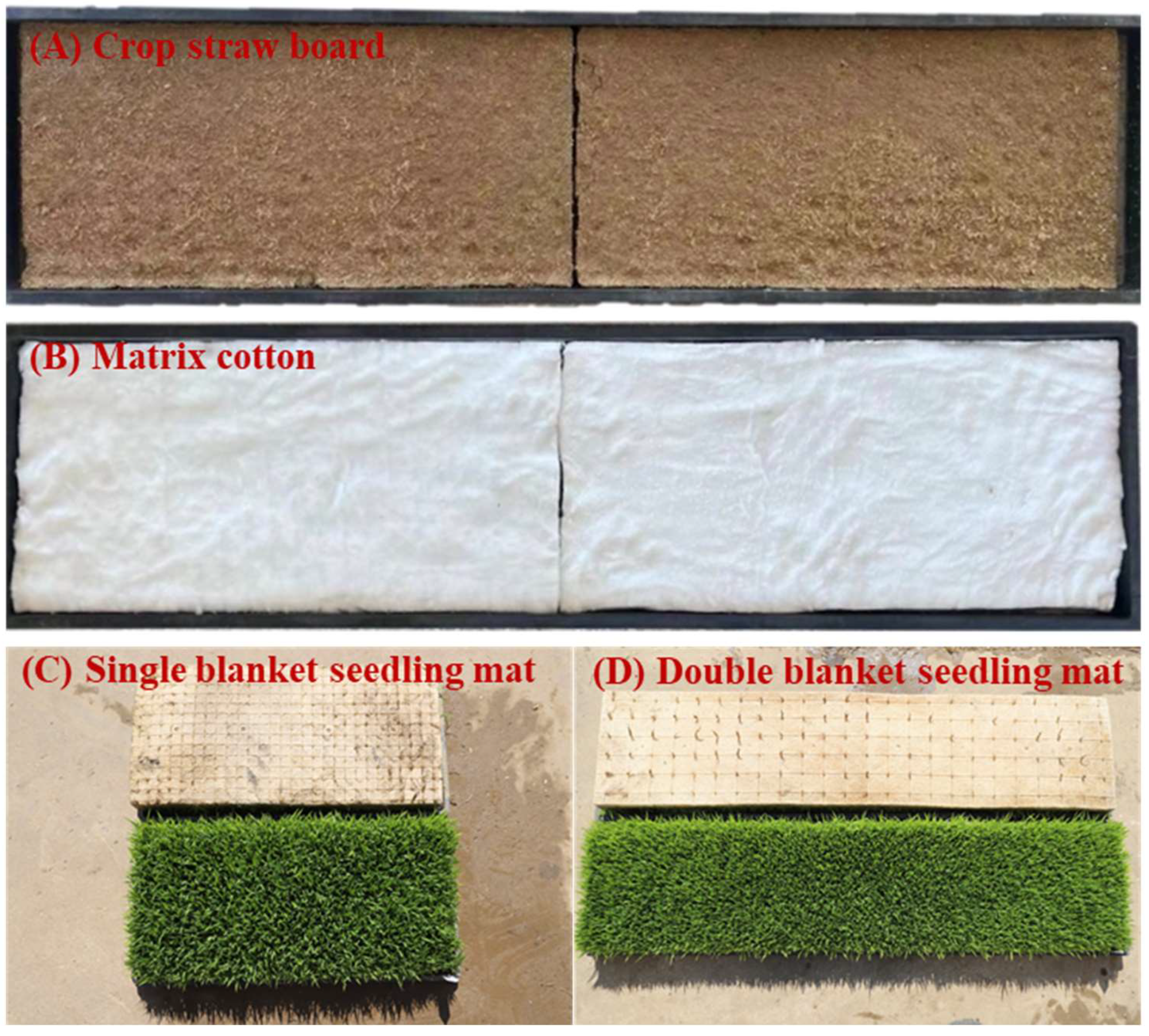
Figure 2 depicts the two lightweight substrates and the blanket seedling mat. Among the three seedling substrates examined, no significant differences were observed in rice seedling emergence rates, although a slight improvement was noted with the lightweight substrates (crop straw boards and matrix cotton). Compared to nursery soil, the lightweight substrates significantly enhanced seedling height, leaf age, basal stem width, and shoot dry weight. Regarding root characteristics—including root length, root number, and rooting ability—the lightweight substrates demonstrated marginally better performance than nursery soil. However, the root weight of matrix cotton was significantly lower than the other substrates. Furthermore, relative to nursery soil, the lightweight substrates substantially increased root anchorage strength and nitrogen accumulation in the seedlings (Table 2).

3.1.2. Transplanting Quality and Seedling Tray Weight

The type of substrate exerted a significant impact on the transplanting quality of rice seedlings. Compared to the double-blanket nutrient soil, lightweight substrates notably decreased the rates of missing hills, floating seedlings, and upturned seedlings to varying extents. Specifically, the application of double-blanket crop straw boards resulted in reductions of 20.14%, 4.41%, and 15.20% in these respective rates relative to the double-blanket nutrient soil. The weight of the seedling tray is a critical factor in practical field operations. Under double-blanket trays, both the total weight of the seedling tray and mat after darkening, as well as the seedling mat weight prior to transplanting, were significantly lower when lightweight substrates were used compared to nutrient soil. Although the inherent weight of double-blanket trays was significantly greater than single-blanket trays, the seedling mat weight before transplanting under double-blanket crop straw boards did not differ significantly from that observed under single-blanket nutrient soil (Table 3).

3.1.3. Yield and Its Components

Compared to rice seedlings cultivated in nutrient soil, those grown in lightweight seedling substrates demonstrated relatively higher rice yields (Table 4). Notably, crop straw boards and matrix cotton enhanced yields through different mechanisms. Seedlings grown on crop straw boards exhibited a slight reduction in both filled grain rate and grain weight relative to nutrient soil seedlings but showed comparatively higher panicle numbers and spikelets per panicle. Conversely, matrix cotton seedlings increased yield by enhancing spikelets per panicle and filled grain rate compared to nutrient soil seedlings.

3.2. Effects of Different Seeding Densities and Age on Seedlings

The aforementioned study demonstrated the feasibility of utilizing lightweight seedling substrates for rice seedling cultivation. Seedlings grown on crop straw boards exhibited stable quality, with superior aboveground growth and stem thickness compared to those cultivated in nutrient soil, and without the reduction in root biomass observed in matrix cotton substrates (Table 2). Regarding mechanical transplanting performance, compared to nutrient soil, seedlings from crop straw boards showed relatively low rates of missing hills, floating seedlings, and upturned seedlings while maintaining a moderate seedling tray weight (Table 3). This avoided the excessive tray weight associated with nutrient soil seedlings and the inconsistent seedling quality observed in matrix cotton. Furthermore, crop straw board seedlings achieved a significant increase in spikelets per panicle, thereby sustaining high yield levels. Consequently, crop straw boards were selected as the seedling substrate for subsequent investigations.

3.2.1. Aboveground Traits of Rice Seedlings

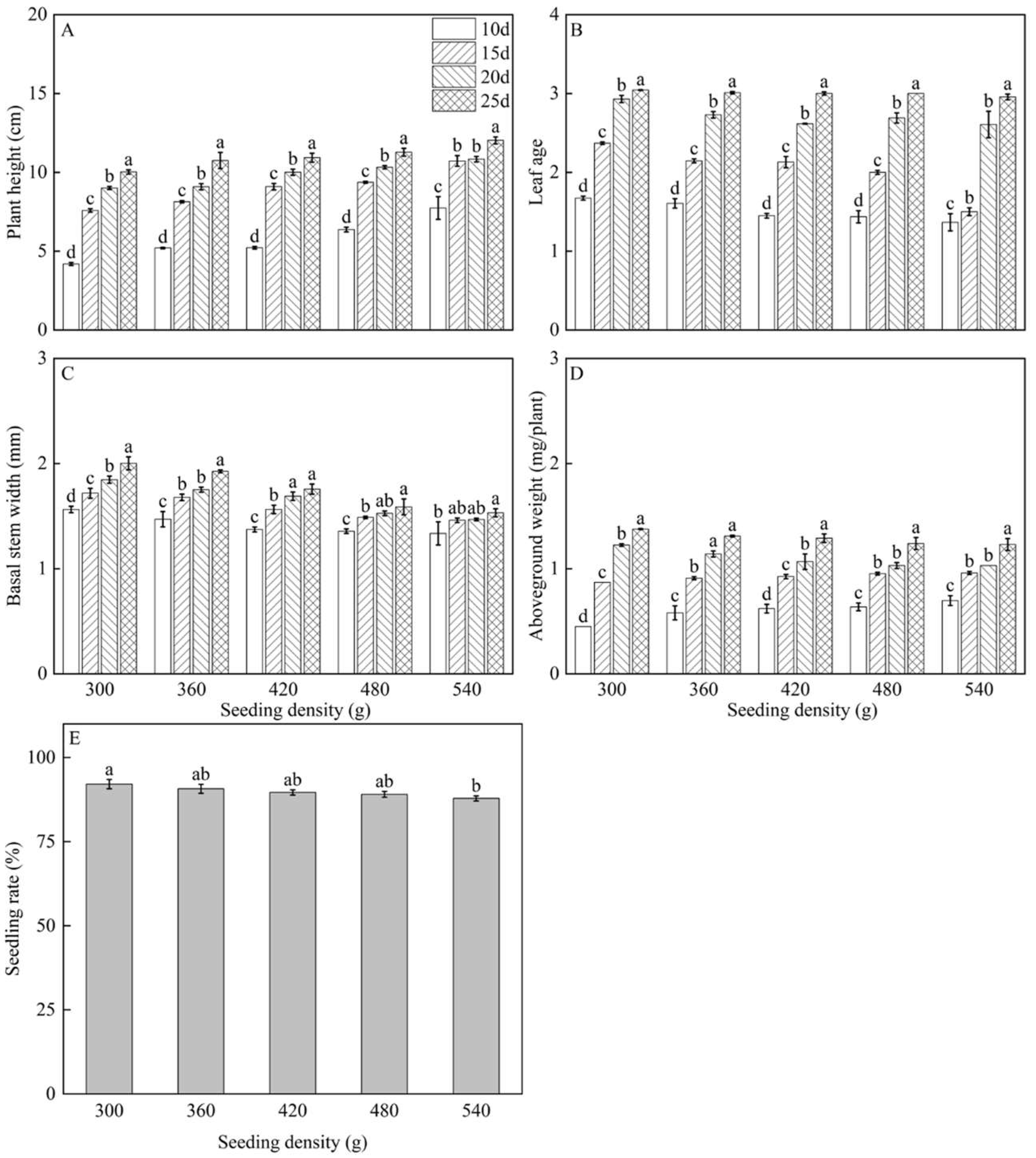
As seeding density increased, the seedling emergence rate gradually declined; when the seeding density reached 540 g, the emergence rate was significantly reduced by 4.63% compared to 300 g (Figure 3E). Concerning aboveground seedling traits, at a constant seeding density, plant height, leaf age, basal stem width, and aboveground dry matter accumulation all increased with seedling age (Figure 3A–D). At a fixed seedling age, plant height tended to increase with seeding density, whereas basal stem width and leaf age generally decreased. The pattern of aboveground dry matter accumulation in response to increasing seeding density varied depending on seedling age: specifically, at 10 and 15 d, aboveground dry matter increased with seeding density, whereas at 20 and 25 d, it gradually declined.

3.2.2. Root Traits of Rice Seedlings

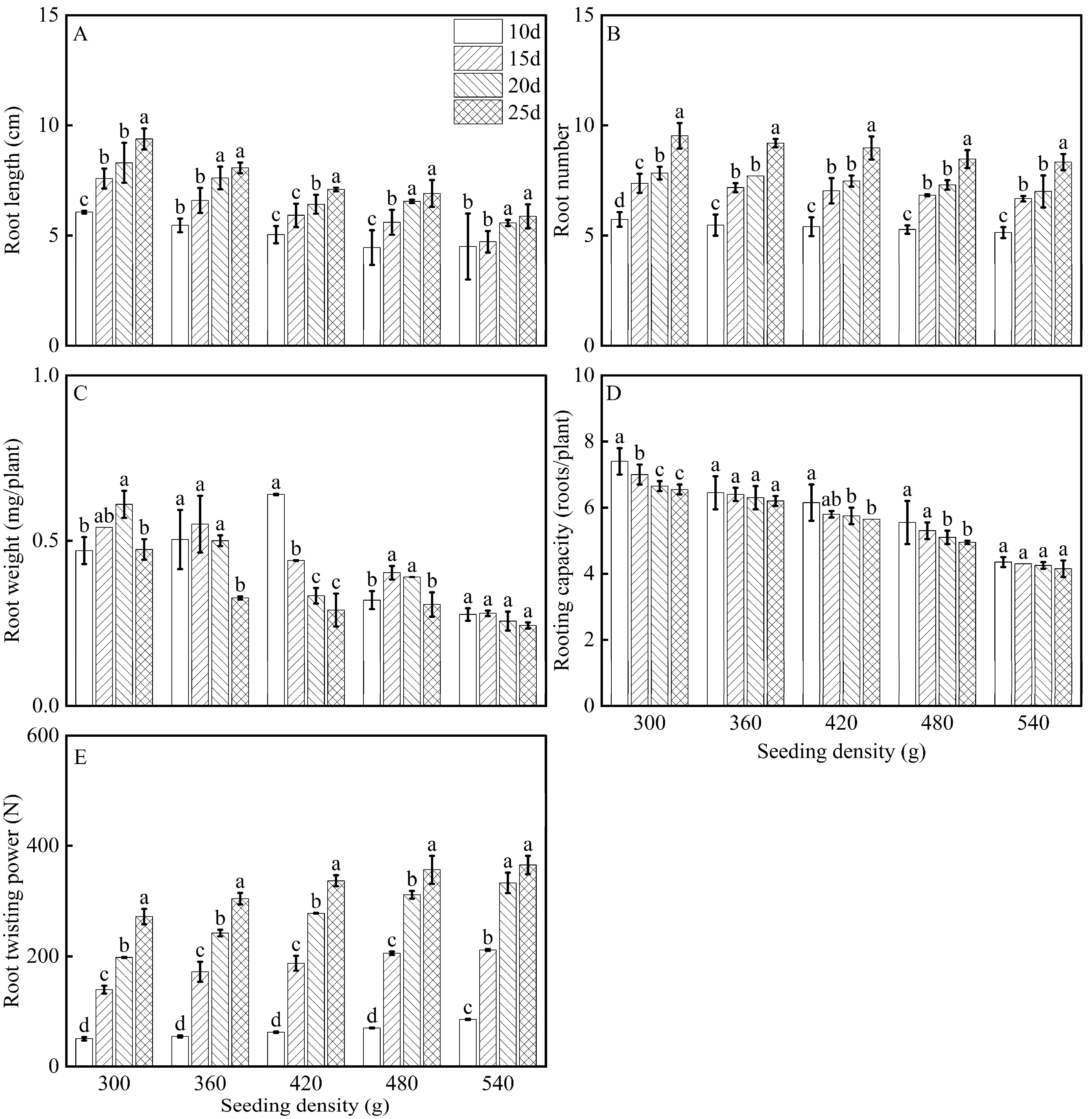
Concerning root traits, at a given seedling age, root length, root number, and rooting ability generally decreased as seeding density increased (Figure 4A,B,D), whereas root twisting force exhibited a gradual increase (Figure 4E). At seedling ages of 10 and 15 d, root dry weight initially increased and subsequently decreased with rising seeding density; specifically, at 10 d, root dry weight reached its maximum at a seeding density of 420 g, while at 15 d, the peak occurred at 360 g. At 20 and 25 d, root dry weight peaked at 300 g seeding density (Figure 4C). At a constant seeding density, root length, root number, and root twisting force increased progressively with seedling age. Regarding root dry weight, except at 420 g seeding density, seedlings at other densities demonstrated an initial increase followed by a decline with age; the peak was observed at 20 d for 300 g seeding density and at 15 d for the remaining densities. Rooting ability decreased gradually with increasing seedling age under the same seeding density.

3.2.3. Nitrogen Content and Nitrogen Accumulation

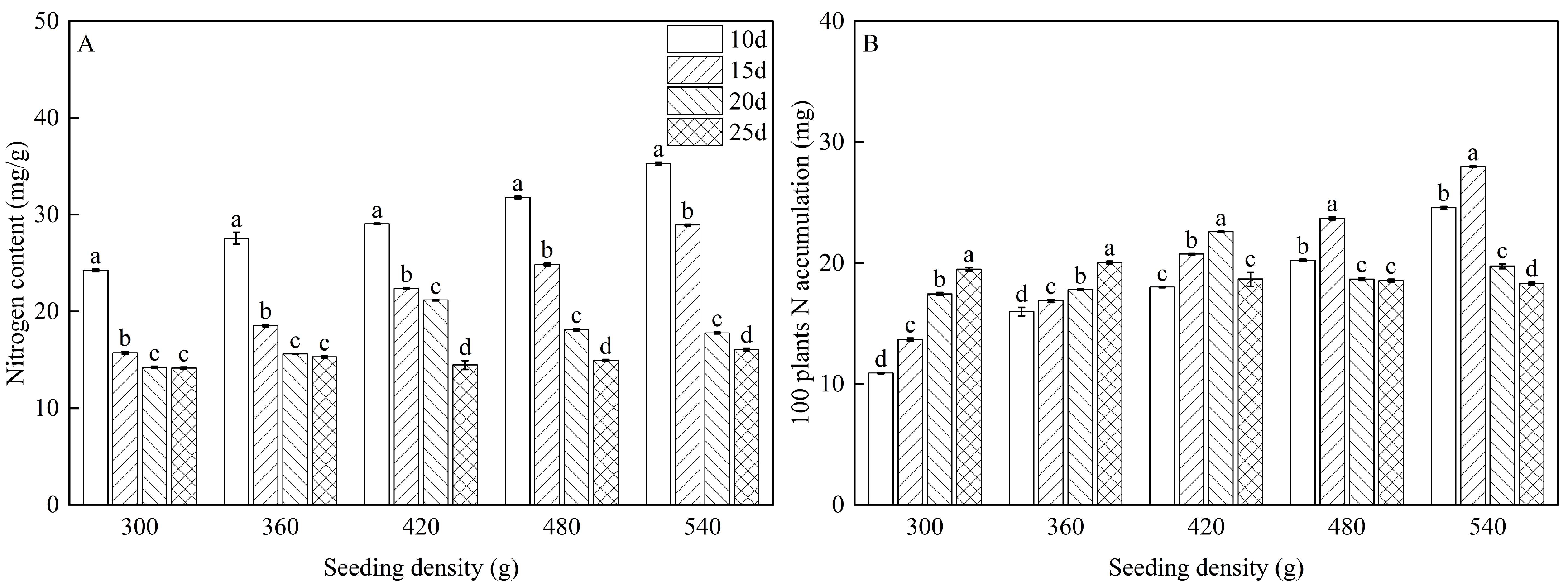
At seedling ages of 10 and 15 d, seedling nitrogen content exhibited a gradual increase corresponding with rising seeding density. At 20 d, nitrogen content initially increased and subsequently declined as seeding density increased, reaching a maximum at 420 g seeding density. Nitrogen accumulation similarly increased with seeding density at 10 and 15 d. However, at 20 d, nitrogen accumulation under 480 g and 540 g seeding densities decreased by 17.36% and 12.58%, respectively, compared to the 420 g seeding density. At 25 d, nitrogen accumulation at 420, 480, and 540 g seeding densities was significantly lower than that observed at 300 and 360 g, with reductions ranging from 4.82% to 10.08%. Within the same seeding density, nitrogen content declined progressively with increasing seedling age. Concerning nitrogen accumulation per 100 seedlings, values increased steadily with seedling age at 300 and 360 g seeding densities, whereas at 420~540 g seeding densities, accumulation initially increased and then decreased with age. For each seeding density, the variation between the highest and lowest nitrogen accumulation across seedling ages ranged from 25.33% to 78.64% (Figure 5).

3.2.4. Mechanized Transplanting Quality

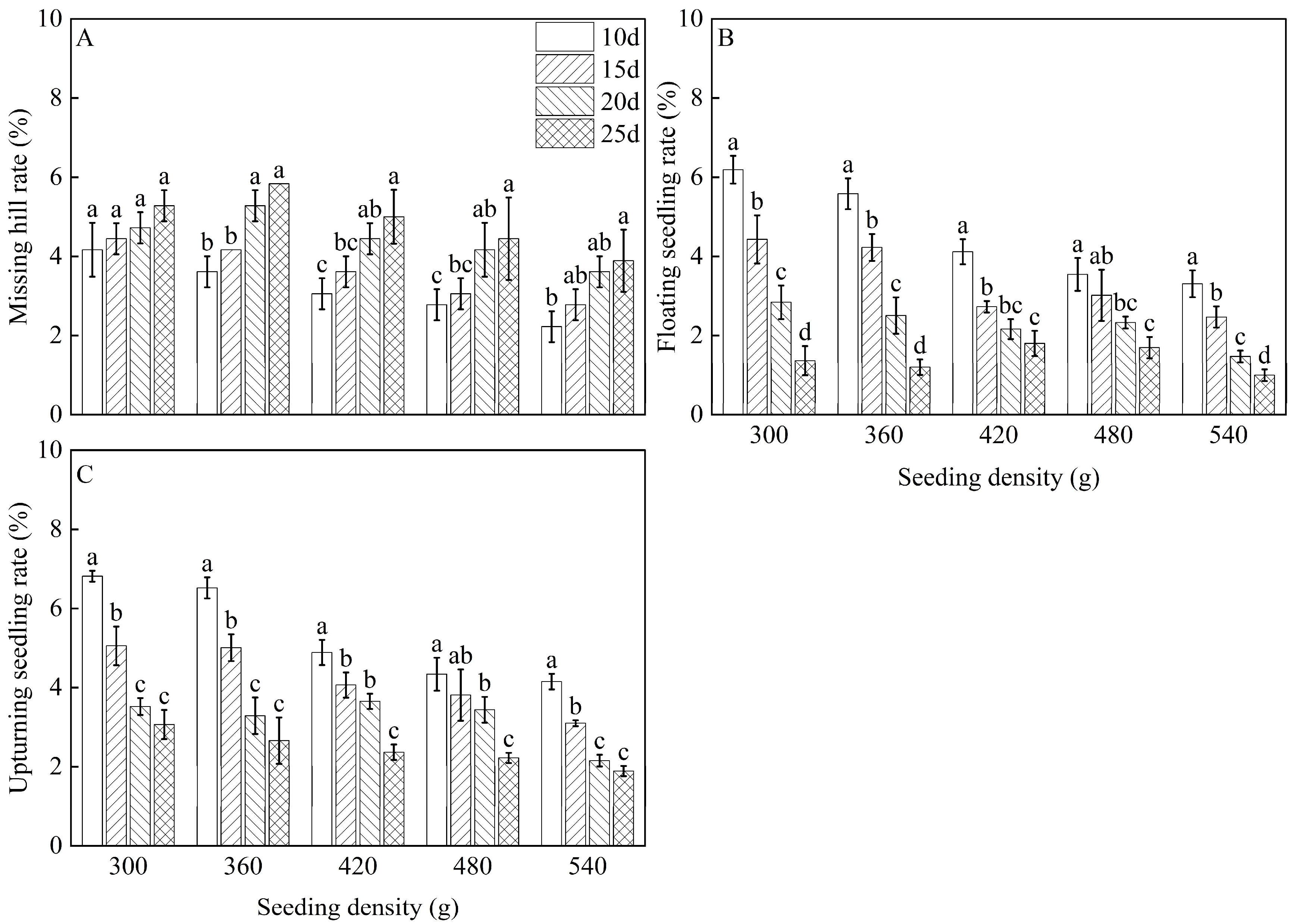
At seedling ages of 10 and 15 d, the rates of missing hills, floating seedlings, and upturned seedlings all exhibited a gradual decline as seeding density increased. At 20 and 25 d, the pattern of mechanical transplanting quality was less consistent. However, these rates generally tended to decrease with higher seeding densities. At a constant seeding density, the missing hill rate increased with seedling age, whereas the floating seedling rate and upturned seedling rate gradually decreased (Figure 6). Furthermore, increasing seeding density significantly reduced the number of seedling trays required per hectare. Under double-blanket seedling tray treatments, seeding densities of 360~540 g reduced tray usage per hectare by 15.88~41.44% compared to a seeding density of 300 g. Relative to the conventional single-blanket treatment at 150 g seeding density, double-blanket treatments at 300–540 g seeding densities decreased tray usage per hectare by 50.53~70.83% (Table 3 and Table 5).

3.2.5. Seedling Tray and Mat Weight

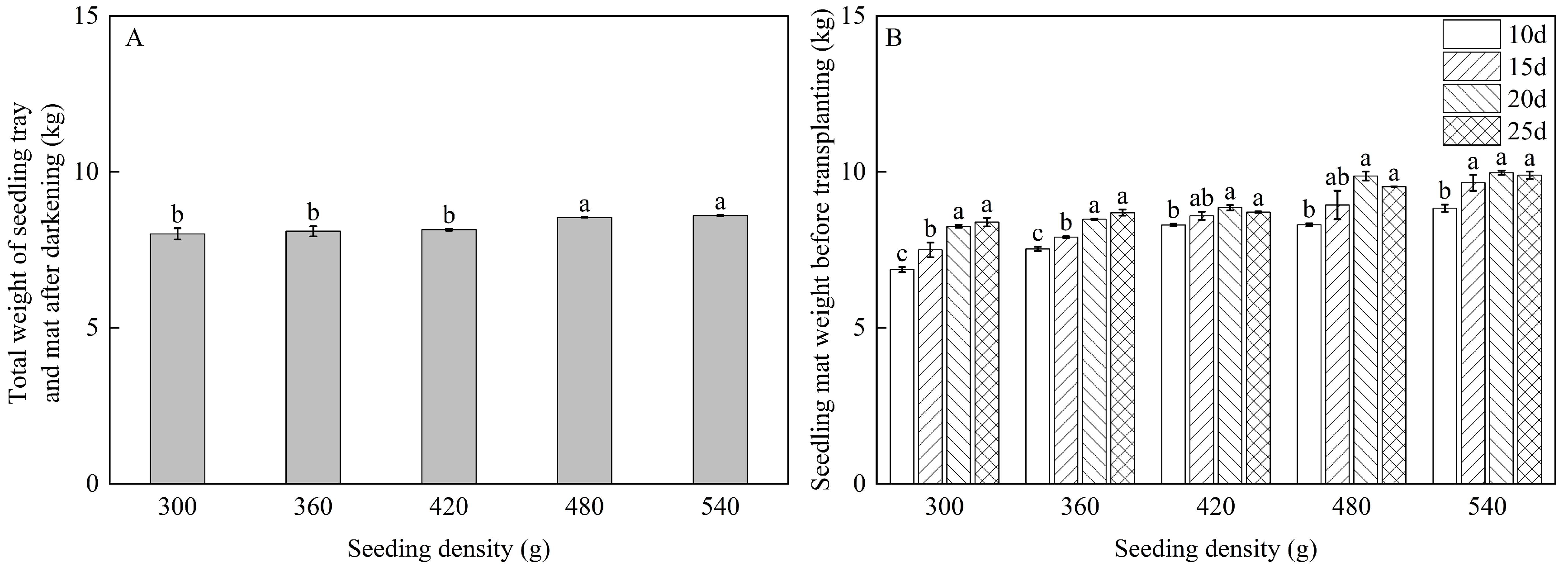
As seeding density increased, the total weight of seedling trays after darkening exhibited a gradual increase. Specifically, at seeding densities of 480 and 540 g, the tray weight after darkening was significantly greater than that observed at densities ranging from 300 to 420 g (Figure 7A). Concerning the seedling mat weight prior to transplanting, at lower seeding densities of 300 and 360 g, mat weight consistently increased with seedling age. In contrast, at higher seeding densities between 420 and 540 g, mat weight initially increased, reaching a peak at 20 d, followed by a slight decline at 25 d (Figure 7B). Additionally, for seedlings of the same age, mat weight before transplanting increased progressively with higher seeding densities.

3.2.6. Cost of Seedling Cultivation and Transportation

Compared with the conventional single-blanket nursery soil treatment, cultivating rice seedlings using the double-blanket crop straw boards markedly reduced the number of trays required per hectare for mechanical transplanting. Although the unit price of a double-blanket tray is higher than that of a single-blanket tray, the tray cost under the 360~540 g seeding density treatments was significantly lower by 16.31~41.13% than that of the conventional method (Table 6). Regarding substrate cost, all seeding densities except the 300 g treatment showed significant reductions of 3.44% to 32.08% compared with the conventional practice. In addition, under the 300~360 g seeding density treatments, the seedling transportation cost for the double-blanket crop straw boards was significantly reduced by 50.00% to 70.57%. Consequently, the total cost of seedling raising and transportation decreased significantly by 0.42% to 41.38%.

3.2.7. PCA and Comprehensive Score

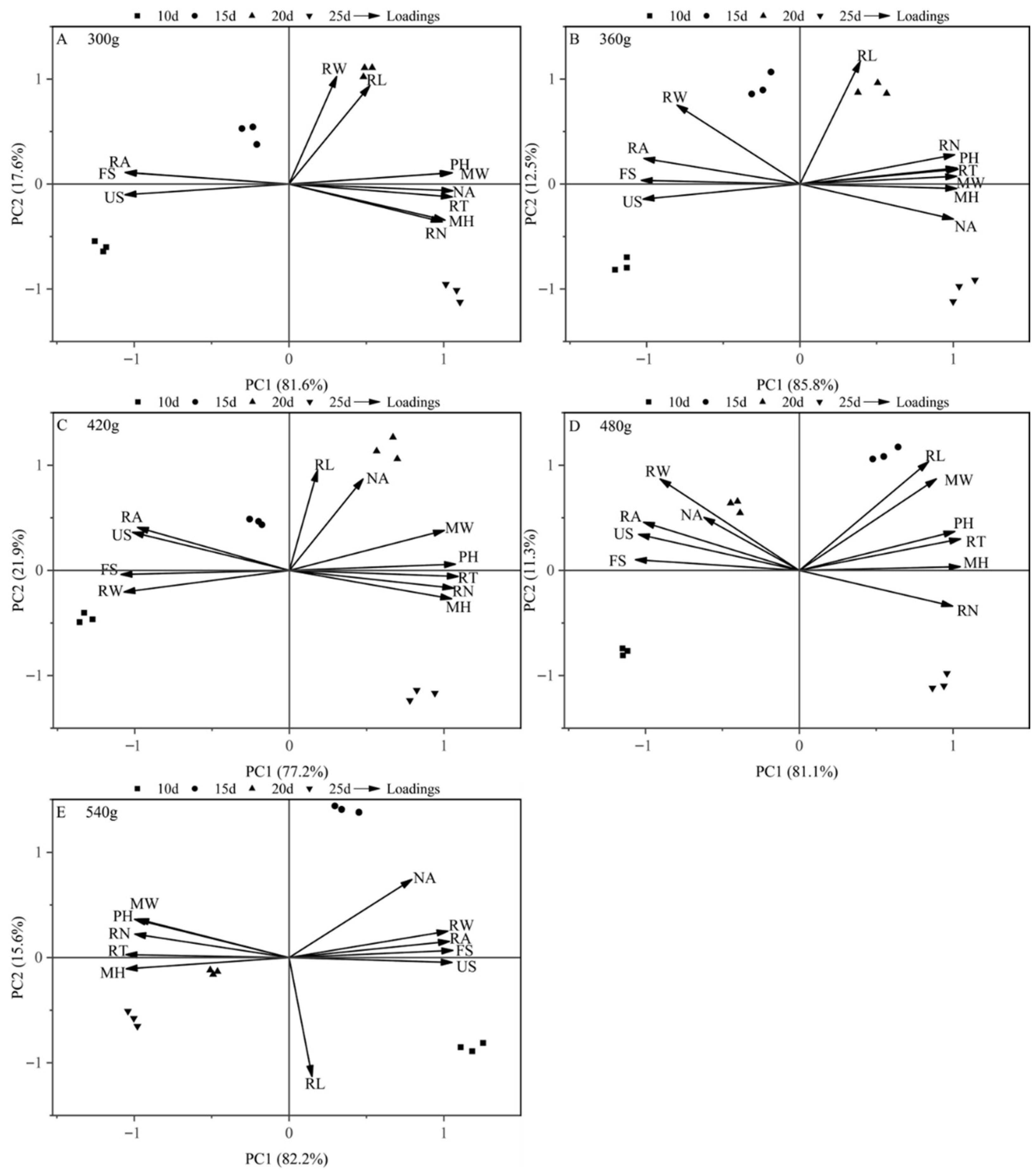
Based on PCA and comprehensive evaluation of rice seedling traits—including plant height, root length, root number, root dry weight, rooting ability, root twisting force, nitrogen accumulation, missing hill rate, floating seedling rate, upturning seedling rate, and seedling mat weight prior to transplanting—under varying seeding densities and seedling ages, it was determined that the optimal seedling age depends on seeding density. Specifically, at a seeding density of 300 g, seedlings aged 25 d exhibited the highest comprehensive score for seedling quality and mechanical transplanting performance. At 360 g seeding density, optimal performance was observed at 20~25 d; at 420 g, the optimal age was 20 d; and at 480 g and 540 g seeding densities, the optimal seedling age was 15 d (Figure 8).

4. Discussion

4.1. Effect of Lightweight Seedling Substrates on Rice Seedling Cultivation

In this study, the use of lightweight seedling substrates was found to enhance rice seedling quality compared to conventional nursery soil. Seedlings cultivated on lightweight substrates exhibited increased plant height, basal stem diameter, shoot dry matter accumulation, and root development relative to those grown in nursery soil (Table 2), suggesting improved photosynthetic capacity and root anchorage. This enhancement can be attributed to two primary factors. First, both crop straw boards and matrix cotton demonstrated relatively low bulk density (Table 1) alongside strong water and nutrient retention capabilities. Second, unlike nursery soil, which can be directly mixed with a seedling-strengthening agent, the crop straw boards and matrix cotton substrates cannot incorporate such additives. Instead, the commercial nutrient product “Miao Zhuang Feng” was applied by spraying after sowing, thereby providing a more sufficient nutrient supply during early seedling growth [23], thereby fostering the development of robust and vigorous seedlings [24,25,26,27]. During mechanical transplanting, seedlings grown on lightweight substrates exhibited significantly superior transplanting quality compared to double-blanket seedlings cultivated in nursery soil (Table 3). This advantage stemmed from enhanced root morphology and root entanglement capacity, as evidenced by greater root number, root length, and rooting ability, which contributed to increased mat cohesiveness and integrity during transplanting, effectively reducing seedling breakage and mechanical damage [28]. Notably, the pre-transplanting weight of double-blanket mats grown on crop straw boards did not differ significantly from single-blanket soil-based mats. However, the number of trays required per hectare was significantly reduced (Table 3). This reduction substantially decreased labor demands associated with seedling feeding and reloading during mechanical transplanting. Therefore, relative to conventional nursery soil, the application of lightweight seedling substrates not only improved seedling and transplanting quality—ultimately enhancing rice yield (Table 4)—but also reduced mat weight and tray requirements per hectare, thereby facilitating a simplified and labor-efficient production system for mechanized rice cultivation.

4.2. Effects of Seeding Density and Seedling Age on Rice Seedling Cultivation

Based on the results of PCA and a comprehensive evaluation encompassing seedling quality, transplanting quality, and seedling mat weight, the optimal combinations of seeding density and seedling age varied under the double-blanket seedling tray system utilizing lightweight crop straw boards as the seedling substrate (Figure 8). Specifically, seeding densities of 480 and 540 g/tray were appropriate for 15-day-old seedlings, 420 g/tray for 20-day-old seedlings, 360 g/tray for seedlings aged 20~25 d, and 300 g/tray for 25-day-old seedlings. Overall, this trend aligned with that observed in single-blanket seedlings: higher seeding densities corresponded to shorter optimal seedling ages, whereas lower seeding densities necessitated longer seedling ages. Under conditions of high seeding density, the increased seedling population accelerates root development and intertwining, facilitating the formation of cohesive seedling mats with strong root binding strength, which are suitable for mechanical transplanting [18,29,30]. However, prolonged nursery duration under dense seeding conditions intensifies inter-plant competition, resulting in taller but weaker seedlings with diminished nutrient reserves and fragile roots. These characteristics increase the risk of mechanical damage during transplanting, suppress tillering and dry matter accumulation, and ultimately reduce grain yield [16,17,18]. Consequently, a shorter transplanting age is preferable at high seeding densities. Although higher seeding density intensified intraspecific competition during the nursery stage—potentially producing weaker individual culms and reducing the number of grains per panicle—the increased total plant population per unit area after transplanting effectively compensated for these individual yield reductions. Consequently, the competitive pressure experienced during seedling cultivation was not sufficient to diminish the plants’ compensatory capacity once established in the field [31,32]. Conversely, at lower seeding densities, seedlings generally exhibit superior morphological quality. However, slower root interlacing delays mat formation. Therefore, a longer seedling age is required to ensure complete mat cohesion and mechanical stability during transplanting [13,14]. Due to the increased length of the double-blanket seedling tray, greater demands are imposed on mat formation capacity. Compared with seedlings grown in single-blanket trays, achieving equivalent mat characteristics at the same seedling age requires a seeding density approximately double or greater to promote sufficient root binding. Although seedling mat weight prior to transplanting did not differ significantly among the optimal seeding density–age combinations (Figure 7), the number of trays required per hectare decreased significantly with increasing seeding density (Table 5). For instance, when seeding density increased from 300 to 540 g/tray, the number of trays required per hectare decreased from 141 to 83, representing a 41.14% reduction (Table 5). This reduction is attributable to the fact that higher seeding density increases the number of seedlings per tray, thereby enlarging the transplantable area per tray under identical mechanical transplanting conditions [11,33]. Therefore, determining the appropriate seedling age for each seeding density can balance seedling quality and transplanting performance, ensuring high-quality transplanting. Simultaneously, reducing the number of trays per hectare without increasing mat weight effectively decreases labor demand, thereby contributing to labor savings and the simplification of mechanized rice production.

4.3. Practical Implications for Large-Scale Mechanized Transplanting

The results of this study demonstrate that the double-blanket crop straw board system offers substantial advantages for large-scale mechanized rice production. First, the number of trays required per hectare was greatly reduced, leading to significant improvements in operational efficiency. Under the 360~540 g seeding density treatments, tray usage in the field decreased by approximately 50.00~70.57% compared with the conventional single-blanket nursery soil method (Table 6). The reduction in tray number directly lowers labor requirements for seedling cultivation, stacking, transportation, and loading onto the transplanter. Second, the decreased tray usage substantially shortens the time needed to load the transplanter in the field. Assuming a loading time of 6~8 s per tray, reducing 100~200 trays per hectare would save 10~16 min of labor, a particularly important time-saving benefit during peak transplanting periods when labor is scarce and operational timeliness is critical. Third, the system provides notable economic benefits. Although the unit price of double-blanket trays is higher, the total tray-related cost under the 360~540 g seeding densities was reduced by 16.31~41.13%. Except for the 300 g treatment, substrate costs decreased by 3.44~32.08%. Furthermore, lighter seedling mats reduced transportation costs by 50.00~70.57%. Overall, the total cost of seedling cultivation and transportation declined by 0.42~41.38%. This technology is particularly suitable for regions facing labor shortages and rising production costs, providing a feasible approach to promoting efficient and sustainable rice cultivation.

5. Conclusions

This study confirmed that integrating double-blanket seedling trays with lightweight seedling substrates offers a simplified and labor-efficient approach to mechanized rice cultivation. The use of crop straw boards and matrix cotton not only enhanced the development of vigorous and healthy seedlings but also significantly reduced the weight of seedling mats, thereby improving efficiency in transportation and mechanical transplanting. With these lightweight substrates, cohesive and stable seedling mats up to 1.2 m in length were cultivated, meeting the structural demands of high-quality mechanized transplanting. Optimal combinations of seeding density and seedling age were identified as follows: 480 and 540 g/tray for 15-day-old seedlings, 420 g/tray for 20-day-old seedlings, 360 g/tray for 20~25-day-old seedlings, and 300 g/tray for 25-day-old seedlings. Compared to conventional single-blanket trays, the double-blanket system reduced the number of trays required per hectare and the total seedling cultivation and transportation cost by 57.97% and 16.67%. Furthermore, increasing the seeding density from 300 g/tray to 360, 420, 480, and 540 g/tray resulted in additional tray reductions of 16.31%, 26.24%, 34.75%, and 41.13%, respectively, thereby substantially decreasing labor input.

Author Contributions

H.W. (Haoyu Wang): Data curation, Formal analysis, Writing—original draft, Writing—review and editing, Methodology; Z.H.: Investigation, Formal analysis, Data curation; Y.G.: Data curation, Investigation; F.X.: Data curation, Conceptualization, Supervision; G.L. (Guangyan Li): Conceptualization, Data curation; Y.Z.: Conceptualization, Supervision; G.L. (Guodong Liu): Conceptualization, Supervision; Q.H.: Conceptualization, Supervision; H.W. (Haiyan Wei): Writing—review and editing, Supervision, Resources, Formal analysis, Conceptualization. All authors have read and agreed to the published version of the manuscript.

Funding

This work was supported by the National Key Research Program of China (2022YFD2301401), the Earmarked Fund for CARS (Rice, CARS-01), the National Natural Science Foundation of China (32372215, 32372212), the Changzhou Modern Agricultural Science and Technology Innovation Center Project (CAIC (2023)005), the Priority Subject Program Development of Jiangsu Higher Education Institutions (PAPD), the Major Agricultural Technology Collaborative Promotion Project (2025-ZYXT-01) and the Major Independent Innovation Project in Jiangsu Province (CX(23)1034).

Institutional Review Board Statement

Not applicable.

Informed Consent Statement

Not applicable.

Data Availability Statement

The original contributions presented in this study are included in the article.

Conflicts of Interest

The authors declare no conflicts of interest.

References

  1. Azeem, B.; KuShaari, K.; Man, Z.B.; Basit, A.; Thanh, T.H. Review on materials & methods to produce controlled release coated urea fertilizer. J. Controlled Release 2014, 181, 11–21. [Google Scholar] [CrossRef]
  2. Bo, Y.; Wang, X.H.; van Groenigen, K.J.; Linquist, B.A.; Müller, C.; Li, T.; Yang, J.C.; Jägermeyr, J.; Qin, Y.; Zhou, F. Improved alternate wetting and drying irrigation increases global water productivity. Nat. Food 2024, 5, 1005–1013. [Google Scholar] [CrossRef]
  3. Li, Z.H.; Ma, X.; Li, X.H.; Chen, L.T.; Li, H.W.; Yuan, Z.C. Research Progress of Rice Transplanting Mechanization. Trans. Chin. Soc. Agric. Mach. 2018, 49, 1–20. [Google Scholar] [CrossRef]
  4. Peng, S.B.; Zheng, C.; Yu, X. Progress and challenges of rice ratooning technology in China. Crop. Environ. 2023, 2, 5–11. [Google Scholar] [CrossRef]
  5. Zhang, X.; Ding, J.S.; Liu, Y.L.; Gu, Y.; Han, K.F.; Wu, L.H. Effects of mechanical transplanting of rice with controlled release bulk blending fertilizer on rice yield and soil fertility. Chin. J. Appl. Ecol. 2014, 25, 783–789. [Google Scholar] [CrossRef]
  6. Paman, U.; Inaba, S.; Uchida, S. The mechanization of small-scale rice farming: Labor requirements and costs. Eng. Agric. Environ. Food 2014, 7, 122–126. [Google Scholar] [CrossRef]
  7. Rath, I.; Pradhan, P.L.; Dash, R.C.; Mahapatra, M.; Sahoo, P.K.; Behera, D.; Behera, A.; Verma, K. Enhancing rice production economics with self-propelled rice transplanters. Int. J. Res. Agron. 2024, 7, 10–13. [Google Scholar] [CrossRef]
  8. Liu, B.; Han, Y.N.; Yuan, X.F.; Zhu, W.B.; Wang, X.F.; Cui, Z.J. Effects of Five Fungal Chaff Pretreatment Methods on Substrate Properties and Growth of Rice Seedlings. Sci. Agric. Sin. 2016, 49, 3098–3107. [Google Scholar] [CrossRef]
  9. Ding, W.C.; Song, D.L.; Zhou, W. Dominant factors driving the farmland quality in China and strategies for improvemen. J. Plant Nutr. Fert. 2024, 30, 1580–1594. [Google Scholar] [CrossRef]
  10. Wei, H.Y.; Xu, F.F.; Zhang, H.C.; Hu, Q.; Liu, G.D.; Li, G.Y.; Zhu, Y. Seedling Cultivation Tray for Labor-Saving Mechanical Transplanting. CN Patent 221843167U, 18 October 2024. [Google Scholar]
  11. Long, R.P.; Leng, S.C.; Zhao, L.J.; Yin, J.; Yang, J.; Li, G.Y.; Xia, Q.M.; Zhu, H.P.; Zhang, Y.P.; Yang, C.D. Preliminary Study on Mechanical Transplanting Technique of Small Indica Rice Seedlings in Yunnan Province. China Rice 2021, 27, 134–136+139. [Google Scholar] [CrossRef]
  12. Ling, Y.F.; Liu, M.Z.; Feng, Y.; Xing, Z.P.; Gao, H.; Wei, H.Y.; Hu, Q.; Zhang, H.C. Effects of increased seeding density on seedling characteristics, mechanical transplantation quality, and yields of rice with crop straw boards for seedling cultivation. J. Integr. Agric. 2025, 24, 101–113. [Google Scholar] [CrossRef]
  13. Lin, Y.J.; Zhang, J.H.; Hu, Z.H.; Zhu, L.F.; Yu, S.M.; Jin, Q.Y. Research on Rice Mechanized Seedling Substrate in China. China Rice 2015, 21, 7–13. [Google Scholar] [CrossRef]
  14. Zhou, L.Y.; Wu, J.; Gong, K.C.; Zhou, H.; Lu, C.; Huo, Z.Y. Research Progress of Machine-transplanted Rice and Substrate Seedling Raising Techniques. China Rice 2018, 24, 20–23. [Google Scholar] [CrossRef]
  15. Zhang, Z.H.; Qu, X.S.; Wan, S.; Chen, L.H.; Zhu, Y.G. Comparison of QTL controlling seedling vigour under different temperature conditions using recombinant inbred lines in rice (Oryza sativa). Ann. Bot. 2005, 95, 423–429. [Google Scholar] [CrossRef]
  16. Wang, D.Y.; Chen, S.; Wang, Z.M.; Ji, C.L.; Xu, C.M.; Zhang, X.F.; Chauhan, B.S. Optimizing Hill Seeding Density for High-Yielding Hybrid Rice in a Single Rice Cropping System in South China. PLoS ONE 2014, 9. [Google Scholar] [CrossRef]
  17. Ren, H.; Gray, W.M. SAUR Proteins as Effectors of Hormonal and Environmental Signals in Plant Growth. Mol. Plant 2015, 8, 1153–1164. [Google Scholar] [CrossRef] [PubMed]
  18. Teng, F.; Chen, H.Z.; Zhu, D.F.; Cai, X.Q.; Xiang, J.; Xu, Y.C.; Zhang, Z.K. Effects of seed rate on root twining Power and seedling quality. Acta Agric. Univ. Jiangxiensis 2015, 37, 398–403. [Google Scholar] [CrossRef]
  19. Jiangsu Academy of Agricultural Sciences. A Multi-Layer Rice Straw Substrate Block for Mechanical Rice Transplanting and a Method for Raising Seedlings. CN Patent 201910772006.3, 25 June 2021. [Google Scholar]
  20. Longping Seed Co., Ltd. A Tray-Free and Soilless Seedling Raising Method for MechanicallyTransplanted Rice Using Rock Wool Substrate. CN Patent 202110944569.3, 5 November 2021. [Google Scholar]
  21. Zhang, H.; Jing, W.J.; Zhao, B.H.; Wang, W.L.; Xu, Y.J.; Zhang, W.Y.; Gu, J.F.; Liu, L.J.; Wang, Z.Q.; Yang, J.C. Alternative fertilizer and irrigation practices improve rice yield and resource use efficiency by regulating source-sink relationships. Field Crop. Res. 2021, 265, 108124. [Google Scholar] [CrossRef]
  22. Chen, H.Z.; XU, Y.C.; Zhang, Y.P.; Xiang, J.; Zhang, Y.K.; Zhu, D.F. Effect of Pot-Mat Seedling on the Quality of Machined Transplanting and Yield Formation of Super Early Rice. Sci. Agric. Sin. 2019, 52, 4240–4250. [Google Scholar] [CrossRef]
  23. Acuña, R.A.; Bonachela, S.; Magán, J.J.; Marfà, O.; Hernández, J.H.; Cáceres, R. Reuse of rockwool slabs and perlite grow-bags in a low-cost greenhouse: Substrates’ physical properties and crop production. Sci. Hortic. 2013, 160, 139–147. [Google Scholar] [CrossRef]
  24. Jiang, M.; Chen, Z.; Li, Y.; Wang, J.Q.; Shen, X.P. Effects of different seedling substrates on seedling quality and yield of machine-transplanted rice. Appl. Ecol. Env. Res. 2023, 21, 4407–4423. [Google Scholar] [CrossRef]
  25. Zhang, Q.; Xiang, K.H.; Sun, Y.J.; Wu, Y.X.; Guo, C.C.; Tang, Y.; Liu, F.Y.; Ma, J. Effects of Seeding Amount and Transplanting Machines on Rice Yield and Population Quality Under Different Seedling Raising Methods. J. Nucl. Agric. Sci. 2020, 34, 2595–2606. [Google Scholar] [CrossRef]
  26. Zhu, J.W.; Liang, J.; Xu, Z.H.; Fan, X.R.; Zhou, Q.S.; Shen, Q.R.; Xu, G.H. Root aeration improves growth and nitrogen accumulation in rice seedlings under low nitrogen. Aob Plants 2015, 7, plv131. [Google Scholar] [CrossRef]
  27. Saurabh, K.; Roy, H.S.; Shubha, K.; Sundaram, P.K.; Prakash, V.; Koley, T.K.; Mukherjee, A.; Sarkar, B.; Singh, A.K.; Das, A. Transforming rice straw into eco-friendly growing medium for microgreens: A solution for agricultural waste management. Front. Sustain. Food Syst. 2025, 9, 1556396. [Google Scholar] [CrossRef]
  28. Hossen, M.A.; Hossain, M.M.; Haque, M.E.; Bell, R.W. Effect of Seed Rate on Seedling Quality for Mechanical Rice Transplanting. Bangladesh Rice J. 2019, 22, 9–23. [Google Scholar] [CrossRef]
  29. Wu, W.G.; Zhou, Y.J.; Chen, G.; Cai, H.T.; Wu, R.R.; Li, X.H.; Sun, R.Y. Effects of Different Seedling Nursery Substrates and Water Management Modes on Seedling Quality and Yield of Mechanically Transplanted Rice. Chin. J. Eco-Agric. 2014, 22, 1057–1063. [Google Scholar] [CrossRef]
  30. Li, X.Y.; Zuo, Q.S.; Chang, H.B.; Bai, G.P.; Kuai, J.; Zhou, G.S. Higher density planting benefits mechanical harvesting of rapeseed in the Yangtze River Basin of China. Field Crop. Res. 2018, 218, 97–105. [Google Scholar] [CrossRef]
  31. Tian, G.L.; Gao, L.M.; Kong, Y.L.; Hu, X.Y.; Xie, K.L.; Zhang, R.Q.; Ling, N.; Shen, Q.R.; Guo, S.W. Improving rice population productivity by reducing nitrogen rate and increasing plant density. PLoS ONE 2017, 12, e0182310. [Google Scholar] [CrossRef]
  32. Dunn, B.W.; Dunn, T.S.; Mitchell, J.H.; Brinkhoff, J. Effects of plant population and row spacing on grain yield of aerial-sown and drill-sown rice. Crop Pasture Sci. 2020, 71, 219–228. [Google Scholar] [CrossRef]
  33. Zhang, J.Y.; Zhou, H. Substitution elasticity of labor and machinery in the productionof rice under the background of mechanization: Based on thesurvey data of rice farmers in Jiangsu Province. J. South. Agric. 2019, 50, 432–438. [Google Scholar] [CrossRef]
Figure 1. The single-blanket tray (A) and double-blanket tray (B).
Agronomy 15 02808 g001
Figure 2. The crop straw boards (A), matrix cotton (B) and single (double) blanket seedling mat (C,D).
Agronomy 15 02808 g002
Figure 3. Effect of seeding density and seedling age on plant height (A), leaf age (B), basal stem width (C), aboveground weight (D) and seedling rate (E) of rice seedlings. Error bars represent the ±standard error of the mean. Different letters above the columns indicate there is a significant difference in the same seeding density at p < 0.05.
Agronomy 15 02808 g003
Figure 4. Effect of seeding density and seedling age on root length (A), root number (B), root weight (C), rooting capacity (D) and root twisting power (E) of rice seedlings. Different letters above the columns indicate there is a significant difference in the same seeding density at p < 0.05.
Agronomy 15 02808 g004
Figure 5. Effect of seeding density and seedling age on the nitrogen content (A) and nitrogen accumulation (B) of rice seedlings. Different letters above the columns indicate there is a significant difference in the same seeding density at p < 0.05.
Agronomy 15 02808 g005
Figure 6. Effect of seeding density and seedling age on miss hill rate (A), floating seedling rate (B) and upturning seedling rate (C) of rice seedlings. Different letters above the columns indicate there is a significant difference in the same seeding density at p < 0.05.
Agronomy 15 02808 g006
Figure 7. Effect of seeding density and seedling age on total weight of seedling tray and mat after darkening (A) and seedling mat weight before transplanting (B). Different letters above the columns indicate there is a significant difference in the same seeding density at p < 0.05.
Agronomy 15 02808 g007
Figure 8. Principal component analysis of rice seedling quality and mechanical transplanting quality under different seedling ages at seeding densities of 300 g (A), 360 g (B), 420 g (C), 480 g (D), and 540 g (E), along with the scores for each treatment. RW, root dry weight; RL, root length; PH, plant height; MW, mat weight before transplanting; NA, nitrogen accumulation; RT, root twisting force; MH, missing hill rate; RN, root number; US, upturning seedling rate; FS, floating seedling rate; RA, rooting capacity.
Agronomy 15 02808 g008
Table 1. Physicochemical properties of different substrates.
Substrate TypeBulk Density (g/cm3)Organic Matter (g/kg)Available N (g/kg)Available P (g/kg)Available K (g/kg)
Nutrient soil0.6830.630.190.030.25
Crop straw boards0.51720.870.640.972.34
Matrix cotton0.091.860.000.000.00
Table 2. Effect of different seedling-raising substrates on rice seedling quality.
TreatmentsNutrient SoilCrop Straw BoardsMatrix Cotton
Seedling rate (%)90.33 a90.69 a91.03 a
Plant length (cm)8.59 b9.34 a9.85 a
Leaf age2.87 b2.90 b3.03 a
Basal stem width (mm)1.49 c1.65 b1.78 a
Aboveground dry weight (mg/plant)8.47 b9.30 a9.83 a
Root length (cm)5.66 a5.69 a5.53 a
Root number7.93 a8.27 a8.18 a
Rooting capacity (roots/plant)5.60 a5.75 a5.85 a
Root dry weight (mg/plant)3.80 a4.20 a3.07 b
Root twisting force (Newton)277.73 c346.67 b487.47 a
Nitrogen content (mg/g)14.09 b14.01 b17.77 a
100 plants N accumulation (mg)11.93 c13.03 b17.47 a
Different letters following the values in the same row indicate there is a significant difference between seedling-raising substrates at p < 0.05.
Table 3. Effect of different seedling-raising substrates on transplanting quality, seedling tray weight and number of trays per hectare.
TreatmentsMHFSUSSTTADMBTNumber of Trays
(%)(%)(%)(kg)(kg)(kg)(trays/ha)
Single blanket—Nutrient soil2.74 b2.04 b2.57 b0.57 b6.27 c7.27 c282 a
Double blanket—Nutrient soil4.17 a2.95 a3.75 a1.55 a12.94 a14.93 a118 b
Double blanket—Crop straw boards3.33 b2.82 a3.18 ab1.55 a8.66 b7.58 bc118 b
Double blanket—Matrix cotton2.50 b1.18 c2.23 b1.55 a9.19 b8.11 b118 b
MH, missing hill rate; FS, floating seedling rate; US, upturning seedling rate; ST, seedling tray weight; TAD, total weight of seedling tray and mat after darkening; MBT, seedling mat weight before transplanting. Different letters following the values in the same column indicate there is a significant difference between seedling-raising substrates at p < 0.05.
Table 4. Effect of different seedling-raising substrates on rice yield.
TreatmentsPanicle NumberSpikelets PerFilled Grains Grain Weight Yield
(104/ha)Panicle(%)(mg)(t/ha)
Single blanket—Nutrient soil391.95 a121.32 b90.91 b22.51 a9.69 b
Double blanket—Nutrient soil393.30 a112.33 b90.56 b23.22 a9.30 b
Double blanket—Crop straw boards404.70 a125.83 a90.01 b20.78 b9.72 a
Double blanket—Matrix cotton393.30 a124.89 a92.28 a21.13 b9.76 a
Different letters following the values in the same column indicate there is a significant difference between seedling-raising substrates at p < 0.05.
Table 5. The theoretical and actual number of trays required per hectare for mechanical rice transplanting.
TreatmentsInitial Seeding Number 104/haSeedling Number 104/TrayTheoretical Number of Trays/haActual Number of Trays/ha
D-300142.5 a1.06 e134 a141 a
D-360142.5 a1.26 d113 b118 b
D-420142.5 a1.43 c100 c104 c
D-480142.5 a1.60 b89 d92 d
D-540142.5 a1.77 a80 e83 e
D, double-blanket seedling tray; 300, 300 g seeding density; 360, 360 g seeding density; 420, 420 g seeding density; 480, 480 g seeding density; 540, 540 g seeding density. Different letters following the values in the same column indicate there is a significant difference between treatments at p < 0.05.
Table 6. The per-hectare cost of seedling cultivation and transportation for mechanized rice transplanting.
TreatmentsActual Number
of Trays/ha
Costs of
Seedling Trays (CNY/ha)
Costs of
Substrates (CNY/ha)
Transportation
Expenses for
Seedling Trays
(CNY/ha)
Overall Costs (CNY/ha)
SN-150282.00 a846.00 a366.60 b124.08 a1336.68 a
DS-300141.00 b846.00 a423.00 a62.04 b1331.04 b
DS-360118.00 c708.00 b354.00 c51.92 c1113.92 c
DS-420104.00 d624.00 c312.00 d45.76 d981.76 d
DS-48092.00 e552.00 d276.00 e40.48 e868.48 e
DS-54083.00 f498.00 e249.00 f36.52 f783.52 f
SN, single-blanket seedling tray—nutrient soil; DS, double-blanket seedling tray—crop straw boards; 150, 150 g seeding density; 300, 300 g seeding density; 360, 360 g seeding density; 420, 420 g seeding density; 480, 480 g seeding density; 540, 540 g seeding density. Different letters following the values in the same column indicate there is a significant difference between treatments at p < 0.05.
Disclaimer/Publisher’s Note: The statements, opinions and data contained in all publications are solely those of the individual author(s) and contributor(s) and not of MDPI and/or the editor(s). MDPI and/or the editor(s) disclaim responsibility for any injury to people or property resulting from any ideas, methods, instructions or products referred to in the content.