Article

Effects of Co-Existing Microplastics on Adsorption–Desorption Behavior of Perfluorooctanoic Acid in Soil: Co-Sorption and Mechanism Insight

1
Qingdao Engineering Research Center for Rural Environment, College of Resources and Environment, Qingdao Agricultural University, Qingdao 266109, China
2
Central Laboratory, Qingdao Agricultural University, Qingdao 266109, China
3
Academy of Dongying Efficient Agricultural Technology and Industry on Saline and Alkaline Land in Collaboration with Qingdao Agricultural University, Dongying 257347, China
*
Author to whom correspondence should be addressed.
Agronomy 2025, 15(12), 2802; https://doi.org/10.3390/agronomy15122802
Submission received: 12 November 2025 / Revised: 2 December 2025 / Accepted: 4 December 2025 / Published: 5 December 2025
(This article belongs to the Section Agricultural Biosystem and Biological Engineering)

Abstract

Microplastics (MPs) and perfluorooctanoic acid (PFOA) are ubiquitously present in agroecosystems, which can cause varying degrees of environmental damage. This study reports the investigation of the effect of MPs on PFOA adsorption by soil. A comprehensive analysis was performed on the adsorption–desorption dynamics of PFOA by MPs and soil under different conditions. The surface morphology of MPs and their interaction with PFOA were characterized. Irregularly shaped MPs facilitated accurate simulation of real-world conditions, influencing the adsorption quantity of PFOA in soil. Additionally, the peak intensity of various preadsorption and post-adsorption MP functional groups was altered, indicating that MPs augmented PFOA adsorption. The kinetics of PFOA adsorption followed the quasi-second-order reaction, and the isotherm data aligned well with the Freundlich model. This study reveals the mechanism by which the co-sorption of PFOA and MPs in agroecosystems affects their respective environmental behaviors, providing basic research data for the control of pollutants in agroecosystem soil.

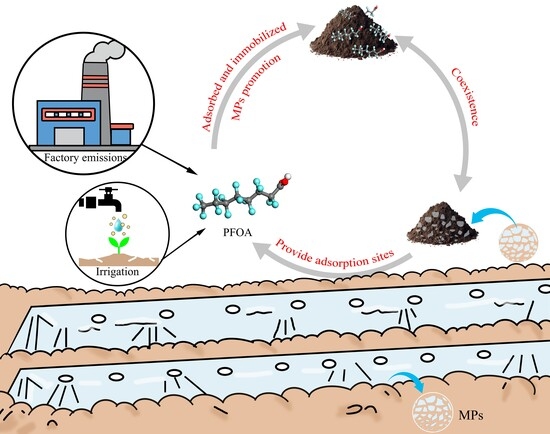
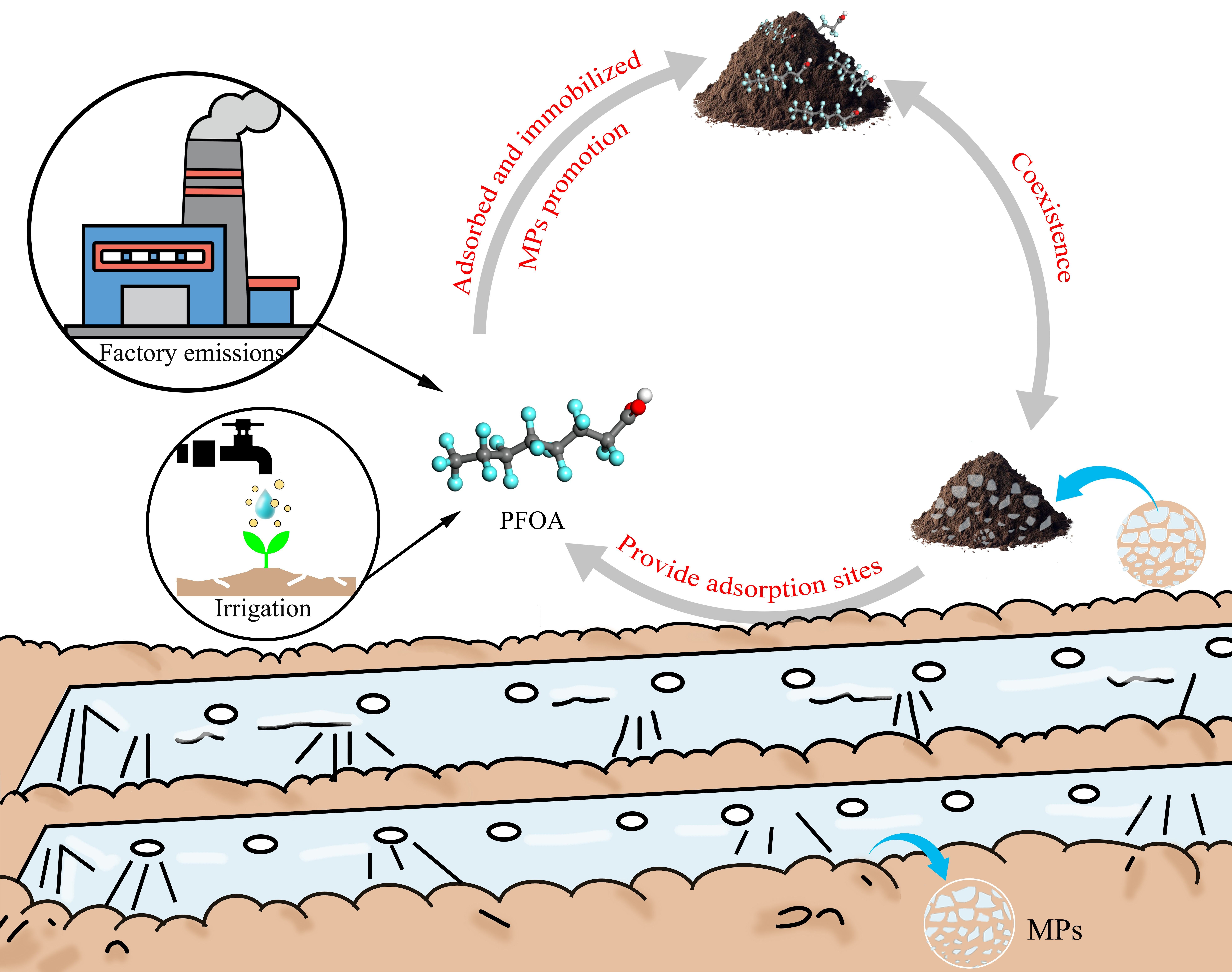
Graphical Abstract

1. Introduction

As industrial and agricultural processes advance, complex mixtures of pollutants (e.g., per- and polyfluoroalkyl substances and microplastics) are continually released into the agroecosystem. These co-occurring contaminants originate from diverse sources, yet their environmental behavior and associated risks remain inadequately characterized due to poorly understood interactions, thereby identifying a critical research gap. Consequently, the complexity and diversity of environmental contamination markedly increase. The use of plastic films in agriculture significantly modifies the microclimate around plant rhizospheres, enhancing crop yield [1,2,3]. Currently, plastic films are an integral part of agricultural production, but their heavy use results in the release and accumulation of microplastics (MPs) in agricultural soils [4]. In addition to persistent MP pollution, there exist other burgeoning contaminants, such as perfluoroalkyl and polyfluoroalkyl substances (PFASs) [5]. The carbon fluorine bond of PFASs is one of the strongest chemical bonds in nature, which endows them with properties of permanent chemicals that resist natural degradation for more than 100 years. After use, these perfluorinated compounds progressively accumulate in the soil environment, and intermix with other pollutants via atmospheric and water circulation [6,7]. This amalgamation further complicates soil environmental management and presents a significant risk to the agroecosystems. Within the complex environment of farmland soil, the emergence of MPs as a pollutant has the potential to impact the adsorption and desorption behaviors of PFASs, particularly PFOA, in soil systems. Consequently, it is imperative to systematically evaluate the potential compound pollution risks to agricultural ecosystems and human health when MPs and PFASs coexist.
PFASs, with PFOA being the most prevalent, contaminate the soil environment [8]. The primary pathway for PFOA to enter soil is through industrial emissions and pollution. During the production process, sludge and waste residues containing PFOA may seep into the surrounding soil and groundwater if not properly managed or disposed of in landfills. This can occur due to rainwater leaching. Furthermore, the use and disposal of products containing PFOA contribute to its wider distribution via various pathways such as atmospheric deposition, agricultural use of sewage sludge, and irrigation with contaminated water. MPs occur in various forms in the soil, and they primarily originate from the adoption of agricultural plastic film, followed by organic fertilizer use, atmospheric deposition, and wastewater irrigation [9]. The spatial dispersion of MPs in soil is generally heterogeneous, especially in farmlands, where they are used for an extended period [10,11]. In particular, the concentration tends to be higher in the surface soil (0~20 cm). However, as external conditions change with time, MPs might migrate below the soil through soil pores and access the groundwater ecosystem. The transport of MPs within soil is influenced by a myriad of factors, notably their soil texture, moisture conditions, microbial activities, and chemical and physical characteristics [12]. Plastics that remain in the soil are further decomposed under the influence of external forces. This process releases plasticizers, exacerbating soil pollution, obstructing the movement of soil water and fertilizer, augmenting the rate of evaporation from soil moisture, and diminishing soil fertility [13,14]. PFASs are also a major threat in soil, and research on their soil pollution has predominantly been conducted at the laboratory level. Upon entering the soil, PFASs impact the microbial community and enzyme activity, including organic degradation, nutrient conversion, and antibiotic production [15,16]. Most plants primarily uptake PFASs via roots. Thus, a high concentration of PFASs predominantly accumulates in the roots. Notably, the concentration of PFASs escalates with the increase in the number of carbon atoms [17,18]. PFASs also exert detrimental influences on soil fauna, especially earthworms. Perfluorooctane sulfonate interferes with the nervous and metabolic systems of earthworms. Perfluorohexanesulfonic acid disrupts the caloric balance and promotes an inflammatory response. Perfluorobutane sulfonic acid induces cell apoptosis in these organisms [19]. Perfluorooctanoic acid (PFOA) contamination stunts earthworm growth and disrupts beneficial microbial processes that occur in the soil. Consequently, this results in long-lasting detrimental effects on soil health [20]. Although co-sorption of MPs with coexisting pollutants has been extensively explored in oceanic and inland water samples, studies addressing the complex multiphase system of soil are lacking.
This paper selects five MPs and typical PFASs (PFOA) in the agroecosystem, and explores the co-adsorption behavior and mechanism of MPs and PFASs in farmland soil, in order to fill the research gap in this field, thus providing theoretical support for ensuring the health of agricultural ecology and the safety of agricultural products.

2. Materials and Methods

2.1. Experimental Materials

The experiment used the following reagents and materials. Soil samples were collected from the surface soil (0~20 cm) of Chinese apple planting fields in Jiaozhou (36°7′27″ N, 119°50′0″ E), Shandong. The soil is collected in the same location, the same depth, and the line is fully homogeneous. The specific sampling measures are attached to Supplementary Text S2. According to the test data, the pH value of the Jiaozhou soil sample was 7.04, with an electrical conductivity of 28.93 μs/cm, a soil organic matter content of 29.13 g/kg, and a moisture content of 20.40%. PFOA (purity ≥ 96%) was purchased from Shanghai Macklin Biochemical Technology Co., Ltd. (Shanghai, China). Common plastic types detected in daily life were selected: polyethylene (PE), polypropylene (PP), polystyrene (PS), polyvinyl chloride (PVC), and polyethylene terephthalate (PET). These were purchased from Guangdong Hengli New Materials Technology Co., Ltd. (Dongguan, China). These plastic materials are thermoplastic carbon chain polymers, with their main chains comprising C–C bonds. However, owing to differences in substituent groups (such as chlorine, methyl, benzene ring, and ester group) and molecular chain regularity, significant differences exist in heat resistance, strength, transparency, and uses. Methanol (purity ≥ 99.9%) was purchased from Merck KGaA (Darmstadt, Germany). Ammonium formate (purity > 99%) and formic acid (purity > 99%) were obtained by Thermo Fisher Technology Co., Ltd. (Waltham, MA, USA).

2.2. Adsorption Experiments

2.2.1. Adsorption Equilibrium Experiment

The adsorption of PFOA by soil and MPs was investigated by formulating a PFOA stock solution with a concentration of 1000 mg L−1 before the experiment and then diluted to 20 mg L−1 as a working solution [21,22]. Based on the content of MPs in soil as reported in earlier studies, a calculated quantity of MPs was introduced to the soil [23]. The experiment was designed to insight the mechanism, so the concentration was designed to simulate moderate to severe pollution scenarios. The profound environmental implications of soil MPs were considered, particularly focusing on a 5% concentration of MPs. The uneven particle MPs and soil samples were added into the conical flask and shaken to ensure even distribution, followed by the infusion of a diluted PFOA working solution, maintaining a liquid-solid ratio of 5:1. After sealing with aluminum foil, the conical flask was placed in a thermostatic water bath shaker, the oscillation temperature was set to 25 °C, and the rotational speed was maintained at 200 r min−1. Sample mixture suspension collections were performed at intervals of 10 min, 0.5, 1, 2, 3, 4, 8, 12, 24, 48, and 72 h. Following centrifugation and other relevant treatments, the samples were stored in a glass bottle at 4 °C for future measurements. For specific operations, please refer to Supplementary Text S3. All experiments were performed in triplicate and analyzed by liquid chromatography–mass spectrometer. To determine the adsorption balance, the adsorption capacity of various MPs and farmland soils toward PFOA was calculated using Equation (1).
Adsorption   capacity :   q t = C 0 C t M × V
where qt denotes the quantity of PFOA adsorbed per gram by MPs and soil (µg g−1); C0 and Ct denote the initial concentration of PFOA in the solution and the equilibrium concentration at time t and the adsorption equilibrium concentration (mg L−1) respectively; M denotes the mass of MPs and soil (g); and V denotes the volume of the adsorption solution PFOA (L).

2.2.2. Adsorption and Desorption Isothermal Experiments

The stock solution of 1000 mg L−1 PFOA was sequentially diluted into aqueous solutions containing 1, 5, 10, 20, 50, and 100 mg L−1 PFOA. In the desorption experiment, we used deionized water as the desorption agent, which can well simulate the desorption process under natural environmental conditions. However, during the experiment, we found that when water was used as the desorption agent, the desorption efficiency was relatively low. Given that methanol has a better solution to target pollutants, the choice of methanol as a desorbing agent is simulated, and the maximum removal condition can be simulated, which can provide the maximum value of the solution.
The methods for adsorption and desorption experimental operations are identical to those described in Section 2.2.1, with the exception that in the desorption experiment, the solution was substituted with an equivalent quantity of methanol. Additionally, the desorption experiment was performed after the adsorption experiment reached equilibrium. After the adsorption experiment was completed, the liquid was kept in the glass bottle according to the procedure of the Supplementary Text S3, and the desorption experiment samples were processed and the sample treatment was consistent with the adsorption experiment samples. Subsequently, all the samples housed within glass bottles were preserved in a refrigerator set at 4 °C until they were ready for further examination. This approach facilitated a quantitative assessment of the maximum desorpability of contaminants bound to the media. It is imperative for researchers to recognize that the “desorpability” determined by this method provides a conservative estimate and cannot be directly applied to water-dominated, kinetically slower desorption processes in the field.

2.3. Instruments and Analytical Methods

The experimental characterization instruments and equipment included the JSM-7500 scanning electron microscope (Tokyo, Japan) and the IRTracer-100 Fourier infrared spectrometer (Shimadzu, Tokyo, Japan).
The adsorption and desorption experiment samples for PFOA was analyzed using a liquid chromatography system (Agilent 1290 II, Agilent, Santa Clara, CA, USA) coupled with a mass spectrometer (AB SCIEX 5500+, AB, Fremont, CA, USA). Liquid phase conditions: A Poroshell 120 EC-C18 (2.1 × 50 mm, 1.9 µm) chromatographic column was used, which operated at 35 °C. The sample injection volume was 1 µL. Gradient elution was performed using methanol (A) and aqueous formic acid-ammonium formate (B) as the mobile phase. The gradient elution conditions are listed in Supplementary Text S3 (Table S2). Furthermore, after each sampling, the injection needle was rinsed with fresh methanol solution to reduce the risk of cross-contamination among diverse samples. Mass spectrometry conditions: The mass spectrometer used an electron spray ionization ion source in a negative mode with an ion spray voltage of 4500 V at 550 °C. The curtain gas pressure and ion source gas were 35 and 55 psi, respectively. Following optimization, the quantitative and qualitative ion pairs for PFOA were 413/169 (m/z) and 413/219 (m/z), respectively.

2.4. Result Calculations

Calculation of the amount of adsorption of PFOA in solidity (soil and MPs) adsorption quantity at adsorption equilibrium using Equation (2).
C s ads = C 0 C aq ads V M
Calculation of the solidity adsorption quantity at desorption equilibrium using Equation (3).
C s des = C s ads × M C aq des × V M
where V represents the initial volume of the aqueous solution (mL); M represents the total mass of soil and MPs (g); C0 represents the initial concentration of PFOA in the aqueous phase (mg L−1);   C aq ads and C aq des denote the concentrations of PFOA in the aqueous phase at equilibrium states of adsorption and desorption, respectively (mg L−1). C s ads and C s des represent the concentrations of PFOA in the soil when adsorption and desorption are balanced (µg g−1).

2.5. Adsorption Model

Experiment results were analyzed using specific formulas to study the adsorption of PFOA onto the soil and MPs. The Freundlich, Langmuir, quasi-first-order kinetic, quasi-second-order kinetic, and Weber–Morris (W–M) intraparticle diffusion models were used Equations (4)–(8) [24].
lgq e = lgK F + 1 n lgC e
C e q e = 1 q max C e + 1 K L q max
log ( q e q t ) = logq e k 1 t 2 . 303
t q t = 1 k 2 q e 2 + t q e
q t = k 3 t 1 2 + C
where Ce denotes the concentration of PFOA in the solution at adsorption equilibrium (mg L−1); qmax denotes the maximum adsorption quantity of the adsorbent; KF and KL represent the adsorption equilibrium constants of the Freundlich and Langmuir models, respectively; qe and qt (mg g−1) refer to the adsorption quantities of PFOA by the adsorbent at the equilibrium state and time t, respectively; k1 and k2 represent the equilibrium rate constants of the quasi-first-order and quasi-second-order kinetic models, respectively; k3 denotes the rate constant of the intraparticle diffusion model, and C is a constant related to the thickness and boundary layers.

2.6. Quantum Chemistry Calculation

The electrostatic potentials of PFOA and five variants of MPs were computed using the Materials Studio 2020 (MS) software to build molecular models. These models were subsequently optimized using the DMOl3 module. The theoretical calculations were performed using the Gaussian 16 suite of programs [25]. The structures of the studied molecules and their complexes were thoroughly optimized at the B3LYP-D3BJ/def2-SVP level of theory. The solvent effects were included in the calculations by using the solvation model based on density [26]. Vibrational frequencies corresponding to optimized structures were accurately computed at an identical theoretical level. The lack of imaginary frequencies confirmed these structures as local energy minima on the potential energy surface. The molecular orbital energy levels, including the highest occupied molecular orbital (HOMO) and lowest unoccupied molecular orbital (LUMO), of the studied compounds were investigated via theoretical calculations. The Gauss View package was used to generate color-filled iso-surface graphs, facilitating the visualization of molecular orbitals.

3. Results

3.1. Characterization of Co-Sorption Between Different MPs and Soil

3.1.1. Characterization of MPs After Adsorption

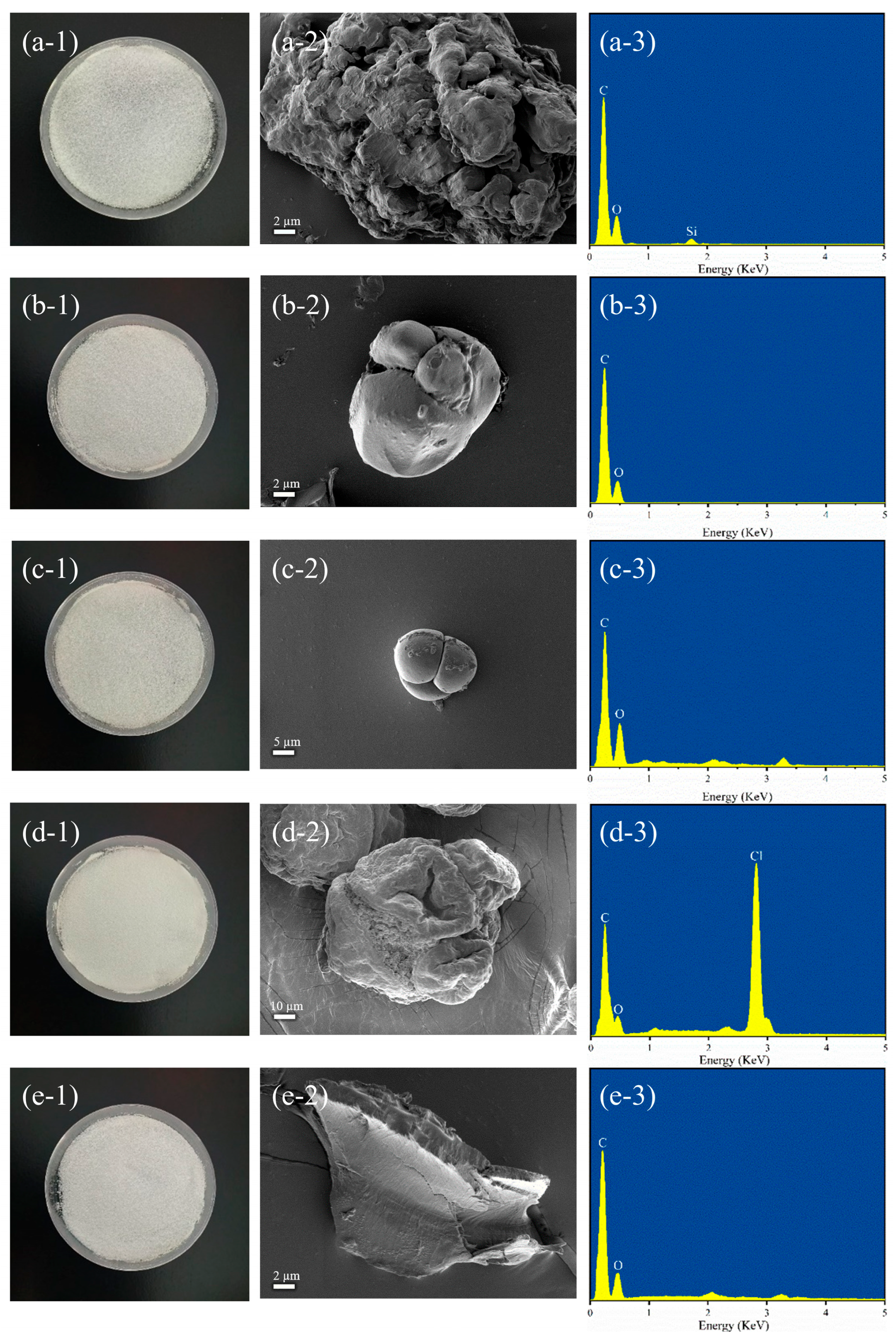
The scanning electron microscopy (SEM) images of the five MPs are presented in Figure 1. The five MPs exhibit inhomogeneity, which was optimal for simulating the adsorption effect in a real soil environment. Figure 1a shows that PE is characterized by numerous protrusions with local depressions on the surface. The energy dispersive X-ray spectroscopy (EDS) results show that carbon is dominant, which is consistent with the composition of the PE polymer. PP and PS exhibit smooth protrusions, while PS comprises nearly spherical particles. Thus, PFOA has fewer adsorption sites Figure 1b,c. Figure 1d shows that PVC exhibits a loose raised surface and encompasses a large quantity of folded structures, with an increased number of adsorption sites. The EDS results presented in Figure 1 show that the element on the surface of MPs is predominantly carbon, which is connected to the repeating unit composition of MPs. The elements of PP, PE, PS, and PET include carbon and oxygen, while PE comprises a small amount of Si [24]. However, the primary constituent of PVC is Cl, with a comparatively low composition of carbon and oxygen.

3.1.2. Fourier-Transform Infrared (FTIR) Analysis of PFOA Adsorption by MPs

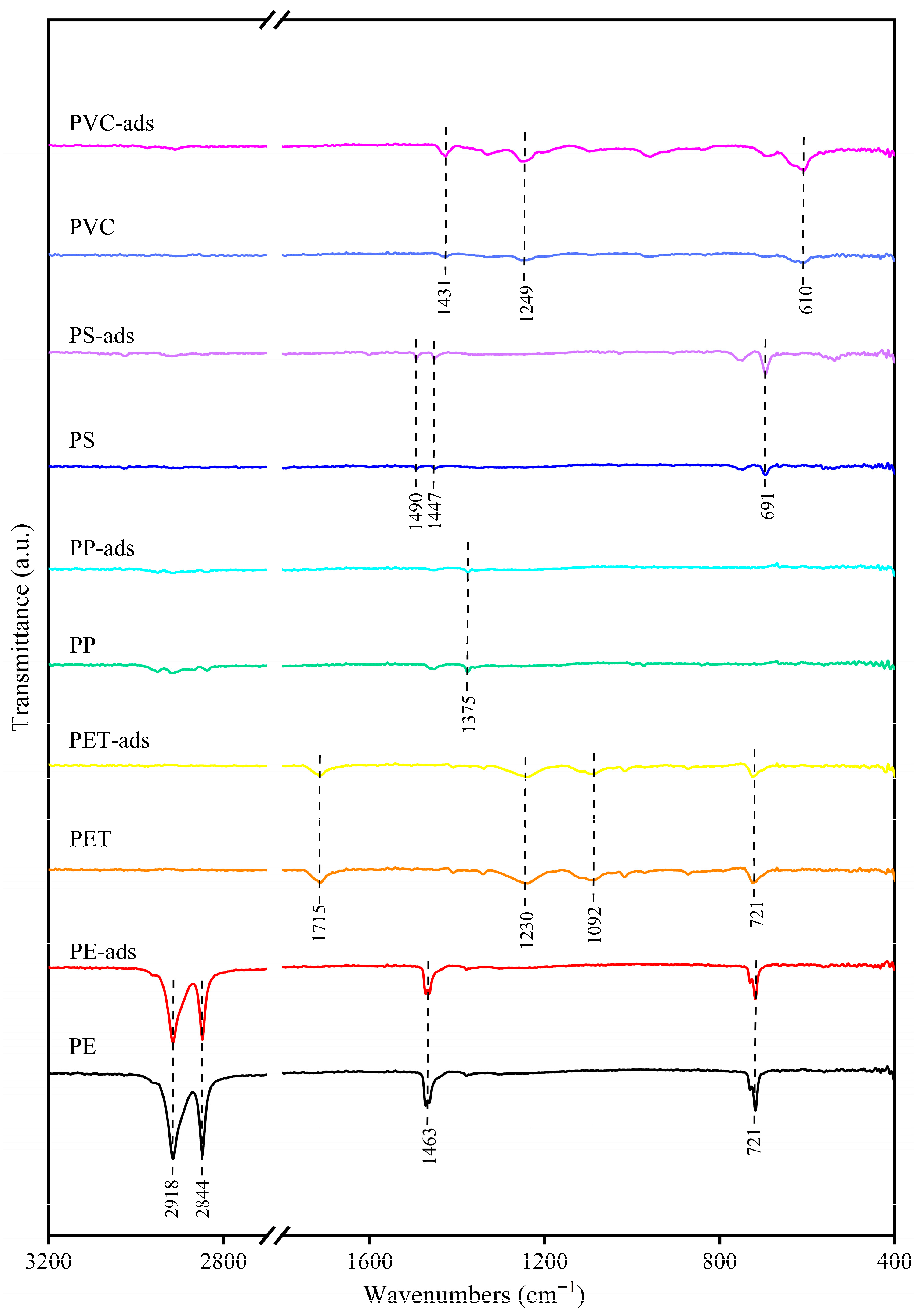
The FTIR spectra of MPs were examined to investigate the surface functionality of MPs (Figure 2). The symmetric and asymmetric stretching vibrations of the characteristic C–H peak of PE appear at 2844 and 2918 cm−1, respectively. Additionally, the bending and rocking vibrations of CH2 appear at 1463 and 721 cm−1 [27], respectively. Although PP exhibits a pronounced methyl C–H stretching vibration at 2950 cm−1, this is not detected, as shown in Figure 2. The absorption peak at 1375 cm−1 is caused by the symmetric deformation vibration of C–H of the methyl group (–CH3) [28]. For PVC, the C–Cl stretching vibration appears at 610 cm−1, with the superposition of CH2 shear deformation vibration and CH3 antisymmetric variable angle vibration at 1421 cm−1. The aromatic ring C–H stretching appears at ~700 cm−1, accompanied by a C=C vibration at 1490 cm−1 [29]. PET might have an ester group with a C=O stretch (1715 cm−1)and a C–O stretch (1233 cm−1) [27].

3.2. Electrostatic Potential and Molecular Orbital

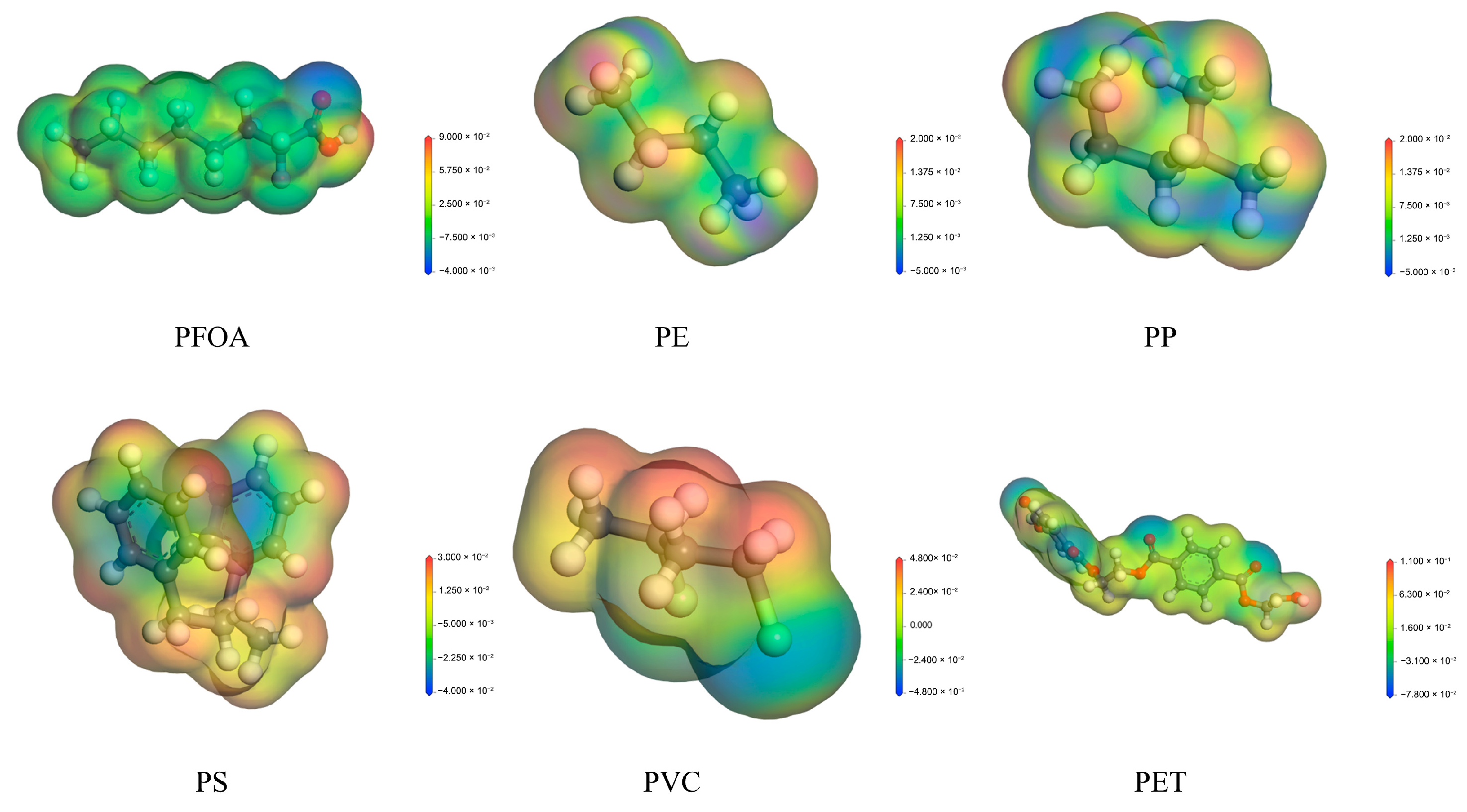
The electrostatic potential values of PFOA and five MPs were calculated using the Materials Studio 2020 software (Figure 3) to further understand the adsorption mechanism. Blue and red regions denote electron-rich and electron-deficient zones, respectively. The electrostatic precipitator diagram aids in predicting nucleophilic and electrophilic sites, which reveal the interaction patterns of molecular systems.
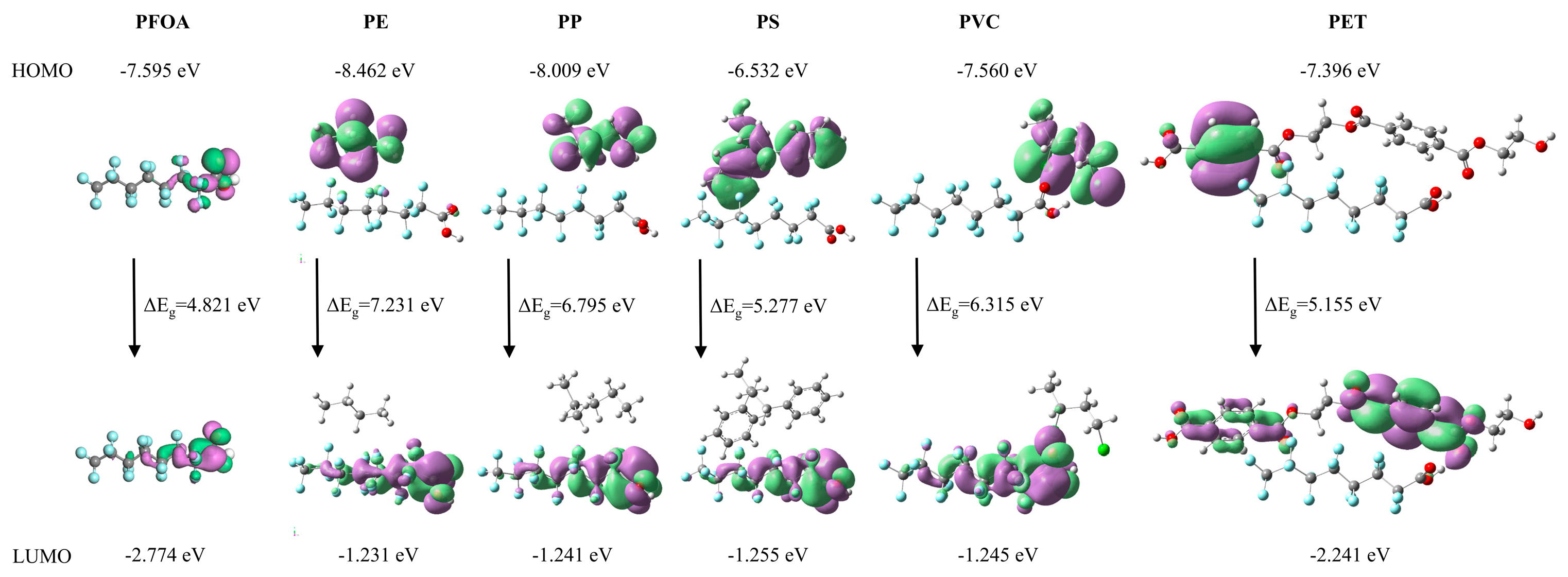
The distributions of HOMO and LUMO of PFOA and the five MPs after adsorption are depicted in Figure 4. Among them, purple represents the negative phase of the wave function, and green represents the positive phase. The head of PFOA comprises a –COOH group for polar interactions, and the tail comprises a perfluorocarbon chain (–C8F17), which is the main driving force for hydrophobic adsorption. The HOMO and LUMO of PFOA extend extensively from the head group to the fluorine atoms adjacent to the carbon chain. However, they are predominantly localized near the head group.

3.3. Co-Sorption of PFOA by Soil and MPs

3.3.1. Adsorption Kinetics

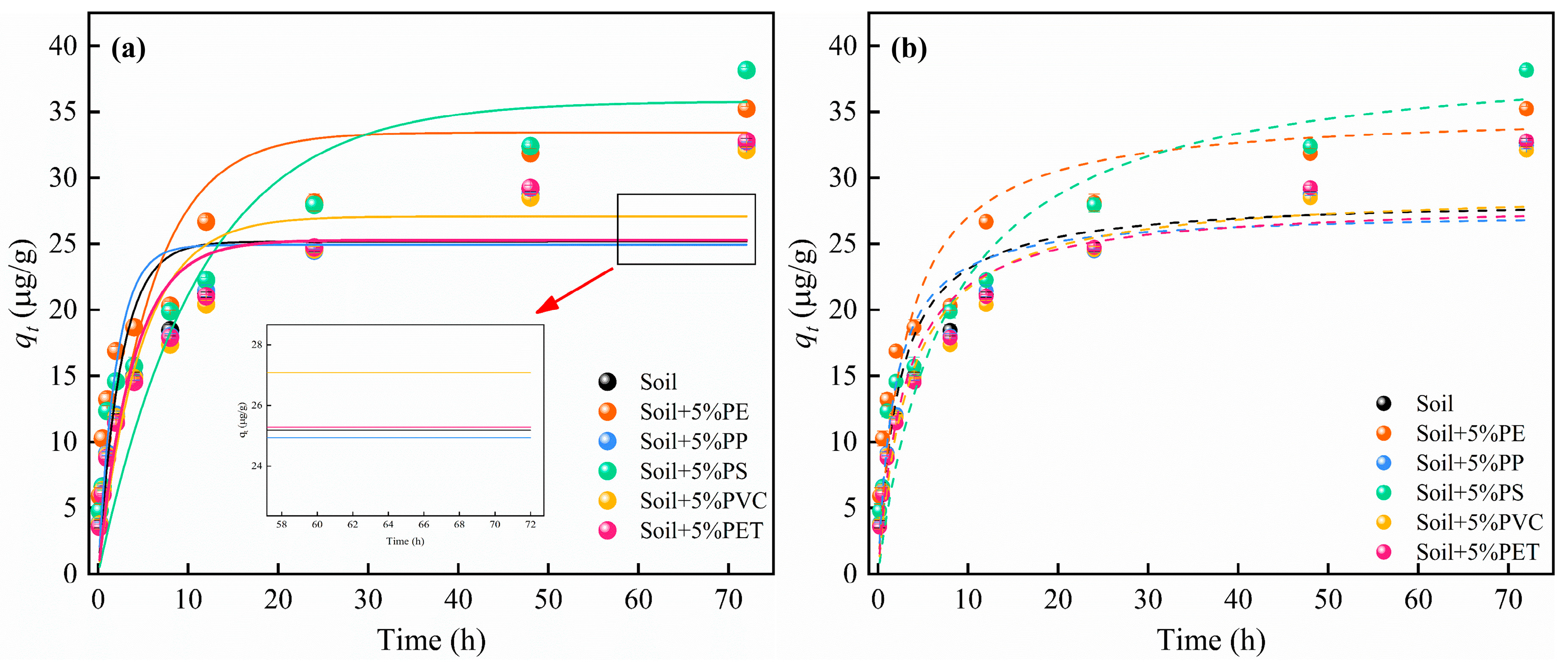
The quasi-first- and quasi-second-order kinetic models were matched with the kinetic adsorption data to investigate the adsorption efficiency of PFOA in the co-sorption system of soil and MPs. A comparison of Figure 5 and the adsorption rate constant ks presented in Table S4 confirms the dynamic adsorption change process of PFOA during co-sorption by soil and five MPs with the increasing reaction time. Based on the fitting coefficient (R2 > 0.9), the quasi-second-order kinetic model can better fit the adsorption of PFOA by MPs than the pseudo-first-order kinetic model. The adsorption of PFOA by the soil surface and MPs follows multiple mechanisms. Compared with the actual equilibrium adsorption capacity qe value, the adsorption capacity of PFOA in this mixed system exhibits the mentioned order: PS > PE > PET > soil > PP > PVC. The presence of PS, PE and PET increased the adsorption of PFOA in soil by 16.8%, 7.8% and 0.4%, respectively. The introduction of MPs to the soil might further increase the environmental pollution by PFOA by changing soil physicochemical properties or directly participating in adsorption.
The fitting results of the kinetics reveal that >85% of PFOA is adsorbed within 48 h by MPs and soil. The W–M model was used to further analyze the key stages that control the absorption process to examine the adsorption mechanism and behavior of PFOA absorbed by soil and MPs via co-sorption. The parameters of the fitting results are presented in Table S3. The relation between qt and t0.5 is nonlinear (Figure S4), which indicates that intraparticle diffusion is involved in PFOA adsorption by soil and MPs. The kinetic adsorption curves of soil and five MPs do not intersect the origin and are divided into three distinct adsorption phases. Thus, the internal diffusion process of the particle is not the sole rate-limiting step, and the impact of membrane diffusion on adsorption should not be underestimated. Based on the parameters that align with the W–M intraparticle diffusion model, the initial rate of adsorption is faster than the rates in subsequent stages in the order of kd1 > kd2 > kd3. The fitting model demonstrates that PFOA is the primary factor in the rapid surface adsorption phase during adsorption.

3.3.2. Adsorption and Desorption Isotherms of PFOA by MPs and Soil

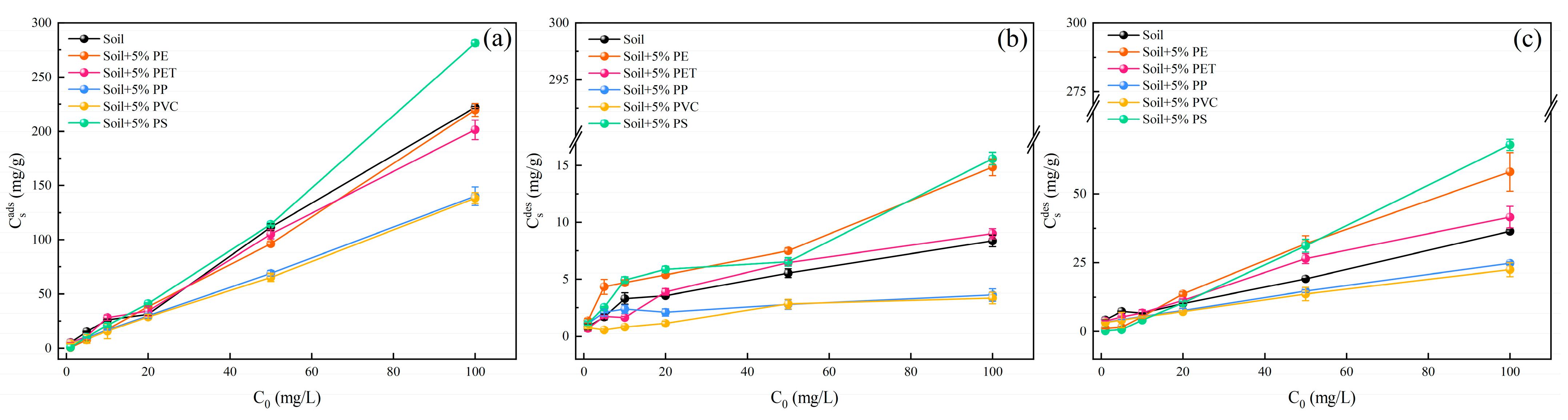
The adsorption data obtained through methanol desorption in this study aim to compare the maximum adsorption capacities of different media (soil, MPs) under experimental conditions and are used for subsequent adsorption–desorption model fitting. However, it should be noted that desorption behavior in natural environments would be much milder and more complex. The adsorption isotherms of PFOA by soil and MPs via co-sorption are depicted in Figure 6a. The adsorption isotherms are fitted according to the Freundlich and Langmuir model isotherms [30,31], and the fitting parameters are presented in Table S4. Based on the fitting parameters listed in Table S4, the Freundlich isothermal model provides a highly accurate representation of PFOA co-sorption by soil and MPs based on the adsorption coefficient and determination coefficient of PFOA. In all samples, R2 in the Freundlich model is higher than that in the Langmuir model, indicating a superior degree of fit. The addition of MPs enhances the heterogeneity of the soil surface, which conforms to the applicability of the Freundlich model. The n value of the sample reflects the intensity of the adsorption effect. The larger the n value, the more intense the adsorption process. When n < 1, adsorption is more difficult to proceed.
The results of the analysis of variance (Figures S2 and S3) show that the disparity between the initial PFOA concentration and the quantity adsorbed is extremely significant (p < 0.01), indicating that the adsorption amount with the change in the PFOA concentration does not randomly fluctuate. The change in concentration directly results in a significant difference in the adsorption amount.
During the desorption experiment, water was initially employed as the desorption solvent, revealing minimal desorption of PFOA. To evaluate the desorption threshold and considering methanol’s superior solubility properties, methanol was selected as an alternative desorption agent to investigate the maximum desorption capacity of PFOA within this system.
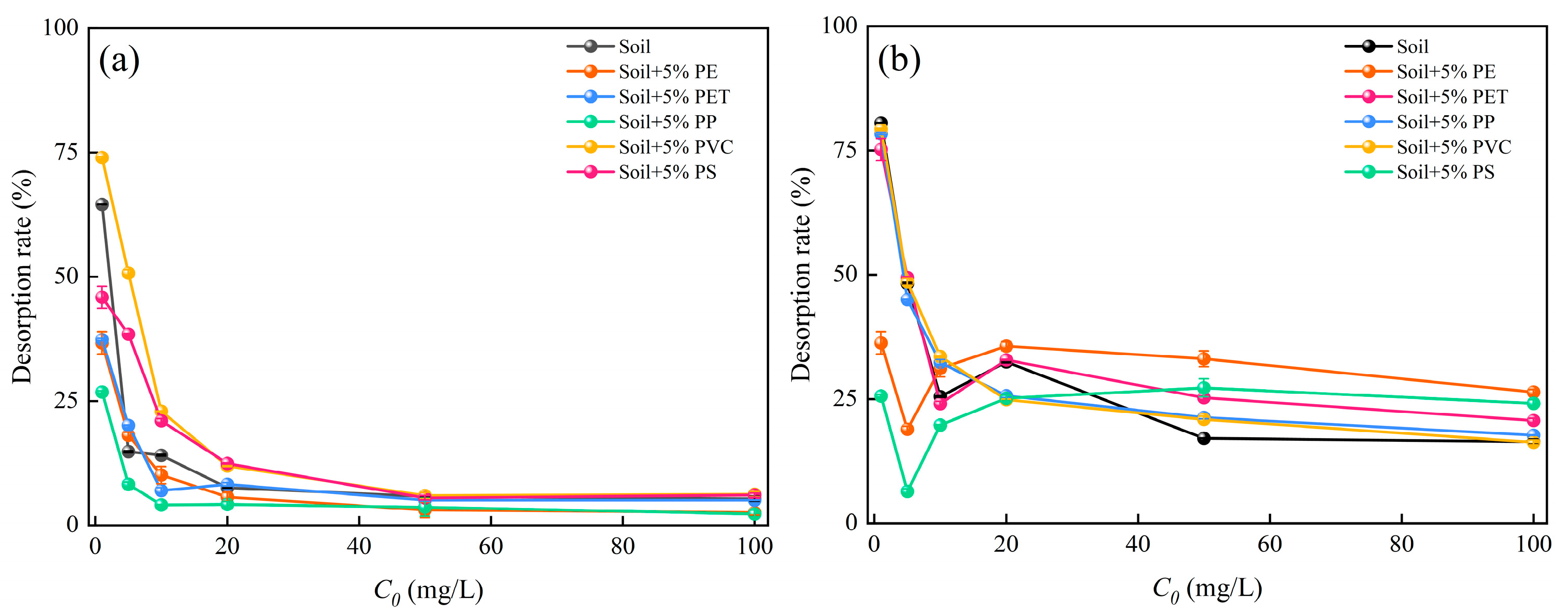
The desorption experiment was performed following the completion of the adsorption experiments. The desorption isotherms of PFOA by soil and MPs are presented in Figure 6b,c. In Figure 6b, c are the results obtained by using water and methanol as desorbents, respectively. The desorption isotherms are fitted according to the Langmuir and Freundlich models (Table 1 and Table 2). Similarly to the adsorption isotherm model, the Freundlich isotherm can better describe PFOA desorption among the studied models. The larger the desorption coefficient in the six samples, the greater the affinity of the system for PFOA [32]. In Figure 7a, when deionized water is used as the desorption solvent, it can be found that PFOA adsorbed onto soil and MPs is more difficult to desorb. In Figure 7b, when methanol is used as the desorption solvent, PVC, PET, and soil show that excess PFOA is desorbed with the increase in the PFOA concentration, while the desorbed PFOA concentration by PE, PP, and PS decreases after PFOA increases to a certain concentration, with no desorption later.

4. Discussion

4.1. Characterization Analysis

Characterization results of MPs after adsorption revealed distinct morphological differences among various plastics, creating conditions conducive to PFOA adsorption. During the experiment, the physical properties of different MPs in the culture dish can be directly observed with the naked eye, differences were observed between PE and other MPs. PE is more likely to absorb moisture from the air than other MPs, causing adhesion. Consequently, a few particles form cluster owing to electrostatic adsorption. To further investigate the effects of PFOA adsorption on MPs functional groups, we analyzed the spectra of MPs after PFOA adsorption using FTIR. And found that the vibrations of intrinsic groups within each plastic particle subjected to different treatments may be influenced by their surrounding environment, leading to variations in peak intensity. For instance, adsorption might enhance intermolecular interactions or initiate the formation of hydrogen bonds, thus modifying the dipole moment and subsequently affecting the absorption strength. Adsorbed substances might cover the surface, diminishing the signal of certain peaks or introducing new peak signals from novel substances. The peak intensity of PVC and PS increases after adsorption of PFOA, while that of PE decreases (Figure 2). In contrast, the peak intensity of PP and PET remains relatively unchanged.

4.2. Theoretical Calculation

In addition to investigating functional group changes via FTIR, the experiment further combined theoretical computational methods to calculate electrostatic potentials and molecular orbitals. PE, PP, PS, and PVC are characterized as weak polar or nonpolar molecules, whereas PET and PFOA are strong polar molecules. PET exhibits the highest polarity among the five MPs because of the pronounced polarity of the ester group in PET coupled with the conjugation effect of the benzene ring. The amphiphilic nature of PFOA stems from the coexistence of two completely opposite parts in its molecule. One is a highly stable and hydrophobic perfluorocarbon chain “tail” composed of the C–F bond, and the other is a charged, water-soluble “head” (–COOH). Nonpolar plastics (PE and PP) might adsorb the perfluorinated chain of PFOA via hydrophobic interactions [33,34]. Conversely, polar plastics (PET) can adsorb the –COOH group via either electrostatic forces or hydrogen bonding. Considering that the –COOH group of PFOA dissociates into anions in solution, it possesses a negative charge. Hence, areas on the plastic surface with positive charges might exhibit a higher propensity for adsorption.
The adsorption process was elucidated by computing the frontier molecular orbitals of the system. According to the first-line molecular orbital theory [35], a strong alignment between the HOMO and LUMO energies of two interacting fragments increases their interaction, enhancing the stability of the system. The calculation of the HOMO-LUMO energy gap (ΔEg) reveals that a large gap corresponds to a highly stable system. Conversely, MPs with small gaps are easily occupied by soil particles on their adsorption sites, resulting in a low PFOA adsorption capacity (Figure 1). Figure 4 shows that the energy gap calculated using the theory before and after adsorption by PE is the largest, verifying its better adsorption potential among the examined MPs. This is consistent with the results presented by the PE group in Figure 1.

4.3. Adsorption and Desorption Mechanisms

Experimental data fitted to kinetic models indicate that the pseudo-second-order kinetic model better describes the adsorption of PFOA by MPs. Furthermore, the presence of PS, PE and PET increased PFOA adsorption in soil by 16.8%, 7.8% and 0.4%, respectively. Other MPs demonstrate a comparatively minimal effect, similar to that of untreated soil, implying a negligible impact on the overall adsorption. PS might be introduced from various sources, including agricultural irrigation and sewage sludge, organic fertilizers, atmospheric deposition, and tire wear particles, while PE is introduced form plastic films. PS and PE are typical MP residues found in agricultural soil [36,37,38]. The analysis suggests that their presence enhances the adsorption of PFOA in soil, intensifying the PFOA risk in agricultural soil [39,40]. This means that in the real natural environment, MPs may play the role of “pollution carriers”, not only enhancing the accumulation of PFOA, but also possibly prolonging its environmental persistence by hindering its migration and degradation, ultimately intensifying the risk of compound pollution to soil ecosystems and groundwater.
The pseudo-first-order kinetic fitting results indicate a rapid initial adsorption rate, which can be ascribed to the unoccupied sites on the surface of the system, resulting in a swift upward trend in the curve. The adsorption rates of the 5 types of MPs showed a trend of first increasing and then gradually decreasing with the extension of adsorption time. This might be because PFOA occupied the adsorption vacancies, thereby reducing the adsorption rate. When all the vacancies in the system where soil and MPs are used as adsorbents are filled, the adsorption rate is the lowest, and the maximum adsorption capacity is reached at this time, thus the adsorption reaches equilibrium. The rate of adsorption is predominantly determined by physical adsorption or diffusion steps. This aligns with the findings of Li et al. [41]. They reported that PFOA rapidly adhered to the adsorbent via mass transfer, subsequently reducing the quantity of effective binding sites on the adsorbent and PFOA adsorption rate. However, the quasi-second-order kinetic model more accurately suggests that chemical adsorption governs the adsorption process. This involves chemical reactions between the adsorbate and active sites on the adsorbent surface, including electron transfer or covalent bond formation. Control group (soil and PFOA) and different treatment groups (soil, MPs and PFOA) are rapidly adsorbed within 8 h before the adsorption equilibrium, and gradually approached adsorption equilibrium with the extension of adsorption time. Compared with soil, PP exhibits a promoting effect on the adsorption of PFOA within the first 12 h, while PS shows an inhibitory effect, probably because PP has high crystallinity, abundant micropores, or a rough surface [42,43], providing a large effective specific surface area and additional adsorption sites. In contrast, the adsorption inhibition of PS was observed in the first 12 h by comparing Figure 1 and Figure 5a, which might be due to the surface of PS is smoother than that of other MPs, and its adsorption capacity is relatively limited. PS polarity might be slightly lower than PP hydrophobicity owing to the benzene ring, while the linear structure of PE might make it weakly hydrophobic, resulting in a reduced adsorption capacity. Moreover, PP hydrophobicity is stronger than those of PE and PS, which is more conducive to the adsorption of the carbon–fluorine chain of PFOA via hydrophobic interaction [44].
Combining the W–M particle internal diffusion model, it is not difficult to conclude that the internal diffusion process of particles is not the sole rate-limiting step, and the influence of membrane diffusion on adsorption should not be underestimated. During this phase, PFOA swiftly occupies the adsorption sites on the soil and MP surfaces, whereas the dispersion of PFOA into the internal framework of MPs and soil occurs at a slower rate. Each sample exhibits these three stages, which can be categorized into diffusion in mesopores and micropores. The swift adsorption during the initial stage is primarily governed by membrane diffusion, while the subsequent linear stage pertains to internal diffusion of particles at quasi-equilibrium. The adsorption process can be categorized into three distinct phases: the (i) initial rapid adsorption stage, (ii) intermediate slow adsorption phase, and (iii) final equilibrium. These phases are achieved within 48 h. Based on the previous kinetic model results, it is possible that in the control group, PFOA is rapidly adsorbed onto the soil surface and then diffuses into the pores of the interlayer structure of the soil [45]. Adsorption via hydrophobic interactions has been reported as a potential mechanism for PFOA retention in MPs. The process of PFOA adsorption following aggregation with various MPs is depicted in Figure S1. Noncovalent interactions between the configurations are formed, and the bond length ranges from 1.65 Å to 2.92 Å. In the initial phase, PFOA is swiftly adsorbed onto the combined system across various treatment groups. This rapid adsorption can be attributed to multiphase adsorption processes, occupying the external activation sites via different interactions: hydrophobic interactions, covalent forces, and van der Waals forces [46,47,48]. Figure S4 shows that the fitted model contains a nonzero intercept, indicating that surface adsorption and intraparticle diffusion jointly promote the actual adsorption process of PFOA by soil and MPs [49]. In the second stage, PFOA slowly diffuses from the liquid membrane to the polyporate surface. In the last stage, owing to the pore diameter, the intraparticle diffusion rate is considerably lower than the surface diffusion rate in the previous stage. The kd1 values of PE and PS were measured at 4- and 5-time more than that of the control group, respectively. A large kd value suggests rapid internal diffusion with minimal impact on the overall adsorption rate, while a small kd value indicates slow internal diffusion, potentially serving as a rate-controlling step.
Whether water or methanol is used as a desorbent, the results of isothermal model fitting indicate that the Freundlich model outperforms the Langmuir model. A comparison of the desorption results between water and methanol revealed that methanol exhibited significantly superior desorption capacity compared to water. However, overall, both systems demonstrated an increasing trend in desorption amount with elevated initial additive concentration Figure 6b, c. The adsorption intensity reflected by n in the Freundlich model is consistent with the changes in different MPs. It was observed during the experiment that PE easily absorbs moisture from the air, and adhesion and agglomeration occur between different particles, reducing the adsorption surface area. Combined with the SEM image of PVC in Figure 1d, it shows a wrinkled shape, which increases its surface area and the possibility of adsorption. Figure 1e shows that PET depicts a layered structure with small particle diameters and is nonlinearly adsorbed with the PVC group [50,51]. Although PS particles are small, their surface is smooth Figure 1c, which reduces PFOA adsorption sites. PS particles might occupy the adsorption sites of soil, reducing the adsorption of PFOA by soil and PS.
As shown in Figure 7, the desorption rates of PFOA in soil–MPs coexisting systems using different desorbing agents were compared. It was observed that when water served as the desorbing agent, the PVC, Soil, and PET groups exhibited relatively high desorption rates of 73.93%, 64.55%, and 45.88%, respectively. However, negligible desorption occurred when concentrations exceeded 20 mg/L. In contrast, methanol demonstrated sustained desorption capacity at higher concentrations: the desorption rates for Soil (80.54%), PVC (79.27%), PP (78.40%), and PET (75.19%) decreased to 16.42%, 16.26%, 17.71%, and 20.66%, respectively, under these conditions, yet the overall desorption amounts remained significantly higher than those achieved with water as the desorbing agent.
As PFOA concentrations increased, PVC, PET, and soil samples desorbed some PFOA, while PE, PP, and PS samples initially desorbed PFOA but then ceased desorption. This outcome is potentially attributable to the varying polarities of different MPs. PVC and PET contain polar groups, such as –Cl and –COOH–, respectively. These groups can bind to the –COOH group of PFOA either via hydrogen bonding or electrostatic action, increasing their adsorption capacity. However, as the PFOA concentration increases, the adsorption sites become progressively saturated, the adsorption capacity no longer increases [52,53]. Conversely, PS, PE, and PP are nonpolar polymers that primarily adsorb PFOA via hydrophobic interactions [54]. When the concentration exceeds a certain critical threshold, these hydrophobic interactions can facilitate multilayer PFOA adsorption on the material surface or even induce the formation of micelles. Thus, free PFOA decreases, resulting in reduced desorption. At elevated concentrations, PFOA might exceed its critical micelle concentration, prompting the formation of micelles or aggregates. Micelle formation subsequently diminishes the effective concentration of free PFOA in the solution, which decreases desorption [55]. Nonpolar plastics (PE) might experience polymer swelling or alterations of the micropore structure upon exposure to PFOA at high concentrations, contributing to the physical entrapment of several PFOA molecules and hindering desorption kinetics. The molecular charge distribution of the negatively charged PFOA solution is distinct from the electrostatic potential map (Figure 3). The surfaces of PE and PP, with weak negative charges owing to oxidation or impurities, can enhance electrostatic repulsion at high concentrations [56,57]. These findings are further corroborated by the data presented in Figure 6a, which illustrate the high concentration of PFOA adsorption, and Figure 3, which highlights the charge distribution of PE and PS. The fixed concentration used in this study may not be fully representative of all the real environment, and in the future studies should consider a broader concentration gradient to assess the concentration effect.
It should be noted that the method of using methanol as desorption solvent in this study is to evaluate the maximum desorption potential of pollutants under strong desorption conditions, which is a key limitation of this study. Since methanol can strongly destroy various binding interactions between pollutants and media, its measured value can be regarded as the theoretical upper limit of desorption capacity, which may be significantly higher than the desorption degree observed in the actual water environment. Therefore, the desorption data of this study should be carefully interpreted and should not be directly used to predict the absolute desorption amount in the environment. In order to more truly reflect the environmental behavior of pollutants, it is recommended that future work combine such enhanced experiments with mild aqueous phase desorption experiments, chemical speciation analysis, and field verification to achieve a more accurate assessment of the mobility and risk of pollutants.

4.4. Future Perspectives

The conclusions of this study are primarily based on soil samples from a single orchard in Jiaozhou, Shandong Province; therefore, caution should be exercised when extrapolating these findings to agricultural soils of different types or geographical regions. Although this study provides new insights into the interactions between MPs and PFOA in soil environments, it is important to acknowledge several limitations. Firstly, the experiment utilized only one type of soil from an orchard with fixed physicochemical properties (e.g., organic matter content, pH, and texture). However, farmland soils exhibit significant variability in their characteristics, which can substantially influence the environmental behavior of PFAS and MPs. Therefore, caution should be exercised when extrapolating the findings of this study to all types of agricultural soils. Future research should include a broader range of soils with diverse properties to establish more universally applicable models. Secondly, the MPs used in this study were virgin materials obtained directly from manufacturers, whose surface characteristics differ from those of MPs that have undergone long-term weathering and aging in the environment. Natural aging alters the surface chemistry, roughness, and functional groups of MPs, which may affect their adsorption behavior toward pollutants. Consequently, laboratory results might differ from actual environmental conditions. As the initial study in a series of investigations, this research was conducted under fixed initial pH conditions without revealing the effects of dynamic pH changes on the adsorption process. The primary objective was to control variables and first elucidate the fundamental influence patterns of MPs presence on PFAS adsorption behavior within a single soil pH context. Therefore, we maintained the system’s initial pH throughout the experimental process. We acknowledge that differences in adsorption behavior under varying pH conditions will constitute an important direction for future research. Future studies should incorporate artificially or naturally aged MPs to better simulate environmental processes. Thirdly, methanol was used as the desorption agent in the experiments to evaluate the maximum desorption potential of PFOA, a condition that cannot occur under natural aquatic environments. While this method facilitates mechanistic investigations into the binding strength of pollutants, it may overestimate migration risks and bioavailability under real-world scenarios such as rainfall or irrigation. Additionally, the concentrations of PFOA and MPs employed in this study were set to clearly observe their interaction effects under controlled conditions. These levels might exceed background values typically found in some agricultural soils but could be relevant for simulating localized pollution hotspots or predicting future contamination trends. Finally, this study was primarily conducted at the batch experiment level and did not account for the impacts of more complex soil–plant systems or microbial communities. In summary, future research should aim to validate the findings of this study under conditions closer to real-world scenarios, such as multiple soil media, aged MPs, and microscopic experiments.

5. Conclusions

This study reveals that MPs, as anthropogenic carriers, can significantly alter the interfacial behavior and fate of PFOA in soil environments. The extent of their influence is closely related to MP types, with PS, PE, and PET all exhibiting enhanced adsorption effects on PFOA. This phenomenon is primarily attributed to these plastics providing additional hydrophobic partition phases and adsorption sites for PFOA beyond those naturally present in soil matrices. Our findings demonstrate that within coexisting systems of MPs and soil, MPs are not inert entities but rather act as active “regulators” participating in pollutant distribution processes, where their hydrophobicity serves as the key driving factor for PFOA redistribution. The introduction of MPs may transform contaminated land into a more complex “composite pollution source”. As MPs undergo aging and fragmentation in environmental conditions, the risk of re-releasing adsorbed PFOA increases significantly, thereby creating potential “secondary pollution sources” that prolong and intensify the ecological exposure cycle and risks associated with PFOA. Therefore, when assessing and remediating agricultural soils contaminated by PFOA, the presence and specific types of MPs must be incorporated as core consideration factors. This study first explored the interaction between MPs and PFOA within an agricultural system, reporting valuable data for evaluating the migration and transformation of PFOA in soil–crop systems, with potential risks to human health. These findings hold significant scientific value for developing strategies to remediate organic pollutants in agricultural soil with MPs, refining risk assessment models for polluted sites, and establishing a theoretical foundation for the development of new soil composite pollution control technologies based on interface regulation. Future studies should concentrate on the desorption risk of PFOA during the aging process of MPs and its potential impact on soil microbial functions. Additionally, future studies can explore the potential effects of MPs as carriers in the water–soil system on the migration and transformation of perfluorinated compounds.

Supplementary Materials

The following supporting information can be downloaded at: https://www.mdpi.com/article/10.3390/agronomy15122802/s1, Text S1. Preparation of MPs Samples; Text S2. Soil samples collection and preparation; Text S3. Preparation and determination of PFOA samples; Table S1. Recovery of PFOA in Different MPs.; Table S2. Adsorption kinetic parameters of PFOA by different MPs in soil; Table S3. Characteristic parameters of internal diffusion model (Initial concentration 20 mg/L); Table S4. Characteristic parameters of adsorption isotherms fitted by different models; Figure S1. Molecular structures of the PFOA and MPs complexes. Representative intermolecular distances between the PFOS F atoms and the MPs atoms (Å) are indicated with red numbers. (a) PE and PFOA; (b) PP and PFOA; (c) PS and PFOA; (d) PVC and PFOA; (e) PET and PFOA; Figure S2. Adsorption of PFOA by soil under different concentrations and treatments; Figure S3. Desorption of PFOA by soil under different concentrations and treatments; Figure S4. Internal diffusion model of PFOA in different MPs and soil co-sorption systems.

Author Contributions

W.Z.: Writing—original draft, Visualization, Investigation, Formal analysis, Data Curation. G.C.: Formal analysis, Methodology, Investigation. J.J.: Data Curation. Visualization, Formal analysis. Z.L.: Formal analysis, Investigation, Data Curation. Y.Z.: Investigation, Resources, Data Curation. G.L.: Methodology, Supervision, Resources. C.Z.: Resources, Supervision, Methodology. Q.Y.: Supervision, Resources, Methodology. S.X.: Validation, Supervision, Resources. Y.X.: Writing—review and editing, Supervision, Funding acquisition, Conceptualization, Resources. Q.W.: Writing—review and editing, Supervision, Funding acquisition, Conceptualization, Resources. All authors have read and agreed to the published version of the manuscript.

Funding

This work has been financially supported by the Qingdao Natural Science Foundation (No. 24-4-4-zrjj-20-jch), the Experimental Technology Research Programme of Qingdao Agricultural University (SYJS202402).

Data Availability Statement

The original contributions presented in this study are included in the article/Supplementary Material. Further inquiries can be directed to the corresponding author(s).

Acknowledgments

We acknowledge the support of the sample testing by Central Laboratory of Qingdao Agricultural University.

Conflicts of Interest

The authors declare that they have no known competing financial interests or personal relationships that could have appeared to influence the work reported in this paper.

Abbreviations

MPsMicroplastics
PFOAperfluorooctanoic acid
PFASsperfluoroalkyl and polyfluoroalkyl substances
PEpolyethylene
PPpolypropylene
PSpolystyrene
PVCpolyvinyl chloride
PETpolyethylene terephthalate
SEMscanning electron microscope
EDSenergy dispersive X-ray spectroscopy
FTIRFourier-transform infrared

References

  1. Bons, H.K.; Rattanpal, H.S.; Brar, A.S. Influence of different mulches on growth and productivity of kinnow mandarin. Agric. Res. J. 2018, 55, 765–767. [Google Scholar] [CrossRef]
  2. Singh, R.; Kumar, V.; Jat, R.; Singh, V.P. Mulches and Their Impact on Floor Management and Performance of Fruit Crops: A Review. Curr. J. Appl. Sci. Technol. 2020, 39, 62–78. [Google Scholar] [CrossRef]
  3. Marín-Guirao, J.I.; Martín-Expósito, E.; García-García, M.d.C.; de Cara-García, M. Alternative Mulches for Sustainable Greenhouse Tomato Production. Agronomy 2022, 12, 1333. [Google Scholar] [CrossRef]
  4. Lian, Y.; Liu, W.; Shi, R.; Zeb, A.; Wang, Q.; Li, J.; Zheng, Z.; Tang, J. Effects of polyethylene and polylactic acid microplastics on plant growth and bacterial community in the soil. J. Hazard. Mater. 2022, 435, 129057. [Google Scholar] [CrossRef]
  5. Mahinroosta, R.; Senevirathna, L. A review of the emerging treatment technologies for PFAS contaminated soils. J. Environ. Manag. 2020, 255, 109896. [Google Scholar] [CrossRef]
  6. Evich, M.G.; Davis, M.J.B.; McCord, J.P.; Acrey, B.; Awkerman, J.A.; Knappe, D.R.U.; Lindstrom, A.B.; Speth, T.F.; Tebes-Stevens, C.; Strynar, M.J.; et al. Per- and polyfluoroalkyl substances in the environment. Science 2022, 375, eabg9065. [Google Scholar] [CrossRef]
  7. Simones, T.L.; Evans, C.; Goossen, C.P.; Kersbergen, R.; Mallory, E.B.; Genualdi, S.; Young, W.; Smith, A.E. Uptake of Per- and Polyfluoroalkyl Substances in Mixed Forages on Biosolid-Amended Farm Fields. J. Agric. Food Chem. 2024, 72, 23108–23117. [Google Scholar] [CrossRef]
  8. Wee, S.Y.; Aris, A.Z. Environmental impacts, exposure pathways, and health effects of PFOA and PFOS. Ecotoxicol. Environ. Saf. 2023, 267, 115663. [Google Scholar] [CrossRef]
  9. Allen, S.; Allen, D.; Phoenix, V.; Roux, G.L.; Jiménez, P.D.; Simonneau, A.; Binet, S.; Galop, D. Atmospheric transport and deposition of microplastics in a remote mountain catchment. Nat. Geosci. 2019, 12, 339–344. [Google Scholar] [CrossRef]
  10. Tian, L.; Jinjin, C.; Ji, R.; Ma, Y.; Yu, X. Microplastics in agricultural soils: Sources, effects, and their fate. Curr. Opin. Environ. Sci. Health 2022, 25, 100311. [Google Scholar] [CrossRef]
  11. Zhu, N.; Li, Z.; Yu, Y.; Liu, Z.; Liang, X.; Wang, W.; Zhao, J. Fate of microplastics in soil-water systems: View from free radicals driven by global climate change. Ecotoxicol. Environ. Saf. 2025, 295, 118138. [Google Scholar] [CrossRef] [PubMed]
  12. Liu, W.; Wang, Y.; Gu, C.; Wang, J.; Dai, Y.; Maryam, B.; Chen, X.; Yi, X.; Liu, X. Polyethylene microplastics distinctly affect soil microbial community and carbon and nitrogen cycling during plant litter decomposition. J. Environ. Manag. 2025, 373, 123616. [Google Scholar] [CrossRef] [PubMed]
  13. Machado, A.A.d.S.; Lau, C.W.; Till, J.; Kloas, W.; Lehmann, A.; Becker, R.; Rillig, M.C. Impacts of Microplastics on the Soil Biophysical Environment. Environ. Sci. Technol. 2018, 52, 9656–9665. [Google Scholar] [CrossRef] [PubMed]
  14. Xiao, J.; Zhang, Z. Sources, occurrence characteristics and potential risks of microplastics in farmland soils: A review. China Plast. 2024, 38, 137–144. [Google Scholar] [CrossRef]
  15. Song, J.; Song, J.; Zhang, R.; Che, C.; Yuan, Y.; Tan, W.; Xi, B.; Hui, K.; Zhang, J. Study on interaction, feedback, and response between perfluorinated compounds and soil environments. Emerg. Contam. 2025, 11, 100428. [Google Scholar] [CrossRef]
  16. Wang, Y.; Munir, U.; Huang, Q. Occurrence of per- and polyfluoroalkyl substances (PFAS) in soil: Sources, fate, and remediation. Soil Environ. Health 2023, 1, 100004. [Google Scholar] [CrossRef]
  17. Ghisi, R.; Vamerali, T.; Manzetti, S. Accumulation of perfluorinated alkyl substances (PFAS) in agricultural plants: A review. Environ. Res. 2019, 169, 326–341. [Google Scholar] [CrossRef]
  18. Zhang, W.; Cao, H.; Liang, Y. Plant uptake and soil fractionation of five ether-PFAS in plant-soil systems. Sci. Total Environ. 2021, 771, 144805. [Google Scholar] [CrossRef]
  19. Qin, C.; Lu, C.; Lu, C.; Zhao, L.; Li, X.; Sun, Y.; Weng, L.; Li, Y. Toxicological effects of per- and polyfluoroalkyl substances (PFASs) on earthworms: Progress and prospects. Appl. Soil Ecol. 2025, 206, 105853. [Google Scholar] [CrossRef]
  20. Zheng, X.-q.; Shi, Y.-j.; Lu, Y.-l.; Xu, X.-b. Growth inhibition and DNA damage in the earthworm (Eisenia fetida) exposed to perfluorooctane sulphonate and perfluorooctanoic acid. Chem. Ecol. 2016, 32, 103–116. [Google Scholar] [CrossRef]
  21. Bolan, N.; Sarkar, B.; Yan, Y.; Li, Q.; Wijesekara, H.; Kannan, K.; Tsang, D.C.W.; Schauerte, M.; Bosch, J.; Noll, H.; et al. Remediation of poly- and perfluoroalkyl substances (PFAS) contaminated soils–To mobilize or to immobilize or to degrade? J. Hazard. Mater. 2021, 401, 123892. [Google Scholar] [CrossRef]
  22. Biswas, B.; Joseph, A.; Parveen, N.; Ranjan, V.P.; Goel, S.; Mandal, J.; Srivastava, P. Contamination of per- and poly-fluoroalkyl substances in agricultural soils: A review. J. Environ. Manag. 2025, 380, 124993. [Google Scholar] [CrossRef]
  23. Fuller, S.G.; Gautam, A. A Procedure for Measuring Microplastics using Pressurized Fluid Extraction. Environ. Sci. Technol. 2016, 50, 5774–5780. [Google Scholar] [CrossRef]
  24. Guo, X.; Pang, J.; Chen, S.; Jia, H. Sorption properties of tylosin on four different microplastics. Chemosphere 2018, 209, 240–245. [Google Scholar] [CrossRef]
  25. Frisch, M.J.; Trucks, G.W.; Schlegel, H.B.; Scuseria, G.E.; Robb, M.A.; Cheeseman, J.R.; Scalmani, G.; Barone, V.; Petersson, G.A.; Nakatsuji, H.; et al. Gaussian 16 Rev. A.03; Gaussian Inc.: Wallingford, CT, USA, 2016. [Google Scholar]
  26. Marenich, A.V.; Cramer, C.J.; Truhlar, D.G. Universal Solvation Model Based on Solute Electron Density and on a Continuum Model of the Solvent Defined by the Bulk Dielectric Constant and Atomic Surface Tensions. J. Phys. Chem. B 2009, 113, 6378–6396. [Google Scholar] [CrossRef] [PubMed]
  27. Bian, J.; Cao, Y.; Han, Y.; Liu, J.; Chen, Q.; Liu, Z.; Li, M. Screening, identification, and performance of Microplastic degrading functional bacteria in Saline-alkali soil environment. Environ. Sci. 2025, 1–16. [Google Scholar] [CrossRef]
  28. Tang, J.; Peng, S.; Gu, W.; Bai, J.; Zhao, J.; Ma, Q. Effective degradation of polypropylene plastics by Bacillus Subtilis. Nonferrous Met. 2025, 116–123. [Google Scholar] [CrossRef]
  29. Bao, Z.; Chen, Z.; Qi, Z.; Wang, G.; Cai, Z. Adsorption mechanism of typical monohydroxyphenanthrene on polyvinyl chloride microplastics. Chin. J. Chromatogr. 2021, 39, 870–877. [Google Scholar] [CrossRef]
  30. Guo, J.; Du, Y.; Yang, L.; Luo, Y.; Zhong, G.; Zhao, H.-M.; Liu, J. Effects of microplastics on the environmental behaviors of the herbicide atrazine in soil: Dissipation, adsorption, and bioconcentration. J. Hazard. Mater. 2024, 465, 133085. [Google Scholar] [CrossRef]
  31. Wu, P.; Cai, Z.; Jin, H.; Tang, Y. Adsorption mechanisms of five bisphenol analogues on PVC microplastics. Sci. Total Environ. 2019, 650, 671–678. [Google Scholar] [CrossRef]
  32. Zheng, T.; Hu, T.; Zhang, J.; Tang, C.; Duan, J.; Song, Y.; Zhang, Q. Dynamics in imidacloprid sorption related to changes of soil organic matter content and quality along a 20-year cultivation chronosequence of citrus orchards. Environ. Pollut. 2021, 291, 118069. [Google Scholar] [CrossRef]
  33. Tourinho, P.S.; Kočí, V.; Loureiro, S.; van Gestel, C.A.M. Partitioning of chemical contaminants to microplastics: Sorption mechanisms, environmental distribution and effects on toxicity and bioaccumulation. Environ. Pollut. 2019, 252, 1246–1256. [Google Scholar] [CrossRef] [PubMed]
  34. Liang, S.; Wang, K.; Wang, K.; Kou, Y.; Wang, T.; Guo, C.; Wang, W.; Wang, J. Adsorption of Diclofenac Sodium by Aged Degradable and Non-Degradable Microplastics: Environmental Effects, Adsorption Mechanisms. Toxics 2022, 11, 24. [Google Scholar] [CrossRef] [PubMed]
  35. Simonetti, F.; Mancini, M.; Gioia, V.; Zumpano, R.; Mazzei, F.; Frugis, A.; Migliorati, V. Unveiling the adsorption mechanism of perfluorooctane sulfonate onto polypropylene nanoplastics: A combined theoretical and experimental investigation. Water Res. 2025, 278, 123324. [Google Scholar] [CrossRef] [PubMed]
  36. Ding, L.; Zhang, S.; Wang, X.; Yang, X.; Zhang, C.; Qi, Y.; Guo, X. The occurrence and distribution characteristics of microplastics in the agricultural soils of Shaanxi Province, in north-western China. Sci. Total Environ. 2020, 720, 137525. [Google Scholar] [CrossRef]
  37. Weithmann, N.; Möller, J.N.; Löder, M.G.J.; Piehl, S.; Laforsch, C.; Freitag, R. Organic fertilizer as a vehicle for the entry of microplastic into the environment. Sci. Adv. 2018, 4, eaap8060. [Google Scholar] [CrossRef]
  38. Wang, J.; Li, J.; Liu, S.; Li, H.; Chen, X.; Peng, C.; Zhang, P.; Liu, X. Distinct microplastic distributions in soils of different land-use types: A case study of Chinese farmlands. Environ. Pollut. 2021, 269, 116199. [Google Scholar] [CrossRef]
  39. Barhoumi, B.; Sander, S.G.; Tolosa, I. A review on per- and polyfluorinated alkyl substances (PFASs) in microplastic and food-contact materials. Environ. Res. 2022, 206, 112595. [Google Scholar] [CrossRef]
  40. Zhang, H. Study on the Toxicity Mechanisms of Polystyrene Microplastics and Perfluorooctanoic Acid to Submerged Plants. Master’s Thesis, Shenyang Jianzhu University, Shenyang, China, 2024. [Google Scholar] [CrossRef]
  41. Li, J.; Guo, K.; Cao, Y.; Wang, S.; Song, Y.; Zhang, H. Enhance in mobility of oxytetracycline in a sandy loamy soil caused by the presence of microplastics. Environ. Pollut. 2021, 269, 116151. [Google Scholar] [CrossRef]
  42. Joo, S.H.; Liang, Y.; Kim, M.; Byun, J.; Choi, H. Microplastics with adsorbed contaminants: Mechanisms and Treatment. Environ. Chall. 2021, 3, 100042. [Google Scholar] [CrossRef]
  43. Zhang, H.; Wang, J.; Zhou, B.; Zhou, Y.; Dai, Z.; Zhou, Q.; Chriestie, P.; Luo, Y. Enhanced adsorption of oxytetracycline to weathered microplastic polystyrene: Kinetics, isotherms and influencing factors. Environ. Pollut. 2018, 243, 1550–1557. [Google Scholar] [CrossRef]
  44. Wang, C.; Liu, X.; Wang, M.; Liu, M.; Yan, Z.; Zhao, Y.; Zhao, R.; Jiang, F.; Dai, Y.; Yue, T.; et al. Occurrence, adsorption and transport mechanism of microplastics in soil. Sci. Sin. Chim. 2024, 54, 2463–2479. [Google Scholar] [CrossRef]
  45. Wang, J.; Guo, X. Adsorption kinetic models: Physical meanings, applications, and solving methods. J. Hazard. Mater. 2020, 390, 122156. [Google Scholar] [CrossRef] [PubMed]
  46. Almouallem, W.; Michel, J.; Dorge, S.; Joyeux, C.; Trouvé, G.; Le Nouen, D. A comparative study of the sorption of O-PAHs and PAHs onto soils to understand their transport in soils and groundwater. J. Environ. Sci. 2023, 124, 61–75. [Google Scholar] [CrossRef] [PubMed]
  47. Zhang, X.; Li, J.; Li, M.; Zhang, W.; Wang, Y.; Xian, Q. The effects of co-existing acridine on adsorption-desorption behavior of carbazole in soils: Co-sorption and mechanism insight. J. Hazard. Mater. 2024, 470, 134205. [Google Scholar] [CrossRef]
  48. Guo, X.; Ge, J.; Yang, C.; Wu, R.; Dang, Z.; Liu, S. Sorption behavior of tylosin and sulfamethazine on humic acid: Kinetic and thermodynamic studies. RSC Adv. 2015, 5, 58865–58872. [Google Scholar] [CrossRef]
  49. Yin, Y.; Guo, X.; Yang, C.; Gao, L.; Hu, Y. An efficient method for tylosin removal from an aqueous solution by goethite modified straw mass. RSC Adv. 2016, 6, 95425–95434. [Google Scholar] [CrossRef]
  50. Huang, X.; Chen, K.; Wang, C.; Gao, P. Characteristics of fluoride adsorption in different soil types: Potential factors and implications for environmental risk assessment. Environ. Pollut. 2025, 367, 125537. [Google Scholar] [CrossRef]
  51. Wu, T.; He, C.; Chang, H.; Bian, C.; Zhou, R.; Dong, Z.; Li, Y.; Li, B. Adsorption-desorption mechanisms and migration behavior of fluchlordiniliprole in four different soils under varied conditions. Ecotoxicol. Environ. Saf. 2024, 285, 117026. [Google Scholar] [CrossRef]
  52. Ning, Z.; Zhou, S.; Yang, Y.; Li, P.; Zhao, Z.; Zhang, W.; Lu, L.; Ren, N. Adsorption behaviors of perfluorooctanoic acid on aged microplastics. Water Environ. Res. 2024, 96, e11080. [Google Scholar] [CrossRef]
  53. Du, Z.; Deng, S.; Bei, Y.; Huang, Q.; Wang, B.; Huang, J.; Yu, G. Adsorption behavior and mechanism of perfluorinated compounds on various adsorbents—A review. J. Hazard. Mater. 2014, 274, 443–454. [Google Scholar] [CrossRef]
  54. Hüffer, T.; Metzelder, F.; Sigmund, G.; Slawek, S.; Schmidt, T.C.; Hofmann, T. Polyethylene microplastics influence the transport of organic contaminants in soil. Sci. Total Environ. 2019, 657, 242–247. [Google Scholar] [CrossRef]
  55. Cheng, J.; Vecitis, C.D.; Park, H.; Mader, B.T.; Hoffmann, M.R. Sonochemical Degradation of Perfluorooctane Sulfonate (PFOS) and Perfluorooctanoate (PFOA) in Groundwater: Kinetic Effects of Matrix Inorganics. Environ. Sci. Technol. 2010, 44, 445–450. [Google Scholar] [CrossRef]
  56. Salawu, O.A.; Olivares, C.I.; Adeleye, A.S. Adsorption of PFAS onto secondary microplastics: A mechanistic study. J. Hazard. Mater. 2024, 470, 134185. [Google Scholar] [CrossRef]
  57. Kaihe, L.; Cong, M.; Shikun, C.; Zifu, L. Research Progress on Adsorption, Migration, and Compound Toxic of Microplastics and Antibiotics in Soil. Environ. Sci. 2025, 46, 5271–5282. [Google Scholar] [CrossRef]
Figure 1. Appearance, SEM, and energy spectrum of different MPs. (a-1a-3) PE; (b-1b-3) PP; (c-1c-3) PS; (d-1d-3) PVC; (e-1e-3) PET.
Agronomy 15 02802 g001
Figure 2. Infrared spectra of five MPs before and after PFOA absorption (ads: After adsorption).
Agronomy 15 02802 g002
Figure 3. Electrostatic potential (ESP) map of MPs and PFOA.
Agronomy 15 02802 g003
Figure 4. Distribution of the HOMO and LUMO of the PFOA and MPs after the adsorption process. The energies of each orbital and the HOMO-LUMO energy gap (ΔEg) are also shown. In the figure, atoms C, F, H, O and Cl are represented by gray, blue, white, red, and green respectively.
Agronomy 15 02802 g004
Figure 5. (a) Pseudo-first-order adsorption kinetics of PFOA in different MPs and soil blends; (b) Pseudo-second-order adsorption kinetics of PFOA in different MPs and soil blends.
Agronomy 15 02802 g005
Figure 6. Adsorption (a) and Desorption of PFOA in the Soil–MPs coexistence system. (The solvent for (b) is water, whereas that for (c) is methanol).
Agronomy 15 02802 g006
Figure 7. Relative abundance of MPs desorption under different contents of PFOA. ((a,b) solvents are water and methanol).
Agronomy 15 02802 g007
Table 1. Characteristic parameters of desorption (Water) isotherms fitted by different models.
SamplesLangmuirFreundlich
kLdesCmR2kFdesnR2
Soil0.0378.3830.9140.7660.5130.985
Soil + 5% PET0.0338.9970.8720.4550.6620.924
Soil + 5% PVC0.0363.3570.3740.2690.5260.514
Soil + 5% PP0.2763.6270.5941.1900.2320.883
Soil + 5% PE0.02914.8340.8091.4370.4430.908
Soil + 5% PS0.03615.5950.8391.0690.5480.892
Note: kLdes represents the Langmuir desorption isothermal rate parameter; kFdes is the isothermal rate parameter of Freundlich desorption; Cm represents the maximum desorption capacity.
Table 2. Characteristic parameters of desorption (Methanol) isotherms fitted by different models.
SamplesLangmuirFreundlich
kLdesCmR2kFdesnR2
Soil0.03136.4460.8341.3260.7110.964
Soil + 5% PET0.03341.6010.8761.4220.7350.990
Soil + 5% PVC0.03722.5000.8681.2720.6180.978
Soil + 5% PP0.03524.8240.8641.2380.6460.978
Soil + 5% PE0.02657.9950.8540.7730.9400.997
Soil + 5% PS0.02167.7910.8070.3181.1650.999
Note: kLdes represents the Langmuir desorption isothermal rate parameter; kFdes is the isothermal rate parameter of Freundlich desorption; Cm represents the maximum desorption capacity.
Disclaimer/Publisher’s Note: The statements, opinions and data contained in all publications are solely those of the individual author(s) and contributor(s) and not of MDPI and/or the editor(s). MDPI and/or the editor(s) disclaim responsibility for any injury to people or property resulting from any ideas, methods, instructions or products referred to in the content.