

Relations Among Agronomic Traits of Commercial Blackberry (Rubus subg. Eubatus Focke) Cultivars Under the Climatic Conditions of the Moscow Region

 , , , , and
Abstract
1. Introduction
2. Materials and Methods
2.1. Study Site
2.2. Cultivars
- (1)
- 1 May—calcium nitrate (Ca(NO3)2), 10 kg/ha (Russia);
- (2)
- 20 May—NPK fertilizer (18N–18P–18K + 2% MgO), 15 kg/ha (Russia);
- (3)
- 10 June—NPK fertilizer (18N–18P–18K + 2% MgO), 15 kg/ha (Russia);
- (4)
- 1 July—NPK fertilizer (13N–40P–13K + 2% MgO), 20 kg/ha (Russia);
- (5)
- 15 July—NPK fertilizer (13N–40P–13K + 2% MgO), 20 kg/ha (Russia);
- (6)
- 1 August—NPK fertilizer (3N–11P–38K + 2% MgO), 15 kg/ha (Russia);
- (7)
- 15 August—NPK fertilizer (3N–11P–38K + 2% MgO), 20 kg/ha (Russia).
2.3. Phenological and Morphological Observations
2.4. Evaluation of Blackberry Productivity Parameters
2.5. Statistical Data Analysis
3. Results
3.1. Flowering and Ripening Time of Tested Blackberry Cultivars
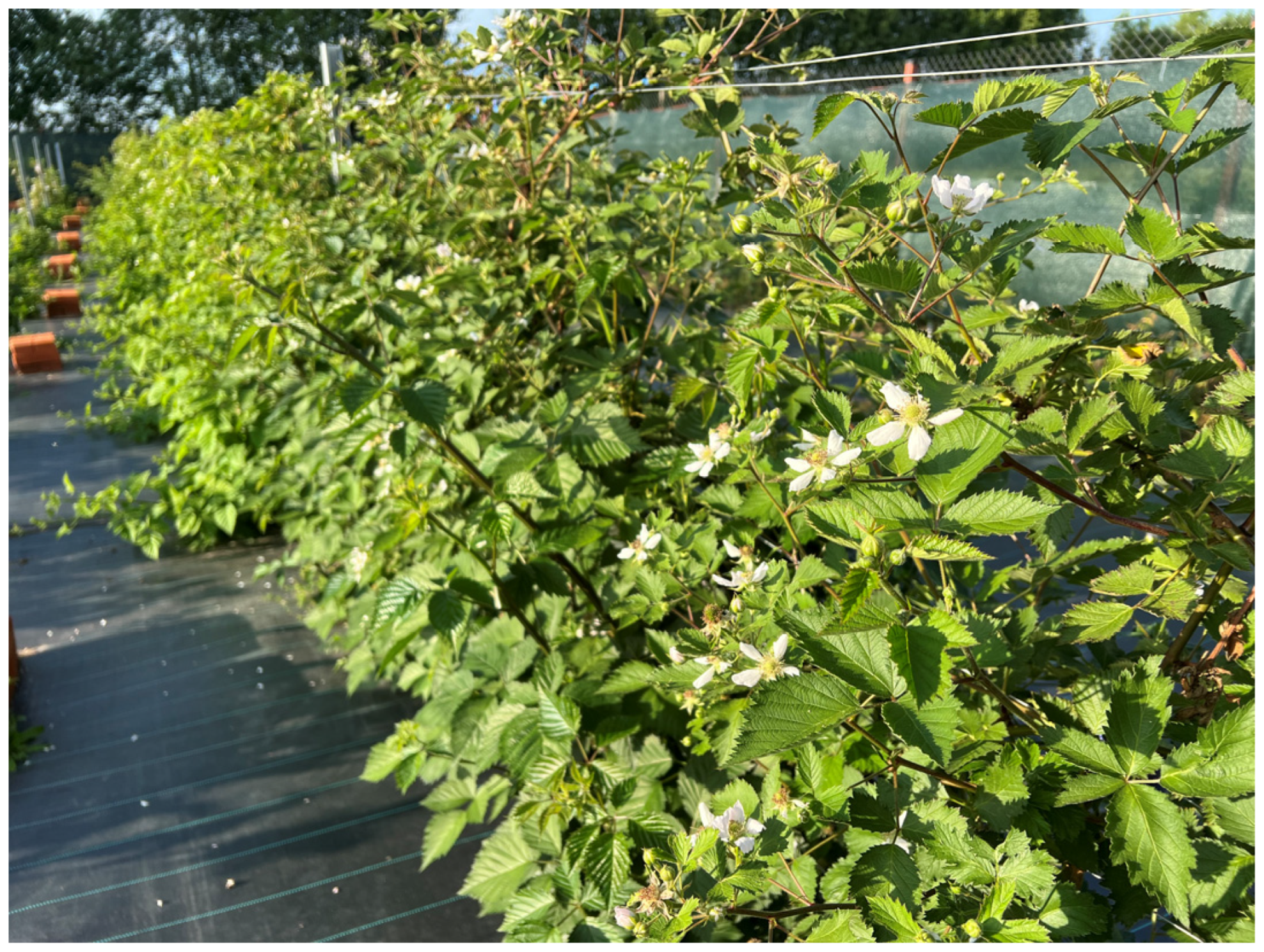
- Early-ripening: ‘Karaka Black’, ‘Loch Tay’, and ‘Natchez’;
- Medium-ripening: ‘Columbia Sunrise’, ‘Hall’s Beauty’, ‘Caddo’, ‘Columbia Giant’, ‘Victoria’ and ‘Brzezina’.
3.2. Morphological Traits of Blackberry Cultivars
- (i)
- Yield component traits, used to assess cultivar productivity—namely, number of first-year canes per plant, first-year cane length, number of fruiting laterals per first-year cane, number of berries per lateral, and lateral length;
- (ii)
- Discriminatory (diagnostic) traits, employed for cultivar distinction—including length and width of the central leaflet, predominant number of leaflets per compound leaf, petiole length, and flower diameter [24].
3.3. Evaluation of Blackberry Productivity Parameters
3.4. Correlations Among Phenological, Morphological, and Agronomically Important Traits in Blackberry Cultivars
- −
- A shorter flowering duration is associated with a higher drupelet number per fruit, a trait linked to improved fruit appearance (r = −0.83);
- −
- Later fruiting onset correlates with longer laterals (r = 0.75), a characteristic typically associated with enhanced yield potential;
- −
- Shorter central leaflet length is associated with a greater number of fruiting laterals per first-year cane (r = −0.86);
- −
- Higher fruit number per lateral correlates positively with both soluble solids content (SSC, r = 0.83) and lateral length (r = 0.84).
4. Discussion
5. Conclusions
- −
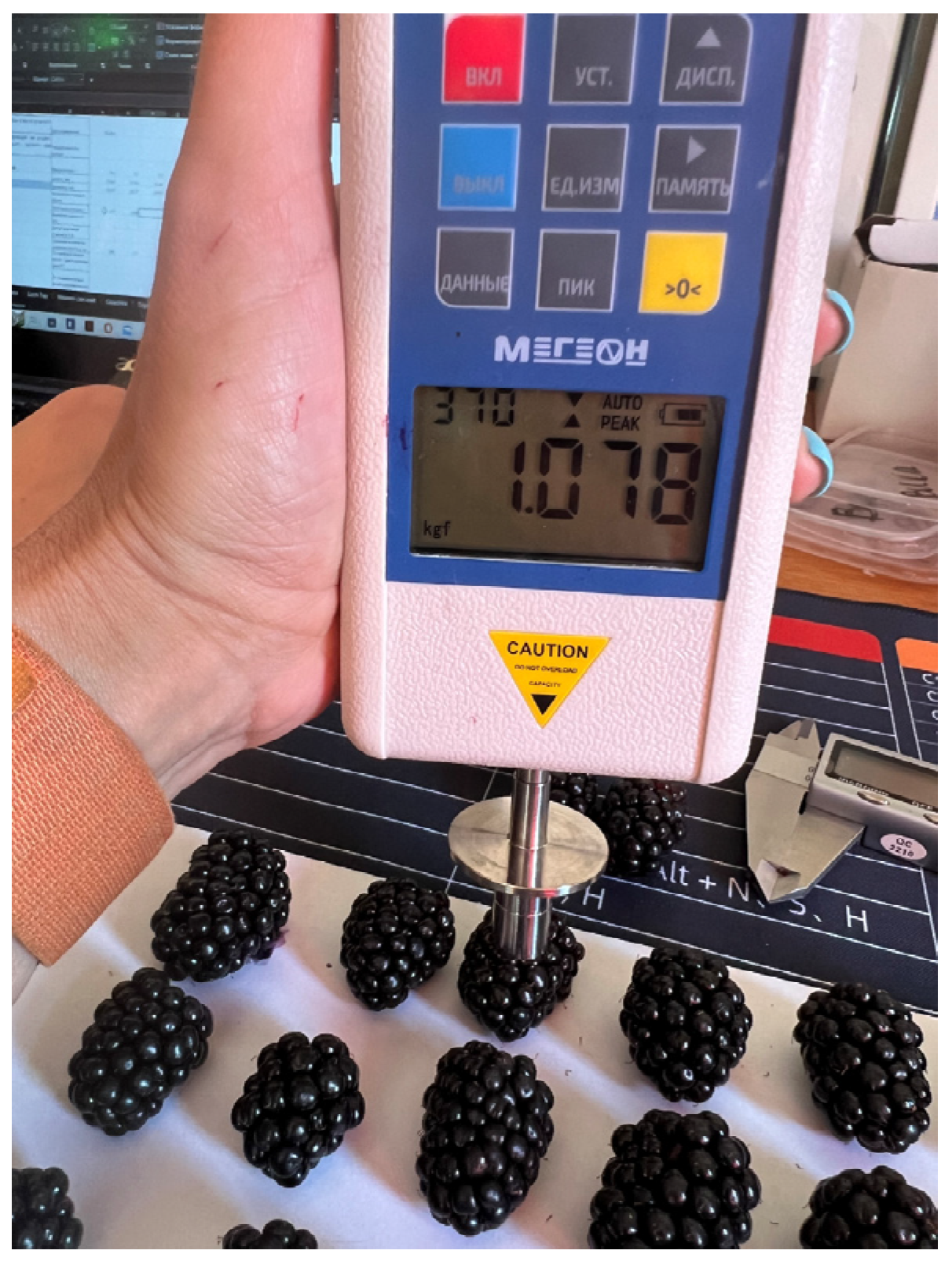
- ‘Hall’s Beauty’ (650.3 gf), ‘Loch Tay’ (632.2 gf), and ‘Victoria’ (882.2 gf) exhibited high fruit firmness, supporting their suitability for retail supply chains;
- −
- ‘Brzezina’ (416.1 gf), ‘Columbia Giant’ (354.1 gf), ‘Karaka Black’ (566.1 gf), and ‘Natchez’ (422.2 gf) showed intermediate firmness, aligning with requirements for direct-to-consumer markets;
- −
- ‘Columbia Giant’ (11.5 g) and ‘Karaka Black’ (11.2 g) exhibited the largest fruit mass, identifying them as valuable donors for large-fruit breeding;
- −
- ‘Victoria’ (882.2 gf) emerged as the premier source of high fruit firmness.
- −
- Shorter flowering duration was linked to higher drupelet number per fruit (r = −0.83), a trait associated with improved fruit appearance;
- −
- Later fruiting onset correlated with longer laterals (r = 0.75), a characteristic generally favorable for yield;
- −
- Shorter central leaflet length was associated with greater numbers of fruiting laterals (r = −0.86);
- −
- Higher fruit number per lateral correlated positively with both soluble solids content (r = 0.83) and lateral length (r = 0.84).
Author Contributions
Funding
Institutional Review Board Statement
Informed Consent Statement
Data Availability Statement
Acknowledgments
Conflicts of Interest
Appendix A

| Bud Formation Period, Date | Flowering Onset, Date | Flowering Completion, Date | Flowering Duration, Days | Fruiting Onset, Date | Fruiting Completion, Date | Fruiting Duration, Days | Number of First-Year Canes per Plant, pcs | Shoots Length, cm | Number of Fruiting Laterals per Shoot, pcs | Fruit Number per Lateral, pcs | Lateral Length, cm | Central Leaflet Length, cm | Central Leaflet Width, cm | Petiole Length, cm | Flower Diameter, cm | Yield, kg·per Plant | Fruit Mass, g | Fruit Length, mm | Fruit Diameter, mm | Soluble Solids Content,% | Fruit Firmness, gf | Drupelet Number per Fruit | |
|---|---|---|---|---|---|---|---|---|---|---|---|---|---|---|---|---|---|---|---|---|---|---|---|
| Bud formation period. date | 1.00 | 0.54 | −0.65 | −0.21 | 0.07 | 0.23 | 0.38 | 0.52 | 0.25 | 0.44 | −0.22 | −0.03 | −0.24 | 0.31 | 0.13 | −0.25 | −0.55 | −0.17 | −0.06 | 0.16 | −0.08 | 0.16 | 0.23 |
| Flowering onset. date | 1.00 | −0.36 | 0.07 | 0.34 | 0.34 | 0.29 | 0.41 | 0.51 | 0.07 | 0.43 | 0.38 | 0.04 | 0.24 | 0.12 | −0.61 | −0.05 | −0.37 | −0.07 | 0.27 | 0.47 | 0.44 | −0.14 | |
| Flowering completion. date | 1.00 | 0.14 | 0.11 | −0.38 | −0.75 | −0.63 | −0.66 | −0.18 | 0.36 | 0.46 | −0.14 | −0.32 | −0.50 | 0.04 | 0.22 | 0.10 | −0.04 | 0.06 | 0.16 | 0.27 | −0.48 | ||
| Flowering duration. days | 1.00 | 0.65 | 0.58 | 0.05 | −0.46 | 0.02 | −0.67 | 0.30 | 0.22 | 0.50 | 0.26 | −0.22 | 0.43 | 0.08 | −0.42 | −0.32 | −0.25 | 0.40 | 0.01 | −0.83 | |||
| Fruiting onset. date | 1.00 | 0.61 | −0.21 | −0.17 | −0.15 | −0.46 | 0.64 | 0.75 | 0.20 | −0.14 | −0.22 | −0.18 | 0.04 | −0.42 | −0.25 | 0.08 | 0.57 | 0.07 | −0.61 | ||||
| Fruiting completion. date | 1.00 | 0.57 | 0.20 | 0.12 | −0.29 | 0.13 | 0.02 | 0.22 | 0.01 | 0.01 | 0.17 | −0.08 | −0.53 | −0.12 | −0.33 | 0.17 | −0.42 | −0.17 | |||||
| Fruiting duration. days | 1.00 | 0.49 | 0.55 | 0.06 | −0.46 | −0.64 | 0.14 | 0.33 | 0.26 | 0.15 | −0.29 | −0.21 | 0.19 | −0.23 | −0.39 | −0.42 | 0.35 | ||||||
| Number of first-year canes per plant. pcs | 1.00 | 0.38 | 0.48 | −0.12 | −0.18 | −0.41 | −0.36 | −0.06 | −0.37 | −0.38 | −0.35 | −0.15 | −0.33 | −0.16 | 0.09 | 0.56 | |||||||
| Shoots length. cm | 1.00 | 0.14 | 0.11 | −0.24 | 0.12 | 0.39 | 0.31 | −0.28 | 0.17 | −0.32 | −0.21 | 0.04 | 0.18 | 0.05 | 0.12 | ||||||||
| Number of fruiting laterals per shoot. pcs | 1.00 | −0.06 | −0.16 | −0.86 | −0.24 | −0.13 | −0.31 | −0.09 | −0.24 | −0.33 | −0.11 | −0.13 | 0.02 | 0.59 | |||||||||
| Fruit number per lateral. pcs | 1.00 | 0.84 | −0.15 | −0.35 | −0.27 | −0.55 | 0.50 | −0.51 | −0.48 | 0.11 | 0.83 | 0.32 | −0.46 | ||||||||||
| Lateral length. cm | 1.00 | −0.14 | −0.31 | −0.36 | −0.59 | 0.12 | −0.26 | −0.24 | 0.35 | 0.62 | 0.48 | −0.54 | |||||||||||
| Central leaflet length. cm | 1.00 | 0.56 | 0.58 | 0.38 | 0.24 | 0.43 | 0.44 | 0.22 | 0.15 | −0.10 | −0.32 | ||||||||||||
| Central leaflet width. cm | 1.00 | 0.53 | 0.22 | −0.05 | 0.32 | 0.31 | 0.45 | −0.06 | 0.04 | −0.20 | |||||||||||||
| Petiole length. cm | 1.00 | 0.06 | 0.43 | 0.57 | 0.50 | 0.43 | 0.06 | −0.36 | 0.43 | ||||||||||||||
| Flower diameter. cm | 1.00 | −0.01 | 0.12 | −0.05 | −0.54 | −0.22 | −0.36 | −0.15 | |||||||||||||||
| Yield. kg·per plant | 1.00 | 0.04 | −0.13 | 0.08 | 0.62 | −0.23 | 0.01 | ||||||||||||||||
| Fruit mass. g | 1.00 | 0.81 | 0.57 | −0.41 | −0.12 | 0.31 | |||||||||||||||||
| Fruit length. mm | 1.00 | 0.59 | −0.53 | −0.25 | 0.32 | ||||||||||||||||||
| Fruit diameter. mm | 1.00 | 0.01 | 0.14 | 0.01 | |||||||||||||||||||
| Soluble solids content. % | 1.00 | 0.35 | −0.48 | ||||||||||||||||||||
| Fruit firmness. gf | 1.00 | −0.47 | |||||||||||||||||||||
| Drupelet number per fruit | 1.00 | ||||||||||||||||||||||
| 0.76–1.00 | 0–−0.25 | ||||||||||||||||||||||
| 0.51–0.75 | −0.26–−0.50 | ||||||||||||||||||||||
| 0.26–0.50 | −0.51–−0.75 | ||||||||||||||||||||||
| 0–0.25 | −0.76–−1.00 | ||||||||||||||||||||||
References
- Nava-Delgado, J.; Solano-Báez, A.R.; Kolařík, M.; Leyva-Mir, S.G.; Beltran-Peña, H.; Márquez-Licona, G. Detection of Colletotrichum godetiae Causing Leaf Anthracnose on Blackberry in Mexico. J. Phytopathol. 2025, 173, e70151. [Google Scholar] [CrossRef]
- Dogan, H.; Aglar, E.; Ozturk, B.; Tekin, O.; Alan, D.; Sumbul, A. Pomological and Biochemical Properties of Blackberry (Rubus fruticosus) Genotypes. Food Sci. Nutr. 2025, 13, e70591. [Google Scholar] [CrossRef] [PubMed]
- Maslovatiy, T. Movable Trellis for Blackberries: US Experience and Implementation in Ukraine. Veg. Fruits 2016, 3, 98–101. [Google Scholar]
- Savina, O.; Glyudzyk-Shemota, M.; Popovych, G.; Sheydyk, K. Agrobiological Features of Blackberry Yield Formation. Plant Sci. (Hortic. Vitic. Seed Prod.) 2024, 3, 53–58. [Google Scholar] [CrossRef]
- Ladyzhenskaya, O.; Aniskina, T.; Kryuchkova, V.; Simakhin, M. Comparison of Fruit Parameters and Elemental Composition of Commercial Varieties of Blackberries. Agronomy 2023, 13, 2628. [Google Scholar] [CrossRef]
- Daguzhieva, Z.S.; Kovalenko, V.A. Blackberry Cultivation Practices under the Agroclimatic Conditions of the Republic of Adygea. Curr. Issues Sci. Educ. 2024, 1, 31–34. [Google Scholar]
- Ladyzhenskaya, O.V.; Simakhin, M.V. Prospects for Establishing a Blackberry (Rubus L. subgenus Rubus Watson) Collection in the Tsitsin Main Botanical Garden MBG RAS. Bull. Landsc. Archit. 2023, 35, 39–41. [Google Scholar]
- Ladyzhenskaya, O.V.; Donskikh, V.G.; Pashutin, V.R. Cane Winter Hardiness Assessment in Modern Blackberry Cultivars under Different Winter Protection Methods. Bull. Landsc. Archit. 2024, 39, 40–42. [Google Scholar]
- Ladyzhenskaya, O.V.; Letunovsky, S.S.; Aniskina, T.S.; Kryuchkova, V.A.; Simakhin, M.V. Comparison of Modern Raspberry Varieties Long Cane. Agric. Sci. 2024, 383, 100–105. [Google Scholar] [CrossRef]
- Dickson, R. Update: Growing Rubus Crops in Containers and Substrate. e-GRO Edibles Alert 2023, 8, 1. [Google Scholar]
- Pérez, P.; de los Campos, G. Genome-Wide Regression and Prediction with the BGLR Statistical Package. Genetics 2014, 198, 483–495. [Google Scholar] [CrossRef]
- Mathey, M.M.; Mookerjee, S.; Mahoney, L.L.; Gündüz, K.; Rosyara, U.; Hancock, J.F.; Stewart, P.J.; Whitaker, V.M.; Bassil, N.V.; Davis, T.M.; et al. Genotype by Environment Interactions and Combining Ability for Strawberry Families Grown in Diverse Environments. Euphytica 2017, 213, 112. [Google Scholar] [CrossRef]
- Hardigan, M.A.; Finn, C.E.; Jones, P.A.; Strik, B.C.; Peterson, M.E.; Bassil, N.V.; King, R.M.; Wiegand, Z.J.; Olaya, C.; Martin, R.R.; et al. ‘Thunderhead’ Erect First Year Cane Fruiting Blackberry. HortScience 2025, 60, 1366–1371. [Google Scholar] [CrossRef]
- Finn, C.E.; Strik, B.C.; Yorgey, B.M.; Peterson, M.E.; Jones, P.A.; Buller, G.; Lee, J.; Bassil, N.V.; Martin, R.R. ‘Galaxy’ Thornless Semierect Blackberry. HortScience 2020, 55, 967–971. [Google Scholar] [CrossRef]
- Edgley, M.; Close, D.C.; Measham, P.F. Red Drupelet Reversion in Blackberries: A Complex of Genetic and Environmental Factors. Sci. Hortic. 2020, 272, 109555. [Google Scholar] [CrossRef]
- Edgley, M.; Close, D.C.; Measham, P.F. Flesh Temperature during Impact Injury and Subsequent Storage Conditions Affect the Severity of Colour Change Caused by Red Drupelet Reversion in Blackberries. Acta Hortic. 2019, 1265, 129–134. [Google Scholar] [CrossRef]
- Gruner, L.A.; Kornilov, B.B. Breeding Priorities and Future Prospects for Blackberry (Rubus spp.) in the Central Region of Russia. Vavilov J. Genet. Breed. 2020, 24, 489–500. [Google Scholar] [CrossRef] [PubMed]
- USDA Plant Hardiness Zone Map; The United States National Arboretum: Washington, DC, USA, 1990.
- Isaeva, A.A. Handbook of Ecological and Climatic Characteristics of Moscow (Based on Observations from the Meteorological Observatory of Moscow State University Named After M.V. Lomonosov); Solar Radiation, Sunshine, Meteorological Elements and Phenomena. Characteristics of the Atmospheric Boundary Layer; Department of Natural Resources and Environmental Protection of the Moscow City Government, Ed.; Moscow University Press: Moscow, Russia, 2003; Volume 1, p. 304. ISBN 5-89575-059-1. [Google Scholar]
- Sedov, E.N. Program and Methodology for Cultivar Evaluation of Fruit, Berry, and Nut Crops; Russian Academy of Agricultural Sciences, All-Russian Research Institute of Fruit Crop Breeding (VNIISPK); Sedov, E.N., Ogoltsovoy, T.P., Eds.; VNIISPK: Orel, Russia, 1999; p. 606. ISBN 5-900705-15-3. [Google Scholar]
- Telepenko, Y.Y. Frost Resistance of Blackberry Cultivars (Rubus subg. Eubatus Focke) in the Conditions of the Western Forest-Steppe of Ukraine. Plant Var. Stud. Prot. 2018, 14, 124–131. [Google Scholar] [CrossRef]
- Arabova, N.Z. Morphobiology of Some Plants with Rhizomes. Bull. Sci. Educ. 2022, 7, 13–15. [Google Scholar]
- Zaman, W. Morphology, Palynology and Phytochemicals of Medicinal Plants. Horticulturae 2024, 10, 202. [Google Scholar] [CrossRef]
- Gruner, L.A. Blackberry. In Pomology: In 5 Volumes; Sedov, E.N., Gryuner, L.A., Eds.; VNIISPK: Orel, Russia, 2014; Volume 5, pp. 300–306. [Google Scholar]
- Okan, O.T.; Deniz, I.; Yayli, N.; Şat, I.G.; Öz, M.; Hatipoğlu Serdar, G. Antioxidant Activity, Sugar Content and Phenolic Profiling of Blueberry Cultivars: A Comprehensive Study. Not. Bot. Horti Agrobot. Cluj 2018, 46, 639–652. [Google Scholar] [CrossRef]
- Akšić, M.F.; Tosti, T.; Sredojević, M.; Milivojević, J.; Meland, M.; Natić, M. Comparison of Sugar Profile between Leaves and Fruits of Blueberry and Strawberry Cultivars Grown in Organic and Integrated Production System. Plants 2019, 8, 205. [Google Scholar] [CrossRef]
- Garazhian, M.; Gharaghani, A.; Eshghi, S. Genetic Diversity and Inter-Relationships of Fruit Biochemicals and Antioxidant Activity in Iranian Wild Blackberry Species. Sci. Rep. 2020, 10, 18983. [Google Scholar] [CrossRef] [PubMed]
- Ladyzhenskaya, O.V.; Aniskina, T.S.; Kryuchkova, V.A. Prospects for Cultivating ‘Karaka Black’ Blackberry in Russia. AgroEcoInfo 2022, 4, 15. [Google Scholar] [CrossRef]
- Telepenko, Y.Y. Comparative Assessment of Drought Resistance of Blackberry Varieties (Rubus L.) in the Western Forest-Steppe of Ukraine. Sci. Prog. Innov. 2018, 1, 78–82. [Google Scholar] [CrossRef]
- Chenier, J.; Myers, A.; Threlfall, R.; Howard, L.; Brownmiller, C.; Clark, J.R.; Worthington, M.; Lafontaine, S. Impact of Harvest Date on Size, Composition, and Volatiles of Arkansas Fresh-Market Blackberries. Acta Hortic. 2024, 1388, 263–270. [Google Scholar] [CrossRef]
- Mikulic-Petkovsek, M.; Veberic, R.; Hudina, M.; Zorenc, Z.; Koron, D.; Senica, M. Fruit Quality Characteristics and Biochemical Composition of Fully Ripe Blackberries Harvested at Different Times. Foods 2021, 10, 1581. [Google Scholar] [CrossRef]
- Finn, C.E.; Strik, B.C.; Yorgey, B.M.; Peterson, M.E.; Jones, P.A.; Lee, J.; Martin, R.R. ‘Columbia Giant’ Thornless Trailing Blackberry. HortScience 2018, 53, 251–255. [Google Scholar] [CrossRef]
- Finn, C.E.; Strik, B.C.; Yorgey, B.M.; Peterson, M.E.; Lee, J.; Martin, R.R.; Hall, H.K. ‘Columbia Star’ Thornless Trailing Blackberry. HortScience 2014, 49, 1108–1112. [Google Scholar] [CrossRef]
- Lewers, K.S.; Wang, S.Y.; Vinyard, B.T. Evaluation of Blackberry Cultivars and Breeding Selections for Fruit Quality Traits and Flowering and Fruiting Dates. Crop Sci. 2010, 50, 2475–2491. [Google Scholar] [CrossRef]
- Milosevic, T.; Mratinic, E.; Milosevic, N.; Glisic, I.; Mladenovic, J. Segregation of Blackberry Cultivars Based on the Fruit Physico-Chemical Attributes. J. Agric. Sci. 2012, 18, 100–109. [Google Scholar]
- Milošević, T.; Milošević, N.; Glišić, I.; Mladenović, J. Fruit Quality Attributes of Blackberry Grown under Limited Environmental Conditions. Plant Soil Environ. 2012, 58, 322–327. [Google Scholar] [CrossRef]
- Orzeł, A.; Król-Dyrek, K.; Kostecka-Gugała, A.; Bieniasz, M.; Augustynowicz, J.; Wyżgolik, G. Evaluation of Vegetative Growth and Fruit Chemistry of Some Raspberry and Blackberry Cultivars Grown in Southern Poland. Acta Hortic. 2015, 1133, 371–378. [Google Scholar] [CrossRef]
- Pavlis, G.C. Blueberry Fruit Quality and Yield as Affected by Fertilization. Acta Hortic. 2006, 715, 353–356. [Google Scholar] [CrossRef]
- McCoy, J.E.; Clarke, J.R.; Salgado, A.A.; Jecmen, A. Evaluation of Harvest Time/Temperature and Storage Temperature on Postharvest Incidence of Red Drupelet Reversion Development and Firmness of Blackberry (Rubus L. subgenus Rubus Watson). Discov. Stud. J. Dale Bump. Coll. Agric. Food Life Sci. 2016, 17, 59–65. [Google Scholar]
- Clark, J.R.; Stafne, E.T.; Hall, H.K.; Finn, C.E. Blackberry Breeding and Genetics. Plant Breed. Rev. 2007, 29, 19–94. [Google Scholar]
- Clark, J.R.; Finn, C.E. New Trends in Blackberry Breeding. Acta Hortic. 2005, 777, 41–48. [Google Scholar] [CrossRef]
- Kornilov, B.; Gruner, L. Prospects for primocane-fruiting Blackberry breeding in the Central part of Russia and the model of the ideal cultivar (review). Contemp. Hortic. 2024. [Google Scholar] [CrossRef]
- Danek, J.; Orzeł, A. Evaluation of the Breeding Value of Selected Blackberry Genotypes. J. Fruit Ornam. Plant Res. 2004, 12, 29–33. [Google Scholar]
- Finn, C.E.; Strik, B.C.; Yorgey, B.M.; Peterson, M.E.; Jones, P.A.; Lee, J.; Bassil, N.V.; Martin, R.R. ‘Hall’s Beauty’ Thornless Trailing Blackberry. HortScience 2019, 54, 371–376. [Google Scholar] [CrossRef]

| Cultivar | Bud Formation Period, Date | Flowering Onset, Date | Flowering Completion, Date | Flowering Duration, Days | Fruiting Onset, Date | Fruiting Completion, Date | Fruiting Duration, Days |
|---|---|---|---|---|---|---|---|
| ‘Brzezina’ | 01.06–08.06 | 14.06–20.06 | 15.07–20.07 | 30–33 | 10.08–15.08 | 15.09–20.09 | 33–35 |
| ‘Caddo’ | 22.05–28.05 | 04.06–06.06 | 20.07–22.07 | 46–47 | 16.08–20.08 | 05.09–10.09 | 18–26 |
| ‘Columbia Giant’ | 29.05–02.06 | 10.06–15.06 | 08.07–08.07 | 23–28 | 27.07–29.07 | 28.08–02.09 | 28–37 |
| ‘Columbia Star’ | 02.06–02.06 | 12.06–15.06 | 10.07–12.07 | 27–28 | 19.07–23.07 | 05.09–09.09 | 44–51 |
| ‘Columbia Sunrise’ | 02.06–02.06 | 06.06–11.06 | 01.07–02.07 | 20–25 | 21.07–25.07 | 22.08–28.08 | 31–35 |
| ‘Hall’s Beauty’ | 31.05–04.06 | 11.06–13.06 | 13.07–15.07 | 32–34 | 21.07–26.07 | 26.08–31.08 | 31–41 |
| ‘Karaka Black’ | 24.05–31.05 | 02.06–05.06 | 25.06–27.06 | 20–25 | 25.07–28.07 | 12.08–17.08 | 15–23 |
| ‘Loch Tay’ | 27.05–01.06 | 08.06–10.06 | 27.06–30.06 | 18–21 | 19.07–22.07 | 15.08–17.08 | 24–29 |
| ‘Natchez’ (c) | 31.05–04.06 | 06.06–10.06 | 24.06–29.06 | 18–21 | 23.07–25.07 | 13.08–21.08 | 21–28 |
| ‘Victoria’ | 11.06–15.06 | 20.06–25.06 | 17.07–22.07 | 22–28 | 05.08–10.08 | 28.08–03.09 | 22–29 |
| Cultivar | Number of First-Year Canes per Plant, pcs | Cane Length, cm | Number of Laterals per First-Year Cane, pcs | Fruits Number per Lateral, pcs | Lateral Length, cm | Central Leaflet Length, cm | Central Leaflet Width, cm | Petiole Length, cm | Flower Diameter, cm |
|---|---|---|---|---|---|---|---|---|---|
| ‘Brzezina’ | 4.8 ± 1.4 c | 312 ± 55 c | 11.2 ± 3.3 a | 10.1 ± 3.1 d | 30.5 ± 4.8 c | 12.2 ± 1.4 cd | 8.8 ± 2.0 b | 5.9 ± 1.7 b | 3.2 ± 0.6 a |
| ‘Caddo’ | 3.9 ± 1.3 b | 202 ± 33 a | 12.3 ± 3.2 ab | 8.1 ± 2.2 c | 26.2 ± 4.1 bc | 10.9 ± 3.2 c | 7.7 ± 1.5 b | 6.1 ± 2.0 b | 4.6 ± 1.3 bc |
| ‘Columbia Giant’ | 5.8 ± 1.7 d | 301 ± 47 c | 15.2 ± 3.7 b | 5.8 ± 0.7 a | 10.9 ± 3.2 a | 18.1 ± 4.5 e | 13.4 ± 3.0 c | 12.3 ± 3.5 c | 4.2 ± 0.8 b |
| ‘Columbia Star’ | 6.7 ± 1.8 e | 290 ± 53 c | 15.9 ± 4.4 b | 6.1 ± 1.5 a | 13.1 ± 3.3 a | 7.2 ± 1.6 a | 5.8 ± 1.6 a | 4.6 ± 1.9 a | 4.2 ± 1.2 b |
| ‘Columbia Sunrise’ | 7.7 ± 2.1 e | 310 ± 89 c | 18.5 ± 6.5 d | 6.5 ± 1.7 b | 15.1 ± 3.2 ab | 8.7 ± 2.3 b | 6.1 ± 1.9 a | 4.3 ± 1.4 a | 4.1 ± 1.3 b |
| ‘Hall’s Beauty’ | 5.7 ± 1.5 d | 302 ± 66 c | 15.2 ± 4.9 b | 6.6 ± 1.4 b | 12.3 ± 2.4 a | 12.8 ± 5.9 d | 11.1 ± 2.7 c | 4.3 ± 1.1 a | 5.1 ± 1.3 c |
| ‘Karaka Black’ | 4.7 ± 1.2 c | 236 ± 84 b | 9.7 ± 1.1 a | 6.4 ± 1.8 ab | 19.7 ± 2.2 b | 11.8 ± 2.8 c | 7.2 ± 1.7 b | 5.8 ± 1.1 b | 3.7 ± 0.9 b |
| ‘Loch Tay’ | 5.4 ± 1.3 c | 300 ± 88 c | 16.3 ± 3.7 bc | 12.5 ± 3.2 d | 22.8 ± 5.9 b | 9.1 ± 2.6 b | 6.2 ± 1.4 a | 4.8 ± 1.2 ab | 2.7 ± 0.3 a |
| ‘Natchez’ (c) | 2.5 ± 0.8 a | 189 ± 26 a | 18.5 ± 5.5 d | 6.4 ± 1.5 ab | 19.3 ± 3.2 b | 8.3 ± 2.5 ab | 7.9 ± 1.8 b | 5.5 ± 1.5 b | 3.8 ± 1.0 b |
| ‘Victoria’ | 6.3 ± 2.1 d | 344 ± 69 d | 18.6 ± 3.4 d | 8.5 ± 2.2 c | 37.1 ± 9.9 d | 7.1 ± 2.0 a | 5.3 ± 1.4 a | 4.7 ± 1.5 ab | 3.3 ± 0.5 ab |
| Cultivar | Yield per Plant, kg | Fruit Mass, g | Length, mm | Diameter, mm | Soluble Solids Content, % | Fruit Firmness, gf | Number of Drupelets per Fruit |
|---|---|---|---|---|---|---|---|
| ‘Brzezina’ | 2.2 ± 0.1 ab | 7.2 ± 0.7 c | 30.0 ± 2.0 b | 22.3 ± 2.0 c | 11.3 ± 0.6 bc | 416.1 ± 81.2 b | 100.4 ± 35.3 a |
| ‘Caddo’ | 2.4 ± 0.2 b | 6.5 ± 0.7 b | 25.5 ± 4.3 a | 17.2 ± 4.3 a | 13.0 ± 1.1 c | 313.8 ± 80.4 a | 100.7 ± 13.8 a |
| ‘Columbia Giant’ | 2.6 ± 0.1 c | 11.5 ± 0.9 d | 40.3 ± 0.9 c | 22.4 ± 4.2 c | 10.2 ± 0.8 b | 354.1 ± 42.3 ab | 219.2 ± 33.1 c |
| ‘Columbia Star’ | 2.0 ± 0.2 a | 5.2 ± 0.6 a | 29.9 ± 0.6 b | 17.5 ± 2.0 a | 8.8 ± 0.8 a | 286.5 ± 41.7 a | 199.5 ± 24.6 bc |
| ‘Columbia Sunrise’ | 2.3 ± 0.2 b | 5.9 ± 0.6 a | 29.0 ± 2.0 b | 18.3 ± 2.0 ab | 9.4 ± 0.5 ab | 286.4 ± 40.2 a | 224.4 ± 23.9 c |
| ‘Hall’s Beauty’ | 2.2 ± 0.2 ab | 6.2 ± 1.0 b | 24.0 ± 2.1 a | 17.1 ± 2.1 a | 10.0 ± 0.6 b | 650.3 ± 60.1 c | 86.8 ± 8.0 a |
| ‘Karaka Black’ | 2.0 ± 0.2 a | 11.2 ± 1.6 d | 41.0 ± 4.1 c | 19.2 ± 4.1 b | 9.0 ± 0.7 a | 566.1 ± 65.2 bc | 164.0 ± 18.9 b |
| ‘Loch Tay’ | 3.3 ± 0.2 d | 5.4 ± 1.0 a | 24.5 ± 2.6 a | 21.7 ± 2.6 bc | 11.4 ± 1.0 bc | 632.2 ± 68.4 c | 103.8 ± 11.0 a |
| ‘Natchez’ (c) | 2.3 ± 0.1 b | 8.8 ± 1.5 c | 31.6 ± 2.7 b | 22.1 ± 2.2 c | 8.5 ± 0.9 a | 422.2 ± 110.2 b | 166.5 ± 28.8 b |
| ‘Victoria’ | 2.4 ± 0.2 b | 6.2 ± 0.7 b | 27.2 ± 2.0 ab | 20.9 ± 2.0 b | 12.3 ± 0.6 c | 882.2 ± 105.2 d | 168.4 ± 35.3 b |
Disclaimer/Publisher’s Note: The statements, opinions and data contained in all publications are solely those of the individual author(s) and contributor(s) and not of MDPI and/or the editor(s). MDPI and/or the editor(s) disclaim responsibility for any injury to people or property resulting from any ideas, methods, instructions or products referred to in the content. |
© 2025 by the authors. Licensee MDPI, Basel, Switzerland. This article is an open access article distributed under the terms and conditions of the Creative Commons Attribution (CC BY) license (https://creativecommons.org/licenses/by/4.0/).
Share and Cite
Ladyzhenskaya, O.; Simakhin, M.; Donskih, V.; Pashutin, V.; Glinyuk, T.; Kryuchkova, V. Relations Among Agronomic Traits of Commercial Blackberry (Rubus subg. Eubatus Focke) Cultivars Under the Climatic Conditions of the Moscow Region. Agronomy 2025, 15, 2774. https://doi.org/10.3390/agronomy15122774
Ladyzhenskaya O, Simakhin M, Donskih V, Pashutin V, Glinyuk T, Kryuchkova V. Relations Among Agronomic Traits of Commercial Blackberry (Rubus subg. Eubatus Focke) Cultivars Under the Climatic Conditions of the Moscow Region. Agronomy. 2025; 15(12):2774. https://doi.org/10.3390/agronomy15122774
Chicago/Turabian StyleLadyzhenskaya, Olga, Maxim Simakhin, Vitaliy Donskih, Vladimir Pashutin, Taisiya Glinyuk, and Viktoria Kryuchkova. 2025. "Relations Among Agronomic Traits of Commercial Blackberry (Rubus subg. Eubatus Focke) Cultivars Under the Climatic Conditions of the Moscow Region" Agronomy 15, no. 12: 2774. https://doi.org/10.3390/agronomy15122774
APA StyleLadyzhenskaya, O., Simakhin, M., Donskih, V., Pashutin, V., Glinyuk, T., & Kryuchkova, V. (2025). Relations Among Agronomic Traits of Commercial Blackberry (Rubus subg. Eubatus Focke) Cultivars Under the Climatic Conditions of the Moscow Region. Agronomy, 15(12), 2774. https://doi.org/10.3390/agronomy15122774