You are currently viewing a new version of our website. To view the old version click .
Agronomy
  • Article
  • Open Access

30 November 2025

National-Scale Assessment of Soil pH Change in Chinese Croplands from 1980 to 2018

,
,
,
,
,
and
1
State Key Laboratory of Nutrient Use and Management, College of Resources and Environmental Sciences, National Academy of Agriculture Green Development, China Agricultural University, Beijing 100193, China
2
Cultivated Land Quality Monitoring and Protection Center, Ministry of Agriculture and Rural Affairs, Beijing 100125, China
*
Authors to whom correspondence should be addressed.
Agronomy2025, 15(12), 2775;https://doi.org/10.3390/agronomy15122775 
(registering DOI)
This article belongs to the Section Soil and Plant Nutrition

Abstract

Soil acid–base status fundamentally regulates biogeochemical cycling and agroecosystem resilience by controlling nutrient solubility, cation exchange, and redox equilibria. However, the long-term evolution of soil pH and its spatial divergence under intensive agricultural expansion remain poorly quantified. Herein, we integrate three nationwide soil surveys (1980, 2012, 2018) encompassing over 190,000 cropland observations into a harmonized 1 km dataset to reconstruct four decades of soil pH change across China. National mean soil pH declined from 7.1 in 1980 to 6.7 in 2012 and 6.6 in 2018, revealing a sustained acidification trend. Nearly one quarter of neutral soils (pH 6.5–7.5) have shifted into acidic classes (<6.5) since 1980, reflecting widespread depletion of soil buffering capacity under intensive fertilization, high rainfall, and carbonate exhaustion. By integrating current pH conditions with standardized pH change rate, we delineate nine bidirectional soil pH risk zones that capture contrasting acidification and alkalization processes along climatic and edaphic gradients. Acidification-prone zones dominate humid southern croplands, whereas alkalization risk prevails in arid northern regions. Our results provide nationally consistent, grid-level evidence of soil acid–base evolution across nearly four decades, offering a quantitative foundation for region-specific soil management to sustain productivity and mitigate environmental risks.

1. Introduction

Soil pH is a fundamental regulator of terrestrial ecosystem functioning, controlling nutrient solubility, microbial activity, and metal mobility, and thereby serving as a primary determinant of soil fertility, crop productivity, and environmental quality [,]. Even small deviations in acidity or alkalinity can disrupt nutrient balance, reduce crop productivity, and mobilize toxic metals, with cascading consequences on food security and ecosystem health [,]. Shifts in soil pH are increasingly recognized as a pervasive form of soil degradation, accelerating the loss of nutrients and base cations, constraining microbial and enzymatic activities, and amplifying greenhouse gas emissions from agricultural soils []. Globally, agricultural intensification, excessive nitrogen fertilizer inputs, and atmospheric acid deposition have collectively enhanced soil acidification, particularly in regions with inherently weak buffering capacity and intensive double-cropping systems, posing urgent challenges for sustainable land and nutrient management []. However, the long-term trajectories and regional contrasts of soil pH change remain poorly quantified, limiting our capacity to identify consistent patterns and to develop region-specific management strategies.
China is among the regions most vulnerable to soil acid–base change, reflecting decades of intensive fertilizer application, rapid agricultural expansion, and widespread acid deposition [,]. Pronounced acidification has occurred in humid southern croplands, especially in red soils and rice-based systems with high nitrogen inputs, frequent flooding–drainage cycles, and inherently low buffering capacity, leading to progressive depletion of base cations and carbonate reserves. In contrast, northern regions with arid and saline–alkaline soils exhibit an opposite trend toward alkalization, driven by strong evaporation, irrigation practices, and reduced acid inputs []. These opposing trajectories reveal a spatial duality in the biogeochemical functioning of Chinese croplands, where acidification and alkalization processes coexist along climatic and edaphic gradients under coupled influences of nitrogen deposition, fertilizer management, and parent material weathering []. Excessive nitrogen inputs and atmospheric deposition have further accelerated acidification, while diverse crop rotations and multi-cropping systems modulate soil pH dynamics through differences in nutrient uptake and organic matter turnover [,,]. However, existing assessments remain geographically fragmented, methodologically inconsistent, and temporally discontinuous, limiting understanding of the magnitude, spatial heterogeneity, and ecological consequences of these long-term shifts []. A comprehensive, high-resolution, and nationally consistent assessment is therefore needed to reconstruct multi-decadal soil pH dynamics, identify emerging transition zones, and provide a spatial foundation for region-specific soil management.
Recent advances in spatiotemporal modelling, such as four-dimensional 4D approaches, have been increasingly applied to capture soil pH dynamics by integrating multi-period observations with environmental covariates and machine learning algorithms []. However, persistent deviations in soil pH can destabilize nutrient cycling, alter metal solubility, and impair biological processes, pushing cropland systems beyond agronomic and ecological thresholds. Such shifts undermine nutrient-use efficiency, soil carbon retention, and resilience to climatic extremes, threatening long-term productivity and environmental sustainability [,]. Despite extensive research on localized acidification or salinization, major uncertainties remain regarding the magnitude, pace, and spatial coherence of pH change across China’s croplands. It is unclear whether acidification in the humid south is continuing to intensify, whether alkalization in the north is accelerating under aridification and irrigation, and how these opposing trajectories interact to reshape national soil functioning [,]. Existing assessments are often fragmented in space or inconsistent in time, lacking the spatial resolution and temporal continuity needed to detect emerging transition zones where small pH shifts can trigger disproportionate biogeochemical responses []. Addressing these uncertainties requires a comprehensive, high-ressolution, and temporally harmonized framework that can capture both the direction and rate of long-term acid–base change, thereby providing an empirical foundation for early-warning diagnostics and region-specific soil management strategies.
Herein, we integrate three nationwide soil pH surveys from 1980, 2012 and 2018, encompassing over 190,000 cropland samples, into a harmonized 1 km dataset to reconstruct four decades of soil acid–base dynamics across China. This framework quantifies long-term trajectories of soil pH, tracks transitions among agronomic classes, and maps the rates and directions of acidification and alkalization. By linking current pH conditions with historical changes, we develop a bidirectional risk-zoning approach that identifies national hotspots of acid–base imbalance and provides a spatial foundation for region-specific soil management. These findings deliver the first grid-level evidence of multi-decadal soil pH change in China, offering new insights for sustaining soil health and food security under accelerating environmental and management pressures.

2. Materials and Methods

2.1. Soil pH Datasets

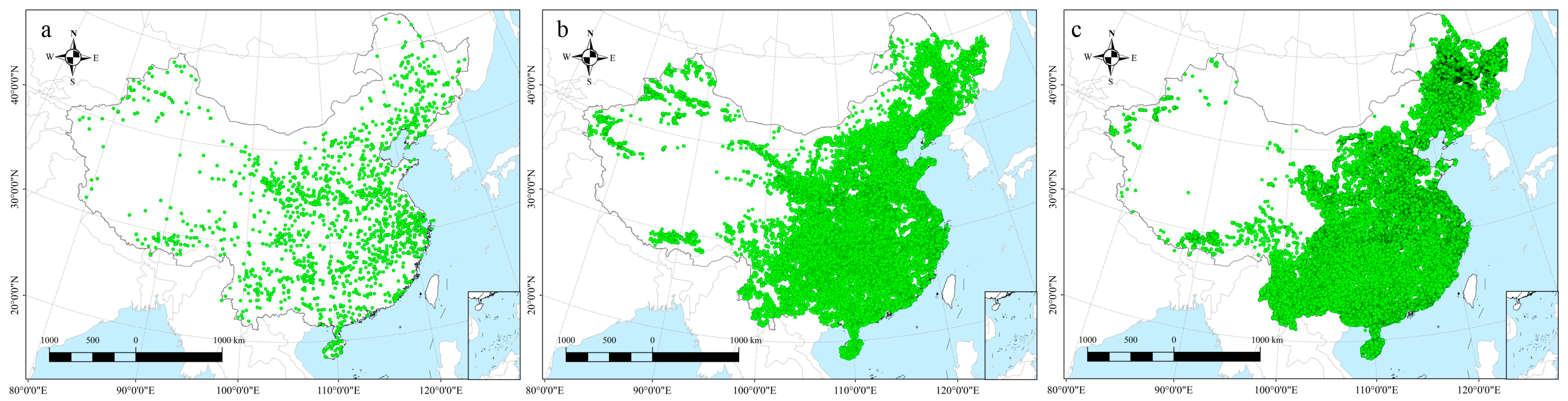
We compiled cropland soil pH data for the years 1980, 2012, and 2018 from three major national monitoring programs: the Second National Soil Survey, the National Cultivated Land Quality Survey, and the National Soil Testing and Fertility Campaign led by the Cultivated Land Quality Monitoring and Protection Center, Ministry of Agriculture and Rural Affairs of China. These datasets provided 3644, 35,386, and 151,804 samples, respectively, all collected from the top 0–20 cm soil layer (Figure 1). To ensure data comparability across survey periods, all soil pH values were determined according to the Chinese National Standard method for soil analysis, using a glass electrode and a soil-to-water ratio of 1:2.5. For spatial harmonization, we applied geostatistical interpolation to standardize all records to a 1 km × 1 km grid, thereby generating methodologically consistent, high-resolution maps of cropland soil pH for each reference year.
Figure 1. Spatial distribution of nationwide cropland soil pH sampling sites. (a) 1980 survey (n = 3644). (b) 2012 survey (n = 35,386). (c) 2018 survey (n = 151,804). Sampling points were compiled from three nationwide soil monitoring programs. Green dots denote individual sampling sites included in each nationwide soil monitoring program.

2.2. pH Classification, Transitions, and Change Rates

To quantify systematic shifts in soil chemical environments, cropland soil pH values were categorized into five agronomic classes: strongly acidic (<5.5), moderately acidic (5.5–6.5), neutral (6.5–7.5), moderately alkaline (7.5–8.5), and strongly alkaline (>8.5) []. These thresholds follow internationally recognized agronomic standards and delineate key physiological ranges that govern nutrient solubility, microbial activity, and crop performance. Soils with pH below 5.5 are susceptible to aluminum toxicity and phosphorus fixation due to enhanced solubility of Al3+ and Fe3+ oxides [,]; values between 6.5 and 7.5 correspond to near-optimal nutrient availability and microbial functioning for most staple crops []; while soils above 7.5 typically constrain micronutrient uptake and signal the onset of salinization or sodicity [,]. This classification scheme was applied consistently to the harmonized 1 × 1 km gridded pH datasets for 1980, 2012, and 2018 to ensure comparability across time periods and agroecological zones.
For each transition period (1980–2012 and 2012–2018), consecutive pH maps were spatially overlaid to track changes in pH classes at the grid-cell level. A transition matrix Aij was constructed, where each element represents the proportion of grid cells transitioning from class i in the initial year to class j in the subsequent year:
A i j = N i j   N t o t a l
where N i j is the number of 1 × 1 km grid cells that shifted from class i to class j, and N t o t a l is the total number of cropland grid cells considered.
The analysis was performed within a fixed cropland mask defined from the baseline year (2018), allowing pH transitions to be evaluated consistently within the same cropland area across all survey periods. The diagonal elements ( A i j ) represent areas where soil pH remained within the same class, while off-diagonal elements quantify the extent of acidification (transition from higher to lower pH classes) or alkalization (transition from lower to higher classes). The sum of all elements equals one, ensuring spatial comparability across periods and regions.
To visualize the magnitude and direction of these transitions, Sankey diagrams were generated using the networkD3 package in R (v0.4). Node heights were scaled to the relative proportion of each pH class, and link widths were proportional to the fraction of grid cells undergoing class-to-class transitions. Each link was colored according to the initial (source) pH class, thereby emphasizing dominant transition pathways such as the widespread flow from neutral (6.5–7.5) to moderately acidic (5.5–6.5) conditions.
To further quantify not only the direction but also the rate of soil pH change, the standardized rate of soil pH change (SAR) was calculated for each grid cell as:
SAR   =   ( pH t 2     pH t 1 ) t 2     t 1
where p H t 1 and p H t 2 are soil pH values at consecutive surveys and (t2 − t1) is the number of years between surveys (32 years for 1980–2012 and 6 years for 2012–2018). Negative SAR values denote acidification, while positive values indicate alkalization.

2.3. Soil pH Risk Zoning Based on Current Status and Temporal Change

To further evaluate the direction and intensity of soil acid–base dynamics, a bidirectional pH risk zoning framework was developed by integrating the soil pH condition with its temporal change (ΔpH). This approach distinguishes between acidification—and alkalization—prone soils and identifies areas where soil buffering systems are either being depleted or reinforced. The soil pH determines the dominant buffering mechanism and thus the soil’s sensitivity to acid–base perturbations. Soils with low pH (<5.5) are primarily buffered by Fe and Al oxides, which confer strong resistance to further acidification but make them sensitive to base inputs. Medium-pH soils (5.5–7.5) are dominated by cation—exchange buffering, exhibiting relatively stable conditions yet remaining bidirectionally responsive to both acidification and alkalization. High-pH soils (>7.5) are controlled by carbonate buffering; once carbonate reserves are depleted, the buffering capacity collapses rapidly, rendering these soils highly susceptible to acidification.
The magnitude and significance of long-term acid–base changes were quantified using the SAR derived from consecutive soil surveys. Negative SAR values indicate acidification, whereas positive values indicate alkalization. Following agronomic standards and long-term monitoring evidence [,], a total ΔpH of ±0.10 was adopted as the threshold for statistically and agronomically meaningful change over decadal timescales, corresponding to approximately ±0.3–0.4 units over 30–40 years. To ensure temporal comparability among periods of unequal duration, this threshold was normalized by the observation interval to yield an annual rate threshold (SARthreshold = 0.10/Δt). Accordingly, for the 1980–2018 period (Δt = 38 years), the significance level was set to ±0.003 pH·yr−1. Grid cells with SAR ≤ −0.003 were classified as significantly acidifying, those with SAR ≥ +0.003 as alkalizing, and intermediate values as stable. This criterion minimizes the influence of short-term variability and analytical uncertainty, ensuring consistent identification of long-term soil pH trends across spatial and temporal scales.
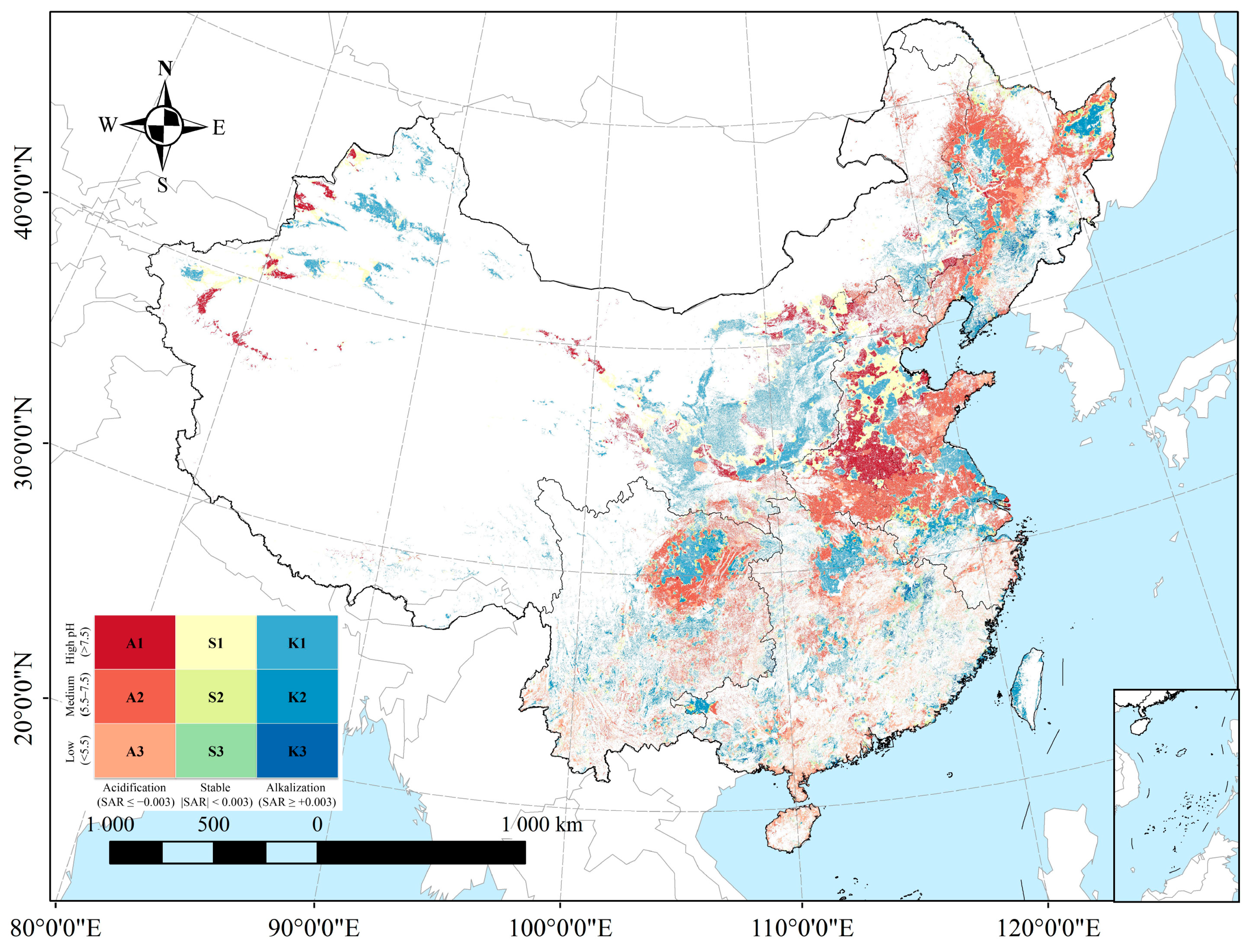
To capture the current soil status and its dynamic trajectory, three pH categories (low, medium, and high) were combined with three SAR intervals (≤−0.003, −0.003 to +0.003, and ≥+0.003) to construct a 3 × 3 classification matrix. Each matrix cell represents a unique combination of baseline buffering status and directional pH change, defining nine pH risk zones that encompass acidification-dominant, alkalization-dominant, and stable regimes. This framework provides a spatially explicit tool for diagnosing acid–base vulnerability, evaluating long-term soil degradation intensity, and supporting region-specific soil management and restoration strategies.

3. Results

3.1. Spatiotemporal Dynamics of Cropland Soil pH in CHINA

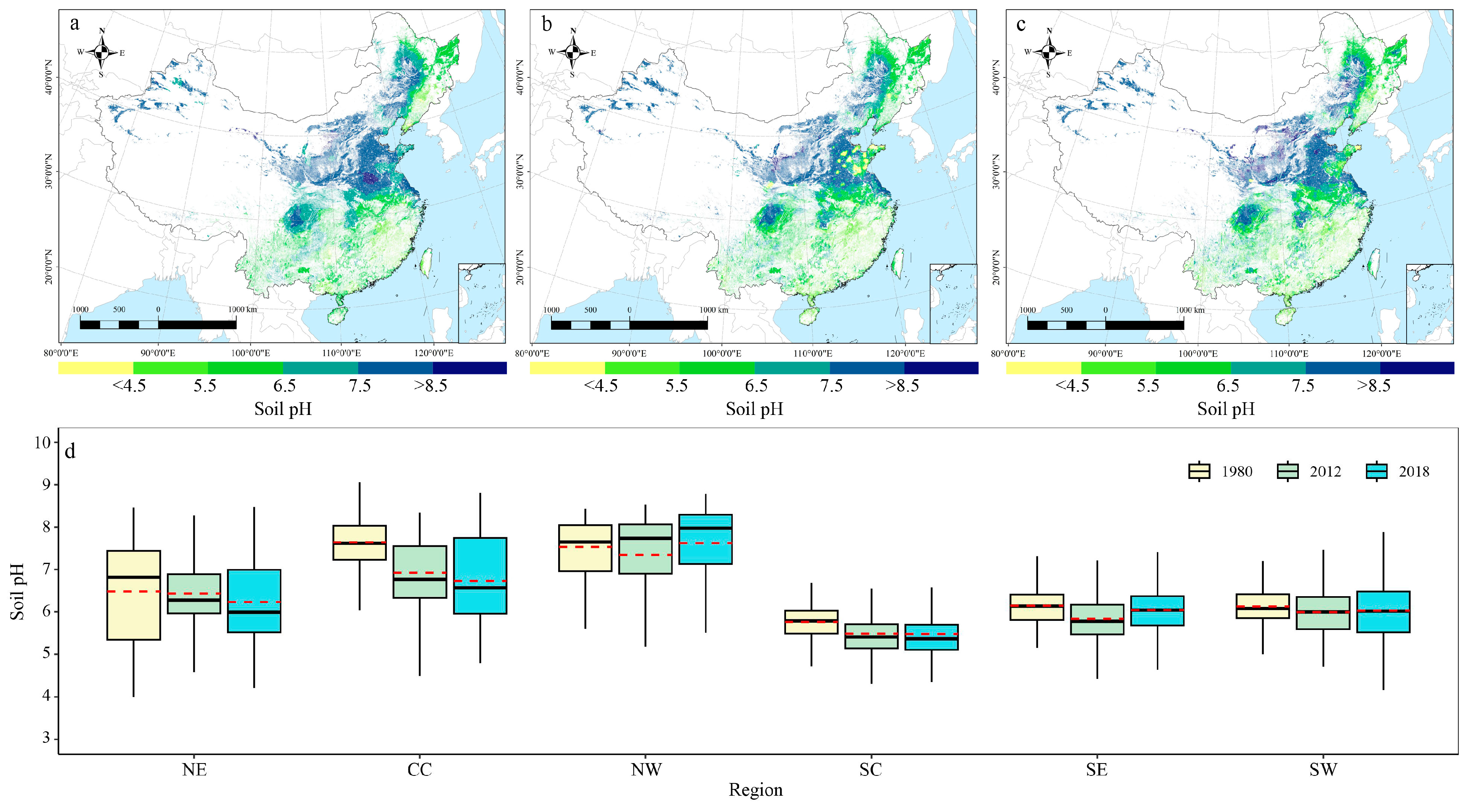
We compiled soil pH data from three nationwide soil testing campaigns conducted in 1980 (n = 3644), 2012 (n = 35,386), and 2018 (n = 151,804), and harmonized all observations to a 1 × 1 km grid using geostatistical interpolation to ensure spatial comparability across survey years (Figure 2a–c). National cropland soils exhibited a pronounced acidification trajectory over the past four decades, with mean pH declining from 7.1 in 1980 to 6.7 in 2012 and 6.6 in 2018. This nationwide trend was accompanied by substantial regional heterogeneity. The most severe acidification occurred in Central China (−0.6 pH units), followed by the Southeast (−0.4), Northeast (−0.3), and Southwest (−0.3), while modest declines were observed in the South (−0.2) and slight alkalization in the Northwest (+0.1) (Figure 2d). Collectively, these spatially divergent trajectories reveal a nationwide progression of cropland acidification, with southern and central regions emerging as hotspots driven by intensive fertilization, high rainfall, and inherently low soil buffering capacity.
Figure 2. Spatiotemporal patterns of cropland soil pH across China from 1980 to 2018. (ac) Spatial distribution of cropland soil pH for 1980, 2012, and 2018, harmonized to a 1 × 1 km grid through geostatistical interpolation. (d) Regional variations in soil pH across six major agricultural zones: NE, Northeast; CC, Central; NW, Northwest; SC, South; SE, Southeast; and SW, Southwest. Boxplots show the median (black line), interquartile range (boxes), and 1.5 × IQR whiskers; red dashed lines represent regional mean values for each survey year.

3.2. National and Regional Transitions of Cropland Soil pH

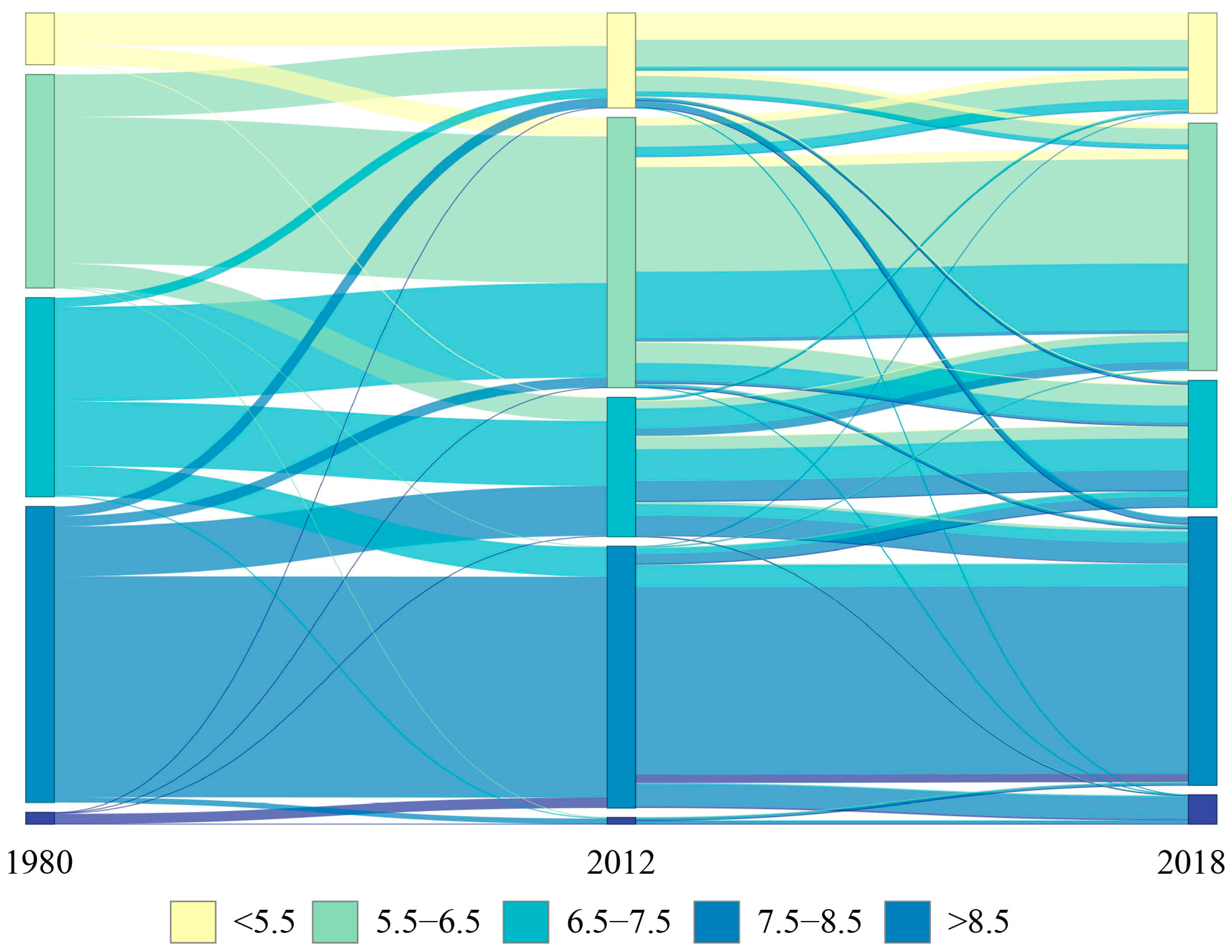
Cropland soils across China underwent systematic transitions among pH classes between 1980 and 2018 (Figure 3). From 1980 to 2012, nearly one fifth of neutral soils (pH 6.5–7.5) shifted into the moderately acidic range (5.5–6.5), and approximately 6% further declined to strongly acidic levels (<5.5). Between 2012 and 2018, an additional 13% of neutral soils moved into acidic classes, resulting in the cumulative loss of nearly one quarter of neutral soils since 1980. Moderately alkaline soils (7.5–8.5) contracted sharply, with less than 10% remaining by 2018, whereas strongly acidic (<5.5) and strongly alkaline (>8.5) categories each accounted for under 3% of total cropland. Sankey trajectories highlight the predominance of acidification pathways, with major flows from neutral to moderately acidic soils and from moderately alkaline to neutral conditions, indicating a nationwide progression toward increasingly acidic soil environments.
Figure 3. Transitions of cropland soil pH classes across China from 1980 to 2018. Sankey diagrams illustrate the transitions of cropland soils among five agronomic pH classes (<5.5, 5.5–6.5, 6.5–7.5, 7.5–8.5, and >8.5) across three survey years (1980, 2012, and 2018). Flow widths are proportional to the proportion of 1 × 1 km grid cells undergoing each transition, and colors correspond to the initial pH class in 1980.
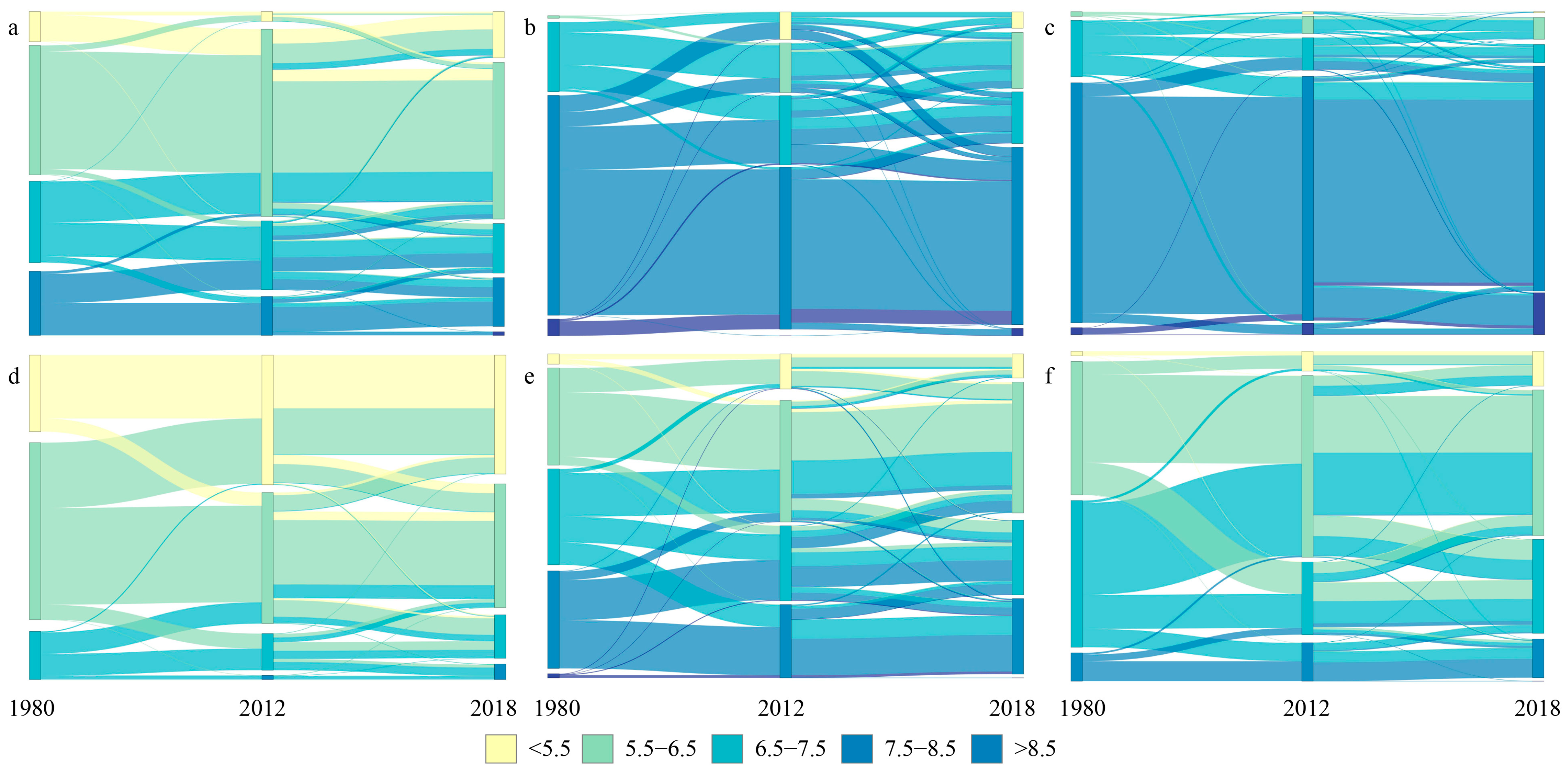
Regional trajectories diverged substantially (Figure 4). In South China and Southwest China, large areas transitioned from neutral and moderately acidic classes to strongly acidic conditions, producing the steepest regional declines in mean pH. Central and Southeast China also exhibited persistent acidification, characterized by extensive flows from neutral to acidic classes. In contrast, Northeast and Northwest China were dominated by transitions from moderately alkaline to neutral soils, reflecting their greater buffering capacity and limited acidification pressure. Collectively, these contrasting trajectories indicate that national-scale acidification was driven primarily by southern croplands, whereas northern regions, although relatively buffered, still experienced gradual downward shifts in pH over time.
Figure 4. Transitions of cropland soil pH classes across six agricultural regions in China from 1980 to 2018. Sankey diagrams illustrate transitions of cropland soils among five agronomic pH classes (≤5.5, 5.5–6.5, 6.5–7.5, 7.5–8.5, ≥8.5) during three national soil surveys (1980, 2012, and 2018). (a) Northeast (NE); (b) Central (CC); (c) Northwest (NW); (d) South (SC); (e) Southeast (SE); (f) Southwest (SW). Flows are colored according to the initial pH class in 1980, and line widths are proportional to the proportion of 1 × 1 km grid cells undergoing class-to-class transitions.

3.3. Spatiotemporal Changes in Cropland Soil pH

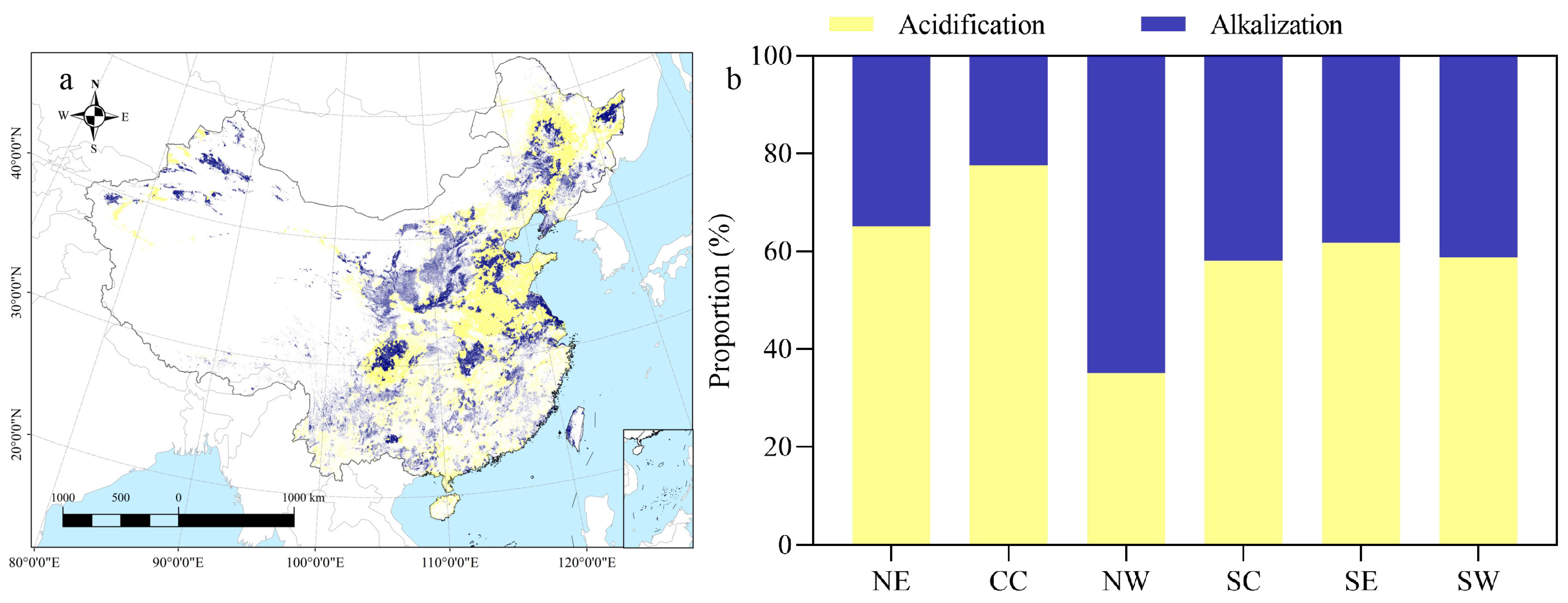
Cropland soils across China experienced widespread and accelerating acidification between 1980 and 2018, with more than 60% of croplands showing a decline in pH (Figure 5). The most pronounced decreases occurred in South, Southeast and Southwest China, coinciding with regions of intensive rice cultivation, high rainfall, and sustained nitrogen inputs. In contrast, localized alkalization was detected in the arid Northwest, mainly associated with salt accumulation under strong evapotranspiration. These spatial patterns revealed a clear south–north divide: humid croplands in the south have become persistent acidification hotspots, whereas northern croplands remain relatively buffered but show increasing heterogeneity in alkalization risk.
Figure 5. Spatiotemporal changes in cropland soil pH across China from 1980 to 2018. (a) Spatial distribution of changes in soil pH (ΔpH) between 1980 and 2018. (b) Proportion of grid cells exhibiting acidification and alkalization within six major agricultural zones: NE, Northeast; CC, Central; NW, Northwest; SC, South; SE, Southeast; and SW, Southwest.
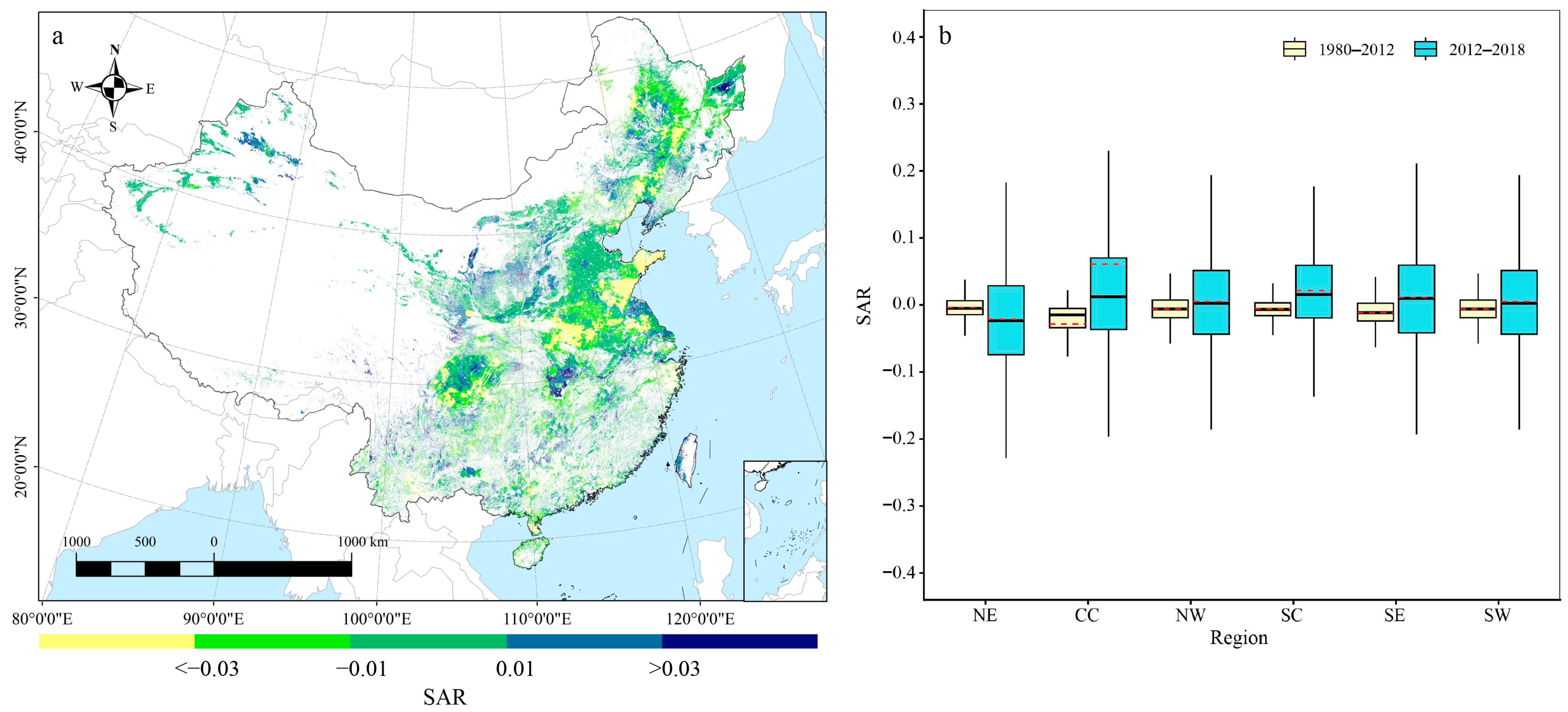
The spatial distribution of the SAR revealed marked heterogeneity across China’s croplands during the past four decades (Figure 6a). Most croplands experienced a decline in pH, with widespread acidification in the humid southern and central regions and localized alkalization in the arid north and northwest. From 1980 to 2018, the national mean SAR was −0.0042 pH yr−1, indicating a persistent yet spatially variable acidification trend. The most rapid acidification (SAR < −0.01 pH yr−1) occurred in the Yangtze River Basin, the southeastern hilly areas, and parts of the Northeast Plain, where intensive rice-based systems, high nitrogen inputs and carbonate depletion prevail. In contrast, mild alkalization (SAR > 0.01 pH yr−1) was detected mainly in parts of the Northwest and the North China Plain, reflecting the combined effects of alkaline irrigation, limited rainfall and evaporation-driven salt accumulation.
Figure 6. Spatial and temporal patterns of soil standardized pH change rate (SAR) across China’s croplands. (a) Spatial distribution of the standardized acidification rate (SAR, pH yr−1) from 1980 to 2018. (b) Regional variations in SAR across six major agricultural zones for two periods (1980–2012 and 2012–2018). Boxes show interquartile ranges (IQRs), horizontal lines represent medians, and whiskers denote the 5th–95th percentiles, and red dashed lines indicate the regional mean SAR. NE, Northeast; CC, Central; NW, Northwest; SC, South; SE, Southeast; and SW, Southwest.
Regional statistics further revealed substantial differences in the magnitude and direction of soil acid–base change across the six major agricultural zones (Figure 6b). The Northeast and Central China exhibited the highest acidification rates, with median SAR values of −0.0051 and −0.0047 pH yr−1, respectively, whereas the Northwest remained relatively stable around −0.001 pH yr−1. Comparisons between periods showed that soil acidification accelerated significantly in recent years, with median SAR values during 2012–2018 almost twice those of 1980–2012, reflecting increased fertilizer inputs and intensified cropping despite recent improvements in nutrient management. These results highlight a clear spatial contrast between southern and northern croplands, where rapid acidification dominates the south while the north remains largely stable or mildly alkalizing, emphasizing the spatial imbalance in soil buffering capacity under long-term agricultural intensification.

3.4. Spatial Patterns and Typology of Soil pH Risk Zones

Nationwide mapping of soil pH risk revealed pronounced spatial heterogeneity in acid–base dynamics across China’s croplands (Figure 7). By integrating current soil pH with SAR, croplands were classified into nine risk zones, each representing a distinct buffering regime and trajectory of chemical change. Acidification-dominant zones occupied approximately 40.5% of total cropland, primarily distributed across humid southern and central regions characterized by rice-based systems, high nitrogen inputs, and long-term carbonate depletion. Stable zones covered about 16.4% of cropland, mostly in the northeastern and southwestern uplands, where moderate pH and balanced nutrient management sustain effective cation-exchange buffering. Alkalization-dominant zones accounted for roughly 43.1%, concentrated in arid and semi-arid northern regions influenced by alkaline irrigation water, limited acid deposition, and evaporation-induced salt accumulation.
Figure 7. Soil pH risk zoning framework based on current pH and standardized acidification rate (SAR). The nine-zone matrix integrates current soil pH classes (<5.5, 5.5–7.5, and >7.5) with SAR intervals (≤−0.003, −0.003 to +0.003, and ≥+0.003 pH·yr−1) to delineate acidification-, stable-, and alkalization-prone soils. Red shades (A1–A3) indicate acidification-dominant zones where carbonate buffering is being depleted or nitrogen-driven acid inputs prevail. Yellow–green tones (S1–S3) denote stable soils with effective buffering capacity. Blue shades (K1–K3) represent alkalization-dominant zones influenced by excessive liming, alkaline irrigation, or reduced acid deposition.
Across these zones, clear transitions were observed among dominant buffering systems, from carbonate-controlled alkalinity in high-pH soils (>7.5) to oxide-controlled acidity in low-pH soils (<5.5). Soils with medium pH (5.5–7.5) exhibited bidirectional responses to fertilizer inputs, cropping intensity, and hydrological conditions, indicating variable buffering states. The nine-zone framework delineated a distinct south–north dichotomy, with acidification risk prevailing in humid southern croplands and alkalization risk dominating arid northern regions (Figure 7).

4. Discussion

Our study provides a nationally consistent, grid-level reconstruction of soil pH trajectories across China’s croplands, revealing acidification as a pervasive and accelerating form of soil degradation over the past four decades. On average, cropland soils nationwide have acidified by 0.5 pH units, with the most pronounced declines observed in the humid southern and central regions, where intensive fertilization, high rainfall, and inherently weak buffering capacities converge. These large-scale shifts are consistent with regional evidence from red soils and rice-based systems, where sustained nitrogen enrichment and acid deposition have depleted base cations and exhausted carbonate reserves. Notably, Dada et al. (2021) highlight that insufficient lime application in South and Southwest China has exacerbated soil acidification, failing to mitigate pH decline in these regions []. In contrast, modest alkalization in the arid Northwest is attributed to evaporation-driven salt accumulation and minimal acid inputs, aligning with site-level observations in dryland agroecosystems. Collectively, these divergent trends highlight a growing spatial polarization of soil acid-base regimes, driven by coupled biogeochemical and anthropogenic processes. The convergence of national-scale acidification with regional divergence signals a progressive destabilization of soil buffering capacities, exacerbated by decades of agricultural intensification.
The pronounced regional heterogeneity in soil pH trajectories reflects the combined influence of soil properties, management practices, and climate regimes []. The most substantial declines occurred in North, Southeast, and Northeast China, with mean pH decreases of 0.6, 0.4, and 0.3 units, respectively, largely driven by intensive nitrogen fertilization, continuous double cropping, and high precipitation []. Moderate acidification also appeared in the Southwest (−0.3 units) and South (−0.2 units), where rice-based systems and low-buffering red soils amplify acid inputs. In contrast, Northwest China exhibited a slight pH increase (+0.1 unit), reflecting the dominance of carbonate-rich soils and limited fertilizer application under arid conditions [,,]. Collectively, these patterns reveal divergent soil chemical pathways: acidification prevails across the humid and intensively farmed regions of the east and south, whereas mild alkalization persists in parts of the dry northwest [,]. This bidirectional evolution challenges the notion of a uniform acidification trajectory and underscores that soil degradation processes in China’s croplands are shaped by region-specific interactions among fertilizer regimes, parent material, and climate []. Recognizing this duality is essential for developing targeted management strategies that mitigate acidification in the south while preventing secondary salinization in the north.
Regions where soil pH falls below the agronomic optimum are mainly characterized by intensive nitrogen fertilizer use, long-term atmospheric nitrogen deposition, high cropping frequency, and depletion of base cations under humid conditions with weak buffering capacity [,,]. The agronomic and ecological implications of these divergent transitions are substantial. Acidification reduces nitrogen-use efficiency, mobilizes toxic metals, and decreases the availability of phosphorus, whereas alkalization limits micronutrient uptake, exacerbates salinity stress, and impairs root functioning [,]. Collectively, these processes erode the buffering and biological capacity of cropland soils, weaken their resilience to climatic extremes, and threaten the long-term stability of food production systems. Such degradation undermines progress toward sustainable nutrient management, amplifying both yield risks and environmental losses []. The risk assessment framework developed here provides a quantitative foundation for identifying vulnerable regions and designing targeted interventions that sustain productivity while preserving ecosystem integrity. High-risk values in the Yangtze River Basin, the Northeast Plain, and the southern hilly croplands highlight zones where remediation is most urgent. In acidified regions, practices such as liming, organic amendments, and balanced fertilization can replenish base cations and restore buffering capacity [,]. In alkaline northern regions, management should emphasize salinity control, irrigation optimization, and the targeted use of acidifying inputs, supported by micronutrient supplementation [,]. These interventions serve both corrective and preventive functions, enhancing nutrient-use efficiency, reducing environmental losses, and strengthening resilience to climatic stress. Integrating region-specific measures into national soil-health initiatives offers a scalable pathway to restore soil function and advance the broader goals of sustainable agriculture and food security.
Several limitations should be acknowledged. Although the three nationwide surveys provided unprecedented temporal and spatial coverage, differences in sampling density and analytical protocols across decades introduce uncertainties that cannot be fully eliminated even after harmonization. The use of geostatistical interpolation may smooth local variability, potentially underestimating small-scale hotspots of acidification or alkalization [,]. While the 1 km mapping framework effectively captures regional and sub-regional variation, finer-scale heterogeneity within small landscapes or individual fields remains unresolved due to the sampling density of the national datasets. Applying generalized agronomic thresholds ensures consistency across regions and crops but does not reflect crop-specific sensitivities, which may lead to under- or overestimation of risks. Moreover, the observational and statistical framework constrains causal attribution among fertilizer inputs, atmospheric deposition, soil buffering capacity, and climatic drivers. Future work should integrate process-based models with machine learning approaches to disentangle the dominant drivers of pH change, extend monitoring to deeper soil layers to capture vertical acidification, and link pH dynamics with crop productivity and socio-economic outcomes. Scenario-based assessments combining soil biogeochemical processes with socio-economic pathways will be crucial for evaluating the cost-effectiveness and climate co-benefits of interventions such as liming, organic amendments, and low-acidifying fertilizers [,]. These advances will strengthen the foundation for adaptive soil governance and for embedding soil pH management within broader national and global sustainability agendas.

5. Conclusions

Cropland soils across China have experienced a marked shift in acid–base status over the past four decades. The national mean pH has declined by 0.5 units, driven mainly by intensive nitrogen inputs, acid deposition, and carbonate depletion in humid regions, while localized alkalization has persisted in the arid north. The bidirectional risk-zoning framework developed in this study captures this spatial polarization, highlighting acidification hotspots in the south and alkalization-prone areas in the north. Maintaining soil buffering capacity through region-specific management such as liming, organic amendments, balanced fertilization, and salinity control will be critical for sustaining soil health, nutrient efficiency, and long-term agricultural resilience.

Author Contributions

Z.C. (Zhenling Cui), Y.Y., H.W., H.Y., H.Z., Z.C. (Zhong Chen) and H.G. designed the research. Z.C. (Zhong Chen) and H.G. performed all computational analyses and prepared the figures and tables. Z.C. (Zhong Chen) and H.G. drafted the paper. All authors reviewed and commented on the manuscript. All authors have read and agreed to the published version of the manuscript.

Funding

This research was funded by the National Key Research and Development Program of China (2021YFD1901001).

Data Availability Statement

The original contributions presented in this study are included in the article; further inquiries can be directed to the corresponding authors.

Conflicts of Interest

The authors declare no conflicts of interest.

References

  1. Naz, M.; Hussain, S.; Tariq, M.; Danish, S.; Khan, I. The soil pH and heavy metals revealed their impact on soil microbial community. J. Environ. Manag. 2022, 321, 115770. [Google Scholar] [CrossRef]
  2. Slessarev, E.W.; Lin, Y.; Bingham, N.L.; Johnson, J.E.; Dai, Y.; Schimel, J.P.; Chadwick, O.A. Water balance creates a threshold in soil pH at the global scale. Nature 2016, 540, 567–569. [Google Scholar] [CrossRef]
  3. Carstensen, J.; Duarte, C.M. Drivers of pH variability in coastal ecosystems. Environ. Sci. Technol. 2019, 53, 4020–4029. [Google Scholar] [CrossRef]
  4. Ghisman, V.; Muresan, A.C.; Bogatu, N.L.; Herbei, E.E.; Buruiana, D.L. Recent advances in the remediation of degraded and contaminated soils: A review of sustainable and applied strategies. Agronomy 2025, 15, 1234. [Google Scholar] [CrossRef]
  5. Zhong, Y.; Yan, W.; Canisares, L.P.; Wang, S.; Brodie, E.L. Alterations in soil pH emerge as a key driver of the impact of global change on soil microbial nitrogen cycling: Evidence from a global meta-analysis. Glob. Ecol. Biogeogr. 2022, 32, 145–165. [Google Scholar] [CrossRef]
  6. Smith, P.; House, J.I.; Bustamante, M.; Sobocká, J.; Harper, R.; Pan, G.; West, P.C.; Clark, J.M.; Adhya, T.; Rumpel, C.; et al. Global change pressures on soils from land use and management. Glob. Change Biol. 2016, 22, 1008–1028. [Google Scholar] [CrossRef] [PubMed]
  7. Guo, J.; Liu, X.J.; Zhang, Y.; Shen, J.L.; Han, W.X.; Zhang, W.F.; Christie, P.; Goulding, K.W.T.; Vitousek, P.M.; Zhang, F.S. Significant acidification in major Chinese croplands. Science 2010, 327, 1008–1010. [Google Scholar] [CrossRef]
  8. Liu, L.; Xu, W.; Lu, X.; Zhong, B.; Guo, Y.; Lu, X.; Zhao, Y.; He, W.; Wang, S.; Zhang, X.; et al. Exploring global changes in agricultural ammonia emissions and their contribution to nitrogen deposition since 1980. Proc. Natl. Acad. Sci. USA 2022, 119, e2121998119. [Google Scholar] [CrossRef]
  9. Dong, Y.; Yang, J.-L.; Zhao, X.-R.; Yang, S.-H.; Mulder, J.; Dörsch, P.; Peng, X.-H.; Zhang, G.-L. Soil acidification and loss of base cations in a subtropical agricultural watershed. Sci. Total Environ. 2022, 827, 154338. [Google Scholar] [CrossRef]
  10. Hong, S.; Gan, P.; Chen, A. Environmental controls on soil pH in planted forest and its response to nitrogen deposition. Environ. Res. 2019, 172, 159–165. [Google Scholar] [CrossRef]
  11. Li, Q.; Li, A.W.; Yu, X.L.; Dai, T.F.; Peng, Y.Y.; Yuan, D.; Zhao, B.; Tao, Q.; Wang, C.Q.; Li, B.; et al. Soil acidification of the soil profile across Chengdu Plain of China from the 1980s to 2010s. Sci. Total Environ. 2020, 698, 134320. [Google Scholar] [CrossRef] [PubMed]
  12. Chen, J.; Xie, E.; Peng, Y.; Yan, G.; Jiang, J.; Hu, W.; Zhao, Y. Four-dimensional modelling reveals decline in cropland soil pH during last four decades in China’s Mollisols region. Geoderma 2025, 453, 117135. [Google Scholar] [CrossRef]
  13. Davis, A.G.; Huggins, D.R.; Reganold, J.P. Linking soil health and ecological resilience to achieve agricultural sustainability. Front. Ecol. Environ. 2023, 21, 131–139. [Google Scholar] [CrossRef]
  14. Wu, Z.; Sun, X.; Sun, Y.; Yan, J.; Zhao, Y.; Chen, J. Soil acidification and factors controlling topsoil pH shift of cropland in central China from 2008 to 2018. Geoderma 2022, 408, 115654. [Google Scholar] [CrossRef]
  15. Saleem, A.; Zulfiqar, A.; Saleem, M.Z.; Ali, B.; Saleem, M.H.; Ali, S.; Tufekci, E.D.; Tufekci, A.R.; Rahimi, M.; Mostafa, R.M. Alkaline and acidic soil constraints on iron accumulation by rice cultivars in relation to several physio-biochemical parameters. BMC Plant Biol. 2023, 23, 397. [Google Scholar] [CrossRef]
  16. Bojorquez-Quintal, E.; Escalante-Magana, C.; Echevarria-Machado, I.; Martinez-Estevez, M. Aluminum, a friend or foe of higher plants in acid soils. Front. Plant Sci. 2017, 8, 1767. [Google Scholar] [CrossRef]
  17. Jaiswal, S.K.; Naamala, J.; Dakora, F.D. Nature and mechanisms of aluminium toxicity, tolerance and amelioration in symbiotic legumes and rhizobia. Biol. Fertil. Soils 2018, 54, 309–318. [Google Scholar] [CrossRef]
  18. Zhao, X.; He, C.; Liu, W.; Liu, W.; Liu, Q.; Bai, W.; Li, L.; Lal, R.; Zhang, H. Responses of soil pH to no-till and the factors affecting it: A global meta-analysis. Glob. Change Biol. 2022, 28, 154–166. [Google Scholar] [CrossRef]
  19. Penn, C.; Camberato, J. A critical review on soil chemical processes that control how soil pH affects phosphorus availability to plants. Agriculture 2019, 9, 120. [Google Scholar] [CrossRef]
  20. Wang, C.; Kuzyakov, Y. Soil organic matter priming: The pH effects. Glob. Change Biol. 2024, 30, e17349. [Google Scholar] [CrossRef] [PubMed]
  21. Husson, O.; Sarthou, J.-P.; Bousset, L.; Ratnadass, A.; Schmidt, H.-P.; Kempf, J.; Husson, B.; Tingry, S.; Aubertot, J.-N.; Deguine, J.-P.; et al. Soil and plant health in relation to dynamic sustainment of Eh and pH homeostasis: A review. Plant Soil 2021, 466, 391–447. [Google Scholar] [CrossRef]
  22. Zhang, Y.; Ye, C.; Su, Y.; Peng, W.; Lu, R.; Liu, Y.; Huang, H.; He, X.; Yang, M.; Zhu, S. Soil acidification caused by excessive application of nitrogen fertilizer aggravates soil-borne diseases: Evidence from literature review and field trials. Agric. Ecosyst. Environ. 2022, 340, 108205. [Google Scholar] [CrossRef]
  23. Daba, N.A.; Li, D.; Huang, J.; Han, T.; Zhang, L.; Ali, S.; Khan, M.N.; Du, J.; Liu, S.; Legesse, T.G.; et al. Long-Term Fertilization and Lime-Induced Soil pH Changes Affect Nitrogen Use Efficiency and Grain Yields in Acidic Soil Under Wheat-Maize Rotation. Agronomy 2021, 11, 2069. [Google Scholar] [CrossRef]
  24. Li, J.; Richter, D.D.; Mendoza, A.; Heine, P. Effects of land-use history on soil spatial heterogeneity of macro- and trace elements in the Southern Piedmont, USA. Geoderma 2010, 156, 60–73. [Google Scholar] [CrossRef]
  25. Zhang, X.; Xiang, D.Q.; Yang, C.; Wu, W.; Liu, H.B. The spatial variability of temporal changes in soil pH affected by topography and fertilization. Catena 2022, 218, 106547. [Google Scholar] [CrossRef]
  26. Siddique, M.N.E.A.; Lobry de Bruyn, L.; Guppy, C.N.; Osanai, Y. Temporal variations of soil organic carbon and pH at landscape scale and the implications for cropping intensity in rice-based cropping systems. Agronomy 2020, 11, 1786. [Google Scholar] [CrossRef]
  27. Liu, J.; Liu, M.; Wu, M.; Jiang, C.; Chen, X.; Cai, Z.; Wang, B.; Zhang, J.; Zhang, T.; Li, Z. Soil pH rather than nutrients drive changes in microbial community following long-term fertilization in acidic Ultisols of southern China. J. Soils Sediments 2018, 18, 1853–1864. [Google Scholar] [CrossRef]
  28. Zhai, W.D.; Zheng, N.; Huo, C.; Xu, Y.; Zhao, H.-D.; Li, Y.-W.; Zang, K.-P.; Wang, J.-Y.; Xu, X.-M. Subsurface pH and carbonate saturation state of aragonite on the Chinese side of the North Yellow Sea: Seasonal variations and controls. Biogeosciences 2014, 11, 1103–1123. [Google Scholar] [CrossRef]
  29. Perri, S.; Molini, A.; Hedin, L.O.; Porporato, A. Contrasting effects of aridity and seasonality on global salinization. Nat. Geosci. 2022, 15, 375–381. [Google Scholar] [CrossRef]
  30. Wang, J.; Jin, X.; Liu, X.; Fu, Y.; Bao, K.; Quan, Z.; Xu, C.; Wang, W.; Lu, G.; Zhang, H. Potassium fulvate alleviates salinity and boosts oat productivity by modifying soil properties and rhizosphere microbial communities in the saline–alkali soils of the Qaidam Basin. Agronomy 2025, 15, 456. [Google Scholar] [CrossRef]
  31. Wu, W.; Zhao, G.; Zheng, Z.; Cai, M.; Zhang, Y. Unraveling four decades of soil acidification on the Qinghai–Tibetan Plateau: Patterns, drivers, and future projections. Environ. Pollut. 2025, 375, 126324. [Google Scholar] [CrossRef]
  32. Bailey, M.; Hsieh, E.J.; Tsai, H.H.; Ravindran, A.; Schmidt, W. Alkalinity modulates a unique suite of genes to recalibrate growth and pH homeostasis. Front. Plant Sci. 2023, 14, 1100701. [Google Scholar] [CrossRef]
  33. Liu, K.; Liu, Z.; Zhou, N.; Shi, X.; Lock, T.R.; Kallenbach, R.L.; Yuan, Z. Predicted increased P relative to N growth limitation of dry grasslands under soil acidification and alkalinization is ameliorated by increased precipitation. Soil Biol. Biochem. 2022, 173, 108828. [Google Scholar] [CrossRef]
  34. Fletcher, C.; Ripple, W.J.; Newsome, T.; Barnard, P.; Beamer, K.; Behl, A.; Bowen, J.; Cooney, M.; Crist, E.; Field, C.; et al. Earth at risk: An urgent call to end the age of destruction and forge a just and sustainable future. PNAS Nexus 2024, 3, pgae106. [Google Scholar] [CrossRef]
  35. Mrunalini, K.; Behera, B.; Jayaraman, S.; Abhilash, P.C.; Dubey, P.K.; Swamy, G.N.; Prasad, J.V.N.S.; Rao, K.V.; Krishnan, P.; Pratibha, G.; et al. Nature-based solutions in soil restoration for improving agricultural productivity. Land Degrad. Dev. 2022, 33, 1269–1289. [Google Scholar] [CrossRef]
  36. Uwiringiyimana, E.; Lai, H.-W.; Ni, N.; Shi, R.-Y.; Pan, X.-Y.; Gao, J.-N.; Biswash, R.; Li, J.-Y.; Cui, X.-M.; Xu, R.-K. Comparative efficacy of alkaline slag, biomass ash, and biochar application for the amelioration of different acidic soils. Plant Soil 2024, 504, 47–61. [Google Scholar] [CrossRef]
  37. Bargaz, A.; Lyamlouli, K.; Chtouki, M.; Zeroual, Y.; Dhiba, D. Soil microbial resources for improving fertilizers efficiency in an integrated plant nutrient management system. Front. Microbiol. 2018, 9, 1606. [Google Scholar] [CrossRef] [PubMed]
  38. Shruthi; Prakash, N.B.; Dhumgond, P.; Goiba, P.K.; Laxmanarayanan, M. The benefits of gypsum for sustainable management and utilization of acid soils. Plant Soil 2024, 504, 5–28. [Google Scholar] [CrossRef]
  39. Oliver, M.A.; Webster, R. A tutorial guide to geostatistics: Computing and modelling variograms and kriging. Catena 2014, 113, 56–69. [Google Scholar] [CrossRef]
  40. Spadavecchia, L.; Williams, M. Can spatio-temporal geostatistical methods improve high-resolution regionalisation of meteorological variables? Agric. For. Meteorol. 2012, 149, 1105–1117. [Google Scholar] [CrossRef]
  41. Pandian, K.; Mustaffa, M.R.A.F.; Mahalingam, G.; Paramasivam, A.; Prince, A.J.; Gajendiren, M.; Mohammad, A.R.R.; Varanasi, S.T. Synergistic conservation approaches for nurturing soil, food security and human health towards sustainable development goals. J. Hazard. Mater. Adv. 2024, 16, 100503. [Google Scholar] [CrossRef]
  42. González-García, A.; Palomo, I.; Codemo, A.; Rodeghiero, M.; Dubo, T.; Vallet, A.; Lavorel, S. Co-benefits of nature-based solutions exceed the costs of implementation. Cell Rep. Sustain. 2025, 2, 100012. [Google Scholar] [CrossRef]
Disclaimer/Publisher’s Note: The statements, opinions and data contained in all publications are solely those of the individual author(s) and contributor(s) and not of MDPI and/or the editor(s). MDPI and/or the editor(s) disclaim responsibility for any injury to people or property resulting from any ideas, methods, instructions or products referred to in the content.

Article Metrics

Citations

Article Access Statistics

Multiple requests from the same IP address are counted as one view.