Abstract
Soil salinization poses a significant threat to agricultural sustainability. This study investigated the effects of different microbial fertilizers on the rhizosphere fungal community and physicochemical properties of saline–alkali soil cultivated with sunflower. Three microbial fertilizers were applied at three concentration gradients to two sunflower varieties with contrasting salt–alkali tolerance (salt-tolerant NX53177 and salt-sensitive NKY1502) to elucidate the mechanisms underlying microbial fertilizer-mediated amelioration of saline–alkali soils. Among all treatments, the application of Aikesa microbial fertilizer at 50 g per pot (treatments T8 and T17) demonstrated the most pronounced ameliorative effects. In the salt-tolerant variety NX53177, the 50 g/L Aikesa fertilizer treatment increased the relative abundance of the beneficial genus Mortierella by 46.2%. It decreased the potentially pathogenic genus Lophotrichus by 82.2% compared to the no-fertilizer control. Soil fungal diversity was significantly improved, with the Shannon index increasing by 9.86% and the Simpson index decreasing by 25.83%. Concurrently, critical soil properties were enhanced: soil pH decreased by 7.79%, salinity decreased by 3.13%, and the contents of organic matter, available nitrogen, available phosphorus, and available potassium increased by 42.13%, 49.96%, 12.34%, and 53.22%, respectively. In the salt-sensitive variety NKY1502, the 50 g/L Aikesa fertilizer treatment increased Mortierella abundance by 15.96% and decreased Lophotrichus by 73.6% compared to the no-fertilizer control. The ACE and Shannon diversity indices increased by 10.00% and 9.92%, respectively, while the Simpson index decreased by 12.17%. Soil health was also markedly improved, with pH decreasing by 7.47%, salinity by 2.95%, and substantial increases in organic matter (57.94%), available nitrogen (75.78%), available phosphorus (13.20%), and available potassium (52.97%). In conclusion, the 50 g/L Aikesa fertilizer treatment effectively improved the rhizosphere fungal community structure and significantly enhanced soil physicochemical properties under saline–alkali stress. These findings provide a theoretical foundation and practical guidance for utilizing microbial fertilizers in ecological restoration and sustainable agricultural development of saline–alkali lands.
1. Introduction
Soil salinization represents a global ecological and environmental challenge that poses a serious threat to agricultural productivity and ecosystem stability []. In China, the total area of saline–alkali land reaches 99.13 million hectares, accounting for approximately one-tenth of the world’s total saline–alkali area []. Xinjiang, as a typical arid and semiarid region in northwestern China, is particularly affected, with saline–alkali land covering about 1.3 million hectares—about 22% of the national total []. Soil salinization deteriorates soil physicochemical properties, impairs plant growth and development, and disrupts ecosystem functioning, with cascading negative effects on agricultural and socioeconomic systems. Specifically, under saline conditions, decreased soil osmotic potential and excessive ions such as Na+ and Mg2+ damage cellular structures, suppress photosynthetic efficiency, reduce chlorophyll content, and interfere with nitrogen metabolism. These effects lead to the accumulation of toxic intermediates, physiological drought, impaired nutrient uptake, and ultimately, reduced crop growth, yield loss, and even plant mortality, thereby constraining sustainable agricultural development [,].
Sunflower (Helianthus annuus L.) is a major oilseed crop in China, with an annual cultivation area in Xinjiang ranging from 533,300 to 640,000 hectares. This accounts for more than 60% of the region’s oil crop area and about 3.5% of its total cultivated land. Recognized for its strong tolerance to salinity, drought, and low temperatures, sunflower is well adapted to Xinjiang’s growing conditions. It can reduce soil moisture evaporation and surface salt accumulation, maintaining relatively stable yield and oil quality under abiotic stress. As such, sunflower is considered a promising species for bioremediation of saline–alkali soils and holds strategic importance in safeguarding national edible oil security [].
Microbial fertilizers represent a novel category of bio-organic amendments with considerable potential for sustainable agriculture. They contribute to enhancing soil fungal diversity [], improving soil structure and fertility, and promoting crop growth []. Their mechanisms are largely based on the principle of “biological regulation,” involving both the introduction of exogenous functional microorganisms and the modulation of the rhizosphere microenvironment. Rhizosphere microorganisms, in particular, serve as key mediators of plant–soil interactions and play an essential role in plant adaptation to saline–alkali stress []. Studies have demonstrated that a healthy rhizosphere microbiome not only facilitates nutrient acquisition but also strengthens plant stress tolerance through diverse mechanisms []. Conversely, saline–alkali stress reduces microbial diversity, suppresses growth-promoting bacteria, and disturbs fungal community composition, often increasing the abundance of pathogenic fungi while reducing beneficial taxa such as arbuscular mycorrhizal fungi []. Research by Liang et al. [] indicated that microbial fertilizer application can effectively mitigate the increase in soil pH and total salt content, while improving overall soil nutrient status. Beneficial microorganisms in these fertilizers secrete organic acids through metabolism, which promote mineral dissolution, activate fixed nutrients, and increase soluble ion concentrations in the soil solution. These processes help lower soil pH and salinity while enhancing nutrient availability [,,]. Different microbial inoculants exert distinct effects: Bacillus subtilis primarily enhances bacterial diversity [], whereas Trichoderma species exerts more pronounced influences on fungal communities []. Fungi, as crucial components of the soil microbiome, contribute significantly to nutrient cycling and organic matter decomposition, especially in the early stages of crop residue breakdown, during which they often exhibit stronger degradative capacity than bacteria and actinomycetes [,]. Fertilization is a key agricultural management practice that considerably influences the structure of soil microbial communities []. However, the mechanisms by which microbial fertilizers alleviate saline–alkali stress in sunflowers remain insufficiently understood. Therefore, this study systematically evaluates the effects of three types of microbial fertilizers applied at three concentration levels, with a focus on their regulatory roles in shaping rhizosphere microbial diversity and composition, driving soil nutrient cycling, and facilitating the reconstruction of a healthy rhizosphere micro-ecology. The results are expected to provide a theoretical basis and technical support for the ecological restoration and sustainable utilization of saline–alkali soils.
2. Materials and Methods
2.1. Study Area Description
The experiment was conducted from 2023 to 2024 at the Anningqu Experimental Site in the Xinshi District of Urumqi, Xinjiang Uygur Autonomous Region (87°28′ E, 43°56′ N). The site was located in a pre-treated saline–alkali pond with 0.6% complex saline–alkali stress (NaCl:NaHCO3 = 1:1). The experimental area is situated in a mid-temperate continental arid climate zone, characterized by an annual precipitation of 180–220 mm, a high precipitation–drought index, and reliance on agricultural irrigation. The average temperature is 25.7 °C, with 2771.8 annual sunshine hours, a frost-free period of 174 days, and an annual accumulated temperature of 4063.1 °C. The baseline soil properties are detailed in Table 1.
Table 1.
Baseline soil properties.
2.2. Experimental Design
Two sunflower varieties with contrasting salt–alkali tolerance were selected as test materials based on a preliminary screening of 167 domestic and international cultivars: the salt–alkali tolerant variety NX53177 (supplied by China National Seed Group Co., Ltd., Beijing, China) and the non-salt–alkali tolerant variety NKY1502 (supplied by Xinjiang Academy of Agricultural Reclamation Sciences, Shihezi, China). A randomized complete block design was implemented with 20 treatments, each replicated three times, resulting in a total of 60 experimental plots in Table 2. Each plot measured 12 m2 (5 m × 2.4 m). The planting configuration utilized a wide-narrow row arrangement with double rows per plastic mulch. Row spacing was set at (50 cm + 70 cm), with plant spacing maintained at 30 cm. Sowing was conducted on 30 April 2024, using dry sowing with wet emergence technique. Fertilization management followed standard field production practices, with basal application of organic manure at 300 kg/hm2, and top-dressing applications of urea (187.5 kg/hm2), acidic potassium diammonium phosphate (150 kg/hm2), and compound fertilizer (300 kg/hm2). Three microbial fertilizers were evaluated: (1) Qiaosengen, a composite bacterial microbial fertilizer produced by Hainan Jinyufeng Bioengineering Co., Ltd., Haikou, China (main component: ≥2.0 × 10⁸ CFU/mL Bacillus subtilis). (2) Polylactic acid, a high-polymer soil conditioner developed by Xinjiang Fengshou Tree Biotechnology Co., Ltd., Shihezi, China (produced by catalytic ring-opening polymerization using lactide as the raw material). (3) Aikesa composite microbial agent, a composite fungal microbial fertilizer produced by Xinjiang Ainongshi Agricultural Co., Ltd., Shihezi, China (containing Bacillus subtilis, Bacillus amyloliquefaciens, Paenibacillus mucilaginosus, and Brevibacillus laterosporus). (4) A control treatment (CK) with no microbial fertilizer application. This study was designed to systematically evaluate how different microbial fertilizer treatments influence the physicochemical properties of sunflower rhizosphere soil and the structure of its resident microbial communities. The findings are expected to provide a scientific basis for the rational application of microbial fertilizers in field sunflower cultivation.
Table 2.
Fertilization treatment of microbial fertilizers of different concentrations.
2.3. Sample Collection and Processing
At the key flowering stage of the sunflower, a critical period for the plant, samples were collected on 15 July. Five representative, uniform, and healthy plants were selected from each experimental plot. Rhizosphere soil samples were collected from the 0–20 cm depth, carefully avoiding root damage. The soil adhering to roots within a 2 mm radius was defined as rhizosphere soil. After collection, the samples were thoroughly mixed to form composite samples. The composite samples were divided into two subsamples for different analyses. One subsample was air-dried and sieved through 0.25 mm and 1 mm meshes for analysis of soil physicochemical properties. The other subsample was placed in sterile centrifuge tubes, immediately frozen in liquid nitrogen, and stored at −80 °C until DNA extraction. High-throughput sequencing of the ITS rRNA gene region was performed by Shanghai Majorbio Bio-pharm Technology Co., Ltd., Shanghai, China, to analyze fungal community structure and diversity.
2.4. Measurement Items and Methods
2.4.1. Determination of Soil Physicochemical Properties
Soil physicochemical parameters were determined according to the methods described in Bao Shidan’s Soil and Agricultural Chemistry Analysis: pH was measured with a pH meter at a soil-to-water ratio of 2.5:1. EC was assessed with a conductivity meter. TN and SOM were quantified using the semi-micro Kjeldahl method and the potassium dichromate external heating method, respectively. AN was determined via alkaline hydrolysis diffusion, AP through sodium bicarbonate extraction and molybdenum antimony anti-colorimetric analysis, and AK via ammonium acetate extraction and flame photometry. Elemental composition was analyzed using inductively coupled plasma optical emission spectrometry (ICP-OES) and inductively coupled plasma mass spectrometry (ICP-MS) []. Soil salinity was calculated from electrical conductivity (EC) measurements using the established regression equation []: soil salinity (g/kg) = 0.004 × EC (μS/cm) + 0.237 (n = 81, R2 = 0.974).
2.4.2. High-Throughput Sequencing of Soil Fungi
DNA Extraction: Total genomic DNA was extracted from soil samples using the E.Z.N.A.® Soil DNA Kit (Omega Bio-tek, Norcross, GA, USA) following manufacturer’s protocols. DNA quality was verified by 1% agarose gel electrophoresis, while concentration and purity were assessed using a NanoDrop 2000 spectrophotometer (Thermo Scientific, Wilmington, DE, USA).
PCR Amplification: Using the extracted DNA as a template, the fungal ITS1 variable region was amplified by PCR using the barcoded forward primer ITS1F (5′-CTTGGTCATTTAGAGGAAGTAA-3′) and reverse primer ITS2R (5′-GCTGCGTTCTTCATCGATGC-3′) []. The PCR was performed using Pro Taq enzyme in a total reaction volume of 20 μL, containing: 10 μL of 2 × Pro Taq Pre-Mix, 0.8 μL of each forward and reverse primer (5 μM), and 1 μL of template DNA (10 ng/μL), with the final volume adjusted to 20 μL with ddH2O. The reaction was carried out on an ABI GeneAmp® 9700 (Applied Biosystems, Foster City, CA, USA) thermocycler with the following program: initial denaturation at 95 °C for 3 min; followed by a set number of cycles (each cycle consisting of 95 °C for 30 s, a specified annealing temperature for 30 s, and 72 °C for 45 s); and a final extension at 72 °C for 10 min, then held at 10 °C. The PCR products were recovered using 2% agarose gel electrophoresis and purified with a DNA Gel Extraction Kit (Axygen, Yuhua, China). The purified products were quantified using a Qubit 4.0 (Thermo Fisher Scientific, Waltham, MA, USA). A library was constructed from the purified PCR products using the NEXTFLEX® Rapid DNA-Seq Kit (Bioo Scientific, Austin, TX, USA), which involved: (1) adapter ligation; (2) removal of self-ligated adapter fragments using magnetic beads; (3) enrichment of the library template by PCR amplification; and (4) recovery of PCR products with magnetic beads to obtain the final library. Sequencing was performed on the Illumina NextSeq 2000 platform (Shanghai Majorbio Bio-pharm Technology Co., Ltd., Shanghai, China).
High-Throughput Sequencing Data Analysis: The raw paired-end sequencing reads were quality-controlled using fastp software (v1.0.0) [] and merged using FLASH software (v1.0.0) []. Using UPARSE v7.1 [,], the quality-controlled and merged sequences were clustered into Operational Taxonomic Units (OTUs) at 97% similarity, and chimeras were removed during the clustering process. To minimize the effect of sequencing depth on alpha and beta diversity analyses, all samples were normalized to 20,000 sequences. After normalization, the average Good’s coverage for each sample remained at 99.09%. The RDP classifier [] (version 2.11) was used to assign taxonomic classification to OTUs against the UNITE fungal database (Release 8.0) with a confidence threshold of 0.7. The community composition of each sample was then determined at different taxonomic levels (domain, kingdom, phylum, class, order, family, genus, species). Functional prediction of ITS was performed using PICRUSt2 [] (version 2.2.0).
Commonly used algorithms for microbial Alpha diversity indices are as follows:
- number of OTUs containing one sequence; number of OTUs containing “abund” or fewer sequences; number of OTUs containing more than “abund” sequences
- estimated number of OTUs; observed number of OTUs; number of OTUs containing only one sequence; number of OTUs containing only two sequences
observed number of OTUs; number of sequences in the i-th OTU; total number of sequences.
observed number of OTUs; number of sequences in the i-th OUT; total number of sequences.
2.5. Data Processing and Analysis
Excel 2022 was used for initial data organization. Statistical analysis, including one-way analysis of variance (ANOVA) and Duncan’s test at p < 0.05, was performed using IBM SPSS Statistics 27 (Statistical Graphics Corp, Princeton, NJ, USA). Graphing and further analyses were completed using R 4.3.2, OriginPro 2024, and the OE Cloud platform (https://cloud.oebiotech.com, accessed on 12 September 2025). Figures were generated using Origin 2021. LEfSe analysis was conducted, and the corresponding plots were visualized using the OE Cloud platform.
3. Results
3.1. Effects of Different Microbial Fertilizers on the Diversity of Sunflower Rhizosphere Soil Fungal Communities
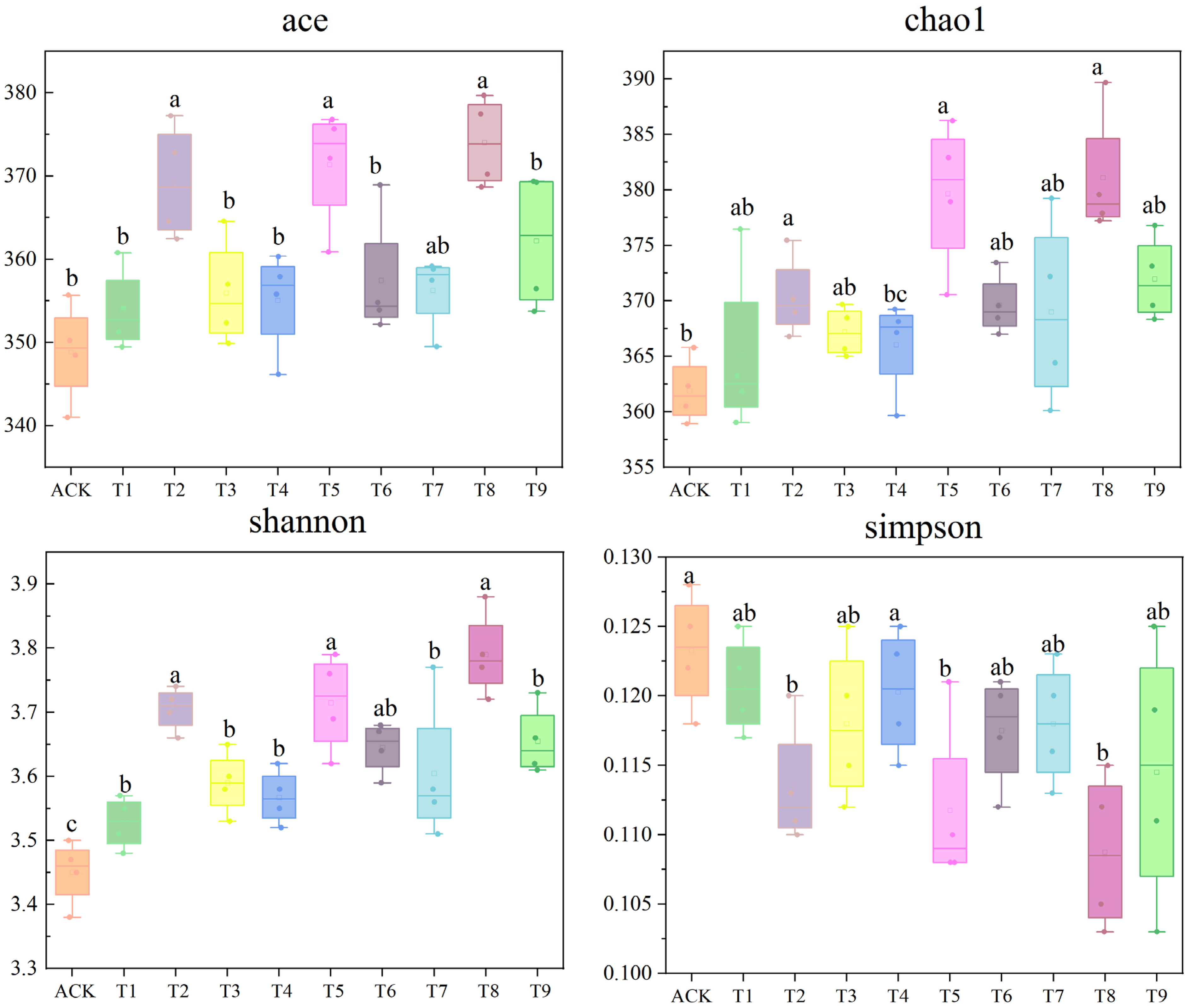
In environmental microbiology, Alpha diversity analysis is used to assess the species richness and evenness within a community. Richness, which estimates the total number of species, is represented by the Chao1 and ACE indices. Diversity, which reflects both species evenness and the dominance of certain species, is comprehensively measured by the Shannon and Simpson indices. Together, these metrics reveal the ecological complexity and stability of the soil microbial community. The effects of different microbial fertilizer treatments on the fungal community diversity in the rhizosphere soil of the salt–alkali-tolerant sunflower variety NX53177 are shown in Figure 1. Under treatments T1–T9, the species richness index (ace) increased by 1.45%, 5.85%, 2.04%, 1.78%, 6.46%, 2.47%, 2.12%, 7.21%, and 3.83%, respectively, compared to ACK. The Chao1 index increased by 0.90%, 2.34%, 1.47%, 1.15%, 4.91%, 2.14%, 1.96%, 5.31%, and 2.78%, respectively. The species diversity index (Shannon) increased by 2.32%, 7.54%, 4.06%, 3.48%, 7.83%, 5.80%, 4.64%, 9.86%, and 6.09%, respectively. The Simpson index of community dominance decreased by 8.78%, 21.49%, 12.40%, 12.19%, 25.10%, 15.81%, 14.77%, 25.83%, and 21.49%, respectively. Among all microbial fertilizer treatments, the T8 treatment increased the Shannon diversity index by 9.86% and decreased the Simpson index by 25.83% compared to ACK, indicating that the T8 treatment can effectively increase the species diversity level of the rhizosphere soil fungal community.
Figure 1.
Effects of different concentrations of microbial fertilizer on the Alpha diversity of soil fungal communities in the NX53177 variety. Different letters indicate statistically significant differences at p < 0.05.
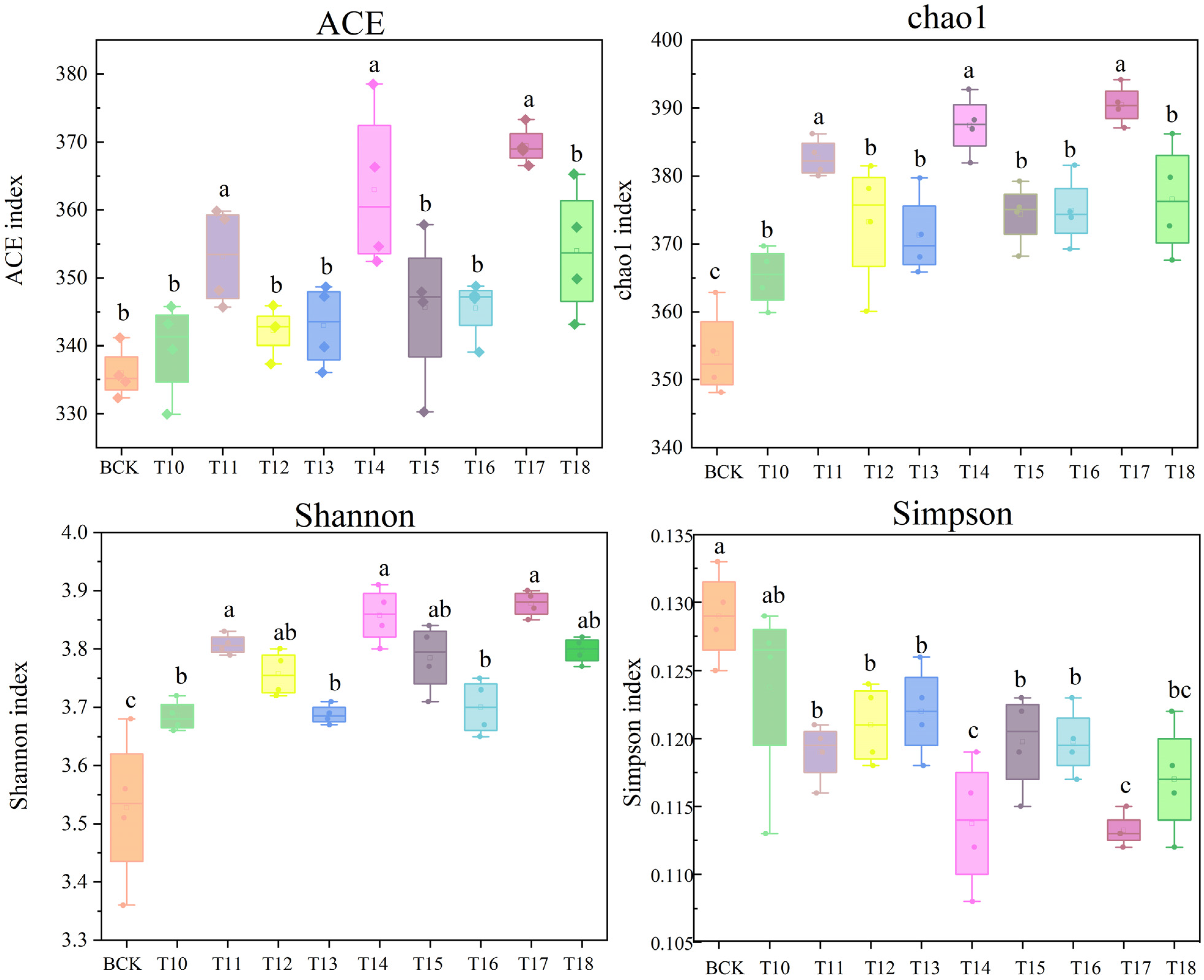
The effects of different microbial fertilizer treatments on the fungal community diversity in the rhizosphere soil of the non-salt–alkali-tolerant sunflower variety NKY1502 are shown in Figure 2. Under treatments T10-T18, the species richness index (ace) increased by 1.08%, 5.10%, 1.86%, 2.08%, 8.04%, 2.87%, 2.86%, 10.00%, and 5.35%, respectively, compared to BCK. The Chao1 index increased by 3.18%, 8.91%, 5.47%, 4.91%, 9.49%, 5.79%, 5.93%, 10.34%, and 6.41%, respectively. The species diversity index (Shannon) increased by 4.53%, 7.93%, 6.52%, 4.53%, 9.35%, 7.37%, 4.82%, 9.92%, and 7.65%, respectively. The Simpson index of community dominance decreased by 4.03%, 7.75%, 6.20%, 5.43%, 11.78%, 7.13%, 7.13%, 12.17%, and 9.23%, respectively. Among all microbial fertilizer treatments, the T17 treatment increased the species richness (ACE index) and community diversity (Shannon index) of the sunflower rhizosphere soil fungal community by 10.00% and 9.92%, respectively, while decreasing the community dominance (Simpson index) by 12.17% compared to BCK. This indicates that the T17 treatment had the most significant effect on improving the diversity of the rhizosphere soil fungal community. Microbial fertilizers can increase the richness and species diversity of the soil fungal community while decreasing its dominance, thus regulating the rhizosphere soil microbiome.
Figure 2.
Effects of different concentrations of microbial fertilizer on the Alpha diversity of soil fungal communities in the NKY1502 variety. Different letters indicate statistically significant differences at p < 0.05.
3.2. Effects of Different Microbial Fertilizers on the Abundance of Sunflower Rhizosphere Soil Fungal Communities
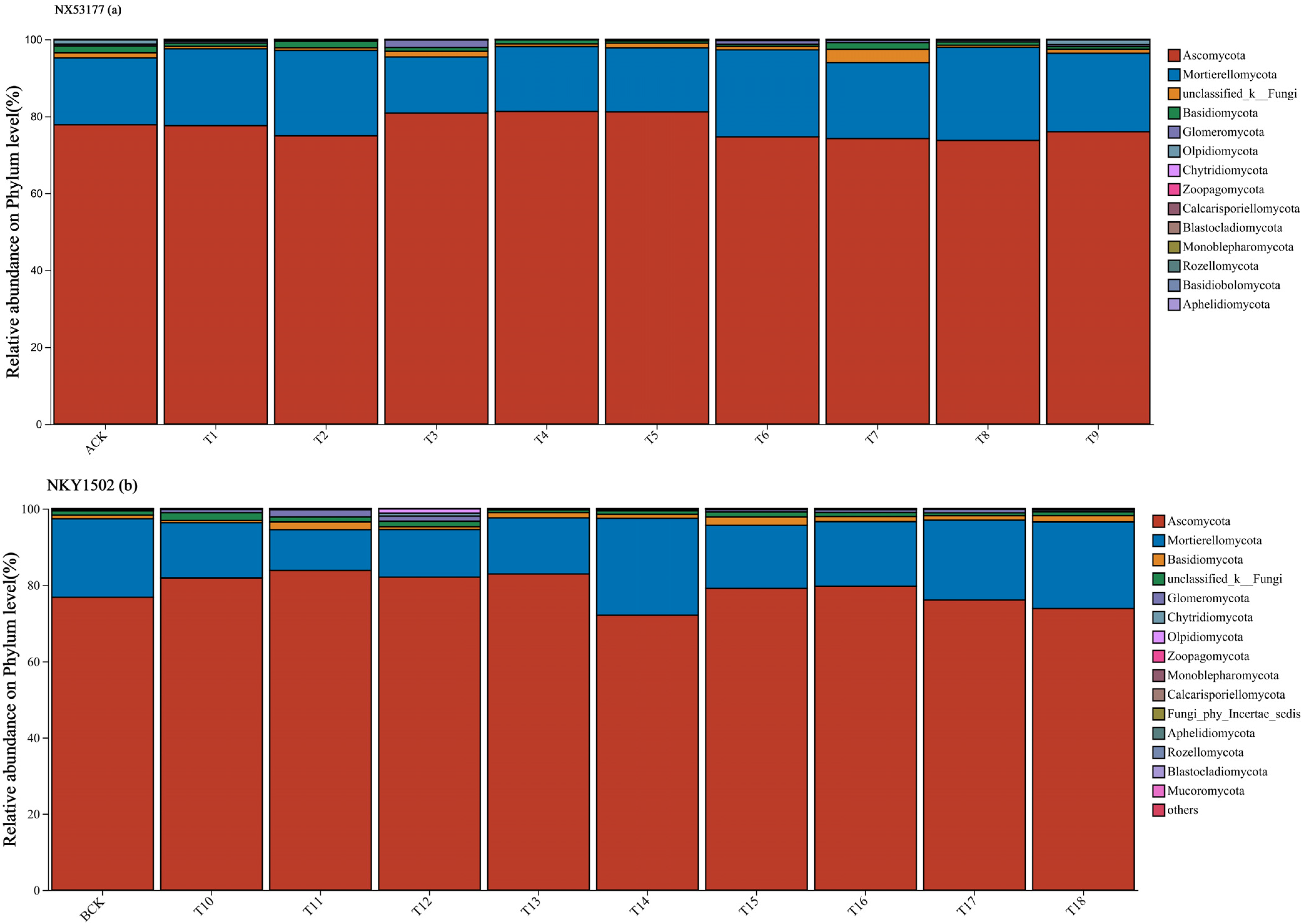
In this experiment, a total of 537 species of fungi were identified, belonging to 16 phyla, 49 classes, 92 orders, 174 families, and 354 genera. At the phylum level, the fungal communities in the rhizosphere soil of the salt–alkali-tolerant sunflower variety NX53177 (Figure 3a) with a relative abundance greater than 1% included Ascomycota (73.74–81.26%), Mortierellomycota (14.60–24.21%), and Basidiomycota (0.57–2.17%). For the non-salt–alkali-tolerant sunflower variety NKY1502 (Figure 3b), the fungal phyla with relative abundances greater than 1% were Ascomycota (72.06–83.80%), Mortierellomycota (10.73–25.41%), and Basidiomycota (0.53–2.17%).
Figure 3.
Relative abundance of rhizosphere soil fungi at the phylum level. (a) NX53177, (b) NKY1502.
At the phylum level, the relative abundance of fungal phyla in the rhizosphere of the salt–alkali-tolerant sunflower variety NX53177 varied among different microbial fertilizers and concentrations (Figure 3a). The relative abundance of Mortierellomycota was concentrated in the T2 and T8 treatments, increasing by 28.0% and 39.4% compared to ACK, respectively. The relative abundance of Ascomycota in the T8 treatment was 73.74%, a decrease of 5.20% compared to ACK, while in the T6 (74.68%) and T7 (74.23%) treatments, it decreased by 4.04% and 4.61% relative to ACK, respectively. The relative abundance of Basidiomycota in all treatment groups was lower than in ACK, with reductions ranging from 68.5% to 91.2%. The T8 treatment showed the largest decrease in Basidiomycota abundance, down by 68.5% compared to ACK, whereas the T6 treatment showed the smallest decrease, down by 51.6% compared to ACK. This indicates that different microbial fertilizer treatments have significantly different inhibitory effects on Basidiomycota, with their relative abundance decreasing across all treatments. In summary, different microbial fertilizer treatments significantly affect the relative abundance of dominant fungal phyla in sunflower rhizosphere soil, indicating that microbial fertilizers exert a specific regulatory effect on the structure of the rhizosphere fungal community. In the non-salt–alkali-tolerant sunflower variety NKY1502, the relative abundance of fungal phyla also showed variability among different microbial fertilizer treatments and concentrations (Figure 3b). The relative abundances of Ascomycota and Mortierellomycota both exceeded 1%. In the T12 and T13 treatments, the relative abundance of Ascomycota increased by 5.24% and 6.08% compared to BCK, respectively, whereas the T14 and T18 treatments showed an inhibitory effect, with relative abundances decreasing by 4.74% and 3.89% compared to BCK, respectively. Mortierellomycota showed varied responses among treatments; its relative abundance increased by 23.7% and 10.6% in the T14 and T18 treatments, respectively, compared to BCK. Conversely, the T11 and T10 treatments exhibited an inhibitory effect, with relative abundances decreasing by 47.8% and 29.0%, respectively, compared to BCK. This demonstrates that different concentrations of microbial fertilizers have a significant regulatory effect on the relative abundance of major fungal phyla in the rhizosphere soil of sunflowers.
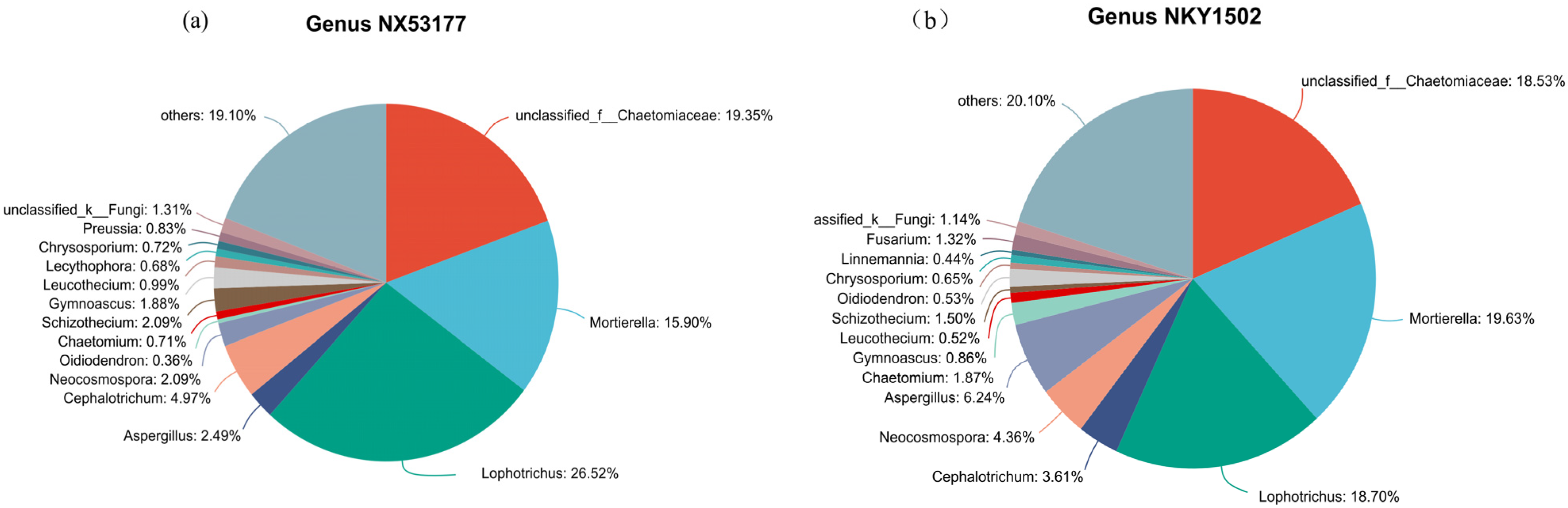
At the genus level, the fungal community in the rhizosphere soil of the salt–alkali-tolerant sunflower variety NX53177 (Figure 4a) was analyzed by selecting the top 15 dominant fungal genera based on relative abundance. Among them, the relative abundance of Mortierella was 15.90%. The relative abundance of Mortierella was significantly increased in the T3 and T8 treatments by 20.2% and 46.2%, respectively, compared to ACK, indicating that these fertilizer treatments promote this genus. The relative abundance of Lophotrichus was 26.52%. Its abundance decreased in all treatment groups, with the T3 treatment showing the most significant inhibitory effect, a 67.6% reduction compared to ACK. In contrast, the relative abundance of Chaetomium was 0.71%, and it showed the best promotional effect in the T8 treatment, with its relative abundance increasing by 309.9% compared to ACK. This indicates that different types and concentrations of microbial fertilizers have a significant impact on the structure of the fungal genus community. For the non-salt–alkali-tolerant sunflower variety NKY1502 (Figure 4b), an analysis of the top 15 dominant fungal genera revealed that among them, the relative abundance of Lophotrichus was 18.70%, and its abundance decreased in all treatment groups, with the T12 treatment showing a 73.6% reduction compared to BCK. The total relative abundance of unclassified Chaetomiaceae was exceptionally high, totaling 35.03%. The relative abundance of Mortierella was 0.34%. In the T14 treatment, its relative abundance significantly increased by 15.96% compared to BCK, but decreased by 32.1% in the T10 treatment, showing a concentration-dependent “promotion-inhibition” effect. These results suggest that microbial fertilizers regulate the fungal community structure by altering the rhizosphere microenvironment, and different concentrations can affect the abundance and distribution patterns of specific functional fungal groups.
Figure 4.
Relative abundance of rhizosphere soil fungi at the genus level. (a) NX53177, (b) NKY1502.
3.3. Effects of Different Microbial Fertilizer Treatments on Differential Species in the Rhizosphere Soil of Oil Sunflower
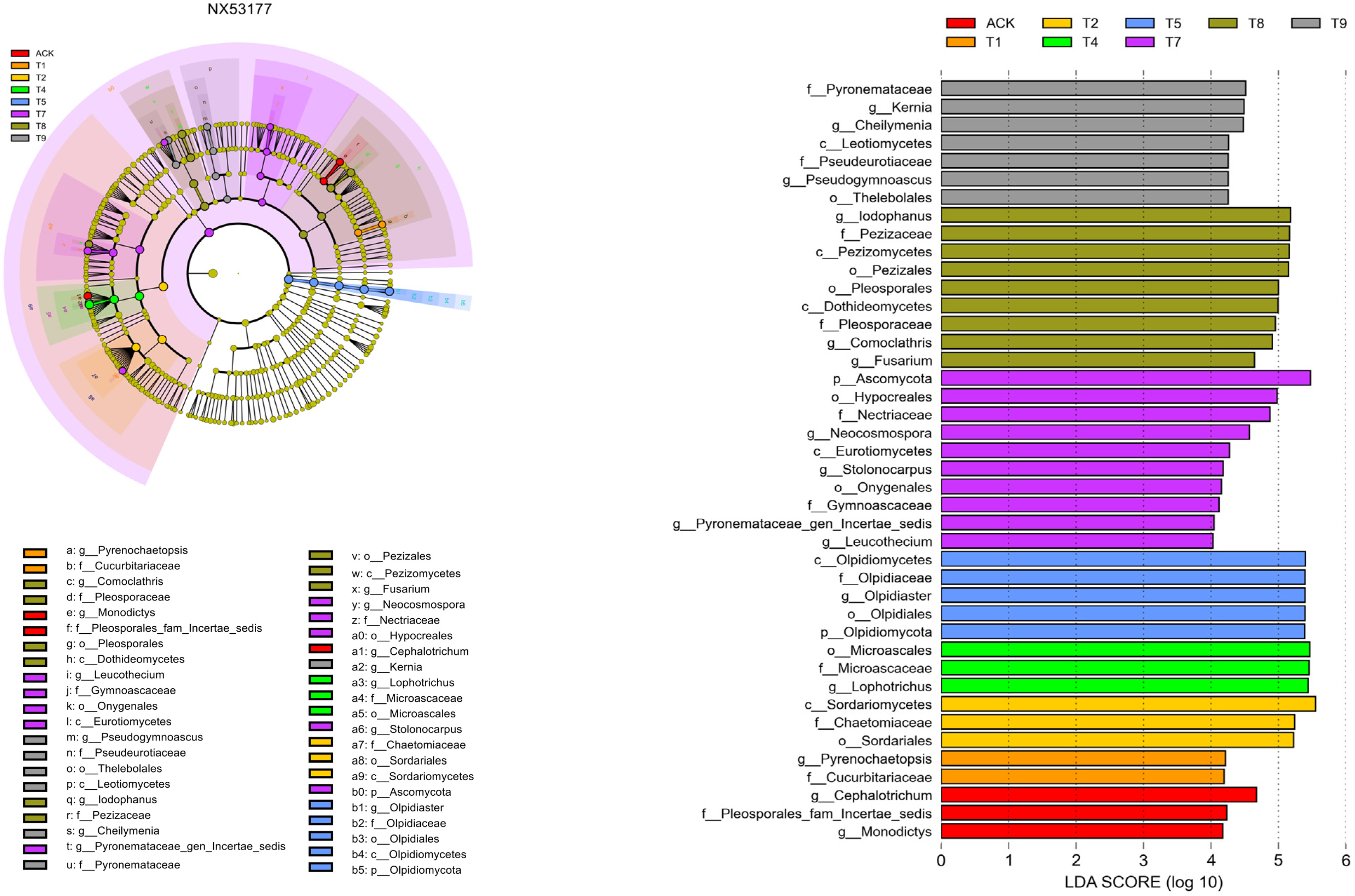
Using LEfSe analysis on the fungal community during the flowering stage, significantly enriched taxonomic units were identified at multiple levels for the NX53177 variety (LDA > 2.0, p < 0.05). The results (Figure 5) show that a total of 143 differentially abundant species were identified across treatments. Within the phylum Ascomycota, the number of identified species in the ACK-T9 treatments for the genus Aspergillus ranged from 5 to 9; for Penicillium, 2–4; for Cladosporium, 4–6; and for Alternaria, 1–7. The T8 treatment had the highest number of biomarker species (23), an increase of 10 compared to ACK. At the phylum level, Ascomycota was significantly enriched in multiple sample groups with 324 species, indicating its dominant position in the soil fungal community. At the genus level, common soil fungi such as Aspergillus, Cladosporium, Alternaria, and Penicillium were significantly enriched with 14, 8, 9, and 7 species, respectively. In summary, the LEfSe analysis revealed that different treatments had a significant impact on the number of species within each genus. These differences help us to better understand the relationship between different treatment conditions and the distribution of specific genera within Ascomycota.
Figure 5.
LEfSe analysis of differential soil fungal taxa in the NX53177 variety treated with different concentrations of microbial fertilizer.
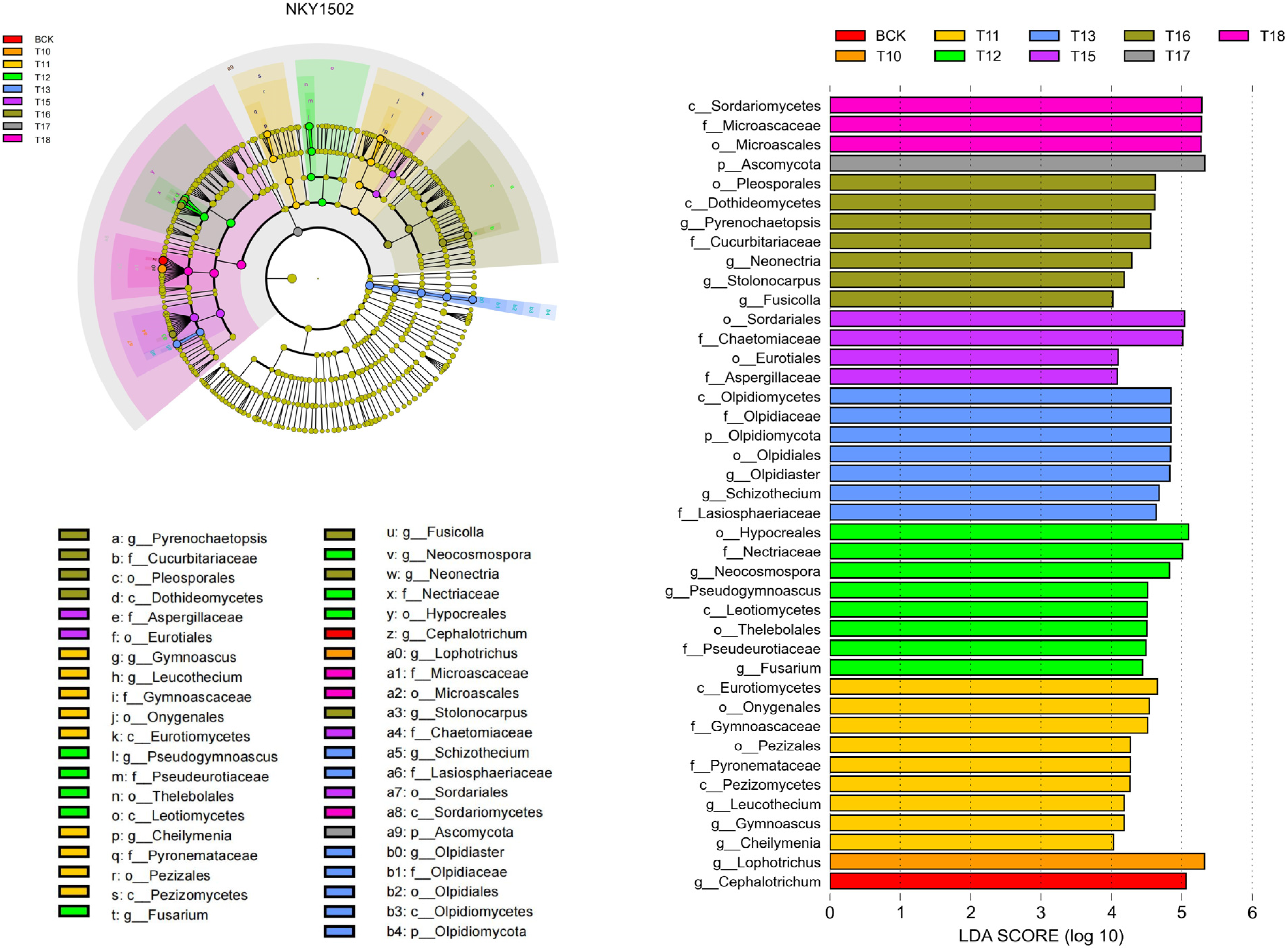
For the NKY1502 variety, significantly enriched fungal taxa were identified at multiple taxonomic levels (LDA > 4.0, p < 0.05). The results (Figure 6) show that the phylum Ascomycota was significantly enriched across multiple sample groups with a total of 1384 species. The top four significantly enriched genera were Aspergillus, Mortierella, Cladosporium, and Cephalotrichum, with 68, 56, 55, and 33 species, respectively. A total of 152 differentially abundant species were identified among the treatments. In the BCK-T18 treatments, the number of species for Aspergillus ranged from 5 to 9; for Penicillium, 1–4; for Cladosporium, 4–7; and for Alternaria, 2–4. The T17 treatment group had the highest number of significantly enriched microbial taxa, with 162 significantly different taxonomic units identified. This suggests that under the environmental conditions represented by the T17 treatment, various taxa within Ascomycota are more likely to thrive. In conclusion, this study’s LEfSe analysis demonstrates that different treatment measures significantly altered the structure and composition of the soil fungal community, with the T17 treatment fostering the greatest diversity of specific microbial taxa.
Figure 6.
LEfSe analysis of differential soil fungal taxa in the NKY1502 variety treated with different concentrations of microbial fertilizer.
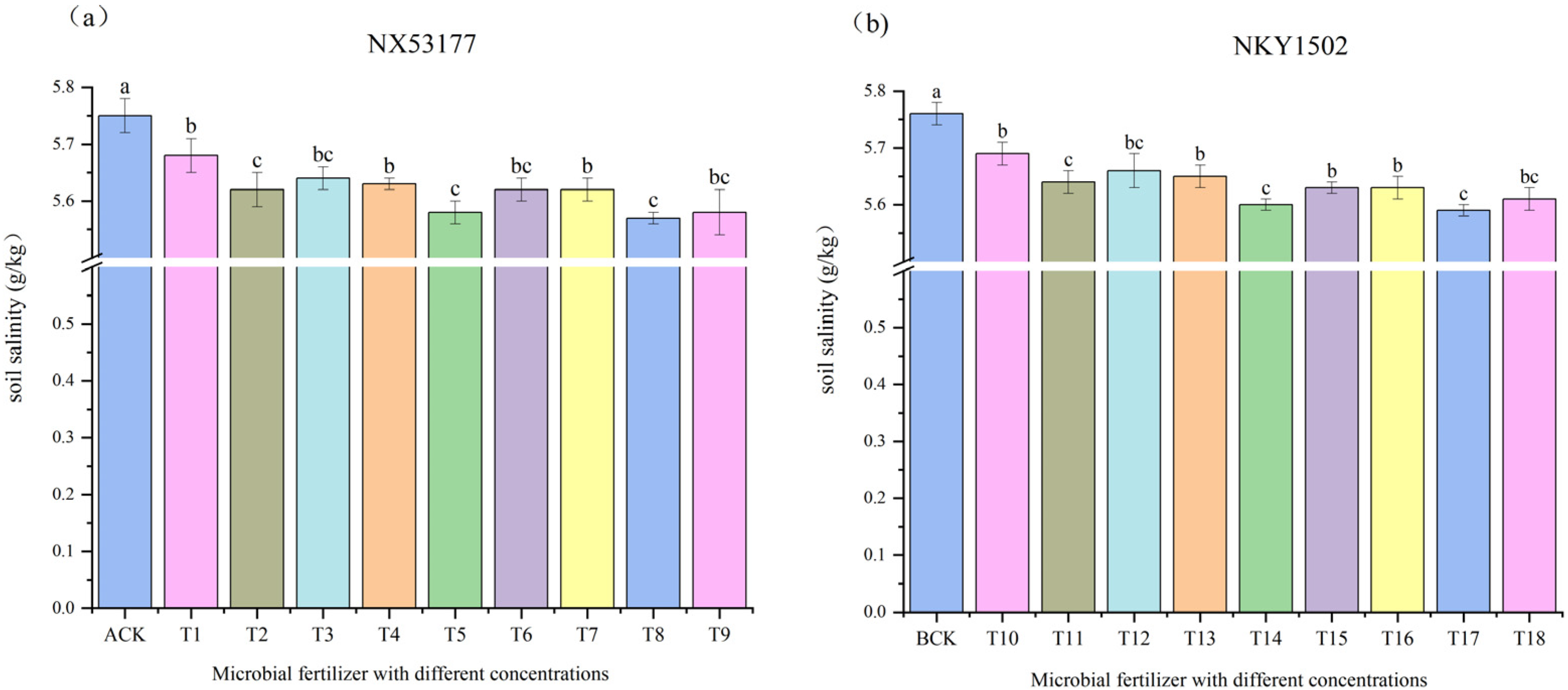
3.4. Effects of Different Concentrations of Microbial Fertilizers on Soil Salinity
Soil salinity is a core indicator for characterizing the degree of soil salinization and assessing soil quality and crop suitability. As the concentration of microbial fertilizer increased, soil salt content showed a trend of first decreasing and then increasing. The effect on the soil salinity of the salt–alkali-tolerant variety NX53177 is shown in Figure 7a. The Qiaosengen treatments T1, T2, and T3 decreased soil salinity by 1.22%, 2.26%, and 1.91%, respectively, compared to ACK. The Polylactic acid treatments T4, T5, and T6 decreased it by 2.09%, 2.96%, and 2.26%, respectively. The Aikesa treatments T7, T8, and T9 decreased it by 2.26%, 3.13%, and 2.96%, respectively. The medium concentration treatments of all three fertilizers (T2, T5, T8) showed the optimal salt-reducing effect, with the Aikesa fertilizer T8 treatment being the most effective, reducing salinity to 1.83 g/kg, a 3.13% decrease compared to ACK, which was superior to other treatments.
Figure 7.
Effects of different concentrations of microbial fertilizers on sunflower soil salinity. (a) NX53177, (b) NKY1502. Different letters indicate statistically significant differences at p < 0.05.
The effect on the soil salinity of the non-salt–alkali-tolerant variety NKY1502 is shown in Figure 7b. The Qiaosengen treatments T10, T11, and T12 decreased soil salinity by 1.22%, 2.08%, and 1.74%, respectively, compared to BCK. The Polylactic acid treatments T13, T14, and T15 decreased it by 1.91%, 2.78%, and 2.26%, respectively. The Aikesa treatments T16, T17, and T18 decreased it by 2.26%, 2.95%, and 2.60%, respectively. The medium concentration treatments of all three fertilizers (T11, T14, T17) showed the best salt-reducing effect, with the Aikesa fertilizer T17 treatment being the most significant, reducing salinity by 2.95% compared to BCK, followed by the Polylactic acid T14 and Qiaosengen T11 treatments. In conclusion, the salt reduction in the salt–alkali-tolerant sunflower variety NX53177 was greater than that in the non-tolerant variety NKY1502, indicating that the ameliorative effect of microbial fertilizers differs with crop salt tolerance. A comprehensive comparison of the salt-reducing capabilities of the three fertilizers ranked them as Aikesa > Polylactic acid > Qiaosengen, a trend that was consistent for both varieties. For the amelioration of saline–alkali land, the use of a medium concentration of Aikesa fertilizer can maximize the reduction in soil salinity, especially for the cultivation of salt–alkali tolerant sunflower, providing a scientific basis for optimizing microbial remediation technologies for saline–alkali land.
3.5. Effects of Different Concentrations of Microbial Fertilizers on Soil Nutrients
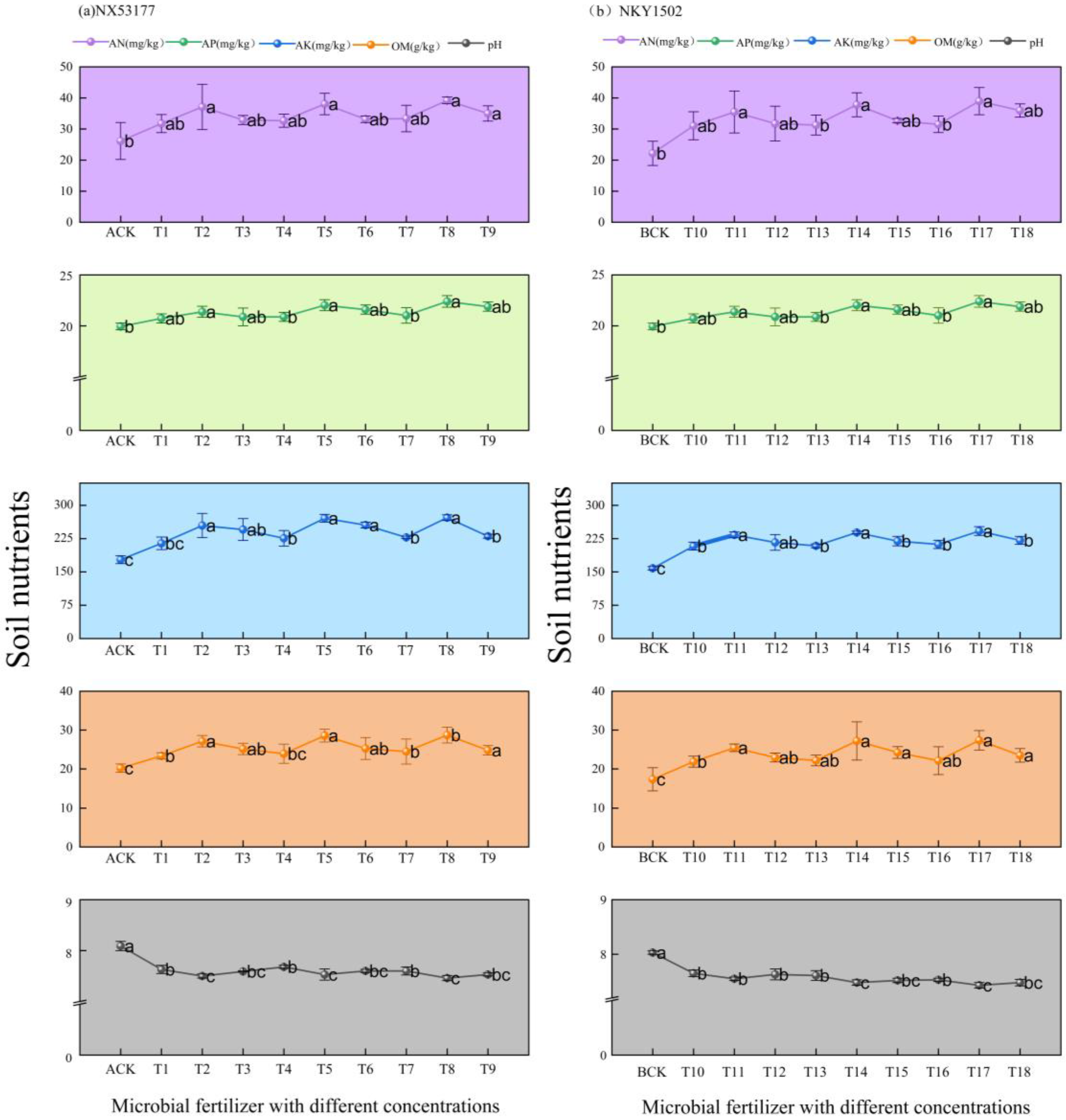
Soil nutrients are fundamental to sustaining ecosystem productivity and function, as their availability directly governs plant growth, shapes community structure, and drives biogeochemical cycling. This study evaluated the influence of different microbial fertilizers on the nutrient profile of sunflower rhizosphere soil by analyzing key indicators, including available nitrogen (AN), available phosphorus (AP), available potassium (AK), organic matter (OM) content, and pH. For both sunflower varieties tested, the fertilizer efficacy across three concentration levels consistently demonstrated the trend: medium concentration > high concentration > low concentration.
As detailed in Figure 8a, the medium-concentration treatments (T2, T5, T8) significantly enhanced the nutrient status in the rhizosphere soil of the salt–alkali-tolerant variety NX53177 compared to the untreated control (ACK). Specifically, hydrolyzable nitrogen content increased by 41.93%, 45.60%, and 49.96%; available potassium content increased by 43.25%, 52.46%, and 53.22%; available phosphorus content increased by 7.22%, 10.48%, and 12.34%; and organic matter content increased by 34.31%, 41.44%, and 42.13%, respectively. Soil pH decreased by 7.29%, 6.92%, and 7.79%, respectively, compared to ACK. These results demonstrate that the application of microbial fertilizers, particularly at medium concentrations, effectively augments the availability of key nutrients and mitigates soil alkalinity in the rhizosphere of salt–alkali-tolerant sunflowers. Among the treatments, the medium concentration of Aikesa fertilizer (T8) proved to be the most effective, yielding the highest nutrient enrichment and acidification effect, followed by T5 and T2.
Figure 8.
Effects of different concentrations of microbial fertilizers on sunflower soil nutrient content. (a) NX53177, (b) NKY1502. Different letters indicate statistically significant differences at p < 0.05.
Consistent with the results for the salt-tolerant variety, the medium-concentration treatments (T11, T14, T17) also significantly enhanced the nutrient profile of the rhizosphere soil for the non-salt–alkali-tolerant variety NKY1502 compared to its control (BCK) (Figure 8b). Hydrolyzable nitrogen content increased by 59.99%, 70.50%, and 75.78%; available potassium content increased by 47.47%, 50.85%, and 52.97%; available phosphorus content increased by 15.32%, 16.40%, and 13.20%; and organic matter content increased by 46.80%, 55.92%, and 57.94%, respectively. Soil pH decreased by 9.04%, 6.85%, and 7.47%, respectively, compared to BCK. Among these, the medium concentrations of Polylactic acid (T14) and Aikesa (T17) fertilizers were the most effective at boosting hydrolysable nitrogen and organic matter content. All fertilizer treatments effectively reduced the degree of soil salinization, with pH reductions ranging from 6.85% to 9.04%. In summary, medium-concentration microbial fertilizer treatments can effectively increase the content of available nitrogen, available potassium, available phosphorus, and organic matter in rhizosphere soil, while lowering soil pH, thus mitigating alkaline stress. These results confirm the potential of microbial fertilizers for improving saline–alkali soil environments, and their mechanism of action may be closely related to the targeted regulation of key functional microbial groups in the rhizosphere, as observed in previous research.
3.6. Correlation Between Soil Environmental Factors and Fungal Community Structure Under Different Microbial Fertilizer Treatments
Analyzing the correlation between rhizosphere soil microbial communities and environmental factors is essential for elucidating soil ecosystem functions and plant-microbe interactions. Our results demonstrate that soil physicochemical properties significantly shaped the fungal community composition, with distinct patterns observed between the two sunflower varieties.
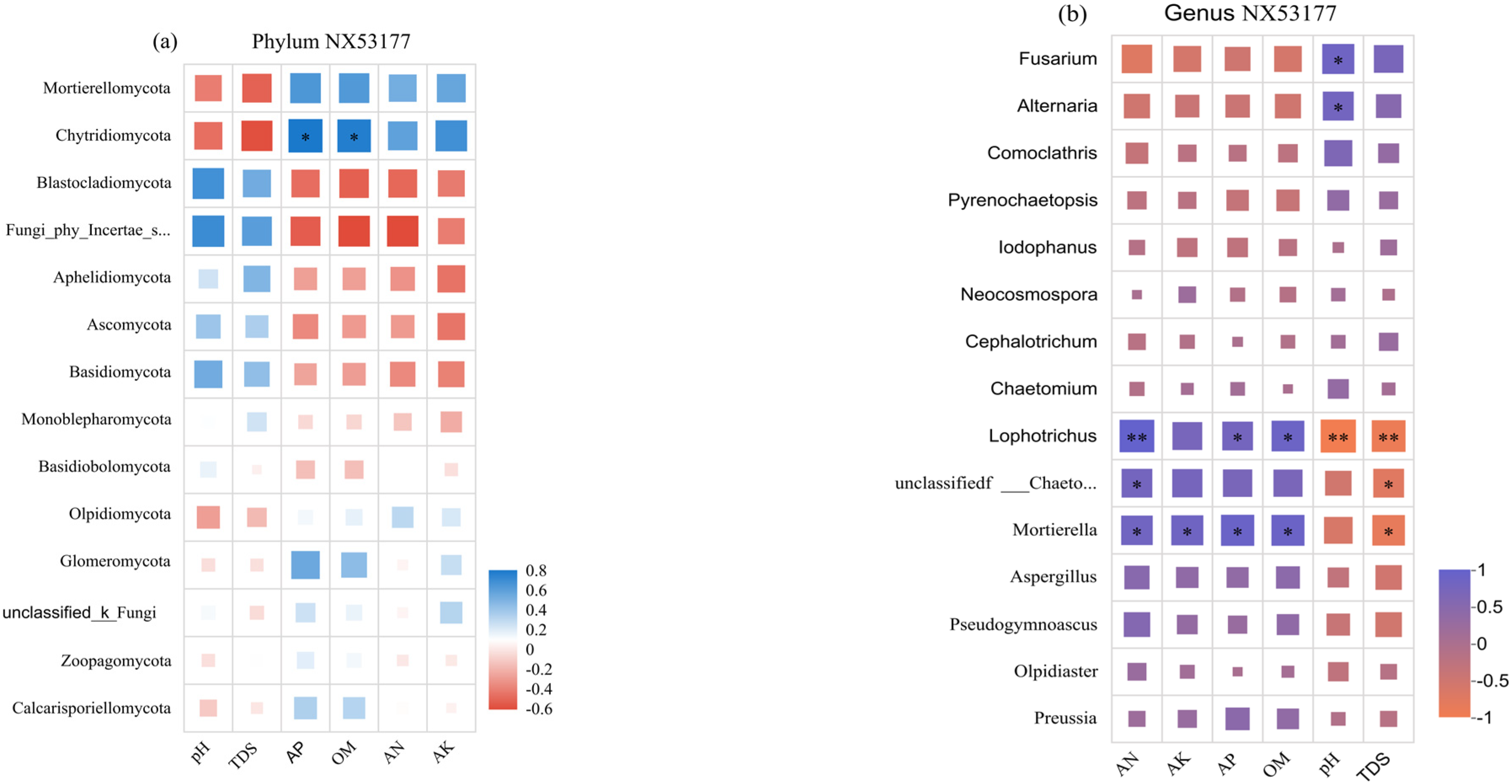
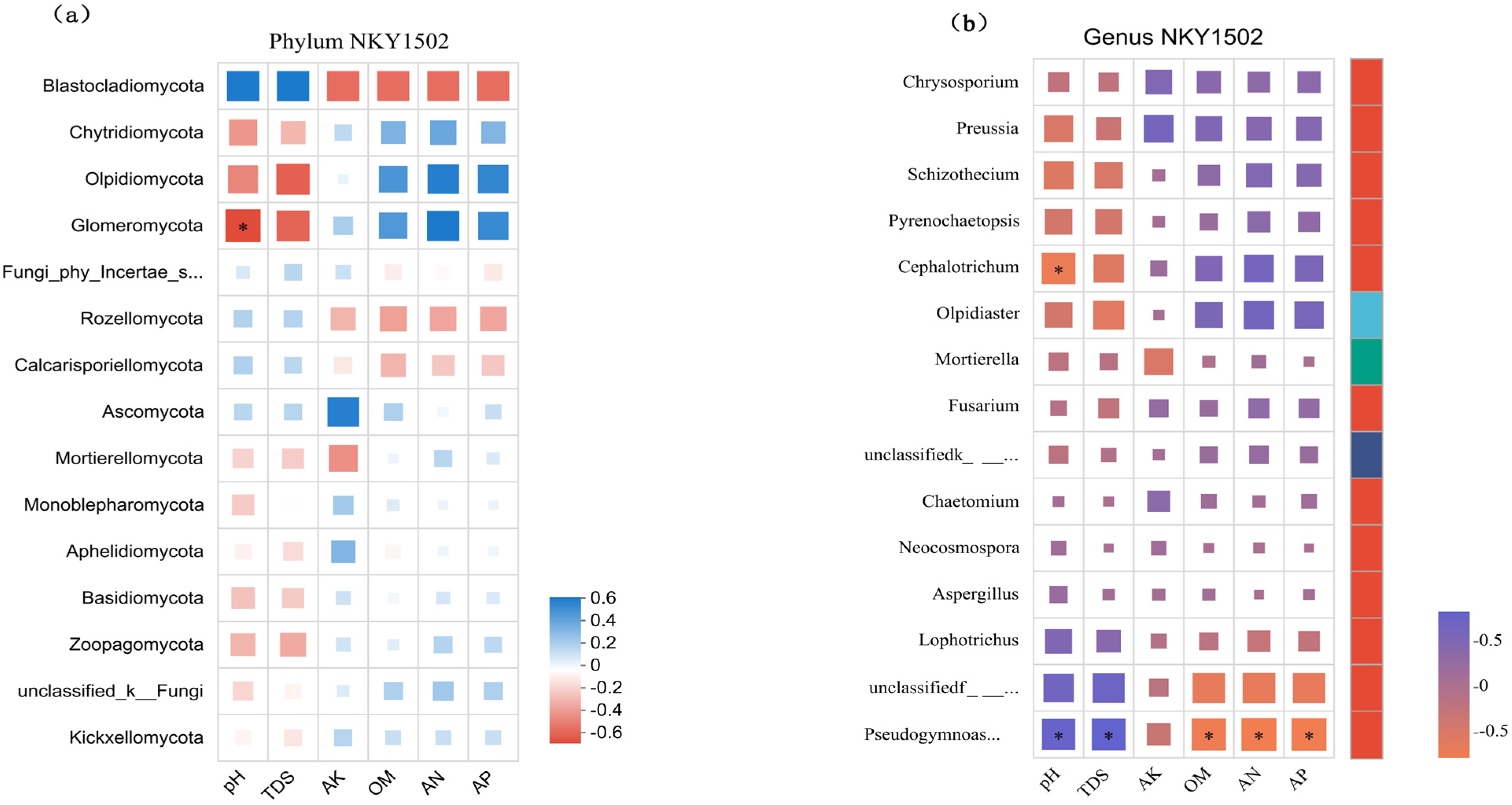
In the salt–alkali-tolerant variety NX53177 (Figure 9a), soil pH was a key differentiating factor, showing a positive correlation with Ascomycota (r = 0.34) but a negative correlation with Mucoromycota (r = −0.41), suggesting a selective pressure on fungal taxa in alkaline conditions. Salinity (TDS) exerted a significant inhibitory effect on Mucoromycota (r = −0.50 *) and Chytridiomycota (r = −0.49 *). In contrast, available phosphorus (AP) promoted the growth of these phyla, with positive correlations observed for Mucoromycota (r = 0.56 *) and Chytridiomycota (r = 0.71 **). Furthermore, organic matter (OM) and available nitrogen (AN) were strongly positively correlated with Chytridiomycota abundance (r = 0.68 ** and r = 0.52 *, respectively), underscoring the pivotal role of nutrient availability in structuring the microbial community under saline–alkaline stress. The non-salt–alkali-tolerant variety NKY1502 exhibited different response patterns. Available potassium (AK) content showed a significant inhibitory effect on Blastocladiomycota (r = −0.52 *) but a mild promotional effect on Glomeromycota (r = 0.16), indicating that nutrient imbalances can selectively restrict specific microbial groups. A key commonality between the varieties was the consistent positive response of Chytridiomycota to organic matter and nitrogen; however, this effect was more pronounced in the salt–alkali-tolerant NX53177. This suggests that the variety’s tolerance may be linked to a more efficient microbe-mediated nutrient utilization pathway, which is enhanced under favorable soil nutrient conditions. In conclusion, specific soil factors are critical determinants of fungal community structure. The differential response of the two varieties highlights the role of plant genotype in mediating these soil-community interactions. These findings have significant theoretical and practical value for optimizing microbial fertilizer applications and improving crop resilience in saline–alkaline soils.
Figure 9.
Spearman correlation heatmap of environmental factors and fungal community composition for the NX53177 variety. (a) Phylum level. (b) Genus level. The X-axis and Y-axis represent environmental factors and fungal groups, respectively. Correlation R and p values were calculated. * Indicates 0.01 < p < 0.05, ** indicates 0.001 < p < 0.01.
At the genus level, correlation analysis revealed distinct response patterns of the fungal community to soil environmental factors between the salt–alkali-tolerant variety NX53177 and the non-tolerant variety NKY1502. In the salt–alkali-tolerant variety NX53177 (Figure 9b), available nitrogen (AN) exhibited a strong positive correlation with the relative abundance of unclassified Chaetomiaceae (r = 0.64) and Lophotrichus (r = 0.83), but a significant negative correlation with Fusarium (r = −0.62). This indicates a selective regulatory effect of nitrogen enrichment, potentially favoring certain saprotrophic taxa while suppressing this common pathogen. Furthermore, both available potassium (AK) and organic matter (OM) were positively correlated with Mortierella (r = 0.70 and r = 0.76, respectively), suggesting a synergistic role of nutrients in promoting this beneficial genus. Conversely, soil pH and salinity (TDS) were strongly negatively correlated with Lophotrichus (r = −0.86 and r = −0.63, respectively). The significant positive correlation between available phosphorus (AP) and Mortierella (r = 0.76) further suggests that phosphorus availability may be a critical auxiliary factor supporting its proliferation in saline–alkaline conditions.
The non-salt–alkali-tolerant variety NKY1502 exhibited a distinct response pattern to soil environmental factors (Figure 10a). Notably, available potassium (AK) content demonstrated a significant negative correlation with the abundance of Blastocladiomycota (r = −0.52 *), while showing a slight positive correlation with Glomeromycota (r = 0.16). This indicates that AK imbalance may selectively restrict certain microbial taxa. A key commonality across both varieties was the consistent positive response of Chytridiomycota to increased organic matter and available nitrogen. However, this synergistic effect was markedly more pronounced in the salt–alkali-tolerant variety NX53177. This differential response suggests that the mechanism of salt–alkali tolerance may be linked to the host plant’s ability to foster a rhizosphere microbiome that more efficiently utilizes organic amendments and available nitrogen for growth and stress mitigation. In conclusion, specific soil factors are key determinants of fungal community structure, and their regulatory effects are modulated by plant genotype. These findings provide a mechanistic insight into plant-microbe interactions under abiotic stress and hold significant practical value for guiding targeted microbial fertilizer applications to enhance crop resilience and rehabilitate saline–alkaline ecosystems.
Figure 10.
Spearman correlation heatmap of environmental factors and fungal community composition for the NKY1502 variety. (a) Phylum level. (b) Genus level. The X-axis and Y-axis represent environmental factors and fungal groups, respectively. Correlation R and p values were calculated. * Indicates 0.01 < p < 0.05.
In the non-salt–alkali-tolerant variety NKY1502 (Figure 10b), the fungal community at the genus level exhibited distinct environmental correlations. A positive correlation was observed between soil pH and an unclassified genus within Mucoraceae (r = 0.52 *), reflecting its adaptation to a neutral-alkaline environment. Salinity (TDS) exerted divergent influences, demonstrating a promotional effect on Pseudogymnoascus (r = 0.66 **) but an inhibitory effect on Schizothecium (r = −0.45), highlighting a clear differentiation between salt-tolerant and salt-sensitive fungal groups. Furthermore, nutrient availability played a critical regulatory role; organic matter (OM) and available nitrogen (AN) exhibited synergistic beneficial effects on Chrysosporium (r = 0.43 and r = 0.52 *, respectively). In contrast, Pseudogymnoascus was significantly suppressed by increased organic matter (r = −0.71 **), underscoring the differential nutrient preferences among fungal taxa.
Collectively, these results elucidate the specific environmental adaptation strategies of fungal genera within the rhizosphere. More importantly, they provide a theoretical foundation for enhancing crop stress resistance by strategically managing the rhizosphere microbiome through the amendment of soil nutrient properties and the mitigation of salinity stress.
4. Discussion
4.1. Effects of Microbial Fertilizer on the Abundance and Diversity of the Rhizosphere Soil Fungal Community
Quantity, activity, and community composition of soil microorganisms serve as core indicators of soil quality and key criteria for assessing soil fertility levels. At the phylum level, the dominant fungal phyla in the rhizosphere soil of both sunflower varieties (the salt–alkali-tolerant variety NX53177 and the non-salt–alkali-tolerant variety NKY1502) were Ascomycota, Mortierellomycota, and Basidiomycota. This finding aligns with the results of Zhu et al. [], who reported that microbial fertilizers promote rhizosphere fungal diversity. Under salt stress, Ascomycota, Mortierellomycota, and Basidiomycota exhibit significant salt–alkali tolerance, establishing themselves as dominant microbial groups in the rhizosphere. Studies indicate that microbial fertilizers can regulate the composition of the rhizosphere soil fungal community by promoting or inhibiting specific fungal phyla (Ascomycota, Mortierellomycota). Different microbial fertilizer treatments exerted varying degrees of regulatory effects on the relative abundance of these dominant fungi. For the salt–alkali-tolerant variety NX53177, the relative abundance of Ascomycota in the T8 treatment was significantly lower than in the ACK control, whereas the relative abundance of Mortierellomycota was 39.4% higher. Furthermore, all fertilizer treatments suppressed Basidiomycota, with reductions ranging from 78.4% to 91.2%. For the non-salt–alkali-tolerant variety NKY1502, the T14 and T18 treatments promoted the growth of Ascomycota, while the T11 treatment inhibited it. At the genus level, the abundance of Mortierella increased by 46.2% in the T8 treatment for NX53177 and by 15.96% in the T14 treatment for NKY1502, which can be attributed to its decomposition capacity and plant growth-promoting properties. The genus Lophotrichus was inhibited across all fertilizer treatments, consistent with the findings of Chen [], Harsonowati [], and others. Studies indicate that microbial fertilizers can regulate the composition of the rhizosphere soil fungal community by promoting or inhibiting specific fungal phyla (e.g., Ascomycota, Mortierellomycota). This regulatory effect is primarily influenced by the type and concentration of the microbial fertilizer, as well as the salt–alkali tolerance of the crop variety [,]. This finding not only demonstrates the targeted regulatory role of microbial fertilizers on the fungal community in saline–alkali soils but also provides a crucial theoretical basis for understanding the ecological mechanisms through which they improve the fungal community structure in such environments.
Microbial community diversity is a key indicator for assessing the stability of the soil micro-ecosystem. The application of microbial fertilizers can increase the abundance of the fungal community in the plant rhizosphere soil, thereby creating a favorable micro-ecological environment for healthy crop growth and laying the foundation for the biological control of soil-borne diseases. The results of this study demonstrate that for the salt-tolerant variety NX53177, the medium concentration of Aikesa fertilizer (T8 treatment) significantly increased the Ace, Chao1, and Shannon indices, while decreasing the Simpson index. A similar pattern was observed for the salt-sensitive variety NKY1502 under the medium concentration Aikesa fertilizer treatment (T17). The study by Hu et al. [] showed that the application of Bacillus amyloliquefaciens ZM9 mixed with marigold powder increased the number of OTUs, the Chao1 index, and the Shannon index of the soil microbial community, outperforming the control, which is consistent with our findings. The medium concentration of Aikesa fertilizer significantly enhanced the species richness, diversity, and evenness of the rhizosphere soil fungal community, providing suitable living conditions for a wider range of fungal groups. Excessively high or low concentrations did not yield comparable results. This is likely related to the regulation of environmental factors such as soil nutrients and ion balance by the fertilizer concentration, consistent with the findings of Tao, Chen et al. [,]. This research not only provides a scientific basis for the rational application of Aikesa fertilizer but also suggests that the optimized fungal community structure lays the foundation for the adaptive growth of sunflowers under saline–alkali stress.
4.2. Effects of Microbial Fertilizer on Soil Salinity and Nutrients
Soil microorganisms play a vital role in maintaining soil ecological functions. They influence soil fertility formation and ecosystem function by participating in key processes such as organic matter decomposition, humus formation, and nutrient transformation [,]. Microbial fertilizers, as efficient biological amendments, improve the soil ecological environment by regulating microbial community structure, enhancing soil enzyme activity, and promoting nutrient cycling. In this experiment, the ameliorative effects of Aikesa fertilizer (T8 and T17 treatments) were optimal. Under the T8 treatment, soil pH decreased by 7.79%, salinity (TDS) decreased by 3.13%, organic matter (OM) content increased by 42.13%, and the contents of available nitrogen (AN), phosphorus (AP), and potassium (AK) increased by 49.96%, 12.34%, and 53.22%, respectively. Under the T17 treatment, soil pH decreased by 7.47%, salinity decreased by 2.95%, OM content increased by 57.94%, and the contents of AN, AP, and AK increased by 75.78%, 13.20%, and 52.97%, respectively. Studies by Li [] and Liu [] have shown that the combined application of organic manure with microbial fertilizers and humic acid can significantly increase soil nitrogen content. Research by Shang et al. [] confirmed that the application of microbial agents can increase the content of soil organic matter, total phosphorus, alkali-hydrolysable nitrogen, available phosphorus, and available potassium in the 0–20 cm soil layer of Dongkui bayberry orchards, though it is necessary to monitor and adjust soil pH to prevent acidification from long-term application.
In terms of mechanism, microbial fertilizers convert poorly available soil nutrients into available forms through the metabolic activities of functional microorganisms capable of nitrogen fixation, phosphorus solubilization, and potassium solubilization. This is manifested specifically as an increase in the content of AN, AP, and AK in the soil. The accumulation of microbial residues and their secretions can also contribute to increased soil organic matter. The improvement of these soil properties provides an important environmental basis for the proliferation and structural development of the fungal community.
4.3. Correlation Between the Soil Fungal Community and Soil Environmental Factors
The community composition and distribution patterns of plant rhizosphere soil microorganisms are closely related to surrounding soil environmental factors, primarily reflecting the differential adaptability of microorganisms to various environmental conditions. Guo et al. [], using RDA analysis, demonstrated that the structure of the soil fungal community is mainly affected by available phosphorus and available nitrogen. The key influencing factors can differ under varying cropping patterns; in mixed cropping systems, soil organic matter, available nitrogen, and available phosphorus significantly affect the formation of the fungal community structure. The abundance of Penicillium and Mortierella is positively correlated with the content of available nitrogen and available phosphorus.
In this experiment, Spearman correlation analysis revealed the relationships between soil physicochemical properties and fungal community composition. Soil pH, TDS, OM, AN, AK, and AP were identified as environmental factors affecting changes in the fungal community, with different fungal groups responding differently to these factors. Ascomycota and Mortierellomycota were negatively correlated with soil pH and TDS, which may be related to the relatively higher salt–alkali tolerance of Ascomycota. Beneficial fungi such as Mortierella and Lophotrichus were positively correlated with OM, AN, and AK, and negatively correlated with soil pH and TDS, indicating their preference for low-salinity, high-nutrient soil microenvironments. The abundance of Basidiomycota and Lophotrichus was inhibited; after the application of microbial fertilizer, intensified nutrient competition and decreased soil pH likely limited their proliferation. This is consistent with the research results of Leng et al. [], Xu et al. [], and Ning et al. [].
It is evident that the regulatory effect of microbial fertilizers on the fungal community is achieved by altering soil physicochemical properties, which in turn affects the abundance of different soil fungi. The varying sensitivities of different fungal groups to environmental factors determine their relative abundance within the community, which, to some extent, explains the soil–fungal community effect mechanism of microbial fertilizers.
5. Conclusions
This study comprehensively analyzed the composition of the sunflower rhizosphere soil fungal community using high-throughput sequencing, identifying a total of 537 fungal species belonging to 16 phyla, 49 classes, 92 orders, 174 families, and 354 genera. At the phylum level, Ascomycota, Mortierellomycota, and Basidiomycota were the main fungal groups. Microbial fertilizer treatments significantly regulated the fungal community structure and diversity, with effects varying by fertilizer concentration and sunflower variety. In the salt-tolerant variety NX53177, the medium concentration of Aikesa (T8) increased the relative abundance of Mortierellomycota by 39.4%, the Shannon index by 9.86%, and decreased the Simpson index by 25.83%. In the salt-sensitive variety NKY1502, the T14 and T18 treatments significantly increased the abundance of Mortierellomycota by 23.7% and 10.6%, respectively, and the T17 treatment increased the Shannon index by 9.92%.
The fertilizer effectively reduced soil salinity and improved nutrient levels, with the medium-concentration treatments performing optimally. The T8 treatment reduced soil salinity by 9.45%, increased hydrolyzable nitrogen, available potassium, and organic matter by 49.96%, 53.22%, and 42.13%, respectively, and lowered pH by 7.79%. The T17 treatment reduced salinity by 6.05%, increased hydrolyzable nitrogen and available potassium by 75.78% and 52.97%, respectively, and lowered pH by 7.47%.
Spearman correlation analysis indicated that the rhizosphere fungal community of the salt-tolerant variety was more significantly associated with environmental factors; available phosphorus was strongly positively correlated with Chytridiomycota, and salinity (TDS) was negatively correlated with Mucoromycota. At the genus level, nitrogen content significantly promoted the growth of Lophotrichus, while pH significantly inhibited its abundance.
In summary, this study demonstrates that microbial fertilizers positively affect salt–alkali tolerance by regulating the fungal community structure and improving soil physicochemical properties. Among the treatments, the Aikesa fertilizer (T8, T17) was the most effective, providing a theoretical basis and practical guidance for the ecological restoration of saline–alkali lands and sustainable agricultural development. Future research will continue to investigate the dynamic changes in the fungal community at different plant growth stages and the precise application of microbial fertilizers.
Author Contributions
Writing—original draft, S.G. Conceptualization, writing—review and editing, W.D. and K.W. Funding acquisition, Y.L. and Y.H. Methodology, P.W. and S.L. Project administration, X.J. Supervision. All authors have read and agreed to the published version of the manuscript.
Funding
This research was funded by the Science and Technology Innovation Talent Project of Xinjiang Production and Construction Corps (2023CB007-06), the Youth Project of “Outstanding Talents of Xinjiang Production and Construction Corps”, the Key Area Science and Technology Research Project of Xinjiang Production and Construction Corps (2024AB014), the Key R&D Plan Project of Gansu Academy of Agricultural Sciences (2022GAAS20), and the Sunflower Modern Technology Industry System Construction Project (CARS-16).
Data Availability Statement
The original contributions presented in this study are included in the article. Further inquiries can be directed to the corresponding authors.
Acknowledgments
We thank everyone who contributed to this study. The authors acknowledge the use of AI tools (DeepSeek) for language polishing and translation of the manuscript. The authors are solely responsible for the content and originality of the scientific work presented herein.
Conflicts of Interest
The authors declare no conflicts of interest.
References
- Zhao, Y.; Wang, G.; Zhao, M.; Wang, M.; Jiang, M. Direct and indirect effects of soil salinization on soil seed banks in salinizing wetlands in the Songnen Plain, China. Sci. Total Environ. 2022, 819, 152035. [Google Scholar] [CrossRef]
- Wang, M.; Xu, P.; Zhou, J.; Ge, J.; Xu, G. Characterization of the molecular, cellular, and behavioral changes caused by exposure to a saline-alkali environment in the Chinese mitten crab, Eriocheir sinensis. Environ. Res. 2024, 262, 119956. [Google Scholar] [CrossRef] [PubMed]
- Baloch, M.Y.J.; Zhang, W.; Sultana, T.; Akram, M.; Al Shoumik, B.A.; Khan, M.Z.; Farooq, M.A. Utilization of sewage sludge to manage saline–alkali soil and increase crop production: Is it safe or not? Environ. Technol. Innov. 2023, 32, 103266. [Google Scholar] [CrossRef]
- Lei, G.; Zeng, W.; Jiang, Y.; Chang, A.; Wu, J.; Huang, J. Sensitivity analysis of the SWAP (soil-water-atmosphere-plant) model under different nitrogen applications and root distributions in saline soils. Pedosphere 2021, 31, 807–821. [Google Scholar] [CrossRef]
- Acosta, A.; Jansen, B.; Kalbitz, K.; Faz, A.; Martínez-Martínez, S. Salinity increases mobility of heavy metals in soils. Chemosphere 2011, 85, 1318–1324. [Google Scholar] [CrossRef]
- Li, C.; Yang, J.; Wang, D. Phytoremediation of uranium and cadmium contaminated soils by sunflower (Helianthus annuus L.) enhanced with biodegradable chelating agents. J. Clean. Prod. 2020, 263, 121491. [Google Scholar] [CrossRef]
- Xiang, X.; Liu, J.; Zhang, J.; Li, D.; Xu, C.; Kuzyakov, Y. Divergence in fungal abundance and community structure between soils under long-term mineral and organic fertilization. Soil Tillage Res. 2020, 196, 104491. [Google Scholar] [CrossRef]
- Liu, Y.; Xun, W.; Chen, L.; Xu, Z.; Zhang, N.; Feng, H.; Zhang, Q.; Zhang, R. Rhizosphere microbes enhance plant salt tolerance: Toward crop production in saline soil. Comput. Struct. Biotechnol. J. 2022, 20, 6543–6551. [Google Scholar] [CrossRef]
- Sun, C.; Sun, B.; Chen, L.; Zhang, M.; Lu, P.; Wu, M.; Xue, Q.; Guo, Q.; Tang, D.; Lai, H. Harnessing biosynthesized selenium nanoparticles for recruitment of beneficial soil microbes to plant roots. Cell Host Microbe 2024, 32, 150–162. [Google Scholar] [CrossRef]
- Li, X.; Cai, K.; Li, X.; Jiang, Z.; Shen, H.; Zhu, S.; Xu, K.; Sun, X. Rhizobia–legume symbiosis modulates the rhizosphere microbiota and proteins which affect the growth and development of pear rootstock. Sci. Hortic. 2024, 334, 113328. [Google Scholar] [CrossRef]
- He, M.; Li, D.; Peng, S.; Wang, Y.; Ding, Q.; Wang, Y.; Zhang, J. Reduced soil ecosystem multifunctionality is associated with altered complexity of the bacterial-fungal interkingdom network under salinization pressure. Environ. Res. 2025, 269, 120863. [Google Scholar] [CrossRef]
- Liang, J.; Xue, Z.; Yang, Z.; Chai, Z.; Shi, Z. Effects of microbial organic fertilizers on Astragalus membranaceus growth and rhizosphere microbial community. Ann. Microbiol. 2021, 71, 11. [Google Scholar] [CrossRef]
- Hoffman, B.M.; Dean, D.R.; Seefeldt, L.C. Climbing nitrogenase: Toward a mechanism of enzymatic nitrogen fixation. Acc. Chem. Res. 2009, 42, 609–619. [Google Scholar] [CrossRef]
- Jiang, X.; Zhao, J.-X.; Shi, P.-P.; Wang, X.-X.; Du, C.-H.; Zhang, S.-S.; Zhan, H.-X. Effects of different microbial fertilizers on Codonopsis pilosula physiology and rhizosphere soil environment. China J. Chin. Mater. Medica 2024, 49, 241–251. [Google Scholar] [CrossRef]
- Peng, Y.; Zhang, H.; Lian, J.; Zhang, W.; Li, G.; Zhang, J. Combined application of organic fertilizer with microbial inoculum improved aggregate formation and salt leaching in a secondary salinized soil. Plants 2023, 12, 2945. [Google Scholar] [CrossRef]
- Xia, H.; Liu, H.; Gong, P.; Li, P.; Xu, Q.; Zhang, Q.; Sun, M.; Meng, Q.; Ye, F.; Yin, W. Study of the mechanism by which Bacillus subtilis improves the soil bacterial community environment in severely saline-alkali cotton fields. Sci. Total Environ. 2025, 958, 178000. [Google Scholar] [CrossRef]
- Wang, Y.; Liu, Z.; Hao, X.; Wang, Z.; Wang, Z.; Liu, S.; Tao, C.; Wang, D.; Wang, B.; Shen, Z.; et al. Biodiversity of the beneficial soil-borne fungi steered by Trichoderma-amended biofertilizers stimulates plant production. npj Biofilms Microbiomes 2023, 9, 46. [Google Scholar] [CrossRef] [PubMed]
- Barrios, E. Soil biota, ecosystem services and land productivity. Ecol. Econ. 2007, 64, 269–285. [Google Scholar] [CrossRef]
- Purahong, W.; Wubet, T.; Lentendu, G.; Schloter, M.; Pecyna, M.J.; Kapturska, D.; Hofrichter, M.; Krüger, D.; Buscot, F. Life in leaf litter: Novel insights into community dynamics of bacteria and fungi during litter decomposition. Mol. Ecol. 2016, 25, 4059–4074. [Google Scholar] [CrossRef]
- Zhao, S.; Qiu, S.; Xu, X.; Ciampitti, I.A.; Zhang, S.; He, P. Change in straw decomposition rate and soil microbial community composition after straw addition in different long-term fertilization soils. Appl. Soil Ecol. 2019, 138, 123–133. [Google Scholar] [CrossRef]
- Bao, S.D. Soil Agricultural Chemistry Analysis; China Agriculture Press: Beijing, China, 2000; p. 495. [Google Scholar]
- Zhang, S.; Wang, Z.; Chang, C.; Zhao, G.; Chen, Y.; Pan, J. Spatial-temporal characteristics of soil water and salt and its coupling relationship in the coastal area of the Yellow River Delta. J. Soil Water Conserv. 2022, 36, 299–308. [Google Scholar] [CrossRef]
- Liu, C.; Zhao, D.; Ma, W.; Guo, Y.; Wang, A.; Wang, Q. Denitrifying sulfide removal process on high-salinity wastewaters in the presence of Halomonas sp. Appl. Microbiol. Biotechnol. 2016, 100, 1421–1426. [Google Scholar] [CrossRef] [PubMed]
- Chen, S.; Zhou, Y.; Chen, Y.; Gu, J. fastp: An ultra-fast all-in-one FASTQ preprocessor. Bioinformatics 2018, 34, i884–i890. [Google Scholar] [CrossRef] [PubMed]
- Magoč, T.; Salzberg, S.L. FLASH: Fast length adjustment of short reads to improve genome assemblies. Bioinformatics 2011, 27, 2957–2963. [Google Scholar] [CrossRef] [PubMed]
- Edgar, R.C. UPARSE: Highly accurate OTU sequences from microbial amplicon reads. Nat. Methods 2013, 10, 996–998. [Google Scholar] [CrossRef]
- Stackebrandt, E.; Goebel, B.M. Taxonomic Note: A Place for DNA-DNA Reassociation and 16S rRNA Sequence Analysis in the Present Species Definition in Bacteriology. Int. J. Syst. Bacteriol. 1994, 44, 846–849. [Google Scholar] [CrossRef]
- Wang, Q.; Garrity, G.M.; Tiedje, J.M.; Cole, J.R. Naive Bayesian classifier for rapid assignment of rRNA sequences into the new bacterial taxonomy. Appl. Environ. Microbiol. 2007, 73, 5261–5267. [Google Scholar] [CrossRef]
- Douglas, G.M.; Maffei, V.J.; Zaneveld, J.R.; Yurgel, S.N.; Brown, J.R.; Taylor, C.M.; Huttenhower, C.; Langille, M.G.I. PICRUSt2 for prediction of metagenome functions. Nat. Biotechnol. 2020, 38, 685–688. [Google Scholar] [CrossRef]
- Zhu, Z.; Bai, Y.; Lv, M.; Tian, G.; Zhang, X.; Li, L.; Jiang, Y.; Ge, S. Soil Fertility, Microbial Biomass, and Microbial Functional Diversity Responses to Four Years Fertilization in an Apple Orchard in North China. Hortic. Plant J. 2020, 6, 223–232. [Google Scholar] [CrossRef]
- Chen, J.; Zhou, L.; Din, I.U.; Arafat, Y.; Li, Q.; Wang, J.; Wu, T.; Wu, L.; Wu, H.; Qin, X.; et al. Antagonistic activity of Trichoderma spp. against Fusarium oxysporum in rhizosphere of Radix pseudostellariae triggers the expression of host defense genes and improves its growth under long-term monoculture system. Front. Microbiol. 2021, 12, 579920. [Google Scholar] [CrossRef]
- Harsonowati, W.; Marian, M.; Surono, N.K. The effectiveness of a dark septate endophytic fungus, Cladophialophora chaetospira SK51, to mitigate strawberry Fusarium wilt disease and with growth promotion activities. Front. Microbiol. 2020, 11, 585. [Google Scholar] [CrossRef] [PubMed]
- Shen, Z.; Ruan, Y.; Wang, B.; Zhong, S.; Su, L.; Li, R.; Shen, Q. Effect of biofertilizer for suppressing Fusarium wilt disease of banana as well as enhancing microbial and chemical properties of soil under greenhouse trial. Appl. Soil Ecol. 2015, 93, 111–119. [Google Scholar] [CrossRef]
- Zhao, J.; Wang, Y.; Liang, H.; Huang, J.; Chen, Z.; Nie, Y. The rhizosphere microbial community response to a bio-organic fertilizer: Finding the mechanisms behind the suppression of watermelon Fusarium wilt disease. Acta Physiol. Plant. 2018, 40, 17. [Google Scholar] [CrossRef]
- Hu, Y.; Zhao, W.; Li, X.; Feng, J.; Li, C.; Yang, X.; Guo, Q.; Wang, L.; Chen, S.; Li, Y.; et al. Integrated biocontrol of tobacco bacterial wilt by antagonistic bacteria and marigold. Sci. Rep. 2021, 11, 16360. [Google Scholar] [CrossRef]
- Tao, C.; Wang, Z.; Liu, S.; Lv, N.; Deng, X.; Xiong, W.; Shen, Z.; Zhang, N.; Geisen, S.; Li, R.; et al. Additive fungal interactions drive biocontrol of Fusarium wilt disease. New Phytol. 2023, 238, 1198–1214. [Google Scholar] [CrossRef]
- Chen, H.; Zhao, J.; Jiang, J.; Zhao, Z.; Guan, Z.; Chen, S. Effects of inorganic, organic and bio-organic fertilizer on growth, rhizosphere soil microflora and soil function sustainability in chrysanthemum monoculture. Agriculture 2021, 11, 1214. [Google Scholar] [CrossRef]
- Rajkumar, M.; Vara Prasad, M.N.; Freitas, H.; Ae, N. Biotechnological applications of serpentine soil bacteria for phytoremediation of trace metals. Crit. Rev. Biotechnol. 2009, 29, 120–130. [Google Scholar] [CrossRef] [PubMed]
- Kong, Z.; Liu, H. Modification of Rhizosphere Microbial Communities: A Possible Mechanism of Plant Growth Promoting Rhizobacteria Enhancing Plant Growth and Fitness. Front. Plant Sci. 2022, 13, 920813. [Google Scholar] [CrossRef] [PubMed]
- Li, X.; Lu, Q.; Li, D.; Wang, D.; Ren, X.; Yan, J.; Ahmed, T.; Li, B. Effects of Different Microbial Fertilizers on Growth and Rhizosphere Soil Properties of Corn in Newly Reclaimed Land. Plants 2022, 11, 1978. [Google Scholar] [CrossRef]
- Liu, M.; Wang, C.; Wang, F.; Xie, Y. Maize (Zea mays) growth and nutrient uptake following integrated improvement of vermicompost and humic acid fertilizer on coastal saline soil. Appl. Soil Ecol. 2019, 142, 147–154. [Google Scholar] [CrossRef]
- Shang, C.; Chen, A.; Chen, G.; Li, H.; Guan, S.; He, J. Microbial biofertilizer decreases nicotine content by improving soil nitrogen supply. Appl. Biochem. Biotechnol. 2016, 180, 1506–1518. [Google Scholar] [CrossRef] [PubMed]
- Guo, T.; Yao, X.; Wu, K.; Yao, Y. Effects of different fertilization levels on rhizosphere soil fungal community structure and diversity of hulless barley and pea mixed cropping pattern. Soils 2023, 55, 1261–1271. [Google Scholar] [CrossRef]
- Leng, F.F.; Cui, X.S.; Zhu, N.; Wang, Y.; Li, X. Characterization of root microbial communities associated with Astragalus membranaceus and their correlation with soil environmental factors. Rhizosphere 2022, 24, 100656. [Google Scholar] [CrossRef]
- Xu, C.C.; Zhang, J.T.; Ye, S.P.; Wang, L.; Chen, H. Isolation, identification of a phosphate-solubilizing Penicillium strain from soil and its application effects. Soil Fertil. Sci. China 2020, 6, 272–278. [Google Scholar] [CrossRef]
- Ning, Q.; Chen, L.; Li, F.; Zhang, C.Z.; Ma, D.H.; Cai, Z.J.; Zhang, J.B. Effects of Mortierella on Nutrient Availability and Straw Decomposition in Soil. Acta Pedol. Sin. 2022, 59, 206–217. [Google Scholar] [CrossRef]
Disclaimer/Publisher’s Note: The statements, opinions and data contained in all publications are solely those of the individual author(s) and contributor(s) and not of MDPI and/or the editor(s). MDPI and/or the editor(s) disclaim responsibility for any injury to people or property resulting from any ideas, methods, instructions or products referred to in the content. |
© 2025 by the authors. Licensee MDPI, Basel, Switzerland. This article is an open access article distributed under the terms and conditions of the Creative Commons Attribution (CC BY) license (https://creativecommons.org/licenses/by/4.0/).