Abstract
Cumulative temperature (CT) serves as a critical factor influencing soybean growth and yield, particularly under changing climatic conditions. This study investigated the relationship between CT, growth traits, and yield components of two vegetable soybean (Glycine max (L.) Merrill) cultivars, ‘Pungsannamulkong’ and ‘Aram’, across four sowing dates (late May to late June) in a mid-mountainous region of Korea during 2023–2024. Yield exhibited strong positive correlations with the number of pods per plant (r = 0.88, p < 0.001) and 100-seed weight (r = 0.86, p < 0.001), both indirectly influenced by CT. Structural analysis indicated that CT was indirectly responsible for yield by pod number per plant, which being affected by stem elongation at the R2 stage. The optimal CT range for stable yield was identified as being between 3100 °C and 3500 °C, corresponding to early to mid-June sowing. These findings highlight that optimizing sowing time to secure adequate CT during vegetative growth is a practical adaptation strategy to sustain soybean productivity in mid-mountainous regions under climate warming scenarios.
1. Introduction
Temperature is one of the most critical environmental factors influencing seasonal plant growth and geographic adaptation []. Over the past decade, global surface temperatures have risen by approximately 1.09 °C compared to pre-1900 levels, and the summer of 2023 was recorded as the hottest in history []. Such extreme heat events have adversely impacted the growth and productivity of major crops, including soybean (Glycine max (L.)), posing a significant threat to yield stability. Zhao et al. [] reported that each 1 °C increase in global mean temperature could reduce yields by 3.1% for soybean, 6.0% for wheat, 3.2% for rice, and 7.4% for maize. Regarding crop physiological responses, Alsajri et al. [] found that photosynthesis in two soybean cultivars was reduced by 7–25% under moderately elevated temperatures. Similarly, Ding et al. [] observed that yield components such as pods and seeds per plant were significantly higher under 35 °C (day)/27 °C (night) conditions than at 40/32 °C. These findings highlight that maintaining optimal temperature ranges is essential for stable crop productivity.
Soybean is one of the world’s most important food crops, valued for its protein and oil content [], and is cultivated across a wide geographic range from tropical to temperate regions. Climate change, through unpredictable temperature and precipitation patterns, has become a major challenge to crop productivity []. Addressing this vulnerability requires advances in agricultural technologies, including genetic improvement and adaptive cultivation practices []. Among these practices, determining the optimal sowing time is one of the most crucial agronomic strategies in soybean production. Proper sowing timing enhances vegetative and reproductive development, thereby improving yield and seed quality [,]. Conversely, inappropriate sowing times may lead to poor germination, delayed early growth, and increased susceptibility to environmental stresses such as drought and extreme temperatures [,].
In response to rising food and industrial demand, soybean production in South Korea has expanded, reaching 155,000 Mg in 2024 []. The country provides region-specific recommendations for optimal sowing periods based on altitude and climatic conditions, such as late May to early June in mid-mountainous regions. Adjusting sowing times also offers flexibility in cropping systems, enabling transitions from monoculture to double cropping (e.g., winter crops followed by soybean crops).
Therefore, the objective of this study was to investigate the effect of cumulative temperature on determining the optimal sowing time for vegetable soybean cultivars in a mid-mountainous region of South Korea. To address this objective, we hypothesized that an increase in cumulative temperature during the cultivation period would result in a delayed optimal sowing time.
2. Materials and Methods
2.1. Experimental Site and Weather Information
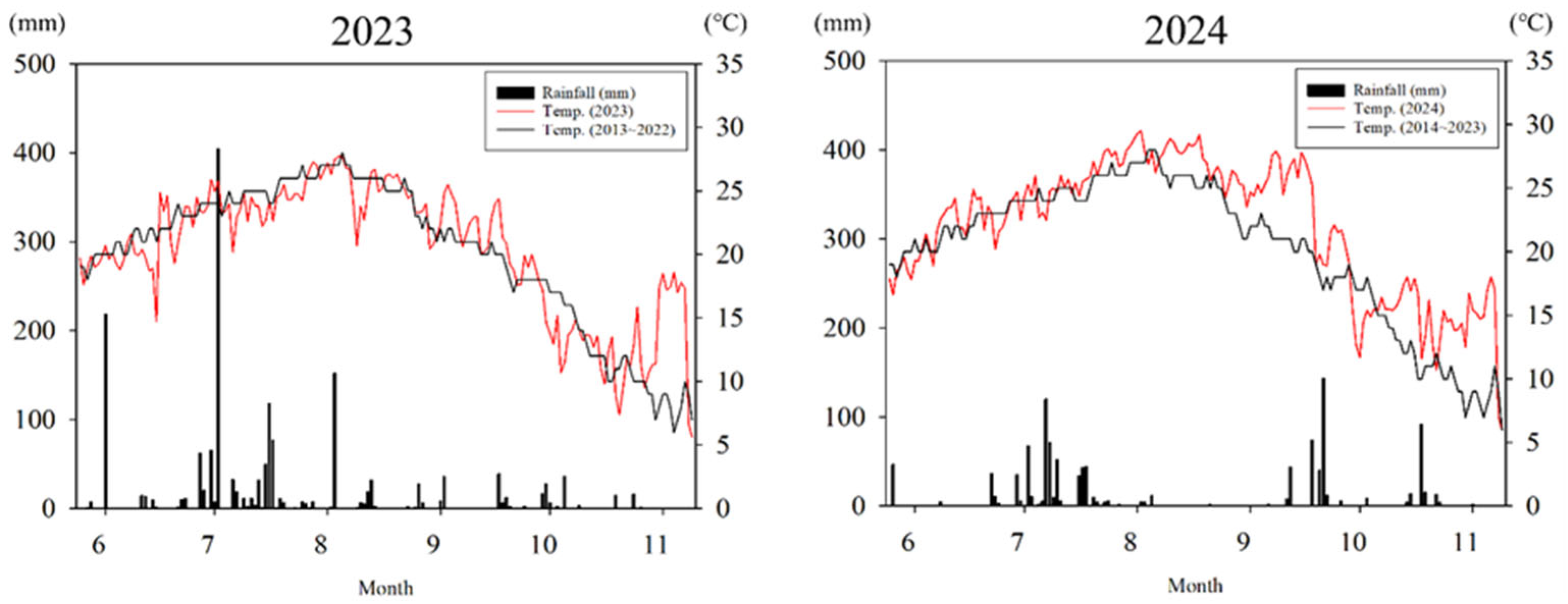
This experiment was conducted at a field with an elevation above 200 m, located in Goesan (36°48′18″ N 127°44′52″ E), Chungcheongbuk-do, South Korea, for two years, 2023 and 2024. The ATMOS-41 weather sensors (METER-Group, Pullman, WA, USA) were installed to monitor temperature and precipitation in the field, and both data were collected at 15 min intervals throughout the experiment. The data of rainfall, temperature, and ten-year mean temperature during the experiment period (late May to early November) are shown in Figure 1.
Figure 1.
Meteorological data collected during the growth duration in 2023 and 2024 provides insight into daily temperature (°C) and rainfall (mm) totals.
2.2. Experimental Setup
A split-plot design with three replications was employed, with soybean cultivars as the main plot factor and sowing time as the subplot factor. Two vegetable soybean varieties (Glycine max (L.) Merrill, non-GMO), ‘Pungsannamulkong’ and ‘Aram’, developed by the National Institute of Crop Science (NICS), RDA, were directly sown at four different time points: late May, early June, mid-June, and late June. The planting densities were 70 × 10 cm, and each plot measured 9.8 m2 (1.4 × 7.0 m). Fertilizer with N (urea), P2O5 (superphosphate), and K2O (potassium chloride) was applied before rotary tillage at the standard rate of 30–30–34 kg ha−1, as recommended by the Rural Development Administration (RDA), South Korea [].
2.3. Soil Physicochemical Properties
Soil physicochemical properties were analyzed prior to the experiment using the standard method of the Rural Development Administration (RDA) as described by []. The experimental field soil was classified as a sandy loam, with a pH of 6.0 (1:5 soil-to-water ratio) and an electrical conductivity (EC) of 0.2 dS/m (1:5). The soil contained 10.9 g kg−1 of organic matter, 251 mg kg−1 of available P2O5, 0.25 cmolc kg−1 of exchangeable potassium (K), 5.42 cmolc kg−1 of exchangeable calcium (Ca), and 1.4 cmolc kg−1 of exchangeable magnesium (Mg).
2.4. Growth Parameters, Yield, and Yield Components
Growth parameters of soybean plants were measured to evaluate their responses to different sowing dates at the reproductive stages (R2 and R5) and at harvest (R8). The main stem length (from the soil surface to the stem apex) and leaf area index (LAI) were recorded using fifteen randomly selected plants from each plot. Shoot dry weight (including stems, leaves, and pods; g plant−1) was determined from five uniformly growing plants. Above-ground biomass was oven-dried at 80 °C until a constant weight was achieved. For the estimation of yield and yield components, fifteen uniformly growing plants were harvested to determine soybean yield (kg ha−1) and yield components, including pods per plant, seeds per pod, and 100-seed weight (g).
2.5. Statistical Analysis
Data from three replicates were analyzed using RStudio (version 4.1.3). A one-way ANOVA was conducted, and Tukey’s HSD test was applied for post hoc comparisons when p < 0.05. Correlation and principal component analysis (PCA) were performed to evaluate the relationships between variables and between agronomic traits and sowing dates, respectively.
3. Results
3.1. Temperature and Precipitation During the Experiment
Temperature and precipitation are critical factors to significantly influence growth and development, as well as yield and seed quality in soybean production. Daily average temperature and precipitation during the soybean growing season (late May to early November) of 2023 and 2024 are presented in Figure 1. The weather patterns during both years showed considerable deviations from the 10-year average, and could lead to direct consequences on soybean physiology and growth performance. The average temperature for each year of the growing period was 20.4 °C in 2023 and 22.4 °C in 2024, and these values were 0.3 °C and 1.8 °C higher than the 10-year average, respectively. The trend of yearly precipitation was contrasted between both years (Figure 1). In 2023 and 2024, throughout the growing season, annual precipitation was recorded as 1553 and 1152 mm, respectively, which indicated a 35% greater increase in 2023 compared to 2024. Additionally, most of the recorded rainfall showed the tendency to be concentrated in July.
3.2. Cumulative Temperature and Growing Days by Sowing Date
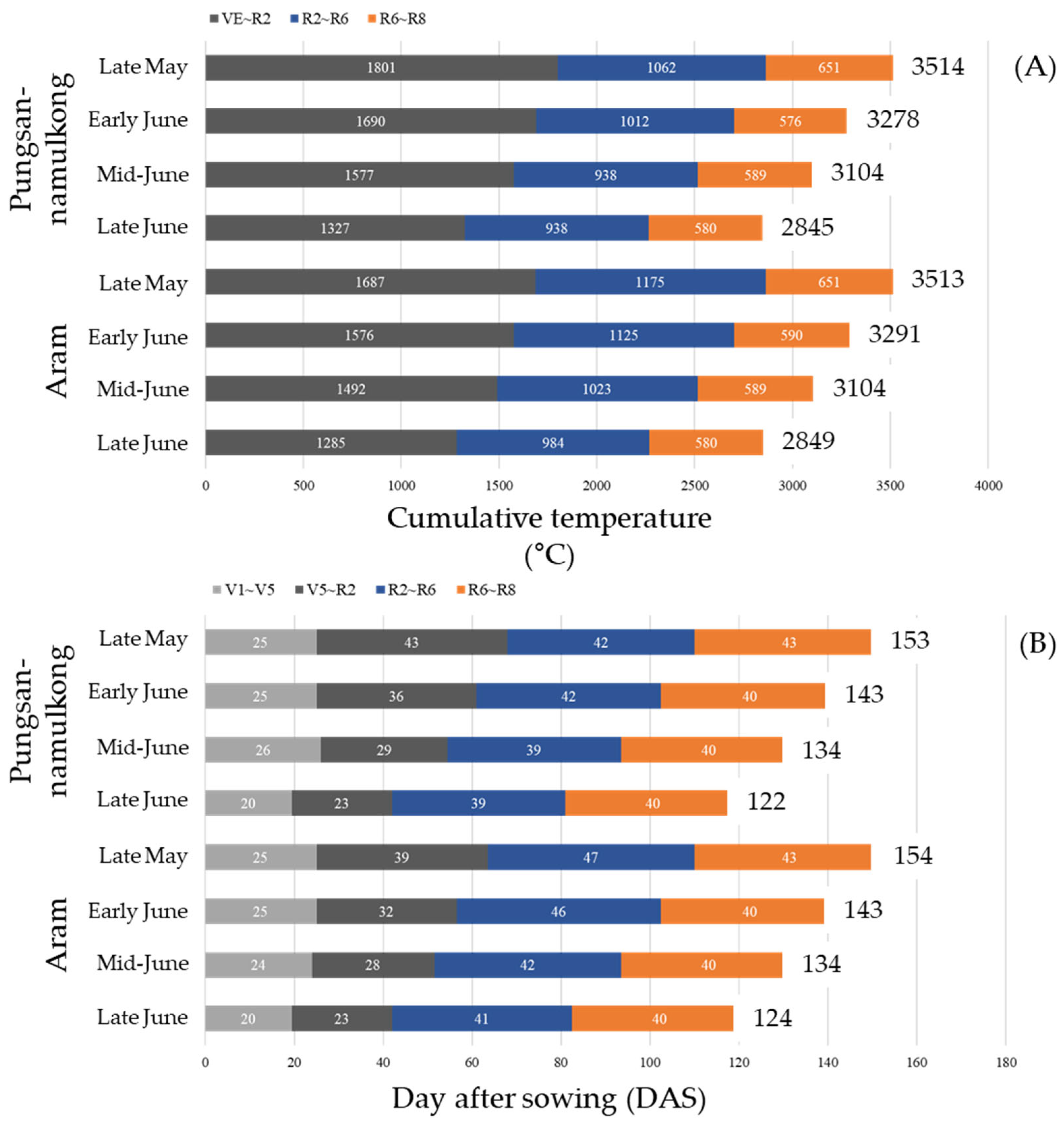
The cumulative temperature (CT, °C) and the number of growing days required to reach each developmental stage were obviously different from the sowing date (Figure 2A). The delayed sowing date significantly decreased CT, declining from 2845 °C to 3514 °C for Pungsannamulkong and 2849 °C to 3513 °C for Aram. On average, every 10-day delay of sowing date decreased the 22.3 °C of CT, and the saving effect of CT was observed to be greatest during the vegetative growth period. The growing days also presented a decreasing pattern with delayed sowing date (Figure 2B). Days required for full maturity were from 122 to 154 days, and a big difference was at the period from V5 (5 leaves) to R2 (full bloom).
Figure 2.
(A) Cumulative temperature (°C) and (B) growing days required to reach each developmental stage (VE–R2, R2–R6, and R6–R8) in Pungsannamulkong and Aram under four sowing dates.
3.3. Growth Parameters, Yield Components, and Yield
The selected agronomic traits (full bloom, R2; beginning seed, R5) and yield (physiological maturity, R8) were measured to compare the development of soybean plants in response to different sowing dates (Table 1). At the R2 stage, stem length (SL), LAI, and dry weight (DW) significantly differed from variety (V, p < 0.001, p < 0.05, and p < 0.001) and sowing time (S, p < 0.001, p < 0.001, and p < 0.001). The LAI and DW were definitely affected by the combination effect of V-S, V-Y(year), S-Y, and V-S-Y. These traits showed a similar pattern at the R5 stage, indicating a significant difference. In particular, sowing date was a key factor responsible for SL, LAI, and DW at both growth stages, showing a significant decrease due to the delay.
Table 1.
Agronomic traits at R2 (full bloom) and R5 (beginning seed) stages by variety and sowing date.
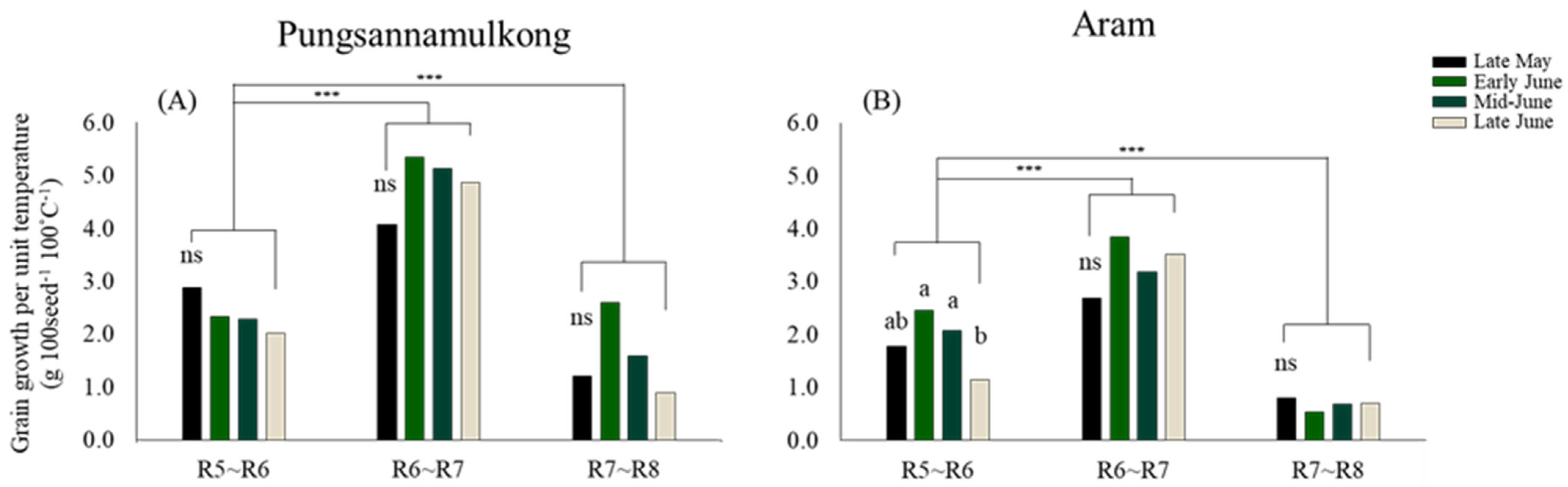
To evaluate the effect of sowing date on soybean productivity, yield and yield components were measured, and some of these traits showed a clear decrease with delayed sowing (Table 2). Yield and yield components in Pungsannamulkong were not significantly affected by sowing date except in terms of pods per plant, although the highest yield (3725 kg ha−1) was observed for mid-June sowing. In contrast, Aram was significantly different in terms of pods per plant, 100-seed weight, and yield by sowing date, with the highest yield (4007 kg ha−1) obtained from early June sowing. Due to the importance of temperature during seed development, seed filling as a function of unit temperature (100 °C) was estimated at three different time points, seed setting (R5 to R6), seed development (R6 to R7), and seed dehydration (R7 to R8). The seed development rate of both varieties was significantly higher in terms of seed development (4.0~5.5 g/100-seeds/100 °C for Pungsannamulkong; 4.0~5.5 g/100-seeds/100 °C for Aram), followed by seed setting and seed dehydration. Additionally, active seed development was dominant from early to mid-June (Figure 3).
Table 2.
Yield and yield components at R8 (full maturity) stage, classified by variety and sowing date.
Figure 3.
Effect of unit temperature (100 °C) on seed maturity during reproductive stage (R5–R8). (A) Pungsannamulkong; (B) Aram. Different letters on a bar indicate a significance at p < 0.05 by Tukey’s HSD test. ns, no significance; *** p < 0.001.
3.4. Correlation and Principal Components Analysis
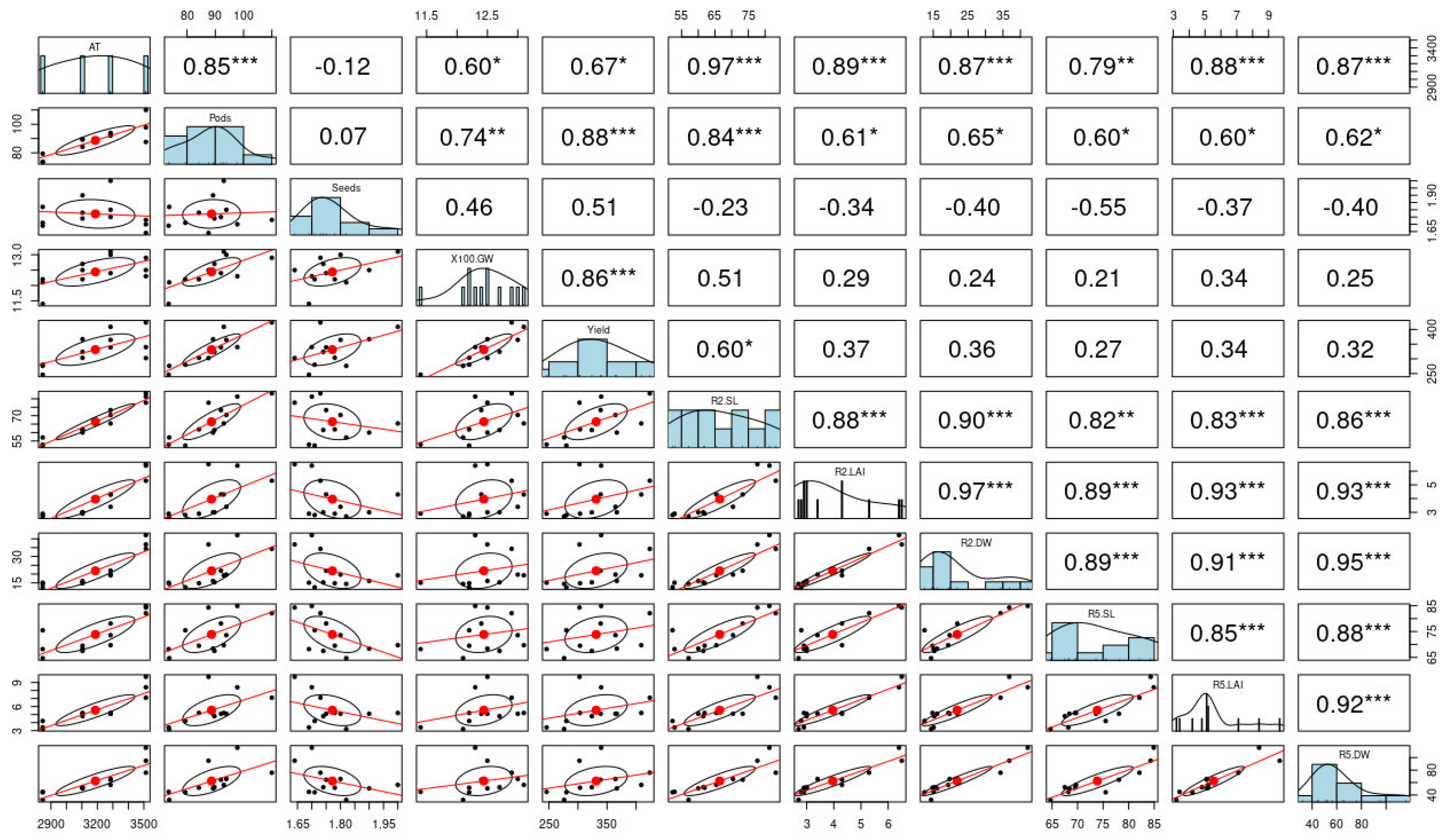
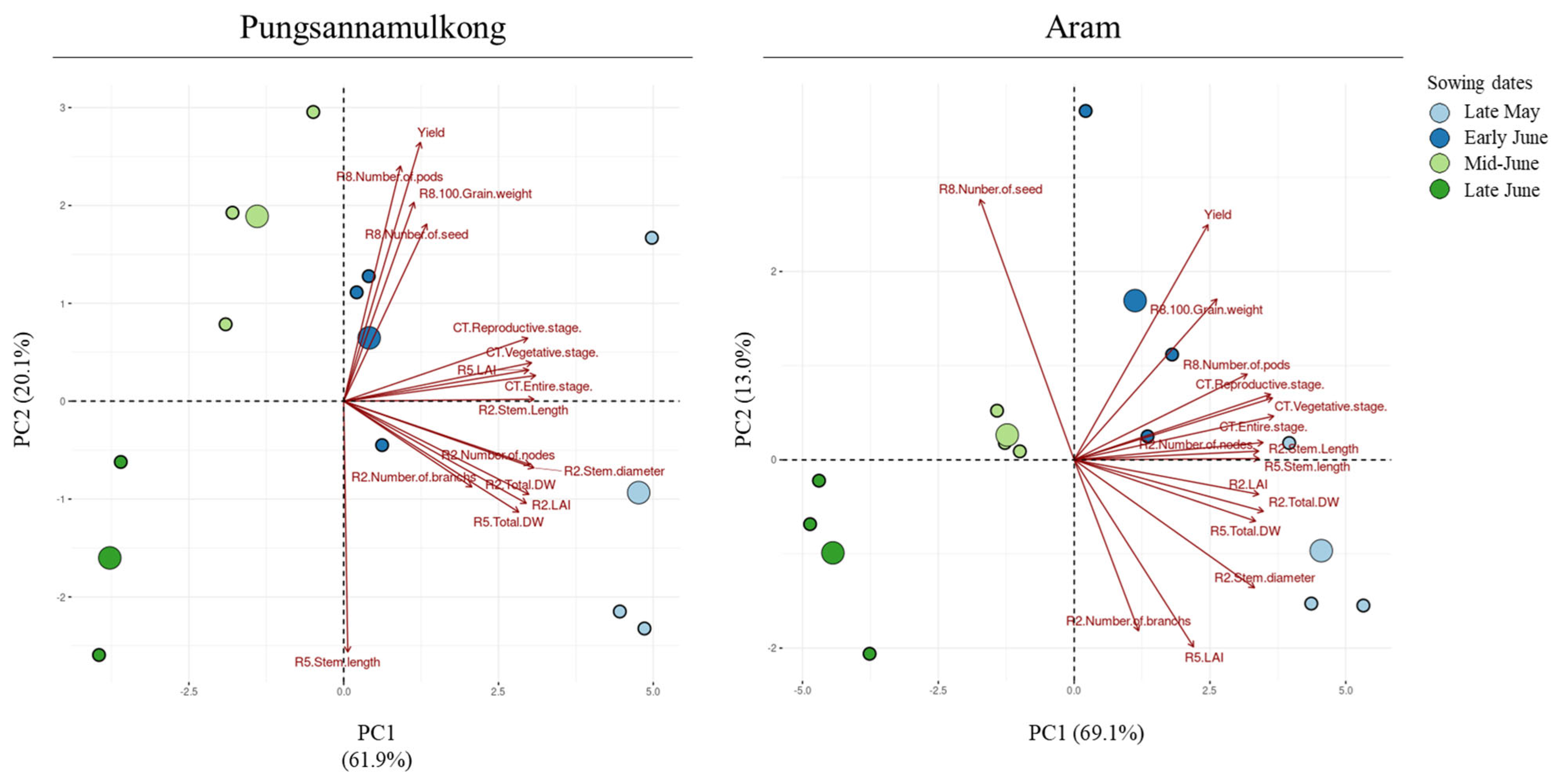
The correlation analysis was performed to understand the association between selected agricultural traits (Figure 4). Yield of soybeans at R8 (harvest stage) was significantly correlated with the number of pods per plant (0.88, p < 0.0001) and 100-seed weight (0.86, p < 0.0001). Despite the relatively lower significance for yield (0.67, p < 0.05), the cumulative temperature (CT) entirely affected most of agricultural traits, including stem length (R2) (0.97, p < 0.001) and LAI (R2) (0.89, p > 0.001), indicating the great dependence of reproductive as well as vegetative growth of soybean plants. The biplot of principal component analysis (PCA) was also implemented to investigate the relationship between sowing time and agronomic traits (Figure 5). For Pungsannamulkong, PC1 and PC2 explained 59.4% and 22.6% of the total variance, respectively, accounting for 82% of the total variance. For Aram, PC1 and PC2 explained 63% and 15.5% of the total variance, respectively, explaining 78.5% of the total variance. Most of the selected agronomic traits were closely associated with the sowing time of late May for Pungsannamulkong and late May and early June for Aram.
Figure 4.
Pearson’s correlation matrix for cumulative temperature, growth traits, and yield components of soybean. The lower triangle shows scatter plots with fitted regression lines and 95% confidence ellipses. The diagonal panels display histograms for each variable. The upper triangle presents Pearson’s correlation coefficients with significance levels (p < 0.05: *, p < 0.01: **, p < 0.001: ***). Strong positive correlations were observed between cumulative temperature (CT), number of pods, and stem length at R2, which in turn influenced yield.
Figure 5.
Biplot of the principal component analysis for agronomic growth traits, yield, and yield components with different sowing dates.
4. Discussion
4.1. Cumulative Temperature (CT), Growing Days, Soybean Growth, and Yield
Soybean [Glycine max (L.) Merr.] is a typical short-day crop that responds sensitively to environmental conditions. The growth and development of soybean plants are greatly influenced by photoperiod and temperature, and thus it is well documented that a cumulative temperature (CT) of 2500–3000 °C is required for stable production [,]. Kantolic et al. [] documented that yield components of soybean are primarily determined after flowering, particularly between the R3 and R6 stage, and [] reported that the prolonged exposure to higher day temperature (>30 °C) before flowering resulted in remarkably delayed flowering and reduced yield. Therefore, shifting the sowing date could be the most cost-effective and practical implementation to avoid temperature stress []. Nevertheless, due to biased studies focusing growth and yield by shifting sowing dates, there is still limited information to understand the relationship between CT and growth []. Our results also showed that the delayed sowing date significantly decreased CT and the growing period, in line with previous observations [,,,]. Compared to late June sowing, late May sowing required an additional 667 ± 4 °C for CT and more than 30 days to reach final maturity (harvest), and this decreasing trend was significantly greater in sowing date than varietal differences. However, late June sowing in mid-mountainous areas resulted in a sharp decline in total plant biomass, indicating 32 (Pungsannamulkong) to 46% (Aram) at R2 and 41 (Pungsannamulkong) to 44% (Aram) at R5 compared to late May sowing, respectively (Table 1). Evidently, the increasing CT clearly contributed to biomass production and, in particular, resulted in a prolonged vegetative period (V5 to R2) (Figure 2 and Table 1). This finding was not consistent with the result reported by [], which showed that earlier sowing dates led to greater CTs during the reproductive phase. Therefore, it is suggested that the dependency of CT might differ in terms of growth stage for soybean cultivars (usage). As shown in Figure 3, seed development was significantly dominant at R6 to R7 in both cultivars, producing 4 to 5 g 100-seeds−1 100 °C−1, and this trend was not affected by the difference in sowing dates. This result could be strongly supported by the CT at R6-R8 (Figure 2A), and thus the influence of the shift in sowing dates was greater for vegetative growth than the reproductive phase.
Interestingly, both extended (late May sowing) and shortened (late June sowing) vegetative growth periods resulted in significant yield reduction in Aram, and soybean yield in Pungsannamulkong tended to decline even though there was no statistical significance (Figure 2A and Table 2). Zheng et al. [] and Mourtzinis et al. [] documented that earlier sowing promoted longer vegetative growth phases, earlier node formation and flowering, and increased pod number and yield. The discrepancy between this study and those results is likely to be due to a difference in climate conditions, and thus a prolonged vegetative period by earlier sowing resulted in excessive vegetative growth. On the contrary, Lee et al. [] reported that a marked decrease in photosynthesis by delayed sowing could lead to the limited accumulation of photo-assimilate due to retarded plant growth (shortage of photosynthetically active fully expanded leaves). Consequently, our result suggests that suitable yield of soybean in mid-mountainous areas is likely to definitely depend on an optimal cumulative temperature (CT) during vegetative phase (1500~1700 °C), and thus a recommended sowing date is between early June to mid-June.
4.2. Correlation and PCA
The CT clearly contributed to growth and yield of soybean from the result of correlation analysis, and this implies that the optimized CT ensures not only suitable vegetative growth but also expected yield. Additionally, pod number per plant and 100-seed weight were also positively associated with yield. Our result was strongly supported by previous studies reporting that there was an optimal temperature for development and yield formation at each growth stage [,,] and we observed that pod number was a key determinant of yield []. A path coefficient also clearly revealed that the CT regulated soybean yield via stem length at R2 stage (0.97 ***, p < 0.001) and pod number at the R8 stage (0.84 ***, p < 0.001). Higher temperatures of 30.5–32.5 °C since flowering decreased seed weight due to increased respiration [], and led to a reduction in single seed weight during the reproductive period, ultimately resulting in yield loss []. These previous observations imply the importance of a favorable temperature environment during the seed development period.
5. Conclusions
This study demonstrated that the cumulative temperature (CT) is a key environmental determinant of soybean growth and yield in mid-mountainous regions of Korea. Delayed sowing markedly reduced CT and the duration of vegetative growth, leading to decreases in plant height, leaf area index, biomass accumulation, and ultimately yield. Structural and correlation analyses indicated that the CT indirectly affects yield through its strong influence on stem length and pod number per plant. Total CT, ranging between 3100 °C and 3500 °C, during the growing season resulted in optimal seed filling and yield, corresponding to sowing dates from early to mid-June. In conclusion, total CT, ranging between 3100 °C and 3500 °C, during the growing season was necessary for suitable seed filling and yield corresponding to sowing dates from early to mid-June. These results provide useful information not only for the adjustment of soybean cultivation schedules in mid-mountainous areas but also to develop mid-mountain-adaptable soybean varieties.
Author Contributions
Conceptualization, J.S.; validation, J.L., M.K. (Minji Kim), B.L., M.K. (Minchang Kim), S.J., P.S., H.J., and J.S.; investigation, J.L., M.K. (Minji Kim), B.L., and M.K. (Minchang Kim); resources, P.S. and H.J.; writing—original draft preparation, J.L. and M.K. (Minji Kim); writing—review and editing, S.J., P.S., H.J., and J.S.; supervision, J.S.; project administration, J.S.; funding acquisition, J.S. All authors have read and agreed to the published version of the manuscript.
Funding
This research was funded by the ‘Research Program for Agriculture Science & Technology Development (Project No. RS-2023-00215864)’, Rural Development Administration, Republic of Korea.
Data Availability Statement
The original contributions presented in this study are included in the article. Further inquiries can be directed to the corresponding author.
Acknowledgments
We thank the National Institute of Crop and Food Science for providing the seeds of soybean, Pungsannamulkong, and Aram.
Conflicts of Interest
The authors declare no conflicts of interest.
Abbreviations
The following abbreviations are used in this manuscript:
| CT | Cumulative temperature |
References
- Li, B.; Gao, K.; Ren, H.; Tang, W. Molecular Mechanisms Governing Plant Responses to High Temperatures. J. Integr. Plant Biol. 2018, 60, 757–779. [Google Scholar] [CrossRef]
- Thenveettil, N.; Bheemanahalli, R.; Reddy, K.N.; Gao, W.; Reddy, K.R. Temperature and Elevated CO2 Alter Soybean Seed Yield and Quality, Exhibiting Transgenerational Effects on Seedling Emergence and Vigor. Front. Plant Sci. 2024, 15, 1427086. [Google Scholar] [CrossRef]
- Zhao, C.; Liu, B.; Piao, S.; Wang, X.; Lobell, D.B.; Huang, Y.; Huang, M.; Yao, Y.; Bassu, S.; Ciais, P.; et al. Temperature Increase Reduces Global Yields of Major Crops in Four Independent Estimates. Proc. Natl. Acad. Sci. USA 2017, 114, 9326–9331. [Google Scholar] [CrossRef] [PubMed]
- Alsajri, F.A.; Wijewardana, C.; Bheemanahalli, R.; Irby, J.T.; Krutz, J.; Golden, B.; Reddy, V.R.; Reddy, K.R. Morpho-Physiological, Yield, and Transgenerational Seed Germination Responses of Soybean to Temperature. Front. Plant Sci. 2022, 13, 839270. [Google Scholar] [CrossRef]
- Ding, C.; Alghabari, F.; Rauf, M.; Zhao, T.; Javed, M.M.; Alshamrani, R.; Ghazy, A.-H.; Al-Doss, A.A.; Khalid, T.; Yang, S.H. Optimization of Soybean Physiochemical, Agronomic, and Genetic Responses under Varying Regimes of Day and Night Temperatures. Front. Plant Sci. 2024, 14, 1332414. [Google Scholar] [CrossRef] [PubMed]
- Mall, R.; Lal, M.; Bhatia, V.; Rathore, L.; Singh, R. Mitigating Climate Change Impact on Soybean Productivity in India: A Simulation Study. Agric. For. Meteorol. 2004, 121, 113–125. [Google Scholar] [CrossRef]
- Mourtzinis, S.; Specht, J.E.; Conley, S.P. Defining Optimal Soybean Sowing Dates Across the US. Sci. Rep. 2019, 9, 2800. [Google Scholar] [CrossRef] [PubMed]
- Rowntree, S.C.; Suhre, J.J.; Weidenbenner, N.H.; Wilson, E.W.; Davis, V.M.; Naeve, S.L.; Casteel, S.N.; Diers, B.W.; Esker, P.D.; Specht, J.E.; et al. Genetic Gain × Management Interactions in Soybean: I. Planting Date. Crop Sci. 2013, 53, 1128–1138. [Google Scholar] [CrossRef]
- Nico, M.; Miralles, D.J.; Kantolic, A.G. Natural Post-Flowering Photoperiod and Photoperiod Sensitivity: Roles in Yield Determining Processes in Soybean. Field Crops Res. 2019, 231, 141–152. [Google Scholar] [CrossRef]
- Setiyono, T.D.; Weiss, A.; Specht, J.; Bastidas, A.M.; Cassman, K.G.; Dobermann, A. Understanding and Modeling the Effect of Temperature and Daylength on Soybean Phenology Under High-Yield Conditions. Field Crops Res. 2007, 100, 257–271. [Google Scholar] [CrossRef]
- Divito, G.A.; Echeverría, H.E.; Andrade, F.H.; Sadras, V.O. Soybean Shows an Attenuated Nitrogen Dilution Curve Irrespective of Maturity Group and Sowing Date. Field Crops Res. 2016, 186, 1–9. [Google Scholar] [CrossRef]
- Uslu, N.; Esendal, E. Response to Inoculation and Sowing Date of Soybean Under Bafra Plain Conditions in the Northern Region of Turkey. Turk. J. Agric. For. 1998, 22, 525–531. [Google Scholar]
- KOSIS 2023 Crop Production Statistics (2214-5141). 2024. Available online: https://kosis.kr (accessed on 31 October 2025).
- RDA. Standard Fertilization Recommendation; Version 5; RDA: Jeonju, Republic of Korea, 2022. [Google Scholar]
- Lee, Y.J.; Sung, J.K.; Lee, S.B.; Lim, J.E.; Song, Y.S.; Lee, D.B.; Hong, S.Y. Plant analysis methods for evaluating mineral nutrient. Korean J. Soil Sci. Fertil. 2017, 50, 93–99. [Google Scholar] [CrossRef]
- Han, W.-Y.; Park, K.-Y.; Kim, H.-T.; Ko, J.-M.; Baek, I.-Y.; Lee, C.-Y.; Choung, M.-G. Variations in Growth Characteristics and Seed Qualities of Korean Soybean Landraces. Korean J. Crop Sci. 2008, 53, 96–102. [Google Scholar]
- Lee, J.E.; Jung, G.H.; Kim, S.K.; Kim, M.T.; Shin, S.H.; Jeon, W.T. Effects of Growth Period and Cumulative Temperature on Flowering, Ripening and Yield of Soybean by Sowing Times. Korean J. Crop Sci. 2019, 64, 406–413. [Google Scholar] [CrossRef]
- Kantolic, A.G.; Peralta, G.E.; Slafer, G.A. Seed Number Responses to Extended Photoperiod and Shading during Reproductive Stages in Indeterminate Soybean. Eur. J. Agron. 2013, 51, 91–100. [Google Scholar] [CrossRef]
- Oh-e, I.; Uwagoh, R.; Jyo, S.; Kurahashi, T.; Saitoh, K.; Kuroda, T. Effect of Rising Temperature on Flowering, Pod Set, Dry-Matter Production and Seed Yield in Soybean. Jpn. J. Crop Sci. 2007, 76, 433–444. [Google Scholar] [CrossRef]
- Ding, Y.; Wang, W.; Zhuang, Q.; Luo, Y. Adaptation of Paddy Rice in China to Climate Change: The Effects of Shifting Sowing Date on Yield and Irrigation Water Requirement. Agric. Water Manag. 2020, 228, 105890. [Google Scholar] [CrossRef]
- Hu, M.; Wiatrak, P. Effect of Planting Date on Soybean Growth, Yield, and Grain Quality. Agron. J. 2012, 104, 785–790. [Google Scholar] [CrossRef]
- Księżak, J.; Bojarszczuk, J. The Seed Yield of Soybean Cultivars and Their Quantity Depending on Sowing Term. Agronomy 2022, 12, 1066. [Google Scholar] [CrossRef]
- Serafin-Andrzejewska, M.; Helios, W.; Jama-Rodzeńska, A.; Kozak, M.; Kotecki, A.; Kuchar, L. Effect of Sowing Date on Soybean Development in South-Western Poland. Agriculture 2021, 11, 413. [Google Scholar] [CrossRef]
- Chae, S.; Shin, P.; Youn, J.; Sung, J.; Jeon, S. The Effect of Sowing Date on Soybean Growth and Yield under Changing Climate in the Southern Coastal Region of Korea. Agriculture 2025, 15, 1174. [Google Scholar] [CrossRef]
- Zheng, H.; Zhang, L.; Sun, H.; Zheng, A.; Harrison, M.T.; Li, W.; Zou, J.; Zhang, D.; Chen, F.; Yin, X. Optimal Sowing Time to Adapt Soybean Production to Global Warming with Different Cultivars in the Huanghuaihai Farming Region of China. Field Crops Res. 2024, 312, 109386. [Google Scholar] [CrossRef]
- Mourtzinis, S.; Gaspar, A.P.; Naeve, S.L.; Conley, S.P. Planting Date, Maturity, and Temperature Effects on Soybean Seed Yield and Composition. Agron. J. 2017, 109, 2040–2049. [Google Scholar] [CrossRef]
- Alsajri, F.A.; Wijewardana, C.; Irby, J.T.; Bellaloui, N.; Krutz, L.J.; Golden, B.; Gao, W.; Reddy, K.R. Developing Functional Relationships Between Temperature and Soybean Yield and Seed Quality. Agron. J. 2020, 112, 194–204. [Google Scholar] [CrossRef]
- Robinson, A.P.; Conley, S.P.; Volenec, J.J.; Santini, J.B. Analysis of High-Yielding, Early-Planted Soybean in Indiana. Agron. J. 2009, 101, 131–139. [Google Scholar] [CrossRef]
- Gibson, L.; Mullen, R. Soybean Seed Quality Reductions by High Day and Night Temperature. Crop Sci. 1996, 36, 1615–1619. [Google Scholar] [CrossRef]
- Mochizuki, A.; Shiraiwa, T.; Nakagawa, H.; Horie, T. The Effect of Temperature during the Reproductive Period on Development of Reproductive Organs and the Occurrence of Delayed Stem Senescence in Soybean. Jpn. J. Crop Sci. 2005, 74, 339–343. [Google Scholar] [CrossRef]
Disclaimer/Publisher’s Note: The statements, opinions and data contained in all publications are solely those of the individual author(s) and contributor(s) and not of MDPI and/or the editor(s). MDPI and/or the editor(s) disclaim responsibility for any injury to people or property resulting from any ideas, methods, instructions or products referred to in the content. |
© 2025 by the authors. Licensee MDPI, Basel, Switzerland. This article is an open access article distributed under the terms and conditions of the Creative Commons Attribution (CC BY) license (https://creativecommons.org/licenses/by/4.0/).