Abstract
The WUSCHEL-related homeobox (WOX) transcription factors (TF) regulate critical developmental processes in plants, including organ formation and stem cell maintenance. Although characterized in model species, the WOX family remains unexplored in passion fruit (Passiflora edulis). In this study, 10 WOX genes were identified in passion fruit, which are distributed across six chromosomes. We analyzed the phylogenetic relationships, gene structure, conserved motifs, and syntenic relationships of the PeWOX genes. Multiple sequence alignment analysis revealed strong conservation of the homeodomain region among WOX TF family members. Phylogenetic reconstruction further demonstrated that the 10 identified PeWOX genes in passion fruit could be classified into three distinct evolutionary clades: the WUS clade, the Intermediate clade, and the Ancient clade. The conserved motif and gene structure of WOX TF family members in the same evolutionary clade were highly consistent. Expression analysis based on RNA-seq and RT-qPCR showed that most PeWOX genes were expressed during ovule development. The expression level of PeWOX genes varies with different stress conditions. Subcellular localization analysis of tobacco leaf epidermal cells showed that PeWOX3/7/10 proteins were localized in the nucleus and cell membrane. Collectively, this study lays a foundation for future functional studies of passion fruit WOX genes.
1. Introduction
The eukaryotic superfamily of homeobox (HB) TFs is characterized by a small segment of the amino acid (60–66 residues), which can fold to form a triple-helix structure that can specifically bind to DNA [,]. HB TF serves as a pivotal developmental regulator in eukaryotes []. WUSCHEL (WUS) homeobox TF is a member of the WUS homeobox (WOX) protein family, which is a plant-specific subfamily of the homeobox TF superfamily. Extensive research has demonstrated that WOX TFs are crucial regulators of diverse plant developmental processes, including embryogenesis, stem cell niche maintenance, and organogenesis []. WOX genes are ubiquitously distributed across the plant kingdom, extending from basal chlorophytes to advanced angiosperms. However, it was not found in red algae, indicating that the WOX family may originate from green algae. The number of WOX genes in different plants is different, and the number increases with the evolution of plants. For example, there is only one WOX gene in unicellular green algae, three in moss, six in Selaginella, and fifteen in Arabidopsis []. According to the evolutionary relationship, WOX members can be divided into three evolutionary clades: WUS clade, intermediate clade, and ancient clade. The WOX genes of lower plants are only distributed in the ancient clade, while those of higher plants are distributed in these three evolutionary clades [].
The WOX TF family in Arabidopsis thaliana, comprising 15 members, exhibits functional specialization in regulating meristem activity and organ development across various tissues. For instance, in apical meristems, AtWUS, AtWOX1, and AtWOX9 are essential for the maintenance and growth of the shoot apical meristem (SAM) [,,], whereas AtWOX5 functions specifically in the root apical meristem (RAM) []. Beyond the meristems, several members regulate the formation of lateral organs: AtWOX3 promotes cell proliferation and lateral organ formation []. At the same time, AtWOX4 and AtWOX14 modulate lateral and vascular development by regulating cambium activity and gibberellin biosynthesis, respectively [,]. The family also plays critical roles in reproductive development: AtWOX2 and AtWOX8 in early embryogenesis [], AtWOX6 in ovule development [], and AtWOX13 in fruit patterning []. Furthermore, functional divergence is evident in root organogenesis, where AtWOX11/12 promote adventitious root formation [], in contrast to AtWOX7, which suppresses lateral root development []. Collectively, these studies underscore the functional diversity of WOX genes. Although their phylogeny is established in model plants, their molecular evolution in passion fruit remains uncharacterized.
Passion fruit (Passiflora edulis) constitutes a significant tropical fruit crop, distinguished by its distinctive aromatic properties and favorable flavor profile. It is an herbaceous vine of the Passiflora family and the Passiflora genus. The two primary commercially cultivated passion fruit varieties are the purple-fruited type (Passiflora edulis Sims) and the yellow-fruited form (Passiflora edulis f. flavicarpa) []. It has the pleasant aroma of pineapple, banana, mango, guava, apple, sour plum, and other fruits. Due to its rich aroma and high acidity, it is known as the king of natural fruit juice []. Passion fruit is widely eaten because of its rich juice, sour and sweet taste, rich amino acids, protein, fat, vitamins, and other substances beneficial to the human body []. Passion fruit can not only be used as an edible fruit but also has great economic and ecological benefits. The pericarp of passion fruit is thick and hard, which can be used as feed and for pectin extraction. Its seeds are pressed for oil, which can be used for food, soap, and paint. The flowers of passion fruit are notably large and aesthetically pleasing, rendering the plant suitable for ornamental horticultural applications. At the same time, its roots, stems, and leaves can be used as medicine, which has the effects of strengthening the body, calming pain, improving human immunity, decompression, and delaying aging [,,].
In this study, 10 genes in the WOX homeobox gene family of passion fruit were identified. Based on phylogenetic analysis, the WOX family genes can be classified into three distinct clades. The gene structure, protein structure, protein motif, and expression patterns of different flower tissues were further studied. We analyzed the expression patterns of WOX family genes in passion fruit under various abiotic stress conditions (cold, heat, salt, and drought) to investigate their stress-responsive behavior. Our results elucidate previously uncharacterized aspects of WOX gene function, particularly in regulating floral morphogenesis and abiotic/biotic stress adaptation pathways in Passiflora edulis.
2. Materials and Methods
2.1. Identification and Sequence Analysis of the WOX Transcription Factor Family Members in Passion Fruit
The genomic data of passion fruit was downloaded from the National Genomics Data Center (NGDC) (https://ngdc.cncb.ac.cn/) (accessed on 8 January 2021) with the login number: GWHAZTM00000000. The Hidden Markov Model (HMM) of the WOX domain (PF00046) was downloaded from the Pfam database (http://pfam.xfam.org/) (accessed on 8 January 2021), which was used as a query model to perform the TBtools software (v2.376) [] (E-value < 1 × 10⁻⁵) with protein sequences of passion fruit and the repeated sequences were manually removed. NCBI Conserved Domain Database (https://www.ncbi.nlm.nih.gov/cdd) (accessed on 8 January 2021) [] and SMART (http://smart.embl-heidelberg.de) (accessed on 8 January 2021) [] were used to analyze the protein structure of the candidate sequences, and the candidate sequences without the complete homeodomain were removed. The molecular weight and isoelectric point of all predicted protein sequences of the passion fruit WOX family were analyzed by the ExPASY proteomics server (http://expasy.Org/) (accessed on 8 January 2021) []. Subcellular localization predictions were generated with Plant-mPLoc (http://www.csbio.sjtu.edu.cn/bioinf/plant-multi/) (accessed on 8 January 2021) [].
2.2. Multiple Sequence Alignment and the Phylogenetic Tree
The genomic data of Arabidopsis were downloaded from the Arabidopsis Information Resource (TAIR) database (http://www.arabidopsis.org/) (accessed on 8 January 2021). The WOX protein sequences from Arabidopsis thaliana, Populus trichocarpa, Ricinus communis, and Vitis vinifera were retrieved from the Plant Transcription Factor Database (PlantTFDB) (http://planttfdb.gao-lab.org/index.php) (accessed on 8 January 2021).
Based on the previous research [], the conserved domain of WOX proteins in passion fruit was analyzed using ClustalW X 2.0 [] with the default parameter settings. The results were visualized by ESPript 3.0 []. At the same time, the WebLogo 3 tool [] is used to generate sequence logos. Phylogenetic analysis of WOX genes was conducted by performing multiple sequence alignments of WOX proteins from five plant species (Passiflora edulis, Arabidopsis thaliana, Populus trichocarpa, Ricinus communis, and Vitis vinifera) using ClustalW. Subsequently, the Maximum Likelihood tree was constructed by MEGA6.06 [] with the following parameters: JTT matrix-based model, pairwise deletion of gaps, and 1000 bootstrap replicates.
2.3. Gene Structure, Conserved Motif, and Cis-Regulatory Elements Analysis
The gene structure information of WOX genes in passion fruit and Arabidopsis thaliana was obtained from the GFF annotation files of their genome. The conserved motifs were analyzed using the MEME program (http://meme.nbcr.net/meme/cgi-bin/meme.cgi) (accessed on 8 January 2021) [], with the following parameters: the maximum number of motifs was 5, and the other parameters were default. The 2000 bp promoter region upstream from the ATG start codon among the putative WOX genes was extracted by TBtools software. The PlantCARE website (https://bioinformatics.psb.ugent.be/webtools/plantcare/html/) (accessed on 8 January 2021) [] was used to predict various types of cis-regulatory elements in the putative promoter region of PeWOX genes. The results were visualized by TBtools software.
2.4. Chromosome Localization and Synteny Analysis
The chromosomal location information of the passion fruit WOX genes was obtained from the genetic feature files (gff). The physical location of the WOX genes was presented using TBtools software. To analyze the synteny of orthologous WOX genes obtained from passion fruit and Arabidopsis thaliana, we analyzed gene duplication events by using the one-step MCScanX in TBtools. The results were visualized using the Dual Synteny Plot in TBtools.
2.5. Subcellular Localization of PeWOXs
Subcellular localization of PeWOX proteins was analyzed to determine their specific intracellular locations. The full-length coding sequences (CDS) of PeWOX3, PeWOX7, and PeWOX10 were amplified from the cDNA of passion fruit leaf tissue and subsequently cloned into the pGWB506 (35S: GFP) vector. The recombinant plasmids were then introduced into Agrobacterium tumefaciens strain GV3101. The amplification primers are listed in Supplementary Table S1. Finally, the constructed Agrobacterium strains were introduced into tobacco leaves via agroinfiltration. Tobacco leaves transformed with Agrobacterium GV3101 containing the empty pGWB506 vector were used as a control []. GFP signals were observed 48 h after infiltration, and images were captured using a Leica TCS SP8 confocal microscope (Wetzlar, Germany).
2.6. Expression Patterns Analysis Based on RNA-SEQ Data
The RNA-seq data for the passion fruit variety ‘Tainong 1’ were obtained from public databases. Data from different organs and developmental stages—including bract (br1, br2), coronal filament (ca1, ca8), stigma (sg1, sg1), sepal (se1, se8), petal (pe1, pe8), stamen (st1, st8, st9), and seven stages of ovule (ov2–ov8)—were retrieved from the China National GeneBank (CNGB; accession number CNP0002747) [,]. RNA-seq data of root, flower, leaf, and seed were downloaded from the China National Center for Bioinformation (CNCB; accession number CRA003773) []. The heatmap of the PeWOX expression was generated using the pheatmap package in R (v3.6.3) based on log2 (FPKM + 0.01) values.
2.7. Plant Materials and Treatment Methods
The passion fruit materials used in this study were obtained from the Haixia Institute of Science and Technology, Fujian Agriculture and Forestry University, Fujian, China. The P. edulis plants were grown in a growth chamber under long-day conditions (16 h light/8 h dark) at 27/22 °C day/night. The 3-week-old passion fruit seedlings were treated with cold, heat, drought, and salt stress, respectively. Under heat stress, passion fruit seedlings were exposed to 45 ± 2 °C. Seedlings were exposed to 4 ± 2 °C under cold stress. Under salt stress, the seedlings were cultured with 100 mM and 200 mM sodium chloride, respectively. Under drought stress, the seedlings were treated with 100 mM and 200 mM mannitol, respectively. Plant material was sampled at four critical time points (0 h [baseline], 12 h, 24 h, and 48 h) post-induction, with mock-treated plants providing reference controls. Samples were flash-frozen in liquid nitrogen within 30 s of collection and stored at −80 °C until total RNA extraction. The entire sampling procedure was replicated three times using independent biological samples to account for biological variability.
2.8. RNA Extraction and RT-qPCR
Total RNA was isolated using Trizol reagent (Trans-Gen, Beijing, China) according to the supplier’s instructions. Gene-specific primers were designed following the manufacturer’s protocols for the Bio-Rad real-time PCR system (Foster City, CA, USA). Seven gene-specific primer pairs for passion fruit WOX genes were designed using the PrimerQuest Tool (Integrated DNA Technologies, Coralville, IA, USA) for quantitative real-time PCR (RT-qPCR) applications. To determine the expression analysis of the selected WOX gene, total RNA was isolated from treated and untreated (control) passion fruit leaves using the RNA Extraction Kit (omega bio TEK, Shanghai, China) according to the manufacturer’s instructions. First-strand cDNA synthesis was performed using the TransGen cDNA Extraction Kit (Beijing, China) with integrated gDNA remover to eliminate genomic DNA contamination. The resulting cDNA was diluted 20-fold prior to qPCR analysis. For real-time PCR amplification, 2 μL of the diluted cDNA template (final reaction volume: 20 μL) was subjected to thermal cycling conditions optimized for the Bio-Rad CFX system (Foster City, CA, USA): initial denaturation at 95 °C for 30 s, followed by 39 cycles of 95 °C for 5 s (denaturation) and 60 °C for 34 s (annealing/extension) []. The PeEF1a was used as the reference gene to determine the fold change in the gene expression, and the primers are listed in Supplementary Table S1. At least three biological replicates and three independent technical replicates were conducted for the qPCR assays, and the results were calculated by the 2−ΔΔCT method.
3. Results
3.1. Identification and Characterization of PeWOX Genes
In order to identify the WOX gene family of passion fruit, an HMM search was carried out on the passion fruit protein database, and finally, 10 PeWOX genes were predicted. The 10 PeWOX genes were named from PeWOX1A to PeWOX10 according to their physical positions on chromosomes 1–9 and Contig 3 (from top to bottom) (Table 1).
Table 1.
Characteristics of the WOX TF family in Passiflora edulis.
Through the analysis of the physical and chemical properties of the identified PeWOX genes, it is found that there are certain differences in the length of amino acids among the members, ranging from 185 to 870 aa, and the molecular weight of protein ranges from 21.22 to 94.97 kDa, as shown in Table 1. The protein theoretical isoelectric points of family members also have some differences, ranging from 5.39 to 8.73. The number of exons ranges from 2 to 20. These significant differences may indicate the functional differences of the PeWOX family genes in passion fruit.
3.2. Identification and Analysis of Homeodomain
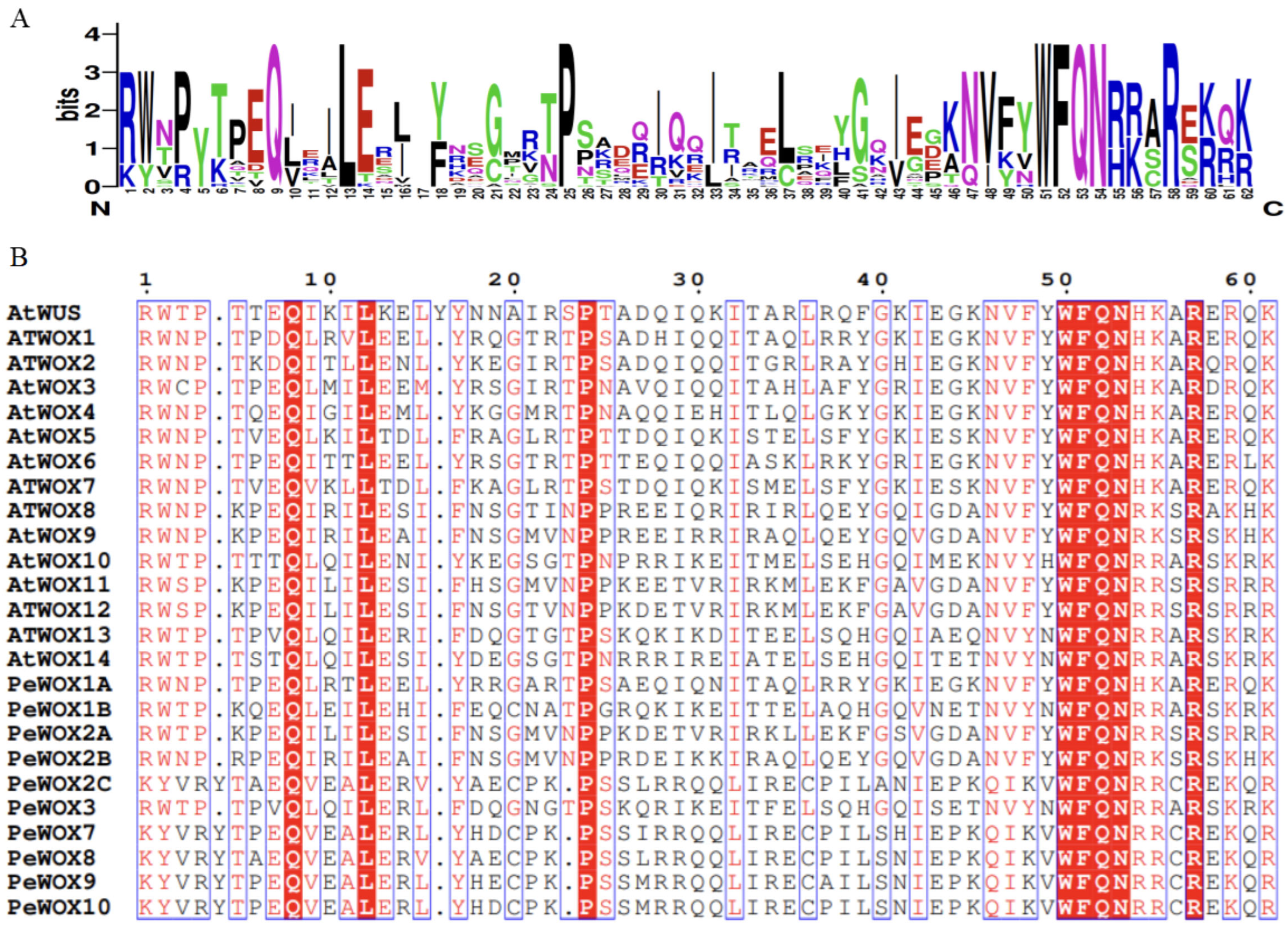
Multiple sequence alignment using ClustalW confirmed that all identified PeWOX proteins contain a conserved homeodomain. Visualization via WebLogo 3 and ESPript 3.0 (Figure 1A) revealed striking structural similarity between the homeodomains of Passiflora edulis and Arabidopsis thaliana, exhibiting the characteristic 60-amino-acid helix–loop–helix–turn–helix fold []. Critically conserved residues—including Gln (Q), Leu (L), and Tyr (Y) in Helix 1, and Ile (I), Val (V), Trp (W), Phe (F), Asn (N), Lys (K), and Arg (R) in Helix 3 were fully preserved in PeWOX proteins (Figure 1B). This high conservation suggests these residues are essential for functional specificity, likely governing DNA-binding affinity and transcriptional regulation in passion fruit WOX TFs [].
Figure 1.
Conserved homeodomain analysis of WOX family members in passion fruit. (A) The logo in Arabidopsis thaliana and passion fruit. (B) Alignment of the WOX homodomain sequences in passion fruit.
3.3. Phylogenetic Analysis
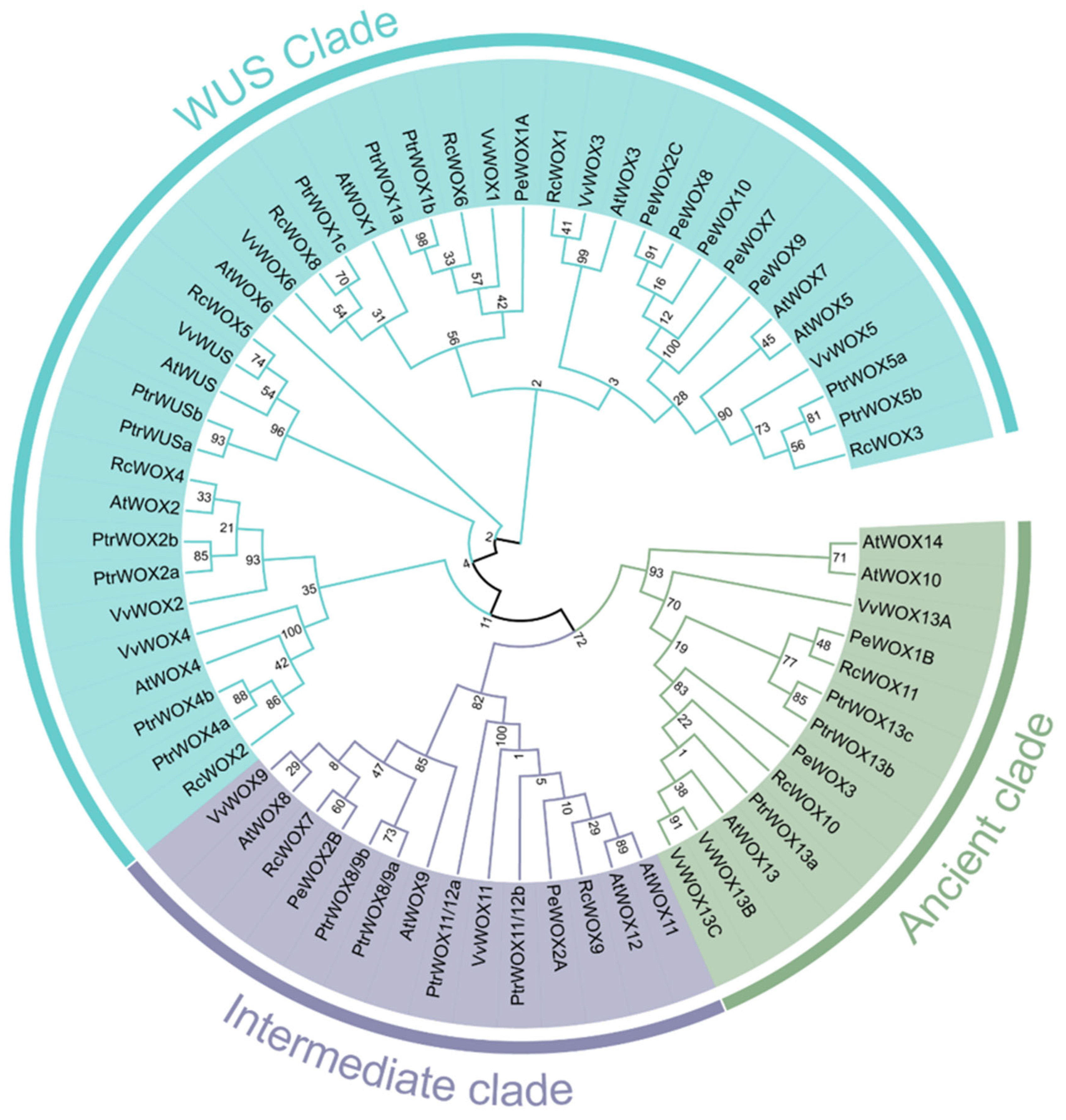
To elucidate the evolutionary relationships within the passion fruit WOX gene family, we performed multiple sequence alignment of the homeodomains from Passiflora edulis and four reference species (Arabidopsis thaliana, Populus trichocarpa, Ricinus communis, and Vitis vinifera). A Maximum Likelihood phylogenetic tree was constructed using MEGA (v7) (Figure 2 and Supplementary Table S2) with the following parameters: JTT substitution model, pairwise gap deletion, and 1000 bootstrap replicates.
Figure 2.
Phylogenetic tree of WOX proteins in Passiflora edulia (Pe), Arabidopsis thaliana (At), Populus trichocarpa (Ptr), Ricinus communis (Rc), and Vitis vinifera (Vv). MEGA6.0 and Maximum Likelihood tree were used to construct a rootless phylogenetic tree; 66 WOXs from 5 plants were divided into 3 clades in different colors.
The analysis encompassed 66 WOX proteins distributed as follows: 15 from Arabidopsis thaliana, 18 from Populus trichocarpa, 11 from Ricinus communis, 12 from Vitis vinifera and 10 from passion fruit. These 66 WOX proteins were segregated into three evolutionarily distinct clades: WUS clade, intermediate clade and ancient clade. WUS clade is the largest clade, with a total of 39 members, including 8 Arabidopsis thaliana, 11 Populus trichocarpa, 7 Ricinus communis, 7 Vitis vinifera and 6 passion fruit WOX proteins. The intermediate clade includes 4 Arabidopsis thaliana, 4 Populus trichocarpa, 2 Ricinus communis, 2 Vitis vinifera, and 2 passion fruit WOX proteins; the ancient clade consists of 3 Arabidopsis thaliana, 3 Populus trichocarpa, 2 Ricinus communis and 3 Vitis vinifera proteins, and 2 passion fruit WOX proteins. Critically, each clade contained at least one representative from both Passiflora edulis and Arabidopsis thaliana. This conserved phylogenetic distribution indicates that WOX family diversification predates the speciation event separating Passifloraceae and Brassicaceae.
3.4. Analysis of the Exon/Intron Structure and Conserved Motifs of the Passion Fruit WOX Gene Family
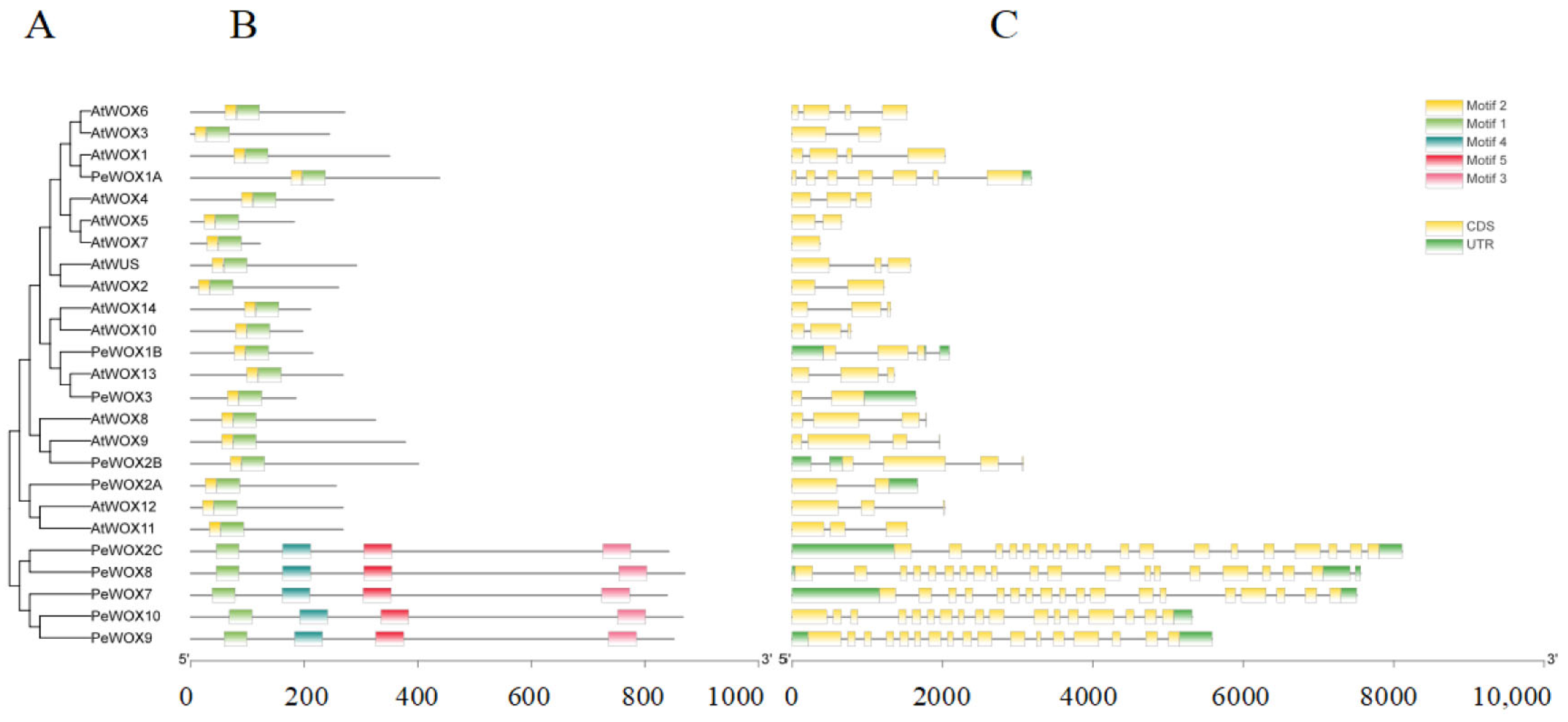
To investigate structural diversity within the passion fruit WOX gene family, we generated exon–intron structural schematics for PeWOXs and Arabidopsis thaliana orthologs (AtWOXs) using TBtools (Figure 3A). PeWOX genes exhibited considerable variation in exon number (2–20 exons per gene), with distinct patterns corresponding to phylogenetic clades: PeWOX2C, PeWOX7, PeWOX8, PeWOX9, and PeWOX10 genes of WUS clade had 18, 18, 20, 19, and 19 exons, respectively, while PeWOX1A contained only 7 exons. PeWOX2A and PeWOX2B of the intermediate clade contain 2 and 5 exons, respectively; PeWOX1B and PeWOX3 of the ancient clade have 4 and 2 exons, respectively. Notably, genes within the same clade shared conserved exon–intron architectures (e.g., WUS-clade genes typically contained > 18 exons except PeWOX1A). This structural conservation validates the phylogenetic topology (Figure 3B) through congruence between sequence evolution and gene organization, which indicates functional conservation of splicing patterns within clades, suggesting an ancient origin of WOX structural diversity prior to Passifloraceae speciation.
Figure 3.
Exon–intron structures and the conserved motifs of WOX family members in Arabidopsis and Passiflora edulis. (A) Phylogenetic relationship of PeWOXs and AtWOXs. (B) The conserved motifs of PeWOXs and AtWOXs. (C) Gene structure of PeWOXs and AtWOXs.
To characterize conserved motifs across the WOX TF family, we analyzed protein sequences from Arabidopsis thaliana and the newly identified passion fruit WOX members using the MEME online tool (v5.5.2) with default parameters (Figure 3C). The analysis revealed that all WOX proteins contained a core 60-residue motif corresponding to the homeodomain. Crucially, clade-specific motif architectures were observed, where proteins within the same phylogenetic clade (WUS/Intermediate/Ancient) exhibited identical motif compositions, and motif positional arrangements were conserved across orthologs. This clade-level motif conservation provides independent validation of the phylogenetic topology, confirming that sequence-based evolutionary relationships reflect functional structural constraints.
3.5. Analysis of Cis-Regulatory Elements in PeWOX Promoters
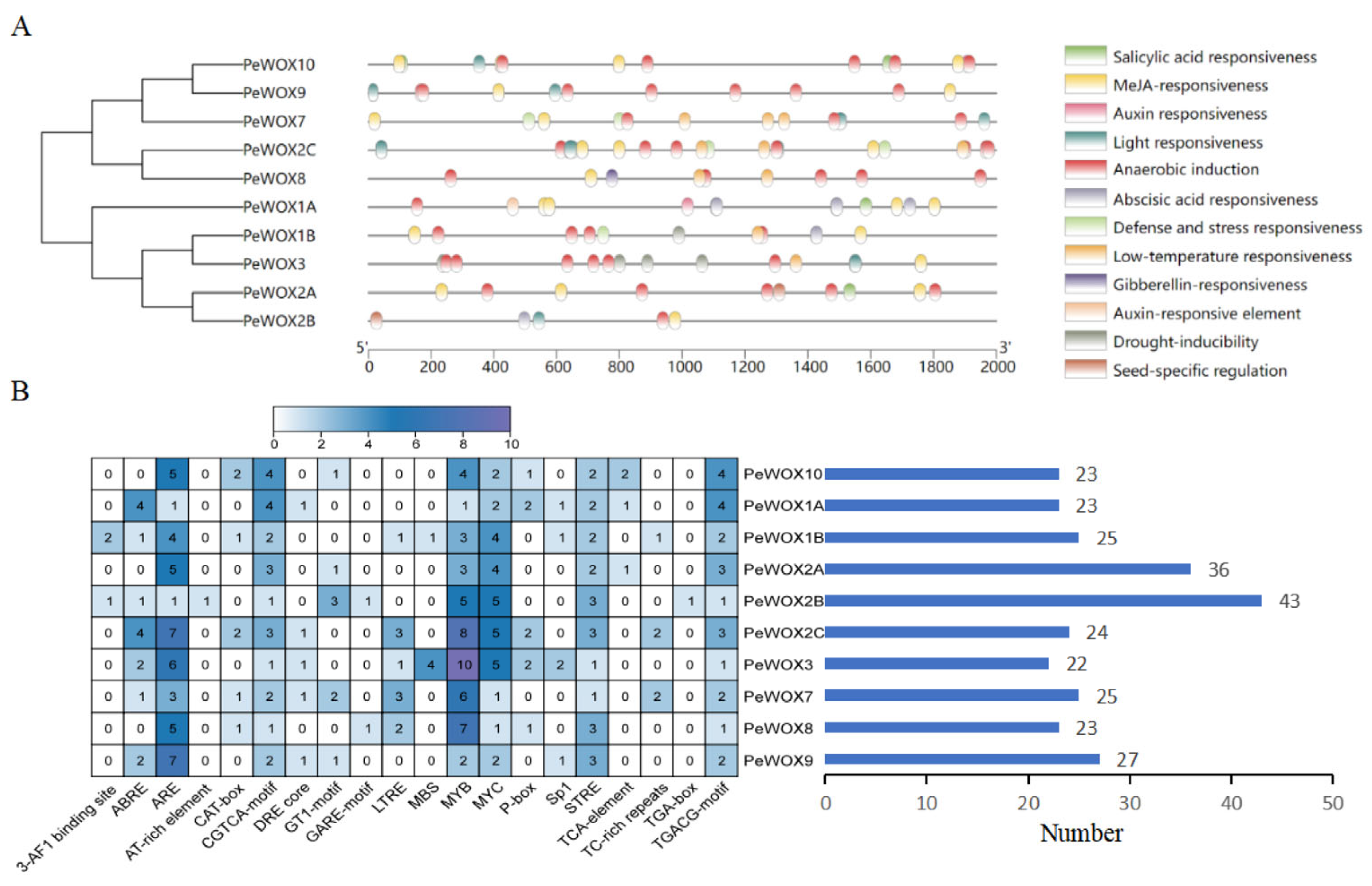
To identify putative cis-regulatory elements, we analyzed the 2000 bp promoter sequences upstream of the start codon (ATG) of the PeWOX genes using the PlantCARE database. The sequences analyzed in this study are provided in Supplementary Table S3. Twelve functionally significant elements were categorized into three groups: stress-responsive elements, hormone-responsive motifs, and developmental and environmental regulators (Figure 4A). Stress response elements of the ABA-responsive element (ABRE), dehydration-responsive element (DRE), low-temperature responsive elements (LTRE), MYB, and MYC elements have been reported to play important roles in salt, drought, cold, ABA, and GA responses [,,]. In addition to the core cis-regulatory elements, many regulatory motifs were associated with light regulation (3-AF1 binding site, GT1-motif, Sp1), anaerobic induction (ARE), and defense and stress responses (TC-rich repeats). In addition, we identified several cis-regulatory elements associated with stress and hormone responses, including the MYB binding site involved in drought induction (MBS), salicylic acid-responsive elements (TCA-element), methyl jasmonate-responsive motifs (CGTCA-motif), auxin-responsive elements (TGA-box), gibberellin-responsive elements (P-box, TATC-box, GARE-motif), as well as tissue-specific regulatory elements (CAT-box). Notably, we found significant differences in the promoter region of the predicted PeWOX genes, suggesting that the predicted PeWOX genes may exhibit different regulatory characteristics. Analysis revealed that light-responsive elements and abscisic acid (ABA)-responsive elements constituted the most prevalent cis-regulatory motifs, exhibiting widespread distribution across the promoter regions of PeWOX genes. All PeWOXs have an anaerobic induction element (ARE), MeJA-responsiveness element, MYB and MYC binding sites (Figure 4B). In summary, this cis-regulatory element landscape demonstrates that the transcriptional regulation of PeWOX genes integrates hormonal signaling, stress adaptation, and developmental cues, with architectural diversity potentially underlying functional divergence among paralogs.
Figure 4.
The cis-regulatory element on the putative promoter of the PeWOX genes. (A) Distribution of cis-regulatory elements identified in the 2000 bp upstream promoter region of PeWOX genes. (B) The number of cis-regulatory elements on putative promoters of PeWOX genes.
3.6. Chromosomal Distribution and Synteny Analysis
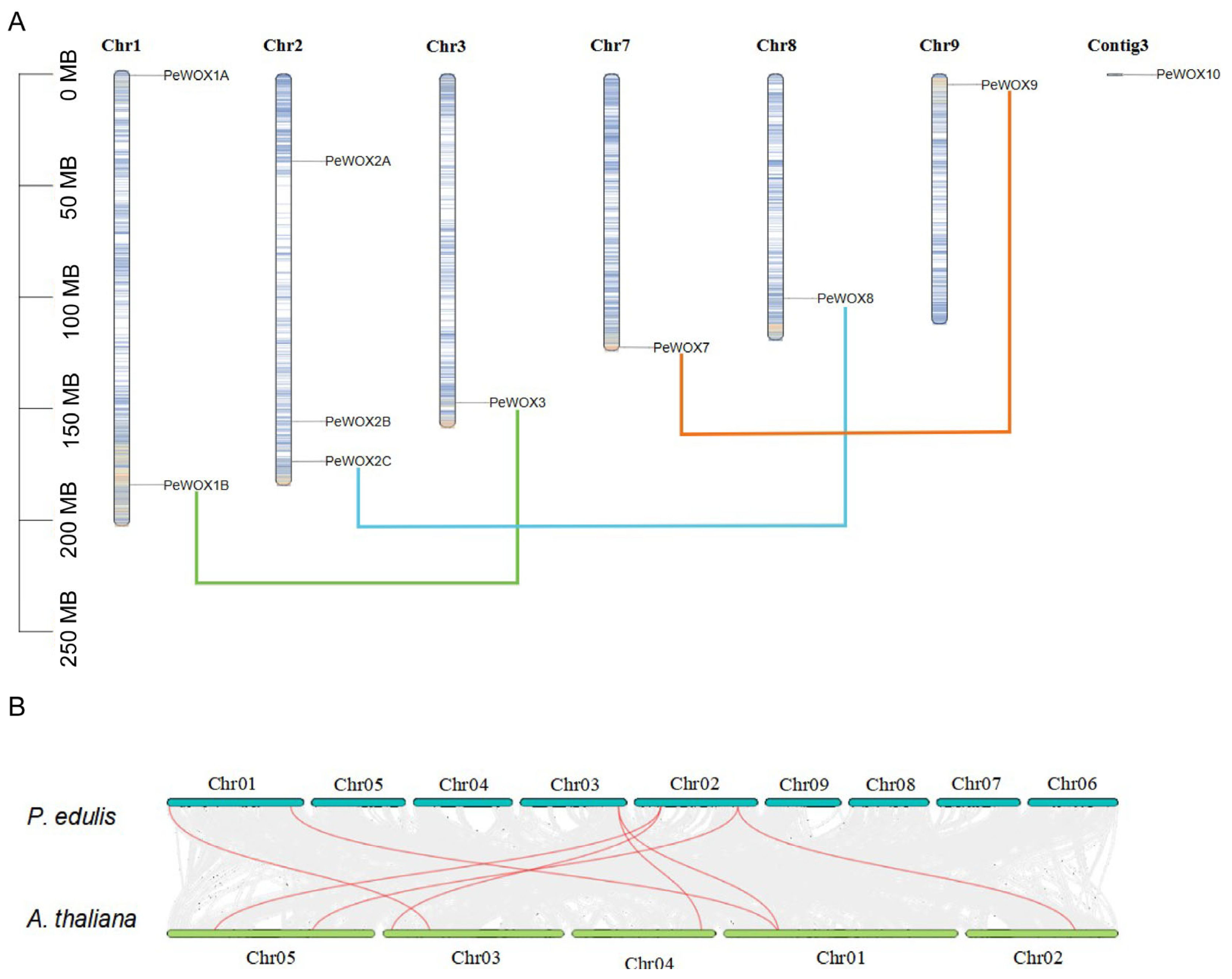
Chromosomal localization of all PeWOX genes was determined using genome annotation files and visualized with TBtools. Nine PeWOX genes were distributed across six chromosomes, while PeWOX10 resided on an unassembled contig (Contig3). The distribution pattern showed that PeWOX2A, PeWOX2B, and PeWOX2C genes are located on chromosome 2, PeWOX1A and PeWOX1B on chromosome 1, and PeWOX3, PeWOX7, PeWOX8, and PeWOX9 on chromosomes 3, 7, 8, and 9, respectively. To elucidate the expansion mechanism of the WOX family, we identified three segmental duplication events: PeWOX1A-PeWOX1B (chromosome 1), PeWOX2B-PeWOX2C (chromosome 2), and PeWOX7-PeWOX9 (between chromosomes 7 and 9) (Figure 5A). These duplications account for 60% of PeWOX genes (6/10), demonstrating that segmental duplication represents the primary driver of WOX family expansion in Passiflora edulis.
Figure 5.
Chromosomal distribution and synteny analysis. (A) Chromosomal distribution and gene duplications of PeWOXs. The segmental duplicated genes are linked by lines. The scale bar on the left indicates the length (Mb) of passion fruit chromosomes. (B) Synteny analysis of the WOX genes between passion fruit and Arabidopsis thaliana. Gray lines in the background indicate the collinear blocks between the passion fruit and Arabidopsis thaliana genomes, and the red lines highlight the syntenic WOX gene pairs.
To elucidate evolutionary conservation between passion fruit and Arabidopsis thaliana WOX genes, we performed collinearity analysis using MCScanX. The synteny map revealed eight orthologous gene pairs connecting five PeWOXs and seven AtWOXs (Figure 5B). Crucially, each WOX clade (WUS/Intermediate/Ancient) contained at least one syntenic pair, demonstrating deep conservation of microsynteny. This pattern indicates that WOX family diversification predates the Brassicaceae–Passifloraceae speciation event (~112 MYA, based on fossil-calibrated timetrees), with ancestral WOX loci maintained in syntenic blocks despite extensive genomic reorganization.
3.7. Subcellular Localization of PeWOXs Protein
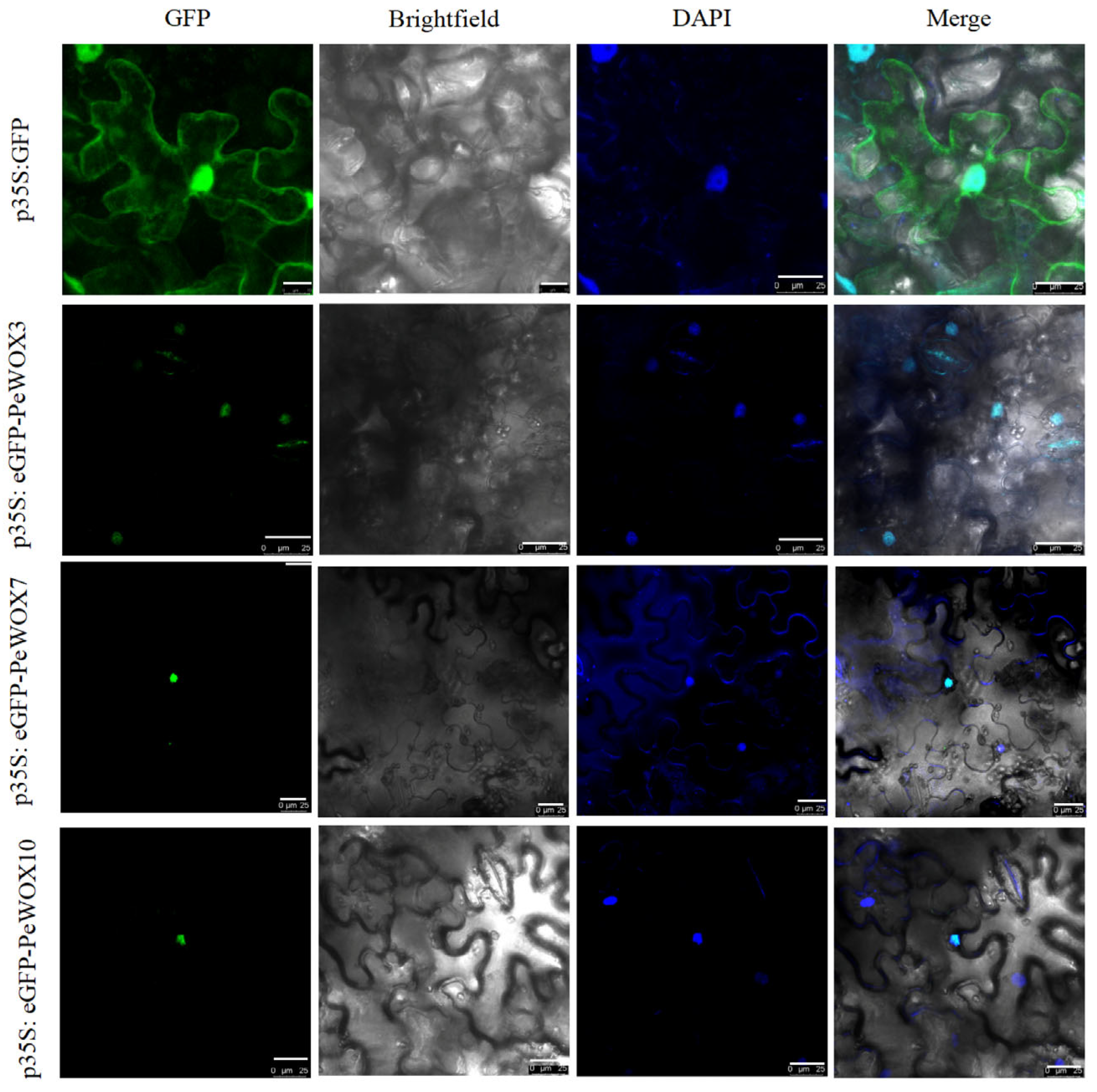
To detect the subcellular localization of PeWOX proteins, we conducted in vivo localization assays in Nicotiana benthamiana. The coding sequences of PeWOX3, PeWOX7, and PeWOX10 (without stop codons) were fused C-terminally to GFP under the control of the 35S promoter and transiently expressed via Agrobacterium tumefaciens infiltration, using p35S-GFP as a cytosolic/nuclear marker. Confocal imaging at 48 h post-infiltration showed that whereas p35S-GFP was diffused throughout the cell, all three PeWOX-GFP fusions localized exclusively to the nucleus (Figure 6).
Figure 6.
Subcellular localization analysis of PeWOXs in Nicotiana benthamiana leaves. p35S: eGFP-PeWOX3, p35S:eGFP-PeWOX7, and p35S:eGFP-PeWOX10 were localized in the cell nucleus by nuclear marker 4,6-diamidino-2-phenylindole (DAPI), GFP, and the DAPI/GFP merged images. Overall cell structure in this leaf tissue is also shown under the bright field setting. Bars = 25 µm.
This nuclear-specific localization aligns with the canonical nature of WOX family TFs, as observed in orthologs from Arabidopsis (e.g., AtWOX3, AtWOX7) and rice. The absence of cytoplasmic signal suggests that PeWOX3, PeWOX7, and PeWOX10 function primarily as nuclear transcriptional regulators, supporting their roles in WOX-related developmental processes.
3.8. Expression Patterns of PeWOXs in Different Tissues of Passion Fruit
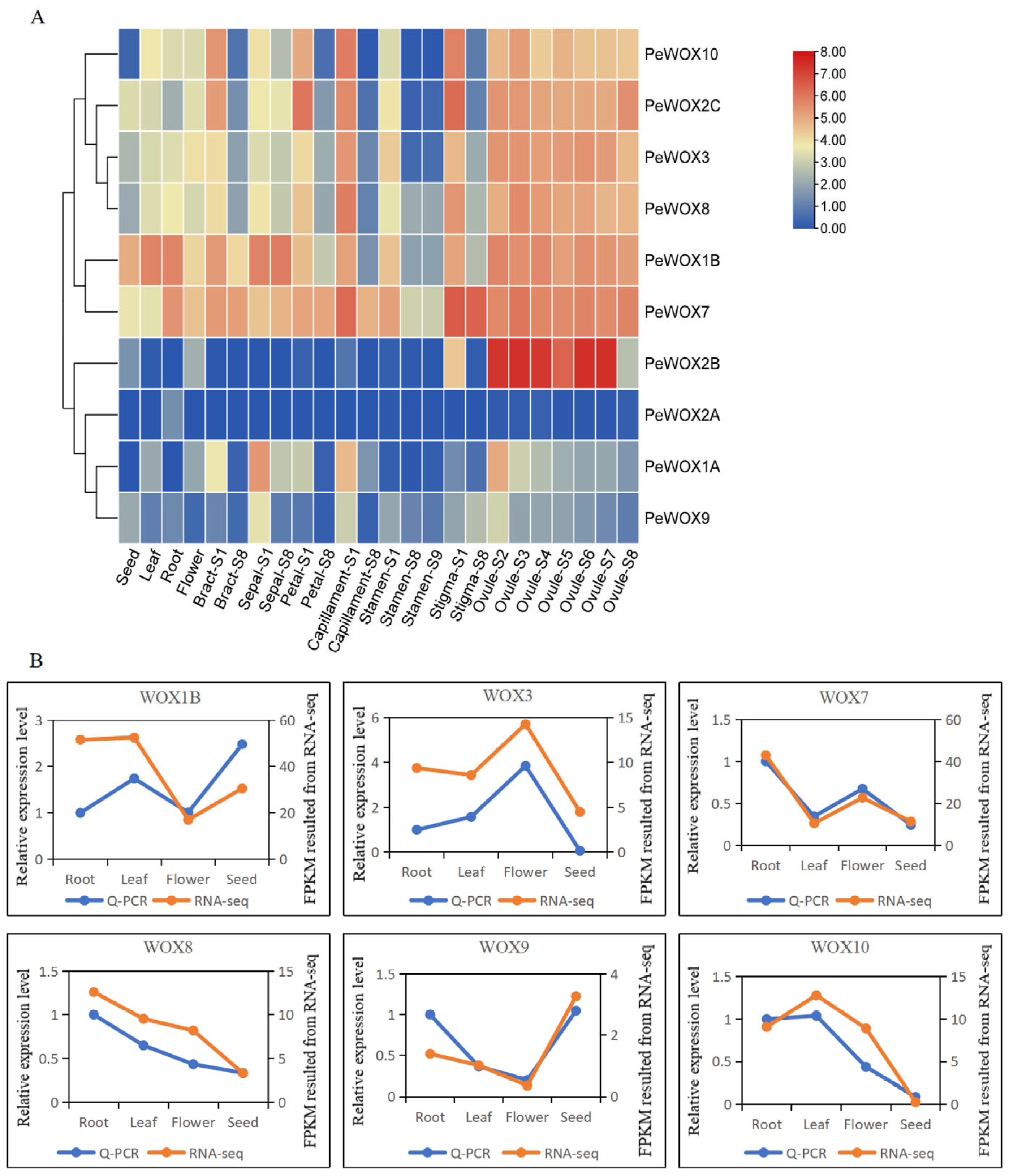
To characterize the spatiotemporal expression dynamics of WOX genes in passion fruit, we analyzed RNA-seq data spanning multiple tissues and developmental stages of flower development. Expression profiles were quantified as FPKM values, normalized across samples, and visualized via hierarchical clustering in TBtools (Figure 7A). The result showed that PeWOX2A exhibits weak expression in all tissues, while PeWOX7 was ubiquitously expressed. The expression of some genes is tissue-specific. For example, PeWOX2B exhibited exclusive high expression during ovule development, and PeWOX1B, PeWOX2C, PeWOX3, PeWOX7, PeWOX8, and PeWOX10 were co-expressed in developing ovules, indicating that these genes are involved in the different ovule development processes of passion fruit. This constitutive or co-expression module suggests PeWOX functional redundancy and/or cooperative regulation in female reproductive development.
Figure 7.
Expression patterns of PeWOXs in different tissues of passion fruit. (A) Heatmap of the tissue-specific expression profiles of the 10 WOX genes in passion fruit. (B) RT-qPCR of WOX genes in root, leaf, flower, and seed. The expression of four WOX genes in root, leaf, flower, and seed was verified by RT-qPCR. The left y-axis represents the relative expression of RT-qPCR result, and the right y-axis stands for the FPKM value from RNA-seq result. The blue dashed line represents RT-qPCR, and the red solid line represents the RNA-seq result.
To validate tissue-specific expression patterns identified by RNA-seq, we selected four representative PeWOX genes (PeWOX3, PeWOX7, PeWOX9 and PeWOX10) spanning distinct phylogenetic clades for RT-qPCR analysis across root, leaf, flower, and seed tissues. Using ef1α as the endogenous control, three biological replicates with technical triplicates were analyzed via the 2−ΔΔCT method. RT-qPCR analysis of four phylogenetically diverse PeWOX genes (PeWOX3/7/9/10) across root, leaf, flower, and seed tissues confirmed high concordance with RNA-seq profiles (Figure 7B). This orthogonal verification demonstrates robust reliability of the transcriptome data for deciphering spatiotemporal regulation in passion fruit.
3.9. Expression Patterns of PeWOXs in Different Abiotic Stress Treatments
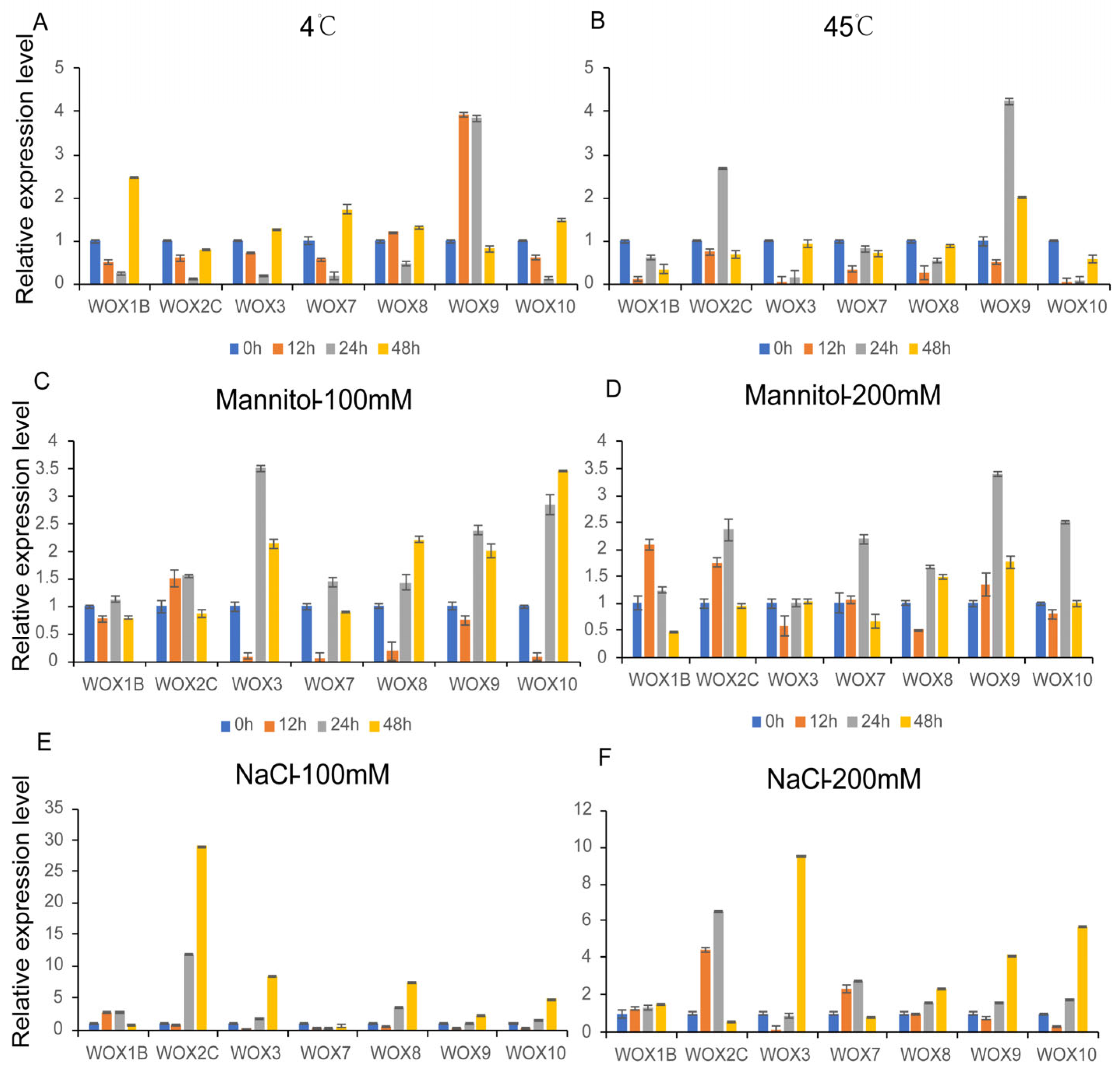
To further investigate the impact of abiotic stresses on PeWOX gene expression, we analyzed seven PeWOX genes (PeWOX1B, PeWOX2C, PeWOX3, PeWOX7, PeWOX8, PeWOX9, and PeWOX10) under drought, heat, cold, and salt stress using RT-qPCR. Under cold stress, six genes (PeWOX1B, PeWOX2C, PeWOX3, PeWOX7, PeWOX8, and PeWOX10) exhibited moderate induction at 6 h and 12 h, followed by a slight reduction at 24 h (Figure 8A). In contrast, PeWOX9 displayed an opposing response, with transcript levels increasing significantly during cold exposure. Under heat stress, transcriptional suppression was observed for most PeWOX genes, except PeWOX2C and PeWOX9, which showed transcript accumulation at 12 h (Figure 8B). Notably, PeWOX9 expression increased under both temperature extremes (cold and heat), suggesting its potential importance in temperature stress adaptation.
Figure 8.
Expression profiles of PeWOX members under treatments of cold, heat, drought, and salt stress, respectively. The relative expression levels are normalized to ef1α. Cold, heat, drought, and salt stress represent the in vitro plants treated with 4 °C (A), 45 °C (B), 100 mM Mannitol (C), 200 mM Mannitol (D), 100 mM NaCl (E), 200 mM NaCl (F). The numbers 0, 12, 24, and 48 indicate the time (hour) after treatments. Error bars represent the standard deviation (SD) of three biological replicates.
Under mannitol-induced osmotic stress, all PeWOX genes exhibited a conserved biphasic expression pattern characterized by initial downregulation, followed by transient induction and subsequent decline across tested concentrations (Figure 8C,D). Similarly, NaCl treatments elicited comparable responses, with transcript levels of all PeWOX genes displaying initial suppression followed by gradual upregulation. Notably, PeWOX2C and PeWOX8 showed differential sensitivity to sodium chloride concentration, exhibiting significantly higher induction under 100 mM NaCl compared to 200 mM treatment (Figure 8E,F). Collectively, RT-qPCR analysis revealed that passion fruit WOX family members are substantially altered by osmotic stressors, demonstrating both shared response dynamics and gene-specific modulation patterns. These findings suggest functional diversification within the PeWOX family, with members potentially fulfilling both overlapping and distinct roles in osmotic stress adaptation.
4. Discussion
Plant-specific WOX TF orchestrate pivotal biological processes, including stem cell homeostasis, embryogenesis, and organogenesis. In this study, we identified 10 WOX family members within the passion fruit (Passiflora edulis) genome—a first systematic characterization for this species. All PeWOX proteins harbor the conserved 60-amino-acid homeodomain, exhibiting high sequence conservation with Arabidopsis thaliana orthologs, underscoring deep functional preservation across eudicots.
Phylogenetic reconstruction using maximum likelihood analysis of WOX proteins from P. edulis, A. thaliana, Populus trichocarpa, Ricinus communis, and Vitis vinifera resolved three evolutionarily distinct clades (Figure 2). Crucially, each clade contained at least one representative from both passion fruit and Arabidopsis, indicating lineage-specific retention of ancestral WOX subfamilies predating the speciation divergence of these taxa. Supporting this evolutionary model, exon–intron structural analyses revealed divergent gene architectures between clades but remarkable conservation within clades (Figure 3A–C). While exon numbers varied substantially across paralogs from different subfamilies, orthologous pairs within the same clade shared highly similar splicing patterns. This structural coherence within phylogenetically defined groups reinforces the hypothesis that WOX family diversification occurred prior to rosid–asterid cladogenesis (~125 MYA). The conserved homeodomain and syntenic retention of orthogroups further suggest strong purifying selection on core developmental functions.
Cis-regulatory elements orchestrate transcriptional regulation through interactions with TFs []. Our promoter analysis of PeWOX genes revealed an abundance of regulatory motifs associated with hormonal signaling, developmental processes, and stress responses. Strikingly, MeJA-responsive elements were ubiquitously present across all PeWOX promoters, indicating conserved jasmonate-mediated regulation within this family. We further identified widespread distribution of low-temperature responsiveness (LTR) elements and abscisic acid-responsive elements (ABREs) among PeWOX members, suggesting synergistic roles in abiotic stress adaptation. The prevalence of these motifs implies that PeWOX genes integrate jasmonate signaling with ABA-dependent pathways and cold stress responses—a regulatory nexus potentially critical for passion fruit’s environmental resilience. The universal presence of MeJA-responsive elements suggests deep conservation of jasmonate signaling in WOX-regulated developmental pathways across eudicots—consistent with JA’s role in wound response and tissue regeneration [,]. Concurrent enrichment of ABREs and LTR elements supports crosstalk between ABA-dependent stress signaling and cold acclimation mechanisms, potentially enabling PeWOX genes to coordinate growth-defense tradeoffs under abiotic stress. Given passion fruit’s tropical origin, these regulatory architectures may represent adaptive innovations for temperature fluctuation tolerance during domestication.
Promoter analysis revealed that PeWOX genes harbor abundant cis-regulatory elements associated with hormonal regulation (e.g., MeJA, ABA), developmental processes, and stress responses (Figure 4). Strikingly, MeJA-responsive elements were universally present in all PeWOX promoters, suggesting conserved jasmonate-mediated transcriptional control across this family. Co-enrichment of MeJA and ABA elements hints at hormonal antagonism in PeWOX regulation: JA typically promotes regeneration while ABA inhibits growth under stress. This may enable PeWOX genes to balance tissue repair with stress survival—a tradeoff critical in perennial crops like passion fruit. Concurrent enrichment of low-temperature responsiveness (LTR) elements and abscisic acid-responsive elements (ABREs) implies synergistic integration of cold signaling and ABA-dependent pathways—a regulatory paradigm potentially critical for passion fruit’s adaptation to abiotic stressors. Chromosomal mapping identified six PeWOX genes forming three paralogous pairs (PeWOX1B/3, PeWOX2C/8, PeWOX7/9) on homologous chromosomes (Figure 5A), indicating lineage-specific whole-genome duplications. Collinearity analysis further demonstrated that each WOX subfamily contains at least one orthologous pair between Passiflora edulis and Arabidopsis thaliana (Figure 5B). This conserved synteny, coupled with shared exon–intron architectures within clades (Figure 3A,B), strongly supports pre-rosid–asterid divergence origination of WOX family diversification—predating the ~125-million-year speciation split of these taxa. The retention of syntenic orthologs across passion fruit and Arabidopsis implies strong purifying selection on WOX developmental functions. Paralog pairs (PeWOX1B/3, etc.) likely arose from Passiflora-specific γ whole-genome duplication, suggesting subfunctionalization during niche adaptation.
Confirming the in silico predictions, our experimental results verified the nuclear localization of PeWOX3, PeWOX7, and PeWOX10 (Figure 6). This nuclear compartmentalization is a hallmark of their identity as TFs. It suggests that their primary mode of action involves binding to specific promoter elements of target genes to orchestrate transcriptional programs. Furthermore, their presence in the nucleus allows for potential protein-protein interactions with other nuclear factors or post-translational modifications (e.g., phosphorylation) that could finely modulate their transcriptional activity in response to developmental or environmental cues.
Gene expression profiles provide critical insights into functional specialization within multigene families. Our analysis reveals striking divergence in PeWOX spatial expression: PeWOX2A exhibits transcriptional silencing across all examined tissues, while PeWOX7 demonstrates constitutive expression consistent with putative housekeeping functions. Notably, PeWOX2B displays strict tissue-specific expression with pronounced enrichment during ovule development, suggesting specialized roles in female gametogenesis. The constitutive PeWOX7 expression mirrors AtWOX4’s roles in cambial maintenance, suggesting deep functional conservation. Conversely, neofunctionalization is evident in PeWOX2B’s ovule-specific expression—a lineage-specific adaptation possibly linked to passion fruit’s unique floral architecture [,]. Six additional members (PeWOX1B, PeWOX2C, PeWOX3, PeWOX7, PeWOX8 and PeWOX10) show ovule-stage expression, implicating collective regulation of passion fruit reproductive development through potentially redundant or complementary mechanisms [,].
Abiotic stressors trigger adaptive transcriptional reprogramming to maintain cellular homeostasis []. We observed stimulus-specific PeWOX induction patterns characterized by PeWOX9’s significant upregulation under both cold and heat stress, indicating its specialized role in thermotolerance mediation; broad induction of most PeWOX genes (excluding PeWOX1B) during drought, suggesting coordinated osmotic adjustment and pronounced NaCl-responsive induction of PeWOX2C and PeWOX3, implicating their specialized functions in ion homeostasis under salt stress. The strong concordance between RNA-seq and RT-qPCR expression profiles validates our transcriptomic approach and reinforces the biological significance of observed expression patterns.
This study presents the first genome-wide identification and functional characterization of the WOX TF family in passion fruit, elucidating their molecular properties, evolutionary relationships, and expression dynamics across developmental stages and abiotic stress conditions. Our findings establish a critical foundation for future mechanistic investigations into PeWOX gene functions in passion fruit growth, reproduction, and environmental adaptation.
5. Conclusions
In this study, we identified 10 WOX genes in the passion fruit genome. Phylogenetic analysis was divided into three groups (WUS, intermediate, and ancient clade), which were further supported by their conserved motifs and gene structures. The prediction analysis of cis-regulatory elements showed that PeWOXs may participate in a variety of biological processes by regulating a variety of target genes involved in growth, development, hormone, and stress reactions. The RNA-seq data were used to analyze the expression profiles of different flower tissues and developmental stages, which is helpful to study their functions in ovule developmental processes or regulatory pathways. We also show that some PeWOX genes were involved in various biological and abiotic stresses (heat, cold, and NaCl). A comprehensive analysis of the results of the WOX family will help to screen genes and provide a basis for further functional studies of passion fruit.
Supplementary Materials
The following supporting information can be downloaded at: https://www.mdpi.com/article/10.3390/agronomy15122766/s1, Table S1. Primers used for this paper. Table S2. The protein sequences of passion fruit WOXs. Table S3. The promoter sequences of passion fruit WOXs.
Author Contributions
Software, L.X.; Validation, T.W. and B.T.; Formal analysis, O.O.A., P.Z., Y.C. and H.C.; Data curation, M.G.A. and X.W.; Writing—original draft, J.G. and D.Z.; Writing—review & editing, Y.Q. and L.W. All authors have read and agreed to the published version of the manuscript.
Funding
This work was supported by the Major Science and Technology Project of Fujian Province (2024NZ029029) and the Science and Technology Major Project of Guangxi (Gui Ke AA22068096). The project of Guangxi featured a fruit innovation team, with the pineapple Nanning Integrated test station under the national modern agricultural industry technology system (nycytxgxcxtd-2024-17-10).
Data Availability Statement
The raw data supporting the conclusions of this article will be made available by the authors on request.
Conflicts of Interest
The authors declare no conflict of interest.
References
- Gehring, W.J.; Müller, M.; Affolter, M.; Percival-Smith, A.; Billeter, M.; Qian, Y.Q.; Otting, G.; Wüthrich, K. The structure of the homeodomain and its functional implications. Trends Genet. 1990, 6, 323–329. [Google Scholar] [CrossRef]
- Gehring, W.J.; Qian, Y.Q.; Billeter, M.; Furukubo-Tokunaga, K.; Schier, A.F.; Resendez-Perez, D.; Affolter, M.; Otting, G.; Wüthrich, K. Homeodomain-DNA recognition. Cell 1994, 78, 211–223. [Google Scholar] [CrossRef] [PubMed]
- Gehring; Walter, J.J.G. Exploring the homeobox. Gene 1993, 135, 215–221. [Google Scholar] [CrossRef]
- van der Graaff, E.; Laux, T.; Rensing, S.A.J.G.B. The WUS homeobox-containing (WOX) protein family. Genome Biol. 2009, 10, 248. [Google Scholar] [CrossRef]
- Mukherjee, K.; Brocchieri, L.; Bürglin, T.R. A comprehensive classification and evolutionary analysis of plant homeobox genes. Mol. Biol. Evol. 2009, 26, 2775–2794. [Google Scholar] [CrossRef]
- Breuil-Broyer, S.; Trehin, C.; Morel, P.; Boltz, V.; Sun, B.; Chambrier, P.; Ito, T.; Negrutiu, I. Analysis of the Arabidopsis superman allelic series and the interactions with other genes demonstrate developmental robustness and joint specification of male–female boundary, flower meristem termination and carpel compartmentalization. Ann. Bot. 2016, 117, mcw023. [Google Scholar] [CrossRef]
- Laux, T.; Mayer, K.F.; Berger, J.; Jurgens, G. The WUSCHEL gene is required for shoot and floral meristem integrity in Arabidopsis. Development 1996, 122, 87. [Google Scholar] [CrossRef] [PubMed]
- Kong, D.; Hao, Y.; Cui, H. The WUSCHEL Related Homeobox Protein WOX7 Regulates the Sugar Response of Lateral Root Development in Arabidopsis thaliana. Mol. Plant 2016, 9, 261–270. [Google Scholar] [CrossRef]
- Suer, S.; Agusti, J.; Sanchez, P.; Schwarz, M.; Greb, T. WOX4Imparts Auxin Responsiveness to Cambium Cells in Arabidopsis. Plant Cell 2011, 23, 3247–3259. [Google Scholar] [CrossRef] [PubMed]
- Haecker, A. Expression dynamics of WOX genes mark cell fate decisions during early embryonic patterning in Arabidopsis thaliana. Development 2004, 131, 657–668. [Google Scholar] [CrossRef]
- Shimizu, R.; Ji, J.; Kelsey, E.; Ohtsu, K.; Schnable, P.S.; Scanlon, M.J. Tissue specificity and evolution of meristematic WOX3 function. Plant Physiol. 2009, 149, 841–850. [Google Scholar] [CrossRef]
- Romera-Branchat, M.; Ripoll, J.J.; Yanofsky, M.F.; Pelaz, S. The WOX13 homeobox gene promotes replum formation in the Arabidopsis thaliana fruit. Plant J. 2013, 73, 37–49. [Google Scholar] [CrossRef]
- Zhang, Y.; Wu, R.; Qin, G.; Chen, Z.; Gu, H.; Qu, L.J. Over-expression of WOX1 Leads to Defects in Meristem Development and Polyamine Homeostasis in Arabidopsis. J. Integr. Plant Biol. 2011, 53, 14. [Google Scholar] [CrossRef] [PubMed]
- Gonzali, S.; Novi, G.; Loreti, E.; Paolicchi, F.; Poggi, A.; Alpi, A.; Perata, P. A turanose-insensitive mutant suggests a role for WOX5 in auxin homeostasis in Arabidopsis thaliana. Plant J. 2005, 44, 633–645. [Google Scholar] [CrossRef] [PubMed]
- Liu, J.; Sheng, L.; Xu, Y.; Li, J.; Yang, Z.; Huang, H.; Xu, L. WOX11 and 12 Are Involved in the First-Step Cell Fate Transition during de Novo Root Organogenesis in Arabidopsis. Plant Cell 2014, 26, 1081–1093. [Google Scholar] [CrossRef] [PubMed]
- Wu, X.; Dabi, T.; Weigel, D. Requirement of Homeobox Gene STIMPY/WOX9 for Arabidopsis Meristem Growth and Maintenance-ScienceDirect. Curr. Biol. Cb 2005, 15, 436–440. [Google Scholar] [CrossRef]
- Park, S.O. The PRETTY FEW SEEDS2 gene encodes an Arabidopsis homeodomain protein that regulates ovule development. Development 2005, 132, 841. [Google Scholar] [CrossRef]
- Roda, A.; Lucini, L.; Torchio, F.; Dordoni, R.; De Faveri, D.M.; Lambri, M. Metabolite profiling and volatiles of pineapple wine and vinegar obtained from pineapple waste. Food Chem. 2017, 229, 734–742. [Google Scholar] [CrossRef]
- Talcott, S.T.; Percival, S.S.; Pittet-Moore, J.; Celoria, C. Phytochemical composition and antioxidant stability of fortified yellow passion fruit (Passiflora edulis). J. Agric. Food Chem. 2003, 51, 935–941. [Google Scholar] [CrossRef]
- Leterme, P.; Buldgen, A.; Estrada, F.; Londoño, A.M. Mineral content of tropical fruits and unconventional foods of the Andes and the rain forest of Colombia. Food Chem. 2006, 95, 644–652. [Google Scholar] [CrossRef]
- Barbosa, P.R.; Valvassori, S.S.; Bordignon, C.L., Jr.; Kappel, V.D.; Martins, M.R.; Gavioli, E.C.; Quevedo, J.; Reginatto, F.H. The aqueous extracts of Passiflora alata and Passiflora edulis reduce anxiety-related behaviors without affecting memory process in rats. J. Med. Food 2008, 11, 282–288. [Google Scholar] [CrossRef]
- Coleta, M.; Batista, M.T.; Campos, M.G.; Carvalho, R.; Cotrim, M.D.; Lima, T.C.M.d.; Cunha, A.P.d. Neuropharmacological evaluation of the putative anxiolytic effects of Passiflora edulis Sims, its sub-fractions and flavonoid constituents. Phytother. Res. 2006, 20, 1067–1073. [Google Scholar] [CrossRef]
- Sena, L.M.; Zucolotto, S.M.; Reginatto, F.H.; Schenkel, E.P.; De Lima, T.C. Neuropharmacological activity of the pericarp of Passiflora edulis flavicarpa degener: Putative involvement of C-glycosyl flavonoids. Exp. Biol. Med. 2009, 234, 967–975. [Google Scholar] [CrossRef]
- Chen, C.; Chen, H.; Zhang, Y.; Thomas, H.R.; Frank, M.H.; He, Y.; Xia, R. TBtools: An Integrative Toolkit Developed for Interactive Analyses of Big Biological Data. Mol. Plant 2020, 13, 1194–1202. [Google Scholar] [CrossRef]
- Marchler-Bauer, A.; Bo, Y.; Han, L.; He, J.; Lanczycki, C.J.; Lu, S.; Chitsaz, F.; Derbyshire, M.K.; Geer, R.C.; Gonzales, N.R.; et al. CDD/SPARCLE: Functional classification of proteins via subfamily domain architectures. Nucleic Acids Res. 2017, 45, D200–D203. [Google Scholar] [CrossRef] [PubMed]
- Letunic, I.; Doerks, T.; Bork, P. SMART 7: Recent updates to the protein domain annotation resource. Nucleic Acids Res. 2012, 40, D302–D305. [Google Scholar] [CrossRef] [PubMed]
- Artimo, P.; Jonnalagedda, M.; Arnold, K.; Baratin, D.; Csardi, G.; de Castro, E.; Duvaud, S.; Flegel, V.; Fortier, A.; Gasteiger, E.; et al. ExPASy: SIB bioinformatics resource portal. Nucleic Acids Res. 2012, 40, W597–W603. [Google Scholar] [CrossRef]
- Chou, K.-C.; Shen, H.-B. Cell-PLoc: A package of Web servers for predicting subcellular localization of proteins in various organisms. Nat. Protoc. 2008, 3, 153–162. [Google Scholar] [CrossRef]
- Lian, G.; Ding, Z.; Wang, Q.; Zhang, D.; Xu, J. Origins and evolution of WUSCHEL-related homeobox protein family in plant kingdom. Sci. World J. 2014, 2014, 534140. [Google Scholar] [CrossRef] [PubMed]
- Larkin, M.A.; Blackshields, G.; Brown, N.P.; Chenna, R.; McGettigan, P.A.; McWilliam, H.; Valentin, F.; Wallace, I.M.; Wilm, A.; Lopez, R.; et al. Clustal W and Clustal X version 2.0. Bioinformatics 2007, 23, 2947–2948. [Google Scholar] [CrossRef]
- Gouet, P.; Robert, X.; Courcelle, E. ESPript/ENDscript: Extracting and rendering sequence and 3D information from atomic structures of proteins. Nucleic Acids Res. 2003, 31, 3320–3323. [Google Scholar] [CrossRef] [PubMed]
- Crooks, G.E.; Hon, G.; Chandonia, J.-M.; Brenner, S.E. WebLogo: A sequence logo generator. Genome Res. 2004, 14, 1188–1190. [Google Scholar] [CrossRef]
- Kumar, S.; Stecher, G.; Li, M.; Knyaz, C.; Tamura, K. MEGA X: Molecular Evolutionary Genetics Analysis across Computing Platforms. Mol. Biol. Evol. 2018, 35, 1547–1549. [Google Scholar] [CrossRef]
- Bailey, T.L.; Boden, M.; Buske, F.A.; Frith, M.; Grant, C.E.; Clementi, L.; Ren, J.; Li, W.W.; Noble, W.S. MEME SUITE: Tools for motif discovery and searching. Nucleic Acids Res. 2009, 37, W202–W208. [Google Scholar] [CrossRef]
- Lescot, M.; Déhais, P.; Thijs, G.; Marchal, K.; Moreau, Y.; Van de Peer, Y.; Rouzé, P.; Rombauts, S. PlantCARE, a database of plant cis-regulatory elements and a portal to tools for in silico analysis of promoter sequences. Nucleic Acids Res. 2002, 30, 325–327. [Google Scholar] [CrossRef]
- Wang, H.; Lu, Y.; Jiang, T.; Berg, H.; Li, C.; Xia, Y. The Arabidopsis U-box/ARM repeat E3 ligase AtPUB4 influences growth and degeneration of tapetal cells, and its mutation leads to conditional male sterility. Plant J. 2013, 74, 511–523. [Google Scholar] [CrossRef]
- Liang, J.; Hou, Z.; Liao, J.; Qin, Y.; Wang, L.; Wang, X.; Su, W.; Cai, Z.; Fang, Y.; Aslam, M.; et al. Genome-Wide Identification and Expression Analysis of LBD Transcription Factor Genes in Passion Fruit (Passiflora edulis). Int. J. Mol. Sci. 2022, 23, 4700. [Google Scholar] [CrossRef]
- Liu, Y.; Yuan, J.; Zhang, D.; Deng, K.; Chai, G.; Huang, Y.; Ma, S.; Qin, Y.; Wang, L. Genome-Wide Identification and Characterization of the SBP Gene Family in Passion Fruit (Passiflora edulis Sims). Int. J. Mol. Sci. 2022, 23, 14153. [Google Scholar] [CrossRef]
- Cai, H.; Zhao, L.; Wang, L.; Zhang, M.; Su, Z.; Cheng, Y.; Zhao, H.; Qin, Y. ERECTA signaling controls Arabidopsis inflorescence architecture through chromatin-mediated activation of PRE1 expression. New Phytol. 2017, 214, 1579–1596. [Google Scholar] [CrossRef] [PubMed]
- Zhang, X.; Zong, J.; Liu, J.; Yin, J.; Zhang, D. Genome-wide analysis of WOX gene family in rice, sorghum, maize, Arabidopsis and poplar. J. Integr. Plant Biol. 2010, 52, 1016–1026. [Google Scholar] [CrossRef] [PubMed]
- Chai, M.; Cheng, H.; Yan, M.; Priyadarshani, S.; Zhang, M.; He, Q.; Huang, Y.; Chen, F.; Liu, L.; Huang, X.; et al. Identification and expression analysis of the DREB transcription factor family in pineapple (Ananas comosus (L.) Merr.). PeerJ 2020, 8, e9006. [Google Scholar] [CrossRef]
- Li, W.; Cui, X.; Meng, Z.; Huang, X.; Xie, Q.; Wu, H.; Jin, H.; Zhang, D.; Liang, W. Transcriptional regulation of Arabidopsis MIR168a and argonaute1 homeostasis in abscisic acid and abiotic stress responses. Plant Physiol. 2012, 158, 1279–1292. [Google Scholar] [CrossRef]
- Zhang, Y.; Chen, C.; Jin, X.F.; Xiong, A.S.; Peng, R.H.; Hong, Y.H.; Yao, Q.H.; Chen, J.M. Expression of a rice DREB1 gene, OsDREB1D, enhances cold and high-salt tolerance in transgenic Arabidopsis. BMB Rep. 2009, 42, 486–492. [Google Scholar] [CrossRef]
- Butler, J.E.; Kadonaga, J.T. The RNA polymerase II core promoter: A key component in the regulation of gene expression. Genes Dev. 2002, 16, 2583–2592. [Google Scholar] [CrossRef] [PubMed]
- Zhang, H.; Zhu, J.; Gong, Z.; Zhu, J.K. Abiotic stress responses in plants. Nat. Rev. Genet. 2022, 23, 104–119. [Google Scholar] [CrossRef]
- Zhang, G.; Zhao, F.; Chen, L.; Pan, Y.; Sun, L.; Bao, N.; Zhang, T.; Cui, C.X.; Qiu, Z.; Zhang, Y.; et al. Jasmonate-mediated wound signaling promotes plant regeneration. Nat. Plants 2019, 5, 491–497. [Google Scholar] [CrossRef]
- Bai, X.; Fu, Q.; Jing, W.; Zhang, H.; Jian, H.; Qiu, X.; Li, H.; Wang, Q.; Yang, S.; Zhang, Y.; et al. Genome-wide identification of WOX family members in rose and functional analysis of RcWUS1 in embryogenic transformation. Plant Genome 2025, 18, e70012. [Google Scholar] [CrossRef] [PubMed]
- Costanzo, E.; Trehin, C.; Vandenbussche, M. The role of WOX genes in flower development. Ann. Bot. 2014, 114, 1545–1553. [Google Scholar] [CrossRef]
- Yuan, Y.; Huang, L.; Lu, H.; Xia, C.; Ramirez, C.; Gao, M.; Zhang, C.; Xiao, F. The ubiquitin ligase SINA3 and the transcription factor WOX14 regulate tomato growth and development. Plant Cell 2025, 37, koaf096. [Google Scholar] [CrossRef] [PubMed]
- Hsu, H.F.; Li, Y.C.; Shen, Y.H.; Yang, C.H. PaWOX3 and PaWOX3B Regulate Flower Number and the Lip Symmetry of Phalaenopsis. Plant Cell Physiol. 2024, 65, 1328–1343. [Google Scholar] [CrossRef]
- Nguyen, H.-C.; Lin, K.-H.; Ho, S.-L.; Chiang, C.-M.; Yang, C.-M. Enhancing the abiotic stress tolerance of plants: From chemical treatment to biotechnological approaches. Physiol. Plant. 2018, 164, 452–466. [Google Scholar] [CrossRef] [PubMed]
Disclaimer/Publisher’s Note: The statements, opinions and data contained in all publications are solely those of the individual author(s) and contributor(s) and not of MDPI and/or the editor(s). MDPI and/or the editor(s) disclaim responsibility for any injury to people or property resulting from any ideas, methods, instructions or products referred to in the content. |
© 2025 by the authors. Licensee MDPI, Basel, Switzerland. This article is an open access article distributed under the terms and conditions of the Creative Commons Attribution (CC BY) license (https://creativecommons.org/licenses/by/4.0/).