Antimicrobial and Herbicidal Secondary Metabolites from Insect-Associated Fungus Leptosphaeria sp. FZN28 in Mecopoda elongata


 , and
, and 
Abstract
1. Introduction
2. Materials and Methods
2.1. General Experimental Procedures
2.2. Fungal Strains and Weed Seeds
2.3. Plant Materials and Growth
2.4. Fermentation, Extraction, and Characterization of Secondary Metabolites
2.5. Zoospore Germination Experiments
2.6. Biological Assays Against S. sclerotiorum and P. capsici In Vitro
2.7. Protection Efficacies of Compounds 1 and 2
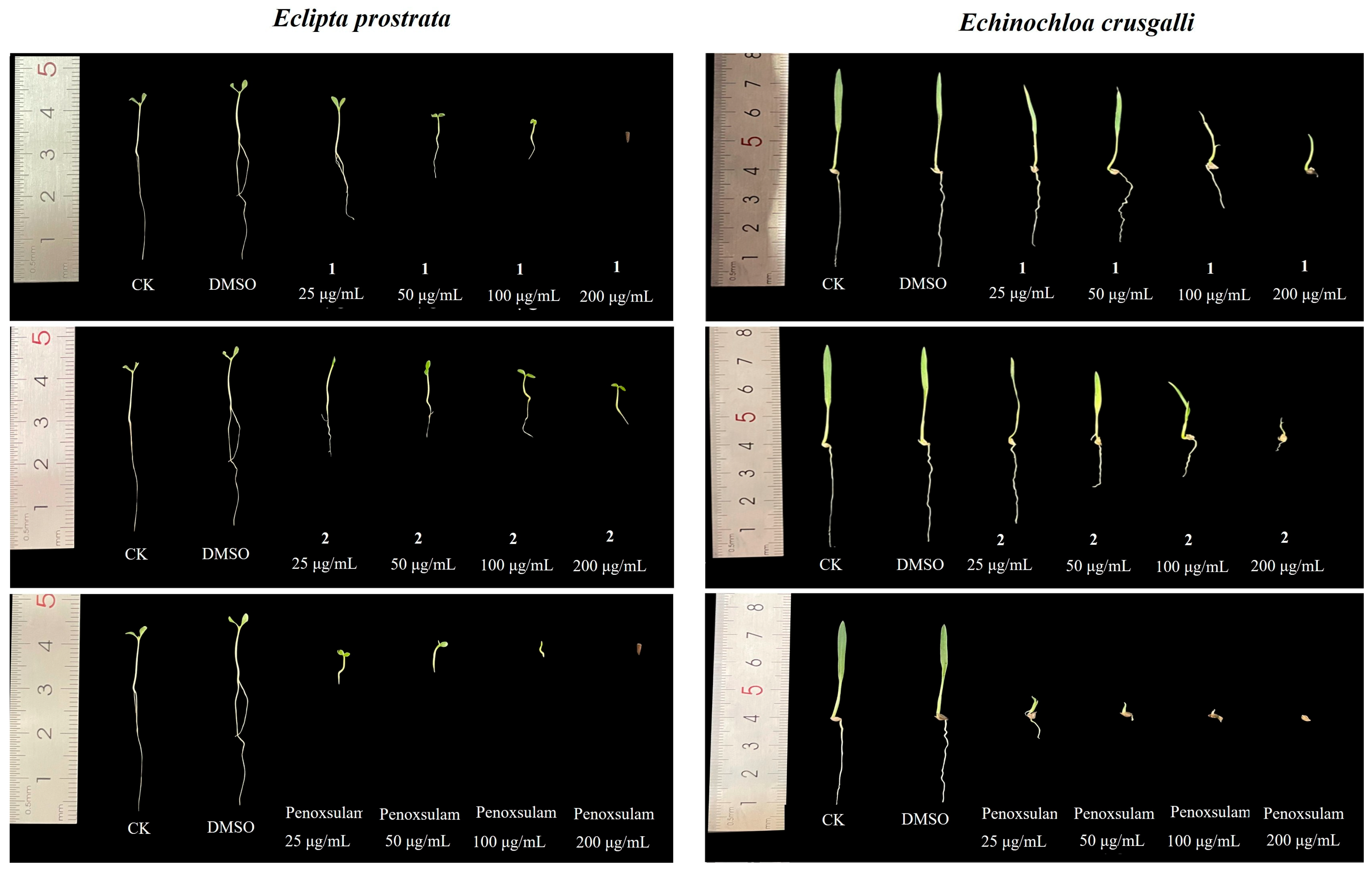
2.8. Bioassays with Echinochloa crusgalli and Eclipta prostrata
2.9. Effects of Compounds 1 and 2 on Hyphal Morphology of S. sclerotiorum and P. capsici
2.10. Statistical Analysis
3. Results
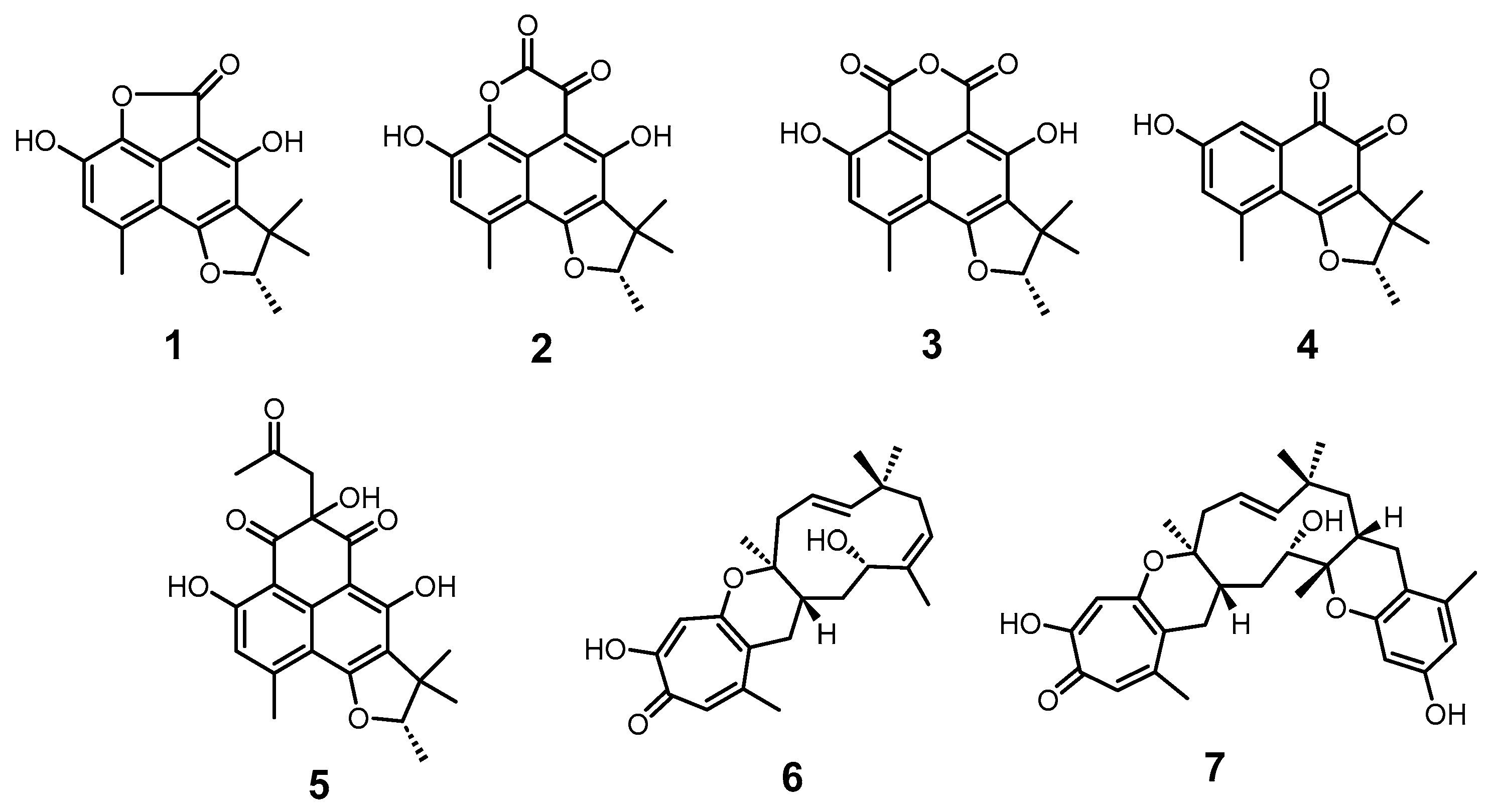
3.1. Structure Elucidation
3.2. Biological Activity
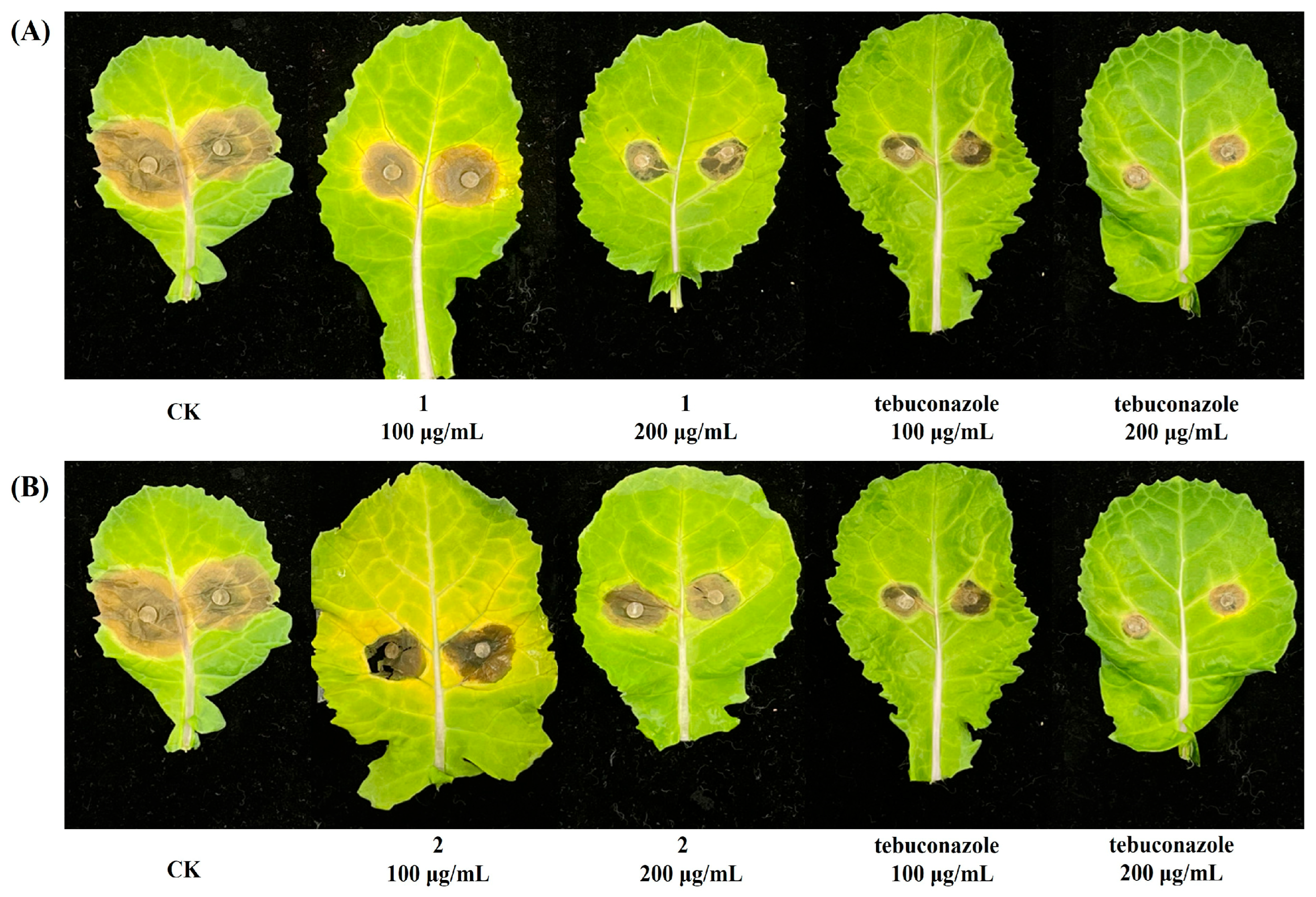
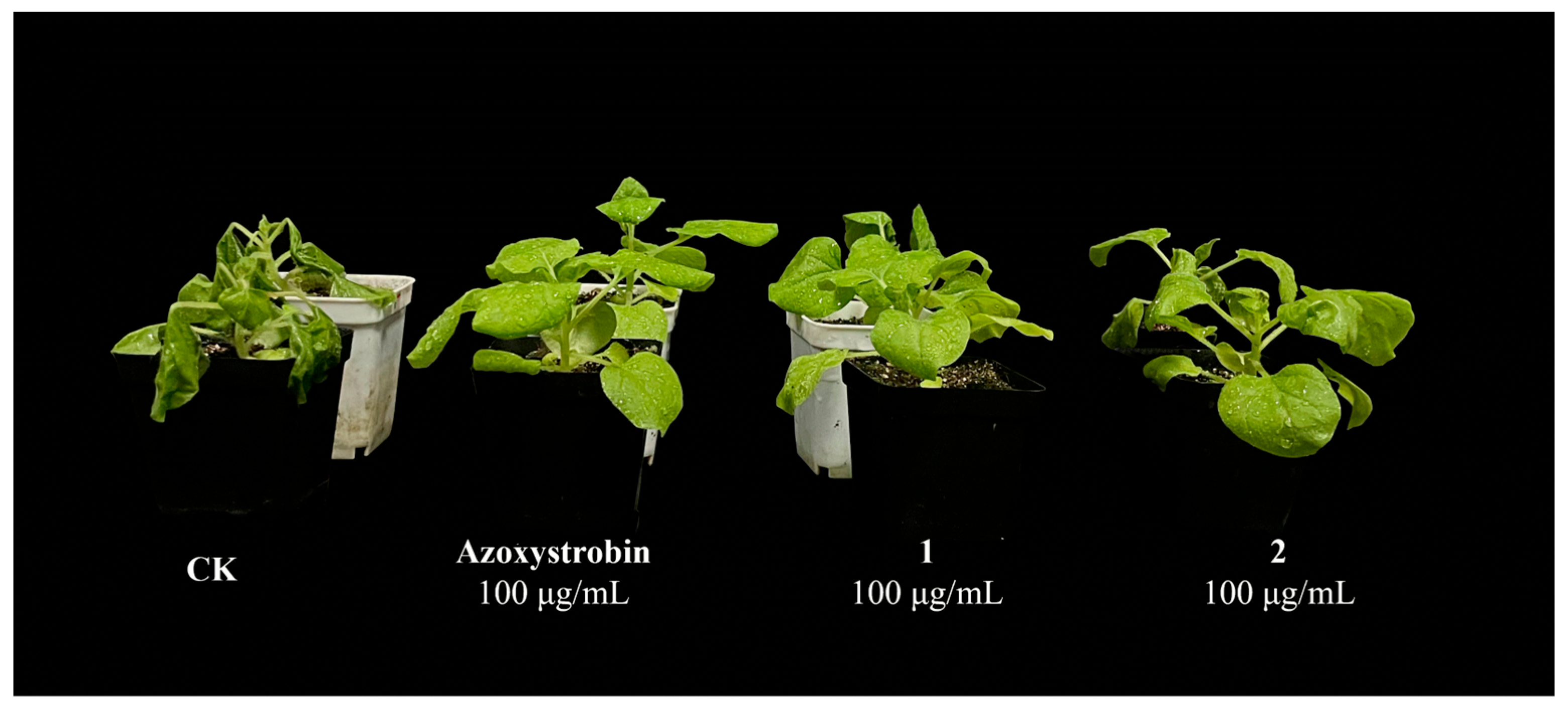
3.3. Protection Efficacies of 1 and 2 Against S. sclerotiorum and P. capsici
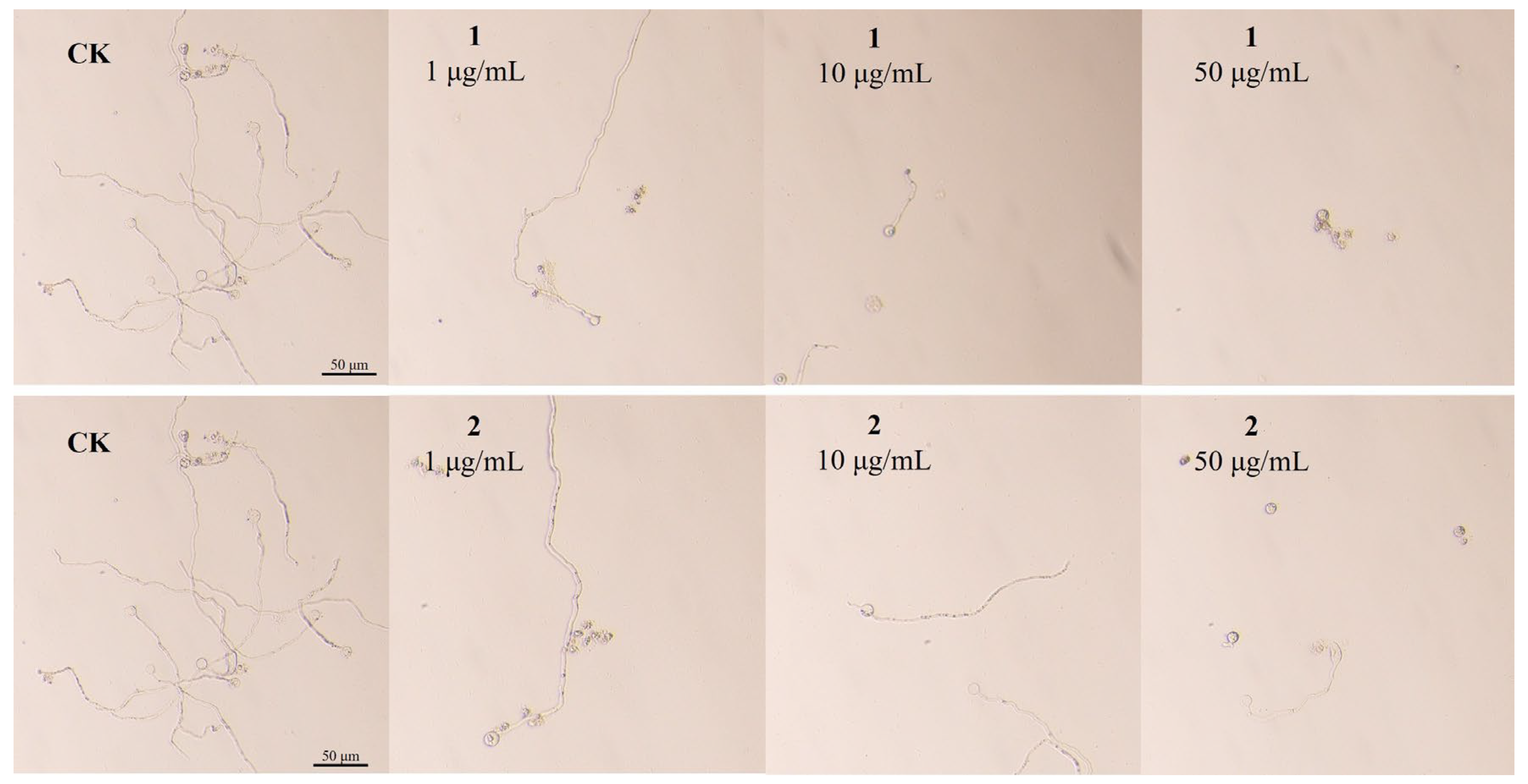
3.4. Effects of Compounds 1 and 2 on Spore Germination of P. capsici
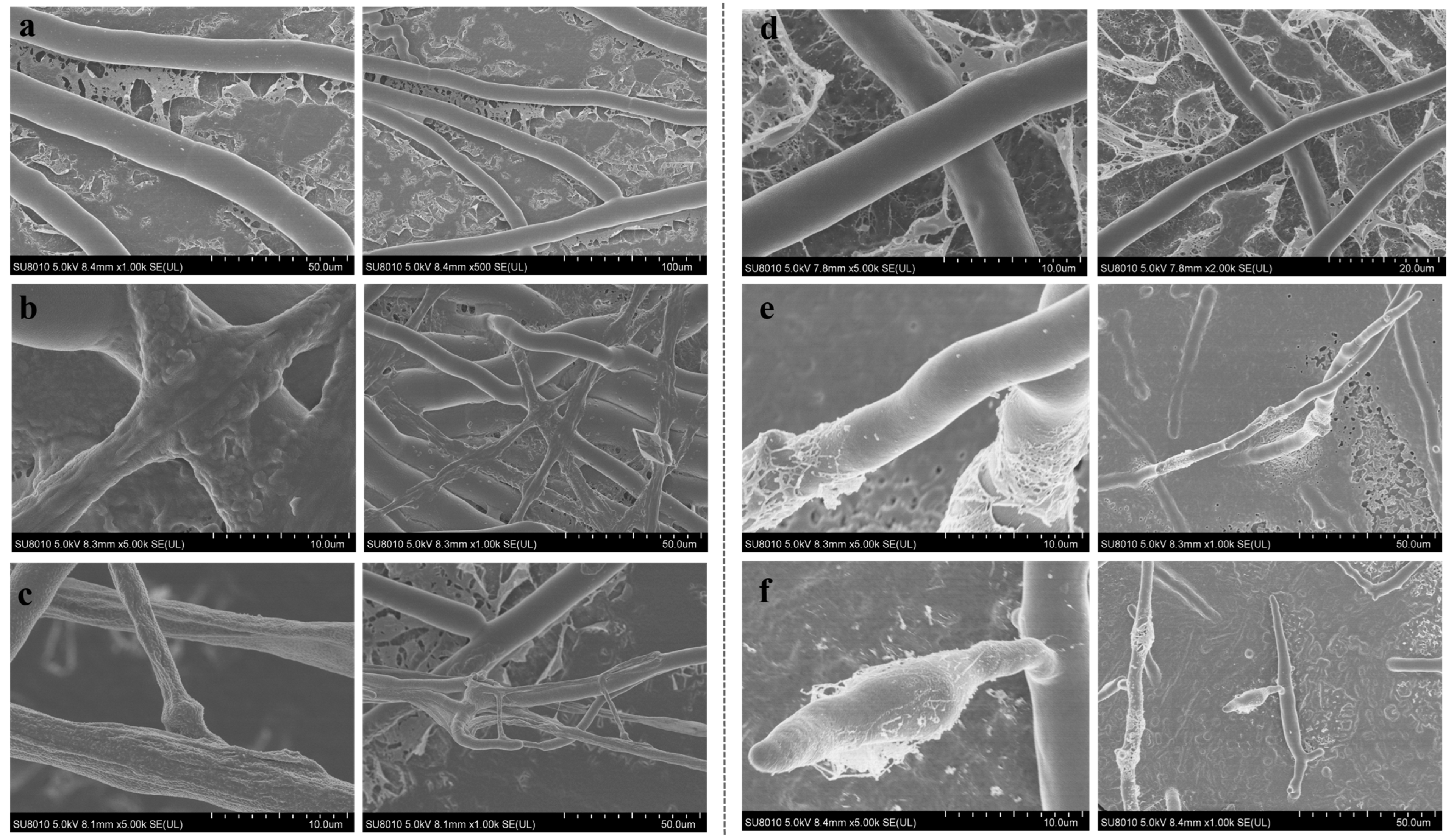
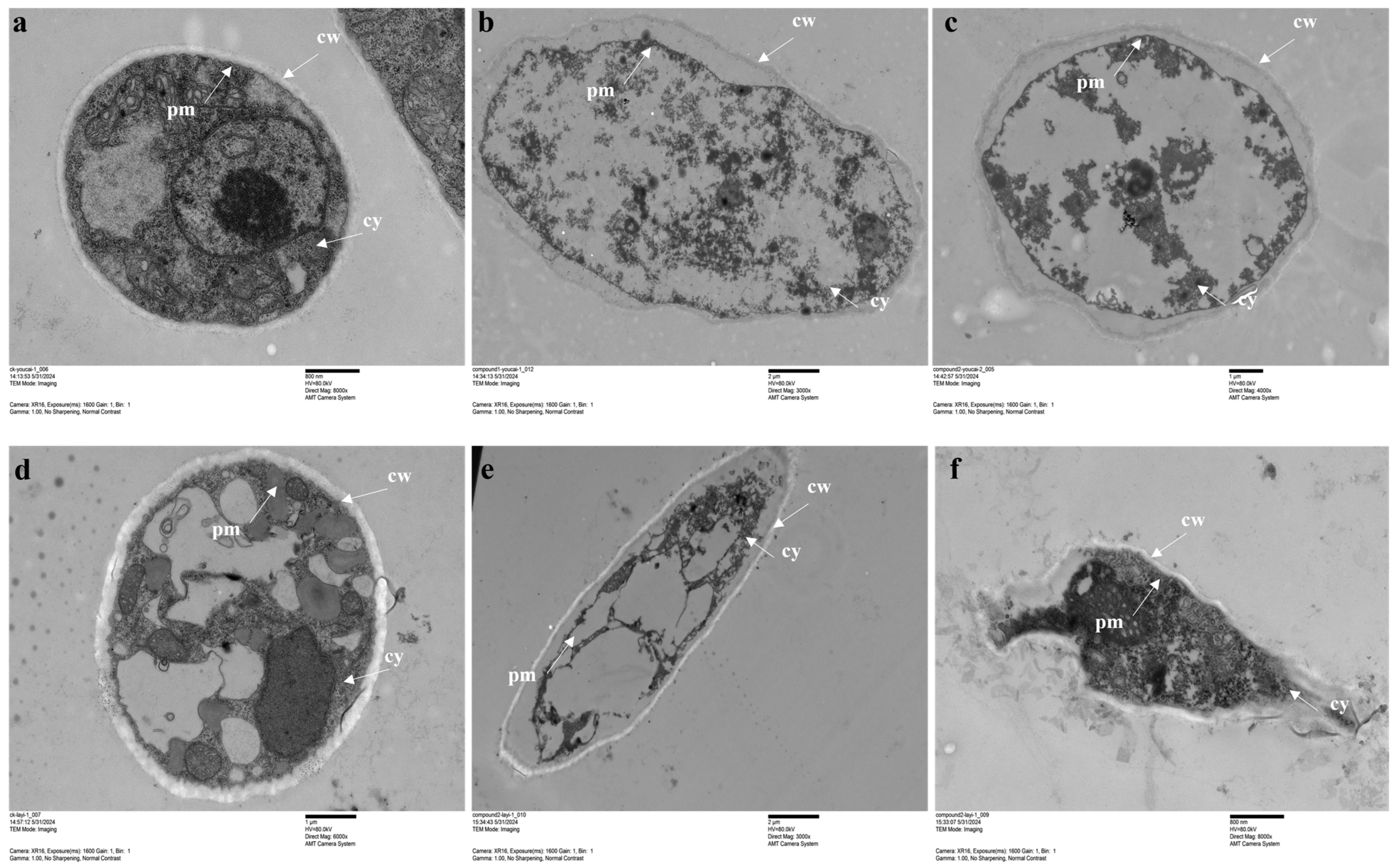
3.5. Effects of Compounds 1 and 2 on the Hyphal Morphology and Ultrastructure of S. sclerotiorum and P. capsici
3.6. Bioassays with Weed Species
4. Discussion
5. Conclusions
Supplementary Materials
Author Contributions
Funding
Data Availability Statement
Conflicts of Interest
Abbreviations
| SEM | Scanning electron microscope |
| TEM | Transmission electron microscope |
References
- Rodrigues, T.; Reker, D.; Schneider, P.; Schneider, G. Counting on natural products for drug design. Nat. Chem. 2016, 8, 531–541. [Google Scholar] [CrossRef]
- Newman, D.J.; Cragg, G.M. Natural products as sources of new drugs over the nearly four decades from 01/1981 to 09/2019. J. Nat. Prod. 2020, 83, 770–803. [Google Scholar] [CrossRef]
- Gouda, S.; Das, G.; Sen, S.K.; Shin, H.; Patra, J.K. Endophytes: A treasure house of bioactive compounds of medicinal importance. Front. Microbiol. 2016, 7, 1538. [Google Scholar] [CrossRef] [PubMed]
- Gao, H.; Li, G.; Lou, H.X. Structural diversity and biological activities of novel secondary metabolites from endophytes. Molecules 2018, 23, 646. [Google Scholar] [CrossRef] [PubMed]
- Li, T.X.; Xiong, Y.M.; Chen, X.; Yang, Y.N.; Wang, Y.; Jia, X.W.; Yang, X.P.; Tan, L.L.; Xu, C.P. Antifungal Macrocyclic Trichothecenes from the Insect-Associated Fungus Myrothecium roridum. J. Agric. Food Chem. 2019, 67, 13033–13039. [Google Scholar] [CrossRef]
- Joo, H.; Deyrup, S.T.; Shim, S.H. Endophyte-produced antimicrobials: A review of potential lead compounds with a focus on quorum-sensing disruptors. Phytochem. Rev. 2021, 20, 543–568. [Google Scholar] [CrossRef]
- Martinez-Klimova, E.; Rodríguez-Peña, K.; Sánchez, S. Endophytes as sources of antibiotics. Biochem. Pharmacol. 2017, 134, 1–17. [Google Scholar] [CrossRef] [PubMed]
- Rajamanikyam, M.; Vadlapudi, V.; Amanchy, R.; Upadhyayula, S.M. Endophytic fungi as novel resources of natural therapeutics. Biol. Appl. Sci. 2017, 60, e17160542. [Google Scholar] [CrossRef]
- Yu, H.S.; Zhang, L.; Li, L.; Zheng, C.J.; Guo, L.; Li, W.C.; Sun, P.X.; Qin, L.P. Recent developments and future prospects of antimicrobial metabolites produced by endophytes. Microbiol. Res. 2010, 165, 437–449. [Google Scholar] [CrossRef]
- Chen, Q.; Peng, G.; Kutcher, R.; Yu, F.Q. Genetic diversity and population structure of Leptosphaeria maculans isolates in Western Canada. J. Genet. Genom. 2021, 48, 994–1006. [Google Scholar] [CrossRef]
- Fitt, B.D.L.; Brun, H.; Barbetti, M.J.; Rimmer, S.R. World-Wide importance of phoma stem canker (Leptosphaeria maculans and L. biglobosa) on oilseed rape (Brassica napus). Eur. J. Plant Pathol. 2006, 114, 3–15. [Google Scholar] [CrossRef]
- Peng, G.; Liu, C.; Fernando, D.W.G.; Lang, R.; Mclaren, D.L.; Johnson, E.N.; Kutcher, H.R.; Singh, G.; Turkington, T.K.; Yu, F. Early fungicide treatment reduces blackleg on canola but yield benefit is realized only on susceptible cultivars under high disease pressure. Can. J. Plant Pathol. 2021, 43, 384–393. [Google Scholar] [CrossRef]
- Junker, C.; Draeger, S.; Schulz, B. A fine line-endophytes or pathogens in Arabidopsis thaliana. Fungal Ecol. 2012, 5, 657–662. [Google Scholar] [CrossRef]
- Rai, M.; Gade, A.; Zimowska, B.; Ingle, A.P.; Ingle, P. Harnessing the potential of novel bioactive compounds produced by endophytic phoma spp.- biomedical and agricultural applications. Acta Sci. Pol.-Hortorum Cultus 2020, 19, 31–45. [Google Scholar] [CrossRef]
- Chen, H.Y.; Liu, T.K.; Shi, Q.; Yang, X.L. Sesquiterpenoids and diterpenes with antimicrobial activity from Leptosphaeria sp. XL026 2019, an endophytic fungus in Panax notoginseng. Fitoterapia 2019, 137, 104243. [Google Scholar] [CrossRef]
- Lin, J.; Liu, S.C.; Sun, B.; Niu, S.; Li, E.; Liu, X.Z.; Che, Y.S. Polyketides from the ascomycete fungus Leptosphaeria sp. J. Nat. Prod. 2010, 73, 905–910. [Google Scholar] [CrossRef]
- Oerke, E.C. Crop losses to pests. J. Agric. Sci. 2006, 144, 31–43. [Google Scholar] [CrossRef]
- Xu, K.; Li, X.; Zhao, D.; Zhang, P. Antifungal secondary metabolites produced by the fungal endophytes: Chemical diversity and potential use in the development of biopesticides. Front. Microbiol. 2021, 12, 689527. [Google Scholar] [CrossRef]
- Dar, A.; Were, E.; Hilger, T.; Zahir, Z.A.; Ahmad, M.; Hussain, A.; Rasche, F. Bacterial secondary metabolites: Possible mechanism for weed suppression in wheat. Can. J. Microbiol. 2023, 69, 103–116. [Google Scholar] [CrossRef]
- Li, Y.; Xu, Z.F.; Chen, L.Y.F.; Zhu, M.Y.; Wang, D.C.; Jing, M.F.; Chen, Y.L.; Sun, Z.Q.; Wang, Y.M.; He, B.; et al. New metabolites from Streptomyces pseudovenezuelae NA07424 and their potential activity of inducing resistance in plants against Phytophthora capsici. Pest Manag. Sci. 2023, 79, 349–356. [Google Scholar] [CrossRef]
- Lu, S.Q.; Sun, W.B.; Meng, J.J.; Wang, A.; Wang, X.H.; Tian, J.; Fu, X.X.; Dai, J.G.; Liu, Y.; Lai, D.W.; et al. Bioactive bisnaphtho-γ-pyrones from rice false smut pathogen Ustilaginoidea virens. J. Agric. Food Chem. 2015, 63, 3501–3508. [Google Scholar] [CrossRef] [PubMed]
- Yan, W.; Wang, X.; Li, K.; Li, T.X.; Wang, J.J.; Yao, K.C.; Cao, L.L.; Zhao, S.S.; Ye, Y.H. Design, synthesis, and antifungal activity of carboxamide derivatives possessing 1,2,3-triazole a potential succinate dehydrogenase inhibitors. Pestic. Biochem. Physiol. 2019, 156, 160–169. [Google Scholar] [CrossRef]
- Zhao, S.S.; Zhang, Y.Y.; Yan, W.; Cao, L.L.; Xiao, Y.; Ye, Y.H. Chaetomium globosum CDW7, a potential biological control strain and its antifungal metabolites. FEMS Microbiol. Lett. 2017, 364, fnw287. [Google Scholar] [CrossRef] [PubMed]
- He, J.G.; Dou, M.L.; Xie, J.; Hou, S.; Liu, Q.F.; Hu, Z.; Zhang, B.J.; Zheng, S.; Yin, F.M.; Zhang, M.; et al. Discovery of zeylenone from Uvaria grandiflora as a potential botanical fungicide. Pest Manag. Sci. 2021, 77, 5407–5417. [Google Scholar] [CrossRef] [PubMed]
- Du, G.; Shen, L.; Qin, Y.; Li, H.; Ye, J.; Qi, Z.; Cao, Z. Selection of pepper blight resistance and control fungicide of pepper varieties in Hainan province. Hubei Agric. Sci. 2019, 58, 113–116. [Google Scholar] [CrossRef]
- Yu, X.; Zhu, X.; Zhou, Y.; Li, Q.; Hu, Z.; Li, T.; Tao, J.; Dou, M.; Zhang, M.; Shao, Y.; et al. Discovery of N-Aryl-pyridine-4-ones as novel potential agrochemical fungicides and bactericides. J. Agric. Food Chem. 2019, 67, 13904–13913. [Google Scholar] [CrossRef]
- Wu, J.; Ma, J.J.; Liu, B.; Huang, L.; Sang, X.Q.; Zhou, L.J. Herbicidal spectrum, absorption and transportation, and physiological effect on Bidens pilosa of the natural alkaloid berberine. J. Agric. Food Chem. 2017, 65, 6100–6113. [Google Scholar] [CrossRef]
- Cao, L.L.; Yan, W.; Gu, C.G.; Wang, Z.Y.; Zhao, S.S.; Kang, S.; Khan, B.; Zhu, H.L.; Li, J.; Ye, Y.H. New alkylitaconic acid derivatives from Nodulisporium sp. A21 and their auxin herbicidal activities on weed seeds. J. Agric. Food Chem. 2019, 67, 2811–2817. [Google Scholar] [CrossRef]
- Han, C.; Yu, Z.; Zhang, Y.; Wang, Z.; Zhao, J.; Huang, S.-X.; Ma, Z.; Wen, Z.; Liu, C.; Xiang, W. Discovery of frenolicin B as potential agrochemical fungicide forcontrolling fusarium head blight on wheat. J. Agric. Food Chem. 2021, 69, 2108–2117. [Google Scholar] [CrossRef]
- Li, W.; Yuan, S.; Sun, J.; Li, Q.; Jiang, W.; Cao, J. Ethyl p -coumarate exerts antifungal activity in vitro and in vivo against fruit Alternaria alternata via membrane-targeted mechanism. Int. J. Food Microbiol. 2018, 278, 26–35. [Google Scholar] [CrossRef]
- Elsebai, M.F.; Kehraus, S.; Lindequist, U.; Sasse, F.; Shaaban, S.; Gütschow, M.; Josten, M.; Sahl, H.G.; König, G.M. Antimicrobial phenalenone derivatives from the marine-derived fungus Coniothyrium cereale. Org. Biomol. Chem. 2011, 9, 802–808. [Google Scholar] [CrossRef]
- Li, Q.; Zhu, R.; Yi, W.; Chai, W.Y.; Zhang, Z.Z.; Lian, X.Y. Peniciphenalenins A-F from the culture of a marine-associated fungus Penicillium sp. ZZ901. Phytochemistry 2018, 152, 53–60. [Google Scholar] [CrossRef]
- Elsebai, M.F.; Natesan, L.; Kehraus, S.; Mohamed, I.E.; Schnakenburg, G.; Sasse, F.; Shaaban, S.; Gütschow, M.; König, G.M. HLE-inhibitory alkaloids with a polyketide skeleton from the marine-derived fungus Coniothyrium cereale. J. Nat. Prod. 2011, 74, 2282–2285. [Google Scholar] [CrossRef]
- Nazir, M.; Maddah, F.E.; Kehraus, S.; Egereva, E.; Piel, J.; Brachmannb, A.O.; König, G.M. Phenalenones: Insight into the biosynthesis of polyketides from the marine alga-derived fungus Coniothyrium cereale. Org. Biomol. Chem. 2015, 13, 8071–8079. [Google Scholar] [CrossRef]
- Ayer, W.A.; Hoyano, Y.; Pedras, M.S.; Altena, I.V. Metabolites produced by the Scleroderris canker fungus, Gremmeniella abietina. Part 1. Can. J. Chem. 1986, 64, 1585–1589. [Google Scholar] [CrossRef]
- El-Elimat, T.; Raja, H.A.; Ayers, S.; Kurina, S.J.; Burdette, J.E.; Mattes, Z.; Sabatelle, R.; Bacon, J.W.; Colby, A.H.; Grinstaff, M.W.; et al. Meroterpenoids from Neosetophoma sp.: A Dioxa [4.3.3] propellane ring system, potent cytotoxicity, and prolific expression. Org. Lett. 2019, 21, 529–534. [Google Scholar] [CrossRef] [PubMed]
- Alberto, D.; Serra, A.A.; Sulmon, C.; Gouesbet, G.; Couee, I. Herbicide-related signaling in plants reveals novel insights for herbicide use strategies, environmental risk assessment and global change assessment challenges. Sci. Total Environ. 2016, 569, 1618–1628. [Google Scholar] [CrossRef]
- Erwin, D.C.; Ribiero, O.K. Phytophthora diseases worldwide. Plant Pathol. 1998, 47, 224–226. [Google Scholar] [CrossRef] [PubMed]
- William, U.; Michelle, G.; Misar, C.G.; Gulya, T.J.; Seiler, G.J.; Markell, S.G. Multiple species of asteraceae plants are susceptible to root infection by the necrotrophic fungal pathogen Sclerotinia sclerotiorum. Plant Dis. 2022, 106, 1366–1373. [Google Scholar] [CrossRef] [PubMed]
- Zhang, P.; Duan, C.B.; Jin, B.; Ali, A.S.; Han, X.; Zhang, H.; Zhang, M.Z.; Zhang, W.H.; Gu, Y.C. Recent advances in the natural products-based lead discovery for new agrochemicals. Adv. Agrochem. 2023, 2, 324–339. [Google Scholar] [CrossRef]





| Compounds | S. sclerotiorum | P. capsici |
|---|---|---|
| 1 | 10.8 ± 0.8 b | 8.8 ± 0.0 b |
| 2 | 14.8 ± 0.4 c | 20.4 ± 0.1 c |
| 6 | 63.5 ± 1.2 d | 69.2 ± 0.6 d |
| azoxystrobin | - | 7.3 ± 0.2 a |
| tebuconazole | 0.2 ± 0.1 a | - |
| Compounds | Treatment (μg/mL) | Protective Efficacy |
|---|---|---|
| 1 | 100 | 45.6 ± 0.6 a |
| 200 | 66.9 ± 2.1 b | |
| 2 | 100 | 42.4 ± 1.9 a |
| 200 | 61.0 ± 3.1 b | |
| tebuconazole | 100 | 84.9 ± 1.6 a |
| 200 | 95.5 ± 0.0 b |
| Compounds | Treatment (μg/mL) | N. benthamiana | |
|---|---|---|---|
| Disease Index | Protection Efficacy (%) | ||
| CK | - | 95.5 ± 3.3 d | - |
| 1 | 100 | 30.8 ± 8.1 b | 69.1 ± 8.7 b |
| 2 | 100 | 54.3 ± 7.4 c | 45.6 ± 7.6 a |
| azoxystrobin | 100 | 23.4 ± 4.3 a | 76.5 ± 4.6 c |
| Compounds | Concentration (μg/mL) | E. crusgalli | E. prostrate | ||
|---|---|---|---|---|---|
| Shoot | Root | Shoot | Root | ||
| 1 | 25 | 20.1 ± 5.8 a | 53.5 ± 3.3 a | 11.2 ± 2.7 a | 12.2 ± 4.2 a |
| 50 | 46.1 ± 3.3 b | 60.7 ± 3.1 b | 22.2 ± 2.9 b | 19.4 ± 2.6 b | |
| 100 | 59.2 ± 4.3 c | 78.2 ± 4.3 c | 44.6 ± 3.3 c | 54.6 ± 3.1 c | |
| 200 | 100 ± 0 d | 100 ± 0 d | 61.1 ± 3.5 d | 97.2 ± 2.5 d | |
| 2 | 25 | 25.4 ± 0.9 a | 42.1 ± 2.8 a | 13.9 ± 1.6 a | 33.3 ± 3.0 a |
| 50 | 34.6 ± 1.5 b | 43.4 ± 1.8 a | 19.4 ± 3.0 a | 58.3 ± 2.2 b | |
| 100 | 40.1 ± 2.1 c | 67.9 ± 1.3 b | 38.8 ± 2.8 b | 63.9 ± 2.4 c | |
| 200 | 57.7 ± 4.2 d | 94.6 ± 1.2 c | 86.1 ± 2.8 c | 91.7 ± 5.7 d | |
| penoxsulam | 25 | 83.3 ± 5.8 a | 45.4 ± 2.8 a | 58.3 ± 1.9 a | 72.2 ± 3.8 a |
| 50 | 92.3 ± 4.3 b | 55.4 ± 2.2 b | 94.4 ± 1.8 b | 97.2 ± 2.0 b | |
| 100 | 96.1 ± 1.8 b | 83.8 ± 1.8 c | 97.2 ± 2.0 b | 100 ± 0 c | |
| 200 | 100 ± 0 c | 100 ± 0 d | 100 ± 0 c | 100 ± 0 c | |
Disclaimer/Publisher’s Note: The statements, opinions and data contained in all publications are solely those of the individual author(s) and contributor(s) and not of MDPI and/or the editor(s). MDPI and/or the editor(s) disclaim responsibility for any injury to people or property resulting from any ideas, methods, instructions or products referred to in the content. |
© 2025 by the authors. Licensee MDPI, Basel, Switzerland. This article is an open access article distributed under the terms and conditions of the Creative Commons Attribution (CC BY) license (https://creativecommons.org/licenses/by/4.0/).
Share and Cite
Li, Y.; Ping, C.; Yao, M.; Chen, L.; Su, S.; Zhu, Q.; He, B.; Ye, Y.; Yan, W. Antimicrobial and Herbicidal Secondary Metabolites from Insect-Associated Fungus Leptosphaeria sp. FZN28 in Mecopoda elongata. Agronomy 2025, 15, 2673. https://doi.org/10.3390/agronomy15122673
Li Y, Ping C, Yao M, Chen L, Su S, Zhu Q, He B, Ye Y, Yan W. Antimicrobial and Herbicidal Secondary Metabolites from Insect-Associated Fungus Leptosphaeria sp. FZN28 in Mecopoda elongata. Agronomy. 2025; 15(12):2673. https://doi.org/10.3390/agronomy15122673
Chicago/Turabian StyleLi, Yu, Chuan Ping, Michi Yao, Liyifan Chen, Shuqi Su, Qi Zhu, Bo He, Yonghao Ye, and Wei Yan. 2025. "Antimicrobial and Herbicidal Secondary Metabolites from Insect-Associated Fungus Leptosphaeria sp. FZN28 in Mecopoda elongata" Agronomy 15, no. 12: 2673. https://doi.org/10.3390/agronomy15122673
APA StyleLi, Y., Ping, C., Yao, M., Chen, L., Su, S., Zhu, Q., He, B., Ye, Y., & Yan, W. (2025). Antimicrobial and Herbicidal Secondary Metabolites from Insect-Associated Fungus Leptosphaeria sp. FZN28 in Mecopoda elongata. Agronomy, 15(12), 2673. https://doi.org/10.3390/agronomy15122673