Article

The Effect of Seed Priming with Polyamine Spermine on Key Photosynthetic Parameters in Fusarium culmorum Infected Winter Wheat

1
Institute of Plant Physiology and Genetics, Bulgarian Academy of Sciences, Acad. Georgi Bonchev Str., Bldg. 21, 1113 Sofia, Bulgaria
2
Department of Dendrology, Faculty of Forestry, University of Forestry, 10 Kliment Ohridski Blvd, 1756 Sofia, Bulgaria
*
Author to whom correspondence should be addressed.
Agronomy 2025, 15(12), 2675; https://doi.org/10.3390/agronomy15122675
Submission received: 29 October 2025 / Revised: 17 November 2025 / Accepted: 20 November 2025 / Published: 21 November 2025

Abstract

Photosynthesis is a primary plant physiological process, which can easily be affected by various environmental factors, including biotic stressors. The exogenous application of different substances like plant growth regulators might benefit this process both under normal and stress conditions. It is well known that the polyamine spermine positively modulates photosynthesis. We evaluated the effects of 5 mM spermine seed priming on photosynthesis-related parameters in wheat (Triticum aestivum L.) plants grown from Fusarium culmorum-infected seeds. Under no stress conditions, the spermine seed priming improved leaf gas exchange, chlorophyll a fluorescence, and leaf pigment content compared to the control. In non-primed seedlings exposed to the pathogen, these parameters were significantly affected. The most substantial reductions were seen in the net photosynthetic rate (56%), transpiration rate (63%), and stomatal conductance (58%). In plants cultivated from seeds primed with spermine the pathogen’s adverse effect on the assessed parameters was mitigated. Our study demonstrates the efficacy of spermine seed priming in sustaining photosynthetic activity in wheat plants exposed to biotic stress induced by Fusarium culmorum.

1. Introduction

Wheat (Triticum aestivum L.) is a primary food source for over one-third of the world’s population [1]. In Bulgaria, wheat takes up a significant area of the arable land [2]. Although wheat is an important component of agricultural production, its intensive farming faces a number of problems caused by a variety of abiotic or biotic stress factors that decrease yield quality and quantity. Wheat is vulnerable to biotic stressors such as phytopathogenic fungi of the genus Fusarium, which causes Fusarium root and crown rot and significantly compromises produce [3,4]. The most virulent species that attack wheat are Fusarium culmorum (Wm. G. Sm.) Sacc., Fusarium graminearum Schwabe, and Fusarium oxysporum (Schlecht. emend. Snyder and Hansen) [5]. The pathogens can survive in soil, plant debris, and seeds, and they can cause disease. These species are the most important pathogenic fungi found in Bulgaria [6]. Diseased plants exhibit inhibited growth, wilted stems, yellow and wilted leaves, bleached ears, and shrivelled grains [6,7].
Photosynthesis is one of the primary plant physiological processes that is affected by diverse abiotic (temperature, water stress, salinity, etc.) and biotic (viral, bacterial, or fungal infections) stress factors [8,9,10,11,12,13,14]. The normal process of photosynthesis can be negatively impacted by impairment of several essential components, including the disruption of thylakoid electron transport, inactivation of the carbon reduction cycle, CO2 restriction resulting from stomatal closure, and degradation of chlorophyll [8,13]. Further, the stressed plants are unable to photosynthesize efficiently which diminishes agricultural productivity. For example, the study of Yang et al. [15] demonstrated that F. graminerum provoked alterations in photosynthesis-associated parameters and yield of two lines of wheat differing in their susceptibility to the pathogen. Additionally, in a recent study on six wheat varieties with different resistance to Fusarium head blight disease, Sunic et al. [16] revealed that the alterations in photosynthesis-related parameters are variety dependent. Therefore, much focus has been directed towards various solutions that might mitigate the adverse effects of stress on photosynthesis and maintain the efficiency of this physiological process. Priming of seeds or seedlings is a promising approach to alleviate the adverse impacts of stress on photosynthesis. [9]. The priming comprises several techniques, such as pre-exposure of plants to weak and short biotic or abiotic stresses, as well as treatment with various natural or synthetic chemical compounds, including plant growth regulators [9]. Chemical priming has the potential to improve photosynthetic performance of stressed plants [17,18,19,20]. This method is applied mostly as a leaf spraying on whole plants [21,22,23]. However, seed chemical priming by soaking in plant growth regulator solutions has been gaining popularity in recent years [24]. Several articles demonstrated that seed soaking in solutions of kinetin, gibberellic acid, and brassinosteroids significantly improved different attributes of photosynthesis in cucumber (Cucumis sativus L.) grown under optimal conditions [25], in salt-stressed wheat (Triticum aestivum L.) [8], and in peanut (Arachis hypogaea L.) subjected to water deficit [21], respectively. Polyamines are also used as seed priming agents (reviewed by [26]).
Polyamines (PAs) are natural growth regulators having an aliphatic chemical structure with polycationic properties. Putrescine, spermidine, and spermine are the most prevalent ones [26]. Polyamines are abundantly present in both plants and animals, where they play roles in cell division and elongation, control of embryogenesis, tissue differentiation, root development, and flower and fruit production [27,28]. Plant defence responses to biotic and abiotic stressors are modulated by both endogenous and exogenously applied PAs [29,30,31,32,33,34,35,36,37]. Additionally, PAs positively modify photosynthesis performance under stress conditions by protecting the photosynthetic apparatus from damage, increasing chlorophyll content, and enhancing photosystems efficiency [8,38]. It is reported that seed priming with PAs induces a complex of physiological, metabolic, and epigenetic changes that further enhance plant defence mechanisms against diverse stress factors (reviewed by [26]). Recently, we investigated the effects of spermine (Spm) applied in a broad concentration range (0.5–5 mM) on the mycelial growth of F. culmorum in vitro [39]. A distinct fungistatic effect of 5 mM Spm was observed. Further, in the pathosystem T. aestivumF. culmorum, we reported that seed pre-treatment with 5 mM Spm reduced the mycelial growth of F. culmorum and improved plant fitness of young wheat seedlings [39]. This was evidenced by the higher fresh weight and height of plants grown from seeds pre-treated with Spm and then inoculated with the fungus as compared to the non-primed plants. This suggests that Spm appears to be a promising natural metabolite for seed priming that might potentially enhance the photosynthetic efficiency of infected plants.
Evaluation of photosynthetic activity could provide a comprehensive assessment of the effect of exogenously applied Spm on the performance of plant’s photosynthetic systems under biotic stress. The integrated analysis of chlorophyll a fluorescence, leaf gas exchange, and pigment content allows to identify potential physiological deviations caused by the phytopathogenic fungal infection, as well as to assess the possible protective effect of Spm against the impact of disease on photosynthesis.
Therefore, the aim of the current study is to investigate the effect of spermine on the photosynthetic response of young wheat plants infected with F. culmorum. We conducted pot experiments to measure in vivo the leaf gas exchange, chlorophyll a fluorescence parameters, and leaf pigment content in plants grown from seeds treated and non-treated with Spm and then inoculated with phytopathogenic fungus. We hypothesised that Spm seed priming could enhance photosynthetic efficiency and tolerance of wheat to F. culmorum infection.

2. Materials and Methods

2.1. Plant, Pathogen, and Priming Agent

For the purposes of the study, winter wheat (Triticum aestivum L.), variety Sadovo-1, was used as a test object. This cultivar is a certified bread wheat variety and standard in Bulgaria. The seeds were purchased from the Institute of Plant Genetic Resources—Agricultural Academy (IPGR—AA, Sadovo, Bulgaria). Necrotrophic fungus F. culmorum (Wm. G. Sm.) Sacc. was isolated from roots and crowns of wheat plants with disease symptoms in the Institute of Soil Science, Agrotechnologies and Plant Protection “Nikola Poushkarov”—Agricultural Academy (ISSAPP, Kostinbrod, Bulgaria). This pathogenic species has been proved in previous research [6] to be highly aggressive toward wheat. The pathogen was maintained on PDA slants, and before usage, it was proliferated on oat agar. Polyamine spermine (N1,N4-Bis(3-aminopropyl)butane-1,4-diamine, Sigma-Aldrich, CAS: 306-67-2, Merck KGaA, Darmstadt, Germany) was used as a priming agent at a concentration of 5 mM for seed soaking.

2.2. Experimental Design and Growing Conditions

2.2.1. Seed Treatment Procedure

The seeds were surface sterilised with a 3% sodium hypochlorite solution for 5 min, after which they were thoroughly washed three times with distilled water. The disinfected seeds were soaked for 6 h in a spermine solution with a concentration of 5 mM. The control seeds were soaked in sterile distilled water for the same period. The pathogenic inoculum was prepared by suspending the contents of two Petri dishes, which contained agar medium with developed mycelium and spores of the pathogen, in 200 mL of distilled water. This was performed by processing the mixture with a household mixer at moderate speed for approximately 30 s or until a homogeneous consistency was achieved. On the next day, the resulting mycelium-spore suspension (final concentration 6.0–7.5 × 10⁸ spores mL−1) was applied to the seeds of the respective experimental group, using 50 mL of the suspension for every 200 g of seeds. The seed treatments are presented in Table 1.

2.2.2. Pathosystem Wheat—F. culmorum

The experiment was conducted in a glass experimental greenhouse at a controlled temperature of 20 ± 2 °C and average daylight duration of 14 h for 30 days. A completely randomised block design with six replicates was used. Each replication consisted of an aluminium tray measuring 25 cm × 25 cm × 7 cm (volume~4.4 L) containing a fertiliser–soil mixture—Belplanto potting soil, ready for universal use (Agroflora, Thessaloniki, Greece) with an electrical conductivity 40 mS/m (±25%), and pH 5.5–6.5. The mixture consists of peat, coconut fibre, compost (plant–animal), enriched with fertiliser, and perlite for aeration. In each tray, 40 wheat seeds were sown according to a 5 cm × 3 cm sowing pattern (five rows with a 5 cm row spacing, eight seeds per row with a 3 cm plant spacing, and a 3 cm seeding depth). A total of 240 plants were sown for each treatment, distributed in six replications (trays) of 40 plants per tray. Sowing was carried out in the spring of 2025. After 30 days of cultivation, biophysical measurements of leaf gas exchange and chlorophyll a fluorescence and biochemical analyses of the content of leaf pigments were carried out in the 3rd last fully developed leaf of the uniformly grown wheat plants.

2.3. Physiological Analyses

2.3.1. Measurement of Photosynthetic Pigment Content

Leaf pigment content was measured according to [40]. Approximately 20 mg of fresh material collected from 3rd leaf was ground in 5 mL of 80% acetone, and the extracts were centrifuged for 5 min at 3000× g in a refrigerated centrifuge (Sigma 2–16 K, SciQuip, Wem, UK). The absorbance of the supernatants was measured at 663 nm, 645 nm, and 460 nm on a spectrophotometer (Multiskan Spectrum, Thermo Electron Corporation, Vantaa, Finland). Leaf pigment content was determined in triplicate samples in six replicates for each treatment.

2.3.2. Measurement of Leaf Gas Exchange Attributes

Leaf gas exchange parameters—net photosynthesis rate (A, µmol CO2 m−2 s−1), stomatal conductance (gs, mmol m−2 s−1), intercellular CO2 concentration (Ci, µmol mol−1), and transpiration rate (E, mmol H2O m−2 s−1)—were recorded using a Li6800 infrared gas analyser system (LI-COR Biosciences Inc., Lincoln, NE, USA) equipped with a light chamber (LI6800-02). A 10 L buffer was used to counteract fluctuations in CO2 and H2O in the air [41]. Two fully developed 3rd leaves of two plants were used to measure gas exchange parameters per record. The leaves were previously acclimated to the environment. Recordings were made between 11:00 and 14:00 under controlled conditions as follows: temperature 25 °C; relative air humidity from 45 to 55%; air flow rate 200 µmol s−1; PAR 200 µmol m−2 s−1 photon flux density. Twenty parameter recordings were made for each treatment group. Stomatal limitation value (Ls) was calculated using a formula:
Ls = 1 − Ci/Ca,
where Ca is an ambient CO2 concentration [42].

2.3.3. Measurement of Chlorophyll a Fluorescence Attributes

Chlorophyll a fluorescence was measured on a Hendy PEA multifunction plant performance analyser (Hansatech Instruments Ltd., Norfolk, UK). The device was equipped with 3 red LEDs providing a peak wavelength of 650 nm and a photon flux density of 3500 µmol m−2 s−1. Plants were initially dark adapted for 30 min, after which chlorophyll a fluorescence was measured. A 4 mm diameter area of a third fully developed leaf was illuminated with red light, and the fast chlorophyll a fluorescence was determined. The following parameters were recorded: F0 (minimal fluorescence when all reaction centres are open), Fm (maximal fluorescence when all reaction centres are closed), and Fv (variable fluorescence). These values were used to calculate F0/Fm (the quantum yield of energy dissipation as heat), Fv/F0 (efficiency of primary photochemical reactions), and Fv/Fm (the maximum quantum yield of PSII). Twenty parameter recordings were made for each treatment group.

2.4. Statistical Processing of Results

All experiments were performed in the spring of 2025. To assess the significance of the differences in the results of the measurements of leaf pigment content, leaf gas exchange and chlorophyll a fluorescence between all experimental groups, a one-way ANOVA test was applied, followed by a post hoc Duncan test (p < 0.05). Statistically significant differences between the variants are marked with different lowercase letters in the figures.

3. Results and Discussion

Photosynthesis-related parameters such as content of leaf pigments, chlorophyll a fluorescence, and leaf gas exchange are reliable indicators for early diagnosis of stress in plants. All these analyses provide the opportunity for integrated monitoring of the physiological state of plants under real conditions [43,44].

3.1. Photosynthetic Pigment Content

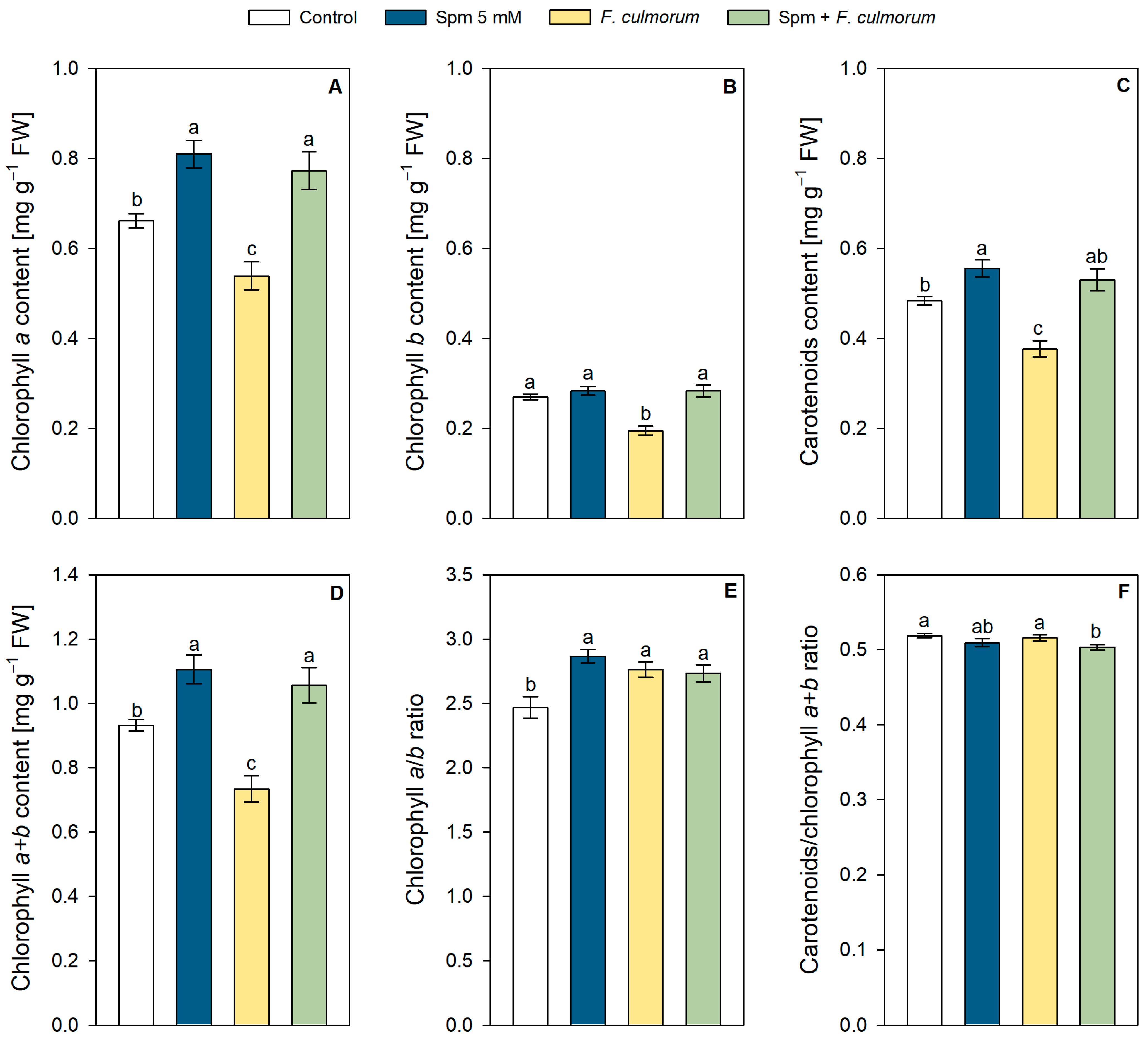
The results showed that the pathogen significantly reduced the content of chlorophyll a (by 19%), chlorophyll b (by 28%), and carotenoids (by 22%) as compared to the healthy controls (Figure 1). On the other hand, there were trends for increasing the content of leaf pigments in both healthy and infected plants grown from spermine-pretreated seeds. The increase was as follows: by 22% (Spm primed) and 17% (Spm primed and inoculated with F. culmorum) for chlorophyll a; by 5% (both Spm primed variants) for chlorophyll b; and by 15% (Spm primed) and by 10% (Spm primed and inoculated with F. culmorum) for carotenoids. Regarding the chlorophyll a/b ratio, all treatments exhibited elevated values relative to the control; however, no significant differences were observed across the treatments. No substantial changes were observed in the carotenoids/chlorophyll ratio.
Leaf pigments (chlorophylls a and b, and carotenoids) are vital for photosynthetic efficiency and plant adaptation to stress conditions. The analysis of these pigments provides an accurate quantitative assessment of changes induced by stress factors [45,46]. The decrease in leaf pigment content is a direct indicator of the damage to the photosynthetic apparatus in F. culmorum-infected plants. The enhanced leaf pigment content caused by seed priming with spermine corroborates the idea that this polyamine aids in preserving the functional integrity of the photosynthetic system under stress [8,47]. In addition, unlike the other polyamines (spermidine and putrescine), spermine has been demonstrated to modulate the in vivo levels of chlorophyll under varying light conditions [48]. An increased concentration of leaf pigments is essential for facilitating the normal process of photosynthesis in plants subjected to biotic stress. The observed elevation in the chlorophyll a/b ratio in the treated plants might comprise a distinct physiological aspect. In plants cultivated from Spm-primed seeds, this is likely attributable to the elevated chlorophyll a levels, while the chlorophyll b content remains relatively constant. The rise in the ratio implies a transition to a more efficient state of the photosynthetic system. In infected plants, the more pronounced loss of chlorophyll b compared to chlorophyll a resulted in an elevated chlorophyll a/b ratio. This is a typical reaction of plants under stress [49]. Chlorophyll a is often associated with reaction centres in photosynthesis, whereas chlorophyll b participates in light harvesting complexes [50]. Chlorophyll b is often more susceptible to stress than chlorophyll a [51]. By augmenting the chlorophyll a/b ratio, infected plants could enhance photosynthetic efficiency under F. culmorum disease, therefore maximising energy capture with restricted light harvesting capacity.

3.2. Leaf Gas Exchange Attributes

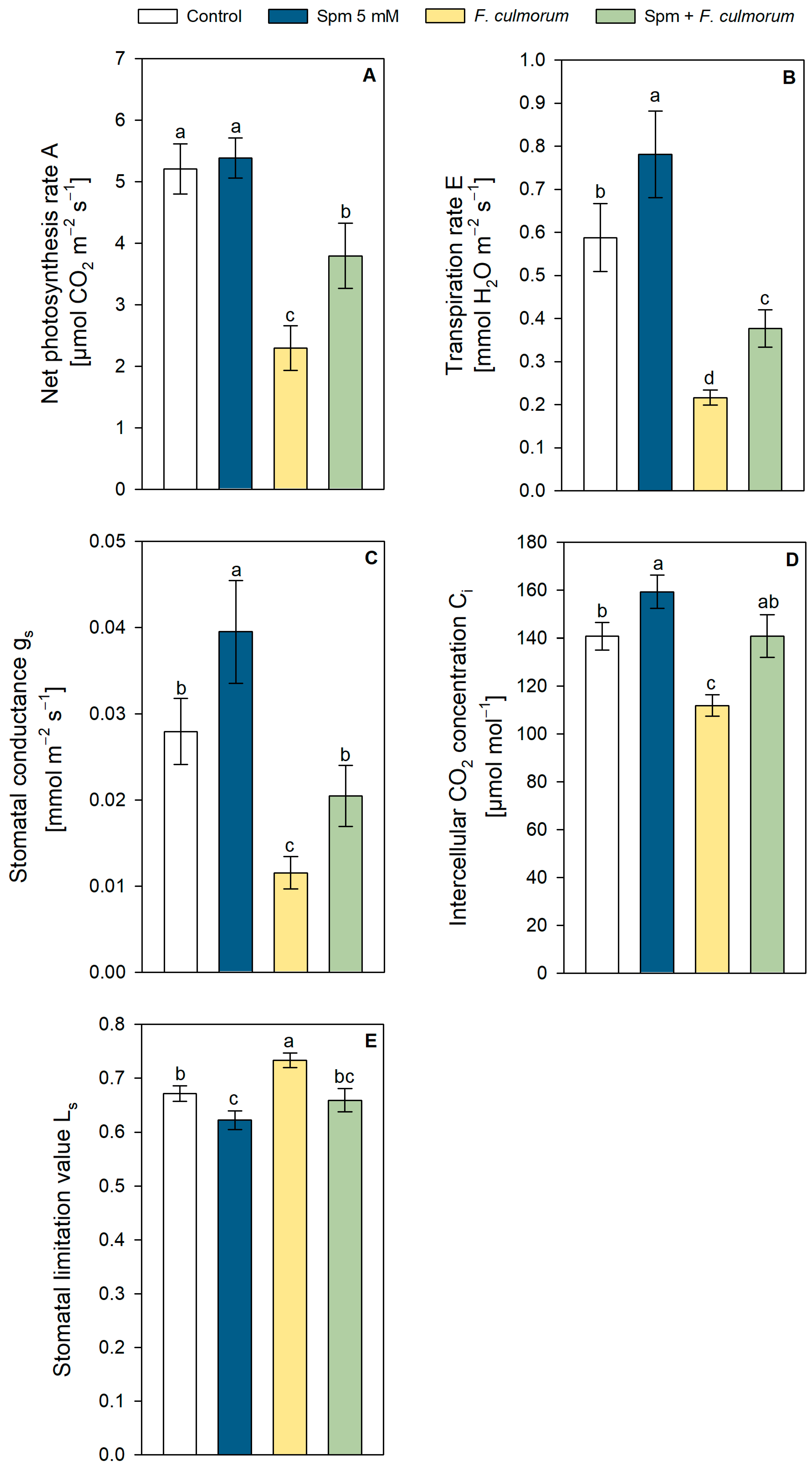
The results of the photosynthetic studies indicated that 5 mM spermine significantly increased the transpiration rate E (by 33%), intercellular CO2 concentration Ci (by 13%), and stomatal conductance gs (by 42%) of the healthy wheat plants, although photosynthesis was comparable to that of the control (Figure 2). The stomatal limitation value Ls was below the control (by 8%). The results also showed that the infection with Fusarium culmorum had a strong negative impact on the three physiological parameters studied, causing a statistically significant decrease in photosynthesis A (by 56%), transpiration E (by 63%), intercellular CO2 concentration Ci (by 22%), and stomatal conductance gs (by 58%), along with an increase in Ls (by 12%). It was found that the pretreatment of seeds with 5 mM spermine partially mitigated the negative effects of the infection with F. culmorum on leaf gas exchange. Although in the infected plants pre-treated with spermine, the levels of the studied parameters did not reach those of the healthy controls, they were higher and statistically significant as compared to those measured in the infected non-primed with Spm plants.
Leaf gas exchange is closely linked to photosynthetic activity, and changes in the rate of CO2 assimilation may reflect metabolic adaptations of plants to stress [44]. Under biotic stress, stomatal closure, reduced carboxylation activity of RuBisCO, and increased production of reactive oxygen species (ROS) are often observed [52,53], which limit the photosynthetic capacity of plants [12,54]. The decline in leaf gas exchange parameters A, E, Ci, and gs is a typical physiological response of plants subjected to biotic stress, leading to a decrease in their physiological status and productivity [12,15,42,55]. Along with the other factors, photosynthesis is also altered by stomatal aperture. According to Wang et al. [42], a reduction in intercellular CO2 concentration (Ci) coupled with an increase in the stomatal limitation value (Ls) probably indicates that the decline in net photosynthetic rate is primarily related to stomatal constraints. On the contrary, a drastic rise in Ci accompanied by a drop in Ls suggests that the reduction in net photosynthesis is mostly attributable to non-stomatal constraints. The decrease in Ci and the increase in Ls in infected plants imply that the reduction in net photosynthesis rate was due to stomatal limitation. Stomatal restriction typically arises during the early phases of stress or when the stress is not sufficiently severe. As stress escalates, stomatal limitation could shift to a non-stomatal limitation phase. During this period, alongside the closing of the stomata, biochemical changes occur, resulting in damages of the plant’s photosynthetic apparatus [42]. Our results suggest that the stress has not yet significantly manifested in the aerial parts of the infected plants. Since the pathogen develops in the roots, the deviations in the parameters measured clearly indicate that the manifestation of the disease in the leaves is still in its initial stages. With prolonged exposure to the pathogen, the visible leaf symptoms develop as the root damage reaches a critical level and becomes severe enough to stress the plants [39].
Enhanced stomatal conductance and transpiration rate in plants grown from spermine-primed seeds is in accordance with the known role of polyamines in improving leaf gas exchange under both normal and stress conditions [56]. Based on our data we can speculate that spermine enhances plant tolerance to disease and sustains photosynthesis process through two possible mechanisms. Firstly—the fungistatic effect of spermine by direct pathogen suppression as described by Nikolova et al. [39]. The lower disease severity index in Spm-primed plants suggests better root health, which facilitates improved water balance, resulting in more effective leaf gas exchange characteristics in infected plants. The second mechanism might be associated with the activation of host defence systems that eliminate ROS induced by the pathogen infection, retarding chlophyll degradation by inhibition of the chlorophyllase activity or modification of chlorophyll-bound proteins [12,56,57]. However, the proposed second mechanism in this particular model system requires further investigation.

3.3. Chlorophyll a Fluorescence Attributes

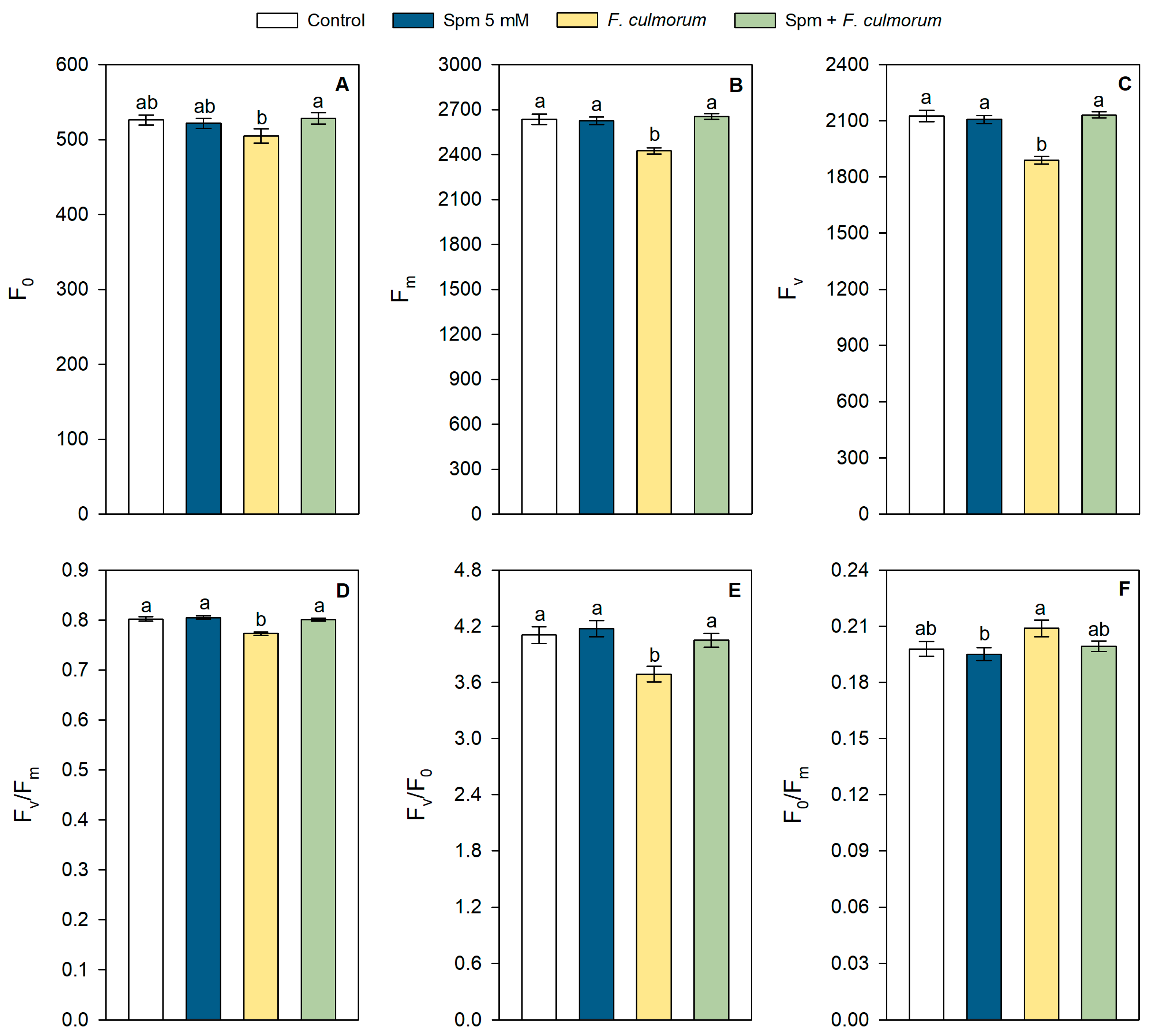
The results of chlorophyll a fluorescence (Figure 3) showed that the infection with F. culmorum caused some decrease in F0 (by 4%), Fm (by 8%), and Fv (by 11%), which was reflected in alterations in the values of Fv/Fm (decrease by 4%), Fv/F0 (decrease by 10%), and F0/Fm (increase by 6%). With the exception of F0 and F0/Fm, the changes in the parameters were statistically significant as compared to the other treatments. Although there were some fluctuations in the parameters due to Spm priming in both healthy and F. culmorum-inoculated plants, the values of chlorophyll a fluorescence indices studied were near to the respective controls.
Chlorophyll a fluorescence measurement allows for non-destructive assessment of photosynthetic efficiency and tolerance of plants to stress. This method provides information on the functioning of Photosystem II (PSII), which plays a key role in electron transfer in the light phase of photosynthesis. A decrease in the variable-to-maximal fluorescence ratio (Fv/Fm) often correlates with stomatal closure, oxidative stress, and pigment photodestruction, and is an indicator of stress [43]. Although the alterations were not drastic, the results of chlorophyll a fluorescence clearly showed that infection with F. culmorum has a negative impact on the primary (F0, Fv and Fm) and calculated (Fv/Fm, Fv/F0) parameters. Except for F0 and F0/Fm, the other parameters were altered significantly. The changes in Fv/Fm and Fv/F0 are an indicator of damage to the photosynthetic apparatus, in particular the reaction centres of Photosystem II (PSII), and of reduced efficiency in light energy conversion [49]. Our results demonstrated that although the pathogen infection caused a decrease in these parameters—it was not severe. This implies that stress was not fully developed yet and is in accordance with the changes of Ls. Seed pre-treatment with 5 mM spermine improved Fv/Fm and Fv/F0 in infected plants. Overall, the results demonstrate that spermine supports plants to maintain a healthy and efficient photosynthetic process [58] even in the presence of Fusarium culmorum infection as we have established in the current research.

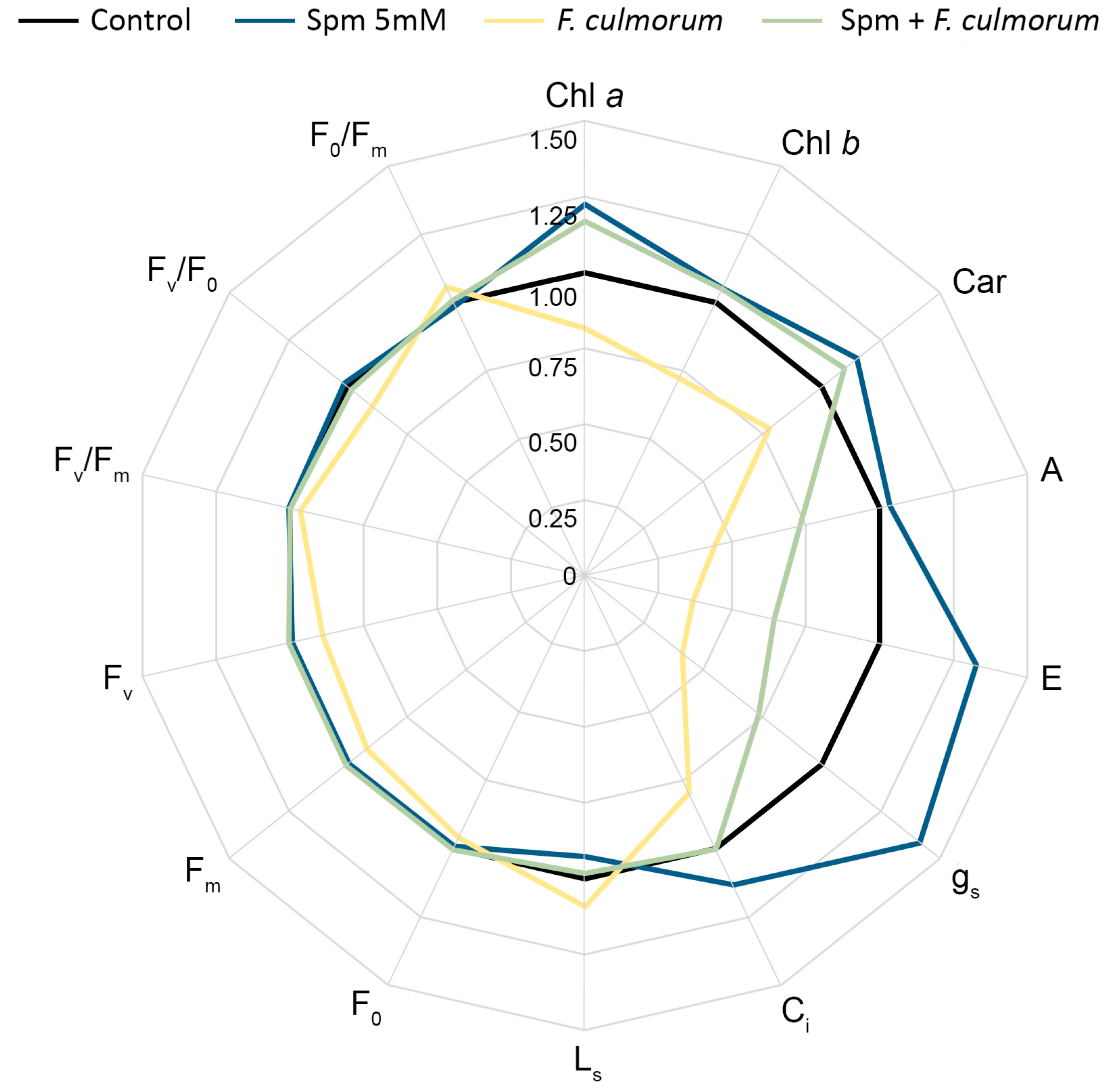
3.4. Spider Diagram of Photosynthesis-Related Parameters Normalised to the Control

The obtained data demonstrate a clear relationship between the studied photosynthetic parameters and treatments applied (Figure 4). The plants infected with F. culmorum showed a significant deviation from the controls in the studied parameters, mainly in leaf gas exchange and pigment content. The increased content of chlorophyll and carotenoids observed upon pre-treatment with spermine is closely related to the optimised function of Photosystem II (PSII), expressed by normalised levels of fluorescence parameters and contributed to a higher rate of leaf gas exchange. Efficient photosynthesis is the basis of biomass accumulation and overall plant growth [59], which corresponds to the mitigation of the negative effects of the pathogen by pre-treatment of seeds with spermine [39]. The protective effect of spermine on pigments [47,56] ensures a more efficient use of light energy and protects the photosynthetic apparatus from oxidative damage. Our data support the suggestions that spermine enhances plant tolerance to F. culmorum and sustains photosynthesis-related parameters near to optimal physiological levels.

4. Conclusions

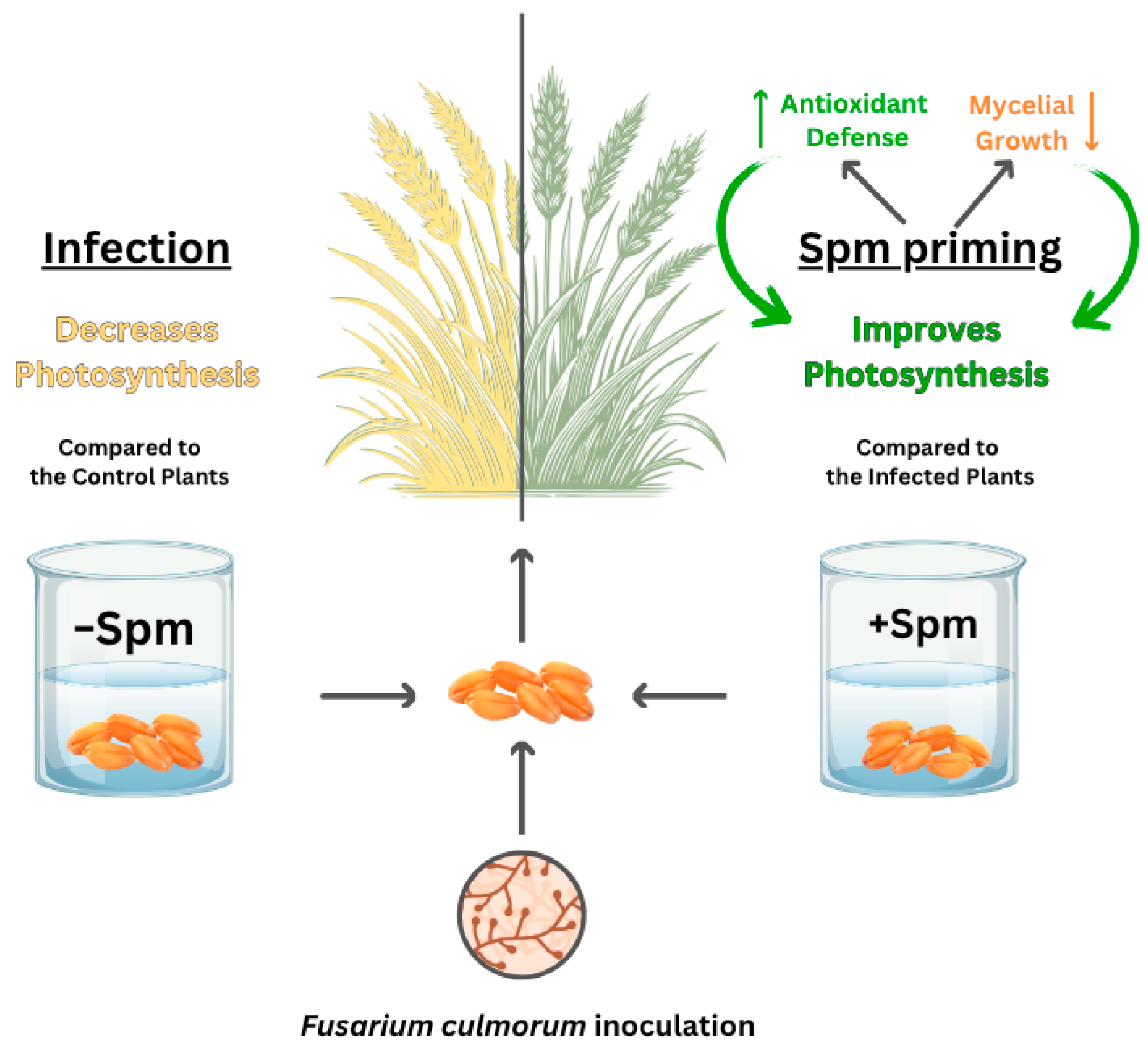
In general, the photosynthetic parameters in infected plants changed noticeably but not drastically. This indicates the beginning of deviations from the normal physiological state in the early stages of the infection, when there are still no visible manifestations of symptom development in the leaves. Our data show that spermine priming largely reduced the negative effects on photosynthesis in this phase of the disease. Although the exact mechanism of Spm protective action is not known, it can be speculated that it could be due to its direct fungistatic effect and/or Spm might induce antioxidant defence system that scavenge ROS generated under fungal infection. The effects of spermine seed priming and possible mechanisms of its protective action are illustrated in Figure 5.
To summarise, our research presents new data regarding the priming of seeds with spermine as a viable option for protecting wheat from F. culmorum infection. Both the specific protective mechanism and the feasibility of using spermine as an alternative to conventional fungicides require extensive future investigation.

Author Contributions

Conceptualization, D.T.; methodology, D.T., T.N., I.S. and S.A.; software, T.N. and I.S.; validation, D.T., I.S. and S.A.; formal analysis, T.N., I.S., D.T. and S.A.; investigation, T.N., I.S., D.T. and S.A.; resources, D.T.; data curation, D.T. and I.S.; writing—original draft preparation, D.T. and T.N.; writing—review and editing, D.T., T.N., I.S. and S.A.; visualisation, T.N. and I.S.; supervision, D.T.; project administration, D.T.; funding acquisition, D.T. All authors have read and agreed to the published version of the manuscript.

Funding

This work is supported by the Bulgarian National Scientific Fund (BNSF), Republic of Bulgaria (Grant KP-06-N86/6-06 December 2024).

Data Availability Statement

The original contributions presented in this study are included in the article. Further inquiries can be directed to the corresponding author.

Conflicts of Interest

The authors declare no conflicts of interest.

Abbreviations

The following abbreviations are used in this manuscript:
Chl aChlorophyll a
Chl bChlorophyll b
carCarotenoids
ANet photosynthesis rate
ETranspiration rate
gsStomatal conductance
CiIntercellular CO2 concentration
LsStomatal limitation value
F0Minimal chlorophyll a fluorescence
FmMaximal chlorophyll a fluorescence
FvVariable chlorophyll a fluorescence
Fv/FmMaximum quantum yield of PSII
Fv/F0Efficiency of primary photochemical reactions
F0/FmEnergy dissipated as heat
SpmSpermine
PAsPolyamines

References

  1. Crop Prospects and Food Situation. In GIEWS—Global Information and Early Warning System on Food and Agriculture; Food and Agriculture Organization of the United Nations: Washington, DC, USA, 2011; Available online: http://www.fao.org/giews/ (accessed on 24 October 2025).
  2. Dimanov, D.K. Main changes in agricultural land use in Bulgaria. Knowl.-Int. J. 2023, 60, 143–149. (In Bulgarian) [Google Scholar] [CrossRef]
  3. Figueroa, M.; Hammond-Kosack, K.E.; Solomon, P.S. A Review of Wheat Diseases—A Field Perspective. Mol. Plant Pathol. 2018, 19, 1523–1536. [Google Scholar] [CrossRef]
  4. Chai, Y.; Senay, S.; Horvath, D.; Pardey, P. Multi-Peril Pathogen Risks to Global Wheat Production: A Probabilistic Loss and Investment Assessment. Front. Plant Sci. 2022, 13, 1034600. [Google Scholar] [CrossRef]
  5. Leslie, J.F.; Summerell, B.A. The Fusarium Laboratory Manual; John Wiley & Sons: Hoboken, NJ, USA; Blackwell Publishing: Oxford, UK, 2006; 388p. [Google Scholar]
  6. Yanashkov, I.; Vatchev, T.; Gilardi, G. Soilborne Fungal Diseases of Small Grain Cereal Crops. Bulg. J. Crop Sci. 2016, 53, 3–21. [Google Scholar]
  7. Khaledi, N.; Taheri, P.; Falahati Rastegar, M. Identification, Virulence Factors Characterization, Pathogenicity and Aggressiveness Analysis of Fusarium spp., Causing Wheat Head Blight in Iran. Eur. J. Plant Pathol. 2017, 147, 897–918. [Google Scholar] [CrossRef]
  8. Aldesuquy, H.; Baka, Z.; Mickky, B. Kinetin and spermine mediated induction of salt tolerance in wheat plants: Leaf area, photosynthesis and chloroplast ultrastructure of flag leaf at ear emergence. Egypt. J. Basic Appl. Sci. 2014, 1, 77–87. [Google Scholar] [CrossRef]
  9. Sherin, G.; Aswathi, K.P.R.; Puthur, J.T. Photosynthetic functions in plants subjected to stresses are positively influenced by priming. Plant Stress 2022, 4, 100079. [Google Scholar] [CrossRef]
  10. Todorova, D.; Aleksandrov, V.; Anev, S.; Sergiev, I. Photosynthesis Alterations in Wheat Plants Induced by Herbicide, Soil Drought or Flooding. Agronomy 2022, 12, 390. [Google Scholar] [CrossRef]
  11. Todorova, D.; Aleksandrov, V.; Anev, S.; Sergiev, I. Comparative Study of Photosynthesis Performance of Herbicide-Treated Young Triticale Plants during Drought and Waterlogging Stress. Agronomy 2023, 13, 1992. [Google Scholar] [CrossRef]
  12. Cheaib, A.; Killiny, N. Photosynthesis Responses to the Infection with Plant Pathogens. Mol. Plant-Microbe Interact. 2025, 38, 9–29. [Google Scholar] [CrossRef]
  13. Chaturvedi, H.; Singh, B.; Jajoo, A.; Prakash, A. Shielding of Photosynthetic Apparatus by Consortia of Bacterial Endophytes in Tomato Plants Suffering From Fusarium Wilt. Front. Agron. 2022, 4, 831731. [Google Scholar] [CrossRef]
  14. Stirbet, A.; Lazár, D.; Guo, Y.; Govindjee, G. Photosynthesis: Basics, history and modelling. Ann. Bot. 2019, 126, 511–537. [Google Scholar] [CrossRef]
  15. Yang, S.M.; Li, X.; Chen, W.Q.; Liu, T.G.; Zhong, S.F.; Ma, L.X.; Zhang, M.; Zhang, H.Y.; Yu, D.L.; Luo, P.G. Wheat resistance to Fusarium head blight is associated with changes in photosynthetic parameters. Plant Dis. 2016, 100, 847–852. [Google Scholar] [CrossRef]
  16. Sunic, K.; Brkljacic, L.; Vukovic, R.; Katanic, Z.; Salopek-Sondi, B.; Spanic, V. Fusarium head blight infection induced responses of six winter wheat varieties in ascorbate–glutathione pathway, photosynthetic efficiency and stress hormones. Plants 2023, 12, 3720. [Google Scholar] [CrossRef] [PubMed]
  17. Huang, B.; Chen, Y.-E.; Zhao, Y.-Q.; Ding, C.-B.; Liao, J.-Q.; Hu, C.; Zhou, L.-J.; Zhang, Z.-W.; Yuan, S.; Yuan, M. Exogenous Melatonin Alleviates Oxidative Damages and Protects Photosystem II in Maize Seedlings Under Drought Stress. Front. Plant Sci. 2019, 10, 677. [Google Scholar] [CrossRef] [PubMed]
  18. Asgher, M.; Ahmed, S.; Sehar, Z.; Gautam, H.; Gandhi, S.G.; Khan, N.A. Hydrogen peroxide modulates activity and expression of antioxidant enzymes and protects photosynthetic activity from arsenic damage in rice (Oryza sativa L.). J. Hazard. Mater. 2021, 401, 123365. [Google Scholar] [CrossRef]
  19. Yang, X.L.; Xu, H.; Li, D.; Gao, X.; Li, T.L.; Wang, R. Effect of melatonin priming on photosynthetic capacity of tomato leaves under low-temperature stress. Photosynthetica 2018, 56, 884–892. [Google Scholar] [CrossRef]
  20. Lotfi, R.; Ghassemi-Golezani, K.; Pessarakli, M. Salicylic acid regulates photosynthetic electron transfer and stomatal conductance of mung bean (Vigna radiata L.) under salinity stress. Biocatal. Agric. Biotechnol. 2020, 26, 101635. [Google Scholar] [CrossRef]
  21. Huang, L.; Zhang, L.; Zeng, R.; Wang, X.; Zhang, H.; Wang, L.; Liu, S.; Wang, X.; Chen, T. Brassinosteroid priming improves peanut drought tolerance via eliminating inhibition on genes in photosynthesis and hormone signaling. Genes 2020, 11, 919. [Google Scholar] [CrossRef]
  22. dos Santos Araújo, G.; de Oliveira Paula-Marinho, S.; de Paiva Pinheiro, S.K.; de Castro Miguel, E.; de Sousa Lopes, L.; Marques, E.C.; Carvalho, H.H.; Gomes-Filho, E. H2O2 priming promotes salt tolerance in maize by protecting chloroplasts ultrastructure and primary metabolites modulation. Plant Sci. 2021, 303, 110774. [Google Scholar] [CrossRef]
  23. Wang, W.; Wang, X.; Zhang, J.; Huang, M.; Cai, J.; Zhou, Q.; Dai, T.; Jiang, D. Salicylic acid and cold priming induce late-spring freezing tolerance by maintaining cellular redox homeostasis and protecting photosynthetic apparatus in wheat. Plant Growth Regul. 2020, 90, 109–121. [Google Scholar] [CrossRef]
  24. Paul, S.; Dey, S.; Kundu, R. Seed Priming: An Emerging Tool towards Sustainable Agriculture. Plant Growth Regul. 2022, 97, 215–234. [Google Scholar] [CrossRef]
  25. Anwar, A.; Yu, X.; Li, Y. Seed priming as a promising technique to improve growth, chlorophyll, photosynthesis and nutrient contents in cucumber seedlings. Not. Bot. Horti Agrobo. 2020, 48, 116–127. [Google Scholar] [CrossRef]
  26. Wojtyla, Ł.; Wleklik, K.; Borek, S.; Garnczarska, M. Polyamine Seed Priming: A Way to Enhance Stress Tolerance in Plants. Int. J. Mol. Sci. 2024, 25, 12588. [Google Scholar] [CrossRef] [PubMed]
  27. Kusano, T.; Berberich, T.; Tateda, C.; Takahashi, Y. Polyamines: Essential Factors for Growth and Survival. Planta 2008, 228, 367–381. [Google Scholar] [CrossRef] [PubMed]
  28. Stolarska, E.; Paluch-Lubawa, E.; Grabsztunowicz, M.; Kumar Tanwar, U.; Arasimowicz-Jelonek, M.; Phanstiel, O.; Mattoo, A.K.; Sobieszczuk-Nowicka, E. Polyamines as Universal Bioregulators Across Kingdoms and Their Role in Cellular Longevity and Death. Crit. Rev. Plant Sci. 2023, 42, 364–384. [Google Scholar] [CrossRef]
  29. Walters, D.R. Polyamines and Plant Disease. Phytochemistry 2003, 64, 97–107. [Google Scholar] [CrossRef]
  30. Walters, D. Resistance to Plant Pathogens: Possible Roles for Free Polyamines and Polyamine Catabolism. New Phytol. 2003, 159, 109–115. [Google Scholar] [CrossRef]
  31. Todorova, D.; Katerova, Z.; Sergiev, I.; Alexieva, V. Polyamines—Involvement in Plant Stress Tolerance and Adaptation. In Plant Adaptation to Environmental Change: Significance of Amino Acids and Their Derivatives; Anjum, N.A., Gill, S.S., Gill, R., Eds.; CABI: Wallingford, UK, 2014; pp. 194–221. [Google Scholar]
  32. Bouchereau, A.; Aziz, A.; Larher, F.; Martin-Tanguy, J. Polyamines and Environmental Challenges: Recent Development. Plant Sci. 1999, 140, 103–125. [Google Scholar] [CrossRef]
  33. Walters, D.R. Polyamines in Plant–Microbe Interactions. Physiol. Mol. Plant Pathol. 2000, 57, 137–146. [Google Scholar] [CrossRef]
  34. Wimalasekera, R.; Tebartz, F.; Scherer, G.F.E. Polyamines, Polyamine Oxidases and Nitric Oxide in Development, Abiotic and Biotic Stresses. Plant Sci. 2011, 181, 593–603. [Google Scholar] [CrossRef] [PubMed]
  35. Todorova, D.; Katerova, Z.; Alexieva, V.; Sergiev, I. Polyamines—Possibilities for Application to Increase Plant Tolerance and Adaptation Capacity to Stress. Genet. Plant Physiol. 2015, 5, 123–144. [Google Scholar]
  36. Hussain, S.S.; Ali, M.; Ahmad, M.; Siddique, K.H.M. Polyamines: Natural and Engineered Abiotic and Biotic Stress Tolerance in Plants. Biotechnol. Adv. 2011, 29, 300–311. [Google Scholar] [CrossRef] [PubMed]
  37. Haggag, W.M. Polyamines: Induction and Effect on Rust Disease Control of Bean. Plant Pathol. Bull. 2005, 14, 89–102. [Google Scholar]
  38. Adam, S.; Murthy, S.D.S. Role of polyamines and their effect on photosynthesis in plants. Res. J. Pharm. Biol. Chem. Sci. 2013, 4, 596–605. [Google Scholar]
  39. Nikolova, T.; Todorova, D.; Vatchev, T.; Stoyanova, Z.; Lyubenova, V.; Taseva, Y.; Yanashkov, I.; Sergiev, I. Dose-Dependent Effect of the Polyamine Spermine on Wheat Seed Germination, Mycelium Growth of Fusarium Seed-Borne Pathogens, and In Vivo Fusarium Root and Crown Rot Development. Agriculture 2025, 15, 1695. [Google Scholar] [CrossRef]
  40. Arnon, D.I. Copper enzymes in isolated chloroplasts. Polyphenoloxidase in Beta vulgaris. Plant Physiol. 1949, 24, 1–15. [Google Scholar] [CrossRef]
  41. LiCor. Using the LI-6400/LI-6400XT Portable Photosynthesis System; LI-COR Biosciences: Lincoln, NE, USA, 2012; p. 846. [Google Scholar]
  42. Wang, R.; Qin, X.; Pan, H.; Li, D.; Xiao, X.; Jin, Y.; Wang, Y.; Liang, H. Assessing the effects of drought stress on photosynthetic performance and physiological resistance in camphor seedling leaves. PLoS ONE 2025, 20, e0313316. [Google Scholar] [CrossRef]
  43. Baker, N.R. Chlorophyll fluorescence: A probe of photosynthesis in vivo. Ann. Rev. Plant Biol. 2008, 59, 89–113. [Google Scholar] [CrossRef]
  44. Flexas, J.; Barbour, M.M.; Brendel, O.; Cabrera, H.M.; Carriquí, M.; Díaz-Espejo, A.; Douthe, C.; Dreyer, E.; Ferrio, J.P.; Gago, J.; et al. Mesophyll diffusion conductance to CO2: An unappreciated central player in photosynthesis. Plant Sci. 2012, 193–194, 70–84. [Google Scholar] [CrossRef]
  45. Lichtenthaler, H.K.; Wellburn, A.R. Determinations of total carotenoids and chlorophylls a and b of leaf extracts in different solvents. Biochem. Soc. Trans. 1983, 11, 591–592. [Google Scholar] [CrossRef]
  46. Porra, R.J. The chequered history of the development and use of simultaneous equations for the accurate determination of chlorophylls a and b. Photosynth. Res. 2002, 73, 149–156. [Google Scholar] [CrossRef]
  47. Unal, D.; Tuney, I.; Sukatar, A. The role of external polyamines on photosynthetic responses, lipid peroxidation, protein and chlorophyll a content under the UV-A (352nm) stress in Physcia semipinnata. J. Photochem. Photobiol. B Biol. 2007, 90, 64–68. [Google Scholar] [CrossRef] [PubMed]
  48. Beigbeder, A.; Kotzabasis, K. The influence of exogenously supplied spermine on protochlorophyllide and chlorophyll biosynthesis. J. Photochem. Photobiol. B Biol. 1994, 23, 201–206. [Google Scholar] [CrossRef]
  49. Ashraf, M.; Haris, P.J.C. Photosynthesis under stressful environments: An overview. Photosynthetica 2013, 51, 163–190. [Google Scholar] [CrossRef]
  50. Kume, A.; Akitsu, T.; Nasahara, K.N. Why is chlorophyll b only used in light-harvesting systems? J. Plant Res. 2018, 131, 961–972. [Google Scholar] [CrossRef] [PubMed]
  51. Shin, Y.K.; Bhandari, S.R.; Lee, J.G. Monitoring of Salinity, Temperature, and drought stress in grafted watermelon seedlings using chlorophyll fluorescence. Front. Plant Sci. 2021, 12, 786309. [Google Scholar] [CrossRef]
  52. Kretschmer, M.; Damoo, D.; Djamei, A.; Kronstad, J. Chloroplasts and plant immunity: Where are the fungal effectors? Pathogens 2019, 9, 19. [Google Scholar] [CrossRef]
  53. Hu, Y.; Zhong, S.; Zhang, M.; Liang, Y.; Gong, G.; Chang, X.; Tan, F.; Yang, H.; Qiu, X.; Luo, L.; et al. Potential role of photosynthesis in the regulation of reactive oxygen species and defence responses to Blumeria graminis f. sp. tritici in wheat. Int. J. Mol. Sci. 2020, 21, 5767. [Google Scholar] [CrossRef]
  54. Berger, S.; Benediktyová, Z.; Matouš, K.; Bonfig, K.; Mueller, M.J.; Nedbal, L.; Roitsch, T. Visualization of dynamics of plant–pathogen interaction by novel combination of chlorophyll fluorescence imaging and statistical analysis: Differential effects of virulent and avirulent strains of P. syringae and of oxylipins on A. thaliana. J. Exp. Bot. 2006, 58, 797–806. [Google Scholar] [CrossRef]
  55. Alisaac, E.; Mahlein, A. Fusarium Head Blight on Wheat: Biology, modern Detection and Diagnosis and Integrated Disease Management. Toxins 2023, 15, 192. [Google Scholar] [CrossRef]
  56. Shu, S.; Guo, S.-R.; Yuan, L.-Y. A Review: Polyamines and Photosynthesis. In Advances in Photosynthesis-Fundamental Aspects; Najafpour, M., Ed.; InTech Publ.: London, UK, 2012; pp. 439–464. ISBN 978-953-307-928-8. [Google Scholar]
  57. Seifi, H.S.; Shelp, B.J. Spermine Differentially Refines Plant Defense Responses Against Biotic and Abiotic Stresses. Front. Plant Sci. 2019, 10, 117. [Google Scholar] [CrossRef] [PubMed]
  58. Navakoudis, E.; Kotzabasis, K. Polyamines: A bioenergetic smart switch for plant protection and development. J. Plant Physiol. 2022, 270, 153618. [Google Scholar] [CrossRef] [PubMed]
  59. Zhu, X.; Long, S.P.; Ort, D.R. What is the maximum efficiency with which photosynthesis can convert solar energy into biomass? Curr. Opin. Biotechnol. 2008, 19, 153–159. [Google Scholar] [CrossRef] [PubMed]
Figure 1. Chlorophyll a (A), chlorophyll b (B), carotenoids (C), chlorophyll a + b (D) content, chlorophyll a/b ratio (E), and carotenoids/chlorophyll ratio (F) in the third leaf of wheat plants grown from non-treated seeds (Control), spermine-pre-treated seeds (Spm 5 mM), pathogen-inoculated seeds (F. culmorum); spermine-pre-treated and pathogen-inoculated seeds (Spm + F. culmorum). Different lowercase letters indicate statistically significant differences between treatments according to One-Way ANOVA with Duncan’s post hoc test at p < 0.05 (n = 18).
Agronomy 15 02675 g001
Figure 2. Net photosynthetis rate (A), transpiration rate (B), stomatal conductance (C), intercellular CO2 concentration (D), and stomatal limitation value (E) in the third leaf of wheat plants grown from non-treated seeds (Control) spermine-pre-treated seeds (Spm 5 mM) pathogen inoculated seeds (F. culmorum) spermine-pre-treated and pathogen-inoculated seeds (Spm + F. culmorum). Different lowercase letters indicate statistically significant differences between treatments according to One-Way ANOVA with Duncan’s post hoc test at p < 0.05 (n = 20).
Agronomy 15 02675 g002
Figure 3. Minimal fluorescence F0 (A), maximal fluorescence Fm (B), variable fluorescence Fv (C), maximum quantum yield of photosystem II Fv/Fm (D), efficiency of primary photochemical reactions Fv/F0 (E), and energy dissipation as heat F0/Fm (F) in the third leaf of wheat plants grown from non-treated seeds (Control), spermine-pre-treated seeds (Spm 5 mM), pathogen-inoculated seeds (F. culmorum), spermine-pre-treated and pathogen-inoculated seeds (Spm + F. culmorum). Different lowercase letters indicate statistically significant differences between treatments according to One-Way ANOVA with Duncan’s post hoc test at p < 0.05 (n = 20).
Agronomy 15 02675 g003
Figure 4. Spider diagram of chlorophyll a (Chl a), chlorophyll b (Chl b), carotenoids (Car), net photosynthesis rate (A), transpiration rate (E), stomatal conductance (gs), intercellular CO2 concentration (Ci), stomatal limitation value (Ls), minimal chlorophyll a fluorescence (F0), maximal chlorophyll a fluorescence (Fm), variable chlorophyll a fluorescence (Fv), maximum quantum yield of PSII (Fv/Fm), efficiency of primary photochemical reactions (Fv/F0), energy dissipated as heat (F0/Fm) in the third leaf of wheat plants grown from non-treated seeds (Control), spermine-pre-treated seeds (Spm), pathogen-inoculated seeds (F. culmorum), spermine-pre-treated and pathogen-inoculated seeds (Spm + F. culmorum). The values of the parameters are normalised to the control.
Agronomy 15 02675 g004
Figure 5. Schematic visualisation of the effects of spermine seed priming and possible mechanisms of its protective action against Fusarium culmorum infection on winter wheat.
Agronomy 15 02675 g005
Table 1. Experimental set-up and treatments.
#VariantTreatment
1.ControlNo spermine priming, no F. culmorum inoculation
2.Spm 5 mM5 mM spermine priming, no F. culmorum inoculation
3.F. culmorumNo spermine priming, F. culmorum inoculation
4.Spm + F. culmorum5 mM spermine priming, F. culmorum inoculation
Disclaimer/Publisher’s Note: The statements, opinions and data contained in all publications are solely those of the individual author(s) and contributor(s) and not of MDPI and/or the editor(s). MDPI and/or the editor(s) disclaim responsibility for any injury to people or property resulting from any ideas, methods, instructions or products referred to in the content.