
Article

Hydroponic and Soil-Based Screening for Salt Tolerance and Yield Potential in the Different Growth Stages of Thai Indigenous Lowland Rice Germplasm

Department of Agronomy, Faculty of Agriculture, Khon Kaen University, Khon Kaen 40002, Thailand
*
Author to whom correspondence should be addressed.
Agronomy 2025, 15(11), 2574; https://doi.org/10.3390/agronomy15112574
Submission received: 12 October 2025 / Revised: 3 November 2025 / Accepted: 6 November 2025 / Published: 8 November 2025

Abstract

Salinity is one of the primary limiting factors in the rice production system in northeast Thailand due to the presence of underground salt rocks, and the situation is expected to deteriorate further in the future since rice is particularly susceptible to salinity. In this study, 382 indigenous lowland rice germplasms were evaluated for salt tolerance under hydroponic conditions at the seedling stage. The stress condition was induced by adding NaCl from 2 dS/m to 22 dS/m. Twenty-two varieties (group 1) were selected based on low leaf salinity scores in 2019 and 2020. Ten varieties, LLR050, LLR054, LLR106, LLR216, LLR309, LLR365, LLR377, LLR402, LLR441, and LLR449, were selected from leaf salt injury scores under hydroponic conditions in 2021 and 2022. The response of ten selected varieties was investigated under both hydroponic and soil media at the seedling stage, as well as soil culture at the tillering and flowering stages. The results revealed that LLR054, LLR365, and LLR216 exhibited low leaf injury scores (less than 4.0) at both the seedling and tillering stages. At the seedling stage, most varieties demonstrated high Na+ accumulation in the root, while high accumulation in the shoot was observed at the tillering stage. Varieties LLR054 and LLR441 displayed low leaf damage scores, root sodium accumulation at the seedling stage, and shoot sodium accumulation at the tillering stage, similar to the tolerant check variety Pokkali. Additionally, LLR365 and LLR216 showed high shoot sodium accumulation but low leaf damage scores at the tillering stage. At the flowering stage, LLR050 and LLR449 maintained high yields and filled seeds per panicle under salt stress. Therefore, early-stage LLR054, LLR441, LLR365, and LLR216 had high tolerance and LLR050 and LLR449 maintained high yields, and these varieties are potential sources of salt tolerance for future rice breeding programs.

1. Introduction

Rice (Oryza sativa L.) is one of the world’s most important food crops and the cornerstone of Thailand’s economy. In the 2022/2023 crop year, Thailand boasted a rice production area of 11 million hectares, with the northeastern regions serving as the primary hub [1]. The majority of rice fields in this area rely on a rainfed system and planting mainly in the rainy season [2,3]. The northeastern region of Thailand is characterized by an undulating plateau with inherently low soil fertility [3,4]. Furthermore, the presence of underground salt rocks has given rise to soil salinity issues in certain areas [5]. Approximately 1.84 million hectares are affected by soil salinity. The prevalence of saline soil is expected to escalate in the future due to climate change [6,7]. The repercussions of soil salinity directly impact rice production since rice is recognized as one of the most salinity-sensitive crops [8,9].
The adverse effects of salinity on rice plants manifest through a series of interconnected factors, including drought, low soil moisture, evaporation, and the upward movement of salinity transport to the soil surface. These factors affect growth and yield. Rice cultivation in saline soil with an electrical conductivity higher than 6 dS/m can reduce yield by 50–100% [10], depending on the stage of rice growth and the duration of salinity exposure. Numerous studies confirm that rice is most susceptible to salinity during the seedling and reproductive stages [11,12,13]. During the seedling stage, salinity triggers leaf necrosis [14], growth is significantly limited, and the leaf area index is low [15]. At the tillering stage, the tiller and height are significantly reduced, along with inflorescence formation per tiller when the rice is fully tillered [7]. At the flowering stage, panicle development is lost, the number of branches per panicle is reduced, flowering is delayed, and pollen fertilization is affected when the rice flowers, resulting in a low seed set and seed filling percentage [16]. Cellular metabolisms, photosynthesis, protein synthesis, and lipid metabolism are reduced [17,18] due to salt stress, sodium ion accumulates in cells, and a loss of ion balance occurs, resulting in stunted plant growth and development [19].
Rice plants respond differently to salinity depending on the stage of development, type and concentration of salt, duration of exposure, water regime, soil pH, humidity, solar radiation, and temperature [20]. In addition, the toxic levels of Na+ in the cytoplasm cause cell disorder. So, the plant must maintain a low cytosolic Na+ concentration or ratio of K+/Na+ by reducing Na+ influx into root cells, compartmentalizing Na+ into vacuoles, or increasing Na+ efflux from root cells [21] to tolerate salt stress. Moreover, it is difficult to establish salt-tolerant genotypes as traits are controlled by a quantitative trait [22]. The selection criteria were complicated and ideotype preference is the obstacle for new variety. Indigenous rice has adapted to the local environment and has been selected by farmers in each area for a long time, according to quality and quantity preferences. So, it is considered an important genetic resource for finding new genetics to overcome the challenges involved in crop production [23]. Conventional breeding has been used for the improvement of salt-tolerant rice varieties through two basic steps: (1) generate/obtain a breeding population and (2) select among the segregating progeny [20]. In a salinity stress tolerance breeding program, the limited parental resources contribute to the limited success of breeding programs despite the high throughput for rapid breeding schemes nowadays. In the northeastern region of Thailand, there are still many native rice varieties that have not been studied for their ability to tolerate salinity at different growth stages, and consequently, these varieties have not been utilized as a genetic resistance resource. The objective of this study is to screen for salinity tolerance at different growth stages in Thai indigenous lowland rice germplasm. The results are expected to provide salt-tolerant indigenous lowland rice varieties for further breeding programs.

2. Materials and Methods

The experiments were split into two main experiments over several years to sequentially screen and validate salt tolerance. Experiment 1 was the initial, large-scale screening conducted under hydroponic conditions in 2019 and 2020, utilizing 382 rice varieties arranged in an alpha lattice design with three replications. Experiment 2 built upon these findings, divided into two sub-groups: sub-group 2.1 involved a hydroponic confirmation of the 22 selected salt-tolerant varieties in 2021 and 2022, using a completely randomized design (CRD) with four replications. Finally, sub-group 2.2 focused on a detailed validation of the 10 selected varieties in 2023, evaluated under both hydroponic (seedling stage) and soil conditions (seedling, tillering, and flowering stages), also employing a CRD with four replications (Table 1). In addition, all experiments included a control condition. This control involved plants grown under normal growth conditions with zero added salinity stress and the same numbers of plants and replications in each experiment.

2.1. Experiment 1 Hydroponic Screening

Three hundred and eighty-two indigenous lowland rice varieties of the indica type, together with tolerant control (Pokkali) and susceptible control (IR29), were evaluated in 2019 and 2020. The experiment was performed at Khon Kaen University (KKU), Khon Kaen, Thailand. The varieties used in this study were obtained from the rice germplasm collection project of Khon Kaen University, Thailand. They were sourced from cultivated areas and represent the diversity of germplasm historically cultivated in the region. The experiment used a hydroponic system. Plants were grown in 288-hole plastic trays and put into a hydroponic block (1.2 m width × 2.7 m length × 1.0 m depth) filled with 1000 L of nutrient solution per block. The experiment was performed under greenhouse conditions with average temperatures of 33.1 ± 2.1 °C and 30.9 ± 2.3 °C throughout the growing period in 2019 and 2020, respectively. Yoshida’s solution [24] was used, the composition of which (g per 1000 L) was: NH4NO3 (91.4); NaH2PO4 (35.6); K2SO4 (71.4); CaCl2 (117.2); MgSO4 (324); MnCl3 (1.5); (NH4)6Mo7O24 (0.074); ZnSO4 (0.35); H3BO3 (0.934); CuSO4 (0.31); FeCl3 (7.7); C6H8O7 (11.9); and H2SO4 (50). Solutions were changed every 3 d, at which time the pH was adjusted to 4.9–5.3.
The experiment was conducted under greenhouse conditions. Seeds of each variety were soaked in water for 48 h, rinsed, and then incubated at room temperature for an additional 48 h to initiate germination. The resulting seedlings were then transplanted into plastic trays, with one seedling placed per hole and five seedlings per replication. The salt treatment was initiated 21 days after transplanting (DAT), coinciding with the emergence of the third leaf. In the salinity stress treatment, salinity was imposed incrementally using NaCl to achieve a final target concentration of 22 dS/m. The salt concentration was incremented with a two-day interval following the sequence 2, 4, 6, 8, 10, 12, 16, 18, 20, and 22 dS/m. This concentration was selected based on a previous study [25]. For evaluation and scoring, the visual symptoms of salt stress were observed and recorded after each NaCl increment or when symptoms appeared on the susceptible control variety (IR29). Individual plants were scored using the standard evaluation system for rice (SES), as established by the International Rice Research Institute (IRRI) [26]. The SES score is defined as follows: (1) growth and tillering are nearly normal, (3) growth is nearly normal but tillering is reduced, and some leaves are discolored and rolled, (5) growth and tillering are noticeably reduced; most leaves are discolored/whitish and rolled, with only a few leaves elongating, (7) growth has ceased; most leaves are dry, and some plants are dying, and (9) almost all plants are dead or dying. The visual score was recorded separately by three evaluators for all replications, and the average score was used for statistical analysis.

2.2. Experiment 2 Responses in Growth and Ion Concentration of Selected Varieties of Rice Germplasm to Different Soil Salinity Media and Growth Stage

From the results of Experiment 1, 22 salt-tolerant rice varieties were identified based on their leaf injury scores. To confirm these findings, the evaluation of these 22 varieties was repeated under hydroponic conditions in 2021 and 2022. The experiment was performed under greenhouse conditions with average temperatures of 27.5 ± 1.1 °C and 26.7 ± 1.8 °C throughout the growing period in 2021 and 2022, respectively. The visual leaf injury score of individual plants was observed and recorded using the standard evaluation system of rice (SES), following the International Rice Research Institute standard [26].
Then, 10 rice varieties were selected, LLR050, LLR054, LLR106, LLR216, LLR309, LLR365, LLR377, LLR402, LLR441, and LLR449, with Pokkali (tolerant control), IR29 (susceptible control) and KDML105 (cultivated variety) and evaluation in 2023 at different stages and on different media. Hydroponic conditions were used as in Experiment 1 with ten plants in each replication. The experiment was performed under greenhouse conditions with an average temperature of 31.6 ± 1.1 °C.
Each pot (10.2 cm diameter and 7.6 cm high) was filled with 0.5 kg of soil with a 2.0 mm wide net in the bottom to prevent soil leakage with ten plants in each replication. The experiment was performed under greenhouse conditions with an average temperature of 30.4 ± 2.3 °C. Salt stress was imposed by placing the pots in a closed tray measuring 53 cm in width, 60 cm in length, and 8 cm in height with 6 L of NaCl solution per tray. At 21 days after seedling, salt stress treatment was performed from 2–22 dS/m [25].
At the tillering stage pots with ten plants per replication (19.8 cm diameter and 14.5 cm high) were filled with 3 kg of soil with a 2.0 mm wide net in the bottom to prevent soil leakage. The pots were placed in a block of 4.3 m width × 5.3 m length × 0.5 m depth with 200 L of water per block. The experiment was performed under greenhouse conditions with an average temperature of 29.2 ± 1.6 °C. Sixty days later, the seedlings were treated with NaCl mixed with water and the salt concentration rose from 4 dS/m to 16 dS/m. The flowering stage used the same growing conditions as the tillering stage (ten plants per replication). The salt stress treatment was imposed at 50% flowering in each variety from 4 dS/m to 16 dS/m. For the data collection, at the seedling stage the salt stress evaluation score or leaf injury score was evaluated when the susceptible variety showed symptoms or when the salt was adjusted. The visual leaf injury score of individual plants was observed and recorded using the SES following the International Rice Research Institute standard [26]. In Experiment 2, for seedling and tillering stages, sodium ion (Na+) and potassium ion (K+) contents were determined. For the brief determination of sodium in the leaf, 0.5 g dried material was digested in 40 mL of 4% nitric acid (HNO3). Leaves were cut into 1 cm pieces, placed in test tubes containing 20 mL distilled deionized water, and heated in a boiling water bath for 1 h. The tubes were then autoclaved at 121 °C for 20 min and cooled. The sodium content in 15 times diluted extract was determined by atomic absorption spectrophotometry (AA-660, Shimadzu, Kyoto, Japan) [27].
At the flowering stage, the growing condition was the same as for the tillering stage. Data were collected including agronomic characteristics, yield components, and yield. Data were determined at maturity, including the panicle number per hill, total grain yield per plant, number of grains per panicle, and number of filled grains per panicle. The data on each parameter were obtained from the main panicle for each replication. The experiment was performed under greenhouse conditions with an average temperature of 28.8 ± 1.6 °C.

2.3. Data Analysis

Statistical analyses were performed in Statistix10 [28]. Data for leaf injury score in Experiment 1 were analyzed using one-way ANOVA to determine and differences among the mean values of varieties were assessed by least significant differences (LSDs). Ward’s method for group clustering was used to examine varieties for salt tolerance in Experiment 2 using MEGA7 version 7.0.26 [29] and R statistical software version 4.5.2 (R Core Team) [30] and results were visualized using the ggplot2 package [31]. For grain yield and yield components between the selected varieties, results were analyzed based on a completely randomized design and the mean values were assessed by LSDs.

3. Results

3.1. Solution Conditions

The evaluation of salt-tolerant indigenous lowland rice germplasm in 2019 and 2020 revealed that the rice varieties had different salinity scores for tolerant (score <3), moderately tolerant (score 3–5) as growth and tillering reduced; most leaves discolored/whitish and rolled, susceptible (score 6–7) as growth completely ceases; most leaves dry; some plants dying, and highly susceptible (score 8–9) as almost all plants dead or dying. The 382 rice germplasm varieties were screened for salt tolerance over two years. The classification results showed variability: in 2019, the screening showed 28 tolerant, 175 moderately tolerant, 174 susceptible, and 5 very susceptible varieties. In 2020, the distribution shifted significantly, classifying 71 varieties as tolerant, 282 moderately tolerant, 26 susceptible, and 3 very susceptible. To identify stable tolerance, the clustering analysis utilized the salt reaction data from both years. This analysis separated the varieties into five distinct groups based on the leaf salinity evaluation score (Figure 1). Group 1 consistently demonstrated the highest resistance to salt stress in both the 2019 and 2020 screening cycles. The 75 most common varieties demonstrated tolerance in both years. However, some varieties were discarded due to the number of seeds being insufficient, while some varieties did not germinate. Twenty-two selected varieties demonstrated consistent resistance to salt stress during the validation experiments conducted in 2019 and 2020. So, 22 selected varieties were used to confirm the resistance to salt stress in the 2021 and 2022 experiments. This finding is particularly notable because most of the lowland rice germplasm was otherwise susceptible to salinity. However, some tolerant varieties performed better than the tolerant control variety, confirming their high potential.
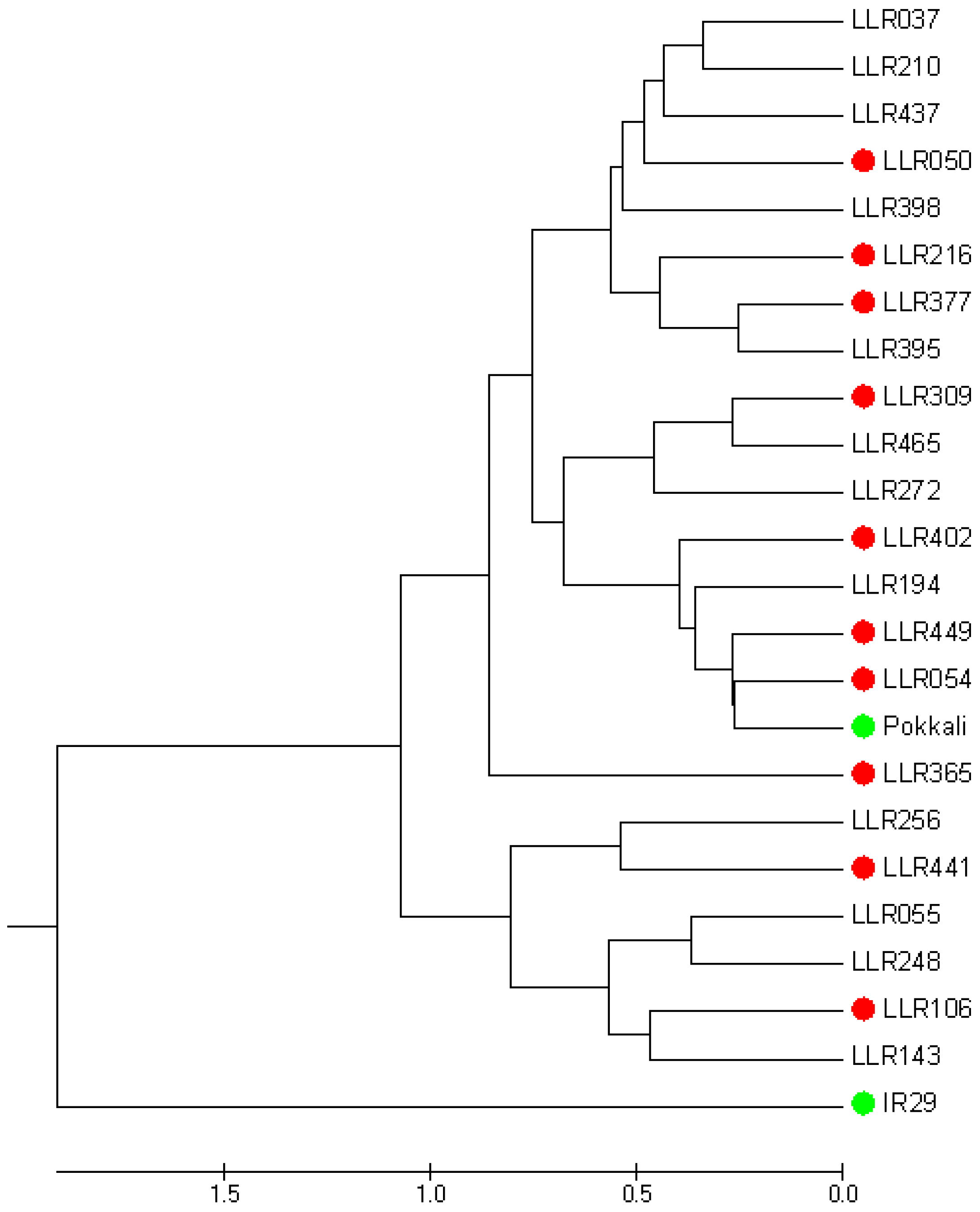
The 22 indigenous lowland rice varieties were selected that consistently demonstrated high resistance in the initial 2019 and 2020 screenings (Group 1) for further hydroponic validation in 2021 and 2022. The evaluation under hydroponic conditions with 12, 14, 18, and 22 dS/m NaCl in 2021 was significantly different between varieties under all salinity levels, while 2022 demonstrated significance between varieties at 18 and 22 dS/m. Across the 12, 14, and 18 dS/m salinity levels in 2021, a collection of nine distinct varieties exhibited a tolerance response statistically comparable to the tolerant control, Pokkali. The specific varieties that were not significantly different from Pokkali at each stress level were: LLR216, LLR365, LLR398, LLR402, LLR449, and LLR465 (at 12 dS/m) and LLR194, LLR365, LLR398, LLR402, and LLR449 (at 14 and 18 dS/m). In 2022, several varieties were identified whose tolerance scores were not significantly different from the tolerant control, Pokkali (Table 2). This group included six varieties (LLR054, LLR194, LLR272, LLR309, LLR402, and LLR465) at 18 dS/m. Under the extreme stress of 22 dS/m, five varieties (LLR054, LLR272, LLR309, LLR402, and LLR465) maintained this statistical equivalence to Pokkali. Based on the combined leaf salinity scores from these two years, the final cluster analysis (Figure 2) separated the 22 varieties into three groups. Group 1 included only the susceptible control (IR29). Group 2 included six moderately tolerant varieties: LLR256, LLR441, LLR055, LLR248, LLR106, and LLR143. Group 3 included 17 varieties, alongside the tolerant control (Pokkali): LLR054, LLR050, LLR216, etc. (Figure 2). These results confirm that all selected varieties were more tolerant than the susceptible control, but their division into three distinct groups highlights that each variety possesses a different level of response to salt stress.

3.2. Evaluation of the Salt-Tolerant Rice Varieties in Different Media and Stages

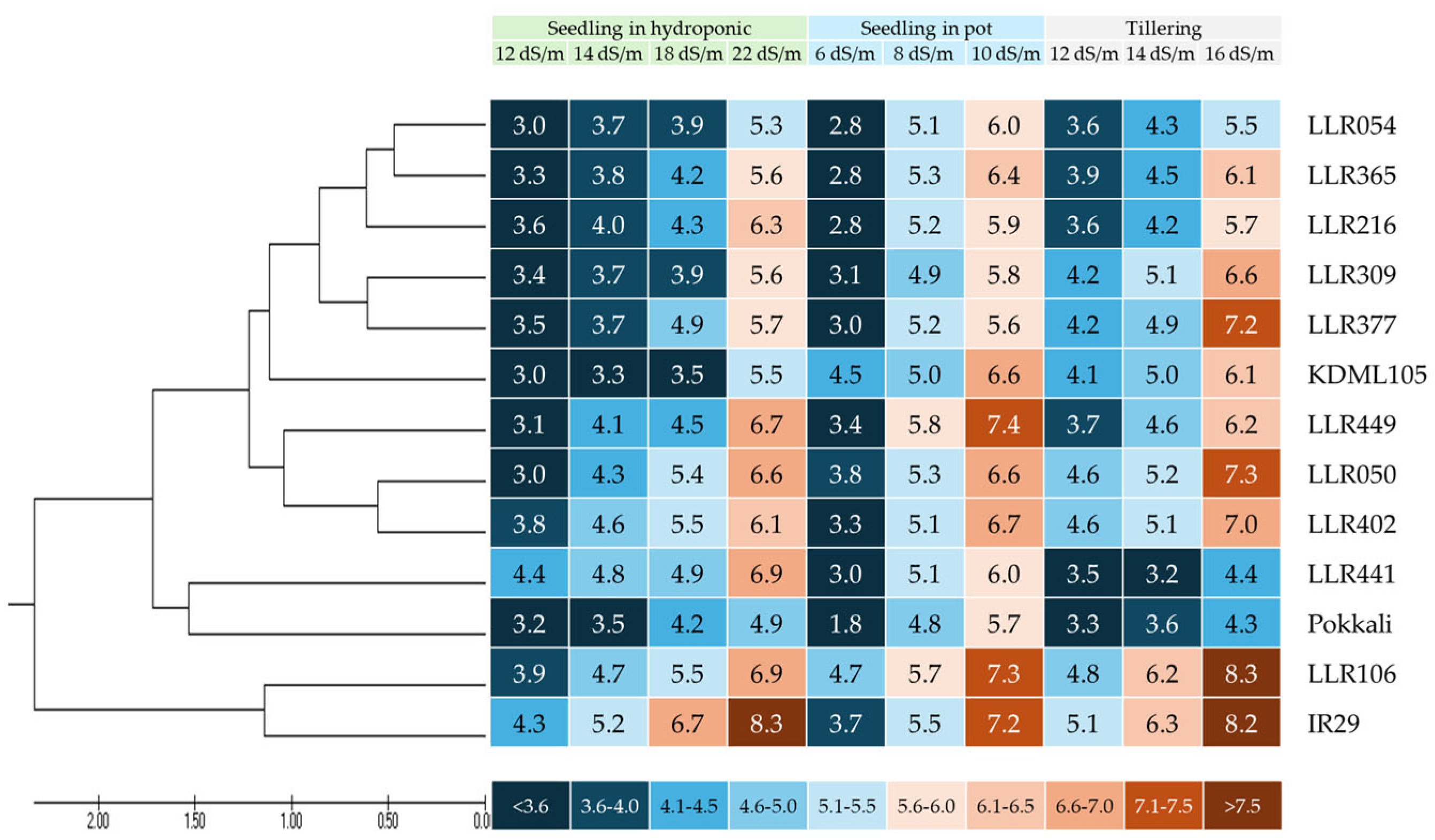
The ten selected varieties based on leaf salinity scores for both 2021 and 2022 are separated into tolerance groups (Groups 2 and 3) and represent the sub-group. The ten varieties and control varieties were evaluated under different growth stages in 2023. At the seedling stage, most selected varieties showed tolerance until 18 dS/m, such as LLR054 and LLR309. At the seedling stage and when planted in soil, most showed a decrease in tolerance after 8 dS/m, but at the tillering stage, most exhibited tolerance until 14 dS/m, such as LLR441 and Pokkali (Figure 3).
The results indicate that the salt tolerance was stage-specific. However, the tolerant variety showed less damage from salt due to its low leaf salinity score. The long period of leaf maintenance or staying green means that the leaf is still functional, such as in the case of LLR054, LLR365, and LLR216. There was less damage from salt in the early to middle stages of stress infusion compared to Pokkali. However, some varieties, such as KDML105, had high tolerance at the seedling stage under hydroponic conditions. However, KDML105 was significantly damaged under soil conditions at the seedling and tillering stages. Similarly, LLR441 had high tolerance at the seedling and tillering stages under soil conditions compared to Pokkali. The results indicate that even soil or the solution affected rice response, and therefore, tolerance should be confirmed under different conditions and stages.
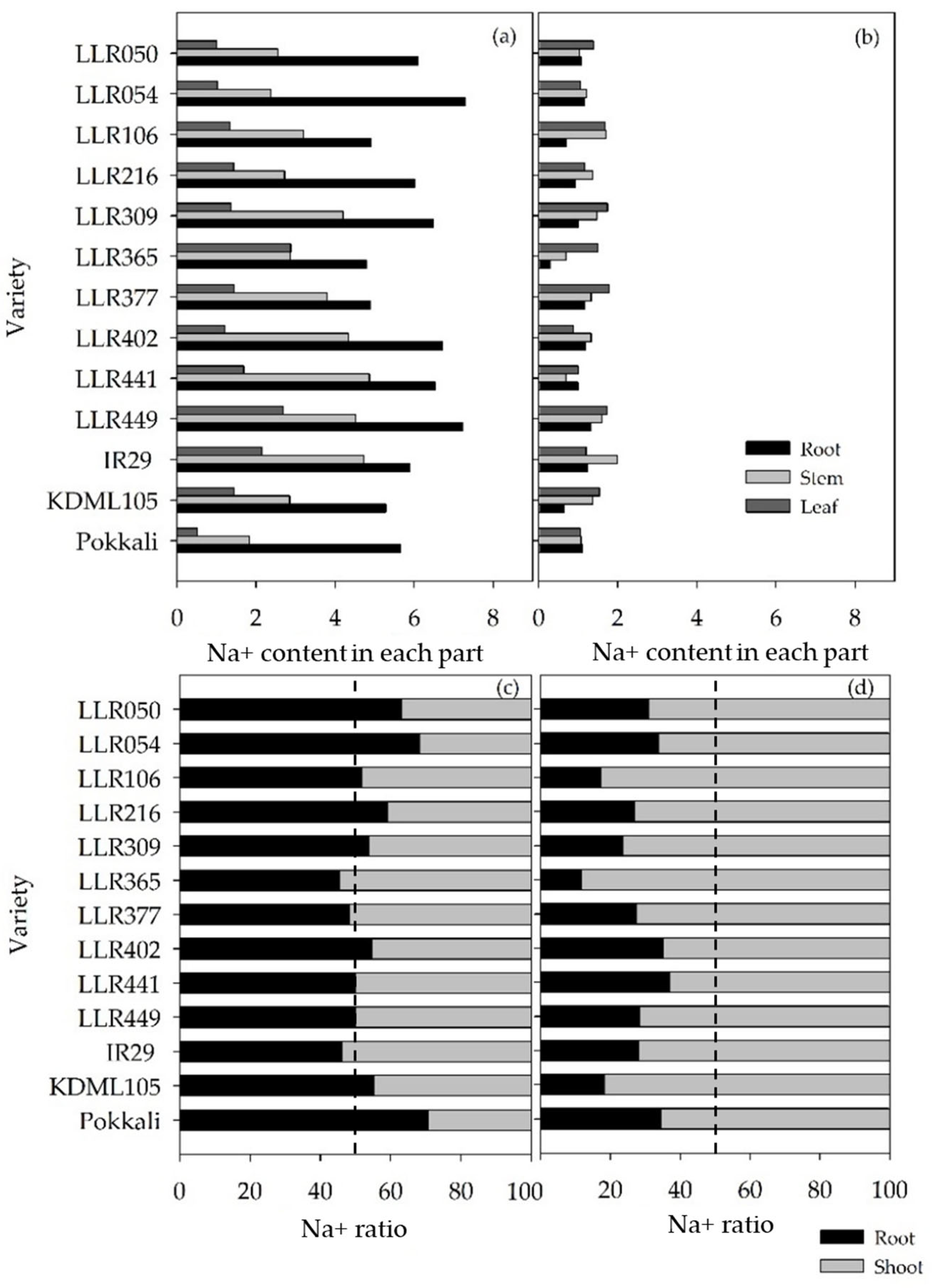
The leaf, stem, and root Na+ concentrations were measured at 18 dS/m (hydroponic) for the seedling stage and 16 dS/m (soil pots) for the tillering stage. The result showed that the effect of salinity on plant tissue under Na+ concentrations demonstrated that the concentrations were higher at the seedling stage than at the tillering stage in all varieties. At the seedling stage, Na+ mostly accumulated in the root, while at the tillering stage, the Na+ tended to accumulate in the leaf and stem (Figure 4a,b). The proportion of Na+ accumulation in the upper and lower parts of the plant indicates that most varieties at the seedling stage had a half root per shoot accumulation. On the other hand, Na+ tended to accumulate in the upper part of the plant tissue rather than the lower part at the tillering stage. These results show that, at the early growth stage, plants had a smaller number of leaves, and the tolerant varieties minimized sodium toxicity through root sequestration. However, at the tillering or vegetative stage, with a large amount of leaves, plants can store sodium in the leaf vacuole without damaging the leaf tissue as an included mechanism. The study found that, at the seedling stage, the varieties with accumulation the same as that of Pokkali (more root Na+ accumulation) were LLR050, LLR054, and LLR216. At the tillering stage, the varieties with a high proportion of shoot accumulation as same as Pokkali variety were LLR050, LLR054, LLR402, and LLR441 (Figure 4c,d). However, when comparing the salt scores at the tillering stage, LLR054 and LLR441 were found to have low salinity scores, and Na+ accumulation in the shoots was excluded. In contrast, LLR356 and LLR216 had high Na+ accumulation in the shoot but a low leaf damage score, and this would be an included mechanism.
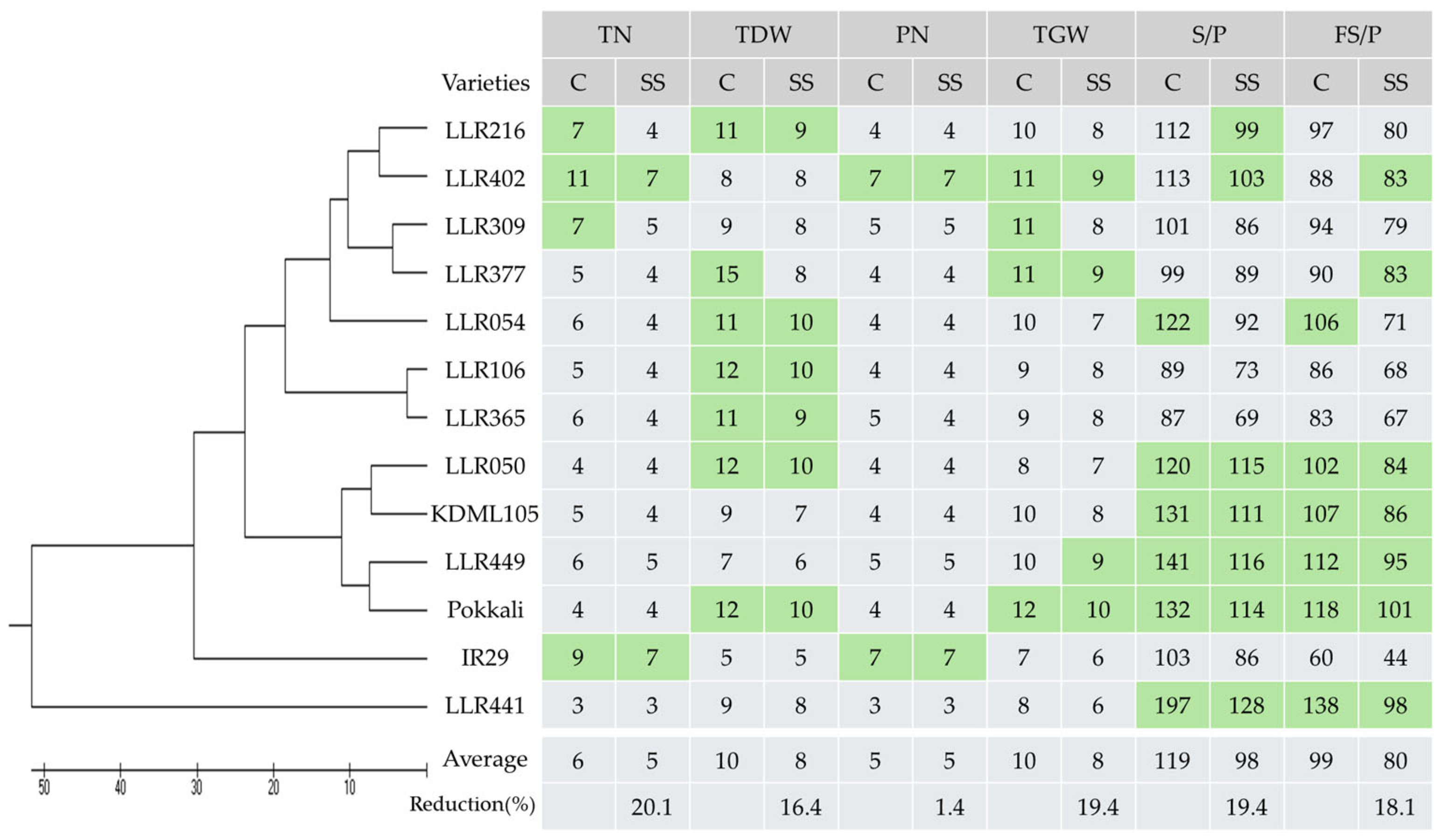
The agronomic traits and yield of rice variety were the main criteria of the rice selection program. Salt stress had a significant effect on yield and yield components (Figure 5). The varieties with high numbers of seeds per panicle and filled seeds per panicle under salt stress conditions were LLR050, KDML105, LLR441, LLR449, and Pokkali. Some varieties had a high total grain weight (TGW) or number of filled seeds per panicle, such as LLR402, LLR216, and LLR377 (Figure 5). The results indicate that different varieties were tolerant at the seedling or tillering stage and maintained grain yield at the flowering stage. Therefore, the selection should be based on all stages and confirmed under different planting media. However, the selection should be based on the target environment since some of the varieties showed high salt tolerance at the seedling stage and could maintain yield under control conditions such as LLR054 and have the potential to be a donor parent in an early breeding program in a salt stress area.

4. Discussion

Rice farming systems under rainfed conditions in a high-salinity area where the topography is sedimentary salt rock layers, such as northeastern Thailand, often face the problem of salinity when soil moisture decreases. There are many confirmed reports that rice is most susceptible to salinity during both seedling and reproductive stages [12,13]. The variation of rainfall causes unpredictable stress, leading to different stages for screening each obstacle. Rice screening for salt tolerance has been performed for a decade. The IRRI research program successfully identified Pokkali as a tolerant variety by breeding with a local rice variety of another research team. Thailand has many local rice varieties and a large amount of germplasm collected by various organizations. Most of the locally cultivated varieties adapt well to Thailand’s environment. Rice breeding programs involving the introduction of donor parents from other areas or different countries are not always successful because the varieties cannot adapt to the environment. Moreover, farmer preference is the major criterion for a breeding program. Therefore, local rice germplasm should be screened for quantitative and qualitative traits. According to the study results, Thai rice germplasm varied significantly in salinity tolerance. Most lowland rice germplasm was susceptible to salinity. However, some varieties were more tolerant than Pokkali (tolerant control). The major criterion for seedling stage screening for salt tolerance was leaf damage such as rolled leaves, dryness, wilting, and necrosis and, in severe cases, leaves may show symptoms of leaf burn and plant death [26,33]. However, the selection should be made based on repeatable results and season or year replications. This study was evaluated over two years with 22 selected varieties investigated. The 22 selected varieties showed greater tolerance to salinity than the susceptible control (IR29). However, they were separated into sub-groups of tolerance. These results strongly suggest that this finding may imply a difference in mechanisms or gene control. The data support the hypothesis that the quantitative traits of this study such as tiller numbers were different in each stage. In addition, many reports on the control of different salt stress genes related to leaf damage in tolerant and susceptible varieties, based on the signaling mechanism involved [34,35], reveal diverse phenotypes in each variety.
Ten selected varieties based on the leaf damage score were evaluated in different stages and media. Most abiotic stress tolerance was specific to the plant stage, so the screening should be based on the target environment. Rice in northeastern Thailand is cultivated under rainfed conditions, so unpredictable rainfall affects the plant water stress, including salt stress at every plant stage. The screening for breeding selection should be evaluated under all plant stages if possible. In this study, salt tolerance screening was evaluated based on the seedling stage, which is more susceptible than other stages and suitable for a large number of lines/variety identification. The other stages and media were then confirmed. The selected plants were evaluated under hydroponic and soil conditions at the seedling, tillering, and flowering stages. Following the seedling and tillering tolerance criteria should result in less damage to the plants due to the low leaf salinity score. The long period of leaf maintenance or staying green meant that the leaves on varieties such as LLR054, LLR365, and LLR216 were still functioning. Leaf function was an important criterion in salt tolerance since most plants experience leaf death, leaf rolling, leaf wilting, or even programmed cell death (PCD) [36,37]. Moreover, soil and hydroponic conditions exhibited different effects since hydroponic conditions generally imposed salinization over a relatively short period (often a 1–2-day interval), whereas the salinity stress in the soil demonstrated a greater level of spatial and temporal variation due to soil particles. Consequently, some varieties, such as LLR441, had high tolerance at the seedling and tillering stages in soil conditions but were susceptible under hydroponic conditions. The ability of the selected varieties to maintain physiological function and low leaf injury scores under high salinity strongly suggests that mechanisms related to ionic homeostasis and antioxidant defense are governing their superior, stage-specific response to salt stress [38]. Therefore, prolonged leaf damage resistance was the major criterion for this stage for LLR054, LLR365, and LLR216, which can maintain photosynthesis and assimilation mechanisms in cereals. The low leaf damage score resulting from reduced water absorption (osmotic stress) or during transpiration indicates the plants absorb solutions that contain sodium or chloride ions, damaging the plant cells and resulting in a loss of ion balance [39] and leaf damage. The accumulation of toxic concentrations of Na+ and Cl in cells can be assessed by the amount of sodium ion accumulation in each part. Most rice plants under study had higher sodium ion accumulation in the roots than the stems or leaves due to the salt exclusion mechanism of expelling sodium ions from the leaf blade to prevent the accumulation of toxic concentrations within the leaf [8]. Gupta and Shaw [40] reported that, in the tolerant varieties, sodium ion accumulation was higher in the roots and lower in the shoots than in the susceptible varieties, indicating the importance of the salt exclusion trait in salinity tolerance. According to the findings of this study, LLR050 and LLR054 and Pokkali (tolerant control) showed the lower Na+ accumulation in the leaves, suggesting that an effective Na+ exclusion mechanism may be operating at the seedling stage. On the other hand, at the tillering stage, sodium accumulation was equal in both the shoot and root. The observed tolerance could be attributed to tolerant varieties managing Na+ accumulation through the plant parts. Xu et al. [41] reported that tolerant varieties had lower Na+/K+ ratios and lower shoot sodium ion accumulation than the susceptible variety, while Shunkao and Theerakulpisut [42] and Santanoo et al. [43] found that, under salt stress, there was a minimal effect on photosynthesis by managing Na+ in the cell as vacuole accumulation. Therefore, some selected tolerant varieties in this study, such as LLR054 and LLR441, exhibited a low salinity score and Na+ accumulation in the shoot part at the tillering stage. In contrast, LLR365 and LLR216 had high Na+ accumulation in the shoot but a low leaf damage score at the tillering stage. Sodium sequestration was one of the main mechanisms for accumulation management of plants under high sodium concentration conditions. Plants should maintain a low cytosolic Na+ concentration by mechanisms such as compartmentalizing Na+ into vacuoles [44]. The phenotypic data in this study were consistent with a mechanism involving enhanced vacuolar compartmentalization, as has been proposed in similar crops. It is suggested that some varieties could exclude the Na+ (LLR054 and LLR441) while others included the Na+ (LLR356 and LLR216). These results were consistent with a mechanism involving improved vacuolar compartmentalization, as has been reported in other work. However, all varieties showed tolerance according to the leaf damage score. The observed tolerance was likely attributed to low leaf Na+ concentrations, which typically suggests an Na+ exclusion mechanism. So, high leaf Na+ concentrations imply that this mechanism is not present. The main mechanisms in plants are to (1) reduce Na+ influx into root cells; (2) compartmentalize Na+ into vacuoles; (3) increase Na+ efflux from root cells [44].
The salinity affected cell elongation and division, reducing the growth of roots and leaves [45,46]. The effects of salinity on rice plants at each stage are different; during the booting to flowering stage, panicle development is lost, the number of branches per panicle is reduced, flowering is delayed, and pollen is sterile, resulting in a low seed set and grain filling percentage [16]. The ten selected tolerant varieties were confirmed at each stage (seedling, tillering, and flowering). However, the key selection criterion for stress was potential yield. The selected varieties LLR402, LLR050, LLR449, and LLR441 had high grain yield under salt stress conditions. In addition, this study showed that salinity at the flowering stage had a significant effect, causing an 18–19% reduction in total grain weight, seeds per panicle, and filled seeds (Figure 5) which affect final grain yield. According to the study results, different varieties exhibited tolerance at the seedling, tillering, and flowering stages. Therefore, the selection should be based on the target environment or the selected variety used as a donor parent or improved by a breeding program before release. Thus, the selection should be based on a variety with high salt tolerance at the seedling and tillering stages, such as LLR054, to maintain the final grain yield under stress due to its low sodium accumulation and ability to maintain yield under control conditions. This variety could be used as a donor parent in a breeding program for vegetative salt stress. At the flowering stage, LLR449 was able to maintain the tiller number and yield under salt stress and could be used for yield improvement in a salt stress breeding program. The relationship between tolerance in the salinity-sensitive stages of seedlings and reproduction in each cultivar was controlled by different genes, indicating that tolerance at the seedling stage is not necessarily related to the reproductive stage [47,48]. In addition, saline soil in rice fields should be tested to ascertain the stability of the varieties. Genetic studies should also be conducted to confirm the durability of the variety and its potential use in breeding programs.

5. Conclusions

This study evaluates the responses to salt stress in Thai indigenous lowland rice germplasm. Thai indigenous lowland rice varieties displayed a variation in their responses to salt stress. Hydroponic screening was useful for selecting large accessions or genotypes. The test conditions affected the tolerance level of selected genotypes. Ten selected varieties were evaluated first under hydroponic and soil conditions at the seedling stage. In addition, all ten varieties were evaluated at tilling and flowering stages, the plants demonstrated varying tolerance responses across each stage. At the seedling and tillering stages, LLR054, LLR365, and LLR216 exhibited low leaf damage, while LLR054 and LLR441 had a low leaf damage score and shoot sodium accumulation at the tillering stage. In addition, LLR365 and LLR216 had high shoot sodium accumulation but a low leaf damage score at the tillering stage. At the flowering stage, LLR050 and LLR449 maintained high yields and filled seeds per panicle. Therefore, these varieties are potential sources of salt tolerance for future rice breeding programs.

Author Contributions

Conceptualization, T.M.; methodology, T.M. and S.C.; validation, T.M., W.K., M.P., T.W. and S.C.; formal analysis, W.K., M.P. and T.W.; investigation, W.K., T.W. and M.P.; resources, J.S.; data curation, T.M. and W.K.; writing—original draft preparation, W.K.; writing—review and editing, T.M. and S.C.; visualization, T.M.; supervision, J.S.; funding acquisition, T.M. All authors have read and agreed to the published version of the manuscript.

Funding

This research received no external funding.

Data Availability Statement

The original contributions presented in this study are included in the article. Further inquiries can be directed to the corresponding author.

Acknowledgments

The authors express their sincerest gratitude to the Fundamental Fund of Khon Kaen University and the National Science Research and Innovation Fund (NSRF) for providing financial support.

Conflicts of Interest

The authors declare no conflicts of interest.

References

  1. Office of Agricultural Economics. Agricultural Statistics of Thailand. 2022. Available online: https://www.oae.go.th/assets/portals/1/files/jounal/2566/yearbook2565.pdf (accessed on 15 March 2024).
  2. Suebpongsang, P.; Ekasingh, B.; Cramb, R. Commercialisation of rice farming in northeast Thailand. In White Gold: The Commercialisation of Rice Farming in the Lower Mekong Basin; Gateway East: Singapore, 2020. [Google Scholar] [CrossRef]
  3. Yanai, J.; Hirose, M.; Tanaka, S.; Sakamoto, K.; Nakao, A.; Dejbhimon, K.; Sriprachote, A.; Kanyawongha, P.; Lattirasuvan, T.; Abe, S. Changes in paddy soil fertility in Thailand due to the Green Revolution during the last 50 years. Soil Sci. Plant Nutr. 2020, 66, 889–899. [Google Scholar] [CrossRef]
  4. Sangwongchai, W.; Tananuwong, K.; Krusong, K.; Thitisaksakul, M. Yield, grain quality, and starch physicochemical properties of 2 elite Thai rice cultivars grown under varying production systems and soil characteristics. Foods 2021, 10, 2601. [Google Scholar] [CrossRef]
  5. Gardner, L.S. Report of Investigation—Thailand, Department of Mineral Resources; Thailand Department of Mineral Resources: Bangkok, Thailand, 1967; p. 11. [Google Scholar]
  6. Arunin, S.; Pongwichian, P. Salt-affected soils and management in Thailand. Bull. Soc. Sea Water Sci. 2015, 69, 319–325. [Google Scholar]
  7. Yang, Y.; Ye, R.; Srisutham, M.; Nontasri, T.; Sritumboon, S.; Maki, M.; Yoshida, K.; Oki, K.; Homm, K. Rice production in farmer fields in soil salinity classified areas in Khon Kaen, Northeast Thailand. Sustainability 2022, 14, 9873. [Google Scholar] [CrossRef]
  8. Munns, R.; Tester, M. Mechanism of salinity tolerance. Annu. Rev. Plant Biol. 2008, 59, 651–681. [Google Scholar] [CrossRef]
  9. Joseph, B.; Jini, D.; Sujatha, S. Biological and physiological perspectives of specificity in abiotic salt stress response from various. Asian J. Agric. Sci. 2010, 2, 99–105. [Google Scholar]
  10. Aref, F.; Ebrahimi-Rad, H. Physiological characterization of rice under salinity stress during vegetative and reproductive stages. Indian J. Sci. Technol. 2012, 5, 2578–2586. [Google Scholar] [CrossRef]
  11. Zeng, L.; Shannon, M.C. Salinity effects on seedling growth and yield components of rice. Crop Sci. 2000, 40, 996–1003. [Google Scholar] [CrossRef]
  12. Zeng, L.; Shannon, M.C.; Lesch, S.M. Timing of salinity stress affects rice growth and yield components. Agric. Water Manag. 2001, 48, 191–206. [Google Scholar] [CrossRef]
  13. Haq, T.U.; Akhtar, J.; Nawaz, S.; Ahmad, R. Morpho-physiological response of rice (Oryza sativa L.) varieties to salinity stress. Pak. J. Bot. 2009, 41, 2943–2956. [Google Scholar]
  14. Heenan, D.P.; Lewin, L.G.; McCaffery, D.W. Salinity tolerance in rice varieties at different growth stages. Aust. J. Exp. Agric. 1988, 28, 343–349. [Google Scholar] [CrossRef]
  15. Meng, T.; Zhang, X.; Ge, J.; Chen, X.; Yang, Y.; Zhu, G.; Chen, Y.; Zhou, G.; Wei, H.; Dai, Q. Agronomic and physiological traits facilitating better yield performance of japonica/indica hybrids in saline fields. Field Crops Res. 2021, 271, 108255. [Google Scholar] [CrossRef]
  16. Ismail, A.M.; Horie, T. Genomics, physiology, and molecular breeding approaches for improving salt tolerance. Annu. Rev. Plant Biol. 2017, 68, 405–434. [Google Scholar] [CrossRef]
  17. Zahra, J.; Nazim, H.; Cai, S.; Han, Y.; Wu, D.; Zhang, B.; Haider, S.I.; Zhang, G. The influence of salinity on cell ultrastructures and photosynthetic apparatus of barley genotypes differing in salt stress tolerance. Acta Physiol. Plant. 2014, 36, 1261–1269. [Google Scholar] [CrossRef]
  18. Mohanty, A.; Chakraborty, K.; Mondal, S.; Jena, P.; Panda, R.K.; Samal, K.C.; Chattopadhyay, K. Relative contribution of ion exclusion and tissue tolerance traits govern the differential response of rice towards salt stress at seedling and reproductive stages. Environ. Exp. Bot. 2023, 206, 105131. [Google Scholar] [CrossRef]
  19. Ahmad, I.; Zhu, G.; Zhou, G.; Song, X.; Ibrahim, M.E.H.; Salih, E.G.I. Effect of N on growth, antioxidant capacity, and chlorophyll content of sorghum. Agronomy 2022, 12, 501. [Google Scholar] [CrossRef]
  20. Hoang, T.M.L.; Moghaddam, L.; Williams, B.; Khanna, H.; Dale, J.; Mundree, S.G. Development of salinity tolerance in rice by constitutive-overexpression of genes involved in the regulation of programmed cell death. Front. Plant Sci. 2015, 6, 175. [Google Scholar] [CrossRef]
  21. Keisham, M.; Mukherjee, S.; Bhatla, S.C. Mechanisms of Sodium Transport in Plants—Progresses and Challenges. Int. J. Mol. Sci. 2018, 19, 647. [Google Scholar] [CrossRef]
  22. Fita, A.; Rodríguez-Burruezo, A.; Boscaiu, M.; Prohens, J.; Vicente, O. Breeding and domesticating crops adapted to drought and salinity: A new paradigm for increasing food production. Front. Plant Sci. 2015, 6, 978. [Google Scholar] [CrossRef]
  23. Dwivedi, S.L.; Ceccarelli, S.; Blair, M.W.; Upadhyaya, H.D.; Are, A.K.; Ortiz, R. Landrace germplasm for improving yield and abiotic stress adaptation. Trends Plant Sci. 2016, 21, 31–42. [Google Scholar] [CrossRef] [PubMed]
  24. Yoshida, S.; Forno, D.A.; Cock, J.H.; Gomez, K.A. Routine Procedures for Growing Rice Plants in Culture Solution; Laboratory Manual for Physiological Studies of Rice; IRRI: Manila, Philippines, 1976; pp. 61–66. [Google Scholar]
  25. Shavrukov, Y. Salt stress or salt shock: Which genes are we studying? J. Exp. Bot. 2013, 64, 119–127. [Google Scholar] [CrossRef]
  26. International Rice Research Institute (IRRI). Standard Evaluation System for Rice, 5th ed.; The International Rice Research Institute: Manila, Philippines, 2013; pp. 12–15. [Google Scholar]
  27. Dionisio-Sese, M.L.; Tobita, S. Antioxidant responses of rice seedlings to salinity stress. Plant Sci. 1998, 135, 1–9. [Google Scholar] [CrossRef]
  28. Analytical Software. Statistix (Version 10) [Computer Software]; Analytical Software: Tallahassee, FL, USA, 2013. [Google Scholar]
  29. Kumar, S.; Stecher, G.; Tamura, K. MEGA7: Molecular Evolutionary Genetics Analysis version 7.0. Mol. Biol. Evol. 2015, 33, 1870–1874. [Google Scholar] [CrossRef] [PubMed]
  30. R Core Team. R: A Language and Environment for Statistical Computing; R Foundation for Statistical Computing: Vienna, Austria, 2025; Available online: https://www.R-project.org/ (accessed on 20 March 2021).
  31. Wickham, H. ggplot2: Elegant Graphics for Data Analysis; Springer: New York, NY, USA, 2016. [Google Scholar]
  32. Sneath, P.H.A.; Sokal, R.R. Numerical Taxonomy: The Principles and Practice of Numerical Classification. W. H. Freeman and Company: San Francisco, CA, USA, 1973. [Google Scholar]
  33. Hao, S.; Wang, Y.; Yan, Y.; Liu, Y.; Wang, J.; Chen, S. A Review on Plant Responses to Salt Stress and Their Mechanisms of Salt Resistance. Horticulturae 2021, 7, 132. [Google Scholar] [CrossRef]
  34. Chen, T.; Shabala, S.; Niu, Y.; Chen, Z.; Shabala, L.; Meinke, H.; Venkataraman, G.; Pareek, A.; Xu, J.; Zhou, M. Molecular mechanisms of salinity tolerance in rice. Crop J. 2021, 9, 506–520. [Google Scholar] [CrossRef]
  35. Fang, X.; Mo, J.; Zhou, H.; Shen, X.; Xie, Y.; Xu, J.; Yang, S. Comparative transcriptome analysis of gene responses of salt-tolerant and salt-sensitive rice cultivars to salt stress. Sci. Rep. 2023, 13, 19065. [Google Scholar] [CrossRef] [PubMed]
  36. Liu, S.H.; Fu, B.Y.; Xu, H.X.; Zhu, L.H.; Zhai, H.Q.; Li, Z.K. Cell death in response to osmotic and salt stresses in two rice (Oryza sativa L.) ecotypes. Plant Sci. 2007, 172, 897–902. [Google Scholar] [CrossRef]
  37. Li, J.Y.; Jiang, A.L.; Zhang, W. Salt stress-induced programmed cell death in rice root tip cells. J. Integr. Plant Biol. 2007, 49, 481–486. [Google Scholar] [CrossRef]
  38. Kumar, V.; Srivastava, A.K.; Sharma, D.; Pandey, S.P.; Pandey, M.; Dudwadkar, A.; Parab, H.J.; Suprasanna, P.; Das, B.K. Antioxidant defense and ionic homeostasis govern stage-specific response of salinity stress in contrasting rice varieties. Plants 2024, 13, 778. [Google Scholar] [CrossRef]
  39. Barba-Espín, G.; Clemente-Moreno, M.J.; Álvarez, S.; García-Legaz, M.F.; Hernandez, J.A.; Diaz-Vivancos, P. Salicylic acid negatively affects the response to salt stress in pea plants. Plant Biol. 2011, 13, 909–917. [Google Scholar] [CrossRef]
  40. Gupta, A.; Shaw, B.P. Biochemical and molecular characterisations of salt tolerance components in rice varieties tolerant and sensitive to NaCl: The relevance of Na+ exclusion in salt tolerance in the species. Funct. Plant Biol. 2020, 48, 72–87. [Google Scholar] [CrossRef]
  41. Xu, Y.; Bu, W.; Xu, Y.; Fei, H.; Zhu, Y.; Ahmad, I.; Nimir, N.E.A.; Zhou, G.; Zhu, G. Effects of Salt Stress on Physiological and Agronomic Traits of Rice Genotypes with Contrasting Salt Tolerance. Plants 2024, 13, 1157. [Google Scholar] [CrossRef]
  42. Shunkao, S.; Theerakulpisut, P. Effects of salinity on photosynthesis and growth of rice and alleviation of salt-stress by exogenous spermidine. Khon Kaen Agric. J. 2019, 47, 1–6. [Google Scholar]
  43. Santanoo, S.; Lontom, W.; Dongsansuk, A.; Vongcharoen, K.; Theerakulpisut, P. Photosynthesis performance at different growth stages, growth, and yield of rice in saline fields. Plants 2023, 12, 1903. [Google Scholar] [CrossRef]
  44. Tester, M.; Davenport, R. Na+ tolerance and Na+ transport in higher plants. Ann. Bot. 2003, 91, 503–527. [Google Scholar] [CrossRef]
  45. Khan, M.H.; Panda, S.K. Alterations in root lipid peroxidation and antioxidative responses in two rice cultivars under NaCl salinity stress. Acta Physiol. Plant. 2008, 30, 81–89. [Google Scholar] [CrossRef]
  46. Ijaz, B.; Sudiro, C.; Jabir, R.; Schiavo, F.L.; Hyder, M.Z.; Yasmin, T. Adaptive behaviour of roots under salt stress correlates with morpho-physiological changes and salinity tolerance in rice. Int. J. Agric. Biol. 2019, 21, 667–674. [Google Scholar]
  47. Singh, R.K.; Flowers, T.J. The physiology and molecular biology of the effects of salinity on rice. In Handbook of Plant and Crop Stress, 3rd ed.; Pessarakli, M., Ed.; CRC Press: Boca Raton, FL, USA, 2010; pp. 899–942. [Google Scholar]
  48. Mohammadi, R.; Mendioro, M.S.; Diaz, G.Q.; Gregorio, G.B.; Singh, R.K. Genetic analysis of salt tolerance at seedling and reproductive stages in rice (Oryza sativa). Plant Breed. 2014, 133, 548–559. [Google Scholar] [CrossRef]
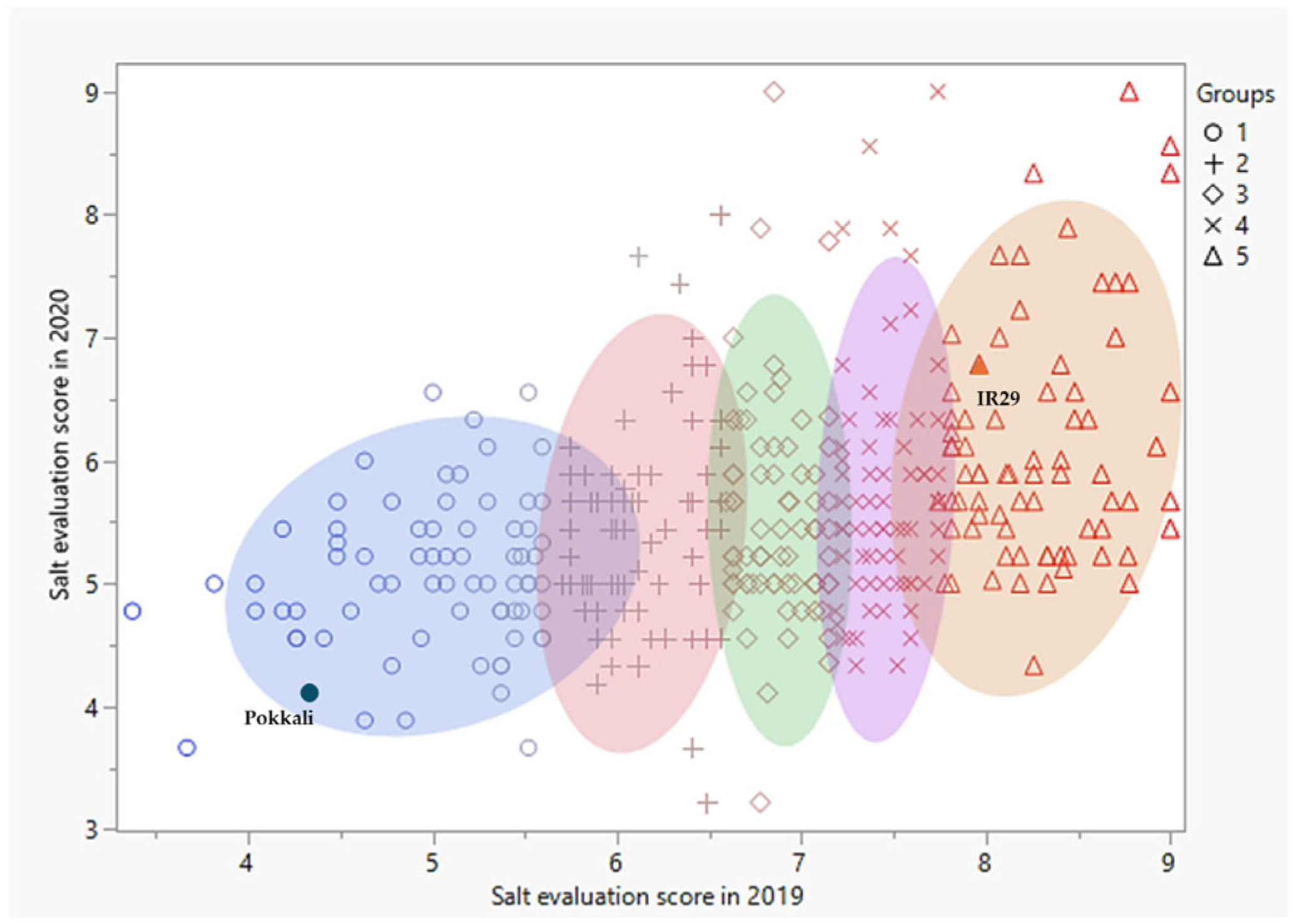
Figure 1. Group cluster based on the leaf salinity evaluation score in 2019 and 2020 at 18 dS/m NaCl. Blue = group 1, red = group 2, green = group 3, pink = group 4 and orange = group 5.
Agronomy 15 02574 g001
Figure 2. A cluster of 22 selected varieties based on salt scores of 12, 14, 16, and 22 dS/m in both 2021 and 2022 using the UPGMA method [32] (Sneath and Soka, 1973). Red circle = a variety selected for further experiment, green circle = control variety; Pokkali is the tolerant control and IR29 is the susceptible control.
Agronomy 15 02574 g002
Figure 3. Salinity score at different stages and salinity level of 10 selected experimental varieties and control varieties.
Agronomy 15 02574 g003
Figure 4. Sodium content in each part root, stem, and leaf at seedling (a) and tillering (b) stages and Na+ ratio in the shoot (stem + leaf) and root at seedling (c) and tillering (d) stages. The vertical lines of (c,d) show a 50:50 ratio. The plant was collected to determine sodium concentration at 18 dS/m (seedling–hydroponic) and 16 dS/m (tillering–soil pots).
Agronomy 15 02574 g004
Figure 5. Cluster group of 10 selected genotypes based on tiller number (TN), total dry weight (TDW), panicle number (PN), total grain weight (TGW), seeds per panicle (S/P), filled seeds per panicle (FS/P), the average and reduction (%). C = control, SS = salt stress. Green cells indicate higher than average.
Agronomy 15 02574 g005
Table 1. The experiment trials and flow of variety selection in each year and condition.
ExperimentYearConditionPlant StageNo. Varieties
Experiment 12019 and 2020HydroponicSeedling382
Experiment 22021 and 2022HydroponicSeedling22
2023HydroponicSeedling10
2023SoilSeedling10
2023SoilTillering10
2023SoilFlowering10
Table 2. Leaf salinity scores for 12, 14, 18, and 22 dS/m in 2021 and 2022 under hydroponic conditions.
20212022
Varieties12 (dS/m) 114 (dS/m)18 (dS/m)22 (dS/m)12 (dS/m)14 (dS/m)18 (dS/m)22 (dS/m)
LLR0372.17 b–f3.5 b–e3.63 b–e4.04 def2.373.805.16 a–e6.02 b–f
LLR0502.60 abc3.50 b–e3.88 b–e4.17 cde2.903.814.82 b–e5.56 c–h
LLR0542.22 b–f3.38 b–e3.25 b–e3.34 fg2.073.324.27 de5.00 fgh
LLR0552.52 a–d3.88 abc4.03 abc4.23 b–e3.144.615.67 abc6.53 a–d
LLR1062.57 abc3.60 b–e3.97 b–e4.60 bcd2.563.805.51 a–d6.69 abc
LLR1432.07 b–f3.46 b–e3.78 b–e4.21 b–e2.804.135.93 ab6.95 ab
LLR1942.17 b–f3.25 def3.38 def4.03 def1.933.334.14 e5.29 d–h
LLR2102.13 b–f3.28 c–f3.50 c–f3.83 d–g2.614.034.68 b–e5.91 b–h
LLR2161.79 def3.61 bcd3.83 bcd4.65 bcd2.684.074.47 cde5.22 e–h
LLR2482.63 abc3.53 b–e3.98 b–e4.62 bcd3.214.695.22 a–e6.74 abc
LLR2562.80 ab3.60 b–e4.10 b–e5.00 ab2.033.474.78 b–e6.47 b–e
LLR2722.60 abc3.73 a–d4.20 a–d4.54 bcd1.843.504.32 de5.15 fgh
LLR3092.40 a–d3.65 bcd3.83 bcd4.50 bcd2.273.204.02 e4.60 h
LLR3651.52 f2.98 ef3.09 ef3.10 g2.853.704.43 cde5.63 c–h
LLR3772.27 b–f3.38 b–e3.60 b–e4.37 b–e2.123.724.63 cde5.36 d–h
LLR3952.10 b–f3.43 b–e3.85 b–e4.58 bcd2.283.704.72 b–e5.65 c–h
LLR3982.03 c–f2.75 f3.60 f3.93 def2.393.684.84 b–e5.53 c–h
LLR4021.63 ef3.25 def3.73 def3.83 d–g2.323.434.28 de4.99 fgh
LLR4372.30 b–e3.38 b–e3.45 b–e4.23 b–e2.894.165.45 a–d6.12 b-f
LLR4412.31 b–e3.90 ab4.35 ab4.97 abc2.703.824.85 b–e6.04 b–f
LLR4491.97 c–f3.23 def3.45 def3.57 efg1.973.334.45 cde5.23 e–h
LLR4652.00 c–f3.50 b–e4.08 b–e4.50 bcd2.133.274.07 e4.72 gh
Pokkali
(Tolerant control)
1.98 c–f3.16 def3.24 def3.59 efg2.393.294.30 de4.99 fgh
IR29
(Susceptible control)
3.10 a4.28 a5.05 a5.67 a3.484.626.18 a7.78 a
Mean2.243.473.784.252.503.774.805.76
F-test******nsns***
C.V. (%)23.7712.7213.8513.6523.2118.4716.1413.48
F-test was showed significant as ns, *, ** are non-significant and significant at p < 0.05 and p < 0.01, respectively. The different letters after the numbers indicate the significance level. 1 The classification is score <3 = tolerant, score 3–5 = moderately tolerant, score 6–7= susceptible, and score 8–9 = highly susceptible. Mean is the average of each salt injury score at each salt level. C.V. (%) is the percentage of coefficient of variation in each salt injury score at each salt level.
Disclaimer/Publisher’s Note: The statements, opinions and data contained in all publications are solely those of the individual author(s) and contributor(s) and not of MDPI and/or the editor(s). MDPI and/or the editor(s) disclaim responsibility for any injury to people or property resulting from any ideas, methods, instructions or products referred to in the content.