Article

Regulatory Effects of Different Compost Amendments on Soil Urease Kinetics, Thermodynamics, and Nutrient Stoichiometry in a Temperate Agroecosystem

1
College of Garden, Changchun University, Changchun 130012, China
2
Institute of Resource Utilization and Soil Conservation, Changchun University, Changchun 130022, China
*
Author to whom correspondence should be addressed.
Agronomy 2025, 15(11), 2544; https://doi.org/10.3390/agronomy15112544
Submission received: 27 September 2025 / Revised: 26 October 2025 / Accepted: 29 October 2025 / Published: 31 October 2025
(This article belongs to the Section Agricultural Biosystem and Biological Engineering)

Abstract

Compost amendments are widely recognized as an effective strategy for improving soil quality, modulating enzyme activities, and enhancing nitrogen cycling. Urease, a key enzyme in nitrogen transformation, is characterized by kinetic parameters such as the maximum reaction rate (Vmax) and Michaelis constant (Km), as well as thermodynamic attributes including temperature sensitivity (Q10), activation energy (Ea), enthalpy change (ΔH), Gibbs free energy change (ΔG), and entropy change (ΔS). However, how different compost sources regulate urease kinetics, thermodynamics, and nitrogen availability remains poorly understood. In this study, we evaluated the effects of three compost amendments—mushroom residue (MR), mushroom residue–straw mixture (MSM), and leaf litter (LL)—on urease kinetics and thermodynamics in a temperate agroecosystem. The MSM treatment significantly enhanced urea hydrolysis capacity and catalytic efficiency. In contrast, LL treatment resulted in the highest Km value, indicating a substantially lower enzyme-substrate affinity. Furthermore, MSM reduced the Ea and increased the thermal stability of urease, thereby supporting enzymatic performance under fluctuating temperatures. Collectively, our findings highlight that compost composition is a critical determinant of urease function and nitrogen turnover. By elucidating the coupled kinetic and thermodynamic responses of urease to compost inputs, this study provides mechanistic insights to guide optimized soil management and sustainable nitrogen utilization in temperate agricultural systems.

1. Introduction

The intensive reliance on chemical fertilizers in modern agriculture has caused severe soil degradation, characterized by nutrient imbalances, acidification, and loss of microbial diversity. These issues are particularly evident in the black soil (Mollisol) regions of Northeast China, one of the world’s most significant grain-producing areas [1,2]. To mitigate these adverse impacts, organic amendments such as crop residues and livestock manure have been increasingly adopted as essential components of sustainable soil management strategies [3]. Among these, lignocellulosic composts derived from agricultural byproducts (e.g., mushroom residue, straw, and leaf litter) offer dual benefits: alleviating environmental burdens from organic waste accumulation and enhancing soil carbon sequestration [4,5].
Soil extracellular enzymes govern nutrient cycling by mediating the transformation of organic substrates into bioavailable forms. Urease, a key enzyme in nitrogen turnover, hydrolyzes urea to ammonium and thereby directly regulates nitrogen supply to plants [6]. Its kinetic parameters (Vmax, Km) and thermodynamic traits (Q10, Ea, ΔH, ΔG, ΔS) are sensitive indicators of microbial metabolic efficiency and environmental adaptability, providing mechanistic insights into how organic inputs reshape soil function [7,8]. However, previous studies have primarily emphasized enzyme activity levels, while systematic assessments of how compost mixtures influence both kinetic and thermodynamic properties of urease remain limited—particularly in temperate agroecosystems [9,10]. The croplands of Northeast China, with Mollisols under a continental monsoon climate characterized by pronounced freeze–thaw cycles, represent a unique yet understudied agroecological system [11].
Despite the growing interest in compost-based soil improvement, three critical knowledge gaps remain. (1) Material-specific effects: The distinct influences of mushroom residue (rich in lignin), straw (cellulose-dominated), and leaf litter (variable TOC/TN ratio) on urease regulation are not well quantified. (2) Mechanistic understanding: Few studies have linked compost-driven changes in urease kinetics (e.g., substrate affinity) and thermodynamics (e.g., temperature sensitivity) to microbial biomass (MBC, MBN, MBP) and nutrient stoichiometry. (3) Regional applicability: Compost optimization tailored to cold temperate soils with unique thermal regimes and microbial communities, such as those of Northeast China, remains underexplored [12,13].
To address these gaps, we investigated the kinetic and thermodynamic responses of soil urease to three compost amendments—mushroom residue (MR), mushroom residue–straw mixture (MSM), and leaf litter (LL). Our primary objective was to clarify the relationships among urease function, microbial biomass, and soil C-N-P availability under different compost inputs, with the goal of developing region-specific composting strategies to enhance nitrogen-use efficiency in Northeast China’s agroecosystems. We hypothesized that (1) compost blending (MSM) would synergistically enhance urease catalytic efficiency and thermal stability compared with single-material composts (MR or LL); and (2) synergistic C-N release from mushroom residue and straw would lower energy barriers (ΔG, Ea) and improve catalytic resilience across fluctuating temperature regimes.
We propose that the mixed composting of mushroom residue and straw (MSM) will establish a more resilient and efficient soil urease system than single-material improvement. This enhancement is attributed to the synergistic optimization of carbon and nitrogen release and microorganisms, which jointly reduce thermodynamic barriers (ΔG, Ea) and improve catalytic efficiency and stability under fluctuating temperatures.
This study advances the theoretical framework of enzyme-mediated nutrient cycling by integrating kinetic and thermodynamic perspectives into compost evaluation. In practical terms, it provides guidance for designing compost formulations tailored to climatic and edaphic contexts, thereby supporting “Green Agriculture” initiatives that aim to restore degraded black soils while promoting sustainable recycling of agricultural residues.

2. Materials and Methods

2.1. Composting Materials and Preparation

This study utilized three typical agricultural and forestry waste materials from Northeast China as composting substrates: (1) Auricularia auricula residue, sourced from the Auricularia auricula demonstration base in Huangsongdian Town, Jilin Province, China; (2) Rice straw, collected from rice-growing regions of Jilin Province, China; and (3) Mongolian oak (Quercus mongolica) leaves, gathered from the landscaping areas of Changchun University, China.
Prior to composting, all raw materials were mechanically shredded (straw and leaves to <5 cm) and adjusted to an initial moisture content of 55–60%. The composting experiment included three treatments: Auricularia auricula residue alone (MR), Auricularia auricula residue mixed with rice straw at a 1:1 dry weight ratio (MSM), and Mongolian oak leaf composting alone (LL), with three replicates per treatment.
Composting was performed under aerobic conditions, with pile dimensions of 1.5 m × 1.2 m × 1.0 m (L × W × H). The piles were turned twice weekly, and temperature was continuously monitored using a portable temperature logger to ensure adequate aeration and compost maturity. The composting duration was 60 days, and maturity was evaluated based on the germination index (GI ≥ 80%) and heavy metal content (Cd < 3 mg/kg, Hg < 3 mg/kg, Pb < 300 mg/kg, Cr < 500 mg/kg, As < 30 mg/kg), adhering to the Control Standards for Pollutants in Agricultural Sludge (GB4284-2018 [14]). The physicochemical properties of the composted materials are presented in Table 1.

2.2. Experimental Site and Design

The field experiment was conducted at the Changchun University Experimental Teaching Base (43°49′50″ N, 125°17′58″ E) in Changchun, Jilin Province, China. This region has a temperate continental monsoon climate, with an average annual precipitation of approximately 600 mm and a frost-free period of 140–150 days. The soil type is degraded chernozem, and the experimental crop was tomato (Lycopersicon esculentum Mill.). A randomized complete block design (RCBD) was employed, with four treatments: (1) Auricularia auricula residue amendment (MR); (2) Auricularia auricula residue–rice straw compost amendment (MSM); (3) Oak leaf compost amendment (LL); (4) Control without organic fertilizer application (CK). Each treatment had three replicates, resulting in a total of 12 experimental plots (4 m × 6 m each). The compost amendments were applied in October 2023 at a uniform dry matter input rate of 5 t/ha and incorporated into the top 20 cm of soil. The selected application ratio of 5 tons per hectare is a standard and effective dosage of organic conditioner in field soil management, which is sufficient to significantly improve the biochemical properties of the soil while avoiding the burden caused by excessive application.

2.3. Soil Sampling and Processing

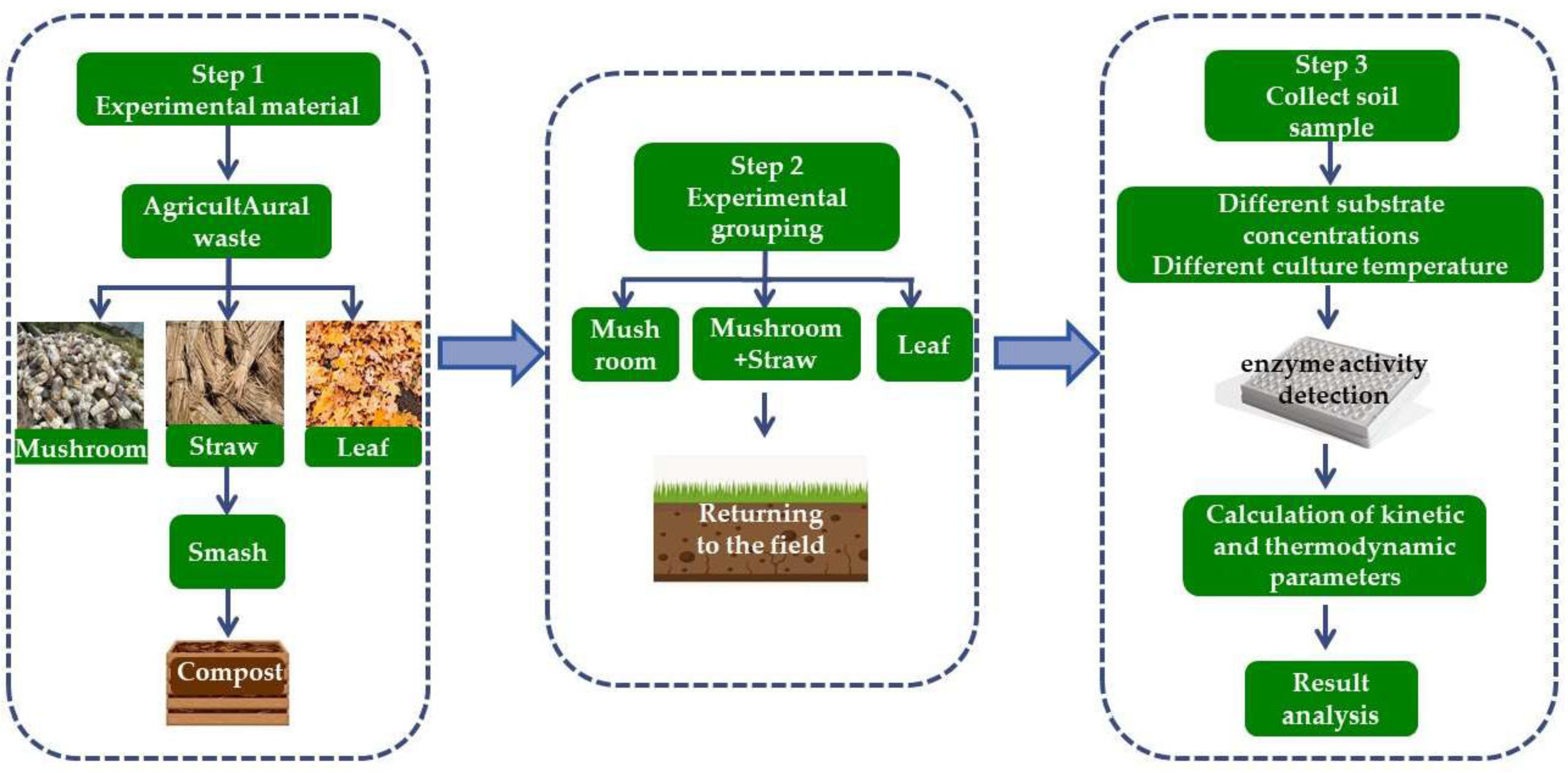
Soil samples were collected in October 2024, after a full growing season following amendment application. A modified “S”-shaped sampling strategy was employed, where five subsamples were collected from each plot at a depth of 0–20 cm and then homogenized. The composite samples were placed in sterile polyethylene bags and transported to the laboratory for further processing. In the laboratory, visible plant debris and stones were manually removed. The samples were air-dried at 25 °C in a shaded, well-ventilated area, then ground and sieved through a 0.25 mm nylon mesh. The processed samples were stored in brown wide-mouth bottles for subsequent analyses. The experimental workflow is illustrated in Figure 1.

2.4. Analytical Methods

2.4.1. Determination of Soil Carbon, Nitrogen, and Phosphorus Fractions

Total nitrogen (TN) was measured using the Kjeldahl digestion method [15], while total phosphorus (TP) was determined by the molybdenum-antimony colorimetric method [16]. Ammonium nitrogen (NH4+-N) and nitrate nitrogen (NO3-N) were extracted with 1 mol·L−1 KCl and analyzed using a continuous flow analyzer (AA3, SEAL Analytical, Norderstedt, Germany) [17]. Dissolved organic carbon (DOC) and total organic carbon (TOC) were quantified using the external heating potassium dichromate oxidation method [18]. Microbial biomass carbon (MBC), microbial biomass nitrogen (MBN), and microbial biomass phosphorus (MBP) were determined by the chloroform fumigation-extraction method [19].

2.4.2. Soil Urease Activity and Enzymatic Kinetics

Soil urease activity was determined according the phenol-sodium hypochlorite colorimetric method [20], with urea solutions of varying concentrations (0.01, 0.05, 0.10, 0.2 mol/L) as substrates. Samples were incubated at different temperatures (5, 15, 25, 35, 45 °C) for 24 h after toluene treatment.
The Michaelis-Menten equation was used to calculate soil urease kinetics [21]:
V 0 = V m a x [ S ] K m + [ S ]
where V0 represents the initial reaction velocity (mg·g−1·h−1), [S] denotes the substrate concentration (mol·L−1), Vmax is the maximum reaction velocity (mg·g−1·h−1), and Km is the Michaelis constant (mol·L−1). The catalytic efficiency (Ka) of urease was expressed as the ratio of Vmax to Km.
The temperature sensitivity of soil enzyme kinetic parameters was calculated using the following equation [22]:
Q 10 = A T + 10 A T
where Q10 represents the temperature sensitivity coefficient, T is the incubation temperature (°C), and A denotes the soil enzyme kinetic parameters, including the maximum reaction velocity (Vmax), the Michaelis constant (Km), and the catalytic efficiency (Ka).
Additionally, the reaction rate constant (k) was calculated using the first-order reaction equation, the thermodynamic parameters of urease activity, including Gibbs free energy change (ΔG), enthalpy change (ΔH), and entropy change (ΔS), were calculated using the following equations [23]:
k = 1 t × l n a a x
Δ G = R × T × l n R × T N × h × k
Δ H = E a R × T
Δ S = H G T
where a is the maximum rate of product formation (mg·g−1·h−1); x is the product concentration at time t (mol·L−1), A is the pre-exponential factor, T is the absolute temperature (K), R is the universal gas constant (8.314 J·mol−1·K−1), N is Avogadro’s number (6.023 × 10²³ ·mol), and h is Planck’s constant (6.626 × 10⁻³⁴ J·s−1).

2.5. Data Processing

Experimental data were compiled and organized using Microsoft Excel. Statistical analyses were conducted in SPSS 25.0, with significance testing at p < 0.05 and two-way analysis of variance (ANOVA) applied to examine treatment effects. Michaelis-Menten hyperbolic fitting of enzyme activity versus substrate concentration was performed using GraphPad Prism 9.5. Bar charts, scatter plots, and correlation heatmaps were generated using Origin 2024. The structural equation model analysis of the soil property influence path was conducted using R software (version 4.5.1). Prior to model fitting, key assumptions for SEM were tested and satisfied, including multivariate normality, linearity, and independence of residuals.

3. Results and Discussion

3.1. Effects of Different Compost Amendments on Soil Carbon, Nitrogen, and Phosphorus Fractions

Application of compost products markedly altered soil carbon, nitrogen, and phosphorus fractions compared with the control (CK) (Table 2). Total organic carbon (TOC) increased significantly under all compost treatments (p < 0.05). MSM recorded the highest TOC (18.81 g·kg−1), 53% higher than CK, followed by MR (18.21 g·kg−1) and LL (18.02 g·kg−1). The pronounced increase under MSM can be attributed to the dual role of straw and mushroom residue: lignin-rich straw contributes to the stabilization of recalcitrant carbon, while mushroom residue provides labile substrates for microbial metabolism, collectively enhancing carbon sequestration [24]. Total nitrogen (TN) exhibited a similar trend, with MSM (1.55 g·kg−1) achieving the greatest improvement (82% above CK). MR (1.27 g·kg−1) also significantly increased TN, while LL (0.97 g·kg−1) showed only a moderate effect. These results suggest that MSM supports a more favorable C/N balance that supports microbial mineralization and reduces N immobilization [25,26]. Leaf litter treatment (LL) resulted in the greatest increase in total phosphorus (TP, 0.19 g·kg−1), representing a 172% rise over CK. This can be explained by the inherently high phosphorus concentration in leaf litter (9.4 g·kg−1) and the rapid release of inorganic P during decomposition [27]. MR and MSM also enhanced TP (0.15 and 0.20 g·kg−1, respectively), but to a lesser extent.
Microbial biomass carbon (MBC), nitrogen (MBN), and phosphorus (MBP) were significantly elevated under compost amendments. MSM achieved the highest values (MBC: 428.83 mg·kg−1; MBN: 28.03 mg·kg−1; MBP: 9.51 mg·kg−1), representing increases of 131%, 93%, and 32% compared with CK, respectively. This integrated improvement highlights that straw provides structural carbon and microbial habitat, while mushroom residue supplies N and P for microbial proliferation [28].
DOC also increased significantly across treatments. MR recorded the highest DOC (122.18 mg·kg−1), followed by LL (120.31 mg·kg−1) and MSM (115.06 mg·kg−1), all significantly higher than CK (100.60 mg·kg−1). The elevated DOC is likely due to the mobilization of soluble polysaccharides and proteins during organic matter decomposition [29].
NH4+-N levels were significantly enhanced by MR (4.31 mg·kg−1) and MSM (4.34 mg·kg−1) compared with CK (4.17 mg·kg−1), likely because straw provides adsorption sites that reduce ammonium losses [30]. LL did not significantly affect NH4+-N. The NO3-N fraction responded differently to compost types. LL showed the highest NO3-N (4.50 mg·kg−1), 74% higher than CK, reflecting late-stage nitrification after initial immobilization. MR also increased NO3-N (3.44 mg·kg−1), whereas MSM maintained levels comparable to CK (3.12 mg·kg−1), indicating that sustained C release from straw moderated nitrification activity.
The TOC/TN ratio decreased in MSM (12.19) relative to CK (14.47), reflecting enhanced nitrogen availability and reduced immobilization potential. By contrast, LL exhibited the highest TOC/TN (18.88), suggesting limited nitrogen supply during early decomposition. For TN/TP, LL recorded the lowest value (5.17), highlighting relative P enrichment, while MR (8.27) and MSM (7.73) showed higher values, indicating stronger P limitation. TOC/TP ratios followed the order MR (118.38) > CK (105.48) > LL (96.80) > MSM (94.28), suggesting that MR may promote long-term C accumulation but at the cost of P depletion risk [31].
Collectively, compost amendments significantly modified soil nutrient fractions and microbial biomass, but the magnitude of change varied with compost composition. MSM enhanced stable carbon pools and nitrogen cycling efficiency, LL promoted phosphorus enrichment, and MR improved short-term nitrogen supply while posing risks of P depletion. These findings underscore the material-specific impacts of compost products on soil C-N-P balance and microbial resource allocation [32].

3.2. Effects of Different Compost Amendments on Soil Urease Activity

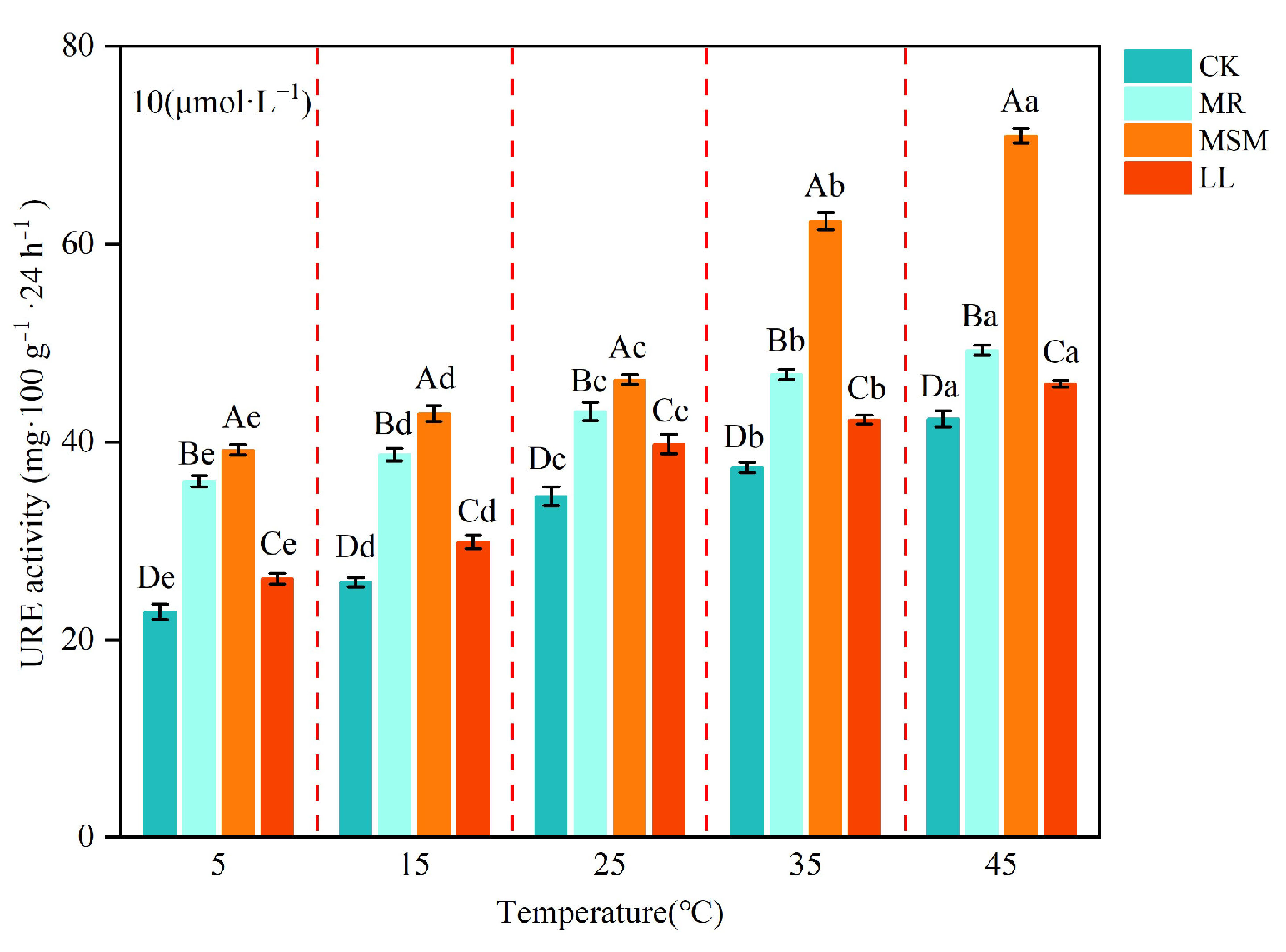
Soil urease activity demonstrated marked sensitivity to both substrate concentration and temperature, with significant differences observed across compost treatments (Figure 2). At the given substrate level, all compost treatments exhibited significantly higher urease activity compared to the control under the same incubation temperature. Urease activity increased with rising temperature and reached a maximum at 45 °C, consistent with the general thermodynamic principles governing enzyme activity—moderate thermal conditions (35–45 °C) promote enhanced enzyme–substrate interactions. Among the treatments, MSM consistently displayed the highest urease activity across all temperature levels, whereas LL showed the lowest activity, and MR exhibited intermediate performance [33,34].
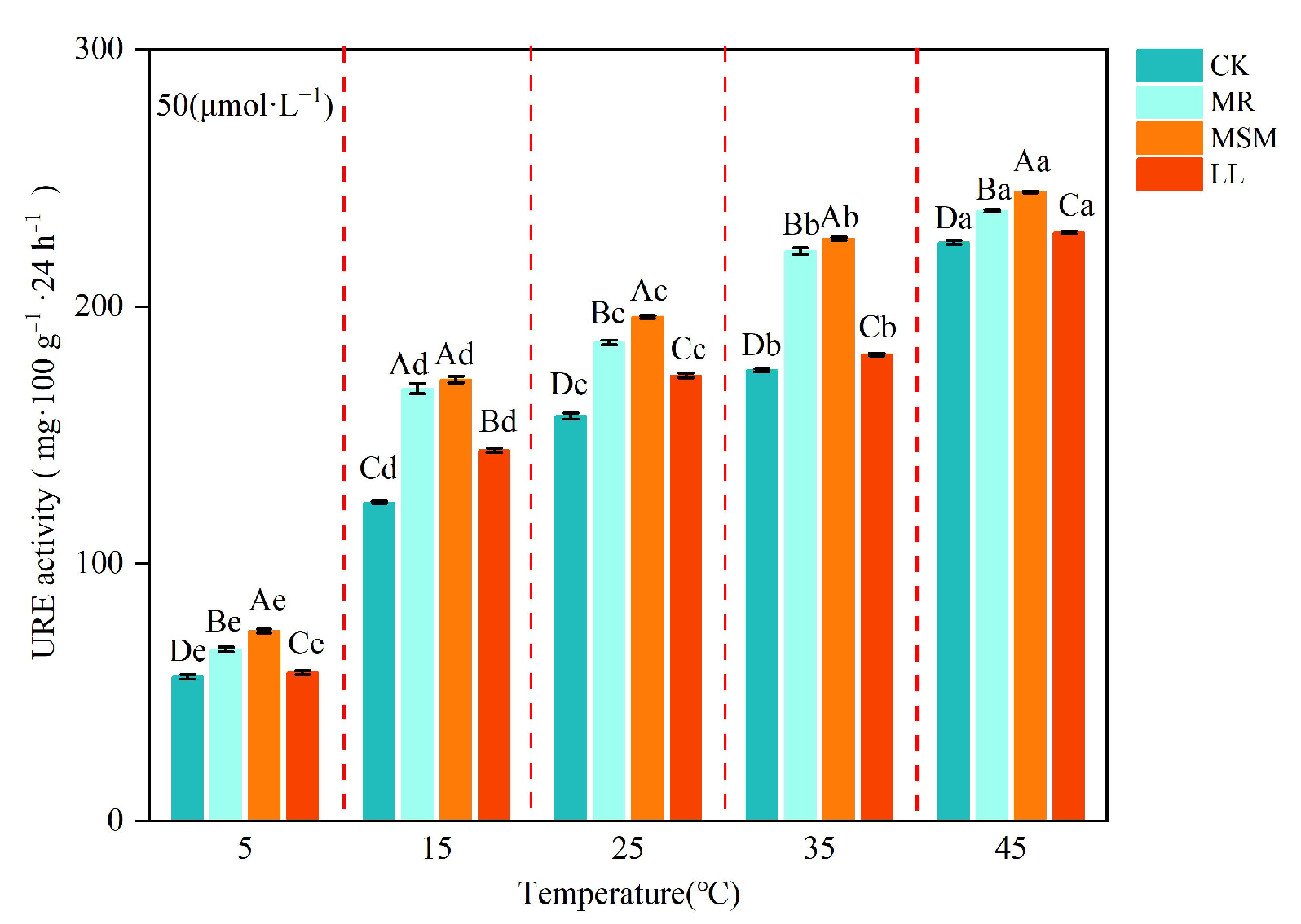
At a urea concentration of 50 μmol·L−1 (Figure 3), urease (URE) activity remained strongly dependent on temperature and compost treatment [35]. Activity increased with temperature, reaching a maximum at 45 °C. MSM maintained its superiority in urease activity across all temperatures, significantly outperforming CK, MR, and LL. LL still displayed the lowest activity, while MR showed intermediate performance, indicating consistent treatment effects even at moderately higher substrate supply [36,37].
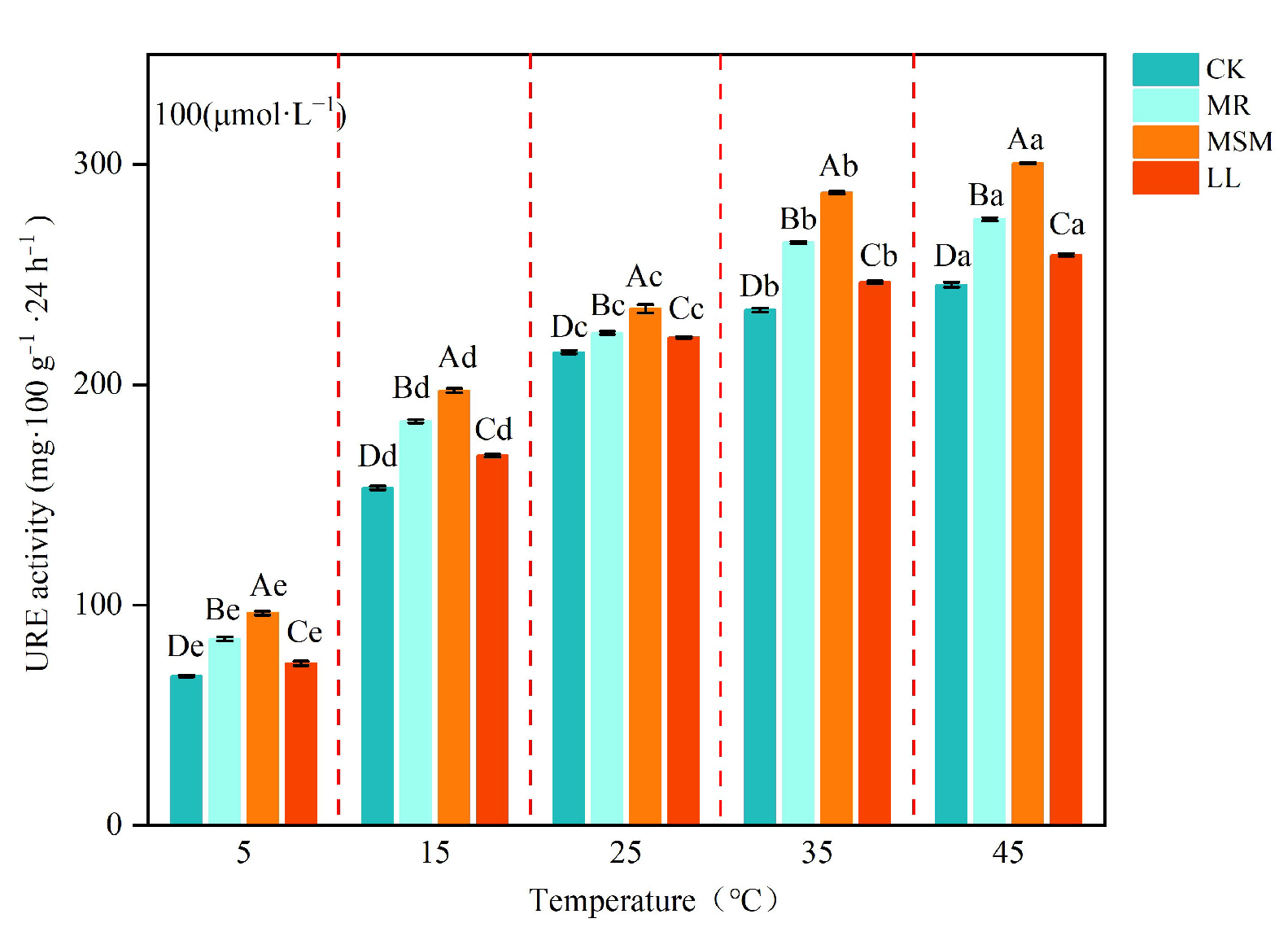
When the urea concentration was elevated to 100 μmol·L−1 (Figure 4), the pattern of URE activity in response to temperature and compost treatments remained consistent. URE activity rose steadily with temperature, peaking at 45 °C. MSM continued to achieve the highest activity, demonstrating its robust performance under this substrate condition. MR improved URE activity relative to CK but did not match MSM, while LL had the lowest activity, reflecting the persistent influence of compost composition on enzymatic activity [38,39].
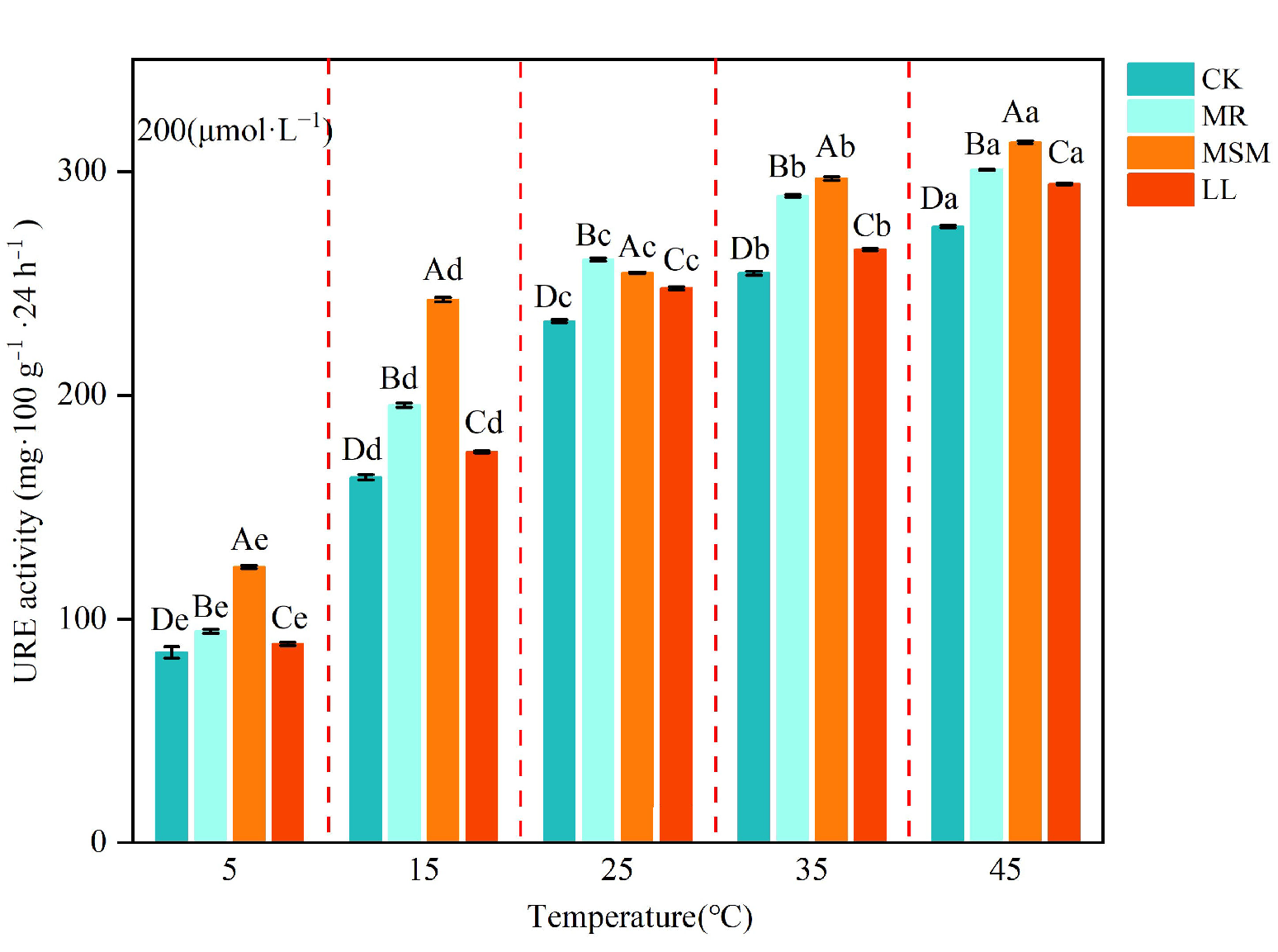
At the highest tested urea concentration (Figure 5), URE activity showed pronounced temperature dependence, increasing with temperature and peaking at 45 °C. MSM again exhibited the highest activity across all temperatures, emphasizing its consistent advantage regardless of substrate concentration. MR and LL showed intermediate and lowest activities, respectively, confirming that treatment effects were consistent even under high substrate supply.
Collectively, across all urea concentrations (10, 50, 100, and 200 μmol·L−1), soil urease activity was significantly influenced by both temperature and compost treatment. Urease (URE) activity consistently increased with temperature up to 45 °C, consistent with enzymatic thermodynamic principles. MSM consistently produced the highest activity among all treatments, which can be attributed to the synergistic effects of mushroom residue and straw on microbial metabolism and enzyme stabilization [40,41]. In comparison, LL exhibited the lowest activity, which was attributed to its high C/N ratio and lignin content, both of which can suppress urease synthesis. MR showed moderate improvements over CK but did not reach the level of MSM, particularly at higher temperatures and substrate concentrations. These findings demonstrate that compost composition plays a critical role in regulating the balance between substrate availability, microbial nutrient demand, and enzymatic resilience, thereby shaping the temperature- and concentration-dependent dynamics of urease activity in temperate agroecosystems.

3.3. Effects of Different Compost Amendments on Soil Urease Kinetic Parameters

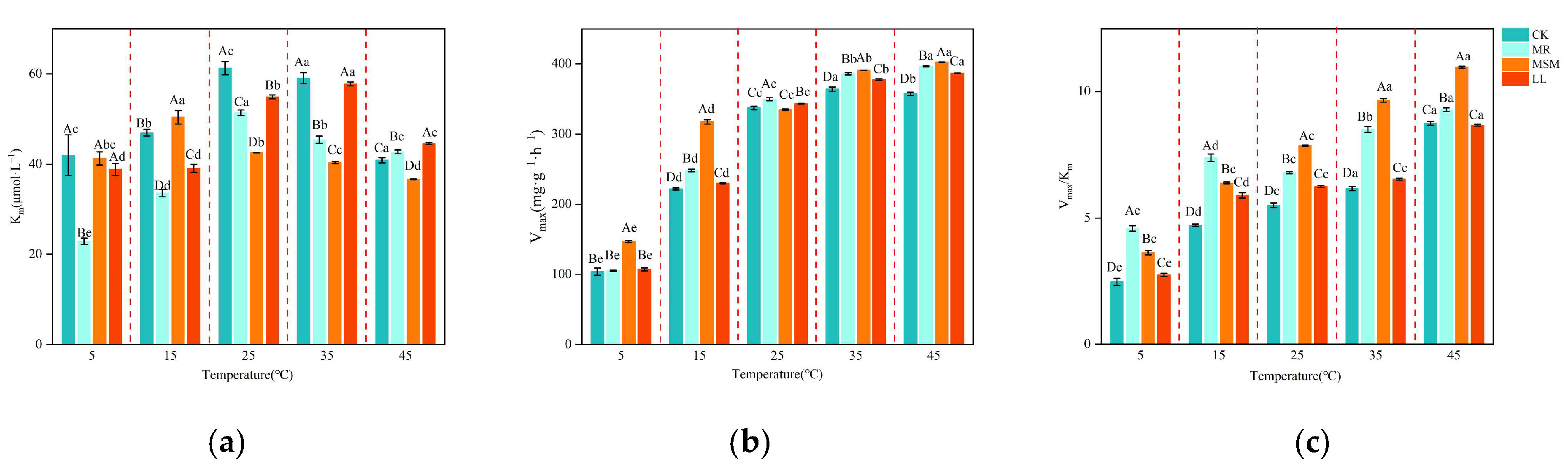
The effects of compost type and temperature on soil urease kinetic parameters, along with the results of two-way ANOVA, are shown in Figure 6 and Table 3. Both factors, as well as their interaction, had highly significant effects (p < 0.01) on Km, Vmax, and Vmax/Km. Across treatments, Km generally increased (p < 0.05) with rising temperature, peaking at 25 °C, whereas Vmax and Vmax/Km increased progressively up to 45 °C (p < 0.05). This thermal response reflects a dual regulatory mechanism of urease activity: within the optimal range (25–45 °C), increased molecular kinetic energy promotes enzyme–substrate complex formation, as predicted by the Arrhenius equation; beyond this threshold, thermal destabilization of the enzyme’s tertiary structure diminishes catalytic performance [42,43].
Compared with the control, MR treatments showed significantly lower Km at all temperatures (p < 0.05), indicating that labile organic compounds in mushroom residue (e.g., amino acids, short-chain carbon substrates) improve the accessibility of urease active sites, thereby increasing substrate affinity. In contrast, MSM exhibited a significantly higher Km at 15 °C (p < 0.05), possibly due to competitive inhibition from phenolic derivatives released during lignin decomposition in straw, which may hinder substrate binding [44]. LL treatments showed no significant Km change at 5 °C or 35 °C but displayed significant increases at other temperatures (p < 0.05), consistent with the hypothesis that high C/N ratios induce nitrogen limitation, weakening enzyme–substrate recognition. These results suggest that complex organic inputs can modulate Km through physical adsorption of urea or chemical interactions that interfere with substrate binding.
The interaction between compost type and temperature (C × T) significantly influenced ΔG but had only weak effects on ΔH and ΔS, which aligns with the inherent logic of thermodynamic formulations. According to the relationship ΔG = ΔH − TΔSΔG = ΔH − TΔS, ΔG integrates the contributions of ΔH, ΔS, and temperature, whereas ΔH and ΔS reflect the intrinsic energy and disorder attributes of the enzymatic reaction. The nonsignificant C × T effect on ΔH and ΔS suggests that compost amendments stabilized the thermodynamic baseline of urease by modifying soil organic matter and microbial communities, and the temperature range tested (5–45 °C) did not differentially disrupt these intrinsic properties. The significance of ΔG arises from the amplifying role of temperature: even if ΔS is only weakly affected by C × T, an increase in temperature magnifies the interaction via the TΔS term. As a dynamic factor, temperature makes TΔS a key driver of ΔG variation, ultimately allowing the combined influence of compost and temperature to significantly modulate the thermodynamic spontaneity of urease activity without directly altering the enzyme’s inherent enthalpy and entropy.
Kinetic parameters provide valuable insights into enzyme properties, stability, and the formation dynamics of enzyme–substrate formation. Vmax represents the maximum reaction rate under substrate saturation, reflecting the upper limit of catalytic capacity [45]. In this study, Vmax increased with temperature across all compost treatments, consistent with earlier reports. This trend is primarily driven by enhanced molecular motion at elevated temperatures, which promotes enzyme–substrate collisions. Moreover, higher temperatures may stimulate microbial metabolism, increasing the synthesis and secretion of urease and thereby indirectly elevating Vmax.
The catalytic efficiency constant (Ka = Vmax/Km) reached its peak at 45 °C in all treatments, indicating that high temperature not only increased reaction rate but also optimized substrate conversion efficiency. MSM consistently achieved the highest Ka values across temperatures, supporting the carbon–nitrogen coupling hypothesis: straw-derived structural carbon forms a protective matrix around urease active sites, reducing thermal denaturation, while nitrogen from mushroom residue fuels microbial synthesis of highly active urease isoforms. This synergistic mechanism highlights the potential of tailored compost formulations to generate thermally stable enzyme systems, offering a theoretical basis for designing organic amendments that enhance urease performance under fluctuating temperature conditions [46,47].

3.4. Effects of Compost Amendments on Temperature Sensitivity

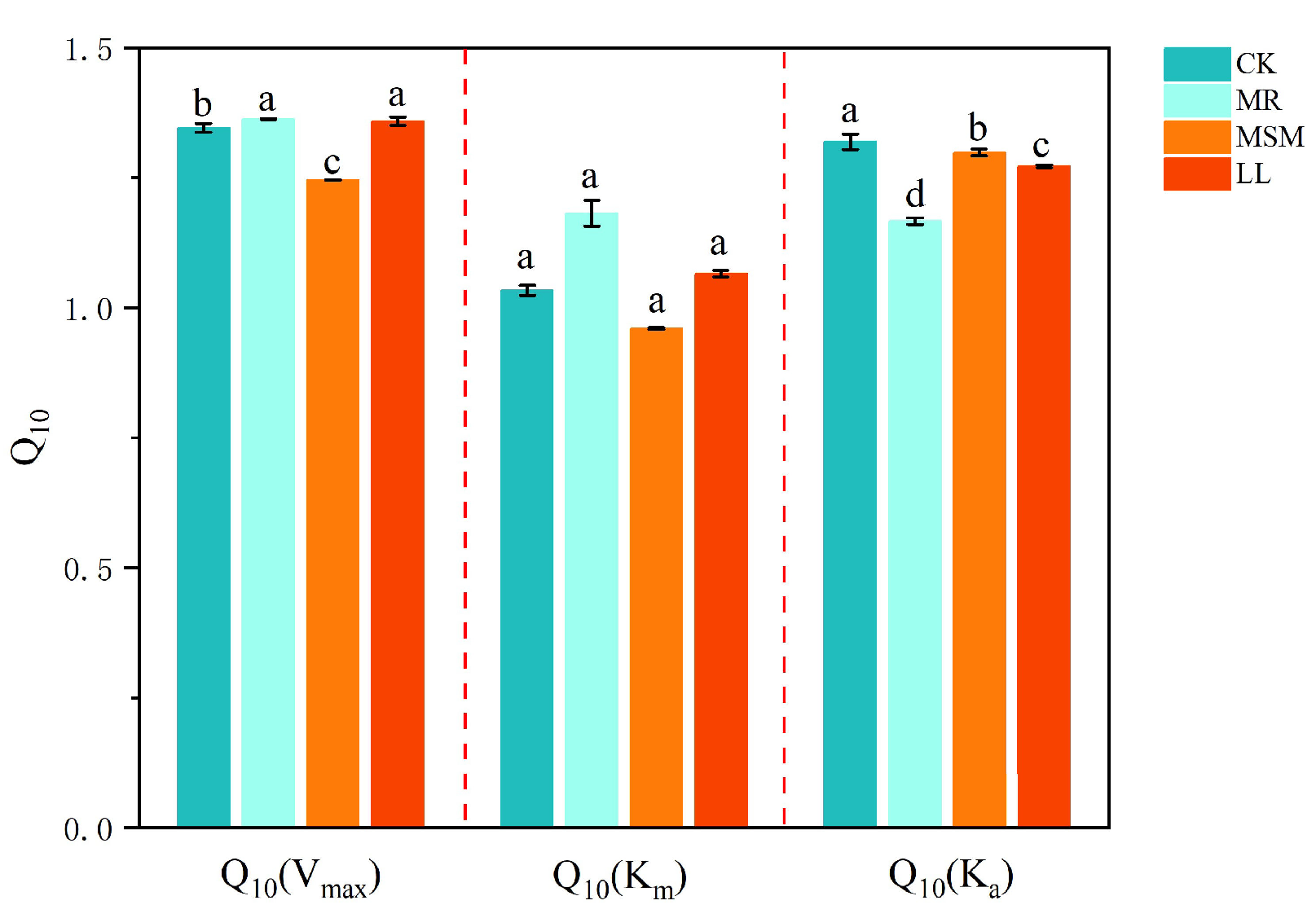
The temperature sensitivity parameters Q10 for different compost amendments are shown in Figure 7. This parameter quantifies the proportional change in enzyme kinetic parameters per 10 °C temperature increase, offering insights into the thermal adaptability of enzymes and their response to environmental fluctuations [48]. In soil urease studies, Q10 values reveal how substrate quality and decomposition dynamics regulate enzyme stability and catalytic efficiency under temperature variations [49,50].
Among the treatments, MSM exhibited the lowest Q10Vmax, significantly lower than all other groups (p < 0.05), indicating enhanced thermal stability of urease. This stability is likely attributable to phenolic compounds derived from straw lignin that may form protective complexes with the enzyme, thereby limiting conformational fluctuations at elevated temperatures, though direct evidence for such complex formation was not obtained in the present study. In contrast, MR and LL showed higher Q10Vmax, suggesting greater thermal sensitivity, consistent with their unstable carbon composition (MR) or high C/N ratio (LL), both of which may accelerate microbial turnover and enzyme denaturation under warming.
Similarly, MSM also recorded the lowest Q10Km, reflecting minimal temperature-induced changes in substrate affinity. This may result from the lignin-mediated stabilization of enzyme–substrate interactions, whereby hydrophobic residues in straw help maintain accessibility to active sites across temperatures. Conversely, MR displayed the highest Q10Km, indicating a marked decline in substrate affinity at higher temperatures. This pattern may be linked to competitive inhibition by low-molecular-weight organic acids released during the rapid mineralization of mushroom residue, which transiently alter the enzyme microenvironment.
Interestingly, despite its low Q10Vmax, MSM maintained a relatively high Q10Ka, comparable to the control, suggesting an optimized balance between reaction rate and substrate affinity. This contrasts with MR, where Q10Ka declined sharply due to a disproportionate increase in Km relative to Vmax. These differences underscore the functional role of recalcitrant carbon in MSM: lignin slows carbon release, synchronizing microbial enzyme production with substrate availability and thereby stabilizing catalytic efficiency under thermal fluctuations [51].

3.5. Effects of Compost Amendments on Soil Urease Thermodynamic Parameters

The effects of compost type and temperature on soil urease thermodynamic parameters, along with the results of two-way ANOVA, are shown in Table 3 and Table 4. Compost type exerted highly significant effects (p < 0.01) on ΔH, ΔS, and ΔG, while temperature had highly significant effects on ΔS and ΔG (p < 0.01). The interaction between the two factors significantly influenced ΔG only (p < 0.01), underscoring the specificity of enzyme reaction pathways under the joint regulation of environmental conditions and organic amendments.
Across all treatments, ΔG increased with rising temperature and reached its maximum at 45 °C (p < 0.05). This trend suggests that elevated temperatures enhance the negative contribution of ΔS, thereby driving a positive shift in ΔG. In contrast, ΔS exhibited a unimodal response, increasing initially and then decreasing, with the lowest values recorded at 45 °C (p < 0.05). This indicates that high temperatures substantially increase the degree of ordering within the enzyme–substrate complex during its formation.
Compared with the control, all compost treatments significantly reduced ΔG (p < 0.05). MSM showed the largest decrease, accompanied by significant reductions in ΔS, ΔH, and activation energy (Ea) (p < 0.05), whereas MR and LL produced no significant changes in ΔH or Ea. These patterns can be explained by transition state theory: in MSM, lignin–humic acid complexes derived from straw may lower the activation barrier for the transition state, reducing Ea and thus facilitating the conversion of substrate to product. In contrast, LL recorded the highest Ea values, implying that nitrogen limitation induced by its high C/N ratio increased the energetic barrier, consistent with the negative relationship between Ea and reaction rate described by the Arrhenius equation.
In this study, all ΔG values were positive, confirming that the formation of the enzyme–substrate transition state complex is endergonic. The consistently negative ΔS values indicate a substantial entropy decrease during urease-catalyzed urea hydrolysis, reflecting a shift toward a more ordered reaction system [52,53]. The most pronounced decrease in ΔS occurred in MSM, supporting the carbon–nitrogen synergy hypothesis: the stable carbon framework provided by straw promotes hydrogen-bond-mediated alignment of water molecules, reducing system disorder, while the readily available nitrogen from mushroom residue enhances the local microenvironment of active sites, further reinforcing the entropy reduction effect. Enthalpy change (ΔH) reflects the total energy variation in the system during the reaction [54]. As temperature rises, intermolecular forces weaken, facilitating the formation of the transition state; consequently, ΔH decreases with increasing temperature.

3.6. Correlation Between Urease Kinetic Parameters and Soil C and N Fractions

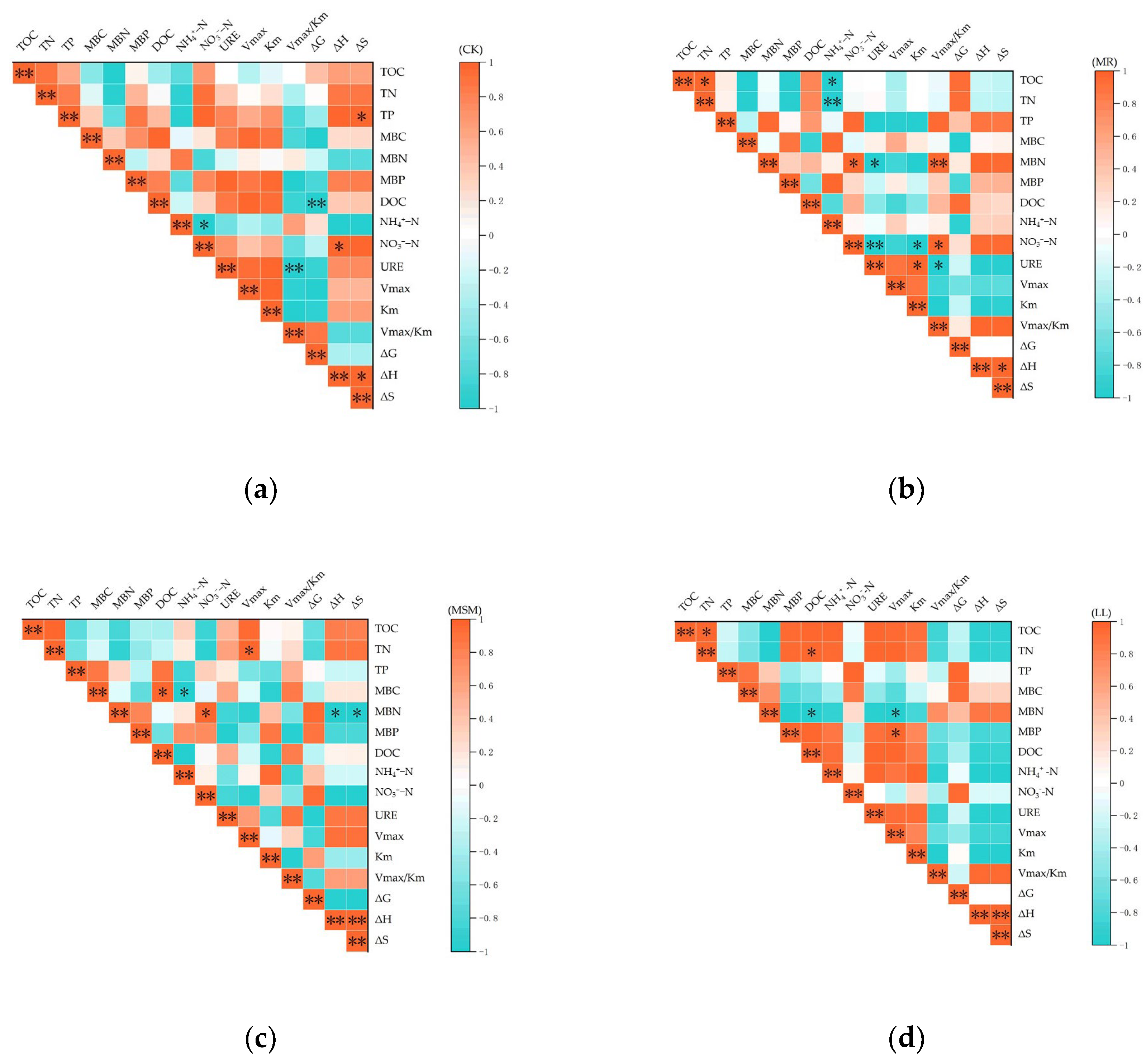
As illustrated in Figure 8, distinct correlation patterns emerged between urease kinetic parameters and soil C, N, and P fractions under different compost amendments.
In the control soil, TOC was strongly and positively correlated with TN, reflecting the inherent coupling of carbon and nitrogen cycles in unfertilized Mollisols. TOC also exhibited significant positive correlations with MBC and MBN, suggesting that the baseline soil organic C pool underpins microbial biomass development. Urease activity was significantly correlated with NO3-N, indicating that urease-mediated N transformations are closely linked to nitrate accumulation in unamended soils. Among thermodynamic parameters, ΔH and ΔS showed a strong positive correlation, consistent with the cooperative role of enthalpy and entropy in enzyme-mediated catalysis.
In LL-amended soils, correlations between TOC and labile C pools (DOC, MBC) were strengthened, indicating that easily decomposable carbon derived from leaf litter stimulated microbial proliferation. Urease activity was significantly correlated with MBN and MBP, suggesting that microbial N and P demands exert a stronger regulatory effect on enzyme activity when leaf inputs are present. Notably, Vmax and Vmax/Km were more tightly correlated than in CK, implying that leaf litter enhanced the linkage between maximal catalytic rate and catalytic efficiency. Furthermore, ΔH and ΔS displayed an even stronger correlation, suggesting that leaf litter inputs modified the energetics of urease catalysis, making enthalpy–entropy cooperativity more pronounced.
In MR-amended soils, TOC was significantly correlated with NH4+-N, and the strong TOC-TN correlation observed in CK was maintained. This indicates that mushroom residue not only enriches soil carbon pools but also stimulates N mineralization through ammonium release. The correlation network among urease kinetic parameters was more complex: Km was strongly negatively correlated with Vmax/Km, while urease activity was positively associated with both NO3--N and Vmax. These results suggest that MR regulates catalytic efficiency and N transformation primarily by modulating substrate affinity (Km) and maximum reaction rate (Vmax). Thermodynamically, ΔG showed stronger correlations with ΔH and ΔS, indicating that free energy changes in MR-amended soils were more dependent on enthalpy–entropy interactions.
In MSM treatments, TOC was highly correlated with both TN and TP, highlighting the co-benefits of this compost in enhancing soil C, N, and P pools simultaneously. Microbial biomass indicators (MBC, MBN, MBP) also exhibited broad positive correlations with DOC and NH4+-N, confirming that MSM provided abundant nutrient sources to fuel microbial metabolism and nutrient turnover. Importantly, Vmax/Km was strongly correlated with ΔG and ΔH, indicating that the mixture not only enhanced catalytic efficiency but also altered enthalpic energy inputs in ways that facilitated spontaneous urease-mediated hydrolysis. This synergistic regulation reflects the dual role of mushroom residue (supplying N and P) and straw (providing structural and recalcitrant C) in optimizing both kinetic and thermodynamic dimensions of enzyme performance.
Synthesis. Overall, CK soils relied primarily on native organic matter to maintain C-N coupling, whereas compost amendments introduced exogenous C, N, and P that reshaped correlation networks. LL strengthened the linkage between TOC and microbial biomass, but its high TOC/TN ratio constrained urease activity. MR enhanced N mineralization and linked urease activity with nitrate accumulation, while also altering Km-Vmax relationships. MSM exerted the most comprehensive effects, reinforcing C-N-P co-regulation, promoting microbial proliferation, and enhancing urease catalytic performance by simultaneously improving Vmax and Vmax/Km. Moreover, the significant correlation between ΔG and Vmax/Km under MSM indicates that compost blending not only improved catalytic efficiency but also reduced energetic barriers for urea hydrolysis, thereby accelerating N supply to crops [55].

3.7. Redundancy Analysis of Soil Enzyme Kinetics, Thermodynamics, and Nutrient Fractions

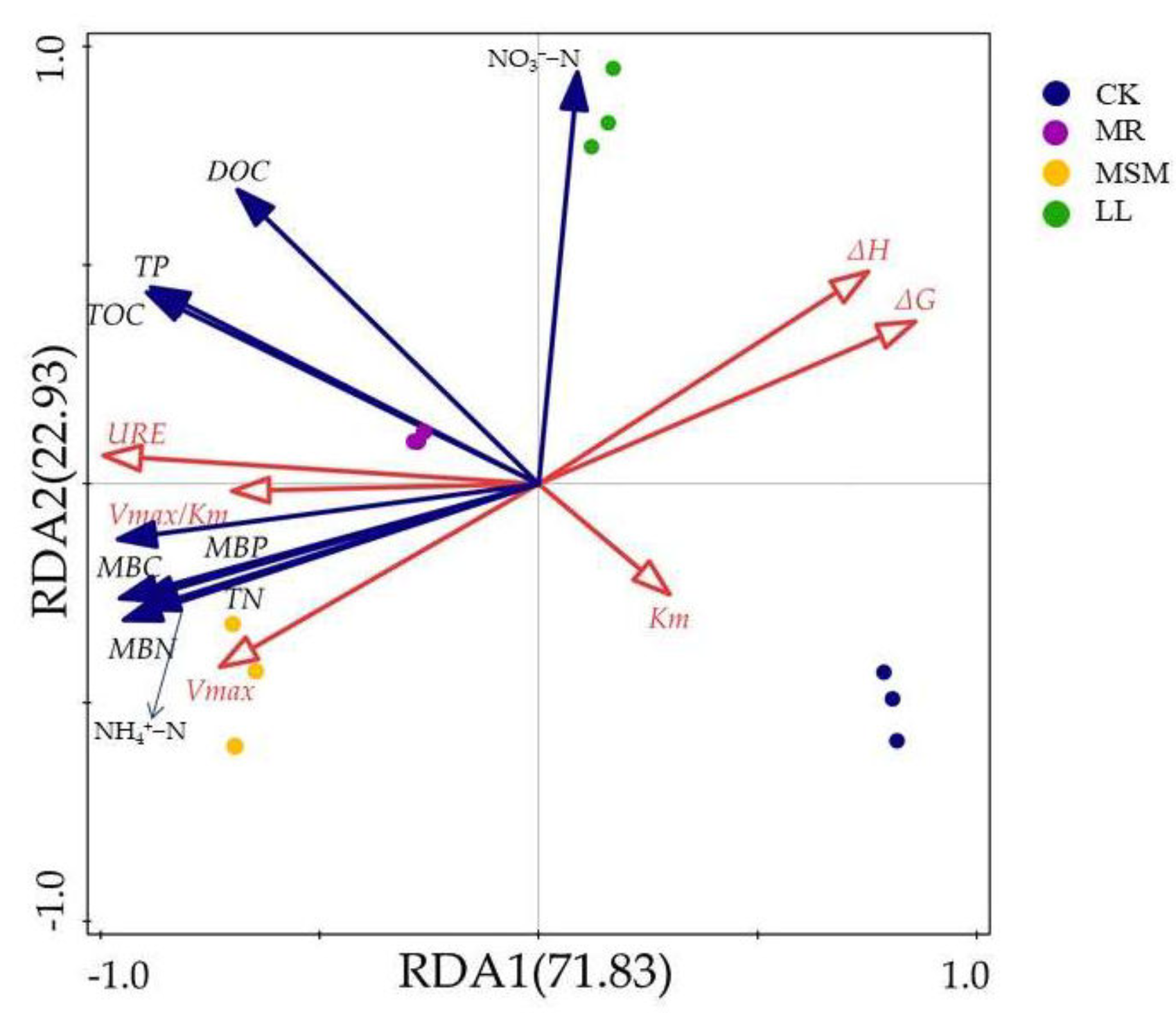
Redundancy analysis (RDA) was conducted using soil C, N, and P fractions, urease activity, and urease kinetic and thermodynamic parameters as nitrogen fertility indicators (Figure 9). The first two axes explained 94.76% of the total variance (RDA1: 71.83%; RDA2: 22.93%), indicating strong associations between soil physicochemical properties, microbial biomass, and urease-related kinetic and thermodynamic characteristics. This further demonstrates that compost amendments differentially modulate these relationships.
Sample points for CK were positioned on the positive side of RDA1, closely aligned with Km, ΔG, and ΔH. This pattern suggests that in native soils without exogenous organic inputs, limited soil organic carbon and microbial biomass (MBC, MBN) constrained urease-producing microbial activity. Consequently, urease synthesis and secretion were suppressed, resulting in reduced substrate affinity (higher Km) and lower catalytic rates. In addition, insufficient microbial energy supply restricted the thermodynamic processes of ΔG and ΔH, causing urease activity in CK soils to remain at a relatively low functional level.
MR samples were distributed in the upper-left quadrant of the RDA plot, showing close association with DOC, TOC, urease activity, and catalytic efficiency (Vmax/Km). This indicates that mushroom residue inputs increased the availability of labile C and N pools, providing readily available substrates for microbial growth. Consequently, urease synthesis was enhanced, leading to higher maximum catalytic rates and improved enzyme-substrate affinity. Therefore, MR amendments directly improved urease kinetic efficiency by supporting microbial proliferation and balanced C-N nutrition.
MSM samples clustered in the lower-left quadrant, strongly associated with microbial biomass indices (MBC, MBN, MBP), TN, NH4+-N, and Vmax. These associations highlight the synergistic regulation of C-N-P cycles by mushroom residue (high N and P content) and straw (structural carbon). This composite input created optimal conditions for microbial growth and enzymatic catalysis. The significant increase in Vmax was likely driven not only by enhanced urease synthesis but also by improvements in soil physicochemical properties (e.g., porosity, water retention), which facilitated greater enzyme–substrate contact and accelerated urea hydrolysis.
LL samples were positioned on the positive side of RDA1, clustered near the NO3-N vector, and overlapped with ΔH and ΔG. Leaf inputs, characterized by high C and low N, induced microbial “N hunger,” which stimulated nitrification and led to substantial nitrate accumulation. From a thermodynamic perspective, ΔH reflects the heat exchange of enzymatic reactions, while ΔG indicates spontaneity. The strong alignment of LL with ΔG and ΔH suggests that leaf litter altered soil TOC/TN balance and indirectly modulated urease energetics. Microbial competition for nitrogen increased the energy demand of urease catalysis, causing thermodynamic parameters to co-vary with nitrate accumulation.
The RDA clearly revealed an “environment–enzyme function” association network. Compost amendments reshaped soil nutrient pools and microbial activity, which in turn optimized enzyme kinetics (Vmax increase, Km decrease, higher Vmax/Km). Thermodynamic parameters (ΔH, ΔG) indirectly reflected enzyme energy efficiency and spontaneity through their associations with soil N forms (NH4+-N, NO3-N) and microbial metabolic processes. Among all treatments, MSM displayed the strongest synergistic regulation, while CK showed the weakest associations due to the absence of exogenous inputs. These results confirm that combined composts, by simultaneously improving soil C, N, and P availability and stimulating microbial activity, can optimize urease function at both kinetic and thermodynamic levels, thereby strengthening soil nitrogen cycling and fertility.

3.8. Mechanistic Pathway Analysis of Soil Fertility Enhancement

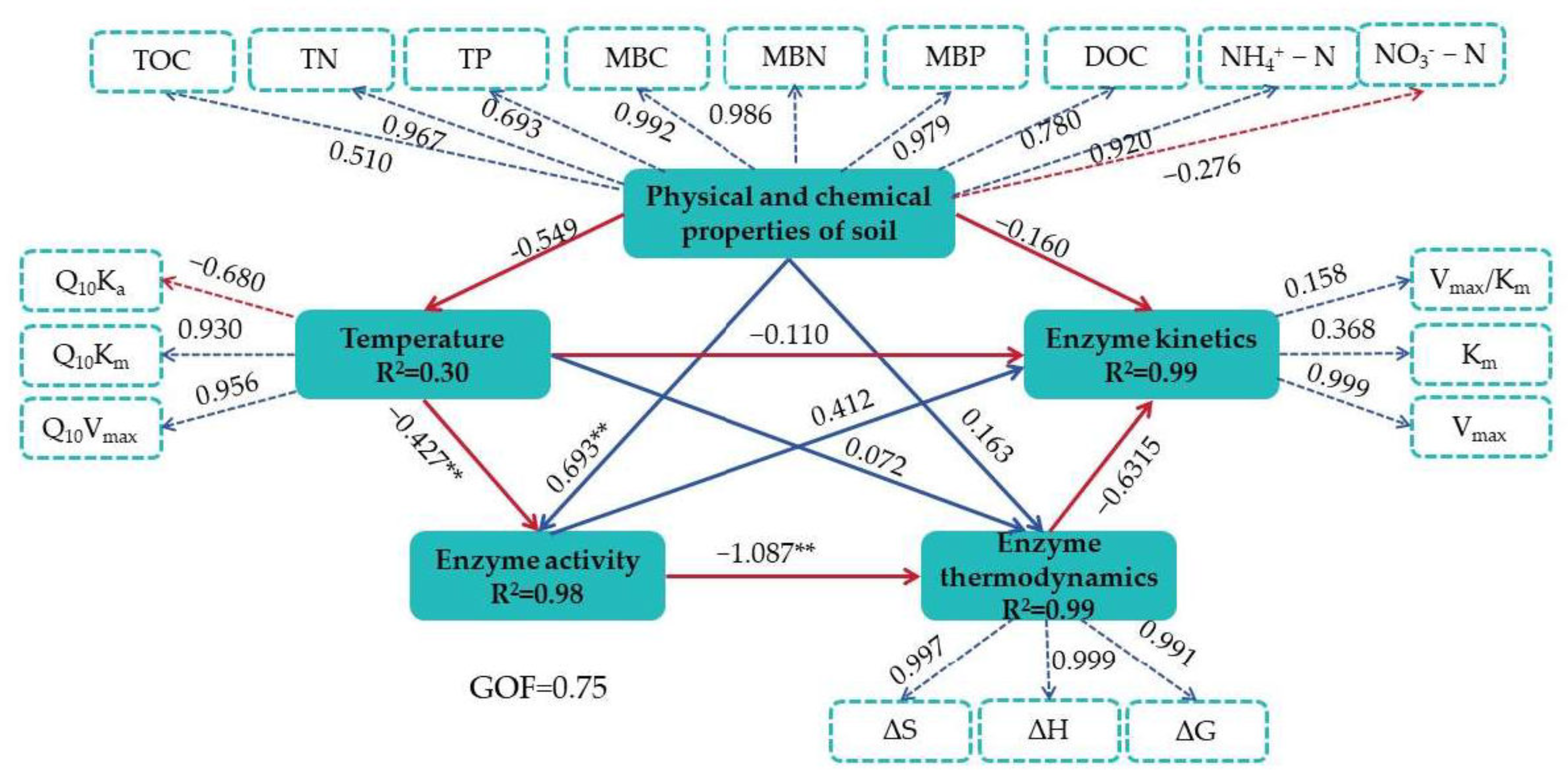
The structural equation model (SEM) quantitatively disentangled the interactions among soil physicochemical properties, temperature sensitivity, urease kinetics, enzyme activity, and thermodynamic parameters (Figure 10). The model achieved a satisfactory goodness-of-fit (GOF = 0.75), explaining 30% of the variance in temperature sensitivity, 98% of enzyme activity, 99% of enzyme kinetics, and 99% of enzyme thermodynamics. These high explanatory powers highlight the robustness of the causal pathways [56].
Soil physicochemical properties served as the central driver. Soil physicochemical variables (TOC, TN, TP, MBC, MBN, MBP, DOC, NH4+-N) exerted strong positive effects on enzyme kinetics (path coefficient = 0.412) and thermodynamics (0.276), while negatively regulating NO3-N accumulation (−0.276). The strongest associations were observed with microbial biomass pools (MBC, MBN, MBP, all >0.95), indicating that nutrient-rich soils provide favorable conditions for microbial proliferation and urease synthesis [57].
Temperature acted as a dual regulator. Temperature sensitivity was negatively correlated with soil physicochemical properties (−0.527), suggesting that warming undermines soil C and N stabilization. At the same time, temperature positively influenced Q10 indices, including Q10Ka (0.930) and Q10Vmax/Ka (0.956), reflecting enhanced catalytic sensitivity to thermal fluctuations. However, temperature exhibited a significant negative path to enzyme activity (−1.087, p < 0.01), implying that although short-term heating increases catalytic sensitivity, long-term warming suppresses overall urease activity, likely due to enzyme denaturation [58].
Enzyme kinetics as a mediator. Enzyme kinetics (R2 = 0.99) was strongly driven by soil physicochemical properties (0.412) and was positively correlated with Vmax /Ka (0.365), Km (0.158), and Vmax (0.431). These relationships highlight that compost amendments indirectly optimize substrate affinity and catalytic efficiency through their impacts on soil nutrient pools [59].
Enzyme activity as a functional outcome. Enzyme activity (R2 = 0.98) was negatively affected by temperature (−1.087), but indirectly enhanced by improved soil physicochemical conditions via enzyme kinetics. The positive correlation between enzyme activity and Q10Ka indicates that urease systems with higher thermal sensitivity can maintain activity more effectively under fluctuating conditions [60].
Enzyme thermodynamics is an energetic endpoint. Thermodynamic parameters (ΔS, ΔH, ΔG) were explained almost entirely by soil properties (0.276) and enzyme kinetics (0.513, p < 0.01). The strongest association was observed between Vmax/Ka and ΔG, underscoring that catalytic efficiency is tightly coupled with the energetic spontaneity of the reaction. MSM amendments, by enriching both carbon and nitrogen pools, reduced ΔH and ΔG, thereby lowering the energy barrier for urease-mediated hydrolysis and improving catalytic spontaneity [61].
Together, these findings confirm that composite compost (MSM) exerts the most profound regulatory effects, simultaneously enhancing soil C-N-P pools, stabilizing enzyme kinetics, and reducing thermodynamic energy constraints. This multi-pathway synergy provides a mechanistic explanation for the observed improvements in soil fertility and nitrogen-use efficiency under compost amendments.

4. Conclusions

This study demonstrated that compost amendments significantly enhanced soil fertility, urease activity, and enzymatic efficiency in a temperate Mollisol agroecosystem. Among the treatments, the mushroom residue–straw mixture (MSM) exerted the strongest effects, markedly increasing TOC, DOC, and microbial biomass while balancing C/N/P availability. These improvements supported microbial proliferation, stimulated urease synthesis, and promoted more efficient nitrogen turnover compared with single-material composts.
At the enzymatic level, MSM achieved the highest catalytic efficiency (Vmax/Km) and thermal stability. Thermodynamic analysis revealed reductions in enthalpy change (ΔH), entropy change (ΔS), and Gibbs free energy change (ΔG), indicating lowered energy barriers and enhanced catalytic spontaneity. Redundancy analysis and structural equation modeling further confirmed that soil physicochemical properties and microbial biomass served as central drivers regulating urease kinetics and thermodynamics. In contrast, MR enhanced short-term nitrogen availability but risked P depletion, whereas LL induced N limitation due to its high C/N ratio.
In summary, MSM represents the most effective composting strategy for temperate black soils, providing synergistic carbon and nitrogen inputs that optimize enzyme function and nutrient cycling. These findings offer theoretical insights and practical guidance for designing region-specific compost formulations to enhance soil fertility and nitrogen-use efficiency within sustainable agricultural systems.

Author Contributions

Conceptualization, Q.L. and X.Z.; methodology, X.Z. and X.G.; software, Q.L. and Y.Q.; validation, Q.L. and X.Z.; formal analysis, Q.L. and X.G.; investigation, Q.L., J.Z. and Y.X.; resources, Q.L. and Z.D.; data curation, X.Z., W.Y. and G.Z.; writing—original draft preparation, Q.L. and X.Z.; writing—review and editing, Q.L.; supervision, Q.L., X.Z. and P.W.; project administration, Q.L.; funding acquisition, Q.L. All authors have read and agreed to the published version of the manuscript.

Funding

This research was supported by grants from the General Project of Natural Science Foundation of Jilin Province [20250203140SF] and the Climbing Project of Changchun University (ZKP202202).

Institutional Review Board Statement

Not applicable.

Informed Consent Statement

Not applicable.

Data Availability Statement

Data are contained within the article.

Conflicts of Interest

The authors declare no conflicts of interest.

References

  1. Inoue, A.; Kameya, T.; Oya, M. Probability Density Functional Method of Enzyme Effect on Denatured Protein Soil. J. Oleo Sci. 2024, 73, 675–681. [Google Scholar] [CrossRef] [PubMed]
  2. Wang, L.; Xiong, X. Long-Term Organic Manure Application Alters Urease Activity and Ureolytic Microflora Structure in Agricultural Soils. Agronomy 2022, 12, 3018. [Google Scholar] [CrossRef]
  3. Cui, J.; Ge, T.; Nie, M.; Kuzyakov, Y.; Alharbi, S.; Fang, C.; Deng, Z. Contrasting effects of maize litter and litter-derived biochar on the temperature sensitivity of paddy soil organic matter decomposition. Front. Microbiol. 2022, 13, 1008744. [Google Scholar] [CrossRef] [PubMed]
  4. Yang, Y.; Li, T.; Wang, Y.; Dou, Y.; Cheng, H.; Liu, L.; An, S. Linkage between soil ectoenzyme stoichiometry ratios and microbial diversity following the conversion of cropland into grassland. Agric. Ecosyst. Environ. 2021, 314, 107418. [Google Scholar] [CrossRef]
  5. Liu, Y.; Tan, X.; Wang, Y.; Guo, Z.; He, D.; Fu, S.; Wan, S.; Ye, Q.; Zhang, W.; Liu, W.; et al. Responses of litter, organic and mineral soil enzyme kinetics to 6 years of canopy and understory nitrogen additions in a temperate forest. Sci. Total Environ. 2020, 712, 136383. [Google Scholar] [CrossRef]
  6. Jiang, C.; Zhu, B.; Zeng, H. Soil extracellular enzyme stoichiometry reflects the unique habitat of karst tiankeng and helps to alleviate the P-limitation of soil microbes. Ecol. Indic. 2022, 144, 109552. [Google Scholar] [CrossRef]
  7. Dong, R.; Abdelkerim-Ouba, D.; Liu, D.; Ma, X.; Wang, S. Impacts of Partial Substitution of Chemical Fertilizer with Organic Manure on the Kinetic and Thermodynamic Characteristics of Soil β–Glucosidase. Agronomy 2023, 13, 1065. [Google Scholar] [CrossRef]
  8. Zhang, X.; Yang, Y.; Zhang, C.; Niu, S.; Yang, H.; Yu, G.; Wang, H.; Blagodatskaya, E.; Kuzyakov, Y.; Tian, D.; et al. Contrasting responses of phosphatase kinetic parameters to nitrogen and phosphorus additions in forest soils. Funct. Ecol. 2017, 32, 106–116. [Google Scholar] [CrossRef]
  9. Juan, Y.H.; Chen, Z.H.; Chen, L.J.; Qiu, W.W.; Zhang, L.L.; Zhang, Y.L. Kinetics of Soil Urease in Four Agricultural Soils Affected by Urease Inhibitor PPD at Contrasting Moisture Regimes. Commun. Soil Sci. Plant Anal. 2014, 45, 2268–2276. [Google Scholar] [CrossRef]
  10. Wu, J.; Wu, Z.; Agathokleous, E.; Zhu, Y.; Fan, D.; Han, J. Unveiling a New Perspective on Cadmium-Induced Hormesis in Soil Enzyme Activity: The Relative Importance of Enzymatic Reaction Kinetics and Microbial Communities. Agriculture 2024, 14, 904. [Google Scholar] [CrossRef]
  11. Zhou, Y.; Hartemink, A.E.; Shi, Z.; Liang, Z.; Lu, Y. Land use and climate change effects on soil organic carbon in North and Northeast China. Sci. Total Environ. 2019, 647, 1230–1238. [Google Scholar] [CrossRef]
  12. Kunito, T.; Moro, H.; Mise, K.; Sawada, K.; Otsuka, S.; Nagaoka, K.; Fujita, K. Ecoenzymatic stoichiometry as a temporally integrated indicator of nutrient availability in soils. Soil Sci. Plant Nutr. 2024, 70, 246–269. [Google Scholar] [CrossRef]
  13. Blagodatskaya, E.; Blagodatsky, S.; Khomyakov, N.; Myachina, O.; Kuzyakov, Y. Temperature sensitivity and enzymatic mechanisms of soil organic matter decomposition along an altitudinal gradient on Mount Kilimanjaro. Sci. Rep. 2016, 6, 22240. [Google Scholar] [CrossRef] [PubMed]
  14. GB 4284-2018; Control Standards of Pollutants in Sludge for Agricultural Use. National Standardization Administration of China: Beijing, China, 2018.
  15. Kamruzzaman, M.; Rees, R.M.; Islam, M.T.; Drewer, J.; Sutton, M.; Bhatia, A.; Bealey, W.J.; Hasan, M. Improvement of Physical and Chemical Properties of Calcareous Dark Gray Soil Under Different Nitrogenous Fertilizer Management Practices in Wetland Rice Cultivation. Commun. Soil Sci. Plant Anal. 2025, 56, 994–1012. [Google Scholar]
  16. Mi, W.; Zheng, H.; Chi, Y.; Ren, W.; Zhang, H.; Zhang, W.; Yuan, F.; Liu, Y.J.C. Reseeding restoration significantly improves the physical and chemical properties of degraded grassland soil in China—A meta-analysis. CATENA 2025, 252, 108849. [Google Scholar] [CrossRef]
  17. She, J.; Zheng, Q.; Zhang, X.; Yu, N.; Huang, L. Study on rhizosphere microbial community structure and soil physical and chemical properties of rare trees in Xiangxi Region. J. Cent. South Univ. For. Technol. 2023, 43, 104–115. [Google Scholar]
  18. Li, D.; Fan, J.; Zhang, X.; Xu, X.; He, N.; Wen, X.; Sun, X.; Blagodatskaya, E.; Kuzyakov, Y. Hydrolase kinetics to detect temperature-related changes in the rates of soil organic matter decomposition. Eur. J. Soil Biol. 2017, 81, 108–115. [Google Scholar] [CrossRef]
  19. Jiang, Y.; Li, H.; Liang, M.; Wu, Y.; Zhao, Z.; Li, Y.; Liu, G.; Xue, S. Kinetic Parameters of Soil Enzymes and Temperature Sensitivity Under Different Mulching Practices in Apple Orchards. Agronomy 2025, 15, 617. [Google Scholar] [CrossRef]
  20. Ge, T.; Wei, X.; Razavi, B.S.; Zhu, Z.; Hu, Y.; Kuzyakov, Y.; Jones, D.L.; Wu, J. Stability and dynamics of enzyme activity patterns in the rice rhizosphere: Effects of plant growth and temperature. Soil Biol. Biochem. 2017, 113, 108–115. [Google Scholar] [CrossRef]
  21. Yim, B.; Ibrahim, Z.; Rüger, L.; Ganther, M.; Maccario, L.; Sørensen, S.J.; Heintz-Buschart, A.; Tarkka, M.T.; Vetterlein, D.; Bonkowski, M.; et al. Soil texture is a stronger driver of the maize rhizosphere microbiome and extracellular enzyme activities than soil depth or the presence of root hairs. Plant Soil 2022, 478, 229–251. [Google Scholar] [CrossRef]
  22. Wu, Y.; Zhou, H.; Sun, W.; Zhao, Q.; Liang, M.; Chen, W.; Guo, Z.; Jiang, Y.; Jiang, Y.; Liu, G.; et al. Temperature sensitivity of soil enzyme kinetics under N and P fertilization in an alpine grassland, China. Sci. Total Environ. 2022, 838, 156042. [Google Scholar] [CrossRef]
  23. Barros, N. Thermodynamics of Soil Microbial Metabolism: Applications and Functions. Appl. Sci. 2021, 11, 4962. [Google Scholar] [CrossRef]
  24. Wu, Y.; Tie, L.; Huang, C.; Sardans, J.; Javier, D.L.C.; Bose, A.K.; Ouyang, S.; Duan, H.; Wang, J.; Peuelas, J.J.G.E.; et al. The Effects, Patterns and Predictors of Phosphorus Addition on Terrestrial Litter Decomposition. Glob. Ecol. Biogeogr. 2025, 34, 70057. [Google Scholar] [CrossRef]
  25. Sun, H.; Kumar, A.; Van Zwieten, L.; Auwal, M.; Kuzyakov, Y. Soil Aggregates Mediate the Thermal Response of Soil Carbon Mineralization and Microbial Enzyme Activity. Int. J. Environ. Res. 2025, 19, 1–14. [Google Scholar] [CrossRef]
  26. Gamayunova, V.; Honenko, L.; Baklanova, T.; Pylypenko, T.J.E.E.; Technology, E. Changes in soil fertility in the southern steppe zone of Ukraine. Ecol. Eng. Environ. Technol. 2025, 26, 229–236. [Google Scholar] [CrossRef]
  27. Holz, M.; Lewin, S.; Kolb, S.; Becker, J.N.; Bergmann, J. How to get to the N—A call for interdisciplinary research on organic N utilization pathways by plants. Plant Soil 2025, 508, 955–969. [Google Scholar] [CrossRef]
  28. Abou-Shady, A.J.S.; Research, T. Explore the potential for improving phosphorus availability in calcareous soil through electrokinetic methods. Soil Tillage Res. 2025, 250, 106525. [Google Scholar] [CrossRef]
  29. Zheng, S.; Liu, J.Y.; Sun, L.; Wu, J. The combined application of swine manure and straw strips to the field can promote the decomposition of corn straw in “broken skin yellow” of black soil. BMC Plant Biol. 2025, 25, 1–13. [Google Scholar] [CrossRef] [PubMed]
  30. Mahongnao, S.; Sharma, P.; Ahamad, A.; Nanda, S. Analysis of the Fertilizing and Bioremediation Potential of Leaf Litter Compost Amendment in Different Soils through Indexing Method. J. Environ. Prot. 2024, 15, 265–297. [Google Scholar] [CrossRef]
  31. Yu, Z.; Wang, B.; Wu, X.; Yu, R.; Shen, L.; Wu, X.; Li, J.; Liu, Y.; Zeng, W.J.M. Exploration of the Vermiculite-Induced Bacterial Community and Co-Network Successions during Sludge-Waste Mushroom Co-Composting. Microorganisms 2024, 12, 585. [Google Scholar] [CrossRef]
  32. Bilik, B.; Akdağ, A.; Ocak, N. Different milling byproduct supplementations in mushroom production compost composed of wheat or rice straw could upgrade the properties of spent mushroom substrate as a feedstuff. Cienc. E Agrotecnologia 2024, 48, e000524. [Google Scholar] [CrossRef]
  33. Sindi, A.M.; Zaman, U.; Saleh, E.A.M.; Kassem, A.F.; Rahman, K.U.; Khan, S.U.; Alharbi, M.; Rizg, W.Y.; Omar, K.M.; Majrashi, M.A.A.; et al. Biochemical and thermodynamic properties of de novo synthesized urease from Vicia sativa seeds with enhanced industrial applications. Int. J. Biol. Macromol. 2024, 259, 9. [Google Scholar] [CrossRef] [PubMed]
  34. Zhao, Z.W.; Wu, Y.; Chen, W.J.; Sun, W.; Wang, Z.H.; Liu, G.B.; Xue, S. Soil enzyme kinetics and thermodynamics in response to long-term vegetation succession. Sci. Total. Environ. 2023, 882, 10. [Google Scholar] [CrossRef] [PubMed]
  35. Pintari, M.; Tuhec, A.; Tratnik, E.; Langerholc, T.J.M. Spent Mushroom Substrate Improves Microbial Quantities and Enzymatic Activity in Soils of Different Farming Systems. Microorganisms 2024, 12, 1521. [Google Scholar] [CrossRef]
  36. Song, Y.; Xing, J.; Hu, C.; Song, C.; Wang, Q.; Wang, S.J.F. Decomposition and Carbon and Nitrogen Releases of Twig and Leaf Litter Were Inhibited by Increased Level of Nitrogen Deposition in a Subtropical Evergreen Broad-Leaved Forest in Southwest China. Forests 2024, 15, 492. [Google Scholar] [CrossRef]
  37. Hu, L.; Li, T.; Jing, Y. Thermal Pyrolysis Behavior and Decomposition Mechanism of Lignin Revealed by Stochastic Cluster Dynamics Simulations. J. Phys. Chem. C 2024, 128, 3832–3838. [Google Scholar] [CrossRef]
  38. Wu, H.; Sun, W.; Zhu, F.; Jiang, Y.; Huang, S.; Goloran, J.; Xue, S. Straw addition increases enzyme activities and microbial carbon metabolism activities in bauxite residue. J. Environ. Sci. 2024, 135, 332–344. [Google Scholar] [CrossRef]
  39. Wang, Y.; Tian, Z.; Li, X.; Zhang, M.; Fang, Y.; Xiang, Y.; Liu, Y.; Liu, E.; Jia, Z.; Siddique, K.H.; et al. Straw-derived biochar regulates soil enzyme activities, reduces greenhouse gas emissions, and enhances carbon accumulation in farmland under mulching. Field Crop. Res. 2024, 317, 109547. [Google Scholar] [CrossRef]
  40. Zhong, X.; Zhou, X.; Luo, G.; Huang, Y.; Wu, Y.; Cao, R.; Tian, C.; Peng, J. Soil mineral nitrogen, soil urease activity, nitrogen losses and nitrogen footprint under machine-planted rice with side-deep fertilization. Plant Soil 2024, 494, 185–202. [Google Scholar]
  41. Al-Khalidi, R.J.H.; Al-Taweel, L. The Effect of Humic Acid and Urea on the Activity of the Urease Enzyme in Soil Planted with Daughter Potatoes. In IOP Conference Series: Earth and Environmental Science; IOP Publishing: Bristol, UK, 2024. [Google Scholar]
  42. Saha, P.; Das, T.K.; Sen, S.; Govindasamy, P.; Singh, R.; Raj, R.; Mahanta, D.; Meena, M.C.; Bhatia, A.; Shukla, L.; et al. The interplay between external residue addition, and soil organic carbon dynamics and mineralization kinetics: Experiences from a 12-year old conservation agriculture. J. Environ. Manag. 2024, 371, 122998. [Google Scholar] [CrossRef]
  43. Salehuddin, N.F.; Mansor, N.; Yahya, W.Z.N.; Affendi, N.M.N.; Manogaran, M.D. Organosulfur Compounds as Soil Urease Inhibitors and Their Effect on Kinetics of Urea Hydrolysis. J. Soil Sci. Plant Nutr. 2021, 21, 2652–2659. [Google Scholar] [CrossRef]
  44. Čolnik, M.; Irgolič, M.; Perva, A.; Škerget, M. Hydrolytic Decomposition of Corncobs to Sugars and Derivatives Using Subcritical Water. Processes 2025, 13, 267. [Google Scholar] [CrossRef]
  45. Yuan, T.; Zhang, D.; Li, X.; Xu, P.; Zhang, Z.; Yang, Y.; Yang, J.; He, Y.; Elgamal, R. Effect of biological enzyme pretreatment on the kinetics, microstructure, and quality of vacuum drying of wolfberry. LWT 2025, 217, 117455. [Google Scholar] [CrossRef]
  46. Sindhu; Gangadhara, S. Swelling Characteristics of Bioenzyme Stabilized Black Cotton Soil. In Proceedings of the Indian Young Geotechnical Engineers Conference, Silchar, India, 15 March 2019; Springer: Singapore, 2025. [Google Scholar]
  47. Parik, P.; Patra, N.R. Applicability of Clay Soil Stabilized with Red Mud, Bioenzyme, and Red Mud–Bioenzyme as a Subgrade Material in Pavement. J. Hazard. Toxic Radioact. Waste 2023, 27, 04023003. [Google Scholar] [CrossRef]
  48. Shang, X.-Y.; Liu, Y.-J.; Wang, Y.-B.; Zhu, X.-Y.; Teng, H.H. Kinetic and thermodynamic characteristics of typical soil clay-grained minerals adsorbing soil dissolved organic matter (DOM). Acta Petrol. Mineral. 2025, 44, 451. [Google Scholar]
  49. Xu, M.; Zhou, Z.; Guo, Y.; Shen, Y.; Zhang, H.; Yu, Q. Soil ph promoted respiration is stimulated by exoenzyme kinetic properties for a pinus tabuliformis forest of northern china. Soil Biol. Biochem. 2025, 202, 109709. [Google Scholar] [CrossRef]
  50. Huang, G.; Su, Y.G. Microorganisms exert overriding impacts on the temperature sensitivity of soil C decomposition than substrate quality. Soil Ecol. Lett. 2025, 7, 250303. [Google Scholar] [CrossRef]
  51. Zhao, S.; Zhang, S. Long-term phosphorus addition alters soil enzyme kinetics with limited impact on their temperature sensitivity in an alpine meadow. Sci. Total Environ. 2024, 957, 177569. [Google Scholar] [CrossRef]
  52. Li, Y.; Vanapalli, S.K. Correction functions for soil–water characteristics curves extending the principles of thermodynamics. Can. Geotech. J. 2024, 61, 13. [Google Scholar] [CrossRef]
  53. Barros, N.; Popovic, M.; Molina-Valero, J.; Lestido-Cardama, Y.; Pérez-Cruzado, C. Unravelling the thermodynamic properties of soil ecosystems in mature beech forests. Sci. Rep. 2024, 14, 16644. [Google Scholar] [CrossRef]
  54. Sahin, A.; Weilandt, D.R.; Hatzimanikatis, V. Optimal enzyme utilization suggests that concentrations and thermodynamics determine binding mechanisms and enzyme saturations. Nat. Commun. 2023, 14, 2618. [Google Scholar] [CrossRef] [PubMed]
  55. Lin, J.; Han, Z.; Wang, D.; Mai, L.; Liu, Q.; Yuan, J.; Yu, X.; Li, G. Effects of different coverings on the simplified static composting and humification process of cheery-tomato straw. Trans. Chin. Soc. Agric. Eng. 2024, 40, 273–283. [Google Scholar]
  56. Yang, S.Y.; Phong, N.V. Phenolic compounds from the stems of Zanthoxylum piperitum and their inhibition of β-glucuronidase: Enzyme kinetics, molecular docking, and molecular dynamics analysis. J. Mol. Struct. 2024, 1317, 139117. [Google Scholar] [CrossRef]
  57. Ma, X.; Zhao, Y.; Zheng, Y.; Wang, L.; Zhang, Y.; Sun, Y.; Ji, J.; Hao, X.; Liu, S.; Sun, N. Effect of Different Fertilization on Soil Fertility, Biological Activity, and Maize Yield in the Albic Soil Area of China. Plants 2025, 14, 810. [Google Scholar] [CrossRef]
  58. Li, M.; Wang, Y.; Ni, J.; Zhang, S.; Zhao, X.; Zhu, L.; Wang, Z. Remediation of Heavy Metal-Contaminated Soil Using Soybean Urease-Induced Carbonate Precipitation. Soil Sediment Contam. Int. J. 2025, 34, 1973–1990. [Google Scholar] [CrossRef]
  59. Jiang, X.L.; Mao, R.; Li, Z.L.; Chen, F.S.; Xu, B.; He, J.; Huang, Y.X.; Fang, X.M. Tree species mixture effect on extracellular enzyme kinetics varies with enzyme type and soil depth in subtropical plantations. Plant Soil 2023, 493, 267–282. [Google Scholar] [CrossRef]
  60. Saccà, M.L.; Francesco, C.; Enrico, C.; Flavio, F. Fungal β-glucosidase gene and corresponding enzyme activity are positively related to soil organic carbon in unmanaged woody plantations. Soil Ecol. Lett. 2024, 6, 240238. [Google Scholar] [CrossRef]
  61. Abdalla, K.; Schierling, L.; Sun, Y.; Schuchardt, M.A.; Jentsch, A.; Deola, T.; Wolff, P.; Kiese, R.; Lehndorff, E.; Pausch, J.J.B. Temperature sensitivity of soil respiration declines with climate warming in subalpine and alpine grassland soils. Biogeochemistry 2024, 167, 1453–1467. [Google Scholar] [CrossRef]
Figure 1. The process of conducting the experiment.
Agronomy 15 02544 g001
Figure 2. Changes in soil urease activity under different substrate (urea) concentration after application of different compost products. CK: Control; MR: Mushroom residue treatment; MSM: Mushroom residue + straw treatment; LL: Leaf litter treatment. Different uppercase letters indicate significant differences between different treatments at the same temperature (p < 0.05), and different lowercase letters indicate significant differences between different temperatures at the same treatment (p < 0.05).
Agronomy 15 02544 g002
Figure 3. Changes Changes in soil urease activity under different substrate (urea) concentration after application of different compost products. CK: Control; MR: Mushroom residue treatment; MSM: Mushroom residue + straw treatment; LL: Leaf litter treatment. Different uppercase letters indicate significant differences between different treatments at the same temperature (p < 0.05), and different lowercase letters indicate significant differences between different temperatures at the same treatment (p < 0.05).
Agronomy 15 02544 g003
Figure 4. Changes in soil urease activity under different substrate (urea) concentration after application of different compost products. CK: Control; MR: Mushroom residue treatment; MSM: Mushroom residue + straw treatment; LL: Leaf litter treatment. Different uppercase letters indicate significant differences between different treatments at the same temperature (p < 0.05), and different lowercase letters indicate significant differences between different temperatures at the same treatment (p < 0.05).
Agronomy 15 02544 g004
Figure 5. Changes in soil urease activity under different substrate (urea) concentration after application of different compost products. CK: Control; MR: Mushroom residue treatment; MSM: Mushroom residue + straw treatment; LL: Leaf litter treatment. Different uppercase letters indicate significant differences between different treatments at the same temperature (p < 0.05), and different lowercase letters indicate significant differences between different temperatures at the same treatment (p < 0.05).
Agronomy 15 02544 g005
Figure 6. Soil urease kinetic parameters after different compost products. CK: contrast; MR: Mushroom residue treatment; MSM: Mushroom residue + straw treatment; LL: Leaf litter treatment; Km: Mi constant (a); Vmax: Maximum speed of enzymatic reaction (b); Vmax/Km: enzyme catalytic efficiency (c). Different uppercase letters indicate significant difference between different treatments at the same temperature (p < 0.05), and different lowercase letters indicate significant difference between different temperatures at the same treatment (p < 0.05).
Agronomy 15 02544 g006
Figure 7. Temperature sensitive parameters of different compost materials returning to field.CK: contrast; MR: Mushroom residue treatment; MSM: Mushroom residue + straw treatment; LL: Leaf litter treatment; Q10Vmax: temperature sensitivity of kinetic parameters; Q10Km: Temperature sensitivity of Km dynamics parameters. Q10Ka: Temperature sensitivity of Ka dynamic parameters. Different lowercase letters indicated significant difference between different treatments (p < 0.05).
Agronomy 15 02544 g007
Figure 8. Correlation analysis between soil urease parameters and soil carbon, nitrogen and phosphorus components. CK: contrast (a); MR: Mushroom residue treatment (b); MSM: Mushroom residue + straw treatment (c); LL: Leaf litter treatment (d); TN: total nitrogen; TP: total phosphorus; DOC: soluble organic carbon; TOC: Total organic carbon; MBC, microbial biomass carbon; MBN: microbial biomass nitrogen; MBP: Microbial biomass phosphorus; Km: Mi constant; Vmax: maximum speed of enzymatic reaction; Vmax/Km: enzyme catalytic efficiency. ΔH: enthalpy change; ΔS: entropy change; ΔG: Gibbs free energy change; * p < 0.05; ** p < 0.01.
Agronomy 15 02544 g008
Figure 9. Urease kinetics and thermodynamic parameters of soil under different composting treatments and redundancy analysis of soil carbon, nitrogen and phosphorus components. CK: contrast; MR: Mushroom residue treatment; MSM: Mushroom residue + straw treatment; LL: Leaf litter treatment; Km: Mi constant; Vmax: maximum speed of enzymatic reaction; Vmax/Km: enzyme catalytic efficiency. TN: total nitrogen; TP: total phosphorus; DOC: soluble organic carbon; TOC: Total organic carbon; MBC, microbial biomass carbon; MBN: microbial biomass nitrogen; MBP: Microbial biomass phosphorus. ΔH: enthalpy change; ΔG: Gibbs free energy change.
Agronomy 15 02544 g009
Figure 10. Structural equation model. TN: total nitrogen; TP: total phosphorus; DOC: soluble organic carbon; TOC: Total organic carbon; MBC, microbial biomass carbon; MBN: microbial biomass nitrogen; MBP: Microbial biomass phosphorus; Km: Mi constant; Vmax: maximum speed of enzymatic reaction; Vmax/Km: enzyme catalytic efficiency. ΔH: enthalpy change; ΔS: entropy change; ΔG: Gibbs free energy change; Q10Vmax: temperature sensitivity of kinetic parameters; Q10Km: Temperature sensitivity of Km dynamics parameters. Q10Ka: Temperature sensitivity of Ka dynamic parameters; ** p < 0.01.
Agronomy 15 02544 g010
Table 1. Initial background value of composted and decomposed materials (n = 3).
TreatmentpHEC (mS·cm−1)TOC (g·kg−1)TN (g·kg−1)TP (g·kg−1)TK (g·kg−1)C/N
MR8.17 ± 0.10 a3.32 ± 0.05 a281.54 ± 0.25 a18.49 ± 0.22 a7.73 ± 0.20 a32.24 ± 0.06 a15.23 ± 0.06 a
MSM8.27 ± 0.14 a2.81 ± 0.02 b282.98 ± 0.17 a16.45 ± 0.15 b13.22 ± 0.07 b26.18 ± 0.05 b17.20 ± 0.09 b
LL7.66 ± 0.11 b1.52 ± 0.05 c254.83 ± 0.05 b14.31 ± 0.12 c9.94 ± 0.23 c38.85 ± 0.11 c17.81 ± 0.13 c
Note: EC: electrical conductivity; TOC: Total organic carbon; TN: total nitrogen; TP: total phosphorus; TK: total potassium; C/N: carbon nitrogen ratio. Different lowercase letters within the same column indicate significant differences among treatments (p < 0.05).
Table 2. Changes in soil carbon, nitrogen and phosphorus components after application of different compost products.
TreatmentCKMRMSMLL
TOC (g·kg−1)12.28 ± 0.20 c18.21 ± 0.10 b18.81 ± 0.03 a18.02 ± 0.04 b
TN (g·kg−1)0.85 ± 0.07 c1.27 ± 0.10 b1.55 ± 0.09 a0.97 ± 0.16 c
TP (g·kg−1)0.12 ± 0.01 c0.15 ± 0.01 bc0.2 ± 0.02 a0.19 ± 0.01 ab
MBC (mg·kg−1)185.67 ± 0.37 d313.12 ± 2.26 b428.83 ± 0.53 a236.80 ± 1.79 c
MBN (mg·kg−1)14.54 ± 0.14 d22.32 ± 0.25 b28.03 ± 0.07 a16.47 ± 0.04 c
MBP (mg·kg−1)7.20 ± 0.06 d8.30 ± 0.05 b9.51 ± 0.02 a8.01 ± 0.05 c
DOC (mg·kg−1)100.60 ± 0.08 d122.18 ± 0.72 a115.06 ± 0.61 c120.31 ± 0.68 b
NH4 +-N (mg·kg−1)4.17 ± 0.01 b4.31 ± 0.03 a4.34 ± 0.03 a4.19 ± 0.01 b
NO3-N (mg·kg−1)3.11 ± 0.09 c3.44 ± 0.14 b3.12 ± 0.13 c4.50 ± 0.17 a
TOC/TN14.47 ± 0.78 b14.35 ± 0.96 b12.19 ± 0.66 b18.88 ± 3.08 a
TN/TP7.28 ± 0.54 a8.27 ± 0.67 a7.73 ± 0.82 a5.17 ± 0.50 b
TOC/TP105.48 ± 12.59 ab118.38 ± 8.21 a94.28 ± 12.27 b96.80 ± 10.00 ab
CK: contrast; MR: Mushroom residue treatment; MSM: Mushroom residue + straw treatment; LL: Leaf litter treatment. Different lowercase letters in the same column indicated significant difference between different treatments (p < 0.05). TN: total nitrogen; TP: total phosphorus; DOC: soluble organic carbon; TOC: Total organic carbon; MBC, microbial biomass carbon; MBN: microbial biomass nitrogen; MBP: Microbial biomass phosphorus.
Table 3. Two-factor variance analysis of the effects of compost products and temperature on soil urease activity, kinetic and thermodynamic parameters (F value).
FactorUrease ActivityKinetic ParameterThermodynamic Parameter
KmVmaxVmax/KmΔHΔSΔG
Compost product (C)6.33 **231.29 **1159.41 **2494.42 **1062.39 **960.98 **1964.05 **
Temperature (T)90.12 **368.83 **38,958.12 **9276.47 **2.7948.34 **294,700.82 **
C × T0.48 **81.99 **257.75 **191.34 **00.40172.68 **
Km: Mi constant; Vmax: maximum speed of enzymatic reaction; Vmax/Km: enzyme catalytic efficiency; ΔH: enthalpy change; ΔS: entropy change; ΔG: Gibbs free energy change; ** p < 0.01.
Table 4. Soil urease thermodynamic parameters after application of different compost products.
ParameterTemperature (°C)CKMRMSMLL
ΔG
(kJ·mol−1)
569.923 ± 0.07 Ae69.702 ± 0.01 Ce69.114 ± 0.01 De69.819 ± 0.03 Be
1570.746 ± 0.01 Ad70.343 ± 0.01 Cd69.921 ± 0.01 Dd70.577 ± 0.01 Bd
2572.387 ± 0.01 Ac72.203 ± 0.01 Dc72.221 ± 0.01 Cc72.282 ± 0.01 Bc
3574.681 ± 0.01 Ab74.394 ± 0.07 Cb74.307 ± 0.01 Db74.574 ± 0.01 Bb
4577.045 ± 0.01 Aa76.792 ± 0.01 Ca76.685 ± 0.01 Da76.879 ± 0.01 Ba
ΔH
(kJ·mol−1)
519.682 ± 0.49 Aa19.276 ± 0.09 Aa14.982 ± 0.13 Ba19.711 ± 0.19 Aa
1519.599 ± 0.49 Aa19.192 ± 0.09 Aab14.900 ± 0.13 Bab19.628 ± 0.19 Aa
2519.516 ± 0.49 Aa19.110 ± 0.09 Aabc14.816 ± 0.13 Bab19.545 ± 0.19 Aa
3519.433 ± 0.49 Aa19.026 ± 0.09 Abc14.733 ± 0.13 Bab19.462 ± 0.19 Aa
4519.350 ± 0.49 Aa18.943 ± 0.09 Ac14.650 ± 0.13 Bb19.379 ± 0.19 Aa
ΔS
(J·mol−1)
5−180.626 ± 1.50 Ab−181.295 ± 0.30 Ad−194.614 ± 0.42 Bd−180.145 ± 0.55 Ac
15−177.502 ± 1.67 Aa−177.514 ± 0.29 Aa−190.947 ± 0.42 Ba−176.813 ± 0.66 Aa
25−177.330 ± 1.61 Aa−178.077 ± 0.28 Ab−192.537 ± 0.41 Bb−176.881 ± 0.62 Aa
35−179.291 ± 1.55 Aab−179.677 ± 0.30 Ac−193.329 ± 0.43 Bc−178.848 ± 0.59 Ab
45−181.348 ± 1.54 Ab−181.830 ± 0.29 Ae−194.989 ± 0.42 Bd−180.734 ± 0.58 Ac
Ea(kJ·mol−1)21.995 ± 0.49 A21.588 ± 0.09 A17.295 ± 0.13 B22.024 ± 0.19 A
CK: contrast; MR: Mushroom residue treatment; MSM: Mushroom residue and straw mixture treatment; LL: Leaf litter treatment; ΔH: enthalpy change; ΔS: entropy change; ΔG: Gibbs free energy change. Different uppercase letters in the same row indicate significant differences between different treatments at the same temperature (p < 0.05), and different lowercase letters in the same column indicate significant differences between different temperatures at the same treatment (p < 0.05).
Disclaimer/Publisher’s Note: The statements, opinions and data contained in all publications are solely those of the individual author(s) and contributor(s) and not of MDPI and/or the editor(s). MDPI and/or the editor(s) disclaim responsibility for any injury to people or property resulting from any ideas, methods, instructions or products referred to in the content.