Abstract
The production of high-quality coffee seedlings is essential to meet the demands of the coffee sector, requiring more efficient and sustainable water management practices. In this context, the use of hydroretentive polymers, particularly biodegradable ones, emerges as a promising alternative to optimize water use, reduce the environmental impact associated with synthetic polymers, and improve the agronomic traits of seedlings. Therefore, this study aimed to evaluate the effects of different irrigation intervals and hydroretentive polymer doses on the water consumption and agronomic characteristics of Coffea arabica L. seedlings. This study was conducted in a protected environment using a randomized block design with split plots and four replicates. The plots consisted of two irrigation intervals (2 and 4 days), and the subplots included four doses of hydroretentive polymer (0%, 0.25%, 0.5%, and 1%), applied in 0.5 dm3 polypropylene bags. Results showed that the 0.5% polymer dose combined with a 2-day irrigation interval resulted in the highest water consumption, while the combination of 0% polymer and a 4-day irrigation interval led to the lowest water consumption. The 0.25% hydroretentive polymer dose with irrigation every 2 days showed the best performance in gas exchange, promoting photosynthesis without causing water saturation. This management also promoted better seedling growth, increasing biomass, height, leaf area, and root volume compared to longer irrigation intervals. The crop coefficients (Kc × Ks) were 0.20, 0.28, and 0.45 during the periods of 0–50, 51–80, and 81–150 days after sowing, respectively. A dose of 0.25% hydroretentive polymer with a 2-day irrigation interval is recommended for the production of Arabica coffee seedlings, contributing to agricultural practices aligned with environmental preservation and productive efficiency.
1. Introduction
Coffee is cultivated in over 80 tropical countries and ranks among the most traded commodities in the global market. It is also one of the most widely consumed beverages worldwide, representing a central element in various sociocultural contexts [1,2,3]. Among coffee species, Arabica coffee (Coffea arabica L.) stands out as the most widely cultivated due to its appreciated sensory properties and high added value in international markets [4,5,6]. Brazil leads as the largest producer and consumer of coffee, with a national production of 54.8 million processed bags in 2024, of which 39.6 million were Coffea arabica L. [7].
The establishment of a productive and resilient coffee plantation begins with the production of high-quality seedlings. This initial stage is essential to ensure proper field establishment and maximize the crop’s genetic potential, directly influencing root growth, shoot development, and tolerance to environmental adversities [8,9]. However, seedling production faces significant challenges related to adverse climatic conditions, such as irregular rainfall distribution, extreme temperatures, and frost occurrences, which threaten the sustainability of coffee farming [10]. Several factors impact the morphological and physiological quality of coffee seedlings, including genetics, seed provenance, nursery environmental conditions, and management practices [4,8,9,11].
Currently, seedling water management is predominantly based on empirical practices with insufficient scientific backing. In commercial nurseries, excessive water volumes are commonly applied under the assumption that higher water availability is beneficial. However, both excess water and deficiency can stress plants, reducing photosynthesis and impairing development [9,12,13]. In less technified nurseries, irrigation frequency also plays a critical role, as high frequencies increase labor costs, while low frequencies can lead to water deficits and even seedling mortality [13].
The use of hydroretentive polymers presents a promising alternative for enhancing water retention in containers and providing greater water security during seedling production. These superabsorbent materials, such as hydrogel, can store water within their structure and release it gradually according to the plant’s needs, thereby reducing irrigation frequency and minimizing water waste [14,15,16]. Additionally, the use of biodegradable polymers, such as UPDT®—composed of starch-g-poly (2-propenamide-co-2-propenoic acid)—represents a sustainable approach. These polymers not only improve substrate structure as they naturally degrade but also reduce the environmental impact associated with synthetic materials [17,18].
Although technologies like UPDT® are promising, knowledge gaps remain regarding their efficiency in coffee seedling production. Aspects such as the optimal polymer dose, the interaction with different irrigation intervals, and the soil biodegradation time require further investigation to support practical recommendations. Simultaneously, the choice of cultivation container, traditionally represented by polyethylene bags, also directly influences water retention, root architecture, and final seedling quality [19].
Given these considerations, the hypothesis of this study is that the use of hydroretentive polymers combined with appropriate irrigation intervals contributes to greater water use efficiency, promoting the development of Coffea arabica L. seedlings with improved agronomic quality and reduced losses due to water deficit or excess. Therefore, this study aimed to evaluate the effects of different irrigation intervals and hydroretentive polymer doses on water consumption and the agronomic characteristics of Coffea arabica L. seedlings, thereby contributing to the development of more efficient and sustainable strategies for seedling production that align with the needs of the coffee sector.
2. Materials and Methods
2.1. Area Characterization
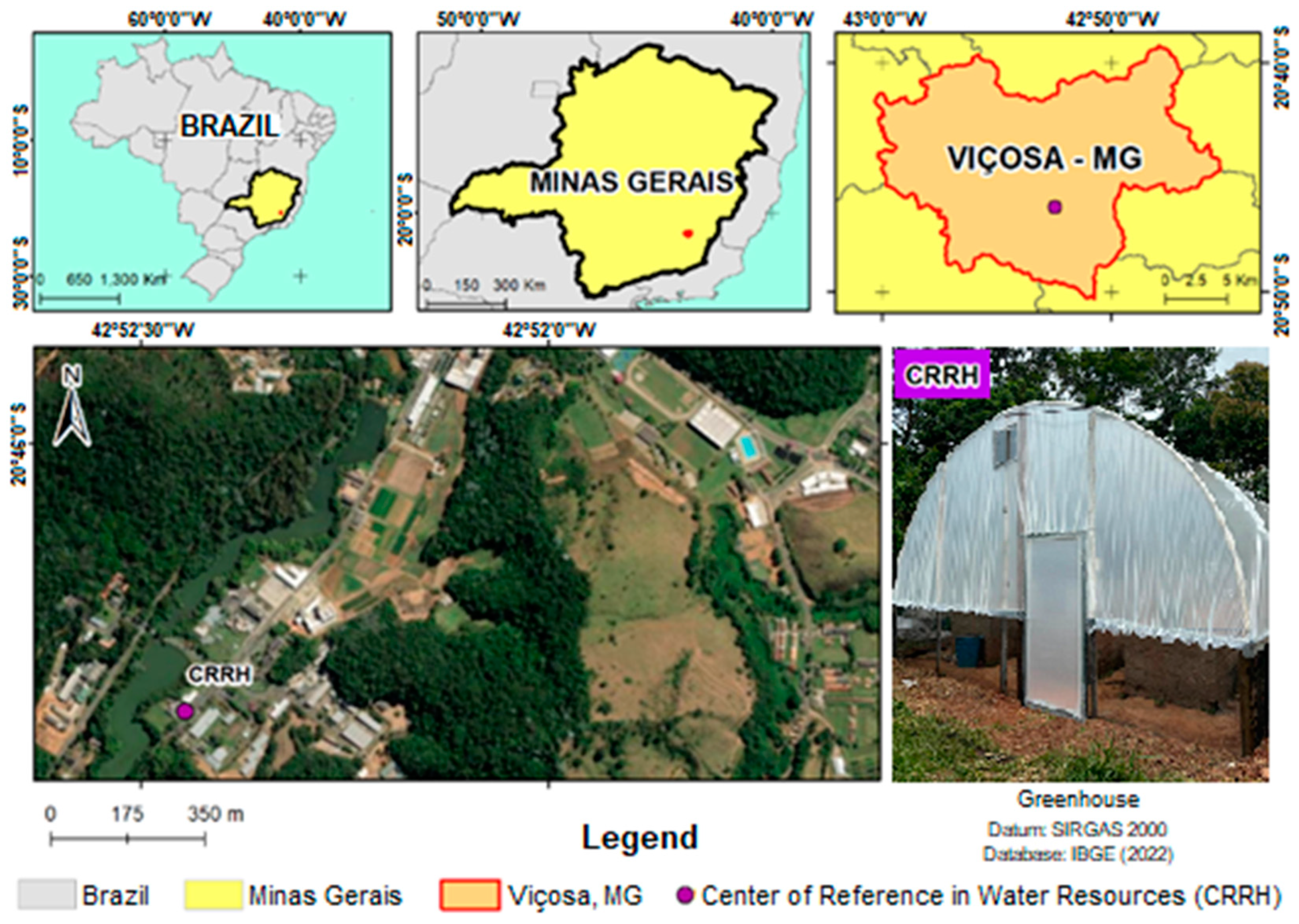
The experiment was conducted in the experimental area of the Reference Center for Water Resources (CRRH) (Figure 1), located at geographic coordinates 42°52′53″ W longitude, 20°45′14″ S latitude, and an altitude of 648.74 m. This site is part of the Department of Agricultural Engineering (DEA) at the Federal University of Viçosa (UFV) in the municipality of Viçosa, Minas Gerais, Brazil. The region’s climate is classified as Cwa, which is humid temperate with dry winters and hot summers, according to Alvares et al. [20].
Figure 1.
Location of the experimental area.
The protected environment at the CRRH has the following characteristics: dimensions of 6.0 × 7.0 × 3.0 m; a greenhouse cover made of transparent, 150-micron high-density polyethylene film, installed in a single piece; lateral screens that provide 30% shading; and three internal concrete experimental benches.
2.2. Experimental Design
The experiment was conducted using seeds of Coffea arabica L., cultivar Catuaí Amarelo IAC 62, which were grown in polypropylene bags with a capacity of 0.5 dm3. The experimental design adopted was a randomized block design (RBD) with split plots and four replications. The main plots comprised the irrigation intervals of 2 and 4 days, while the subplots represented four doses of the hydroretentive polymer UPDT® applied to the substrate: 0% (control), 0.25%, 0.5%, and 1% by volume.
2.3. Experiment Setup
For the preparation of 1 m3 of substrate, 0.7 m3 of slope soil and 0.3 m3 of cured bovine manure were used [21]. The soil had a clayey texture and was classified as a dystrophic Red-Yellow Latosol, according to Santos et al. [22]. The soil underwent thermal treatment through solarization for 70 days. The cured bovine manure was sieved, and after its incorporation into the soil, the substrate was supplemented with 6 kg of single superphosphate (Ca(H2PO4)2 + CaSO4·2H2O), 1 kg of potassium chloride (KCl), and 1 kg of dolomitic limestone [21].
After substrate preparation, the proportions for the different doses of the hydroretentive polymer were separated and homogenized using a 0.4 m3 cement mixer. The containers were then filled with 500 g of the substrate and seeded with two coffee seeds planted at a depth of 3–5 cm. The seeds were sourced from Boa Safra Sementes in Paula Cândido, MG. The sowing of coffee, which marked the beginning of the experimental period for seedling production, took place on 5 December 2023, and the collection of vegetative field data, which marked the end of the experimental period, was conducted until 30 April 2024. From the start of the experiment, irrigation was conducted according to the irrigation intervals defined for each treatment.
2.4. Irrigation Management
The coffee seedlings were irrigated manually using watering cans. However, the crop’s water requirements were determined directly by weighing the containers daily with a digital scale (0.01 g accuracy). The difference between the container weights from the previous day (field capacity) and the current day represented water loss through evapotranspiration [23]. The irrigation time was calculated based on the application rate of the system.
Water consumption was converted into crop evapotranspiration (ETc), considering the vegetated area of each experimental unit. Reference evapotranspiration (ETo) was estimated using the Penman-Monteith method (FAO 56), as described by Allen et al. [24]. Using the data on crop evapotranspiration (ETc) and reference evapotranspiration (ETo), the crop coefficient (Kc) and soil moisture coefficient (Ks) were calculated according to Equation (1) [24].
Here, Kc—crop coefficient (dimensionless); Ks—soil moisture coefficient (dimensionless); ETc—crop evapotranspiration (mm day−1); and ETo—reference evapotranspiration (mm day−1).
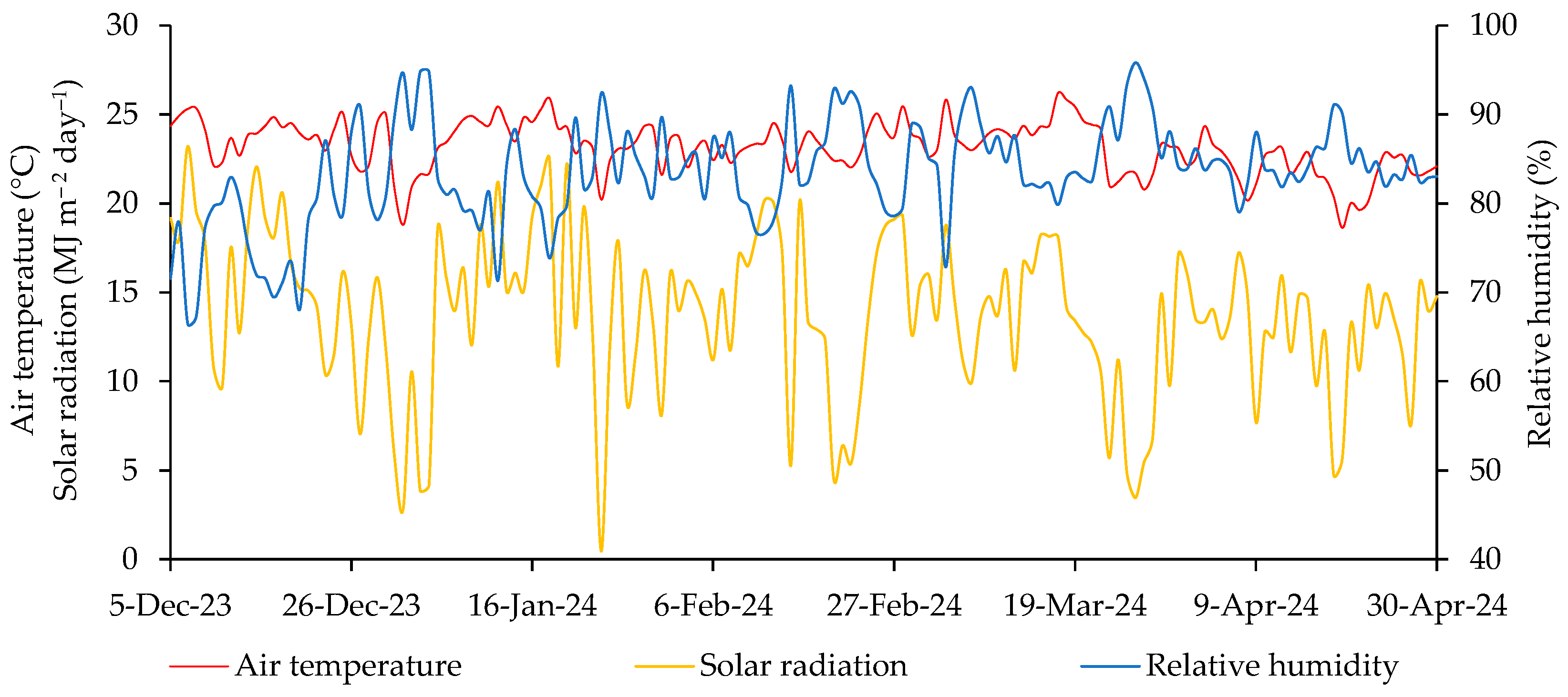
For the estimation of daily ETo, climate variables were collected using meteorological data from an automatic station located in the experimental area. Figure 2 shows the behavior of the meteorological variables during the experimental period. All hourly and daily meteorological data recorded during this period can be found in the Supplementary Materials (Tables S1–S3).
Figure 2.
Behavior of the meteorological variables.
2.5. Analyzed Variables
Germination occurred over a period of up to 54 days during the experiment, and the following analyses were performed: final germination (FG), germination speed index (GSI), mean germination time (MGT), and mean germination speed (MGS). The equations used to calculate each characteristic are described by Cruz et al. [13] and shown as follows:
where FG—final germination (%); n—number of germinated seeds; N—total number of seeds; GSI—germination speed index; ni—number of germinated seeds on each daily count until the last count; ti—number of days after the start of the test for each count; MGT—mean germination time (days); MGS—mean germination speed (seeds days−1); and CoVg—germination speed coefficient.
Physiological evaluations were carried out 120 days after coffee sowing. Photosynthesis (A; μmol CO2 m−2 s−1), stomatal conductance (gs; mol H2O m−2 s−1), transpiration (E; mmol H2O m−2 s−1), and internal CO2 concentration (Ci; μmol CO2 m−2 s−1) were assessed. These measurements were performed using a photosynthesis meter (Infrared Gas Analyzer—IRGA, ADC BioScientific Ltd., Hoddesdon, UK, model LC-Pro+). The air temperature ranged from 21.5 to 23.0 °C during the evaluation period. Based on this information, water use efficiency (WUE) (A/E) [(μmol CO2 m−2 s−1) (mol H2O m−2 s−1)−1] and instantaneous carboxylation efficiency (EiC) (A/Ci) [(μmol CO2 m−2 s−1) (μmol CO2 mol−1)−1] were calculated. Measurements were taken on the third fully expanded leaf, counted from the apex of the plant, between 8 am and 12 pm, using an artificial light source of 1500 µmol m−2 s−1 and under natural temperature and CO2 concentration conditions. Two plants were used to evaluate each experimental unit (replication).
At 150 days, the following biometric and production analyses were performed:
- -
- Plant height: measured as the distance from the collar to the apex using a graduated ruler (cm).
- -
- Leaf temperature: measured using an infrared thermometer (Brand: B-MAS, Model: M-300) at the middle third of the coffee seedling.
- -
- Collar diameter: measured 5 cm from the soil using a digital caliper (mm).
- -
- Clod structure: The seedlings were classified based on how easily they could be removed from the container, using a scale from 5 to 1, where 5—root breakage (not possible to remove the root ball); 4—very difficult to remove the root ball, but possible; 3—moderate difficulty; 2—moderately easy; and 1—easy to remove from the tube [25].
- -
- Leaf area: determined by scanning the leaves using a device with known cell areas, expressed in cm2, and estimated using the LI-COR leaf area meter model LI-3000.
- -
- Root length: measured as the distance from the surface to the deepest root (cm).
- -
- Dickson quality index: determined using Equation (6) [26].
- -
- Robustness index: obtained using Equation (7) [26].
- -
- Root volume: measured with the aid of the software for root parameters, WinRhizo version 1.0 [27].
- -
- Fresh and dry mass of leaves, stems, and roots: the plant material was divided into previously identified and weighed paper bags using an analytical balance with a precision of 0.01 g to determine the fresh mass. To obtain the dry mass, the material was placed in an oven at 65 °C for 72 h and then weighed on a balance.
2.6. Data Analysis
The normality and homoscedasticity of the residuals were evaluated using the Shapiro–Wilk and Bartlett tests, respectively. The data were also subjected to variance analysis, regression, and simple correlation.
The analysis of variance was performed using the F-test at a 0.05 probability level. Regardless of the significance of the interactions between factors, they were examined. The means were compared using Tukey’s test at a 0.05 probability level. For the quantitative factor (hydroretentive polymer doses), linear and quadratic models were also tested. The selection of the model was based on the significance of the regression coefficients, which was assessed using the t-test at a 0.05 probability level, the coefficient of determination (r2), and the biological phenomenon.
Statistical analyses were performed using R software version 4.4.2 [28].
3. Results and Discussion
3.1. Germination
An interaction was observed between the factors of irrigation intervals and hydroretentive polymer doses for the final germination (FG) of Arabica coffee seeds (Table 1). The complete analysis of variance for FG and all other attributes evaluated in the experiment is available in the Supplementary Materials (Tables S4–S29). The same table shows that the 2-day irrigation interval consistently outperformed the 4-day irrigation interval across all hydroretentive polymer doses. This performance can be attributed to the higher water availability in the 2-day irrigation interval, which seems to meet the ideal water requirements for the germination process. Water, as a determining factor, directly influences germination throughout the plant’s life cycle [29]. In contrast, the conditions in the 4-day irrigation interval may have compromised the necessary water content, exacerbating the inherent difficulty of coffee seed germination, which is slow and has low storage potential. This limitation hinders the proper formation of seedlings within suitable timeframes and under favorable climatic conditions for crop establishment [9]. In the germination process, water absorption plays a crucial role in softening the seed coat, expanding the embryo and reserve tissues, and facilitating the rupture of the seed coat. This process also improves gas diffusion and primary root emergence, both of which are essential for the plant’s early development [3,9].
Table 1.
Average values of final germination (FG), germination velocity index (GVI), mean germination time (MGT), and mean germination speed (MGS) of Arabica coffee for the respective combinations of hydroretentive polymer doses and irrigation intervals of 2 days (II 2) and 4 days (II 4), along with a summary of the analysis of variance.
Regardless of the hydroretentive polymer dose, the irrigation intervals did not affect the germination velocity index (GVI). No significant differences were observed between the irrigation intervals (Table 1), indicating uniformity in germination speed throughout the evaluated period. GVI, as described by Maguire [30], is widely used to measure germination speed and is an important parameter for evaluating seed performance.
Regarding the mean germination time (MGT) (Table 1), no significant differences were observed between irrigation intervals, regardless of the hydroretentive polymer dose used. This result indicates that the irrigation intervals, whether every 2 or 4 days, were equally effective in maintaining adequate conditions for seed germination. Under the evaluated conditions, irrigation every 4 days was sufficient to prevent hypoxia, even at higher doses of the hydroretentive polymer, due to adequate drainage that promoted good substrate aeration. This suggests that water management can be flexible, adapting to operational needs without compromising germination efficiency [31]. Maintaining a low MGT is beneficial as it allows for faster seedling formation, optimizes the production process, facilitates planting scheduling, and contributes to more efficient lot organization.
For the mean germination speed (MGS), an interaction was observed between the factors of irrigation intervals and hydroretentive polymer doses (Table 1). Only the control treatment (0% hydroretentive polymer) with the 2-day irrigation interval showed statistically superior performance compared to the treatment with the 4-day irrigation interval. In the other doses, the irrigation intervals did not differ significantly. The higher MGS in the control treatment can be attributed to the presence of ash on the seed surface, which helped retain and balance moisture, providing adequate aeration in the substrate during germination. This environment favored metabolic activity and accelerated the germination process [4]. However, despite the higher germination speed in the control, the total number of seeds that ultimately germinated was lower than in the other treatments, indicating that the process’s efficiency was not accompanied by a higher germination percentage.
As observed in Table 1, for all parameters analyzed under the 2-day irrigation interval, the treatment without the application of a hydroretentive polymer (0%) showed lower physiological performance of Arabica coffee seeds compared to the treatments that used the polymer at concentrations of 0.25%, 0.5%, and 1%. This result can be attributed to the hydroretentive polymer’s ability to enhance water retention in the soil, providing a more stable and favorable moisture level for seed germination and initial development [4,31]. The increased water availability likely reduced stress on the seeds, promoted better metabolic activity, and supported uniform germination. Under the 4-day irrigation interval, no significant differences were identified between treatments, possibly due to the lower water content in the substrate for all treatments, regardless of the use of the hydroretentive polymer. This outcome suggests that the prolonged interval between irrigations exceeded the substrate’s water-holding capacity, limiting the hydroretentive polymer’s effectiveness and creating unfavorable conditions for germination.
3.2. Water Consumption
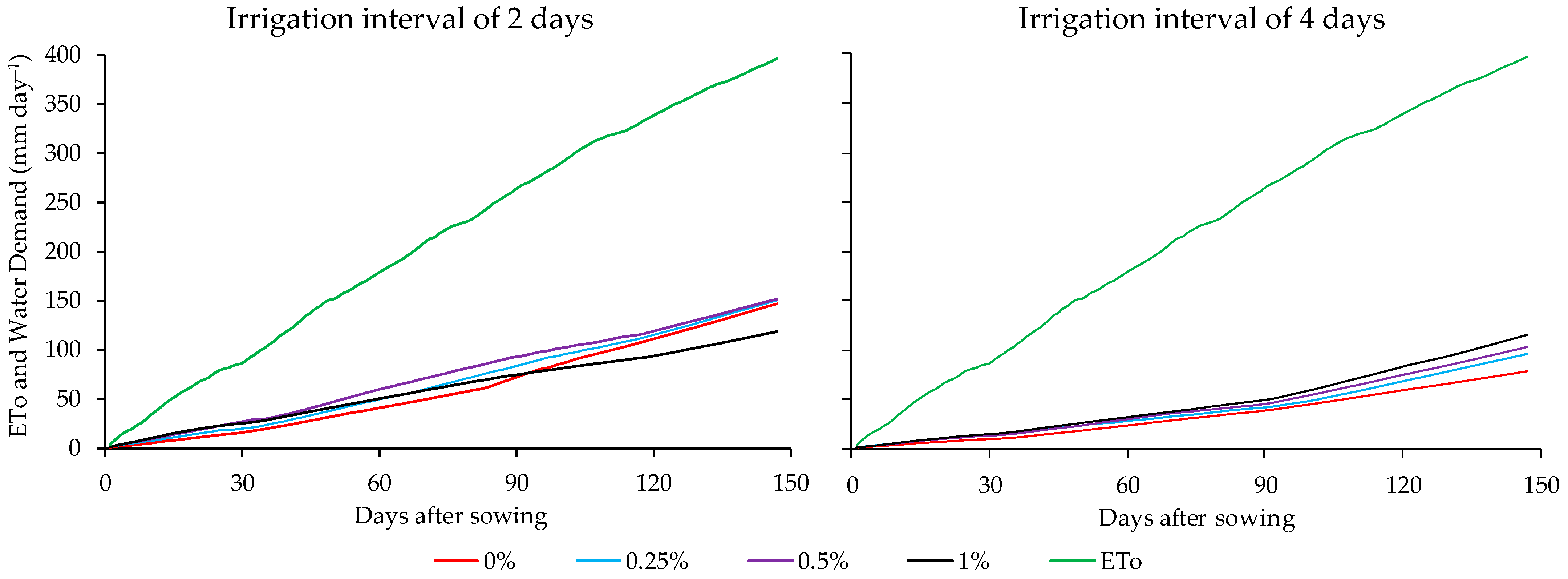
Figure 3 presents the reference evapotranspiration (ETo) rates and water consumption of Arabica coffee seedlings produced with different doses of hydroretentive polymer and irrigation intervals. All water consumption data are also available in the Supplementary Materials (Table S2). The ETo values fluctuated significantly throughout the period, with an average of 2.70 mm day−1, reaching maximum and minimum values of 4.49 mm day−1 and 0.80 mm day−1, respectively. The ETo reflects the main climatic effects on the evapotranspiration rate of Arabica coffee seedlings, while also being influenced by plant physiology and substrate moisture conditions. It is worth noting that the ETo values observed in this study were lower than those typically found in the region, which can be attributed to the research being conducted in a greenhouse. This structure reduces ETo estimates due to lower levels of solar radiation, vapor pressure deficit, and wind speed.
Figure 3.
Accumulated reference evapotranspiration (ETo) values and water consumption of Arabica coffee seedlings produced with varying doses of hydroretentive polymer and different irrigation intervals.
The results indicate that the application of hydroretentive polymer in the substrate significantly influences the water demand of the seedlings, with similar patterns observed for both evaluated irrigation intervals. In general, higher doses of hydroretentive polymer increase water demand, likely due to the greater water retention capacity in the soil, which provides more water to the coffee seedlings. On the other hand, lower concentrations of hydroretentive polymer result in reduced water consumption over time, indicating lower water retention efficiency.
As illustrated in Figure 3, the hydroretentive polymer acts as a soil conditioner, increasing its water storage capacity and prolonging water availability to the plants, regardless of the irrigation interval evaluated. This effect is corroborated by Agaba et al. [32], who reported an increase in evapotranspiration with higher concentrations of the hydroretentive polymer, attributed to greater water availability for the plants. These results reinforce the potential of the hydroretentive polymer as a strategic tool for optimizing water management in coffee seedling production systems.
Table 2 presents the total water consumption of Arabica coffee seedlings produced with different doses of hydroretentive polymer across the two evaluated irrigation intervals. It can be seen that the 2-day irrigation interval resulted in higher total water consumption compared to the 4-day irrigation interval at all tested doses. This difference is due to the higher irrigation frequency in the 2-day interval treatment, which results in more frequent water applications, even in smaller volumes per event. Additionally, the shorter duration between irrigations in the 2-day interval increases evaporation losses and allows for greater moisture availability in the soil, favoring water absorption. On the other hand, the longer interval between irrigations in the 4-day irrigation interval may lead to periods of greater water deficit, thereby reducing total consumption over the cycle.
Table 2.
Total water consumption of Arabica coffee seedlings for the various combinations of hydroretentive polymer doses and irrigation intervals.
3.3. Gas Exchange
Table 3 presents the physiological parameters of Arabica coffee seedlings produced with different doses of hydroretentive polymer and irrigation intervals. It can be seen in this table that there was no interaction between the factors of irrigation intervals and hydroretentive polymer doses for any evaluated parameter. However, an isolated effect of irrigation intervals on the net photosynthetic assimilation rate (A) was observed, in which the 2-day irrigation interval provided higher values of A compared to the 4-day irrigation interval, regardless of the hydroretentive polymer dose applied (Table 3).
Table 3.
Physiological parameters of Arabica coffee seedlings as a function of different doses of hydroretentive polymer and irrigation intervals of 2 days (II 2) and 4 days (II 4), along with a summary of the analysis of variance.
The results for A suggest that the 2-day irrigation interval was more efficient in optimizing the photosynthetic performance of the seedlings, regardless of the polymer dose used. This behavior can be attributed to the fact that the shorter irrigation interval maintained soil moisture at adequate levels, favoring water absorption by the roots and avoiding water saturation conditions that could limit root oxygenation and impair photosynthesis [33]. Furthermore, the results indicate that even at higher doses of hydroretentive polymer, the 2-day irrigation interval remained the most efficient for maximizing A, reinforcing the idea that irrigation management can be adjusted to ensure optimal photosynthetic performance, regardless of the amount of hydroretentive polymer applied.
Stomatal conductance (gs) did not show significant differences between irrigation intervals at any level of hydroretentive polymer (Table 3). This result indicates that, regardless of the irrigation interval, the application of the polymer contributed to maintaining constant water availability, promoting stability in stomatal behavior. In treatments without the hydroretentive polymer, gs was also not influenced by irrigation intervals, suggesting that the overall irrigation conditions were sufficient to meet the water demands of the seedlings, even without polymer application [34]. This pattern reinforces the idea that water management, whether or not combined with the use of the hydroretentive polymer, can be adjusted without compromising gas exchange, as long as minimum irrigation requirements are met.
The leaf transpiration rate (E) did not show significant differences between irrigation intervals at any hydroretentive polymer doses (Table 3). This result suggests that irrigation frequency did not influence the transpiration of the coffee seedlings, even with the application of different polymer doses. The hydroretentive polymer, regardless of the dose, likely helped maintain soil moisture at adequate levels, promoting efficient and stable transpiration without causing water stress. Balanced E values indicate good stomatal function and a favorable relationship among water, nutrient transport, and leaf temperature maintenance [33]. Furthermore, the lack of differences between treatments reinforces the effectiveness of water management, combined with the use of the polymer, in mitigating extremes of water deficit or excess, thereby providing stable conditions for seedling development [29,35].
The internal carbon concentration (Ci) in coffee seedlings, regardless of the hydroretentive polymer dose, was not affected by the irrigation intervals (Table 3). This result may indicate that the tested treatments did not cause significant water stress capable of altering carbon fixation dynamics. According to Batista et al. [36], Ci is less sensitive to variations in water availability when general cultivation conditions maintain a balance in photosynthetic metabolism, which may be the case in this experiment.
Water use efficiency (WUE) did not show significant differences between irrigation intervals at any hydroretentive polymer dose (Table 3). These results suggest that, regardless of irrigation frequency, the application of hydroretentive polymer contributed to efficient water use. Under conditions of higher irrigation frequency and moderate polymer doses, the plants were able to maximize carbon assimilation while minimizing water loss through transpiration [33]. On the other hand, at higher polymer doses, excessive water retention in the soil may have reduced water use efficiency by promoting water saturation or restricting root system aeration, which compromised the relationship between photosynthesis and transpiration.
Finally, the instantaneous carboxylation efficiency (EiC) did not show significant differences between irrigation intervals at any level of hydroretentive polymer dose (Table 3). These results suggest that irrigation frequency did not significantly affect carbon fixation during photosynthesis when the polymer was applied. The polymer, at appropriate doses, appears to provide a favorable water environment for carbon fixation. In treatments without the polymer, the lower EiC may be associated with water stress or fluctuations in soil moisture, which compromise the enzymatic efficiency of the carboxylation process [37]. This result emphasizes the importance of integrating hydroretentive polymers with irrigation management strategies to optimize coffee seedling physiology.
It can also be seen in Table 3 that regardless of the irrigation interval used, the application of a hydroretentive polymer did not affect the parameters E, Ci, and WUE. This suggests that, for these specific parameters, the polymer had no significant impact on the efficiency of gas exchange or water use by the plants, which is supported by studies indicating that the effect of the polymer may be more noticeable in other physiological parameters [38,39,40]. However, for the other gas exchange parameters evaluated, the 0.25% hydroretentive polymer dose resulted in higher values of A, gs, and EiC compared to the treatment without polymer application (0%), indicating a benefit of polymer use in improving photosynthesis and stomatal conductance, possibly by enhancing water availability at the root zone. This effect was not significantly different from the treatments with 0.5% and 1% polymer, suggesting that higher doses did not provide additional advantages over 0.25%.
3.4. Biometrics Evaluations
In Table 4, no significant interaction was observed between the irrigation intervals and hydroretentive polymer doses for any of the evaluated parameters. However, there was a main effect of the irrigation interval on seedling height (H), in which the 2-day irrigation interval resulted in higher values, regardless of the hydroretentive polymer dose applied. This result suggests that a higher irrigation frequency is more effective in promoting seedling growth, leading to better height development compared to the 4-day irrigation interval. Plant height is an important quality indicator in seedlings, associated with vigor and establishment potential [41].
Table 4.
Mean values of height (H), leaf temperature (LT), stem diameter (SD), and clod structure (CS) of Arabica coffee seedlings for the respective combinations of hydroretentive polymer doses and irrigation intervals of 2 days (II 2) and 4 days (II 4), along with a summary of the analysis of variance.
The 2-day irrigation interval resulted in lower leaf temperatures (LT) compared to the 4-day irrigation interval, regardless of the hydroretentive polymer dose used (Table 4). This result suggests that increased irrigation frequency helped maintain greater water availability in the substrate, thereby providing better conditions for leaf cooling mechanisms. The higher water retention capacity associated with higher polymer doses was not sufficient to mitigate the effects of the longer irrigation interval, as plants under the 4-day irrigation interval showed higher leaf temperatures. Maintaining lower leaf temperatures under the 2-day irrigation interval is advantageous, as it helps preserve the water and thermal balance of the plants, promoting more efficient growth and increasing resistance to environmental stress [42]. However, higher leaf temperatures may be beneficial in specific situations, such as in cold climates or for stimulating faster seedling growth.
In the case of stem diameter (SD), a crucial biometric variable that reflects the assimilation of liquid photosynthetic products and is directly related to seedling survival in the field, no significant difference was observed between the irrigation intervals, regardless of the hydroretentive polymer dose used (Table 4). This result may be explained by the fact that, for stem diameter, the limiting factor for plant growth may not be directly related to substrate water availability but rather to other factors, such as the seedlings’ ability to adapt to the environment or their efficient use of nutrients. Thus, irrigation, even in shorter or longer intervals, may not have been a determinant for stem growth, as the plant may have been able to adjust its metabolism to variations in water availability.
Regarding the clod structure (CS) (Table 4), no significant statistical differences were found between the treatments. According to Freitas et al. [43], the satisfactory development of the root system across all treatments promoted good root entanglement, resulting in values close to 1.0, which indicates satisfactory clod structure in all cases. Additionally, the averages for the number of nodes and leaves were consistent among the treatments, with values of five and eight, respectively, indicating that these attributes were not influenced by varying doses of hydroretentive polymer or irrigation intervals.
The application of a hydroretentive polymer affected only the height and stem diameter of Arabica coffee seedlings, both under the 4-day irrigation interval, with the 0.25% dose standing out by surpassing the treatments with 0% and 0.5% doses, respectively. For the other parameters evaluated and under the different irrigation intervals, the polymer doses had no significant impact on the Arabica coffee seedlings. The lack of effects on the other parameters may be related to the nature of these attributes, which could be more influenced by factors such as temperature and nutrient availability or potentially due to the limits of the polymer’s effectiveness at the tested doses.
As shown in Table 5, no significant differences were observed in the leaf area (LA) of the coffee seedlings, regardless of the irrigation interval or the hydroretentive polymer dose applied. Leaf area is an important indicator of the plant’s photosynthetic capacity, and the absence of variation in this parameter may indicate that factors other than water availability play a significant role in leaf development. A reduction in leaf area is a typical response to water deficiency; however, in this case, the irrigation conditions, both with 2-day and 4-day intervals, were not sufficient to generate significant variations in this parameter [44].
Table 5.
Average values of leaf area (LA), primary root length (RL), Dickson quality index (DQI), robustness index (RI), and root volume (RV) of Arabica coffee seedlings for the respective combinations of hydroretentive polymer doses and irrigation intervals of 2 days (II 2) and 4 days (II 4), along with a summary of the analysis of variance.
As shown in Table 5, no significant differences in the primary root length (RL) were observed between irrigation intervals, regardless of the hydroretentive polymer dose applied. This indicates that the irrigation frequency, whether in 2-day or 4-day intervals, did not influence the development of the main root length. The absence of differences in this parameter suggests that other factors, beyond irrigation management, may have been more influential on root development. The root system morphology was likely shaped by the inherent characteristics of the substrates and the overall management practices rather than by the irrigation interval alone. These results are consistent with other studies suggesting that the interaction between hydroretentive polymers and the substrate can improve water and nutrient absorption [45].
The Dickson quality index (DQI) showed no significant statistical differences between irrigation intervals for any of the hydroretentive polymer doses (Table 5). These results suggest that the overall quality of the seedlings was similar across the treatments. The DQI is widely used in seedling quality evaluation due to its advantage of jointly analyzing various morphological parameters in a single assessment [46]. This parameter is highly employed because it considers the robustness and balance among the evaluated characteristics; the higher its value, the higher the seedling quality within the same batch.
It can be seen in Table 5 that there was no significant difference in the robustness index (RI) of the coffee seedlings across the irrigation intervals, regardless of the hydroretentive polymer dose used. Under the 2-day irrigation interval, the 0.5% hydroretentive polymer dose yielded the highest RI value compared to the 0% dose; however, no significant difference was observed compared to the other treatments. The RI values remained within the recommended range set by Carneiro [47], indicating balanced growth of the coffee seedlings, regardless of the irrigation interval. This suggests that irrigation frequency did not significantly influence the robustness of the seedlings, implying that other factors, such as polymer dose, played a more prominent role in determining this parameter.
It can be seen in Table 5 that there was no significant difference in root volume (RV) between the irrigation intervals, regardless of the hydroretentive polymer dose used. No irrigation interval yielded a higher RV value, suggesting that irrigation frequency did not have a significant effect on root development, regardless of the amount of polymer applied. This result may be related to the fact that, for root volume, water availability in the substrate, even with the presence of the polymer, was not a limiting factor that promoted root growth in shorter irrigation intervals. Additionally, the impact of the polymer may have been mitigated, resulting in similar RV values across the irrigation intervals, as previously discussed by Melo et al. [48] and Gokavi et al. [4].
The results indicate that the use of shorter irrigation intervals promoted better performance of the biometric variables of Arabica coffee seedlings. This improvement is due to increased water retention and availability provided by the higher irrigation frequency, which results in greater turgor pressure. This condition favors leaf expansion, increasing the plant’s photosynthetic capacity and optimizing its initial development.
3.5. Phytomasses
Table 6 presents the parameters of biomass production for Arabica coffee seedlings. It can be seen that there was no interaction between the irrigation intervals and hydroretentive polymer doses for any of the parameters evaluated. It can also be seen in Table 6 that there were no significant differences in leaf fresh mass (LFM) across the irrigation intervals, regardless of the hydroretentive polymer dose used. Under the 2-day irrigation interval, the 0.25% hydroretentive polymer dose resulted in the highest LFM compared to the treatment without polymer, but it did not differ from the treatments with 0.5% and 1% polymer doses. Fresh mass mainly reflects the amount of water present in the cells; although the hydroretentive polymer contributed to improving water availability in the substrate, this variable was not influenced by different irrigation intervals. This suggests that, for fresh mass, the limiting factor may not have been water availability but rather other aspects of management.
Table 6.
Average values of leaf fresh mass (LFM), leaf dry mass (LDM), stem fresh mass (SFM), stem dry mass (SDM), root fresh mass (RFM), and root dry mass (RDM) of Arabica coffee seedlings for the respective combinations of hydroretentive polymer doses and irrigation intervals of 2 days (II 2) and 4 days (II 4), along with a summary of the analysis of variance.
However, for leaf dry mass (LDM), it was observed that the 2-day irrigation interval provided higher averages compared to the 4-day irrigation interval, regardless of the hydroretentive polymer dose applied (Table 6). This result suggests that the shorter irrigation interval favored the plant’s metabolism, allowing for greater cellular turgidity and optimizing stomatal function, which are factors that are important for growth and photosynthesis. Dry mass reflects the accumulation of biomass in the leaves, indicating a more efficient growth process, likely due to the more constant water supply provided by the 2-day irrigation interval, which allowed for better conditions for the translocation of photosynthetic products and cellular function.
The results for the fresh and dry stem mass parameters (Table 6) indicate that there were no significant differences between the treatments. This suggests that regardless of the irrigation intervals, the experimental conditions did not significantly influence stem growth. A possible reason for this lack of difference could be that stem development, in comparison to other parts of the plant, is less sensitive to variations in the water regime or the presence of the polymer, or that the evaluation period was not long enough to observe significant effects on this parameter. Continued monitoring and analysis of complementary variables may be important for a more precise assessment.
In Table 6, it can be seen that the root fresh mass (RFM) was higher in coffee seedlings irrigated with a 2-day irrigation interval, regardless of the hydroretentive polymer dose used. This result suggests that the 2-day irrigation interval favored root development, promoting greater fresh mass, which may be related to increased water availability and the optimization of the plant’s metabolism, thereby providing better conditions for root growth. More developed roots indicate a greater capacity for water and nutrient absorption, which is essential for the healthy growth of seedlings and their adaptation to the new environment [49].
On the other hand, for root dry mass (RDM), no significant differences were observed between irrigation intervals in any of the treatments with different hydroretentive polymer doses. This result can be explained by the fact that RDM reflects biomass accumulation, which may be more related to growth time and the plant’s ability to adapt to the substrate’s water conditions, regardless of the irrigation interval [41]. This suggests that while available water may have an immediate effect on root growth, dry mass reflects a more stable aspect of root development that was not as affected by variations in irrigation intervals.
3.6. Hydroretentive Polymer
Table 7 presents the behavior of the studied variables based on hydroretentive polymer doses for each irrigation interval implemented in this study. The results demonstrate that the use of hydroretentive polymer significantly influenced several variables related to the development and physiology of Arabica coffee seedlings, varying according to the irrigation intervals (2 and 4 days). The dose that yielded the best performance differed for each variable, reflecting the complexity of the water and nutritional balance under water restriction conditions.
Table 7.
Parameters related to germination, physiology, growth, and production of Arabica coffee seedlings under different irrigation intervals (II) and in relation to hydroretentive polymer doses (HPD).
The germination speed index (GSI) and the initial growth rate of seedlings showed improved performance with polymer doses between 0.25% and 0.5% under the 2-day irrigation interval. This is consistent with the findings of Araújo et al. [29], who observed that hydroretentive polymers can increase water retention in the substrate, thereby favoring seed hydration and promoting uniform germination.
The net photosynthetic rate (A) and stomatal conductance (gs) were enhanced with intermediate polymer doses, suggesting that higher water retention in the substrate created favorable conditions for stomatal opening and CO2 transport into the leaves. These results corroborate the findings of Deans et al. [50], who report that optimizing photosynthesis in seedlings under water management occurs when the water supply is sufficient to prevent stomatal closure without over-saturating the substrate.
Shoot dry mass and plant height were significantly higher with doses near 0.25% polymer at the 2-day irrigation interval. These results indicate that effective water management, combined with the use of the polymer, contributed to seedling development by optimizing water availability for essential metabolic processes. According to Beltramin et al. [15], the use of hydroretentive polymers can improve water and nutrient use efficiency, as reflected in seedling growth.
The results suggest that using hydroretentive polymer at moderate doses (around 0.25%) may be a viable strategy for improving water efficiency in coffee seedling nurseries, particularly under management conditions with less frequent irrigation. However, it is crucial to consider that excessive doses may limit development due to substrate saturation effects and potential oxygen deficiency for the roots, as discussed by Araújo et al. [29].
3.7. Crop and Soil Moisture Coefficients
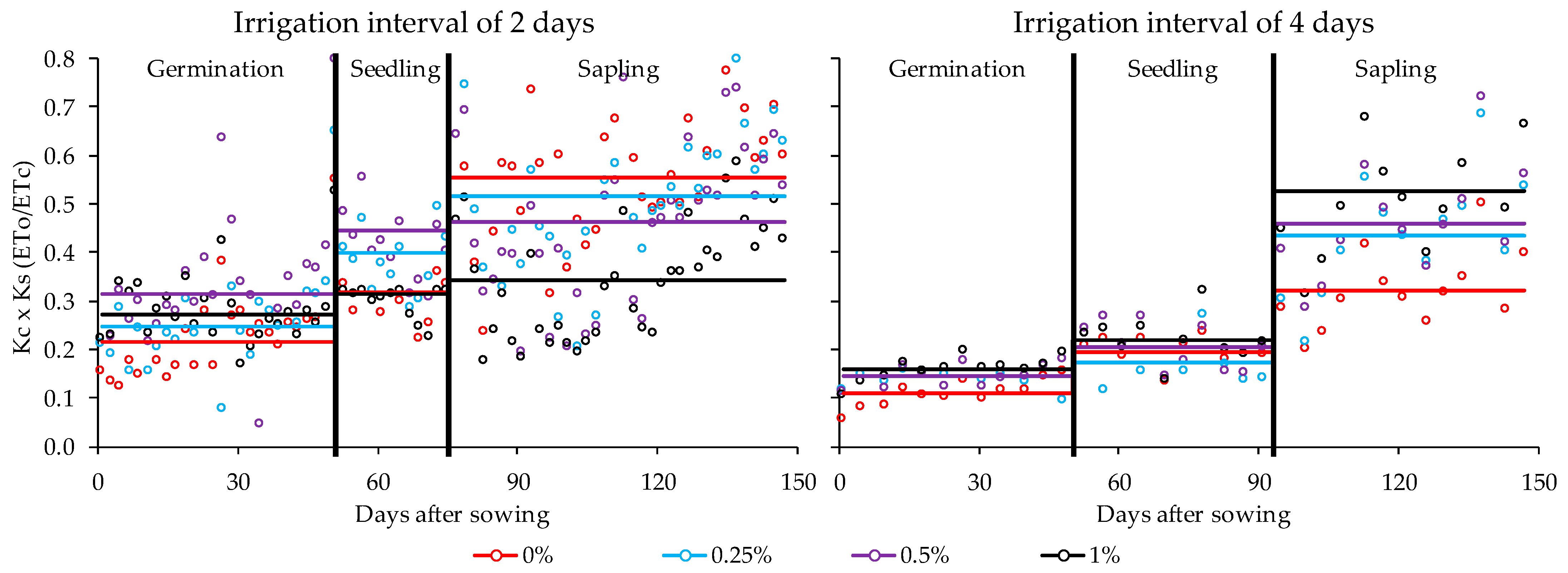
The accurate determination of crop coefficients (Kc) and soil moisture coefficients (Ks) is essential for optimizing water use in agriculture, as these coefficients are key parameters for determining crop evapotranspiration (ETc). Detailed studies of these parameters can lead to reduced production costs and environmental impacts [24,51,52]. Kc, in particular, is a relevant indicator because it reflects the physical and biological characteristics of the crop, such as leaf area, plant architecture, and transpiration [24]. Figure 4 shows the behavior of Kc and Ks values over the experimental period for the combinations of hydroretentive polymer doses and irrigation intervals. All Kc × Ks data are also available in the Supplementary Materials (Table S3).
Figure 4.
Crop coefficient (Kc) and soil moisture coefficients (Ks) of Arabica coffee for the various combinations of hydroretentive polymer doses and irrigation intervals.
As shown in Figure 4, the Kc × Ks values for the 2-day irrigation interval varied across different stages of the plant development cycle. Up to 50 days after sowing (DAS), the values were 0.21, 0.25, 0.31, and 0.27 for treatments with 0%, 0.25%, 0.5%, and 1% hydroretentive polymer, respectively. Between 51 and 75 DAS, the values increased to 0.32, 0.40, 0.45, and 0.31, while from 75 to 150 DAS, the values were 0.56, 0.52, 0.46, and 0.34 for the same treatments.
For the 4-day irrigation interval, Figure 4 also shows that the Kc · Ks values until 49 DAS were 0.11, 0.14, 0.14, and 0.16 for the treatments with 0%, 0.25%, 0.5%, and 1% hydroretentive polymer, respectively. Between 51 and 91 DAS, the coefficients increased to 0.19, 0.17, 0.21, and 0.22, while from 92 to 150 DAS, they reached 0.32, 0.43, 0.46, and 0.53, respectively.
The Kc × Ks values in the early stage, particularly during germination and seedling phases, were low due to minimal water consumption by the plants. At this stage, the seedlings had limited leaf area and underdeveloped root systems, resulting in lower transpiration and consequently lower Kc values. These results are consistent with Allen et al. [24], who highlight that the initial Kc is directly related to the phenological stage and soil cover.
In treatments with hydroretentive polymer, a variation in Kc × Ks was observed throughout the development cycle. For the 2-day irrigation interval, the Kc × Ks values were higher in the treatment with 0.5% polymer until 75 DAS, indicating that water availability was sufficient to meet metabolic demands during the early growth stage. These values are justified by the fact that with less frequent irrigation, the polymer’s water retention provided near-ideal conditions for the plants, as suggested by Taiz and Zeiger [33].
On the other hand, in the 4-day irrigation interval, the highest Kc × Ks values were found in the treatment with 1% polymer, regardless of the coffee seedling stage. These results can be attributed to the polymer’s greater capacity to retain water for longer periods, meeting the plants’ needs during phases of higher water demand, such as active growth and vegetative development. According to Rodríguez et al. [53], balancing water availability with soil conditions is essential for optimizing the plants’ physiological performance.
Moreover, the reduction in Kc × Ks at higher polymer doses during the 2-day irrigation interval after 75 DAS suggests that, under frequent irrigation conditions, an excess of polymer can create a less favorable water environment due to soil saturation and oxygen limitation for the roots. This dynamic reinforces the importance of adjusting polymer doses according to the irrigation interval, seeking a balance between water retention and aeration.
In the treatments with a 4-day irrigation interval, a reduction in the Kc × Ks values was observed, which can be attributed to the lower water content in the substrate. This reduced water content minimized the Ks, reflecting a more limited water availability for the plants. On the other hand, the higher Kc × Ks values in the 2-day irrigation interval during the final stages (up to 150 DAS) indicate that management with less frequent irrigation, combined with higher polymer doses (1%), provides greater water availability during critical periods, resulting in increased transpiration and productivity. These results align with Oliveira et al. [52], who emphasize the importance of water management strategies that consider the interaction between irrigation frequency and substrate water retention capacity.
4. Conclusions
The combination of 0.50% hydroretentive polymer (UPDT®) with a 2-day irrigation interval resulted in the highest water consumption and potential for the initial development of Arabica coffee seedlings, while 0% polymer with a 4-day interval was more water-efficient but limited under conditions of higher water demand. For production in 0.5 dm3 polyethylene bags, the use of 0.25% hydroretentive polymer is recommended, as it balances water retention and availability, with a 2-day irrigation interval ensuring efficient root and vegetative growth. The recommended values for irrigation management are the product of the crop coefficient (Kc) and the soil moisture coefficient (Ks), calculated as 0.20, 0.28, and 0.45 for the periods of 0 to 50, 51 to 80, and 81 to 150 days after sowing, respectively, thereby promoting efficient water use and optimal seedling performance.
Supplementary Materials
The following supporting information can be downloaded at https://www.mdpi.com/article/10.3390/agronomy15010218/s1: Table S1: Hourly meteorological data; Table S2: Daily meteorological and water consumption data; Table S3: Water consumption and Kc · Ks data; Table S4: Original data for all attributes evaluated in the experiment; Table S5: Analysis of variance for final germination; Table S6: Analysis of variance for germination velocity index; Table S7: Analysis of variance for final mean germination time; Table S8: Analysis of variance for mean germination speed; Table S9: Analysis of variance for net photosynthetic assimilation rate; Table S10: Analysis of variance for stomatal conductance; Table S11: Analysis of variance for leaf transpiration rate; Table S12: Analysis of variance for internal carbon concentration; Table S13: Analysis of variance for water use efficiency; Table S14: Analysis of variance for instantaneous carboxylation efficiency; Table S15: Analysis of variance for height; Table S16: Analysis of variance for leaf temperature; Table S17: Analysis of variance for stem diameter; Table S18: Analysis of variance for clod structure; Table S19: Analysis of variance for leaf area; Table S20: Analysis of variance for primary root length; Table S21: Analysis of variance for Dickson quality index; Table S22: Analysis of variance for robustness index; Table S23: Analysis of variance for root volume; Table S24: Analysis of variance for leaf fresh mass; Table S25: Analysis of variance for leaf dry mass; Table S26: Analysis of variance for stem fresh mass; Table S27: Analysis of variance for stem dry mass; Table S28: Analysis of variance for root fresh mass; Table S29: Analysis of variance for root dry mass.
Author Contributions
Conceptualization, M.O.S., F.R.S.B., A.W.P. and F.F.d.C.; methodology, M.O.S., F.R.S.B., A.W.P. and F.F.d.C.; validation, M.O.S., V.R.S.d.A., F.R.S.B., M.W.M.F., A.W.P. and F.F.d.C.; formal analysis, M.O.S. and F.F.d.C.; investigation, M.O.S. and F.R.S.B.; resources, F.F.d.C.; data curation, M.O.S., V.R.S.d.A., F.R.S.B. and M.W.M.F.; writing—original draft preparation, M.O.S., F.R.S.B. and F.F.d.C.; writing—review and editing, M.O.S. and F.F.d.C.; visualization, M.O.S., V.R.S.d.A., F.R.S.B., M.W.M.F., A.W.P. and F.F.d.C.; supervision, F.F.d.C.; project administration, F.F.d.C.; funding acquisition, F.F.d.C. All authors have read and agreed to the published version of the manuscript.
Funding
This research was funded by Coordination for the Improvement of Higher Education Personnel, Brazil (CAPES), Finance Code 001 and the National Council for Scientific and Technological Development, Brazil (CNPq), Process 308769/2022-8.
Data Availability Statement
The original contributions presented in this study are included in the article/Supplementary Material. Further inquiries can be directed to the corresponding author.
Acknowledgments
We thank the Department of Agriculture Engineering (DEA) and the Graduate Program in Agricultural Engineering (PPGEA) of the Federal University of Viçosa (UFV) for supporting the researchers.
Conflicts of Interest
The authors declare no conflicts of interest.
References
- Samoggia, A.; Riedel, B. Coffee consumption and purchasing behavior review: Insights for further research. Appetite 2018, 129, 70–81. [Google Scholar] [CrossRef]
- Damatta, F.M.; Rahn, E.; Läderach, P.; Ghini, R.; Ramalho, J.C. Why could the coffee crop endure climate change and global warming to a greater extent than previously estimated? Clim. Change 2019, 152, 167–178. [Google Scholar] [CrossRef]
- Chekol, H.; Bezuayehu, Y.; Warkineh, B.; Shimber, T.; Adamska, A.M.; Dąbrowska, G.B.; Degu, A. Unraveling drought tolerance and sensitivity in coffee genotypes: Insights from seed traits, germination, and growth-physiological responses. Agriculture 2023, 13, 1754. [Google Scholar] [CrossRef]
- Gokavi, N.; Mote, K.; Mukharib, D.S.; Manjunath, A.N.; Raghuramulu, Y. Performance of hydrogel on seed germination and growth of young coffee seedlings in nursery. J. Pharmacogn. Phytochem. 2018, 7, 1364–1366. [Google Scholar]
- Barbosa, I.D.; Oliveira, A.C.B.; Rosado, R.D.S.; Sakiyama, N.S.; Cruz, C.D.; Pereira, A.A. Sensory analysis of arabica coffee: Cultivars of rust resistance with potential for the specialty coffee market. Euphytica 2020, 216, 165. [Google Scholar] [CrossRef]
- Abdelwahab, S.I.; Taha, M.M.E.; Jerah, A.A.; Aljahdali, I.A.; Oraibi, B.; Alfaifi, H.A.; Abdullah, S.M.; Alzahrani, A.H.; Oraibi, O.; Babiker, Y.; et al. Coffee arabica research (1932–2023): Performance, thematic evolution and mapping, global landscape, and emerging trends. Heliyon 2024, 10, e36137. [Google Scholar] [CrossRef]
- Companhia Nacional de Abastecimento (CONAB). Produção De Café De 2024 É Estimada Em 54,79 Milhões De Sacas, Influenciada Por Clima. 2024. Available online: https://www.conab.gov.br (accessed on 3 December 2024).
- Franzin, M.L.; Moreira, C.C.; Silva, L.N.P.; Martins, E.F.; Fadini, M.A.M.; Pallini, A.; Elliot, S.L.; Venzon, M. Metarhizium associated with coffee seedling roots: Positive effects on plant growth and protection against Leucoptera coffeella. Agriculture 2022, 12, 2030. [Google Scholar] [CrossRef]
- Hirooka, Y.; Motomura, M.; Iijima, M. Ultra-fine bubble irrigation promotes coffee (Coffea arabica) seedling growth under repeated drought stresses. Plant Prot. Sci. 2024, 27, 47–55. [Google Scholar] [CrossRef]
- Venancio, L.P.; Filgueiras, R.; Mantovani, E.C.; Amaral, C.H.; Cunha, F.F.; Silva, F.C.S.; Althoff, D.; Santos, R.A.; Cavatte, P.C. Impact of drought associated with high temperatures on Coffea canephora plantations: A case study in Espírito Santo State, Brazil. Sci. Rep. 2020, 10, 19719. [Google Scholar] [CrossRef]
- Alixandre, F.T.; Lopes, J.C.; Ferreira, A.; Alexandre, R.S.; Lima, P.A.M.; Guarçoni, R.C.; Kroling, C.A.; Dias, R.S.; Favaratto, L.F.; Alixandre, R.D.; et al. Physiological quality of seeds from traditional and new recommended groups of Arabic coffee cultivars to highland regions. Int. J. Adv. Eng. Sci. 2021, 8, 114–120. [Google Scholar] [CrossRef]
- Correia, C.C.S.A.; Cunha, F.F.; Mantovani, E.C.; Silva, D.J.H.; Dias, S.H.B.; Ferreira, T.S. Irrigation of arugula cultivars in the region of Zona da Mata Mineira. Semina 2019, 40, 1101–1114. [Google Scholar] [CrossRef]
- Cruz, G.H.M.; Cunha, F.F.; Souza, E.J.; Silva, A.J.; Filgueiras, R.; Silva, F.C.S. Irrigation frequency and vermiculite proportion in substrate for Eucalyptus grandis seedling. Semina 2020, 41, 1495–1506. [Google Scholar] [CrossRef]
- Silva, W.R.D.; Salomão, L.C.; Pereira, D.R.; Oliveira, H.F.; Pereira, A.I.D.A.; Cantuario, F.S. Irrigation levels and use of hydro retainer polymer in greenhouse lettuce production. Rev. Bras. Eng. Agric. Ambient. 2019, 23, 406–412. [Google Scholar] [CrossRef]
- Beltramin, F.A.; Silva, W.C.; Santos, C.C.; Scalon, S.P.Q.; Vieira, M.C. Water-retaining polymer mitigates the water deficit in Schinus terebinthifolia: Photosynthetic metabolism and initial growth. Agric. Eng. 2020, 40, 684–691. [Google Scholar] [CrossRef]
- Patra, S.K.; Poddar, R.; Brestic, M.; Acharjee, P.U.; Bhattacharya, P.; Sengupta, S.; Pal, P.; Bam, B.; Biswas, B.; Barek, V.; et al. Prospects of hydrogels in agriculture for enhancing crop and water productivity under water deficit condition. Int. J. Polym. Sci. 2022, 2022, 4914836. [Google Scholar] [CrossRef]
- Choi, H.; Park, J.; Lee, J. Sustainable bio-based superabsorbent polymer: Poly (itaconic acid) with superior swelling properties. Appl. Polym. Mater. 2022, 4, 4098–4108. [Google Scholar] [CrossRef]
- UPL. Polímero Vegetal, UPDT®. 2024. Available online: https://www.upl-ltd.com/br (accessed on 3 December 2024).
- Schorn, L.A.; Pandini, G.; Bittencourt, R.; Fenilli, T.A.B. Definição de idades ótimas para expedição de mudas de Araucaria angustifolia (Bertol.) Kuntze (Araucariaceae) em função de sua qualidade e volume de recipientes. Biotemas 2019, 32, 19–27. [Google Scholar] [CrossRef][Green Version]
- Alvares, C.A.; Stape, J.L.; Sentelhas, P.C.; Gonçalves, J.L.M.; Sparovek, G. Köppen’s climate classification map for Brazil. Meteorol. Z. 2013, 22, 711–728. [Google Scholar] [CrossRef] [PubMed]
- Moura, W.M.; Soares, L.G. Implantação de Lavoura de Café em Sistema Orgânico; Circular Técnica; Empresa de Pesquisa Agropecuária de Minas Gerais—EPAMIG: Belo Horizonte, Brazil, 2022; Volume 372, p. 7. [Google Scholar]
- Santos, H.G.; Jacomine, P.K.T.; Anjos, L.H.C.; Oliveira, V.A.; Lumbreras, J.F.; Coelho, M.R.; Almeida, J.A.; Araujo Filho, J.C.; Oliveira, J.B.; Cunha, T.J.F. Sistema Brasileiro de Classificação de Solos; Empresa Brasileira de Pesquisa Agropecuária—Embrapa: Brasília, Brazil, 2018; p. 355. [Google Scholar]
- Nascimento, H.R.; Moura, L.O.; Duarte, A.B.; Dantas, S.A.G.; Ferreira, D.O.; Rosmaninho, L.B.C.; Cavallin, I.C.; Cunha, F.F.; Silva, F.L. A new methodological approach for simulating water deficit in soybean genotypes. J. Agron. Crop Sci. 2021, 207, 946–955. [Google Scholar] [CrossRef]
- Allen, R.G.; Pereira, L.S.; Raes, D.; Smith, M. Crop Evapotranspiration: Guidelines for Computing Crop Water Requirements. In FAO Irrigation and Drainage Paper 56; FAO: Rome, Italy, 1998; p. 300. [Google Scholar]
- Rodrigues, L.A.; Figueiredo, N.A.; Porto, V.G.V.; Barroso, D.G. Clod structure and the quality of moringa seedlings (Moringa oleifera LAM.) grown in commercial substrate and in organic composts. Rev. Árvore 2021, 45, e450135. [Google Scholar] [CrossRef]
- Dickson, A.; Leaf, A.L.; Hosner, J.F. Quality appraisal of white spruce and white pine seedling stock in nurseries. For. Chron. 1960, 36, 10–13. [Google Scholar] [CrossRef]
- Bauhus, J.; Messier, C. Evaluation of fine root length and diameter measurements obtained using WinRhizo image analysis. Agron. J. 1999, 91, 142–147. [Google Scholar] [CrossRef]
- R Development Core Team. R: A Language and Environment for Statistical Computing; 4.4.2 Version; R Development Core Team: Vienna, Austria, 2023; Available online: www.r-project.org/ (accessed on 11 November 2024).
- Araújo, E.D.; Assis, M.O.; Guimarães, C.M.; Araújo, E.F.; Borges, A.C.; Cunha, F.F. Superabsorbent polymers and sanitary sewage change water availability during the cowpea emergence phase. Nativa 2024, 12, 37–48. [Google Scholar] [CrossRef]
- Maguire, M.P. Variability in length and arm ratio of the pachytene chromosomes corn. Cytologia 1962, 27, 248–257. [Google Scholar] [CrossRef]
- Silva, A.B.; Damascena, J.F.; Lima, E.F.; Pereira, J.A.; Silva, C.M.; Silva, W.A. Germinação e desenvolvimento inicial de rosa do deserto em diferentes substratos. J. Environ. Anal. Prog. 2022, 7, 127–134. [Google Scholar] [CrossRef]
- Agaba, H.; Orikiriza, L.J.B.; Esegu, J.F.O.; Obua, J.; Kabasa, J.D.; Hüttermann, A. Effects of hydrogel amendment to different soils on plant available water and survival of trees under drought conditions. Clean Soil Air Water 2010, 38, 328–335. [Google Scholar] [CrossRef]
- Taiz, L.; Zeiger, E. Fisiologia Vegetal; Artmed: Porto Alegre, Brazil, 2017; p. 719. [Google Scholar]
- Zheng, H.; Mei, P.; Wang, W.; Yin, Y.; Li, H.; Zheng, M.; Ou, X.; Cui, Z. Effects of super absorbent polymer on crop yield, water productivity and soil properties: A global meta-analysis. Agric. Water Manag. 2023, 282, 108290. [Google Scholar] [CrossRef]
- Pacholczak, A.; Nowakowska, K.; Monder, M.J. Starch-based superabsorbent enhances the growth and physiological traits of ornamental shrubs. Agriculture 2023, 13, 1893. [Google Scholar] [CrossRef]
- Batista, R.C.M.; Carvalho, J.S.B.; Coqueiro, D.R.; Aquino, P.G.V.; Alves, L.Z. Growth, gas exchange and essential oil production of Mentha spicata L. under water deficiency. Pesqui. Agropecu. Trop. 2023, 53, e76893. [Google Scholar] [CrossRef]
- Sousa, J.T.M.; Sousa, A.B.O.; Rosal, G.B.; Lima Junior, J.C.; Lacerda, C.F.; Oliveira, A.M.S. Gas exchanges and thermal index of strawberry cultivars grown under hydrogel doses. Rev. Bras. Eng. Agric. Ambient. 2024, 28, e280160. [Google Scholar] [CrossRef]
- Bezerra, F.T.C.; Bezerra, M.A.F.; Nascimento, R.R.A.; Pereira, W.E.; Oliveira, C.J.A.; Souza, G.L.F.; Ribeiro, J.E.S. Physiology in Talisia esculenta seedlings under irrigation with saline water on substrate with hydrogel. Semin. Cienc. Agrar. 2022, 43, 751–774. [Google Scholar] [CrossRef]
- Badr, E.A.; Bakhoum, G.S.; Sadak, M.S.; Al-Ashkar, I.; Islam, M.S.; El Sabagh, A.; Abdelhamid, M.T. Enhancing canola yield and photosynthesis under water stress with hydrogel polymers. Phyton Int. J. Exp. Bot. 2024, 93, 1623–1645. [Google Scholar] [CrossRef]
- Ren, Y.; Li, X.; Cheng, B.; Yue, L.; Cao, X.; Wang, C.; Wang, Z. Carbon dot-embedded hydrogels promote maize germination and growth under drought stress. Environ. Sci. 2024, 11, 2239–2248. [Google Scholar] [CrossRef]
- Grossnickle, S.C.; Macdonald, J.E. Why seedlings grow: Influence of plant attributes. New For. 2018, 49, 1–34. [Google Scholar] [CrossRef]
- Jagadish, S.V.K.; Way, D.A.; Sharkey, T.D. Plant heat stress: Concepts directing future research. Plant Cell Environ. 2021, 44, 1992–2005. [Google Scholar] [CrossRef] [PubMed]
- Freitas, T.A.S.D.; Oliveira, M.F.; Souza, L.S.; Dias, C.N.; Quintela, M.P. Qualidades de mudas de Myracrodruon urundeuva Fr. All. conduzidas sob diferentes volumes de recipientes. Cienc. Florest. 2022, 32, 19–42. [Google Scholar] [CrossRef]
- Mote, K.; Gokavi, N. Performance of hydrogel on post planting behavior of young coffee cv. CXR. J. Crop Weed 2020, 2, 197–203. [Google Scholar] [CrossRef]
- Pattanaaik, S.K.; Wangchu, L.; Singh, B.; Hazarika, B.N.; Singh, S.M.; Pandey, A.K. Effect of hydrogel on water and nutrient management of Citrus reticulata. Res. Crops 2015, 16, 98–103. [Google Scholar] [CrossRef]
- Silva, O.M.C.; Hernández, M.M.; Araújo, G.C.R.; Cunha, F.L.; Evangelista, D.V.P.; Leles, P.S.S.; Melo, L.A. Potencial uso da casca de café como constituinte de substrato para produção de mudas de espécies florestais. Cienc. Florest. 2020, 30, 1161–1175. [Google Scholar] [CrossRef]
- Carneiro, J.G.A. Produção e controle de qualidade de mudas florestais. In FUPEF Fundação de Apoio da Universidade Federal do Paraná; UFPR: Curitiba, Brazil, 1995; p. 451. [Google Scholar]
- Melo, L.A.; Abreu, A.H.M.; Leles, P.S.S.; Oliveira, R.R.; Silva, D.T. Qualidade e crescimento inicial de mudas de Mimosa caesalpiniifolia Benth. produzidas em diferentes volumes de recipientes. Cienc. Florest. 2018, 28, 47–55. [Google Scholar] [CrossRef]
- Guo, Y.; Huang, G.; Guo, Q.; Peng, C.; Liu, Y.; Zhang, M.; Li, Z.; Zhou, Y.; Duan, L. Increase in root density induced by coronatine improves maize drought resistance in North China. Crop J. 2023, 11, 278–290. [Google Scholar] [CrossRef]
- Deans, R.M.; Brodribb, T.J.; Busch, F.A.; Farquhar, G.D. Optimization can provide the fundamental link between leaf photosynthesis, gas exchange and water relations. Nat. Plants 2020, 6, 1116–1125. [Google Scholar] [CrossRef] [PubMed]
- Alface, A.B.; Pereira, S.B.; Filgueiras, R.; Cunha, F.F. Sugarcane spatial-temporal monitoring and crop coefficient estimation through NDVI. Rev. Bras. Eng. Agric. Ambient. 2019, 23, 330–335. [Google Scholar] [CrossRef]
- Oliveira, R.M.; Cunha, F.F.; Silva, G.H.; Andrade, L.M.; Morais, C.V.; Ferreira, P.M.O. Evapotranspiration and crop coefficients of Italian zucchini cultivated with recycled paper as mulch. PLoS ONE 2020, 15, e0232554. [Google Scholar] [CrossRef]
- Rodríguez, C.A.; Araújo, W.F.; Chagas, P.C.; Siqueira, R.H.S.; Chagas, E.A.; Paulichi, M.G.; Lima, J.V.G.; Sakazaki, R.T.; Monteiro Neto, J.L.L.; Valero, M.A.M.; et al. Determination of evapotranspiration and crop coefficient of Myrciaria dubia (Kunth) McVaugh for domestication and conservation on uplands. Rev. Chapingo Ser. Hortic. 2020, 26, 175–188. [Google Scholar] [CrossRef]
Disclaimer/Publisher’s Note: The statements, opinions and data contained in all publications are solely those of the individual author(s) and contributor(s) and not of MDPI and/or the editor(s). MDPI and/or the editor(s) disclaim responsibility for any injury to people or property resulting from any ideas, methods, instructions or products referred to in the content. |
© 2025 by the authors. Licensee MDPI, Basel, Switzerland. This article is an open access article distributed under the terms and conditions of the Creative Commons Attribution (CC BY) license (https://creativecommons.org/licenses/by/4.0/).