

Combining Controlled-Release Urea and Normal Urea to Improve the Yield, Nitrogen Use Efficiency, and Grain Quality of Single Season Late japonica Rice

 ,
,
Abstract
1. Introduction
2. Materials and Methods
2.1. Experiment Location and Weather Conditions
2.2. Experimental Design and Field Management
2.3. Plant Sampling and Data Collection
2.4. Data Analysis
3. Results
3.1. Grain Yield and Its Components
3.2. Leaf Area Index (LAI) and Dry Matter Accumulation
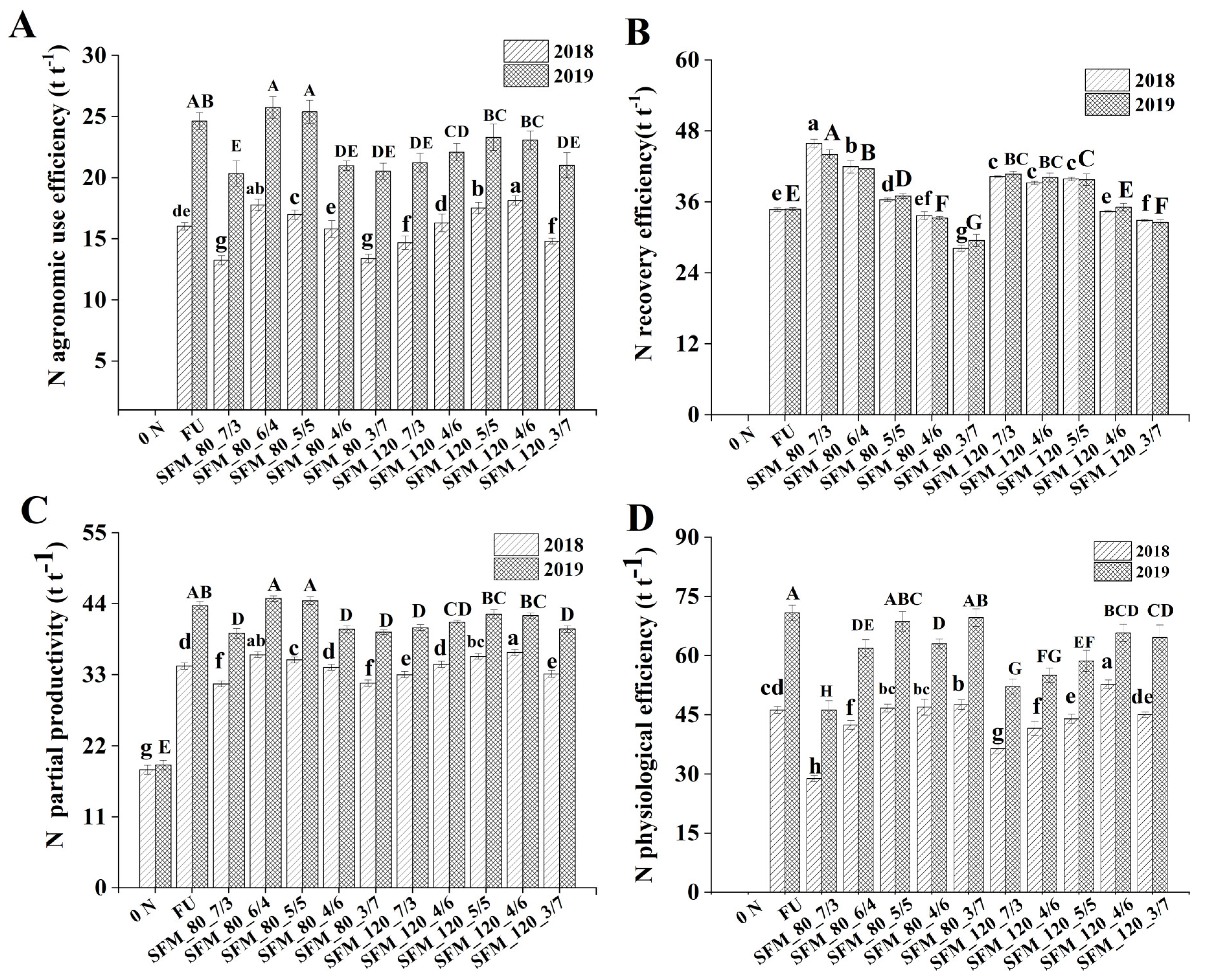
3.3. N Accumulation and N Use Efficiency (NUE)
3.4. Grain Quality
4. Discussion
4.1. Effects of Different Fertilization Modes on Yield, LAI, and Dry Matter Accumulation
4.2. Effects of Different Fertilization Modes on Nitrogen Accumulation and NUEs
4.3. Effects of Different Fertilization Modes on Grain Quality
5. Conclusions
Supplementary Materials
Author Contributions
Funding
Data Availability Statement
Acknowledgments
Conflicts of Interest
References
- Che, S.G.; Zhao, B.Q.; Li, Y.T.; Liang, Y.; Wei, L.; Lin, Z.; Bing, S. Review grain yield and nitrogen use efficiency in rice production regions in China. J. Integr. Agric. 2015, 14, 2456–2466. [Google Scholar] [CrossRef] [Scilit]
- China Agricultural Yearbook. China Agricultural Yearbook; China Agricultural Publishing House: Beijing, China, 2013; pp. 206–222. [Google Scholar]
- Grant, C.A.; Wu, R.; Selles, F.; Harker, K.N.; Clayton, G.W.; Bittman, S.; Zebarth, B.J.; Lupwayi, N.Z. Crop yield and nitrogen concentration with controlled Release urea and split applications of nitrogen as compared to non-coated urea Applied at seeding. Field Crop Res. 2012, 127, 170–180. [Google Scholar] [CrossRef] [Scilit]
- Peng, S.B.; Buresh, R.J.; Huang, J.L.; Zhong, X.H.; Zou, Y.B.; Yang, J.C.; Wang, G.H.; Liu, Y.Y.; Hu, R.F.; Tang, Q.; et al. Improving nitrogen fertilization in rice by site-specific N management. A review. Agron. Sustain. Dev. 2010, 30, 649–656. [Google Scholar] [CrossRef] [Scilit]
- Ke, J.; He, R.; Hou, P.; Ding, C.; Ding, Y.; Wang, S.; Li, G. Combined controlled-released nitrogen fertilizers and deep placement effects of N leaching, rice yield and N recovery in machine-transplanted rice. Agric. Ecosyst. Environ. 2018, 265, 402–412. [Google Scholar] [CrossRef] [Scilit]
- National Bureau of Statistics. China Agriculture Yearbook; China Agriculture Press: Beijing, China, 2013. [Google Scholar]
- Can, Z.; Huang, H.; Qian, Z.H.; Jiang, H.X.; Liu, G.M.; Ke, X.U.; Hu, Y.J.; Dai, Q.G.; Huo, Z.Y. Effect of side deep placement of nitrogen on yield and nitrogen use efficiency of single season late japonica rice. J. Integr. Agric. 2021, 20, 2–17. [Google Scholar]
- Zhang, W.; Cao, G.; Li, X.; Zhang, H.; Wang, C.; Liu, Q.; Dou, Z. Closing yield gaps in China by empowering smallholder farmers. Nature 2016, 537, 671–674. [Google Scholar] [CrossRef] [Scilit]
- Trenkel, M.E. Controlled-Release and Stabilized Fertilizers in Agriculture; International Fertilizer Industry Association: Paris, France, 1997; pp. 11–12. [Google Scholar]
- Ye, Y.; Liang, X.; Chen, Y.; Liu, J.; Gu, J.; Guo, R.; Li, L. Alternate wetting and drying irrigation and controlled-release nitrogen fertilizer in late-season rice. Effects on dry matter accumulation, yield, water and nitrogen use. Field Crop Res. 2013, 144, 212–224. [Google Scholar] [CrossRef] [Scilit]
- Zhang, W.; Liang, Z.; He, X.; Wang, X.; Shi, X.; Zou, C.; Chen, X. The effects of controlled release urea on maize productivity and reactive nitrogen losses: A meta-analysis. Environ. Pollut. 2019, 246, 559–565. [Google Scholar] [CrossRef] [Scilit]
- Kenawy, E.R.; Hosny, A.; Saad-Allah, K. Reducing nitrogen leaching while enhancing growth, yield performance and physiological traits of rice by the application of controlled-release urea fertilizer. Paddy Water Environ. 2021, 19, 173–188. [Google Scholar] [CrossRef] [Scilit]
- Tian, X.F.; Li, C.L.; Zhang, M.; Li, T.; Lu, Y.Y.; Liu, L.F. Controlled release urea improved crop yields and mitigated nitrate leaching under cotton- garlic intercropping system in a 4-year field trial. Soil Tillage Res. 2018, 175, 158–167. [Google Scholar] [CrossRef] [Scilit]
- Sun, H.; Zhou, S.; Zhang, J.; Zhang, X.; Wang, C. Effects of controlled-release fertilizer on rice grain yield, nitrogen use efficiency, and greenhouse gas emissions in a paddy field with straw incorporation. Field Crop Res. 2020, 253, 107814. [Google Scholar] [CrossRef] [Scilit]
- Farmaha, B.S.; Sims, A.L. The influence of PCU and urea fertilizer mixtures on spring wheat protein concentrations and economic returns. Agron. J. 2013, 105, 1328–1334. [Google Scholar] [CrossRef] [Scilit]
- Noellsch, A.J.; Motavalli, P.P.; Nelson, K.A.; Kitchen, N.R. Corn response to conventional and slow-release nitrogen fertilizers across a claypan landscape. Agron. J. 2009, 101, 607–614. [Google Scholar] [CrossRef] [Scilit]
- Payne, K.M.; Hancock, D.W.; Cabrera, M.L.; Lacy, R.C.; Kissel, D.E. Blending Polymer-Coated nitrogen fertilizer improved Bermuda grass forage production. Crop Sci. 2015, 55, 2918–2928. [Google Scholar] [CrossRef] [Scilit]
- Butardo, V.M.; Sreenivasulu, N.; Juliano, B.O. Improving rice grain quality: State-of-the-art and future prospects. Rice Grain Qual. 2019, 19, 55. [Google Scholar]
- Balindong, J.L.; Ward, R.M.; Liu, L.; Rose, T.J.; Pallas, L.A.; Ovenden, B.W.; Snell, P.J.; Waters, D.L.E. Rice grain protein composition influences instrumental measures of rice cooking and eating quality. J. Cereal Sci. 2018, 79, 35–42. [Google Scholar] [CrossRef] [Scilit]
- Gu, J.F.; Chen, J.; Chen, L.; Wang, Z.; Zhang, H.; Yang, J.C. Grain quality changes and responses to nitrogen fertilizer of japonica rice cultivars released in the Yangtze River Basin from the 1950s to 2000s. Crop J. 2015, 3, 285–297. [Google Scholar] [CrossRef] [Scilit]
- Zhao, C.; Gao, Z.J.; Liu, G.M.; Qian, Z.H.; Jiang, Y.; Li, G.; Huo, Z.Y. Optimization of combining controlled-release urea of different release period and normal urea improved rice yield and nitrogen use efficiency. Arch. Agron. Soil Sci. 2022, 1–14. [Google Scholar] [CrossRef] [Scilit]
- Han, M.; Okamoto, M.; Beatty, P.H.; Rothstein, S.J.; Good, A.G. The genetics of nitrogen use efficiency in crop plants. Annu. Rev. Genet. 2015, 49, 269–289. [Google Scholar] [CrossRef] [Scilit]
- Huang, J.W.; Pan, Y.P.; Chen, H.F.; Zhang, Z.X.; Fang, C.X.; Shao, C.H.; Amjad, H.R.; Lin, W.W.; Lin, W.X. Physiochemical mechanisms involved in the improvement of grain-filling, rice quality mediated by related enzyme activities in the ratoon cultivation system—ScienceDirect. Field Crop Res. 2020, 258, 107962. [Google Scholar] [CrossRef] [Scilit]
- Mikami, T. Development of evaluation systems for rice taste quality. Jpn. J. Food Eng. 2009, 10, 191–197. [Google Scholar] [CrossRef] [Scilit]
- Zhao, C.; Liu, G.M.; Chen, Y.; Jiang, Y.; Shi, Y.; Zhao, L.T.; Huo, Z.Y. Excessive nitrogen application leads to lower rice yield and grain quality by inhibiting the grain filling of inferior grains. Agriculture 2022, 12, 962. [Google Scholar] [CrossRef] [Scilit]
- Wang, W.; Ge, J.; Xu, K.; Gao, H.; Liu, G.; Wei, H.; Zhang, H. Differences in starch structure, thermal properties, and texture characteristics of rice from main stem and tiller panicles. Food Hydrocoll. 2020, 99, 105341–105348. [Google Scholar] [CrossRef] [Scilit]
- Wei, H.Y.; Chen, Z.F.; Xing, Z.P.; Lei, Z.; Liu, Q.Y.; Zhang, Z.Z.; Zhang, H.C. Effects of slow or controlled release fertilizer types and fertilization modes on yield and quality of rice. J. Integr. Agric. 2018, 17, 2222–2234. [Google Scholar] [CrossRef] [Scilit]
- Fageria, N.K. Yield physiology of rice. J. Plant Nutr. 2007, 30, 843–879. [Google Scholar] [CrossRef] [Scilit]
- Xue, X.X.; Wu, X.P.; Wang, W.B.; Zhang, Y.F.; Luo, X.H.; Wang, D.P. Effects of combined application of common urea and controlled-loss urea on grain yield and nitrogen use efficiency in paddy rice. Chin. J. Trop. Crop. 2018, 39, 2132–2139. [Google Scholar]
- Li, Y.; Li, Y.H.; Zhao, J.H.; Sun, Y.J.; Xu, H.; Yan, F.J.; Xie, H.Y.; Ma, J. Effects of slow-and controlled-release nitrogen fertilizer on nitrogen utilization characteristics and yield of machine-transplanted rice. J. Zhejiang Univ. 2015, 41, 673–684. [Google Scholar]
- Wei, H.Y.; Li, H.L.; Cheng, J.Q.; Zhang, H.C.; Dai, Q.G.; Huo, Z.Y.; Xu, K.; Guo, B.W.; Hu, Y.J.; Cui, P.Y. Effects of slow/controlled release fertilizer types and their application regime on yield in rice with different types of panicles. Act Agron. Sin. 2017, 43, 730–740. [Google Scholar] [CrossRef] [Scilit]
- Vaesen, K.; Gilliams, S.; Nackaerts, K.; Coppin, P. Ground-measured spectral signatures as indicators of ground cover and leaf area index: The case of paddy rice. Field Crop Res. 2001, 69, 13–25. [Google Scholar] [CrossRef] [Scilit]
- Hu, Y.J.; Wei, D.W.; Xing, Z.P.; Gong, J.L.; Zhang, H.C.; Dai, Q.G.; Huo, Z.Y.; Xu, K.; Wei, H.Y.; Guo, B.W. Modifying nitrogen fertilization ratio to increase the yield and nitrogen up take of super japonica rice. J. Plant Nutr. Fert. 2015, 21, 12–22. [Google Scholar]
- Girsang, S.S.; Quilty, J.R.; Correa, T.Q.; Sanchez, P.B.; Buresh, R.J. Rice yield and relationships to soil properties for production using overhead sprinkler irrigation without soil submergence. Geoderma 2019, 352, 277–288. [Google Scholar] [CrossRef] [Scilit]
- Zheng, W.; Liu, Z.; Zhang, M.; Shi, Y.; Zhu, Q.; Sun, Y.; Geng, J. Improving crop yields, nitrogen use efficiencies, and profits by using mixtures of coated controlled-released and uncoated urea in a wheat-maize system. Field Crop Res. 2017, 205, 106–115. [Google Scholar] [CrossRef] [Scilit]
- Li, P.; Lu, J.; Hou, W.; Pan, Y.; Wang, Y.; Khan, M.R.; Li, X. Reducing nitrogen losses through ammonia volatilization and surface runoff to improve apparent nitrogen recovery of double cropping of late rice using controlled release urea. Environ. Sci. Pollut. Res. 2017, 24, 11722–11733. [Google Scholar] [CrossRef] [Scilit] [PubMed]
- Zhang, S.; Shen, T.; Yang, Y.; Li, Y.C.; Wan, Y.; Zhang, M.; Allen, S.C. Controlled-release urea reduced nitrogen leaching and improved nitrogen use efficiency and yield of direct-seeded rice. J. Environ. Manage 2018, 220, 191–197. [Google Scholar] [CrossRef] [Scilit] [PubMed]
- Shi, W.J.; Xiao, G.; Struik, P.C.; Jagadish, K.S.; Yin, X.Y. Quantifying source-sink relationships of rice under high night-time temperature com-bined with two nitrogen levels. Field Crop Res. 2017, 202, 36–46. [Google Scholar] [CrossRef] [Scilit]
- Yang, X.; Geng, J.; Liu, Q.; Zhang, H.; Hao, X.; Sun, Y.; Lu, X. Controlled-release urea improved rice yields by providing nitrogen in synchrony with the nitrogen requirements of plants. J. Sci. Food Agric. 2021, 101, 4183–4192. [Google Scholar] [CrossRef] [Scilit] [PubMed]
- Ladha, J.K.; Pathak, H.; Krupnik, T.J.; Six, J.; Kessel, C.V. Efficiency of fertil-izer nitrogen in cereal production: Retrospects and prospects. Adv. Agron. 2005, 87, 85–156. [Google Scholar]
- Yang, Y.; Zhang, M.; Li, Y.C.; Fan, X.; Geng, Y. Controlled release urea improved nitrogen use efficiency, activities of leaf enzymes, and rice yield. Soil Sci. Soc. Am. J. 2012, 76, 2307–2317. [Google Scholar] [CrossRef] [Scilit]
- Mi, W.H.; Zheng, S.Y.; Yang, X.; Wu, L.H.; Liu, Y.L.; Chen, J.Q. Comparison of yield and nitrogen use efficiency of different types of nitrogen fertilizers for different rice cropping systems under subtropical monsoon climate in China. Eur. J. Agron. 2017, 90, 78–86. [Google Scholar] [CrossRef] [Scilit]
- Geng, J.; Sun, Y.; Zhang, M.; Li, C.; Yang, Y.; Liu, Z.; Li, S. Long-term effects of controlled release urea application on crop yields and soil fertility under rice-oilseed rape rotation system. Field Crops Res. 2015, 184, 65–73. [Google Scholar] [CrossRef] [Scilit]
- Setiyono, T.D.; Walters, D.T.; Cassman, K.G.; Witt, C.; Dobermann, A. Estimating maize nutrient uptake requirements. Field Crop. Res. 2010, 118, 158–168. [Google Scholar] [CrossRef] [Scilit]
- Jiang, Y.; Chen, Y.; Zhao, C.; Liu, G.; Shi, Y.; Zhao, L.; Huo, Z.Y. The starch physicochemical properties between superior and inferior grains of japonica rice under panicle nitrogen fertilizer determine the difference in eating quality. Foods 2022, 11, 2489. [Google Scholar] [CrossRef] [Scilit] [PubMed]
- Zhou, L.J.; Liang, S.S.; Ponce, K.; Marundon, S.; Ye, G.Y.; Zhao, X.Q. Factors affecting head rice yield and chalkiness in indica rice. Field Crop Res. 2015, 172, 1–10. [Google Scholar] [CrossRef] [Scilit]
- Aluko, G.; Martinez, C.; Tohme, J.; Castano, C.; Bergman, C.; Oard, J.H. QTL mapping of grain quality traits from the interspecific cross Oryza sativa × O. glaberrima. Theor. Appl. Genet. 2004, 109, 630–639. [Google Scholar] [CrossRef] [Scilit] [PubMed]

| Tmin (°C) | Tmax (°C) | Tmean (°C) | Rainfall (mm) | RHmean (%) | SD (h) | |||||||
|---|---|---|---|---|---|---|---|---|---|---|---|---|
| 2018 | 2019 | 2018 | 2019 | 2018 | 2019 | 2018 | 2019 | 2018 | 2019 | 2018 | 2019 | |
| May | 13 | 9.2 | 36.3 | 36.4 | 21.8 | 22.1 | 251.9 | 34.2 | 79 | 56 | 147.3 | 198 |
| June | 18.4 | 18.5 | 37.6 | 36.4 | 26.3 | 25.5 | 55.7 | 71.5 | 70.4 | 68.5 | 222.3 | 173.9 |
| July | 23.4 | 20.8 | 36.6 | 37.6 | 29.5 | 28.4 | 146.6 | 54.3 | 83.4 | 76.4 | 239.6 | 156.2 |
| August | 23.3 | 21.2 | 36.2 | 36.3 | 29.4 | 28.2 | 217.8 | 143 | 85 | 75.2 | 232.6 | 210.9 |
| September | 17.4 | 16.9 | 32.9 | 31.6 | 24.7 | 23.8 | 39.9 | 105.6 | 78.9 | 76.4 | 170.1 | 161 |
| October | 7.7 | 7.5 | 26.6 | 30.6 | 17.6 | 18.5 | 9.4 | 2.7 | 64.7 | 71.7 | 223.9 | 149.6 |
| November | 5.5 | 1.6 | 23.2 | 25.5 | 12.1 | 13.1 | 83.5 | 31.4 | 87.1 | 65.4 | 123.3 | 157.2 |
| Treatment | The N Ratio of Controlled-Release Urea a and Normal Urea | N Rate (kg N ha−1) | Total N (kg ha−1) | Nitrogen Application Time | |||
|---|---|---|---|---|---|---|---|
| Before Transplanting | Mid-Tillering | 13th Leaf Order | 15th Leaf Order | ||||
| 0 N | / | 0 | 0 | 0 | 0 | 0 | 0 |
| FU | / | 99.75 | 99.75 | 42.75 | 42.75 | 285 | 4 |
| SFM_80_7/3 | 7:3 | 285 | 0 | 0 | 0 | 285 | 1 |
| SFM_80_6/4 | 6:4 | 285 | 0 | 0 | 0 | 285 | 1 |
| SFM_80_5/5 | 5:5 | 285 | 0 | 0 | 0 | 285 | 1 |
| SFM_80_4/6 | 4:6 | 285 | 0 | 0 | 0 | 285 | 1 |
| SFM_80_3/7 | 3:7 | 285 | 0 | 0 | 0 | 285 | 1 |
| SFM_120_7/3 | 7:3 | 285 | 0 | 0 | 0 | 285 | 1 |
| SFM_120_4/6 | 6:4 | 285 | 0 | 0 | 0 | 285 | 1 |
| SFM_120_5/5 | 5:5 | 285 | 0 | 0 | 0 | 285 | 1 |
| SFM_120_4/6 | 4:6 | 285 | 0 | 0 | 0 | 285 | 1 |
| SFM_120_3/7 | 3:7 | 285 | 0 | 0 | 0 | 285 | 1 |
| Year | Treatment | Panicles per m2 | Spikelets per Panicle | Filled Grains (%) | 1000-Grain Weight (g) | Grain Yield (t ha−1) |
|---|---|---|---|---|---|---|
| 2018 | 0 N | 246.98f | 85.41f | 95.89ab | 28.69a | 5.22g |
| FU | 362.14e | 109.21a | 92.08cd | 28.28ab | 9.79d | |
| SFM_80_7/3 | 391.85bcd | 92.91cd | 95.58ab | 27.65abc | 9.00f | |
| SFM_80_6/4 | 409.88ab | 92.28cd | 95.84ab | 28.54a | 10.29ab | |
| SFM_80_5/5 | 422.62a | 90.99de | 95.24abc | 27.93abc | 10.06c | |
| SFM_80_4/6 | 427.62a | 90.71de | 93.11bcd | 27.86abc | 9.73d | |
| SFM_80_3/7 | 428.34a | 88.06ef | 91.15d | 27.15bc | 9.04f | |
| SFM_120_7/3 | 381.57de | 95.00bc | 96.42ab | 27.64abc | 9.41e | |
| SFM_120_4/6 | 383.51cde | 96.48b | 97.57a | 27.94abc | 9.87d | |
| SFM_120_5/5 | 392.09bcd | 96.50b | 97.33a | 27.83abc | 10.22bc | |
| SFM_120_4/6 | 406.23abc | 96.69b | 96.25ab | 27.53abc | 10.39a | |
| SFM_120_3/7 | 404.88abcd | 92.64cd | 95.72ab | 26.91c | 9.44e | |
| 2019 | 0 N | 246.05f | 93.50g | 98.06a | 28.28a | 5.43f |
| FU | 380.79cd | 137.23a | 88.83c | 26.91ab | 12.45ab | |
| SFM_80_7/3 | 389.49bcd | 128.73bc | 92.93b | 27.19ab | 11.23e | |
| SFM_80_6/4 | 402.99abc | 125.40cde | 94.88b | 27.34ab | 12.77a | |
| SFM_80_5/5 | 408.05ab | 121.16e | 94.25b | 27.11ab | 12.67a | |
| SFM_80_4/6 | 415.79a | 115.18f | 89.19c | 26.79ab | 11.41de | |
| SFM_80_3/7 | 420.73a | 112.70f | 87.98c | 26.31b | 11.29de | |
| SFM_120_7/3 | 350.32e | 127.09bcd | 93.45b | 27.34ab | 11.48de | |
| SFM_120_4/6 | 363.76de | 126.61bcd | 93.99b | 28.39a | 11.73cd | |
| SFM_120_5/5 | 374.48de | 130.54b | 94.47b | 28.17a | 12.07bc | |
| SFM_120_4/6 | 383.48bcd | 126.27bcd | 93.76b | 27.70ab | 12.01c | |
| SFM_120_3/7 | 376.63d | 123.27de | 93.83b | 27.63ab | 11.42de | |
| Analysis of variance | Year | ** | ** | ** | * | ** |
| Treatment | ** | ** | ** | NS | ** | |
| Y × T | NS | ** | NS | NS | ** |
| Treatment | Tillering Stage | Jointing Stage | Heading Stage | Maturity Stage |
|---|---|---|---|---|
| 0 N | 1.11e | 1.71g | 2.55g | 1.54f |
| FU | 2.28c | 3.66e | 7.04a | 3.00d |
| SFM_80_7/3 | 2.07d | 3.83cde | 6.67bc | 3.07cd |
| SFM_80_6/4 | 2.41b | 4.02cd | 6.73b | 3.02cd |
| SFM_80_5/5 | 2.72a | 4.57b | 6.59bc | 2.96d |
| SFM_80_4/6 | 2.71a | 5.26a | 6.42d | 2.96d |
| SFM_80_3/7 | 2.82a | 5.56a | 6.54cd | 2.65e |
| SFM_120_7/3 | 2.07d | 2.78f | 6.55cd | 3.56a |
| SFM_120_4/6 | 2.08d | 3.09f | 6.68bc | 3.36ab |
| SFM_120_5/5 | 2.22c | 3.54e | 6.73b | 3.3abc |
| SFM_120_4/6 | 2.30bc | 3.80de | 5.82e | 3.09bcd |
| SFM_120_3/7 | 2.30c | 4.12c | 5.65f | 3.10bcd |
| Treatment | S-T | T-J | J-H | H-M-2018 | H-M-2019 |
|---|---|---|---|---|---|
| 0 N | 1.13f | 1.33h | 6.03h | 3.00f | 3.20i |
| FU | 2.03c | 2.57de | 10b | 4.77bc | 4.73e |
| SFM_80_7/3 | 1.76e | 3.42b | 9.44c | 3.88e | 3.53h |
| SFM_80_6/4 | 1.99c | 3.98a | 9.11d | 4.08e | 4.54ef |
| SFM_80_5/5 | 2.28b | 3.42b | 6.75g | 5.84a | 6.33a |
| SFM_80_4/6 | 2.29ab | 3.87a | 6.79g | 4.20de | 4.48f |
| SFM_80_3/7 | 2.38a | 3.79a | 7.01f | 4.53cd | 4.18g |
| SFM_120_7/3 | 1.89d | 1.66g | 10.02b | 5.59a | 5.58c |
| SFM_120_4/6 | 1.87d | 1.98f | 9.88b | 5.97a | 5.95b |
| SFM_120_5/5 | 1.84de | 2.53e | 10.5a | 5.86a | 5.83b |
| SFM_120_4/6 | 2.08c | 2.75d | 9.64c | 5.11b | 5.08d |
| SFM_120_3/7 | 2.05c | 3.13c | 8.75e | 4.55cd | 4.53ef |
| Treatment | S-T | T-J | J-H | H-M |
|---|---|---|---|---|
| 0 N | 16.99g | 26.69i | 28.08fg | 20.29h |
| FU | 50.35f | 61.26e | 48.41a | 31.04e |
| SFM_80_7/3 | 53.25e | 80.71a | 45.63b | 40.6d |
| SFM_80_6/4 | 54.88d | 75.14b | 48.41a | 32.68e |
| SFM_80_5/5 | 59.17c | 68.49c | 36.84cd | 32.09e |
| SFM_80_4/6 | 61.01b | 62.76d | 36.21d | 27.5f |
| SFM_80_3/7 | 63.54a | 57.16f | 28.99f | 24.51g |
| SFM_120_7/3 | 50.24f | 63.19d | 37.88c | 56.18b |
| SFM_120_4/6 | 54.93d | 57.93f | 33.17e | 59.12a |
| SFM_120_5/5 | 59.21c | 53.31g | 33.81e | 59.2a |
| SFM_120_4/6 | 60.82b | 46.53h | 27.41g | 56.33b |
| SFM_120_3/7 | 60.41bc | 45.83h | 25.89h | 53.18c |
| Treatment | Brown Rice Rate (%) | Milled Rice Rate (%) | Head Rice Rate (%) | Chalky Rate (%) | Chalkiness (%) |
|---|---|---|---|---|---|
| 0 N | 83.97g | 74g | 58.08i | 62.52a | 21.17a |
| FU | 85.05cd | 75.1f | 68.71gh | 54.38def | 18.02b |
| SFM_80_7/3 | 85.71a | 77.81a | 73.15ab | 52.01fg | 15.24d |
| SFM_80_6/4 | 85.26abc | 77.18bc | 72.38bc | 53.49ef | 16.07cd |
| SFM_80_5/5 | 85.07cd | 76.94c | 71.85cd | 56.65bcd | 17.5bc |
| SFM_80_4/6 | 84.66def | 76.72cd | 69.98ef | 56.49bcd | 18.52b |
| SFM_80_3/7 | 84.36fg | 75.99e | 68.02h | 58.08bc | 19.22b |
| SFM_120_7/3 | 85.58ab | 77.54ab | 73.47a | 45.65h | 15.47d |
| SFM_120_4/6 | 85.15bcd | 77.14bc | 71.83cd | 49.64g | 14.68d |
| SFM_120_5/5 | 84.92cde | 76.81c | 71de | 54.33def | 15.79cd |
| SFM_120_4/6 | 84.36fg | 76.22de | 70.62e | 55.26cde | 16.13cd |
| SFM_120_3/7 | 84.43efg | 76.18e | 69.23fg | 58.9b | 18.52b |
| Treatment | Hardness | Viscosity | Balance | Taste Value | Amylose Content (%) | Gel Consistency (mm)—2018 | Gel Consistency (mm)—2019 | Protein Content (%) |
|---|---|---|---|---|---|---|---|---|
| 0 N | 5.65cd | 8.95a | 8.75a | 86.25a | 9.26e | 97.00cde | 95.00fg | 6.82f |
| FU | 6.20a | 8.07def | 7.75d | 78.05def | 9.41de | 108.67a | 106.00a | 7.85bcd |
| SFM_80_7/3 | 6.18a | 7.90f | 7.70d | 76.75f | 10.09a | 90.00g | 92.67gh | 8.22ab |
| SFM_80_6/4 | 6.16a | 8.00ef | 7.73d | 77.42def | 10.26a | 94.00ef | 98.67bcde | 7.75bcde |
| SFM_80_5/5 | 5.78bc | 8.33cde | 8.20c | 79.33cdef | 9.95ab | 92.00fg | 96.67def | 8.03abc |
| SFM_80_4/6 | 5.82bc | 8.53bc | 8.40bc | 81.58bc | 10.11a | 95.00def | 100.00bcd | 7.68cde |
| SFM_80_3/7 | 5.85bc | 8.45bcd | 8.27c | 79.58cde | 9.68bcd | 99.67bc | 101.33b | 7.28ef |
| SFM_120_7/3 | 6.16a | 8.07def | 7.72d | 77.00ef | 10.26a | 98.00bcd | 90.67h | 8.41a |
| SFM_120_4/6 | 5.93b | 8.46bc | 8.24c | 80.00cd | 10.03ab | 97.67bcd | 96.33ef | 8.07abc |
| SFM_120_5/5 | 5.91b | 8.59abc | 8.23c | 81.17bc | 9.91abc | 99.00bc | 96.00efg | 7.6cde |
| SFM_120_4/6 | 5.73bcd | 8.56bc | 8.41bc | 81.33bc | 9.54cde | 99.00bc | 97.33cdef | 7.35de |
| SFM_120_3/7 | 5.55d | 8.77ab | 8.68ab | 83.75ab | 9.47de | 100.67b | 100.33bc | 7.3ef |
Disclaimer/Publisher’s Note: The statements, opinions and data contained in all publications are solely those of the individual author(s) and contributor(s) and not of MDPI and/or the editor(s). MDPI and/or the editor(s) disclaim responsibility for any injury to people or property resulting from any ideas, methods, instructions or products referred to in the content. |
© 2023 by the authors. Licensee MDPI, Basel, Switzerland. This article is an open access article distributed under the terms and conditions of the Creative Commons Attribution (CC BY) license (https://creativecommons.org/licenses/by/4.0/).
Share and Cite
Zhao, C.; Gao, Z.; Liu, G.; Chen, Y.; Ni, W.; Lu, J.; Shi, Y.; Qian, Z.; Wang, W.; Huo, Z. Combining Controlled-Release Urea and Normal Urea to Improve the Yield, Nitrogen Use Efficiency, and Grain Quality of Single Season Late japonica Rice. Agronomy 2023, 13, 276. https://doi.org/10.3390/agronomy13010276
Zhao C, Gao Z, Liu G, Chen Y, Ni W, Lu J, Shi Y, Qian Z, Wang W, Huo Z. Combining Controlled-Release Urea and Normal Urea to Improve the Yield, Nitrogen Use Efficiency, and Grain Quality of Single Season Late japonica Rice. Agronomy. 2023; 13(1):276. https://doi.org/10.3390/agronomy13010276
Chicago/Turabian StyleZhao, Can, Zijun Gao, Guangming Liu, Yue Chen, Wei Ni, Jiaming Lu, Yi Shi, Zihui Qian, Weiling Wang, and Zhongyang Huo. 2023. "Combining Controlled-Release Urea and Normal Urea to Improve the Yield, Nitrogen Use Efficiency, and Grain Quality of Single Season Late japonica Rice" Agronomy 13, no. 1: 276. https://doi.org/10.3390/agronomy13010276
APA StyleZhao, C., Gao, Z., Liu, G., Chen, Y., Ni, W., Lu, J., Shi, Y., Qian, Z., Wang, W., & Huo, Z. (2023). Combining Controlled-Release Urea and Normal Urea to Improve the Yield, Nitrogen Use Efficiency, and Grain Quality of Single Season Late japonica Rice. Agronomy, 13(1), 276. https://doi.org/10.3390/agronomy13010276

