Communication

Mathematical Models of the Dynamic Stability of Arid Pasture Ecosystems in the South of Russia
by
Aleksandr Nikolaevich Salugin
and
Marina Vladimirovna Vlasenko
*
Federal State Budget Scientific Institution «Federal Scientific Centre of Agroecology, Complex Melioration and Protective Afforestation of the Russian Academy of Sciences», Volgograd 400062, Russia
*
Author to whom correspondence should be addressed.
Agronomy 2022, 12(6), 1448; https://doi.org/10.3390/agronomy12061448

Submission received: 13 May 2022 / Revised: 7 June 2022 / Accepted: 14 June 2022 / Published: 16 June 2022

Abstract

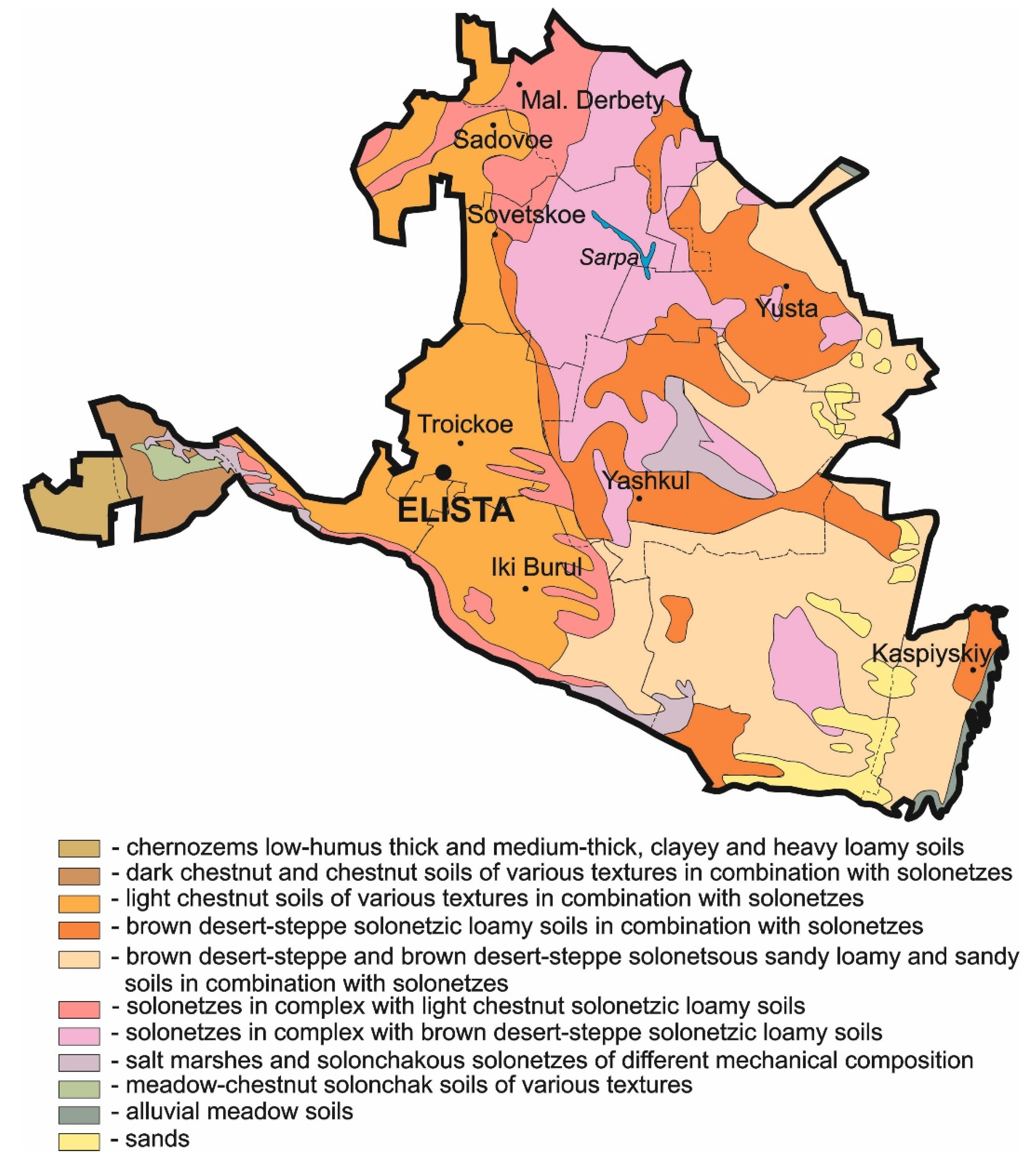
In this study, the issue of the ecological stability of the soil and vegetation cover of the North-Western Near-Caspian arid zones within the borders of the Black Lands (BL) of the Republic of Kalmykia was considered. Modeling was carried out of the open systems’ thermodynamics principles using continuous and discrete formalisms. Models presented in the form of systems of ordinary differential equations, Markov’s circuits, and autonomous impulse processes show the possibility of their application in the management of pasture feed stocks. Modeling with the systems of differential equations makes it possible to identify points of stable states of pasture systems. Markov circuits are able to establish an optimal animal load on these systems. A computational algorithm for determining the stability of pasture ecosystems using autonomous impulse processes allows optimization problems to be solved to determine the conditions for the spread of external influences. Computational experiments were carried out to determine the parameters of the model corresponding to the sustainable mode of operation in arid pasture ecosystems.
Keywords: degradation; desertification; ordinary differential equations; autonomous and impulse processes; Markov circuits (MC); stability degradation; desertification; ordinary differential equations; autonomous and impulse processes; Markov circuits (MC); stability