

Phosphorus Fertilizers From Sewage Sludge Ash and Animal Blood Have No Effect on Earthworms



Abstract
1. Introduction
2. Materials and Methods
2.1. Fertilizers
2.2. Soil and Meteorological Conditions
2.3. Experimental Design and Agronomic Management
2.4. Earthworm Sampling and Identification
2.5. Statistical Analysis
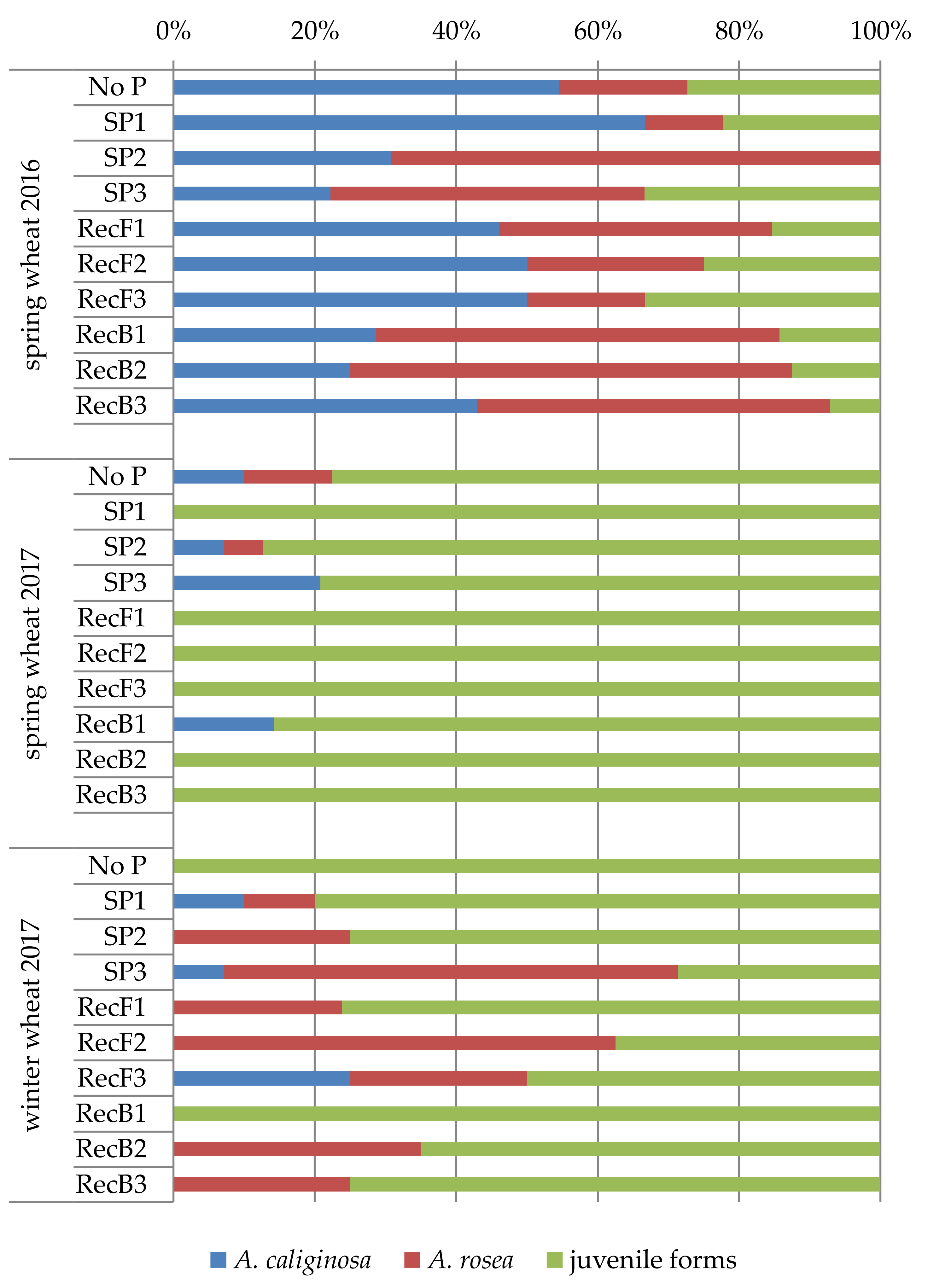
3. Results and Discussion
4. Conclusions
Supplementary Materials
Author Contributions
Funding
Acknowledgments
Conflicts of Interest
References
- Van Groenigen, J.W.; Lubbers, I.M.; Vos, H.M.J.; Brown, G.G.; De Deyn, G.B.; Van Groenigen, K.J. Earthworms increase plant production: A meta-analysis. Sci. Rep. 2014, 4, 6365. [Google Scholar] [CrossRef] [Scilit] [PubMed]
- Bhadauria, T.; Saxena, K.G. Role of earthworms in soil fertility maintenance through the production of biogenic structures. Appl. Environ. Soil Sci. 2010, 2010. [Google Scholar] [CrossRef] [Scilit]
- Johnston, A.S.A.; Sibly, R.M.; Hodson, M.E.; Alvarez, T.; Thorbek, P. Effects of agricultural management practices on earthworm populations and crop yield: Validation and application of a mechanistic modelling approach. J. Appl. Ecol. 2015, 52, 1334–1342. [Google Scholar] [CrossRef] [Scilit]
- Feledyn-Szewczyk, B.; Radzikowski, P.; Stalenga, J.; Matyka, M. Comparison of the effect of perennial energy crops and arable crops on earthworm populations. Agronomy 2019, 9, 675. [Google Scholar] [CrossRef] [Scilit]
- Ashworth, A.J.; Allen, F.L.; Tyler, D.D.; Pote, D.H.; Shipitalo, M.J. Earthworm populations are affected from long-term crop sequences and bio-Covers under no-Tillage. Pedobiologia 2017, 60, 27–33. [Google Scholar] [CrossRef] [Scilit]
- Doran, J.W.; Zeiss, M.R. Soil health and sustainability: Managing the biotic component of soil quality. Appl. Soil Ecol. 2000, 15, 3–11. [Google Scholar] [CrossRef] [Scilit]
- Edwards, C.A.; Bohlen, P.J. Biology and Ecology of Earthworms, 3rd ed.; Chapman & Hall: London, UK, 1996; p. 426. [Google Scholar]
- Baldivieso-Freitas, P.; Blanco-Moreno, J.M.; Gutiérrez-López, M.; Peigné, J.; Pérez-Ferrer, A.; Trigo-Aza, D.; Sans, F.X. Earthworm abundance response to conservation agriculture practices in organic arable farming under Mediterranean climate. Pedobiologia 2018, 66, 58–64. [Google Scholar] [CrossRef] [Scilit]
- Radziemska, M.; Bęś, A.; Gusiatin, Z.M.; Majewski, G.; Mazur, Z.; Bilgin, A.; Jaskulska, I.; Brtnický, M. Immobilization of Potentially Toxic Elements (PTE) by Mineral-Based Amendments: Remediation of Contaminated Soils in Post-Industrial Sites. Minerals 2020, 10, 87. [Google Scholar] [CrossRef] [Scilit]
- Lalthanzara, H.; Ramanujam, S.N. Effect of fertilizer (NPK) on earthworm population in the agro-Forestry system of Mizoram India. Sci. Vis. 2010, 10, 159–167. [Google Scholar]
- Marhan, S.; Scheu, S. The influence of mineral and organic fertilisers on the growth of the endogeic earthworm Octolasion tyrtaeum (Savigny). Pedobiologia 2005, 49, 239–249. [Google Scholar] [CrossRef] [Scilit]
- Abbiramy, K.S.K.; Ross, P.R.; Paramanandham, J.P. Assessment of acute toxicity of superphosphate to Eisenia foetida using paper contact method. Asian J. Plant Sci. Res. 2013, 3, 112–115. [Google Scholar]
- Shruthi, N.; Biradar, A.P.; Muzammil, S. Toxic effect of inorganic fertilizers to earthworms (Eudrilus eugeniae). J. Entomol. Zool. Stud. 2017, 5, 1135–1137. [Google Scholar]
- European Commission. Report on critical raw materials for the EU. In Report of the Ad-Hoc Working Group on Defining Critical Raw Materials; EC: Brussels, Belgium, 2014; p. 41. [Google Scholar]
- Romiński, M.; Michalak, P.; Jaskulski, D.; Jaskulska, I. Technology for manufacturing granulated magnesium fertilizers with the use of wastes from chlorine production. Przem. Chem. 2011, 90, 628–630. [Google Scholar]
- Jaskulski, D.; Jaskulska, I. Possibility of using waste from the polyvinyl chloride production process for plant fertilization. Pol. J. Environ. Stud. 2011, 20, 351–354. [Google Scholar]
- Smol, M. The importance of sustainable phosphorus management in the circular economy (CE) model: The Polish case study. J. Mater. Cycl. Waste Manag. 2019, 21, 227–238. [Google Scholar] [CrossRef] [Scilit]
- Herzel, H.; Krüger, O.; Hermann, L.; Adam, C. Sewage sludge ash-A promising secondary phosphorus source for fertilizer production. Sci. Total Environ. 2016, 542, 1136–1143. [Google Scholar] [CrossRef] [Scilit]
- Saeid, A.; Wyciszkiewicz, M.; Jastrzębska, M.; Chojnacka, K.; Górecki, H. A concept of production of new generation of phosphorus-Containing biofertilizers. BioFertP project. Przem. Chem. 2015, 94, 361–365. [Google Scholar]
- Saeid, A.; Labuda, M.; Chojnacka, K.; Górecki, H. Use of microorganism in production of phosphorus fertilizers. Przem. Chem. 2012, 91, 956–958. [Google Scholar]
- Jastrzębska, M.; Kostrzewska, M.K.; Saeid, A.; Treder, K.; Makowski, P.; Jastrzębski, W.P.; Okorski, A. Granulated phosphorus fertilizer made of ash from biomass combustion and bones with addition of Bacillus megaterium in the field assessment. Part 1. Impact on yielding and sanitary condition of winter wheat. Przem. Chem. 2017, 96, 2168–2174. [Google Scholar]
- Severin, M.; Breuer, J.; Rex, M.; Stemann, J.; Adam, C.; Van den Weghe, H.; Kücke, M. Phosphate fertilizer value of heat treated sewage sludge ash. Plant Soil Environ. 2014, 60, 555–561. [Google Scholar] [CrossRef] [Scilit]
- Jastrzȩbska, M.; Kostrzewska, M.K. Using an environment-friendly fertiliser from sewage sludge ash with the addition of Bacillus megaterium. Minerals 2019, 9, 423. [Google Scholar] [CrossRef] [Scilit]
- McGrath, S.P.; Chaudri, A.M.; Giller, K.E. Long-term effects of metals in sewage sludge on soils, microorganisms and plants. J. Ind. Microbiol. 1995, 14, 94–104. [Google Scholar] [CrossRef] [Scilit] [PubMed]
- Charlton, A.; Sakrabani, R.; Tyrrel, S.; Rivas Casado, M.; McGrath, S.P.; Crooks, B.; Cooper, P.; Campbell, C.D. Long-term impact of sewage sludge application on soil microbial biomass: An evaluation using meta-analysis. Environ. Pollut. 2016, 219, 1021–1035. [Google Scholar] [CrossRef] [Scilit] [PubMed]
- Rolewicz, M.; Rusek, P.; Borowik, K. Obtaining of granular fertilizers based on ashes from combustion of waste residues and ground bones using phosphorous solubilization by bacteria Bacillus megaterium. J. Environ. Manag. 2018, 216, 128–132. [Google Scholar] [CrossRef] [Scilit]
- Pfiffner, L. Earthworms—architects of fertile soils. Their significance and recommendations for their promotion in agriculture. In Technical Guide on Earthworms; Research Institute of Organic Agriculture: Frick, Switzerland, 2014. [Google Scholar]
- Food and Agriculture Organization of the United Nations. World reference base for soil resources 2014. In International Soil Classification System for Naming Soils and Creating Legends for Soil Maps; Food and Agriculture Organization of the United Nations: Rome, Italy, 2014. [Google Scholar]
- Ivask, M.; Kuu, A.; Truu, M.; Truu, J. The effect of soil type and soil moisture on earthworm communities. Agric. Sci. 2006, 17, 7–11. [Google Scholar]
- Singh, J.; Schädler, M.; Demetrio, W.; Brown, G.G.; Eisenhauer, N. Climate change effects on earthworms-A review. Soil Org. 2019, 91, 114. [Google Scholar]
- Kasprzak, K. Soil Oligochaeta. 3. Family: Earthworms (Lumbricidae); Państwowe Wydawnictwo Naukowe: Warsaw, Poland, 1986; p. 186. [Google Scholar]
- Statistica (Data Analysis Software System), version 12; StatSoft: Tulsa, OK, USA, 2014.
- Tiwari, S.C. Effects of organic manure and NPK fertilization on earthworm activity in an Oxisol. Biol. Fertil. Soil 1993, 16, 293–295. [Google Scholar] [CrossRef] [Scilit]
- Kanianska, R.; Jad’ud’ová, J.; Makovníková, J.; Kizeková, M. Assessment of relationships between earthworms and soil abiotic and biotic factors as a tool in sustainable agricultural. Sustainability 2016, 8, 906. [Google Scholar] [CrossRef] [Scilit]
- Dinter, A.; Oberwalder, C.; Kabouw, P.; Coulson, M.; Ernst, G.; Leicher, T.; Miles, M.; Weyman, G.; Klein, O. Occurrence and distribution of earthworms in agricultural landscapes across Europe with regard to testing for responses to plant protection products. J. Soil Sedim. 2013, 13, 278–293. [Google Scholar] [CrossRef] [Scilit]
- Geraskina, A.P. Restoration of earthworms community (Oligochaeta: Lumbricidae) at sand quarries (Smolensk Oblast, Russia). Ecol. Quest. 2019, 30, 1–13. [Google Scholar] [CrossRef] [Scilit]
- Tripathi, G.; Kachhwaha, N.; Dabi, I.; Singh, J. Earthworms as bioengineers. In Frontiers in Ecology Research; Nova Publishers: New York, NY, USA, 2007; p. 227. [Google Scholar]
- Iordache, M.; Borza, I. Relation between chemical indices of soil and earthworm abundance under chemical fertilization. Plant Soil Environ. 2010, 56, 401–407. [Google Scholar] [CrossRef] [Scilit]
- Chauhan, R.P.; Pande, K.R.; Shah, S.C.; Dhakal, D.D. Soil properties and earthworm dynamics affected by land use systems in western Chitwan, Nepal. J. Inst. Agric. Anim. Sci. 2015, 33–34, 123–128. [Google Scholar] [CrossRef] [Scilit]
- Khan, M.U.; Ahmed, M.; Nazim, K. The population behavior of earth worm (Oheritema posthuma Kinberg) under the influence of industrial waste. FUUAST J. Biol. 2017, 7, 1–8. [Google Scholar]
- Jayathilakan, K.; Sultana, K.; Radhakrishna, K.; Bawa, A.S. Utilization of byproducts and waste materials from meat, poultry and fish processing industries: A review. J. Food Sci. Tech. 2012, 49, 278–293. [Google Scholar] [CrossRef] [Scilit] [PubMed]
- Yunta, F.; Di Foggia, M.; Bellido-Díaz, V.; Morales-Calderón, M.; Tessarin, P.; López-Rayo, S.; Tinti, A.; Kovács, K.; Klencsár, Z.; Fodor, F.; et al. Blood meal-based compound. Good choice as iron fertilizer for organic farming. J. Agric. Food Chem. 2013, 61, 3995–4003. [Google Scholar] [CrossRef] [Scilit] [PubMed]
- Kowalski, Z.; Makara, A.; Banach, M. Krew zwierzęca, metody jej przetwarzania i zastosowanie. Tech. Trans. Chem. 2011, 108, 87–105. [Google Scholar]
- Neuhauser, E.F.; Loehr, R.C.; Milligan, D.L.; Malecki, M.R. Toxicity of metals to the earthworm Eisenia fetida. Biol. Fert. Soil 1985, 1, 149–152. [Google Scholar] [CrossRef] [Scilit]
- Spurgeon, D.J.; Hopkin, S.P. The effects of metal contamination on earthworm populations around a smelting works: Quantifying species effects. Appl. Soil Ecol. 1996, 4, 147–160. [Google Scholar] [CrossRef] [Scilit]
- Zhao, L.; Qiu, J.P. Aluminum bioaccumulation in the earthworm and acute toxicity to the earthworm. In Proceedings of the 4th International Conference on Bioinformatics and Biomedical Engineering, Chengdu, China, 18–20 June 2010. [Google Scholar]
- Stoven, K.; Schnug, E. Long term effects of heavy metal enriched sewage sludge disposal in agriculture on soil biota. Landbauforsch. Volkenrode 2009, 59, 131–138. [Google Scholar]
- Rastetter, N.; Rothhaupt, K.O.; Gerhardt, A. Ecotoxicological Assessment of Phosphate Recyclates from Sewage Sludges. Water Air Soil Pollut. 2017, 228, 171. [Google Scholar] [CrossRef] [Scilit]
- Elyamine, A.M.; Afzal, J.; Rana, M.S.; Imran, M.; Cai, M.; Hu, C. Phenanthrene mitigates cadmium toxicity in earthworms Eisenia fetida (epigeic specie) and Aporrectodea caliginosa (endogeic specie) in soil. Int. J. Environ. Res. Public Health 2018, 15, 2384. [Google Scholar] [CrossRef] [Scilit] [PubMed]
- Yahyaabadi, M.; Hamidian, A.H.; Ashrafi, S. Dynamics of earthworm species at different depths of orchard soil receiving organic or chemical fertilizer amendments. Eurasian J. Soil Sci. 2018, 7, 318–325. [Google Scholar] [CrossRef] [Scilit]
- Jastrzębska, M.; Kostrzewska, M.K.; Makowski, P.; Treder, K.; Marks, M. Effects of ash and bone phosphorus biofertilizers on Bacillus megaterium counts and select biological and physical soil properties. Pol. J. Environ. Stud. 2015, 24, 1603–1609. [Google Scholar] [CrossRef] [Scilit]
- Jastrzębska, M.; Kostrzewska, M.K.; Makowski, P.; Treder, K.; Jastrzębski, W.P. Functional properties of granulated ash and bone-based phosphorus biofertilizers in the field assessment. Part 3. Impact on selected properties of soil environment of winter wheat. Przem. Chem. 2016, 95, 1591–1594. [Google Scholar]
- Jastrzębska, M.; Kostrzewska, M.K.; Makowski, P.; Treder, K.; Jastrzębski, W.P. Granulated phosphorus fertilizer made of ash from biomass combustion and bones with addition of Bacillus megaterium in the field assessment. Part 3. Impact on selected properties of soil environment of winter wheat. Przem. Chem. 2017, 96, 2180–2183. [Google Scholar]

| Element | Unit | 2016 | 2017 | ||
|---|---|---|---|---|---|
| RecF | RecB | RecF | RecB | ||
| P | % mass. | 8.68 | 9.55 | 5.40 | 4.95 |
| N | 2.89 | 2.87 | 3.44 | 3.15 | |
| K | 1.09 | 1.16 | 0.62 | 0.67 | |
| C | 13.4 | 14.6 | 14.2 | 12.3 | |
| Mg | 1.54 | 1.70 | 0.79 | 0.78 | |
| S | 0.56 | 0.56 | 0.47 | 0.40 | |
| C | 12.5 | 13.9 | 16.5 | 18.1 | |
| Fe | g kg–1 | 26.9 | 29.0 | 11.4 | 11.3 |
| Al | 23.7 | 25.5 | 11.3 | 12.1 | |
| Zn | 3.14 | 3.29 | 1.09 | 0.99 | |
| As | mg kg–1 | 31.4 | 20.0 | 15.5 | 20.5 |
| Cd | <0.01 | 0.345 | 0.660 | 0.742 | |
| Cr | 54.7 | 62.9 | 63.9 | 59.1 | |
| Cu | 778 | 850 | 334 | 334 | |
| Ni | 54.8 | 62.6 | 28.5 | 21.2 | |
| Pb | 19.9 | 21.8 | 0.920 | 4.53 | |
| B | 71.3 | 74.1 | 41.1 | 57.6 | |
| Ba | 349 | 382 | 162 | 168 | |
| Co | 14.0 | 16.2 | 5.24 | 4.24 | |
| Mn | 562 | 609 | 299 | 437 | |
| Mo | 35.3 | 23.7 | 9.25 | 13.9 | |
| Experiment | Soil Type | Soil Texture | pH in KCl | Total, g kg–1 | ||||
|---|---|---|---|---|---|---|---|---|
| C | N | P | K | Mg | ||||
| Spring wheat 2016 | Luvisols 1 | sandy clay loam | 6.28 | 8.53 | 1.42 | 0.61 | 2.98 | 2.02 |
| Spring wheat 2017 | Luvisols | sandy clay loam | 6.23 | 8.48 | 1.34 | 0.60 | 3.14 | 1.94 |
| Winter wheat 2017 | Luvisols | sandy loam | 4.98 | 6.48 | 1.01 | 0.49 | 2.95 | 1.88 |
| Year | Month | Atmospheric Precipitation (mm) | Air Temperature (°C) | ||||||
|---|---|---|---|---|---|---|---|---|---|
| Period of Ten Days | Total | Period of Ten Days | Average | ||||||
| 1st | 2nd | 3rd | 1st | 2nd | 3rd | ||||
| 2016 | July | 39.6 | 34.0 | 65.0 | 138.6 | 17.5 | 18.1 | 19.9 | 18.5 |
| August | 54.5 | 10.4 | 7.0 | 71.9 | 17.7 | 15.6 | 19.3 | 17.6 | |
| 2017 | July | 29.4 | 20.7 | 56.0 | 106.1 | 16.0 | 17.2 | 18.5 | 17.3 |
| August | 31.6 | 11.7 | 11.5 | 54.8 | 20.8 | 19.2 | 16.3 | 18.7 | |
| Treatment Symbol | Fertilizer | P Dose, kg P ha−1 |
|---|---|---|
| No P | without phosphorus fertilizer | 0 |
| SP1 | superphosphate | 17.6 |
| SP2 | 26.4 | |
| SP3 | 35.2 | |
| RecF1 | fertilizer from sewage sludge ash and | 17.6 |
| RecF2 | dried animal blood | 26.4 |
| RecF3 | 35.2 | |
| RecB1 | biofertilizer from sewage sludge ash | 17.6 |
| RecB2 | and dried animal blood | 26.4 |
| RecB3 | 35.2 |
| Item | Experiment | ||
|---|---|---|---|
| Spring Wheat 2016 | Spring Wheat 2017 | Winter Wheat 2017 | |
| Wheatcultivar | Monsun | Monsun | Julius |
| Previous crop | winter rape | spring wheat | winter wheat |
| Soil tillagesystem | plough tillage | plough tillage | plough tillage |
| Fertilization | |||
| −K2O 1,kg ha−1 | 100 | 100 | 100 |
| –N 2, kg ha−1 | 130 | 110 | 150 |
| Plantprotection | |||
| –Herbicides | florasulam + 2,4-D (29 May) | florasulam + 2,4-D (22 May) | florasulam + 2,4-D (13 May) |
| –Fungicides | thiophanate-methyl +tetraconazole (9 June)azoxystrobin (8 July) | thiophanate-methyl + tetraconazole (6 June) azoxystrobin + (propiconazole + cyproconazole) (28 June) | fenpropimorph + epoxiconazole + metrafenone (16 May)fluxapyroxad + pyraclostrobin + epoxiconazole (8 June) |
| –Insecticides | lambda-cyhalothrin(6 June) | deltamethrin (6 June) | deltamethrin (6 June) |
| –Growthregulators | – | – | trinexapac-ethyl (16 May) |
| Sowing date | 21 April 2016 | 20 April 2017 | 4 October 2016 |
| Harvest date | 12 August 2016 | 18 August 2017 | 4 August 2017 |
| P Treatment | Spring Wheat 2016 | Spring Wheat 2017 | Winter Wheat 2017 | |||
|---|---|---|---|---|---|---|
| Earthworm | ||||||
| Density | Biomass | Density | Biomass | Density | Biomass | |
| No P | 22 | 16.3 | 18 | 7.8 | 6 | 1.1 |
| SP1 | 18 | 9.8 | 24 | 5.4 | 22 | 7.6 |
| SP2 | 26 | 21.5 | 32 | 12.0 | 12 | 7.3 |
| SP3 | 18 | 9.4 | 20 | 8.0 | 16 | 8.5 |
| RecF1 | 26 | 15.0 | 12 | 3.2 | 20 | 8.1 |
| RecF2 | 8 | 6.7 | 16 | 3.5 | 20 | 11.0 |
| RecF3 | 12 | 6.1 | 12 | 3.6 | 12 | 6.6 |
| RecB1 | 14 | 11.4 | 16 | 6.7 | 10 | 3.8 |
| RecB2 | 16 | 9.1 | 6 | 1.6 | 14 | 8.0 |
| RecB3 | 28 | 16.4 | 44 | 11.2 | 8 | 4.9 |
© 2020 by the authors. Licensee MDPI, Basel, Switzerland. This article is an open access article distributed under the terms and conditions of the Creative Commons Attribution (CC BY) license (http://creativecommons.org/licenses/by/4.0/).
Share and Cite
Jastrzębska, M.; Kostrzewska, M.K.; Treder, K. Phosphorus Fertilizers From Sewage Sludge Ash and Animal Blood Have No Effect on Earthworms. Agronomy 2020, 10, 525. https://doi.org/10.3390/agronomy10040525
Jastrzębska M, Kostrzewska MK, Treder K. Phosphorus Fertilizers From Sewage Sludge Ash and Animal Blood Have No Effect on Earthworms. Agronomy. 2020; 10(4):525. https://doi.org/10.3390/agronomy10040525
Chicago/Turabian StyleJastrzębska, Magdalena, Marta K. Kostrzewska, and Kinga Treder. 2020. "Phosphorus Fertilizers From Sewage Sludge Ash and Animal Blood Have No Effect on Earthworms" Agronomy 10, no. 4: 525. https://doi.org/10.3390/agronomy10040525
APA StyleJastrzębska, M., Kostrzewska, M. K., & Treder, K. (2020). Phosphorus Fertilizers From Sewage Sludge Ash and Animal Blood Have No Effect on Earthworms. Agronomy, 10(4), 525. https://doi.org/10.3390/agronomy10040525

