Review

Bioplastics Toxicity upon Ingestion: A Critical Review of Biotransformation and Gastrointestinal Effects


by
Cristiana Fernandes
1,
Helena Oliveira
2,
Teresa Rocha-Santos
1 and
Verónica Bastos
2,*
1
Centre for Environmental and Marine Studies (CESAM), Department of Chemistry, University of Aveiro, 3810-193 Aveiro, Portugal
2
Centre for Environmental and Marine Studies (CESAM), Department of Biology, University of Aveiro, 3810-193 Aveiro, Portugal
*
Author to whom correspondence should be addressed.
Polymers 2026, 18(9), 1091; https://doi.org/10.3390/polym18091091
Submission received: 13 March 2026 / Revised: 22 April 2026 / Accepted: 28 April 2026 / Published: 29 April 2026
(This article belongs to the Section Circular and Green Sustainable Polymer Science)

Abstract

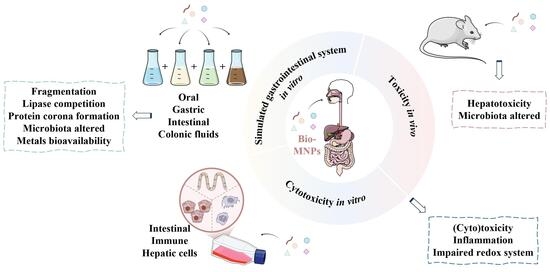
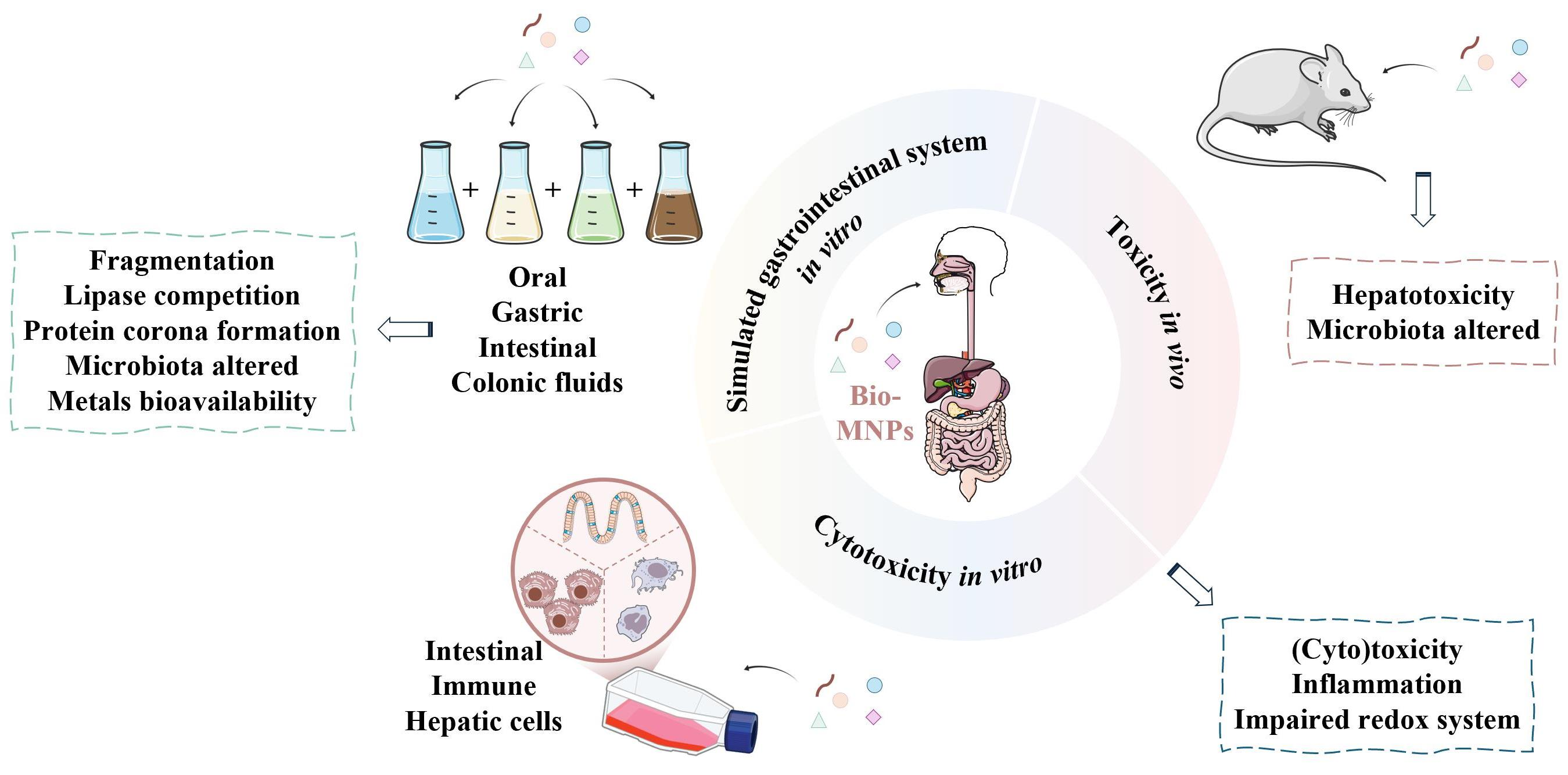
In response to the plastic pollution crisis, bioplastics emerged as a sustainable alternative. However, low degradation rate and abiotic decomposition generate micro- and nanoplastics. These particles enter the food chain, establishing oral intake as a key route of human exposure. This review gathered studies on the biotransformation of bioplastics in the gastrointestinal tract and on their toxicity in human cells and murine models. Most studies focused on polylactic acid particles due to widespread use in food packaging. Under simulated gastrointestinal conditions in vitro, particles were modulated, resulting in cavity and pore formation, fragmentation, lipase competition, protein corona formation, and alterations in the gut microbiota (including Selenomonadaceae, Bifidobacterium, and Prevotellaceae). Also, particle breakdown increases surface area, enhancing interactions with biomolecules and causing higher in vitro and in vivo toxicity. Indeed, pro-inflammatory cytokine secretion, oxidative stress induction, and redox imbalance were found in both models. In mice, alterations in gut microbiota involving Bacillales indirectly mediated hepatotoxicity, leading to uric acid and triglyceride accumulation. Furthermore, microbiota adaptation over time was suggested with an increase in microorganisms and the potential conversion of L-lactic into harmful D-lactic acid. Despite limited studies, this review highlighted that ingested bioplastic-derived micro- and nanoplastics can lead to toxic effects.
Keywords: bioplastic; micro- and nanoplastics; gastrointestinal tract; cytotoxicity; oxidative stress; inflammation; human health bioplastic; micro- and nanoplastics; gastrointestinal tract; cytotoxicity; oxidative stress; inflammation; human health
Graphical Abstract