Quaternized Chitosan Crosslinked Networks for pH-Responsive Macromolecule Delivery: A Review

Abstract
1. Introduction
2. Chitosan and Its Derivatives
2.1. Chitosan Modification Research
2.2. Preparation and Characteristics of Quaternary Ammonium Salt Chitosan
2.2.1. Chemical Synthesis Methods for Quaternary Ammonium Salt Chitosan (QCS)
2.2.2. Key Factors Influencing the Properties of Quaternized Chitosan
Influence of Quaternization Degree on Zeta Potential, Water Solubility, and Charge Density
Influence of Quaternary Ammonium Groups on Antibacterial Activity
pH-Responsiveness (Swelling/Shrinkage Behavior)
3. Tailoring Network Properties Through Crosslinking Strategies
3.1. Crosslinking Strategies and Performance Regulation
3.2. Synergistic Mechanisms of Crosslinked Networks and Their Applications in the Pharmaceutical Field
3.2.1. Synergistically Enhancing Loading, Protection, and Delivery Efficiency
3.2.2. Construction of pH-Sensitive Crosslinked Network
3.2.3. Influence of Crosslinking Density on Drug Delivery Performance
4. Application Frontiers and Translational Hurdles
4.1. Anti-Tumor and Cancer Delivery Therapy
4.1.1. Active Targeting to Decouple Uptake from Toxicity
4.1.2. Synergistic Combination Strategies
4.1.3. Expanding the Therapeutic Repertoire
4.2. Food Packaging and Personal Care Products
4.2.1. pH-Responsive Smart Packaging
4.2.2. Cosmetics and Personal Care Sector
5. Future Perspectives and Emerging Paradigms
5.1. Key Challenges in Translational Research
5.2. Addressing Limitations of Green Crosslinking Systems
5.2.1. Color Limitation and Route to Improvement
5.2.2. Reaction-Time and Kinetic Shortcut
5.2.3. Cost Outlook at Lab-Scale vs. Industrial-Scale
6. Conclusions
Author Contributions
Funding
Data Availability Statement
Acknowledgments
Conflicts of Interest
References
- Aranaz, I.; Alcántara, A.R.; Civera, M.C.; Arias, C.; Elorza, B.; Heras Caballero, A.; Acosta, N. Chitosan: An Overview of Its Properties and Applications. Polymers 2021, 13, 3256. [Google Scholar] [CrossRef] [PubMed]
- Potaś, J.; Szymańska, E.; Winnicka, K. Challenges in Developing of Chitosan–Based Polyelectrolyte Complexes as a Platform for Mucosal and Skin Drug Delivery. Eur. Polym. J. 2020, 140, 110020. [Google Scholar] [CrossRef]
- Bilican, I.; Pekdemir, S.; Onses, M.S.; Akyuz, L.; Altuner, E.M.; Koc-Bilican, B.; Zang, L.-S.; Mujtaba, M.; Mulerčikas, P.; Kaya, M. Chitosan Loses Innate Beneficial Properties after Being Dissolved in Acetic Acid: Supported by Detailed Molecular Modeling. ACS Sustain. Chem. Eng. 2020, 8, 18083–18093. [Google Scholar] [CrossRef]
- Li, A.; Ma, B.; Hua, S.; Ping, R.; Ding, L.; Tian, B.; Zhang, X. Chitosan-Based Injectable Hydrogel with Multifunction for Wound Healing: A Critical Review. Carbohydr. Polym. 2024, 333, 121952. [Google Scholar] [CrossRef]
- Edo, G.I.; Yousif, E.; Al-Mashhadani, M.H. Modified Chitosan: Insight on Biomedical and Industrial Applications. Int. J. Biol. Macromol. 2024, 275, 133526. [Google Scholar] [CrossRef]
- Biswas, U.K.; Bose, A.; Ghosh, B.; Sharma, S. An Insight into Chemically Modified Chitosan and Their Biological, Pharmaceutical, and Medical Applications: A Review. Int. J. Biol. Macromol. 2025, 303, 140612. [Google Scholar] [CrossRef]
- Mottaghitalab, F.; Khodadadi Yazdi, M.; Reza Saeb, M.; Bączek, T.; Farokhi, M. Green and Sustainable Hydrogels Based on Quaternized Chitosan to Enhance Wound Healing. Chem. Eng. J. 2024, 492, 152288. [Google Scholar] [CrossRef]
- Xu, M.; Fang, D.; Shi, C.; Xia, S.; Wang, J.; Deng, B.; Kimatu, B.M.; Guo, Y.; Lyu, L.; Wu, Y.; et al. Anthocyanin-Loaded Polylactic Acid/Quaternized Chitosan Electrospun Nanofiber as an Intelligent and Active Packaging Film in Blueberry Preservation. Food Hydrocoll. 2025, 158, 110586. [Google Scholar] [CrossRef]
- Hu, Q.; Bae, M.; Fleming, E.; Lee, J.-Y.; Luo, Y. Biocompatible Polymeric Nanoparticles with Exceptional Gastrointestinal Stability as Oral Delivery Vehicles for Lipophilic Bioactives. Food Hydrocoll. 2019, 89, 386–395. [Google Scholar] [CrossRef]
- Chen, W.-T.; Kuo, Y.-L.; Chen, C.-H.; Wu, H.-T.; Chen, H.-W.; Fang, W.-P. Improving the Stability and Bioactivity of Curcumin Using Chitosan-Coated Liposomes through a Combination Mode of High-Pressure Processing. LWT 2022, 168, 113946. [Google Scholar] [CrossRef]
- Masih, R.; Iqbal, M.S. Thermal Degradation Kinetics and Pyrolysis GC–MS Study of Curcumin. Food Chem. 2022, 385, 132638. [Google Scholar] [CrossRef]
- Chen, H.; Zhang, M.; Bhandari, B.; Yang, C. Novel pH-Sensitive Films Containing Curcumin and Anthocyanins to Monitor Fish Freshness. Food Hydrocoll. 2020, 100, 105438. [Google Scholar] [CrossRef]
- Sarmah, D.; Rather, M.A.; Sarkar, A.; Mandal, M.; Sankaranarayanan, K.; Karak, N. Self-Cross-Linked Starch/Chitosan Hydrogel as a Biocompatible Vehicle for Controlled Release of Drug. Int. J. Biol. Macromol. 2023, 237, 124206. [Google Scholar] [CrossRef] [PubMed]
- Confederat, L.G.; Tuchilus, C.G.; Dragan, M.; Sha’at, M.; Dragostin, O.M. Preparation and Antimicrobial Activity of Chitosan and Its Derivatives: A Concise Review. Molecules 2021, 26, 3694. [Google Scholar] [CrossRef] [PubMed]
- Ke, P.; Zeng, D.; Xu, K.; Cui, J.; Li, X.; Wang, G. Preparation of Quaternary Ammonium Salt-Modified Chitosan Microspheres and Their Application in Dyeing Wastewater Treatment. ACS Omega 2020, 5, 24700–24707. [Google Scholar] [CrossRef] [PubMed]
- Km, S.; Ravishankar, K.; Lobo, N.P.; Baskar, R.; Raghavachari, D. Solvent-Less Carboxymethylation-Induced Electrostatic Crosslinking of Chitosan. Int. J. Biol. Macromol. 2023, 253, 126633. [Google Scholar] [CrossRef]
- Yeamsuksawat, T.; Liang, J. Characterization and Release Kinetic of Crosslinked Chitosan Film Incorporated with α-Tocopherol. Food Packag. Shelf Life 2019, 22, 100415. [Google Scholar] [CrossRef]
- Anbinder, P.; Macchi, C.; Amalvy, J.; Somoza, A. Chitosan-Graft-Poly(n-Butyl Acrylate) Copolymer: Synthesis and Characterization of a Natural/Synthetic Hybrid Material. Carbohydr. Polym. 2016, 145, 86–94. [Google Scholar] [CrossRef]
- Conzatti, G.; Ayadi, F.; Cavalie, S.; Carrère, N.; Tourrette, A. Thermosensitive PNIPAM Grafted Alginate/Chitosan PEC. Appl. Surf. Sci. 2019, 467, 940–948. [Google Scholar] [CrossRef]
- Gatto, M.; Ochi, D.; Yoshida, C.M.P.; Da Silva, C.F. Study of Chitosan with Different Degrees of Acetylation as Cardboard Paper Coating. Carbohydr. Polym. 2019, 210, 56–63. [Google Scholar] [CrossRef]
- Jiang, S.; Qiao, C.; Wang, X.; Li, Z.; Yang, G. Structure and Properties of Chitosan/Sodium Dodecyl Sulfate Composite Films. RSC Adv. 2022, 12, 3969–3978. [Google Scholar] [CrossRef] [PubMed]
- Tran Vo, T.M.; Mori, M.; Ohnuma, K.; Chen, X.; Potiyaraj, P. Development of Oxidized Bacterial Cellulose Scaffolds Impregnated with Chitosan and Collagen Peptides for Potential Implant Tissue Engineering Approaches. J. Appl. Polym. Sci. 2026, 143, e70114. [Google Scholar] [CrossRef]
- Hai, L.V.; Zhai, L.; Kim, H.C.; Panicker, P.S.; Pham, D.H.; Kim, J. Chitosan Nanofiber and Cellulose Nanofiber Blended Composite Applicable for Active Food Packaging. Nanomaterials 2020, 10, 1752. [Google Scholar] [CrossRef]
- Liu, N.; Ni, S.; Gao, H.; Chang, Y.; Fu, Y.; Liu, W.; Qin, M. Laccase-Catalyzed Grafting of Lauryl Gallate on Chitosan To Improve Its Antioxidant and Hydrophobic Properties. Biomacromolecules 2021, 22, 4501–4509. [Google Scholar] [CrossRef]
- Yang, J.; Sun, J.; An, X.; Zheng, M.; Lu, Z.; Lu, F.; Zhang, C. Preparation of Ferulic Acid-Grafted Chitosan Using Recombinant Bacterial Laccase and Its Application in Mango Preservation. RSC Adv. 2018, 8, 6759–6767. [Google Scholar] [CrossRef]
- Fujimori, C.; Kumai, J.; Nakamura, K.; Gu, Y.; Katagiri, F.; Hozumi, K.; Kikkawa, Y.; Nomizu, M. Biological Activity of Peptide-conjugated Polyion Complex Matrices Consisting of Alginate and Chitosan. Biopolymers 2017, 108, e22983. [Google Scholar] [CrossRef]
- Liao, J.; Wen, R.; Zhao, X.; Hou, B.; Yin, H.; Zhang, J.; Huang, H. Quaternized Chitin as Biomaterial for Multiple Applications. Cellulose 2024, 31, 4063–4083. [Google Scholar] [CrossRef]
- Liu, Z.; Wang, J.; Li, G.; Yang, S.; Yang, H.; Zuo, J.; Wang, Y. Study on Flocculation Characteristics of Potato Starch Wastewater. Coatings 2023, 13, 1762. [Google Scholar] [CrossRef]
- Min, L.; Liu, M.; Zhu, C.; Liu, L.; Rao, Z.; Fan, L. Synthesis and in Vitro Antimicrobial and Antioxidant Activities of Quaternary Ammonium Chitosan Modified with Nisin. J. Biomater. Sci. Polym. Ed. 2017, 28, 2034–2052. [Google Scholar] [CrossRef]
- Yang, X.; Zhang, C.; Qiao, C.; Mu, X.; Li, T.; Xu, J.; Shi, L.; Zhang, D. A Simple and Convenient Method to Synthesize N-[(2-Hydroxyl)-Propyl-3-Trimethylammonium] Chitosan Chloride in an Ionic Liquid. Carbohydr. Polym. 2015, 130, 325–332. [Google Scholar] [CrossRef]
- Bigogno, R.G.; Rodríguez, R.J.S.; Abreu, M.D.F. Quaternized Chitosan for Ecological Treatment of Bauxite Mining Effluents. J. Polym. Environ. 2018, 26, 4169–4175. [Google Scholar] [CrossRef]
- Guo, Z.; Xing, R.; Liu, S.; Zhong, Z.; Ji, X.; Wang, L.; Li, P. Antifungal Properties of Schiff Bases of Chitosan, N-Substituted Chitosan and Quaternized Chitosan. Carbohydr. Res. 2007, 342, 1329–1332. [Google Scholar] [CrossRef]
- Santos, D.M.D.; Bukzem, A.D.L.; Campana-Filho, S.P. Response Surface Methodology Applied to the Study of the Microwave-Assisted Synthesis of Quaternized Chitosan. Carbohydr. Polym. 2016, 138, 317–326. [Google Scholar] [CrossRef]
- Freitas, E.D.; Moura, C.F., Jr.; Kerwald, J.; Beppu, M.M. An Overview of Current Knowledge on the Properties, Synthesis and Applications of Quaternary Chitosan Derivatives. Polymers 2020, 12, 2878. [Google Scholar] [CrossRef]
- De Moura Junior, C.F.; Ochi, D.; Freitas, E.D.; Kerwald, J.; d’Ávila, M.A.; Beppu, M.M. Synthesis and Characterization of N-Phosphonium Chitosan and Its Virucidal Activity Evaluation against Coronavirus. Int. J. Biol. Macromol. 2023, 246, 125665. [Google Scholar] [CrossRef]
- Sajomsang, W.; Gonil, P.; Ruktanonchai, U.R.; Pimpha, N.; Sramala, I.; Nuchuchua, O.; Saesoo, S.; Chaleawlert-umpon, S.; Puttipipatkhachorn, S. Self-Aggregates Formation and Mucoadhesive Property of Water-Soluble β-Cyclodextrin Grafted with Chitosan. Int. J. Biol. Macromol. 2011, 48, 589–595. [Google Scholar] [CrossRef]
- Zhang, X.; Tian, J.; Wang, P.; Liu, T.; Lu, X.; Guo, J.; Jin, Y.; Xiao, H.; Song, J. Impact of Degree of Substitution of Quaternary Cellulose on the Adsorption on Charged Surfaces and Associated Thermodynamics. Cellulose 2023, 30, 1399–1410. [Google Scholar] [CrossRef]
- Yang, Z.; Wang, C.; Zhang, Z.; Yu, F.; Wang, Y.; Ding, J.; Zhao, Z.; Liu, Y. A pH Responsive Tannic Acid/Quaternized Carboxymethyl Chitosan/Oxidized Sodium Alginate Hydrogels for Accelerated Diabetic Wound Healing and Real-Time Monitoring. Int. J. Biol. Macromol. 2024, 264, 130741. [Google Scholar] [CrossRef]
- Huang, J.; Ye, Y.; Fan, S.; Zhu, Q.; Wang, J.; Chen, Q. Preparation, Optimization, and Targeted Release of Chitosan Quaternary Ammonium Salt Thermosensitive Hydrogels. ChemistrySelect 2025, 10, e202405742. [Google Scholar] [CrossRef]
- Chen, Y.; Li, J.; Li, Q.; Shen, Y.; Ge, Z.; Zhang, W.; Chen, S. Enhanced Water-Solubility, Antibacterial Activity and Biocompatibility upon Introducing Sulfobetaine and Quaternary Ammonium to Chitosan. Carbohydr. Polym. 2016, 143, 246–253. [Google Scholar] [CrossRef]
- Song, Q. Contact-Killing Antibacterial Mechanisms of Polycationic Coatings: A Review. Prog. Org. Coat. 2024, 188, 108214. [Google Scholar] [CrossRef]
- Liu, F.; Zhang, X.; Xiao, X.; Duan, Q.; Bai, H.; Cao, Y.; Zhang, Y.; Alee, M.; Yu, L. Improved Hydrophobicity, Antibacterial and Mechanical Properties of Polyvinyl Alcohol/Quaternary Chitosan Composite Films for Antibacterial Packaging. Carbohydr. Polym. 2023, 312, 120755. [Google Scholar] [CrossRef]
- Li, Z.; Yang, F.; Yang, R. Synthesis and Characterization of Chitosan Derivatives with Dual-Antibacterial Functional Groups. Int. J. Biol. Macromol. 2015, 75, 378–387. [Google Scholar] [CrossRef] [PubMed]
- Peng, Z.-X.; Wang, L.; Du, L.; Guo, S.-R.; Wang, X.-Q.; Tang, T.-T. Adjustment of the Antibacterial Activity and Biocompatibility of Hydroxypropyltrimethyl Ammonium Chloride Chitosan by Varying the Degree of Substitution of Quaternary Ammonium. Carbohydr. Polym. 2010, 81, 275–283. [Google Scholar] [CrossRef]
- Wang, Y.; Zhang, M.; Hou, H.; Yin, M.; Ma, Z.; Chen, K.; Huang, Q. Synthesis of Quaternized Chitosan and Its Application in Cotton as Wound-Dressing Material. Surf. Innov. 2023, 11, 213–222. [Google Scholar] [CrossRef]
- Svirshchevskaya, E.V.; Zubareva, A.A.; Boyko, A.A.; Shustova, O.A.; Grechikhina, M.V.; Shagdarova, B.T.; Varlamov, V.P. Analysis of Toxicity and Biocompatibility of Chitosan Derivatives with Different Physico-Chemical Properties. Appl. Biochem. Microbiol. 2016, 52, 483–490. [Google Scholar] [CrossRef]
- Kainthan, R.K.; Gnanamani, M.; Ganguli, M.; Ghosh, T.; Brooks, D.E.; Maiti, S.; Kizhakkedathu, J.N. Blood Compatibility of Novel Water Soluble Hyperbranched Polyglycerol-Based Multivalent Cationic Polymers and Their Interaction with DNA. Biomaterials 2006, 27, 5377–5390. [Google Scholar] [CrossRef]
- Kumar, S.; Sharma, B. Leveraging Electrostatic Interactions for Drug Delivery to the Joint. Bioelectricity 2020, 2, 82–100. [Google Scholar] [CrossRef]
- Pan, Q.; Zhou, C.; Yang, Z.; He, Z.; Wang, C.; Liu, Y.; Song, S.; Gu, H.; Hong, K.; Yu, L.; et al. Preparation and Characterization of Chitosan Derivatives Modified with Quaternary Ammonium Salt and Quaternary Phosphate Salt and Its Effect on Tropical Fruit Preservation. Food Chem. 2022, 387, 132878. [Google Scholar] [CrossRef]
- Yang, X.; Ban, W.; Zhang, R.; Li, X.; Huang, M.; Yang, Q.; Yan, B. Comb-Like Cationic Chitosan-Based Flocculant with Enhanced H-Bond Hydration for Effectively Treating Saline Colored Effluents with High Salinity. Ind. Eng. Chem. Res. 2024, 63, 2534–2543. [Google Scholar] [CrossRef]
- Wang, L.; Pang, Y.; Xin, M.; Li, M.; Shi, L.; Mao, Y. Effect of the Structure of Chitosan Quaternary Ammonium Salts with Different Spacer Groups on Antibacterial and Antibiofilm Activities. Int. J. Biol. Macromol. 2024, 276, 133777. [Google Scholar] [CrossRef] [PubMed]
- Wu, M.; Long, Z.; Xiao, H.; Dong, C. Recent Research Progress on Preparation and Application of N, N, N-Trimethyl Chitosan. Carbohydr. Res. 2016, 434, 27–32. [Google Scholar] [CrossRef] [PubMed]
- Wang, L.; Xue, J.; Zhang, Y. Preparation and Characterization of Curcumin Loaded Caseinate/Zein Nanocomposite Film Using pH-Driven Method. Ind. Crops Prod. 2019, 130, 71–80. [Google Scholar] [CrossRef]
- Guo, Y.; Liu, H.; Xiao, H.; Yuan, M.; Liu, Y.; Sedlařík, V.; Chin, W.-C.; Liu, J.; Guo, L.; Li, C. Self-Assembled Camptothecin Derivatives–Curcuminoids Conjugate for Combinatorial Chemo-Photodynamic Therapy to Enhance Anti-Tumor Efficacy. J. Photochem. Photobiol. B Biol. 2021, 215, 112124. [Google Scholar] [CrossRef]
- Bahramzadeh, E.; Yilmaz, E.; Sheidaei, S.; Nosrati, R. Glutaraldehyde-Crosslinked Chitosan-Graft-Poly(N-Hydroxyethyl Acrylamide) Films: Synthesis, Characterization, and Application as Fe3+ Adsorbent. Int. J. Biol. Macromol. 2025, 321, 146343. [Google Scholar] [CrossRef]
- Zhao, X.; Tang, J.; Liu, Y.; Hu, B.; Chen, Q.; Liu, Y. Reaction Kinetics of Chitosan Nanogels Crosslinked by Genipin. J. Chromatogr. A 2023, 1710, 464427. [Google Scholar] [CrossRef]
- Pomari, A.A.D.N.; Montanheiro, T.L.D.A.; De Siqueira, C.P.; Silva, R.S.; Tada, D.B.; Lemes, A.P. Chitosan Hydrogels Crosslinked by Genipin and Reinforced with Cellulose Nanocrystals: Production and Characterization. J. Compos. Sci. 2019, 3, 84. [Google Scholar] [CrossRef]
- Rahmi; Hafiza, U.; Febriani; Julinawati. Influence of Citric Acid as Crosslinking Agent on the Mechanical Properties of Chitosan-Cellulose Composite Film. In Proceedings of the IOP Conference Series: Earth and Environmental Science; IOP Publishing: Bristol, UK, 2025; Volume 1510, p. 012059. [Google Scholar] [CrossRef]
- Liao, X.; Feng, X.; Xiao, Z.; Williams, G.R.; Huang, X.; Shi, Y.; Qin, H.; Liu, Y. Multifunctional Phenylboric Acid Modified Carboxymethyl Chitosan Based Hydrogel Crosslinked by Tannic Acid. Int. J. Biol. Macromol. 2025, 304, 140958. [Google Scholar] [CrossRef]
- Keya, K.N.; Li, Z.; Xu, L.; Xia, W. Exploring Cross-Link Density and Additive Effects on Mechanical and Morphological Behaviors of Cross-Linked Polymers. Macromol. Mater. Eng. 2024, 310, 2400383. [Google Scholar] [CrossRef]
- Ghibu, E.; Vasile, V.; Caraş, I.; Giol, E.D.; Banu, N.D.; Vuluga, D.M.; Stan, R.; Jerca, V.V.; Jerca, F.A. Poly(2-Isopropenyl-2-Oxazoline) Hydrogels with Biodegradable Junction Points for Drug-Delivery Applications. Chem. Mater. 2024, 36, 7459–7475. [Google Scholar] [CrossRef]
- Li, B.; Mo, L.; Narsimhan, V.; Narsimhan, G.; Frostad, J.M. A Refined Mechanistic Model for Swelling Kinetics of Starch Granules. Soft Matter 2025, 21, 4351–4367. [Google Scholar] [CrossRef]
- Bejenariu, A.; Popa, M.; Dulong, V.; Picton, L.; Le Cerf, D. Trisodium Trimetaphosphate Crosslinked Xanthan Networks: Synthesis, Swelling, Loading and Releasing Behaviour. Polym. Bull. 2009, 62, 525–538. [Google Scholar] [CrossRef]
- Nguyen, T.K.L.; Tonomura, Y.; Ito, N.; Yamaji, A.; Matsuba, G.; Hara, M.; Ikemoto, Y.; Okeyoshi, K. Reconstruction of Chitosan Network Orders Using the Meniscus Splitting Method for Designing pH-Responsive Materials. Langmuir 2024, 40, 11927–11935. [Google Scholar] [CrossRef]
- Xie, P.; Liu, P. pH-Responsive Surface Charge Reversal Carboxymethyl Chitosan-Based Drug Delivery System for pH and Reduction Dual-Responsive Triggered DOX Release. Carbohydr. Polym. 2020, 236, 116093. [Google Scholar] [CrossRef]
- Yang, S.; Liu, L.; Chen, H.; Wei, Y.; Dai, L.; Liu, J.; Yuan, F.; Mao, L.; Li, Z.; Chen, F.; et al. Impact of Different Crosslinking Agents on Functional Properties of Curcumin-Loaded Gliadin-Chitosan Composite Nanoparticles. Food Hydrocoll. 2021, 112, 106258. [Google Scholar] [CrossRef]
- Mathew, S.A.; Arumainathan, S. Crosslinked Chitosan–Gelatin Biocompatible Nanocomposite as a Neuro Drug Carrier. ACS Omega 2022, 7, 18732–18744. [Google Scholar] [CrossRef]
- Zeng, M.; Xu, J.; Luo, Q.; Hou, C.; Qiao, S.; Fu, S.; Fan, X.; Liu, J. Constructing Antibacterial Polymer Nanocapsules Based on Pyridine Quaternary Ammonium Salt. Mater. Sci. Eng. C 2020, 108, 110383. [Google Scholar] [CrossRef]
- He, H.; Huang, Y.; Yan, M.; Xie, Y.; Li, Y. Synergistic Effect of Electrostatic Adsorption and Ion Exchange for Efficient Removal of Nitrate. Colloids Surf. A Physicochem. Eng. Asp. 2020, 584, 123973. [Google Scholar] [CrossRef]
- Zhang, C.; Li, Y.; Xing, S.; Yang, X.; Zhao, J.; Dong, Q. Studies on Intermolecular Interaction of N-Glycidyltrimethyl Ammonium Chloride Modified Chitosan/N,N-Dimethyl-N-Dodecyl-N-(2,3-Epoxy Propyl) Ammonium Chloride and Curcumin Delivery. Polymers 2022, 14, 1936. [Google Scholar] [CrossRef]
- Feng, Y.H.; Zhang, X.P.; Hu, L.F.; Chen, B.Z.; Guo, X.D. Mesoscopic Simulation for the Effect of Cross-Linking Reactions on the Drug Diffusion Properties in Microneedles. J. Chem. Inf. Model. 2021, 61, 4000–4010. [Google Scholar] [CrossRef]
- Zhang, H.-Y.; Sun, C.; Adu-Frimpong, M.; Yu, J.; Xu, X. Glutathione-Sensitive PEGylated Curcumin Prodrug Nanomicelles: Preparation, Characterization, Cellular Uptake and Bioavailability Evaluation. Int. J. Pharm. 2019, 555, 270–279. [Google Scholar] [CrossRef]
- Xue, H.; Ju, Y.; Ye, X.; Dai, M.; Tang, C.; Liu, L. Construction of Intelligent Drug Delivery System Based on Polysaccharide-Derived Polymer Micelles: A Review. Int. J. Biol. Macromol. 2024, 254, 128048. [Google Scholar] [CrossRef]
- Pourtalebi Jahromi, L.; Ghazali, M.; Ashrafi, H.; Azadi, A. A Comparison of Models for the Analysis of the Kinetics of Drug Release from PLGA-Based Nanoparticles. Heliyon 2020, 6, e03451. [Google Scholar] [CrossRef]
- Ritger, P.L.; Peppas, N.A. A Simple Equation for Description of Solute Release I. Fickian and Non-Fickian Release from Non-Swellable Devices in the Form of Slabs, Spheres, Cylinders or Discs. J. Control. Release 1987, 5, 23–36. [Google Scholar] [CrossRef]
- Martín-Camacho, U.D.J.; Rodríguez-Barajas, N.; Sánchez-Burgos, J.A.; Pérez-Larios, A. Weibull β Value for the Discernment of Drug Release Mechanism of PLGA Particles. Int. J. Pharm. 2023, 640, 123017. [Google Scholar] [CrossRef]
- Omer, A.M.; Ziora, Z.M.; Tamer, T.M.; Khalifa, R.E.; Hassan, M.A.; Mohy-Eldin, M.S.; Blaskovich, M.A.T. Formulation of Quaternized Aminated Chitosan Nanoparticles for Efficient Encapsulation and Slow Release of Curcumin. Molecules 2021, 26, 449. [Google Scholar] [CrossRef]
- Wu, C.; Sun, J.; Jiang, H.; Li, Y.; Pang, J. Construction of Carboxymethyl Konjac Glucomannan/Chitosan Complex Nanogels as Potential Delivery Vehicles for Curcumin. Food Chem. 2021, 362, 130242. [Google Scholar] [CrossRef]
- Amidi, M.; Romeijn, S.G.; Borchard, G.; Junginger, H.E.; Hennink, W.E.; Jiskoot, W. Preparation and Characterization of Protein-Loaded N-Trimethyl Chitosan Nanoparticles as Nasal Delivery System. J. Control. Release 2006, 111, 107–116. [Google Scholar] [CrossRef]
- Ding, Z.; Chen, W.; Jiang, F.; Mo, M.; Bi, Y.; Kong, F. Synthesis, Characterization and in Vitro Digestion of Folate Conjugated Chitosan-Loaded Proanthocyanidins Nanoparticles. Food Res. Int. 2023, 163, 112141. [Google Scholar] [CrossRef]
- Giannotti, M.I.; Esteban, O.; Oliva, M.; García-Parajo, M.F.; Sanz, F. pH-Responsive Polysaccharide-Based Polyelectrolyte Complexes as Nanocarriers for Lysosomal Delivery of Therapeutic Proteins. Biomacromolecules 2011, 12, 2524–2533. [Google Scholar] [CrossRef]
- Hecq, J.; Siepmann, F.; Siepmann, J.; Amighi, K.; Goole, J. Development and Evaluation of Chitosan and Chitosan Derivative Nanoparticles Containing Insulin for Oral Administration. Drug Dev. Ind. Pharm. 2015, 41, 2037–2044. [Google Scholar] [CrossRef]
- Chen, K.-Y.; Zeng, S.-Y. Fabrication of Quaternized Chitosan Nanoparticles Using Tripolyphosphate/Genipin Dual Cross-Linkers as a Protein Delivery System. Polymers 2018, 10, 1226. [Google Scholar] [CrossRef]
- Zhong, Y.; Yu, Y.; Peng, Y.; Su, Z.; Mao, Y.; Chen, Y.; Wang, L.; Xin, M.; Li, M. Construction of Schiff Base Dynamically Cross-Linked pH-Responsive Chitosan-Based Hydrogels and Investigation of Their Targeted Oral Delivery Performance for Vitamin B12. Int. J. Biol. Macromol. 2025, 316, 144478. [Google Scholar] [CrossRef]
- Nwosu, C.J.; Hurst, G.A.; Novakovic, K. Genipin Cross-Linked Chitosan-Polyvinylpyrrolidone Hydrogels: Influence of Composition and Postsynthesis Treatment on pH Responsive Behaviour. Adv. Mater. Sci. Eng. 2015, 2015, 621289. [Google Scholar] [CrossRef]
- Huang, S.; Wang, G.; Lin, H.; Xiong, Y.; Liu, X.; Li, H. Preparation and Dynamic Response Properties of Colorimetric Indicator Films Containing pH-Sensitive Anthocyanins. Sens. Actuators Rep. 2021, 3, 100049. [Google Scholar] [CrossRef]
- Luo, F.-L.; Liu, Z.-H.; Chen, T.-L.; Gong, B.-L. Cross-Linked Polyvinyl Alcohol pH Sensitive Membrane Immobilized with Phenol Red for Optical pH Sensors. Chin. J. Chem. 2006, 24, 341–344. [Google Scholar] [CrossRef]
- Ran, R.; Wang, L.; Su, Y.; He, S.; He, B.; Li, C.; Wang, C.; Liu, Y.; Chen, S. Preparation of pH-indicator Films Based on Soy Protein Isolate/Bromothymol Blue and Methyl Red for Monitoring Fresh-cut Apple Freshness. J. Food Sci. 2021, 86, 4594–4610. [Google Scholar] [CrossRef]
- Wang, M.; Zhang, S.; Zhao, Z.; Li, Z.; Nai, J.; Liu, X.; Zhang, K.; Zhong, J.; Li, Y.; Jiang, L. Phenol Red Hydrogel as pH Indicator with Protection against Nanoceria Degradation. J. Sci. Adv. Mater. Devices 2023, 8, 100644. [Google Scholar] [CrossRef]
- Valentino, A.; Yazdanpanah, S.; Conte, R.; Calarco, A.; Peluso, G. Smart Nanocomposite Hydrogels as Next-Generation Therapeutic and Diagnostic Solutions. Gels 2024, 10, 689. [Google Scholar] [CrossRef]
- Yao, X.; Hu, H.; Qin, Y.; Liu, J. Development of Antioxidant, Antimicrobial and Ammonia-Sensitive Films Based on Quaternary Ammonium Chitosan, Polyvinyl Alcohol and Betalains-Rich Cactus Pears (Opuntia Ficus-Indica) Extract. Food Hydrocoll. 2020, 106, 105896. [Google Scholar] [CrossRef]
- Zou, Y.; Sun, Y.; Shi, W.; Wan, B.; Zhang, H. Dual-Functional Shikonin-Loaded Quaternized Chitosan/Polycaprolactone Nanofibrous Film with pH-Sensing for Active and Intelligent Food Packaging. Food Chem. 2023, 399, 133962. [Google Scholar] [CrossRef]
- Far, B.F.; Jahanbakhshi, M.; Jameie, L.; Shojaei, A.; Zarei, K.; Taromi, P.; Jafarzadeh, S.; Ertas, Y.N. Chitosan-Graft-Gelatin Hydrogel Containing Bromothymol Blue as a Food Spoilage Indicator for Intelligent Food Packaging. Adv. Mater. Interfaces 2025, 12, 2400799. [Google Scholar] [CrossRef]
- Wei, X.; Li, J.; Hu, Z.; Wang, C.; Gao, Z.; Cao, Y.; Han, J.; Li, Y. Carbon Quantum Dot/Chitosan-Derived Hydrogels with Photo-stress-pH Multiresponsiveness for Wearable Sensors. Macromol. Rapid Commun. 2023, 44, 2200928. [Google Scholar] [CrossRef]
- Jin, X.; Chen, N.; Liu, G.; Wu, C.; Zhang, W. Core–Shell Hydrogel for Sequential Release of Antiemetics and Chemotherapy Drugs. J. Appl. Polym. Sci. 2026, 143, e58123. [Google Scholar] [CrossRef]
- Ma, Y.; Tang, Y.; Fan, J.; Sun, T.; Qiu, X.; Wei, L.; Zhang, X. A pH-Responsive Dual-Network Biopolysaccharide Hydrogel with Enhanced Self-Healing and Controlled Drug Release Properties. RSC Adv. 2024, 14, 38353–38363. [Google Scholar] [CrossRef]
- Aycan, D.; Yayla, N.A.; Aydin, Y.A. Chitosan Polyvinyl Alcohol Blend Films for Ibuprofen Encapsulation: Fabrication, Characterization and Kinetics. Polym. Degrad. Stab. 2020, 181, 109346. [Google Scholar] [CrossRef]
- Dai, W.T.; Xie, Z.H.; Ke, Y.B.; You, Y.; Rong, M.Z.; Zhang, M.Q.; He, C.Y.; Jiang, H.Q.; Yang, H. Mechanical Enhancement Mechanism of Interlocked Polymer Networks. Mater. Today Phys. 2022, 27, 100768. [Google Scholar] [CrossRef]
- Zhang, Z.; Zhao, J.; Yan, X. Mechanically Interlocked Polymers with Dense Mechanical Bonds. Acc. Chem. Res. 2024, 57, 992–1006. [Google Scholar] [CrossRef]
- Gonçalves, J.; Luzia Pinto, M.; Ferreira, P.; Nunes, C. Customizing Porosity and Mechanical Strength in Chitosan-Based Scaffolds for Enhanced Bone Tissue Regeneration. Carbohydr. Polym. 2025, 368, 124207. [Google Scholar] [CrossRef]
- Huang, L.; Chu, Y.; Zhang, L.; Liu, X.; Hao, W.; Chen, Y.; Dai, J. High Strength Pure Chitosan Hydrogels via Double Crosslinking Strategy. Biomed. Mater. 2021, 16, 045048. [Google Scholar] [CrossRef]
- Zhang, Q.; Zhang, J.; Ping, Q.; Sui, Z.; Song, M. Green Crosslinked Gelatin Films Loaded with Curcumin: A Promising Eco-Friendly Alternative for Food Packaging. Prog. Org. Coat. 2025, 200, 109054. [Google Scholar] [CrossRef]
- Gámiz González, M.A.; Edlund, U.; Vidaurre, A.; Gómez Ribelles, J.L. Synthesis of Highly Swellable Hydrogels of Water-Soluble Carboxymethyl Chitosan and Poly(Ethylene Glycol): CmCHT-PEG Hydrogels. Polym. Int. 2017, 66, 1624–1632. [Google Scholar] [CrossRef]
- Li, S.; Jin, M.; Wu, Y.; Jung, S.; Li, D.; He, N.; Lee, M. An Efficient Enzyme-Triggered Controlled Release System for Colon-Targeted Oral Delivery to Combat Dextran Sodium Sulfate (DSS)-Induced Colitis in Mice. Drug Deliv. 2021, 28, 1120–1131. [Google Scholar] [CrossRef] [PubMed]
- Pathak, K.; Misra, S.K.; Sehgal, A.; Singh, S.; Bungau, S.; Najda, A.; Gruszecki, R.; Behl, T. Biomedical Applications of Quaternized Chitosan. Polymers 2021, 13, 2514. [Google Scholar] [CrossRef]
- Yu, D.; Xiao, X.; Shokoohi, C.; Wang, Y.; Sun, L.; Juan, Z.; Kipper, M.J.; Tang, J.; Huang, L.; Han, G.S.; et al. Recent Advances in Stimuli-Responsive Smart Membranes for Nanofiltration. Adv. Funct. Mater. 2023, 33, 2211983. [Google Scholar] [CrossRef]
- Shi, J.; Shen, M.; Zhao, W.; Liu, J.; Qu, Z.; Zhu, M.; Chen, Z.; Shi, P.; Zhang, Z.; Zhang, S.-S. Ultrasensitive Dual-Signal Detection of Telomerase and MiR-21 Based on Boolean Logic Operations. ACS Appl. Mater. Interfaces 2021, 13, 51393–51402. [Google Scholar] [CrossRef]
- Dosta, P.; Dion, M.Z.; Prado, M.; Hurtado, P.; Riojas-Javelly, C.J.; Cryer, A.M.; Soria, Y.; Andrews Interiano, N.; Muñoz-Taboada, G.; Artzi, N. Matrix Metalloproteinase- and pH-Sensitive Nanoparticle System Enhances Drug Retention and Penetration in Glioblastoma. ACS Nano 2024, 18, 14145–14160. [Google Scholar] [CrossRef]
- Tang, L.; Yang, Z.; Zhou, Z.; Ma, Y.; Kiesewetter, D.O.; Wang, Z.; Fan, W.; Zhu, S.; Zhang, M.; Tian, R.; et al. A Logic-Gated Modular Nanovesicle Enables Programmable Drug Release for On-Demand Chemotherapy. Theranostics 2019, 9, 1358–1368. [Google Scholar] [CrossRef]
- Teotia, A.; Laurén, I.; Borandeh, S.; Seppälä, J. Quaternized Chitosan Derivatives as Viable Antiviral Agents: Structure–Activity Correlations and Mechanisms of Action. ACS Appl. Mater. Interfaces 2023, 15, 18707–18719. [Google Scholar] [CrossRef]
- Chen, Y.; Wen, Y.; Chen, G.; Zhang, H.; Wang, Z. Fabrication of Anti-Algae Coatings by Using Quaternary Ammonium Compounds for Wastewater Treatment Facilities: Anti-Algae Performance and Mechanisms. Colloids Surf. A Physicochem. Eng. Asp. 2020, 587, 124309. [Google Scholar] [CrossRef]
- Jiao, R.; Lin, X.; Zhang, Q.; Zhang, Y.; Qin, W.; Yang, Q.; Xu, C.; Chen, F.; Zhang, K. Anti-Tumor Immune Potentiation Targets-Engineered Nanobiotechnologies: Design Principles and Applications. Prog. Mater. Sci. 2024, 142, 101230. [Google Scholar] [CrossRef]
- Chai, Y.; Wang, Y.; Li, B.; Qi, W.; Su, R.; He, Z. Microfluidic Synthesis of Lignin/Chitosan Nanoparticles for the pH-Responsive Delivery of Anticancer Drugs. Langmuir 2021, 37, 7219–7226. [Google Scholar] [CrossRef] [PubMed]
- Ding, F.; Shi, X.; Wu, S.; Liu, X.; Deng, H.; Du, Y.; Li, H. Flexible Polysaccharide Hydrogel with pH-Regulated Recovery of Self-Healing and Mechanical Properties. Macromol. Mater. Eng. 2017, 302, 1700221. [Google Scholar] [CrossRef]
- Morariu, S. Advances in the Design of Phenylboronic Acid-Based Glucose-Sensitive Hydrogels. Polymers 2023, 15, 582. [Google Scholar] [CrossRef]
- Karami, Z.; Aghajani, E.; Salami, M.; Shadmani, N.; Saghatchi Zanjani, F.; Khalili, Z.; Hamidi, M.; Masoumshahi, M.; Ghanbarzadeh, S.; Kurd, M. Enhanced Antitumor and Antimetastatic Activity of pH-Responsive Curcumin-Loaded Chitosan-Selenium Nanocomposites against Breast Cancer. BioNanoScience 2024, 14, 4679–4691. [Google Scholar] [CrossRef]
- Zhang, J.; Wu, G.; Bobrin, V.A. Nanocarrier Strategies for Deep Tumour Penetration. RSC Appl. Polym. 2025, 3, 1403–1427. [Google Scholar] [CrossRef]
- Fan, Q.; Miao, C.; Huang, Y.; Yue, H.; Wu, A.; Wu, J.; Wu, J.; Ma, G. Hydroxypropyltrimethyl Ammonium Chloride Chitosan-Based Hydrogel as the Split H5N1 Mucosal Adjuvant: Structure-Activity Relationship. Carbohydr. Polym. 2021, 266, 118139. [Google Scholar] [CrossRef]
- Gao, Y.-Z.; Chen, J.-C.; Wu, Y.-X. Amphiphilic Graft Copolymers of Quaternized Alginate-g-Polytetrahydrofuran for Anti-Protein Surfaces, Curcumin Carriers, and Antibacterial Materials. ACS Appl. Polym. Mater. 2021, 3, 3465–3477. [Google Scholar] [CrossRef]
- Ma, L.; Su, C.-R.; Li, S.-Y.; He, S.; Nag, A.; Yuan, Y. Co-Delivery of Curcumin and Quercetin in the Bilayer Structure Based on Complex Coacervation. Food Hydrocoll. 2023, 144, 108907. [Google Scholar] [CrossRef]
- Tan, X.; Liu, Z.; Ouyang, C.; Deng, M.; Xiao, J.; Xiao, S.; Huang, T.; Yu, S.; Chen, H.; Chu, H.; et al. Enhancing Tumor Cell Affinity and Inhibiting Growth with Albumin-Coated Crosslinked Chitosan Nanoparticle Micelles. J. Appl. Polym. Sci. 2025, 142, e56751. [Google Scholar] [CrossRef]
- Zheng, B.; Zhang, Z.; Chen, F.; Luo, X.; McClements, D.J. Impact of Delivery System Type on Curcumin Stability: Comparison of Curcumin Degradation in Aqueous Solutions, Emulsions, and Hydrogel Beads. Food Hydrocoll. 2017, 71, 187–197. [Google Scholar] [CrossRef]
- Xia, Y.; Wang, D.; Liu, D.; Su, J.; Jin, Y.; Wang, D.; Han, B.; Jiang, Z.; Liu, B. Applications of Chitosan and Its Derivatives in Skin and Soft Tissue Diseases. Front. Bioeng. Biotechnol. 2022, 10, 894667, Erratum in Front. Bioeng. Biotechnol. 2022, 10, 1082945. https://doi.org/10.3389/fbioe.2022.1082945. [Google Scholar] [CrossRef] [PubMed]
- Huang, T.-W.; Ho, Y.-C.; Tsai, T.-N.; Tseng, C.-L.; Lin, C.; Mi, F.-L. Enhancement of the Permeability and Activities of Epigallocatechin Gallate by Quaternary Ammonium Chitosan/Fucoidan Nanoparticles. Carbohydr. Polym. 2020, 242, 116312. [Google Scholar] [CrossRef] [PubMed]
- Rahimi, M.; Kariminezhad, Z.; Rondon, E.-P.; Fahmi, H.; Fernandes, J.C.; Benderdour, M. Chitosan Nanovectors for siRNA Delivery: New Horizons for Nonviral Gene Therapy. Carbohydr. Polym. 2025, 360, 123581. [Google Scholar] [CrossRef]
- Zhao, P.; Wang, H.; Yu, M.; Cao, S.; Zhang, F.; Chang, J.; Niu, R. Paclitaxel-Loaded, Folic-Acid-Targeted and TAT-Peptide-Conjugated Polymeric Liposomes: In Vitro and In Vivo Evaluation. Pharm. Res. 2010, 27, 1914–1926. [Google Scholar] [CrossRef]
- Wu, W.; Shen, J.; Banerjee, P.; Zhou, S. Chitosan-Based Responsive Hybrid Nanogels for Integration of Optical pH-Sensing, Tumor Cell Imaging and Controlled Drug Delivery. Biomaterials 2010, 31, 8371–8381. [Google Scholar] [CrossRef]
- Tao, W.; Fu, T.; He, Z.; Hu, R.; Jia, L.; Hong, Y. Evaluation of Immunostimulatory Effects of N-(2-Hydroxy) Propyl-3-Trimethylammonium Chitosan Chloride for Improving Live Attenuated Hepatitis A Virus Vaccine Efficacy. Viral Immunol. 2017, 30, 120–126. [Google Scholar] [CrossRef]
- Yang, Y.; Xing, R.; Liu, S.; Qin, Y.; Li, K.; Yu, H.; Li, P. Chitosan, Hydroxypropyltrimethyl Ammonium Chloride Chitosan and Sulfated Chitosan Nanoparticles as Adjuvants for Inactivated Newcastle Disease Vaccine. Carbohydr. Polym. 2020, 229, 115423. [Google Scholar] [CrossRef]
- Wu, Y.; Wei, W.; Zhou, M.; Wang, Y.; Wu, J.; Ma, G.; Su, Z. Thermal-Sensitive Hydrogel as Adjuvant-Free Vaccine Delivery System for H5N1 Intranasal Immunization. Biomaterials 2012, 33, 2351–2360. [Google Scholar] [CrossRef]
- Schmitz, L.; Moura, S. Grape By-Products for Smart Packaging Films: Antioxidant, pH-Sensitive, UV-Blocking and Antimicrobial Properties for Food Preservation. Packag. Technol. Sci. 2025, 38, 571–586. [Google Scholar] [CrossRef]
- Xie, F.; Qin, Z.; Luo, Y.; He, Z.; Chen, Q.; Cai, J. Synergistically Engineered Starch-Based Composite Films: Multifunctional Platforms Integrating Quaternary Ammonium Chitosan and Anthocyanins for Intelligent Food Monitoring and Sustainable Packaging. Food Chem. 2025, 478, 143560. [Google Scholar] [CrossRef]
- Ezati, P.; Rhim, J.-W. pH-Responsive Pectin-Based Multifunctional Films Incorporated with Curcumin and Sulfur Nanoparticles. Carbohydr. Polym. 2020, 230, 115638. [Google Scholar] [CrossRef]
- Ma, Q.; Du, L.; Wang, L. Tara Gum/Polyvinyl Alcohol-Based Colorimetric NH3 Indicator Films Incorporating Curcumin for Intelligent Packaging. Sens. Actuators B Chem. 2017, 244, 759–766. [Google Scholar] [CrossRef]
- Guo, C.; Li, Y.; Zhang, H.; Zhang, Q.; Wu, X.; Wang, Y.; Sun, F.; Shi, S.; Xia, X. A Review on Improving the Sensitivity and Color Stability of Naturally Sourced pH-sensitive Indicator Films. Compr. Rev. Food Sci. Food Saf. 2024, 23, e13390. [Google Scholar] [CrossRef] [PubMed]
- Huang, R.; Xia, S.; Gong, S.; Wang, J.; Zhang, W.; Zhong, F.; Lin, Q.; Deng, J.; Li, W. Enhancing Sensitivity and Stability of Natural Pigments in pH-Responsive Freshness Indicators: A Review. Food Chem. 2025, 463, 141357. [Google Scholar] [CrossRef] [PubMed]
- Wang, C.; Lu, Y.; An, X.; Wang, Y.; Wang, N.; Song, Y.; Hu, N.; Ren, M. Preparation, Characterization, and Application of pH-Responsive Biodegradable Intelligent Indicator Film Based on Rose Anthocyanins. LWT 2024, 200, 116156. [Google Scholar] [CrossRef]
- Fernández-Marín, R.; Fernandes, S.C.M.; Sánchez, M.Á.A.; Labidi, J. Halochromic and Antioxidant Capacity of Smart Films of Chitosan/Chitin Nanocrystals with Curcuma Oil and Anthocyanins. Food Hydrocoll. 2022, 123, 107119. [Google Scholar] [CrossRef]
- Wu, C.; Sun, J.; Chen, M.; Ge, Y.; Ma, J.; Hu, Y.; Pang, J.; Yan, Z. Effect of Oxidized Chitin Nanocrystals and Curcumin into Chitosan Films for Seafood Freshness Monitoring. Food Hydrocoll. 2019, 95, 308–317. [Google Scholar] [CrossRef]
- Liu, Y.; Chen, G.; Yang, Y.; Wu, R.; Zhang, L.; Mu, X.; Wang, S. Fabrication of Chitosan-Based Smart Film by the O/W Emulsion Containing Curcumin for Monitoring Pork Freshness. J. Food Eng. 2024, 379, 112115. [Google Scholar] [CrossRef]
- Qi, Y.; Li, Y. Comparison of Nano-Zinc Oxide or Calcium Chloride Incorporated Polyvinyl Alcohol/Chitosan/Anthocyanin Films for Active and Intelligent Packaging. Colloid Polym. Sci. 2024, 302, 1711–1723. [Google Scholar] [CrossRef]
- Jamróz, E.; Cabaj, A.; Tkaczewska, J.; Kawecka, A.; Krzyściak, P.; Szuwarzyński, M.; Mazur, T.; Juszczak, L. Incorporation of Curcumin Extract with Lemongrass Essential Oil into the Middle Layer of Triple-Layered Films Based on Furcellaran/Chitosan/Gelatin Hydrolysates–In Vitro and In Vivo Studies on Active and Intelligent Properties. Food Chem. 2023, 402, 134476. [Google Scholar] [CrossRef] [PubMed]
- Heydari, N.; Karimi, A.R.; Momeni, H.R.; Azadikhah, F.; Etemadi, T. Chitosan Schiff-Base Hydrogel Sunscreen: A Multifunctional Hybrid Network with Antioxidant, Ultraviolet-Shielding, and Self-Healing Properties. ACS Omega 2025, 10, 8250–8261. [Google Scholar] [CrossRef] [PubMed]
- Aranaz, I.; Acosta, N.; Civera, C.; Elorza, B.; Mingo, J.; Castro, C.; Gandía, M.; Heras Caballero, A. Cosmetics and Cosmeceutical Applications of Chitin, Chitosan and Their Derivatives. Polymers 2018, 10, 213. [Google Scholar] [CrossRef] [PubMed]
- Guzmán, E.; Ortega, F.; Rubio, R.G. Chitosan: A Promising Multifunctional Cosmetic Ingredient for Skin and Hair Care. Cosmetics 2022, 9, 99. [Google Scholar] [CrossRef]
- Abugoch, L.E.; Tapia, C.; Villamán, M.C.; Yazdani-Pedram, M.; Díaz-Dosque, M. Characterization of Quinoa Protein–Chitosan Blend Edible Films. Food Hydrocoll. 2011, 25, 879–886. [Google Scholar] [CrossRef]
- Jimtaisong, A.; Saewan, N. Utilization of Carboxymethyl Chitosan in Cosmetics. Int. J. Cosmet. Sci. 2014, 36, 12–21. [Google Scholar] [CrossRef]
- Tahmasebi, A.; Sabahi Mohammadi, N.; Jamali, B.; Taziki Shams-Abadi, S.; Khoddami, A.; Varma, R.S.; Ghasemlou, M.; Lee, C.W. Synthesis and Characterization of Peptide-Chitosan Engineered Nanoparticles as an Ideal Platform for Food Preservation, Cosmetics, and Pharmaceutical Applications. Polym. Rev. 2025, 65, 854–904. [Google Scholar] [CrossRef]
- Morganti, P.; Palombo, M.; Tishchenko, G.; Yudin, V.; Guarneri, F.; Cardillo, M.; Del Ciotto, P.; Carezzi, F.; Morganti, G.; Fabrizi, G. Chitin-Hyaluronan Nanoparticles: A Multifunctional Carrier to Deliver Anti-Aging Active Ingredients through the Skin. Cosmetics 2014, 1, 140–158. [Google Scholar] [CrossRef]
- Jithendra, P.; Rajam, A.M.; Kalaivani, T.; Mandal, A.B.; Rose, C. Preparation and Characterization of Aloe Vera Blended Collagen-Chitosan Composite Scaffold for Tissue Engineering Applications. ACS Appl. Mater. Interfaces 2013, 5, 7291–7298. [Google Scholar] [CrossRef]
- Casanova, F.; Estevinho, B.N.; Santos, L. Preliminary Studies of Rosmarinic Acid Microencapsulation with Chitosan and Modified Chitosan for Topical Delivery. Powder Technol. 2016, 297, 44–49. [Google Scholar] [CrossRef]
- Mitura, S.; Sionkowska, A.; Jaiswal, A. Biopolymers for Hydrogels in Cosmetics: Review. J. Mater. Sci. Mater. Med. 2020, 31, 50. [Google Scholar] [CrossRef] [PubMed]
- Jia, Y.; Jiang, H.; Wang, Y.; Liu, Z.; Liang, P. Fabrication of Bio-Based Coloristic and Ultraviolet Protective Cellulosic Fabric Using Chitosan Derivative and Chestnut Shell Extract. Fibers Polym. 2022, 23, 2760–2768. [Google Scholar] [CrossRef]
- Morsy, R.; Ali, S.S.; El-Shetehy, M. Development of Hydroxyapatite-Chitosan Gel Sunscreen Combating Clinical Multidrug-Resistant Bacteria. J. Mol. Struct. 2017, 1143, 251–258. [Google Scholar] [CrossRef]
- Chekanouskaya, L.; Kraskouski, A.; Hileuskaya, K.; Nikalaichuk, V.; Yuzhyk, L.; Ladutska, A.; Vasilkevich, V.; Bogdanov, R.; Grekova, N.; Yao, W.; et al. Antioxidant, Sun-Protective and Cytotoxic Effects of Chitosan–Glucose Derivatives: A Comparative Study. J. Polym. Environ. 2023, 31, 4875–4890. [Google Scholar] [CrossRef]
- Gao, H.; Wu, N.; Wang, N.; Li, J.; Sun, J.; Peng, Q. Chitosan-Based Therapeutic Systems and Their Potentials in Treatment of Oral Diseases. Int. J. Biol. Macromol. 2022, 222, 3178–3194. [Google Scholar] [CrossRef]
- Sánchez-Cid, P.; Gónzalez-Ulloa, G.; Alonso-González, M.; Jiménez-Rosado, M.; Rafii-El-Idrissi Benhnia, M.; Romero, A.; Ostos, F.J.; Perez-Puyana, V.M. Influence of Natural Crosslinkers on Chitosan Hydrogels for Potential Biomedical Applications. Macromol. Mater. Eng. 2023, 308, 2300195. [Google Scholar] [CrossRef]
- Dimida, S.; Santin, M.; Verri, T.; Barca, A.; Demitri, C. Assessment of Cytocompatibility and Anti-Inflammatory (Inter)Actions of Genipin-Crosslinked Chitosan Powders. Biology 2020, 9, 159. [Google Scholar] [CrossRef]
- Liu, Q.; Cui, H.; Muhoza, B.; Duhoranimana, E.; Hayat, K.; Zhang, X.; Ho, C.-T. Mild Enzyme-Induced Gelation Method for Nanoparticle Stabilization: Effect of Transglutaminase and Laccase Cross-Linking. J. Agric. Food Chem. 2021, 69, 1348–1358. [Google Scholar] [CrossRef]
- Lv, X.; Huang, Y.; Hu, M.; Wang, Y.; Wang, H.; Chen, H.; Ma, L.; Zhang, Y.; Dai, H. Biopolymer-Based Hydrogel Beads with Enhanced Stability and pH/Ion-Responsive Controlled Release through a Dual-Cross-Linking Strategy. Biomacromolecules 2025, 26, 6458–6474. [Google Scholar] [CrossRef]
- Li, X.; Fan, D. Smart Collagen Hydrogels Based on 1-Ethyl-3-Methylimidazolium Acetate and Microbial Transglutaminase for Potential Applications in Tissue Engineering and Cancer Therapy. ACS Biomater. Sci. Eng. 2019, 5, 3523–3536. [Google Scholar] [CrossRef]
- Sun, G.; He, X.; Feng, M.; Xu, X.; Chen, J.; Wang, Y. Flavin Mononucleotide in Visible Light Photoinitiating Systems for Multiple-Photocrosslinking and Photoencapsulation Strategies. Acta Biomater. 2023, 172, 272–279. [Google Scholar] [CrossRef] [PubMed]
- Zhang, Y.; Li, K.; Zhou, C.; Tian, B.; Xu, J.; Wang, X.; Dai, H.; Yu, Y.; Xu, F.; Wang, C. 3D-Printed Stretchable Cellulose Hydrogel for Wound Healing. J. Appl. Polym. Sci. 2026, 143, e58186. [Google Scholar] [CrossRef]
- Li, W.; Min, J. Responsive Polymer Thin Films. J. Polym. Sci. 2023, 61, 993–995. [Google Scholar] [CrossRef]
- Aliakbar Ahovan, Z.; Esmaeili, Z.; Eftekhari, B.S.; Khosravimelal, S.; Alehosseini, M.; Orive, G.; Dolatshahi-Pirouz, A.; Pal Singh Chauhan, N.; Janmey, P.A.; Hashemi, A.; et al. Antibacterial Smart Hydrogels: New Hope for Infectious Wound Management. Mater. Today Bio 2022, 17, 100499. [Google Scholar] [CrossRef]
- Bordbar-Khiabani, A.; Gasik, M. Smart Hydrogels for Advanced Drug Delivery Systems. Int. J. Mol. Sci. 2022, 23, 3665. [Google Scholar] [CrossRef]
- Liu, J.; Cabral, H.; Mi, P. Nanocarriers Address Intracellular Barriers for Efficient Drug Delivery, Overcoming Drug Resistance, Subcellular Targeting and Controlled Release. Adv. Drug Deliv. Rev. 2024, 207, 115239. [Google Scholar] [CrossRef]



| Modification Method | Reaction Reagents | Reaction Site | Key Performance Changes |
|---|---|---|---|
| Direct/indirect quaternization [6,15] | GTA. CHPTAC. | C2-position amino group (-NH2) | Significantly enhanced solubility under neutral/alkaline conditions. Enhanced antimicrobial properties. Increased charge density. Expanded pH-responsiveness range. |
| Carboxymethylation [16] | Chloroacetic acid. NaOH. | C6 position, C3 position hydroxyl (-OH), C2 position amino group | Enhanced solubility under neutral/alkaline conditions. Reduced antibacterial activity. Enhanced hydrophilicity. Expanded pH response range. Enhanced metal chelation capacity. |
| Crosslinking [17] | Glutaraldehyde. TPP. Genipin. | The C2 amino group (-NH2) participates in the Schiff-base reaction. | Reduced solubility. Reduced antibacterial activity. Enhanced mechanical properties. Enhanced sustained release. Enhanced anti-swelling properties. |
| Graft copolymerization [18,19] | Acrylic PNIPAM. Azobenzene. | The C6 hydroxyl (-OH) or C2 amino (-NH2) group is activated to generate free radicals. | Hydrophilic monomers enhance solubility. Antimicrobial monomers enhance activity. Environmentally responsive. |
| Acylation [20] | Acetic anhydride. Benzoyl chloride. | The C2 amino group (-NH2, which reacts preferentially) and the C6 hydroxyl group (-OH, which participates under highly reactive conditions). | Reduced solubility. Reduced antibacterial activity. Controllable degradation rate. |
| Sulphate esterification [21] | Sulphuric acid reagent (e.g., SO3-pyridine). | C6 hydroxyl group (-OH, low steric hindrance, easily modifiable), C3 hydroxyl group (-OH, relatively low reactivity). | Enhanced solubility. Enhanced antimicrobial activity. Enhanced anticoagulant properties. Enhanced antiviral activity. Biocompatibility. |
| Blending/Compositing [22] | Cellulose. Microcrystalline cellulose. Nanocellulose. Polyvinyl alcohol (PVA) Starch. Montmorillonite essential oil. Plant extract. | The amino groups (-NH2) and hydroxyl groups (-OH) of chitosan form hydrogen bonds with the hydroxyl groups (-OH) of cellulose and PVA. | Enhanced solubility. Enhanced antimicrobial properties. Enhanced mechanical properties. Barrier property improvement. Controllable degradability. |
| Nanotechnology (Electrospinning/nanoparticles) [23] | Chitosan solution. PVA and other co-spun polymers. Acetic acid. WO3-x quantum dots. Au@SiO2. ZnONPs/GO. | Chitosan skeleton, which forms nanofibers through intermolecular interactions between polymer chains. | Reduced solubility. Enhanced mechanical properties. Enhanced drug-loading capacity and antimicrobial efficacy. Enhanced degradability. |
| Enzyme-catalyzed modification (e.g., laccase-catalyzed phenolic grafting) [24,25] | Laccase. Phenolic compounds (such as gallic acid, hydroquinone, resorcinol, 4-hexyloxyphenol). Hydrogen peroxide. Tyrosinase. Transglutaminase. | The amino group (-NH2) of chitosan and the phenolic hydroxyl group of phenolic compounds. | Reduced solubility. Enhanced antimicrobial activity. Enhance the mechanical properties and stability of composite materials. Enhanced antioxidant properties. Enzyme responsiveness. Enhanced degradability. |
| Biomolecular coupling (peptides, DNA) [26] | Antimicrobial peptides. Cysteine. | The amino group (-NH2) of chitosan; carboxyl group, amino group, thiol group, etc., of polypeptides. | Enhanced solubility. Reduced mechanical properties. Targeted recognition. Enhanced cell affinity. Degradability Enzyme-regulated degradation. |
| Method Name | Reaction Mechanism | Common Reagents | Reaction Conditions | Advantages and Disadvantages |
|---|---|---|---|---|
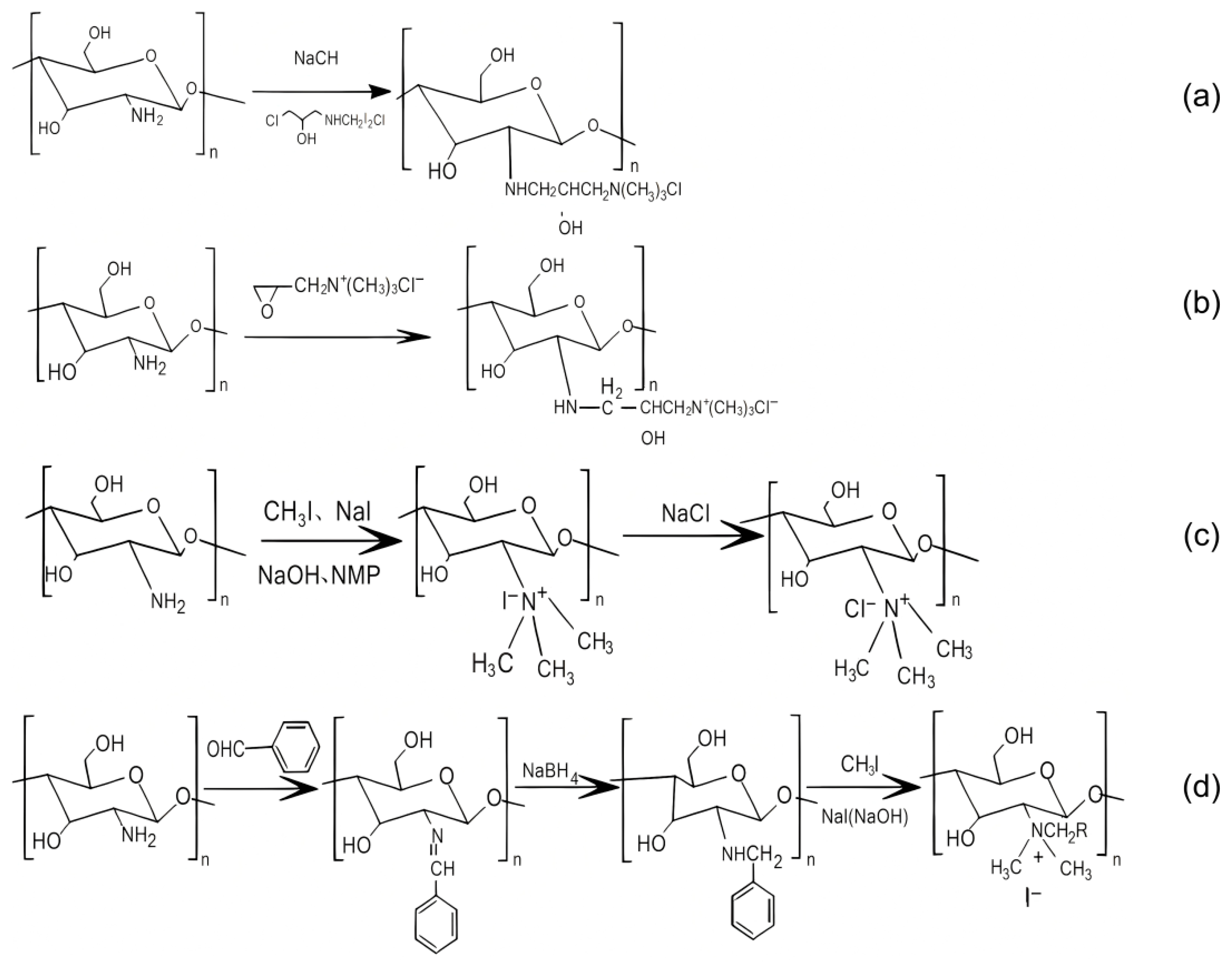
| Direct quaternization [28,29] | The amino group (-NH2) of chitosan reacts directly with the epoxy/reactive group of the quaternization reagent to form a quaternary ammonium structure. | Glycidyl trimethylammonium chloride (GTA) 3-Chloro-2-hydroxypropyl trimethyl ammonium chloride (CHPTAC). | pH: 8–10. Temperature: 50–70 °C. Time: 4–6 h. | Highly efficient reaction with straightforward operation However, crosslinking agents may remain and require purification. |
| Epoxypropyl quaternization [30] | The epoxy group of epoxypropyl quaternary ammonium salts (e.g., EPTAC) undergoes ring-opening reaction with the amino group of chitosan, yielding quaternized products. | Epoxypropyl trimethyl ammonium chloride (EPTAC). | pH: 8–9. Temperature: 60–80 °C. Time: 6–8 h. | Highly substituted products exhibit remarkable water solubility, though elevated temperatures may induce side reactions. |
| Alkylation Quaternization [31] | Nucleophilic substitution reaction between amino groups and halogenated alkanes (e.g., methyl iodide) to introduce quaternary ammonium groups. | Methyl iodide (CH3I) Bromoethane (CH3Br). | pH: 10–12. Temperature: 30–40 °C. Time: 12–24 h. | Mild reaction conditions, Reagents readily available. However, low substitution degree and potential formation of by-products. |
| Reduction of Schiff-base [32] | Amino groups react with aldehydes (e.g., formaldehyde) to form Schiff-bases, which are then reduced to stable quaternary ammonium salts using reducing agents (e.g., NaBH4). | Formaldehyde Glutaraldehyde NaBH4. | pH: 4–6. Temperature: 50–60 °C. Time: 6–12 h. | Capable of introducing multifunctional groups. However, the procedure is complex and requires strict acid control. |
| Microwave-assisted quaternization method [33] | Microwave radiation accelerates molecular collisions between quaternization reagents and chitosan, reducing reaction time. | GTA. CHPTAC. | pH: 9–10. Temperature: 70–90 °C (microwave heating). Time: 0.5–2 h. | Rapid reaction with low energy consumption but requires specialized equipment; potential for localized overheating. |
| Enzyme-catalyzed quaternization | Utilizes enzymes (e.g., peroxidase) to catalyze the grafting reaction between chitosan and quaternization reagents. | GTA. CHPTAC + peroxidase. | pH: 6–8. Temperature: 30–50 °C. Time: 4–8 h. | Environmentally friendly and mild conditions. However, enzyme costs are high, and reaction efficiency is relatively low. |
| Delivery System | Drug | Encapsulation Efficiency | Release Conditions | Release Rate Constant (k) | Release Exponent (n) | Mechanism |
|---|---|---|---|---|---|---|
| GTA-modified chitosan micelles [70] | Curcumin | ~32% | pH 7.4 | 0.087 h−n | 0.52 | Anomalous transport (non-Fickian) |
| Quaternized aminated chitosan nanoparticles (Q-AmCs NPs) [77] | Curcumin | 94.4 ± 0.91% | SGF (pH 1.2)/SCF (pH 7.4) | — | — | Slow release (54.0% cumulative at pH |
| Carboxymethyl konjac glucomannan/chitosan (CMKGM/CS) nanogels [78] | Curcumin | 85–92% | PBS pH 7.4 | 0.095 h−n | 0.61 | Anomalous transport |
| N-Trimethyl chitosan (TMC) nanoparticles [79] | Ovalbumin (protein) | Up to 95% | PBS pH 7.4 | — | — | Sustained release (>70% retained for ≥3 h) |
| Folic Acid-Conjugated Chitosan-Loaded Proanthocyanidin Nanoparticles (PC-CS/FA-NPs) [80] | Epigallocatechin gallate (EGCG) | 72–85% | PBS pH 6.8 | 0.15 h−n | 0.55 | Anomalous transport |
| Trimethyl chitosan (TMC) nanoparticles [81] | α-Galactosidase (α-GAL) | ~65% | pH 7.4 (physiological)/pH 5.0 (acidic) | — | — | pH-triggered release (stable at pH 7.4, releases at acidic pH) |
| Quaternized chitosan derivative nanoparticles (33% substitution) [82] | Insulin | 52 ± 3% | Simulated intestinal fluid | — | — | Sustained release (>210 min) |
| Crosslinked chitosan/gelatin nanocomposite [67] | Dopamine | Not reported | pH 7.4 (neutral) | — | — | Higuchi kinetics (93% release in 24 h) |
| TPP/Genipin dual crosslinked QCS nanoparticles [83] | Bovine Serum Albumin (BSA) | 46.37 ± 2.89% | pH 7.4 PBS | — | — | Sustained release (significantly prolonged after genipin crosslinking) |
Disclaimer/Publisher’s Note: The statements, opinions and data contained in all publications are solely those of the individual author(s) and contributor(s) and not of MDPI and/or the editor(s). MDPI and/or the editor(s) disclaim responsibility for any injury to people or property resulting from any ideas, methods, instructions or products referred to in the content. |
© 2026 by the authors. Licensee MDPI, Basel, Switzerland. This article is an open access article distributed under the terms and conditions of the Creative Commons Attribution (CC BY) license.
Share and Cite
Wang, T.; Sun, H. Quaternized Chitosan Crosslinked Networks for pH-Responsive Macromolecule Delivery: A Review. Polymers 2026, 18, 649. https://doi.org/10.3390/polym18050649
Wang T, Sun H. Quaternized Chitosan Crosslinked Networks for pH-Responsive Macromolecule Delivery: A Review. Polymers. 2026; 18(5):649. https://doi.org/10.3390/polym18050649
Chicago/Turabian StyleWang, Tongtong, and Hui Sun. 2026. "Quaternized Chitosan Crosslinked Networks for pH-Responsive Macromolecule Delivery: A Review" Polymers 18, no. 5: 649. https://doi.org/10.3390/polym18050649
APA StyleWang, T., & Sun, H. (2026). Quaternized Chitosan Crosslinked Networks for pH-Responsive Macromolecule Delivery: A Review. Polymers, 18(5), 649. https://doi.org/10.3390/polym18050649