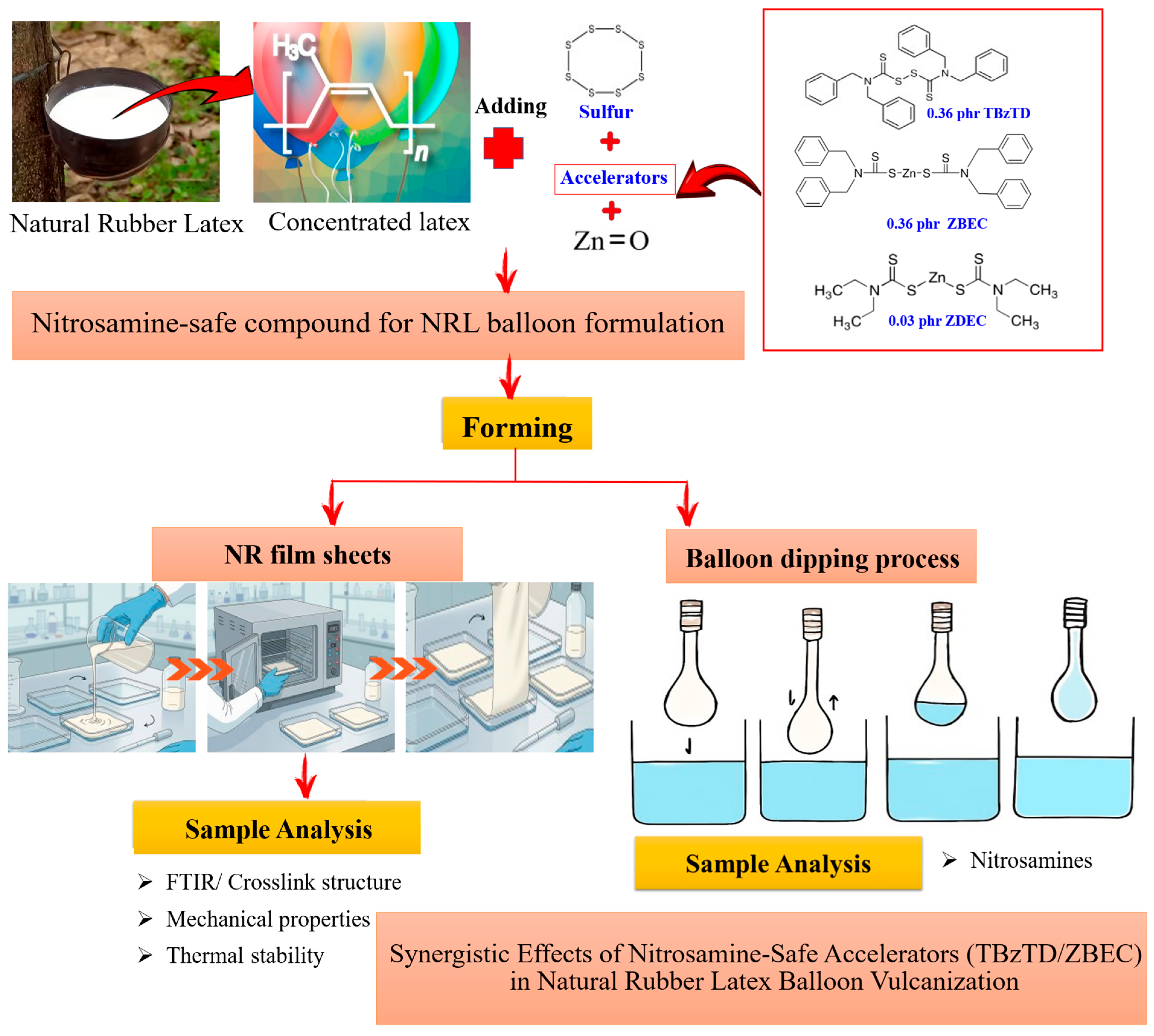
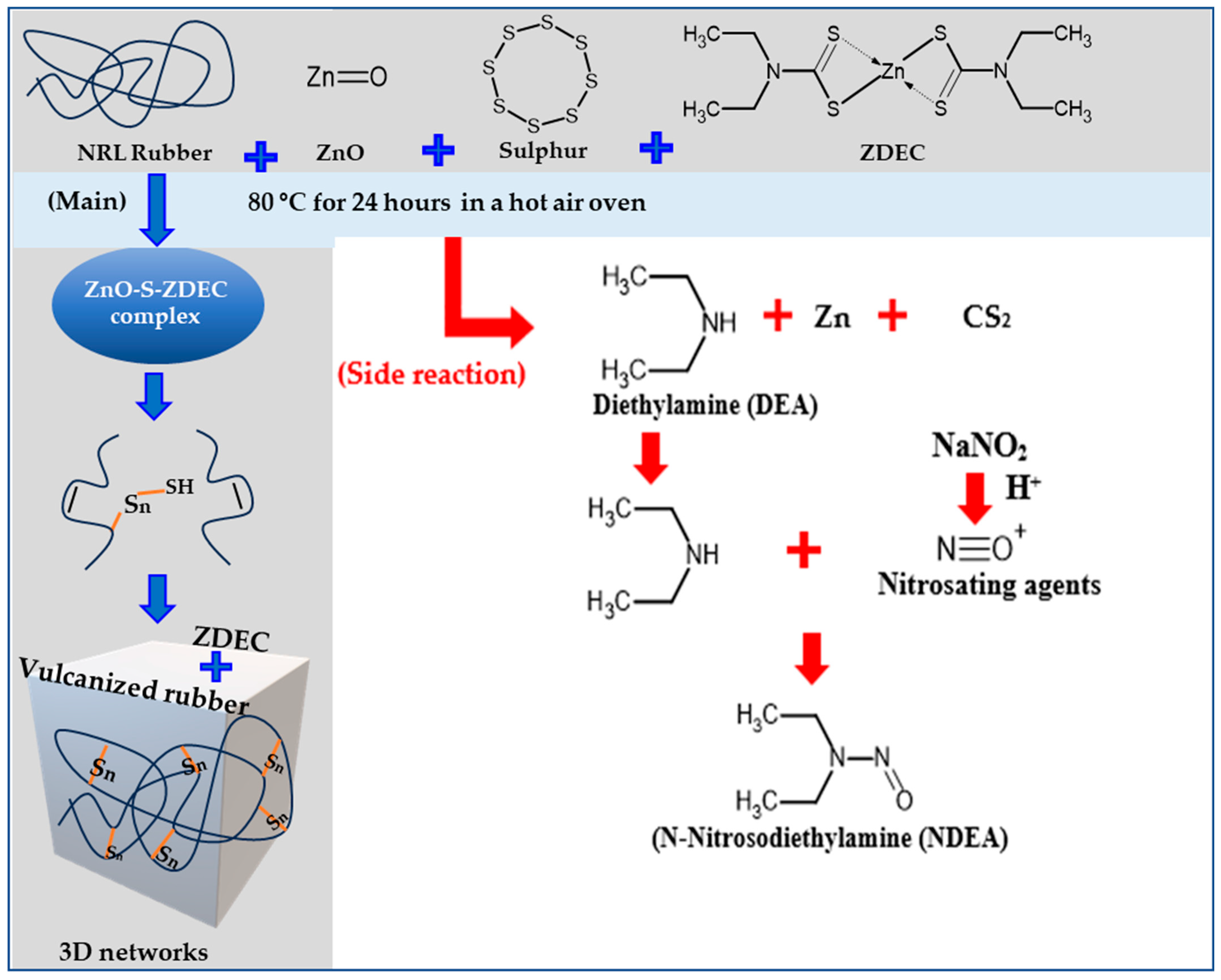
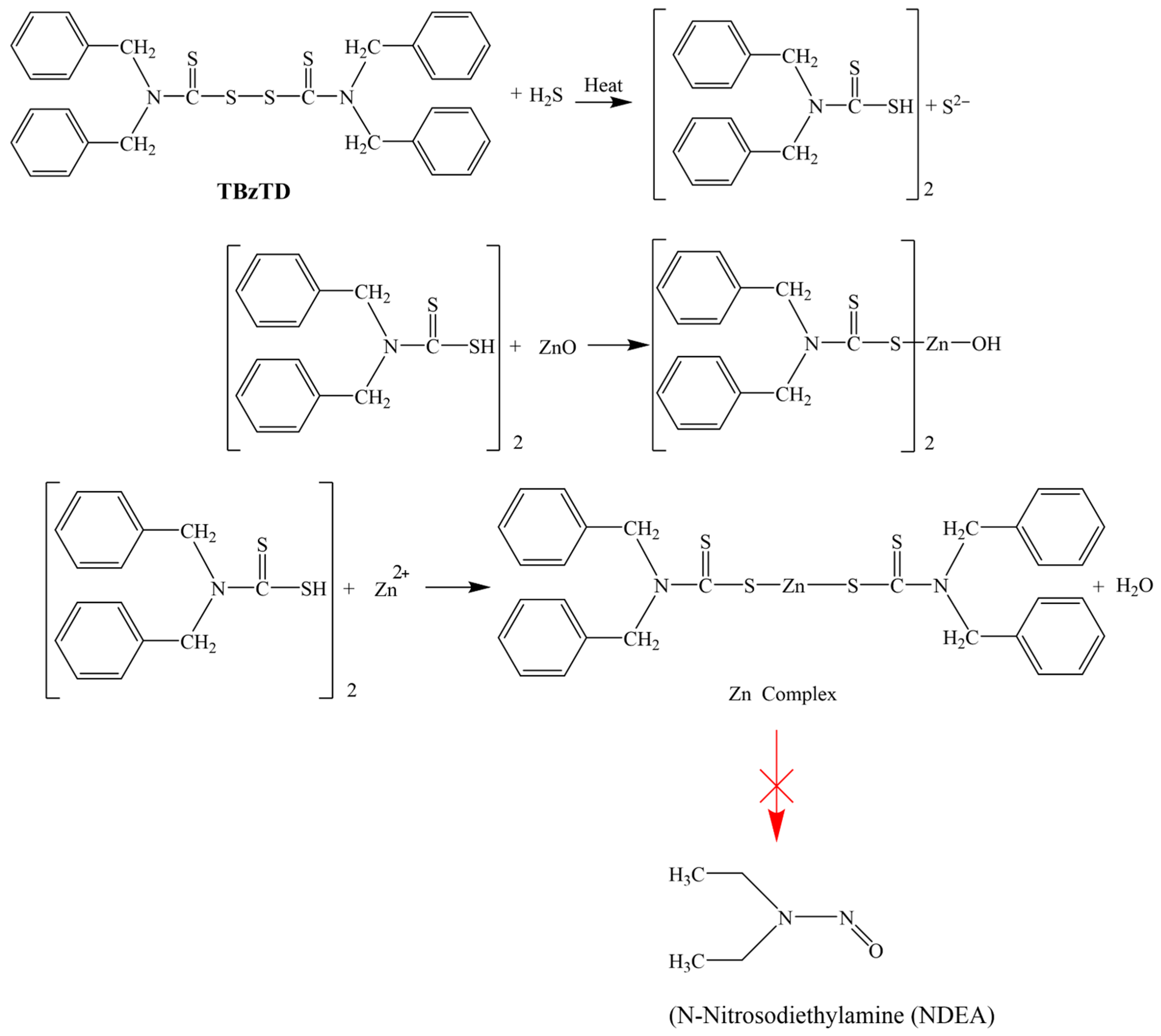
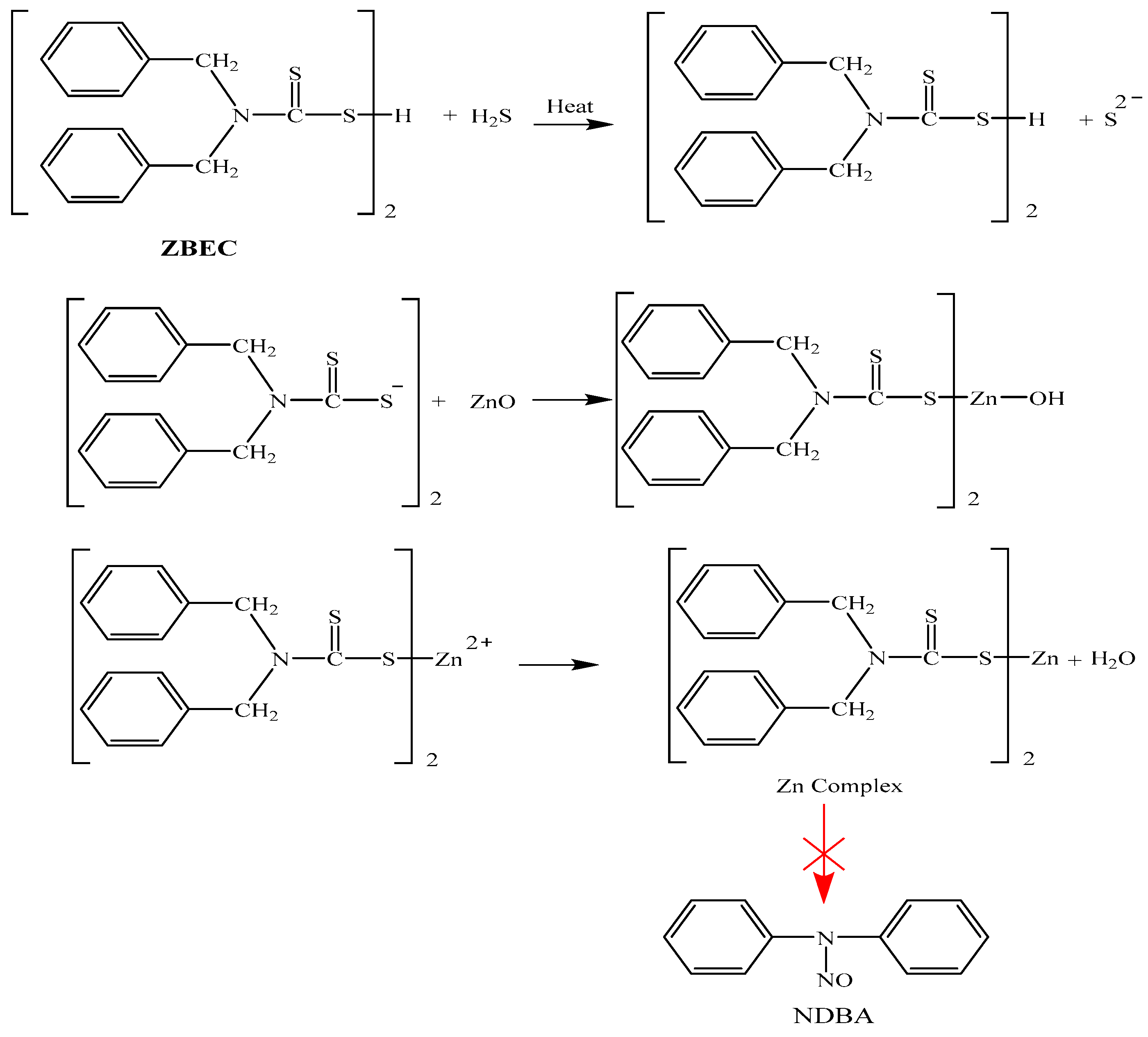
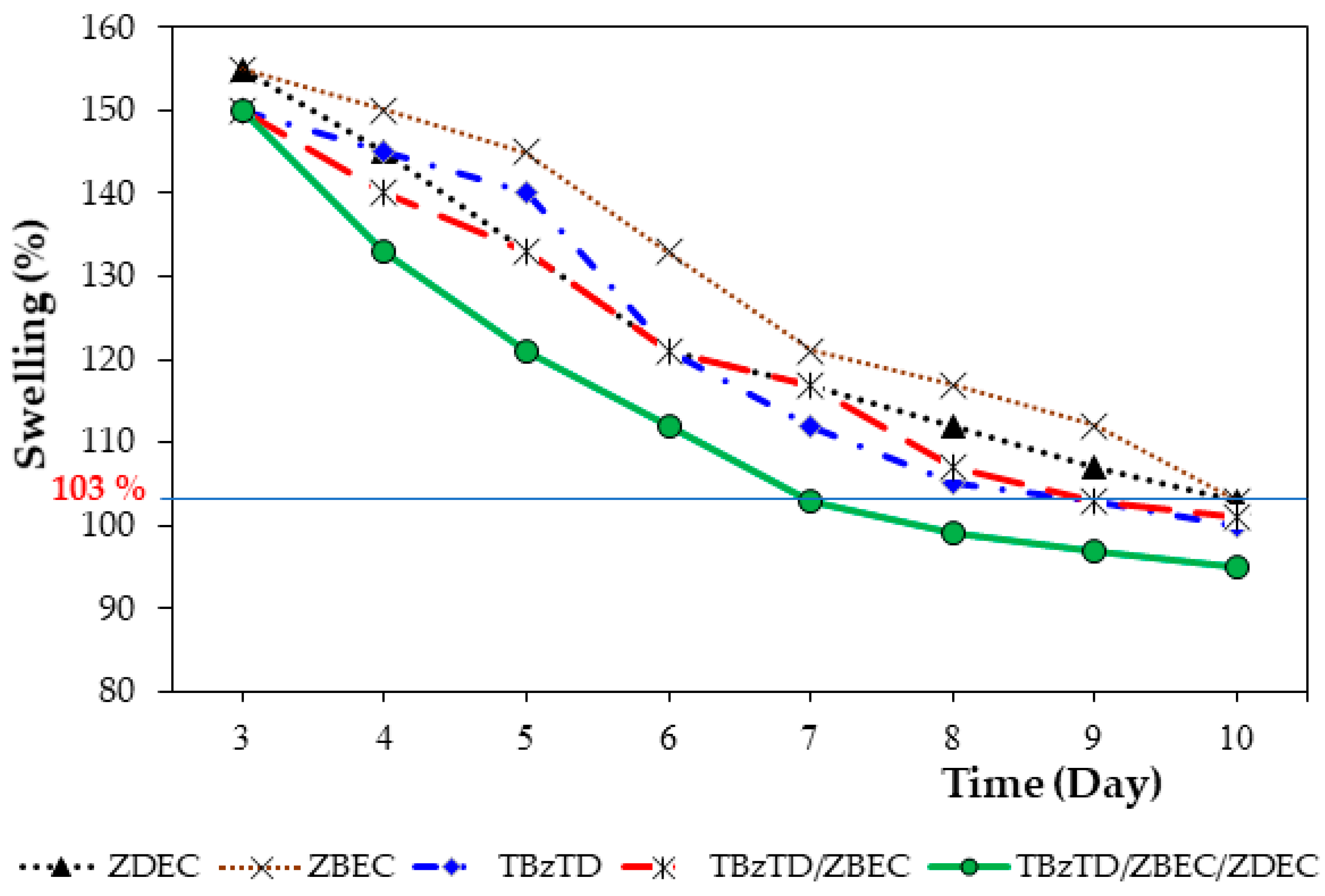
Synergistic Effects of Nitrosamine-Safe Accelerators for Enhanced Natural Rubber Latex Balloon in Sulfur Conventional Vulcanizing System

Abstract
1. Introduction
2. Experimental
2.1. Materials
2.2. Preparation of NRL Films
2.3. NRL Balloon
2.4. Characterization and Properties
2.4.1. The Swelling Test
2.4.2. FTIR Analysis
2.4.3. Mechanical Properties
2.4.4. Thermal Stability
- (1)
- Accelerated aging was conducted following ISO 188, where samples were subjected to thermal aging at 70 °C for 168 h. After aging, tensile strength, elongation at break, and modulus were tested.
- (2)
- Thermogravimetric analysis (TGA) was performed using a TGA-SDTA 851 analyzer (Mettler Toledo, Zurich, Switzerland). Samples were heated from 30 °C to 600 °C under nitrogen atmosphere, then from 600 °C to 900 °C under oxygen atmosphere, both at a 10 °C/min heating rate.
2.4.5. Nitrosamines and Nitrosatable Substances
3. Results and Discussion
3.1. Characterization and Properties
3.1.1. The Swelling Test
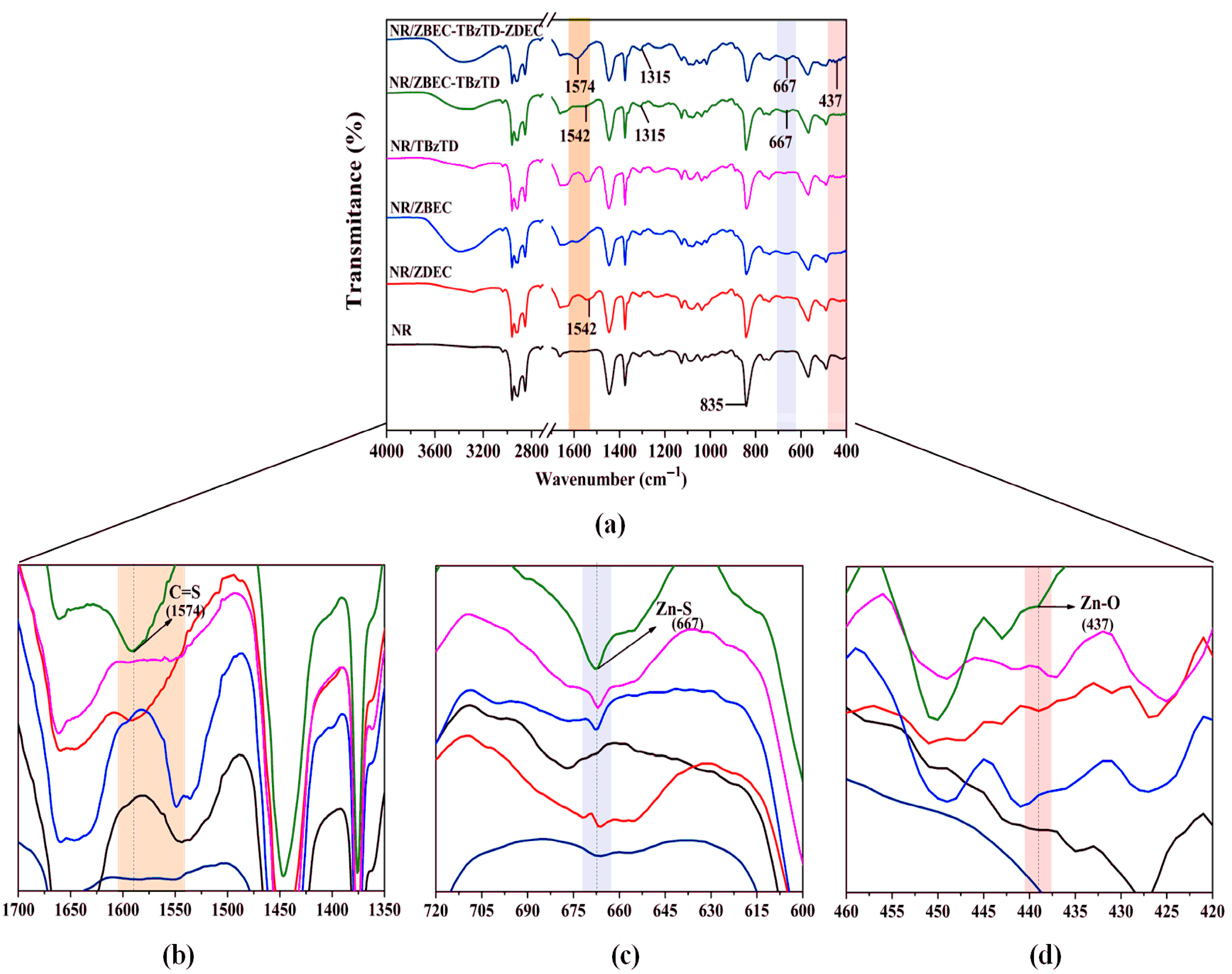
3.1.2. FTIR Analysis of Accelerator Types in Sulfur Vulcanization of NRL Films
3.1.3. Comparative Analysis of Mechanical Properties
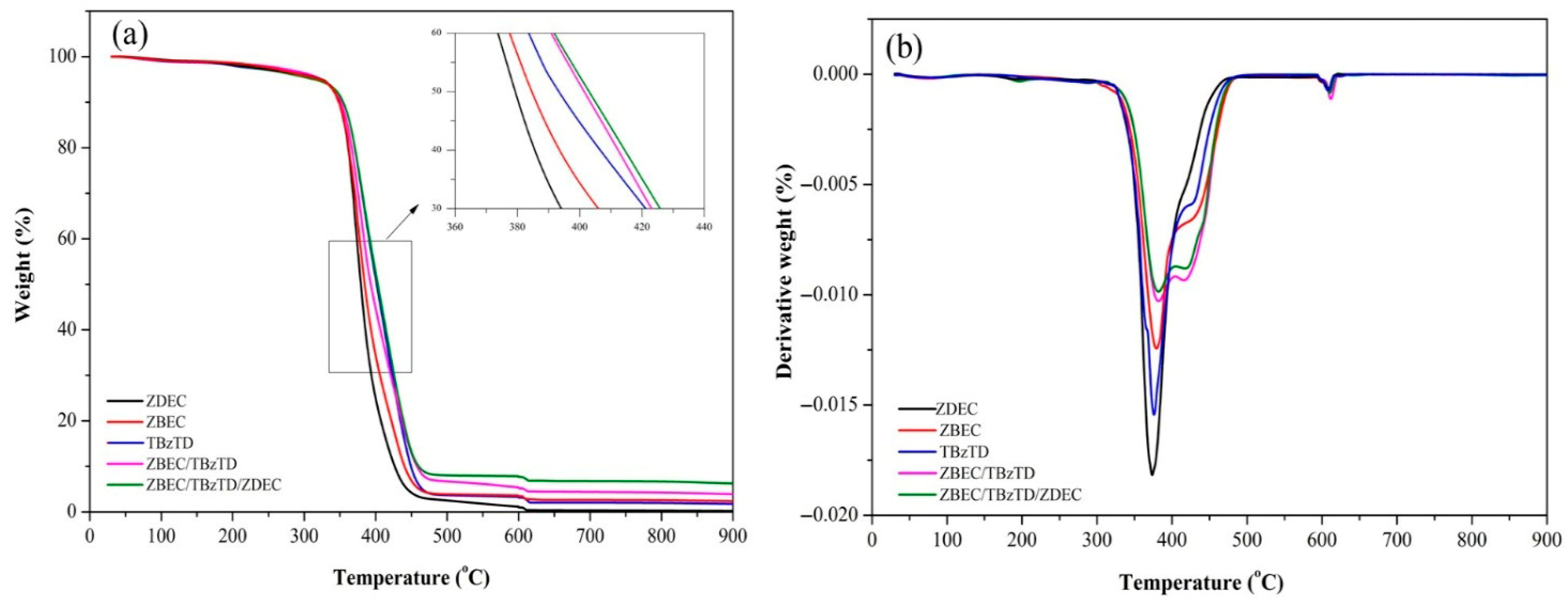
3.1.4. Thermal Stability of Sulfur Vulcanization
3.1.5. Nitrosamine Testing
4. Conclusions
Author Contributions
Funding
Institutional Review Board Statement
Data Availability Statement
Acknowledgments
Conflicts of Interest
References
- Fortune Business Insights. Xenon Market Size, Share & COVID-19 Impact Analysis, by Type (N3, N4. 5, and N5), by Application (Imaging & Lighting, Satellite, Electronics & Semiconductors, Medical and Others), and Regional Forcast, 2022–2029; Fortune Business Insights: Pune, India, 2023. [Google Scholar]
- Fortune Business Insights. Virtual Reality in Education Market Size, Share & Industry Analysis, by Component (Hardware, Software, and Content), by Application (K-12, Higher Education, and Vocational Training), and Regional Forecast, 2024–2032; Market Research Report. 2024. Available online: https://www.fortunebusinessinsights.com/industry (accessed on 29 January 2026).
- Kędzia, J.R.; Sitko, A.M.; Haponiuk, J.T.; Lipka, J.K. Natural rubber latex-origin, specification and application. In Application and Characterization of Rubber Materials; IntechOpen: London, UK, 2022. [Google Scholar]
- Stephens, H.L.; Bhowmick, A.K. Handbook of Elastomers; Dekker: New York, NY, USA, 2001. [Google Scholar]
- Brunnemann, K.D.; Hoffmann, D. Analytical studies on tobacco-specific N-nitrosamines in tobacco and tobacco smoke. Crit. Rev. Toxicol. 1991, 21, 235–240. [Google Scholar] [CrossRef]
- Biaudet, H.; Mouillet, L.; Debry, G. Migration of nitrosamines from condoms to physiological secretions. Bull. Environ. Contam. Toxicol. 1997, 59, 847–853. [Google Scholar] [CrossRef]
- Farren, N.J.; Ramírez, N.; Lee, J.D.; Finessi, E.; Lewis, A.C.; Hamilton, J.F. Estimated exposure risks from carcinogenic nitrosamines in urban airborne particulate matter. Environ. Sci. Technol. 2015, 49, 9648–9656. [Google Scholar] [CrossRef]
- Rao, T. Genotoxicology of N-Nitroso Compounds; Springer Science & Business Media: Berlin/Heidelberg, Germany, 2013. [Google Scholar]
- van Bruggen, M.; van Putten, E.M.; Janssen, P.C.J.M. RIVM 2003. N-Nitrosamines in Balloons: Assessment of the Health Risk for Children. In RIVM Report 609300002/2007 Nitrosamines Released from Rubber Crumb; p. 17. Available online: https://www.rivm.nl/bibliotheek/rapporten/609300002.html (accessed on 29 January 2026).
- World Health Organization. Guidelines for Drinking-Water Quality: Incorporating the First and Second Addenda; World Health Organization: Geneva, Switzerland, 2022. [Google Scholar]
- Hwang, J.B.; Lee, J.E.; Kim, E.; Eom, K.Y.; Kim, H.-A.; Lee, S. Analysis of N-nitrosamines and N-nitrosatable substances from baby bottle rubber teats by liquid chromatography tandem mass spectrometry. Food Addit. Contam. Part A 2023, 40, 518–527. [Google Scholar] [CrossRef]
- EN 71-12:2016; Safety of Toys—Part 12: N-Nitrosamines and N-Nitrosatable Substances. European Standard: Brussels, Belgium, 2016.
- Suchat, S.; Boonrasri, S. Advancement of an environmentally friendly and innovative sustainable rubber wrap film with superior sealing properties. Polymers 2024, 16, 1499. [Google Scholar] [CrossRef]
- Park, J.-e.; Seo, J.-e.; Lee, J.-y.; Kwon, H. Distribution of seven N-nitrosamines in food. Toxicol. Res. 2015, 31, 279–288. [Google Scholar] [CrossRef]
- EN 12868:2017; Child Use and Care Articles—Method for Determining the Release of N-Nitrosamines and N-Nitrosatable Substances from Elastomer or Rubber Teats and Soothers. European Standard: Brussels, Belgium, 2017.
- Fajen, J.; Carson, G.; Rounbehler, D.; Fan, T.; Vita, R.; Goff, U.; Wolf, M.; Edwards, G.; Fine, D.; Reinhold, V. N-nitrosamines in the rubber and tire industry. Science 1979, 205, 1262–1264. [Google Scholar] [CrossRef]
- Smith, S.A.; Norris, B. Reducing the Risk of Choking Hazards: Mouthing Behaviour of Children Aged 1 Month to 5 Years. Inj. Control. Saf. Promot. 2003, 10, 145–154. [Google Scholar] [CrossRef] [PubMed]
- Kędzia, J.; Haponiuk, J.; Formela, K. Natural Rubber Latex Wastes from Balloon Production as Valuable Source of Raw Material: Processing, Physico-Mechanical Properties, and Structure. J. Compos. Sci. 2024, 8, 365. [Google Scholar] [CrossRef]
- Virdi, R.; Grover, B.; Ghuman, K. “Nitrosamine safe” thiuram disulfide. Rubber Chem. Technol. 2019, 92, 90–109. [Google Scholar] [CrossRef]
- Park, S.J.; Jeong, M.J.; Park, S.R.; Choi, J.C.; Choi, H.; Kim, M. Release of N-nitrosamines and N-nitrosatable substances from baby bottle teats and rubber kitchen tools in Korea. Food Sci. Biotechnol. 2018, 27, 1519–1524. [Google Scholar] [CrossRef]
- Murakami, L.M.S.; Azevedo, J.B.; Diniz, M.F.; Silva, L.M.; Dutra, R.d.C.L. Characterization of additives in NR formulations by TLC-IR (UATR). Polímeros 2018, 28, 205–214. [Google Scholar] [CrossRef]
- Sujarit, J.; Phutdhawong, W. Synthesis of Zinc Diethyldithiocarbamate (ZDEC) and Structure Characterization using Decoupling 1H NMR. In Proceedings of the Congress on Science and Technology of Thailand, Golden Jubilee Convention Hall, Khon Kean University (Thailand), Khon Kaen, Thailand, 20–22 October 2003. [Google Scholar]
- Thajudin, N.N.; Shuib, R. Room temperature self-healing natural rubber based on ionic supramolecular network. AIP Conf. Proc. 2020, 2267, 020023. [Google Scholar] [CrossRef]
- Liu, L.-N.; Dai, J.-G.; Zhao, T.-J.; Guo, S.-Y.; Hou, D.-S.; Zhang, P.; Shang, J.; Wang, S.; Han, S. A novel Zn (ii) dithiocarbamate/ZnS nanocomposite for highly efficient Cr6+ removal from aqueous solutions. RSC Adv. 2017, 7, 35075–35085. [Google Scholar] [CrossRef]
- Sivakumar, P.; Thyagarajan, K.; Kumar, A. Investigations on physical properties of Zn ferrite nanoparticles using sol-gel auto combustion technique. Dig. J. Nanomater. Bios. 2018, 13, 1117–1122. [Google Scholar]
- BgVV. Risk Assessment of N-Nitrosamines in Balloons. Federal Institute of Health Protection of Consumers and Veterinary Medicine, Expert Opinion. 11 April 2002. Available online: http://www.bgvv.de (accessed on 29 January 2026).
- de Lima, D.R.; da Rocha, E.B.D.; de Sousa, A.M.F.; da Costa, A.C.A.; Furtado, C.R.G. Effect of vulcanization systems on the properties of natural rubber latex films. Polym. Bull. 2021, 78, 3943–3957. [Google Scholar] [CrossRef]
- Larpkasemsek, A.; Raksaksri, L.; Chuayjuljit, S.; Chaiwutthinan, P.; Boonmahitthisud, A. Effects of sulfur vulcanization system on cure characteristics, physical properties and thermal aging of epoxidized natural rubber. J. Met. Mater. Miner. 2019. [Google Scholar]
- Boonkerd, K.; Deeprasertkul, C.; Boonsomwong, K. Effect of sulfur to accelerator ratio on crosslink structure, reversion, and strength in natural rubber. Rubber Chem. Technol. 2016, 89, 450–464. [Google Scholar] [CrossRef]
- Low, D.Y.S.; Supramaniam, J.; Soottitantawat, A.; Charinpanitkul, T.; Tanthapanichakoon, W.; Tan, K.W.; Tang, S.Y. Recent developments in nanocellulose-reinforced rubber matrix composites: A review. Polymers 2021, 13, 550. [Google Scholar] [CrossRef]
- Blanchard, R.; Ogunsona, E.O.; Hojabr, S.; Berry, R.; Mekonnen, T.H. Synergistic cross-linking and reinforcing enhancement of rubber latex with cellulose nanocrystals for glove applications. ACS Appl. Polym. Mater. 2020, 2, 887–898. [Google Scholar] [CrossRef]
- Suchat, S.; Praksong, K.; Muangprathub, J.; Srisawat, T.; Abdullah, N.H.; Boonrasri, S. Agricultural performance of biomaterials mulch based on nitrosamine-free natural rubber. Green Mater. 2025, 13, 183–195. [Google Scholar] [CrossRef]
- Suchat, S.; Boonrasri, S. Advancement of an Eco-Friendly and Innovative Sustainable Rubber Wrap Film Exhibiting Superior Sealing Properties. Res. Sq. 2024. [Google Scholar] [CrossRef]




| Ingredient in Formulation | Content (phr a) | Function | ||||
|---|---|---|---|---|---|---|
| 1 | 2 | 3 | 4 | 5 | ||
| 60% HA-NR latex | 100 | 100 | 100 | 100 | 100 | Backbone (main component) |
| 10% Potassium hydroxide | 1.0 | 1.0 | 1.0 | 1.0 | 1.0 | Stabilizers 1 |
| 10% Potassium oleate | 1.0 | 1.0 | 1.0 | 1.0 | 1.0 | Stabilizers 2 |
| 50% Sulfur | 1.5 | 1.5 | 1.5 | 1.5 | 1.5 | Vulcanizing Agent |
| 50% ZnO | 1.5 | 1.5 | 1.5 | 1.5 | 1.5 | Activator |
| 5% CNC | 2.0 | 2.0 | 2.0 | 2.0 | 2.0 | Filler |
| 50% Wingstay L | 1.5 | 1.5 | 1.5 | 1.5 | 1.5 | Polyphenol Antioxidant |
| 50% Accelerators b | 0.75 | 0.75 | 0.75 | 0.75 | 0.75 | Accelerators |
| Formula No. # | Accelerator Type | Content (phr) | |||
|---|---|---|---|---|---|
| TBzTD | ZBEC | ZDEC | Total | ||
| 1 | ZDEC | 0.75 | - | - | 0.75 |
| 2 | ZBEC | - | 0.75 | - | 0.75 |
| 3 | TBzTD | - | - | 0.75 | 0.75 |
| 4 | ZBEC/TBzTD | 0.375 | 0.375 | - | 0.75 |
| 5 | ZBEC/TBzTD/ZDEC | 0.36 | 0.36 | 0.03 | 0.75 |
| Type of Accelerator | Mechanical Properties | ||||
|---|---|---|---|---|---|
| Tensile Strength (MPa) | Elongation at Break (%) | 100% Modulus (MPa) | 200% Modulus (MPa) | 300% Modulus (MPa) | |
| Before aging | |||||
| ZBEC | 18.74 ± 0.90 | 1079.31 ± 83 | 0.54 ± 0.01 | 0.81 ± 0.01 | 1.08 ± 0.03 |
| TBzTD | 19.57 ± 1.47 | 1136.74 ± 71 | 0.46 ± 0.01 | 0.65 ± 0.08 | 0.83 ± 0.03 |
| ZDEC | 21.36 ± 1.10 | 1040.86 ± 60 | 0.55 ± 0.07 | 0.88 ± 0.12 | 1.20 ± 0.14 |
| ZBEC/TBzTD | 17.91 ± 0.75 | 1115.82 ± 55 | 0.50 ± 0.13 | 0.67 ± 0.05 | 0.84 ± 0.10 |
| ZBEC/TBzTD/ZDEC | 22.13 ± 1.81 | 1152.90 ± 78 | 0.69 ± 0.02 | 0.95 ± 0.04 | 1.30 ± 0.07 |
| After aging | |||||
| ZBEC | 12.10 ± 2.11 | 626.50 ± 34 | 1.06 ± 0.01 | 1.81 ± 0.02 | 3.30 ± 0.02 |
| TBzTD | 13.25 ± 1.72 | 736.85 ± 26 | 1.24 ± 0.07 | 2.39 ± 0.12 | 3.21 ± 0.15 |
| ZDEC | 15.50 ± 0.89 | 851.9 ± 35 | 1.53 ± 0.02 | 2.00 ± 0.01 | 4.59 ± 0.10 |
| ZBEC/TBzTD | 13.85 ± 0.70 | 785.98 ± 15 | 0.95 ± 0.03 | 1.17 ± 0.03 | 3.50 ± 0.04 |
| ZBEC/TBzTD/ZDEC | 14.23 ± 1.81 | 892.91 ± 8 | 1.69 ± 0.02 | 2.48 ± 0.04 | 4.04 ± 0.07 |
| Rubber Sample Type | Tonset * (°C) | Tmax ** (°C) | Final Decomposition Temperature (FDT) | Final Residue (%) |
|---|---|---|---|---|
| ZBEC | 356.01 | 374.78 | 379.79 | 0.38 |
| TBzTD | 356.13 | 378.01 | 391.14 | 4.47 |
| ZDEC | 358.05 | 376.47 | 384.47 | 2.63 |
| ZBEC/TBzTD | 342.16 | 382.62 | 400.56 | 2.05 |
| ZBEC/TBzTD/ZDEC | 357.75 | 384.15 | 403.04 | 7.66 |
| Test Parameter | 1-ZDEC | 2-ZBEC | 3-TBzTD | 4-ZBEC + TBzTD | 5-ZBEC + TBzTD + ZDEC | |||||
|---|---|---|---|---|---|---|---|---|---|---|
| Nitrosamines | Nitrosatable Substances | Nitrosamines | Nitrosatable Substances | Nitrosamines | Nitrosatable Substances | Nitrosamines | Nitrosatable Substances | Nitrosamines | Nitrosatable Substances | |
| (mg/kg) | (mg/kg) | (mg/kg) | (mg/kg) | (mg/kg) | (mg/kg) | (mg/kg) | (mg/kg) | (mg/kg) | (mg/kg) | |
| 1. NDMA | 0.130 | 0.861 | nd | nd | 0.028 | 0.495 | 0.030 | 0.480 | 0.034 | 0.565 |
| 2. NDEA | 0.100 | 0.405 | nd | nd | nd | 0.372 | nd | 0.250 | 0.006 | 0.329 |
| 3. NDPA | nd | nd | nd | nd | nd | nd | nd | nd | nd | nd |
| 4. NDiBA | nd | nd | nd | nd | nd | nd | nd | nd | nd | nd |
| 5. NDBA | nd | nd | 0.045 | 0.300 | nd | 0.040 | 0.010 | 0.220 | 0.004 | 0.060 |
| 6. NPIP | nd | nd | nd | nd | nd | nd | nd | nd | nd | nd |
| 7. NPYR | nd | nd | nd | nd | nd | nd | nd | nd | nd | nd |
| 8. NMOR | nd | nd | nd | nd | nd | nd | nd | nd | nd | nd |
| 9. NEPhA | nd | nd | nd | nd | nd | nd | nd | nd | nd | nd |
| 10. NMPhA | nd | nd | nd | nd | nd | nd | nd | nd | nd | nd |
| 11. NDiNA | nd | nd | nd | nd | nd | nd | nd | nd | nd | nd |
| 12. NDBzA | nd | nd | nd | nd | 0.015 | 0.076 | 0.004 | 0.035 | 0.004 | 0.040 |
| Total | 0.230 | 1.266 | 0.045 | 0.300 | 0.043 | 0.983 | 0.044 | 0.985 | 0.048 | 0.994 |
| Fail | Fail | pass * | pass ** | pass * | pass ** | pass * | pass ** | pass * | pass ** | |
Disclaimer/Publisher’s Note: The statements, opinions and data contained in all publications are solely those of the individual author(s) and contributor(s) and not of MDPI and/or the editor(s). MDPI and/or the editor(s) disclaim responsibility for any injury to people or property resulting from any ideas, methods, instructions or products referred to in the content. |
© 2026 by the authors. Licensee MDPI, Basel, Switzerland. This article is an open access article distributed under the terms and conditions of the Creative Commons Attribution (CC BY) license.
Share and Cite
Chang-In, T.; Anancharoenwong, E.; Suchat, S. Synergistic Effects of Nitrosamine-Safe Accelerators for Enhanced Natural Rubber Latex Balloon in Sulfur Conventional Vulcanizing System. Polymers 2026, 18, 438. https://doi.org/10.3390/polym18040438
Chang-In T, Anancharoenwong E, Suchat S. Synergistic Effects of Nitrosamine-Safe Accelerators for Enhanced Natural Rubber Latex Balloon in Sulfur Conventional Vulcanizing System. Polymers. 2026; 18(4):438. https://doi.org/10.3390/polym18040438
Chicago/Turabian StyleChang-In, Thanakan, Ekasit Anancharoenwong, and Sunisa Suchat. 2026. "Synergistic Effects of Nitrosamine-Safe Accelerators for Enhanced Natural Rubber Latex Balloon in Sulfur Conventional Vulcanizing System" Polymers 18, no. 4: 438. https://doi.org/10.3390/polym18040438
APA StyleChang-In, T., Anancharoenwong, E., & Suchat, S. (2026). Synergistic Effects of Nitrosamine-Safe Accelerators for Enhanced Natural Rubber Latex Balloon in Sulfur Conventional Vulcanizing System. Polymers, 18(4), 438. https://doi.org/10.3390/polym18040438