Architecting Functional Polymers: Advances in Modular Synthesis, Responsive Design, and Multifaceted Applications

 , , ,
, , , 
Abstract
1. Introduction
1.1. Evolution of Polymer Architectures: From Conventional Linear Systems to Modular and Architected Polymers
Conceptual Framework of Modular Synthesis and Modular Polymer Architectures
1.2. The Modular Synthesis with Its Responsive Design: Transformative Significance
1.3. Bridging Synthetic Strategies, Responsive Design, and Application-Oriented Innovation
1.4. Scope and Novelty of the Current Review
2. Modular Architectures in Polymer Design
2.1. Principles of Modular Polymer Assembly
2.2. Multifunctionality Through Modular Integration
2.3. Structure–Property Control in Modular Polymers
Role of Nanomaterials and Carbon Nanostructures in Smart Polymer Composites
3. Advances in Controlled and Sustainable Polymer Synthesis
3.1. Controlled Polymerization Techniques
3.2. Post-Polymerization Modification Strategies
3.3. Polymer Production Scalability, Efficiency, and Sustainability
4. Stimuli-Responsive Polymer Systems
4.1. Fundamentals of Stimuli Responsiveness
4.2. Architectural Design Strategies of Responsive Architectures
4.3. Synergistic Responsiveness in Multifunctional Polymers
5. Application-Oriented Innovation by Modular and Responsive Polymers
5.1. Specific Drug Delivery Systems
5.2. Self-Healing Polymer Systems
5.3. Adaptive and Smart Coatings
5.4. Polymer-Based Sensors
5.5. Cross-Sector Applications: Biomedicine, Energy, and Environment
6. Computational and Machine Learning Approaches for Polymer Design
6.1. Computational Modelling of Rational Design
6.2. Machine Learning for Structure–Property Prediction
Advantages of Machine Learning in Polymer Design
6.3. Discovery Rush and Sustainable Minimization
7. Integrative Perspective: Bridging Synthesis, Responsiveness, and Application
7.1. How Modular Synthesis Drives Multifunctional Responsiveness
7.2. Synergy Between Synthetic Precision and Application Demand
7.3. Challenges and Design Principles for Next-Generation Smart Polymers
Quantitative Design Principles for Smart Polymer Architectures
8. Conclusions and Future Scope
Author Contributions
Funding
Institutional Review Board Statement
Data Availability Statement
Acknowledgments
Conflicts of Interest
Abbreviations
| ATRP | Atom Transfer Radical Polymerization |
| RAFT | Reversible Addition–Fragmentation Chain Transfer Polymerization |
| ROMP | Ring-Opening Metathesis Polymerization |
| NMP | Nitroxide-Mediated Polymerization |
| PPM | Post-Polymerization Modification |
| ML | Machine Learning |
| DFT | Density Functional Theory |
| LCST | Lower-Critical Solution Temperature |
| UCST | Upper-Critical Solution Temperature |
| pH | Potential of Hydrogen |
| UV | Ultraviolet |
| GSH | Glutathione |
| π–π | Pi–Pi Interactions |
| MD | Molecular Dynamics |
| AI | Artificial Intelligence |
| RDRP | Reversible Deactivation Radical Polymerization |
| PEO | Poly(ethylene oxide) |
| Tg | Glass Transition Temperature |
| Mn | Number Average Molecular Weight |
| Mw | Weight Average Molecular Weight |
| Đ | Dispersity |
| ML-PD | Machine Learning-Based Polymer Design |
| GNN | Graph Neural Network |
| VAE | Variational Autoencoder |
| GAN | Generative Adversarial Network |
References
- Frisch, H.; Tuten, B.T.; Barner-Kowollik, C. Macromolecular superstructures: A future beyond single chain nanoparticles. Isr. J. Chem. 2020, 60, 86–99. [Google Scholar] [CrossRef] [Scilit]
- Sabet, M. From Self-Assembly to Sustainability: Advanced Polymerization Techniques for Energy, Healthcare, and Robotics. Polym.-Plast. Technol. Mater. 2025, 64, 763–793. [Google Scholar] [CrossRef] [Scilit]
- Ma, Z.; Liu, Z.; Zheng, T.; Gan, Z.; Tan, R.; Dong, X.H. Discrete miktoarm star block copolymers with tailored molecular architecture. ACS Polym. Au 2023, 3, 457–465. [Google Scholar] [CrossRef] [Scilit] [PubMed]
- Liang, R.; Xue, Y.; Fu, X.; Le, A.N.; Song, Q.; Qiang, Y.; Xie, Q.; Dong, R.; Sun, Z.; Osuji, C.O.; et al. Hierarchically engineered nanostructures from compositionally anisotropic molecular building blocks. Nat. Mater. 2022, 21, 1434–1440. [Google Scholar] [CrossRef] [Scilit]
- Chen, X.; Michinobu, T. Postpolymerization modification: A powerful tool for the synthesis and function tuning of stimuli-responsive polymers. Macromol. Chem. Phys. 2022, 223, 2100370. [Google Scholar] [CrossRef] [Scilit]
- Hassan, Z.; Matt, Y.; Begum, S.; Tsotsalas, M.; Bräse, S. Assembly of molecular building blocks into integrated complex functional molecular systems: Structuring matter made to order. Adv. Funct. Mater. 2020, 30, 1907625. [Google Scholar] [CrossRef] [Scilit]
- Gao, L.; Yang, J.; Zhao, Y.; Zhao, X.; Zhou, K.; Zhai, W.; Zheng, G.; Dai, K.; Liu, C.; Shen, C. Multilayer Bionic Tunable Strain Sensor with Mutually Non-Interfering Conductive Networks for Machine Learning-Assisted Gesture Recognition. Adv. Funct. Mater. 2025, 35, 2416911. [Google Scholar] [CrossRef] [Scilit]
- Huang, Y.; Wu, C.; Chen, J.; Tang, J. Colloidal Self-Assembly: From Passive to Active Systems. Angew. Chem. 2024, 136, e202313885. [Google Scholar] [CrossRef] [Scilit]
- Ganewatta, M.S.; Wang, Z.; Tang, C. Chemical syntheses of bioinspired and biomimetic polymers toward biobased materials. Nat. Rev. Chem. 2021, 5, 753–772. [Google Scholar] [CrossRef] [Scilit]
- Liu, S.; Dicker, K.T.; Jia, X. Modular and orthogonal synthesis of hybrid polymers and networks. Chem. Commun. 2015, 51, 5218–5237. [Google Scholar] [CrossRef] [Scilit]
- Carlini, A.S.; Adamiak, L.; Gianneschi, N.C. Biosynthetic polymers as functional materials. Macromolecules 2016, 49, 4379–4394. [Google Scholar] [CrossRef] [Scilit] [PubMed]
- Petit, J.; Thomi, L.; Schultze, J.; Makowski, M.; Negwer, I.; Koynov, K.; Herminghaus, S.; Wurm, F.R.; Bäumchen, O.; Landfester, K. A modular approach for multifunctional polymersomes with controlled adhesive properties. Soft Matter 2018, 14, 894–900. [Google Scholar] [CrossRef] [Scilit] [PubMed]
- Wang, S.; Urban, M.W. Redefining polymer science via multi-stimulus responsiveness. Chem 2023, 9, 1362–1377. [Google Scholar] [CrossRef] [Scilit]
- García, J.M.; García, F.C.; Ruiz, J.A.; Vallejos, S.; Trigo-López, M. Smart Polymers: Principles and Applications; Walter de Gruyter GmbH & Co KG: Berlin, Germany, 2022. [Google Scholar]
- Jingcheng, L.; Reddy, V.S.; Jayathilaka, W.A.; Chinnappan, A.; Ramakrishna, S.; Ghosh, R. Intelligent polymers, fibers and applications. Polymers 2021, 13, 1427. [Google Scholar] [CrossRef] [Scilit] [PubMed]
- Fattah-alhosseini, A.; Chaharmahali, R.; Alizad, S.; Kaseem, M.; Dikici, B. A review of smart polymeric materials: Recent developments and prospects for medicine applications. Hybrid Adv. 2024, 5, 100178. [Google Scholar] [CrossRef] [Scilit]
- Thananukul, K.; Kaewsaneha, C.; Opaprakasit, P.; Lebaz, N.; Errachid, A.; Elaissari, A. Smart gating porous particles as new carriers for drug delivery. Adv. Drug Deliv. Rev. 2021, 174, 425–446. [Google Scholar] [CrossRef] [Scilit]
- Zhang, P.; Rešetič, A.; Behl, M.; Lendlein, A. Multifunctionality in polymer networks by dynamic of coordination bonds. Macromol. Chem. Phys. 2021, 222, 2000394. [Google Scholar] [CrossRef] [Scilit]
- Cen, J.; Hou, M.; Hu, J.; Liu, S. Advanced Synthesis, Structural Characterization, and Functional Applications of Precision Polymers. Chem.—Eur. J. 2024, 30, e202401911. [Google Scholar] [CrossRef] [Scilit]
- Rimmele, M.; Glöcklhofer, F.; Heeney, M. Post-polymerisation approaches for the rapid modification of conjugated polymer properties. Mater. Horiz. 2022, 9, 2678–2697. [Google Scholar] [CrossRef] [Scilit]
- Van der Zouwen, A.J.; Witte, M.D. Modular approaches to synthesize activity-and affinity-based chemical probes. Front. Chem. 2021, 9, 644811. [Google Scholar] [CrossRef] [Scilit]
- Wang, X.; Yu, C.; Wang, M.; Zhao, S.; Mao, Q.; Wang, Y. Mechanically Tunable Slide-Ring Polymers via Photo-Regulated Topological Control. Angew. Chem. 2025, 137, e202511493. [Google Scholar] [CrossRef] [Scilit]
- Wurm, F.R.; Boyer, C.; Sumerlin, B.S. Progress on stimuli-responsive polymers. Macromol. Rapid Commun. 2021, 42, 2100512. [Google Scholar] [CrossRef] [Scilit] [PubMed]
- Kassem, S.; Ulijn, R.V. Cover Feature: Designed Complex Peptide-Based Adaptive Systems: A Bottom-Up Approach. ChemSystemsChem 2023, 5, e202200049. [Google Scholar] [CrossRef] [Scilit]
- Han, T.; Wang, X.; Wang, D.; Tang, B.Z. Functional polymer systems with aggregation-induced emission and stimuli responses. In Aggregation-Induced Emission; Springer: Cham, Switzerland, 2021; pp. 287–333. [Google Scholar]
- Haikal, Y.; Blazeck, J. Exploiting protein domain modularity to enable synthetic control of engineered cells. Curr. Opin. Biomed. Eng. 2024, 31, 100550. [Google Scholar] [CrossRef] [Scilit] [PubMed]
- Martinez, M. Macromolecular Engineering and Depolymerization by Reversible Deactivation Radical Polymerization. Doctoral Dissertation, Carnegie Mellon University, Pittsburgh, PA, USA, 2022. [Google Scholar]
- Zhao, X.; Chen, X.; Yuk, H.; Lin, S.; Liu, X.; Parada, G. Soft materials by design: Unconventional polymer networks give extreme properties. Chem. Rev. 2021, 121, 4309–4372. [Google Scholar] [CrossRef] [Scilit] [PubMed]
- Saravanan, V.; Banerjee, S.; Muthukumaradoss, K.; Deivasigamani, P.; Periyasamy, S. Revolutionizing organic synthesis through green chemistry: Metal-free, bio-based, and microwave-assisted methods. Front. Chem. 2025, 13, 1656935. [Google Scholar]
- Goshisht, M.K. Machine learning and deep learning in synthetic biology: Key architectures, applications, and challenges. ACS Omega 2024, 9, 9921–9945. [Google Scholar] [CrossRef] [Scilit]
- Lee, H.W.; Kim, J.G. Multifunctional Polymer Synthesis via Sequential Postpolymerization Modification Using a Single Aldehyde Repeat Unit: Allylation and Orthogonal Esterification and Thiol–ene Reaction. ACS Macro Lett. 2024, 13, 1418–1424. [Google Scholar] [CrossRef] [Scilit]
- Balcerak-Woźniak, A.; Dzwonkowska-Zarzycka, M.; Kabatc-Borcz, J. A comprehensive review of stimuli-responsive smart polymer materials recent advances and future perspectives. Materials 2024, 17, 4255. [Google Scholar] [CrossRef] [Scilit]
- Liu, X.; Liu, F.; Abdiryim, T.; Jamal, R. Recent progress on controlled polymerizations for functional metallopolymers. Polym. Rev. 2024, 64, 306–370. [Google Scholar] [CrossRef] [Scilit]
- Li, Y.; Chang, R.; Chen, Y.X. Recent Advances in Post-polymerization Modifications on Polypeptides: Synthesis and Applications. Chem.—Asian J. 2022, 17, e202200318. [Google Scholar] [CrossRef] [Scilit] [PubMed]
- Qian, X.; Chen, X.; Zhu, L.; Zhang, Q.M. Fluoropolymer ferroelectrics: Multifunctional platform for polar-structured energy conversion. Science 2023, 380, eadg0902. [Google Scholar] [CrossRef] [Scilit] [PubMed]
- Rosario, A.J.; Ma, B. Stimuli-responsive polymer networks: Application, design, and computational exploration. ACS Appl. Polym. Mater. 2024, 6, 14204–14228. [Google Scholar] [CrossRef] [Scilit]
- Fan, X.; Chung, J.Y.; Lim, Y.X.; Li, Z.; Loh, X.J. Review of adaptive programmable materials and their bioapplications. ACS Appl. Mater. Interfaces 2016, 8, 33351–33370. [Google Scholar] [CrossRef] [Scilit]
- Harun-Ur-Rashid, M.; Imran, A.B. Emerging trends in engineering polymers: A paradigm shift in material engineering. Recent Prog. Mater. 2024, 6, 024. [Google Scholar] [CrossRef] [Scilit]
- El-Ghoul, Y.; Alminderej, F.M.; Alsubaie, F.M.; Alrasheed, R.; Almousa, N.H. Recent advances in functional polymer materials for energy, water, and biomedical applications: A review. Polymers 2021, 13, 4327. [Google Scholar] [CrossRef] [Scilit]
- Kamran, F.; Afshar, H.; Shahi, F. Recent Advances and Applications of Sustainable and Recyclable Polymers. Polym. Eng. Sci. 2025, 65, 3845–3879. [Google Scholar] [CrossRef] [Scilit]
- Nerantzaki, M.; Lutz, J.F. Multistep Growth “Polymerizations”. Macromol. Chem. Phys. 2022, 223, 2100368. [Google Scholar] [CrossRef] [Scilit]
- Lutz, J.F.; Ouchi, M.; Liu, D.R.; Sawamoto, M. Sequence-controlled polymers. Science 2013, 341, 1238149. [Google Scholar] [CrossRef] [Scilit]
- Kim, N.H.; Choi, H.; Shahzad, Z.M.; Ki, H.; Lee, J.; Chae, H.; Kim, Y.H. Supramolecular assembly of protein building blocks: From folding to function. Nano Converg. 2022, 9, 4. [Google Scholar] [CrossRef] [Scilit]
- Nagao, M.; Yoshimatsu, D.; Matsumoto, H.; Miura, Y. Sequence-Dependent Effects of Folded Glycopolymer Structures on Their Biomolecular Recognition. ACS Macro Lett. 2025, 14, 989–995. [Google Scholar] [CrossRef] [Scilit]
- Boase, N.R.; Gillies, E.R.; Goh, R.; Kieltyka, R.E.; Matson, J.B.; Meng, F.; Sanyal, A.; Sedlacek, O. Stimuli-responsive polymers at the interface with biology. Biomacromolecules 2024, 25, 5417–5436. [Google Scholar] [CrossRef] [Scilit]
- Ogbonna, N.D.; Dearman, M.; Cho, C.T.; Bharti, B.; Peters, A.J.; Lawrence, J. Topologically precise and discrete bottlebrush polymers: Synthesis, characterization, and structure–property relationships. JACS Au 2022, 2, 898–905. [Google Scholar] [CrossRef] [Scilit] [PubMed]
- Wojtecki, R.J.; Nelson, A. Small changes with big effects: Tuning polymer properties with supramolecular interactions. J. Polym. Sci. Part A Polym. Chem. 2016, 54, 457–472. [Google Scholar] [CrossRef] [Scilit]
- Shakeel, R.; Ahmad, A.; Mushtaq, H.; Haider, T.; Javeria, M.; Asif, A.; Zia, K.; Zafar, H.; Ishaque, B.; Khan, W.Z. Multifunctional nanomaterials in materials chemistry: A cross-disciplinary review of applications in energy, environment, catalysis, and biomedicine. Sch. J. Eng. Technol. 2025, 8, 673–707. [Google Scholar] [CrossRef] [Scilit]
- Yu, H.; Kalutantirige, F.C.; Yao, L.; Schroeder, C.M.; Chen, Q.; Moore, J.S. Self-Assembly of Repetitive Segment and Random Segment Polymer Architectures. ACS Macro Lett. 2022, 11, 1366–1372. [Google Scholar] [CrossRef] [Scilit]
- Paul, J.E.; Gao, Y.; Go, Y.K.; Rodriguez Koett, L.E.; Sharma, A.; Chen, M.; Lessard, J.J.; Topkaya, T.; Leal, C.; Moore, J.S.; et al. Controlled patterning of crystalline domains by frontal polymerization. Nature 2024, 634, 85–90. [Google Scholar] [CrossRef] [Scilit]
- Dranseike, D.; Ota, Y.; Edwardson, T.G.; Guzzi, E.A.; Hori, M.; Nakic, Z.R.; Deshmukh, D.V.; Levasseur, M.D.; Mattli, K.; Tringides, C.M.; et al. Designed modular protein hydrogels for biofabrication. Acta Biomater. 2024, 177, 107–117. [Google Scholar] [CrossRef] [Scilit]
- Ge, L.; Xu, H.; Jiang, X.; Yu, J. Oligopeptide self-assembly: Mechanisms, stimuli-responsiveness, and biomedical applications. CCS Chem. 2024, 6, 69–90. [Google Scholar] [CrossRef] [Scilit]
- Hollingshead, S.; Lin, C.Y.; Liu, J.C. Designing smart materials with recombinant proteins. Macromol. Biosci. 2017, 17, 1600554. [Google Scholar] [CrossRef] [Scilit]
- Yue, Y.; Hayashi, R.; Yokota, Y. Co-self-assembly of amphiphiles into nanocomposite hydrogels with tailored morphological and mechanical properties. ACS Appl. Mater. Interfaces 2023, 15, 21507–21516. [Google Scholar] [CrossRef] [Scilit] [PubMed]
- Shymborska, Y.; Budkowski, A.; Raczkowska, J.; Donchak, V.; Melnyk, Y.; Vasiichuk, V.; Stetsyshyn, Y. Switching it up: The promise of stimuli-responsive polymer systems in biomedical science. Chem. Rec. 2024, 24, e202300217. [Google Scholar] [CrossRef] [Scilit] [PubMed]
- Hu, L.; Shu, T.; Wan, Y.; Fang, C.; Gao, F.; Serpe, M.J. Recent advances in stimuli-responsive polymers for sensing and actuation. Mol. Syst. Des. Eng. 2021, 6, 108–121. [Google Scholar] [CrossRef] [Scilit]
- Besford, Q.A.; Rossner, C.; Fery, A. Messenger Materials Moving Forward: The Role of Functional Polymer Architectures as Enablers for Dynamic Nano-to-Macro Messaging. Adv. Funct. Mater. 2023, 33, 2214915. [Google Scholar] [CrossRef] [Scilit]
- Hofmann, K.P.; Spahn, C.M.; Heinrich, R.; Heinemann, U. Building functional modules from molecular interactions. Trends Biochem. Sci. 2006, 31, 497–508. [Google Scholar] [CrossRef] [Scilit]
- Jeon, S.; Haynie, T.; Chung, S.; Callmann, C.E. Bioinspired, Carbohydrate-Containing Polymers Efficiently and Reversibly Sequester Heavy Metals. ACS Cent. Sci. 2024, 10, 1782–1788. [Google Scholar] [CrossRef] [Scilit]
- Sinha, P.; Mukhopadhyay, T. Programmable multi-physical mechanics of mechanical metamaterials. Mater. Sci. Eng. R Rep. 2023, 155, 100745. [Google Scholar] [CrossRef] [Scilit]
- Shi, C.Y.; Qin, W.Y.; Qu, D.H. Semi-crystalline polymers with supramolecular synergistic interactions: From mechanical toughening to dynamic smart materials. Chem. Sci. 2024, 15, 8295–8310. [Google Scholar] [CrossRef] [Scilit]
- Ikura, R.; Park, J.; Osaki, M.; Yamaguchi, H.; Harada, A.; Takashima, Y. Design of self-healing and self-restoring materials utilizing reversible and movable crosslinks. NPG Asia Mater. 2022, 14, 10. [Google Scholar] [CrossRef] [Scilit]
- Singh, M.; Biswas, A. An overview of recent developments in Al metal matrix nanocomposites for strength-ductility synergy. Mater. Today Proc. 2023, 80, 168–175. [Google Scholar] [CrossRef] [Scilit]
- Van Genabeek, B.; Lamers, B.A.; Hawker, C.J.; Meijer, E.W.; Gutekunst, W.R.; Schmidt, B.V. Properties and applications of precision oligomer materials; where organic and polymer chemistry join forces. J. Polym. Sci. 2021, 59, 373–403. [Google Scholar] [CrossRef] [Scilit]
- Perry, S.L.; Sing, C.E. 100th anniversary of macromolecular science viewpoint: Opportunities in the physics of sequence-defined polymers. ACS Macro Lett. 2020, 9, 216–225. [Google Scholar] [CrossRef] [Scilit] [PubMed]
- Xu, C.; Chen, Y.; Zhao, S.; Li, D.; Tang, X.; Zhang, H.; Huang, J.; Guo, Z.; Liu, W. Mechanical regulation of polymer gels. Chem. Rev. 2024, 124, 10435–10508. [Google Scholar] [CrossRef] [Scilit] [PubMed]
- Oh, S.; Lee, S.; Kim, S.W.; Kim, C.Y.; Jeong, E.Y.; Lee, J.; Kwon, D.A.; Jeong, J.W. Softening implantable bioelectronics: Material designs, applications, and future directions. Biosens. Bioelectron. 2024, 258, 116328. [Google Scholar] [CrossRef] [Scilit]
- Germann, L.S.; Carlino, E.; Taurino, A.; Magdysyuk, O.V.; Voinovich, D.; Dinnebier, R.E.; Bučar, D.K.; Hasa, D. Modulating thermal properties of polymers through crystal engineering. Angew. Chem. 2023, 135, e202212688. [Google Scholar] [CrossRef] [Scilit]
- Peixoto, J.; Hall, D.; Broer, D.J.; Smalyukh, I.I.; Liu, D. Mechanical actuation via homeomorphic transformations of topological solitons within polymer coatings. Adv. Mater. 2024, 36, 2308425. [Google Scholar] [CrossRef] [Scilit]
- Farooq, S.; Shafique, S.; Ahsan, Z.; Cardozo, O.; Wali, F. Tailoring the scattering response of optical nanocircuits using modular assembly. Nanomaterials 2022, 12, 2962. [Google Scholar] [CrossRef] [Scilit]
- Van Lijsebetten, F.; Holloway, J.O.; Winne, J.M.; Du Prez, F.E. Internal catalysis for dynamic covalent chemistry applications and polymer science. Chem. Soc. Rev. 2020, 49, 8425–8438. [Google Scholar] [CrossRef] [Scilit]
- Guerre, M.; Taplan, C.; Winne, J.M.; Du Prez, F.E. Vitrimers: Directing chemical reactivity to control material properties. Chem. Sci. 2020, 11, 4855–4870. [Google Scholar] [CrossRef] [Scilit]
- Maw, M.R. Designing Pressure Sensitive Adhesives from Brush-Like Polymer Networks. Doctoral Dissertation, The University of North Carolina at Chapel Hill, Chapel Hill, NC, USA, 2023. [Google Scholar]
- Bauhofer, W.; Kovacs, J.Z. A Review and Analysis of Electrical Percolation in Carbon Nanotube Polymer Composites. Compos. Sci. Technol. 2009, 69, 1486–1498. [Google Scholar] [CrossRef] [Scilit]
- Li, A.; Zhang, C.; Zhang, Y.-F. Thermal Conductivity of Graphene-Polymer Composites: Mechanisms, Properties, and Applications. Polymers 2017, 9, 437. [Google Scholar] [CrossRef] [Scilit] [PubMed]
- Kanoun, O.; Bouhamed, A.; Ramalingame, R.; Bautista-Quijano, J.R.; Rajendran, D.; Al-Hamry, A. Review on Conductive Polymer/CNTs Nanocomposites Based Flexible and Stretchable Strain and Pressure Sensors. Sensors 2021, 21, 341. [Google Scholar] [CrossRef] [Scilit] [PubMed]
- Wu, S.; Peng, S.; Wang, C.H. Multifunctional Polymer Nanocomposites Reinforced by Aligned Carbon Nanomaterials. Polymers 2018, 10, 542. [Google Scholar] [CrossRef] [Scilit] [PubMed]
- Shi, Q.; Zhang, Z.; Liu, S. Precision Sequence-Defined Polymers: From Sequencing to Biological Functions. Angew. Chem. 2024, 136, e202313370. [Google Scholar] [CrossRef] [Scilit]
- Murphy, E.A.; Zhang, C.; Bates, C.M.; Hawker, C.J. Chromatographic separation: A versatile strategy to prepare discrete and well-defined polymer libraries. Acc. Chem. Res. 2024, 57, 1202–1213. [Google Scholar] [CrossRef] [Scilit]
- Corrigan, N.; Jung, K.; Moad, G.; Hawker, C.J.; Matyjaszewski, K.; Boyer, C. Reversible-deactivation radical polymerization (Controlled/living radical polymerization): From discovery to materials design and applications. Prog. Polym. Sci. 2020, 111, 101311. [Google Scholar] [CrossRef] [Scilit]
- Hakobyan, K.; Ishizuka, F.; Corrigan, N.; Xu, J.; Zetterlund, P.B.; Prescott, S.W.; Boyer, C. RAFT Polymerization for Advanced Morphological Control: From Individual Polymer Chains to Bulk Materials. Adv. Mater. 2025, 37, 2412407. [Google Scholar] [CrossRef] [Scilit]
- Dykeman-Bermingham, P.A.; Bogen, M.P.; Chittari, S.S.; Grizzard, S.F.; Knight, A.S. Tailoring hierarchical structure and rare earth affinity of compositionally identical polymers via sequence control. J. Am. Chem. Soc. 2024, 146, 8607–8617. [Google Scholar] [CrossRef] [Scilit]
- Raji, I.O.; Dodo, O.J.; Saha, N.K.; Eisenhart, M.; Miller, K.M.; Whitfield, R.; Anastasaki, A.; Konkolewicz, D. Network Polymer Properties Engineered Through Polymer Backbone Dispersity and Structure. Angew. Chem. Int. Ed. 2024, 63, e202315200. [Google Scholar] [CrossRef] [Scilit]
- Engelis, N.G.; Anastasaki, A.; Nurumbetov, G.; Truong, N.P.; Nikolaou, V.; Shegiwal, A.; Whittaker, M.R.; Davis, T.P.; Haddleton, D.M. Sequence-controlled methacrylic multiblock copolymers via sulfur-free RAFT emulsion polymerization. Nat. Chem. 2017, 9, 171–178. [Google Scholar] [CrossRef] [Scilit]
- Krishnan, A.; Roy, S.; Menon, S. Amphiphilic block copolymers: From synthesis including living polymerization methods to applications in drug delivery. Eur. Polym. J. 2022, 172, 111224. [Google Scholar] [CrossRef] [Scilit]
- Masuda, T. Design of functional soft interfaces with precise control of the polymer architecture. Polym. J. 2024, 56, 643–652. [Google Scholar] [CrossRef] [Scilit]
- Reis, M.H.; Leibfarth, F.A.; Pitet, L.M. Polymerizations in continuous flow: Recent advances in the synthesis of diverse polymeric materials. ACS Macro Lett. 2020, 9, 123–133. [Google Scholar] [CrossRef] [Scilit] [PubMed]
- Ouchi, M.; Terashima, T.; Sawamoto, M. Precision control of radical polymerization via transition metal catalysis: From dormant species to designed catalysts for precision functional polymers. Acc. Chem. Res. 2008, 41, 1120–1132. [Google Scholar] [CrossRef] [Scilit]
- Sun, J.; Yang, J.; Ding, J. Controlled synthesis of polymers. Chin. J. Chem. 2023, 41, 1235–1248. [Google Scholar] [CrossRef] [Scilit]
- Du, Y.; Zeng, Q.; Yuan, L.; He, L. Post-polymerization modification based on reactive fluorinated polymers reaction. J. Macromol. Sci. Part A 2021, 58, 521–538. [Google Scholar] [CrossRef] [Scilit]
- Gitter, S.R.; Teh, W.P.; Yang, X.; Dohoda, A.F.; Michael, F.E.; Boydston, A.J. C−H Functionalization and Allylic Amination for Post-Polymerization Modification of Polynorbornenes. Angew. Chem. Int. Ed. 2023, 62, e202303174. [Google Scholar] [CrossRef] [Scilit]
- Suraeva, O.; Kaltbeitzel, A.; Landfester, K.; Wurm, F.R.; Lieberwirth, I. Nanoscale Control of the Surface Functionality of Polymeric 2D Materials. Small 2023, 19, 2206454. [Google Scholar] [CrossRef] [Scilit]
- Ghosal, K.; Bhattacharyya, S.K.; Mishra, V.; Zuilhof, H. Click chemistry for biofunctional polymers: From observing to steering cell behavior. Chem. Rev. 2024, 124, 13216–13300. [Google Scholar] [CrossRef] [Scilit]
- DiMarco, R.L.; Heilshorn, S.C. Multifunctional materials through modular protein engineering. Adv. Mater. 2012, 24, 3923–3940. [Google Scholar] [CrossRef] [Scilit]
- Wojtecki, R.J.; Meador, M.A.; Rowan, S.J. Using the dynamic bond to access macroscopically responsive structurally dynamic polymers. Nat. Mater. 2011, 10, 14–27. [Google Scholar] [CrossRef] [Scilit]
- Pearce, A.K.; O’Reilly, R.K. Polymers for biomedical applications: The importance of hydrophobicity in directing biological interactions and application efficacy. Biomacromolecules 2021, 22, 4459–4469. [Google Scholar] [CrossRef] [Scilit] [PubMed]
- Masai, H.; Nakagawa, T.; Terao, J. Recent progress in photoreactive crosslinkers in polymer network materials toward advanced photocontrollability. Polym. J. 2024, 56, 297–307. [Google Scholar] [CrossRef] [Scilit]
- Shao, L.; Ma, J.; Prelesnik, J.L.; Zhou, Y.; Nguyen, M.; Zhao, M.; Jenekhe, S.A.; Kalinin, S.V.; Ferguson, A.L.; Pfaendtner, J.; et al. Hierarchical materials from high information content macromolecular building blocks: Construction, dynamic interventions, and prediction. Chem. Rev. 2022, 122, 17397–17478. [Google Scholar] [CrossRef] [Scilit]
- Shi, X.; Bobrin, V.A.; Yao, Y.; Zhang, J.; Corrigan, N.; Boyer, C. Designing nanostructured 3D printed materials by controlling macromolecular architecture. Angew. Chem. Int. Ed. 2022, 61, e202206272. [Google Scholar] [CrossRef] [Scilit] [PubMed]
- Purohit, P.; Bhatt, A.; Mittal, R.K.; Abdellattif, M.H.; Farghaly, T.A. Polymer Grafting and its chemical reactions. Front. Bioeng. Biotechnol. 2023, 10, 1044927. [Google Scholar] [CrossRef] [Scilit]
- Almesmari, A.; Baghous, N.; Ejeh, C.J.; Barsoum, I.; Abu Al-Rub, R.K. Review of additively manufactured polymeric metamaterials: Design, fabrication, testing, and modeling. Polymers 2023, 15, 3858. [Google Scholar] [CrossRef] [Scilit]
- Herdiana, Y.; Wathoni, N.; Gozali, D.; Shamsuddin, S.; Muchtaridi, M. Chitosan-based nano-smart drug delivery system in breast cancer therapy. Pharmaceutics 2023, 15, 879. [Google Scholar] [CrossRef] [Scilit]
- Grishin, D.F.; Grishin, I.D. Controlled synthesis of polymers in the light of green chemistry. Uspekhi Khimii 2025, 94, RCR5164. [Google Scholar] [CrossRef] [Scilit]
- Marset, X.; Guillena, G. Deep eutectic solvents as à-la-Carte medium for transition-metal-catalyzed organic processes. Molecules 2022, 27, 8445. [Google Scholar] [CrossRef] [Scilit]
- Erdmenger, T.; Guerrero-Sanchez, C.; Vitz, J.; Hoogenboom, R.; Schubert, U.S. Recent developments in the utilization of green solvents in polymer chemistry. Chem. Soc. Rev. 2010, 39, 3317–3333. [Google Scholar] [CrossRef] [Scilit] [PubMed]
- Wang, B.; Zhang, K.; Pan, L.; Li, Y.; Song, D.P. Scalable and Precise Synthesis of Structurally Colored Bottlebrush Block Copolymers: Enabling Refined Color Calibration for Sustainable Photonic Pigments. Angew. Chem. 2025, 137, e202421315. [Google Scholar] [CrossRef] [Scilit]
- Zaquen, N.; Rubens, M.; Corrigan, N.; Xu, J.; Zetterlund, P.B.; Boyer, C.; Junkers, T. Polymer synthesis in continuous flow reactors. Prog. Polym. Sci. 2020, 107, 101256. [Google Scholar] [CrossRef] [Scilit]
- Kabir, E. Application of microwave heating in polymer synthesis: A review. Results Chem. 2023, 6, 101178. [Google Scholar] [CrossRef] [Scilit]
- Singha, S.; Pan, S.; Tallury, S.S.; Nguyen, G.; Tripathy, R.; De, P. Recent developments on cationic polymerization of vinyl ethers. ACS Polym. Au 2024, 4, 189–207. [Google Scholar] [CrossRef] [Scilit]
- Lee, Y.; Boyer, C.; Kwon, M.S. Photocontrolled RAFT polymerization: Past, present, and future. Chem. Soc. Rev. 2023, 52, 3035–3097. [Google Scholar] [CrossRef] [Scilit]
- Von Vacano, B.; Mangold, H.; Vandermeulen, G.W.; Battagliarin, G.; Hofmann, M.; Bean, J.; Künkel, A. Sustainable design of structural and functional polymers for a circular economy. Angew. Chem. Int. Ed. 2023, 62, e202210823. [Google Scholar] [CrossRef] [Scilit]
- Yan, T.; Balzer, A.H.; Herbert, K.M.; Epps, T.H.; Korley, L.T. Circularity in polymers: Addressing performance and sustainability challenges using dynamic covalent chemistries. Chem. Sci. 2023, 14, 5243–5265. [Google Scholar] [CrossRef] [Scilit]
- Radu, I.C.; Vadureanu, A.M.; Cozorici, D.E.; Blanzeanu, E.; Zaharia, C. Advancing Sustainability in Modern Polymer Processing: Strategies for Waste Resource Recovery and Circular Economy Integration. Polymers 2025, 17, 522. [Google Scholar] [CrossRef] [Scilit]
- Haque, F.M.; Ishibashi, J.S.; Lidston, C.A.; Shao, H.; Bates, F.S.; Chang, A.B.; Coates, G.W.; Cramer, C.J.; Dauenhauer, P.J.; Dichtel, W.R.; et al. Defining the macromolecules of tomorrow through synergistic sustainable polymer research. Chem. Rev. 2022, 122, 6322–6373. [Google Scholar] [CrossRef] [Scilit]
- Xia, X.; Spadaccini, C.M.; Greer, J.R. Responsive materials architected in space and time. Nat. Rev. Mater. 2022, 7, 683–701. [Google Scholar] [CrossRef] [Scilit] [PubMed]
- Schoeller, J.; Itel, F.; Wuertz-Kozak, K.; Gaiser, S.; Luisier, N.; Hegemann, D.; Ferguson, S.J.; Fortunato, G.; Rossi, R.M. pH-responsive chitosan/alginate polyelectrolyte complexes on electrospun PLGA nanofibers for controlled drug release. Nanomaterials 2021, 11, 1850. [Google Scholar] [CrossRef] [Scilit] [PubMed]
- Nan, Y.; Zhao, C.; Beaudoin, G.; Zhu, X.X. Synergistic approaches in the design and applications of UCST polymers. Macromol. Rapid Commun. 2023, 44, 2300261. [Google Scholar] [CrossRef] [Scilit] [PubMed]
- Strasser, P.; Monkowius, U.; Teasdale, I. Main group element and metal-containing polymers as photoresponsive soft materials. Polymer 2022, 246, 124737. [Google Scholar] [CrossRef] [Scilit]
- Muzzio, N.; Martinez-Cartagena, M.E.; Romero, G. Soft nano and microstructures for the photomodulation of cellular signaling and behavior. Adv. Drug Deliv. Rev. 2022, 190, 114554. [Google Scholar] [CrossRef] [Scilit]
- Chen, M.; Liu, D.; Liu, F.; Wu, Y.; Peng, X.; Song, F. Recent advances of redox-responsive nanoplatforms for tumor theranostics. J. Control. Release 2021, 332, 269–284. [Google Scholar] [CrossRef] [Scilit]
- Wei, M.; Gao, Y.; Li, X.; Serpe, M.J. Stimuli-responsive polymers and their applications. Polym. Chem. 2017, 8, 127–143. [Google Scholar] [CrossRef] [Scilit]
- Stuart, M.A.; Huck, W.T.; Genzer, J.; Müller, M.; Ober, C.; Stamm, M.; Sukhorukov, G.B.; Szleifer, I.; Tsukruk, V.V.; Urban, M.; et al. Emerging applications of stimuli-responsive polymer materials. Nat. Mater. 2010, 9, 101–113. [Google Scholar] [CrossRef] [Scilit]
- Wang, W.; Li, P.F.; Xie, R.; Ju, X.J.; Liu, Z.; Chu, L.Y. Designable micro-/nano-structured smart polymeric materials. Adv. Mater. 2022, 34, 2107877. [Google Scholar] [CrossRef] [Scilit]
- Mukherji, D.; Marques, C.M.; Kremer, K. Smart responsive polymers: Fundamentals and design principles. Annu. Rev. Condens. Matter Phys. 2020, 11, 271–299. [Google Scholar] [CrossRef] [Scilit]
- Yang, Y.; Mijalis, A.J.; Fu, H.; Agosto, C.; Tan, K.J.; Batteas, J.D.; Bergbreiter, D.E. Reversible changes in solution pH resulting from changes in thermoresponsive polymer solubility. J. Am. Chem. Soc. 2012, 134, 7378–7383. [Google Scholar] [CrossRef] [Scilit]
- Pianowski, Z.L. Recent implementations of molecular photoswitches into smart materials and biological systems. Chem.—Eur. J. 2019, 25, 5128–5144. [Google Scholar] [CrossRef] [Scilit]
- Jo, H.; Hong, H.; Hwang, H.J.; Chang, W.; Kim, J.K. Density physics-informed neural networks reveal sources of cell heterogeneity in signal transduction. Patterns 2024, 5, 100899. [Google Scholar] [CrossRef] [Scilit] [PubMed]
- Pradhan, T.; Chelike, D.K.; Roy, D.; Pramanik, T.; Dolui, S. Stimuli-Responsive Multiacceptor Conjugated Polymers: Recent Trend and Future Direction. ACS Polym. Au 2025, 5, 62–79. [Google Scholar] [CrossRef] [Scilit] [PubMed]
- Fuentes, E.; Gabaldón, Y.; Collado, M.; Dhiman, S.; Berrocal, J.A.; Pujals, S.; Albertazzi, L. Supramolecular Stability of Benzene-1, 3, 5-Tricarboxamide Supramolecular Polymers in Biological Media: Beyond the Stability–Responsiveness Trade-Off. J. Am. Chem. Soc. 2022, 144, 21196–21205. [Google Scholar] [CrossRef] [Scilit] [PubMed]
- Mohanty, P.; Kapoor, U.; Sundaravadivelu Devarajan, D.; Phan, T.M.; Rizuan, A.; Mittal, J. Principles governing the phase separation of multidomain proteins. Biochemistry 2022, 61, 2443–2455. [Google Scholar] [CrossRef] [Scilit]
- De Boer, K.; Schroën, K. Polymer-based stimuli-responsive systems for protein capture: Capacity, reversibility, and selectivity. Sep. Purif. Technol. 2024, 337, 126288. [Google Scholar] [CrossRef] [Scilit]
- Qian, Y.; Kosaba, S.; Ikura, R.; Yamaoka, K.; Takashima, Y. Design of functional and stable adhesion systems using reversible and movable crosslinked materials. Polym. J. 2025, 57, 491–512. [Google Scholar] [CrossRef] [Scilit]
- Adiga, S.P.; Brenner, D.W. Virtual molecular design of an environment-responsive nanoporous system. Nano Lett. 2002, 2, 567–572. [Google Scholar] [CrossRef] [Scilit]
- Cooley, I.; Wang, W.; Kozyrev, V.; Wildman, R.D.; Johnston, B.F.; Croft, A.K. Predictive approaches for 3D-printing: Methods and approaches for polymeric materials. Wiley Interdiscip. Rev. Comput. Mol. Sci. 2025, 15, e70048. [Google Scholar] [CrossRef] [Scilit]
- Dünnebacke, T.; Niemeyer, N.; Baumert, S.; Hochstädt, S.; Borsdorf, L.; Hansen, M.R.; Neugebauer, J.; Fernández, G. Molecular and supramolecular adaptation by coupled stimuli. Nat. Commun. 2024, 15, 5695. [Google Scholar] [CrossRef] [Scilit]
- Yamamoto, H.; Spitzner, F.P.; Takemuro, T.; Buendía, V.; Murota, H.; Morante, C.; Konno, T.; Sato, S.; Hirano-Iwata, A.; Levina, A.; et al. Modular architecture facilitates noise-driven control of synchrony in neuronal networks. Sci. Adv. 2023, 9, eade1755. [Google Scholar] [CrossRef] [Scilit]
- Kalhapure, R.S.; Renukuntla, J. Thermo-and pH dual responsive polymeric micelles and nanoparticles. Chem.-Biol. Interact. 2018, 295, 20–37. [Google Scholar] [CrossRef] [Scilit] [PubMed]
- Cao, Z.Q.; Wang, G.J. Multi-stimuli-responsive polymer materials: Particles, films, and bulk gels. Chem. Rec. 2016, 16, 1398–1435. [Google Scholar] [CrossRef] [Scilit] [PubMed]
- Thaggard, G.C.; Maldeni Kankanamalage, B.K.; Park, K.C.; Haimerl, J.; Fischer, R.A.; Shustova, N.B. Switching in harmony: Tailoring the properties of functional materials with orthogonal stimuli. Chem. Phys. Rev. 2024, 5, 011305. [Google Scholar] [CrossRef] [Scilit]
- Gaddimath, S.; Payamalle, S.; Channabasavana Hundi Puttaningaiah, K.P.; Hur, J. Recent advances in pH and redox responsive polymer nanocomposites for cancer therapy. J. Compos. Sci. 2024, 8, 28. [Google Scholar] [CrossRef] [Scilit]
- Ogbonna, N.D.; Guragain, P.; Mayandi, V.; Sadrinia, C.; Danrad, R.; Jois, S.; Lawrence, J. Discrete Brush Polymers Enhance 19F MRI Performance through Architectural Precision. J. Am. Chem. Soc. 2025, 147, 16171–16178. [Google Scholar] [CrossRef] [Scilit]
- Lazar, J.T.; Tabor, J.J. Bacterial two-component systems as sensors for synthetic biology applications. Curr. Opin. Syst. Biol. 2021, 28, 100398. [Google Scholar] [CrossRef] [Scilit]
- Schmaljohann, D. Thermo-and pH-responsive polymers in drug delivery. Adv. Drug Deliv. Rev. 2006, 58, 1655–1670. [Google Scholar] [CrossRef] [Scilit]
- Kim, Y.J.; Matsunaga, Y.T. Thermo-responsive polymers and their application as smart biomaterials. J. Mater. Chem. B 2017, 5, 4307–4321. [Google Scholar] [CrossRef] [Scilit]
- Zhang, X.; Hou, L.; Samorì, P. Coupling carbon nanomaterials with photochromic molecules for the generation of optically responsive materials. Nat. Commun. 2016, 7, 11118. [Google Scholar] [CrossRef] [Scilit]
- Nakahata, M.; Takashima, Y.; Yamaguchi, H.; Harada, A. Redox-responsive self-healing materials formed from host–guest polymers. Nat. Commun. 2011, 2, 511. [Google Scholar] [CrossRef] [Scilit] [PubMed]
- López Ruiz, A.; Ramirez, A.; McEnnis, K. Single and multiple stimuli-responsive polymer particles for controlled drug delivery. Pharmaceutics 2022, 14, 421. [Google Scholar] [CrossRef] [Scilit] [PubMed]
- James, H.P.; John, R.; Alex, A.; Anoop, K. Smart polymers for the controlled delivery of drugs–a concise overview. Acta Pharm. Sin. B 2014, 4, 120–127. [Google Scholar] [CrossRef] [Scilit] [PubMed]
- AlSawaftah, N.M.; Awad, N.S.; Pitt, W.G.; Husseini, G.A. pH-Responsive Nanocarriers in Cancer Therapy. Polymers 2022, 14, 936. [Google Scholar] [CrossRef] [Scilit]
- Chilkoti, A.; Dreher, M.R.; Meyer, D.E. Design of thermally responsive, recombinant polypeptide carriers for targeted drug delivery. Adv. Drug Deliv. Rev. 2002, 54, 1093–1111. [Google Scholar] [CrossRef] [Scilit]
- El Yousfi, R.; Brahmi, M.; Dalli, M.; Achalhi, N.; Azougagh, O.; Tahani, A.; Touzani, R.; El Idrissi, A. Recent advances in nanoparticle development for drug delivery: A comprehensive review of polycaprolactone-based multi-arm architectures. Polymers 2023, 15, 1835. [Google Scholar] [CrossRef] [Scilit]
- Wang, Y.; Huang, R.; Feng, S.; Mo, R. Advances in nanocarriers for targeted drug delivery and controlled drug release. Chin. J. Nat. Med. 2025, 23, 513–528. [Google Scholar] [CrossRef] [Scilit]
- Mamidi, N.; De Silva, F.F.; Mahmoudsalehi, A.O. Advanced disease therapeutics using engineered living drug delivery systems. Nanoscale 2025, 17, 7673–7696. [Google Scholar] [CrossRef] [Scilit]
- Pathan, N.; Shende, P. Strategic conceptualization and potential of self-healing polymers in biomedical field. Mater. Sci. Eng. C 2021, 125, 112099. [Google Scholar] [CrossRef] [Scilit]
- Amaral, A.J.; Pasparakis, G. Stimuli responsive self-healing polymers: Gels, elastomers and membranes. Polym. Chem. 2017, 8, 6464–6484. [Google Scholar] [CrossRef] [Scilit]
- Wang, X.; Xu, J.; Zhang, Y.; Wang, T.; Wang, Q.; Li, S.; Yang, Z.; Zhang, X. A stretchable, mechanically robust polymer exhibiting shape-memory-assisted self-healing and clustering-triggered emission. Nat. Commun. 2023, 14, 4712. [Google Scholar] [CrossRef] [Scilit] [PubMed]
- Islam, M.A.; Talukder, L.; Al, M.F.; Sarker, S.K.; Muyeen, S.M.; Das, P.; Hasan, M.M.; Das, S.K.; Islam, M.M.; Islam, M.R.; et al. A review on self-healing featured soft robotics. Front. Robot. AI 2023, 10, 1202584. [Google Scholar] [CrossRef] [Scilit] [PubMed]
- Ohnsorg, M.L.; Hushka, E.A.; Anseth, K.S. Photoresponsive Chemistries for User-Directed Hydrogel Network Modulation to Investigate Cell–Matrix Interactions. Acc. Chem. Res. 2024, 58, 47–60. [Google Scholar] [CrossRef] [Scilit]
- Gomez, E.F.; Wanasinghe, S.V.; Flynn, A.E.; Dodo, O.J.; Sparks, J.L.; Baldwin, L.A.; Tabor, C.E.; Durstock, M.F.; Konkolewicz, D.; Thrasher, C.J. 3D-printed self-healing elastomers for modular soft robotics. ACS Appl. Mater. Interfaces 2021, 13, 28870–28877. [Google Scholar] [CrossRef] [Scilit]
- Li, L.; Peng, X.; Zhu, D.; Zhang, J.; Xiao, P. Recent progress in polymers with dynamic covalent bonds. Macromol. Chem. Phys. 2023, 224, 2300224. [Google Scholar] [CrossRef] [Scilit]
- Jain, A.; Goswami, S.; Banerjee, S. Advances in Self-Healing Polymers: Mechanisms, Applications, and Future Perspectives. Macromol. Chem. Phys. 2025, 14, e00159. [Google Scholar] [CrossRef] [Scilit]
- Shao, H.; Yin, K.; Xu, N.; Zhang, Y.; Shi, Z.; Zhou, Y.; Luo, Z.; Wang, D.; Deng, X. Adaptive Surfaces with Stimuli-Responsive Wettability: From Tailoring to Applications. ACS Nano 2025, 19, 6729–6747. [Google Scholar] [CrossRef] [Scilit]
- Tirayaphanitchkul, C.; Auepattana-Aumrung, K.; Crespy, D.; Ogawa, M. Responsive Polymer-Layered Silicate Hybrids for Anticorrosion. ACS Appl. Polym. Mater. 2024, 6, 2129–2138. [Google Scholar] [CrossRef] [Scilit]
- Tang, K.; Dong, K.; Li, J.; Gordon, M.P.; Reichertz, F.G.; Kim, H.; Rho, Y.; Wang, Q.; Lin, C.Y.; Grigoropoulos, C.P.; et al. Temperature-adaptive radiative coating for all-season household thermal regulation. Science 2021, 374, 1504–1509. [Google Scholar] [CrossRef] [Scilit]
- Montero de Espinosa, L.; Meesorn, W.; Moatsou, D.; Weder, C. Bioinspired polymer systems with stimuli-responsive mechanical properties. Chem. Rev. 2017, 117, 12851–12892. [Google Scholar] [CrossRef] [Scilit] [PubMed]
- Yimyai, T.; Thiramanas, R.; Phakkeeree, T.; Iamsaard, S.; Crespy, D. Adaptive coatings with anticorrosion and antibiofouling properties. Adv. Funct. Mater. 2021, 31, 2102568. [Google Scholar] [CrossRef] [Scilit]
- Yelwa, J.M.; Musa, H. Innovative smart coatings: Advancing surface protection and sustainability across industries. Acad. Nano Sci. Mater. Technol. 2024, 1, 1–12. [Google Scholar] [CrossRef] [Scilit]
- Giuffrida, S.G.; Forysiak, W.; Cwynar, P.; Szweda, R. Shaping Macromolecules for Sensing Applications from Polymer Hydrogels to Foldamers. Polymers 2022, 14, 580. [Google Scholar] [CrossRef] [Scilit]
- Di Costanzo, L.; Panunzi, B. Visual pH sensors: From a chemical perspective to new bioengineered materials. Molecules 2021, 26, 2952. [Google Scholar] [CrossRef] [Scilit]
- Usha, S.P.; Manoharan, H.; Deshmukh, R.; Álvarez-Diduk, R.; Calucho, E.; Sai, V.V.; Merkoçi, A. Attomolar analyte sensing techniques (AttoSens): A review on a decade of progress on chemical and biosensing nanoplatforms. Chem. Soc. Rev. 2021, 50, 13012–13089. [Google Scholar] [CrossRef] [Scilit]
- Tran, V.V.; Lee, S.; Lee, D.; Le, T.H. Recent developments and implementations of conductive polymer-based flexible devices in sensing applications. Polymers 2022, 14, 3730. [Google Scholar] [CrossRef] [Scilit]
- Papani, R.; Li, Y.; Wang, S. Soft mechanical sensors for wearable and implantable applications. Wiley Interdiscip. Rev. Nanomed. Nanobiotechnol. 2024, 16, e1961. [Google Scholar] [CrossRef] [Scilit]
- Culver, H.R.; Daily, A.M.; Khademhosseini, A.; Peppas, N.A. Intelligent recognitive systems in nanomedicine. Curr. Opin. Chem. Eng. 2014, 4, 105–113. [Google Scholar] [CrossRef] [Scilit]
- Parvin, N.; Joo, S.W.; Jung, J.H.; Mandal, T.K. Innovative Micro-and Nano-Architectures in Biomedical Engineering for Therapeutic and Diagnostic Applications. Micromachines 2025, 16, 419. [Google Scholar] [CrossRef] [Scilit]
- Niu, J.; Chen, Z.; Zhao, J.; Cui, G. Stimulus-responsive polymers for safe batteries and smart electronics. Sci. China Mater. 2022, 65, 2060–2071. [Google Scholar] [CrossRef] [Scilit]
- Yao, M.; Wu, B.; Feng, X.; Sun, S.; Wu, P. A highly robust ionotronic fiber with unprecedented mechanomodulation of ionic conduction. Adv. Mater. 2021, 33, 2103755. [Google Scholar] [CrossRef] [Scilit] [PubMed]
- Visan, A.I.; Negut, I. Environmental and wastewater treatment applications of stimulus-responsive hydrogels. Gels 2025, 11, 72. [Google Scholar] [CrossRef] [Scilit] [PubMed]
- Mao, M.; Ahrens, L.; Luka, J.; Contreras, F.; Kurkina, T.; Bienstein, M.; de Passos, M.S.; Schirinzi, G.; Mehn, D.; Valsesia, A.; et al. Material-specific binding peptides empower sustainable innovations in plant health, biocatalysis, medicine and microplastic quantification. Chem. Soc. Rev. 2024, 53, 6445–6510. [Google Scholar] [CrossRef] [Scilit] [PubMed]
- Yildirim, M.; Candan, Z. An insight into the next-generation smart membranes. Environ. Sci. Proc. 2023, 25, 19. [Google Scholar]
- Subramaniam, M.; Ruggeri, F.S.; Zuilhof, H. Degradable click-reaction-based polymers as highly functional materials. Matter 2022, 5, 2490–2492. [Google Scholar] [CrossRef] [Scilit]
- Kallepalli, B.; Garg, U.; Jain, N.; Nagpal, R.; Malhotra, S.; Tiwari, T.; Kaul, S.; Nagaich, U. Intelligent drug delivery: Pioneering stimuli-responsive systems to revolutionize disease management-an in-depth exploration. Curr. Drug Deliv. 2025, 22, 195–214. [Google Scholar] [CrossRef] [Scilit]
- Wen, N.; Song, T.; Ji, Z.; Jiang, D.; Wu, Z.; Wang, Y.; Guo, Z. Recent advancements in self-healing materials: Mechanicals, performances and features. React. Funct. Polym. 2021, 168, 105041. [Google Scholar] [CrossRef] [Scilit]
- Alam, M.W.; Islam Bhat, S.; Al Qahtani, H.S.; Aamir, M.; Amin, M.N.; Farhan, M.; Aldabal, S.; Khan, M.S.; Jeelani, I.; Nawaz, A. Recent Progress, Challenges, and Trends in Polymer-Based Sensors: A Review. Polymers 2022, 14, 2164. [Google Scholar] [CrossRef] [Scilit]
- Anwer, A.H.; Ahtesham, A.; Shoeb, M.; Mashkoor, F.; Ansari, M.Z.; Zhu, S.; Jeong, C. State-of-the-art advances in nanocomposite and bio-nanocomposite polymeric materials: A comprehensive review. Adv. Colloid Interface Sci. 2023, 318, 102955. [Google Scholar] [CrossRef] [Scilit]
- Ge, W.; De Silva, R.; Fan, Y.; Sisson, S.A.; Stenzel, M.H. Machine learning in polymer research. Adv. Mater. 2025, 37, 2413695. [Google Scholar] [CrossRef] [Scilit] [PubMed]
- Nguyen, D.; Tao, L.; Li, Y. Integration of machine learning and coarse-grained molecular simulations for polymer materials: Physical understandings and molecular design. Front. Chem. 2022, 9, 820417. [Google Scholar] [CrossRef] [Scilit] [PubMed]
- De Keer, L.; Kilic, K.I.; Van Steenberge, P.H.; Daelemans, L.; Kodura, D.; Frisch, H.; De Clerck, K.; Reyniers, M.F.; Barner-Kowollik, C.; Dauskardt, R.H.; et al. Computational prediction of the molecular configuration of three-dimensional network polymers. Nat. Mater. 2021, 20, 1422–1430. [Google Scholar] [CrossRef] [Scilit] [PubMed]
- Gooneie, A.; Schuschnigg, S.; Holzer, C. A review of multiscale computational methods in polymeric materials. Polymers 2017, 9, 16. [Google Scholar] [CrossRef] [Scilit]
- Theodorou, D.N. Hierarchical modeling of amorphous polymers. Comput. Phys. Commun. 2005, 169, 82–88. [Google Scholar] [CrossRef] [Scilit]
- Patra, T.K. Data-driven methods for accelerating polymer design. ACS Polym. Au 2021, 2, 8–26. [Google Scholar] [CrossRef] [Scilit]
- Nieboer, V.; Olsén, P.; Odelius, K.; Wohlert, J. Predicting Chemical Recyclability Thermodynamics via Molecular Simulations. Macromolecules 2024, 57, 9546–9554. [Google Scholar] [CrossRef] [Scilit]
- Kuenneth, C.; Ramprasad, R. polyBERT: A chemical language model to enable fully machine-driven ultrafast polymer informatics. Nat. Commun. 2023, 14, 4099. [Google Scholar] [CrossRef] [Scilit]
- Li, H.; Yang, J.; Yao, J.; Sheng, C. Digitized material design and performance prediction driven by high-throughput computing. Front. Mater. 2025, 12, 1599439. [Google Scholar] [CrossRef] [Scilit]
- Reis, M.; Gusev, F.; Taylor, N.G.; Chung, S.H.; Verber, M.D.; Lee, Y.Z.; Isayev, O.; Leibfarth, F.A. Machine-learning-guided discovery of 19F MRI agents enabled by automated copolymer synthesis. J. Am. Chem. Soc. 2021, 143, 17677–17689. [Google Scholar] [CrossRef] [Scilit]
- Xu, P.; Chen, H.; Li, M.; Lu, W. New opportunity: Machine learning for polymer materials design and discovery. Adv. Theory Simul. 2022, 5, 2100565. [Google Scholar] [CrossRef] [Scilit]
- Quarteroni, A.; Gervasio, P.; Regazzoni, F. Combining physics-based and data-driven models: Advancing the frontiers of research with scientific machine learning. arXiv 2025, arXiv:2501.18708. [Google Scholar] [CrossRef] [Scilit]
- Malashin, I.P.; Tynchenko, V.S.; Nelyub, V.A.; Borodulin, A.S.; Gantimurov, A.P. Estimation and prediction of the polymers’ physical characteristics using the machine learning models. Polymers 2023, 16, 115. [Google Scholar] [CrossRef] [Scilit] [PubMed]
- Bromberg, L.; Levin, G. Ion-selective gel that is sensitive to temperature, pH, and redox reactions. Macromol. Rapid Commun. 1996, 17, 169–172. [Google Scholar] [CrossRef] [Scilit]
- Antoniuk, E.R.; Li, P.; Kailkhura, B.; Hiszpanski, A.M. Representing polymers as periodic graphs with learned descriptors for accurate polymer property predictions. J. Chem. Inf. Model. 2022, 62, 5435–5445. [Google Scholar] [CrossRef] [Scilit]
- Queen, O.; McCarver, G.A.; Thatigotla, S.; Abolins, B.P.; Brown, C.L.; Maroulas, V.; Vogiatzis, K.D. Polymer graph neural networks for multitask property learning. npj Comput. Mater. 2023, 9, 90. [Google Scholar] [CrossRef]
- Sattari, K.; Xie, Y.; Lin, J. Data-driven algorithms for inverse design of polymers. Soft Matter 2021, 17, 7607–7622. [Google Scholar] [CrossRef] [Scilit]
- Menon, D.; Ranganathan, R. A generative approach to materials discovery, design, and optimization. ACS Omega 2022, 7, 25958–25973. [Google Scholar] [CrossRef] [Scilit]
- Kim, S.; Schroeder, C.M.; Jackson, N.E. Functional monomer design for synthetically accessible polymers. Chem. Sci. 2025, 16, 4755–4767. [Google Scholar] [CrossRef] [Scilit]
- Ming, Y.; Li, J.; Wen, J.; Shuai, L.; Yang, J.; Nie, Y. Machine learning in constructing structure–property relationships of polymers. Chem. Phys. Rev. 2025, 6, 021305. [Google Scholar] [CrossRef] [Scilit]
- Xie, C.; Qiu, H.; Liu, L.; You, Y.; Li, H.; Li, Y.; Sun, Z.; Lin, J.; An, L. Machine learning approaches in polymer science: Progress and fundamentals for a new paradigm. SmartMat 2025, 6, e1320. [Google Scholar] [CrossRef] [Scilit]
- Cencer, M.M.; Moore, J.S.; Assary, R.S. Machine learning for polymeric materials: An introduction. Polym. Int. 2022, 71, 537–542. [Google Scholar] [CrossRef] [Scilit]
- Webb, M.A.; Jackson, N.E.; Gil, P.S.; de Pablo, J.J. Targeted sequence design within the coarse-grained polymer genome. Sci. Adv. 2020, 6, eabc6216. [Google Scholar] [CrossRef] [Scilit] [PubMed]
- Sadybekov, A.V.; Katritch, V. Computational approaches streamlining drug discovery. Nature 2023, 616, 673–685. [Google Scholar] [CrossRef] [Scilit]
- Siahrostami, S.; Murray, N. The success of computational material design for sustainable energy catalysis. Can. J. Chem. 2024, 102, 298–309. [Google Scholar] [CrossRef] [Scilit]
- Motadayen, M.; Nehru, D.; Agarwala, S. Advancing Sustainability: Biodegradable Electronics and New Materials through AI and Machine Learning. ChemRxiv 2024. [Google Scholar] [CrossRef] [Scilit]
- Shahzad, K.; Mardare, A.I.; Hassel, A.W. Accelerating materials discovery: Combinatorial synthesis, high-throughput characterization, and computational advances. Sci. Technol. Adv. Mater. Methods 2024, 4, 2292486. [Google Scholar] [CrossRef] [Scilit]
- Kadulkar, S.; Sherman, Z.M.; Ganesan, V.; Truskett, T.M. Machine learning–assisted design of material properties. Annu. Rev. Chem. Biomol. Eng. 2022, 13, 235–254. [Google Scholar] [CrossRef] [Scilit]
- Bedart, C.; Simoben, C.V.; Schapira, M. Emerging structure-based computational methods to screen the exploding accessible chemical space. Curr. Opin. Struct. Biol. 2024, 86, 102812. [Google Scholar] [CrossRef] [Scilit]
- Miura, Y. Controlled polymerization for the development of bioconjugate polymers and materials. J. Mater. Chem. B 2020, 8, 2010–2019. [Google Scholar] [CrossRef] [Scilit]
- Dolui, S.; Sahu, B.; Banerjee, S. Stimuli-Responsive Functional Polymeric Materials: Recent Advances and Future Perspectives. Macromol. Chem. Phys. 2025, 27, 2400472. [Google Scholar] [CrossRef] [Scilit]
- Lang, F.; Pang, J.; Bu, X.H. Stimuli-responsive coordination polymers toward next-generation smart materials and devices. EScience 2024, 4, 100231. [Google Scholar] [CrossRef] [Scilit]
- Xue, Y.; Jin, Y.; Zhang, Y.; Han, F.; Wang, F. Stimuli-triggered dynamic transformations in supramolecular polymers. Chem. Mater. 2024, 36, 6347–6369. [Google Scholar] [CrossRef] [Scilit]
- Tsitsilianis, C. Responsive reversible hydrogels from associative “smart” macromolecules. Soft Matter 2010, 6, 2372–2388. [Google Scholar] [CrossRef] [Scilit]
- Luu, C.H.; Nguyen, D.T.; Chee, C.Y.; Thi, T.C.; Nguyen, D.Y.; Nguyen, D.H.; Nguyen, C.K. Thermal and redox responsive polyamidoamine dendrimer–poly (N-isopropylacrylamide) bridged by disulfide linkages for targeted and controlled drug delivery system. J. Appl. Polym. Sci. 2023, 140, e54108. [Google Scholar] [CrossRef] [Scilit]
- Peng, Y.; Tan, Q.; Huang, H.; Zhu, Q.; Kang, X.; Zhong, C.; Han, B. Customization of functional MOFs by a modular design strategy for target applications. Chem. Synth. 2022, 2, 15. [Google Scholar] [CrossRef] [Scilit]
- Romero, A.C.; Leal, J.A. Responsive Architecture: New paradigms of urban relations. SHS Web Conf. 2022, 139, 01005. [Google Scholar] [CrossRef] [Scilit]
- Pandey, T.; Sharma, A.; Sandhu, A.; Pandey, V. Controlled polymerization in microfluidics: Advancement in nanogel synthesis. SPE Polym. 2024, 5, 113–126. [Google Scholar] [CrossRef] [Scilit]
- Lai, Z.; Ai, Y.; Xian, W.; Guo, Q.; Meng, Q.W.; Yin, S.; Wang, S.; Zhang, L.; Xiong, Y.; Chen, B.; et al. Covalent–organic-framework membrane with aligned dipole moieties for biomimetic regulable ion transport. Adv. Funct. Mater. 2024, 34, 2409356. [Google Scholar] [CrossRef] [Scilit]
- Zhang, B.; De Alwis Watuthanthrige, N.; Wanasinghe, S.V.; Averick, S.; Konkolewicz, D. Complementary dynamic chemistries for multifunctional polymeric materials. Adv. Funct. Mater. 2022, 32, 2108431. [Google Scholar] [CrossRef] [Scilit]
- Elsayed, R.; Teow, Y.H. Advanced functional polymer materials for biomedical applications. J. Appl. Polym. Sci. 2025, 142, e56391. [Google Scholar] [CrossRef] [Scilit]
- Szymanski, N.J.; Rendy, B.; Fei, Y.; Kumar, R.E.; He, T.; Milsted, D.; McDermott, M.J.; Gallant, M.; Cubuk, E.D.; Merchant, A.; et al. An autonomous laboratory for the accelerated synthesis of novel materials. Nature 2023, 624, 86–91. [Google Scholar] [CrossRef] [Scilit]
- Sahu, B.; Maity, S.; Jain, A.; Banerjee, S. Next-generation stimuli-responsive polymers for a sustainable tomorrow. Chem. Commun. 2025, 61, 12265–12282. [Google Scholar] [CrossRef] [Scilit]
- Zimmerman, J.B.; Anastas, P.T.; Erythropel, H.C.; Leitner, W. Designing for a green chemistry future. Science 2020, 367, 397–400. [Google Scholar] [CrossRef] [Scilit]
- Lee, D.S.; Choi, Y.S.; Hwang, J.H.; Lee, J.H.; Lee, W.; Ahn, S.K.; Park, S.; Lee, J.H.; Kim, Y.S.; Kim, D.G. Weldable and reprocessable biomimetic polymer networks based on a hydrogen bonding and dynamic covalent thiourea motif. ACS Appl. Polym. Mater. 2021, 3, 3714–3720. [Google Scholar] [CrossRef] [Scilit]
- Mroz, A.M.; Posligua, V.; Tarzia, A.; Wolpert, E.H.; Jelfs, K.E. Into the unknown: How computation can help explore uncharted material space. J. Am. Chem. Soc. 2022, 144, 18730–18743. [Google Scholar] [CrossRef] [Scilit]
- Wilson, A.N.; St John, P.C.; Marin, D.H.; Hoyt, C.B.; Rognerud, E.G.; Nimlos, M.R.; Cywar, R.M.; Rorrer, N.A.; Shebek, K.M.; Broadbelt, L.J.; et al. PolyID: Artificial intelligence for discovering performance-advantaged and sustainable polymers. Macromolecules 2023, 56, 8547–8557. [Google Scholar] [CrossRef] [Scilit]




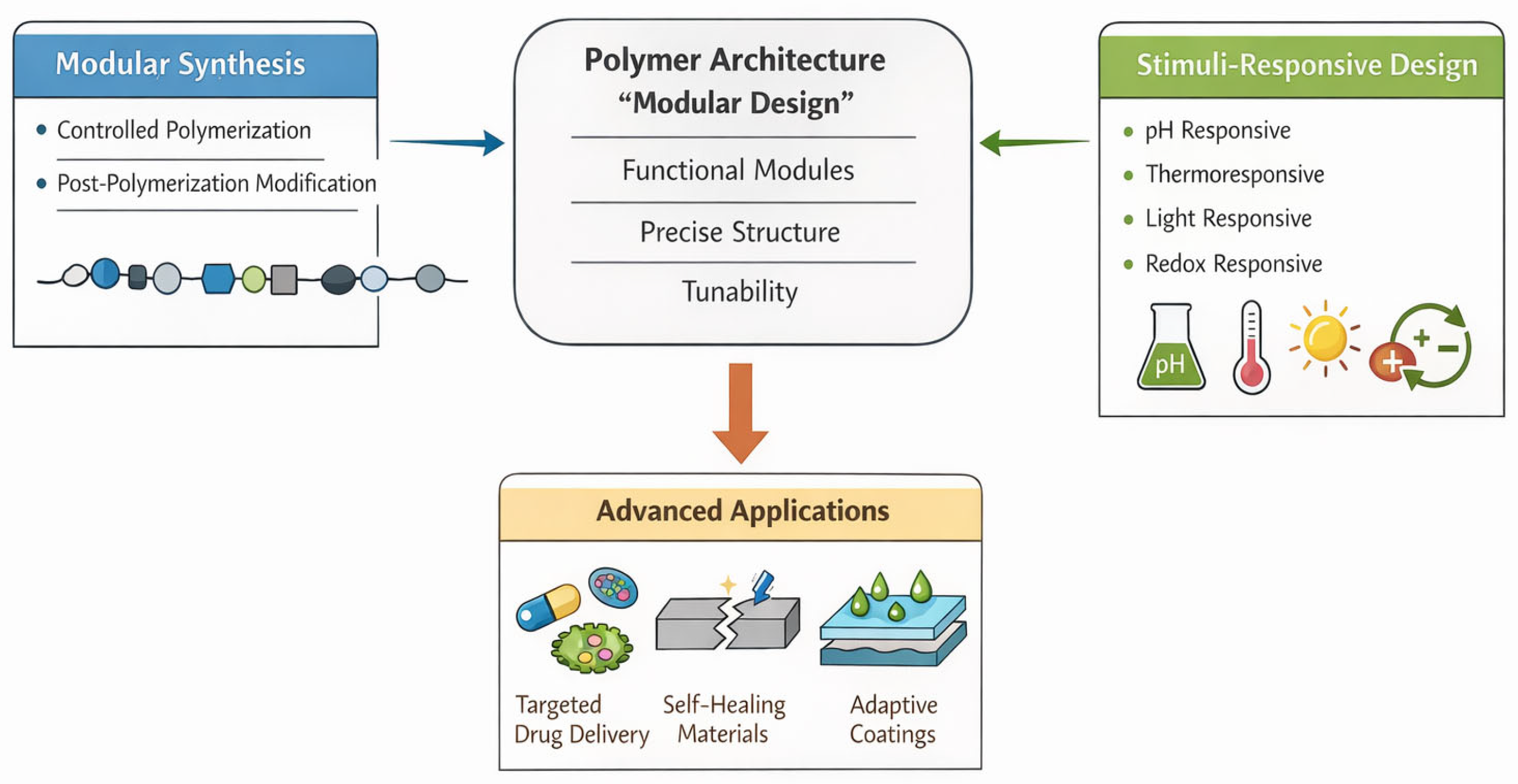
| Key Concept | Description | Reference |
|---|---|---|
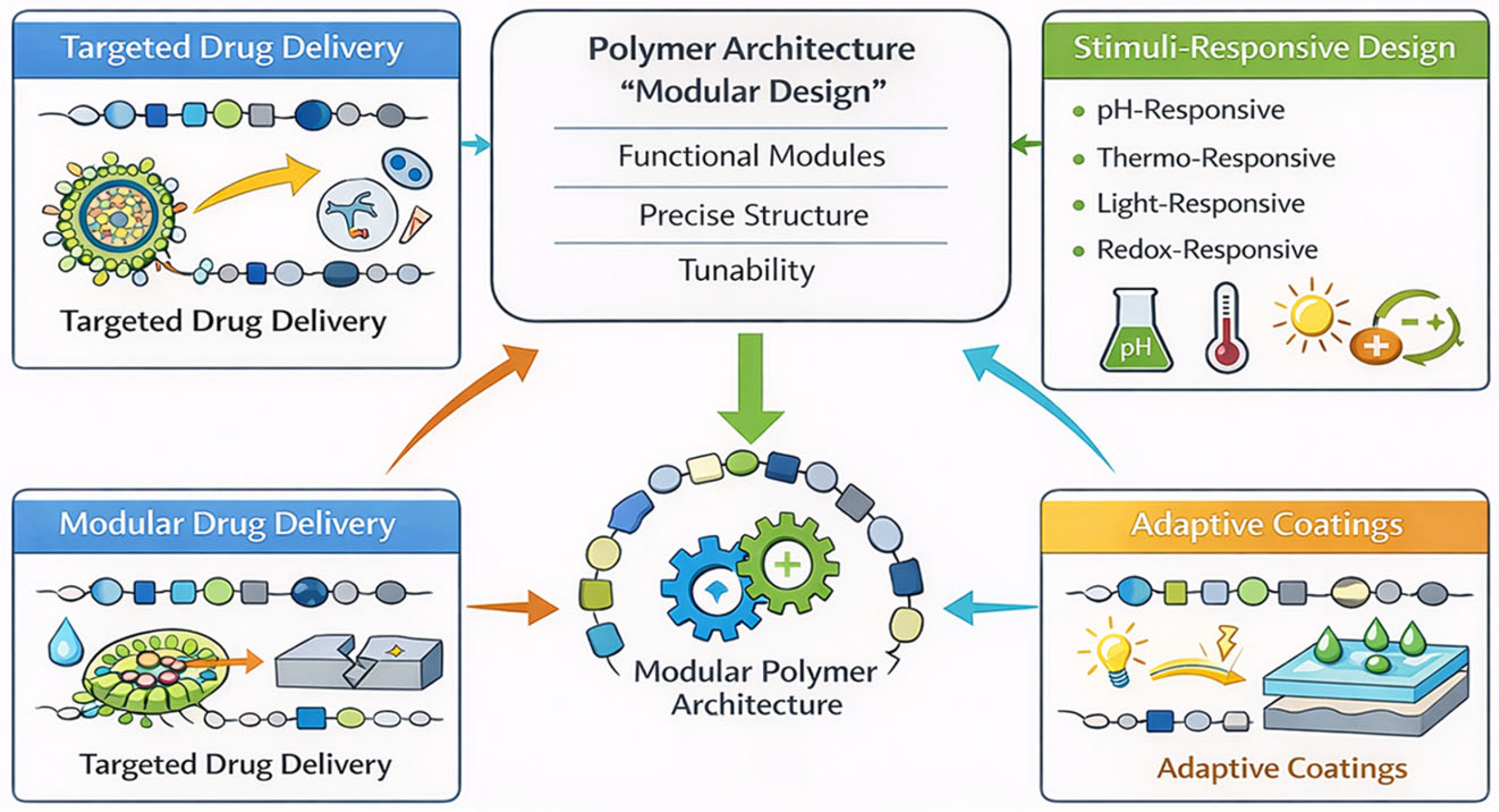
| Modular Polymer Synthesis | Enables the successive construction of polymers using diverse monomers and functional groups to customize properties. | [31] |
| Responsive Design | Polymers change their physical/chemical behaviour when exposed to environmental triggers such as pH, temperature, light, and redox signals. | [32] |
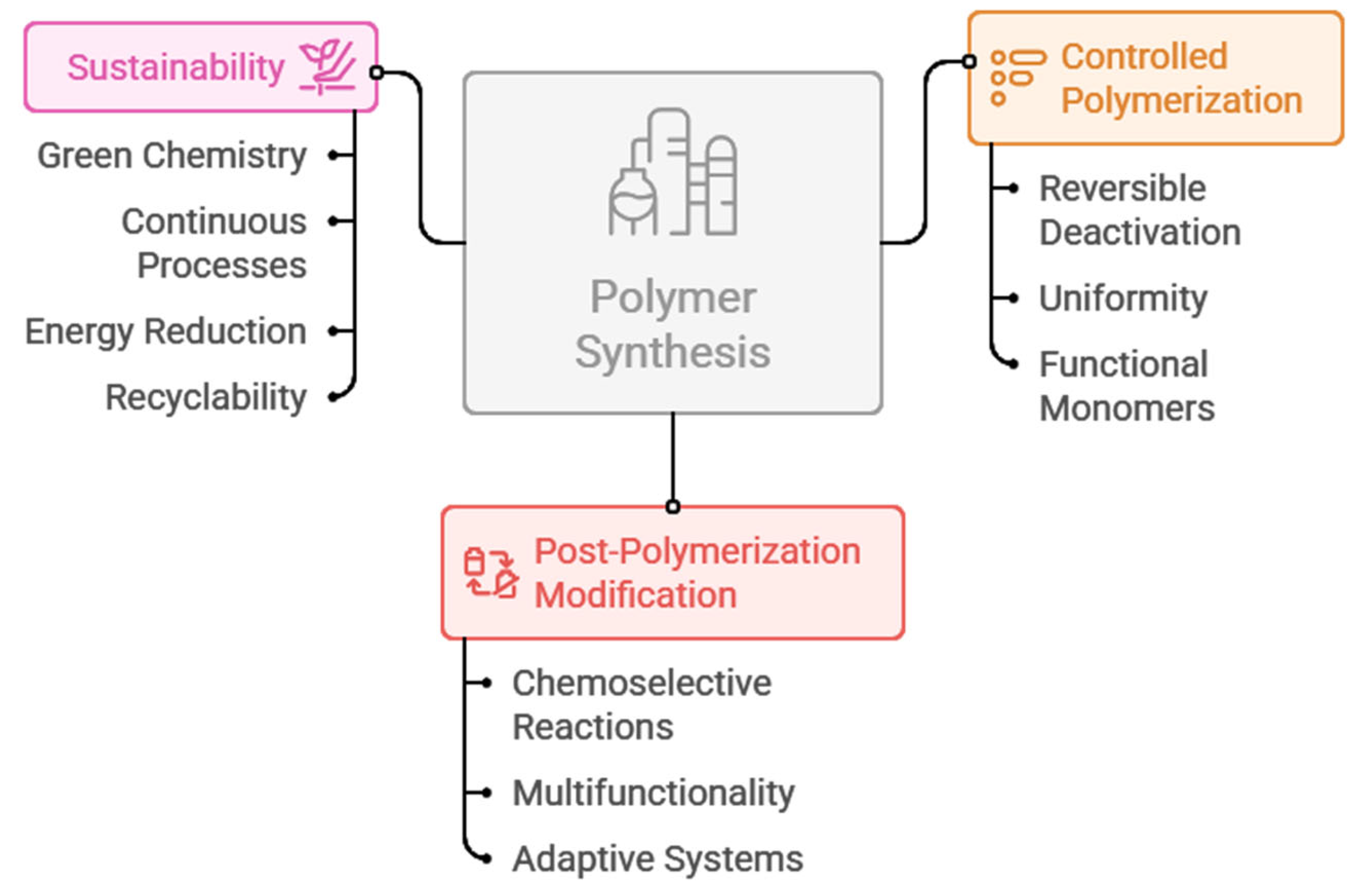
| Controlled Polymerization | Provides efficient, scalable, and sustainable synthetic processes for advanced polymer architectures. | [33] |
| Post-Polymerization Modification | Enhances functional diversity after backbone formation to fine-tune structure–property relationships. | [34] |
| Multifunctional Polymer Systems | Integration of multiple functional modules creates synergistic behaviour within a single polymer system. | [35] |
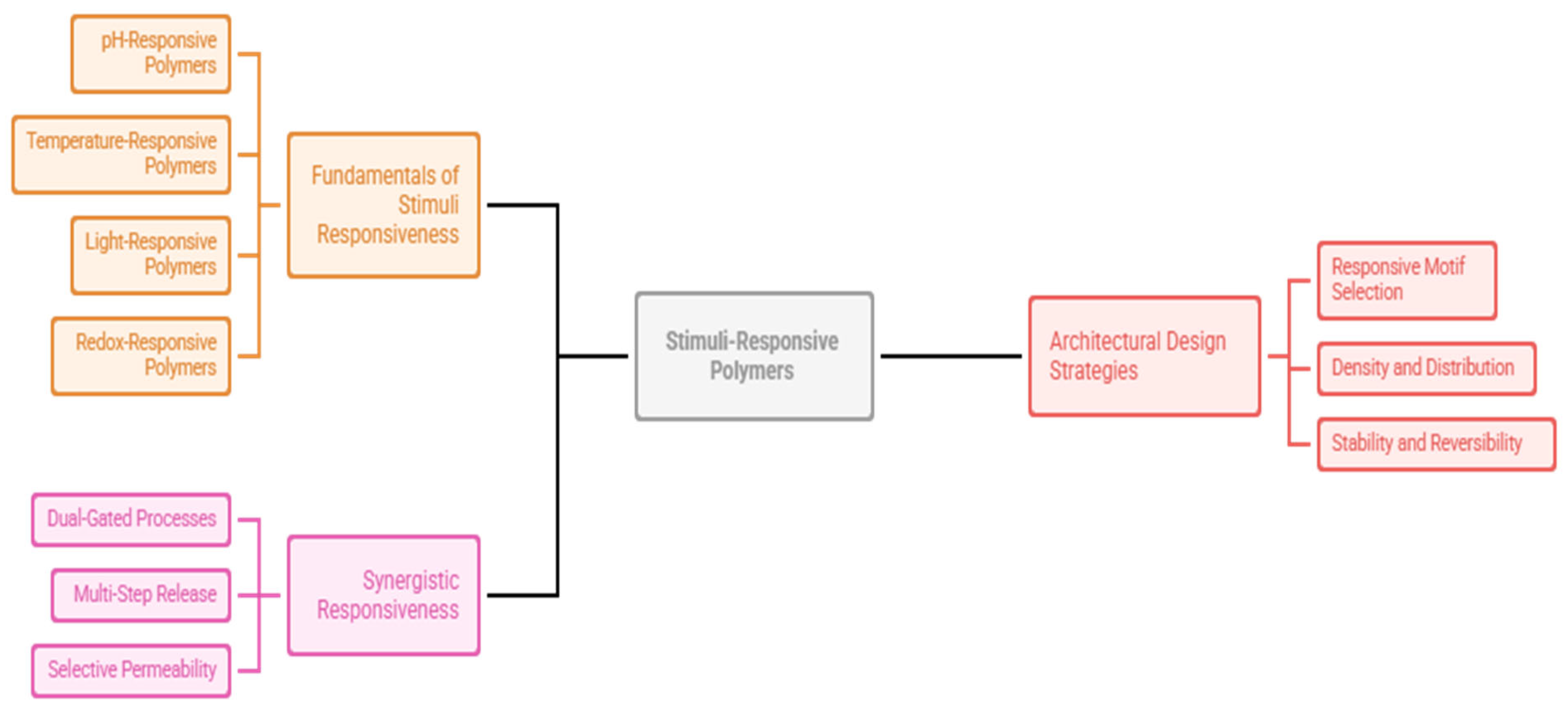
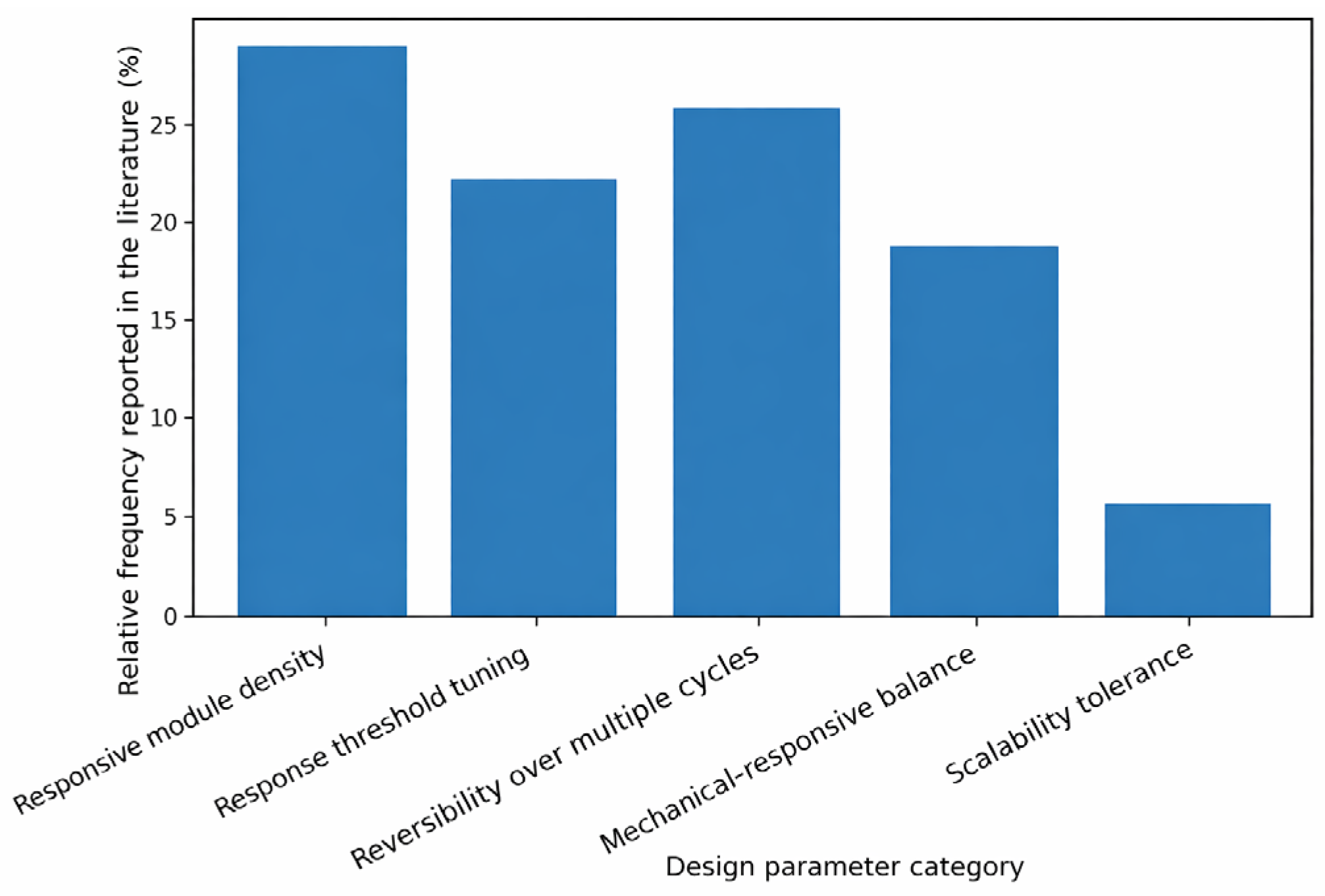
| Design Parameter | Description | Role in Polymer Performance |
|---|---|---|
| Responsive motif selection | Choice of stimulus-sensitive functional units | Determines the type and specificity of response |
| Motif density and distribution | Controlled spatial arrangement of responsive groups | Enables tunable and predictable responsiveness |
| Stability and reversibility | Ability to undergo repeated stimulus cycles | Ensures durability and reusability |
| Synergistic integration | A combination of multiple responsive modules | Produces advanced behaviours such as dual-gated and multi-step responses |
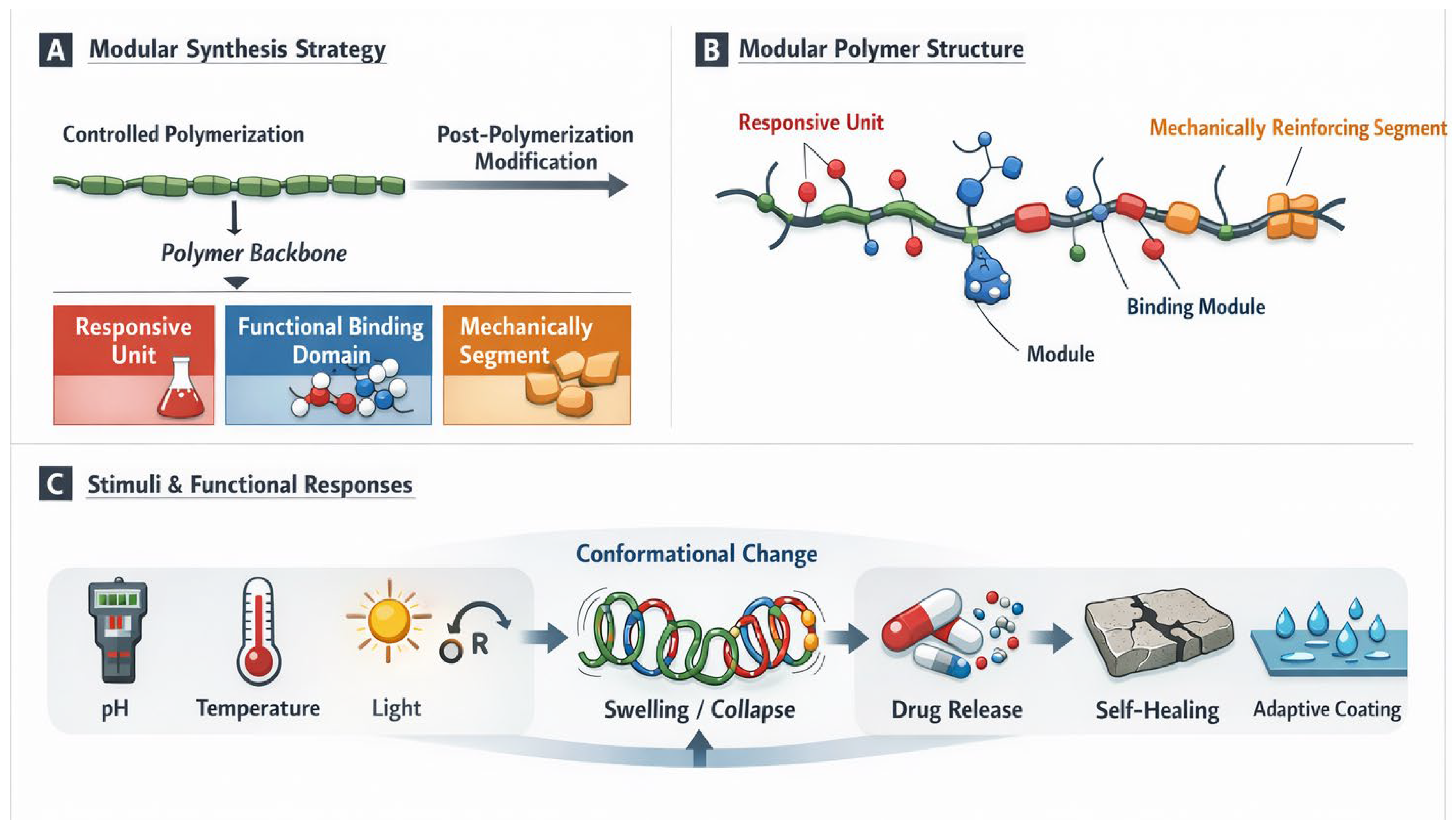
| Environmental Stimulus | Resulting Polymer Response | Example Functional Outcome | Reference |
|---|---|---|---|
| pH | Trigger changes in polymer conformation or behaviour | Targeted delivery or release | [143] |
| Temperature | Alters physical characteristics and chain mobility | Thermo-responsive coatings | [144] |
| Light | Activates reversible photochemical reactions | Adaptive optical materials | [145] |
| Redox Signals | Induces switching or chemical transitions | Self-healing or degradable systems | [146] |
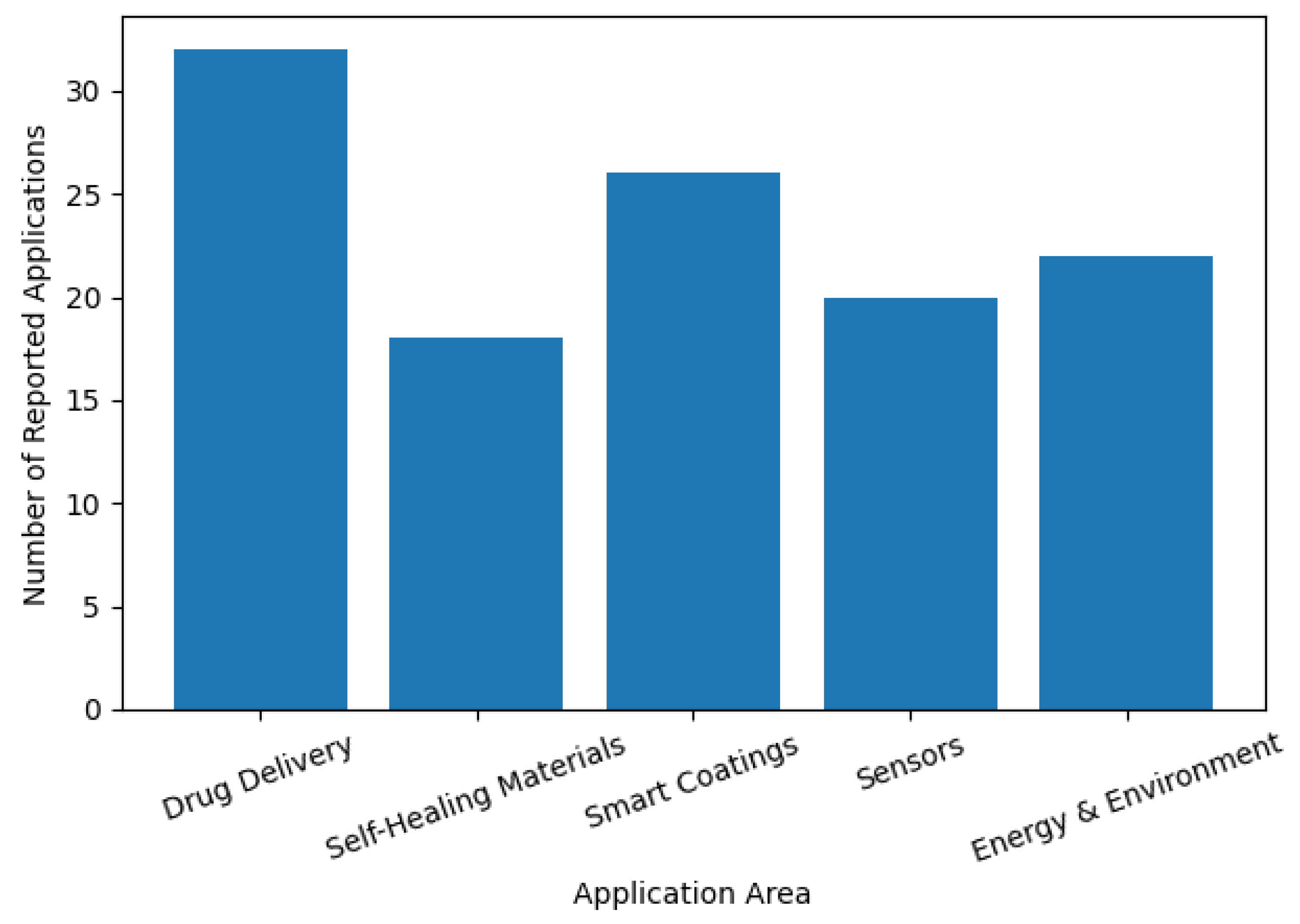
| Application Area | How Polymers Function in This Module | Beneficial Impact | Reference |
|---|---|---|---|
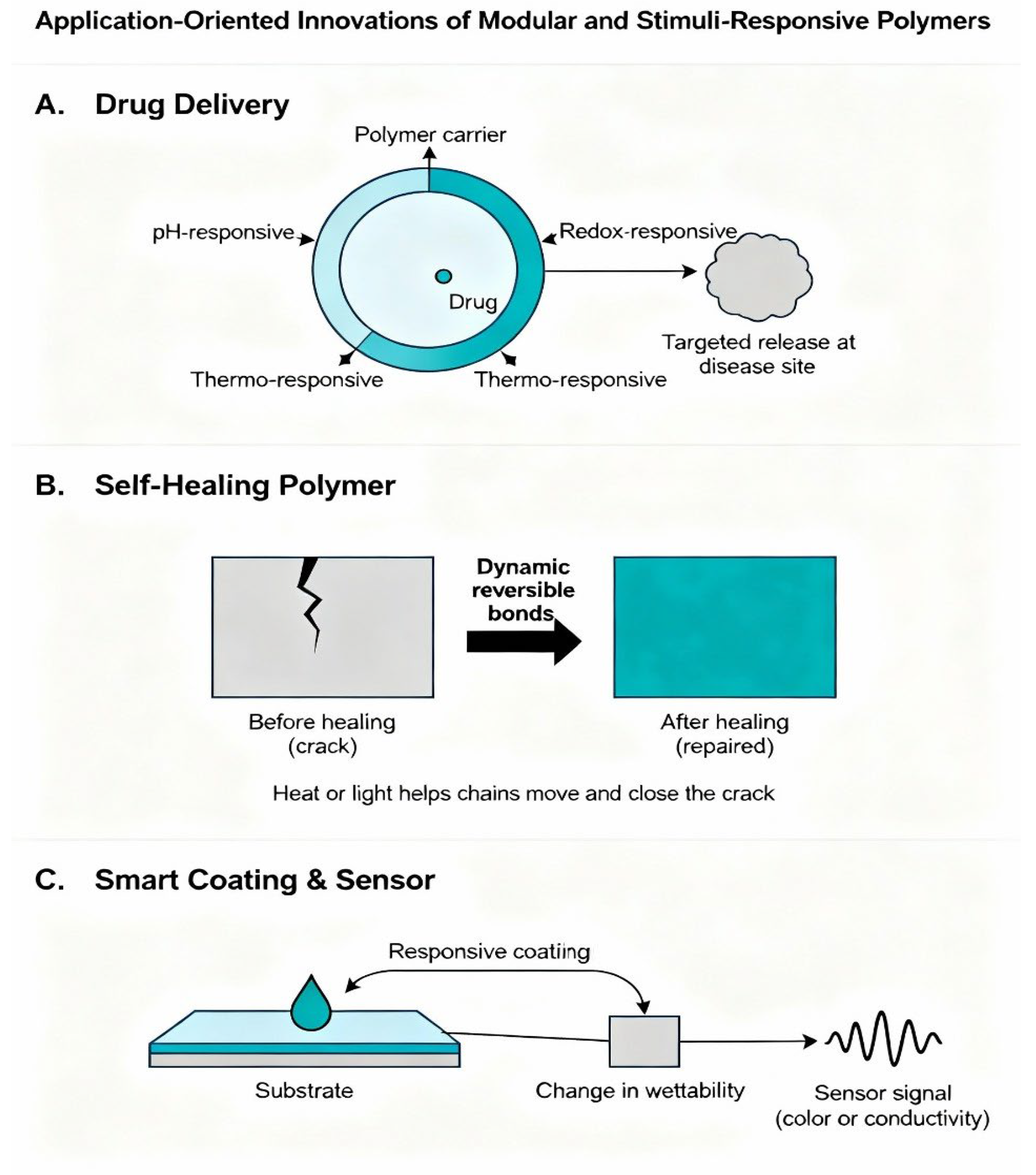
| Targeted Drug Delivery | Stimuli-responsive behaviour guides site-specific release | Increased therapeutic precision | [181] |
| Self-Healing Materials | Responsive polymers repair themselves under environmental cues | Structural longevity | [182] |
| Adaptive Coatings | Polymer surfaces adjust properties with temperature/light | Smart protective surfaces | [164] |
| Sensing Technologies | Polymers detect environmental fluctuations via responsiveness | High-sensitivity diagnostics | [183] |
| Energy and Environmental Applications | Sustainable polymer architectures improve performance | Eco-friendly advanced materials | [184] |
| Machine Learning Method | Typical Input Features | Predicted Properties | Representative Real-World Application |
|---|---|---|---|
| Linear and Ridge Regression | Molecular descriptors, composition ratios | Mechanical modulus, glass transition temperature | Rapid screening of commodity and engineering polymers |
| Random Forest Models | Monomer identity, block length, topology | Thermal stability, tensile strength | Optimization of polymer blends and composites |
| Support Vector Machines | Chemical fingerprints, surface functionality | Solubility, permeability | Membrane materials for gas separation and filtration |
| Artificial Neural Networks | Sequence information, processing parameters | Nonlinear structure–property relationships | Design of stimuli-responsive drug carriers |
| Graph Neural Networks | Polymer graphs and connectivity | Electronic and optical properties | Flexible electronics and conductive polymer design |
| Bayesian Optimization | Design variables with uncertainty | Optimal property trade-offs | Accelerated discovery of multifunctional polymers |
Disclaimer/Publisher’s Note: The statements, opinions and data contained in all publications are solely those of the individual author(s) and contributor(s) and not of MDPI and/or the editor(s). MDPI and/or the editor(s) disclaim responsibility for any injury to people or property resulting from any ideas, methods, instructions or products referred to in the content. |
© 2026 by the authors. Licensee MDPI, Basel, Switzerland. This article is an open access article distributed under the terms and conditions of the Creative Commons Attribution (CC BY) license.
Share and Cite
Sharma, A.; Sharma, M.; Sharma, S.; Sharma, V.; Sharma, S.; Sivanesan, I. Architecting Functional Polymers: Advances in Modular Synthesis, Responsive Design, and Multifaceted Applications. Polymers 2026, 18, 334. https://doi.org/10.3390/polym18030334
Sharma A, Sharma M, Sharma S, Sharma V, Sharma S, Sivanesan I. Architecting Functional Polymers: Advances in Modular Synthesis, Responsive Design, and Multifaceted Applications. Polymers. 2026; 18(3):334. https://doi.org/10.3390/polym18030334
Chicago/Turabian StyleSharma, Akhil, Monu Sharma, Sonu Sharma, Vikas Sharma, Shivika Sharma, and Iyyakkannu Sivanesan. 2026. "Architecting Functional Polymers: Advances in Modular Synthesis, Responsive Design, and Multifaceted Applications" Polymers 18, no. 3: 334. https://doi.org/10.3390/polym18030334
APA StyleSharma, A., Sharma, M., Sharma, S., Sharma, V., Sharma, S., & Sivanesan, I. (2026). Architecting Functional Polymers: Advances in Modular Synthesis, Responsive Design, and Multifaceted Applications. Polymers, 18(3), 334. https://doi.org/10.3390/polym18030334