Thermosets Based on Covalent Bond Exchange: Mechanisms, Properties, and Reprocessing


Abstract
1. Introduction
2. Covalent Bond Exchange Mechanisms
3. Thermosets Based on Representative Dynamic Covalent Reactions
3.1. Transesterification-Based Thermosets
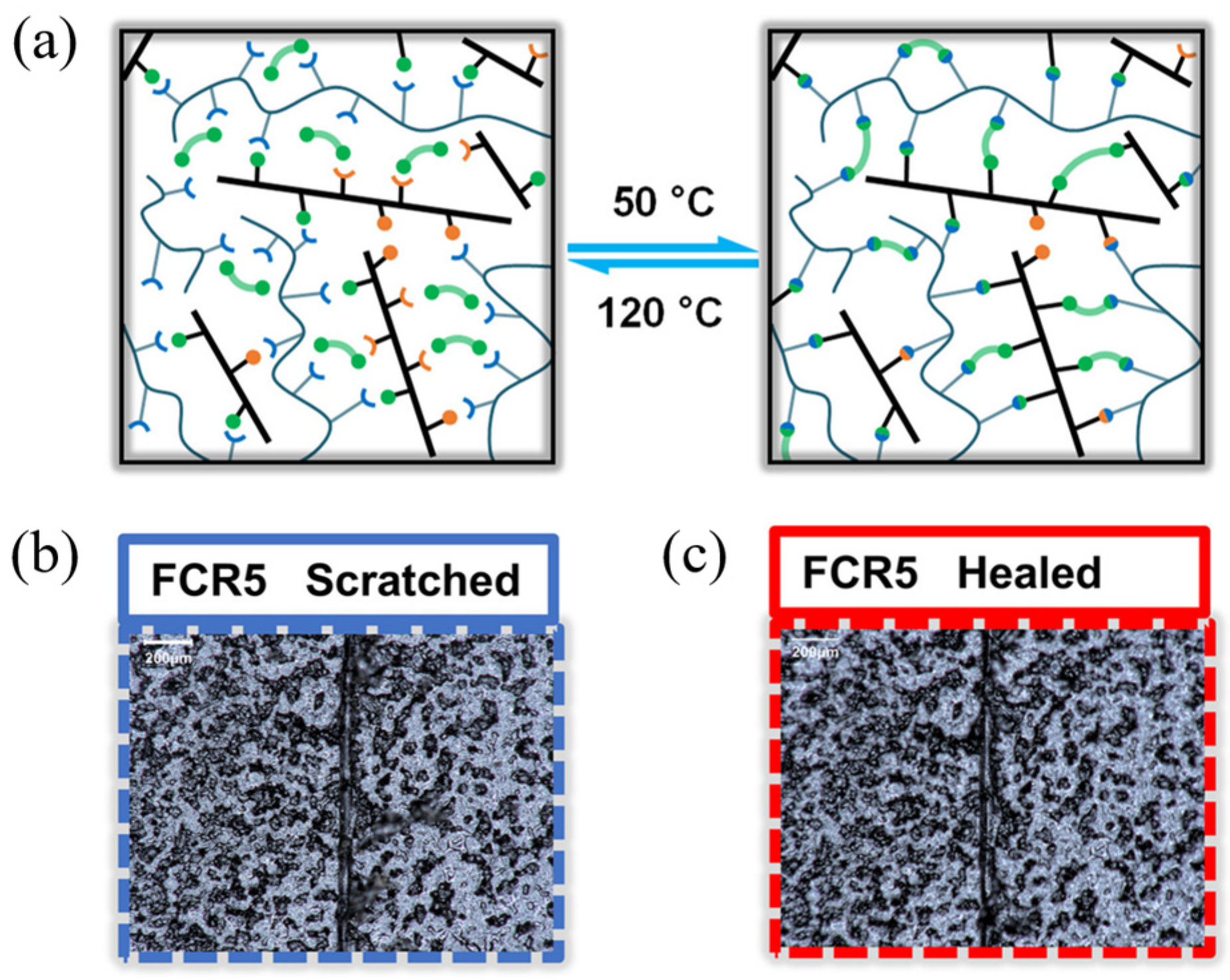
3.2. Diels–Alder Thermoreversible Thermosets
3.3. Imine Exchange Thermosets
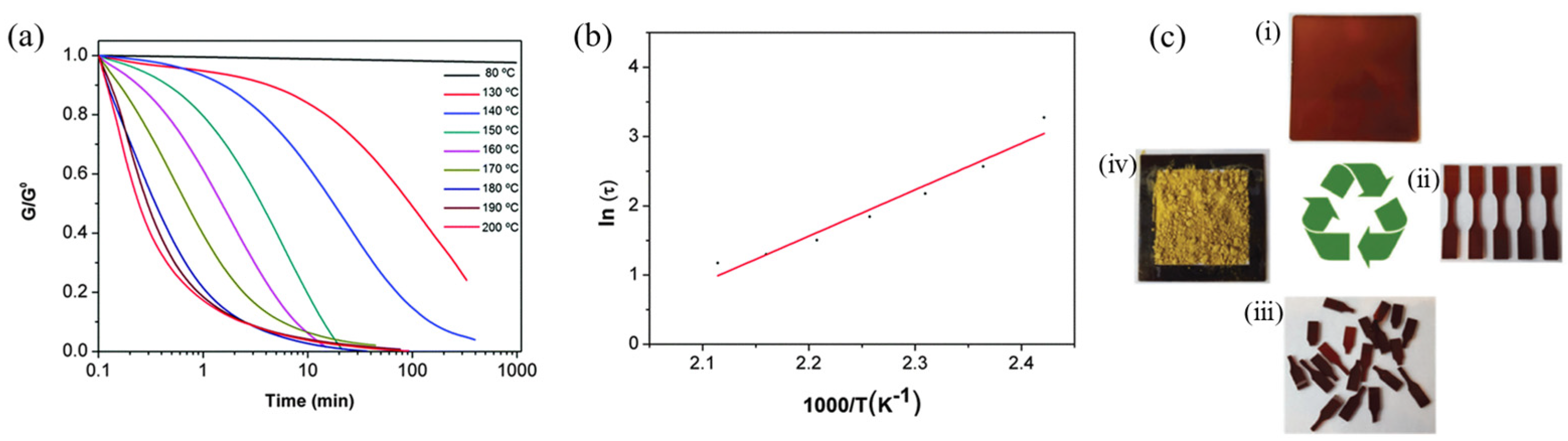
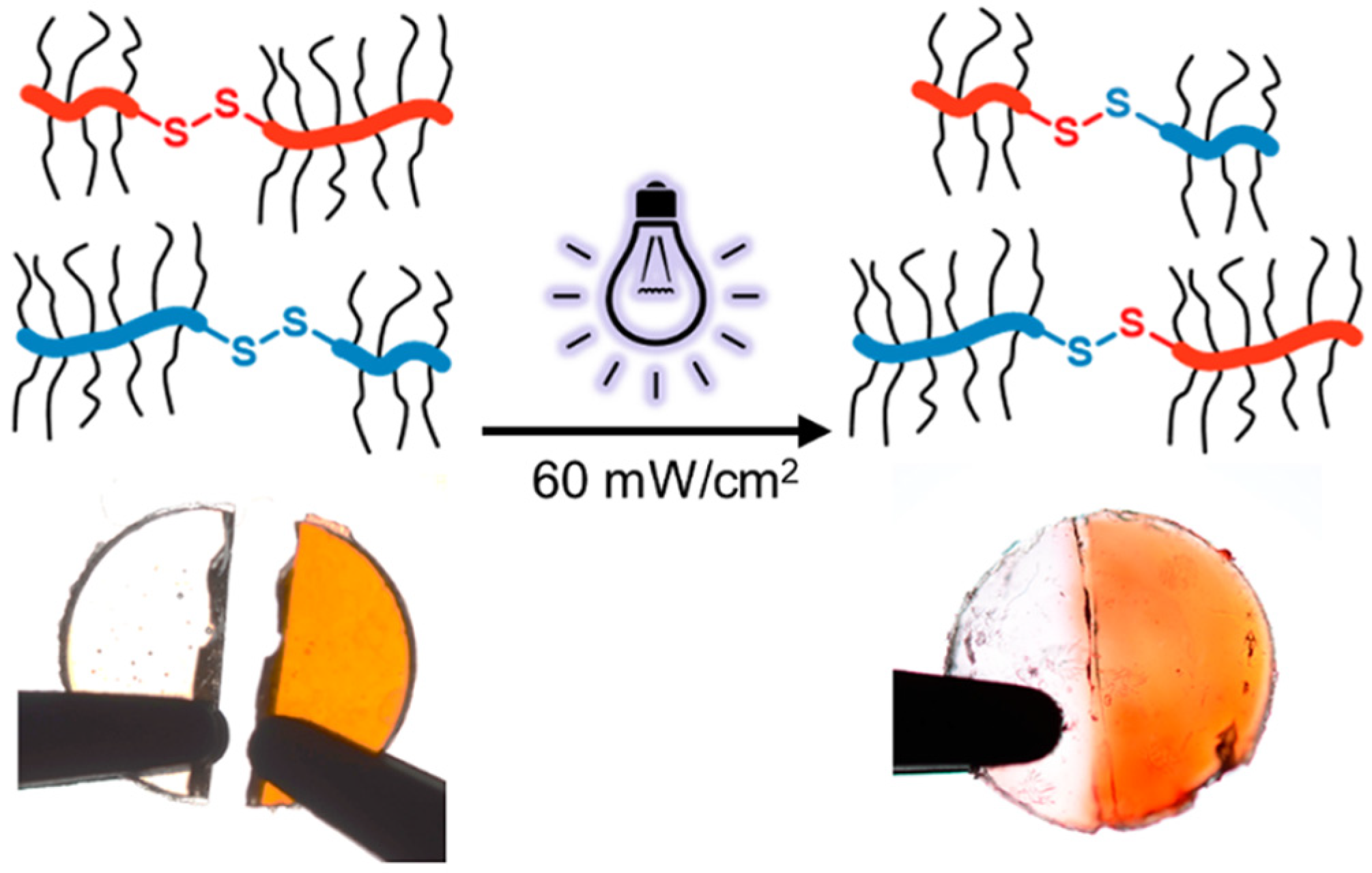
3.4. Disulfide Exchange Thermosets
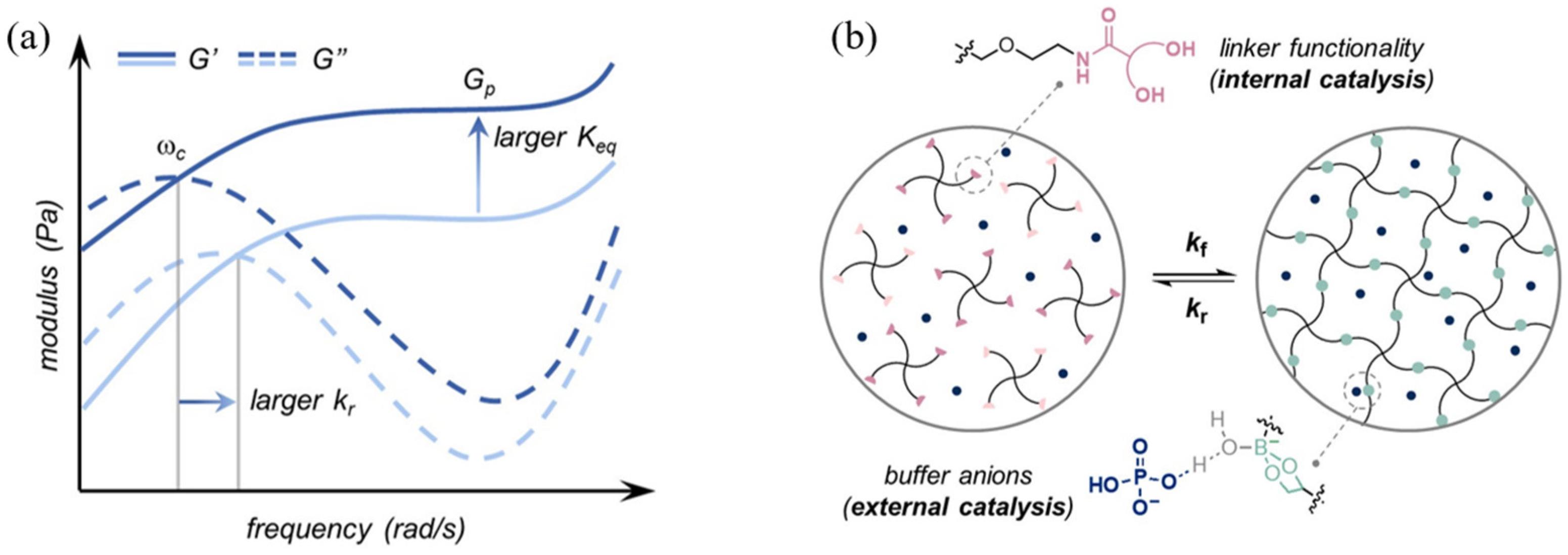
3.5. Boronic Ester-Based Thermosets
3.6. Siloxane Exchange Thermosets
4. Summary
Author Contributions
Funding
Institutional Review Board Statement
Data Availability Statement
Conflicts of Interest
References
- Dodiuk, H. Handbook of Thermoset Plastics; William Andrew: Norwich, NY, USA, 2021. [Google Scholar]
- Beylergil, B.; Ulus, H.; Çetin, M.E.; Kaybal, H.B.; Yildirim, S.; Al-Nadhari, A.; Yildiz, M. Fracture and Fatigue Assessment of Bonded Composite Patch Repairs in Notched and Cracked Plates. Polymers 2026, 18, 912. [Google Scholar] [CrossRef] [Scilit]
- Karatrantos, A.V.; Couture, O.; Hesse, C.; Schmidt, D.F. Molecular Simulation of Covalent Adaptable Networks and Vitrimers: A Review. Polymers 2024, 16, 1373. [Google Scholar] [CrossRef] [Scilit]
- Guo, X.; Liu, F.; Lv, M.; Chen, F.; Gao, F.; Xiong, Z.; Chen, X.; Shen, L.; Lin, F.; Gao, X. Self-Healable Covalently Adaptable Networks Based on Disulfide Exchange. Polymers 2022, 14, 3953. [Google Scholar] [CrossRef] [Scilit]
- Asyraf, M.R.M.; Ilyas, R.A.; Sapuan, S.M.; Harussani, M.M.; Hariz, H.M.; Aiman, J.M.; Baitaba, D.M.; Sanjay, M.R.; Ishak, M.R.; Norkhairunnisa, M.; et al. Advanced Composite in Aerospace Applications: Opportunities, Challenges, and Future Perspective. In Advanced Composites in Aerospace Engineering Applications; Mazlan, N., Sapuan, S.M., Ilyas, R.A., Eds.; Springer International Publishing: Cham, Switzerland, 2022; pp. 471–498. [Google Scholar]
- Tusher, M.H.; Imam, A.; Khatun, M.A. Polymer Composites: Its Processing, Advantages, Properties and Applications. In Hybrid Composite Materials: Experimental and Theoretical Analysis; Verma, A., Gupta, H.S., Sethi, S.K., Eds.; Springer Nature: Singapore, 2024; pp. 45–65. [Google Scholar]
- Kausar, A. Role of thermosetting polymer in structural composite. Am. J. Polym. Sci. Eng. 2017, 5, 1–12. [Google Scholar]
- Morici, E.; Dintcheva, N.T. Recycling of thermoset materials and thermoset-based composites: Challenge and opportunity. Polymers 2022, 14, 4153. [Google Scholar] [CrossRef] [Scilit] [PubMed]
- Geyer, R.; Jambeck, J.R.; Law, K.L. Production, use, and fate of all plastics ever made. Sci. Adv. 2017, 3, e1700782. [Google Scholar] [CrossRef] [Scilit]
- Hopewell, J.; Dvorak, R.; Kosior, E. Plastics recycling: Challenges and opportunities. Philos. Trans. R. Soc. B Biol. Sci. 2009, 364, 2115–2126. [Google Scholar] [CrossRef] [Scilit]
- Ragaert, K.; Delva, L.; Van Geem, K. Mechanical and chemical recycling of solid plastic waste. Waste Manag. 2017, 69, 24–58. [Google Scholar] [CrossRef] [Scilit]
- Rowan, S.J.; Cantrill, S.J.; Cousins, G.R.; Sanders, J.K.; Stoddart, J.F. Dynamic covalent chemistry. Angew. Chem. Int. Ed. 2002, 41, 898–952. [Google Scholar] [CrossRef] [Scilit]
- Scheutz, G.M.; Lessard, J.J.; Sims, M.B.; Sumerlin, B.S. Adaptable crosslinks in polymeric materials: Resolving the intersection of thermoplastics and thermosets. J. Am. Chem. Soc. 2019, 141, 16181–16196. [Google Scholar] [CrossRef] [Scilit]
- Maeda, T.; Otsuka, H.; Takahara, A. Dynamic covalent polymers: Reorganizable polymers with dynamic covalent bonds. Prog. Polym. Sci. 2009, 34, 581–604. [Google Scholar] [CrossRef] [Scilit]
- Zheng, N.; Xu, Y.; Zhao, Q.; Xie, T. Dynamic covalent polymer networks: A molecular platform for designing functions beyond chemical recycling and self-healing. Chem. Rev. 2021, 121, 1716–1745. [Google Scholar] [CrossRef] [Scilit]
- Lehn, J.-M. From supramolecular chemistry towards constitutional dynamic chemistry and adaptive chemistry. Chem. Soc. Rev. 2007, 36, 151–160. [Google Scholar] [CrossRef] [Scilit]
- Kloxin, C.J.; Scott, T.F.; Adzima, B.J.; Bowman, C.N. Covalent adaptable networks (CANs): A unique paradigm in cross-linked polymers. Macromolecules 2010, 43, 2643–2653. [Google Scholar] [CrossRef] [Scilit]
- Fortman, D.J.; Brutman, J.P.; De Hoe, G.X.; Snyder, R.L.; Dichtel, W.R.; Hillmyer, M.A. Approaches to sustainable and continually recyclable cross-linked polymers. ACS Sustain. Chem. Eng. 2018, 6, 11145–11159. [Google Scholar] [CrossRef] [Scilit]
- Elling, B.R.; Dichtel, W.R. Reprocessable cross-linked polymer networks: Are associative exchange mechanisms desirable? ACS Cent. Sci. 2020, 6, 1488–1496. [Google Scholar] [CrossRef] [Scilit]
- Liu, Z.; Fang, Z.; Zheng, N.; Yang, K.; Sun, Z.; Li, S.; Li, W.; Wu, J.; Xie, T. Chemical upcycling of commodity thermoset polyurethane foams towards high-performance 3D photo-printing resins. Nat. Chem. 2023, 15, 1773–1779. [Google Scholar] [CrossRef] [Scilit]
- Zhang, Y.; Ying, H.; Hart, K.R.; Wu, Y.; Hsu, A.J.; Coppola, A.M.; Kim, T.A.; Yang, K.; Sottos, N.R.; White, S.R. Malleable and recyclable poly (urea-urethane) thermosets bearing hindered urea bonds. Adv. Mater. 2016, 28, 7646–7651. [Google Scholar] [CrossRef] [Scilit] [PubMed]
- Taynton, P.; Yu, K.; Shoemaker, R.K.; Jin, Y.; Qi, H.J.; Zhang, W. Heat-or water-driven malleability in a highly recyclable covalent network polymer. Adv. Mater. 2014, 26, 3938–3942. [Google Scholar] [CrossRef] [Scilit] [PubMed]
- Canadell, J.; Goossens, H.; Klumperman, B. Self-healing materials based on disulfide links. Macromolecules 2011, 44, 2536–2541. [Google Scholar] [CrossRef] [Scilit]
- Cash, J.J.; Kubo, T.; Bapat, A.P.; Sumerlin, B.S. Room-temperature self-healing polymers based on dynamic-covalent boronic esters. Macromolecules 2015, 48, 2098–2106. [Google Scholar] [CrossRef] [Scilit]
- Zheng, P.; McCarthy, T.J. A surprise from 1954: Siloxane equilibration is a simple, robust, and obvious polymer self-healing mechanism. J. Am. Chem. Soc. 2012, 134, 2024–2027. [Google Scholar] [CrossRef] [Scilit]
- Capelot, M.; Montarnal, D.; Tournilhac, F.; Leibler, L. Metal-catalyzed transesterification for healing and assembling of thermosets. J. Am. Chem. Soc. 2012, 134, 7664–7667. [Google Scholar] [CrossRef] [Scilit] [PubMed]
- Lu, Y.-X.; Guan, Z. Olefin metathesis for effective polymer healing via dynamic exchange of strong carbon–carbon double bonds. J. Am. Chem. Soc. 2012, 134, 14226–14231. [Google Scholar] [CrossRef] [Scilit]
- Winne, J.M.; Leibler, L.; Du Prez, F.E. Dynamic covalent chemistry in polymer networks: A mechanistic perspective. Polym. Chem. 2019, 10, 6091–6108. [Google Scholar] [CrossRef] [Scilit]
- Sun, M.; Felsenthal, L.M.; Kim, S.; Choi, E.Y.; Reed, L.J.; Elling, B.R.; Dichtel, W.R. Covalent Adaptable Networks: Reprocessable Cross-Linked Polymers. Chem. Rev. 2026, 126, 1829–1948. [Google Scholar] [CrossRef] [Scilit]
- Vanarse, V.B.; Ahmed, M.M.; Singha, D.; Paul, A.; Bandyopadhyay, D. Depolymerization: A catalyst for environmental sustainability. In Depolymerization: Concepts, Progress, and Challenges Volume 1: Core Concepts and Fundamentals; ACS Publications: Washington, DC, USA, 2025; pp. 103–129. [Google Scholar]
- Yan, T.; Balzer, A.H.; Herbert, K.M.; Epps, T.H.; Korley, L.T. Circularity in polymers: Addressing performance and sustainability challenges using dynamic covalent chemistries. Chem. Sci. 2023, 14, 5243–5265. [Google Scholar] [CrossRef] [Scilit]
- Jin, Y.; Lei, Z.; Taynton, P.; Huang, S.; Zhang, W. Malleable and recyclable thermosets: The next generation of plastics. Matter 2019, 1, 1456–1493. [Google Scholar] [CrossRef] [Scilit]
- Jin, Y.; Yu, C.; Denman, R.J.; Zhang, W. Recent advances in dynamic covalent chemistry. Chem. Soc. Rev. 2013, 42, 6634–6654. [Google Scholar] [CrossRef] [Scilit]
- Kloxin, C.J.; Bowman, C.N. Covalent adaptable networks: Smart, reconfigurable and responsive network systems. Chem. Soc. Rev. 2013, 42, 7161–7173. [Google Scholar] [CrossRef] [Scilit]
- Denissen, W.; Winne, J.M.; Du Prez, F.E. Vitrimers: Permanent organic networks with glass-like fluidity. Chem. Sci. 2016, 7, 30–38. [Google Scholar] [CrossRef] [Scilit]
- Ryltsev, R.; Son, L. Statistical description of the sol-gel transition in systems with thermoreversible chemical bonds. J. Exp. Theor. Phys. 2010, 110, 504–520. [Google Scholar] [CrossRef] [Scilit]
- Chakma, P.; Digby, Z.A.; Shulman, M.P.; Kuhn, L.R.; Morley, C.N.; Sparks, J.L.; Konkolewicz, D. Anilinium salts in polymer networks for materials with mechanical stability and mild thermally induced dynamic properties. ACS Macro Lett. 2019, 8, 95–100. [Google Scholar] [CrossRef] [Scilit] [PubMed]
- Chakma, P.; Morley, C.N.; Sparks, J.L.; Konkolewicz, D. Exploring how vitrimer-like properties can be achieved from dissociative exchange in anilinium salts. Macromolecules 2020, 53, 1233–1244. [Google Scholar] [CrossRef] [Scilit]
- Lei, Z.; Chen, H.; Huang, S.; Wayment, L.J.; Xu, Q.; Zhang, W. New advances in covalent network polymers via dynamic covalent chemistry. Chem. Rev. 2024, 124, 7829–7906. [Google Scholar] [CrossRef] [Scilit] [PubMed]
- Delahaye, M.; Winne, J.M.; Du Prez, F.E. Internal catalysis in covalent adaptable networks: Phthalate monoester transesterification as a versatile dynamic cross-linking chemistry. J. Am. Chem. Soc. 2019, 141, 15277–15287. [Google Scholar] [CrossRef] [Scilit]
- Cromwell, O.R.; Chung, J.; Guan, Z. Malleable and self-healing covalent polymer networks through tunable dynamic boronic ester bonds. J. Am. Chem. Soc. 2015, 137, 6492–6495. [Google Scholar] [CrossRef] [Scilit]
- Chen, Y.; Tang, Z.; Zhang, X.; Liu, Y.; Wu, S.; Guo, B. Covalently cross-linked elastomers with self-healing and malleable abilities enabled by boronic ester bonds. ACS Appl. Mater. Interfaces 2018, 10, 24224–24231. [Google Scholar] [CrossRef] [Scilit]
- Yang, Y.; Du, F.-S.; Li, Z.-C. Highly stretchable, self-healable, and adhesive polyurethane elastomers based on boronic ester bonds. ACS Appl. Polym. Mater. 2020, 2, 5630–5640. [Google Scholar] [CrossRef] [Scilit]
- Zhang, L.; Rowan, S.J. Effect of sterics and degree of cross-linking on the mechanical properties of dynamic poly (alkylurea–urethane) networks. Macromolecules 2017, 50, 5051–5060. [Google Scholar] [CrossRef] [Scilit]
- Guo, Q.; Long, R. Mechanics of polymer networks with dynamic bonds. In Self-Healing and Self-Recovering Hydrogels; Springer: Cham, Switzerland, 2020; pp. 127–164. [Google Scholar]
- Long, R.; Qi, H.J.; Dunn, M.L. Modeling the mechanics of covalently adaptable polymer networks with temperature-dependent bond exchange reactions. Soft Matter 2013, 9, 4083–4096. [Google Scholar] [CrossRef] [Scilit]
- Marco-Dufort, B.; Iten, R.; Tibbitt, M.W. Linking molecular behavior to macroscopic properties in ideal dynamic covalent networks. J. Am. Chem. Soc. 2020, 142, 15371–15385. [Google Scholar] [CrossRef] [Scilit]
- Van Lijsebetten, F.; De Bruycker, K.; Van Ruymbeke, E.; Winne, J.M.; Du Prez, F.E. Characterising different molecular landscapes in dynamic covalent networks. Chem. Sci. 2022, 13, 12865–12875. [Google Scholar] [CrossRef] [Scilit] [PubMed]
- Cousin, L.; Tibbitt, M.W. Dynamic Biomaterials from Reversible Covalent Interactions. In Advanced Polymer Life Science; World Scientific: Singapore, 2025; pp. 279–326. [Google Scholar]
- Liu, Y.; Yu, Z.; Wang, B.; Li, P.; Zhu, J.; Ma, S. Closed-loop chemical recycling of thermosetting polymers and their applications: A review. Green Chem. 2022, 24, 5691–5708. [Google Scholar] [CrossRef] [Scilit]
- Hamel, C.M.; Kuang, X.; Qi, H.J. Modeling the dissolution of thermosetting polymers and composites via solvent assisted exchange reactions. Compos. Part B Eng. 2020, 200, 108363. [Google Scholar] [CrossRef] [Scilit]
- Van Lijsebetten, F.; Holloway, J.O.; Winne, J.M.; Du Prez, F.E. Internal catalysis for dynamic covalent chemistry applications and polymer science. Chem. Soc. Rev. 2020, 49, 8425–8438. [Google Scholar] [CrossRef] [Scilit]
- He, Z.; Pei, D.; Xu, L.; Peng, R.; Zhang, O.; Tang, J.; Yang, J.; Hu, J. Toward sustainable thermosets: Advances in toughening and degradation strategies for epoxy resins. Cell Rep. Phys. Sci. 2025, 6, 102855. [Google Scholar] [CrossRef] [Scilit]
- Maes, S.; Badi, N.; Winne, J.M.; Du Prez, F.E. Taking dynamic covalent chemistry out of the lab and into reprocessable industrial thermosets. Nat. Rev. Chem. 2025, 9, 144–158. [Google Scholar] [CrossRef] [Scilit]
- Jia, Y.; Li, H.; Liu, H.; Li, C.; Li, Y.; Wei, F. Extrudable thermosets based on dynamic covalent polymers. Chem. Eur. J. 2025, 31, e202501165. [Google Scholar] [CrossRef] [Scilit]
- Montarnal, D.; Capelot, M.; Tournilhac, F.; Leibler, L. Silica-like malleable materials from permanent organic networks. Science 2011, 334, 965–968. [Google Scholar] [CrossRef] [Scilit]
- Capelot, M.; Unterlass, M.M.; Tournilhac, F.; Leibler, L. Catalytic control of the vitrimer glass transition. ACS Macro Lett. 2012, 1, 789–792. [Google Scholar] [CrossRef] [Scilit]
- Yu, K.; Taynton, P.; Zhang, W.; Dunn, M.L.; Qi, H.J. Reprocessing and recycling of thermosetting polymers based on bond exchange reactions. RSC Adv. 2014, 4, 10108–10117. [Google Scholar] [CrossRef] [Scilit]
- Yu, K.; Taynton, P.; Zhang, W.; Dunn, M.L.; Qi, H.J. Influence of stoichiometry on the glass transition and bond exchange reactions in epoxy thermoset polymers. RSC Adv. 2014, 4, 48682–48690. [Google Scholar] [CrossRef] [Scilit]
- Yang, H.; Yu, K.; Mu, X.; Shi, X.; Wei, Y.; Guo, Y.; Qi, H.J. A molecular dynamics study of bond exchange reactions in covalent adaptable networks. Soft Matter 2015, 11, 6305–6317. [Google Scholar] [CrossRef] [Scilit] [PubMed]
- Altuna, F.I.; Pettarin, V.; Williams, R.J. Self-healable polymer networks based on the cross-linking of epoxidised soybean oil by an aqueous citric acid solution. Green Chem. 2013, 15, 3360–3366. [Google Scholar] [CrossRef] [Scilit]
- Shi, Q.; Yu, K.; Kuang, X.; Mu, X.; Dunn, C.K.; Dunn, M.L.; Wang, T.; Qi, H.J. Recyclable 3D printing of vitrimer epoxy. Mater. Horiz. 2017, 4, 598–607. [Google Scholar] [CrossRef] [Scilit]
- Majumdar, S.; Zhang, H.; Soleimani, M.; Van Benthem, R.A.; Heuts, J.P.; Sijbesma, R.P. Phosphate triester dynamic covalent networks. ACS Macro Lett. 2020, 9, 1753–1758. [Google Scholar] [CrossRef] [Scilit]
- Zhao, S.; Liu, Y.; Zhao, H.; Ma, K.; Fu, Y.; Dong, Y.; Li, J.; Pang, C. Catalyst-free dynamic covalent polyester networks with dissociative transesterification. Macromolecules 2024, 57, 11417–11428. [Google Scholar] [CrossRef] [Scilit]
- Wang, S.; Liu, Y.; Zhao, H.; Lu, C.; Fu, Y.; Zhao, S.; Dong, Y.; Li, J.; Pang, C. Catalyst-Free Covalent Adaptable Polyester Networks Based on Dissociative Transesterification Chemistry. Macromolecules 2025, 58, 5296–5304. [Google Scholar] [CrossRef] [Scilit]
- Gandini, A. The furan/maleimide Diels–Alder reaction: A versatile click–unclick tool in macromolecular synthesis. Prog. Polym. Sci. 2013, 38, 1–29. [Google Scholar] [CrossRef] [Scilit]
- Liu, Y.L.; Hsieh, C.Y. Crosslinked epoxy materials exhibiting thermal remendablility and removability from multifunctional maleimide and furan compounds. J. Polym. Sci. Part A Polym. Chem. 2006, 44, 905–913. [Google Scholar] [CrossRef] [Scilit]
- Boul, P.J.; Reutenauer, P.; Lehn, J.-M. Reversible Diels− Alder reactions for the generation of dynamic combinatorial libraries. Org. Lett. 2005, 7, 15–18. [Google Scholar] [CrossRef] [Scilit]
- Gacal, B.; Durmaz, H.; Tasdelen, M.; Hizal, G.; Tunca, U.; Yagci, Y.; Demirel, A. Anthracene− maleimide-based Diels− Alder “click chemistry” as a novel route to graft copolymers. Macromolecules 2006, 39, 5330–5336. [Google Scholar] [CrossRef] [Scilit]
- Tasdelen, M.A. Diels–Alder “click” reactions: Recent applications in polymer and material science. Polym. Chem. 2011, 2, 2133–2145. [Google Scholar] [CrossRef] [Scilit]
- Chen, X.; Dam, M.A.; Ono, K.; Mal, A.; Shen, H.; Nutt, S.R.; Sheran, K.; Wudl, F. A thermally re-mendable cross-linked polymeric material. Science 2002, 295, 1698–1702. [Google Scholar] [CrossRef] [Scilit]
- Liu, Y.-L.; Chuo, T.-W. Self-healing polymers based on thermally reversible Diels–Alder chemistry. Polym. Chem. 2013, 4, 2194–2205. [Google Scholar] [CrossRef] [Scilit]
- Araya-Hermosilla, R.; Broekhuis, A.; Picchioni, F. Reversible polymer networks containing covalent and hydrogen bonding interactions. Eur. Polym. J. 2014, 50, 127–134. [Google Scholar] [CrossRef] [Scilit]
- Schäfer, S.; Kickelbick, G. Double reversible networks: Improvement of self-healing in hybrid materials via combination of Diels–Alder cross-linking and hydrogen bonds. Macromolecules 2018, 51, 6099–6110. [Google Scholar] [CrossRef] [Scilit]
- Yang, S.; Du, X.; Deng, S.; Qiu, J.; Du, Z.; Cheng, X.; Wang, H. Recyclable and self-healing polyurethane composites based on Diels-Alder reaction for efficient solar-to-thermal energy storage. Chem. Eng. J. 2020, 398, 125654. [Google Scholar] [CrossRef] [Scilit]
- Cerdan, K.; Brancart, J.; Camacho, G.; de Vicente, J.; Puyvelde, P.V. Self-healing magnetorheological elastomers based on thermoreversible Diels–Alder networks. Smart Mater. Struct. 2023, 32, 045004. [Google Scholar] [CrossRef] [Scilit]
- Xi, J.; Wang, N. Synthesis of high mechanical strength and thermally recyclable and reversible polyurethane adhesive by Diels–Alder Reaction. Macromol. Chem. Phys. 2024, 225, 2400199. [Google Scholar] [CrossRef] [Scilit]
- Ciaccia, M.; Di Stefano, S. Mechanisms of imine exchange reactions in organic solvents. Org. Biomol. Chem. 2015, 13, 646–654. [Google Scholar] [CrossRef] [Scilit]
- Belowich, M.E.; Stoddart, J.F. Dynamic imine chemistry. Chem. Soc. Rev. 2012, 41, 2003–2024. [Google Scholar] [CrossRef] [Scilit]
- Kovaricek, P.; Lehn, J.-M. Merging constitutional and motional covalent dynamics in reversible imine formation and exchange processes. J. Am. Chem. Soc. 2012, 134, 9446–9455. [Google Scholar] [CrossRef] [Scilit]
- Kathan, M.; Kovaříček, P.; Jurissek, C.; Senf, A.; Dallmann, A.; Thünemann, A.F.; Hecht, S. Control of imine exchange kinetics with photoswitches to modulate self-healing in polysiloxane networks by light illumination. Angew. Chem. Int. Ed. 2016, 55, 13882–13886. [Google Scholar] [CrossRef] [Scilit]
- Chao, A.; Negulescu, I.; Zhang, D. Dynamic covalent polymer networks based on degenerative imine bond exchange: Tuning the malleability and self-healing properties by solvent. Macromolecules 2016, 49, 6277–6284. [Google Scholar] [CrossRef] [Scilit]
- Taynton, P.; Ni, H.; Zhu, C.; Yu, K.; Loob, S.; Jin, Y.; Qi, H.J.; Zhang, W. Repairable woven carbon fiber composites with full recyclability enabled by malleable polyimine networks. Adv. Mater. 2016, 28, 2904–2909. [Google Scholar] [CrossRef] [Scilit]
- Liu, Y.; Tang, Z.; Chen, Y.; Wu, S.; Guo, B. Programming dynamic imine bond into elastomer/graphene composite toward mechanically strong, malleable, and multi-stimuli responsive vitrimer. Compos. Sci. Technol. 2018, 168, 214–223. [Google Scholar] [CrossRef] [Scilit]
- Shen, X.; Ma, Y.; Luo, S.; Tao, R.; An, D.; Wei, X.; Jin, Y.; Qiu, L.; Zhang, W. Malleable and recyclable imide–imine hybrid thermosets: Influence of imide structure on material property. Mater. Adv. 2021, 2, 4333–4338. [Google Scholar] [CrossRef] [Scilit]
- Yang, Z.; Yin, J.; Lin, Y.; Hu, D.; Zhang, H.; Chen, Q.; Duan, P.; Cao, X.; Liu, J.; Hu, H. High-Performance, Closed-Loop Recyclable Polyimine Elastomers Based on Covalent Adaptive Networks for Polyimine/Carbon Fiber Elastomeric Composites. Macromolecules 2026, 59, 2965–2975. [Google Scholar] [CrossRef] [Scilit]
- Godoy-Alcántar, C.; Yatsimirsky, A.K.; Lehn, J.M. Structure-stability correlations for imine formation in aqueous solution. J. Phys. Org. Chem. 2005, 18, 979–985. [Google Scholar] [CrossRef] [Scilit]
- Fukuda, K.; Shimoda, M.; Sukegawa, M.; Nobori, T.; Lehn, J.-M. Doubly degradable dynamers: Dynamic covalent polymers based on reversible imine connections and biodegradable polyester units. Green Chem. 2012, 14, 2907–2911. [Google Scholar] [CrossRef] [Scilit]
- Otsuka, H.; Nagano, S.; Kobashi, Y.; Maeda, T.; Takahara, A. A dynamic covalent polymer driven by disulfide metathesis under photoirradiation. Chem. Commun. 2010, 46, 1150–1152. [Google Scholar] [CrossRef] [Scilit]
- Fortman, D.J.; Snyder, R.L.; Sheppard, D.T.; Dichtel, W.R. Rapidly reprocessable cross-linked polyhydroxyurethanes based on disulfide exchange. ACS Macro Lett. 2018, 7, 1226–1231. [Google Scholar] [CrossRef] [Scilit]
- Black, S.P.; Sanders, J.K.; Stefankiewicz, A.R. Disulfide exchange: Exposing supramolecular reactivity through dynamic covalent chemistry. Chem. Soc. Rev. 2014, 43, 1861–1872. [Google Scholar] [CrossRef] [Scilit]
- Fairbanks, B.D.; Singh, S.P.; Bowman, C.N.; Anseth, K.S. Photodegradable, photoadaptable hydrogels via radical-mediated disulfide fragmentation reaction. Macromolecules 2011, 44, 2444–2450. [Google Scholar] [CrossRef] [Scilit]
- Rekondo, A.; Martin, R.; de Luzuriaga, A.R.; Cabañero, G.; Grande, H.J.; Odriozola, I. Catalyst-free room-temperature self-healing elastomers based on aromatic disulfide metathesis. Mater. Horiz. 2014, 1, 237–240. [Google Scholar] [CrossRef] [Scilit]
- Li, Y.; Zhang, Y.; Rios, O.; Keum, J.K.; Kessler, M.R. Photo-responsive liquid crystalline epoxy networks with exchangeable disulfide bonds. RSC Adv. 2017, 7, 37248–37254. [Google Scholar] [CrossRef] [Scilit]
- Michal, B.T.; Jaye, C.A.; Spencer, E.J.; Rowan, S.J. Inherently photohealable and thermal shape-memory polydisulfide networks. ACS Macro Lett. 2013, 2, 694–699. [Google Scholar] [CrossRef] [Scilit]
- Tsuruoka, A.; Takahashi, A.; Aoki, D.; Otsuka, H. Fusion of different crosslinked polymers based on dynamic disulfide exchange. Angew. Chem. 2020, 132, 4324–4328. [Google Scholar] [CrossRef] [Scilit]
- Jin, S.; Oh, D.X.; Park, J. Dynamic Disulfide Chemistry for Functional Polymers: Self-Healing, Vitrimer Behavior, and Biochemical/Electronic Applications. ChemSusChem 2026, 19, e202501023. [Google Scholar] [CrossRef] [Scilit]
- Choi, C.; Self, J.L.; Okayama, Y.; Levi, A.E.; Gerst, M.; Speros, J.C.; Hawker, C.J.; Read de Alaniz, J.; Bates, C.M. Light-mediated synthesis and reprocessing of dynamic bottlebrush elastomers under ambient conditions. J. Am. Chem. Soc. 2021, 143, 9866–9871. [Google Scholar] [CrossRef] [Scilit]
- Roy, D.; Cambre, J.N.; Sumerlin, B.S. Triply-responsive boronic acid block copolymers: Solution self-assembly induced by changes in temperature, pH, or sugar concentration. Chem. Commun. 2009, 2106–2108. [Google Scholar] [CrossRef] [Scilit]
- Brooks, W.L.; Sumerlin, B.S. Synthesis and applications of boronic acid-containing polymers: From materials to medicine. Chem. Rev. 2016, 116, 1375–1397. [Google Scholar] [CrossRef] [Scilit]
- Guan, Y.; Zhang, Y. Boronic acid-containing hydrogels: Synthesis and their applications. Chem. Soc. Rev. 2013, 42, 8106–8121. [Google Scholar] [CrossRef] [Scilit]
- He, L.; Fullenkamp, D.E.; Rivera, J.G.; Messersmith, P.B. pH responsive self-healing hydrogels formed by boronate–catechol complexation. Chem. Commun. 2011, 47, 7497–7499. [Google Scholar] [CrossRef] [Scilit]
- Hong, S.H.; Kim, S.; Park, J.P.; Shin, M.; Kim, K.; Ryu, J.H.; Lee, H. Dynamic bonds between boronic acid and alginate: Hydrogels with stretchable, self-healing, stimuli-responsive, remoldable, and adhesive properties. Biomacromolecules 2018, 19, 2053–2061. [Google Scholar] [CrossRef] [Scilit]
- Smithmyer, M.E.; Deng, C.C.; Cassel, S.E.; LeValley, P.J.; Sumerlin, B.S.; Kloxin, A.M. Self-healing boronic acid-based hydrogels for 3D co-cultures. ACS Macro Lett. 2018, 7, 1105–1110. [Google Scholar] [CrossRef] [Scilit]
- Cash, J.J.; Kubo, T.; Dobbins, D.J.; Sumerlin, B.S. Maximizing the symbiosis of static and dynamic bonds in self-healing boronic ester networks. Polym. Chem. 2018, 9, 2011–2020. [Google Scholar] [CrossRef] [Scilit]
- Cho, S.; Hwang, S.Y.; Oh, D.X.; Park, J. Recent progress in self-healing polymers and hydrogels based on reversible dynamic B–O bonds: Boronic/boronate esters, borax, and benzoxaborole. J. Mater. Chem. A 2021, 9, 14630–14655. [Google Scholar] [CrossRef] [Scilit]
- Kang, B.; Kalow, J.A. Internal and External Catalysis in Boronic Ester Networks. ACS Macro Lett. 2022, 11, 394–401. [Google Scholar] [CrossRef] [Scilit]
- Yang, S.; Lian, K.; Tian, P.; Lu, D.; Zhang, J. Photocurable vitrimers with malleable and self-healing trade-off enabled by manipulating dynamic boronic ester bonds. Colloids Surf. A Physicochem. Eng. Asp. 2024, 702, 135103. [Google Scholar] [CrossRef] [Scilit]
- Kantor, S.W.; Grubb, W.T.; Osthoff, R.C. The mechanism of the acid-and base-catalyzed equilibration of siloxanes. J. Am. Chem. Soc. 1954, 76, 5190–5197. [Google Scholar] [CrossRef] [Scilit]
- Osthoff, R.; Bueche, A.; Grubb, W. Chemical stress-relaxation of polydimethylsiloxane elastomers1. J. Am. Chem. Soc. 1954, 76, 4659–4663. [Google Scholar] [CrossRef] [Scilit]
- Schmolke, W.; Perner, N.; Seiffert, S. Dynamically cross-linked polydimethylsiloxane networks with ambient-temperature self-healing. Macromolecules 2015, 48, 8781–8788. [Google Scholar] [CrossRef] [Scilit]
- Wu, X.; Yang, X.; Yu, R.; Zhao, X.-J.; Zhang, Y.; Huang, W. A facile access to stiff epoxy vitrimers with excellent mechanical properties via siloxane equilibration. J. Mater. Chem. A 2018, 6, 10184–10188. [Google Scholar] [CrossRef] [Scilit]
- Nishimura, Y.; Chung, J.; Muradyan, H.; Guan, Z. Silyl ether as a robust and thermally stable dynamic covalent motif for malleable polymer design. J. Am. Chem. Soc. 2017, 139, 14881–14884. [Google Scholar] [CrossRef] [Scilit]
- Yi, B.; Wang, S.; Hou, C.; Huang, X.; Cui, J.; Yao, X. Dynamic siloxane materials: From molecular engineering to emerging applications. Chem. Eng. J. 2021, 405, 127023. [Google Scholar] [CrossRef] [Scilit]
- Tretbar, C.A.; Neal, J.A.; Guan, Z. Direct silyl ether metathesis for vitrimers with exceptional thermal stability. J. Am. Chem. Soc. 2019, 141, 16595–16599. [Google Scholar] [CrossRef] [Scilit]
- Debsharma, T.; Amfilochiou, V.; Wróblewska, A.A.; De Baere, I.; Van Paepegem, W.; Du Prez, F.E. Fast dynamic siloxane exchange mechanism for reshapable vitrimer composites. J. Am. Chem. Soc. 2022, 144, 12280–12289. [Google Scholar] [CrossRef] [Scilit]
- Purwanto, N.S.; Wang, T.; Liu, X.; Broadbelt, L.J.; Debsharma, T.; Torkelson, J.M. Covalent Adaptable Networks With Associative Siloxane Exchange Enabled by Amide-Based Internal Catalysis: Designing for Reprocessability and Extrudability by Increasing the Cross-Link Density. Adv. Funct. Mater. 2025, 35, 2507313. [Google Scholar] [CrossRef] [Scilit]
- Ning, L.; Yuan, L.; Liang, G.; Gu, A. Thermally resistant and strong remoldable triple-shape memory thermosets based on bismaleimide with transesterification. J. Mater. Sci. 2021, 56, 3623–3637. [Google Scholar] [CrossRef] [Scilit]
- Liu, T.; Zhao, B.; Zhang, J. Recent development of repairable, malleable and recyclable thermosetting polymers through dynamic transesterification. Polymer 2020, 194, 122392. [Google Scholar] [CrossRef] [Scilit]
- Krishnakumar, B.; Sanka, R.P.; Binder, W.H.; Parthasarthy, V.; Rana, S.; Karak, N. Vitrimers: Associative dynamic covalent adaptive networks in thermoset polymers. Chem. Eng. J. 2020, 385, 123820. [Google Scholar] [CrossRef] [Scilit]
- Briou, B.; Améduri, B.; Boutevin, B. Trends in the Diels–Alder reaction in polymer chemistry. Chem. Soc. Rev. 2021, 50, 11055–11097. [Google Scholar] [CrossRef] [Scilit]
- Roh, S.; Nam, Y.; Nguyen, M.T.N.; Han, J.-H.; Lee, J.S. Dynamic covalent bond-based polymer chains operating reversibly with temperature changes. Molecules 2024, 29, 3261. [Google Scholar] [CrossRef] [Scilit]
- Polgar, L.M.; Kingma, A.; Roelfs, M.; van Essen, M.; van Duin, M.; Picchioni, F. Kinetics of cross-linking and de-cross-linking of EPM rubber with thermoreversible Diels-Alder chemistry. Eur. Polym. J. 2017, 90, 150–161. [Google Scholar] [CrossRef] [Scilit]
- Liguori, A.; Hakkarainen, M. Designed from biobased materials for recycling: Imine-based covalent adaptable networks. Macromol. Rapid Commun. 2022, 43, 2100816. [Google Scholar] [CrossRef] [Scilit]
- Wang, X.; Zhang, S.; Chen, Y. Polyimine-based self-healing composites: A review on dynamic covalent thermosets for sustainable and high-performance applications. Polymers 2025, 17, 1607. [Google Scholar] [CrossRef] [Scilit]
- Altarawneh, S.S.; Max, J.B.; Schacher, F.H.; Ababneh, T.S. Synthesis, characterization, thermodynamics and thermal degradation kinetics of imine-linked polymers. J. Polym. Res. 2020, 27, 349. [Google Scholar] [CrossRef] [Scilit]
- Ruiz de Luzuriaga, A.; Solera, G.; Azcarate-Ascasua, I.; Boucher, V.; Grande, H.-J.; Rekondo, A. Chemical control of the aromatic disulfide exchange kinetics for tailor-made epoxy vitrimers. Polymer 2022, 239, 124457. [Google Scholar] [CrossRef] [Scilit]
- Yao, H.; Zuo, Y.; Yang, H.; Zhang, J.; Huang, W.; Zhang, G. Recyclable Thermoset Enabled by Copolymer of Elemental Sulfur and Acrylate With Controlled Disulfide Linkages. Angew. Chem. 2026, 138, e25322. [Google Scholar] [CrossRef] [Scilit]
- Bapat, A.P.; Sumerlin, B.S.; Sutti, A. Bulk network polymers with dynamic B–O bonds: Healable and reprocessable materials. Mater. Horiz. 2020, 7, 694–714. [Google Scholar] [CrossRef] [Scilit]
- Wanasinghe, S.V.; Dodo, O.J.; Konkolewicz, D. Dynamic bonds: Adaptable timescales for responsive materials. Angew. Chem. 2022, 134, e202206938. [Google Scholar] [CrossRef] [Scilit]
- Gosecki, M.; Gosecka, M. Boronic Acid Esters and Anhydrates as Dynamic Cross-Links in Vitrimers. Polymers 2022, 14, 842. [Google Scholar] [CrossRef] [Scilit]
- Byczyński, Ł. Effect of different polyethers on surface and thermal properties of poly(urethane-siloxane) copolymers modified with side-chain siloxane. J. Therm. Anal. Calorim. 2013, 114, 397–408. [Google Scholar] [CrossRef] [Scilit]
- Zhang, Y.; Bai, L.; Xu, Z.; Chen, S.; Zheng, J. A robust, thermally stable, and efficiently reprocessable poly (dimethylsiloxane) elastomers based on activated dynamic silyl ether linkages by neighboring groups. Macromol. Chem. Phys. 2023, 224, 2300076. [Google Scholar] [CrossRef] [Scilit]
- Islam, M.S.; Kedziora, G.; Lee, J.; Stafford, A.; Varshney, V.; Nepal, D.; Baldwin, L.A.; Roy, A.K. Efficiency and Mechanism of Catalytic Siloxane Exchange in Vitrimer Polymers: Modeling and Density Functional Theory Investigations. J. Phys. Chem. A 2024, 128, 5627–5636. [Google Scholar] [CrossRef] [Scilit]
- Isogai, T.; Hayashi, M. Critical effects of branch numbers at the cross-link point on the relaxation behaviors of transesterification vitrimers. Macromolecules 2022, 55, 6661–6670. [Google Scholar] [CrossRef] [Scilit]
- Lemouzy, S.; Cuminet, F.; Berne, D.; Caillol, S.; Ladmiral, V.; Poli, R.; Leclerc, E. Understanding the reshaping of fluorinated polyester vitrimers by kinetic and DFT studies of the transesterification reaction. Chem. Eur. J. 2022, 28, e202201135. [Google Scholar] [CrossRef] [Scilit]
- Rizzo, G.; Saitta, L.; Dattilo, S.; Tosto, C.; Pergolizzi, E.; Ivankovic, A.; Cicala, G. Thermomechanical characterization of an unsaturated polyester Vitrimer synthesized using a titanium transesterification catalyst. ACS Appl. Polym. Mater. 2023, 5, 8326–8338. [Google Scholar] [CrossRef] [Scilit]
- Gao, Y.; Niu, H. Polypropylene-based transesterification covalent adaptable networks with internal catalysis. Polym. Chem. 2024, 15, 884–895. [Google Scholar] [CrossRef] [Scilit]
- Berne, D.; Cuminet, F.; Lemouzy, S.; Joly-Duhamel, C.; Poli, R.; Caillol, S.; Leclerc, E.; Ladmiral, V. Catalyst-free epoxy vitrimers based on transesterification internally activated by an α–CF3 group. Macromolecules 2022, 55, 1669–1679. [Google Scholar] [CrossRef] [Scilit]
- Ye, G.; Huo, S.; Wang, C.; Zhang, Q.; Wang, H.; Song, P.; Liu, Z. Strong yet tough catalyst-free transesterification vitrimer with excellent fire-retardancy, durability, and closed-loop recyclability. Small 2024, 20, 2404634. [Google Scholar] [CrossRef] [Scilit]
- Peterson, A.M.; Palmese, G.R. Reversible Diels–Alder cycloaddition for the design of multifunctional network polymers. In Click Chemistry for Biotechnology and Materials Science; John Wiley and Sons: Hoboken, NJ, USA, 2009; p. 195. [Google Scholar]
- Chen, X.; Wudl, F.; Mal, A.K.; Shen, H.; Nutt, S.R. New thermally remendable highly cross-linked polymeric materials. Macromolecules 2003, 36, 1802–1807. [Google Scholar] [CrossRef] [Scilit]
- Adzima, B.J.; Aguirre, H.A.; Kloxin, C.J.; Scott, T.F.; Bowman, C.N. Rheological and chemical analysis of reverse gelation in a covalently cross-linked Diels− Alder polymer network. Macromolecules 2008, 41, 9112–9117. [Google Scholar] [CrossRef] [Scilit]
- Swanson, J.P.; Rozvadovsky, S.; Seppala, J.E.; Mackay, M.E.; Jensen, R.E.; Costanzo, P.J. Development of Polymeric Phase Change Materials on the Basis of Diels− Alder Chemistry. Macromolecules 2010, 43, 6135–6141. [Google Scholar] [CrossRef] [Scilit]
- Oehlenschlaeger, K.K.; Mueller, J.O.; Brandt, J.; Hilf, S.; Lederer, A.; Wilhelm, M.; Graf, R.; Coote, M.L.; Schmidt, F.G.; Barner-Kowollik, C. Adaptable hetero Diels–Alder networks for fast self-healing under mild conditions. Adv. Mater. 2014, 26, 3561–3566. [Google Scholar] [CrossRef] [Scilit] [PubMed]
- Guo, J.; van der Ploeg, N.; Shah, M.N.B.M.; Bose, R.K. Reversible Nanocomposites With Carbon Nanotubes as the Diene in the Diels–Alder Reaction. Polym. Compos. 2026, 47, 4159–4170. [Google Scholar] [CrossRef] [Scilit]
- Strachota, B.; Morand, A.; Dybal, J.; Matějka, L. Control of gelation and properties of reversible diels–alder networks: Design of a self-healing network. Polymers 2019, 11, 930. [Google Scholar] [CrossRef] [Scilit]
- Xiang, H.; Qian, H.; Lu, Z.; Rong, M.; Zhang, M. Crack healing and reclaiming of vulcanized rubber by triggering the rearrangement of inherent sulfur crosslinked networks. Green Chem. 2015, 17, 4315–4325. [Google Scholar] [CrossRef] [Scilit]
- de Luzuriaga, A.R.; Martin, R.; Markaide, N.; Rekondo, A.; Cabañero, G.; Rodríguez, J.; Odriozola, I. Epoxy resin with exchangeable disulfide crosslinks to obtain reprocessable, repairable and recyclable fiber-reinforced thermoset composites. Mater. Horiz. 2016, 3, 241–247. [Google Scholar] [CrossRef] [Scilit]
- Debsharma, T.; Purwanto, N.S.; Fenimore, L.M.; Mitchell, S.; Kennedy, J.; Torkelson, J.M. BiTEMPS methacrylate dynamic covalent cross-linker providing rapid reprocessability and extrudability of covalent adaptable networks: High-yield synthesis with strong selectivity for disulfide linkages. Polym. Chem. 2024, 15, 2167–2176. [Google Scholar] [CrossRef] [Scilit]
- Fenimore, L.M.; Suazo, M.J.; Mitchell, S.; Mohammadi, H.; McLoughlin, K.M.; Gallaschun, C.; Sewruk, P.; Busch, M.; Torkelson, J.M. Fully Recyclable and Remarkably Robust Cross-Linked Polyethylene Networks via Direct Free-Radical Copolymerization with Disulfide Dynamic Covalent Bonds. J. Am. Chem. Soc. 2025, 147, 27179–27185. [Google Scholar] [CrossRef] [Scilit] [PubMed]
- Wang, W.; Li, W.; Guo, X.; Song, Z.; Wang, H.; Cheng, Y.; Shen, L.; Gao, F. Reconfigurable and Chemically Recyclable Thermosets via Cooperative Sulfhydryl–Disulfide Exchange in Sulfur-Rich Dynamic Networks. ACS Appl. Polym. Mater. 2025, 7, 13950–13961. [Google Scholar] [CrossRef] [Scilit]
- Suazo, M.J.; Torkelson, J.M. Reprocessable covalent adaptable networks via free-radical polymerization with an aromatic disulfide cross-linker. ACS Appl. Polym. Mater. 2024, 6, 9209–9218. [Google Scholar] [CrossRef] [Scilit]
- Azcune, I.; Odriozola, I. Aromatic disulfide crosslinks in polymer systems: Self-healing, reprocessability, recyclability and more. Eur. Polym. J. 2016, 84, 147–160. [Google Scholar] [CrossRef] [Scilit]
- Nguyen, H.N.; Lu, L.-H.; Huang, C.-J. Aromatic disulfide cross-linkers for self-healable and recyclable acrylic polymer networks. ACS Appl. Polym. Mater. 2024, 6, 4615–4624. [Google Scholar] [CrossRef] [Scilit]
- Roig, A.; D’Agostino, V.; Serra, À.; De la Flor, S. Towards fast relaxation rates and creep resistance in disulfide vitrimer-like materials. React. Funct. Polym. 2023, 193, 105764. [Google Scholar] [CrossRef] [Scilit]
- Podgórski, M.; Fairbanks, B.D.; Kirkpatrick, B.E.; McBride, M.; Martinez, A.; Dobson, A.; Bongiardina, N.J.; Bowman, C.N. Toward stimuli-responsive dynamic thermosets through continuous development and improvements in covalent adaptable networks (CANs). Adv. Mater. 2020, 32, 1906876. [Google Scholar] [CrossRef] [Scilit]
- Zuo, Y.; Gou, Z.; Zhang, C.; Feng, S. Polysiloxane-Based Autonomic Self-Healing Elastomers Obtained through Dynamic Boronic Ester Bonds Prepared by Thiol–Ene “Click” Chemistry. Macromol. Rapid Commun. 2016, 37, 1052–1059. [Google Scholar] [CrossRef] [Scilit] [PubMed]
- Lian, X.; Li, Y.; Li, M.; Bai, Y.; Zhao, X.; Li, J.; Zhao, S. Cartilage-Inspired Boronic Ester Dynamic Cross-linking Networks for High-Strength and Reversible Adhesives. Polym. Degrad. Stab. 2025, 245, 111907. [Google Scholar] [CrossRef] [Scilit]
- Du, B.; Mi, H.; Du, Y.; Li, Q.; Wang, Y.; Kong, X. Simultaneous recycling and electrical insulation of epoxy resin enabled by dynamic boronic ester bonds. Chem. Eng. J. 2026, 529, 173029. [Google Scholar] [CrossRef] [Scilit]
- Majumdar, S.; Mezari, B.; Zhang, H.; van Aart, J.; van Benthem, R.A.T.M.; Heuts, J.P.A.; Sijbesma, R.P. Efficient Exchange in a Bioinspired Dynamic Covalent Polymer Network via a Cyclic Phosphate Triester Intermediate. Macromolecules 2021, 54, 7955–7962. [Google Scholar] [CrossRef] [Scilit]
- Xia, N.N.; Rong, M.Z.; Zhang, M.Q. Stabilization of catechol–boronic ester bonds for underwater self-healing and recycling of lipophilic bulk polymer in wider pH range. J. Mater. Chem. A 2016, 4, 14122–14131. [Google Scholar] [CrossRef] [Scilit]
- Chen, S.; Cao, J.; Zheng, J. Reprocessable silyl ether-based dynamic covalent poly (dimethylsiloxane) networks with superb thermal stability and creep resistance. ACS Appl. Polym. Mater. 2024, 6, 4215–4225. [Google Scholar] [CrossRef] [Scilit]
- Husted, K.E.L.; Brown, C.M.; Shieh, P.; Kevlishvili, I.; Kristufek, S.L.; Zafar, H.; Accardo, J.V.; Cooper, J.C.; Klausen, R.S.; Kulik, H.J.; et al. Remolding and Deconstruction of Industrial Thermosets via Carboxylic Acid-Catalyzed Bifunctional Silyl Ether Exchange. J. Am. Chem. Soc. 2023, 145, 1916–1923. [Google Scholar] [CrossRef] [Scilit]
- Debsharma, T.; Nguyen, L.T.; Maliszewski, B.P.; Fischer, S.M.; Scholiers, V.; Winne, J.M.; Nolan, S.P.; Du Prez, F.E. Eliminating creep in vitrimers using temperature-resilient siloxane exchange chemistry and N-heterocyclic carbenes. Chem. Sci. 2025, 16, 9337–9347. [Google Scholar] [CrossRef] [Scilit]



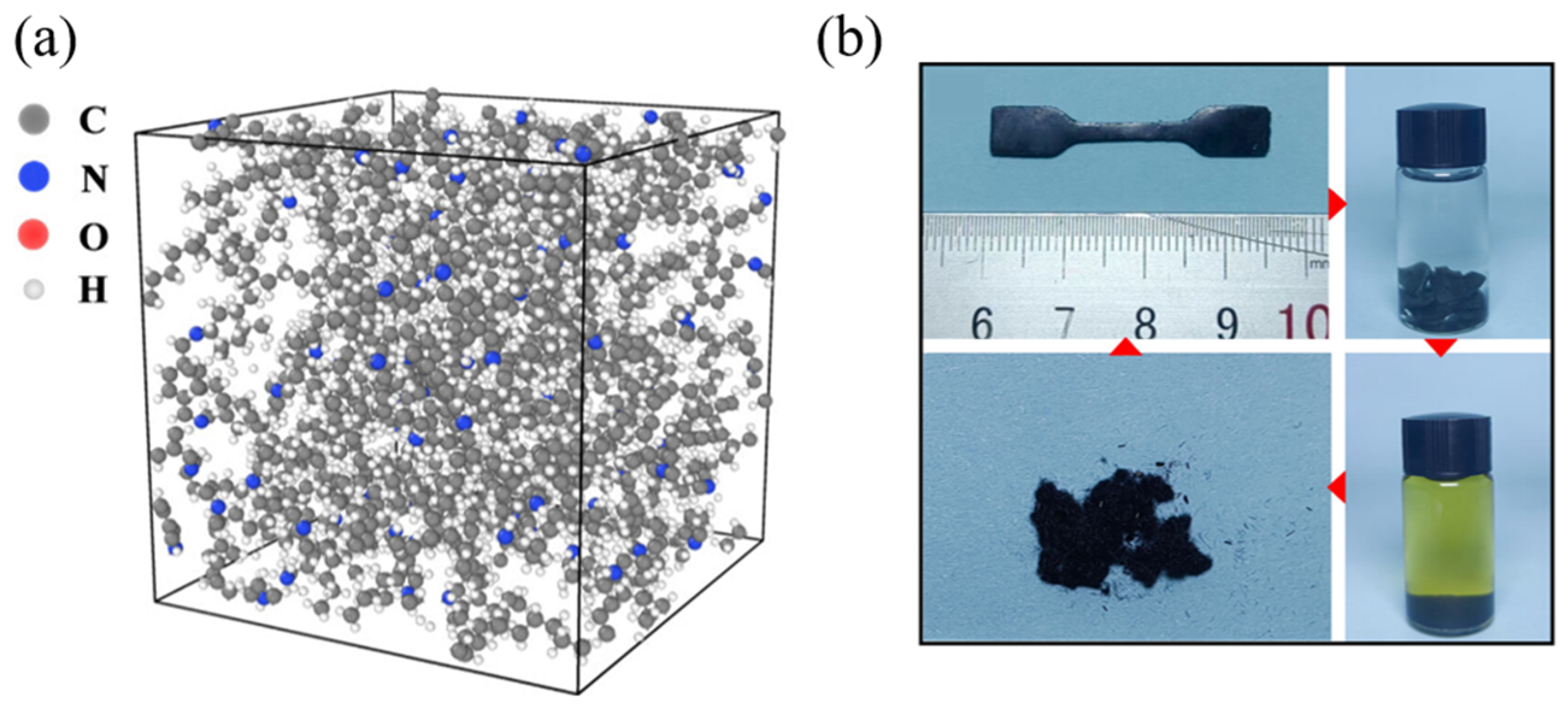


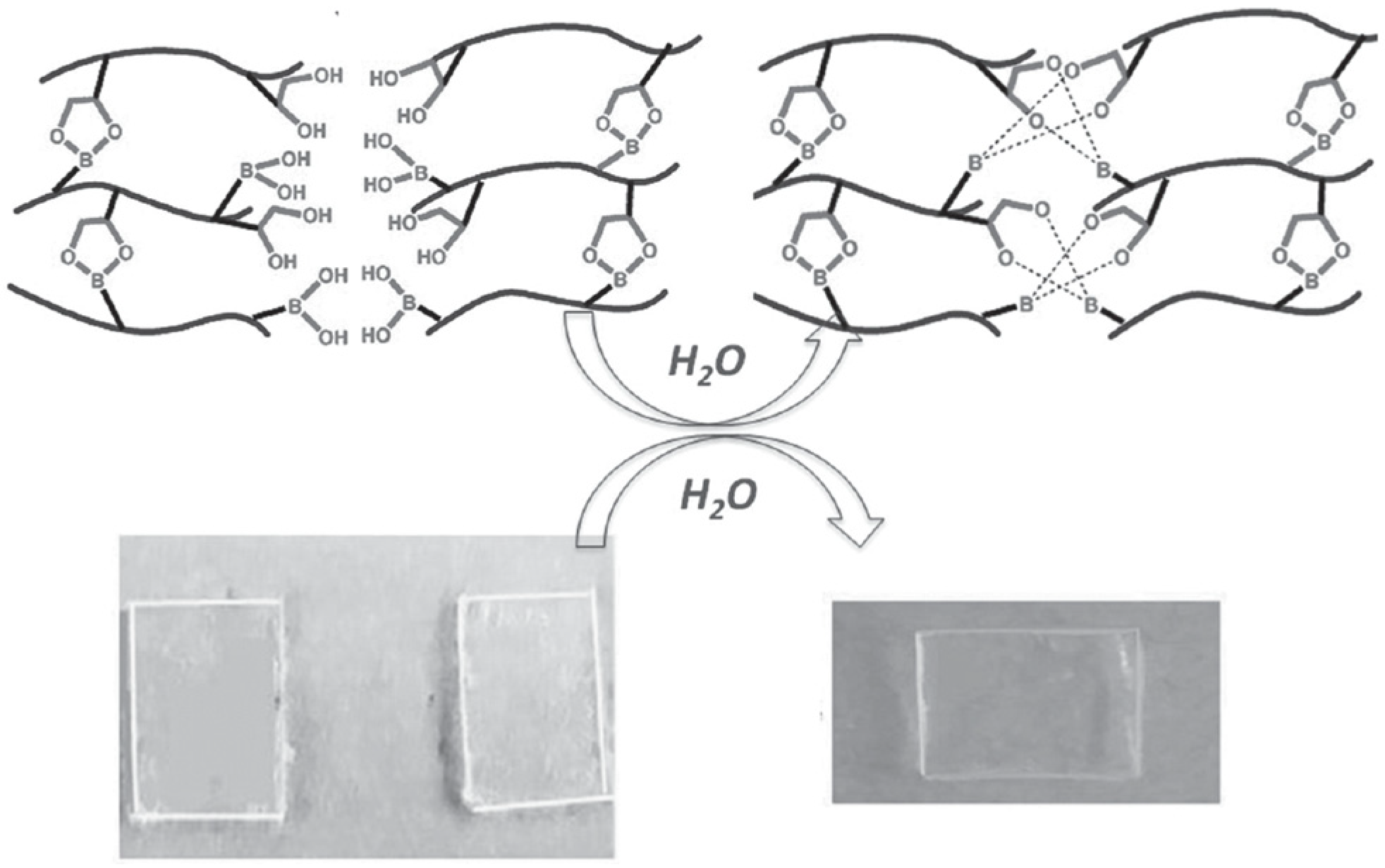


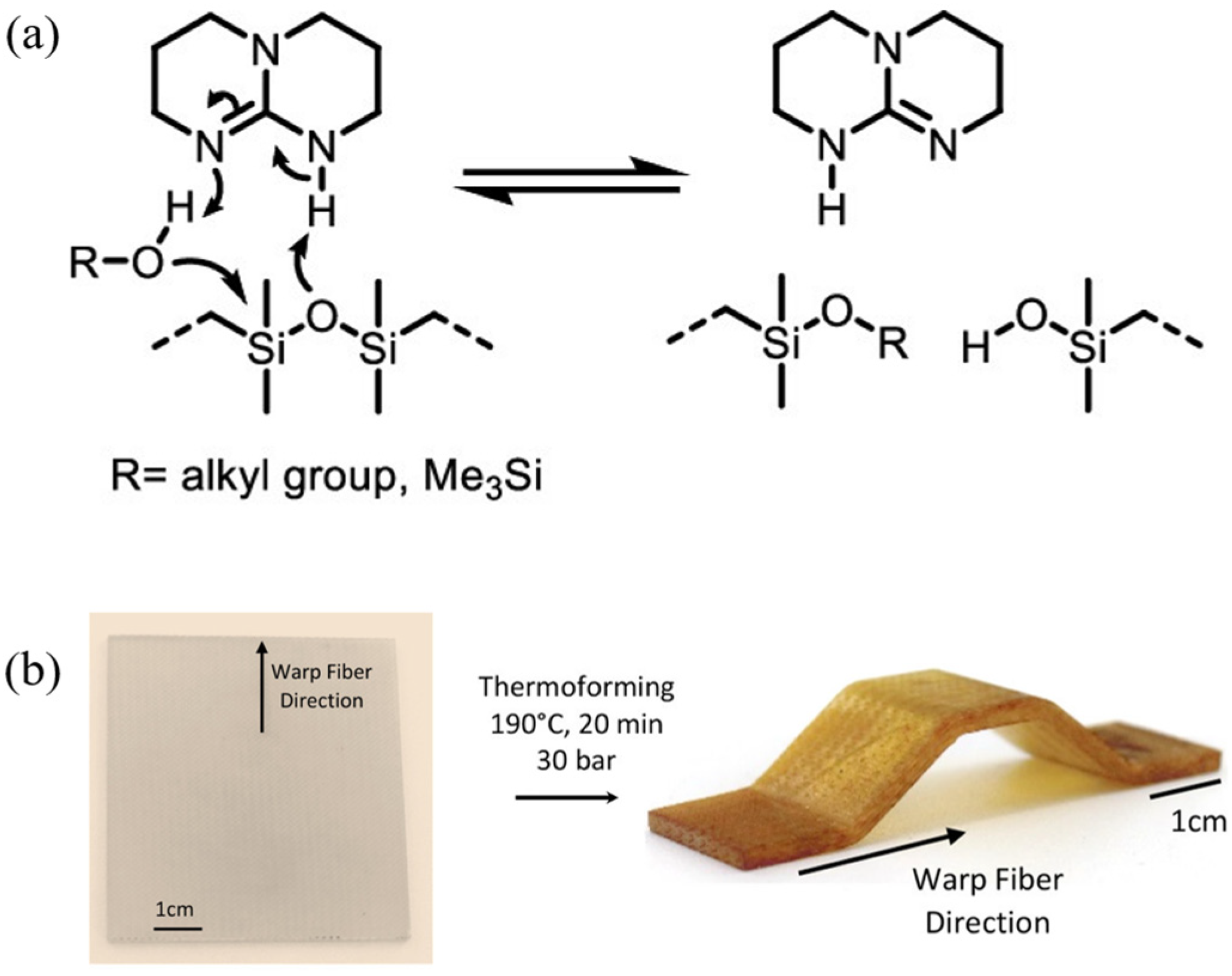

| Dynamic Chemistry | Representative Exchange Pathway | Catalyst Dependence | Neighboring-Group/Internal Catalysis | Solvent/Environmental Sensitivity | Role of Chain Mobility | Typical Topology Evolution Behavior | Ref. |
|---|---|---|---|---|---|---|---|
| Transesterification | Associative or dissociative depending on system | Often catalyst-mediated; can be catalyst-free | Strong in internally catalyzed monoester systems | Swelling solvents may induce decrosslinking | Governs vitrimer-like relaxation and welding efficiency | Preserved connectivity or transient decrosslinking | [26,56,57,58,59,60,61,62,63,64,65] |
| Diels–Alder | Equilibrium-controlled reversible cycloaddition | Generally catalyst-free | Limited | Strongly temperature dependent | Controls reversible gel–sol transition | Reversible crosslink dissociation/reformation | [66,67,68,69,70,71,72,73,74,75,76,77] |
| Imine exchange | Transamination/Hydrolysis–reformation | Usually catalyst-free | Moderate | Sensitive to water and acidic/basic conditions | Influences stress relaxation and healing efficiency | Dynamic rearrangement with hydrolysis susceptibility | [78,79,80,81,82,83,84,85,86,87,88] |
| Disulfide exchange | Associative radical or metathesis-type exchange | Thermal, photochemical, redox, or catalytic activation | Depends on aromatic/ aliphatic structure | Moderate oxidative/ environmental sensitivity | Strongly affects creep and relaxation | Rapid bond rearrangement under activation | [23,89,90,91,92,93,94,95,96,97,98] |
| Boronic ester exchange | Associative exchange | Often catalyst-free but environmentally regulated | Strong neighboring-group and buffering-ion effects | Highly sensitive to humidity and pH | Enables room temperature exchange | Environment- responsive topology rearrangement | [24,41,99,100,101,102,103,104,105,106,107,108] |
| Siloxane exchange | Associative siloxane equilibration | Often catalyst- or silanolate- mediated | Strong in amine/amide assisted systems | Sensitive to catalyst and hydroxyl environment | Governs creep suppression and extrusion behavior | Associative rearrangement with preserved connectivity | [25,109,110,111,112,113,114,115,116,117] |
| Dynamic Chemistry | Representative Activation Energy | Typical Reprocessing Temperature | Ref. |
|---|---|---|---|
| Transesterification | 53–148 kJ mol−1 | 140–220 °C | [118,119,120] |
| Diels–Alder | 7.04 kJ mol−1 for DA; 57.9 kJ mol−1 for retro-DA | retro-DA significant above 100–140 °C | [121,122,123] |
| Imine Exchange | 28–68 kJ mol−1 | RT to <120 °C | [124,125,126] |
| Disulfide Exchange | 99–357 kJ mol−1 | RT to ~180 °C | [122,127,128,129] |
| Boronic ester Exchange | 15.9–23.6 kJ mol−1 for model metathesis | RT to <120 °C | [122,130,131] |
| Siloxane Exchange | 60–130 kJ mol−1 | 180–250 °C | [31,32,132,133,134] |
Disclaimer/Publisher’s Note: The statements, opinions and data contained in all publications are solely those of the individual author(s) and contributor(s) and not of MDPI and/or the editor(s). MDPI and/or the editor(s) disclaim responsibility for any injury to people or property resulting from any ideas, methods, instructions or products referred to in the content. |
© 2026 by the authors. Licensee MDPI, Basel, Switzerland. This article is an open access article distributed under the terms and conditions of the Creative Commons Attribution (CC BY) license.
Share and Cite
Shi, X.; Zhuang, D. Thermosets Based on Covalent Bond Exchange: Mechanisms, Properties, and Reprocessing. Polymers 2026, 18, 1317. https://doi.org/10.3390/polym18111317
Shi X, Zhuang D. Thermosets Based on Covalent Bond Exchange: Mechanisms, Properties, and Reprocessing. Polymers. 2026; 18(11):1317. https://doi.org/10.3390/polym18111317
Chicago/Turabian StyleShi, Xiaojuan, and Daotong Zhuang. 2026. "Thermosets Based on Covalent Bond Exchange: Mechanisms, Properties, and Reprocessing" Polymers 18, no. 11: 1317. https://doi.org/10.3390/polym18111317
APA StyleShi, X., & Zhuang, D. (2026). Thermosets Based on Covalent Bond Exchange: Mechanisms, Properties, and Reprocessing. Polymers, 18(11), 1317. https://doi.org/10.3390/polym18111317