Regenerated Viscose Fibers Enabled by Recycled Cotton Pulps with Different Degrees of Polymerization from Waste Textiles

Abstract
1. Introduction
2. Materials and Methods
2.1. Materials
2.2. Preparation of Recycled Cotton Pulp
2.3. Preparation of Viscose Spinning Solution and Wet Spinning of Fibers
2.4. Characterizations
3. Results and Discussion
3.1. Presence of Insolubles in Viscose Spinning Solutions
3.2. Rheological Behavior of Spinning Solutions
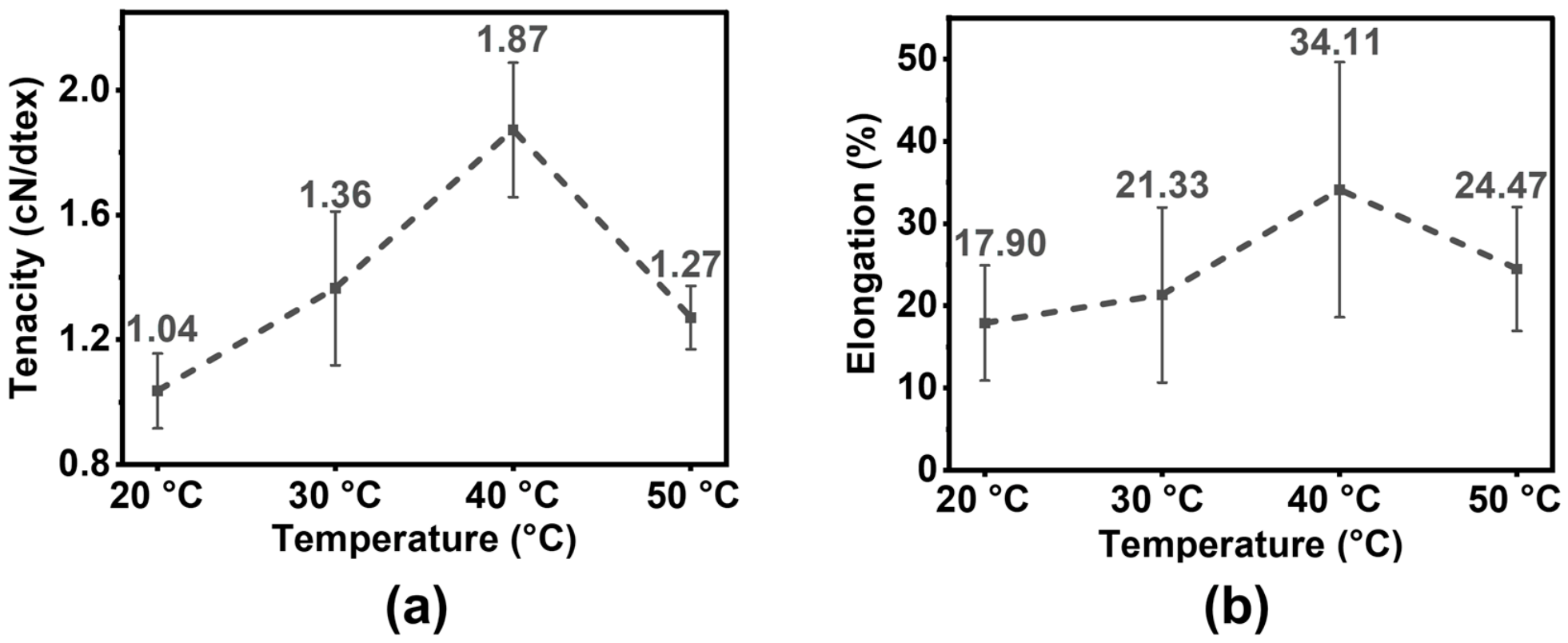
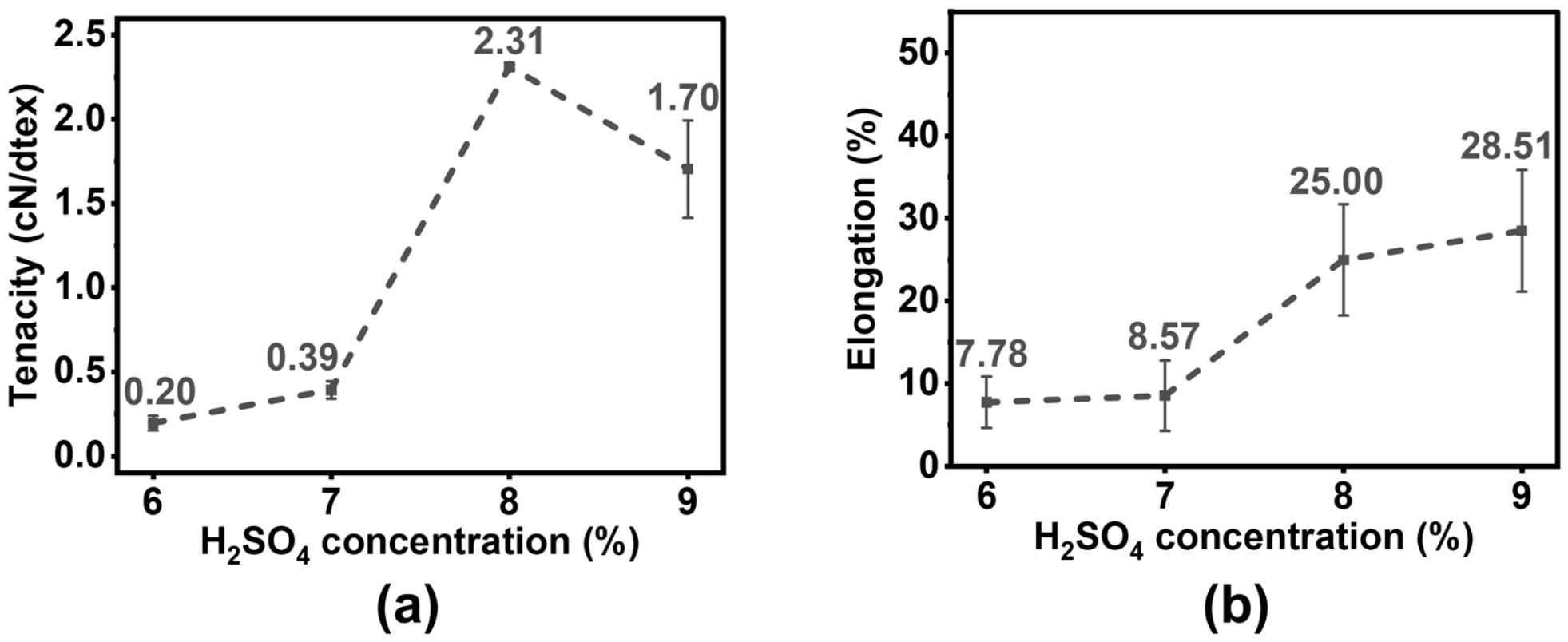
3.3. Optimization of Viscose Spinning Parameters
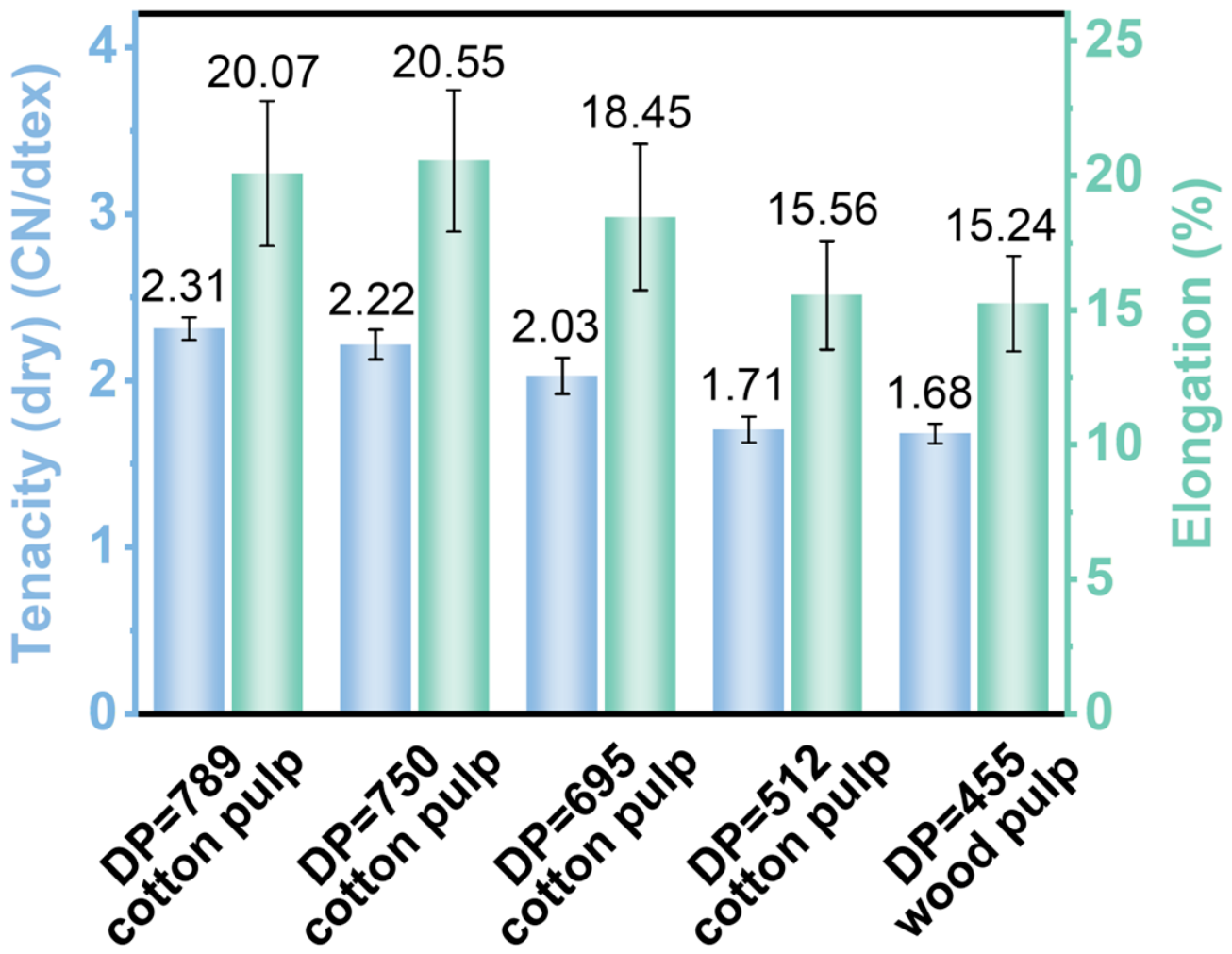
3.4. Mechanical Properties of Viscose Fibers
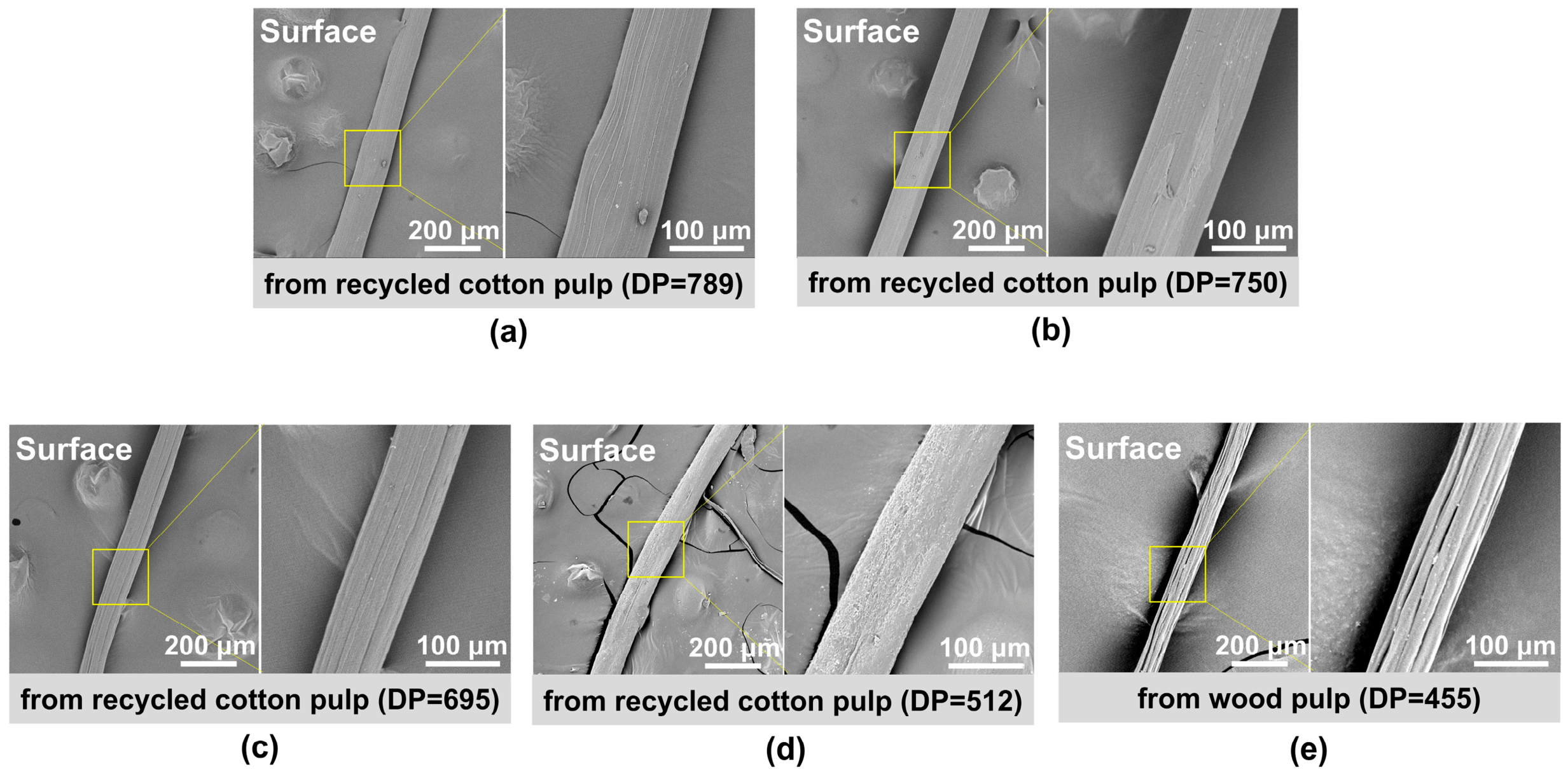
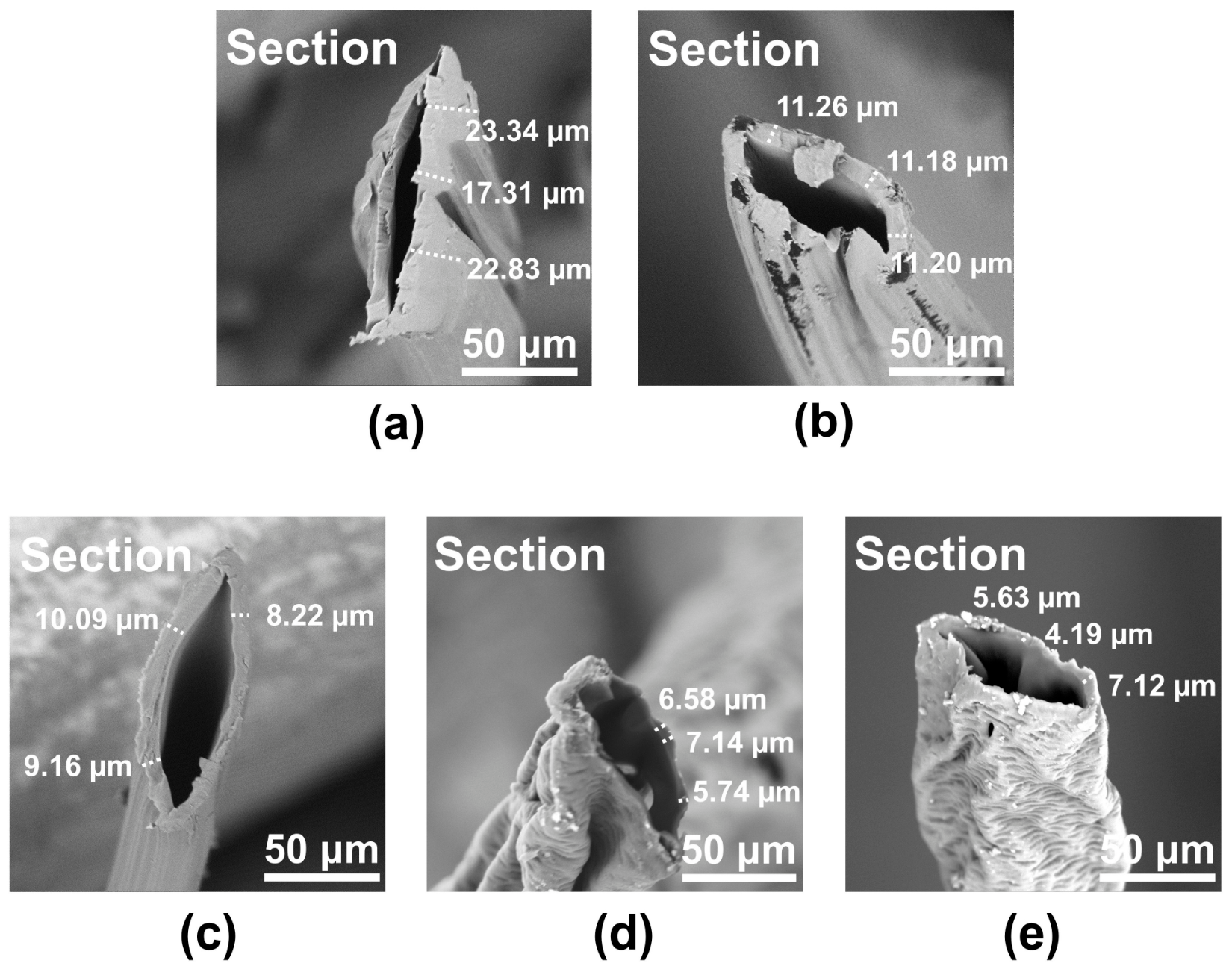
3.5. Morphological Structure of Viscose Fibers
4. Conclusions
Author Contributions
Funding
Institutional Review Board Statement
Data Availability Statement
Conflicts of Interest
References
- Lu, L.-L.; Fan, W.; Meng, X.; Xue, L.-L.; Ge, S.-B.; Wang, C.; Foong, S.Y.; Tan, C.S.Y.; Sonne, C.; Aghbashlo, M.; et al. Current recycling strategies and high-value utilization of waste cotton. Sci. Total Environ. 2023, 856, 158798. [Google Scholar] [CrossRef] [PubMed]
- Wang, Y.-Z. Pathways toward the sustainable development of polymeric materials. Engineering 2026, 58, 6–10. [Google Scholar] [CrossRef]
- Humes, E. Planet junk: A journey through discards. Nature 2019, 575, 278–279. [Google Scholar] [CrossRef]
- Niinimäki, K.; Peters, G.; Dahlbo, H.; Perry, P.; Rissanen, T.; Gwilt, A. The environmental price of fast fashion. Nat. Rev. Earth Environ. 2020, 1, 189–200. [Google Scholar] [CrossRef]
- Yang, T.; Xu, Y.-H.; Liu, G.; Nowack, B. Oligomers are a major fraction of the released submicrometre particles released during washing of polyester textiles. Nat. Water 2024, 2, 151–160. [Google Scholar] [CrossRef]
- Zhang, L.-S.; Leung, M.Y.; Boriskina, S.; Tao, X.-M. Advancing life cycle sustainability of textiles through technological innovations. Nat. Sustain. 2022, 6, 243–253. [Google Scholar] [CrossRef]
- Ma, J.-H.; Yang, K.-L.; Wang, M.-X.; Shan, J.-Y.; Yang, D.; Tian, G.-M. Advancements in component separation through chemical methods for recycled polyester/cotton blended textiles. Cellulose 2024, 31, 9543–9563. [Google Scholar] [CrossRef]
- Sathasivam, T.; Sugiarto, S.; Yew, M.P.Y.; Oh, X.Y.; Chan, S.Y.; Chan, B.Q.Y.; Tim, M.J.; Kai, D. Transforming textile waste into nanocellulose for a circular future. Nanoscale 2024, 16, 14168–14194. [Google Scholar] [CrossRef] [PubMed]
- Ütebay, B.; Çelik, P.; Çay, A. Effects of cotton textile waste properties on recycled fibre quality. J. Clean. Prod. 2019, 222, 29–35. [Google Scholar] [CrossRef]
- Liu, J.-L.; Sixta, H.; Ogawa, Y.; Hummel, M.; Sztucki, M.; Nishiyama, Y.; Burghammer, M. Multiscale structure of cellulose microfibrils in regenerated cellulose fibers. Carbohydr. Polym. 2024, 324, 121512–121520. [Google Scholar] [CrossRef]
- Xue, Z.; Fang, K.-J.; Shi, L.-J.; Li, X.; Feng, B.-H.; Xiao, Z.-C.; Bao, W.; Du, L.-X.; Song, Y.-W. Durable, colored and dual crosslinking networks constructed in lyocell cellulose structure for high-quality greener textiles. Cellulose 2024, 31, 6535–6549. [Google Scholar] [CrossRef]
- Sun, Y.; Yang, J.-X.; Zhang, X.; Liu, Y. Anti-ultraviolet and semi-durable flame-retardant viscose fabrics fabricated by modified tea polyphenols. Int. J. Biol. Macromol. 2024, 286, 138572–138582. [Google Scholar] [CrossRef]
- Song, W.-M.; Zhang, L.-Y.; Fan, R.-Y.; Liu, Y.; Wang, Y.-Z. Multi-functional finishing of viscose fabrics based on tea polyphenols: Integrated flame retardant, antibacterial, hydrophobic, and uv-resistant functionalities. Compos. Part B Eng. 2024, 287, 111848–111858. [Google Scholar] [CrossRef]
- Deng, C.-Y.; Jin, J.-C.; Zhang, H.; Li, J.-H.; Pei, K.-M. Synthesis of a reactive cationic/nonionic waterborne polyurethane dye fixative and its application performance on viscose fiber fabrics. Polymers 2023, 16, 89. [Google Scholar] [CrossRef] [PubMed]
- Acharya, S.; Liyanage, S.; Parajuli, P.; Rumi, S.S.; Shamshina, J.L.; Abidi, N. Utilization of cellulose to its full potential: A review on cellulose dissolution, regeneration, and applications. Polymers 2021, 13, 4344. [Google Scholar] [CrossRef]
- Makarov, I.; Vinogradov, M.; Palchikova, E.; Kulanchikov, Y.; Levin, I.; Procko, A.; Sinyaev, K.; Ermakov, S.; Kulichikhin, V.; Fedorova, E.; et al. The influence of conditioning baths on the structure and properties of fibers spun from cellulose with low alpha content. Carbohydr. Polym. 2025, 370, 124472–124480. [Google Scholar] [CrossRef] [PubMed]
- Kulichikhin, V.; Makarov, I.; Mironova, M.; Golova, L.; Vinogradov, M.; Shandryuk, G.; Levin, I.; Arkharova, N. A role of coagulant in structure formation of fibers and films spun from cellulose solutions. Materials 2020, 13, 3495. [Google Scholar] [CrossRef]
- Shao, Y.-Y.; Mu, B.-N.; Yu, X.-Q.; Neff, A.; Yang, Y.-Q. A green technology for the close-loop recycling of vat dyed textiles. Resour. Conserv. Recycl. 2025, 218, 108265–108273. [Google Scholar] [CrossRef]
- Zhang, X.-Z.; Zhou, W.-H.; Wang, Z.-W.; Xu, Y.-J.; Zhang, G.-Q. Manufacturing of post-consumer waste cotton pulp and its regenerated cellulose fiber. Int. J. Biol. Macromol. 2025, 315, 144227–144238. [Google Scholar] [CrossRef] [PubMed]
- Gondhalekar, S.C.; Pawar, P.J.; Dhumal, S.S.; Thakre, S. Fate of cs2 in viscose process: A chemistry perspective. Cellulose 2022, 29, 1451–1461. [Google Scholar] [CrossRef]
- Bågenholm-Ruuth, E.; Sanchis-Sebastiá, M.; Hollinger, N.; Teleman, A.; Larsson, P.T.; Wallberg, O. Transforming post-consumer cotton waste textiles into viscose staple fiber using hydrated zinc chloride. Cellulose 2024, 31, 737–748. [Google Scholar] [CrossRef]
- Frazier, R.M.; Lendewig, M.; Vera, R.E.; Vivas, K.A.; Forfora, N.; Azuaje, I.; Reynolds, A.; Venditti, R.; Pawlak, J.J.; Ford, E.; et al. Textiles from non-wood feedstocks: Challenges and opportunities of current and emerging fiber spinning technologies. J. Bioresour. Bioprod. 2024, 9, 410–432. [Google Scholar] [CrossRef]
- Veit, D. Cellulosic Man-Made Fibers. In Fibers: History, Production, Properties, Market; Springer: Cham, Switzerland, 2023; pp. 831–880. [Google Scholar]
- Yousef, S.; Tatariants, M.; Tichonovas, M.; Kliucininkas, L.; Lukošiūtė, S.; Yan, L. Sustainable green technology for recovery of cotton fibers and polyester from textile waste. J. Clean. Prod. 2020, 254, 120078–120088. [Google Scholar] [CrossRef]
- Kahoush, M.; Kadi, N. Towards sustainable textile sector: Fractionation and separation of cotton/polyester fibers from blended textile waste. Sustain. Mater. Technol. 2022, 34, e00513. [Google Scholar] [CrossRef]
- Leenders, N.; Moerbeek, R.M.; Puijk, M.J.; Bronkhorst, R.J.A.; Bueno Morón, J.; van Klink, G.P.M.; Gruter, G.-J.M. Polycotton waste textile recycling by sequential hydrolysis and glycolysis. Nat. Commun. 2025, 16, 738–745. [Google Scholar] [CrossRef]
- Binczarski, M.J.; Zuberek, J.Z.; Cieciura-Wloch, W.; Borowski, S.; Cieslak, M.; Baranowska-Korczyc, A.; Witczak, E.; Witonska, I.A. Textile waste subjected to acid hydrolysis as raw materials for biogas production. Renew. Energy 2024, 227, 120428–120435. [Google Scholar] [CrossRef]
- Zhang, S.; Xu, W.-H.; Du, R.-C.; Yan, L.; Liu, X.-H.; Xu, S.-M.; Wang, Y.-Z. Internal water circulation mediated synergistic co-hydrolysis of pet/cotton textile blends in gamma-valerolactone. Nat. Commun. 2024, 15, 4498–4506. [Google Scholar] [CrossRef]
- Zhang, S.-B.; Hu, Q.-K.; Zhang, Y.-X.; Guo, H.-Y.; Wu, Y.-F.; Sun, M.-Z.; Zhu, X.-S.; Zhang, J.-G.; Gong, S.-Y.; Liu, P.; et al. Depolymerization of polyesters by a binuclear catalyst for plastic recycling. Nat. Sustain. 2023, 6, 965–973. [Google Scholar] [CrossRef]
- Peng, W.-X.; Xu, S.-D.; Zhou, J.-R.; Zhao, Y.-S.; Long, M.-C.; Zhang, Q.-Z.; Wu, C.-Y.; Chen, C. Rapid recycling of waste plastics via simultaneous dual carbonyl activation of ethanediylester groups in pet. Appl. Catal. B Environ. Energy 2025, 382, 126009–126017. [Google Scholar] [CrossRef]
- Pavlopoulou, K.E.; Hrůzová, K.; Kahoush, M.; Kadi, N.; Patel, A.; Rova, U.; Matsakas, L.; Christakopoulos, P. Textile recycling: Efficient polyester recovery from polycotton blends using the heated high-ethanol alkaline aqueous process. Polymers 2024, 16, 3008. [Google Scholar] [CrossRef]
- Periyasamy, A.P.; Militky, J. Sustainability in Regenerated Textile Fibers. In Sustainability in the Textile and Apparel Industries: Sourcing Synthetic and Novel Alternative Raw Materials; Muthu, S.S., Gardetti, M.A., Eds.; Springer International Publishing: Cham, Switzerland, 2020; pp. 63–95. [Google Scholar]
- Sixta, H. Pulp Properties and Applications. In Handbook of Pulp; Sixta, H., Ed.; Wiley-VCH: Weinheim, Germany, 2006; pp. 1009–1067. [Google Scholar]
- Mendes, I.S.F.; Prates, A.; Evtuguin, D.V. Production of rayon fibres from cellulosic pulps: State of the art and current developments. Carbohydr. Polym. 2021, 273, 118466–118482. [Google Scholar] [CrossRef]
- Chen, C.-X.; Duan, C.; Li, J.-G.; Liu, Y.-S.; Ma, X.-J.; Zheng, L.-Q.; Stavik, J.; Ni, Y.-H. Cellulose (dissolving pulp) manufacturing processes and properties: A mini-review. BioResources 2020, 11, 5553–5564. [Google Scholar] [CrossRef]
- Chen, L.; Cai, H.-S.; Wang, X.-L.; Xu, W.-H.; Xu, S.-M.; Wang, Y.-Z. A Mild and Efficient Method for Separating Waste Cotton-Containing Textiles and Short-Process Clean Pulping. China Patent CN 121045639 A, 2 December 2025. [Google Scholar]
- ISO 5351:2010; Pulps—Determination of Limiting Viscosity Number in Cupri-Ethylenediamine (CED) Solution. International Organization for Standardization: Geneva, Switzerland, 2010.
- Owens, C.E.; Du, J.-Y.; Sánchez, P.B. Understanding the dynamics of cellulose dissolved in an ionic liquid solvent under shear and extensional flows. Biomacromolecules 2022, 23, 2623–2634. [Google Scholar] [CrossRef]
- Bagherjeri, M.A.; Namjoufar, M.; Haque, A.N.M.A.; Laghaei, M.; Naebe, M. Rheological characterisation and processability window of denim-derived cellulose solutions in nmmo for fibre spinning. Polymers 2026, 18, 1094. [Google Scholar] [CrossRef]
- Hopkins, T.E.; Whatley, J.W. Rheological properties of viscose. J. Appl. Polym. Sci. 1962, 6, 600–604. [Google Scholar] [CrossRef]
- Mansour, O.Y.; Nagaty, A.; Shukry, N. Rheological properties of emulsion viscoses: 1. Influence of alkali concentration, reaction time and order of addition of reactants. Polymer 1973, 14, 27–33. [Google Scholar] [CrossRef]
- Mansour, O.Y.; Nagaty, A.; Shukry, N. Rheological properties of emulsion viscoses: 2. Influence of cellulose origin, carbon disulphide ratio and temperature. Polymer 1973, 14, 34–37. [Google Scholar] [CrossRef]
- Del Giudice, F.; Tassieri, M.; Oelschlaeger, C.; Shen, A.Q. When microrheology, bulk rheology, and microfluidics meet: Broadband rheology of hydroxyethyl cellulose water solutions. Macromolecules 2017, 50, 2951–2963. [Google Scholar] [CrossRef]
- Woodings, C. The Viscose Process. In Regenerated Cellulose Fibres; Woodings, C., Ed.; Elsevier: Amsterdam, The Netherlands, 2001; pp. 37–62. [Google Scholar]
- Hu, J.-L.; Jahid, M.A.; Kumar, N.H.; Harun, V. Fundamentals of the Fibrous Materials. In Handbook of Fibrous Materials; Hu, J.-L., Kumar, B., Lu, J., Eds.; Wiley-VCH: Weinheim, Germany, 2020; pp. 1–36. [Google Scholar]
- Wedin, H.; Niit, E.; Mansoor, Z.A.; Kristinsdottir, A.R.; de la Motte, H.; Jönsson, C.; Östlund, Å.; Lindgren, C. Preparation of viscose fibres stripped of reactive dyes and wrinkle-free crosslinked cotton textile finish. J. Polym. Environ. 2018, 26, 3603–3612. [Google Scholar] [CrossRef]


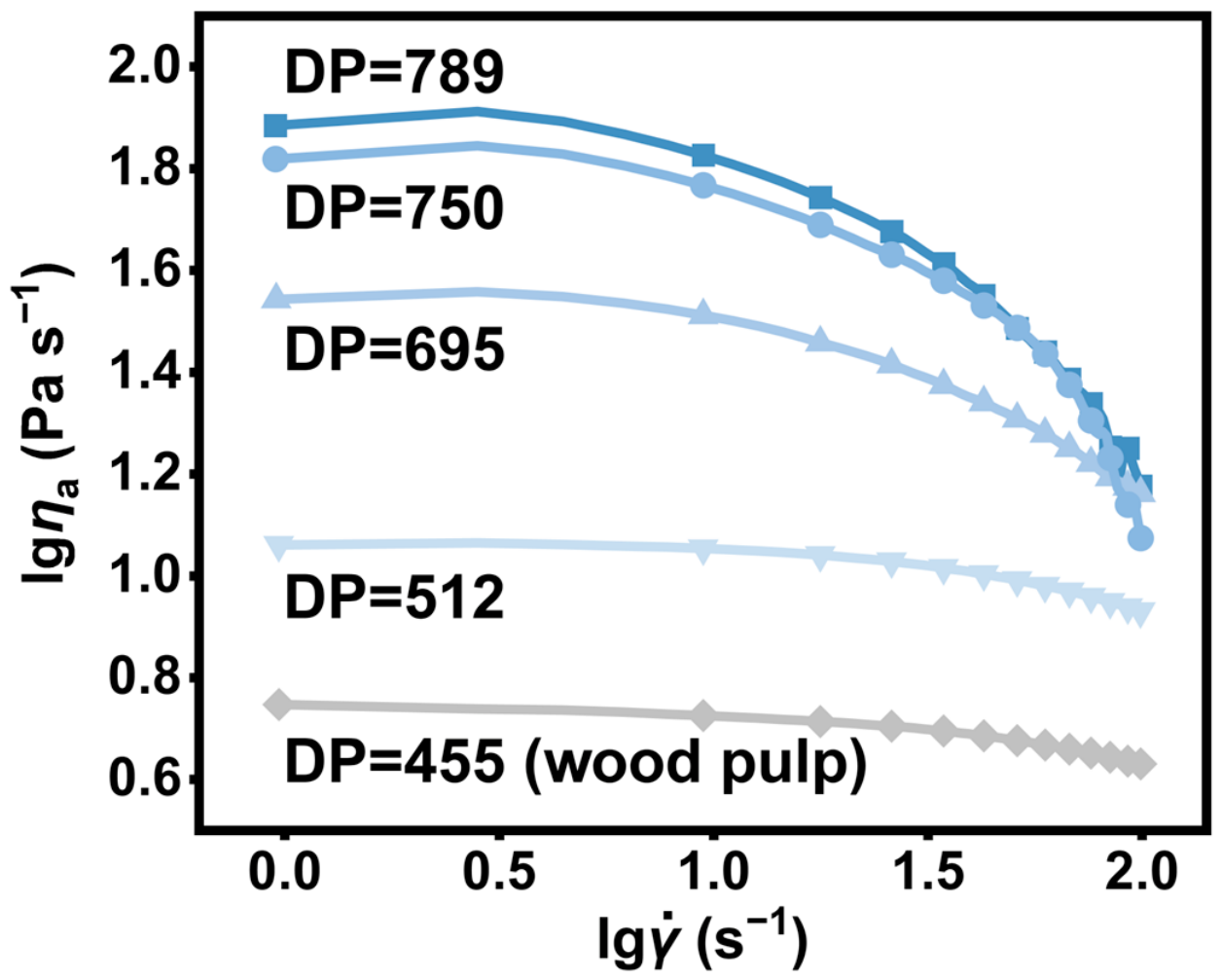



| Raw Material | Zero-Shear Viscosity η0 (Pa·s) | Characteristic Relaxation Time λ(s) | Power-Law Index n | Goodness of Fit R2 |
|---|---|---|---|---|
| Recycled cotton pulp (DP = 789) | 94.85 | 0.68 | 0.31 | 0.999 |
| Recycled cotton pulp (DP = 750) | 77.85 | 0.71 | 0.30 | 0.999 |
| Recycled cotton pulp (DP = 695) | 36.95 | 0.59 | 0.29 | 0.999 |
| Recycled cotton pulp (DP = 512) | 9.85 | 0.42 | 0.28 | 0.999 |
| Commercial wood pulp (DP = 455) | 9.82 | 0.41 | 0.28 | 0.999 |
| Raw Material | Dry Tensile Strength of Viscose Fibers | Elongation at Break of Viscose Fibers |
|---|---|---|
| Recycled cotton pulp (DP = 789) | a | ab |
| Recycled cotton pulp (DP = 750) | a | a |
| Recycled cotton pulp (DP = 695) | b | ab |
| Recycled cotton pulp (DP = 512) | c | b |
| Commercial wood pulp (DP = 455) | c | b |
Disclaimer/Publisher’s Note: The statements, opinions and data contained in all publications are solely those of the individual author(s) and contributor(s) and not of MDPI and/or the editor(s). MDPI and/or the editor(s) disclaim responsibility for any injury to people or property resulting from any ideas, methods, instructions or products referred to in the content. |
© 2026 by the authors. Licensee MDPI, Basel, Switzerland. This article is an open access article distributed under the terms and conditions of the Creative Commons Attribution (CC BY) license.
Share and Cite
Cai, H.; Chen, L.; Wang, X. Regenerated Viscose Fibers Enabled by Recycled Cotton Pulps with Different Degrees of Polymerization from Waste Textiles. Polymers 2026, 18, 1302. https://doi.org/10.3390/polym18111302
Cai H, Chen L, Wang X. Regenerated Viscose Fibers Enabled by Recycled Cotton Pulps with Different Degrees of Polymerization from Waste Textiles. Polymers. 2026; 18(11):1302. https://doi.org/10.3390/polym18111302
Chicago/Turabian StyleCai, Huansheng, Lin Chen, and Xiuli Wang. 2026. "Regenerated Viscose Fibers Enabled by Recycled Cotton Pulps with Different Degrees of Polymerization from Waste Textiles" Polymers 18, no. 11: 1302. https://doi.org/10.3390/polym18111302
APA StyleCai, H., Chen, L., & Wang, X. (2026). Regenerated Viscose Fibers Enabled by Recycled Cotton Pulps with Different Degrees of Polymerization from Waste Textiles. Polymers, 18(11), 1302. https://doi.org/10.3390/polym18111302