Near Azeotropic Ethanol–Water Mixture Pervaporation Through a Polyvinyl Alcohol Membrane: A Parametric Study on Process Efficiency


Abstract
1. Introduction
2. Models and Solving Methods
2.1. Pervaporation Theoretical Model in COMSOL Multiphysics®
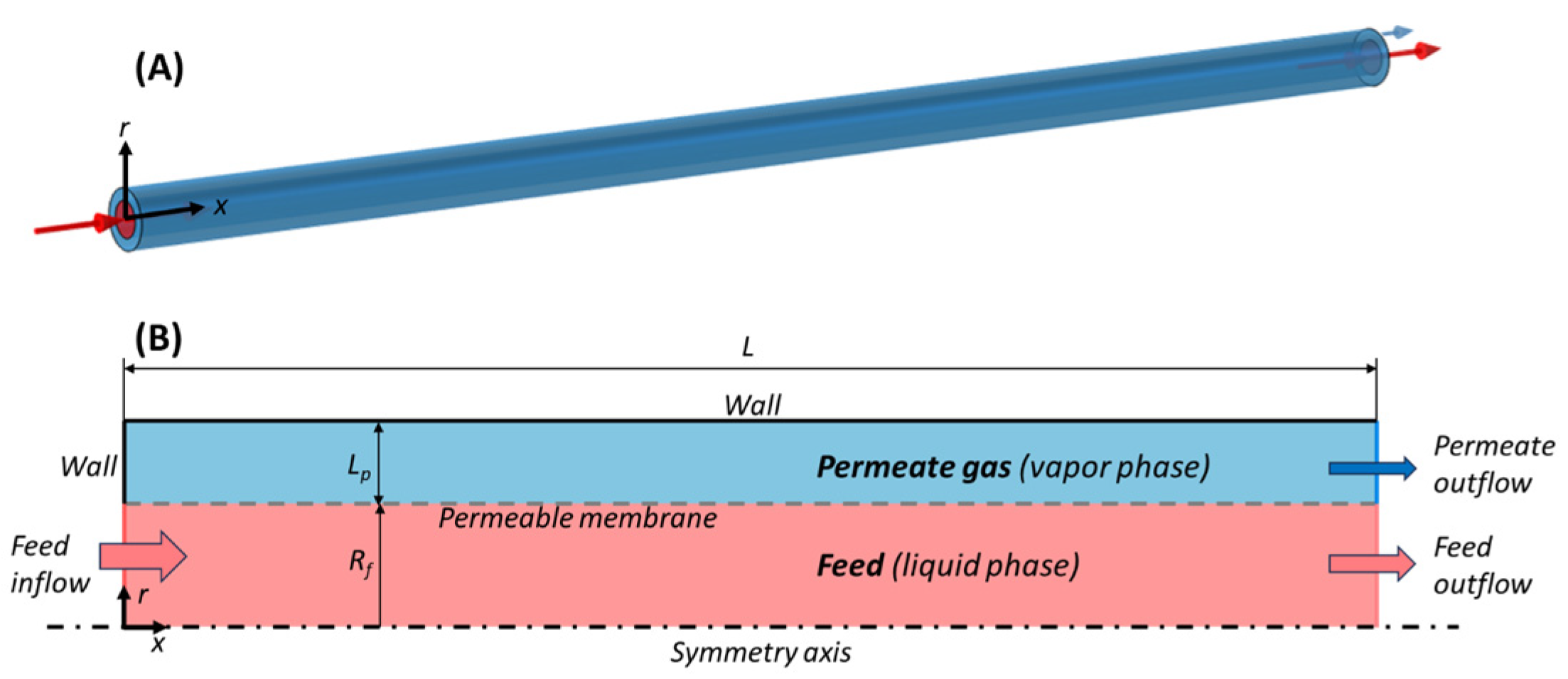
2.1.1. Geometry
2.1.2. Fluid Dynamics
2.1.3. Mass Transfer
2.1.4. Heat Transfer
2.1.5. Parameters and Physical Properties

| Description | Symbol | Value or Expression | Units | Source and Comments | ||||
|---|---|---|---|---|---|---|---|---|
| Module length | L | 1000 | mm | |||||
| Feed tube radius | Rf | 6 | mm | |||||
| Permeate gap size | Lp | 2 | mm | |||||
| Liquid feed inlet velocity | uf,in | 2 | cm/s | |||||
| Mass fractions in feed water ethanol | wf,w,in wf,e,in | 0.1 0.9 | kg/kg | |||||
| Inlet temperature feed | Tf,in | 100 | °C | 373.15 K | ||||
| Permeate outflow pressure | pp,out | 3 | kPa | Vacuum | ||||
Activity coefficients, liquid | aew = 0; awe 0; bew = −55.1681; bwe = 670.441; cew = cwe = 0.3031; | - - | NRTL model equations [57,67,68] (Tf in K) | |||||
| Vapor pressures | Pv,w Pv,e | kPa kPa | [69] [69] (Tf in K) | |||||
| Density, liquid mixture water ethanol | ρf ρw,L ρe,L | kg m−3 kg m−3 kg m−3 | [69] [69] [69] (Tf in K) | |||||
| Density, gas mixture | ρp | kg m−3 | Ideal gas law | |||||
| Viscosity, liquid mixture water ethanol | ηf ηw,L ηe,L | Pa s Pa s Pa s | [69] [69] [69] (Tf in K) | |||||
| Viscosity, gas mixture water ethanol | ηp ηw,G ηe,G | Pa s Pa s Pa s | [69] [69] [69] (Tf and Tp in K) | |||||
| Thermal conductivity, liquid mixture water ethanol | kf kw,L ke,L | W m−1 K−1 W m−1 K−1 W m−1 K−1 | [69] [69] [69] (Tf in K) | |||||
| Thermal conductivity, gas mixture water ethanol | kp kw,G ke,G | W m−1 K−1 W m−1 K−1 W m−1 K−1 | [69] [69] (Tp in K) Assumed (negligible ethanol fraction in permeate) | |||||
| Heat capacity const. P, liquid mixture water ethanol | Cp,f Cp,w,L Cp,e,L | J kg−1 K−1 J kg−1 K−1 J kg−1 K−1 | [69] [69] [69] (Tf in K) | |||||
| Heat capacity const. P, gas mixture water ethanol | Cp,p Cp,w,G Cp,e,G | J kg−1 K−1 J kg−1 K−1 J kg−1 K−1 | [69] [69] [69] (Tp in K) | |||||
| Molar mass mixture water ethanol | Mf, Mp Mw Me | , 18 46 | g mol−1 g mol−1 g mol−1 | |||||
| Latent heat of vaporization water ethanol | J/kmol | [70] Tr = T/Tc (Tf in K) | ||||||
| C1 | C2 | C3 | C4 | Tc, K | ||||
| 5.66·107 | 0.612041 | −0.625697 | 0.398804 | 647.096 | ||||
| 6.5831·107 | 1.1905 | −1.7666 | 1.0012 | 514 | ||||
| Diffusion coefficient ethanol–water, liquid | Df,we | m2 s−1 | (Tf in K) | |||||
| Diffusion coefficient ethanol–water, gas | Dp,we | m2 s−1 | ||||||
| Membrane permeances water ethanol | Pm,w/Lm Pm,e/Lm | Tref = 368.15 K Ew = 15,208.6 kJ/kmol Ee = 15,208.6 kJ/kmol | [57] [57] | |||||
2.1.6. Model Solution
2.2. Statistical Modeling and Optimization
3. Results and Discussion
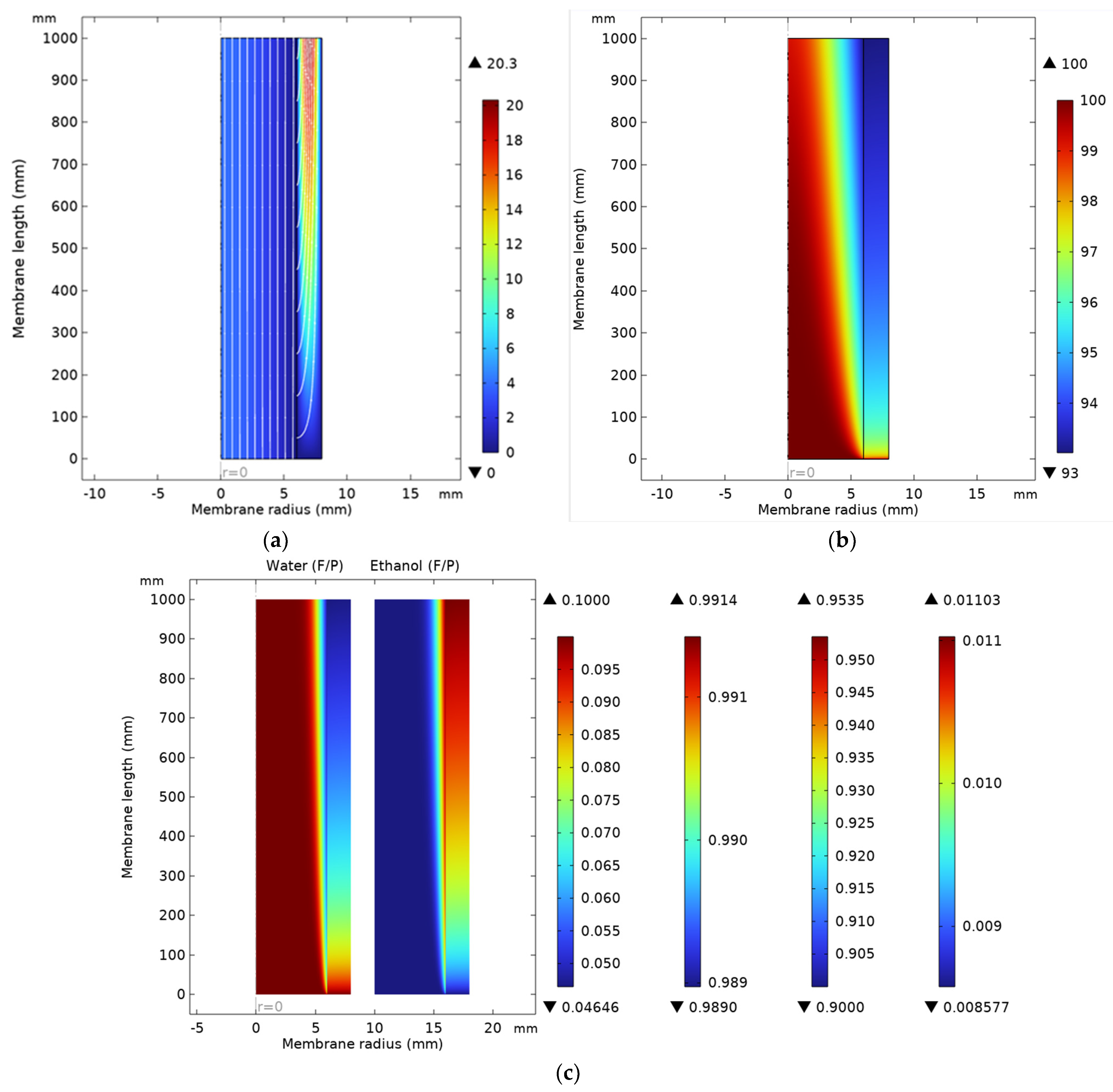
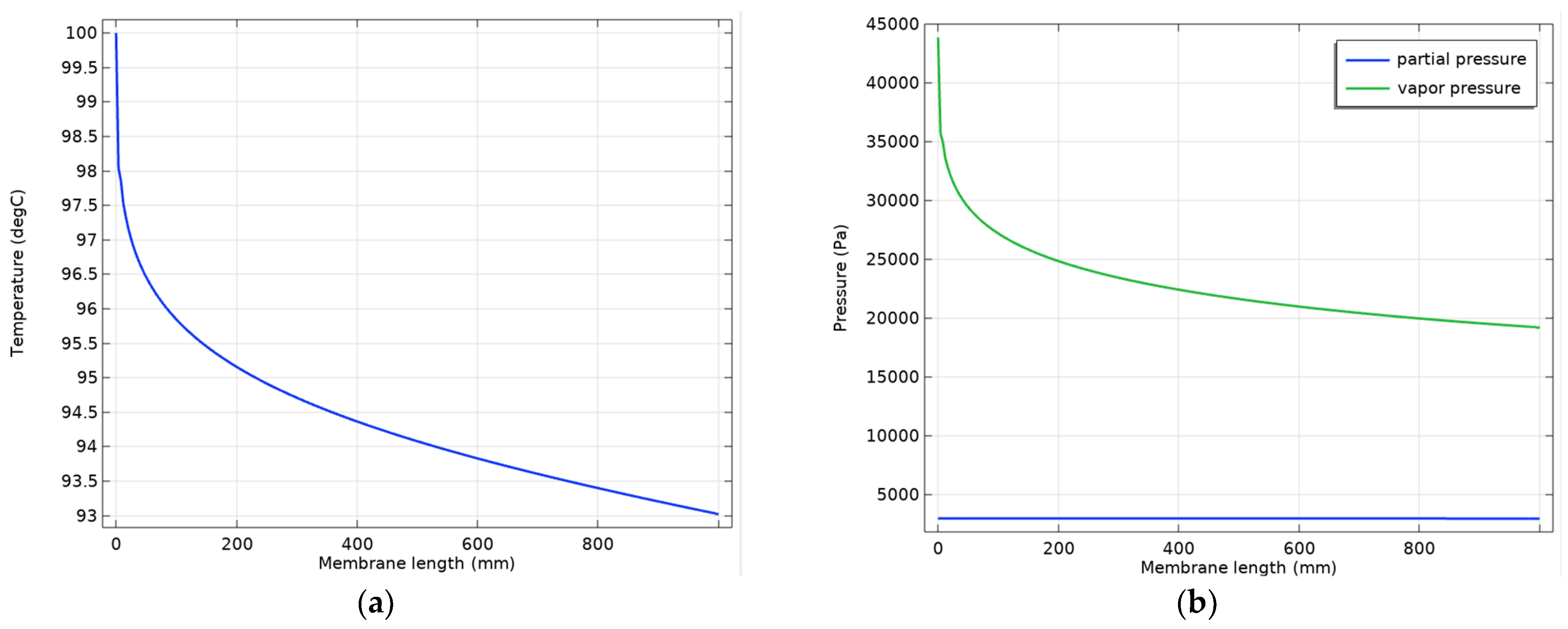
3.1. Pervaporation Theoretical Model in COMSOL Multiphysics®
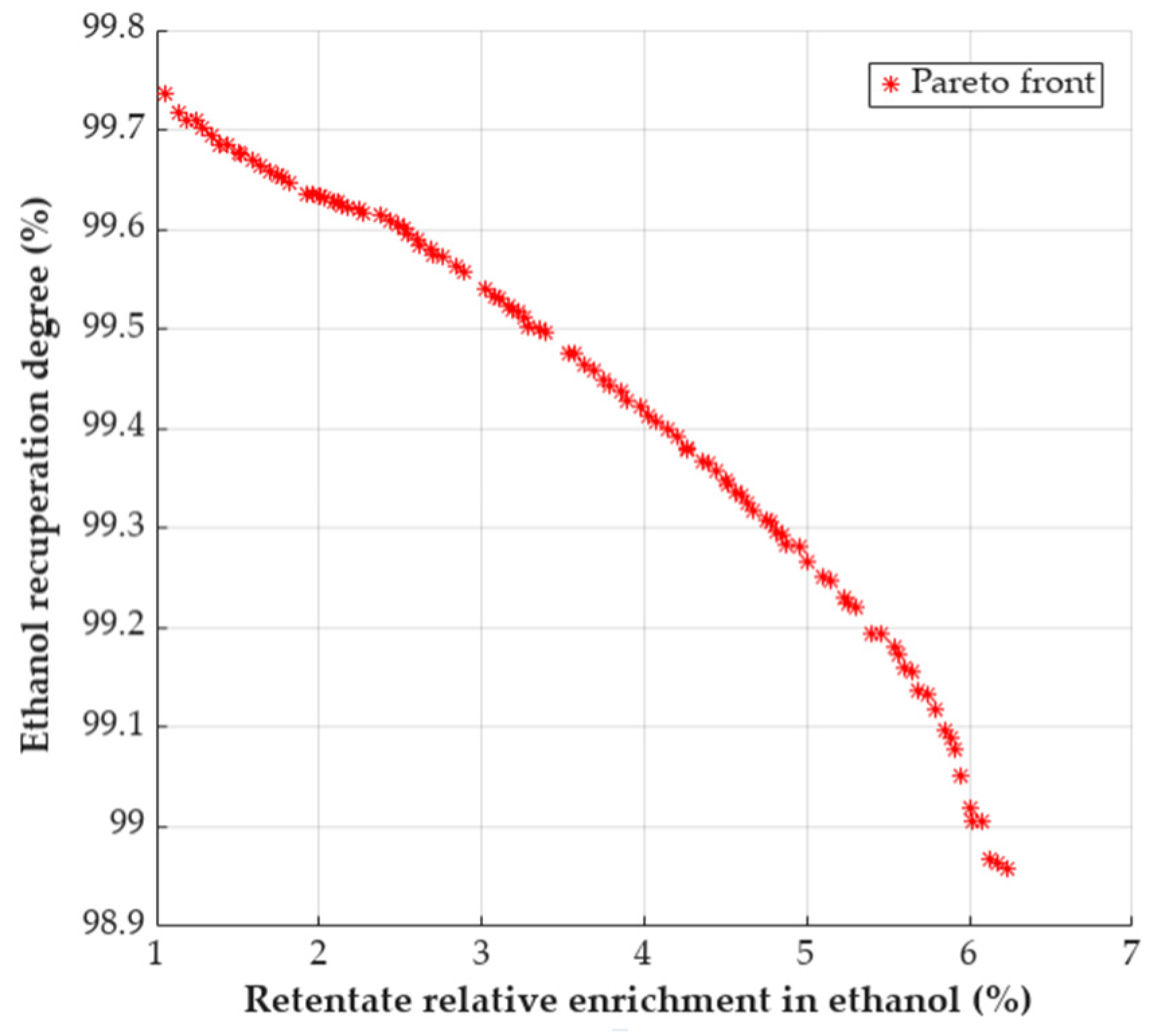
3.2. Statistical Modeling and Optimization
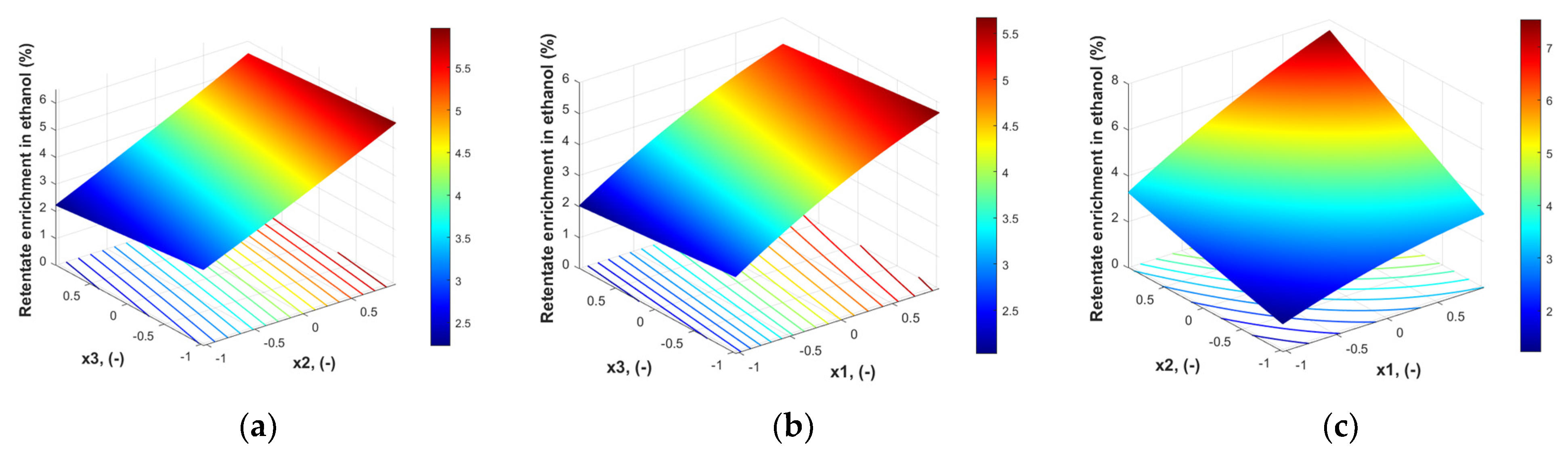
3.2.1. Model for Relative Enrichment of Ethanol in Retentate
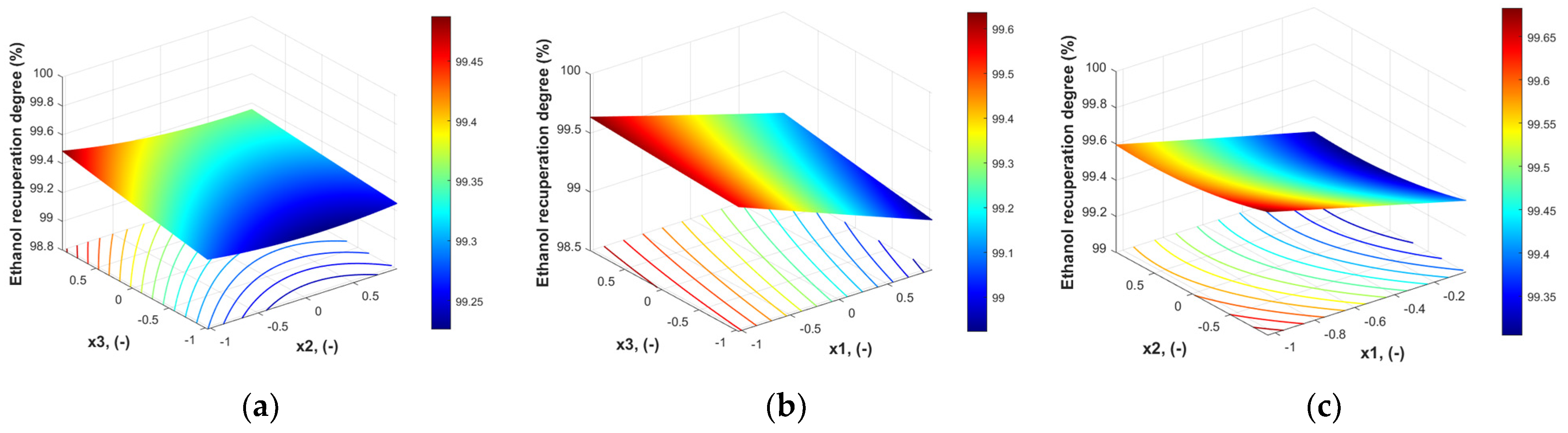
3.2.2. Model for Ethanol Recuperation Degree
4. Conclusions
Author Contributions
Funding
Institutional Review Board Statement
Data Availability Statement
Acknowledgments
Conflicts of Interest
References
- Cai, D.; Wen, J.; Zhuang, Y.; Huang, T.; Si, Z.; Qin, P.; Chen, H. Review of alternative technologies for acetone–butanol–ethanol separation: Principles, state-of-the-art and development trends. Sep. Purif. Technol. 2022, 298, 121244. [Google Scholar] [CrossRef]
- Lyu, H.; Hu, Y.; Zhou, T. Dimethyl carbonate/methanol separation by azeotropic distillation with water: An alternative process driven by low-pressure steam. Sep. Purif. Technol. 2025, 355, 129677. [Google Scholar] [CrossRef]
- Zheng, M.; Wang, J. Simulation and Optimization of the Separation of Methanol–Dimethyl Carbonate Azeotrope by Extractive Dividing Wall Column. Separations 2022, 9, 189. [Google Scholar] [CrossRef]
- Nam, S.Y.; Lee, Y.M. Pervaporation separation of methanol/methyl-tert-butyl-ether (MTBE) mixtures through chitosan composite membranes modified with surfactants. J. Membr. Sci. 1999, 157, 63–71. [Google Scholar] [CrossRef]
- Weber de Menezes, E.; Cataluña, R. Optimization of the ETBE (ethyl tert-butyl ether) production process. Fuel Process. Technol. 2008, 89, 1148–1152. [Google Scholar] [CrossRef]
- Reddy, P.; Benecke, T.P.; Ramjugernath, D. Isothermal vapor–liquid equilibrium at 333.15 K and excess properties for the {ethyl tert-butyl ether + methanol + water} system. Fluid Phase Equilibria 2013, 344, 32–37. [Google Scholar] [CrossRef]
- Cruz Valdez, J.A.; Patiño-Herrera, R.; Avilés Martínez, A.; Pérez, E. Separation of the cyclohexane–benzene mixture by the extractive distillation process using ethylene glycol as a solvent. Chem. Eng. Process.–Process Intensif. 2024, 196, 109686. [Google Scholar] [CrossRef]
- Vázquez-Ojeda, M.; Segovia-Hernández, J.G.; Hernández, S.; Hernández-Aguirre, A.; Kiss, A.A. Design and optimization of an ethanol dehydration process using stochastic methods. Sep. Purif. Technol. 2013, 105, 90–97. [Google Scholar] [CrossRef]
- Zhao, T.; Geng, X.; Qi, P.; Zhu, Z.; Gao, J.; Wang, Y. Optimization of liquid–liquid extraction combined with either heterogeneous azeotropic distillation or extractive distillation processes to reduce energy consumption and carbon dioxide emissions. Chem. Eng. Res. Des. 2018, 132, 399–408. [Google Scholar] [CrossRef]
- Gerbaud, V.; Rodríguez-Donis, I.; Hegely, L.; Lang, P.; Denes, F.; You, X. Review of extractive distillation. Process design, operation, optimization and control. Chem. Eng. Res. Des. 2019, 141, 229–271. [Google Scholar] [CrossRef]
- Kiss, A.A.; Ignat, R.M.; Bildea, C.S. Optimal extractive distillation process for bioethanol dehydration. Comput. Aided Chem. Eng. 2014, 33, 1333–1338. [Google Scholar] [CrossRef]
- Neagu, M.; Pricop-Nicolae, M. Azeotropic and Extractive Distillation for Bio-Ethanol Dehydration: Process Design, Simulation, and Cost Analysis. Processes 2025, 13, 3634. [Google Scholar] [CrossRef]
- Lipnizki, F.; Field, R.W.; Ten, P.-K. Pervaporation-based hybrid process: A review of process design, applications and economics. J. Membr. Sci. 1999, 153, 183–210. [Google Scholar] [CrossRef]
- Jonquières, A.; Clément, R.; Lochon, P.; Néel, J.; Dresch, M.; Chrétien, B. Industrial state-of-the-art of pervaporation and vapour permeation in the western countries. J. Membr. Sci. 2002, 206, 87–117. [Google Scholar] [CrossRef]
- Favre, E. The Future of Membrane Separation Processes: A Prospective Analysis. Front. Chem. Eng. 2022, 4, 916054. [Google Scholar] [CrossRef]
- Vane, L.M. Review of pervaporation and vapor permeation process factors affecting the removal of water from industrial solvents. J. Chem. Technol. Biotechnol. 2019, 95, 495–512. [Google Scholar] [CrossRef]
- Lu, X.; Huang, J.; Pinelo, M.; Chen, G.; Wan, Y.; Luo, J. Modelling and optimization of pervaporation membrane modules: A critical review. J. Membr. Sci. 2022, 664, 121084. [Google Scholar] [CrossRef]
- Kazemimoghadam, M.; Rigi, Z.A. Investigation on Simulation of NaX Zeolite Membrane in Pervaporation Process. Int. J. Sci. Res. Chem. Sci. 2017, 4, 1–8. [Google Scholar]
- Kazemimoghadam, M.; Masjedi, S.M.H. Modeling of Pervaporation Process for Dehydration of Alcohols by Polymer Membrane. Int. J. Adv. Sci. Eng. 2018, 4, 679–686. [Google Scholar] [CrossRef]
- Farhan, N.M.; Ibrahim, S.; Alsalhy, Q. Modeling and simulation of pervaporation (PV) separation for alcohol dehydration. Heliyon 2023, 9, e13713. [Google Scholar] [CrossRef]
- Liu, D.; Liu, G.; Meng, L.; Dong, Z.; Huang, K.; Jin, W. Hollow fiber modules with ceramic-supported PDMS composite membranes for pervaporation recovery of bio-butanol. Sep. Purif. Technol. 2015, 146, 24–32. [Google Scholar] [CrossRef]
- Soares, L.S.; Vieira, A.C.F.; Fidler, F.; Monteiro, A.R.; Di Luccio, M. Pervaporation as an alternative for adding value to residues of oyster (Crassostrea gigas) processing. Sep. Purif. Technol. 2020, 232, 115968. [Google Scholar] [CrossRef]
- Darvishi, A.; Aroujalian, A.; Keshavarz Moraveji, M.; Pazuki, G. Computational fluid dynamic modeling of a pervaporation process for removal of styrene from petrochemical wastewater. RSC Adv. 2016, 6, 15327–15339. [Google Scholar] [CrossRef]
- Rezakazemi, M.; Shahverdi, M.; Shirazian, S.; Mohammadi, T.; Pak, A. CFD simulation of water removal from water/ethylene glycol mixtures by pervaporation. Chem. Eng. J. 2011, 168, 60–67. [Google Scholar] [CrossRef]
- Liu, S.X.; Peng, M.; Vane, L.M. CFD simulation of effect of baffle on mass transfer in a slit-type pervaporation module. J. Membr. Sci. 2005, 265, 124–136. [Google Scholar] [CrossRef]
- Liu, S.X.; Peng, M.; Vane, L.M. CFD modeling of pervaporative mass transfer in the boundary layer. Chem. Eng. Sci. 2004, 59, 5853–5857. [Google Scholar] [CrossRef]
- Wang, L.; Sun, Q.; Zhou, X.; Zhang, W.; Wu, L. Numerical simulation and optimization of pervaporation process based on heat–mass–flow coupling. Appl. Therm. Eng. 2024, 249, 123357. [Google Scholar] [CrossRef]
- Hieu, N.H. Modelling and simulation of a pervaporation process using tubular module for production of anhydrous ethanol. AIP Conf. Proc. 2017, 1878, 020029. [Google Scholar] [CrossRef]
- Moulik, S.; Bukke, V.; Sajja, S.C.; Sridhar, S. Chitosan-polytetrafluoroethylene composite membranes for separation of methanol and toluene by pervaporation. Carbohydr. Polym. 2018, 193, 28–38. [Google Scholar] [CrossRef]
- Huang, J.; Li, J.; Zhan, X.; Chen, C. A modified solution-diffusion model and its application in the pervaporation separation of alkane/thiophenes mixtures with PDMS membrane. J. Appl. Polym. Sci. 2008, 110, 3140–3148. [Google Scholar] [CrossRef]
- Marszałek, J.; Tylman, M.; Rdzanek, P.; Kamiński, W. The influence of hydrodynamic conditions on the recovery of acetone, butanol and ethanol in pervaporation membrane modules. Chem. Process Eng.–Inżynieria Chem. Proces. 2018, 39, 155–163. [Google Scholar] [CrossRef]
- Moulik, S.; Praveen Kumar, K.; Bohra, S.; Sridhar, S. Pervaporation performance of PPO membranes in dehydration of highly hazardous MMH and UDMH liquid propellants. J. Hazard. Mater. 2015, 288, 69–79. [Google Scholar] [CrossRef]
- Asadollahzadeh, M.; Raoufi, N.; Rezakazemi, M.; Shirazian, S. Simulation of nonporous polymeric membranes using CFD for bioethanol purification. Macromol. Theory Simul. 2018, 27, 1700084. [Google Scholar] [CrossRef]
- Marjani, A.; Shirazian, S. Mathematical modeling and CFD simulation of hydrocarbon purification using membrane technology. Orient. J. Chem. 2012, 28, 123–129. [Google Scholar] [CrossRef]
- Cha-umpong, W.; Li, Q.; Razmjou, A.; Chen, V. Concentrating brine for lithium recovery using GO composite pervaporation membranes. Desalination 2021, 500, 114894. [Google Scholar] [CrossRef]
- Sommer, S.; Klinkhammer, B.; Schleger, M.; Melin, T. Performance efficiency of tubular inorganic membrane modules for pervaporation. AIChE J. 2005, 51, 162–177. [Google Scholar] [CrossRef]
- Liu, X.; Wang, R.; Bai, Y.; Zhang, L. Performance of a New-Type Polymeric Membrane for Gas Separation. J. Membr. Sci. 2006, 283, 192–200. [Google Scholar] [CrossRef]
- Mafi, A.; Raisi, A.; Hatam, M.; Aroujalian, A. A mathematical model for mass transfer in hydrophobic pervaporation for organic compounds separation from aqueous solutions. J. Membr. Sci. 2012, 423–424, 175–188. [Google Scholar] [CrossRef]
- Mafi, A.; Raisi, A.; Aroujalian, A. Computational fluid dynamics modeling of mass transfer for aroma compounds recovery from aqueous solutions by hydrophobic pervaporation. J. Food Eng. 2013, 119, 46–55. [Google Scholar] [CrossRef]
- Raza, W.; Wang, J.; Yang, J.; Tsuru, T. Progress in Pervaporation Membranes for Dehydration of Acetic Acid. Sep. Purif. Technol. 2021, 262, 118338. [Google Scholar] [CrossRef]
- Lakshmy, K.S.; Lal, D.; Nair, A.; Babu, A.; Das, H.; Govind, N.; Dmitrenko, M.; Kuzminova, A.; Korniak, A.; Penkova, A.; et al. Pervaporation as a Successful Tool in the Treatment of Industrial Liquid Mixtures. Polymers 2022, 14, 1604. [Google Scholar] [CrossRef]
- Imad, M.; Castro-Muñoz, R. Ongoing Progress on Pervaporation Membranes for Ethanol Separation. Membranes 2023, 13, 848. [Google Scholar] [CrossRef]
- Li, L.; Xu, X.; Liu, L.; Song, P.; Cao, Q.; Xu, Z.; Fang, Z.; Wang, H. Water governs the mechanical properties of poly(vinyl alcohol). Polymer 2021, 213, 123330. [Google Scholar] [CrossRef]
- Jain, N.; Singh, V.K.; Chauhan, S. A review on mechanical and water absorption properties of polyvinyl alcohol based composites/films. J. Mech. Behav. Mater. 2014, 26, 213–222. [Google Scholar] [CrossRef]
- Penkova, A.V.; Acquah, S.F.A.; Dmitrenko, M.E.; Sokolova, M.P.; Ermakov, S.S.; Shcherbina, A.Y.; Maslyk, M.F.; Kovalev, G.V.; Kuznetsov, B.N. Improvement of pervaporation PVA membranes by the controlled incorporation of fullerenol nanoparticles. Mater. Des. 2016, 96, 416–423. [Google Scholar] [CrossRef]
- Dobre, T.; Patrichi, C.A.M.; Pârvulescu, O.C.; Aljanabi, A.A.A. Pervaporation of Aqueous Ethanol Solutions through Rigid Composite Polyvinyl-Alcohol/Bacterial Cellulose Membranes. Processes 2021, 9, 437. [Google Scholar] [CrossRef]
- Filimon, A.; Dobos, A.M.; Onofrei, M.D.; Serbezeanu, D. Polyvinyl Alcohol-Based Membranes: A Review of Research Progress on Design and Predictive Modeling of Properties for Targeted Application. Polymers 2025, 17, 1016. [Google Scholar] [CrossRef]
- Dmitrenko, M.; Penkova, A.; Kuzminova, A.; Missyul, A.; Ermakov, S.; Roizard, D. Development and Characterization of New Pervaporation PVA Membranes for the Dehydration Using Bulk and Surface Modifications. Polymers 2018, 10, 571. [Google Scholar] [CrossRef]
- Sapalidis, A.A. Porous Polyvinyl Alcohol Membranes: Preparation Methods and Applications. Symmetry 2020, 12, 960. [Google Scholar] [CrossRef]
- Samei, M.; Mohammadi, T.; Asadi, A.A. Tubular composite PVA ceramic supported membrane for bio-ethanol production. Chem. Eng. Res. Des. 2013, 91, 2703–2712. [Google Scholar] [CrossRef]
- Ong, Y.K.; Shi, G.M.; Le, N.L.; Tang, Y.P.; Zuo, J.; Nunes, S.P.; Chung, T.-S. Recent Membrane Development for Pervaporation Processes. Prog. Polym. Sci. 2016, 57, 1–31. [Google Scholar] [CrossRef]
- Yave, W. Separation performance of improved PERVAP membrane and its dependence on operating conditions. J. Membr. Sci. Res. 2019, 5, 216–221. [Google Scholar] [CrossRef]
- Li, Y.; Xu, J.; Qian, M.; Yu, J. Desalination by Membrane Pervaporation: A Review. Desalination 2023, 547, 116223. [Google Scholar] [CrossRef]
- Rahman Khan, M.M.; Rumon, M.M.H.; Islam, M. Synthesis, Rheology, Morphology, and Mechanical Properties of Biodegradable PVA-Based Composite Films: A Review on Recent Progress. Processes 2024, 12, 2880. [Google Scholar] [CrossRef]
- Vu, N.Q.; Le, T.M.; Ngo, A.N.B.; Nguyen, M.H.T.; Liao, Y.-C.; Tran, T.T. Engineering Functional PVA: A Comprehensive Review of Chemical Modifications and Prospective Developments. ACS Polym. Au 2025. [Google Scholar] [CrossRef]
- Farhan, N.M.; Ibrahim, S.; Alsalhy, Q.F. A new PERVAPTM membrane to enhance the dehydration of isopropanol by pervaporation. S. Afr. J. Chem. Eng. 2023, 45, 269–282. [Google Scholar] [CrossRef]
- Vane, L.M. Effect of membrane performance variability with temperature and feed composition on pervaporation and vapor permeation system design for solvent drying. J. Chem. Technol. Biotechnol. 2022, 97, 2706–2719. [Google Scholar] [CrossRef]
- Khuri, A.I.; Mukhopadhyay, S. Response Surface Experiments and Designs. In Handbook of Design and Analysis of Experiments; Dean, A., Morris, M., Stufken, J., Bingham, D., Eds.; Chapmann & Hall: Boca Raton, FL, USA; CRC Press: New York, NY, USA, 2015; pp. 198–230. [Google Scholar]
- Montgomery, D.C. Design and Analysis of Experiments, 9th ed.; John Wiley & Sons: Hoboken, NJ, USA, 2017; pp. 489–568. [Google Scholar]
- Kakooei, R.; Hajilary, N.; Rajabi, S. Unveiling a high-performance composite membrane for bioethanol dehydration: Optimizing fiber diameter of MXene-incorporated PVA nanofibers via response surface methodology. Next Mater. 2025, 9, 101280. [Google Scholar] [CrossRef]
- Ahadi, N.; Bakhtiari, O. Preparation and optimization of nanocomposite membranes for ethanol dehydration via pervaporation by using response surface methodology. J. Taiwan Inst. Chem. Eng. 2024, 165, 105790. [Google Scholar] [CrossRef]
- Rasheed, S.H.; Ibrahim, S.S.; Alsalhy, Q.F.; Majdi, H.S. Polydimethylsiloxane (PDMS) Membrane for Separation of Soluble Toluene by Pervaporation Process. Membranes 2023, 13, 289. [Google Scholar] [CrossRef]
- Rasheed, S.H.; Ibrahim, S.S.; Alsalhy, Q.F.; Salih, I.K. Separation of Soluble Benzene from an Aqueous Solution by Pervaporation Using a Commercial PDMS Membrane. Membranes 2022, 12, 1040. [Google Scholar] [CrossRef] [PubMed]
- Singh, A.; Gupta, A.; Chaurasia, A. Optimization of Volatile Organic Compound Separation by Pervaporation Using Response Surface Methodology. J. Membr. Sci. 2022, 622, 118973. [Google Scholar]
- Wee, S.L.; Tye, C.T.; Bhatia, S. Process optimization studies for the dehydration of alcohol–water system by inorganic membrane based pervaporation separation using design of experiments (DOE). Sep. Purif. Technol. 2010, 71, 192–199. [Google Scholar] [CrossRef]
- Baker, R.W. Membrane Technology and Applications, 3rd ed.; JohnWiley & Sons: Chichester, UK, 2012. [Google Scholar]
- Schwarz, C.E. Effect of Variation between Different Experimental VLE Data Sets on Thermodynamic Model and Separation Predictions: NRTL Correlation of the Ethanol + Water System. Ind. Eng. Chem. Res. 2024, 63, 10721–10734. [Google Scholar] [CrossRef]
- Aspen Technology, Inc. Aspen Plus®, v.14; Aspen Technology, Inc.: Bedford, MA, USA, 2025.
- COMSOL AB. COMSOL Multiphysics®, v. 6.3; COMSOL AB: Stockholm, Sweden, 2024.
- Southard, M.Z.; Rowley, R.L.; Wilding, W.V. Physical and Chemical Data. In Perry’s Chemical Engineers’ Handbook, 9th ed.; Green, D.W., Southard, M.Z., Eds.; McGraw-Hill Education: Columbus, OH, USA, 2019; pp. 2-120–2-126. [Google Scholar]
- Khayet, M.; Cojocaru, C.; Zakrzewska-Trznadel, G. Response surface modelling and optimization in pervaporation. J. Membr. Sci. 2008, 321, 272–283. [Google Scholar] [CrossRef]


| Variables (Operating Parameters) | Coded Variables | Coded Levels and Actual Values | ||
|---|---|---|---|---|
| −1 | 0 | 1 | ||
| Water content in feed, ww_in (mass fraction) | x1 | 0.05 | 0.1 | 0.15 |
| Feed temperature, Tf_in (°C) | x2 | 80 | 100 | 120 |
| Permeate pressure, pp (kPa) | x3 | 1 | 3 | 5 |
| Temperature (°C) | Water Flux | Water Partial Pressure (kPa) | Water Activity (−) |
Water Permeance | Obs. |
|---|---|---|---|---|---|
| 95 | 1.6 ÷ 1.7 * | Measured by Yave [52] | |||
| 1.6406 | This work | ||||
| 60 | 0.202 | 9.0425 | 0.45364 | 3.8719·10−7 | Estimated by Vane [57] using experimental data from Yave [52] |
| 0.223 | 8.99 | 0.45350 | 4.2943·10−7 | This work | |
| 105 | 2.400 | 52.346 | 0.43316 | 7.2070·10−7 | Estimated by Vane [57] using experimental data from Yave [52] |
| 2.650 | 52.055 | 0.4329 | 7.982·10−7 | This work |
| Run # | x1 | x2 | x3 | Relative Enrichment of Ethanol in Retentate (%) | Ethanol Recuperation Degree (%) |
|---|---|---|---|---|---|
| 1 | 1 | 1 | 0 | 7.6588 | 99.029 |
| 2 | 1 | −1 | 0 | 3.3718 | 99.126 |
| 3 | −1 | 1 | 0 | 3.3411 | 99.558 |
| 4 | −1 | −1 | 0 | 1.3284 | 99.672 |
| 5 | 1 | 0 | 1 | 5.1365 | 99.122 |
| 6 | 1 | 0 | −1 | 5.6706 | 98.902 |
| 7 | −1 | 0 | 1 | 2.1253 | 99.641 |
| 8 | −1 | 0 | −1 | 2.5811 | 99.566 |
| 9 | 0 | 1 | 1 | 5.6644 | 99.373 |
| 10 | 0 | 1 | −1 | 6.0778 | 99.267 |
| 11 | 0 | −1 | 1 | 2.2167 | 99.475 |
| 12 | 0 | −1 | −1 | 2.8100 | 99.270 |
| 13 | 0 | 0 | 0 | 4.1422 | 99.303 |
| Coefficients | Standard Error | p-Value | |
|---|---|---|---|
| Intercept | 4.14222 | 0.10021 | 3.1161·10−5 |
| x1 | 1.55773 | 0.03543 | 2.59·10−5 |
| x2 | 1.62691 | 0.03543 | 2.2739·10−5 |
| x3 | −0.24957 | 0.03543 | 0.00588 |
| x1·x2 | 0.56861 | 0.05011 | 0.00147 |
| x1·x3 | −0.01958 | 0.05011 | 0.72204 |
| x2·x3 | 0.04500 | 0.05011 | 0.43532 |
| x12 | −0.26554 | 0.06628 | 0.02790 |
| x22 | 0.04834 | 0.06628 | 0.51864 |
| x32 | 0.00166 | 0.06628 | 0.98155 |
| Coefficients | Standard Error | p-Value | |
|---|---|---|---|
| Intercept | 99.30300 | 0.03106 | 6.74935·10−5 |
| x1 | −0.28225 | 0.01098 | 0.00013 |
| x2 | −0.03950 | 0.01098 | 0.03685 |
| x3 | 0.07575 | 0.01098 | 0.00624 |
| x1·x2 | 0.00425 | 0.01553 | 0.80211 |
| x1·x3 | 0.03625 | 0.01553 | 0.10177 |
| x2·x3 | −0.02475 | 0.01553 | 0.20928 |
| x12 | 0.00238 | 0.02055 | 0.91528 |
| x22 | 0.04088 | 0.02055 | 0.14075 |
| x32 | 0.00238 | 0.02055 | 0.91528 |
| Variables | Objective Functions | |||||||
|---|---|---|---|---|---|---|---|---|
| Coded Values | Real Values | RE (%) | s (%) | |||||
| x1 | x2 | x3 | Water Content in Feed, wF,w (Mass Fraction) | Feed Temperature, Tf,in (°C) | Permeat Pressure, pp (kPa) | |||
| Diluted solutions | 0.9429 | 0.2907 | 0.3295 | 0.1471 | 105.81 | 3.66 | 5.9241 | 99.0662 |
| 0.9529 | 0.2951 | 0.9639 | 0.1476 | 105.90 | 4.93 | 5.7855 | 99.1308 | |
| 1.0000 | 0.3000 | −0.9764 | 0.1500 | 106.00 | 1.05 | 6.3486 | 98.9164 | |
| Concentrated solutions | −0.9918 | 0.2282 | 0.9779 | 0.0504 | 104.56 | 4.96 | 2.3677 | 99.6131 |
| −0.9841 | −0.0439 | 0.9619 | 0.0508 | 99.12 | 4.92 | 2.0835 | 99.6268 | |
| −0.9826 | −0.9680 | 0.9943 | 0.0509 | 80.64 | 4.99 | 1.0958 | 99.7293 | |
Disclaimer/Publisher’s Note: The statements, opinions and data contained in all publications are solely those of the individual author(s) and contributor(s) and not of MDPI and/or the editor(s). MDPI and/or the editor(s) disclaim responsibility for any injury to people or property resulting from any ideas, methods, instructions or products referred to in the content. |
© 2025 by the authors. Licensee MDPI, Basel, Switzerland. This article is an open access article distributed under the terms and conditions of the Creative Commons Attribution (CC BY) license.
Share and Cite
Gîjiu, C.L.; Dinculescu, D.D.; Isopescu, R. Near Azeotropic Ethanol–Water Mixture Pervaporation Through a Polyvinyl Alcohol Membrane: A Parametric Study on Process Efficiency. Polymers 2026, 18, 65. https://doi.org/10.3390/polym18010065
Gîjiu CL, Dinculescu DD, Isopescu R. Near Azeotropic Ethanol–Water Mixture Pervaporation Through a Polyvinyl Alcohol Membrane: A Parametric Study on Process Efficiency. Polymers. 2026; 18(1):65. https://doi.org/10.3390/polym18010065
Chicago/Turabian StyleGîjiu, Cristiana Luminița, Daniel Dumitru Dinculescu, and Raluca Isopescu. 2026. "Near Azeotropic Ethanol–Water Mixture Pervaporation Through a Polyvinyl Alcohol Membrane: A Parametric Study on Process Efficiency" Polymers 18, no. 1: 65. https://doi.org/10.3390/polym18010065
APA StyleGîjiu, C. L., Dinculescu, D. D., & Isopescu, R. (2026). Near Azeotropic Ethanol–Water Mixture Pervaporation Through a Polyvinyl Alcohol Membrane: A Parametric Study on Process Efficiency. Polymers, 18(1), 65. https://doi.org/10.3390/polym18010065