Evolutionary Strategies in Nanocomposite Proton Exchange Membranes: A Physical Chemistry Applied Materials (PCAM) LAB Review on Material Design, High-Temperature Performance, and Durability




Abstract
1. Introduction to Polymer Electrolyte Membranes in Fuel Cells
1.1. Fundamental Role of PEMs in Fuel Cell Operation
1.2. Rationale for Alternative Materials and Nanocomposite Strategies
1.3. Overview of the PCAM Lab’s Research Trajectory
2. Foundational Ionomer Chemistry: Structure, Synthesis, and Inherent Properties
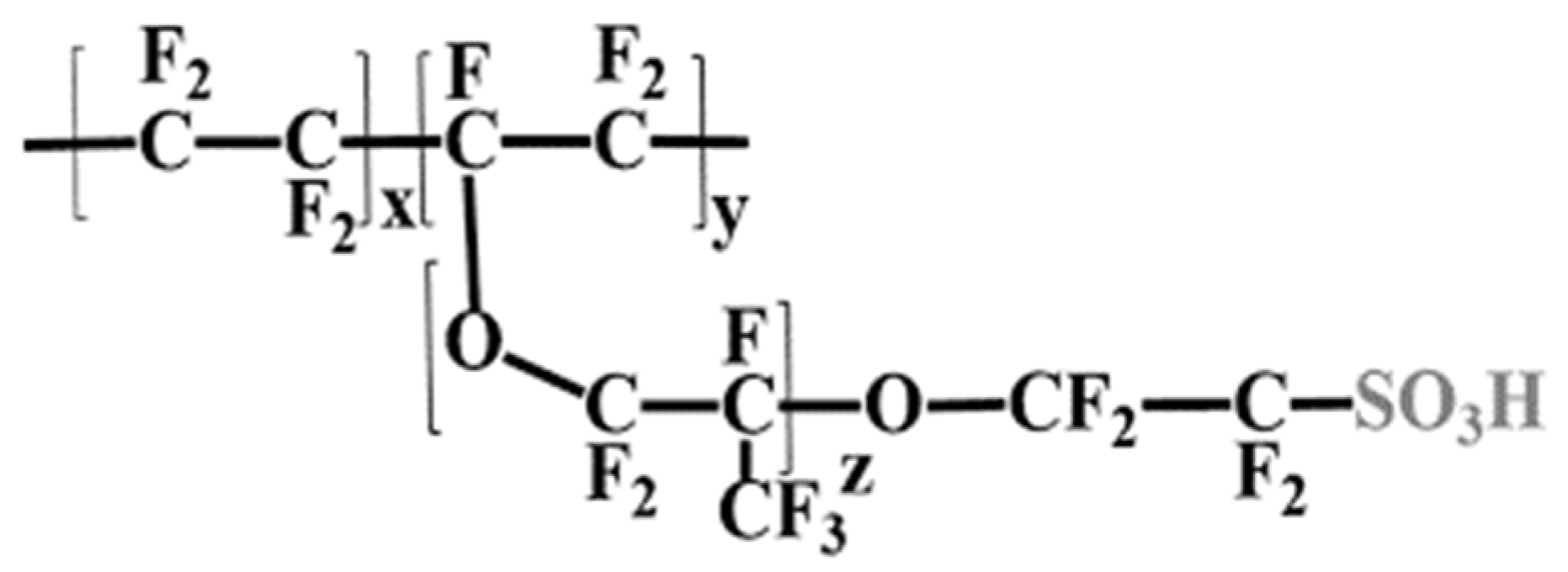
2.1. Perfluorosulfonic Acid (PFSA) Ionomers: The Nafion Benchmark
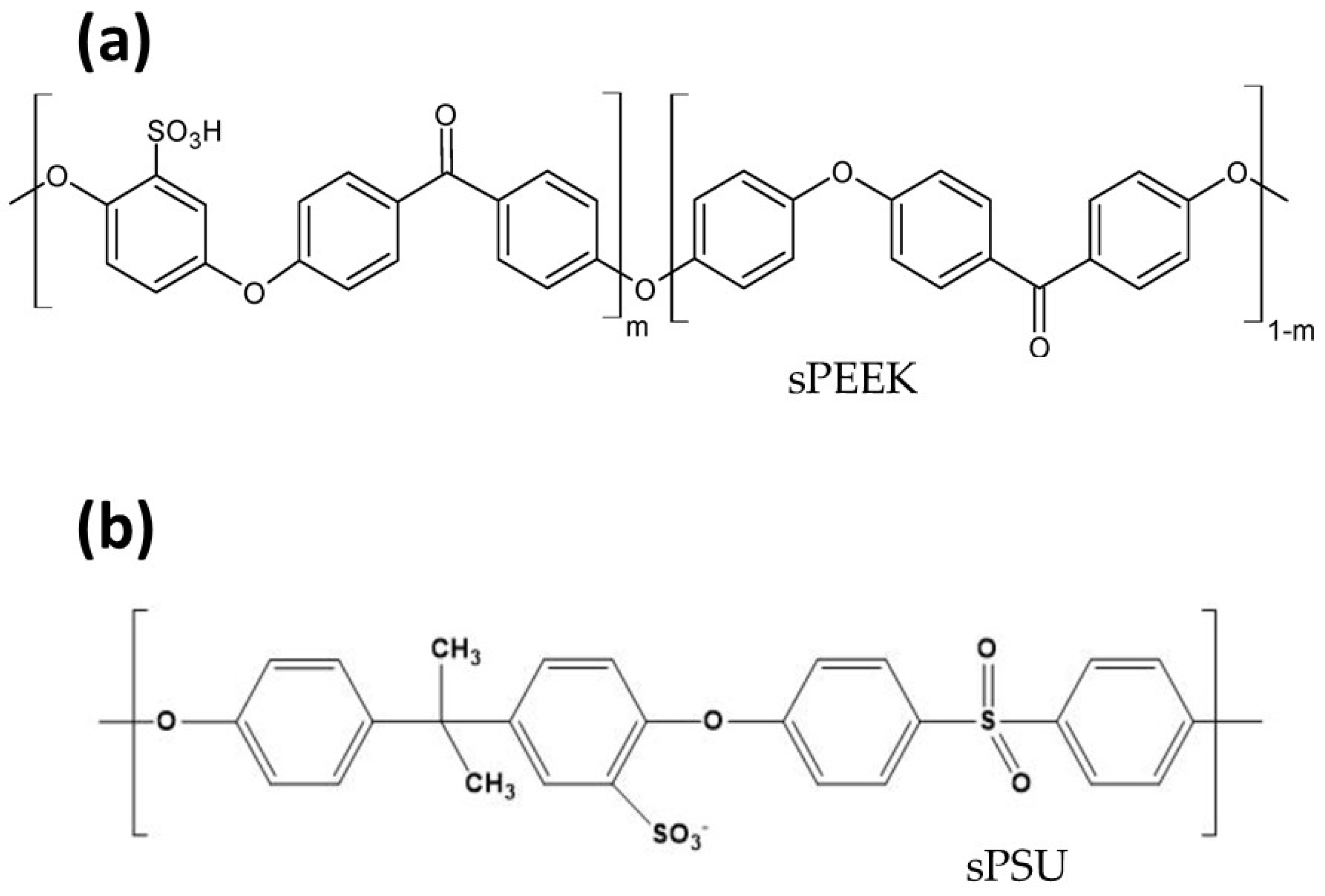
2.2. Aromatic Hydrocarbon Ionomers: Sulfonated Polysulfone (sPSU) and Sulfonated Polyether Ether Ketone (sPEEK)
3. PCAM Lab’s Nanocomposite Strategies for Enhanced PEM Performance
3.1. Layered Double Hydroxides (LDH) as Multi-Functional Nanoclinckers
- Improved Water Molecular Dynamics and Retention: LDH incorporation significantly enhances water retention, particularly at elevated temperatures. For instance, sPSU/LDH membranes can retain up to 40 wt% water content even at 130 °C, a stark contrast to pristine sPSU, which becomes almost dehydrated under similar conditions [17]. This impressive water retention is attributed to strong electrostatic interactions between the LDH platelets and water molecules, especially the “bound water” population, which resists evaporation even at high temperatures. These enhanced interactions lead to significantly higher water self-diffusion coefficients (D) in LDH composites. For example, at 130 °C, the water self-diffusion coefficient for sPSU/LDH is 6.63 × 10⁻⁶ cm2s−1, which is more than an order of magnitude higher than that of pristine sPSU (1.31 × 10⁻⁷ cm2s−1). These improved water dynamics are crucial for maintaining efficient proton transport in dehydrating environments [18].
- Enhanced Dimensional Stability: LDH platelets act as physical crosslinkers between adjacent polymer chains. This strong electrostatic interaction restricts the polymer chains from expanding excessively, thereby significantly improving dimensional stability. For sPSU/LDH, volume swelling is almost negligible with increasing temperature compared to pristine sPSU, which exhibits massive swelling [17]. This enhanced stability is further corroborated by an increase in the glass transition temperature (Tg) of the hydrophilic clusters, for example, from 200 °C for sPSU to 225 °C for sPSU/LDH. This physical crosslinking effectively re-engineers the polymer’s ionic network, preventing channel collapse at high temperatures and restricting swelling.
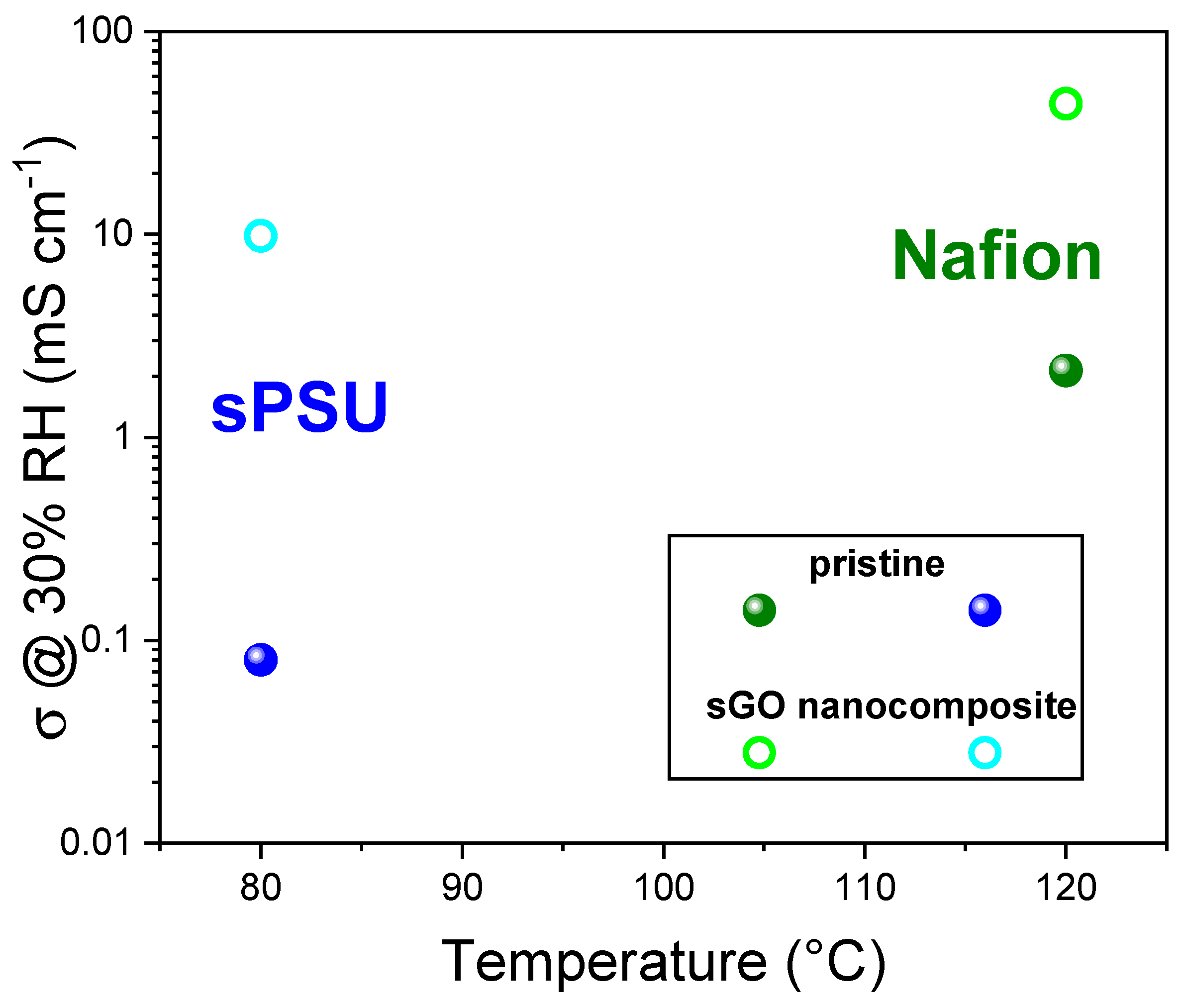
- Increased Proton Conductivity (Grotthuss Mechanism): LDH nanoplatelets directly contribute to proton transport, boosting both the vehicular and Grotthuss mechanisms, independently from the hosting matrix (see Figure 3). They connect isolated sulfonic acid groups, effectively filling gaps and generating continuous networks for proton migration, which is crucial under dehydrating conditions where the Grotthuss mechanism dominates. The activation energy for proton conductivity decreases significantly upon LDH incorporation, for instance, from 16.10 kJ mol−1 for sPSU to 9.25 kJ mol−1 for sPSU/LDH, indicating a noticeable improvement in the efficiency of proton conduction [17].
- Methanol Crossover Mitigation: LDH composites significantly reduce methanol permeability by increasing the tortuosity of diffusional paths within the membrane. For sPSU/LDH, the methanol crossover current can be as much as 60% lower than Nafion 212 and 25% lower than bare sPSU [19]. This is primarily due to the physical cross-linking action of LDH, which reduces the effective size of hydrophilic channels, making it more difficult for larger methanol molecules to permeate. This selective hindering of larger methanol molecules, while facilitating smaller protons, is a key advantage.
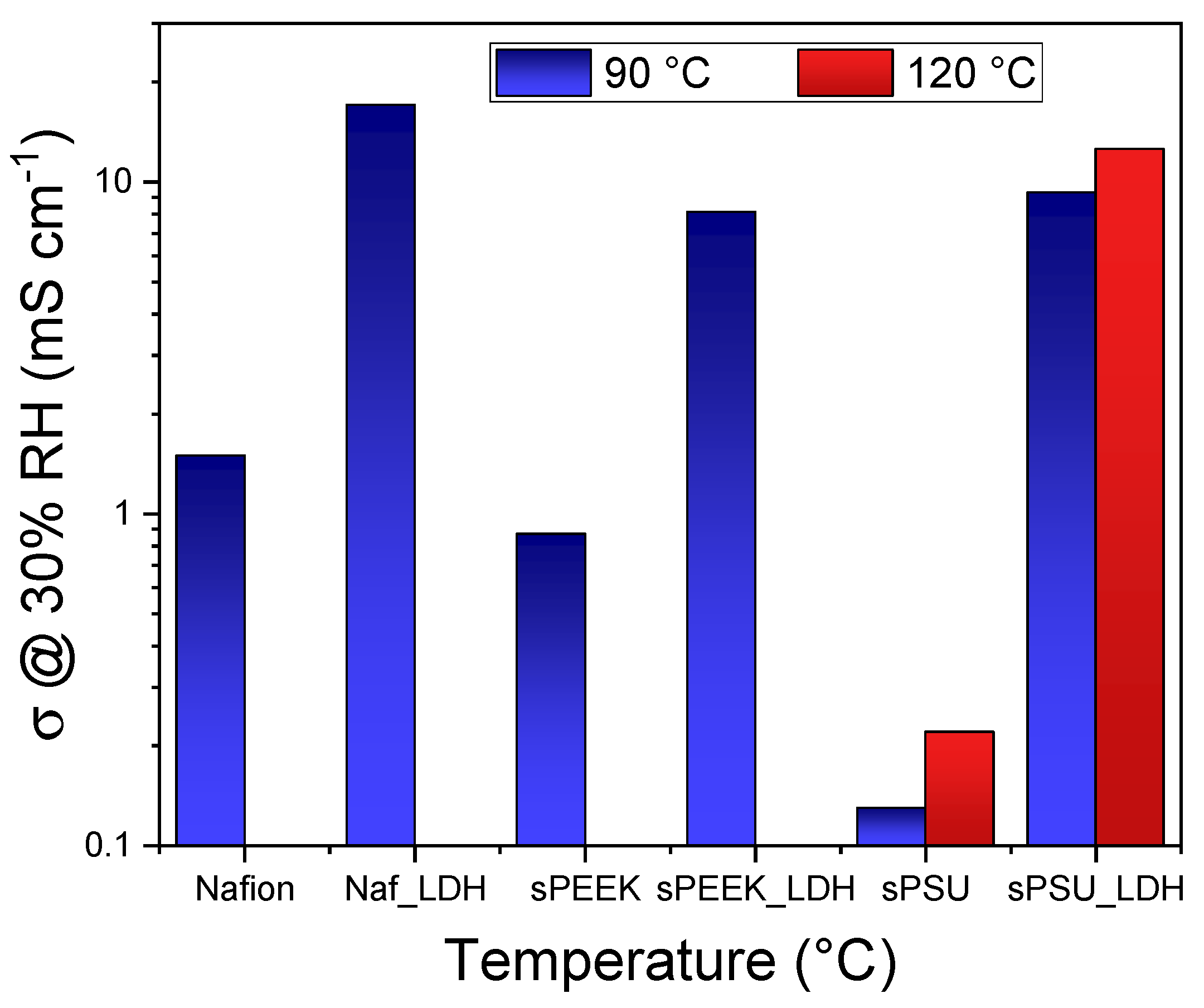
- Intermediate-Temperature PEMFC Performance: sPSU/LDH membranes exhibit superior proton conductivity, especially at low humidity. For example, sPSU/LDH can achieve 4 mS cm−1 at 90 °C and 20% RH, which is 20-fold higher than pristine sPSU and, critically, explicitly exceeds the performance benchmark of Nafion 212 (2.8 mS cm−1) under the same challenging dehydrating conditions. This quantitative advantage demonstrates the material’s ability to successfully overcome the intrinsic dehydration collapse typical of perfluorinated membranes above 80 °C. In single H2/O2 fuel cell tests, sPSU/LDH3 demonstrates a peak power density of 254 mW cm−2 at 80 °C/30% RH, representing a 30% improvement over Nafion recast/212 [17]. Furthermore, it maintains a robust 204.5 mW cm−2 at 110 °C/25% RH, with only a 20% reduction in power compared to 40–50% reductions observed for Nafion and pristine sPSU. This highlights its effective self-humidification capability and significant potential for high-temperature operation.
- DMFC Performance: sPSU/LDH achieves a remarkable power density of 150 mW cm−2 at 80 °C in 5 M methanol solution, making it the highest among the tested membranes [19]. This performance underscores its superior chemical and dimensional stability, enabling extended DMFC operation under high methanol concentrations where Nafion struggles due to excessive swelling.
- Durability and Stability Metrics: The viability for practical application is strongly supported by the inherent durability proxies exhibited by the sPSU/LDH composites. The incorporation of LDH platelets acts as a highly effective physical crosslinker, yielding substantial mechanical and thermal stability improvements. This is evidenced by a significant increase in the glass transition temperature (Tg) of the hydrophilic clusters, shifting from 200 °C for pristine sPSU to 225 °C for sPSU/LDH. Furthermore, Dynamic Mechanical Analysis (DMA) confirms that the storage modulus (E’) is almost 80% higher than the bare polymer [17]. This pronounced mechanical reinforcement ensures negligible volume swelling under increasing temperature. The combined stability gains, i.e., reduced swelling and increased Tg, provide robust evidence of the membrane’s resistance to the dominant mechanical degradation modes (cracking, thinning) induced by the hydration/dehydration cycles typical of high-temperature fuel cell operation, significantly strengthening the case for long-term commercialization potential. This demonstrates the material’s structural resistance to fatigue, addressing the durability imperative required for practical application.
- Anisotropy via Alignment: Mechanical alignment of LDH nanoparticles, for instance, through doctor blade casting, can induce anisotropy in the membrane’s properties. While this can lead to higher in-plane conductivity, through-plane conductivity might be hindered due to a “blocking effect” from the aligned lamellae [20]. This understanding has led to the development of sophisticated dual-layer hybrid membranes. These designs strategically combine an aligned layer for enhanced methanol barrier properties with a cast layer for efficient proton transport, achieving impressive power densities (e.g., 300 mW cm−2 at 100 °C). This represents a sophisticated architectural design principle for PEMs, where researchers deliberately manipulate filler orientation to achieve specific performance profiles, moving beyond simple material addition to deliberate membrane engineering at the macroscopic level.
3.2. Graphene-Based Nanofillers: Engineering Proton Superhighways
3.3. Organosilica Layered Materials (sSLM, PSLM): Designer Nanofillers
- Sulfonated Siliceous Layered Materials (sSLM) are synthesized via a one-pot sol–gel process using 3-(trihydroxysilyl)propyl-1-propane-sulfonic acid, yielding a layered material with a high density of sulfonic groups [24]. Incorporation into PFSA leads to synergistic enhancements of electrochemical performance and thermomechanical stability. Both the Ion Exchange Capacity (IEC) and water uptake increase (e.g., IEC from 0.94 to 1.23 meq/g; water uptake from 24 to 32 wt% at 5% filler loading). N-sSLM5 (Nafion with 5% sSLM) consistently shows the highest water self-diffusion coefficients across the entire temperature range (up to 130 °C), maintaining a continuous increase during heating [25]. These superior water dynamics are attributed to the filler modifying water towards a more thermally stable, “bound” configuration, which resists evaporation and maintains proton transport pathways. In terms of proton conductivity, N-sSLM5 exhibits the highest conductivity (e.g., 179.59 mS cm−1 at 120 °C, 90% RH). Crucially, it maintains remarkably high conductivity even at very low relative humidity (30.24 mS cm−1 at 120 °C, 20% RH), conditions under which pristine Nafion largely ceases to conduct [26]. This is attributed to the formation of stable “bound” water and the inherent proton-conducting properties of sSLMs. Thermomechanical stability is also significantly enhanced. sSLM incorporation increases the storage modulus and shifts the glass transition temperature (Tg) to higher values (e.g., 180 °C for sSLM-filled Nafion vs. 120 °C for recast Nafion), indicating restricted polymer chain mobility due to strong interfacial interactions.
- Similarly, PSLM (Phosphonated SLM) was synthesized from 3-(trihydroxysilyl) propyl methyl phosphonate, monosodium salt, yielding a layered material with phosphonate functional groups [24]. This material has shown significant improvements in mechanical strength, water retention, and proton transport when incorporated into sPEEK nanocomposite membranes. PSLM increases the storage modulus of sPEEK and extends its thermal resistance (sPEEK-PSLM3 remains stable up to 200 °C, with a Tg at 245 °C) [26]. In terms of water retention, PSLM helps sPEEK retain water above 60–80 °C, unlike pristine sPEEK which rapidly dehydrates. T1 analysis reveals that water molecules are distributed between the polymer and filler acid sites, with strong interactions slowing evaporation. For proton transport, PSLM creates an appropriate network that promotes efficient Grotthuss-type proton transport via highly connected paths. sPEEK-PSLM3 achieves conductivity values close to Nafion 212, especially at low hydration levels (20–30% RH). Furthermore, PSLM increases the chemical resistance of the membrane, preventing sPEEK backbone degradation.
3.4. Other Hybrid and Blended Approaches for Fuel Cell Applications
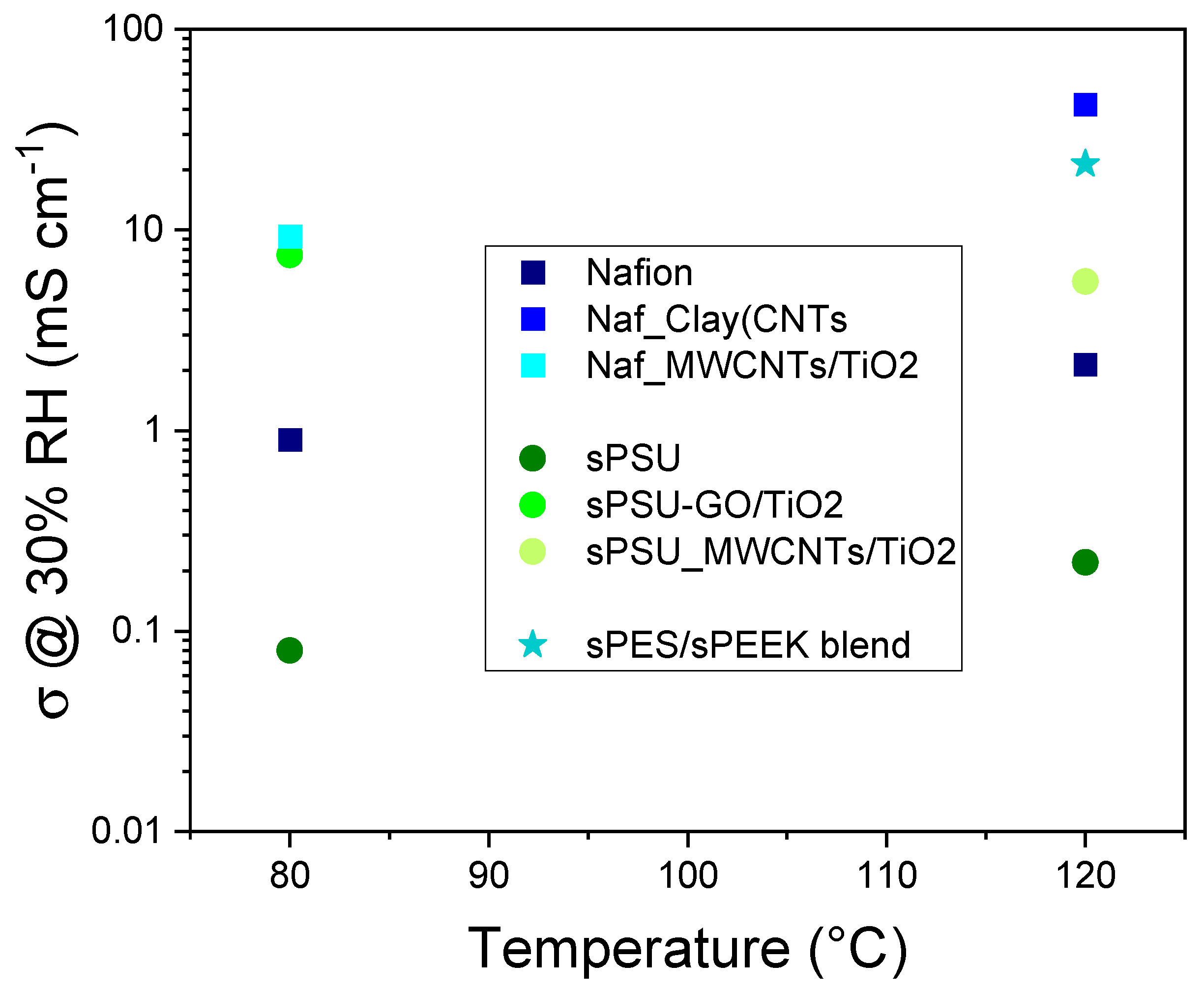
- Branched Clay-CNT Hybrids: A new class of hybrid materials based on carbon nanotubes (CNT) rooted on smectite clays (SWy) is synthesized by catalytic chemical vapor deposition (CCVD) [27]. The CNTs are subsequently oxidized and organo-functionalized with hydrophilic groups, such as -RSO3H. This process creates a “branched structure” that combines the 2D geometry of clay with the 1D nature of CNTs. This “branched structure” is a sophisticated design that addresses the dual, often conflicting, requirements of PEMs: high proton conductivity and low fuel permeability. The 2D/1D hybrid acts as a multi-scale physical barrier, increasing tortuosity for larger methanol molecules while simultaneously offering an efficient, interconnected network of acid sites for proton hopping. This is a highly advanced strategy for decoupling the transport of desired (protons) and undesired (methanol) species, crucial for DMFCs [28]. These materials guarantee very high proton diffusion even in “quasi-anhydrous” conditions, ensuring proton mobility via a network formed by long, functionalized nanotubes distributed through the clay nanoplatelets. Nafion composites with SWy-oxCNT-RSO3H show proton conductivities of 7 × 10⁻² Scm−1 at 120 °C and 30% RH, which is an order of magnitude higher than pristine Nafion. The branched structure effectively obstructs methanol diffusion, leading to reduced methanol crossover. DMFC tests confirm reduced methanol crossover while maintaining appropriate proton conductivity, especially at low humidity and high temperature (above 100 °C).
- GO-TiO2: This is a nanostructured hybrid material comprising TiO2 nanoparticles grown and stabilized on graphene oxide (GO) platelets [29], which was synthesized via a new, simple, one-pot hydrothermal procedure. This hybrid ensures homogeneous dispersion and prevents the agglomeration of TiO2 nanoparticles within the polymer matrix [30,31]. The addition of GO-TiO2 to sPSU produces a highly stable network, leading to a three-fold increase in the storage modulus compared to filler-free sPSU and shifting Tg from approximately 200 °C to ~240 °C. GO-TiO2 composites demonstrate very high water-retention capacity at elevated temperatures and remarkable proton mobility, particularly in very low relative humidity conditions [30], with proton conductivity two-fold higher than Nafion at 90 °C and RH 20%.
- MWCNTs-TiO2: The incorporation of this hybrid nanofiller into Nafion (NMT-x) or sPES (PMx) matrices significantly boosts dimensional stability, hydrophilicity, and overall physicochemical properties [32,33]. The synergy between the elongated MWCNTs and the TiO2 nanoparticles creates a physically interconnected network at the microscale that retains water and provides extended proton superhighways.
- Blending approach: Blended electrolyte membranes based on sulfonated polyethersulfone (sPES) and sulfonated polyetheretherketone (sPEEK), prepared in various ratios (e.g., 50/50 and 25/75) via a simple solution casting process, exhibit enhanced flexibility and thermal resistance without evidence of phase-segregation [34]. Thermogravimetric analysis (TGA) shows higher degradation temperatures and decreased mass loss, indicating improved thermal properties for the blended membranes.
4. Foundational Contributions: Sulfonated Polysulfone (sPSU)—Architectural Constraints and Trade-Offs
4.1. Advantages of sPSU as a Promising PEM Material
4.2. Elucidating Structure-Performance Relationships of sPSU
4.3. Impact of Manufacturing Processes (Recast vs. Mechanical Extrusion) on sPSU’s Anisotropic Behavior
5. State of the Art in Proton Exchange Membranes: Beyond PCAM Lab’s Specific Contributions
5.1. Current Commercial Landscape and Dominance of PFSA Membranes
5.2. Emerging Non-Fluorinated and Hydrocarbon-Based PEMs
- sPEEK: This material is considered a promising alternative to perfluorosulfonic acid membranes due to its excellent thermal stability, mechanical properties, and tunable proton conductivity [47]. Its properties can be controlled by adjusting the degree of sulfonation (DS), which influences hydrophilicity and proton conductivity. However, a high DS can lead to excessive water uptake, resulting in an extremely high swelling ratio and deterioration of mechanical and chemical stability, which limits its commercial application. To address these issues, various composite membranes are developed by combining sPEEK with a range of organic and inorganic materials, enhancing mechanical and chemical stability, reducing fuel permeability, and improving overall performance [48].
- SPI: Sulfonated polyimide membranes have demonstrated reasonable mechanical properties and proton conductivity at 80 °C, even after aging at 130 °C [49]. Polymer chain scission primarily occurs in the early stages of aging, but the membranes largely retain their mechanical integrity. Blending SPI with other polymers, such as polyethersulfone (PES), can significantly increase the stability of the entire membrane and restrict swelling, although it may slightly decrease fuel cell performance if the PES content is too high [49].
- SPEN: Sulfonated poly (aryl ether nitrile) (SPEN) typically possesses excellent properties, but its performance is highly dependent on the degree of sulfonation [50]. Balancing the DS with conductivity, mechanical properties, methanol permeability, and dimensional stability is crucial. Modified SPEN membranes have shown high proton conductivity (e.g., 0.137–0.174 S·cm−1 at 80 °C, which is higher than Nafion 117), excellent selectivity (8.7 times higher than Nafion 117), and good dimensional stability (e.g., 14.22% swelling at 80 °C).
- MOFs: Metal–Organic Frameworks are porous inorganic–organic hybrid materials that have attracted extensive attention in gas storage, gas separation, and reaction catalysis. When incorporated into polymer matrices, MOFs enhance the proton transfer path within the membrane, providing valuable insights into the mechanism of proton transfer in hybrid membranes [6]. They can be immersed with various proton carriers, and their organic ligands can be modified with functional groups to enhance acidity and hydrophilicity, providing more proton conduction sites [53]. MOFs’ large specific surface area allows composite membranes to accommodate more bound water, which improves proton hopping conductivity, and their numerous coordinatively unsaturated metal sites (CUSs) can form hydrogen-bond networks, promoting proton conduction via the Grotthuss mechanism. This incorporation also enhances mechanical strength, chemical stability, and thermal resilience [54].
- COFs: Covalent Organic Frameworks are an emerging class of organic porous crystalline materials composed of organic linkers connected by strong covalent bonds [55]. Their unique characteristics, including well-ordered and tailorable pore channels, permanent porosity, high crystallinity, and excellent chemical and thermal stability, enable COFs to be potential proton conductors in fuel cell devices [55]. COFs display prominent superiorities in constructing rigid ordered proton transfer channels and improving fuel cell performance and long-term durability [56]. Functionalized COFs have achieved proton conductivities exceeding 0.89 S cm−1 at 90 °C under 100% relative humidity (RH), comparable to commercial Nafion membranes [57]. When integrated into PEMFC cathodes, COF-modified ionomers have enabled fuel cells to achieve peak power densities 1.6 times higher than those without COF incorporation.
5.3. Advancements in High-Temperature PEMs (HT-PEMFCs)
5.4. Manufacturing Innovations for PEMs
- Roll-to-roll (R2R) Coating: This continuous manufacturing method is considered key for achieving high throughput and scalability, addressing the pressing need for faster, more cost-effective production of Membrane Electrode Assemblies (MEAs) [63]. Techniques like microgravure and slot-die coating are being optimized for applying catalyst layers and fabricating membranes. R2R coating offers significant cost reductions through economies of scale, despite potentially high initial capital costs. Microgravure, a self-metered technique, has achieved platinum loadings comparable to commercial targets for light-duty vehicles. Slot-die coating offers flexibility and precision with proper optimization, although it can have issues with cracking [63].
- Additive Manufacturing (3D Printing): Also known as 3D printing, this technology enables the creation of complex geometries and structures, improving fuel cell performance and efficiency [63]. It offers advantages such as reduced material waste, improved precision, and rapid prototyping. Crucially, additive manufacturing can integrate multiple conventional parts (e.g., liquid/gas diffusion layer, bipolar plate, gasket, and current distributor) into one multifunctional plate, for the first time [64]. This integration eliminates interfacial contact resistances between parts, leading to significantly increased energy efficiency (up to 86.48% at 2 A/cm2 and 80 °C) and hydrogen generation rates (increased by 61.81%) compared to conventional designs.
- Electrospinning: Nanofiber webs prepared by electrospinning can be used as a reinforcement matrix in PEMs, significantly improving mechanical properties, chemical stability, and durability [65]. The nanofibers can be welded together where they intersect, forming welded joints that make the nanofiber web stronger and stiffer, thereby improving the mechanical strength and hydration stability of the PEM. Alternatively, nanofibers can be impregnated with useful additives, such as inorganic free radical scavengers, that diffuse out slowly, enhancing the chemical stability of the PEM over time.
- Precision Chemical Machining: Processes like photochemical etching are utilized to create high-precision components critical for efficient energy conversion in hydrogen fuel cells, allowing for intricate designs and tight tolerances [66]. This innovative process avoids the introduction of mechanical stress or material distortion, preserving the material’s inherent properties and leading to improved durability and increased efficiency of components.
5.5. Commercial Hydrocarbon Benchmark: Pemion®
- Electrochemical Performance: Pemion®-based cells demonstrate a significantly reduced detrimental influence of high temperatures compared to PFSA-based cells. At an operation temperature of 110 °C, 250 kPa (abs), and 50% RH, Pemion® achieved a peak power density of 0.96 W cm−2, which was 8% higher than a short-side chain PFSA reference cell (0.89 text W cm−2. Under H2/air (80% RH, 80 °C, 250 kPa (abs)), it reached a peak power density of 1.1 W cm−2, reaching performance comparable to state-of-the-art PFSA systems.
- Mechanical Properties: Pemion® is a mechanically reinforced membrane. Technical data sheets report robust tensile properties, with tensile strength values greater than 50 MPa and Young’s Modulus values exceeding 600 MPa [68]. Thermo-mechanical analysis shows that its Young’s modulus and strain hardening are temperature-independent, whereas reinforced PFSA materials exhibit significant decay above 90 °C. This mechanical toughness is attributed to its sterically encumbered, rigid-rod polyphenylene backbone.
- Durability: Critically, Pemion® has been validated against industry-standard durability protocols. It successfully met and exceeded established accelerated durability benchmarks for combined chemical and mechanical stress testing. Throughout 1000 h of cyclical testing (intermittent dry and wet conditions under high-voltage chemical stress), Pemion® exceeded the 20,000 cycle durability targets set by the US Department of Energy (US DOE) by more than two-fold. Furthermore, in cross-pressure accelerated mechanical stress tests (ΔP-AMST), reinforced Pemion® membranes demonstrated a longer lifetime than incumbent reinforced PFSA materials.
6. Long-Term Durability, Stability Limits, and Improvement Strategies
6.1. Intrinsic Stability Limitations of Aromatic Hydrocarbon PEMs
- Chemical Degradation via Radical Attack. The primary failure mode of aromatic hydrocarbon PEMs, such as sPSU and sPEEK, is chemical degradation triggered by Reactive Oxygen Species (ROS), predominantly hydroxyl radicals (•OH) and hydrogen peroxide (H2O2), which are generated during fuel cell operation. These radicals attack the relatively vulnerable C-H bonds present in the polymer’s aromatic backbone, leading to chain scission, reduced molecular weight, and eventual loss of ionic conductivity and mechanical integrity [74]. Furthermore, the functional groups themselves are susceptible to thermal degradation; sulfonic acid groups in sPEEK membranes are significantly reduced when temperatures exceed ~200 °C [62,75].
- Mechanical Degradation and Dimensional Instability: The pursuit of high proton conductivity necessitates a high degree of sulfonation (DS), which directly conflicts with the maintenance of dimensional stability. This is termed the DS-swelling paradox. High DS leads to catastrophic water uptake and excessive swelling, as noted for pristine sPEEK, which can exhibit swelling close to 200% after prolonged treatment [76,77]. This excessive swelling destabilizes the polymer microstructure, causing the collapse of proton transport channels and mechanical weakening, leading to failure modes like cracking and thinning during cyclic operation, load cycling, or temperature cycling. Operation at elevated temperatures (≥90 °C) exacerbates these mechanical stresses. This type of degradation occurs due to various operational stressors, including cyclic operation, load cycling, frequent start-stop cycles, low humidification or humidification cycling, and operation at temperatures of 90 °C or higher [73]. These conditions can lead to membrane thinning, cracking, and loss of mechanical integrity [52].
6.2. The Nanocomposite Challenge: Interfacial Stability and Filler Leaching
- A progressive loss of the very functions the filler was added to provide (e.g., water retention, mechanical reinforcement, proton pathways).
- The leached filler material can travel to the catalyst layers, poisoning the platinum catalyst and irreversibly degrading cell performance.
6.3. Quantifying Durability: Accelerated Stress Test (AST) Protocols
6.4. PCAM Lab’s Targeted Mitigation Strategies
6.5. Broader State-of-the-Art Improvement Strategies for Non-Nafion PEMs
7. Key Characterization Insights and Methodologies
7.1. Nuclear Magnetic Resonance Spectroscopy
- PFG-NMR (Pulsed Field Gradient Nuclear Magnetic Resonance): This technique measures the long-range translational mobility (diffusion coefficient, D) of water, methanol, and ions (e.g., H+, Li+) within the hydrophilic domains of the membrane. It quantifies molecular mobility, helps distinguish between bulk and bound water populations, and reveals how fillers modify water networks and ion pathways. For example, sPSU/LDH membranes exhibited a water diffusion coefficient of 6.63 × 10⁻⁶ cm2s−1 at 130 °C, which is more than ten times higher than that of pristine sPSU. Similarly, Nafion N-sSLM5 composites showed the highest water self-diffusion coefficients across the entire temperature range up to 130 °C.
- T1/T2 Relaxometry: T1 and T2 relaxation times provide information about short-range molecular motions and the strength of interactions between molecules and the polymer matrix. This technique reveals local mobility, the state of water (bound vs. free), and its resistance to evaporation. For instance, the T1 values for sPSU/LDH consistently increased with temperature, indicating stable water structuring within the composite.
- Spectral Analysis (1H, 13C): This provides insights into the chemical environment of various species, changes in functional groups, and molecular interactions. It helps identify different water populations and chemical shifts resulting from acidity or specific interactions within the membrane.
- Rheo-MRI (Rheology-Magnetic Resonance Imaging) is a specialized technique used to investigate the organization of 2D nanoparticles within polymer solutions under shear forces. It provides direct visualization of filler alignment induced by mechanical forces during processing. For example, studies on Nafion/LDH composites using Rheo-MRI demonstrated that shearing induced a preferential orientation of LDH lamellae parallel to the shear direction.
7.2. Electrochemical Impedance Spectroscopy (EIS)
7.3. Dynamic Mechanical Analysis (DMA)
7.4. Microscopy Techniques
- SEM (Scanning Electron Microscopy): SEM is used to examine the surface morphology, cross-sectional structure, homogeneity, and filler dispersion at micro-to-nanoscale. It provides visual evidence of the material’s architecture and confirms the dispersion state of fillers. For instance, SEM revealed that recast sPSU membranes exhibit a dense, homogeneous structure, while mechanically extruded sPSU membranes show micrometer-sized cleavage planes oriented parallel to the surface.
- TEM (Transmission Electron Microscopy): TEM offers higher resolution images of nanoparticle morphology, size, dispersion, and the extent of exfoliation or agglomeration within the polymer matrix. It confirms the nanoscale structure and distribution of fillers. For example, TEM images confirmed the direct growth of TiO2 nanoparticles on MWCNTs in MWCNTs-TiO2 composites.
- AFM (Atomic Force Microscopy): AFM provides information on surface morphology, roughness, and nanoscale phase separation (e.g., hydrophobic/hydrophilic domains). It reveals local structural changes induced by fillers and the distribution of domain sizes.
- MD (Molecular Dynamics) & DFT (Density Functional Theory): These techniques are used to model molecular architecture, estimate structural parameters, and understand interactions within the polymer and with water molecules at a fundamental level. They provide theoretical insights into molecular-level mechanisms. For sPSU, MD simulations revealed an interconnected lamellar-like structure with ionic clusters of 14–18 Å, offering a fundamental explanation for its observed properties.
8. Critical Assessment of Commercialization Barriers and Long-Term Feasibility
8.1. Economic and Market Constraints: Cost vs. Complexity Trade-Off
8.2. Manufacturing and Scalability Challenges of Nanocomposites
8.3. The Durability Imperative: Transition to Accelerated Stress Testing (ASTs)
9. Holistic Environmental Impact: Life Cycle Assessment (LCA) Perspective
9.1. The PFAS-Free Advantage
9.2. Production Hotspots and Environmental Trade-Offs
9.3. Amortization of Environmental Impact Through Operational Efficiency
10. Conclusions and Future Outlook
10.1. Summary of Significant Advancements
10.2. Critical Research Gaps and Future Directions
- Durability Quantification and Long-Term Stability: The most critical future direction involves moving beyond short-term performance metrics to rigorous, long-term durability testing. Comprehensive investigations into the chemical, mechanical, and electrochemical stability of these advanced nanocomposites must be performed under realistic, accelerated load cycling and dynamic operating conditions common in commercial fuel cells [74].
- Mitigating Manufacturing-Induced Anisotropy: The finding that mechanical extrusion, while boosting mechanical strength, fundamentally degrades the critical through-plane proton conductivity in sPSU is a major application limit. Future research must focus intensely on optimizing manufacturing processes to simultaneously preserve mechanical gains while eliminating this detrimental anisotropy, potentially by combining extrusion with filler alignment or architectural strategies that re-orient ionic pathways.
- System Integration and MEA Optimization: The next crucial step is the effective integration of these novel laboratory-scale membranes into industrial Membrane Electrode Assemblies (MEAs). Research is required to optimize MEA design, ensuring uniform current distribution and mitigating interfacial contact resistances. This will require the implementation of advanced, scalable manufacturing techniques such as roll-to-roll (R2R) coating and additive manufacturing.
- Fundamental Mechanistic Understanding: Continued multi-scale computational and experimental studies (MD, PFG-NMR) remain vital to deepen the understanding of ion and water transport mechanisms, particularly within the complex interfaces created by the nanocomposite structure. This detailed mechanistic knowledge is essential for the rational design of even more advanced materials with predictable, industrial-scale performance.
- New Architectures: Exploration of novel membrane architectures, such as gradient membranes, porous structures, and advanced dual-layer designs, can further optimize transport pathways and mitigate existing limitations, leading to next-generation PEMs with unprecedented performance.
- LCA Validation at Scale: Rigorous, scaled-up Life Cycle Assessment must be conducted to prove that the operational efficiency and end-of-life benefits (PFAS elimination) successfully amortize the production phase’s environmental cost (energy consumption during complex nanofiller synthesis).
Author Contributions
Funding
Institutional Review Board Statement
Data Availability Statement
Conflicts of Interest
References
- Fawzy, S.; Osman, A.I.; Doran, J.; Rooney, D.W. Strategies for mitigation of climate change: A review. Environ. Chem. Lett. 2020, 18, 2069–2094. [Google Scholar] [CrossRef] [Scilit]
- Suranovic, S. Fossil fuel addiction and the implications for climate change policy. Glob. Environ. Change 2013, 23, 598–608. [Google Scholar] [CrossRef] [Scilit]
- Fuss, S.; Canadell, J.G.; Peters, G.P.; Tavoni, M.; Andrew, R.M.; Ciais, P.; Jackson, R.B.; Jones, C.D.; Kraxner, F.; Nakicenovic, N.; et al. Betting on negative emissions. Nat. Clim. Change 2014, 4, 850–853. [Google Scholar] [CrossRef] [Scilit]
- Kim, D.J.; Jo, M.J.; Nam, S.Y. A review of polymer-nanocomposite electrolyte membranes for fuel cell application. J. Ind. Eng. Chem. 2015, 21, 36–52. [Google Scholar] [CrossRef] [Scilit]
- Zhu, L.Y.; Li, Y.C.; Liu, J.; He, J.; Wang, L.Y.; Lei, J. Du Recent developments in high-performance Nafion membranes for hydrogen fuel cells applications. Pet. Sci. 2022, 19, 1371–1381. [Google Scholar] [CrossRef] [Scilit]
- Li, L.; Shao, Z.; Liu, W.; Gao, K.; Li, Y.; Cheng, H.; Wei, Y.; Yu, X.; Su, L.; Zhai, L. Advances and advantages of metal-organic framework and its composite membrane as proton conduction materials. Microstructures 2025, 5, 2025036. [Google Scholar] [CrossRef] [Scilit]
- Mauritz, K.A.; Moore, R.B. State of understanding of nafion. Chem. Rev. 2004, 104, 4535–4585. [Google Scholar] [CrossRef] [Scilit]
- Prykhodko, Y.; Fatyeyeva, K.; Hespel, L.; Marais, S. Progress in hybrid composite Nafion®-based membranes for proton exchange fuel cell application. Chem. Eng. J. 2021, 409, 127329. [Google Scholar] [CrossRef] [Scilit]
- Kusoglu, A.; Weber, A.Z. New Insights into Per fl uorinated Sulfonic-Acid Ionomers. Chem. Rev. 2017, 117, 987–1104. [Google Scholar] [CrossRef] [Scilit]
- Zhou, J.; Cao, J.; Zhang, Y.; Liu, J.; Chen, J.; Li, M.; Wang, W.; Liu, X. Overcoming undesired fuel crossover: Goals of methanol-resistant modification of polymer electrolyte membranes. Renew. Sustain. Energy Rev. 2021, 138, 110660. [Google Scholar] [CrossRef] [Scilit]
- Brito dos Santos, F.; Kaschuk, J.; Banvillet, G.; Jalaee, A.; Rojas, O.J.; Foster, E.J. Alternative proton exchange membrane based on a bicomponent anionic nanocellulose system. Carbohydr. Polym. 2024, 340, 122299. [Google Scholar] [CrossRef] [Scilit]
- Ngai, K.S.; Ramesh, S.; Ramesh, K.; Juan, J.C. A review of polymer electrolytes: Fundamental, approaches and applications. Ionics 2016, 22, 1259–1279. [Google Scholar] [CrossRef] [Scilit]
- Karimi, M.B.; Mohammadi, F.; Hooshyari, K. Recent approaches to improve Nafion performance for fuel cell applications: A review. Int. J. Hydrogen Energy 2019, 44, 28919–28938. [Google Scholar] [CrossRef] [Scilit]
- Simari, C. NMR Investigation of Water Molecular Dynamics in Sulfonated Polysulfone/Layered Double Hydroxide Composite Membranes for Proton Exchange Membrane Fuel Cells. Membranes 2023, 13, 684. [Google Scholar] [CrossRef] [Scilit]
- Trotta, F.; Drioli, E.; Moraglio, C.; Baima Poma, E. Sulfonation of polyetheretherketone by chlorosulfuric acid. J. Appl. Polym. Sci. 1998, 70, 477–482. [Google Scholar] [CrossRef] [Scilit]
- Roelofs, K.S.; Hirth, T.; Schiestel, T. Sulfonated poly(ether ether ketone)-based silica nanocomposite membranes for direct ethanol fuel cells. J. Memb. Sci. 2010, 346, 215–226. [Google Scholar] [CrossRef] [Scilit]
- Simari, C.; Lufrano, E.; Brunetti, A.; Barbieri, G.; Nicotera, I. Highly-performing and low-cost nanostructured membranes based on Polysulfone and layered doubled hydroxide for high-temperature proton exchange membrane fuel cells. J. Power Sources 2020, 471, 228440. [Google Scholar] [CrossRef] [Scilit]
- Rehman, M.H.U.; Lufrano, E.; Simari, C. Nanocomposite Membranes for PEM-FCs: Effect of LDH Introduction on the Physic-Chemical Performance of Various Polymer Matrices. Polymers 2023, 15, 502. [Google Scholar] [CrossRef] [Scilit]
- Lufrano, E.; Simari, C.; Lo Vecchio, C.; Aricò, A.S.; Baglio, V.; Nicotera, I. Barrier properties of sulfonated polysulfone/layered double hydroxides nanocomposite membrane for direct methanol fuel cell operating at high methanol concentrations. Int. J. Hydrogen Energy 2020, 45, 20647–20658. [Google Scholar] [CrossRef] [Scilit]
- Simari, C.; Enotiadis, A.; Lo Vecchio, C.; Baglio, V.; Coppola, L.; Nicotera, I. Advances in hybrid composite membranes engineering for high-performance direct methanol fuel cells by alignment of 2D nanostructures and a dual-layer approach. J. Memb. Sci. 2020, 599, 117858. [Google Scholar] [CrossRef] [Scilit]
- Nicotera, I.; Simari, C.; Coppola, L.; Zygouri, P.; Gournis, D.; Brutti, S.; Minuto, F.D.; Aricò, A.S.; Sebastian, D.; Baglio, V. Sulfonated graphene oxide platelets in nafion nanocomposite membrane: Advantages for application in direct methanol fuel cells. J. Phys. Chem. C 2014, 118, 24357–24368. [Google Scholar] [CrossRef] [Scilit]
- Simari, C.; Stallworth, P.; Peng, J.; Coppola, L.; Greenbaum, S.; Nicotera, I. Graphene oxide and sulfonated-derivative: Proton transport properties and electrochemical behavior of Nafion-based nanocomposites. Electrochim. Acta 2019, 297, 240–249. [Google Scholar] [CrossRef] [Scilit]
- Simari, C.; Lufrano, E.; Brunetti, A.; Barbieri, G.; Nicotera, I. Polysulfone and organo-modified graphene oxide for new hybrid proton exchange membranes: A green alternative for high-efficiency PEMFCs. Electrochim. Acta 2021, 380, 138214. [Google Scholar] [CrossRef] [Scilit]
- Nicotera, I.; Simari, C.; Boutsika, L.G.; Coppola, L.; Spyrou, K.; Enotiadis, A. NMR investigation on nanocomposite membranes based on organosilica layered materials bearing different functional groups for PEMFCs. Int. J. Hydrogen Energy 2017, 42, 27940–27949. [Google Scholar] [CrossRef] [Scilit]
- Loise, V.; Simari, C. Next-Generation Nafion Membranes: Synergistic Enhancement of Electrochemical Performance and Thermomechanical Stability with Sulfonated Siliceous Layered Material (sSLM). Polymers 2025, 17, 1866. [Google Scholar] [CrossRef] [Scilit]
- Simari, C.; Enotiadis, A.; Nicotera, I. Transport Properties and Mechanical Features of Sulfonated Polyether Ether Ketone/Organosilica Layered Materials Nanocomposite Membranes for Fuel Cell Applications. Membranes 2020, 10, 87. [Google Scholar] [CrossRef] [Scilit]
- Simari, C.; Potsi, G.; Policicchio, A.; Perrotta, I.; Nicotera, I. Clay-Carbon Nanotubes Hybrid Materials for Nanocomposite Membranes: Advantages of Branched Structure for Proton Transport under Low Humidity Conditions in PEMFCs. J. Phys. Chem. C 2016, 120, 2574–2584. [Google Scholar] [CrossRef] [Scilit]
- Simari, C.; Baglio, V.; Lo Vecchio, C.; Aricò, A.S.; Agostino, R.G.; Coppola, L.; Oliviero Rossi, C.; Nicotera, I. Reduced methanol crossover and enhanced proton transport in nanocomposite membranes based on clay−CNTs hybrid materials for direct methanol fuel cells. Ionics 2017, 23, 2113–2123. [Google Scholar] [CrossRef] [Scilit]
- Li, F.; Jiang, X.; Zhao, J.; Zhang, S. Graphene oxide: A promising nanomaterial for energy and environmental applications. Nano Energy 2015, 16, 488–515. [Google Scholar] [CrossRef] [Scilit]
- Simari, C.; Lufrano, E.; Godbert, N.; Gournis, D.; Coppola, L.; Nicotera, I. Titanium dioxide grafted on graphene oxide: Hybrid nanofiller for effective and low-cost proton exchange membranes. Nanomaterials 2020, 10, 1572. [Google Scholar] [CrossRef] [Scilit]
- Tursi, A.; Beneduci, A.; Nicotera, I.; Simari, C. MWCNTs Decorated with TiO2 as Highly Performing Filler in the Preparation of Nanocomposite Membranes for Scalable Photocatalytic Degradation of Bisphenol A in Water. Nanomaterials 2023, 13, 2325. [Google Scholar] [CrossRef] [Scilit]
- Nicotera, I.; Coppola, L.; Simari, C. Novel Nafion nanocomposite membranes embedded with TiO2-decorated MWCNTs for high-temperature/low relative humidity fuel cell systems. Mater. Renew. Sustain. Energy 2024, 13, 307–318. [Google Scholar] [CrossRef] [Scilit]
- Nicotera, I.; Coppola, L.; Simari, C. Enhancing sulfonated polyethersulfone performance by incorporating TiO2-decorated MWCNTs: A viable solution for high-temperature polymer electrolyte fuel cell applications. Int. J. Hydrogen Energy 2024, 89, 56–65. [Google Scholar] [CrossRef] [Scilit]
- Simari, C.; Lo Vecchio, C.; Baglio, V.; Nicotera, I. Sulfonated polyethersulfone/polyetheretherketone blend as high performing and cost-effective electrolyte membrane for direct methanol fuel cells. Renew. Energy 2020, 159, 336–345. [Google Scholar] [CrossRef] [Scilit]
- Mikhailenko, S.D.; Zaidi, S.M.J.; Kaliaguine, S. Sulfonated polyether ether ketone based composite polymer electrolyte membranes. Catal. Today 2001, 67, 225–236. [Google Scholar] [CrossRef] [Scilit]
- Kim, I.C.; Choi, J.G.; Tak, T.M. Sulfonated polyethersulfone by heterogeneous method and its membrane performances. J. Appl. Polym. Sci. 1999, 74, 2046–2055. [Google Scholar] [CrossRef]
- Simari, C.; Nicotera, I.; Aricò, A.S.; Baglio, V.; Lufrano, F. New insights into properties of methanol transport in sulfonated polysulfone composite membranes for direct methanol fuel cells. Polymers 2021, 13, 1386. [Google Scholar] [CrossRef] [Scilit] [PubMed]
- Simari, C.; Prejanò, M.; Lufrano, E.; Sicilia, E.; Nicotera, I. Exploring the Structure–Performance Relationship of Sulfonated Polysulfone Proton Exchange Membrane by a Combined Computational and Experimental Approach. Polymers 2021, 13, 959. [Google Scholar] [CrossRef] [Scilit] [PubMed]
- Simari, C.; Lufrano, E.; Corrente, G.A.; Nicotera, I. Anisotropic behavior of mechanically extruded sulfonated polysulfone: Implications for proton exchange membrane fuel cell applications. Solid State Ion. 2021, 362, 115581. [Google Scholar] [CrossRef] [Scilit]
- Qasem, N.A.A. A recent overview of proton exchange membrane fuel cells: Fundamentals, applications, and advances. Appl. Therm. Eng. 2024, 252, 123746. [Google Scholar] [CrossRef] [Scilit]
- Ng, W.W.; Thiam, H.S.; Pang, Y.L.; Chong, K.C.; Lai, S.O. A State-of-Art on the Development of Nafion-Based Membrane for Performance Improvement in Direct Methanol Fuel Cells. Membranes 2022, 12, 506. [Google Scholar] [CrossRef] [Scilit]
- Curtin, D.E.; Lousenberg, R.D.; Henry, T.J.; Tangeman, P.C.; Tisack, M.E. Advanced materials for improved PEMFC performance and life. J. Power Sources 2004, 131, 41–48. [Google Scholar] [CrossRef] [Scilit]
- Banerjee, S.; Curtin, D.E. Nafion® perfluorinated membranes in fuel cells. J. Fluor. Chem. 2004, 125, 1211–1216. [Google Scholar] [CrossRef] [Scilit]
- Li, T.; Shen, J.; Chen, G.; Guo, S.; Xie, G. Performance Comparison of Proton Exchange Membrane Fuel Cells with Nafion and Aquivion Perfluorosulfonic Acids with Different Equivalent Weights as the Electrode Binders. ACS Omega 2020, 5, 17628–17636. [Google Scholar] [CrossRef] [Scilit]
- Research, P.M. Fuel Cell Market Size, Share, and Growth Forecast for 2025–2032. Available online: https://www.persistencemarketresearch.com/market-research/fuel-cells-market.asp (accessed on 22 November 2025).
- Esmaeili, N.; Gray, E.M.A.; Webb, C.J. Non-Fluorinated Polymer Composite Proton Exchange Membranes for Fuel Cell Applications—A Review. ChemPhysChem 2019, 20, 2016–2053. [Google Scholar] [CrossRef] [Scilit]
- Chandan, A.; Hattenberger, M.; El-kharouf, A.; Du, S.; Dhir, A.; Self, V.; Pollet, B.G.; Ingram, A.; Bujalski, W. High temperature (HT) polymer electrolyte membrane fuel cells (PEMFC) e A review. J. Power Sources 2013, 231, 264–278. [Google Scholar] [CrossRef] [Scilit]
- Sarirchi, S.; Rowshanzamir, S.; Mehri, F. Effect of sulfated metal oxides on the performance and stability of sulfonated poly (ether ether ketone) nanocomposite proton exchange membrane for fuel cell applications. React. Funct. Polym. 2020, 156, 104732. [Google Scholar] [CrossRef] [Scilit]
- Yin, Y.; Suto, Y.; Sakabe, T.; Chen, S.; Hayashi, S.; Mishima, T.; Yamada, O.; Tanaka, K.; Kita, H.; Okamoto, K.I. Water stability of sulfonated polyimide membranes. Macromolecules 2006, 39, 1189–1198. [Google Scholar] [CrossRef] [Scilit]
- Nor, N.A.M.; Mohamed, M.A.; Juhana, J. Modified sulfonated polyphenylsulfone proton exchange membrane with enhanced fuel cell performance: A review. J. Ind. Eng. Chem. 2022, 116, 32–59. [Google Scholar] [CrossRef] [Scilit]
- Selyanchyn, O.; Selyanchyn, R.; Lyth, S.M. A Review of Proton Conductivity in Cellulosic Materials. Front. Energy Res. 2020, 8, 596164. [Google Scholar] [CrossRef] [Scilit]
- Yang, I.; Gautama, Z.A.R.; Hutapea, Y.A.; Ariyoshi, M.; Fujikawa, S.; Sugiyama, T.; Lyth, S.M.; Sasaki, K.; Nishihara, M. Improved chemical durability in polymer electrolyte membranes with nanocellulose-based gas barrier interlayers. J. Power Sources 2025, 629, 235833. [Google Scholar] [CrossRef] [Scilit]
- Liu, Q.; Li, Z.; Wang, D.; Li, Z.; Peng, X.; Liu, C.; Zheng, P. Metal Organic Frameworks Modified Proton Exchange Membranes for Fuel Cells. Front. Chem. 2020, 8, 694. [Google Scholar] [CrossRef] [Scilit]
- Escorihuela, J.; Narducci, R.; Compañ, V.; Costantino, F. Proton Conductivity of Composite Polyelectrolyte Membranes with Metal-Organic Frameworks for Fuel Cell Applications. Adv. Mater. Interfaces 2019, 6, 1801146. [Google Scholar] [CrossRef] [Scilit]
- Joseph, V.; Nagai, A. Recent advancements of covalent organic frameworks (COFs) as proton conductors under anhydrous conditions for fuel cell applications. RSC Adv. 2023, 13, 30401–30419. [Google Scholar] [CrossRef] [Scilit]
- Ji, J.; Yang, T.; Zhang, W.; Li, J.; Li, H.; Tang, Y.; Jin, W.; Sun, Y.; Li, K.; Li, W.; et al. Triazine-rich covalent organic framework composited proton exchange membranes for flexible operating temperature and enhanced long-term stability fuel cells. J. Power Sources 2025, 632, 236351. [Google Scholar] [CrossRef] [Scilit]
- Lu, Y.; Zhou, S.; Zhu, C.; Zhou, D.J.; Feng, D.X. Recent Advances in the Application of Covalent Organic Framework–Based Ionic Conductors in Proton Exchange Membrane Fuel Cells. Chem.-Eur. J. 2025, 31, e202501116. [Google Scholar] [CrossRef] [Scilit] [PubMed]
- Alashkar, A.; Al-Othman, A.; Tawalbeh, M.; Qasim, M. A Critical Review on the Use of Ionic Liquids in Proton Exchange Membrane Fuel Cells. Membranes 2022, 12, 178. [Google Scholar] [CrossRef] [Scilit] [PubMed]
- Ebrahimi, M.; Kujawski, W.; Fatyeyeva, K.; Kujawa, J. A review on ionic liquids-based membranes for middle and high temperature polymer electrolyte membrane fuel cells (Pem fcs). Int. J. Mol. Sci. 2021, 22, 5430. [Google Scholar] [CrossRef] [Scilit]
- Ebrahimi, M.; Fatyeyeva, K.; Kujawski, W. Different Approaches for the Preparation of Composite Ionic Liquid-Based Membranes for Proton Exchange Membrane Fuel Cell Applications—Recent Advancements. Membranes 2023, 13, 593. [Google Scholar] [CrossRef] [Scilit]
- Nicotera, I.; Kosma, V.; Simari, C.; Angioni, S.; Mustarelli, P.; Quartarone, E. Ion dynamics and mechanical properties of sulfonated polybenzimidazole membranes for high-temperature proton exchange membrane fuel cells. J. Phys. Chem. C 2015, 119, 9745–9753. [Google Scholar] [CrossRef] [Scilit]
- Li, X.; Ye, T.; Meng, X.; He, D.; Li, L.; Song, K.; Jiang, J.; Sun, C. Advances in the Application of Sulfonated Poly(Ether Ether Ketone) (SPEEK) and Its Organic Composite Membranes for Proton Exchange Membrane Fuel Cells (PEMFCs). Polymers 2024, 16, 2840. [Google Scholar] [CrossRef] [Scilit]
- Liu, P.; Yang, D.; Li, B.; Zhang, C.; Ming, P. Recent progress of catalyst ink for roll-to-roll manufacturing paired with slot die coating for proton exchange membrane fuel cells. Int. J. Hydrogen Energy 2023, 48, 19666–19685. [Google Scholar] [CrossRef] [Scilit]
- Yang, G.; Mo, J.; Kang, Z.; Dohrmann, Y.; List, F.A.; Green, J.B.; Babu, S.S.; Zhang, F.Y. Fully printed and integrated electrolyzer cells with additive manufacturing for high-efficiency water splitting. Appl. Energy 2018, 215, 202–210. [Google Scholar] [CrossRef] [Scilit]
- Mu’min, M.S.; Komma, M.; Abbas, D.; Wagner, M.; Krieger, A.; Thiele, S.; Böhm, T.; Kerres, J. Electrospun phosphonated poly(pentafluorostyrene) nanofibers as a reinforcement of Nafion membranes for fuel cell application. J. Memb. Sci. 2023, 685, 121915. [Google Scholar] [CrossRef] [Scilit]
- Lu, Z.; Yan, Y. Temperature Control of Fuel Cell Based on PEI-DDPG. Energies 2024, 17, 1728. [Google Scholar] [CrossRef] [Scilit]
- Edwards, P.P.; Kuznetsov, V.L.; David, W.I.F.; Brandon, N.P. Hydrogen and fuel cells: Towards a sustainable energy future. Energy Policy 2008, 36, 4356–4362. [Google Scholar] [CrossRef] [Scilit]
- Nguyen, H.; Lombeck, F.; Schwarz, C.; Heizmann, P.A.; Adamski, M.; Lee, H.F.; Britton, B.; Holdcroft, S.; Vierrath, S.; Breitwieser, M. Hydrocarbon-based PemionTM proton exchange membrane fuel cells with state-of-the-art performance. Sustain. Energy Fuels 2021, 5, 3687–3699. [Google Scholar] [CrossRef] [Scilit]
- Lufrano, E.; Simari, C.; Enotiadis, A.; Nicotera, I. Sulfonated Polyether Ether Ketone and Organosilica Layered Nanofiller for Sustainable Proton Exchange Membranes Fuel Cells (PEMFCs). Appl. Sci. 2022, 12, 963. [Google Scholar] [CrossRef] [Scilit]
- Simari, C.; Vecchio, C.L.; Enotiadis, A.; Davoli, M.; Baglio, V.; Nicotera, I. Toward optimization of a robust low-cost sulfonated-polyethersulfone containing layered double hydroxide for PEM fuel cells. J. Appl. Polym. Sci. 2019, 136, 47884. [Google Scholar] [CrossRef] [Scilit]
- Wei, J.; Geng, S.; Hedlund, J.; Oksman, K. Lightweight, flexible, and multifunctional anisotropic nanocellulose-based aerogels for CO2 adsorption. Cellulose 2020, 27, 2695–2707. [Google Scholar] [CrossRef] [Scilit]
- Di Virgilio, M.; Basso Peressut, A.; Arosio, V.; Arrigoni, A.; Latorrata, S.; Dotelli, G. Functional and Environmental Performances of Novel Electrolytic Membranes for PEM Fuel Cells: A Lab-Scale Case Study. Clean Technol. 2023, 5, 74–93. [Google Scholar] [CrossRef] [Scilit]
- Guerrero Moreno, N.; Cisneros Molina, M.; Gervasio, D.; Pérez Robles, J.F. Approaches to polymer electrolyte membrane fuel cells (PEMFCs) and their cost. Renew. Sustain. Energy Rev. 2015, 52, 897–906. [Google Scholar] [CrossRef] [Scilit]
- Madhav, D.; Wang, J.; Keloth, R.; Mus, J.; Buysschaert, F.; Vandeginste, V. A Review of Proton Exchange Membrane Degradation Pathways, Mechanisms, and Mitigation Strategies in a Fuel Cell. Energies 2024, 17, 998. [Google Scholar] [CrossRef] [Scilit]
- Yuan, Z.; Li, X.; Hu, J.; Xu, W.; Cao, J.; Zhang, H. Degradation mechanism of sulfonated poly (ether under vanadium flow battery medium. Phys. Chem. Chem. Phys. 2014, 16, 19841–19847. [Google Scholar] [CrossRef] [Scilit]
- Wu, X.; Wang, X.; He, G.; Benziger, J. Differences in Water Sorption and Proton Conductivity Between Nafion and SPEEK. J. Polym. Sci. Part B Polym. Phys. 2011, 49, 1437–1445. [Google Scholar] [CrossRef] [Scilit]
- Wang, X.; Shi, B. Simultaneously Promoting Proton Conductivity and Mechanical Stability of SPEEK Membrane by Incorporating Porous g—C3N4. Membranes 2025, 15, 194. [Google Scholar] [CrossRef] [Scilit] [PubMed]
- Manoharan, Y.; Hosseini, S.E.; Butler, B.; Alzhahrani, H.; Senior, B.T.F.; Ashuri, T.; Krohn, J. Hydrogen fuel cell vehicles; Current status and future prospect. Appl. Sci. 2019, 9, 2296. [Google Scholar] [CrossRef] [Scilit]
- Hamlyn, R.; Mahl, J.; Zhang, X.; English, D.; McAfee, T.; Crumlin, E.J. Challenges and strategies for probing the composite interface of PEM electrolyzers and fuel cells using operando AP-XPS. J. Mater. Chem. A 2025, 13, 21672–21682. [Google Scholar] [CrossRef] [Scilit]
- De Bruijn, F.A.; Dam, V.A.T.; Janssen, G.J.M. Review: Durability and degradation issues of PEM fuel cell components. Fuel Cells 2008, 8, 3–22. [Google Scholar] [CrossRef] [Scilit]
- Using, C.; Bae, B. Evaluating the Durability of Perfluorosulfonic Acid Membranes Stability Testing. Polymers 2024, 16, 1348. [Google Scholar]
- Mukundan, R.; Baker, A.M.; Kusoglu, A.; Knights, S.; Weber, A.Z.; Borup, R.L.; Beattie, P. Membrane Accelerated Stress Test Development for Polymer Electrolyte Fuel Cell Durability Validated Using Field and Drive Cycle Testing. J. Electrochem. Soc. 2018, 165, 3085–3093. [Google Scholar] [CrossRef] [Scilit]
- Rozière, J.; Jones, D.J. Non-Fluorinated Polymer Materials for Proton Exchange Membrane Fuel Cells. Annu. Rev. Mater. Res. 2003, 33, 503–555. [Google Scholar] [CrossRef] [Scilit]
- Arun, M.; Giddey, S.; Joseph, P.; Dhawale, D.S. Challenges and mitigation strategies for general failure and degradation in polymer electrolyte membrane-based fuel cells and electrolysers. J. Mater. Chem. A 2025, 13, 11236–11263. [Google Scholar] [CrossRef] [Scilit]
- Wang, W.; Alexandridis, P. Composite Polymer Electrolytes: Nanoparticles Affect Structure and Properties. Polymers 2016, 8, 387. [Google Scholar] [CrossRef] [Scilit]
- Li, L.; Soyhan, I.; Warszawik, E.; Rijn, P. Van Layered Double Hydroxides: Recent Progress and Promising Perspectives Toward Biomedical Applications. Adv. Sci. 2024, 11, 2306035. [Google Scholar] [CrossRef] [Scilit]
- Murali, A.; Ramesh, R.; Sakar, M.; Park, S.; Han, S.S. Unveiling the potential of emergent nanoscale composite polymer electrolytes for safe and efficient all solid-state lithium-ion batteries. RSC Adv. 2024, 14, 30618–30629. [Google Scholar] [CrossRef] [Scilit] [PubMed]
- Pang, X.; Chen, L.; Liu, Y.; Chi, M.; Li, Z.; Plank, J. Growth behavior of water dispersed MgAl layered double hydroxide nanosheets. RSC Adv. 2017, 7, 14989–14997. [Google Scholar] [CrossRef] [Scilit]
- Borup, R.; Meyers, J.; Pivovar, B.; Kim, Y.S.; Mukundan, R.; Garland, N.; Myers, D.; Wilson, M.; Garzon, F.; Wood, D.; et al. Scientific aspects of polymer electrolyte fuel cell durability and degradation. Chem. Rev. 2007, 107, 3904–3951. [Google Scholar] [CrossRef] [Scilit]
- Rimon, S.T.A.; Mourshed, M.; Kibria, M.G. Proton exchange membrane fuel cells: Advances in materials development, performance optimization, and future outlook. Energy Convers. Manag. X 2025, 27, 101102. [Google Scholar] [CrossRef] [Scilit]
- Pasalwad, K.A.; Baby, N.; Edjenguele, A.; Sadhasivam, S.; Palanisamy, G.; Magdum, S.S.; Thangarasu, S.; Oh, T.H. Progress on polymer-based materials and composites for humidity sensor applications: From materials aspects to sensor performances. J. Mater. Chem. A 2025, 13, 23248–23311. [Google Scholar] [CrossRef] [Scilit]
- Cells, P.E.M.F. DOE Cell Component Accelerated Stress Test; U.S. Department of Energy: Washington, DC, USA, 2010.
- Gottardo, G.; Peressut, A.B.; Colnago, S.; Latorrata, S.; Piegari, L.; Dotelli, G. LCA of a Proton Exchange Membrane Fuel Cell Electric Vehicle Considering Different Power System Architectures. Energies 2023, 16, 6782. [Google Scholar] [CrossRef] [Scilit]
- Khan, M.I.; Shanableh, A.; Shahida, S.; Lashari, M.H.; Manzoor, S.; Fernandez, J. SPEEK and SPPO Blended Membranes for Proton Exchange Membrane Fuel Cells. Membranes 2022, 12, 263. [Google Scholar] [CrossRef] [Scilit] [PubMed]



| Nanofiller Type | Functional Groups/Key Structural Feature | Host Polymer | Primary Impact | Key Mechanism | Representative Performance Metric |
|---|---|---|---|---|---|
| Layered Double Hydroxides (LDH) | Layered, Fixed Positive Charge, Anion Exchange | sPSU, Nafion, sPEEK | Water Retention, Dimensional Stability, Proton Conductivity, Methanol Barrier | Physical Crosslinking, Grotthuss Enhancement, Increased Tortuosity | sPSU/LDH: 4 mS cm−1 at 90 °C/20% RH (20× sPSU) |
| Sulfonated Graphene Oxide (sGO) | Sulfonic, 2D Layered | Nafion, sPSU | Water Retention, Proton Conductivity, Methanol Barrier | Strong H-bonding Network, Proton Hopping | Nafion-sGOsulf: 231.9 mS cm−1 at 90% RH (81% enhancement) |
| TiO2-decorated Graphene Oxide (GO-TiO2) | TiO2 Nanoparticles on GO, Hybrid | sPSU | Mechanical Strength, Water Retention, Proton Conductivity, Thermal Stability | Homogeneous Dispersion, Internal Humidification | sPSU_GO-TiO2 3%: 2× Nafion conductivity at RH 20% |
| TiO2-decorated Multi-Walled Carbon Nanotubes (MWCNTs-TiO2) | TiO2 Nanoparticles on MWCNTs, Hybrid | Nafion, sPES | Dimensional Stability, Water Retention, Proton Conductivity | Interconnected Network, Direct Proton Contribution | Nafion NMT-3: 307.7 mW/cm2 at 120 °C/30% RH (3× Nafion) |
| Sulfonated Siliceous Layered Materials (sSLM) | Sulfonic, Layered | Nafion, sPEEK | Water Retention, Proton Conductivity, Thermomechanical Stability | “Bound” Water Structuring, Nacre-like Structure | Nafion N-sSLM5: 30.24 mS cm−1 at 120 °C/20% RH |
| Phosphonated Organosilica Layered Materials (PSLM) | Phosphonic, Layered | sPEEK | Mechanical Strength, Water Retention, Proton Transport | Physical Crosslinking, Grotthuss Enhancement | sPEEK-PSLM3: Conductivity close to Nafion 212 at low RH |
| Clay-Carbon Nanotubes (Clay-CNT) | Branched 2D/1D Hybrid, Sulfonic | Nafion | Proton Transport, Methanol Barrier | Multi-scale Physical Barrier, Functionalized Network | Nafion/SWy-oxCNT-RSO3H: 7 × 10⁻² Scm−1 at 120 °C/30% RH |
| sPES/sPEEK Blends | Polymer Blend | sPES | Flexibility, Thermal Resistance, Proton Transport, Methanol Barrier | Miscibility, Complementary Properties | sPES-sPEEK (25/75): 130 mW cm−2 at 80 °C/4 M methanol |
| Membrane Type | IEC (meq g−1) | Water Uptake (wt% at 20–25 °C) | Tensile Strength (MPa) | Young’s Modulus (MPa) | Glass Transition Temperature (Tg, °C) | Proton Conductivity (mS cm−1) at 80 °C/90% RH | Activation Energy for Proton Conductivity (kJ mol−1) | Water Self-Diffusion Coefficient (D, cm2s−1) at 130 °C | Methanol Crossover Current (mA cm−2) at 80 °C/5 M | Peak Power Density (mW cm−2) in Fuel Cell Test (H2/O2 or DMFC) |
|---|---|---|---|---|---|---|---|---|---|---|
| Pristine sPSU (Recast) | 1.36 | 27 | 26.5 | 15.4 | 200 | 69 | 16.10 | 1.31 × 10⁻⁷ | 379 | 101 (DMFC) |
| Pristine sPSU (Extruded) | 1.36 | 22 | 42.3 | 34.3 | - | 78.0 (120 °C) | 24.31 | 1.31 × 10⁻⁷ | - | - |
| sPSU/LDH | 1.49 | 29 | - | - | 225 | 102 (120 °C) | 9.25 | 6.63 × 10⁻⁶ | 292 | 150 (DMFC) |
| sPSU/sGO | 1.32 | 38 | - | - | - | 9.4 (80 °C/20% RH) | - | - | - | 182.6 (H2/O2) |
| sPSU/GO-TiO2 | 1.36 | 37 | - | - | 240 | 100 (100% RH) | - | 1.1 × 10⁻⁵ (130 °C) | - | - |
| Membrane Type | Host Polymer (If Composite) | Proton Conductivity (mS/cm) (T/RH) | Mechanical Strength (Tensile Strength MPa/Young’s Modulus MPa/Storage Modulus MPa) | Water Uptake (wt%) (T/RH) | Methanol Crossover (mA cm−2/Permeability cm2s−1) (T/Methanol Conc.) | Operating Temperature Range (°C)/High-Temperature Performance Notes | Key Advantages | Key Challenges | Refs. |
|---|---|---|---|---|---|---|---|---|---|
| PCAM Lab Materials | |||||||||
| sPSU/LDH | sPSU | 4 (90 °C/20% RH); 102 (120 °C/20% RH) | - | 29 (20–25 °C); 40 (130 °C) | 292 (80 °C/5 M) | Up to 110 °C; 254 mW cm−2 at 80 °C/30% RH; 204.5 mW cm−2 at 110 °C/25% RH | Cost-effective, high water retention, excellent dimensional stability, high-T operation, reduced methanol crossover | - | [17,19] |
| Nafion-sGOsulf | Nafion | 231.9 (90% RH); 44.9 (90 °C/30% RH) | - | Outstanding retention up to 130 °C | Reduced | High-T operation; internal humidification | Proton superhighways, superior water retention, high conductivity at low RH | - | [21,22] |
| sPEEK5/SSLM 5 wt% | sPEEK | 12.8 (90 °C/30% RH) | 68.32 MPa/-/260 MPa | Halved at 5 wt% SSLM | - | Improved water diffusivity at high T | Nacre-like structure, high mechanical strength, high conductivity at low RH, improved hydrolytic stability | Water uptake decline with high filler content | [26,69] |
| sPES/sPEEK (25/75) | sPES | Superior to pristine sPES at low hydration | Enhanced flexibility, thermal resistance | Water diffusivity 1 order of magnitude higher (50/50 blend) | Dramatically reduced (>3 orders of magnitude vs. pristine sPES) | 130 mW cm−2 at 80 °C/4 M methanol | Scalable, cost-effective, balanced properties, excellent methanol barrier | - | [34,70] |
| Other Advanced Materials | |||||||||
| Sulfonated Nanocellulose | Cellulose | 15 (120 °C, fully hydrated) | 1.15 GPa (Young’s Modulus) | 6330 (48 h) | 8.28 × 10⁻⁹ (sulfated cellulose) | Up to 190 °C thermal-oxidative stability | Renewable, low-cost, high water uptake, good mechanical robustness, environmentally friendly | Water instability (requires crosslinking) | [11,71] |
| PA-doped PBIANI | PBI | 167 (120 °C/100% RH) | 26 ± 3 MPa | - | - | 120–200 °C; 691 mW/cm2 at 160 °C (PFCB-PBI) | High-T/anhydrous operation, CO tolerance, improved mechanical strength | PA leaching, limited long-term stability | [47] |
| Sulfonated Graphene Oxide (SGO) | - | 1150 (80 °C) | Inferior to Nafion 212 (20.3 MPa tensile stress for Nafion) | Higher than Nafion 212 (0.71 meq g−1 IEC for Nafion) | Reduced | - | PFAS-free, high IEC, high proton conductivity, good environmental impact trade-off | Inferior mechanical performance to Nafion | [72] |
| PIL-PBI Blends | PBI | 70 (150 °C) | Lower elastic modulus | - | - | High-T/anhydrous operation | High conductivity at elevated temperatures, non-volatility | IL leaching, limited long-term thermal/mechanical stability | [60] |
| COF-based PEMs | Various (e.g., polymer composites) | >890 (90 °C/100% RH); 86.3 (160 °C, N2) | Robust structure stability | Pore solvation ability | - | High-T/anhydrous potential | Tunable porosity, ordered channels, high stability, enhanced power density | Humidity dependence, scalability, acid-resistance, MEA integration | [55] |
| Commercial Benchmarks | |||||||||
| Pemion® | Sulfo-phenylated Polyphenylene (sPPX-H+) | 41 (40% RH) | >50/>600 | Lower gas | Up to 120 °C; 0.96 W cm−2 at 110 °C/50% RH | Exceeded DOE 20,000 cycle AST target (Validated Durability) | [68] | ||
| Aquivion SSC-PFSA | - | Higher than Nafion LSC-PFSA (low RH) | Higher crystallinity, higher Tg (140 °C vs. 100 °C for Nafion) | - | - | Up to 110 °C | Higher operating temperature, better performance at low RH, higher stability | - | [44] |
| Concentration Regime | Physical Phenomenon | Impact on Proton Conductivity | Impact on Mechanical Integrity |
|---|---|---|---|
| Low Loading (0.1–1.0 wt%) | Dispersion Zone: Nanoparticles are isolated. Formation of interfacial “space-charge” regions. | Slight increase or neutral. Conductivity is dominated by the bulk polymer matrix. | Minimal reinforcement. Fracture toughness may increase due to crack pinning. |
| Optimum Loading (1.0–5.0 wt%) | Percolation Threshold: Functional zones around particles overlap, forming continuous conduction pathways. | Peak Performance. Rapid increase in conductivity as new high-speed pathways bridge polymer clusters. | Optimal stiffness/toughness balance. Fillers restrict polymer chain mobility (creep resistance). |
| Overloading (>5.0–10 wt%) | Agglomeration Zone: Particles clump due to surface energy. Blocking of polymer channels. | Decline. Agglomerates act as inert obstacles, increasing tortuosity and severing ionic channels. | Embrittlement. Agglomerates act as stress concentrators, reducing tensile strength and elongation. |
| Nanocomposite System | Primary Commercial Advantage | Key Scalability/Manufacturing Hurdle | Estimated Complexity Cost Barrier (Synthesis) | Long-Term Stability Challenge Addressed |
|---|---|---|---|---|
| sPSU/Layered Double Hydroxides (LDH) | Cost-effective polymer host, high-T/low-RH operation, effective methanol barrier | Hydrophilic LDH dispersion in polymer matrix; risk of agglomeration; detrimental manufacturing-induced anisotropy (Extrusion Paradox) | Medium (requires controlled particle synthesis and functionalization) | Dimensional instability (via physical crosslinking) |
| Nafion/Sulfonated Graphene Oxide (sGO) | Proton superhighways, superior water retention, high conductivity at low RH | High cost and complexity of sGO functionalization; difficulty in maintaining homogeneity and preventing agglomeration at industrial scale | High (nanofiller production complexity) | Dehydration/Conductivity collapse at high T |
| sPEEK/Sulfonated Siliceous Layered Material (sSLM) | Biomimetic ‘nacre-like’ reinforcement, exceptional mechanical durability | Multi-step sol–gel required for designer filler synthesis; difficulty in achieving precise architectural (layered) control during R2R coating | Medium-High (designer filler, complex synthetic route) | Mechanical degradation and swelling (via nacre structure) |
Disclaimer/Publisher’s Note: The statements, opinions and data contained in all publications are solely those of the individual author(s) and contributor(s) and not of MDPI and/or the editor(s). MDPI and/or the editor(s) disclaim responsibility for any injury to people or property resulting from any ideas, methods, instructions or products referred to in the content. |
© 2025 by the authors. Licensee MDPI, Basel, Switzerland. This article is an open access article distributed under the terms and conditions of the Creative Commons Attribution (CC BY) license (https://creativecommons.org/licenses/by/4.0/).
Share and Cite
Nicotera, I.; Coppola, L.; Simari, C. Evolutionary Strategies in Nanocomposite Proton Exchange Membranes: A Physical Chemistry Applied Materials (PCAM) LAB Review on Material Design, High-Temperature Performance, and Durability. Polymers 2025, 17, 3185. https://doi.org/10.3390/polym17233185
Nicotera I, Coppola L, Simari C. Evolutionary Strategies in Nanocomposite Proton Exchange Membranes: A Physical Chemistry Applied Materials (PCAM) LAB Review on Material Design, High-Temperature Performance, and Durability. Polymers. 2025; 17(23):3185. https://doi.org/10.3390/polym17233185
Chicago/Turabian StyleNicotera, Isabella, Luigi Coppola, and Cataldo Simari. 2025. "Evolutionary Strategies in Nanocomposite Proton Exchange Membranes: A Physical Chemistry Applied Materials (PCAM) LAB Review on Material Design, High-Temperature Performance, and Durability" Polymers 17, no. 23: 3185. https://doi.org/10.3390/polym17233185
APA StyleNicotera, I., Coppola, L., & Simari, C. (2025). Evolutionary Strategies in Nanocomposite Proton Exchange Membranes: A Physical Chemistry Applied Materials (PCAM) LAB Review on Material Design, High-Temperature Performance, and Durability. Polymers, 17(23), 3185. https://doi.org/10.3390/polym17233185