Structural and Optical Characterizations of Polymethyl Methacrylate Films with the Incorporation of Ultrafine SiO2/TiO2 Composites Utilized as Self-Cleaning Surfaces


 and
and
Abstract
1. Introduction
2. Materials and Methods
3. Results and Discussion
3.1. Morphological and Structural Characteristics
3.2. Optical Characteristics
3.3. Self-Cleaning Surface Applications
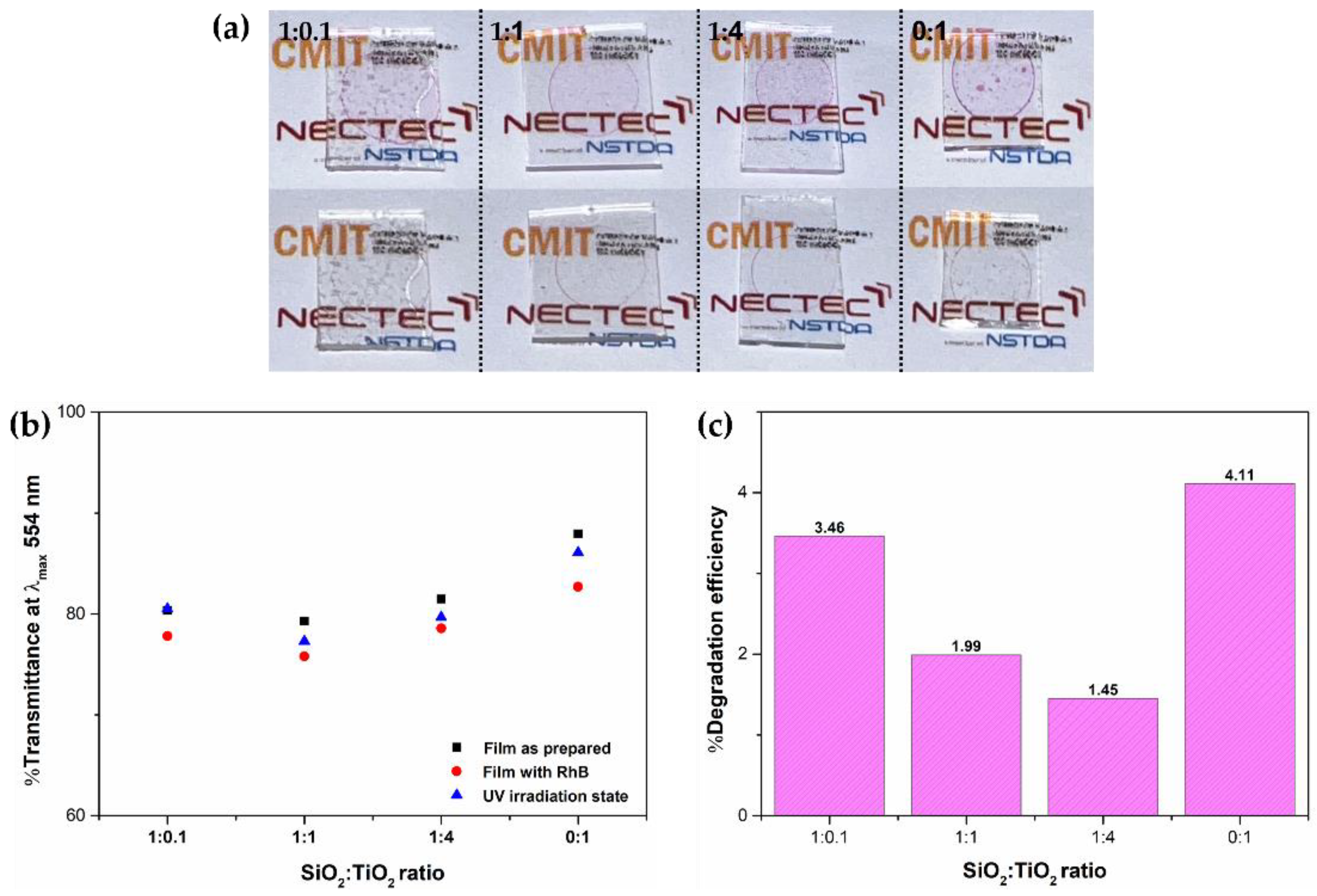
 ), RhB stain on the composite film (
 ), and after UV irradiation on RhB stain on the composite film (
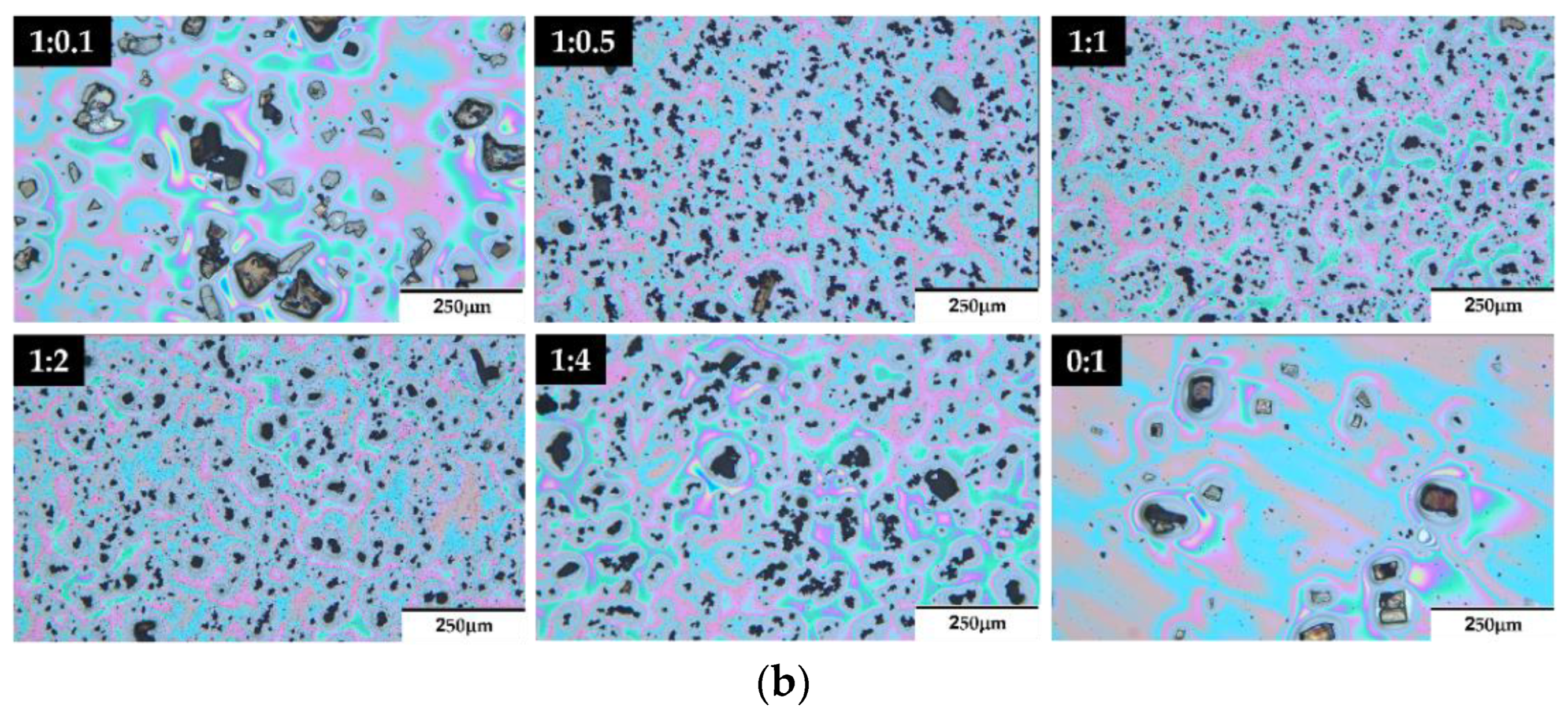
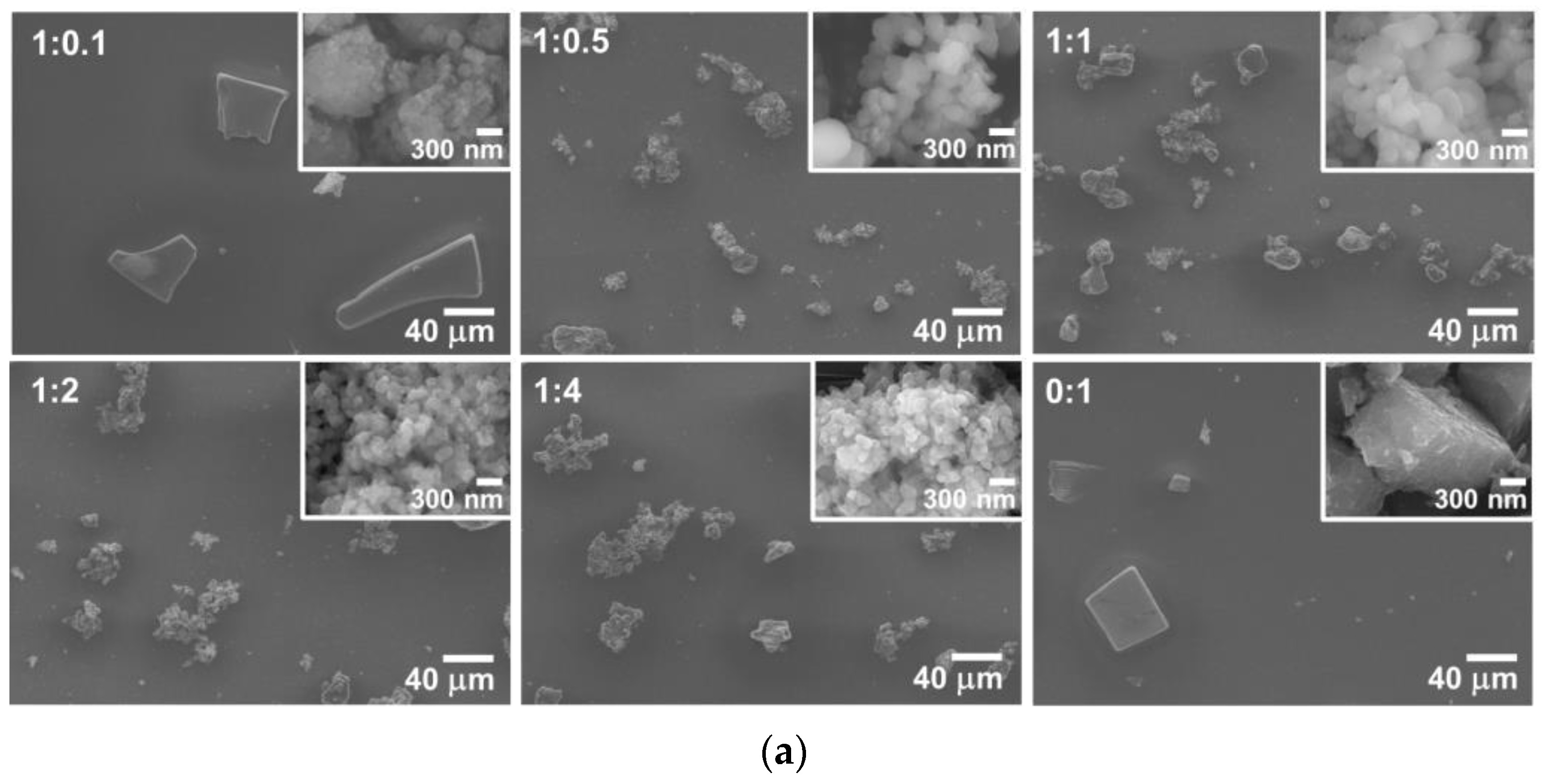
 ). The transmission of as-prepared nanocomposite films was measured and used as a reference. For RhB droplets on the films, as shown in red dots, the decrease in %T value on the films is clearly noted due to the light absorbance of RhB dye. After UV irradiation, the %T values of all samples considerably increased due to the decrease in the dye absorbance or the diminished dye concentration, reflecting the effective RhB dye degradation by photocatalytic reaction on each film surface [28]. The highest photocatalytic degradation by the photocatalyst film was performed using pure TiO2 film due to its dominant photocatalytic property of anatase TiO2. Under UV irradiation, the electron–hole pairs created on the TiO2 photocatalyst surface strongly reacted with hydroxide groups and O2 molecules in the environment to produce the superoxide and hydroxyl radicals [29]. After that, the organic molecules in the RhB chemical structure were decomposed by these strong radicals to form in the conjugated chromophore, as presented by the clear RhB stain and higher %T value [30]. In the case of SiO2/TiO2/PMMA nanocomposite films, good photocatalytic activity was found in the sample with a SiO2:TiO2 ratio of 1:0.1. Although this specimen is mainly composed of SiO2 nanoparticles as a matrix, the photocatalytic reaction could be executed by the increase in active sites on the surface of SiO2 nanoparticles, providing a greater active surface area under UV irradiation. Moreover, the separation of photo-generated electron–hole pairs would be improved by the presence of oxygen defects on the SiO2 nanoparticle surface attributed to the decrease in the electron–hole pair recombination rate and enhancing the photocatalytic activity of the SiO2-based photocatalyst [31]. Meanwhile, the composite film with a 1:1 SiO2:TiO2 ratio had a higher photocatalytic reaction due to the homogenous particle dispersion on the film compared with the film with a SiO2:TiO2 ratio of 1:4. This reaction can be achieved due to the existence of a TiO2 photocatalyst in the SiO2/TiO2 nanocomposite. The photocatalytic reaction by the composite film with a SiO2:TiO2 ratio of 1:1 may be enhanced by the presence of a mixed TiOSi phase (Si–O–Ti linkages) at the TiO2/SiO2 interface, guiding the decrease in the tight agglomeration of the anatase phase in TiO2 material and the suppression of photoactive radicals by electron–hole pairs and effective surface with the silica phase in the composite. However, after UV irradiation, %T values of the composite films with SiO2:TiO2 ratios of 1:1, 1:4, and 0:1 were slightly different to the initial value of as-prepared films, which could be due to the coverage of well-dispersed particles on the film surface, as revealed by optical image analysis. A number of irradiation photons can be absorbed by the particles on the film surface, reflecting the decrease in %T value. Furthermore, the percentage of dye degradation in the film with RhB before and after UV irradiation was calculated to confirm the photocatalytic performance of the films, as shown in Figure 9c. The superior dye degradation efficiency of bare TiO2 film was determined to be approximately 4.11%, while the percentage of the SiO2/TiO2 composite films with SiO2:TiO2 ratios of 1:0.1, 1:1, and 1:4 was approximately 3.46, 1.99, and 1.45, respectively. According to the spherical shape of SiO2 nanoparticles in the composite film, a large number of active sites could be generated and enhance UV light absorption with their high surface-to-volume ratio, promoting the photocatalytic abilities under this condition. For the composite film with SiO2:TiO2 ratios at 1:1 and 1:4, the photocatalytic activity could be enhanced by the influence of the hydrophilicity of SiO2 and TiO2 according to the increase in the hydroxyl group generated on their surfaces.
4. Conclusions
Author Contributions
Funding
Institutional Review Board Statement
Data Availability Statement
Acknowledgments
Conflicts of Interest
References
- Ren, Y.; Li, W.; Cao, Z.; Jiao, Y.; Xu, J.; Liu, P.; Li, S.; Li, X. Robust TiO2 nanorods-SiO2 core-shell coating with high-performance self-cleaning properties under visible light. Appl. Surf. Sci. 2020, 509, 145377. [Google Scholar]
- Ganesh, V.A.; Raut, H.K.; Nair, A.S.; Ramakrishna, S. A review on self-cleaning coatings. J. Mater. Chem. 2011, 21, 16304. [Google Scholar] [CrossRef]
- Kurbanova, A.; Myrzakhmetova, N.; Akimbayeva, N.; Kishibayev, K.; Nurbekova, M.; Kanagat, Y.; Tursynova, A.; Zhunussova, T.; Seralin, A.; Kudaibergenova, R.; et al. Superhydrophobic SiO2/trimethylchlorosilane coating for self-cleaning application of construction materials. Coating 2022, 12, 1422. [Google Scholar] [CrossRef]
- Rosales, A.; Frade, L.O.; Ramirez, I.E.M.; Godínez, L.A.; Esquivel, K. Self-cleaning of SiO2-TiO2 coating: Effect of sonochemical synthetic parameters on the morphological, mechanical, and photocatalytic properties of the films. Ultrason. Sonochem. 2021, 73, 105483. [Google Scholar] [CrossRef] [PubMed]
- Teamsinsungvon, A.; Ruksakulpiwat, C.; Amonpattaratkit, P.; Ruksakulpiwat, Y. Structural characterization of titanium–silica oxide using synchrotron radiation X-ray absorption spectroscopy. Polymer 2022, 14, 2729. [Google Scholar] [CrossRef]
- Isaifan, R.J.; Samara, A.; Suwaileh, W.; Johnson, D.; Yiming, W.; Abdallah, A.A.; Aïssa, B. Improved self-cleaning properties of an efficient and easy to scale up TiO2 thin films prepared by adsorptive self-assembly. Sci. Rep. 2017, 7, 9466. [Google Scholar] [CrossRef]
- Guan, K. Relationship between photocatalytic activity, hydrophilicity and self-cleaning effect of TiO2/SiO2 films. Surf. Coat. Technol. 2005, 191, 155–160. [Google Scholar] [CrossRef]
- Balachandaran, K.; Venckatesh, R.; Sivaraj, R. Synthesis of nano TiO2–SiO2 composite using sol–gel method: Effect on size, surface morphology and thermal stability. Int. J. Eng. Sci. 2010, 2, 3695–3700. [Google Scholar]
- Tong, H.; Enomoto, N.; Inada, M.; Tanaka, Y.; Hojo, J. Hydrothermal synthesis of mesoporous TiO2–SiO2 core–shell composites for dye-sensitized solar cells. Electrochim. Acta 2014, 130, 329–334. [Google Scholar]
- Lekshmi, G.A.; Pillai, S. Sonochemical synthesis of TiO2 and TiO2–SiO2 nanocomposites and their photocatalytic properties. Int. Res. J. Eng. Technol. 2018, 5, 1343–1349. [Google Scholar]
- Le, M.C.; Le, T.H.; Thi, T.H.B.; Nguyen, Q.D.; Tai, T.H.D.; Thi, M.N.T. Synthesizing and evaluating the photocatalytic and antibacterial ability of TiO2/SiO2 nanocomposite for silicate coating. Front. Chem. 2021, 9, 738969. [Google Scholar] [CrossRef] [PubMed]
- Hirano, M.; Ota, K.; Inagaki, M.; Iwata, H. Hydrothermal synthesis of TiO2/SiO2 composite nanoparticles and their photocatalytic performances. J. Ceram. Soc. Jpn. 2004, 112, 143–148. [Google Scholar] [CrossRef]
- Arani, M.M.; Noasari, M.S. A simple sonochemical approach for synthesis and characterization of Zn2SiO4 nanostructures. Ultrason. Sonochem. 2016, 29, 226–235. [Google Scholar] [CrossRef]
- Sugumaran, S.; Bellan, C.S. Transparent nanocomposite PVA–TiO2 and PMMA–TiO2 thin films: Optical and dielectric properties. Optik 2014, 125, 5128–5133. [Google Scholar] [CrossRef]
- Sarkın, A.S.; Ekren, N.; Sağlam, Ş. A review of anti-reflection and self-cleaning coatings on photovoltaic panels. Sol. Energy 2020, 199, 63–73. [Google Scholar] [CrossRef]
- Samal, S.K.; Mohanty, S.; Nayak, S.K. Superhydrophobic Polymer Coatings, 1st ed.; Elsevier: Cambridge, UK, 2019; pp. 49–50. [Google Scholar]
- Demircan, G.; Gurses, E.F.; Acikgoz, A.; Yalcin, S.; Aktas, B. Effects of spin coating parameters on stress, electrical and optical properties of multilayer ZnO thin film prepared by sol–gel. Mol. Cryst. Liq. Cryst. 2020, 709, 61–69. [Google Scholar]
- Babyszko, A.; Wanag, A.; Sadłowski, M.; Nejman, E.K.; Morawski, A.W. Synthesis and characterization of SiO2/TiO2 as photocatalyst on methylene blue degradation. Catalysts 2022, 12, 1372. [Google Scholar] [CrossRef]
- Hashem, M.; Rez, M.F.A.; Fouad, H.; Elsarnagawy, T.; Elsharawy, M.A.; Umar, A.; Assery, M.; Ansari, S.G. Influence of titanium oxide nanoparticles on the physical and thermomechanical behavior of poly methyl methacrylate (PMMA): A denture base resin. Sci. Adv. Mater. 2017, 9, 938–944. [Google Scholar] [CrossRef]
- Rosales, A.; Ramírez, A.M.; Gutiérrez, R.M.D.; Guzmán, C.; Esquivel, K. SiO2@TiO2 coating: Synthesis, physical characterization and photocatalytic evaluation. Coating 2018, 8, 120. [Google Scholar] [CrossRef]
- Rachwal, J.D. X-ray Diffraction Applications in Thin Films and (100) Silicon Substrate Stress Analysis. Master’s Degree, University of South Florida, Tampa, FL, USA, 7 April 2010. [Google Scholar]
- Heo, S.W. Ultra-flexible organic photovoltaics with nanograting patterns based on CYTOP/Ag nanowires substrate. Nanomaterials 2020, 10, 2185. [Google Scholar] [CrossRef]
- Limwichean, S.; Eiamchai, P.; Ponchio, C.; Kasayapanand, N.; Horprathum, M. Comparative investigations of DCMS/HiPIMS reactively sputtered WO3 thin films for photo-electrochemical efficiency enhancements. Vacuum 2021, 185, 109978. [Google Scholar] [CrossRef]
- Chaikeeree, T.; Mungkung, N.; Kasayapanand, N.; Nakajima, H.; Lertvanithphol, T.; Tantiwanichapan, K.; Sathukarn, A.; Horprathum, M. Investigation of omnidirectional transmittance related to ITO nanorods orientation for optical applications. Opt. Mater. 2022, 129, 112439. [Google Scholar] [CrossRef]
- Pakdel, E.; Daoud, W.A.; Wang, X. Self-cleaning and superhydrophilic wool by TiO2/SiO2 nanocomposite. Appl. Surf. Sci. 2013, 275, 397–402. [Google Scholar] [CrossRef]
- Jnu, D.; Qi, W.; Shan, Z.; Xin, G.; Jiao, L.; Haizhi, G.; Wenlong, Z.; Hailong, P.; Jianguo, Z. Effect of hydroxyl groups on hydrophilic and photocatalytic activities of rare earth doped titanium dioxide thin films. J. Rare Earths 2015, 33, 148. [Google Scholar]
- Abdulrazzaq, S.J.; Mousa, A.O.; Abbas, T.M. Linear optical characterization of rhodamine band malachite green organic laser dyes mixture solutions. Des. Eng. 2021, 9, 2546–2557. [Google Scholar]
- Yin, X.; Liu, L.; Ai, F. Enhanced photocatalytic degradation of methylene blue by WO3 nanoparticles under NIR light irradiation. Front. Chem. 2021, 9, 683765. [Google Scholar] [CrossRef]
- Banerjee, S.; Dionysiou, D.D.; Pillai, S.C. Self-cleaning applications of TiO2 by photo-induced hydrophilicity and photocatalysis. Appl. Catal. B 2015, 176–177, 369–428. [Google Scholar] [CrossRef]
- Kahtani, A.A. Photocatalytic degradation of rhodamine B dye in wastewater using gelatin/CuS/PVA nanocomposites under solar light irradiation. J. Biomater. Nanobiotechnol. 2017, 8, 66–82. [Google Scholar] [CrossRef]
- Biradar, A.I.; Sarvalkar, P.D.; Teli, S.B.; Pawar, C.A.; Patil, P.S.; Prasad, N.R. Photocatalytic degradation of dyes using one-step synthesized silica nanoparticles. Mater. Today Proc. 2021, 43, 2832–2838. [Google Scholar] [CrossRef]







Disclaimer/Publisher’s Note: The statements, opinions and data contained in all publications are solely those of the individual author(s) and contributor(s) and not of MDPI and/or the editor(s). MDPI and/or the editor(s) disclaim responsibility for any injury to people or property resulting from any ideas, methods, instructions or products referred to in the content. |
© 2023 by the authors. Licensee MDPI, Basel, Switzerland. This article is an open access article distributed under the terms and conditions of the Creative Commons Attribution (CC BY) license (https://creativecommons.org/licenses/by/4.0/).
Share and Cite
Songpanit, M.; Boonyarattanakalin, K.; Limwichean, S.; Lertvanithphol, T.; Horprathum, M.; Pecharapa, W.; Mekprasart, W. Structural and Optical Characterizations of Polymethyl Methacrylate Films with the Incorporation of Ultrafine SiO2/TiO2 Composites Utilized as Self-Cleaning Surfaces. Polymers 2023, 15, 3162. https://doi.org/10.3390/polym15153162
Songpanit M, Boonyarattanakalin K, Limwichean S, Lertvanithphol T, Horprathum M, Pecharapa W, Mekprasart W. Structural and Optical Characterizations of Polymethyl Methacrylate Films with the Incorporation of Ultrafine SiO2/TiO2 Composites Utilized as Self-Cleaning Surfaces. Polymers. 2023; 15(15):3162. https://doi.org/10.3390/polym15153162
Chicago/Turabian StyleSongpanit, Maneerat, Kanokthip Boonyarattanakalin, Saksorn Limwichean, Tossaporn Lertvanithphol, Mati Horprathum, Wisanu Pecharapa, and Wanichaya Mekprasart. 2023. "Structural and Optical Characterizations of Polymethyl Methacrylate Films with the Incorporation of Ultrafine SiO2/TiO2 Composites Utilized as Self-Cleaning Surfaces" Polymers 15, no. 15: 3162. https://doi.org/10.3390/polym15153162
APA StyleSongpanit, M., Boonyarattanakalin, K., Limwichean, S., Lertvanithphol, T., Horprathum, M., Pecharapa, W., & Mekprasart, W. (2023). Structural and Optical Characterizations of Polymethyl Methacrylate Films with the Incorporation of Ultrafine SiO2/TiO2 Composites Utilized as Self-Cleaning Surfaces. Polymers, 15(15), 3162. https://doi.org/10.3390/polym15153162