Article

Effect of Multiple Enamel Surface Treatments on Micro-Shear Bond Strength
1
Division of Cardiology & Endodontology, University Clinics of Dental Medicine, University of Geneva, 1211 Geneva, Switzerland
2
Division of Fixed Prosthodontics and Biomaterials, University Clinics of Dental Medicine, University of Geneva, 1211 Geneva, Switzerland
3
Independent Researcher, 1211 Geneva, Switzerland
4
Department of Economics and Quantitative Methods, University of Genoa, 16100 Genoa, Italy
*
Author to whom correspondence should be addressed.
Polymers 2021, 13(20), 3589; https://doi.org/10.3390/polym13203589
Submission received: 30 August 2021 / Revised: 11 October 2021 / Accepted: 13 October 2021 / Published: 18 October 2021

Abstract

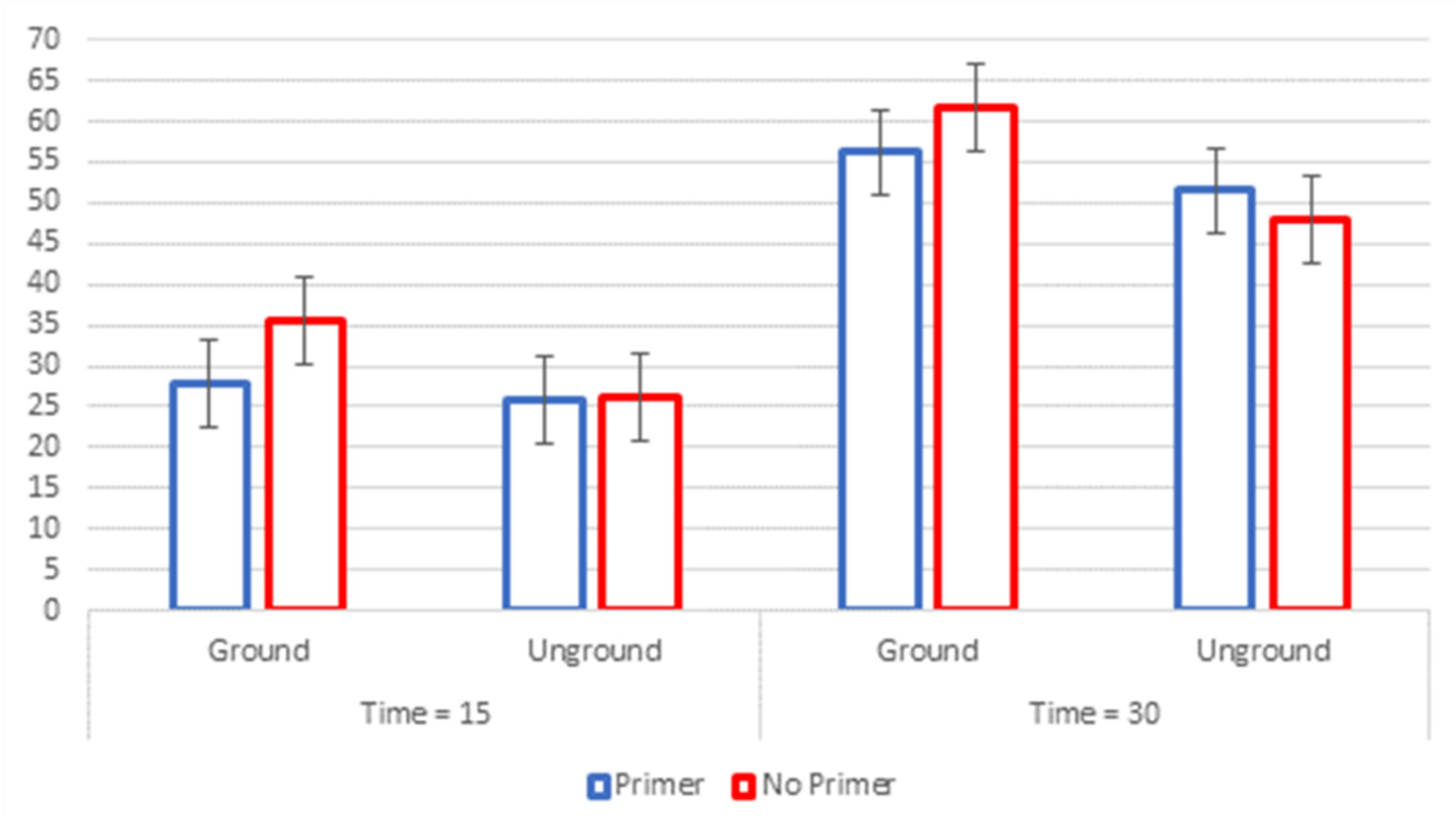
Objectives: The aim of this study was to evaluate the effect of different enamel surface treatments on the micro-shear bond strength. Materials and methods: Sixty-four approximal surfaces from freshly extracted molars were randomly assigned to eight groups, according to combinations of the following enamel surface treatments: ground or unground, 37.5% phosphoric acid etching time of 15 or 30 s, and with or without primer application. The same bonding agent (Optibond FL™ Adhesive, Kerr) was then used for all groups, and a 1.8 mm diameter resin composite (Harmonize™, Kerr) cylinder was built up on the bonded surface. Samples underwent a shear force test at a crosshead speed of 1 mm/min until failure. Bond strength was calculated, and failure modes were inspected under an optical microscope. Results: Bond-strength values ranged from 8.2 MPa for 15 s etched unground enamel with primer application to 19.6 MPa for 30 s etched ground enamel without primer application. ANOVA and Fisher’s LSD post hoc tests revealed significant differences between the groups. Conclusions: Etching time and grinding have a statistically significant effect on the micro-shear bond strength of a three-step etch-and-rinse adhesive system on enamel. Primer application does not seem to be beneficial for enamel adhesion.
Keywords: etching time; bonding; adhesion etching time; bonding; adhesion