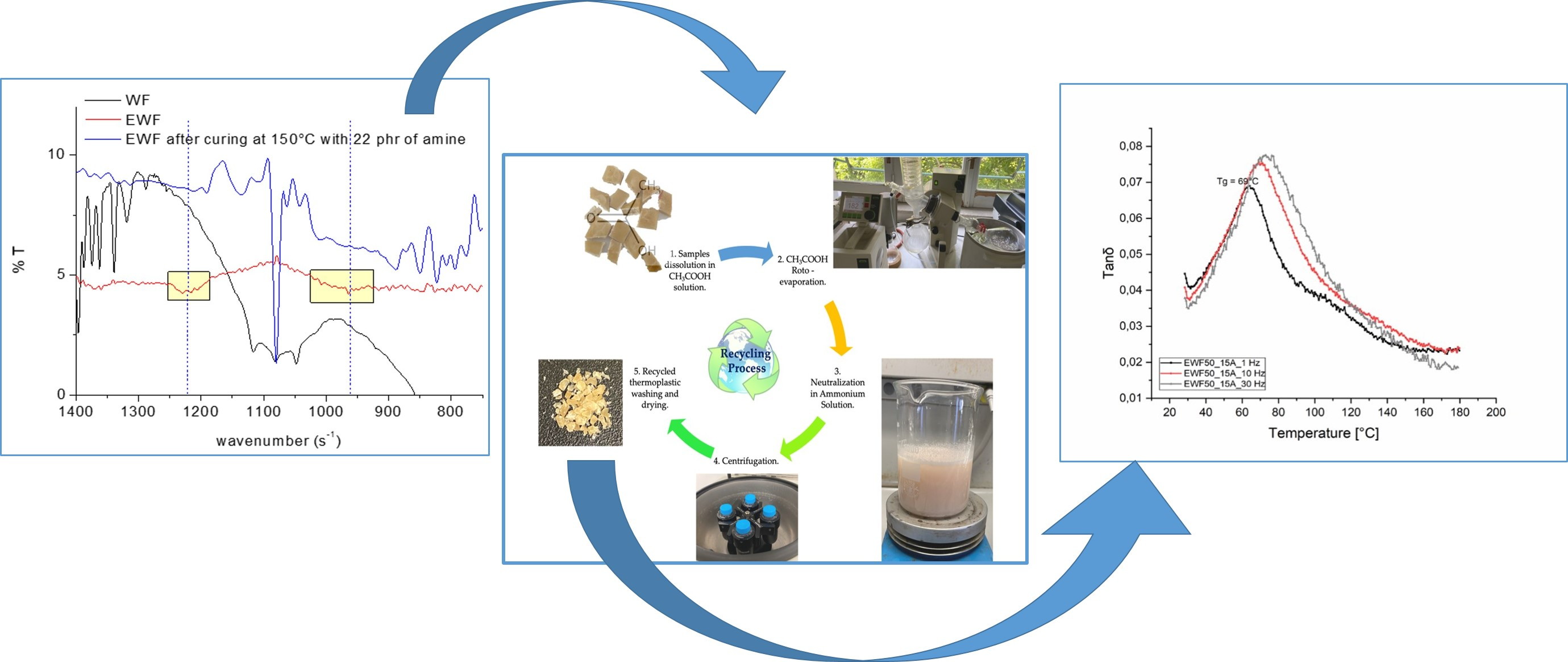
Fully Recyclable Bio-Based Epoxy Formulations Using Epoxidized Precursors from Waste Flour: Thermal and Mechanical Characterization

 ,
,  ,
, 
 ,
,  and
and 
Abstract
Share and Cite
Ferrari, F.; Esposito Corcione, C.; Striani, R.; Saitta, L.; Cicala, G.; Greco, A. Fully Recyclable Bio-Based Epoxy Formulations Using Epoxidized Precursors from Waste Flour: Thermal and Mechanical Characterization. Polymers 2021, 13, 2768. https://doi.org/10.3390/polym13162768
Ferrari F, Esposito Corcione C, Striani R, Saitta L, Cicala G, Greco A. Fully Recyclable Bio-Based Epoxy Formulations Using Epoxidized Precursors from Waste Flour: Thermal and Mechanical Characterization. Polymers. 2021; 13(16):2768. https://doi.org/10.3390/polym13162768
Chicago/Turabian StyleFerrari, Francesca, Carola Esposito Corcione, Raffaella Striani, Lorena Saitta, Gianluca Cicala, and Antonio Greco. 2021. "Fully Recyclable Bio-Based Epoxy Formulations Using Epoxidized Precursors from Waste Flour: Thermal and Mechanical Characterization" Polymers 13, no. 16: 2768. https://doi.org/10.3390/polym13162768
APA StyleFerrari, F., Esposito Corcione, C., Striani, R., Saitta, L., Cicala, G., & Greco, A. (2021). Fully Recyclable Bio-Based Epoxy Formulations Using Epoxidized Precursors from Waste Flour: Thermal and Mechanical Characterization. Polymers, 13(16), 2768. https://doi.org/10.3390/polym13162768