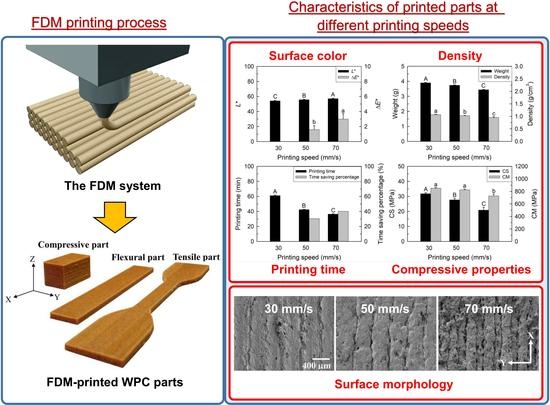
Morphology and Mechanical Properties of 3D Printed Wood Fiber/Polylactic Acid Composite Parts Using Fused Deposition Modeling (FDM): The Effects of Printing Speed



Abstract
Share and Cite
Yang, T.-C.; Yeh, C.-H. Morphology and Mechanical Properties of 3D Printed Wood Fiber/Polylactic Acid Composite Parts Using Fused Deposition Modeling (FDM): The Effects of Printing Speed. Polymers 2020, 12, 1334. https://doi.org/10.3390/polym12061334
Yang T-C, Yeh C-H. Morphology and Mechanical Properties of 3D Printed Wood Fiber/Polylactic Acid Composite Parts Using Fused Deposition Modeling (FDM): The Effects of Printing Speed. Polymers. 2020; 12(6):1334. https://doi.org/10.3390/polym12061334
Chicago/Turabian StyleYang, Teng-Chun, and Chin-Hao Yeh. 2020. "Morphology and Mechanical Properties of 3D Printed Wood Fiber/Polylactic Acid Composite Parts Using Fused Deposition Modeling (FDM): The Effects of Printing Speed" Polymers 12, no. 6: 1334. https://doi.org/10.3390/polym12061334
APA StyleYang, T.-C., & Yeh, C.-H. (2020). Morphology and Mechanical Properties of 3D Printed Wood Fiber/Polylactic Acid Composite Parts Using Fused Deposition Modeling (FDM): The Effects of Printing Speed. Polymers, 12(6), 1334. https://doi.org/10.3390/polym12061334