


From Egg to Nanomaterials: Egg-Derived Precursors for Green Nanotechnology



Abstract
1. Introduction
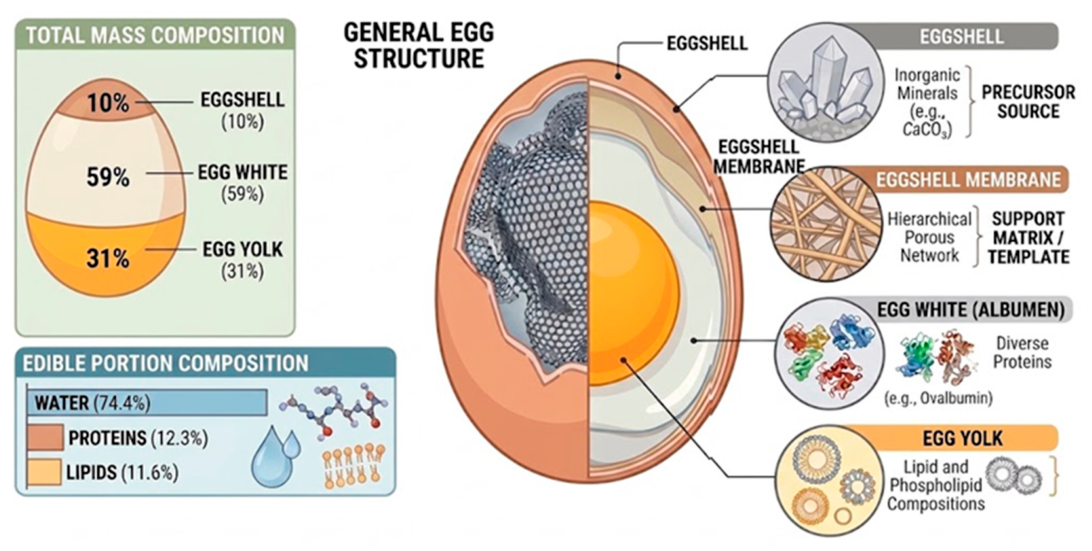
2. Egg-Derived Components as Functional Precursors
2.1. Eggshell as an Inorganic Precursor

| Material Type | Synthesis Route | Mechanism | Advantages | Limitations | Best-Fit Applications |
|---|---|---|---|---|---|
| Eggshell—Mineral Precursor | |||||
| CaO nanoparticles | Washing → grinding → thermal calcination (600–1000 °C); or sol–gel route (HCl dissolution → sol → gel → calcination 900 °C, 1 h) | Thermal decomposition of CaCO3 to CaO; sol–gel route achieves homogeneous solution-phase nucleation prior to calcination | Low-cost bio-waste valorization; strong basic character; high specific surface area/reactivity | Direct calcination yields broader particle-size distribution | Heterogeneous catalysis (biodiesel), heavy-metal adsorption, CO2 capture |
| Hydroxyapatite (HA) | Calcination of CaCO3 to CaO → hydration to Ca(OH)2 → reaction with phosphate precursor (wet precipitation/hydrothermal) | Mineral-precursor phase transformation; Ca–P lattice substitution | Bone-like composition; high biocompatibility; antioxidant/anti-inflammatory activity reported | Incomplete phase conversion possible depending on conditions; extra purification needed for biomedical grade | Bone regeneration, dental/orthopedic implants, antibiotic-pollutant adsorption |
| Egg White—Chelating, Reducing, and Stabilizing Medium | |||||
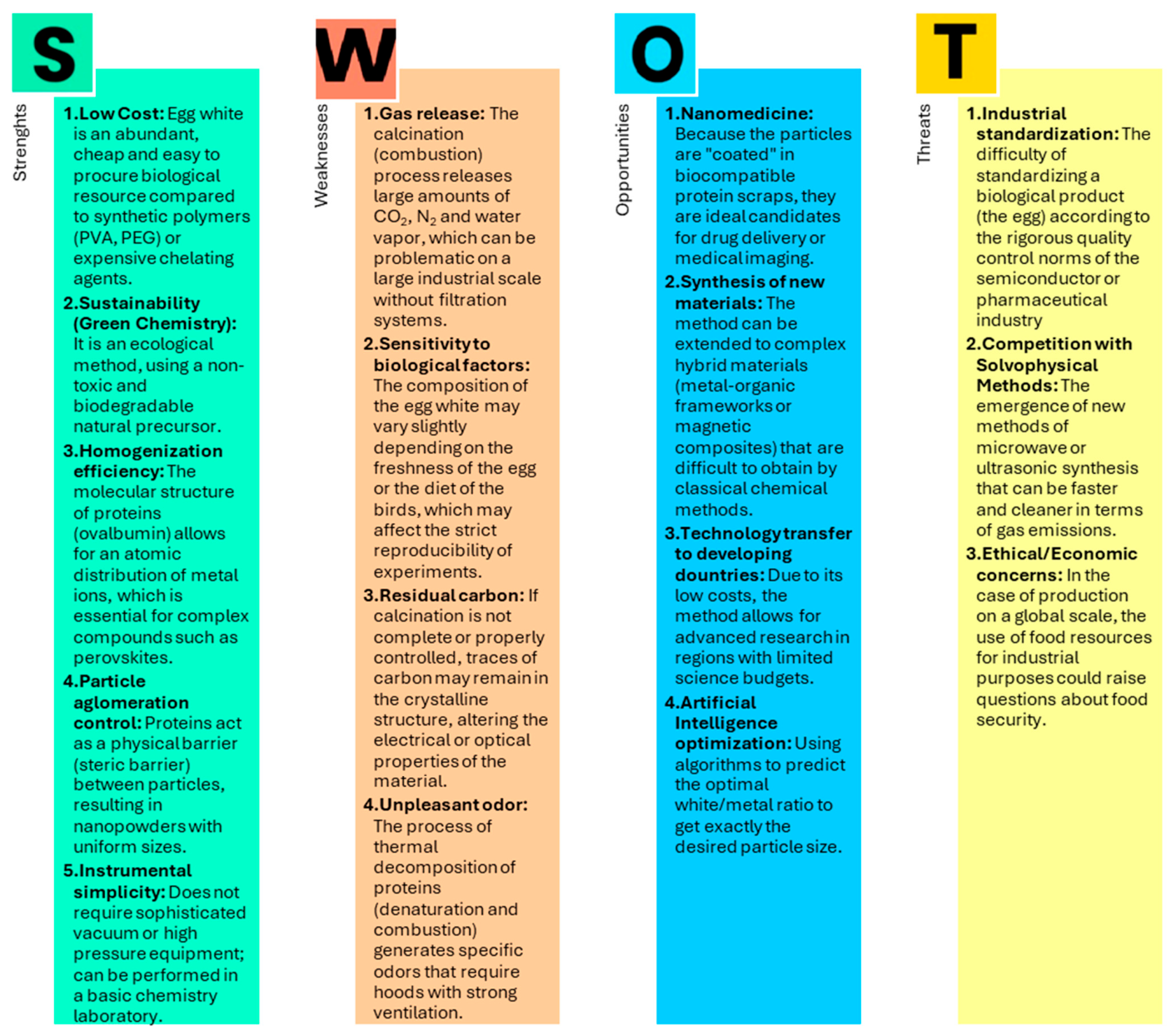
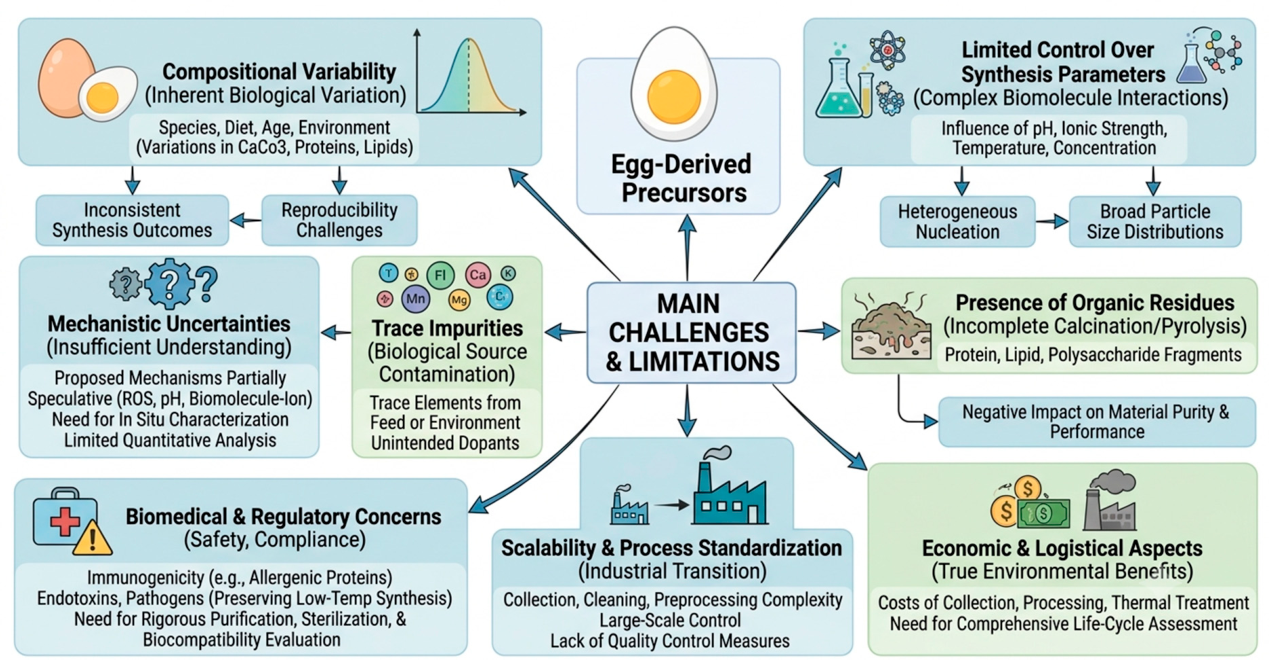
| Metal oxides (ZnO, TiO2, CeO2, Fe2O3, NiO, Al2O3, MgO) | Metal salt + egg white → gel formation → calcination (400–1100 °C, oxide-dependent) | Ovalbumin chelation/templating of metal ions (–NH2/–COOH/–OH) followed by oxidative calcination | Lower calcination temperatures than conventional solid-state routes; good dispersion, reduced agglomeration | Reproducibility sensitive to protein-batch and feedstock variability; scalability untested beyond lab scale | Photocatalysis (TiO2, CeO2), antibacterial/biomedical composites, gas sensing |
| Zero-valent metals (Ag, Au, Cu) | Metal salt (e.g., AgNO3) reduced in egg-white medium at controlled pH | Thiol/amine-mediated reduction to the zero-valent state; protein capping arrests post-nucleation growth | Aqueous, reductant-free green route; sub-20 nm Ag particles; strong antibacterial activity | Cu requires inert-atmosphere control to prevent oxidation; narrow processing window | Antibacterial coatings, nanomedicine (drug delivery, photothermal therapy) |
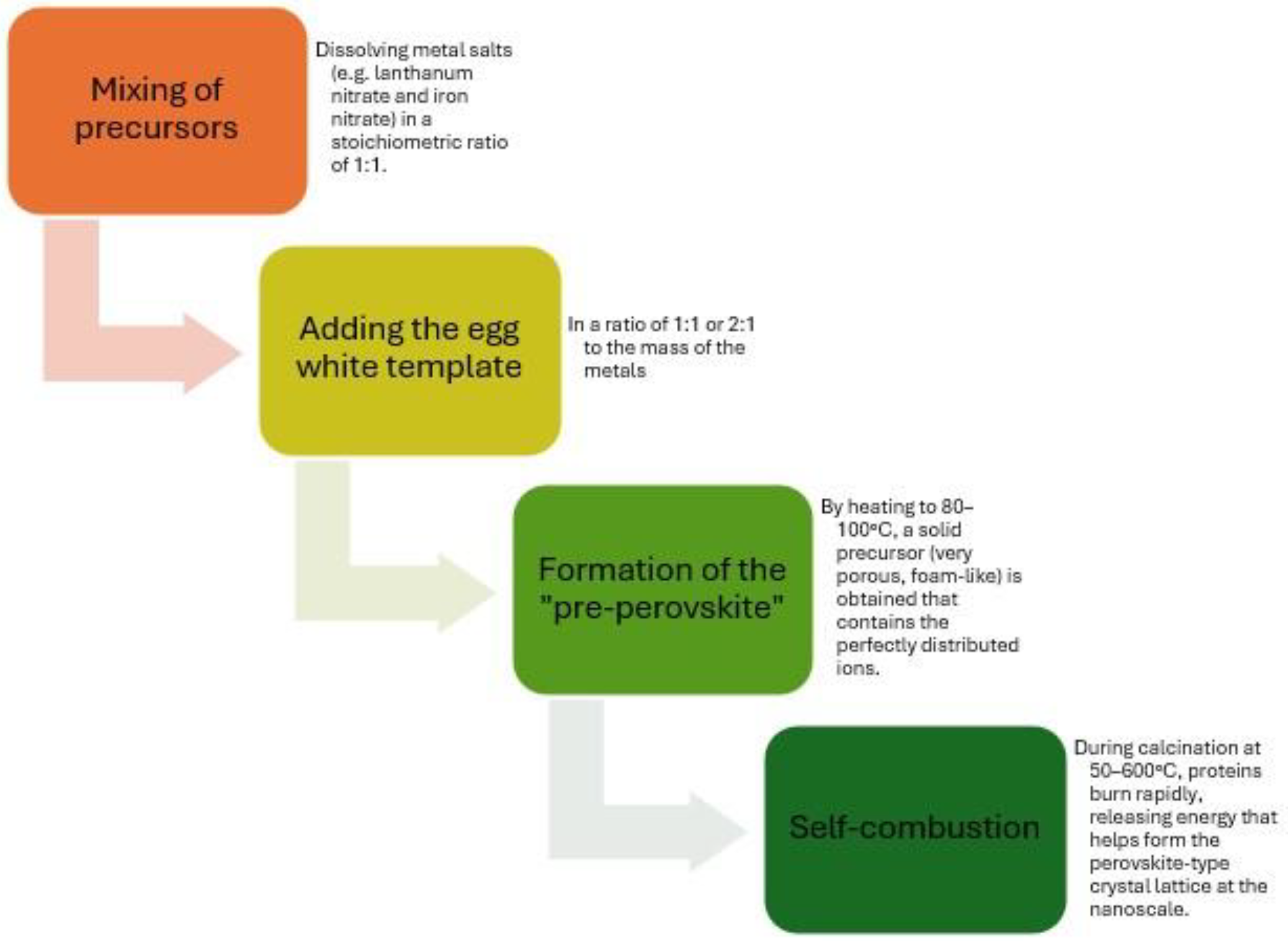
| Perovskites (LaMnO3, BaTiO3, BiFeO3) | Multi-cation gel formation in egg-white matrix → calcination (500–1000 °C) | Ovalbumin coordinates multiple A/B-site cations, suppressing selective precipitation | Phase-pure crystalline perovskites at temperatures 400–500 °C below conventional ceramic routes | Cross-study reproducibility not systematically documented; composite systems need 800–1000 °C | CO oxidation catalysis, piezoelectric/capacitor materials, multiferroic/photocatalytic materials |
| Egg Yolk—Lipidic Soft Template | |||||
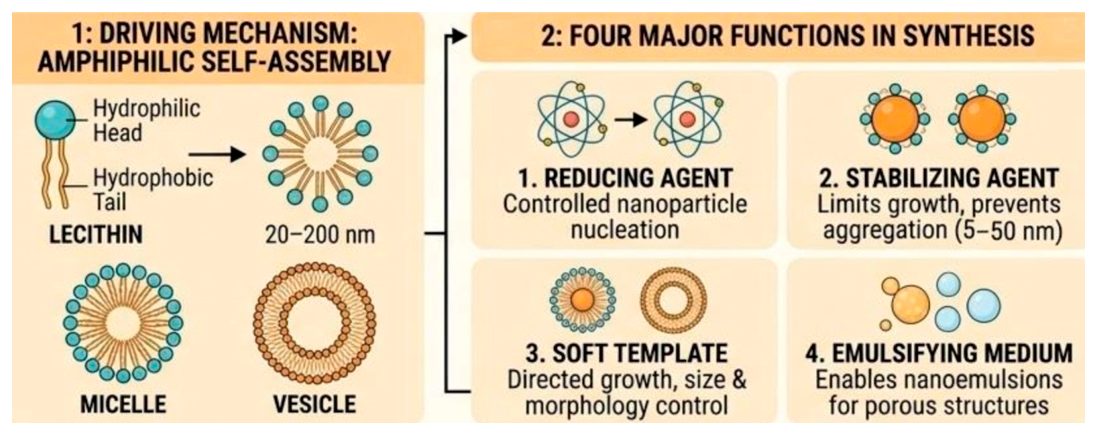
| Oxide nanoparticles via lipid templating (TiO2, ZnO) | Nanoemulsion-assisted synthesis using yolk lipoproteins/phospholipids as soft template, followed by calcination | Amphiphilic self-assembly of lecithin/lipoproteins into micelles/vesicles confines nucleation and growth | Smaller, more monodisperse particles (5–50 nm, PDI < 0.3) than many egg-white oxide routes | Post-calcination purity/porosity less predictable than in protein-gel systems | Catalytic and adsorption applications requiring controlled particle size |
| Lipid-based nanocarriers (liposomes, SLNs) | Self-assembly of yolk phospholipids/lipoproteins under controlled pH and ionic strength | Lecithin-driven amphiphilic self-assembly forming bilayer/micellar nanocarriers | High biocompatibility; 60–90% encapsulation efficiency for hydrophobic drugs; sustained release 24–72 h | Batch-to-batch compositional variability affecting particle size and morphology | Drug delivery, controlled-release systems, bioimaging |
| Eggshell Membrane (ESM)—Fibrous Biotemplate and Carbon Precursor | |||||
| Metal/metal-oxide nanoparticles on ESM fibers (Ag, Fe3O4, Pd-PdO, ZnO nanorods) | In situ ion binding on ESM fibers (electrostatic/coordination) → reduction or thermal transformation | ESM functional groups (–NH2/–COOH/–OH/–SH) bind and immobilize metal ions, directing anisotropic templated growth | High surface area (200–400 m2/g); well-dispersed, low-aggregation particles; 1D anisotropic growth achievable | Composition/structure variability (species/diet-dependent) affects reproducibility | Antibacterial materials, heavy-metal removal, photocatalytic degradation, sensing |
| Porous doped carbon | Pyrolysis of ESM (600–900 °C) | Thermal conversion of the collagenous/keratinous fiber network into N/S-heteroatom-doped porous carbon | High surface area (300–800 m2/g); intrinsic N/S doping enhances conductivity/catalytic activity; standardizable process | Reported surface-area values vary with pyrolysis protocol and heating rate | Supercapacitor electrodes, oxygen-reduction electrocatalysis |
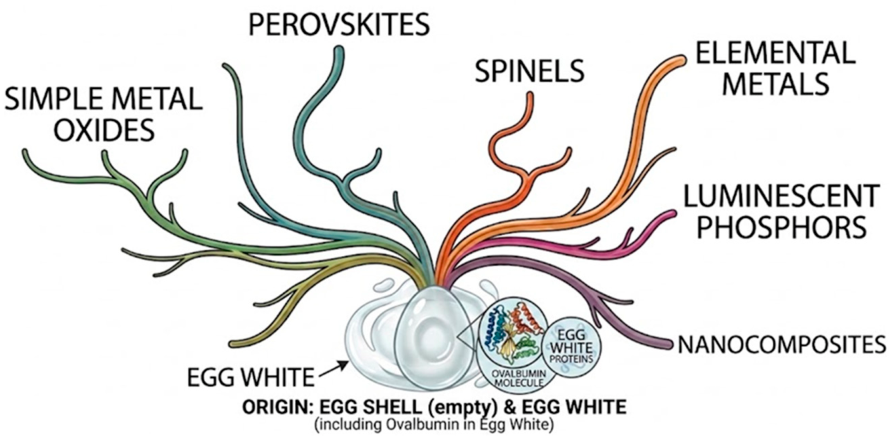
2.2. Egg White as a Biogenic Precursor in Nanomaterial Synthesis
- Chelating agent by proteins (ovalbumin) which contain functional groups such as -NH2, -OH and -COOH, coordinate and immobilize metal ions within the protein matrix, ensuring a uniform distribution in the protein matrix.
- Templating agent through the complex structure of proteins who directs the growth of crystals, controlling the size and shape of nanoparticles.
- Stabilizer because prevents particle agglomeration of particles, resulting in a fine and homogeneous product.
2.2.1. Metal Oxides Synthesis
2.2.2. Metal Nanostructures Synthesis
2.2.3. Perovskite-Type Materials
2.2.4. Other Inorganic Materials
Spinel Structures (Aluminates and Complex Ferrites)
Phosphors (Luminescent Materials)
Silicates and Biocompatible Glasses
Nanocomposites (Metal–Oxide Hybrids)
Metal Sulfides
2.3. Egg Yolk as a Functional Component in Nanomaterial Synthesis
2.4. Eggshell Membrane as a Biotemplate and Carbon Precursor
3. Comparative Analysis of Egg-Derived Precursors
3.1. Comparison Between Conventional and Egg-Derived Synthesis
3.2. Comparative Analysis of Egg-Derived Components
4. Determinants of Synthesis Success in Egg-Assisted Nanomaterial Preparation: Mechanistic Insights
4.1. Metal–Protein Interaction Mechanisms
4.2. Nucleation and Growth Pathways
4.3. Reduction Mechanisms for Zero-Valent Metal Nanoparticle Formation
4.4. Process Parameters Governing Synthesis Outcomes
- Protein Concentration
- Solution pH
- Heating rate and thermal treatment
5. Challenges and Limitations of Egg-Derived Precursors in Nanomaterial Synthesis
6. Guidelines for Selecting Egg-Derived Precursors in Nanomaterial Synthesis
6.1. Selection Based on Target Material Composition
6.2. Selection Based on Structural and Morphological Control
6.3. Selection Based on Functional Performance
6.4. Selection Based on Process Conditions and Scalability
6.5. Integrated Selection Strategy
- Eggshell best suited for calcium-based materials and large-scale applications;
- Eggshell membrane (ESM) is ideal for templated synthesis and carbon-based nanomaterials;
- Egg white is optimal for controlled synthesis of metal oxides and catalytic materials;
- Egg yolk is preferred for noble metal nanoparticles and biomedical nanocarriers.
7. Conclusions
Author Contributions
Funding
Data Availability Statement
Acknowledgments
Conflicts of Interest
References
- Réhault-Godbert, S.; Guyot, N.; Nys, Y. The Golden Egg: Nutritional Value, Bioactivities, and Emerging Benefits for Human Health. Nutrients 2019, 11, 684. [Google Scholar] [CrossRef] [Scilit]
- Sirri, F.; Zampiga, M.; Berardinelli, A.; Meluzzi, A. Variability and Interaction of Some Egg Physical and Eggshell Quality Attributes during the Entire Laying Hen Cycle. Poult. Sci. 2018, 97, 1818–1823. [Google Scholar] [CrossRef] [Scilit] [PubMed]
- Torres-Mansilla, A.; Hincke, M.; Voltes, A.; López-Ruiz, E.; Baldión, P.A.; Marchal, J.A.; Álvarez-Lloret, P.; Gómez-Morales, J. Eggshell Membrane as a Biomaterial for Bone Regeneration. Polymers 2023, 15, 1342. [Google Scholar] [CrossRef] [Scilit] [PubMed]
- Sabu, U.; Shyamkumar, C.N.; Logesh, G.; Rashad, M.; Prasad, K.; Balasubramanian, M. Protein-Rich Eggshell Membrane-Assisted Growth of ZnO Single Crystals via Oriented Attachment. J. Mater. Sci. 2026, 61, 8493–8504. [Google Scholar] [CrossRef] [Scilit]
- Jia, B.; Liu, D.; Niu, C.; Yu, Q.; Ren, J.; Liu, Q.; Wang, H. Chitin/Egg Shell Membrane@Fe3O4 Nanocomposite Hydrogel for Efficient Removal of Pb2+ from Aqueous Solution. RSC Adv. 2022, 12, 4417–4427. [Google Scholar] [CrossRef] [Scilit] [PubMed]
- Liu, M.; Luo, G.; Wang, Y.; Xu, R.; Wang, Y.; He, W.; Tan, J.; Xing, M.; Wu, J. Nano-Silver-Decorated Microfibrous Eggshell Membrane: Processing, Cytotoxicity Assessment and Optimization, Antibacterial Activity and Wound Healing. Sci. Rep. 2017, 7, 436. [Google Scholar] [CrossRef] [Scilit] [PubMed]
- Liu, X.; Li, K.; Wu, C.; Zhou, Y.; Pei, C. Egg White-Assisted Preparation of Inorganic Functional Materials: A Sustainable, Eco-Friendly, Low-Cost and Multi-Functional Method. Ceram. Int. 2019, 45, 23869–23889. [Google Scholar] [CrossRef] [Scilit]
- Li, Z.; Huang, X.; Tang, Q.; Ma, M.; Jin, Y.; Sheng, L. Functional Properties and Extraction Techniques of Chicken Egg White Proteins. Foods 2022, 11, 2434. [Google Scholar] [CrossRef] [Scilit] [PubMed]
- Sabouri, Z.; Akbari, A.; Hosseini, H.A.; Khatami, M.; Darroudi, M. Egg White-Mediated Green Synthesis of NiO Nanoparticles and Study of Their Cytotoxicity and Photocatalytic Activity. Polyhedron 2020, 178, 114351. [Google Scholar] [CrossRef] [Scilit]
- Molaei, P.; Rahimi-Moghadam, F. Optimized Synthesis of ZnO Nanostructures by Egg-White Content Ratio Manipulation for Photocatalytic Applications. Mater. Res. Express 2019, 6, 1250h7. [Google Scholar] [CrossRef] [Scilit]
- Lu, R.; Yang, D.; Cui, D.; Wang, Z.; Guo, L. Egg White-Mediated Green Synthesis of Silver Nanoparticles with Excellent Biocompatibility and Enhanced Radiation Effects on Cancer Cells. Int. J. Nanomed. 2012, 7, 2101–2107. [Google Scholar] [CrossRef] [Scilit] [PubMed]
- Molaei, P.; Rahimi Moghadam, F. Seed-Free Synthesis of ZnO Nanorods through Egg White/Glycerol Medium for Photocatalyst Applications. Mater. Today Commun. 2022, 31, 103677. [Google Scholar] [CrossRef] [Scilit]
- Noviyanti, A.R.; Asyiah, E.N.; Permana, M.D.; Dwiyanti, D.; Suryana; Eddy, D.R. Preparation of Hydroxyapatite-Titanium Dioxide Composite from Eggshell by Hydrothermal Method: Characterization and Antibacterial Activity. Crystals 2022, 12, 1599. [Google Scholar] [CrossRef] [Scilit]
- Resmi, V.R.; Soney, J.M.; Dhannia, T. Photocatalytic Activity of ZnO Nanoparticle and ZnO–TiO2 Nanocomposite Synthesized Using Egg-White Mediated Co-Precipitation Technique with Microwave Irradiation. Opt. Mater. 2025, 168, 117440. [Google Scholar] [CrossRef] [Scilit]
- Vijan, E.A.; Modan, E.M.; Moga, S.G.; Negrea, D.A.; Schiopu, A.-G.; Oproescu, M.; Istrate, D. Assisted Egg White Biogenic Synthesis for Elaboration of ZnO Nanoparticles. Crystals 2025, 15, 71. [Google Scholar] [CrossRef] [Scilit]
- Sarantidi, E.; Ainatzoglou, A.; Papadimitriou, C.; Stamoula, E.; Maghiorou, K.; Miflidi, A.; Trichopoulou, A.; Mountzouris, K.C.; Anagnostopoulos, A.K. Egg White and Yolk Protein Atlas: New Protein Insights of a Global Landmark Food. Foods 2023, 12, 3470. [Google Scholar] [CrossRef] [Scilit] [PubMed]
- Niju, S.; Meera, K.M.; Begum, S.; Anantharaman, N. Modification of Egg Shell and Its Application in Biodiesel Production. J. Saudi Chem. Soc. 2014, 18, 702–706. [Google Scholar] [CrossRef] [Scilit]
- Nada, E.A.; Abu Kaddorah, M.E.; El Jamal, M.; Hamad, A.; Mansour, F.R. Eggshell Waste as a Sustainable Resource for Nanoparticle Preparation: Synthesis, Characterization and Applications. Environ. Nanotechnol. Monit. Manag. 2025, 24, 101092. [Google Scholar] [CrossRef] [Scilit]
- Mallampati, R.; Valiyaveettil, S. Eggshell Membrane-Supported Recyclable Catalytic Noble Metal Nanoparticles for Organic Reactions. ACS Sustain. Chem. Eng. 2014, 2, 855–859. [Google Scholar] [CrossRef] [Scilit]
- Abdulrahman, I.; Tijani, H.I.; Mohammed, B.A.; Saidu, H.; Yusuf, H.; Jibrin, M.N.; Mohammed, S. From Garbage to Biomaterials: An Overview on Egg Shell Based Hydroxyapatite. J. Mater. 2014, 2014, 802467. [Google Scholar] [CrossRef] [Scilit]
- Kareem, Z.; Eyiler, E. Synthesis of Hydroxyapatite from Eggshells via Wet Chemical Precipitation: A Review. RSC Adv. 2024, 14, 21439–21452. [Google Scholar] [CrossRef] [Scilit] [PubMed]
- Sharma, P.; Ganguly, M.; Doi, A. Application of the Synergism between Eggshells and Copper in Nanotechnology. Nanoscale Adv. 2025, 7, 3914–3940. [Google Scholar] [CrossRef] [Scilit] [PubMed]
- Hamouda, R.A.; Al-Hagan, B.N.; El-Naggar, N.E.-A.; Hagagy, N. Sustainable and Eco-Friendly Production of Biodiesel from Chlorella vulgaris Supplemented with Biogenic Calcium Oxide Nanoparticles Derived from Ulva intestinalis and Eggshell as Precursors. Algal Res. 2024, 81, 103582. [Google Scholar] [CrossRef] [Scilit]
- Azis, Y.; Adrian, M.; Alfarisi, C.D.; Khairat; Sri, R.M. Synthesis of Hydroxyapatite Nanoparticles from Egg Shells by Sol-Gel Method. IOP Conf. Ser. Mater. Sci. Eng. 2018, 345, 012040. [Google Scholar] [CrossRef] [Scilit]
- Habte, L.; Shiferaw, N.; Mulatu, D.; Thenepalli, T.; Chilakala, R.; Ahn, J.W. Synthesis of Nano-Calcium Oxide from Waste Eggshell by Sol-Gel Method. Sustainability 2019, 11, 3196. [Google Scholar] [CrossRef] [Scilit]
- Jalu, R.G.; Chamada, T.A.; Kasirajan, D.R. Calcium Oxide Nanoparticles Synthesis from Hen Eggshells for Removal of Lead (Pb(II)) from Aqueous Solution. Environ. Chall. 2021, 4, 100193. [Google Scholar] [CrossRef] [Scilit]
- Tsai, C.-H.; Morgan, H.M.; Tsai, W.-T. Valorization of Eggshell Powder as a Catalytic Activation Agent for Producing Porous Carbon Materials from Lignocellulosic Waste. Catalysts 2025, 15, 712. [Google Scholar] [CrossRef] [Scilit]
- Adaikalam, K.; Hussain, S.; Anbu, P.; Rajaram, A.; Sivanesan, I.; Kim, H.-S. Eco-Friendly Facile Conversion of Waste Eggshells into CaO Nanoparticles for Environmental Applications. Nanomaterials 2024, 14, 1620. [Google Scholar] [CrossRef] [Scilit] [PubMed]
- Sacia, E.R.; Ramkumar, S.; Phalak, N.; Fan, L.-S. Synthesis and Regeneration of Sustainable CaO Sorbents from Chicken Eggshells for Enhanced Carbon Dioxide Capture. ACS Sustain. Chem. Eng. 2013, 1, 903–909. [Google Scholar] [CrossRef] [Scilit]
- Hemmami, H.; Zeghoud, S.; Ben Amor, I.; Alhamad, A.A.; Tliba, A.; Alsalme, A.; Cornu, D.; Bechelany, M.; Barhoum, A. Green Synthesis of CaO Nanoparticles from Chicken Eggshells: Antibacterial, Antifungal, and Heavy Metal (Pb2+, Cr2+, Cd2+ and Hg2+) Adsorption Properties. Front. Environ. Sci. 2024, 12, 1450485. [Google Scholar] [CrossRef] [Scilit]
- Patty, D.J.; Nugraheni, A.D.; Ana, I.D.; Yusuf, Y. In Vitro Bioactivity of 3D Microstructure Hydroxyapatite/Collagen Based-Egg White as an Antibacterial Agent. J. Biomed. Mater. Res. Part B Appl. Biomater. 2022, 110, 1412–1424. [Google Scholar] [CrossRef] [Scilit] [PubMed]
- Rivera, E.M.; Araiza, M.; Brostow, W.; Castaño, V.M.; Díaz-Estrada, J.R.; Hernández, R.; Rodríguez, J.R. Synthesis of Hydroxyapatite from Eggshells. Mater. Lett. 1999, 41, 128–134. [Google Scholar] [CrossRef] [Scilit]
- Khandelwal, H.; Prakash, S. Synthesis and Characterization of Hydroxyapatite Powder by Eggshell. J. Miner. Mater. Charact. Eng. 2016, 4, 119–126. [Google Scholar] [CrossRef]
- Sabir, A.; Abbas, H.; Aminy, A.Y.; Asmal, S. Analysis of Duck Eggshells as Hydroxyapatite with Heat Treatment Method. EUREKA Phys. Eng. 2022, 4, 16–24. [Google Scholar] [CrossRef] [Scilit]
- Muthu, D.; Kumar, G.S.; Gowri, M.; Prasath, M.; Viswabaskaran, V.; Kattimani, V.; Girija, E. Rapid Synthesis of Eggshell Derived Hydroxyapatite with Nanoscale Characteristics for Biomedical Applications. Ceram. Int. 2022, 48, 1326–1339. [Google Scholar] [CrossRef] [Scilit]
- Khalid, M.; Jikan, S.S.B.; Adzila, S.; Murni, Z.; Badarulzaman, N.A.; Rosley, R.; Hameed, M.U. Synthesis and Characterizations of Hydroxyapatite Using Precursor Extracted from Chicken Egg Shell Waste. Biointerface Res. Appl. Chem. 2022, 12, 5663–5671. [Google Scholar] [CrossRef] [Scilit]
- Ahmed, T.A.E.; Wu, L.; Younes, M.; Hincke, M. Biotechnological Applications of Eggshell: Recent Advances. Front. Bioeng. Biotechnol. 2021, 9, 675364. [Google Scholar] [CrossRef] [Scilit] [PubMed]
- Tseng, P.-C.; Yang, W.-Y.; Chen, Y.-C.; Chen, Y.-P.; Shiu, J.-S.; Wang, S.-Y. Optimizing the Gelation, Structure, and Thermal Stability of Alkali-Induced Duck Egg White Gels with Calcium Chloride. Poult. Sci. 2025, 104, 104662. [Google Scholar] [CrossRef] [Scilit] [PubMed]
- Ali, N.A.; Khairuddin, N.; Siddique, B.M. Eggshell Waste as a Catalyst for Biodiesel Production: A Preliminary Study. IOP Conf. Ser. Mater. Sci. Eng. 2021, 1195, 012043. [Google Scholar] [CrossRef] [Scilit]
- Chen, G.; Shan, R.; Shi, J.; Yan, B. Ultrasonic-Assisted Production of Biodiesel from Transesterification of Palm Oil over Ostrich Eggshell-Derived CaO Catalysts. Bioresour. Technol. 2014, 171, 428–432. [Google Scholar] [CrossRef] [Scilit] [PubMed]
- Owuamanam, S.; Cree, D. Progress of Bio-Calcium Carbonate Waste Eggshell and Seashell Fillers in Polymer Composites: A Review. J. Compos. Sci. 2020, 4, 70. [Google Scholar] [CrossRef] [Scilit]
- Babalola, B.M.; Wilson, L.D. Valorization of Eggshell as Renewable Materials for Sustainable Biocomposite Adsorbents—An Overview. J. Compos. Sci. 2024, 8, 414. [Google Scholar] [CrossRef] [Scilit]
- Yavuz, D. Enhancing Metakaolin-Based Geopolymer Mortar with Eggshell Powder and Fibers for Improved Sustainability. Buildings 2025, 15, 2526. [Google Scholar] [CrossRef] [Scilit]
- Velić, N.; Stjepanović, M.; Ostojčić, M.; Švarc, H.; Strelec, I.; Budžaki, S. Valorisation of Eggshell Waste for Effective Biosorption of Congo Red Dye from Wastewater. Clean Technol. 2026, 8, 2. [Google Scholar] [CrossRef] [Scilit]
- Baskar, K.; Karthikeyan, B.S.; Gurucharan, I.; Mahalaxmi, S.; Rajkumar, G.; Dhivya, V.; Kishen, A. Eggshell Derived Nano-Hydroxyapatite Incorporated Carboxymethyl Chitosan Scaffold for Dentine Regeneration: A Laboratory Investigation. Int. Endod. J. 2022, 55, 89–102. [Google Scholar] [CrossRef] [Scilit] [PubMed]
- Habeeb, A.M.; Salih, N.A.-A. Synthesis of Hydroxyapatite from Egg Shell Bio-Waste for Use in Functionally Graded NiTi/HA Bone Implants. Ann. Chim. Sci. Mater. 2024, 48, 57–62. [Google Scholar] [CrossRef] [Scilit]
- Adeogun, A.I.; Ofudje, A.E.; Idowu, M.A.; Kareem, S.O. Facile Development of Nano Size Calcium Hydroxyapatite Based Ceramic from Eggshells: Synthesis and Characterization. Waste Biomass Valoriz. 2018, 9, 1469–1473. [Google Scholar] [CrossRef] [Scilit]
- Dukle, A.; Dua, R.; Deepati, A.K.; Sankar, M.R. Repurposing Biowaste for Biomedical Applications: Eggshell Containing Injectable Bone Substitution Cements for Bone Regeneration. Hybrid Adv. 2025, 10, 100425. [Google Scholar] [CrossRef] [Scilit]
- Fu, Z.; Cui, J.; Zhao, B.; Shen, S.G.; Lin, K. An Overview of Polyester/Hydroxyapatite Composites for Bone Tissue Repairing. J. Orthop. Transl. 2021, 28, 118–130. [Google Scholar] [CrossRef] [Scilit] [PubMed]
- Alhasan, H.S.; Alahmadi, N.; Yasin, S.A.; Khalaf, M.Y.; Ali, G.A.M. Low-Cost and Eco-Friendly Hydroxyapatite Nanoparticles Derived from Eggshell Waste for Cephalexin Removal. Separations 2022, 9, 10. [Google Scholar] [CrossRef] [Scilit]
- Ningsih, S.K.W.; Nizar, U.K.; Bahrizal; Nasra, E.; Suci, R.F. Effect of Egg White as Additive for Synthesis and Characterization of Al-Doped ZnO Nanoparticles by Using Sol-Gel Method. J. Phys. Conf. Ser. 2019, 1185, 012029. [Google Scholar] [CrossRef] [Scilit]
- Schiopu, A.-G.; Vijan, E.A.; Modan, E.M.; Moga, S.G.; Negrea, D.A.; Istrate, D.; Cîrstea, G.; Oproescu, M.; Atapek, Ş.H. Ovalbumin-Mediated Biogenic Synthesis of ZnO and MgO Nanostructures: A Path Toward Green Nanotechnology. Molecules 2025, 30, 1164. [Google Scholar] [CrossRef] [Scilit] [PubMed]
- Al-Senani, G.M.; Al-Fawzan, F.F.; Alshabanat, M.; Abd-Elkader, O.H.; Nasrallah, M.; Nasrallah, M. Biosynthesis Effect of Egg White on Formation and Characteristics of NiO/NiCo2O4 Nanocomposites. Crystals 2023, 13, 1579. [Google Scholar] [CrossRef] [Scilit]
- Modan, E.M.; Schiopu, A.-G.; Moga, S.G.; Negrea, D.A.; Istrate, D.; Ciuca, I.; Oproescu, M. Advanced Copper Oxide Chemical and Green Synthesis: Characterization and Antibacterial Evaluation. Crystals 2025, 15, 7. [Google Scholar] [CrossRef] [Scilit]
- Zhang, M.; Wang, X. Green and Eco-Friendly Egg White–TiO2 Hydrogel with Enhanced Antimicrobial, Adsorptive, and Photocatalytic Properties. Catalysts 2024, 14, 899. [Google Scholar] [CrossRef] [Scilit]
- Kumar, S.; Ahmed, F.; Shaalan, N.M.; Saber, O. Biosynthesis of CeO2 Nanoparticles Using Egg White and Their Antibacterial and Antibiofilm Properties on Clinical Isolates. Crystals 2021, 11, 584. [Google Scholar] [CrossRef] [Scilit]
- Kumar, S.; AlOmar, S.Y.; Kumari, K.; Albalawi, F.; Kumar, R.; Ahmed, F.; Ahmad, N.; Dwivedi, S.; Alvi, P.A. Structural, Optical, Electrical and Antibacterial Properties of Fe-Doped CeO2 Nanoparticles. Crystals 2021, 11, 1594. [Google Scholar] [CrossRef] [Scilit]
- Tian, X.; Wang, Z.; Ding, M.; Zhou, S.; Ouyang, R.; Miao, Y. Recent Progress in Cerium-Based Nanomaterials for Electrochemical Biosensors. Int. J. Electrochem. Sci. 2020, 15, 10330–10349. [Google Scholar] [CrossRef] [Scilit]
- Nadeem, M.; Khan, R.; Afridi, K.; Nadhman, A.; Ullah, S.; Faisal, S.; Mabood, Z.U.; Hano, C.; Abbasi, B.H. Green Synthesis of Cerium Oxide Nanoparticles (CeO2 NPs) and Their Antimicrobial Applications: A Review. Int. J. Nanomed. 2020, 15, 5951–5961. [Google Scholar] [CrossRef] [Scilit] [PubMed]
- Maensiri, S.; Masingboon, C.; Laokul, P.; Jareonboon, W.; Promarak, V.; Anderson, P.L.; Seraphin, S. Egg White Synthesis and Photoluminescence of Platelike Clusters of CeO2 Nanoparticles. Cryst. Growth Des. 2007, 7, 950–955. [Google Scholar] [CrossRef] [Scilit]
- Silva, H.J.L.; Nielsen, M.G.; Fiordaliso, E.M.; Damsgaard, C.D.; Gundlach, C.; Kasama, T.; Chorkendorff, I.; Chakraborty, D. FeNi/γ-Al2O3 Egg-shell Catalyst for H2 Generation by Ammonia Decomposition. In Proceedings of the 17th Nordic Symposium on Catalysis, Nordic Symposium on Catalysis, Lund, Sweden, 14–16 June 2016. [Google Scholar]
- Hmamouchi, S.; El Yacoubi, A.; El Idrissi, B.C. Using Egg Ovalbumin to Synthesize Pure α-Fe2O3 and Cobalt-Doped α-Fe2O3: Structural, Morphological, Optical and Photocatalytic Properties. Heliyon 2022, 8, e08953. [Google Scholar] [CrossRef] [Scilit] [PubMed]
- Aghababazadeh, R.; Mirhabibi, A.R.; Pourasad, J.; Brown, A.; Brydson, R.; Banijamali, S.; Mahabad, N.A. Economical Synthesis of Nanocrystalline Alumina Using an Environmentally Low-Cost Binder. Surf. Sci. 2007, 601, 2864–2867. [Google Scholar] [CrossRef] [Scilit]
- Onache, A.E.; Schiopu, A.-G.; Cîrstea, G. Elaboration of ZnO Nanoparticles Using Egg White and Zinc Sulphate. In Proceedings of the 2025 17th International Conference on Electronics, Computers and Artificial Intelligence (ECAI); IEEE: Bucharest, Romania, 2025; pp. 1–5. [Google Scholar] [CrossRef] [Scilit]
- Onache, A.E.; Schiopu, A.-G.; Negrea, D.A.; Moga, S.G.; Modan, E.M. The Influence of Precursors in the Development of Zinc Oxide Nanopowder Using Ovalbumin from Chicken Eggs Raised in Poultry Farms. In Proceedings of the 2025 17th International Conference on Electronics, Computers and Artificial Intelligence (ECAI); IEEE: Bucharest, Romania, 2025; pp. 1–5. [Google Scholar] [CrossRef] [Scilit]
- Ahmed, F.; Arshi, N.; Jeong, Y.S.; Anwar, M.S.; Dwivedi, S.; Alsharaeh, E.; Koo, B.H. Novel Biomimetic Synthesis of ZnO Nanorods Using Egg White (Albumen) and Their Antibacterial Studies. J. Nanosci. Nanotechnol. 2016, 16, 5959–5965. [Google Scholar] [CrossRef] [Scilit] [PubMed]
- Silva, H.; Nielsen, M.G.; Fiordaliso, E.M.; Damsgaard, C.D.; Gundlach, C.; Kasama, T.; Chorkendorff, I.; Chakraborty, D. Synthesis and Characterization of Fe–Ni/γ-Al2O3 Egg-Shell Catalyst for H2 Generation by Ammonia Decomposition. Appl. Catal. A Gen. 2015, 505, 548–556. [Google Scholar] [CrossRef] [Scilit]
- Bagheri, S.; Shameli, K.; Abd Hamid, S.B. Synthesis and Characterization of Anatase Titanium Dioxide Nanoparticles Using Egg White Solution via Sol–Gel Method. J. Chem. 2013, 2013, 848205. [Google Scholar] [CrossRef] [Scilit]
- Kadam, A.N.; Salunkhe, T.T.; Kim, H.; Lee, S.-W. Biogenic Synthesis of Mesoporous N–S–C Tri-Doped TiO2 Photocatalyst via Ultrasonic-Assisted Derivatization of Biotemplate from Expired Egg White Protein. Appl. Surf. Sci. 2020, 518, 146194. [Google Scholar] [CrossRef] [Scilit]
- Lu, C.-M.; Sharma, R.K.; Lin, P.-Y.; Huang, Y.-H.; Chen, J.-S.; Lee, W.-C.; Chen, C.-Y. Characteristics of Doped TiO2 Nanoparticle Photocatalysts Prepared by the Rotten Egg White. Materials 2022, 15, 4231. [Google Scholar] [CrossRef] [Scilit] [PubMed]
- Joseph, D.; Geckeler, K.E. Synthesis of Highly Fluorescent Gold Nanoclusters Using Egg White Proteins. Colloids Surf. B Biointerfaces 2014, 115, 46–50. [Google Scholar] [CrossRef] [Scilit] [PubMed]
- Aghaee, M.; Manteghi, F. A Modified Silver–Egg Shell Nanocomposite Applied for Antibacterial Activities. Chem. Proc. 2022, 12, 80. [Google Scholar] [CrossRef] [Scilit]
- Etemadoleslami Bakhtiari, F.S.; Ghabool, Y.; Amiri, N.; Roudi, S.M.; Moghaddam, F.G.; Zare-Zardini, H.; Behboodian, B.; Es-Haghi, A.; Yazdi, M.E.T. Egg White Albumin and Gelatin Scaffolds Incorporating Silver Copper Nanoparticles for Enhancing Anticancer Activity against Hepatocellular Carcinoma. Results Chem. 2026, 23, 103140. [Google Scholar] [CrossRef] [Scilit]
- Schiopu, A.-G.; Călin-Istrate, F.; Bâldea, M.; Istrate, D. Structure–Morphology–Defect Relationships in CaTiO3-Based Perovskites for Environmental Applications. Ann. Dunarea Jos Univ. Galati Fascicle IX Metall. Mater. Sci. 2025, 49, 40–49. [Google Scholar] [CrossRef] [Scilit]
- Gabal, M.A.; Al-Solami, F.; Al Angari, Y.; Ali, A.; Al-Juaid, A.; Huang, K.-W.; Alsabban, M. Auto-Combustion Synthesis and Characterization of Perovskite-Type LaFeO3 Nanocrystals Prepared via Different Routes. Ceram. Int. 2019, 45, 16530–16539. [Google Scholar] [CrossRef] [Scilit]
- Gao, H.; Liu, Y.; Shen, H.; Guan, W.; Sun, S.; Zheng, T.; Wu, L.; Yang, J.; Li, G. Biomimetic-Inspired Piezoelectric Ovalbumin/BaTiO3 Scaffolds Synergizing with Anisotropic Topology for Modulating Schwann Cell and DRG Behavior. Int. J. Biol. Macromol. 2024, 271, 132394. [Google Scholar] [CrossRef] [Scilit] [PubMed]
- Muthu, K.S.; Lakshminarasimhan, N.; Perumal, P. One-Pot Synthesis of LaFeO3–NiFe2O4 Nanocomposite Ceramic by Egg-White Method and Its Magnetic and Dielectric Properties. Solid State Sci. 2017, 72, 33–40. [Google Scholar] [CrossRef] [Scilit]
- Bharathkumar, S.; Sakar, M.; Navaneethan, M.; Archana, J. Mechanistic Insights into the Electrospinning Fabrication of Belt-Like Structures of BiFeO3 and Their Photocatalytic Properties. Mater. Lett. 2021, 304, 130475. [Google Scholar] [CrossRef] [Scilit]
- Bharathkumar, S.; Sakar, M.; Balakumar, S. Egg White-Mediated Synthesis of BiFeO3 Cubes and Their Enhanced Photocatalytic Degradation Properties under Solar Irradiation. J. Mater. Sci. Mater. Electron. 2022, 33, 12638–12647. [Google Scholar] [CrossRef] [Scilit]
- Tripathy, S.; Singha, N.; Khilari, S. A Green Protocol for Fabricating Dome-Shaped Porous MgAl2O4 Ceramic Beads. Mater. Lett. 2026, 404, 139675. [Google Scholar] [CrossRef] [Scilit]
- Tripathy, S.; Saini, D.S.; Bhattacharya, D. Synthesis and Fabrication of MgAl2O4 Ceramic Foam via a Simple, Low-Cost and Eco-Friendly Method. J. Asian Ceram. Soc. 2016, 4, 149–154. [Google Scholar] [CrossRef] [Scilit]
- Aji Udhaya, P.; Meena, M.; Abila Jeba Queen, M.; Mary Freeda, M.; Regin Das, T. Albumen-Mediated Green Synthesis of ZnFe2O4 Nanoparticles and Their Physico-Chemical Properties. Jordan J. Phys. 2021, 14, 445–449. [Google Scholar] [CrossRef] [Scilit]
- Tamilarasi, K.; Udhaya, P.A.; Meena, M. Enhancement on the Electrical and Optical Behaviour of ZnFe2O4 Nanoparticles via Transition Metal Substitution. Mater. Today Proc. 2022, 64, 1671–1678. [Google Scholar] [CrossRef] [Scilit]
- Al-Senani, G.M.; Al-Fawzan, F.F.; Almufarij, R.S.; Abd-Elkader, O.H.; Deraz, N.M. Biosynthesis, Physicochemical and Magnetic Properties of Inverse Spinel Nickel Ferrite System. Crystals 2022, 12, 1542. [Google Scholar] [CrossRef] [Scilit]
- Maensiri, S.; Masingboon, C.; Boonchom, B.; Seraphin, S. A Simple Route to Synthesize Nickel Ferrite (NiFe2O4) Nanoparticles Using Egg White. Scr. Mater. 2007, 56, 797–800. [Google Scholar] [CrossRef] [Scilit]
- Al Angari, Y.M. Magnetic Properties of La-Substituted NiFe2O4 via Egg-White Precursor Route. J. Magn. Magn. Mater. 2011, 323, 1835–1839. [Google Scholar] [CrossRef] [Scilit]
- Faizan, M.; Siddique, M.N.; Kumar, S. Enhanced Luminescence and Photocatalytic Activity of the Monovalent Sodium (Na+) Co-Doped MgAl2O4:Eu3+ Nanostructures. Indian J. Pure Appl. Phys. 2024, 62, 9–18. [Google Scholar] [CrossRef] [Scilit]
- Ganesh, I. A Review on Magnesium Aluminate (MgAl2O4) Spinel: Synthesis, Processing and Applications. Int. Mater. Rev. 2013, 58, 63–112. [Google Scholar] [CrossRef] [Scilit]
- Li, J.; Ding, Y.; Li, X.; Jiao, G.; Wang, T.; Chen, W.; Luo, H. New Method for the Preparation of Nonuniform Distributed Co/SiO2 Catalysts. Chem. Commun. 2008, 44, 5954–5956. [Google Scholar] [CrossRef] [Scilit] [PubMed]
- Zhuang, Y.Q.; Claeys, M.; van Steen, E. Novel Synthesis Route for Egg-Shell, Egg-White and Egg-Yolk Type of Cobalt on Silica Catalysts. Appl. Catal. A Gen. 2006, 301, 138–142. [Google Scholar] [CrossRef] [Scilit]
- Dilika, M.D.; Fanta, G.M.; Tański, T. Green Synthesis of Titanium Dioxide Nanoparticles Using Maerua oblongifolia Root Bark Extract: Photocatalytic Degradation and Antibacterial Activities. Materials 2024, 17, 5835. [Google Scholar] [CrossRef] [Scilit] [PubMed]
- Wang, L.; Liang, K.; Jiang, X.; Yang, M.; Liu, Y. Dynamic Protein–Metal Ion Networks: A Unique Approach to Injectable and Self-Healable Metal Sulfide/Protein Hybrid Hydrogels with High Photothermal Efficiency. Chem.-Eur. J. 2018, 24, 6557–6563. [Google Scholar] [CrossRef] [Scilit] [PubMed]
- Anton, M. Egg Yolk: Structures, Functionalities and Processes. J. Sci. Food Agric. 2013, 93, 2871–2880. [Google Scholar] [CrossRef] [Scilit] [PubMed]
- Shan, Y.; Zeng, Q.; Lv, X.; Ma, J.; Liu, X.; Yao, X.; Pan, J.; Xia, J.; Jin, G.; Jin, Y. Egg Yolk-Derived Emulsions: Formation Mechanisms, Improvement Strategies and Applications. Trends Food Sci. Technol. 2024, 153, 104711. [Google Scholar] [CrossRef] [Scilit]
- Lei, Z.; Xiangling, S.; Xu, Z.; Lixin, Z.; Weiqiang, H.; Rui, W.; Xi, L. Influences of Egg White–Egg Yolk MnO2–NiO/γ-Al2O3 Catalytic Activity on the Desulfurization Performance. Sci. Eng. Compos. Mater. 2017, 24, 799–805. [Google Scholar] [CrossRef] [Scilit]
- Aigbe, U.O.; Osibote, O.A. Green Synthesis of Metal Oxide Nanoparticles, and Their Various Applications. J. Hazard. Mater. Adv. 2024, 13, 100401. [Google Scholar] [CrossRef] [Scilit]
- Torchilin, V.P. Recent Advances with Liposomes as Pharmaceutical Carriers. Nat. Rev. Drug Discov. 2005, 4, 145–160. [Google Scholar] [CrossRef] [Scilit] [PubMed]
- Allen, T.M.; Cullis, P.R. Liposomal Drug Delivery Systems: From Concept to Clinical Applications. Adv. Drug Deliv. Rev. 2013, 65, 36–48. [Google Scholar] [CrossRef] [Scilit] [PubMed]
- Whitesides, G.M.; Grzybowski, B. Self-Assembly at All Scales. Science 2002, 295, 2418–2421. [Google Scholar] [CrossRef] [Scilit] [PubMed]
- Chen, J.; Zuo, K.; Li, Y.; Huang, X.; Hu, J.; Yang, Y.; Wang, W.; Chen, L.; Jain, A.; Verduzco, R.; et al. Eggshell Membrane Derived Nitrogen-Rich Porous Carbon for Selective Electrosorption of Nitrate from Water. Water Res. 2022, 216, 118351. [Google Scholar] [CrossRef] [Scilit] [PubMed]
- Su, H.; Dong, Q.; Han, J.; Zhang, D.; Guo, Q. Biogenic Synthesis and Photocatalysis of Pd–PdO Nanoclusters Reinforced Hierarchical TiO2 Films with Interwoven and Tubular Conformations. Biomacromolecules 2008, 9, 499–504. [Google Scholar] [CrossRef] [Scilit] [PubMed]
- Dong, Q.; Su, H.; Xu, J.; Zhang, D.; Wang, R. Synthesis of Biomorphic ZnO Interwoven Microfibers Using Eggshell Membrane as the Biotemplate. Mater. Lett. 2007, 61, 2714–2717. [Google Scholar] [CrossRef] [Scilit]
- Ma, Y.; Liu, X.; Tang, M.; Du, K.; Yin, H.; Mao, X.; Wang, D. Waste Eggshell-Derived N, P, S Tri-Doped Core–Shell Catalysts for Efficient Fenton-Like Catalysis. Chem. Eng. J. 2022, 440, 135879. [Google Scholar] [CrossRef] [Scilit]
- Li, Z.; Zhang, L.; Amirkhiz, B.S.; Tan, X.; Xu, Z.; Wang, H.; Olsen, B.C.; Holt, C.M.B.; Mitlin, D. Carbonized Chicken Eggshell Membranes with 3D Architectures as High-Performance Electrode Materials for Supercapacitors (Adv. Energy Mater. 4/2012). Adv. Energy Mater. 2012, 2, 430. [Google Scholar] [CrossRef] [Scilit]
- Ristić, M.; Musić, S.; Ivanda, M.; Popović, S. Sol-gel synthesis and characterization of nanocrystalline ZnO powders. J. Alloys Compd. 2005, 397, L1–L4. [Google Scholar] [CrossRef] [Scilit]
- Siva Vijayakumar, T.; Mahboob, S.; Bupesh, G.; Vasanth, S.; Al-Ghanim, K.A.; Al-Misned, F.; Govindarajan, M. Facile synthesis and biophysical characterization of egg albumen-wrapped zinc oxide nanoparticles: A potential drug delivery vehicles for anticancer therapy. J. Drug Deliv. Sci. Technol. 2020, 60, 102015. [Google Scholar] [CrossRef] [Scilit]
- Veronesi, P.; Colombini, E.; Canarslan, Ö.S.; Baldi, G.; Leonelli, C. Procedure to generate a selection chart for microwave sol-gel synthesis of nanoparticles. Chem. Eng. Process.-Process Intensif. 2023, 189, 109383. [Google Scholar] [CrossRef] [Scilit]
- Aalami, Z.; Hoseinzadeh, M.; Manesh, P.H.; Aalami, A.H.; Es’haghi, Z.; Darroudi, M.; Sahebkar, A.; Hosseini, H.A. Synthesis, characterization, and photocatalytic activities of green sol-gel ZnO nanoparticles using Abelmoschus esculentus and Salvia officinalis: A comparative study versus co-precipitation-synthesized nanoparticles. Heliyon 2024, 10, e24212. [Google Scholar] [CrossRef] [Scilit] [PubMed]
- Rehman, F.U.; Zada, Z.; Qayyum, I.; Raza, A.; Zahra, M. Hydrothermal Synthesis of Copper doped Zinc Oxide Nano Composites to Achieve Optimum Removal of Organic Pollutant Dye from Waste Water Following the Photo Catalytic Degradation. J. Nanomater. Mol. Nanotechnol. 2022, 11, 6. [Google Scholar]
- Kaur, A.; Bajaj, B.; Kaushik, A.; Saini, A.; Sud, D. A review on template assisted synthesis of multi-functional metal oxide nanostructures: Status and prospects. Mater. Sci. Eng. B 2022, 286, 116005. [Google Scholar] [CrossRef] [Scilit]
- Soltys, L.; Olkhovyy, O.; Tatarchuk, T.; Naushad, M. Green synthesis of metal and metal oxide nanoparticles: Principles of green chemistry and raw materials. Magnetochemistry 2021, 7, 145. [Google Scholar] [CrossRef] [Scilit]
- Emmerich, A.-K.; Zeller, V.; Liu, X.; Weidenkaff, A.; Widenmeyer, M. Egg White Assisted Synthesis of Fe-Mn Spinel Oxides: Effects of Egg White Ratio, Oxygen Partial Pressure, and Life Cycle Impacts. Inorganics 2026, 14, 13. [Google Scholar] [CrossRef] [Scilit]
- Abbate, S.; Centobelli, P.; Cerchione, R.; Giardino, G.; Passaro, R. Coming out the egg: Assessing the benefits of circular economy strategies in agri-food industry. J. Clean. Prod. 2023, 385, 135665. [Google Scholar] [CrossRef] [Scilit]
- Saraliev, P.; Kolev, N.; Vlahova-Vangelova, D.; Dragoev, S.; Balev, D. Egg By-Products: Composition, Bioactive Potential, and Utilization in the Circular Economy. Biomass 2025, 5, 80. [Google Scholar] [CrossRef] [Scilit]
- Navas, D.; Fuentes, S.; Castro-Alvarez, A.; Chavez-Angel, E. Review on Sol-Gel Synthesis of Perovskite and Oxide Nanomaterials. Gels 2021, 7, 275. [Google Scholar] [CrossRef] [Scilit] [PubMed]
- Yu, L.; Yu, H.; Liu, S.; Meng, X.; Yang, J.; Wang, Y.; Li, X. Development and characterization of egg white protein-pullulan-pomegranate peel polyphenol composite films for berry fruits preservation. Food Chem. X 2025, 31, 103081. [Google Scholar] [CrossRef] [Scilit] [PubMed]
- Wang, C.; Wang, Z.; Wang, X.; Li, N.; Tao, J.; Zheng, W.; Yan, B.; Cui, X.; Cheng, Z.; Chen, G. A Review on the Hydrothermal Treatment of Food Waste: Processing and Applications. Processes 2022, 10, 2439. [Google Scholar] [CrossRef] [Scilit]
- Ahmed, S.; Saifullah; Ahmad, M.; Swami, B.L.; Ikram, S. Green Synthesis of Silver Nanoparticles Using Azadirachta indica Aqueous Leaf Extract. J. Radiat. Res. Appl. Sci. 2016, 9, 1–7. [Google Scholar] [CrossRef] [Scilit]
- Kim, Y.; Roh, Y. Effects of Microbial Growth Conditions on Synthesis of Magnetite Nanoparticles Using Indigenous Fe(III)-Reducing Bacteria. Minerals 2018, 8, 212. [Google Scholar] [CrossRef] [Scilit]
- Karam, S.T.; Abdulrahman, A.F. Green Synthesis and Characterization of ZnO Nanoparticles by Using Thyme Plant Leaf Extract. Photonics 2022, 9, 594. [Google Scholar] [CrossRef] [Scilit]
- Elshikh, H.H.; Hammad, S.E.; El-Rouby, M.N.E.; Mostafa, M.A.-A. Comparative Evaluation of Anticancer and Antibacterial Activities of Endophytic Fungus-Derived ZnO Nanoparticles and Chemically Synthesized ZnO Nanoparticles. Al-Azhar J. Pharm. Sci. 2023, 67, 150–180. [Google Scholar] [CrossRef] [Scilit]
- Adegbolagun, T.I.; Odeniyi, O.A.; Odeniyi, M.A. Green Synthesis and Antibacterial Properties of Native and Pregelatinized Bitter Yam Starch–Zinc Oxide Nanoparticles and Their Oral Dissolving Films. Starch-Stärke 2025, 77, e70132. [Google Scholar] [CrossRef] [Scilit]
- Schiopu, A.-G.; Oproescu, M.; Moga, S.G.; Modan, E.M.; Negrea, D.A.; Istrate, D.; Bîrsan, G.V.; Ducu, M.C. Silver-Based Nanoparticles as Antibacterial Materials. Crystals 2026, 16, 124. [Google Scholar] [CrossRef] [Scilit]
- Ninganagouda, S.; Rathod, V.; Singh, D. Characterization and Biosynthesis of Silver Nanoparticles Using a Fungus Aspergillus niger. Int. Lett. Nat. Sci. 2014, 15, 49–57. [Google Scholar] [CrossRef] [Scilit]
- Huang, S.; Yu, Z.-M.; Zhang, Y.; Qi, C.; Zhang, S. In Situ Green Synthesis of Antimicrobial Carboxymethyl Chitosan–Nanosilver Hybrids with Controlled Silver Release. Int. J. Nanomed. 2017, 12, 3181–3191. [Google Scholar] [CrossRef] [Scilit] [PubMed]
- Win, T.T.; Khan, S.; Bo, B.; Zada, S.; Fu, P. Green Synthesis and Characterization of Fe3O4 Nanoparticles Using Chlorella-K01 Extract for Potential Enhancement of Plant Growth Stimulating and Antifungal Activity. Sci. Rep. 2021, 11, 21996. [Google Scholar] [CrossRef] [Scilit] [PubMed]
- Rascov, M.; Spoiala, A.; Motelica, L.; Trusca, R.-D.; Chircov, C.; Popescu, R.C.; Radacina, O.-R.; Surdu, V.-A.; Ficai, D.; Oprea, O.-C.; et al. Synthesis, Characterization and In Vitro Bioactivity of Magnetite Nanoparticles Obtained by Co-Precipitation. J. Funct. Biomater. 2026, 17, 393. [Google Scholar] [CrossRef] [Scilit]
- Serunting, M.A.; Rusnadi, R.; Setyorini, D.A.; Ramadan, B.S. An Effective Cerium (III) Ions Removal Method Using Sodium Alginate-Coated Magnetite (Alg-Fe3O4) Nanoparticles. J. Water Supply Res. Technol.-Aqua 2018, 67, 754–765. [Google Scholar] [CrossRef] [Scilit]

| Synthesized Oxide | Metal Salt | Calcination Temperature | Characteristics Obtained | Reference |
|---|---|---|---|---|
| ZnO | Zn(NO3)2 | 400–600 °C | Egg white improves to obtain various morphologies (nanoflowers, stems). | [15,16,52,53,54] |
| MgO | Mg(NO3)2 | 550 °C | The method prevents severe agglomeration, resulting in fine cubic nanopowders. | [53] |
| NiO | Ni(NO3)2 | 300–700 °C | Usually spherical, uniformly formed, and well-dispersed particles. | [9,54] |
| CuO | Cu(CH3COOH)2 | 550 °C | Irregular polyhedral particles. | [55] |
| TiO2 | Ti{OCH(CH3)2}4/TiCl4 | 400–550 °C | Good control between anatase and rutile phases. Egg white can act as residual nitrogen doping (N-doping), increasing photocatalytic activity. TiO2 nanocomposites and hydrogels with enhanced antimicrobial and photocatalytic properties. | [15,56] |
| CeO2 | Ce(NO3)3 | 500–600 °C | Very small spherical particles. Egg white helps maintain good dispersion, crucial for redox properties (oxygen storage). | [57,58,59,60,61] |
| Fe2O3 | Fe(NO3)3 | 400–600 °C | Synthesis of Fe2O3, α phase. The process is fast. The egg white influences the magnetic properties by controlling the size of the crystallites. Doping with Co stabilizes the phase γ. | [62] |
| Al2O3 | Al(NO3)3 | 800–1100 °C | Requires higher temperatures for phase α. Egg white helps to obtain porous alumina with high thermal stability. | [63] |
| Material Class | Synthesis Mechanism | Particle-Size Control | Reproducibility | Scalability | Purity/Residues | Environmental Impact | Best-Demonstrated Performance |
|---|---|---|---|---|---|---|---|
| Metal oxides (ZnO, TiO2, Fe2O3, CeO2, NiO, Al2O3, MgO) | Chelation/templating by ovalbumin –NH2/–COOH/–OH, followed by oxidative calcination (400–1100 °C) | Protein-gel mesh confinement; optimal precursor:egg-white ratio ~1:1–1:2 (v/w) | Moderate—10–100 nm reported across studies/oxides, sensitive to feedstock and protein-batch variability | Lab-scale; calcination energy cost scales with the oxide (400 °C for ZnO/CeO2 vs. 800–1100 °C for Al2O3) | Requires complete organic burn-off; incomplete combustion can leave carbonaceous residues | Aqueous, no toxic reductants; but CO2/N2/H2O off-gassing and calcination energy input | Strong for photocatalysis (TiO2, CeO2) and magnetic oxides (Fe2O3) |
| Zero-valent metals (Ag, Au, Cu) | Thiol oxidation + Maillard-derived reduction, with –NH2/–OH as capping/stabilizing ligands | Protein capping arrests growth post-nucleation (Ag typically <20 nm) | Ag well-reproduced across studies; Cu markedly less so (narrow processing window, inert atmosphere required) | Ag straightforward near RT; Cu needs inert-atmosphere control, adding engineering complexity | Cu requires a protective carbonaceous layer to block oxidation—a functional but purity-relevant trade-off | Avoids toxic chemical reductants (e.g., NaBH4, hydrazine) used in conventional routes—a genuine green-chemistry gain | Strong antibacterial activity (Ag); promising nanomedicine applications (Au) |
| Perovskites (LaMnO3, LaFeO3, BaTiO3, BiFeO3) | Multi-cation (A/B-site) coordination by ovalbumin, suppressing selective precipitation | Not explicitly quantified in the surveyed literature—a genuine gap | Compositional homogeneity depends on the protein–ion pre-coordination step; cross-study reproducibility untested | Reaches phase purity at 500–600 °C vs. ~1000 °C conventional—advantage erodes for composites requiring 800–1000 °C | Multi-cation systems more prone to secondary-phase formation without adequate gel confinement | Same aqueous-route benefits as oxides, plus meaningful calcination-energy savings for most compositions | High-purity BiFeO3 without secondary phases; enhanced piezoelectric/catalytic behavior |
| Spinels, ferrites, phosphors, silicates & composites | Chelation/templating logic extended to ternary/quaternary and doped/composite systems | Reported only qualitatively (e.g., porous MgAl2O4)—mechanism not established | Each system typically reported by a single or few groups; reproducibility largely untested across the class | No unified process window (15 min at 300 °C for NiFe2O4 vs. 800–1000 °C for composites) | Sulfide routes require an added sulfur precursor (thioacetamide), introducing an extra residue/purity variable | Retains aqueous green-synthesis benefits, partly offset by added dopant/precursor chemicals | Application-specific gains shown (luminescence, photocatalysis, quantum-dot optics) but rarely benchmarked head-to-head against conventional routes |
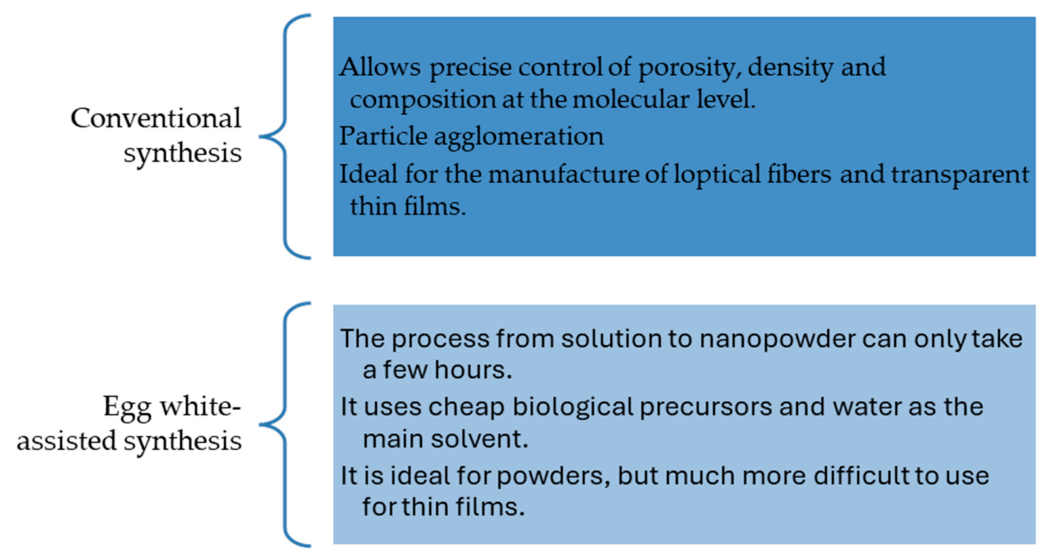
| Parameter | Egg-Derived Synthesis (This Review) | Sol–Gel [105,107,108] | Hydrothermal [109] | Precipitation/Co-Precipitation [110,111,112] | Combustion Synthesis [75] |
|---|---|---|---|---|---|
| Synthesis temperature | 400–1100 °C (oxide-dependent; e.g., 400–600 °C for egg-white ZnO/CeO2, 600–1000 °C for eggshell-derived CaO, 600–900 °C for ESM pyrolysis) | Typically 400–800 °C for post-gel calcination, occasionally up to ~1000 °C for full crystallization | 120–250 °C under autoclave pressure | Near ambient to ~90 °C | Self-sustained exothermic reaction reaching transient temperatures of 500–1500 °C within seconds; external ignition may require only 300–500 °C |
| Processing time | Minutes to hours for gel/protein-matrix formation, plus 1 to several hours of calcination | Hours to days (gelation/aging 12–48 h, plus calcination 2–6 h) | Several hours to ~24 h | Minutes to a few hours | Minutes (very fast, self-propagating reaction) |
| Reported yield | Rarely quantified—reported in only 1 of 12 representative studies compiled in Table 5 of this review | Generally high, though often reported qualitatively rather than as a numeric percentage | Often reported as high (>80%) under optimized conditions | Typically high (>90%) | High but variable; strongly dependent on fuel-to-oxidizer ratio |
| Particle-size distribution | Moderate; 5–200 nm depending on precursor (metals <20 nm; oxides 10–100 nm; eggshell-derived 20–200 nm) | Narrow, well-controlled (often 5–50 nm) via controlled hydrolysis/condensation | Narrow and highly uniform; excellent morphology control | Broader; agglomeration common without capping/stabilizing agents | Broad; nanocrystalline but often agglomerated due to the exothermic burst |
| Crystallinity | High after calcination, though the initial protein/lipid-matrix stage offers less precise control than solution-phase conventional routes | High, tunable via calcination temperature/time | Very high; often near-single-crystal | Variable; frequently requires post-annealing to improve crystallinity | High, achieved rapidly, though secondary/impurity phases are more common |
| Specific surface area (BET) | Wide range, 10–800 m2/g (eggshell-derived CaO/HA ~10–150 m2/g; ESM-derived carbon up to 800 m2/g) | Moderate–high, ~50–150 m2/g | Moderate, ~20–100 m2/g depending on morphology | Variable, ~30–120 m2/g | Variable, often lower (~10–60 m2/g) due to sintering during the exotherm |
| Waste generation | Minimal; aqueous/biological byproducts (CO2, N2, H2O from protein/lipid decomposition); no toxic solvents or heavy-metal salts required | Organic solvent and metal-alkoxide waste; some toxic byproducts (e.g., alcohols) | Comparatively low chemical waste (aqueous system), but energy-intensive due to pressurized/heated vessels | Significant aqueous salt/base waste (e.g., NaOH, ammonia); requires neutralization and washing steps | Gaseous combustion byproducts (e.g., NOx, CO2); minimal liquid waste |
| Scalability | Still largely confined to laboratory scale; feedstock variability and lack of standardized protocols limit industrial translation (Section 5) | Well-established, mature industrial technology | Proven at pilot/industrial scale, though autoclave capacity constrains batch size | Excellent; one of the most industrially scalable routes (low cost, simple equipment) | Good; single-step process, though exotherm control becomes more challenging at larger scale |
| Nanomaterial | Method | Biogenic Agent | Particle Size/Distribution | Reaction Conditions (Temp./Time) | Green/ Cost Indicator | Ref. |
|---|---|---|---|---|---|---|
| ZnO | Egg white | Fresh hen egg white (ovalbumin), Zn(NO3)2 | 23.6–52.2 nm (XRD crystallite); 0.1–3.0 µm agglomerates (SEM) | RT mixing; 120 °C/4 h drying; 550 °C/2 h calcination | Aqueous; low-cost, renewable, biodegradable agent | [15] |
| Plant extract | Thyme (Thymus vulgaris) leaf extract | 39.4–51.86 nm (FESEM); 35.2–243.3 nm (XRD, calcination-dependent) | 80 °C/3 h synthesis; 150–450 °C/2 h calcination; pH 8 | Aqueous plant extract replacing toxic reductants | [120] | |
| Microbial | Fusarium chlamydosporum (endophytic fungus), extracellular filtrate | ~19.3 nm (TEM), spherical | Not specified (extracellular, ambient culture conditions) | “eco-friendly biosynthetic technique” (qualitative) | [121] | |
| Polysaccharide | Bitter yam starch (native and pregelatinized) | Not quantified in nm (finer for fully green-synthesized particles, per authors) | Not fully reported—verify in full text | Starch as reducing/capping agent, aqueous medium | [122] | |
| Ag | Egg white | Fresh hen egg white, AgNO3 | ~20 nm average (TEM), spherical, protein-coated | Aqueous-phase reduction, near room temperature (exact time not reported) | Simple, cost-effective, environmentally friendly | [11] |
| Plant extract | Azadirachta indica (neem) aqueous leaf extract | SPR peak 436–446 nm (UV-Vis); discrete nm size not captured—verify TEM data in full text | Room temperature, 15 min | Simple, one-step, eco-friendly, non-toxic | [123] | |
| Microbial | Aspergillus niger, fungal filtrate | 20–55 nm, spherical | Not fully specified in accessible source | Fungal extracellular route | [124] | |
| Polysaccharide | Carboxymethyl chitosan | 6–20 nm range; mean 12.22 ± 2.57 nm (optimal formulation) | Aqueous, microwave irradiation, 10 min | Green chemistry; non-toxic; energy-efficient (microwave vs. thermal) | [125] | |
| α-Fe2O3 | Egg white | Fresh hen egg white (ovalbumin), Fe/Co chlorides | ~21 nm average crystallite (pure); ~43 nm (Co-doped) | 80 °C/2 h stirring (500 rpm); 550 °C/2 h calcination | Simple, green, and cost-efficient process | [62] |
| Fe3O4 | Plant extract | Chlorella-K01 microalgal extract * | 76.5 nm avg. (TEM 50–100 nm; DLS 20–200 nm), spheroidal, monodisperse | 65 °C | Environmentally friendly; no toxic chemicals | [126] |
| Microbial | Indigenous Fe(III)-reducing bacteria | 2–10 nm (optimal); 8–12 nm at 25 °C; 6–25 nm (less uniform) at 35 °C | 25 °C, 1-week incubation, pH 8.5 | Clean, nontoxic, environmentally acceptable; noted as cost-efficient for scale-up | [127] | |
| Polysaccharide | Sodium alginate coating, co-precipitation | 13.70 nm | Conditions reported pertain to the adsorption step—verify synthesis-specific temp/time | Alginate as natural biopolymer coating agent | [128] |
| Parameter | Eggshell | Eggshell Membrane (ESM) | Egg White (Albumen) | Egg Yolk |
|---|---|---|---|---|
| Main composition | ~94–97% CaCO3 (calcite), minor MgCO3, Ca3(PO4)2 | Fibrous proteins (collagen, keratin), polysaccharides | ~90% water, ~10% proteins (ovalbumin, lysozyme) | ~32–35% lipids, ~16–18% proteins, ~8–12% phospholipids |
| Dominant functional role | Inorganic precursor (Ca source) | Biotemplate, adsorbent, carbon precursor | Chelating agent, reducing agent, stabilizer | Emulsifier, soft template, stabilizer |
| Key mechanism | Thermal decomposition (CaCO3 → CaO) and precipitation | Ion adsorption and templated growth on fibrous network | Protein denaturation generates gel and uniform ion distribution | Phospholipid self-assembly generates micelles/vesicles and confined nucleation |
| Typical synthesis routes | Calcination (600–1000 °C), precipitation, sol–gel | Adsorption, reduction, pyrolysis (carbonization) | Sol–gel-like, combustion, co-precipitation | Nanoemulsion-assisted synthesis, lipid-mediated reduction |
| Typical nanomaterials obtained | CaO, CaCO3, hydroxyapatite (HA), Ca phosphates | Metal NPs, metal oxides, carbon materials | ZnO, TiO2, Fe2O3, CeO2, NiO, perovskites, ferites | Ag, Au nanoparticles, nanoemulsions, hybrid oxides |
| Nanoparticle size range | 20–200 nm (CaO, HA) | 5–100 nm (metal NPs, carbon dots) | 10–100 nm (oxides), <20 nm (metals) | 5–50 nm (metals), 80–200 nm (liposomes) |
| Morphology control | Depends on precipitation conditions | Guided by fibrous structure | Protein matrix controls growth | Micelle/vesicle confinement) |
| Specific surface area (BET) | 10–80 m2/g (CaO), up to ~150 m2/g (HA) | High: 200–800 m2/g (carbonized ESM) | High: 50–200 m2/g (porous oxides) | Moderate: 50–150 m2/g |
| Crystallinity | High after calcination | Moderate (depends on treatment) | High at relatively low temperatures (400–600 °C) | Moderate; may require post-treatment |
| Porosity | Moderate (inherited from shell structure) | Very high (hierarchical porous network) | High (foamy structure after protein decomposition) | Moderate (depends on emulsion template) |
| Thermal behavior | CaCO3 decomposition, CO2 release | Carbonization generates porous carbon andheteroatom doping | Exothermic protein decomposition gas release (CO2, N2, H2O) | Lipid decomposition possible carbon residues |
| Metal nanoparticle synthesis | Limited | Very effective (surface functional groups bind ions) | Possible but requires controlled atmosphere | Highly effective for noble metals (Ag, Au) |
| Metal oxide synthesis | Excellent (Ca-based materials) | Good (template-assisted oxides) | Excellent (ZnO, TiO2, Fe2O3, etc.) | Moderate (via nanoemulsions) |
| Carbon-based materials | Possible (residual carbon structures) | Excellent (activated carbon) | Possible (residual carbon structures) | Possible (carbon doping from lipids) |
| Antibacterial activity | CaO, HA: moderate (pH effect, ROS) | High (metal NP-loaded ESM systems) | High (ZnO, Ag systems; inhibition zones 10–25 mm) | High (Ag NPs; inhibition zones 12–20 mm; MIC 10–50 µg/mL) |
| Photocatalytic performance | Moderate (HA-based systems) | Moderate–high (hybrid systems) | High (ZnO, TiO2 with high surface area) | Moderate (enhanced via carbon doping) |
| Biomedical applications | Excellent (bone regeneration, implants, HA) | Good (scaffolds, tissue engineering) | Limited (indirect via oxides) | Excellent (liposomes, drug delivery, SLNs) |
| Reproducibility | High (inorganic composition stable) | Moderate (biological variability) | Good (protein composition relatively stable) | Lower (lipid composition varies) |
| Scalability | High (abundant waste material) | Moderate | Moderate–high | Moderate |
| Major advantages | Low cost, high Ca content, biomedical relevance | Unique 3D template, high surface area | Excellent control over size, morphology, crystallinity | Ideal for nanoemulsions and biomedical systems |
| Main limitations | Limited to Ca-based materials | Variability, structural heterogeneity | Risk of agglomeration if poorly controlled | Lipid residues, reproducibility issues |
| Best suited applications | Bioceramics, catalysis, CO2 capture | Adsorption, catalysis, energy storage | Photocatalysis, sensors, oxide nanomaterials | Drug delivery, nanomedicine, noble metal NPs |
Disclaimer/Publisher’s Note: The statements, opinions and data contained in all publications are solely those of the individual author(s) and contributor(s) and not of MDPI and/or the editor(s). MDPI and/or the editor(s) disclaim responsibility for any injury to people or property resulting from any ideas, methods, instructions or products referred to in the content. |
© 2026 by the authors. Licensee MDPI, Basel, Switzerland. This article is an open access article distributed under the terms and conditions of the Creative Commons Attribution (CC BY) license.
Share and Cite
Schiopu, A.-G.; Oproescu, M. From Egg to Nanomaterials: Egg-Derived Precursors for Green Nanotechnology. Crystals 2026, 16, 549. https://doi.org/10.3390/cryst16080549
Schiopu A-G, Oproescu M. From Egg to Nanomaterials: Egg-Derived Precursors for Green Nanotechnology. Crystals. 2026; 16(8):549. https://doi.org/10.3390/cryst16080549
Chicago/Turabian StyleSchiopu, Adriana-Gabriela, and Mihai Oproescu. 2026. "From Egg to Nanomaterials: Egg-Derived Precursors for Green Nanotechnology" Crystals 16, no. 8: 549. https://doi.org/10.3390/cryst16080549
APA StyleSchiopu, A.-G., & Oproescu, M. (2026). From Egg to Nanomaterials: Egg-Derived Precursors for Green Nanotechnology. Crystals, 16(8), 549. https://doi.org/10.3390/cryst16080549

