Article

Phase Transformation and Hydrogen Embrittlement Assessment in Pre-Strained 316L Austenitic Stainless Steel Sheets


by
Stavroula Maritsa
1,
Maciej Szczerba
2,
Magdalena Bieda
2,
Joanna Wojewoda-Budka
2,
Theodore Steriotis
3,
Christos Tampaxis
3 and
Anna D. Zervaki
1,*
1
Shipbuilding Technology Laboratory, School of Naval Architecture and Marine Engineering, National Technical University of Athens, 9 Heroon Polytechniou Street, Zografou, 15772 Athens, Greece
2
Institute of Metallurgy and Materials Science, Polish Academy of Sciences, 25 Reymonta St., 30-059 Krakow, Poland
3
Institute of Nanoscience and Nanotechnology, National Centre for Scientific Research “Demokritos”, Ag. Paraskevi, 15341 Athens, Greece
*
Author to whom correspondence should be addressed.
Crystals 2026, 16(6), 385; https://doi.org/10.3390/cryst16060385
Submission received: 24 April 2026 / Revised: 2 June 2026 / Accepted: 6 June 2026 / Published: 11 June 2026

Abstract

Marine transportation and storage of liquid hydrogen (LH2) has gained increasing interest, while potential LH2 membrane-type tanks could utilize 316L corrugated austenitic stainless-steel sheets. The corrugation process results in a strain-induced martensitic transformation in the material, introducing rapid diffusion pathways for hydrogen atoms and promoting the formation of hydrogen-trapping sites that alter hydrogen transport and reduce the material’s resistance to hydrogen embrittlement. In this study, 316L sheets were subjected to different levels of uniaxial pre-strain (10, 20, 30, and 40%) with two different strain-rates, to replicate the varying degrees of pre-deformation caused by the corrugation. Microstructural analysis using Electron Backscatter Diffraction (EBSD) (Thermo Fisher Scientific, Waltham, MA, USA) and X-Ray Diffraction (XRD) (Bruker, Billerica, MA, USA) combined with quantitative phase analysis using the Rietveld Method on XRD data, provided valuable insights into the induced phase transformations. Cathodic hydrogen charging method was implemented on as-received and pre-strained material, followed by slow strain rate tensile testing (SSRT) and thermal desorption spectroscopy (TDS) to examine the hydrogen effect on each condition. Experimental results indicated that although 316L exhibits considerable phase stability, it undergoes strain-induced phase transformation resulting in a significant amount of martensite, reaching 5% in the 40% pre-strained condition. Pre-deformation increased hydrogen embrittlement, as evidenced by fractographic analysis which indicated a Relative Reduction of Area (RRA) of 0.83, and by increased hydrogen uptake. These findings contribute to a better understanding of phase transformations and the role of hydrogen in austenitic stainless steels.

1. Introduction

The growing environmental crisis is accelerating the demand for innovative technologies across energy-intensive sectors. One notable example is the maritime industry, where the push toward decarbonization is becoming increasingly urgent [1,2]. This transition is largely driven by the adoption of low- and zero-emission technologies, energy sources, and fuels, with alternative fuels emerging as a major focus of interest. Among these, hydrogen has emerged as a leading candidate for zero-emission marine propulsion. Its potential has drawn considerable attention from both the scientific and industrial communities [2,3]. However, for hydrogen to become a practical and efficient energy solution, especially for long-distance applications, liquefaction is essential. In its gaseous state, hydrogen exhibits an extremely low volumetric energy density, rendering its storage and transport inefficient.
Within the maritime sector hydrogen is attracting growing interest, serving both as fuel and as cargo in liquid or (cryo)compressed form. LH2 is typically stored at cryogenic temperatures around 20 K (−253 °C) at atmospheric pressure. Material selection for these storage systems is critical to ensure mechanical reliability under such extreme conditions [3,4]. The marine transport of LH2 adds further complexity, as it imposes stringent requirements on materials due to both thermal and mechanical stresses. A recent investigation [4] describes a cargo containment system (CCS) designed for LH2 carriers, comprising a corrugated stainless steel primary barrier paired with insulation panels.
A major challenge associated with the metallic barrier in such CCS is hydrogen embrittlement (HE), since the stainless steel is directly exposed to hydrogen environment [5]. HE is a phenomenon where hydrogen atoms diffuse into the metal lattice, causing a significant loss of ductility, fatigue resistance and fracture toughness [6]. Hydrogen atoms can be trapped at microstructural defects and interfaces within the lattice, which are referred as trapping sites. These sites include dislocations, grain boundaries, vacancies, phase interfaces, and deformation-induced features such as shear bands and martensite/austenite boundaries. The formation of α′ martensite is particularly significant, playing a crucial role in determining the HE susceptibility of stainless steels. Material susceptibility to HE depends strongly on microstructural features as well as the prevailing service conditions. Among the candidate materials for LH2 environments, austenitic stainless steels—particularly grades belonging to the 300 series—are widely used because they retain favorable mechanical properties under cryogenic conditions [5]. Their face-centered cubic (FCC) crystal structure also provides comparatively high resistance to hydrogen permeation and diffusion. Despite their strong performance, HE can affect these materials, especially when phase transformations occur. During fabrication, metallic sheets are pressed into corrugated forms at room temperature, introducing plastic strain. Depending on the deformation conditions and the stability of the austenite, the transformation may proceed through the formation of ε-martensite (HCP) as an intermediate phase before the formation of α′-martensite. Alloys with lower Ni-equivalent content and a Stacking Fault Energy (SFE) below 18 mJ/m2 tend to favor ε-martensitic transformation, whereas a higher Ni content increases the SFE, and promotes dislocation slip or deformation twinning [7]. The extent of this transformation varies across the corrugated surface, depending on the strain distribution. Martensitic phase deteriorates HE resistance because of its body-centered cubic (BCC) structure, allowing for significantly higher hydrogen diffusion and permeability. The presence of α′ is critical, as it provides preferential pathway for hydrogen diffusion in the material, making it a key factor in the HE resistance of stainless steels. As a result, the corrugated area is more prone to embrittlement [4,8,9].
There is substantial research on the combined effects of pre-straining and cryogenic tensile properties for stainless steel grades such as 304/304L, largely driven by the maritime LNG industry [10,11,12]. However, comparable studies incorporating hydrogen effects are limited, particularly for promising candidate materials for liquid hydrogen (LH2) applications, such as 316L stainless steel [13]. Most existing studies examine strain levels up to 30% [4,9,14,15,16] and are often conducted at ambient or moderately low temperatures (down to 77 K), typically omitting hydrogen effects [9,16]. Additionally, these studies mainly focus on 304/304L stainless steels, leaving a knowledge gap regarding other promising candidates like 316L. Therefore, the need for a more comprehensive understanding of how pre-deformation influences the response of 316L stainless steel to hydrogen exposure is highlighted. The present study aims to contribute to this area by examining the relationship between pre-strain and hydrogen embrittlement in 316L stainless steel.

2. Materials and Methods

Commercial-grade 316L austenitic stainless steel was utilized in the present study, the chemical composition of which is summarized in Table 1. Owing to its favorable balance of tensile strength and ductility at cryogenic temperatures, this alloy is considered a promising material for liquid hydrogen (LH2) applications. Plate specimens (250 × 25 × 1 mm) were pre-strained under uniaxial loading to four different strain levels (10%, 20%, 30%, and 40%) to promote strain-induced martensitic transformation. The deformation process was carried out using an MTS hydraulic testing machine (MTS Systems, Eden Prairie, MN, USA). To evaluate the effect of deformation rate on phase transformation, pre-strain was conducted at two distinct strain rates: 1.6 × 10⁻⁴ s−1 and 5 × 10⁻⁵ s−1. In total 10 specimens were fabricated; AR refers to the as-received condition, A1, B1, C1, D1 correspond to 10, 20, 30 and 40% pre-straining at 5 × 10⁻⁵ s−1, respectively, A2, B2, C2 and D2 correspond to a second set of specimens subjected to a strain rate 1.6 × 10⁻⁴ s−1. The tests were performed by regulating the estimated strain rate over the parallel length, as specified in Method A2 of ISO 6892-1:2016 [17]. Strain was measured using an extensometer (Epsilon Technology, Jackson, WY, USA). After testing, the relative tolerance of the strain rate was found to be within ±20%, which is acceptable according to this standard.
Scanning electron microscopy (SEM) was conducted on pre-strained samples. A Quanta 3D FEG Scanning Electron Microscope (Thermo Fisher Scientific, Eindhoven, The Netherlands) was utilized, which is equipped with an electron backscatter diffraction (EBSD) system using EDAX OIM Data Collection 7.0 software (AMTEK, Pleasanton, CA, USA). EBSD maps were acquired with dimensions of 120 × 120 µm and a step size of 200 nm. The acquired data were subsequently processed using EDAX TSL OIM Analysis 8.0 software (AMTEK, Pleasanton, CA, USA). Phase distribution maps and inverse pole figure (IPF) maps were then evaluated. Quantification of the martensitic (α′) and austenitic phase fractions was carried out based on the EBSD results.
Crystallographic analysis of the phase composition was performed by X-ray diffraction (XRD) analysis utilizing a Bruker D8 Discovery system (Bruker, Karlsruhe, Germany) equipped with Co Kα radiation source. The measurements were obtained in the 2Theta coupled mode in the range of 20–120° with the step size of 0.05° and 0.1s per step. The post-processing phase analysis was performed using DiffracPlus software Ver. 2.4.
The quantitative determination of the FCC and BCC phase fractions in the samples was carried out using the Rietveld refinement method. The MAUD software Version 2.99993 was used to conduct Rietveld analysis [18], which involved fitting the diffraction pattern while considering both instrumental broadening and background noise. Structural and microstructural parameters of the material were adjusted using an iterative non-linear least squares algorithm to minimize residual function WSS (1), with the process continuing until convergence was reached.
W S S = i w i I i e x p I i c a l c 2 , w i = 1 I i e x p
where
-
I i e x p is the observed intensity (in terms of the number of x-ray photons detected) at any point i of the observed pattern,
-
I i c a l c is the theoretical intensity.
The Rietveld method simulates theoretical diffraction patterns using two models: a structural model that determines Bragg reflection intensity and positions based on atomic lattice positions, and a non-structural model that accounts for instrumental effects and specimen features like absorption, displacement, crystallite size, and microstrain. Detailed description of the method and the theoretical intensity calculation is described elsewhere [18,19,20]. The analysis performed using MAUD considered two phases: austenite and α′-martensite. Their crystallographic information was imported into the software using CIF files for FCC-Iron (COD-file 9008469) and BCC-Iron (COD-file 9008536).
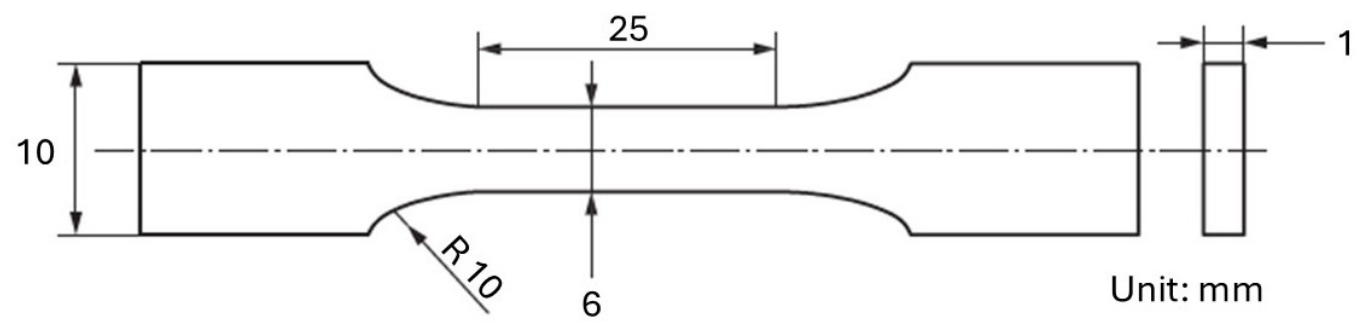
In this study, the mechanical behavior in room temperature under hydrogen environment was evaluated. To reproduce the effects associated with prolonged exposure to hydrogen-containing environments, cathodic hydrogen charging was conducted in accordance with ISO 16573-2:2022 [21]. Tensile specimens fabricated according to the geometry illustrated in Figure 1 underwent electrochemical hydrogen charging before mechanical testing. During the charging procedure, each specimen works as the cathode, while a spiral platinum wire with a diameter of 0.5 mm serves as the anode. To introduce a high hydrogen concentration in accordance with the ISO recommendations, the electrolyte consisted of an aqueous mixture containing 30 g/L sodium chloride (NaCl) and 3 g/L ammonium thiocyanate (NH4SCN). Hydrogen charging was carried out using a VersaSTAT4 potentiostat/galvanostat (AMETEK, Berwyn, PA, USA) under an applied current density of 100 mA/cm2 for a duration of 72 h.
Following the hydrogen charging procedure, slow strain rate tensile (SSRT) tests were conducted using the same testing apparatus employed previously for the pre-straining tests. To avoid hydrogen release during testing, the charged specimens were electrolytically Zn-coated as proposed in the afore mentioned ISO standard [21]. The crosshead separation rate was controlled to achieve an estimated strain rate over the parallel length of 10−5 s−1. Scanning Electron Microscopy (SEM) (JEOL, Akishima, Tokyo, Japan) was employed for the examination of the fracture surfaces.
The amount of H that enters the metal lattice in each material condition, is studied using Thermal Desorption Spectroscopy (TDS) analysis. A Pfeiffer OmniStar GSD 301 O2 quadrupole mass spectrometer (Pfeiffer Vacuum, Asslar, Germany) was utilized with an Ar flow of 50 mL/min. Specimens measuring 3 × 3 × 1 mm were prepared from both the as-received and 40% pre-strained material using Robofil 290 electrical discharge machining (EDM) system (Charmilles Technologies, Geneva, Switzerland). These specimens were then cathodically charged under the conditions described previously, in order to avoid hydrogen loss associated with cutting full-size tensile specimens. Following charging, the samples were stored in liquid nitrogen until the analysis. The heating rate was set to 5 °C/min, with a maximum temperature of 700 °C.

3. Results and Discussion

3.1. Formation of α′-Martensite

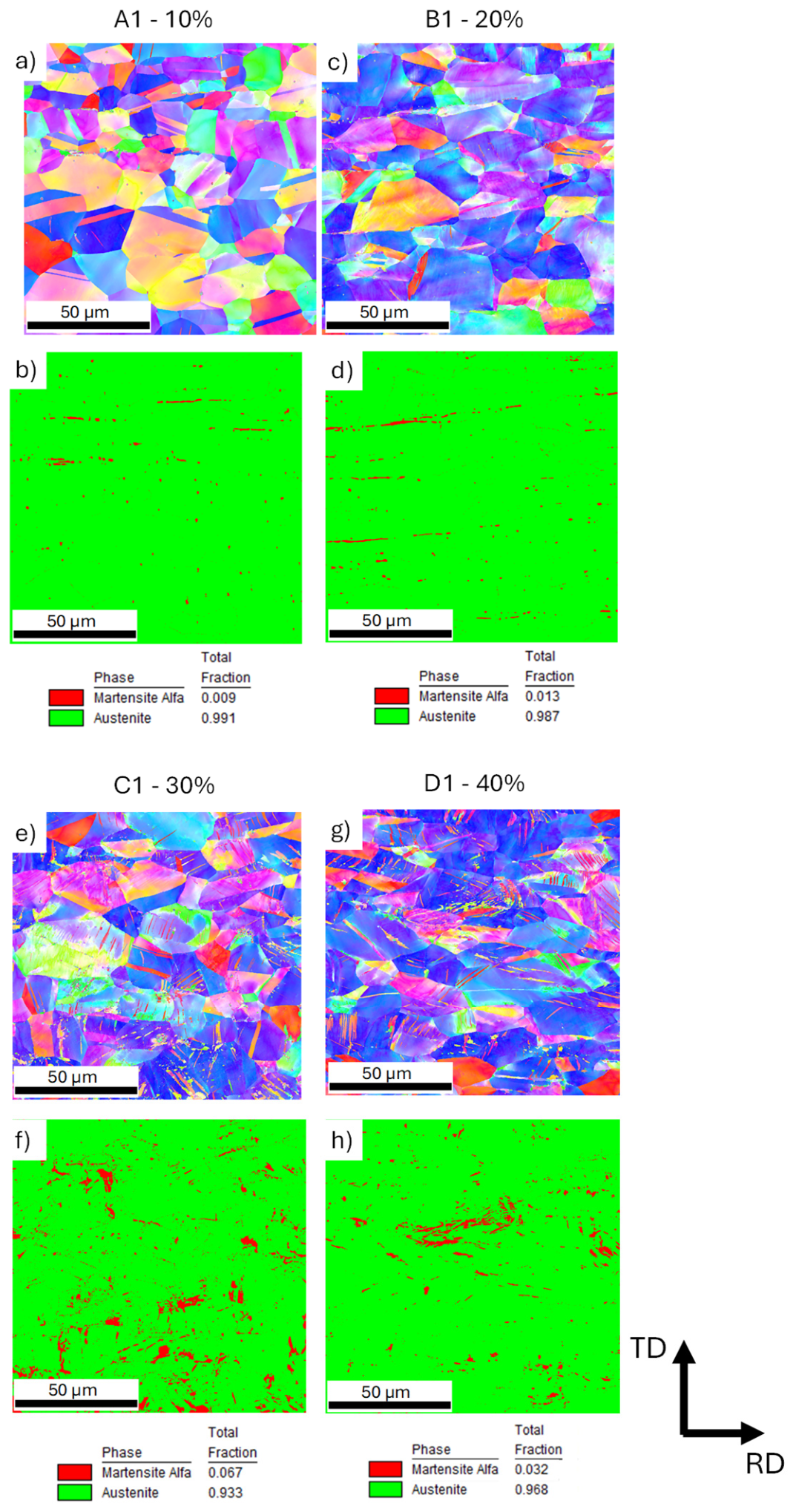
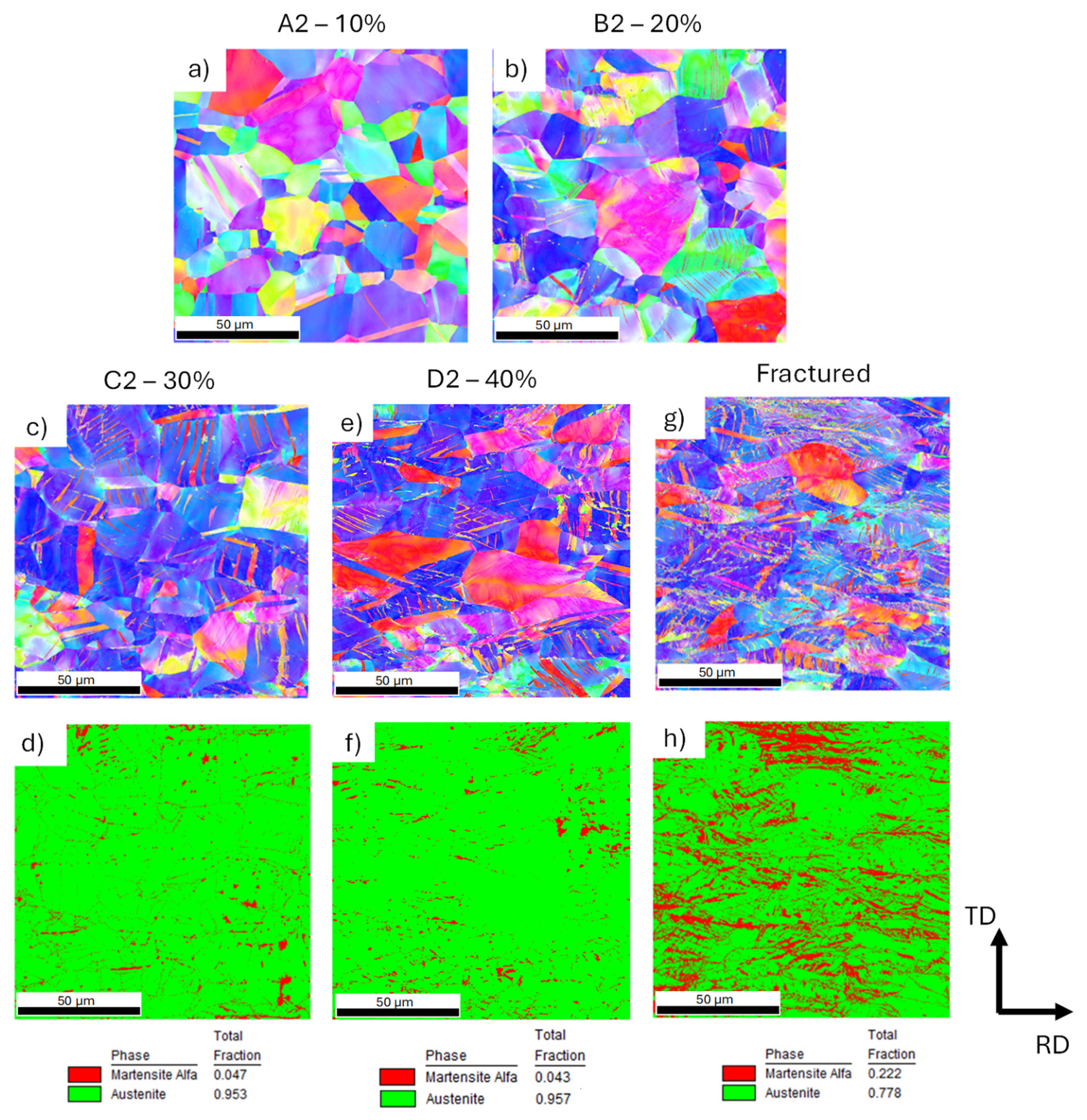
Two strain rates 1.6 × 10⁻⁴ and 5 × 10⁻⁵ s−1 were selected for the pre-strain tests. The influence of strain rate on strain-induced martensitic (SIM) transformation in austenitic stainless steels has been extensively reported in the literature, showing that α′-martensite content decreases as strain rate increases [22,23,24]. Previous studies have shown that increased strain rate results in lower martensite content due to the adiabatic heating caused by flow stress which decreases the chemical driving force for γ→α′ transformation [22]. In a previous study on 304 austenitic stainless steel [23], at the low strain rate (3 × 10⁻⁴ s−1), the transformation rate increased rapidly just below the uniform strain, while this behavior disappeared when the strain rate was increased. In studies investigating SIM in pre-strained ASTS specimens, strain rates typically range from 10−4 to 10−5 s−1 [4,9,15]. However, it remains unclear whether this one-order-of-magnitude difference significantly influences SIM formation. In this study, the sensitivity of SIM transformation at low strain rates was investigated by selecting two relatively close low strain rates [25]. As reported in a previous study, at low strain rates α′ martensite nucleates on both primary and secondary slip systems [24]. Figure 2 presents the EBSD results of the material pre-deformed to 10%, 20%, 30%, and 40% strain at a strain rate of 5 × 10⁻⁵ s−1. No martensitic phase was observed in the as-received condition. At lower deformation levels of 10% and 20%, martensite is mainly localized along grain boundary regions, exhibiting linear zones that follows the rolling direction. As the strain increases to 30%, pronounced shear-band development is observed throughout the microstructure. The regions where shear bands intersect become highly favorable locations for martensite nucleation. The results indicate that SIM formation is strain dependent. The volume fraction of α′-martensite, calculated from IPF maps is 0.9% at 10% pre-strain, 1.3% at 20% and increases at 6.7% at 30% and decreases to 3.2% at 40%. Figure 3 depicts the EBSD results for material pre-strained at strain rate of 1.6 × 10⁻⁴ s−1. Similarly to the lower strain rate, SIM formation is dependent on the strain level. However, in this case at 10% and 20% pre-strain, no martensite was detected, whereas at 30% and 40% it reached 4.7% and 4.3%, respectively. Shear bands were observed in all samples with strain levels above 10%. In the sample pre-strained to 20%, shear bands are present; however, no martensite was detected. This observation indicates that small differences in strain rate can affect the kinetics of SIM transformation, which in the case of low strain rates cannot be attributed to adiabatic heating. Lastly, the IPF maps of a fractured specimen (F2) show an increased martensite volume fraction near the fracture surface, reaching 22.2%.
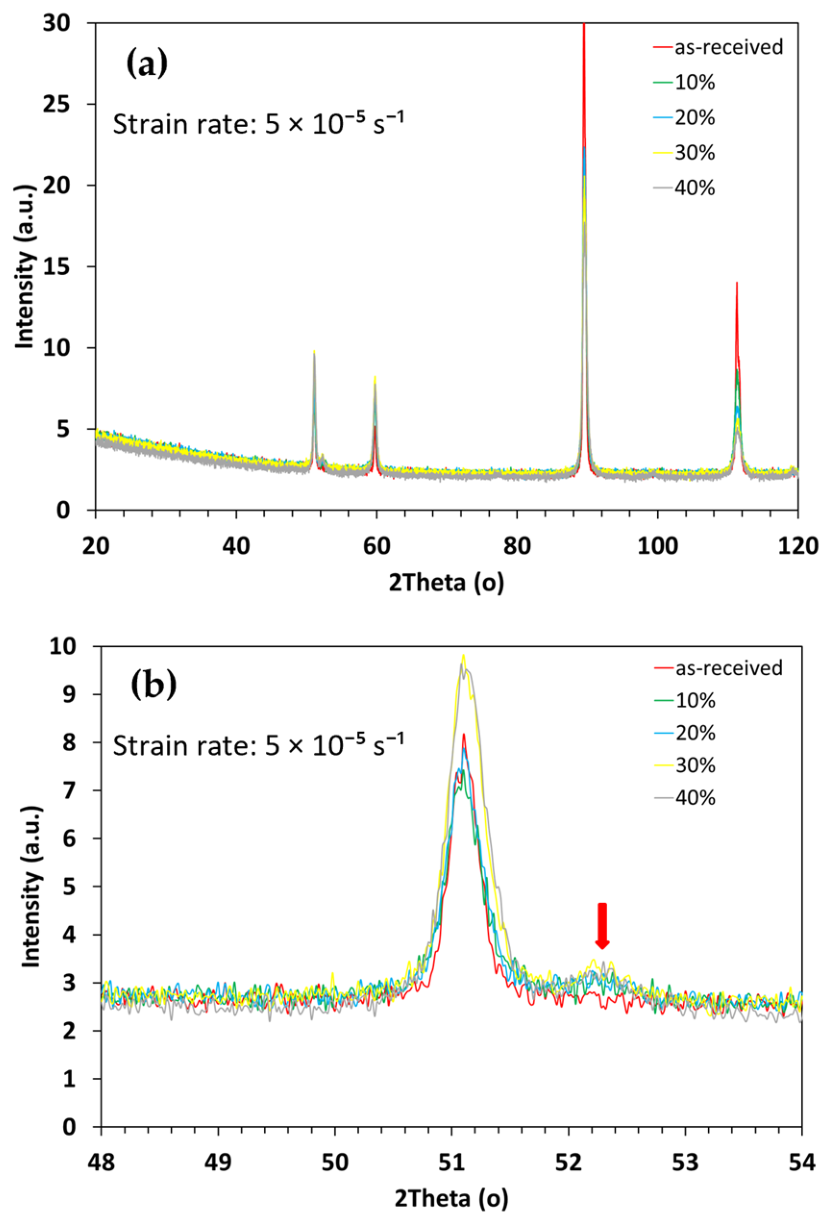
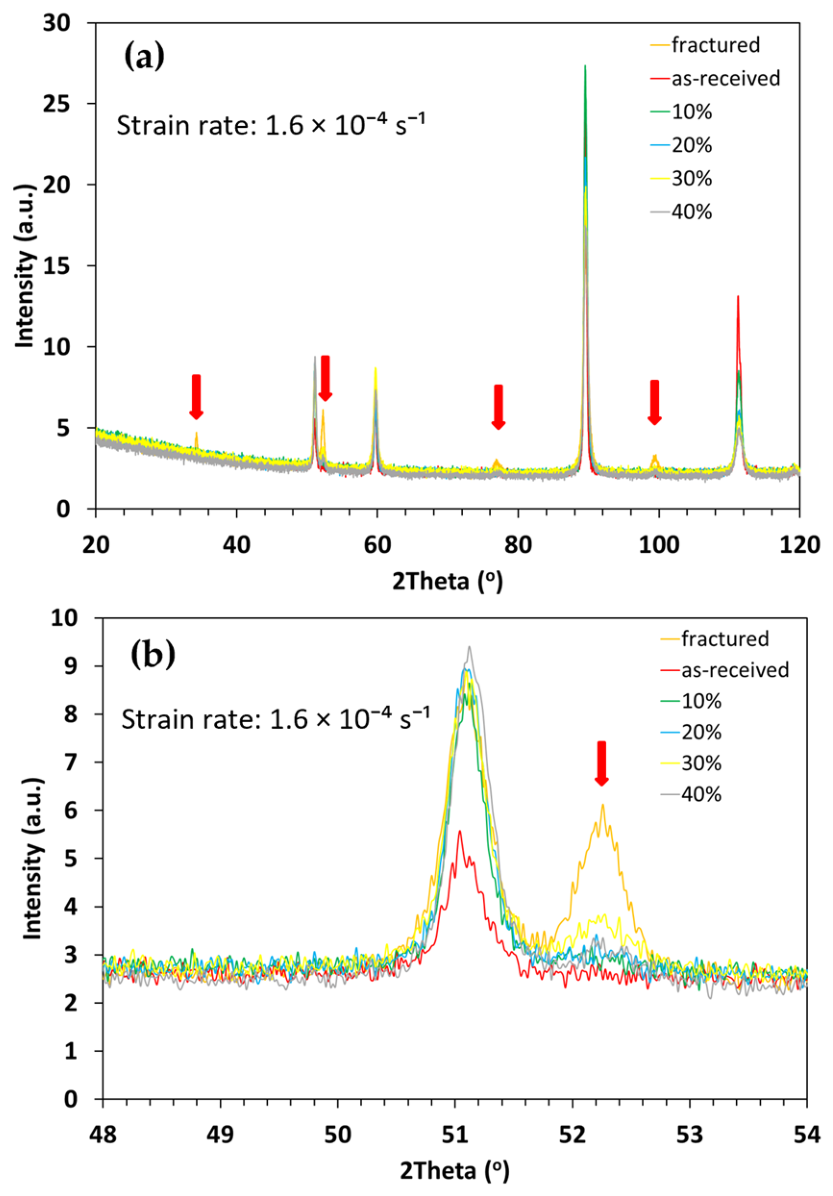
XRD analysis was conducted over a larger area, and the Rietveld method was used to quantify the phase fractions. Figure 4 and Figure 5 show the XRD results for the pre-strained material at strain rates of 5 × 10⁻⁵ s−1 and 1.6 × 10⁻⁴ s−1, respectively. In both cases, two phases—FCC and BCC—were identified, corresponding to austenite and α′-martensite.
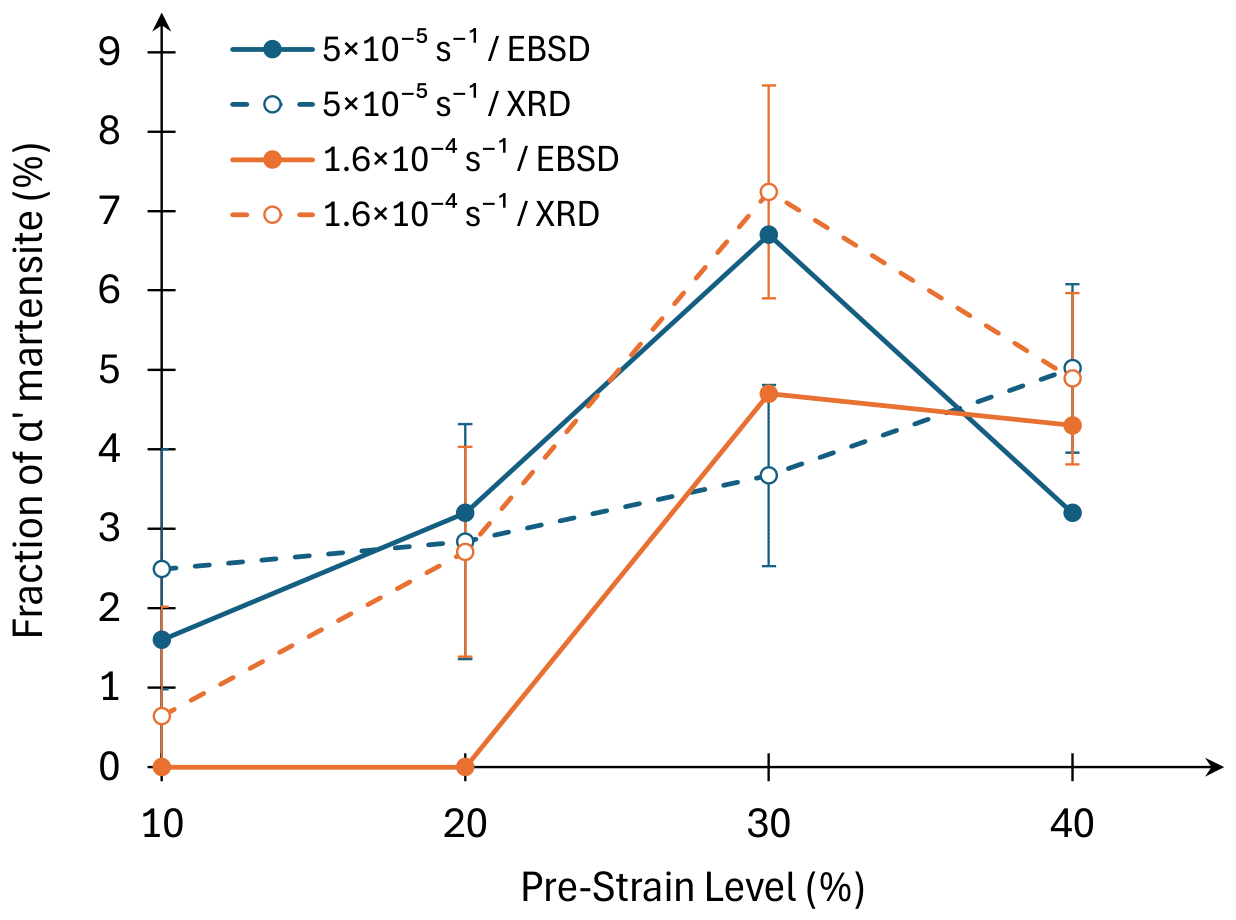
Figure 6 presents the phase quantification results obtained from the Rietveld analysis using MAUD, along with a comparison to the EBSD data. The error in determining the volume fraction is approximately ±1% and tends to decrease with increasing strain level due to the more pronounced presence of martensite. Taking the error margin into account, the XRD results generally align well with the EBSD measurements. No martensite was detected in the as-received condition. Results on the first set of samples (A1 to D1) showed a martensite content of 2.49 ± 1.51% in the 10% pre-strained condition, that increased up to 4.72 ± 1.06% in 40%. For the second set of specimens (A2–D2), at the lower pre-strain levels of 10% and 20%, EBSD did not detect any martensite, whereas XRD revealed a small but progressively increasing amount. In specimen A2, the martensite content was measured at 0.64% ± 1.38%. Although this value is within the error margin, the presence of a visible martensite peak in the XRD pattern indicates that the content is not zero. The martensite content increases with strain, reaching 7.24% at 30% pre-strain before decreasing to 4.89% at 40% pre-strain, indicating continued martensite formation during deformation. The apparent decrease observed between the 30% and 40% pre-strained conditions is attributed to the localized nature of the EBSD measurements. The XRD results, which provide an assessment over a substantially larger area, indicate a smaller difference in martensite content when the associated quantification uncertainty is taken into account. Furthermore, it should be noted that the decrease in martensite fraction at 40% strain may be related to localized deformation, where strain concentrates in specific regions rather than being uniformly distributed, resulting in non-uniform martensite formation.
The results indicate that the two strain rates influence the evolution of SIM. The 5 × 10⁻⁵ s−1 strain rate exhibits a faster transformation rate and earlier martensite formation at lower strains, whereas the 1.6 × 10⁻⁴ s−1 strain rate shows a delayed transformation response. Despite these differences in transformation kinetics, both conditions reach comparable martensite fractions at the highest strain levels investigated. This suggests that even relatively small variations in strain rate can affect the kinetics of martensitic transformation, while having a limited effect on the final martensite content.

3.2. Hydrogen Embrittlement Susceptibility Assessment

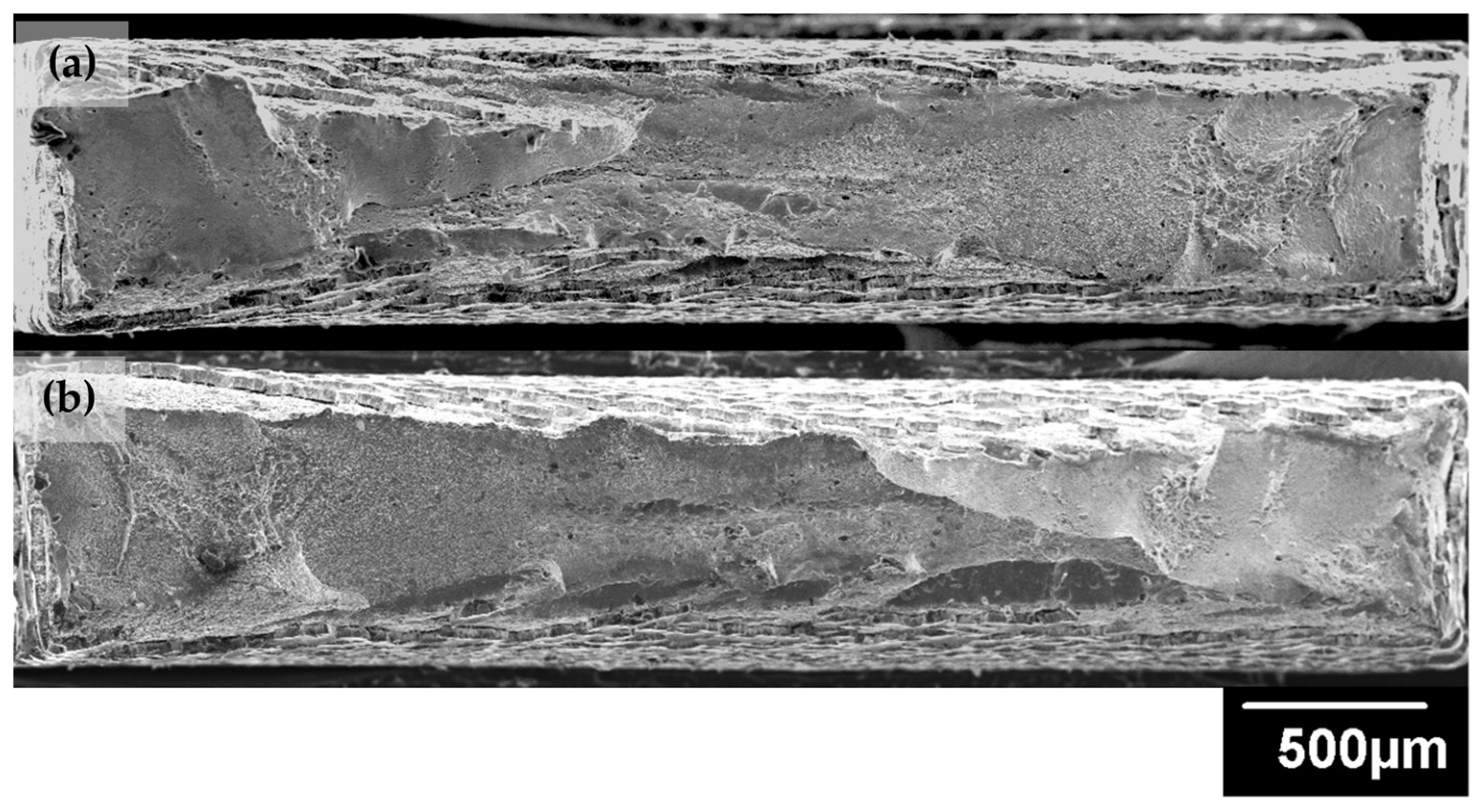
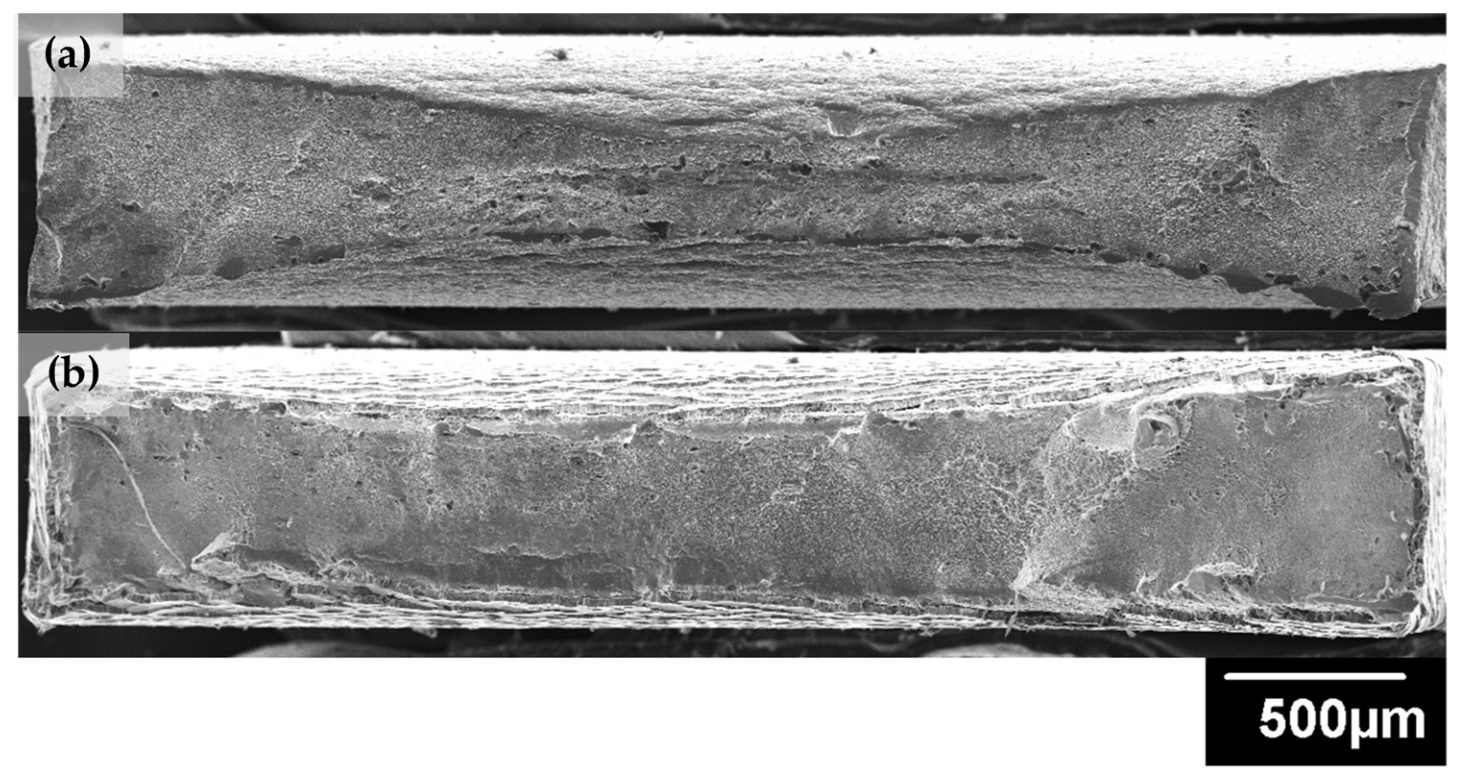
The presence of α′ is critical, as it provides preferential pathway for hydrogen diffusion in the material, making it a key factor in the hydrogen embrittlement (HE) resistance of stainless steels. To assess the material’s susceptibility to HE, both the as-received and 40% pre-strained specimens (strain rate of 1.6 × 10⁻⁴ s−1) were subjected to cathodic hydrogen charging and were subsequently tested. For comparison, uncharged specimens were also tested to failure. The fracture surfaces were then examined using SEM. As illustrated in Figure 7 and Figure 8 for the as-received and 40% pre-strained conditions, respectively, the presence of hydrogen led to a noticeable increase in brittle fracture characteristics in both material states. This effect was considerably more severe in the pre-strained specimens. One of the most evident manifestations of hydrogen embrittlement was the reduced necking observed after charging, which became especially pronounced after hydrogen charging in the pre-deformed material.
The Relative Reduction of Area (RRA) was calculated to assess hydrogen embrittlement susceptibility. RRA is defined as:
R R A = R A H R A R
where RAH is the reduction of area of the hydrogen-charged specimens and RAR is the relative value of the non-charged specimens.
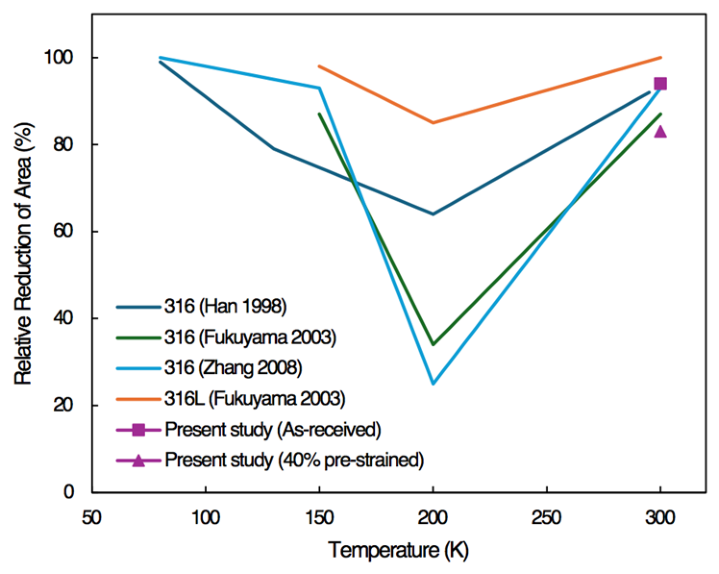
At present, there is no dedicated regulatory framework or standardized testing methodology for qualifying materials specifically for service in liquid hydrogen environments [26]. However, standards exist for evaluating material compatibility with gaseous or compressed hydrogen, including ISO 16573-2 [21] and ANSI/CSA CHMC 1 [27]. The latter proposes a screening method based on slow strain rate tensile (SSRT) testing on smooth and/or notched specimens. According to this standard, austenitic stainless steels may be directly qualified for hydrogen service if the Relative Reduction of Area (RRA) for smooth specimens or the Notch Tensile Strength Ratio (RNTS) for notched specimens is equal to or greater than 0.90. If these criteria are not satisfied, but the RNTS remains equal to or greater than 0.50, additional testing is required to assess suitability. In the absence of specific criteria for liquid hydrogen, the RRA ≥ 0.90 threshold is adopted in the present study as a compatibility criterion, while acknowledging that it is formally applicable only to gaseous hydrogen environments. In this study, the Relative Reduction of Area (RRA) was determined through image analysis. An RRA value of 0.94 was obtained for the as-received condition, while it decreased to 0.83 for specimens subjected to 40% pre-strain.
Figure 9 compares the RRA values obtained in this study with those reported in the literature, noting that the latter were derived from experiments using gaseous hydrogen charging. According to the literature 316L is expected to exhibit a RRA greater than 90% at ambient temperatures. While hydrogen charging methods and content vary across different studies, it is consistently observed that the RRA for 316 and 316L remains high under ambient conditions. Notable differences in the RRA behavior are observed between 316 and 316L stainless steel grades. Additionally, the nickel equivalent plays a significant role in influencing RRA, particularly under cryogenic conditions [28]. However, the literature indicates that the primary challenges arise at cryogenic temperatures, specifically within the range of 150–250 K [29,30,31]. It should be noted that studies on H charging of 316L pre-strained specimens are scarce, mostly focusing on 304(L) grade [4,14,15,32] despite that pre-deformation is expected to play a crucial role in HE as discussed earlier.
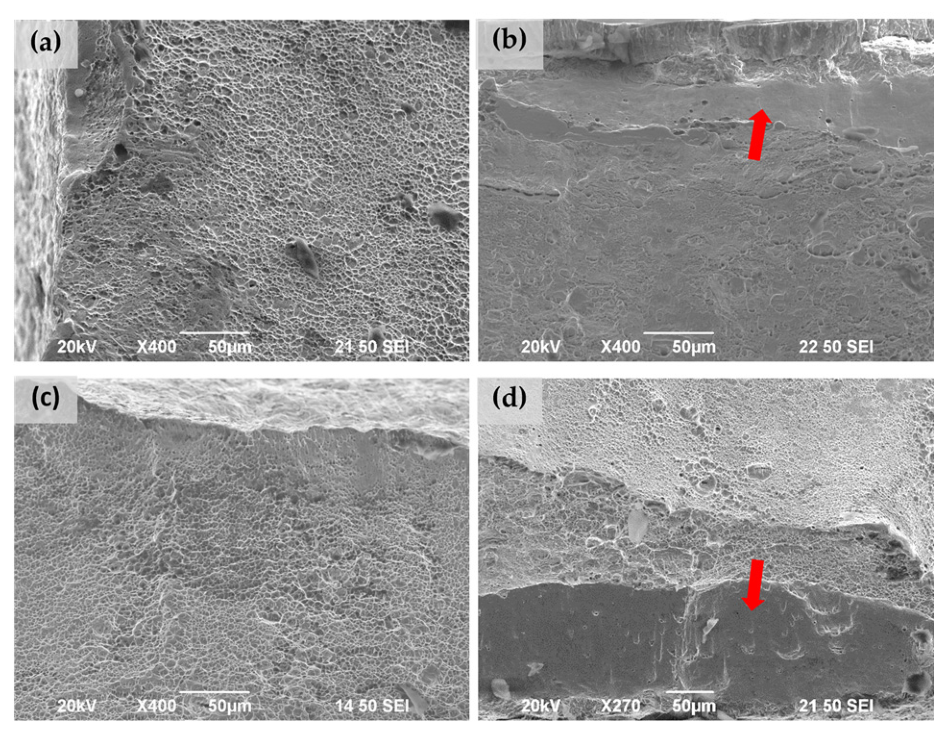
Figure 10 illustrates the fracture morphology near the edges of the 40% pre-strained specimens (Figure 10a,b) and the non-strained (Figure 10c,d). In non-hydrogen charged specimens (Figure 10a,c), the fracture surfaces predominantly exhibit ductile failure, characterized by micro-void coalescence and dimple formation. However, after hydrogen charging the fracture mode shifted to a mixed type, where ductile features remain dominant but are accompanied by a narrow region of brittle fracture located close to the specimen edges. Area measurements revealed that the brittle fracture regions accounted for 10.1% of the fracture surface in the hydrogen-charged as-received condition and 15.5% in the hydrogen-charged pre-strained condition. This increase is consistent with the reduction in RRA and increased martensite content observed in pre-strained material, and further indicating the enhanced susceptibility of the pre-strained material to hydrogen embrittlement. This behavior was present in both the as-received and pre-strained condition. These results demonstrate that 316L stainless steel retains a high level of ductility even after cathodic hydrogen charging, consistent with previous studies. Cathodic hydrogen charging method is known to produce non-uniform hydrogen concentration in the material thickness, with most amount accumulated in the first few hundreds of μm. As cathodic hydrogen charging proceeds, the hydrogen concentration increases rapidly at first and then reaches a plateau after a certain time and concentration level, as hydrogen diffuses from the surface into the steel and further penetration becomes increasingly slow and time consuming. This explains the localization of brittle regions near the specimen edges. Although HE in austenitic stainless steels is relatively limited at ambient temperature, it is expected to become more pronounced under intermediate cryogenic conditions.
Based on the present results, the observed reduction in ductility and fracture surface characteristics, including microvoid coalescence (Figure 10a,c), suggest that hydrogen-enhanced localized plasticity (HELP) is likely the dominant mechanism.

3.3. Thermal Desorption Spectroscopy Analysis

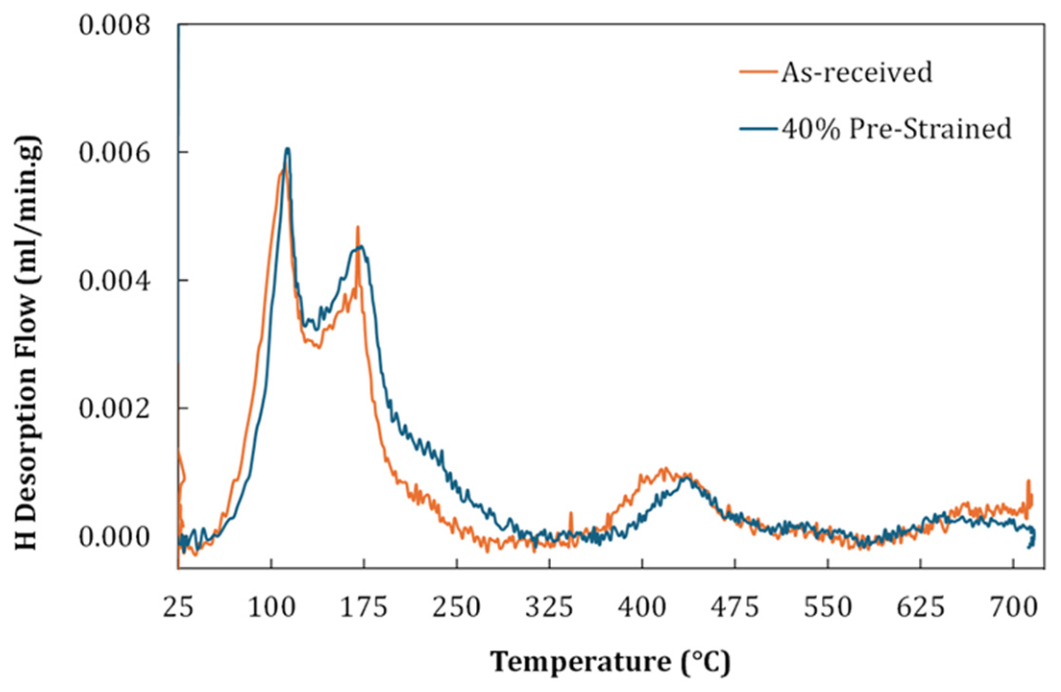
The sites within the FCC lattice that H is trapped may correspond to interstitial lattice sites or trapping defects [33]. The terminology of “reversible” and “irreversible” trap sites is often used to describe the probability of H atoms to escape. At ambient conditions, a trap with de-trapping energy Eα larger than 50 kJ/mol is considered irreversible [6]. Desorption from all trap sites is possible, however at ambient conditions the desorption rate from high-energy traps is negligible. Temperature-based criteria are also commonly used to classify hydrogen trap sites, where desorption peaks above approximately 300–350 °C are associated with high-energy traps and are therefore considered irreversible [34]. Figure 11 presents the hydrogen desorption flow profiles for the as-received and 40% pre-strained samples, with total desorbed hydrogen contents of 9.77 wppm and 11.34 wppm, respectively. In both cases, four desorption peaks were observed at approximate temperatures of 112, 170, 235 and 420 °C. The 4th peak corresponds to higher-energy trapped hydrogen, as reported in the literature. In previous study on H cathodic charged 316L steel, three distinct peaks were also observed in the temperature range of 100–250 °C, which were corresponded to trap sites of elastic stress fields, core dislocations and grain boundaries [35].
Direct comparison of hydrogen concentration values reported in the literature is challenging and must be approached with caution, as there are multiple influencing factors. Differences in charging conditions and experimental setups result in variations in hydrogen absorption, while material characteristics such as Ni equivalent, grain size, and surface roughness further influence hydrogen uptake [28,36].

4. Conclusions

This study examines the effects of hydrogen embrittlement on as-received and pre-strained 316L austenitic stainless steel sheets intended for use in liquid hydrogen tanks in the maritime industry. Pre-straining levels of 0%, 10%, 20%, 30%, and 40% were applied to simulate the deformation experienced in the corrugated regions of membrane-type tanks. Material characterization was performed, and hydrogen embrittlement behavior in the as-received and 40% pre-strained conditions was evaluated using slow strain rate tensile (SSRT) testing and thermal desorption spectroscopy (TDS). Main conclusions are summarized as followed:
  • EBSD and XRD analyses showed that the total martensite fraction can reach up to 5% in higher deformation levels of 30 and 40%, indicating increased hydrogen pathways near the tips of the corrugation formation. Comparing the two strain rates, the slower strain rate appears to favor martensitic transformation, as evidenced by the earlier onset of martensite fraction formation during the early stages of deformation.
  • SSRT of as-received and 40% pre-strained material, both with and without cathodic hydrogen charging, revealed that the pre-strained material behaves differently, with an RRA value of 83%—below the typical range of 90–100% reported in the literature for 316L at ambient temperature.
  • Hydrogen analysis via TDS indicated similar trapping behavior with respect to the nature of the trapping sites. The total hydrogen content in the pre-strained specimens was approximately 15% higher than that in the as-received specimens.
  • Further investigation of the different material conditions, combining experimental and numerical analyses, is required to precisely quantify the effect of martensite formation on the behavior of CCS in a liquid hydrogen (LH2) environment. Notched Slow Strain Rate Tests (NSSRT) are required to further evaluate the material compatibility for LH2.
The above results highlight the need for further investigation to more accurately assess the effect of martensite formation on the mechanical behavior of corrugated sheets used in CCS intended for operation in liquid hydrogen (LH2) environments. A complete assessment of the material’s suitability requires additional mechanical characterization, such as NSSRT, Charpy impact and fatigue testing conducted at both ambient and cryogenic temperatures.

Author Contributions

S.M.: Writing—review & editing, Writing—original draft, Visualization, Validation, Methodology, Investigation, Formal analysis, Data curation, Conceptualization. M.S.: Writing—review and editing, Visualization, Validation, Resources, Investigation, Formal analysis, Data curation. M.B.: Writing—review and editing, Visualization, Validation, Resources, Investigation, Formal analysis, Data curation. J.W.-B.: Writing—review and editing, Supervision, Resources, Project administration, Funding acquisition. T.S.: Validation, Supervision, Resources, Methodology. C.T.: Validation, Supervision, Methodology, Investigation. A.D.Z.: Writing—review and editing, Supervision, Resources, Project administration, Methodology, Funding acquisition, Conceptualization. All authors have read and agreed to the published version of the manuscript.

Funding

This work is part of the project “Safe and Efficient Marine Transportation of Liquid Hydrogen” (LH2CRAFT) funded by the European Commission and Clean Hydrogen Partnership under Grand Agreement No 101111972. The authors gratefully acknowledge their financial support. Views and opinions expressed are however those of the authors only and do not necessarily reflect those of the European Union or Clean Hydrogen JU. Neither the European Union nor the granting authority can be held responsible for them.

Data Availability Statement

Data will be made available on request.

Acknowledgments

SEM/EBSD and XRD measurements were performed in IMMS PAS within the framework of MoU signed by National Technical University of Athens and Institute of Metallurgy and Materials Science Polish Academy of Sciences. Anna D. Zervaki and Joanna Wojewoda-Budka acknowledge Polish Academy of Sciences for financing of their mutual scientific visits.

Conflicts of Interest

The authors declare that they have no known competing financial interests or personal relationships that could have appeared to influence the work reported in this paper.

References

  1. International Maritime Organization. 2023 IMO Strategy on Reduction of GHG Emissions from Ships; IMO: London, UK, 2023. [Google Scholar]
  2. Ustolin, F.; Campari, A.; Taccani, R. An Extensive Review of Liquid Hydrogen in Transportation with Focus on the Maritime Sector. J. Mar. Sci. Eng. 2022, 10, 1222. [Google Scholar] [CrossRef]
  3. Mazloomi, K.; Gomes, C. Hydrogen as an energy carrier: Prospects and challenges. Renew. Sustain. Energy Rev. 2012, 16, 3024–3033. [Google Scholar] [CrossRef]
  4. Choi, Y.-H.; Lee, J.H.; Kim, S.-M.; Lee, D.-H.; Kim, H.-T.; Kim, J.-H.; Kim, M.; Kim, S.-K.; Lee, J.-M. Temperature-Dependent Hydrogen Embrittlement of Austenitic Stainless Steel on Phase Transformation. Metals 2023, 13, 35. [Google Scholar] [CrossRef]
  5. Ogata, T. Hydrogen environment embrittlement on austenitic stainless steels from room temperature to low temperatures. Proc. IOP Conf. Ser. Mater. Sci. Eng. 2015, 102, 012005. [Google Scholar] [CrossRef]
  6. Chen, Y.-S.; Huang, C.; Liu, P.-Y.; Yen, H.-W.; Niu, R.; Burr, P.; Moore, K.L.; Martínez-Pañeda, E.; Atrens, A.; Cairney, J.M. Hydrogen Trapping and Embrittlement in Metals—A Review. Int. J. Hydrogen Energy 2025, 136, 789–821. [Google Scholar] [CrossRef]
  7. Li, J.; Huang, Z.; Zhang, L.; Zheng, Z.; Zhang, C.; Rao, S.; Teng, L.; Jiang, L. Atomistic Insights into Hydrogen Diffusion and Deformation Mechanisms in FeCrNi-Based Austenitic Stainless Steels: Effects of Alloying, Temperature, and Hydrogen Concentration. Molecules 2026, 31, 1688. [Google Scholar] [CrossRef]
  8. Kim, M.-S.; Lee, T.; Son, Y.; Park, J.; Kim, M.; Eun, H.; Park, J.-W.; Kim, Y. Metallic Material Evaluation of Liquid Hydrogen Storage Tank for Marine Application Using a Tensile Cryostat for 20 K and Electrochemical Cell. Processes 2022, 10, 2401. [Google Scholar] [CrossRef]
  9. Kim, J.-H.; Park, W.-S.; Chun, M.-S.; Kim, J.-J.; Bae, J.-H.; Kim, M.-H.; Lee, J.-M. Effect of pre-straining on low-temperature mechanical behavior of AISI 304L. Mater. Sci. Eng. A 2012, 543, 50–57. [Google Scholar] [CrossRef]
  10. Kim, Y.S.; Bak, S.H.; Kim, S.S. Effect of Strain-Induced Martensite on Tensile Properties and Hydrogen Embrittlement of 304 Stainless Steel. Metall. Mater. Trans. A 2016, 47, 222–230. [Google Scholar] [CrossRef]
  11. Bak, S.H.; Abro, M.A.; Lee, D.B. Effect of hydrogen and strain-induced martensite on mechanical properties of AISI 304 stainless steel. Metals 2016, 6, 169. [Google Scholar] [CrossRef]
  12. Wang, Y.; Zhou, Z.; Wu, W.; Gong, J. Warm pre-strain: Strengthening the metastable 304L austenitic stainless steel without compromising its hydrogen embrittlement resistance. Materials 2017, 10, 1331. [Google Scholar] [CrossRef]
  13. Bak, S.H.; Kim, S.S.; Lee, D.B. Effect of hydrogen on dislocation structure and strain-induced martensite transformation in 316L stainless steel. RSC Adv. 2017, 7, 27840–27845. [Google Scholar] [CrossRef]
  14. Zhang, L.; Li, Z.; Zheng, J.; Zhao, Y.; Xu, P.; Zhou, C.; Li, X. Effect of strain-induced martensite on hydrogen embrittlement of austenitic stainless steels investigated by combined tension and hydrogen release methods. Int. J. Hydrogen Energy 2013, 38, 8208–8214. [Google Scholar] [CrossRef]
  15. Wang, Y.; Wang, X.; Gong, J.; Shen, L.; Dong, W. Hydrogen embrittlement of catholically hydrogen-precharged 304L austenitic stainless steel: Effect of plastic pre-strain. Int. J. Hydrogen Energy 2014, 39, 13909–13918. [Google Scholar] [CrossRef]
  16. Wu, S.; Xin, J.; Xie, W.; Zhang, H.; Huang, C.; Wang, W.; Zhou, Z.; Zhou, Y.; Li, L. Mechanical properties and microstructure evolution of cryogenic pre-strained 316LN stainless steel. Cryogenics 2022, 121, 103388. [Google Scholar] [CrossRef]
  17. ISO 6892-1; Metallic Materials—Tensile Testing—Part 1: Method of Test at Room Temperature. International Organization for Standardization: Geneva, Switzerland, 2016.
  18. Lutterotti, L.; Matthies, S.; Wenk, H.-R. MAUD: A friendly Java program for material analysis using diffraction. Newsl. CPD 1999, 21, 14–15. [Google Scholar]
  19. Lutterotti, L. Maud: A Rietveld analysis program designed for the internet and experiment integration. Acta Crystallogr. Sect. A 2000, 56, s54. [Google Scholar] [CrossRef]
  20. Saville, A.I.; Creuziger, A.; Mitchell, E.B.; Vogel, S.C.; Benzing, J.T.; Klemm-Toole, J.; Clarke, K.D.; Clarke, A.J. MAUD Rietveld Refinement Software for Neutron Diffraction Texture Studies of Single- and Dual-Phase Materials. Integr. Mater. Manuf. Innov. 2021, 10, 461–487. [Google Scholar] [CrossRef] [PubMed]
  21. ISO 16573-2; Steel—Measurement Method for the Evaluation of Hydrogen Embrittlement Resistance of High-Strength Steels—Part 2: Slow Strain Rate Test. International Organization for Standardization: Geneva, Switzerland, 2022.
  22. Isakov, M.; Hiermaier, S.; Kuokkala, V.-T. Effect of Strain Rate on the Martensitic Transformation During Plastic Deformation of an Austenitic Stainless Steel. Metall. Mater. Trans. A 2015, 46, 2352–2355. [Google Scholar] [CrossRef]
  23. Talonen, J.; Hänninen, H.; Nenonen, P.; Pape, G. Effect of strain rate on the strain-induced γ → α′-martensite transformation and mechanical properties of austenitic stainless steels. Metall. Mater. Trans. A 2005, 36, 421–432. [Google Scholar] [CrossRef]
  24. Vázquez-Fernández, N.; Nyyssönen, T.; Isakov, M.; Hokka, M.; Kuokkala, V.-T. Uncoupling the effects of strain rate and adiabatic heating on strain induced martensitic phase transformations in a metastable austenitic steel. Acta Mater. 2019, 176, 134–144. [Google Scholar] [CrossRef]
  25. Maritsa, S.; Tzanetos, I.; Szczerba, M.; Bieda, M.; Wojewoda-Budka, J.; Zervaki, A.D. Liquid Hydrogen Cargo Containment Systems: A Focus on Metallic Barrier Materials. In Proceedings of the Innovations in Sustainable Maritime Technology—IMAM 2025; Springer Nature: Cham, Switzerland, 2025; pp. 259–269. [Google Scholar] [CrossRef]
  26. Mavrozoumis, T.; Maritsa, S.; Zervaki, A.D.; Tsouvalis, N. Gaps in International Codes and Standards Regarding Material Requirements and Testing in Cryogenic Conditions for Liquid Hydrogen Containment Systems. In Proceedings of the Innovations in Sustainable Maritime Technology—IMAM 2025; Springer Nature: Cham, Switzerland, 2025; pp. 270–282. [Google Scholar] [CrossRef]
  27. ANSI/CSA CHMC 1-2014 (R2023); Test Methods for Evaluating Material Compatibility in Compressed Hydrogen Applications—Metals. CSA Group: Toronto, ON, Canada, 2014.
  28. Zhang, L.; Wen, M.; Imade, M.; Fukuyama, S.; Yokogawa, K. Effect of nickel equivalent on hydrogen gas embrittlement of austenitic stainless steels based on type 316 at low temperatures. Acta Mater. 2008, 56, 3414–3421. [Google Scholar] [CrossRef]
  29. Fukuyama, S.; Sun, D.; Zhang, L.; Wen, M.; Yokogawa, K. Effect of Temperature on Hydrogen Environment Embrittlement of Type 316 Series Austenitic Stainless Seels at Low Temperatures. J. Jpn. Inst. Met. Mater. 2003, 67, 456–459. [Google Scholar] [CrossRef]
  30. Han, G.; He, J.; Fukuyama, S.; Yokogawa, K. Effect of strain-induced martensite on hydrogen environment embrittlement of sensitized austenitic stainless steels at low temperatures. Acta Mater. 1998, 46, 4559–4570. [Google Scholar] [CrossRef]
  31. Michler, T.; Schweizer, F.; Wackermann, K. Review on the Influence of Temperature upon Hydrogen Effects in Structural Alloys. Metals 2021, 11, 423. [Google Scholar] [CrossRef]
  32. Zhou, C.; Song, Y.; Shi, Q.; Hu, S.; Zheng, J.; Xu, P.; Zhang, L. Effect of pre-strain on hydrogen embrittlement of metastable austenitic stainless steel under different hydrogen conditions. Int. J. Hydrogen Energy 2019, 44, 26036–26048. [Google Scholar] [CrossRef]
  33. Zhao, Y.; Lee, D.-H.; Seok, M.-Y.; Lee, J.-A.; Phaniraj, M.; Suh, J.-Y.; Ha, H.-Y.; Kim, J.-Y.; Ramamurty, U.; Jang, J.-I. Resistance of CoCrFeMnNi high-entropy alloy to gaseous hydrogen embrittlement. Scr. Mater. 2017, 135, 54–58. [Google Scholar] [CrossRef]
  34. Tong, Z.; Wang, H.; Zheng, W.; Zhou, H. Change in Hydrogen Trapping Characteristics and Influence on Hydrogen Embrittlement Sensitivity in a Medium-Carbon, High-Strength Steel: The Effects of Heat Treatments. Materials 2024, 17, 1854. [Google Scholar] [CrossRef]
  35. Silverstein, R.; Eliezer, D.; Boellinghaus, T. Hydrogen-trapping mechanisms of TIG-welded 316L austenitic stainless steels. J. Mater. Sci. 2018, 53, 10457–10468. [Google Scholar] [CrossRef]
  36. Wang, Y.; Han, J.; Zhao, Y.; Xie, H.; Li, X.; Dou, D.; Wang, Q. Grain refinement’s effect on hydrogen embrittlement of 304 austenitic stainless steel: A comparative investigation of hydrogen in-situ charging vs. pre-charging. Int. J. Hydrogen Energy 2024, 78, 22–39. [Google Scholar] [CrossRef]
Figure 1. Tensile specimen of 316L stainless steel.
Crystals 16 00385 g001
Figure 2. Orientation IPF maps acquired from pre-strained samples using a strain rate of 5 × 10⁻⁵ s−1 (a,b) 10%, (c,d) 20%, (e,f) 30% and (g,h) 40% pre-strain levels.
Crystals 16 00385 g002
Figure 3. Orientation IPF maps acquired from pre-strained samples using a strain rate of 1.6 × 10⁻⁴ s−1 (a) 10%, (b) 20%, (c,d) 30%, (e,f) 40% pre strain levels and (g,h) fractured specimen near the fracture surface.
Crystals 16 00385 g003
Figure 4. (a) X-ray diffraction data of samples of the 1st series pre-strained at a strain rate of 5 × 10⁻⁵ s−1 (b) an enlarged part of the diffraction pattern of (a) indicating the austenite and martensite (red arrow) phases.
Crystals 16 00385 g004
Figure 5. (a) X-ray diffraction data of samples of 2nd series pre-strained at a strain rate of 1.6 × 10⁻⁴ s−1 (b) an enlarged part of the diffraction pattern of (a) indicating the reflections of austenite and martensite (red arrow) phases.
Crystals 16 00385 g005
Figure 6. EBSD and XRD quantification results for each strain level and strain rate. The error of the XRD quantification is indicated.
Crystals 16 00385 g006
Figure 7. Fracture surfaces of the as-received material under two conditions: (a) uncharged and (b) hydrogen-charged.
Crystals 16 00385 g007
Figure 8. Fracture surfaces of the 40% pre-strained material under two conditions: (a) uncharged and (b) hydrogen-charged.
Crystals 16 00385 g008
Figure 9. Comparison of RRA value of this study with literature data [28,29,30].
Crystals 16 00385 g009
Figure 10. Near-edge fracture surface characteristics of the (a) 40% pre-strain condition without hydrogen and (b) H-charged, (c) as-received condition without hydrogen and (d) H-charged. The red arrows indicate the narrow brittle-fracture region located close to the specimen edges.
Crystals 16 00385 g010
Figure 11. H desorption flow curves for the two material conditions studied.
Crystals 16 00385 g011
Table 1. Chemical composition of the 316L used in this study (wt. %).
ElementCMnSiPSNiCrMoCuCoNFe
wt. %0.0181.020.640.020.019.8717.152.10.470.220.036Rem.
Disclaimer/Publisher’s Note: The statements, opinions and data contained in all publications are solely those of the individual author(s) and contributor(s) and not of MDPI and/or the editor(s). MDPI and/or the editor(s) disclaim responsibility for any injury to people or property resulting from any ideas, methods, instructions or products referred to in the content.