
Review

Crystallization-Based Technologies for Microplastic Removal from Wastewater: Mechanisms, Advances, and Future Perspectives

1
Department of Chemical Engineering, Dr. B. R. Ambedkar National Institute of Technology, Jalandhar 144008, India
2
Laboratory of Polymer and Dyes Chemistry and Technology, 54124 Thessaloniki, Greece
*
Authors to whom correspondence should be addressed.
Crystals 2026, 16(6), 386; https://doi.org/10.3390/cryst16060386
Submission received: 19 April 2026 / Revised: 2 June 2026 / Accepted: 8 June 2026 / Published: 12 June 2026
(This article belongs to the Section Industrial Crystallization)

Abstract

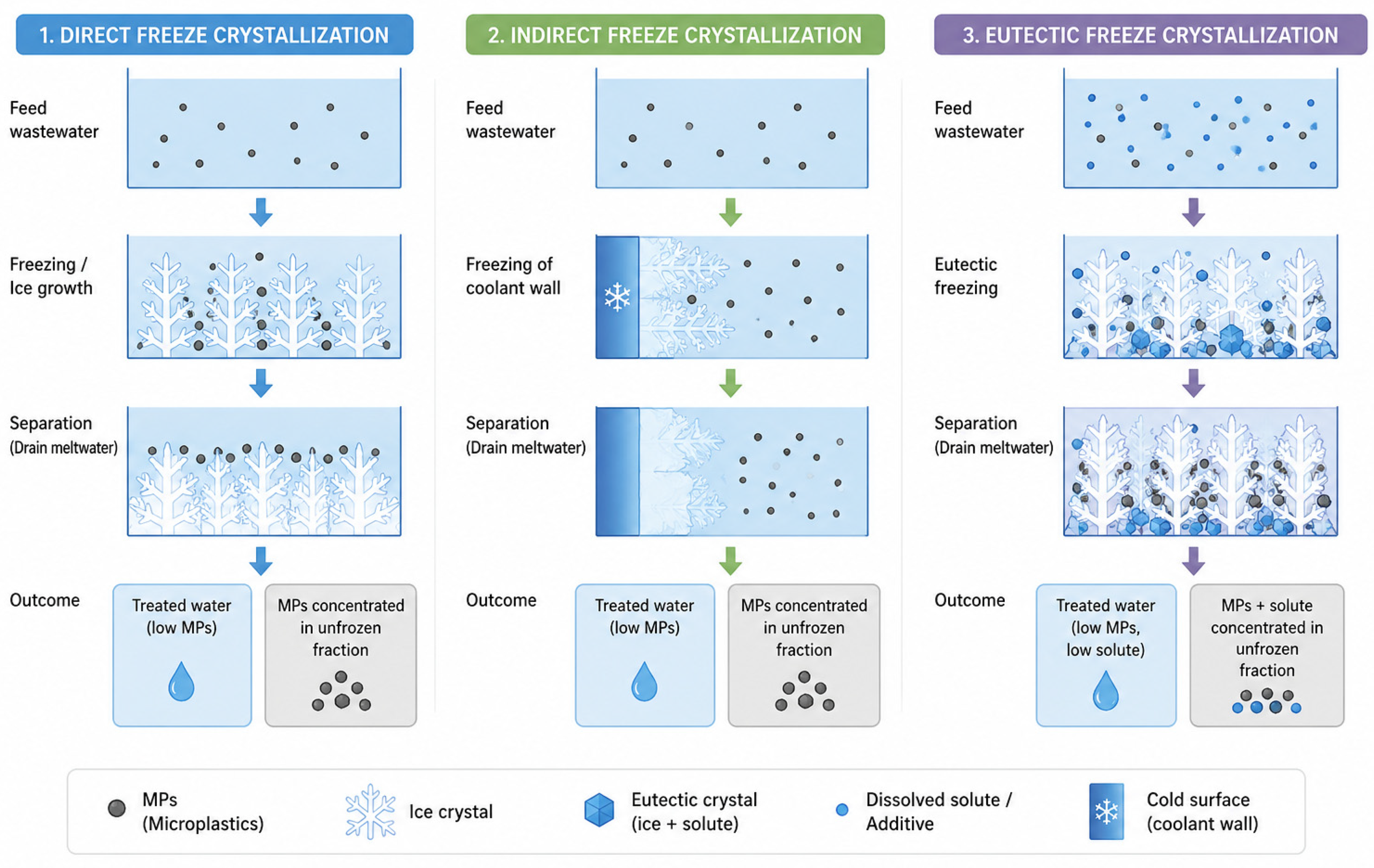
Persistent microplastics contaminate wastewater systems and pose significant environmental and human health risks due to their small size, buoyancy, persistence, and diverse physicochemical properties, which reduce the effectiveness of conventional treatment technologies. Freeze crystallization, indirect freeze crystallization, eutectic freeze crystallization, and ice-templated separation have emerged as promising long-term technologies for microplastic removal. Particle rejection at the solid–liquid interface, heterogeneous ice nucleation, brine channel formation, and particle entrapment within advancing ice fronts are key crystallization mechanisms governing microplastic separation. Microplastics can adhere to or nucleate growing ice crystals, according to lab and field research. These interactions influence crystal growth kinetics and ice structure formation. Indirect freeze crystallization (IFC) and related chemical-free crystallization systems offer lower energy requirements and improved scalability. Crystallization processes concentrate microplastics for downstream treatment, may connect with photochemical or oxidative degradation at ice interfaces, and are useful in cold areas or low-temperature industrial streams. Despite these advances, several challenges remain, including freezing rate, salinity, particle size distribution, and surface weathering, which are difficult to control. Integrating crystallization into wastewater treatment systems is also difficult. This review covers the latest advances in microplastic–ice interactions, crystallization engineering, and freeze-based separation technologies. It also highlights major knowledge gaps and suggests future research to use crystallization to remove microplastics from wastewater in a sustainable, scalable, and energy-efficient manner.
Keywords: freeze crystallization; eutectic freeze crystallization; wastewater treatment; microplastics; ice nucleation; freeze concentration; impurity rejection freeze crystallization; eutectic freeze crystallization; wastewater treatment; microplastics; ice nucleation; freeze concentration; impurity rejection