
Article

Preparation of Au/Cl Modified Multi-Walled Carbon Nanotube Composite Film for Electromagnetic Interference Shielding

1
College of Materials Science and Engineering, Nanjing Tech University, No. 30 Puzhu South Road, Jiangbei New Area, Nanjing 211816, China
2
College of Emergency Management, Nanjing Tech University, No. 30 Puzhu South Road, Jiangbei New Area, Nanjing 211816, China
*
Authors to whom correspondence should be addressed.
Crystals 2026, 16(6), 368; https://doi.org/10.3390/cryst16060368
Submission received: 5 May 2026 / Revised: 23 May 2026 / Accepted: 25 May 2026 / Published: 1 June 2026
(This article belongs to the Section Inorganic Crystalline Materials)

Abstract

Carbon nanotubes (CNT) are among the strongest candidates for electromagnetic interference (EMI) shielding materials because of their excellent performance. However, when assembled into macroscale materials, their conductivity is usually limited to 104 S/m, restricting further application as shielding materials. Here, we prepared a carbon nanotube composite film (Au/Cl-CNT) with high conductivity and excellent EMI properties. Characterizations confirm that Au exists in the form of uniform Au plates and particles anchored on the CNT surface, while Cl is doped into the CNT framework as halogen dopants. The optimized Au/Cl-CNT film delivers an ultra-high electrical conductivity of 3.39 × 10⁵ S/m, which is approximately 23 times higher than that of the pristine CNT film. The excellent electrical properties of the Au/Cl-CNT films endow them with excellent EMI shielding effectiveness (SE). Au/Cl-CNT films with a thickness of ~10.5 μm achieve an EMI SE of up to 67 dB across both the X-band and Ku-band. The superior EMI SE mainly results from the combined effect of various mechanisms, namely reflection inside and outside the material, as well as absorption inside the material. This work clarifies the synergistic enhancement mechanism of Au and Cl on CNT conductivity and EMI shielding, offering new insights into halogen-modified shielding materials.

1. Introduction

The fast-paced advancement of electronic and information technology in the contemporary age has provided high efficiency for social production, but it has also brought about serious electromagnetic interference (EMI) [1]. EMI has become a troubling problem that needs to be solved urgently, because EMI not only causes problems for the normal operation of electronic equipment [2], but it will also cause harm to human body health [3]. For this reason, it is necessary to develop advanced materials with superior electromagnetic interference shielding effectiveness (EMI SE). In addition to excellent EMI SE, lightweight, flexible, and readily manufacturable advanced materials are also essential [4,5,6].
Over the years, carbon-based materials have gained widespread acceptance for EMI shielding purposes, including graphene [7], carbon fibers [8], and carbon nanotubes [9]. Carbon-based materials have superior properties, including high electrical conductivity, light weight, good mechanical properties, and chemical stability [10,11,12]. Among them, carbon nanotubes (CNT) stand out as a typical nanoscale conductive functional material, featuring a distinctive nano-structure, large-scale production capabilities, and superior electrical as well as mechanical characteristics, which have made them one of the ideal candidates for many EMI shielding materials [13,14,15]. It has been well documented that a single CNT’s electrical conductivity can reach up to 108 S/m [16], and its tensile strength can reach up to 100 GPa [17]. However, the inherent electrical performances and mechanics of a single CNT are still underutilized in their assembled counterparts. By way of illustration, CNT films mass-produced via floating catalyst chemical vapor deposition (FCCVD) are one of the CNT-assembled materials [18]. Yet their electrical conductivity typically only reaches around 104 S/m [19], showing a marked difference from the theoretical value. Within the scope of EMI shielding, conductivity is also an important parameter for evaluating EMI SE [20]. Therefore, the poor conductivity of CNT film materials will seriously limit their further application in EMI shielding.
In order to further enhance the electrical properties of CNT film materials and enable their better application in EMI shielding, researchers have carried out a series of explorations. For example, metal modification can effectively promote the electron transfer between metals and CNTs, which helps to improve the conductivity of CNT films, thus improving their EMI SE. And the most common structures for metal modification are metal structures such as gold nanoparticles [21], silver nanowires [22], and copper nanocubes [23]. For example, Tsapenko et al. [24] demonstrated that HAuCl4 can effectively p-type-dope single-walled carbon nanotubes (SWCNTs), thereby enabling the preparation of highly conductive and stable conductive films. Jelmy et al. [25] demonstrated that the incorporation of Au nanoparticles effectively optimizes the microstructure and interfacial charge transfer of MWCNT/PANI composites, while the in situ doping strategy endows the composite with excellent electrical conductivity as well as outstanding X-band EMI shielding and microwave absorption properties, achieving a total shielding efficiency of −16 dB and a minimum reflection loss of −56.5 dB. Shi et al. [26] developed a new method utilizing metal–organic decomposition (MOD) by introducing silver nanoparticles in situ into the multi-walled carbon nanotubes (MWCNTs) to manufacture flexible Ag-CNT composite films. These films exhibit an electrical conductivity as high as 6.82 × 10⁵ S/m and an EMI SE exceeding 66 dB over the ultra-wide frequency band (3–40 GHz). Ma et al. [27] adopted the method of loading a monolayer of Cu nanoparticles on the surface of a MWCNT film, and achieved an excellent electromagnetic shielding performance of 84 dB over the 2.6–26.5 GHz broadband. In addition, electron transfer between non-metals and CNTs can be equally effectively promoted by non-metallic modifications, and among them, halogens (Cl, Br, and I) [28,29] have attracted widespread concern because of their strong chemical reactivity, enabling electron transfer to be induced by doping with halogens, which significantly improves the electrical performance. Milowska et al. [30] increased the electrical conductivity of SWCNT films by more than 20-fold through brief immersion in bromine water and ultrasonic treatment. Inoue et al. [31] showed that bromine-assisted FC-CVD significantly promoted CNT growth and substantially reduced the resistivity of SWCNT films. However, most of the aforementioned research on halogen doping has focused on SWCNTs. Given the excellent structural characteristics and practical advantages of MWCNTs, numerous studies on halogen modification of MWCNTs have also been reported. For example, Janas et al. [32] found that by immersing CNT films into an iodine monochloride solution, resistance reduction up to 67%, the introduction of halogens has a strong doping effect on CNT films and greatly improves the electrical properties. Recently, Yin et al. [33] proposed a method for rapidly incorporating halogens, chlorine and bromine, into multi-walled carbon nanotube films through an electrolysis process. Due to the high electronegativity of halogens, electrons transfer from the carbon nanotubes to the halogens, significantly enhancing the conductivity of the film, with the maximum increase reaching nearly 21 times. Although previous studies have separately achieved halogen-based structural regulation and single-component HAuCl4 doping modification, there has been a lack of systematic research on the synergistic modification of Au and Cl for applications in electromagnetic shielding. In this regard, based on the above description, we firstly envisage modifying CNT films by introducing metal structures on the surface of CNT films to promote the electron transport between the metal and CNT to improve the electrical performance. Secondly, the introduction of halogens into the metal-modified CNT film to enhance the interactions between the bundles is expected to further improve the electrical performance and EMI SE.
Therefore, here we demonstrate the synergistic effect of Au and Cl on CNT and report a Au/Cl-carbon nanotube composite film (Au/Cl-CNT) with high electrical conductivity and excellent EMI SE. Firstly, Au plates and Au particles were synthesized on the CNT film in one step by the hydrothermal method, and secondly, Cl was introduced into the CNT network structure by the electrolytic doping method. The sequential addition of Au and Cl significantly improved the electrical properties of the CNT film material and exhibited excellent electrical conductivity (3.39 × 10⁵ S/m), which was attributed to the fact that the introduction of Au and Cl effectively reduced the contact resistance between CNT. Furthermore, the EMI SE of the 10.5 μm-thick Au/Cl CNT films reaches 67 dB, spanning the X (8.2–12.4 GHz) to Ku (12.4–18 GHz) frequency range.

2. Materials and Methods

2.1. Materials

The carbon nanotube (CNT) films applied in this work were supplied by Suzhou Jiedi Nanotechnology Co., Ltd. (Suzhou, China) and prepared by the FCCVD method. These materials correspond to multi-walled carbon nanotubes (MWCNTs) with an outer diameter of 10~30 nm and a length of 50~100 μm. For the chemical reagents, Shanghai Lingfeng Chemical Reagent Co., Ltd. (Shanghai, China) provided the 38% hydrochloric acid (HCl) used in this study, while Sinopharm Chemical Reagent Co., Ltd. (Shanghai, China) supplied the analytical reagent (AR) grade sodium hydroxide (NaOH). Gold chloride trihydrate (HAuCl4·3H2O, purity ≥ 99.9%) and dimethyl sulfoxide (DMSO, purity 99.9%) were sourced from Shanghai Aladdin Biochemical Technology Co., Ltd. (Shanghai, China) and Shanghai Macklin Biochemical Technology Co., Ltd. (Shanghai, China), respectively.

2.2. Purification of CNT Films

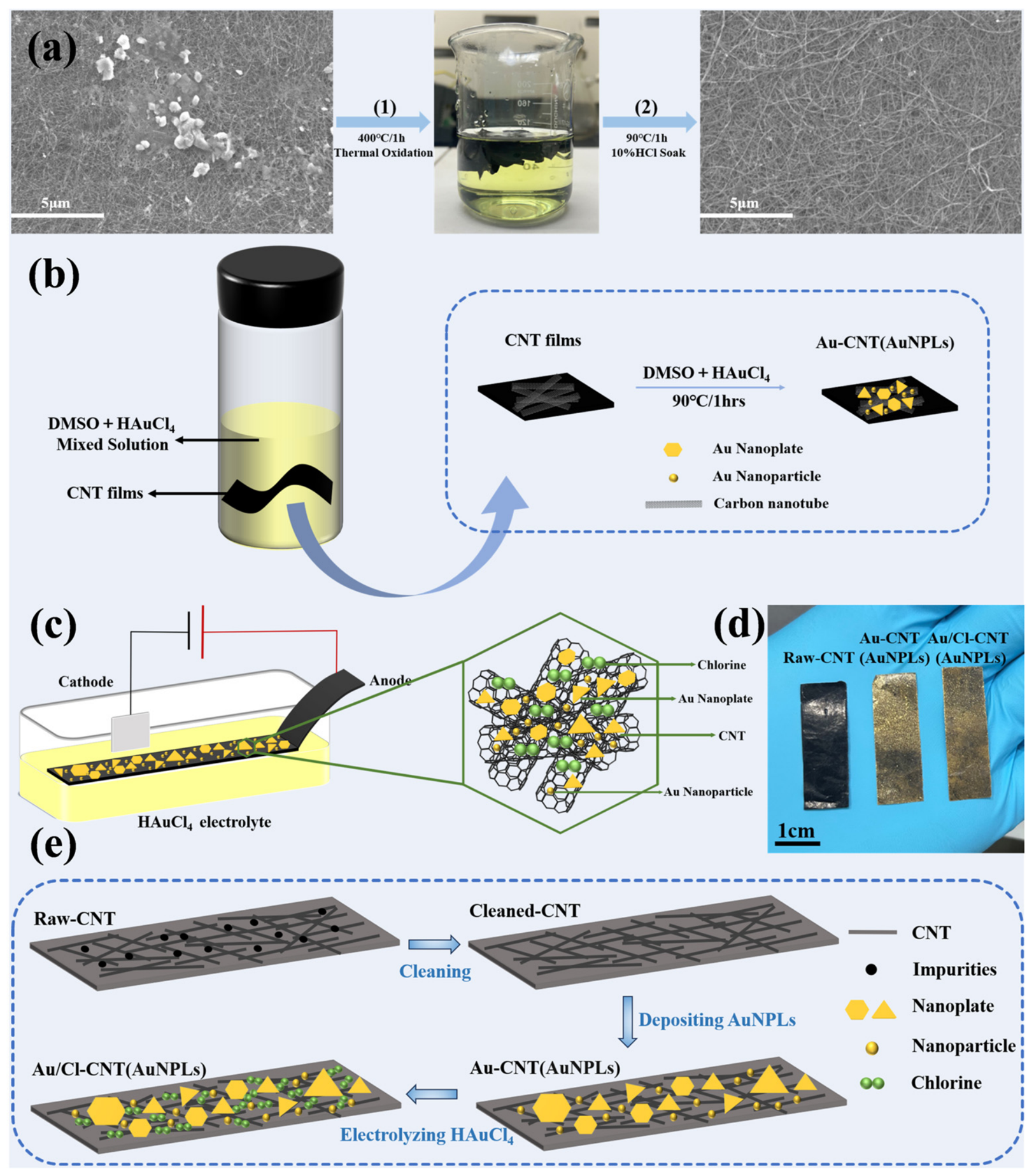
The purification of raw carbon nanotube films (Raw-CNT) is critical for electromagnetic shielding applications. Catalyst particles and amorphous carbon impurities remaining in untreated films can cause structural defects, increase contact resistance, and reduce electrical conductivity and EMI SE. Purification processes can effectively remove these impurities and optimize the conductive network, thereby ensuring excellent electrical conductivity and electromagnetic shielding performance. Figure S1 illustrates the digital photographs of Raw-CNT. The purification process for the Raw-CNT film primarily comprises two steps: high-temperature thermal oxidation and acid treatment. Initially, thermal oxidation was performed on the Raw-CNTs in a muffle furnace at 400 °C for 90 min to remove non-crystalline carbon. Subsequently, the oxidized CNTs were soaked in 10% hydrochloric acid (HCl) solution at 80 °C for 40 min to dissolve iron-based catalyst contaminants. After 40 min, the solution turned yellow, indicating that the iron-containing catalyst had been extracted from the sample (Figure 1a). Finally, after neutralizing residual HCl on the films using sodium hydroxide solution, the films were repeatedly rinsed with DIW (deionized water) and dried in a vacuum oven, ultimately yielding a cleaned carbon nanotube film (Cleaned-CNT).

2.3. Synthesis of Au Plates and Au Particles

The schematic of the synthesis of Au plates and Au particles is shown in Figure 1b. The CNT film was cut to a suitable size and transferred to a glass vial containing 16 mL of DIW. Then 2 mL of HAuCl4 (20 mM) and 2 mL of DMSO were added sequentially, and the mixture was shaken to mix well for a 1 h reaction at 90 °C. At the completion of the reaction, the CNT film was taken out of the solution and washed thoroughly with DIW. After that, the Au CNT film (Au-CNT) was placed in a vacuum oven at 120 °C until completely dry.

2.4. Halogen Doping Process

The halogen doping schematic is shown in Figure 1c. A 10 mM HAuCl4 solution was used as the electrolyte, with the anode consisting of an Au-CNT film, and the cathode comprising a Pt electrode. The voltage and current were set to 15 V and 0.02 A, respectively, and the electrolysis duration was 180 s. After electrolysis was completed, the Au/Cl-CNT film (Au/Cl-CNT) was rinsed repeatedly with DIW, followed by full drying at normal temperature.

2.5. Characterization

A scanning electron microscope (SEM) (SNE-4500 M, SEC Co., Ltd., Suwon, Gyeonggi-do, Republic of Korea, Seko Testing Equipment Co., Ltd., Seoul, Republic of Korea) was used to view the morphology and microstructure of carbon nanotube films at an accelerated voltage of 5 kV. The film’s conductivity was measured using a four-probe tester (FT-341, Ningbo Ruike Micro-Intelligence Technology Co., Ltd., Ningbo, China). The carbon nanotube film was characterized using a Raman spectrometer (RTS2-785-N, Beijing Zolix Instruments Co., Ltd., Beijing, China) (laser wavelength: 785 nm; exposure time: 10 s). The Thermo Scientific K-Alpha X-ray photoelectron spectrometer (Thermo Fisher Scientific, Waltham, MA, USA) was used for the determination of the elements of the samples. Structural analysis of carbon nanotube films was conducted using an X-ray diffractometer (Smartlab, Rigaku Corporation, Tokyo, Japan). Contact angle measurements were performed using a contact angle goniometer (SDC 350KS, Dongguan SINDIN Precision Instrument Co., Ltd., Dongguan, China). In order to measure the shielding effect of the composite film, using a vector network analyzer (N5247A Agilent, Keysight Technologies, Inc., Santa Rosa, CA, USA), the EMI SEs of the composite films were measured in the X and Ku band frequency ranges via the waveguide method. The EMI SE was calculated based on the scattering parameters (S11 = S22, S12 = S21), which include the total amount of SE (SET), the amount of SE reflections (SER), and the amount of SE absorption (SEA) with the following equations [34].
R = S 11 2 = S 22 2
T = S 12 2 = S 21 2
1 = R + A + T
SE R   = 10 log ( 1 R )
SE A   = 10 log ( T 1 R )
SE T =   SE R + SE A + SE M
where SEM stands for multiple internal reflections. When the SET is greater than 15 dB, the value of SEM can be ignored. R is the reflection coefficient; T is the transmission coefficient; A is the absorption coefficient.

3. Results and Discussion

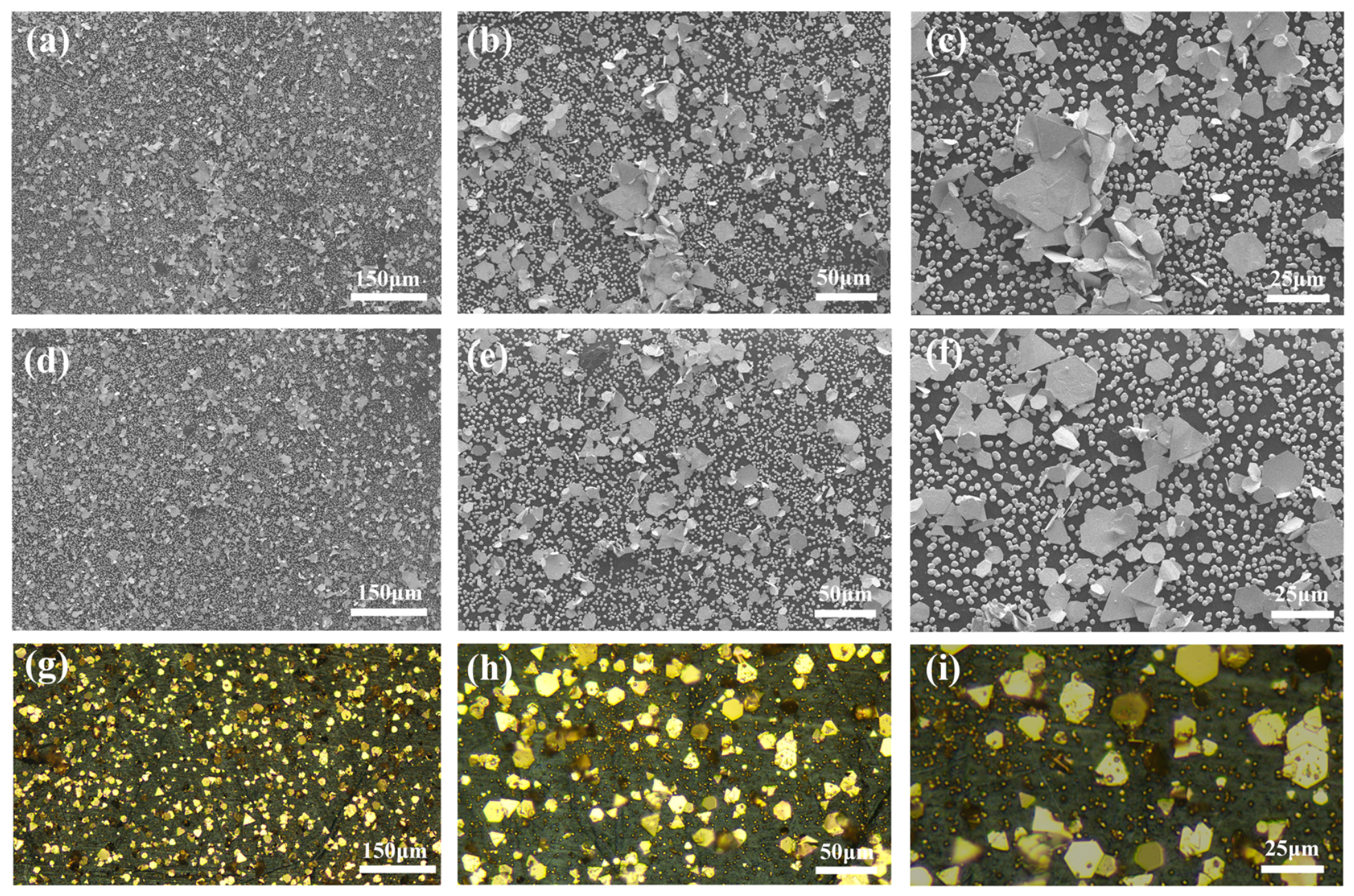
Figure 1e describes the Au/Cl-CNT preparation process. Most impurities can be removed through purification (Figure S2), and the purification process can introduce oxygen-containing functional groups into the CNTs, which provide sites for Au deposition [35]. The Au plates and Au particles can be synthesized by the hydrothermal method to be uniformly deposited on CNT films, and then halogen doping can be carried out. The microstructures of Au-CNT and Au/Cl-CNT films were characterized by SEM, as shown in Figure 2. Figure 2a–c show the Au-CNT at different magnifications, from which it can be seen that the synthesized Au plates and Au particles are uniformly distributed in the network structure of the CNT films. After halogen doping, there were no significant differences in the morphology or particle size of the samples (Figure 2d–f). The high-resolution SEM morphological features of Au/Cl-CNT are shown in Figure S3. In addition, it is also clearer from the optical microscopy (OM) Figure 2g–i that their Au structures do not change significantly after the introduction of halogens. The deposition of Au (plates and particles) onto CNT film surfaces helped enhance the interactions between the tube bundles, which were further enhanced by the introduction of Cl [36]. The EDS element distribution map (Figure S4) shows the uniform distribution of the three components (C, Au, and Cl). Significantly, the profile of Au elemental is highly consistent with the morphology of the plate-like structure in Au/Cl-CNT, which further proves that the plate-like structure is a Au plate composed of Au elements. Au and Cl increase the total carrier concentration (holes) by inducing the transfer of electrons, which strengthens the interactions between the tube bundles and can effectively enhance the conductive properties of the CNT films. Moreover, excellent conductivity is an important indicator of EMI SE [37].
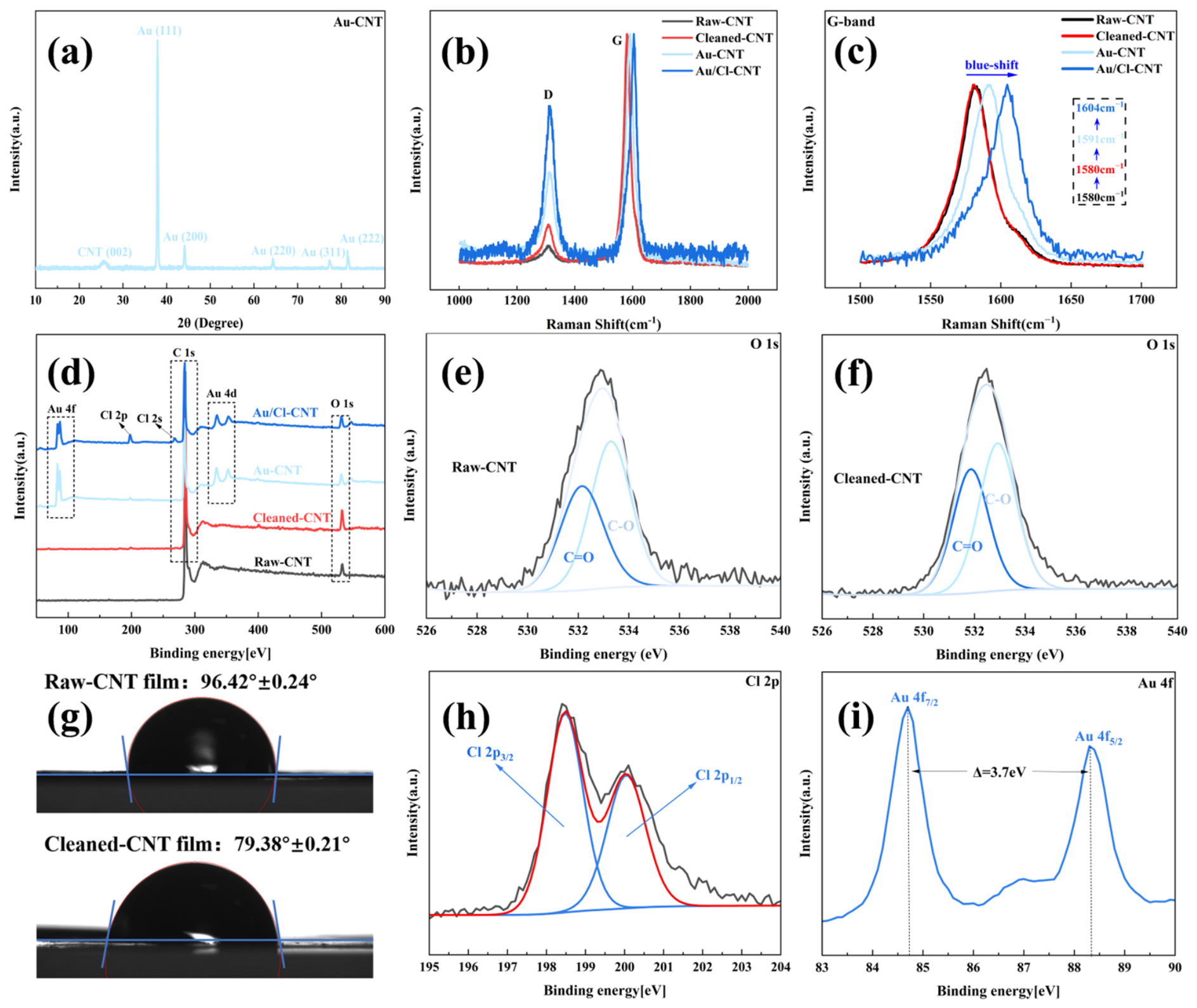
XRD (X-ray diffraction) was employed to characterize the Au plates and Au particles synthesized in one-pot on CNT films. The XRD spectral analysis showed the successful growth of Au plates and Au particles on the CNT network (Figure 3a): the diffraction peaks at 37.9°, 44.1°, 64.4°, 77.3°, and 81.4° are attributed to the crystal diffraction surfaces of (111), (200), (220), (311), and (222) Au crystal diffraction surfaces. These Au diffraction peaks correspond to a face-centered cubic crystal structure, indicating that no intermetallic compounds have formed [38]. The characteristic peak at 2θ = 25.7° is attributed to the graphite (002) crystal plane of the CNT [39]. In addition, Raman spectroscopy is an effective means of characterizing CNT materials, and the four types of CNT samples (Raw-CNT, Cleaned-CNT, Au-CNT, and Au/Cl-CNT) were subjected to Raman characterization. In Figure 3b, the Raman spectrogram of the CNT film shows at 1310 cm−1 (D-band) and at 1580 cm−1 (G-band). For CNTs, D-band signifies the existence of structural defects or disorders, while G-band is indicative of the material’s graphite-like sp2 hybrid structure. As a result, the commonly used ID/IG intensity ratio (D-band vs. G-band) is employed to evaluate the graphitization degree and defect density of CNTs [40]. While Raw-CNT’s ID/IG ratio of roughly 0.09 points to good quality, it still harbors a certain quantity of impurities, namely iron-based contaminants and amorphous carbon. Following the purification treatment, Cleaned-CNT’s ID/IG ratio attains 0.18, a change that stems from the formation of irreversible defects in the nanotubes during thermal oxidation [41]. When Au particles and Au plates are introduced, the ID/IG ratio exhibits a significant increase from 0.18 to 0.41, mainly because Au, as a foreign substance deposited on the CNT film, may destroy the original structure and increase the degree of defects. The introduction of Cl increases the ID/IG value to 0.69, which is mainly due to the interaction of Cl with CNT during the doping process, leading to halogenation and thus the formation of defects in CNT, and the existence of a large ID/IG value in Au/Cl-CNT may also indicate that the introduction of Cl is successful [42]. Meanwhile, in the analysis of the G Raman peak within CNT spectra, shifts in the G-band position consistently furnish vital insights regarding the doping process. A large body of existing research has confirmed that the G-band blueshift is a powerful proof for the generation of electron transfer [43,44]. In Figure 3c, the G-band of the Raw and Cleaned-CNT is observed at ~1580 cm−1. Following Au incorporation, this band shifts toward a higher wavenumber to 1591 cm−1; subsequent Cl doping (based on the Au-modified CNTs) further induces an upward shift, with the peak settling at 1604 cm−1. This phenomenon can be accurately attributed to the strong electronegativity of Au and Cl, and this enables electron shift from CNTs to these two dopants during their interaction and typifies the p-doping mechanism [29]. Figure 3d presents the XPS survey spectra of CNT films at different treatment stages, with the corresponding elemental atomic percentages (C, O, Au, Cl) detailed in Table S1. The C:O of Raw-CNT decreased from 30.35 to 14.65 after cleaning (Figure S5), which was attributed to thermal oxidation during the cleaning process, in agreement with the above Raman representation. While the O 1s high-resolution XPS spectra showed (Figure 3e,f) that the C=O/C-O of Cleaned-CNT films was higher compared to that of Raw-CNT films, indicating the presence of oxidation of carbon groups across the CNT film surface. In addition, the contact angle test acquired for Raw and Cleaned-CNT films (Figure 3g) showed that the contact angle of the Raw-CNT film (96.42 ± 0.24°) was higher than that of the Cleaned-CNT film (79.3 ± 0.21°), suggesting that there are more polar surface groups in the Cleaned-CNT film, which further confirms that the CNT film will lead to the oxidation of surface carbon groups after cleaning [21]. In Figure 3d, Au and Cl elements are absent in the Raw and Cleaned CNTs. With their successive introduction, four characteristic peaks (Au 4f, Au 4d, Cl 2p, and Cl 2s) emerged in the Au/Cl-CNTs, located at 85.08 eV, 345.08 eV, 198.08 eV, and 269.08 eV, respectively. Figure 3h,i (Cl 2p, Au 4f) show high-resolution XPS spectra of Au/Cl-CNTs. Cl 2p corresponds to Cl 2p3/2 and Cl 2p1/2, while Au 4f is associated with the Au 4f7/2 and Au 4f5/2 orbitals. Among these, the Cl 2p3/2 absorption peak is located at approximately 198–199 eV, and this binding energy is significantly lower than that of a typical C–Cl covalent bond. This indicates that Cl primarily exists on the CNT surface in the form of physically adsorbed Cl or Cl2, and that electron transfer from the CNT to Cl results in a p-type doping effect. The Au 4f spectrum indicates that Au exists in the form of zero-valent metal plates and particles, but its surface may exhibit weak electronic coupling with Cl. These results collectively verify the successful introduction of both Au and Cl into the CNT films.
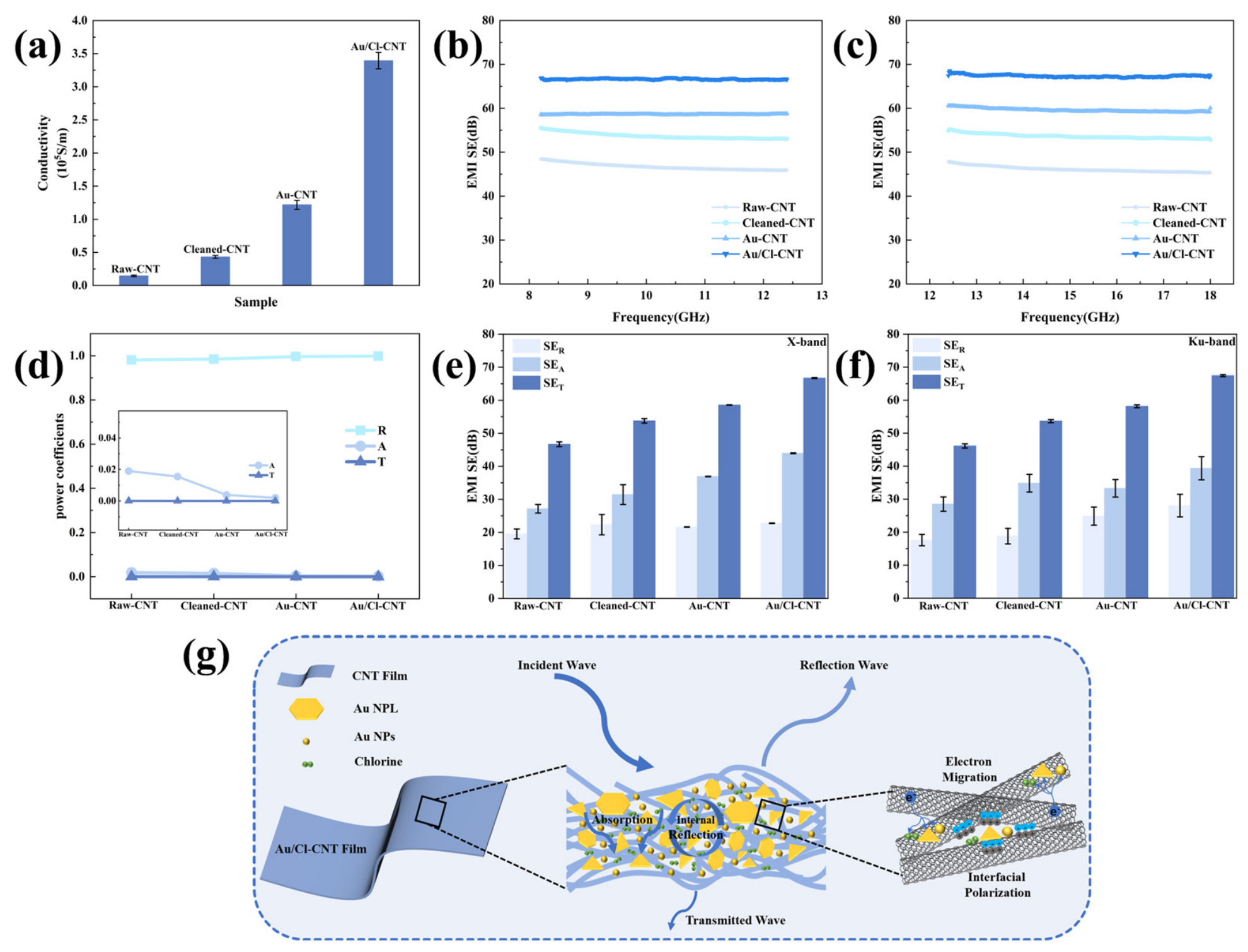
The strength of conductivity can reflect the EMI shielding capability to a certain degree, and high conductivity will give the material a high EMI SE [45]. Cross-sectional SEM analysis (Figure S6) revealed that the average thicknesses of the Raw-CNT film and the Au/Cl-CNT film were approximately 11 μm and 10.5 μm, respectively. Subsequent electrical conductivity measurements are shown in Figure 4a. The conductivity of Raw-CNT film is 1.46 × 10⁴ S/m, and after cleaning, the conductivity increases to 4.32 × 10⁴ S/m. After the introduction of Au particles and Au plates, the conductivity increases to 1.22 × 10⁵ S/m, while a subsequent Cl treatment further raises it significantly to 3.39 × 10⁵ S/m, which constitutes an approximate 23-fold improvement over Raw-CNT. This significant enhancement is primarily due to the reduction in inter-tube contact resistance within the CNT network. It should be noted that the MWCNTs used in this study have a metallic outer layer due to their relatively large diameter. Therefore, the surface charge transfer cannot significantly alter the carrier concentration within the tube or open up new conduction channels, which is different from the situation of semiconductor SWCNTs. The observed enhancement in conductivity is attributed to the optimization of inter-tube transmission, rather than the doping of the nanotubes. On the one hand, Au plates and Au particles act as highly conductive bridges, effectively connecting adjacent carbon nanotubes and significantly reducing the inter-tube contact resistance [46]. On the other hand, Cl treatment promotes the densification of the film [33], increases the effective contact area between adjacent CNTs, and alters the surface electronic structure and work function through interfacial charge transfer, as evidenced by the Raman G-band blue shift. These two effects reinforce each other. The gold bridge provides a low-resistance path at the junction, while the chlorine-induced densification and interface modification further improve the electrical contact between adjacent carbon nanotubes, thereby synergistically enhancing the overall conductivity. Furthermore, this paper also estimated the microwave conductivity of CNT films by using electromagnetic parameters. The relevant test results are shown in Figure S7. The excellent electrical conductivity of the Au/Cl-CNT films results in excellent EMI SE. Figure 4b,c show the total EMI SE (SET) of different CNT films for the frequency intervals of 8.2–12.4 GHz (X-band) and 12.4–18 GHz (Ku-band). The SET of the Raw-CNT film is about 46 dB, which is enhanced to 53 dB after cleaning treatment. This is mostly because the cleaning process enhances the film’s overall conductivity, while the existence of defects and polar functional groups can also increase SET through polarization loss [47,48]. On the other hand, the shielding effectiveness increases from 53 dB to 58 dB with the introduction of the Au plate and Au particles. This is mainly attributed to the high conductivity and reflective properties of Au, which reflect off a portion of the incident electromagnetic wave when it is first contacted, and the residual electromagnetic wave is further attenuated in the interior of the CNT film [49]. When Cl is introduced into the CNT film, the high conductivity due to the synergistic effect of Au and Cl results in the SET of the Au/Cl-CNT film of up to 67 dB (thickness ~10.5 μm), which is an enhancement of about 45.6%. It should be emphasized that the Au/Cl-CNT film at a thickness of ~10.5 μm not only obtains an excellent EMI SE of 67 dB, but also obtains an excellent specific SE (SE/t) of 63,809.5 dB/cm. The SET from the Raw-CNT film to the Au/Cl-CNT film rises as the conductivity increases, and this is consistent with Simon’s formula [50,51], which states that the overall EMI SE of a shielding material can be improved with increased conductivity or thickness. In addition, the average SER and SEA in the X and Ku bands for each sample are shown in Figure 4e,f. SER and SEA are key indicators measuring a sample’s capacity to dampen incident electromagnetic waves through reflection and absorption, respectively [52], and it can be clearly seen that the increase in SET for the Au/Cl-CNT films is mainly contributed by SEA. In addition, for the purpose of conducting a more in-depth analysis of the shielding mechanism exhibited by Au/Cl-CNT films, calculating the R, A, and T coefficients (Figure 4d), the Au/Cl-CNT film’s R value increases steadily with increasing conductivity; the A value decreases; and the R value is always higher than the A and T values, indicating that the Au/Cl-CNT film adopts a reflection-dominated EMI shielding mechanism [26]. This means that the highly conductive Au/Cl-CNT film reflects most incoming electromagnetic waves, while only a small portion of it can penetrate into the material to be attenuated.
In addition, to provide a more intuitive understanding of the electromagnetic shielding mechanism of the Au/Cl-CNT film, Figure 4g presents a schematic diagram illustrating the potential propagation process of electromagnetic waves within the Au/Cl-CNT film. When electromagnetic waves impinge on the Au/Cl-CNT film’s surface, the impedance mismatch between the free space (air) and the highly conductive Au/Cl-CNT film results in the reflection of most incoming waves back to free space [53]. The remaining impinging electromagnetic waves keep penetrating the Au/Cl-CNT film, and the unique carbon nanotube network structure inside the material increases the paths and probability of interaction between the electromagnetic waves and the material, causing the electromagnetic waves to be continuously reflected and absorbed [54]. The doping of Cl can effectively increase the carrier concentration, which results in the conduction loss of the electromagnetic wave being converted into thermal energy [55]. In addition, the free charge accumulated at the heterogeneous interface between the CNT, Au, and Cl induces the interfacial polarization, whereas the residual defects and oxygen-containing groups in the material can also act as the electric dipoles and lead to dipole polarization [56,57]. Specifically, structural defects such as vacancies and lattice distortions disrupt the symmetry of the charge distribution in CNTs, thereby generating local dipoles that respond to alternating electromagnetic fields through dipole relaxation [56]. At the same time, the oxygen-containing groups retained on the surface of CNTs exhibit a significant difference in electronegativity between oxygen and carbon atoms, making them additional polarization centers [57]. In short, the overall EMI SE can be synergistically improved by reflections (multiple reflections and reflections) inside and outside of the material, as well as by absorption (conduction losses and polarization losses) inside the material.
To contextualize our research within the broader landscape of recent advancements in EMI shielding materials, Table 1 summarizes relevant published research works in recent years. The compilation focuses on key characteristics of these materials, including their structural forms, thickness specifications, and EMI SE values. Compared with Table 1, which records the results of a survey, the Au/Cl-CNT composite films (~10.5 μm) we prepared showed excellent EMI SE at frequencies of 8.2–12.4 GHz (X–band), and 12.4–18 GHz (Ku–band) ranges, up to 67 dB.

4. Conclusions

In summary, we adopted a new method based on co-modification of carbon nanotube film with metals and non-metals, and by introducing Au and Cl into the CNT films, the interactions between CNT bundles and bundles were improved by the interplay of Au and Cl, resulting in the Au/Cl-CNT film exhibiting high electrical conductivity (3.39 × 10⁵ s/m) and excellent EMI SE (both X and Ku-band reach as high as 67 dB).

Supplementary Materials

The following supporting information can be downloaded at: https://www.mdpi.com/article/10.3390/cryst16060368/s1, Figure S1: Photographs of carbon nanotube films; Figure S2: TEM image of CNT. (a) Raw-CNT, (b) Cleaned-CNT; Figure S3: SEM image of Au/Cl-CNT; Figure S4: EDS images of Au/Cl-CNT and the corresponding elemental maps of C, Au and Cl; Table S1: The relative atomic percentages of each element in the CNT film; Figure S5: C:O of Raw and Cleaned carbon nanotube films; Figure S6: Cross-section SEM of Raw and Au/Cl carbon nanotube film; Figure S7: The microwave conductivity of different CNT films in the X-band and Ku-band.

Author Contributions

Conceptualization, Y.C. and W.X.; Methodology, X.M., C.Y. and W.X.; Validation, Y.C. and W.X.; Formal analysis, X.M.; Investigation, X.M. and C.Y.; Data curation, X.M. and C.Y.; Writing—original draft, X.M. and C.Y.; Writing—review and editing, Y.C. and W.X.; Supervision, X.S. All authors have read and agreed to the published version of the manuscript.

Funding

This research received no external funding.

Data Availability Statement

The original contributions presented in this study are included in the article. Further inquiries can be directed to the corresponding authors.

Acknowledgments

We acknowledge the start-up funding support from Nanjing Tech University. The authors thank Shiyanjia Lab (www.shiyanjia.com (accessed on 21 January 2026)) for the support of the Contact Angle Test and XPS tests.

Conflicts of Interest

The authors declare no conflicts of interest.

References

  1. Lu, D.; Mo, Z.; Liang, B.; Yang, L.; He, Z.; Zhu, H.; Tang, Z.; Gui, X. Flexible, lightweight carbon nanotube sponges and composites for high-performance electromagnetic interference shielding. Carbon 2018, 133, 457–463. [Google Scholar] [CrossRef]
  2. Chen, Z.; Xu, C.; Ma, C.; Ren, W.; Cheng, H.-M. Lightweight and Flexible Graphene Foam Composites for High-Performance Electromagnetic Interference Shielding. Adv. Mater. 2013, 25, 1296–1300. [Google Scholar] [CrossRef]
  3. Mariappana, P.M.; Raghavana, D.R.; Aleemb, S.H.E.A.; Zobaac, A.F. Effects of electromagnetic interference on the functional usage of medical equipment by 2G/3G/4G cellular phones: A review. J. Adv. Res. 2016, 7, 727–738. [Google Scholar] [CrossRef]
  4. Wei, Q.; Pei, S.; Qian, X.; Liu, H.; Liu, Z.; Zhang, W.; Zhou, T.; Zhang, Z.; Zhang, X.; Cheng, H.-M.; et al. Superhigh Electromagnetic Interference Shielding of Ultrathin Aligned Pristine Graphene Nanosheets Film. Adv. Mater. 2020, 32, 1907411. [Google Scholar] [CrossRef] [PubMed]
  5. Weng, G.-M.; Li, J.; Alhabeb, M.; Karpovich, C.; Wang, H.; Lipton, J.; Maleski, K.; Kong, J.; Shaulsky, E.; Elimelech, M.; et al. Layer-by-Layer Assembly of Cross-Functional Semi-transparent MXene-Carbon Nanotubes Composite Films for Next-Generation Electromagnetic Interference Shielding. Adv. Funct. Mater. 2018, 28, 1803360. [Google Scholar] [CrossRef]
  6. Yang, R.; Gui, X.; Yao, L.; Hu, Q.; Yang, L.; Zhang, H.; Yao, Y.; Mei, H.; Tang, Z. Ultrathin, Lightweight, and Flexible CNT Buckypaper Enhanced Using MXenes for Electromagnetic Interference Shielding. Nano-Micro Lett. 2021, 13, 66. [Google Scholar] [CrossRef]
  7. Wang, Z.; Cai, G.; Xia, Y.; Li, P.; Shi, S.; Wang, B.; Gao, W.; Liu, Y.; Xu, Z.; Gao, C. Highly conductive graphene fiber textile for electromagnetic interference shielding. Carbon 2024, 222, 118996. [Google Scholar] [CrossRef]
  8. Jia, L.-C.; Xu, L.; Ren, F.; Ren, P.-G.; Yan, D.-X.; Li, Z.-M. Stretchable and durable conductive fabric for ultrahigh performance electromagnetic interference shielding. Carbon 2019, 144, 101–108. [Google Scholar] [CrossRef]
  9. Hassan, T.; Iqbal, A.; Yoo, B.; Jo, J.Y.; Cakmakci, N.; Naqvi, S.M.; Kim, H.; Jung, S.; Hussain, N.; Zafar, U.; et al. Multifunctional MXene/Carbon Nanotube Janus Film for Electromagnetic Shielding and Infrared Shielding/Detection in Harsh Environments. Nano-Micro Lett. 2024, 16, 216. [Google Scholar] [CrossRef]
  10. Wang, H.; Sun, X.; Wang, Y.; Li, K.; Wang, J.; Dai, X.; Chen, B.; Chong, D.; Zhang, L.; Yan, J. Acid enhanced zipping effect to densify MWCNT packing for multifunctional MWCNT films with ultra-high electrical conductivity. Nat. Commun. 2023, 14, 380. [Google Scholar] [CrossRef]
  11. Wang, Y.-Y.; Zhang, F.; Li, N.; Shi, J.-F.; Jia, L.-C.; Yan, D.-X.; Li, Z.-M. Carbon-based aerogels and foams for electromagnetic interference shielding: A review. Carbon 2023, 205, 10–26. [Google Scholar] [CrossRef]
  12. Zhou, E.; Xi, J.; Guo, Y.; Liu, Y.; Xu, Z.; Peng, L.; Gao, W.; Ying, J.; Chen, Z.; Gao, C. Synergistic effect of graphene and carbon nanotube for high-performance electromagnetic interference shielding films. Carbon 2018, 133, 316–322. [Google Scholar] [CrossRef]
  13. Li, B.; Yang, Y.; Wu, N.; Zhao, S.; Jin, H.; Wang, G.; Li, X.; Liu, W.; Liu, J.; Zeng, Z. Bicontinuous, High-Strength, and Multifunctional Chemical-Cross-Linked MXene/Superaligned Carbon Nanotube Film. ACS Nano 2022, 16, 19293–19304. [Google Scholar] [CrossRef]
  14. Wan, Y.-J.; Wang, X.-Y.; Li, X.-M.; Liao, S.-Y.; Lin, Z.-Q.; Hu, Y.-G.; Zhao, T.; Zeng, X.-L.; Li, C.-H.; Yu, S.-H.; et al. Ultrathin Densified Carbon Nanotube Film with “Metal-like” Conductivity, Superior Mechanical Strength, and Ultrahigh Electromagnetic Interference Shielding Effectiveness. ACS Nano 2020, 14, 14134–14145. [Google Scholar] [CrossRef]
  15. Wu, G.; Chen, Y.; Zhan, H.; Chen, H.T.; Lin, J.H.; Wang, J.N.; Wan, L.Q.; Huang, F.R. Ultrathin and flexible carbon nanotube/polymer composite films with excellent mechanical strength and electromagnetic interference shielding. Carbon 2020, 158, 472–480. [Google Scholar] [CrossRef]
  16. Zhang, X.; Lu, W.; Zhou, G.; Li, Q. Understanding the Mechanical and Conductive Properties of Carbon Nanotube Fibers for Smart Electronics. Adv. Mater. 2020, 32, 1902028. [Google Scholar] [CrossRef]
  17. Wang, M.-S.; Golberg, D.; Bando, Y. Tensile Tests on Individual Single-Walled Carbon Nanotubes: Linking Nanotube Strength with Its Defects. Adv. Mater. 2010, 22, 4071–4075. [Google Scholar] [CrossRef] [PubMed]
  18. Han, B.; Xue, X.; Xu, Y.; Zhao, Z.; Guo, E.; Liu, C.; Luo, L.; Hou, H. Preparation of carbon nanotube film with high alignment and elevated density. Carbon 2017, 122, 496–503. [Google Scholar] [CrossRef]
  19. Wu, K.; Niu, Y.; Zhang, Y.; Yong, Z.; Li, Q. Continuous growth of carbon nanotube films: From controllable synthesis to real applications. Compos. Part A Appl. Sci. Manuf. 2021, 144, 106359. [Google Scholar] [CrossRef]
  20. Gupta, S.; Tai, N.-H. Carbon materials and their composites for electromagnetic interference shielding effectiveness in X-band. Carbon 2019, 152, 159–187. [Google Scholar] [CrossRef]
  21. Yang, F.; Ma, S.; Khor, C.M.; Su, Y.; Barani, Z.; Xu, Z.; Boyko, A.; Iddya, A.; Segev-Mark, N.; Zheng, X.; et al. One-step method for the fabrication of pure and metal-decorated densified CNT films for effective electromagnetic interference shielding. Carbon 2023, 214, 118370. [Google Scholar] [CrossRef]
  22. Wang, Z.; Kong, Q.-Q.; Yi, Z.-L.; Xie, L.-J.; Jia, H.; Chen, J.-P.; Liu, D.; Jiang, D.; Chen, C.-M. Electromagnetic interference shielding material for super-broadband: Multi-walled carbon nanotube/silver nanowire film with an ultrathin sandwich structure. J. Mater. Chem. A 2021, 9, 25999–26009. [Google Scholar] [CrossRef]
  23. Ye, J.; Wang, Y.; Luo, L.; Qian, K.; Zhou, J.; Miao, M.; Feng, X. Carbon nanotube films embedded with Cu@C nanocubes for electromagnetic interference shielding. J. Polym. Sci. 2023, 61, 2688–2696. [Google Scholar] [CrossRef]
  24. Tsapenko, A.P.; Goldt, A.E.; Shulga, E.; Popov, Z.I.; Maslakov, K.I.; Anisimov, A.S.; Sorokin, P.B.; Nasibulin, A.G. Highly conductive and transparent films of HAuCl4-doped single-walled carbon nanotubes for flexible applications. Carbon 2018, 130, 448–457. [Google Scholar] [CrossRef]
  25. Jelmy, E.J.; Ramakrishnan, S.; Kothurkar, N.K. EMI shielding and microwave absorption behavior of Au-MWCNT/polyaniline nanocomposites. Polym. Adv. Technol. 2016, 27, 1121–1260. [Google Scholar] [CrossRef]
  26. Shi, Y.-Y.; Liao, S.-Y.; Wang, Q.-F.; Xu, X.-Y.; Wang, X.-Y.; Gu, X.-Y.; Hu, Y.-G.; Zhu, P.-L.; Sun, R.; Wan, Y.-J. Enhancing the Interaction of Carbon Nanotubes by Metal–Organic Decomposition with Improved Mechanical Strength and Ultra-Broadband EMI Shielding Performance. Nano-Micro Lett. 2024, 16, 134. [Google Scholar] [CrossRef] [PubMed]
  27. Ma, Y.; Lv, C.; Tong, Z.; Zhao, C.F.; Li, Y.S.; Hu, Y.Y.; Yin, Y.H.; Liu, X.B.; Wu, Z.P. Single-layer copper particles integrated with a carbon nanotube film for flexible electromagnetic interference shielding. J. Mater. Chem. C 2020, 8, 9945–9953. [Google Scholar] [CrossRef]
  28. Janas, D.; Boncel, S.; Koziol, K.K.K. Electrothermal halogenation of carbon nanotube films. Carbon 2014, 73, 259–266. [Google Scholar] [CrossRef]
  29. Wang, P.; Liu, D.; Zou, J.; Ye, Y.; Hou, L.; Zhao, J.; Men, C.; Zhang, X.; Li, Q. Gas infiltration of bromine to enhance the electrical conductivity of carbon nanotube fibers. Mater. Des. 2018, 159, 138–144. [Google Scholar] [CrossRef]
  30. Milowska, K.Z.; Krzywiecki, M.; Payne, M.C.; Janas, D. Effective doping of single-walled carbon nanotube films with bromine under ultrasound. Mater. Des. 2022, 213, 110310. [Google Scholar] [CrossRef]
  31. Inoue, H.; Karakassides, A.; Fujimori, T.; Jiang, H.; Iwasaki, R.; Takakura, A.; Yasin, G.; Inoue, Y.; Kauppinen, E.I. Halogen-promoted long single-walled carbon nanotube growth by floating catalyst chemical vapor deposition for high-performance transparent conductive films. Carbon 2026, 253, 121426. [Google Scholar] [CrossRef]
  32. Janas, D.; Milowska, K.Z.; Bristowe, P.D.; Koziol, K.K.K. Improving the electrical properties of carbon nanotubes with interhalogen compounds. Nanoscale 2017, 9, 3212–3221. [Google Scholar] [CrossRef]
  33. Yin, C.; Hu, R.; Mao, X.; Cai, C.; Li, X.; Shen, X.; Xin, W. A fast, efficient and reversible approach to enhance the electrical conductivity of carbon nanotube films. J. Mater. Chem. C 2025, 13, 5565–5574. [Google Scholar] [CrossRef]
  34. Liu, Y.; Wang, Y.; Wu, N.; Han, M.; Liu, W.; Liu, J.; Zeng, Z. Diverse Structural Design Strategies of MXene-Based Macrostructure for High-Performance Electromagnetic Interference Shielding. Nano-Micro Lett. 2023, 15, 240. [Google Scholar] [CrossRef] [PubMed]
  35. Fang, W.; Zhang, Z.; Miao, N.; Yang, R.; Xiao, Z.; Shen, X.; Cao, Y.; Xin, W. Highly Uniform Fabrication of Gold Nanoparticles on Carbon Nanotube Sheets for Sensors Based on Surface-Enhanced Raman Spectroscopy with Improved Reproducibility. ACS Appl. Nano Mater. 2023, 6, 9949–9957. [Google Scholar] [CrossRef]
  36. Janas, D.; Herman, A.P.; Boncel, S.; Koziol, K.K.K. Iodine monochloride as a powerful enhancer of electrical conductivity of carbon nanotube wires. Carbon 2014, 73, 225–233. [Google Scholar] [CrossRef]
  37. Lu, S.; Shao, J.; Ma, K.; Chen, D.; Wang, X.; Zhang, L.; Meng, Q.; Ma, J. Flexible, mechanically resilient carbon nanotube composite films for high-efficiency electromagnetic interference shielding. Carbon 2018, 136, 387–394. [Google Scholar] [CrossRef]
  38. Xin, W.; Yang, J.-M.; Li, C.; Goorsky, M.S.; Carlson, L.; De Rosa, I.M. Novel Strategy for One-Pot Synthesis of Gold Nanoplates on Carbon Nanotube Sheet As an Effective Flexible SERS Substrate. ACS Appl. Mater. Interfaces 2017, 9, 6246–6254. [Google Scholar] [CrossRef] [PubMed]
  39. Zhou, T.; Xu, F.; Sun, L.; Liu, J.; Guo, X.; Wei, S.; Zhang, C.; Liao, L.; Wu, J.; Huang, Z.; et al. Enhanced hydrogen generation performances and mechanism of Al-water reaction catalyzed by flower-like BiOCl@CNTs. Mater. Today Nano 2023, 21, 100300. [Google Scholar] [CrossRef]
  40. Kalbac, M.; Kavan, L. The influence of doping on the Raman intensity of the D band in single walled carbon nanotubes. Carbon 2010, 48, 832–838. [Google Scholar] [CrossRef]
  41. Zhao, Y.; Wei, J.; Vajtai, R.; Ajayan, P.M.; Barrera, E.V. Iodine doped carbon nanotube cables exceeding specific electrical conductivity of metals. Sci. Rep. 2011, 1, 83. [Google Scholar] [CrossRef] [PubMed]
  42. Brownlie, L.; Shapter, J. Advances in carbon nanotube n-type doping: Methods, analysis and applications. Carbon 2018, 126, 257–270. [Google Scholar] [CrossRef]
  43. do Nascimento, G.M.; Hou, T.; Kim, Y.A.; Muramatsu, H.; Hayashi, T.; Endo, M.; Akuzawa, N.; Dresselhaus, M.S. Behavior of the high frequency Raman modes of double-wall carbon nanotubes after doping with bromine or iodine vapors. Carbon 2011, 49, 3585–3596. [Google Scholar] [CrossRef]
  44. Ghosh, S.; Yamijala, S.R.K.C.S.; Pati, S.K.; Rao, C.N.R. The interaction of halogen molecules with SWNTs and graphene. RSC Adv. 2012, 2, 1181–1188. [Google Scholar] [CrossRef]
  45. Liu, H.; Wu, S.; You, C.; Tian, N.; Li, Y.; Chopra, N. Recent progress in morphological engineering of carbon materials for electromagnetic interference shielding. Carbon 2021, 172, 569–596. [Google Scholar] [CrossRef]
  46. Jo, E.; Lee, Y.-B.; Jung, Y.; Kim, S.-B.; Kang, Y.; Seo, M.-H.; Yoon, J.-B.; Kim, A.J. Integration of Gold Nanoparticle–Carbon Nanotube Composite for Enhanced Contact Lifetime of Microelectromechanical Switches with Very Low Contact Resistance. ACS Appl. Mater. Interfaces 2021, 13, 16959–16967. [Google Scholar] [CrossRef]
  47. Wang, X.-X.; Zhang, M.; Shu, J.-C.; Wen, B.; Cao, W.-Q.; Cao, M.-S. Thermally-tailoring dielectric “genes” in graphene-based heterostructure to manipulate electromagnetic response. Carbon 2021, 184, 136–145. [Google Scholar] [CrossRef]
  48. Wen, B.; Cao, M.; Lu, M.; Cao, W.; Shi, H.; Liu, J.; Wang, X.; Jin, H.; Fang, X.; Wang, W.; et al. Reduced Graphene Oxides: Light-Weight and High-Efficiency Electromagnetic Interference Shielding at Elevated Temperatures. Adv. Mater. 2014, 26, 3484–3489. [Google Scholar] [CrossRef] [PubMed]
  49. Li, J.; Liu, H.; Guo, J.; Hu, Z.; Wang, Z.; Wang, B.; Liu, L.; Huang, Y.; Guo, Z. Flexible, conductive, porous, fibrillar polymer–gold nanocomposites with enhanced electromagnetic interference shielding and mechanical properties. J. Mater. Chem. C 2017, 5, 1095–1105. [Google Scholar] [CrossRef]
  50. Wan, Y.-J.; Li, X.-M.; Zhu, P.-L.; Sun, R.; Wong, C.-P.; Liao, W.-H. Lightweight, flexible MXene/polymer film with simultaneously excellent mechanical property and high-performance electromagnetic interference shielding. Compos. Part A Appl. Sci. Manuf. 2020, 130, 105764. [Google Scholar] [CrossRef]
  51. Yun, T.; Kim, H.; Iqbal, A.; Cho, Y.S.; Lee, G.S.; Kim, M.-K.; Kim, S.J.; Kim, D.; Gogotsi, Y.; Kim, S.O.; et al. Electromagnetic Shielding of Monolayer MXene Assemblies. Adv. Mater. 2020, 32, 1906769. [Google Scholar] [CrossRef]
  52. Ma, Z.; Feng, H.; Feng, Y.; Ding, X.; Wang, X.; Wang, W.; Zhang, X.; Kong, S.; Lan, X.; Li, Q. An ultralight and thermally conductive Ti3C2Tx MXene–silver nanowire cellular composite film for high-performance electromagnetic interference shielding. J. Mater. Chem. C 2022, 10, 14169–14179. [Google Scholar] [CrossRef]
  53. Sun, Y.; Han, X.; Guo, P.; Chai, Z.; Yue, J.; Su, Y.; Tan, S.; Sun, X.; Jiang, L.; Heng, L. Slippery Graphene-Bridging Liquid Metal Layered Heterostructure Nanocomposite for Stable High-Performance Electromagnetic Interference Shielding. ACS Nano 2023, 17, 12616–12628. [Google Scholar] [CrossRef] [PubMed]
  54. Wang, M.-L.; Zhou, Z.-H.; Zhu, J.-L.; Lin, H.; Dai, K.; Huang, H.-D.; Li, Z.-M. Tunable high-performance electromagnetic interference shielding of intrinsic N-doped chitin-based carbon aerogel. Carbon 2022, 198, 142–150. [Google Scholar] [CrossRef]
  55. Nguyen, T.T.L.; Cho, S.J.; Ko, J.; Nguyen, D.C.T.; Kim, M.W.; Kim, N.D.; Lee, D.S.; Joo, Y. Exceptional electromagnetic interference shielding using single-walled carbon nanotube/conductive polymer composites films with ultrathin, lightweight properties. Carbon 2024, 230, 119567. [Google Scholar] [CrossRef]
  56. Shi, H.; Zhao, J.; Sun, Z.; Wang, X.; Hu, X.; Li, X.; Xu, C.; Gan, W.; Ding, C. Enhanced Mechanical and Electromagnetic Shielding Properties of Mg Matrix Layered Composites Reinforced with Hybrid Graphene Nanosheet (GNS)-Carbon Nanotube (CNT) Networks. Materials 2025, 18, 3455. [Google Scholar] [CrossRef]
  57. Qin, M.; Zhang, L.; Wu, H. Dielectric Loss Mechanism in Electromagnetic Wave Absorbing Materials. Adv. Sci. 2022, 9, e2105553. [Google Scholar] [CrossRef]
  58. Xie, Z.; Chen, H.; Hu, S.; Zhao, H.; Chen, W.; Jiang, D. Graphene/carbon nanotube/polypyrrole composite films for electromagnetic interference shielding. Polym. Compos. 2023, 44, 3798–3807. [Google Scholar] [CrossRef]
  59. Song, Q.; Ye, F.; Yin, X.; Li, W.; Li, H.; Liu, Y.; Li, K.; Xie, K.; Li, X.; Fu, Q.; et al. Carbon Nanotube–Multilayered Graphene Edge Plane Core–Shell Hybrid Foams for Ultrahigh-Performance Electromagnetic-Interference Shielding. Adv. Mater. 2017, 29, 1701583. [Google Scholar] [CrossRef]
  60. Jia, L.-C.; Li, M.-Z.; Yan, D.-X.; Cui, C.-H.; Wu, H.-Y.; Li, Z.-M. A strong and tough polymer–carbon nanotube film for flexible and efficient electromagnetic interference shielding. J. Mater. Chem. C 2017, 5, 8944–8951. [Google Scholar] [CrossRef]
  61. Chaudhary, A.; Kumari, S.; Kumar, R.; Teotia, S.; Singh, B.P.; Singh, A.P.; Dhawan, S.K.; Dhakate, S.R. Lightweight and Easily Foldable MCMB-MWCNTs Composite Paper with Exceptional Electromagnetic Interference Shielding. ACS Appl. Mater. Interfaces 2016, 8, 10600–10608. [Google Scholar] [CrossRef] [PubMed]
  62. Liu, Y.; Zhang, B.; Wang, Q.; Yu, G.; Liu, W.; Bai, X.; Dong, L. Thin, Flexible, and High-Strength Graphene Films Modified with CoFe2O4 Nanoparticle–Carbon Nanotubes Composites for Electromagnetic Interference Shielding. ACS Appl. Nano Mater. 2023, 6, 17031–17039. [Google Scholar] [CrossRef]
  63. Nguyen, V.-T.; Nguyen, Q.-D.; Min, B.K.; Yi, Y.; Choi, C.-G. Ti3C2Tx MXene/carbon nanotubes/waterborne polyurethane based composite ink for electromagnetic interference shielding and sheet heater applications. Chem. Eng. J. 2022, 430, 133171. [Google Scholar] [CrossRef]
Figure 1. (a) Preparation of Cleaned-CNT films. (b) Schematic of one-pot synthesis of Au plates and Au particles on CNT films. (c) Schematic diagram of the experimental setup for halogen doping. (d) Digital photos of Raw, Au, Au/Cl-CNT films. (e) Schematic diagram of Au/Cl-CNT preparation process.
Crystals 16 00368 g001
Figure 2. (ac) SEM images of Au-CNT at different magnifications, (df) SEM images of Au/Cl-CNT at different magnifications, (gi) OM images of Au/Cl-CNT at different magnifications.
Crystals 16 00368 g002
Figure 3. (a) XRD spectra of Au-CNT films. (b) Raman spectra of Raw, Cleaned, Au and Au/Cl-CNT films. (c) Raman-G band spectra of Raw, Cleaned, Au and Au/Cl-CNT thin films. (d) XPS spectra of Raw, Cleaned, Au and Au/Cl-CNT films. (e) Raw-CNT film O 1s high resolution XPS spectra. (f) Cleaned-CNT film O 1s high-resolution XPS spectrum. (g) Water contact angle measurements of Raw and Cleaned-CNT films. (h) High-resolution spectra of Cl 2p of Au/Cl-CNT films. (i) High-resolution spectrum of Au 4f for Au/Cl-CNT films.
Crystals 16 00368 g003
Figure 4. (a) Electrical conductivity of CNT films under different treatment processes. (b) EMI SE of Raw, Cleaned, Au and Au/Cl-CNT films in X-band. (c) EMI SE of Raw, Cleaned, Au and Au/Cl-CNT films in Ku-band. (d) Comparison of power coefficients of reflectance (R), absorptance (A) and transmittance (T) values of CNT films under different processes. (e) Summarization of SER, SEA and SET for Raw, Cleaned, Au and Au/Cl-CNT films under X-band. (f) Summarization of SER, SEA and SET for Raw, Cleaned, Au and Au/Cl-CNT films under Ku-band. (g) EMI shielding mechanism of Au/Cl-CNT films.
Crystals 16 00368 g004
Table 1. Summary of Relevant Parameters for Typical EMI Shielding Materials.
EMI Shielding MaterialsThickness (µm)EMI SE (dB)Refs.
Cu@C/CNT52.226.65[23]
Graphene/CNT/Polypyrrole24959.6[58]
3D CNT/graphene hybrids160047.5[59]
CNT/NR25044.7[60]
CNT/Polymer130[15]
MCMB/CNT60056[61]
CFO–CNT/RGOp1538.7[62]
CNT/graphene1553.4[12]
CNT sponge/PDMS180054.8[1]
MWCNT/SWCNT13065[37]
Ti3C2Tx/CNT/WPU/Ink20070[63]
CNT/Au/Cl10.567This work
Disclaimer/Publisher’s Note: The statements, opinions and data contained in all publications are solely those of the individual author(s) and contributor(s) and not of MDPI and/or the editor(s). MDPI and/or the editor(s) disclaim responsibility for any injury to people or property resulting from any ideas, methods, instructions or products referred to in the content.